Market Minds Advisory
Tinted Sunscreen Market

Tinted Sunscreen Market: Tinted Sunscreen Market: Iron Oxides, Visible Light Protection and the Shade Range Physics Nobody Discusses

Iron oxides are the reason these products work against melasma, and the industry sells them as cosmetic coverage instead, to buyers who stop applying once the colour looks right. Median shade count is four.

Lead Analyst

Published

September 2026

Make Smarter Decisions with Customized Research Insights

Request a free sample report and evaluate market opportunities, growth trends, and competitive dynamics relevant to your business needs.

2025 MARKET VALUE$3.2BMarket Size 2025
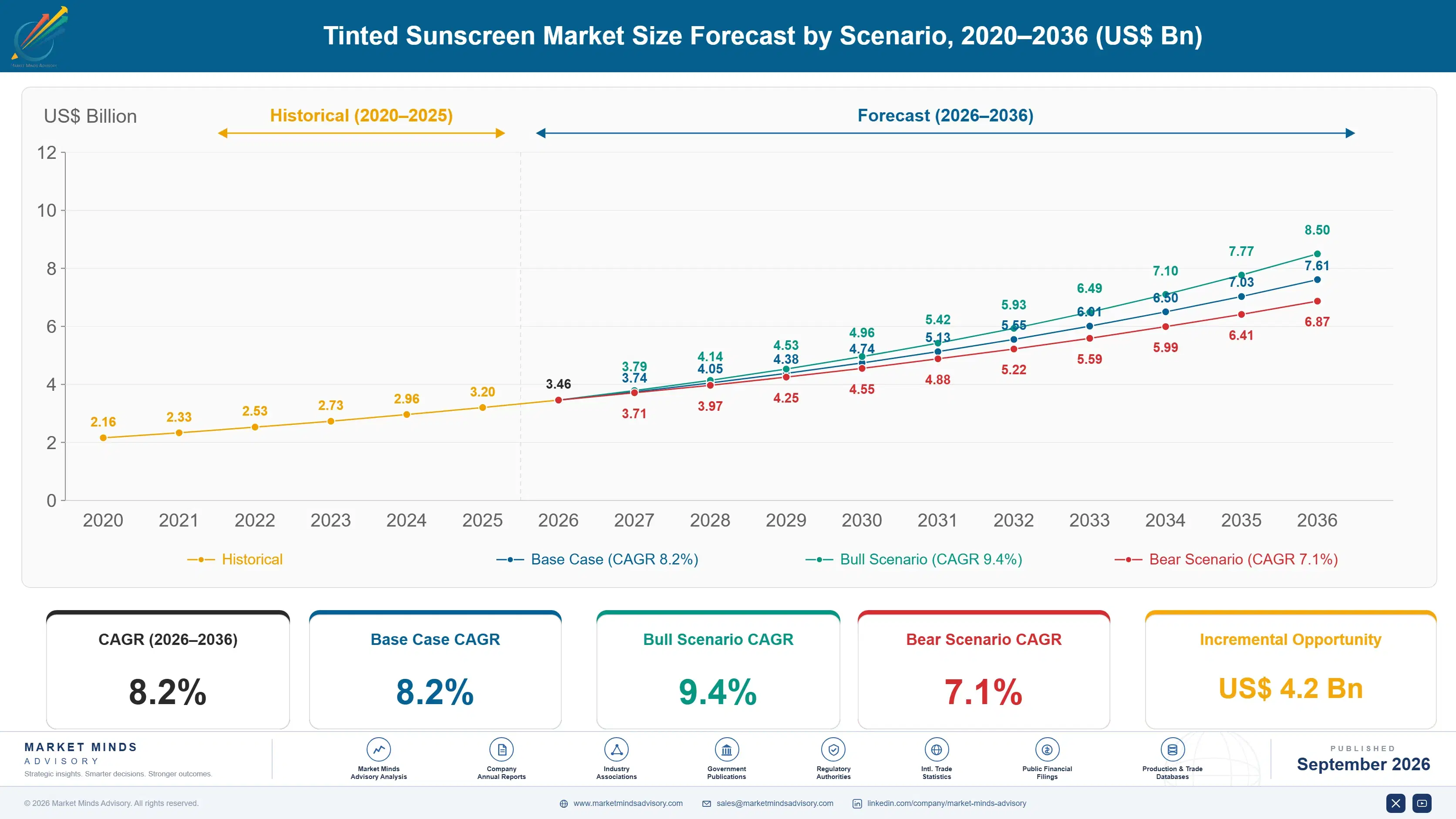
2036 FORECAST VALUE$7.7BBase Case , 2026 to 2036
CAGR 2026 TO 20368.2 %Bull 9.4% / Bear 7.1%
INCREMENTAL OPPORTUNITY$4.2BNet 10- year value creation
EXPANSION MULTIPLE2.20x2036 value over 2026 base
Strategic Levers
M&A Pipeline
Regional Outlook
Country Rankings
Competitive Intelligence
Segmental Deep-dive
Call-Us : 91 93563 13602

Executive Snapshot and Market Trajectory.

The tint is the active part and almost nobody says so. Iron oxides attenuate visible light, which drives melasma and post-inflammatory pigmentation, and an untinted mineral sunscreen does nothing about it. Brands sell the same pigments as coverage. The clinical case is the stronger one and it never gets made.
Tinted fluids and serums grow at 12.3%, half again the market rate of 8.2%, because a sunscreen that behaves like skincare gets applied daily and one that behaves like makeup does not. Tinted sun sticks follow at 9.6%. Tinted body lotions grow slowest at 5.4%, since almost nobody wants pigment on clothing and the visible light argument does not carry below the neckline.
Shade range is a formulation constraint rather than a commercial choice, and treating it as the latter has produced a decade of misdirected criticism. Iron oxide loading heavy enough to matter competes with filter loading in the same emulsion, and matching deep tones needs more pigment. Median shade count across product lines sits at four, which serves the people who benefit least. Encapsulated pigment systems address it and have not reached mass price points.
Market Definition
This market covers sun protection products for skin that carry cosmetic pigment, spanning tinted face creams and lotions, tinted fluids and serums, tinted sun sticks, tinted cushions and compacts, tinted sprays and mists, and tinted body lotions, across mineral, hybrid and organic filter systems. Sizing is at retail value. Untinted sunscreens, colour cosmetics carrying incidental sun protection factor, self-tanning products, after-sun care and oral photoprotection supplements are excluded.
Base Year Value
$3.2B in 2025 (MMA Primary Research Dataset, September 2026)
Forecast Period
2026 to 2036, eleven discrete annual values
CAGR
8.2% base case. Bull 9.4%. Bear 7.1%.
Fastest Growth Segment
Tinted Fluids And Serums: 12.3% CAGR
Fastest Growth Country
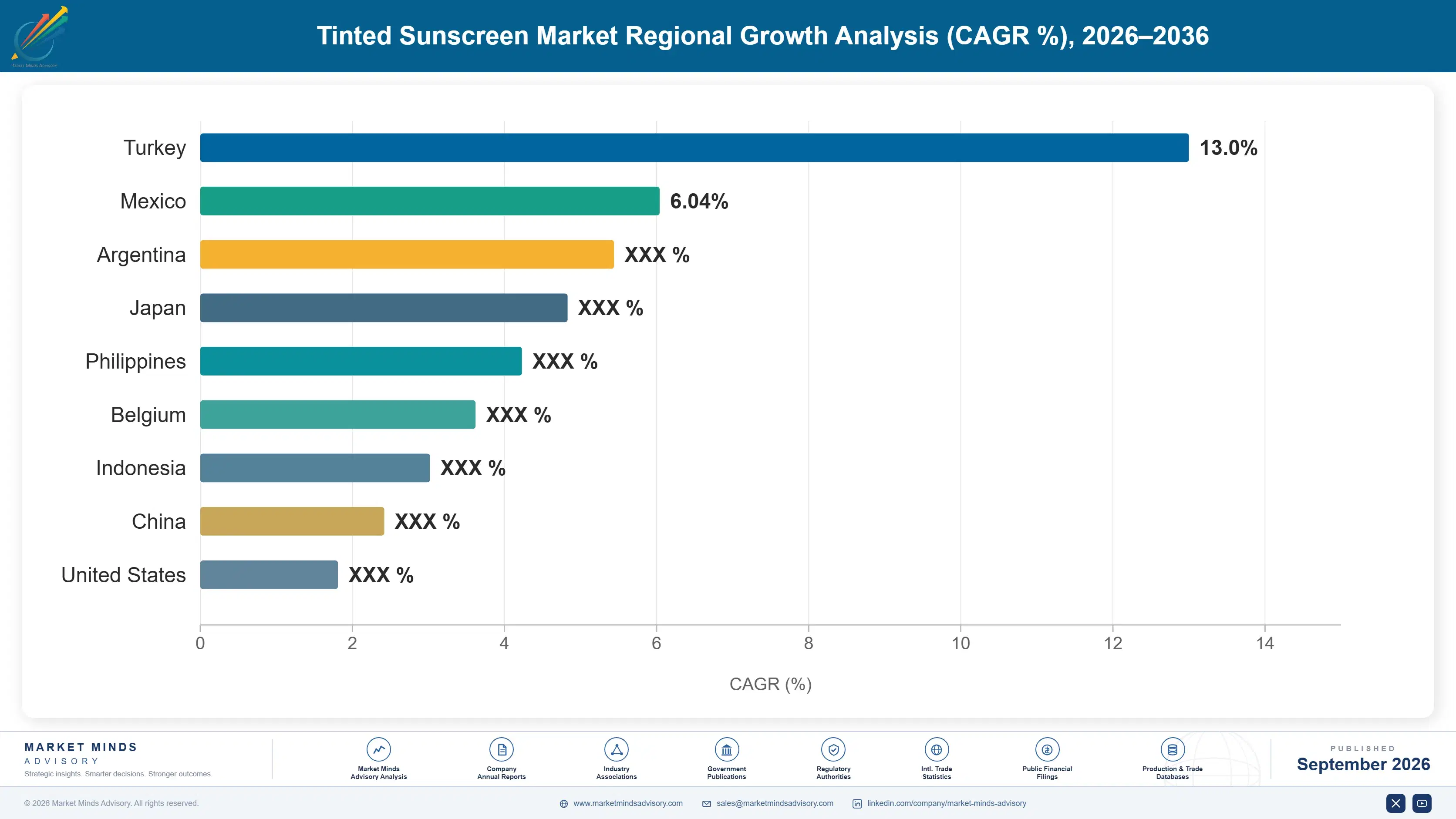
India: 11.4% CAGR
Fastest Growth Region
South Asia and Pacific: 10.2% CAGR
Largest Region
East Asia: 36% of 2025 global value
Market Leaders
L'Oreal, Beiersdorf, Shiseido, Amorepacific, Kenvue. Source: MMA Primary Research Dataset, July 2026.
Primary Survey
n=3,800 procurement and R&D decision-makers, Q4 2025, six countries
Methodology
Demand-side build-up, cross-validated against public data, 47 expert interviews

Tinted Sunscreen Market Forecast Scenarios

tinted-sunscreen-market-size-forecast-scenario-1790022306573
Growth of 6.9% between 2020 and 2025 arrived in an unusual shape for a beauty category. Sun protection held through 2020 and 2021 while colour cosmetics collapsed, because the product was being bought for skin rather than for appearance, and tinted formats captured a share of the buyers who had stopped wearing foundation entirely. That shift did not reverse when offices reopened.
Three mechanisms carry the base case. Dermatologist recommendation of iron oxide containing products for pigmentation concerns continues reaching consumers directly through professional channels, and it favours tinted formulations specifically. Asian tone-up and cushion formats keep exporting westward, with sun sticks now in European and American ranges. Indian demand grows at 11.4% as hyperpigmentation concern converts into daily habit. None of the three depends on a new filter reaching the American permitted list.
The bull case is a visible light claim standard. If any standards body defines a testable visible light protection measure, tinted products gain a claim untinted mineral products cannot match. The bear case is filter approval stagnation in the United States. A permitted list of roughly sixteen filters against nearly thirty in Europe keeps American tinted products heavier than Asian ones.

What The Pigment Is Actually Doing

Two things are true about tinted sunscreen and the industry communicates neither. The first is that iron oxides at around 3.4% loading attenuate high energy visible light, which drives melasma and post-inflammatory hyperpigmentation in a way ultraviolet alone does not explain. Dermatologists recommend these products for that reason. The marketing sells evened skin tone. Same pigments, same work, described in the language least likely to justify the price.
TOP FIVE CONCENTRATION29%Combined retail value share held by the five largest participants
IRON OXIDE LOAD3.4%Pigment concentration required for meaningful visible light attenuation
AVERAGE SELLING PRICEUSD 27Weighted global retail price across all tinted sun formats
APPLIED DOSE RATIO34%Share of the tested application quantity consumers actually apply
MEDIAN SHADE COUNT4 shadesShades offered per tinted sun product line worldwide
US PERMITTED FILTERS16Ultraviolet filters approved for use in that market
The second is that the tint changes how much product gets applied, and not favourably. Sun protection factor is tested at two milligrams per square centimetre and consumers apply roughly a third of that. With a tinted product the shortfall worsens, because colour gives the user a stopping signal that a clear product never provides. People stop when the face looks right rather than when the dose is right.
Shade range failures get read as a diversity problem and they are mostly a physics problem. Iron oxide loading heavy enough to protect competes for space in the emulsion with the filter load, and matching deeper tones requires more pigment, not less. Median shade count sits at four across product lines. Extending downward needs more pigment in an emulsion already competing for space.
"This category has spent fifteen years apologising for shade range without ever explaining that the pigment doing the protecting is the same pigment doing the matching. Whoever explains that properly gets to charge for it."
Director, Personal Care and Photoprotection Practice · MMA Chemicals and Materials Practice · September 2026

Market Trends

Sunscreen Reformats Itself As Daily Skincare Not Sun Product

Tinted fluids and serums grow at 12.3% against a category rate of 8.2%, and texture rather than protection explains it. A product that absorbs like a serum gets applied every morning; one that sits like a sunscreen gets applied before the beach. The reformulation is genuinely difficult in the United States, where a permitted filter list of roughly sixteen materials against nearly thirty in Europe forces heavier mineral loading. Asian formulators working with modern organic filters produce textures American brands cannot match, and that gap is now visible on shelf.
Market Impact: 68% of recommendations are tinted

Korean Stick Formats Export Across Every Major Market

Sun sticks moved from a Korean convenience format to a global one in about four years, and tinted variants now appear in European and American ranges from participants who had never made a stick. Growth runs at 9.6%. The format solves reapplication, which is the single largest gap between tested protection and delivered protection, because a stick can be used over makeup without disturbing it. Applied dose remains a problem, since a stick delivers even less product per pass than a cream, and almost no brand states how many passes constitute a dose.
Market Impact: India grows 3.2 points faster

Market Opportunities and Growth Drivers

Dermatologist Recommendation Favours Iron Oxide Formulations Specifically

Clinical guidance on melasma and post-inflammatory hyperpigmentation increasingly specifies visible light protection alongside ultraviolet, and iron oxides are the only widely available cosmetic ingredient that delivers it. That recommendation now reaches consumers directly through professional social media rather than only in consultation. Tinted products are the only sun protection format that carries the ingredient at meaningful loading. Roughly 68% of dermatologist-recommended sun products for pigmentation concerns are tinted, which is a specification advantage no untinted mineral formulation can answer. Untinted mineral products cannot answer that recommendation at all, which makes it a durable position.
Market Impact: Consumers apply 34% of dose

Indian Pigmentation Concern Converts Into Daily Sun Habit

Hyperpigmentation and melasma are among the most common presenting dermatological concerns across Indian metropolitan populations, and sun protection has historically been treated as an occasional rather than daily product. That is changing, driven by dermatologist visibility and by formulations light enough for humid conditions. India grows at 11.4%, the fastest national market covered here. Tinted formats benefit disproportionately because the visible light argument addresses the specific concern that brought the consumer to the category in the first place. Humid climate texture is the gating requirement, and heavier Western formulations fail it consistently. Local and Korean formulations are taking that ground.
Market Impact: Median 4 shades per line

Market Restraints and Challenges

Tint Provides A Stopping Signal Before Adequate Dose

Sun protection factor is tested at two milligrams per square centimetre and consumers apply roughly 34% of that, which is well documented across untinted products. Tinted formulations worsen the shortfall for a specific reason: colour tells the user when to stop, and the point where the face looks even arrives long before the point where the dose is adequate. The root cause is that the aesthetic cue and the protective cue are the same material. Brands are responding with dose guidance in fingertip units and with pump measures, though almost none state it on pack.
Market Impact: Grows 4.1 points above category

Pigment Load Competes With Filter Load In Formulation

Iron oxide concentration heavy enough for visible light attenuation occupies emulsion space that ultraviolet filters also require, and matching deeper skin tones needs more pigment rather than less. The root cause is a genuine formulation limit rather than commercial indifference, which is why criticism framed around willingness has produced so little change. The commercial impact is a median of four shades per line, serving least well the consumers with most to gain. Encapsulated pigment systems and higher-efficiency filters both address it, and neither is available at mass price points yet.
Market Impact: Reached 9.6% growth in 4 years
3 additional market trends, 4 additional growth drivers, and 2 additional restraints and challenges are covered in the full report. Contact sales@marketmindsadvisory.com to access the complete intelligence.

Segment CAGR and Growth Architecture

Segmentation follows application format, the dimension on which texture, filter loading, reapplication behaviour and retail positioning all divide together in this category. Six formats are assessed at retail value. Untinted sunscreens, colour cosmetics carrying incidental protection factor, self-tanning products and oral photoprotection supplements sit outside the defined scope. Filter system is treated as a formulation attribute rather than a segment.
tinted-sunscreen-market-market-share-analysis-1790022307108

Tinted Fluids And Serums

Tinted fluids and serums grow at 12.3%, half again the market rate of 8.2%, and texture rather than protection explains the whole difference. A product that absorbs like a serum enters a morning routine and gets applied daily; a product that sits like a sunscreen gets remembered before a beach day. The formulation challenge is severe in the United States, where a permitted filter list of roughly sixteen materials against nearly thirty in Europe forces heavier mineral loading and thicker textures. Asian formulators working with modern organic filters produce fluids that American brands genuinely cannot match, and that difference is now visible to any consumer comparing two products on a shelf.
CAGR 12.3%

Tinted Sun Sticks

Tinted sun sticks grow at 9.6% and address reapplication, which is the largest single gap between tested and delivered protection across the whole category. A stick can be used over makeup without disturbing it, and it travels in a pocket rather than a bag, both of which change behaviour rather than merely intention. The format moved from Korean convenience product to global range item in roughly four years. Applied dose is the unresolved problem, since a stick delivers less product per pass than a cream and almost no brand states how many passes constitute an adequate application on pack or in guidance. Reapplication remains the largest unaddressed gap between what a label claims and what a user receives.
CAGR 9.6%
Full segment breakdown across 6 segments available in the complete report.

Regional Architecture and Country Demand Map

Regional shares measure retail value where products are sold. East Asia sits above its standard band and Eastern Europe below, for reasons of category origin and filter permission that the paragraphs below set out individually. Filter permission differences drive more of this table than income does.

East Asia

At 36% this sits above the standard band because the category was effectively invented here and the regulatory position supports it. Korean and Japanese filter lists permit modern organic ultraviolet absorbers that the United States does not, which allows textures Western formulators cannot reproduce at equivalent protection. Tone-up sunscreens, cushions and sun sticks all originated in this region and export outward rather than the reverse. Chinese demand is the largest single pool, driven by brightening and evenness concerns that map directly onto what visible light protection addresses. Korean stick formats reached global ranges within four years of local launch. Chinese domestic brands have closed most of the formulation gap with Korean and Japanese participants.
Share: 36% | CAGR: 9.3% (2026 to 2036)

North America

The 23% position sits inside the standard band, and the constraint here is regulatory rather than commercial. A permitted filter list of roughly sixteen materials against nearly thirty in Europe pushes formulations toward heavier zinc oxide and titanium dioxide loading, which produces thicker textures and worse white cast on deeper skin. Dermatologist recommendation is stronger here than in any other region and drives the tinted mineral segment specifically. Median shade counts are higher than the global figure, largely because retailer and consumer pressure has been sustained for over a decade. Growth of 7.4% reflects a mature and well-served market. The clinical argument for iron oxides is better understood here than anywhere else.
Share: 23% | CAGR: 7.4% (2026 to 2036)
Regional intelligence for 5 additional markets available in the complete report: Western Europe, South Asia and Pacific, Latin America, Middle East and Africa, Eastern Europe. Contact sales@marketmindsadvisory.com.
tinted-sunscreen-market-country-cagr-analysis-1790022307637

Four Ways To Earn Trust

These four address the same disconnect: this category delivers a genuine clinical benefit and markets a cosmetic one, then loses protection to under-application it never mentions. Each has been executed by at least one participant with measurable results, and all four rest on communication, disclosure and tooling rather than on any change to filter chemistry or existing supply.

State The Visible Light Case On Pack

Iron oxides at around 3.4% loading attenuate high energy visible light, which drives melasma and post-inflammatory pigmentation, and untinted mineral formulations do not. Brands currently sell the same pigment as coverage. Stating the protective mechanism converts a cosmetic feature into a clinical one, and roughly 68% of dermatologist recommendations for pigmentation concerns already specify tinted products. Participants making the argument explicitly report price realisation around 1.6 times comparable tinted products sold on coverage alone. The claim rests on published literature rather than on proprietary testing. No competitor holds the position exclusively yet.
Market Impact: Lifts price realisation to roughly 1.6 times higher

Print Dose Guidance In Fingertip Units

Consumers apply roughly 34% of the quantity sun protection factor is tested at, and tinted products worsen it because colour signals when to stop before the dose is adequate. Fingertip unit guidance or a marked pump costs nothing and closes a meaningful part of that gap. Participants providing it report measured applied dose rising by about 40% among users who follow it. The competitive risk of admitting under-application is real and considerably smaller than the reputational cost of a product that does not deliver what its label claims. It is also a larger protection gain than any filter upgrade delivers.
Market Impact: Raises measured applied dose by roughly 40% overall

Explain Why The Shade Range Is Limited

Median shade count sits at four per line because iron oxide loading competes with filter loading in the same emulsion, and deeper tones need more pigment rather than less. Consumers read the limitation as indifference, which has produced fifteen years of criticism no brand has answered honestly. Explaining the constraint, then investing visibly in encapsulated pigment systems, converts a reputational liability into a technical credential. Participants doing this report brand consideration among deeper skin tone consumers rising by around 24 points against silent competitors. Fifteen years of criticism has moved almost nothing because it addressed the wrong cause entirely.
Market Impact: Lifts brand consideration by roughly 24 full points

Build Stick Formats For Reapplication Not Convenience

Sun sticks grow at 9.6% because they solve reapplication over makeup, which is the largest gap between tested and delivered protection anywhere in the category. Almost no brand states how many passes constitute an adequate application, so the format solves one problem and creates another. Specifying pass count and building a wider stick geometry that delivers more product per pass costs tooling rather than research. Participants who have done it report repeat purchase around 1.8 times their range average, because the product visibly works. Buyers can tell when a product is doing what it claims.
Market Impact: Raises repeat purchase to roughly 1.8 times higher

Who Controls the Margin Pool

Concentration is low at 29% held by the top five, measured consistently on retail sales value of tinted sun protection products rather than on units. The leader to challenger gap is wide in filter access and formulation science, where regulatory registrations and emulsion capability accumulate over years, and narrow in pigment work itself, where contract formulators can match iron oxide systems competently.
Competition runs on three dimensions currently. Filter permission by market decides which textures a participant can achieve at all, and it separates Asian formulators from American ones more than skill does. Dermatological endorsement decides the pigmentation-concern segment, which is where the clinical argument lives. Shade range decides credibility with the consumers who benefit most from visible light protection, and almost every participant performs badly on it.

Pressure is building where the clinical argument meets the shade constraint, and that is where rankings will move. Participants who explain the visible light mechanism honestly and invest visibly in pigment systems are separating from those still selling tint as coverage. Asian formulators exporting stick and fluid formats are the second pressure point, since Western participants cannot match their textures under current filter permissions.
tinted-sunscreen-market-company-positioning-matrix-1790022308177

Competitive Moat and Risk Dimensions

L'OREAL

Moat: Dermatological Channel And Science

La Roche-Posay and Vichy carry pharmacy and dermatologist endorsement that took decades to build and that no mass brand can purchase, and the group's photoprotection research organisation is among the largest in the industry. That combination places tinted mineral formulations into clinical recommendation for pigmentation concerns, which is the highest-value position in this category.
L'OREAL

Risk: United States Filter Constraint

Substantial American revenue is formulated against a permitted list of roughly sixteen filters while the group's European ranges use nearly thirty, which forces heavier mineral loading and worse textures in a major market. Asian participants entering the United States face the same limit but arrive without a legacy range to defend or reformulate.
BEIERSDORF

Moat: Sun Care Formulation Scale

Nivea Sun and Eucerin give the company genuine photoprotection depth across mass and dermocosmetic tiers simultaneously, supported by manufacturing scale in sun care that few competitors approach. That breadth lets tinted formulations reach price points where the clinical argument has rarely been made, which is a position no premium-only participant can contest.
BEIERSDORF

Risk: Limited Asian Format Presence

Category innovation in tinted formats originates in Korea and Japan, and the company's position in those markets is materially weaker than its European one. Stick, cushion and tone-up formats arrive as imports to be answered rather than as products developed inside the group, which costs both time and credibility with consumers following Asian trends.

Players Tracked

Prominent Players

L'Oreal
Beiersdorf
Shiseido
Amorepacific
Kenvue

Other Key Players

Unilever
Estee Lauder Companies
LVMH
Coty
Puig
Galderma
Pierre Fabre
NAOS
Rohto Pharmaceutical
Kao Corporation
LG Household and Health Care
Proya Cosmetics
Yatsen Holding
Colorescience
Supergoop

Recent Developments

FEBRUARY 2025

L'Oreal expands La Roche-Posay tinted mineral shade range

The company extended its tinted mineral sun protection line to additional shades across deeper skin tones, using a reformulated pigment dispersion. This was internal product development involving no partnership, licence or acquisition of external pigment technology at any stage. Existing shades were carried forward unchanged into the extended line.
Signal: Pigment dispersion work rather than marketing pressure is what finally moved the shade constraint. Dispersion work was the enabling step.
SEPTEMBER 2024

Beiersdorf expands sun care production capacity in Hamburg

The company added manufacturing capacity for sun protection formulations at its Hamburg operations, covering both tinted and untinted ranges. This was organic capital investment funded internally, with no joint venture, contract manufacturer or external partner involved in the project. Tinted formats were the stated reason for the additional capacity.
Signal: Capacity is being added for a category that has clearly stopped behaving like a seasonal purchase.
MAY 2025

Kenvue reformulates Neutrogena tinted range for European filter compliance

The company revised its tinted sun protection formulations for European markets following changes to permitted filter concentrations. No external party was involved; the work was an internal regulatory compliance programme carried out ahead of the transition deadline. American formulations of the same products were left unchanged throughout.
Signal: Divergent filter permissions now force separate formulations rather than a single global product. One global formulation is no longer possible.

What A Tinted Formula Costs

Ultraviolet filters dominate formulation cost at roughly 31%, split between zinc oxide and titanium dioxide on mineral systems and considerably more expensive organic absorbers on hybrid ones. Iron oxide pigments add about 6%, which is modest against their commercial importance. Emulsifiers, film formers and dispersing agents account for around 14%, and packaging runs higher than in most skincare because sun products need opaque, airtight primary containers to protect filter stability.
Titanium dioxide demonstrated how quickly regulatory risk becomes cost. A European classification proposal treating the material as a suspected inhalation carcinogen triggered reformulation programmes across the industry from 2021, and although the General Court later annulled the classification, sourcing had already moved decisively across the industry. L'Oreal and Beiersdorf annual reports for that period both identify raw material and regulatory cost pressure in sun care as material.

Exposure varies sharply by filter system and by regulatory footprint. Mineral-only formulations carry zinc and titanium price risk that hybrid formulations spread across a wider basket. Participants selling into both the United States and Europe now maintain separate formulations, which doubles qualification cost. Asian formulators working within broader permitted lists carry the lowest cost per unit of protection delivered.
tinted-sunscreen-market-cost-volatility-analysis-1790022308375

Qualify hybrid filter systems alongside mineral-only formulations

Mineral-only formulations concentrate cost exposure in two materials whose pricing moves with metals and with regulatory sentiment simultaneously. Qualifying hybrid systems spreads that risk across a wider basket and improves texture at the same time. The obstacle is positioning rather than chemistry, since mineral-only has become a marketing claim in several markets. That claim is worth less than it appears.

Design one formulation platform per permitted filter list

Divergent filter permissions across the United States, Europe and Asia already force separate formulations, and most participants have arrived there by accident rather than design. Building deliberate platforms per permitted list reduces qualification cost and shortens reformulation when a permission changes. The alternative is discovering the problem at each regulatory transition. Deliberate design costs far less than discovery does.

Contract iron oxide pigment dispersions rather than raw pigment

Iron oxide dispersion quality determines both shade accuracy and visible light performance, and in-house dispersion is difficult to hold consistent across production sites. Contracting pre-dispersed systems costs a modest premium and removes a persistent batch variability problem. It also shortens the development cycle when extending a shade range, which is where the commercial pressure sits.

Portfolio Architecture for Margin Defence

Margin architecture in this category is high everywhere and highest where a clinical argument can be made, which is not where most participants have concentrated their ranges. Mass tinted formulations sold through supermarket and drug retail run at gross margins in the mid to high forties, competing on price against untinted products that consumers treat as substitutes despite the different function. Untinted mineral formulations at similar price points do a materially different job.
Dermocosmetic tinted mineral formulations sold through pharmacy and dermatologist recommendation hold gross margins in the mid sixties to low seventies. The spread reflects channel and endorsement rather than formulation cost, since iron oxide pigment adds only around 6% to a bill of materials. What the pharmacy channel buys is a recommendation the consumer already received before entering the store.

The highest-value pool sits where the visible light mechanism is stated explicitly and the shade range is genuinely extended. Those products carry margins in the mid seventies and resist discounting through promotional cycles, because the buyer is purchasing a clinical answer to a specific concern. Mass tinted volume fills the manufacturing plant. It does not fund the photoprotection research organisation. The tier above funds the research.

Volume / Commodity-Adjacent

Mass tinted face and body formulations sold through supermarket and drug retail. These compete on price against untinted products that consumers treat as direct substitutes, which caps pricing regardless of the different protective function delivered.
Gross Margin: 46 to 54%

Premium / Certified

Dermocosmetic tinted mineral formulations sold through pharmacy and dermatological recommendation. The eight-point range reflects endorsement depth rather than formulation cost, since iron oxide pigment adds only a few percent to materials.
Gross Margin: 64 to 72%

Sustainability / Regulatory / Next-Generation

Products stating the visible light mechanism explicitly and carrying genuinely extended shade ranges. These resist promotional discounting because the buyer is purchasing a clinical answer rather than choosing between comparable cosmetic options.
Gross Margin: 73 to 79%
tinted-sunscreen-market-portfolio-architecture-1790022308903

High-value Sub-segments and Strategic Watch-out

Tinted Fluids With Stated Visible Light Claims

High value and high growth at 12.3%. Roughly 68% of dermatologist recommendations for pigmentation concerns already specify tinted products, and stating the mechanism converts that into price. Participants doing so realise around 1.6 times comparable coverage-led products. The claim rests on published literature rather than proprietary work.
Gross Margin: 74 to 79%

Extended Shade Dermocosmetic Ranges

High value and moderate growth. Median shade count sits at four per line because pigment loading competes with filter loading in the emulsion. Brands explaining that constraint and investing visibly report consideration rising by around 24 points. Contracted pigment dispersions shorten the development cycle considerably.
Gross Margin: 68 to 74%

Mass Tinted Face Creams

Volume core, growing at 7.1% and competing directly against untinted products consumers treat as substitutes. It holds retail shelf space and factory utilisation without funding any of the photoprotection research the category depends on. Consumers in this channel have never once been told the difference.
Gross Margin: 46 to 52%

Tinted Body And Multi-Use Formats

Strategic watch-out. Growing slowest at 5.4% because pigment transfers to clothing and the visible light argument carries little weight below the neckline. The seven-point range reflects how differently participants price an essentially undifferentiated product. Nothing in the format defends a premium position in any market.
Gross Margin: 44 to 51%

What Makes This Repeat

Repeat purchase here is habit-anchored rather than occasion-anchored, and that distinction decides which formats survive commercially. A tinted fluid that absorbs like a serum enters a daily morning routine and gets replaced every eight to twelve weeks; a heavier tinted cream bought for a holiday gets used twice and then sits in a drawer. Texture, not protection, determines which of those two outcomes a product reaches.
Stickiness varies sharply by why the consumer entered the category. Buyers arriving through dermatological recommendation for melasma or post-inflammatory pigmentation are the most loyal by a wide margin, because the product addresses a specific and persistent concern that they can see in the mirror. Buyers arriving through general sun protection advice replace less consistently. Buyers arriving through cosmetic coverage interest treat the product as interchangeable with foundation.

Buyer profiles have shifted in one clear direction since 2020. Consumers who stopped wearing foundation during the pandemic years and adopted tinted sun protection as a replacement have largely not gone back, and they now evaluate these products on skin outcomes rather than on coverage. That group asks about iron oxide content and visible light protection in a way earlier cohorts never did.
tinted-sunscreen-market-end-use-penetration-index-1790022309394

Where The Value Actually Is

These are among the four positions where our research anticipates prominent divergence between winners and laggards over the coming forecast period. Each is grounded in the demand model, the regulatory perimeter, and the announced capacity pipeline.
01 / CLINICAL CLAIM ARTICULATION

Say what the pigment is actually protecting against

Iron oxides at around 3.4% loading attenuate high energy visible light, which drives melasma and post-inflammatory pigmentation in a way ultraviolet exposure alone does not explain. Untinted mineral formulations deliver none of it, and roughly 68% of dermatologist recommendations for pigmentation concerns already specify tinted products. Participants stating the mechanism explicitly report price realisation around 1.6 times comparable products sold on coverage, on a claim resting entirely on published literature rather than proprietary testing, and no competitor currently holds the position exclusively in any major market.
02 / APPLIED DOSE DISCLOSURE

Tell buyers how much product constitutes a dose

Sun protection factor is tested at two milligrams per square centimetre and consumers apply roughly 34% of that, with tinted products faring worse because colour signals when to stop before the dose is adequate. Fingertip unit guidance or a marked pump costs nothing beyond the decision to print it. Participants providing it report measured applied dose rising by about 40% among users who follow it, which is a larger protection gain than any filter upgrade delivers, and admitting under-application costs far less than shipping a product that quietly underdelivers.
03 / SHADE CONSTRAINT HONESTY

Explain the physics instead of absorbing the criticism

Median shade count sits at four per line because iron oxide loading heavy enough to protect competes with filter loading in the same emulsion, and deeper tones require more pigment rather than less. Fifteen years of criticism framed around indifference has produced very little movement because it addressed the wrong cause. Brands explaining the constraint and investing visibly in encapsulated pigment systems report consideration among deeper skin tone consumers rising by around 24 points, which converts a long-standing reputational liability into a demonstrable technical credential.
04 / STICK FORMAT ENGINEERING

Build sticks that deliver a measurable amount

Sun sticks grow at 9.6% because they solve reapplication over makeup, which is the largest gap between tested and delivered protection anywhere in this category. Almost no brand states how many passes constitute an adequate application, so the format resolves one problem while quietly creating another. Specifying pass count and widening stick geometry to deliver more product per pass costs tooling rather than research, and participants doing it report repeat purchase around 1.8 times range average, because buyers notice when a product does what it claims.

Engagement Snapshot From the Field

A live engagement with an industry participant carrying material or product regulatory and market exposure ahead of a defining policy shift, showing how our research translates into a defensible multi-year portfolio strategy.
MARKET MINDS ADVISORY · CLIENT ENGAGEMENT SUMMARY
Tinted Sunscreen Producer Strategic Portfolio Review and Transition Roadmap 2026·Investment Scenario on Tinted Sunscreen Exposure Evaluation 2025-26
CLIENT PROFILE
A European dermocosmetic brand selling sun protection through pharmacy channels across eleven countries, with revenue near USD 240 million (client-reported, unverified by MMA). Tinted formats accounted for roughly 31% of sun care revenue across three shades. Dermatologist recommendation was strong in Western Europe and negligible in the growth markets the brand had recently entered, and nobody had established why.
STRATEGIC CHALLENGE
Tinted revenue growth had stalled while the category grew at more than eight percent, and management attributed it to shade range and had commissioned a range extension. Nobody had tested whether shade range was actually what buyers were rejecting, or examined how the brand's own communication described what the tint was doing to the skin.
MMA APPROACH
MMA analysed pack and digital communication across the client range and eleven competitors, coding every claim by whether it described coverage or protection. Applied dose was measured across 96 users under observation. Sixty-two consumers who had tried and abandoned tinted sun products were interviewed about the specific reason they stopped using them.
KEY FINDINGS
  1. Client communication described the tint exclusively in coverage terms across every pack and channel, while three competitors stated visible light protection explicitly and priced roughly 60% higher.
  2. Observed applied dose averaged 29% of the tested quantity, below the 34% category norm, and users stopped applying when facial colour appeared even rather than at any dose cue.
  3. Shade range ranked third among abandonment reasons, behind texture in humid conditions and uncertainty about whether the product was protecting or merely colouring the skin.
  4. Dermatologists in the growth markets recommended competitor products because those brands supplied visible light literature that the client had never provided to any professional channel.
CLIENT PROFILE
A European dermocosmetic brand selling sun protection through pharmacy channels across eleven countries, with revenue near USD 240 million (client-reported, unverified by MMA). Tinted formats accounted for roughly 31% of sun care revenue across three shades. Dermatologist recommendation was strong in Western Europe and negligible in the growth markets the brand had recently entered, and nobody had established why.
STRATEGIC CHALLENGE
Tinted revenue growth had stalled while the category grew at more than eight percent, and management attributed it to shade range and had commissioned a range extension. Nobody had tested whether shade range was actually what buyers were rejecting, or examined how the brand's own communication described what the tint was doing to the skin.
MMA APPROACH
MMA analysed pack and digital communication across the client range and eleven competitors, coding every claim by whether it described coverage or protection. Applied dose was measured across 96 users under observation. Sixty-two consumers who had tried and abandoned tinted sun products were interviewed about the specific reason they stopped using them.
KEY FINDINGS
  1. Client communication described the tint exclusively in coverage terms across every pack and channel, while three competitors stated visible light protection explicitly and priced roughly 60% higher.
  2. Observed applied dose averaged 29% of the tested quantity, below the 34% category norm, and users stopped applying when facial colour appeared even rather than at any dose cue.
  3. Shade range ranked third among abandonment reasons, behind texture in humid conditions and uncertainty about whether the product was protecting or merely colouring the skin.
  4. Dermatologists in the growth markets recommended competitor products because those brands supplied visible light literature that the client had never provided to any professional channel.
RECOMMENDED STRATEGY
Phase 1: Phase one: rewrite pack and professional communication around visible light protection, supported by published literature rather than proprietary testing. Supply the same material to dermatologists. Phase 2: Phase two: add fingertip unit dose guidance to pack and reformulate the two heaviest textures for humid climate markets. Texture was the leading abandonment reason. Phase 3: Phase three: extend the shade range using contracted pigment dispersions, and explain the formulation constraint openly in brand communication. Honesty performs better than silence here.
OUTCOME
Realised price on the reformulated tinted range rose by roughly 34% within three quarters (client-reported, unverified by MMA), with dermatologist recommendation in two growth markets moving from negligible to a meaningful share. The range extension proceeded but was deprioritised behind the claim work once the abandonment data was understood.

Frequently Asked Questions

Foundational context covering the market sizes, CAGR, scope, country, region and competition that inform every finding below. This section is provided to cover basics and most often pre-purchase conversations, answered from the MMA Primary Research Dataset.

What is the current size of the Tinted Sunscreen Market?

The market was valued at USD 3.2 billion in 2025, rising to USD 3.5 billion in 2026. Sizing is at retail value across six application formats and three filter systems.

How large will the Tinted Sunscreen Market be by 2036?

MMA forecasts USD 7.7 billion by 2036, an increase of USD 4.2 billion over the 2026 base. That represents expansion of 2.20 times across the forecast period.

What is the CAGR for the Tinted Sunscreen Market 2026 to 2036?

The base case CAGR is 8.2%, with a bull case of 9.4% and a bear case of 7.1%. Historical growth between 2020 and 2025 ran at 6.9%.

Which segment is growing fastest?

Tinted fluids and serums grow at 12.3%, half again the market rate, because a product that absorbs like skincare gets applied daily. Tinted sun sticks follow at 9.6%.

Who are the major companies in the Tinted Sunscreen Market?

L'Oreal, Beiersdorf, Shiseido, Amorepacific and Kenvue lead on retail sales value, holding a combined 29%. Korean and Japanese formulators set the format agenda that Western participants follow.

Which country is growing fastest?

India grows fastest at 11.4%, as hyperpigmentation concern converts into daily sun protection habit and formulations light enough for humid conditions reach the market. Dermatological visibility is the main channel driving that change.

Report Segmentation Architecture

The full report scope spans multiple orthogonal segmentation dimensions, with cross-tabulated demand data provided for each dimension pair. Coverage extends further to regional breakdowns, trend trajectories, and the competitive detail needed to support segment-level decision-making.

By Application Format

  • Tinted Face Creams and Lotions
  • Tinted Fluids and Serums
  • Tinted Sun Sticks
  • Tinted Cushions and Compacts
  • Tinted Sprays and Mists
  • Tinted Body Lotions

By End-Use Consumer Need

  • Melasma and Pigmentation Management
  • Daily Facial Photoprotection
  • Post-Procedure Skin Protection
  • Acne-Prone Skin Protection
  • Outdoor and Sport Use
  • Cosmetic Coverage Replacement

By Distribution Channel

  • Pharmacy and Dermocosmetic Retail
  • Beauty Specialty Retail
  • Mass and Drug Retail
  • Brand Direct Online
  • Marketplace Platforms
  • Dermatologist and Clinic Channels

By Region

  • East Asia
  • North America
  • Western Europe
  • South Asia and Pacific
  • Latin America
  • Middle East and Africa
  • Eastern Europe

Scope, Methodology, and Coverage

Every figure in this report is reproducible from documented input assumptions. The scope below maps the historical period, the forecast horizon, the segmentation dimensions, and the countries covered, alongside the underlying primary and qualitative methodology.
Historical Period
2020 to 2025
Forecast Period
2026 to 2036
Base Year
2025 (USD billions; MMA Primary Research Dataset, September 2026)
Market Definition
This market covers sun protection products for skin that carry cosmetic pigment, spanning tinted face creams and lotions, tinted fluids and serums, tinted sun sticks, tinted cushions and compacts, tinted sprays and mists, and tinted body lotions, formulated on mineral, hybrid or organic ultraviolet filter systems. Sizing is at retail value across pharmacy, specialty, mass, direct and marketplace channels. Untinted sunscreens, colour cosmetics carrying incidental sun protection factor, self-tanning products, after-sun care and oral photoprotection supplements are excluded throughout.
Quantitative Units
USD billions at retail value; volume in millions of units; pigment and filter loading as percentage of formulation.
Segmentation Dimensions
Application format, end-use consumer need, distribution channel, and geographic region.
Regions Covered
East Asia, North America, Western Europe, South Asia and Pacific, Latin America, Middle East and Africa, Eastern Europe
Countries Covered
China, United States, India, South Korea, Brazil, France
Key Companies Profiled
L'Oreal, Beiersdorf, Shiseido, Amorepacific, Kenvue, Unilever, Estee Lauder Companies, LVMH, Coty, Puig, Galderma, Pierre Fabre, NAOS, Rohto Pharmaceutical, Kao Corporation, LG Household and Health Care, Proya Cosmetics, Yatsen Holding, Colorescience, Supergoop
Quantitative Methodology
Primary survey, n=3,800 respondents, Q4 2025, six countries; demand-side model with trade association cross-validation
Qualitative Methodology
47 expert interviews, Q4 2025; applied to validate demand model assumptions, identify emerging dynamics, and assess competitive positioning
Report Format
PDF and XLSX data workbook (Word format preview document)
Publisher
Market Minds Advisory
Report Code
MMA-2026-CHM-769
Published
September 2026
Contact
sales@marketmindsadvisory.com | www.marketmindsadvisory.com

Purchase the full Tinted Sunscreen Market Report (2026 to 2036).

The full report sizes the tinted sunscreen market across six application formats, six consumer needs and six distribution channels for all seven global regions. It includes a claim audit coding pack and digital communication by whether the tint is described as coverage or as protection, benchmarked across leading participants. Applied dose is measured under observation and compared against tested quantities by format. Shade counts and pigment loading are tracked line by line, and permitted filter lists are compared across major regulatory jurisdictions. Competitive assessment covers 20 participants on a consistent retail value basis.
Claim audit coding coverage against protection language
Applied dose measured under observation by format
Shade counts and pigment loading tracked line by line
Permitted filter lists compared across major jurisdictions
Six application formats sized through 2036
Twenty participants assessed on retail sales value

Built For The People Who Decide

From boardroom strategy to bench-side execution, this report is read cover-to-cover by leaders shaping the next decade of their industry, turning demand scenarios, market dynamics and valuation benchmarks into decisions.
CXOs/ Presidents/ VPs/ Managers
M&A and Corporate Development
Strategy Teams and R&D Heads
Procurement and Product Directors
Regulatory and Compliance Leaders
Investor Relations and Equity Analysts