

Market Minds Advisory
Tinted Glass Market

Tinted Glass Market: The Pane That Looks Coolest Performs Worst

A dark body tint absorbs roughly half the solar energy striking it and then radiates that heat inward, while a clearer selective coating rejects far more and buyers keep choosing by eye.

Lead Analyst

Bilal Shaikh

Published

September 2026

Make Smarter Decisions with Customized Research Insights

Request a free sample report and evaluate market opportunities, growth trends, and competitive dynamics relevant to your business needs.

2025 MARKET VALUE$8.4BMarket Size 2025
2036 FORECAST VALUE$14.1BBase Case , 2026 to 2036
CAGR 2026 TO 20364.8 %Bull 6.0% / Bear 3.6%
INCREMENTAL OPPORTUNITY$5.3BNet 10- year value creation
EXPANSION MULTIPLE1.60x2036 value over 2026 base
Strategic Levers
M&A Pipeline
Regional Outlook
Country Rankings
Competitive Intelligence
Segmental Deep-dive
Call-Us : 91 93563 13602

Executive Snapshot and Market Trajectory

Tint is bought as an appearance product and sold as a heat rejection one, and those are not the same thing. A dark body tint absorbs around 55% of the solar energy hitting it, then re-radiates a good part of that heat straight into the room behind.
Selective coatings do the opposite. They admit visible light while rejecting infrared, achieving roughly twice the light per unit of heat that a body tint manages, and they look considerably clearer while doing it. Low-E coated glass grows at 7.2%, half again the market rate of 4.8%, and the specification argument is finally being won on performance data. Where codes stay loose, appearance keeps deciding.
Fabrication is the other constraint and it is unforgiving. Absorbing glass heats unevenly against shaded frame edges, so a damaged edge from cutting cracks the pane, and roughly 3% of absorbing panes are lost that way. Heat strengthening fixes it and adds cost that nobody quotes for until the breakage starts. Colour drift between float campaigns is the other quiet cause of facade rejection. Reglazing costs several times the glass itself. Nobody quotes for that.
Market Definition
Flat glass products providing solar control or coloration through body tinting, coatings or interlayers, covering body-tinted float glass, reflective coated tinted glass, solar control low-E coated glass, tinted laminated glass, heat treated tinted safety glass, and tinted patterned and decorative glass. Measured at manufacturer selling value. Excludes applied window film, switchable and electrochromic glazing, framing and glazing systems, and installation.
Base Year Value
$8.4B in 2025 (MMA Primary Research Dataset, August 2026)
Forecast Period
2026 to 2036, eleven discrete annual values
CAGR
4.8% base case. Bull 6.0%. Bear 3.6%.
Fastest Growth Segment
Solar Control Low-E Coated Glass: 7.2% CAGR
Fastest Growth Country
Saudi Arabia: 8.8% CAGR
Fastest Growth Region
South Asia and Pacific: 6.8% CAGR
Largest Region
East Asia: 30% of 2025 global value
Market Leaders
Saint-Gobain, AGC, NSG Group, Guardian Glass, Vitro. Source: MMA Primary Research Dataset, July 2026.
Primary Survey
n=3,800 procurement and R&D decision-makers, Q4 2025, six countries
Methodology
Demand-side build-up, cross-validated against public data, 47 expert interviews

Tinted Glass Market Forecast Scenarios

tinted-glass-market-trends-size-forecast-scenario-1787639970648
Growth ran near 4.0% between 2020 and 2025 and the mix moved more than the total did. Energy codes across most developed markets tightened solar heat gain requirements, which body tint alone increasingly could not satisfy and coated glass could. Automotive glazing shifted toward infrared selective products because light transmission rules prevent dark tint on front side windows anywhere. Decorative tinted volume declined steadily throughout.
Base case 4.8% rests on three mechanisms. Solar control low-E coated glass grows at 7.2% as codes tighten and specification moves from appearance to measured performance. Tinted laminated glass grows at 6.2% on acoustic and safety requirements arriving alongside solar control. And Saudi Arabia grows fastest of any country at 8.8%, where extreme cooling loads and a construction programme of unusual scale coincide. Glazed area itself has been flat for years.
The bull case at 6.0% assumes energy codes tightening solar heat gain limits further in hot climate markets, which would force coated products into applications body tint currently satisfies. The bear case at 3.6% is construction volume falling across the major Asian markets, since float capacity utilisation drives pricing across the whole category and a demand shortfall reaches every product line at once.

Chosen by Eye, Judged by Physics

The central confusion in this category is that darkness looks like performance and is not. A body tint achieves its colour by absorbing solar energy, roughly 55% of what strikes it, and absorbed energy does not disappear. The pane heats and re-radiates much of it inward, which is why a deeply tinted facade feels warm to stand beside.
TOP FIVE CONCENTRATION46%Float producers and independent fabricators occupy quite different positions
SOLAR ENERGY ABSORBED55%Share a dark body tint absorbs rather than reflects
FRONT GLAZING TRANSMISSION FLOOR70%Legal light transmission minimum for front side vehicle glazing
THERMAL STRESS BREAKAGE3%Panes lost to edge initiated cracking on absorbing glass
COLOUR CAMPAIGN INTERVAL6 weeksTypical gap between tinted production runs on a float line
SELECTIVE COATING RATIO2.1Visible light admitted per unit of solar heat rejected
Selective coatings invert the relationship, admitting visible light while reflecting infrared, and reaching roughly twice the light per unit of heat rejected that a body tint achieves. They also look clearer, which is precisely why they lose specification arguments decided on a sample viewed in a showroom. Low-E coated products grow at 7.2% wherever energy codes force the comparison onto measured solar heat gain rather than onto appearance, and stall wherever they do not.
Fabrication imposes a constraint that clear glass never does. Absorbing glass heats unevenly where frame edges shade it, and a microscopic edge flaw from cutting becomes a crack under that differential, costing around 3% of absorbing panes. Heat strengthening removes the risk and adds cost that quotations routinely omit until the first breakages arrive on site.
"Somebody holds a dark sample against a window, decides it looks cool, and specifies a pane that will absorb half the sun and hand it back to the room. The clear looking coated product is doing twice the work and losing the argument on aesthetics."
Director, Glass and Facade Materials Practice · MMA Construction and Industrial Equipment Practice · August 2026

Market Trends

Energy codes moving specification from appearance to measurement

Solar heat gain limits in most developed energy codes have tightened past what body tint alone can deliver, which forces specification onto measured performance rather than onto a sample held up to the light. Coated products grow at 7.2% wherever that comparison actually happens. Where codes remain loose, appearance still decides and darker glass keeps winning arguments it should lose on physics. Regulation is doing the selling that data alone never managed. Suppliers presenting energy model output rather than sample boards reach the argument on ground they win. Regulation is doing what data could not.
Market Impact: Saudi Arabia growing at 8.8%
Vehicle light transmission rules pushing tint toward infrared selectivity

Front side glazing must transmit at least 70% of visible light in most jurisdictions, which rules out dark tint precisely where occupants feel the sun most directly. Manufacturers responded with infrared selective glazing that looks nearly clear while rejecting solar heat, and moved dark tint to rear glazing where rules permit it. The regulation determines the product, and it has done more to advance selective technology than any customer preference. Architectural products inherited the technology directly from that regulatory pressure. Clear looking glass that rejects heat is now the standard answer, and dark tint has retreated to rear glazing entirely.
Market Impact: Laminated tinted growing 6.2% annually

Market Opportunities and Growth Drivers

Extreme cooling loads making envelope performance commercially decisive

Saudi Arabia grows fastest of any country at 8.8% because cooling loads are extreme, construction is proceeding at unusual scale and glass performance translates directly into plant sizing and running cost. In that climate the difference between a body tint and a selective coating shows up in chiller capacity rather than in a spreadsheet. Gulf specification has moved toward measured solar heat gain faster than most temperate markets managed. Cooling degree data predicts where selective coatings sell themselves, and remarkably few commercial teams use it at all. The argument is commercial here.
Market Impact: Around 3% of panes lost

Acoustic and safety requirements arriving alongside solar control

Tinted laminated glass grows at 6.2% because urban facades increasingly need acoustic attenuation and safety performance in the same pane that handles solar control, and an interlayer delivers all three at once. Specifying separately produces thicker, heavier and more expensive assemblies. The commercial effect favours fabricators who can laminate coated substrates rather than those supplying monolithic tinted glass into a market that wants more from every pane. Lamination capability on coated substrate is where the technical value now genuinely concentrates. Fabricators supplying monolithic tinted glass into that market are offering less than the specification asks for on almost every project.
Market Impact: Campaigns run about 6 weeks apart

Market Restraints and Challenges

Thermal stress breakage on absorbing glass after fabrication

Absorbing glass heats unevenly where frame edges shade it, and any edge damage from cutting initiates a crack under that differential, costing roughly 3% of absorbing panes. The root cause is edge quality during fabrication rather than any defect in the glass itself. Commercially it produces site failures, replacement cost and disputes over responsibility. Heat strengthening, controlled edge finishing and thermal stress analysis at design stage are the established mitigations. None of them is a property of the glass the producer shipped. Analysis at design stage prevents nearly all of it, and costs very little to run.
Market Impact: Coated products growing at 7.2%

Colour variation between float production campaigns rejecting facades

Tinted glass runs in campaigns roughly six weeks apart, and colour matching between campaigns is imperfect enough to be visible across a large facade. The root cause is furnace chemistry drift rather than any quality failure. Commercially a visible mismatch is a rejection, and reglazing costs multiples of the glass. Single campaign procurement, batch reservation and colour tolerance specification are the responses that actually prevent it. Contractors who have lived through a rejection pay for batch certainty without needing any persuasion at all. Those who have not rarely ask about it at all.
Market Impact: Front glazing must transmit 70%
4 additional market trends, 3 additional growth drivers, and 2 additional restraints and challenges are covered in the full report. Contact sales@marketmindsadvisory.com to access the complete intelligence.

Segment CAGR and Growth Architecture

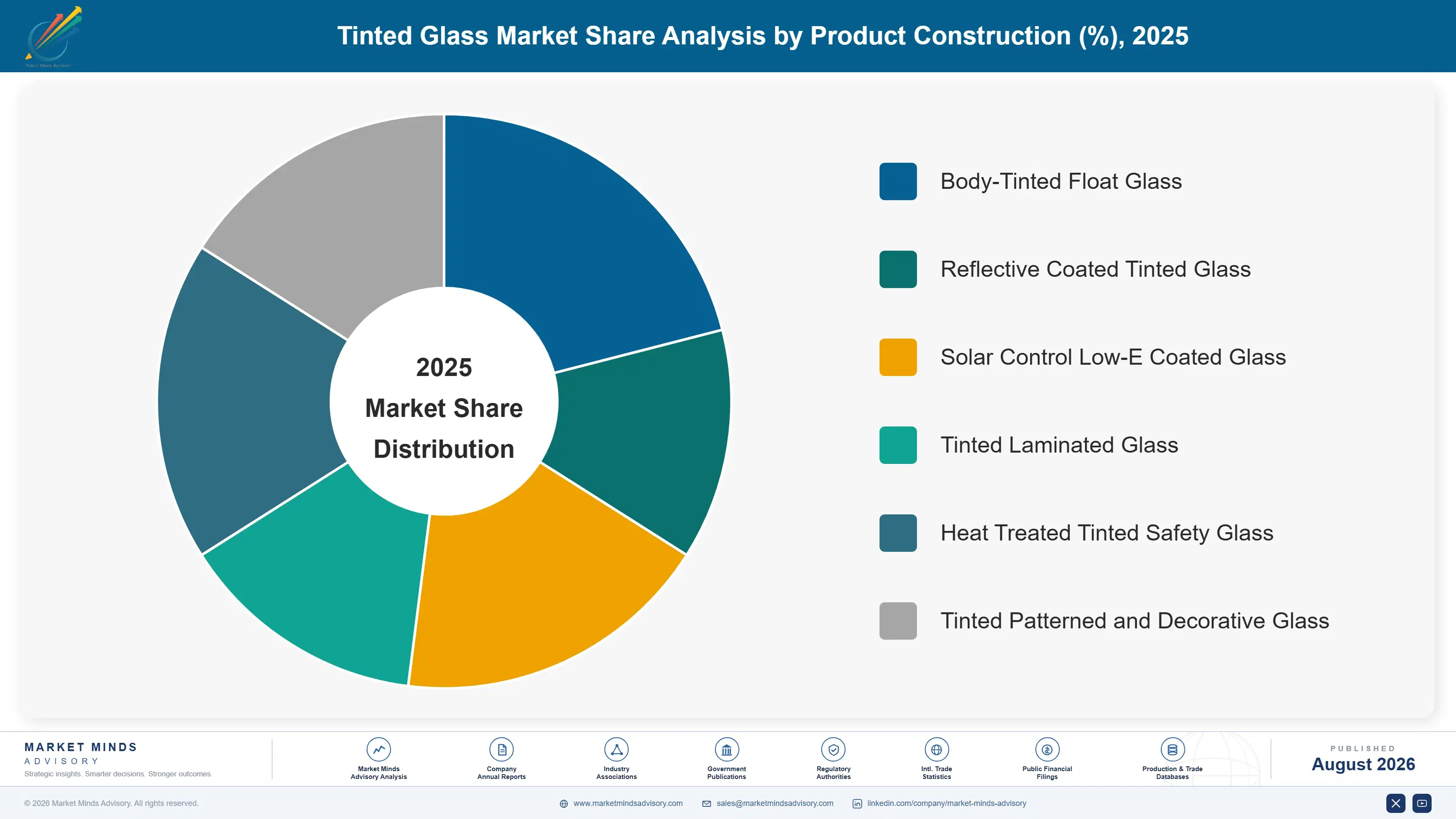
Six segments split by product construction as sold, because construction determines the solar performance achieved, the fabrication steps required, the applications it can serve and the price it commands. Colour and thickness variants sit inside each construction. Application and channel dimensions are handled separately within the framework rather than mixed here. Construction decides the commercial position entirely.
tinted-glass-market-trends-market-share-analysis-1787639971226

Solar Control Low-E Coated Glass

Growing at 7.2%, half again the market rate of 4.8%, solar control coatings admit visible light while reflecting infrared, achieving roughly twice the light per unit of heat rejected that body tint manages. They look considerably clearer, which costs them arguments decided on appearance and wins them arguments decided on measured solar heat gain. Growth tracks energy code tightening almost exactly, and stalls in markets where codes still permit body tint to satisfy the requirement on its own. Suppliers reaching facade consultants and energy modellers during design shape that comparison, while those calling on architects with colour ranges are arguing on ground where the physics works against them. Codes are doing the persuading.
CAGR 7.2%

Tinted Laminated Glass

At 6.2% tinted laminated glass delivers solar control, acoustic attenuation and safety performance in a single assembly, which urban facades increasingly need all at once rather than separately. The interlayer carries colour or coating protection while the laminate handles the rest, and specifying these functions separately produces heavier and costlier assemblies. Growth favours fabricators able to laminate coated substrates, since that combination is where the technical value now concentrates across most commercial projects. Acoustic requirements in dense urban locations have become as common a driver as solar control itself, and safety regulations apply to much of the same glazing regardless. Fabricators without lamination capability on coated substrate are increasingly excluded from the specifications that matter commercially.
CAGR 6.2%
Full segment breakdown across 6 segments available in the complete report.

Regional Architecture and Country Demand Map

East Asia holds 30% of value on float capacity and construction volume that no other region approaches. North America follows at 24% on commercial glazing and stringent energy code enforcement across most states. South Asia and Pacific grows fastest of the seven regions covered here.

North America

Commercial glazing carries most of the regional value, with energy codes across most states now setting solar heat gain limits that body tint alone cannot meet on its own. Coated products have accordingly displaced monolithic tinted glass across the commercial market almost entirely. Automotive glazing follows federal light transmission rules that fix front side glass at high clarity. Growth at 4.2% reflects code driven mix improvement rather than any expansion in glazed area. Facade consultants rather than architects now write the performance requirement, which has moved the specification argument onto measured data across most commercial work. Body tint retains a position only in residential and refurbishment work where codes apply less strictly than to new commercial construction.
Share: 24% | CAGR: 4.2% (2026 to 2036)

Western Europe

Facade specification here is the most performance driven anywhere, with measured solar heat gain and light transmission both regulated and both routinely verified on completed buildings. Body tint has largely disappeared from commercial specification as a result. Heritage and refurbishment work sustains some decorative tinted demand. Regional growth of 3.4% is the slowest anywhere on mature construction volume and a mix transition that has already largely happened. Thermal stress and colour consistency requirements are written into facade specifications more rigorously here than anywhere, which rewards suppliers offering analysis alongside supply. Coated laminates carry most of the commercial value, and monolithic tinted glass has retreated almost entirely into refurbishment. Refurbishment sustains what remains.
Share: 20% | CAGR: 3.4% (2026 to 2036)
Regional intelligence for 5 additional markets available in the complete report: East Asia, South Asia and Pacific, Latin America, Middle East and Africa, Eastern Europe. Contact sales@marketmindsadvisory.com.
tinted-glass-market-trends-country-cagr-analysis-1787639971743

Four Moves Past the Sample Board

This category loses arguments in showrooms that it wins in energy models, because darkness reads as performance and clarity does not. What remains available is moving the comparison onto measured heat gain, protecting fabricators from thermal stress failures, and selling batch consistency as the facade risk it genuinely is. Physics loses to samples routinely.

Move the comparison onto measured solar heat gain

Selective coatings achieve roughly twice the visible light per unit of solar heat rejected that body tint manages, and lose specification arguments anyway because a clear looking sample reads as doing nothing. Suppliers presenting energy model output rather than sample boards change what is being compared. Where codes force that comparison, coated products grow at 7.2%, and where they do not, appearance keeps deciding against the physics entirely. Facade consultants rather than architects now write the performance requirement. Their requirement constrains what an architect can specify. Colour ranges no longer decide anything.
Market Impact: Delivers a 2.1 light to heat rejection ratio

Sell thermal stress analysis alongside absorbing products

Roughly 3% of absorbing panes fail from edge initiated thermal stress, and the cause is fabrication edge quality rather than the glass, which means the supplier is blamed for a failure originating downstream. Providing thermal stress analysis and heat strengthening guidance with the product protects both the customer and the supplier's reputation. Quotations that omit strengthening cost look cheaper and become expensive the moment site breakages start. Heat strengthening removes the risk at modest additional cost. Blame follows the brand rather than the fabricator on site. Quotations omitting strengthening look cheaper and become expensive.
Market Impact: Prevents roughly 3% of absorbing glass pane losses

Reserve single campaign batches for large facades

Colour matching between float campaigns run about six weeks apart is imperfect enough to be visible across a large facade, and a visible mismatch means reglazing at multiples of the glass cost. Suppliers offering batch reservation and single campaign supply are selling risk removal rather than glass. Contractors who have experienced a facade rejection pay for that certainty readily, and those who have not rarely ask about it. Reglazing after a rejection costs several times the original glass supply, which makes batch reservation cheap insurance by comparison. Campaigns run about 6 weeks apart.
Market Impact: Covers the 6 week campaign colour drift risk

Follow cooling load geography rather than construction volume

Saudi Arabia grows fastest at 8.8% because glass performance translates directly into chiller plant sizing where cooling loads are extreme, which makes the performance argument commercial rather than regulatory. Suppliers organised around construction volume alone are covering temperate markets where the same product carries a weaker case. Cooling degree data predicts where selective coatings sell themselves, and remarkably few commercial teams use it. Construction volume and cooling load geography barely overlap at all. Cooling degree data is published and free to use. Coverage rarely reflects it at all. Temperate coverage misses the argument.
Market Impact: Follows the 8.8% Saudi Arabian construction growth rate

Who Controls the Margin Pool

Participation is measured on annual revenue from tinted and solar control flat glass, and the top five hold 46%. Concentration is moderate because float production and downstream fabrication are separate businesses, and independent fabricators buy substrate from the same producers they compete with commercially. The gap to challengers is coating capability rather than float scale, and that gap widens as codes tighten across the developed markets.
Competition runs on three fronts. Float capacity and coating capability decide substrate supply, where scale sets cost. Fabrication capability decides laminated and heat treated products, where independents hold genuine positions. And technical support decides specification, where energy modelling and thermal stress analysis change what gets written. Each front rewards a different capability, and few participants hold more than two of them properly.

Pressure ahead comes from energy codes displacing body tint and from Chinese capacity setting reference pricing globally. Expect coating capable producers to gain against monolithic tinted suppliers. Rankings shift on who supports specification with performance data rather than sample boards. Concentration should rise modestly as coating investment separates producers. Float producers without coating investment look most exposed.
tinted-glass-market-trends-company-positioning-matrix-1787639972263

Competitive Moat and Risk Dimensions

SAINT-GOBAIN

Moat: Coating breadth and specification support

Coating capability across a wide performance range combined with technical support during design reaches specification before a sample board decides anything, and energy modelling delivered at that stage frames the comparison on terms the product wins. That access is difficult for a substrate supplier to replicate, since the argument must be made before a specification is written rather than afterwards.
SAINT-GOBAIN

Risk: Float capacity utilisation exposure

Float lines run continuously and cannot be throttled economically, so construction demand shortfalls reach pricing across every product line at once rather than allowing selective retreat. That exposure is shared with every float producer and grows sharper as Asian capacity sets reference pricing in markets the business used to price independently.
AGC

Moat: Automotive and architectural glazing scale

Serving both automotive and architectural glazing spreads demand across cycles that rarely move together, and infrared selective technology developed for vehicle glazing under light transmission rules transfers usefully into architectural products. That combination gives the business development scale that a single market participant cannot easily match on either side.
AGC

Risk: Chinese capacity pricing pressure

Chinese float capacity sets reference pricing that reaches most markets through trade, and body-tinted product in particular has become close to a commodity on that basis. Defending margin requires coating content and fabrication value that customers will pay for, which is straightforward in regulated markets and difficult everywhere else.

Players Tracked

Prominent Players

Saint-Gobain
AGC
NSG Group
Guardian Glass
Vitro

Other Key Players

Sisecam
Xinyi Glass
Fuyao Glass
CSG Holding
Central Glass
Emirates Float Glass
Cardinal Glass Industries
Taiwan Glass
Asahi India Glass
Schott
Sedak
Press Glass
Northglass
Trulite Glass and Aluminum
Tecnoglass

Recent Developments

MAY 2026

Energy code revision removes body tint from compliance path

A revised commercial energy code tightened solar heat gain limits below what monolithic body-tinted glass can achieve, effectively removing it from the compliance path and moving specification toward coated products across the affected market entirely. Monolithic tinted volume fell sharply within two quarters. Coating lines ran at capacity afterwards.
Signal: Regulation rather than performance data finally moved specification away from appearance based selection in that market entirely
NOVEMBER 2025

Facade rejected over visible colour variation between batches

A completed commercial facade was rejected over visible colour variation between panes supplied from separate float campaigns, requiring partial reglazing at cost multiples of the original glass supply for the project. Both campaigns had met the published colour tolerance individually. Nobody had reserved a single batch.
Signal: Batch consistency is a facade risk that quotations almost never price or even mention to the buyer
FEBRUARY 2026

Fabricator adopts thermal stress analysis after breakage claims

A glass fabricator introduced routine thermal stress analysis and edge quality control following repeated site breakage claims on absorbing products, having established that edge damage during cutting was initiating the failures. Claims fell substantially once edge finishing was controlled. The glass itself had never been at fault.
Signal: Thermal stress failures originate in fabrication yet always arrive as complaints about the glass the producer supplied

Gas, Soda Ash and Silver

Natural gas and electricity carry around 29% of float glass cost, since furnaces run continuously at high temperature and cannot be throttled. Soda ash absorbs roughly 17%, sourced from natural and synthetic producers in a concentrated supply base. Silver and other coating target materials account for about 11% of coated product cost. Silica sand, cullet, labour and logistics take the balance.
European gas pricing moved sharply across recent years, per International Energy Agency reporting on industrial gas markets and Saint-Gobain annual reporting for 2025 on energy cost commentary. Producers passed a considerable part through where specification was regulated and almost none where body tint competed on price, which split pass through by product rather than by supplier or region. That split reflects where specification is regulated.

Exposure divides on furnace position and product mix. A float producer carries energy across nearly a third of cost with no ability to reduce output without losing the furnace campaign entirely. A coater carries silver and target materials on a narrower base with better pass through. An independent fabricator buys substrate at whatever the market sets and adds value downstream, which is a considerably more comfortable position than either.
tinted-glass-market-trends-cost-volatility-analysis-1787639972458

Hedge furnace energy across the campaign duration

Float furnaces run continuously for years and cannot be shut against high energy prices without ending the campaign, which makes energy exposure both large and completely inflexible. Hedging matched to campaign duration rather than to annual budgeting cycles addresses the actual shape of the risk, and producers doing so weathered recent volatility considerably better.

Shift mix toward coated and fabricated value

Body-tinted product competes against Chinese reference pricing on cost alone, while coated and laminated products carry technical content customers will pay for in regulated markets. Moving mix reduces energy exposure per unit of revenue and improves margin at the same time, though it requires coating investment that not every producer can fund. Coating investment is the obstacle.

Contract soda ash against multi-year supply agreements

Soda ash carries close to a fifth of batch cost and comes from a concentrated producer base where spot exposure has proved genuinely damaging. Multi-year agreements with volume commitment secure both price and availability, and the commitment is straightforward to make given furnaces run continuously at predictable consumption rates. Availability matters more than price here.

Portfolio Architecture for Margin Defence

Margin here follows technical content rather than colour, because a body-tinted pane competes against Chinese reference pricing while a coated laminate carries performance a customer can verify. Monolithic tinted float and decorative products earn margins in the high single digits to mid teens, where furnace cost position decides everything and product differentiation is essentially absent. Furnace position rather than product decides who survives a downturn.
Reflective coated and heat treated products do better in the mid teens to high twenties, because coating capability and heat treatment capacity narrow the field of suppliers who can serve a given specification at all. Heat treatment capacity is genuinely scarce in several regional markets.

Solar control coated laminates hold the strongest position, reaching into the high thirties, where energy code compliance, acoustic performance and safety requirements all land in a single assembly that few fabricators can produce. Those margins depend on regulated specification, and compress quickly in markets where codes still allow body tint to satisfy the solar heat gain requirement. Code stringency rather than technical merit decides whether the position holds in any given market, which makes geography the governing variable.

Body-Tinted and Decorative Float

Monolithic tinted product competing against Chinese reference pricing on cost. The seven point range reflects furnace energy position and logistics rather than any performance difference between producers. Codes are removing it from compliance paths.
Gross Margin: 8-15%

Reflective Coated and Heat Treated Products

Coated and toughened products where capability narrows the qualified supplier field. The twelve point range reflects coating line sophistication and heat treatment capacity, which vary considerably between participants. Capability rather than capacity sets the price.
Gross Margin: 16-28%

Solar Control Coated Laminates

Assemblies delivering code compliance, acoustic and safety performance together. The twelve point range reflects whether the local energy code forces the specification or leaves body tint an acceptable option. Regulated specification protects the margin here.
Gross Margin: 26-38%
tinted-glass-market-trends-portfolio-architecture-1787639972955

High-value Sub-segments and Strategic Watch-out

Solar Control Low-E Coated Glass

High value and the fastest growth at 7.2%, achieving roughly twice the light per unit of heat that body tint manages. Energy code stringency decides whether that advantage translates into specification or not. Facade consultants decide it, not architects. Codes do the persuading. Physics alone does not.
Gross Margin: 26-38%

Tinted Laminated Glass

High value and growing at 6.2% as facades need solar control, acoustic attenuation and safety in one assembly. Lamination capability on coated substrate is where the technical value genuinely concentrates. Urban acoustic requirements are driving as much demand. Coated substrate lamination is the capability. Few fabricators hold it.
Gross Margin: 22-34%

Body-Tinted Float Glass

The volume core, competing against Chinese reference pricing with no meaningful differentiation available. Energy codes are steadily removing it from commercial compliance paths across developed markets everywhere. Furnace energy position decides who competes at all. Differentiation is essentially absent. Chinese reference pricing sets the ceiling.
Gross Margin: 8-15%

Thermal Stress Failure Exposure

The strategic watch-out. Around 3% of absorbing panes fail from edge initiated cracking, and the range reflects whether a supplier provides thermal stress analysis or simply ships absorbing glass unaccompanied. Analysis at design stage prevents almost all of it. Blame follows the brand regardless. Design analysis prevents it.
Gross Margin: 5-30%

Specified Once, Glazed Forever

Demand here is decided at facade design and never revisited, because glass is the one building component nobody replaces until it fails or the building is refurbished. A specification written on appearance locks in a performance outcome for decades, and the energy cost of that decision runs every cooling season for the life of the building without anybody attributing it back to the glass.
Stickiness follows the specification rather than the supplier. A named product on a facade drawing holds through the project unless a contractor substitutes on price, which happens routinely where the specification permits equivalents. Automotive glazing positions hold for the vehicle programme, typically several years, because homologation against light transmission rules makes changing glass an expensive exercise nobody undertakes lightly.

The deciding party has moved upstream over the past decade. Facade consultants and energy modellers now write performance requirements that architects once wrote as colour references, which shifts the argument from a sample board toward a solar heat gain figure. Suppliers still calling on architects with colour ranges are talking to somebody whose decision is increasingly constrained by a number somebody else calculated.
tinted-glass-market-trends-end-use-penetration-index-1787639973442

Where We Would Put Effort

These are among the four positions where our research anticipates prominent divergence between winners and laggards over the coming forecast period. Each is grounded in the demand model, the regulatory perimeter, and the announced capacity pipeline.
01 / PERFORMANCE COMPARISON FRAMING

Darkness reads as cooling and is not

A body tint absorbs roughly 55% of the solar energy striking it and re-radiates much of that heat inward, while a clearer selective coating achieves about twice the visible light per unit of heat rejected. Suppliers presenting sample boards to architects are competing on the one measure where the physics works against them completely. Energy model output presented to facade consultants during design changes what is actually being compared, and coated products grow at 7.2% wherever that comparison genuinely happens.
02 / FABRICATION RISK OWNERSHIP

The edge fails and you get blamed

Roughly 3% of absorbing panes fail from edge initiated thermal stress, and the cause is fabrication edge quality rather than any defect in the glass supplied. The producer nonetheless receives the complaint, the claim and the reputational damage from a failure that originated entirely downstream in somebody else's workshop. Providing thermal stress analysis and heat strengthening guidance alongside the product protects both the customer and the producer's own reputation at the same time, and costs very little to do properly.
03 / BATCH CONSISTENCY ASSURANCE

Colour drift rejects finished facades

Tinted glass runs in campaigns roughly six weeks apart and colour matching between them is imperfect enough to be visible across a large facade, where a mismatch means reglazing at multiples of the glass cost. Suppliers offering batch reservation and single campaign supply are selling risk removal rather than glass, which is a different conversation entirely. Contractors who have lived through a facade rejection pay for that certainty without needing any persuasion at all, and those who have not never ask.
04 / COOLING LOAD TARGETING

Sell where the chiller gets smaller

Saudi Arabia grows fastest of any country at 8.8% precisely because glass performance translates directly into chiller plant sizing and running cost where cooling loads are extreme, which makes the argument a commercial one rather than merely a regulatory one. Suppliers organised around construction volume alone are covering temperate markets where exactly the same product carries a considerably weaker commercial case. Cooling degree data predicts where selective coatings sell themselves without argument, and remarkably few commercial teams actually use it for coverage planning.

Engagement Snapshot From the Field

A live engagement with an industry participant carrying material or product regulatory and market exposure ahead of a defining policy shift, showing how our research translates into a defensible multi-year portfolio strategy.
MARKET MINDS ADVISORY · CLIENT ENGAGEMENT SUMMARY
Tinted Glass Producer Strategic Portfolio Review and Transition Roadmap 2026·Investment Scenario on Tinted Glass Exposure Evaluation 2025-26
CLIENT PROFILE
A flat glass producer operating float capacity and coating lines across European and Middle Eastern markets, supplying architectural and automotive customers at annual revenue near 1.4 billion dollars (client-reported, unverified by MMA). Body-tinted volume remained substantial and specification support was limited to sample provision. Coating lines were running below available capacity. Technical support was thin.
STRATEGIC CHALLENGE
Body-tinted margins had compressed against imported product while coated volume grew more slowly than energy code tightening should have supported. Management wanted to understand why performance advantage was not converting into specification wins across the architectural market. Coating investment had already been made and needed volume to justify it. Utilisation mattered.
MMA APPROACH
MMA reviewed specification decisions on completed projects to establish what actually decided glass selection, quantified thermal stress failure rates and their fabrication origins, assessed colour campaign variation against facade rejection incidents, and mapped cooling load geography against the client's commercial coverage. Interviews with 47 experts covered facade consulting, fabrication and glazing contracting.
KEY FINDINGS
  1. Specification on projects examined was decided by sample board comparison in most cases, where the darker product won despite measurably worse solar heat gain performance.
  2. Thermal stress failures on absorbing products were arriving as complaints against the client despite originating in fabrication edge quality the client did not control.
  3. Colour variation between float campaigns had caused facade rejections on several projects, with costs falling on the contractor and reputational damage on the client.
  4. Commercial coverage followed construction volume rather than cooling load, leaving hot climate markets where the performance argument is strongest comparatively under-served. Cooling degree data had never been consulted.
CLIENT PROFILE
A flat glass producer operating float capacity and coating lines across European and Middle Eastern markets, supplying architectural and automotive customers at annual revenue near 1.4 billion dollars (client-reported, unverified by MMA). Body-tinted volume remained substantial and specification support was limited to sample provision. Coating lines were running below available capacity. Technical support was thin.
STRATEGIC CHALLENGE
Body-tinted margins had compressed against imported product while coated volume grew more slowly than energy code tightening should have supported. Management wanted to understand why performance advantage was not converting into specification wins across the architectural market. Coating investment had already been made and needed volume to justify it. Utilisation mattered.
MMA APPROACH
MMA reviewed specification decisions on completed projects to establish what actually decided glass selection, quantified thermal stress failure rates and their fabrication origins, assessed colour campaign variation against facade rejection incidents, and mapped cooling load geography against the client's commercial coverage. Interviews with 47 experts covered facade consulting, fabrication and glazing contracting.
KEY FINDINGS
  1. Specification on projects examined was decided by sample board comparison in most cases, where the darker product won despite measurably worse solar heat gain performance.
  2. Thermal stress failures on absorbing products were arriving as complaints against the client despite originating in fabrication edge quality the client did not control.
  3. Colour variation between float campaigns had caused facade rejections on several projects, with costs falling on the contractor and reputational damage on the client.
  4. Commercial coverage followed construction volume rather than cooling load, leaving hot climate markets where the performance argument is strongest comparatively under-served. Cooling degree data had never been consulted.
RECOMMENDED STRATEGY
Phase 1: Phase one: replace sample based selling with energy model output presented to facade consultants during design, before any specification gets written. Phase 2: Phase two: provide thermal stress analysis and heat strengthening guidance with absorbing products, since the failures arrive as complaints regardless. Phase 3: Phase three: reallocate commercial coverage toward cooling load geography, where selective coatings make their own commercial case. Construction volume is the wrong indicator.
OUTCOME
The producer introduced energy modelling into design stage engagement during 2026 and won coated specifications previously lost on appearance (client-reported, unverified by MMA). Thermal stress support reduced breakage claims substantially, and coverage was reallocated toward hot climate markets. Sample board selling was withdrawn from commercial projects entirely.

Frequently Asked Questions

Foundational context covering the market sizes, CAGR, scope, country, region and competition that inform every finding below. This section is provided to cover basics and most often pre-purchase conversations, answered from the MMA Primary Research Dataset.

What is the current size of the Tinted Glass Market?

MMA sizes it at USD 8.4 billion in 2025, rising to USD 8.80 billion in 2026. The figure covers tinted and solar control flat glass at manufacturer selling value.

How large will the Tinted Glass Market be by 2036?

USD 14.06 billion by 2036, an incremental USD 5.26 billion over the 2026 base and an expansion multiple of 1.60 times. Coated products carry most of that gain.

What is the CAGR for the Tinted Glass Market 2026 to 2036?

4.8% in the base case, with a bull case at 6.0% and a bear case at 3.6%. The spread turns largely on energy code tightening in hot climate markets.

Which segment is growing fastest?

Solar control low-E coated glass at 7.2%, half again the market rate of 4.8%. It admits roughly twice the light per unit of solar heat rejected.

Who are the major companies in the Tinted Glass Market?

Saint-Gobain, AGC, NSG Group, Guardian Glass and Vitro lead on tinted and solar control glass revenue. Fifteen further participants are profiled in the full report.

Which country is growing fastest?

Saudi Arabia at 8.8%, where extreme cooling loads, construction at unusual scale and a growing local float industry all coincide at once, making glass performance a chiller sizing question.

Report Segmentation Architecture

The full report scope spans multiple orthogonal segmentation dimensions, with cross-tabulated demand data provided for each dimension pair. Coverage extends further to regional breakdowns, trend trajectories, and the competitive detail needed to support segment-level decision-making.

By Product Construction

  • Body-Tinted Float Glass
  • Reflective Coated Tinted Glass
  • Solar Control Low-E Coated Glass
  • Tinted Laminated Glass
  • Heat Treated Tinted Safety Glass
  • Tinted Patterned and Decorative Glass

By End-Use Industry

  • Commercial Building Facades
  • Residential Glazing
  • Automotive Glazing
  • Rail and Marine Glazing
  • Interior Partitions and Fittings
  • Refurbishment and Replacement

By Commercial Dimension

  • Direct Project Supply
  • Independent Fabricator Supply
  • Glazing Contractor Purchase
  • Distributor and Merchant Channels
  • Original Equipment Automotive Contracts
  • Replacement and Aftermarket Supply

By Region

  • North America
  • Western Europe
  • East Asia
  • South Asia and Pacific
  • Latin America
  • Middle East and Africa
  • Eastern Europe

Scope, Methodology, and Coverage

Every figure in this report is reproducible from documented input assumptions. The scope below maps the historical period, the forecast horizon, the segmentation dimensions, and the countries covered, alongside the underlying primary and qualitative methodology.
Historical Period
2020 to 2025
Forecast Period
2026 to 2036
Base Year
2025 (USD billions; MMA Primary Research Dataset, August 2026)
Market Definition
Flat glass products providing solar control or coloration through body tinting, coatings or interlayers, covering body-tinted float glass, reflective coated tinted glass, solar control low-E coated glass, tinted laminated glass, heat treated tinted safety glass, and tinted patterned and decorative glass. Measured at manufacturer selling value. Applied window film, switchable and electrochromic glazing, framing and glazing systems, and installation labour are excluded from scope.
Quantitative Units
USD billions (current prices); square metres shipped; USD per square metre by product construction
Segmentation Dimensions
Product construction; end-use industry; commercial dimension; region
Regions Covered
North America, Western Europe, East Asia, South Asia and Pacific, Latin America, Middle East and Africa, Eastern Europe
Countries Covered
United States, Canada, Mexico, Germany, France, United Kingdom, Italy, Spain, China, Japan, South Korea, Taiwan, India, Australia, Indonesia, Brazil, Chile, Saudi Arabia, United Arab Emirates, Poland
Key Companies Profiled
Saint-Gobain, AGC, NSG Group, Guardian Glass, Vitro, Sisecam, Xinyi Glass, Fuyao Glass, CSG Holding, Central Glass, Emirates Float Glass, Cardinal Glass Industries, Taiwan Glass, Asahi India Glass, Schott, Sedak, Press Glass, Northglass, Trulite Glass and Aluminum, Tecnoglass
Quantitative Methodology
Primary survey, n=3,800 respondents, Q4 2025, six countries; demand-side model with trade association cross-validation
Qualitative Methodology
47 expert interviews, Q4 2025; applied to validate demand model assumptions, identify emerging dynamics, and assess competitive positioning
Report Format
PDF and XLSX data workbook (Word format preview document)
Publisher
Market Minds Advisory
Report Code
MMA-2026-CON-119
Published
August 2026
Contact
sales@marketmindsadvisory.com | www.marketmindsadvisory.com

Purchase the full Tinted Glass Market Report (2026 to 2036).

The full report treats tinted glass as a heat rejection product sold on appearance, which is why the darkest pane on a sample board routinely beats the one that performs. It sizes all six product constructions independently through 2036, quantifies thermal stress failure rates against fabrication practice, and maps energy code stringency against achievable specification by market. Regional chapters cover all seven regions with cooling load geography assessed separately from construction volume. Competitive profiling covers 20 participants on one consistent revenue basis. Specification decision routes are traced by project type throughout the analysis.
Six product constructions sized independently through 2036
Thermal stress failure rates quantified against fabrication edge practice
Energy code stringency mapped against achievable specification by market
Cooling load geography assessed separately from construction volume regionally
Colour campaign variation tracked against facade rejection incidents
Twenty participants profiled on one consistent revenue basis

Built For The People Who Decide

From boardroom strategy to bench-side execution, this report is read cover-to-cover by leaders shaping the next decade of their industry, turning demand scenarios, market dynamics and valuation benchmarks into decisions.
CXOs/ Presidents/ VPs/ Managers
M&A and Corporate Development
Strategy Teams and R&D Heads
Procurement and Product Directors
Regulatory and Compliance Leaders
Investor Relations and Equity Analysts