Market Minds Advisory
Tinea Pedis Treatment Market

Tinea Pedis Treatment Market: A One-Week Cure Nobody Finishes

Symptoms clear in three days and the infection does not, so barely a quarter of users complete the course. A third are back within the year, and the toenails nobody treats keep re-seeding it.

Lead Analyst

Alice Ballenger

Published

September 2026

Make Smarter Decisions with Customized Research Insights

Request a free sample report and evaluate market opportunities, growth trends, and competitive dynamics relevant to your business needs.

2025 MARKET VALUE$4.2BMarket Size 2025
2036 FORECAST VALUE$6.7BBase Case , 2026 to 2036
CAGR 2026 TO 20364.4 %Bull 5.6% / Bear 3.2%
INCREMENTAL OPPORTUNITY$2.4BNet 10- year value creation
EXPANSION MULTIPLE1.54x2036 value over 2026 base
Strategic Levers
M&A Pipeline
Regional Outlook
Country Rankings
Competitive Intelligence
Segmental Deep-dive
Call-Us : 91 93563 13602

Executive Snapshot and Market Trajectory

Interdigital tinea pedis is curable in about a week with a topical allylamine used properly. Itching and scaling stop in roughly three days, which is when 73% of users stop applying it. A third of treated cases return within the year, and that repeat purchase is what carries this market.
Growth runs at 4.4% on recurrence and on population rather than on price or innovation of any kind. Oral systemic antifungals grow fastest at 6.6%, exactly 1.50 times the market rate, as clinicians recognise that untreated toenail infection re-seeds the skin indefinitely. Combination and adjunct footwear treatments follow at 6.1%. East Asia holds the largest share on Japanese consumer intensity plus sheer Chinese volume.
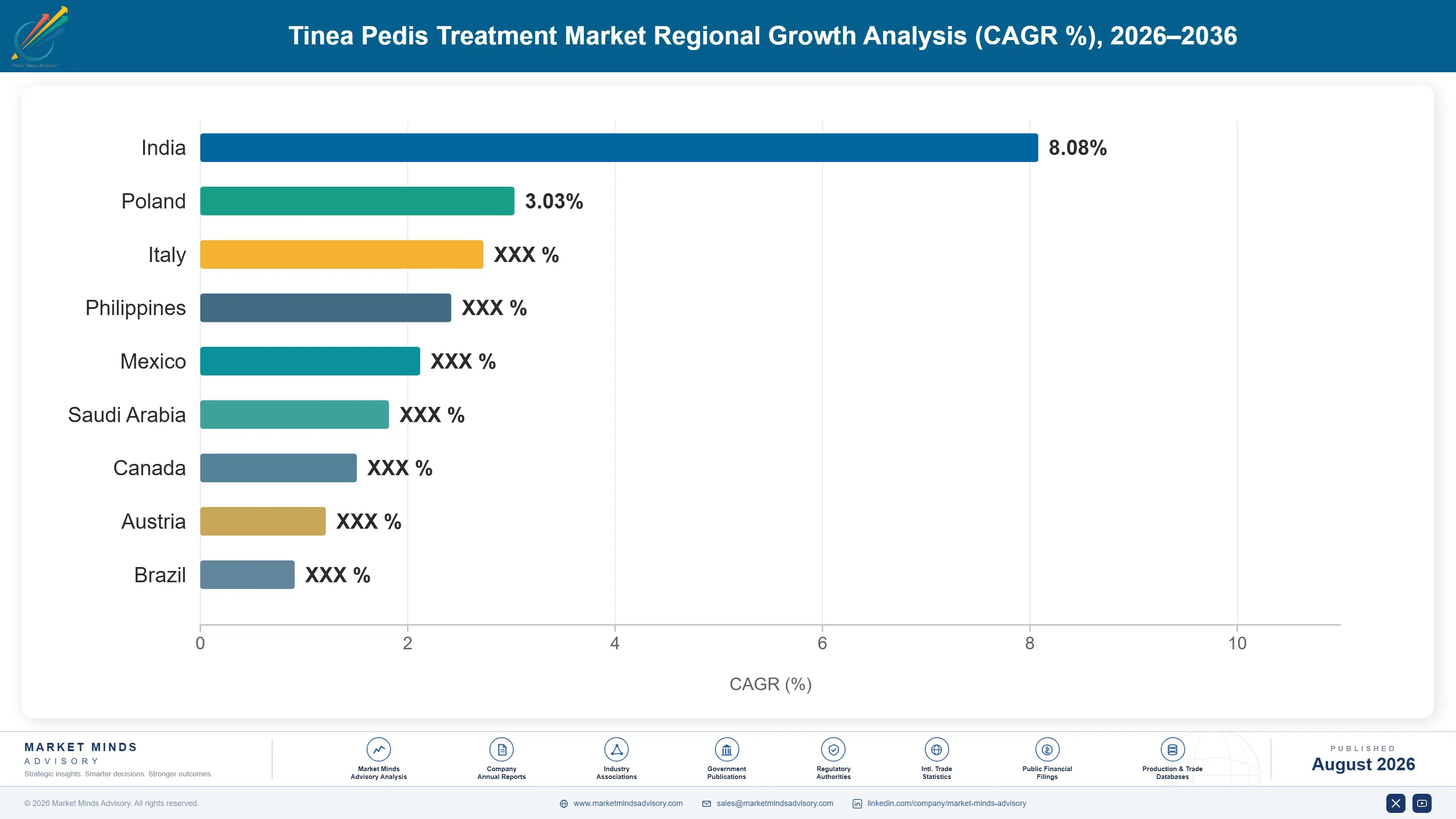
Concentration reaches 41% across the top five measured on annual retail and prescription revenue from tinea pedis products, moderate for a consumer health category and reflecting very strong regional brands alongside global ones. Around 86% of treatment episodes begin without any clinician assessment at all, which means a shelf and a pack design carry more diagnostic weight here than any physician does. India grows fastest at 7.4% on prevalence and resistance together.
Market Definition
This market covers pharmaceutical treatments for tinea pedis, measured at realised prices across retail and prescription channels, spanning over-the-counter topical allylamines, over-the-counter topical azoles, powders, sprays and moisture management products, prescription topical antifungals, oral systemic antifungals, and combination and adjunct footwear treatments. Onychomycosis-specific nail lacquers and devices, tinea infections at other body sites, general foot care and podiatry services, and non-medicated hosiery fall outside scope.
Base Year Value
$4.2B in 2025 (MMA Primary Research Dataset, August 2026)
Forecast Period
2026 to 2036, eleven discrete annual values
CAGR
4.4% base case. Bull 5.6%. Bear 3.2%.
Fastest Growth Segment
Oral Systemic Antifungals: 6.6% CAGR
Fastest Growth Country
India: 7.4% CAGR
Fastest Growth Region
South Asia and Pacific: 6.6% CAGR
Largest Region
East Asia: 27% of 2025 global value
Market Leaders
Bayer, Haleon, Kenvue, Sato Pharmaceutical, Perrigo. Source: MMA Analysis based on company annual reports.
Primary Survey
n=3,800 procurement and R&D decision-makers, Q4 2025, six countries
Methodology
Demand-side build-up, cross-validated against public data, 47 expert interviews

Tinea Pedis Treatment Market Forecast Scenarios

tinea-pedis-treatment-market-growth-size-forecast-scenario-1787299877498
The 2020 to 2025 period ran at 3.6% and very little about the category changed. Volume tracked population and climate rather than any therapeutic development, since the molecules that dominate were established decades ago. The one genuine change was clinical rather than commercial: terbinafine resistance emerged across South Asia and began appearing in imported cases elsewhere, lengthening courses and pushing prescribers toward oral therapy.
Three mechanisms carry the 4.4% base case. Recurrence is the largest, since 34% of treated cases return within a year and each return produces another purchase, which is arithmetic rather than any commercial design. Growing recognition of the nail reservoir is the second, moving a meaningful share of patients toward oral therapy at 6.6%. And South Asian volume is the third, where prevalence is highest and resistance has extended treatment duration considerably.
The 5.6% bull case rests on pharmacist prescribing widening for oral terbinafine, which would move patients with concurrent nail involvement into therapy that actually clears the reservoir. The 3.2% bear case is resistance spreading beyond South Asia into markets where terbinafine carries most of the volume, since the alternatives are slower, costlier, and considerably less well established at retail.

Why the Same Feet Keep Coming Back

This is an unusual category because the medicine works and the treatment mostly does not. A topical allylamine applied for one to two weeks achieves high mycological cure in interdigital disease, which is about as good as dermatology gets. Symptoms resolve in roughly three days. Around 27% of users continue past that point, so the great majority stop while viable organism remains in the skin and are surprised when the itching returns.
TOP FIVE CONCENTRATION41%Moderate across consumer brands and regional prescription suppliers
COURSE COMPLETION RATE27%Of users continuing treatment for the full recommended duration
ANNUAL RECURRENCE RATE34%Of treated cases returning within twelve months of clearance
CONCURRENT NAIL INVOLVEMENT39%Of cases with toenail infection acting as a reservoir
SELF-DIAGNOSIS SHARE86%Of treatment episodes begun without any clinician assessment whatever
SYMPTOM RELIEF ONSET3 daysBefore scaling and itching subside while infection persists underneath
Underneath the adherence problem sits a reservoir problem that almost nobody addresses. Roughly 39% of tinea pedis cases have concurrent toenail infection, and no topical foot preparation penetrates a nail plate in any useful quantity. Those patients will reinfect the skin from their own toenails indefinitely, whatever they apply to it. A large share of what gets recorded as treatment failure is not failure of the drug at all.
Diagnosis meanwhile happens at a shelf. Around 86% of episodes begin with no clinician involved, and a meaningful minority of what people treat as athlete's foot turns out to be eczema, contact dermatitis, or psoriasis, none of which an antifungal touches. Pack design and shelf position therefore carry diagnostic weight that ought to make everybody slightly uncomfortable.
"We have a drug that cures this in a week and a market that depends on people not finishing it. Nobody planned that, but every commercial forecast in the category quietly assumes the recurrence rate holds, which is a strange thing to build a business on."
Director, Consumer Dermatology and Anti-Infectives Practice · MMA Healthcare and

Market Trends

Prescribers Are Finally Treating The Nail Reservoir

Around 39% of tinea pedis cases carry concurrent toenail infection, and topical foot preparations do not penetrate nail plate meaningfully, so those patients reinfect themselves from their own toes for years. Clinical recognition of that reservoir has shifted a growing share of persistent cases toward oral terbinafine or itraconazole, which clear skin and nail together. Oral systemic therapy grows at 6.6% against 4.4% for the market. Pharmacist prescribing rights in several countries have accelerated it further by removing the physician appointment that used to block access. Hepatic monitoring keeps it from becoming first line.
Market Impact: 34% recur within twelve months
Terbinafine Resistance Has Emerged And Is Travelling

Dermatophyte strains carrying squalene epoxidase mutations have spread widely across South Asia, producing infections that fail standard terbinafine courses and require longer, costlier itraconazole regimens instead. Cases are now reported in Europe, North America, and the Gulf, largely through travel and migration rather than local emergence. The commercial consequence is longer treatment episodes and higher per-episode value in affected markets, which flatters revenue while representing a genuine clinical deterioration. India contributes the fastest national growth rate in this forecast at 7.4%. Diagnostic confirmation is rare enough that most affected patients are simply treated twice.
Market Impact: Prevalence exceeds 20% in humid regions

Market Opportunities and Growth Drivers

A Third Of Treated Cases Return Within The Year

Recurrence runs near 34% within twelve months, driven by incomplete courses, untreated nail reservoirs, and re-exposure in the same footwear and the same communal floors. Each recurrence produces a fresh retail purchase, usually of whatever the person used last time since it appeared to work. That makes brand persistence unusually strong for a category with no prescriber relationship behind it. The commercial reality is that repeat episodes rather than new sufferers carry most of the volume in every developed market. New sufferers matter far less than returning ones do. Nobody in the chain knows who they are.
Market Impact: Only 27% complete the course

Warm Humid Climates Carry Far Higher Prevalence

Dermatophyte growth depends on warmth and moisture, so prevalence across South and Southeast Asia, the Gulf, and equatorial Latin America runs well above temperate levels, and occlusive footwear worn in those conditions compounds it considerably. Urbanisation adds communal exposure through gyms, pools, and shared accommodation. India contributes the fastest national growth rate in this forecast at 7.4%, combining that prevalence with rising retail pharmacy access and with resistance lengthening the average treatment episode substantially. Formal treatment access is widening faster than prevalence is falling. Communal exposure through gyms and shared housing adds further to it.
Market Impact: 86% begin without clinical assessment

Market Restraints and Challenges

Barely A Quarter Of Users Complete The Course

Itching and scaling resolve in roughly three days while mycological cure needs one to two weeks of continued application, and only about 27% of users keep going once they feel better. The root cause is that the product delivers its perceived benefit long before it delivers its actual one, which is a difficult thing to design around. Commercial impact is a recurrence rate near 34% that generates repeat sales and steadily erodes confidence in the category. Participants are testing shorter single-application regimens and pack formats that make completion visible. Nothing else in the category matters as much.
Market Impact: Growing at 6.6% annually

Self-Diagnosis Means A Share Are Treating Nothing Fungal

Around 86% of treatment episodes begin without any clinical assessment, and eczema, contact dermatitis, and psoriasis of the foot all present similarly enough that consumers cannot separate them at a shelf. The root cause is that the category is entirely self-selected and no confirmatory test exists at retail. Commercial impact is a body of apparent treatment failures that were never fungal infections, which damages brand trust unfairly. Mitigation runs through pharmacist consultation, packaging that describes when to seek assessment, and referral prompts on failure. Topical steroid combinations sold without prescription make the misdiagnosed cases considerably worse.
Market Impact: India grows at 7.4% annually
3 additional market trends, 4 additional growth drivers, and 2 additional restraints and challenges are covered in the full report. Contact sales@marketmindsadvisory.com to access the complete intelligence.

Segment CAGR and Growth Architecture

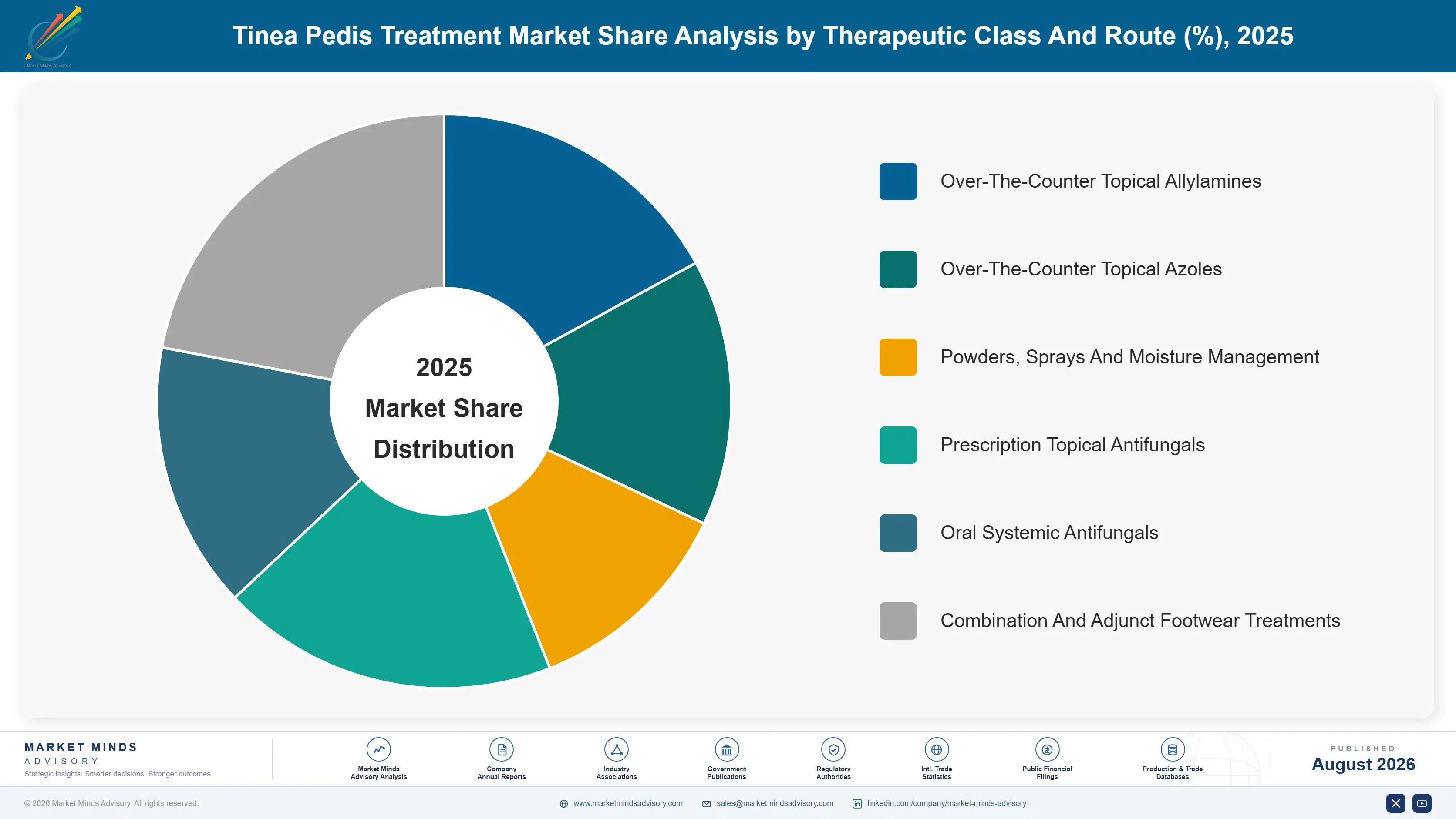
Segmentation follows therapeutic class and route, because those determine whether treatment reaches the nail reservoir, how long a course runs, whether a prescriber or a shelf selects it, and what a supplier can realise per episode. Infection subtype and body site both cut across every class rather than separating them, which makes either a weak primary dimension.
tinea-pedis-treatment-market-growth-market-share-analysis-1787299878037

Oral Systemic Antifungals

The fastest class at 6.6%, exactly 1.50 times the market rate, and the only one that reaches the toenail reservoir carried by roughly 39% of cases. Oral terbinafine and itraconazole clear skin and nail together over courses of six to twelve weeks, which finally addresses the reinfection cycle rather than repeatedly suppressing its symptoms. Growth is driven by clinical recognition of the reservoir and by pharmacist prescribing rights in several countries removing the physician appointment that previously blocked access. Hepatic monitoring requirements and drug interaction caution keep this from becoming a first-line option for straightforward interdigital disease. Access rather than evidence was always the constraint on this class. Interaction caution keeps it second line.
CAGR 6.6%

Combination And Adjunct Footwear Treatments

Second fastest at 6.1%, covering antifungal shoe sprays, in-shoe treatments, and medicated foot powders sold alongside a primary topical rather than instead of it. Growth reflects a genuine clinical point that the category took decades to make properly: reinfection frequently comes from the shoe rather than from the skin, and treating one without the other simply restarts the cycle. Realised value per episode rises meaningfully when an adjunct attaches to the primary purchase. Evidence for individual products varies considerably, and the strongest support sits with straightforward moisture management rather than with any particular active ingredient. Attachment at the shelf rather than advertising decides how much of it sells. Moisture management has the best evidence.
CAGR 6.1%
Full segment breakdown across 6 segments available in the complete report.

Regional Architecture and Country Demand Map

Prevalence and spending diverge sharply here, since the climates producing the most infection are rarely the ones spending most per episode. East Asia leads on Japanese consumer intensity combined with Chinese volume, while South Asia sits well above its band on prevalence and resistance together.

East Asia

Twenty-seven percent, within the framework band, and Japan supplies a disproportionate share of it: athlete's foot is treated as a mainstream self-care category there with per-capita spending among the highest anywhere, supported by an unusually developed range of formats including gels, aerosols, and liquid applicators. Domestic brands hold most of that volume rather than global ones. Chinese demand adds scale at far lower unit prices through retail pharmacy expansion. Korean and Taiwanese markets are smaller and closer to Japanese patterns in format sophistication. Growth at 5.2% runs above the global rate on Chinese volume rather than on Japanese maturity. Format innovation here consistently arrives years ahead of Western markets. Global brands hold less here than anywhere.
Share: 27% | CAGR: 5.2% (2026 to 2036)

North America

Twenty-five percent, and the character here is a large mainstream retail category with heavy brand advertising and grocery as well as pharmacy distribution. Terbinafine and tolnaftate brands dominate shelf space, with prescription topicals reserved largely for treatment failures and for diabetic patients where the clinical stakes are higher. Self-diagnosis rates are at the high end globally, since pharmacist consultation is less embedded than in European systems. Growth at 3.6% sits below the global rate, reflecting a mature category where volume tracks population and recurrence rather than any expansion in the treated group. Online and grocery channels have taken share from pharmacy steadily, which removes even the incidental pharmacist contact that used to catch some misdiagnosed cases before purchase.
Share: 25% | CAGR: 3.6% (2026 to 2036)
Regional intelligence for 5 additional markets available in the complete report: Western Europe, South Asia and Pacific, Latin America, Middle East and Africa, Eastern Europe. Contact sales@marketmindsadvisory.com.
tinea-pedis-treatment-market-growth-country-cagr-analysis-1787299878562

Selling A Cure People Abandon

Only 27% of users finish the course, 34% are back within a year, and 39% of them carry a nail reservoir that no topical product ever reaches. Value comes from designing for completion, from routing reservoir cases to oral therapy, from attaching adjuncts that break reinfection, and from building pharmacist consultation into a self-selected purchase.

Design The Pack So Completion Is Visible

People stop at day three because the itching has gone and nothing in the product reminds them the infection has not. Packs with dated dosing panels, blister-style day markers, or a fixed course quantity rather than an open tube lift completion measurably, and brands testing them report course completion moving from 27% toward the low forties. Higher completion cuts recurrence, which sounds commercially self-defeating and is not, since satisfied users recommend and dissatisfied ones switch brand at the next episode. The design change costs almost nothing to make. Nobody has made it seriously.
Market Impact: Completion moves from 27% toward roughly 40% overall

Route Nail Reservoir Cases Toward Oral Therapy

Roughly 39% of sufferers carry toenail infection that no topical foot product will ever reach, so they reinfect themselves indefinitely and blame the cream. Packaging and pharmacist prompts that ask about toenail appearance and direct those users to oral therapy remove a large block of guaranteed treatment failure from the category. A brand that does this loses some repeat topical volume and gains the trust that determines which pack the same household reaches for next time. Very few manufacturers will say it out loud. It is the most uncomfortable recommendation in this report.
Market Impact: Addresses the 39% of sufferers carrying nail reservoirs

Attach An Adjunct That Breaks The Reinfection Loop

Reinfection frequently comes from footwear rather than from residual skin infection, and an antifungal shoe treatment or moisture management product sold alongside the primary topical raises realised value per episode by roughly 55% while addressing a genuine clinical gap. Adjuncts also carry higher margin than the core topical, which is under permanent generic pressure. The attachment happens at the shelf or at the pharmacy counter, so placement and pharmacist familiarity matter far more than any advertising spend behind it. Own-label ranges have not yet followed into adjuncts, which leaves the tier defensible for now.
Market Impact: Adjuncts raise realised episode value by roughly 55%

Build Pharmacist Consultation Into The Purchase

Around 86% of episodes begin with no clinical assessment and a meaningful share of them are eczema, contact dermatitis, or psoriasis rather than any fungal infection at all. Pharmacist training programmes covering differential appearance, nail involvement, and referral triggers cost perhaps 1.8 million dollars annually across a major market and reduce the wasted purchases that generate apparent treatment failure. Markets with embedded pharmacist consultation show measurably lower category dissatisfaction, which is the asset every brand here is quietly spending down. Nothing else rebuilds it as cheaply. Advertising rebuilds nothing here.
Market Impact: Pharmacist training costs 1.8 million dollars a year

Who Controls the Margin Pool

Concentration reaches 41% across the top five measured on annual retail and prescription revenue from tinea pedis products, which is moderate and reflects an unusual split between global consumer health companies and very strong regional players. Japanese domestic brands hold most of their own market, and Indian manufacturers dominate a South Asian category several times larger by volume than by value. Leader and challenger sit close together and their positions rest on entirely different geogra
Competitive activity runs on three fronts. Shelf position and pack recognition is the first, since 86% of purchases are self-selected with no professional input at all. Format innovation is the second, where gels, sprays, and single-application products compete on convenience rather than on efficacy. Pharmacist relationships are the third, and they matter most in exactly the markets where category trust is highest.

Pressure comes from two directions. Generic and retailer own-label terbinafine at a fraction of branded pricing keeps compressing the core topical tier with no realistic route back to premium. And resistance emerging in South Asia threatens the molecule that carries most of the category's volume and its whole reputation for short effective courses worldwide.
tinea-pedis-treatment-market-growth-company-positioning-matrix-1787299879083

Competitive Moat and Risk Dimensions

BAYER

Moat: Multi-brand shelf coverage

Holding several established antifungal foot brands across different price tiers and formats means one company occupies much of the shelf a self-selecting consumer scans, which matters enormously when 86% of purchases involve no professional advice. That presence took decades to assemble. A single-brand competitor is choosing one position on a crowded shelf.
BAYER

Risk: Generic terbinafine erodes the core

The active ingredients carrying most of this category came off patent long ago, and retailer own-label terbinafine sells at a fraction of branded pricing with identical composition. Brand equity holds a price premium that narrows every year as consumers become more comfortable with generic equivalence. Format and adjunct differentiation are the only defences, and both are copyable.
HALEON

Moat: Allylamine brand recognition globally

An allylamine brand recognised across many markets carries the association with the shortest effective course, which is the one genuine therapeutic advantage available in topical treatment of this condition. That recognition drives self-selection at the shelf far more reliably than any ingredient claim on a pack does. It also travels, which regional brands with stronger local positions cannot easily do.
HALEON

Risk: Resistance threatens the lead molecule

Terbinafine resistance spreading from South Asia attacks precisely the molecule this position depends upon, and the alternatives are slower acting, harder to explain at retail, and less established with consumers. A brand identified with one active ingredient inherits whatever happens to that ingredient clinically. Reformulating around azoles would surrender the shorter-course advantage entirely.

Players Tracked

Prominent Players

Bayer
Haleon
Kenvue
Sato Pharmaceutical
Perrigo

Other Key Players

Reckitt Benckiser
Taisho Pharmaceutical
Kobayashi Pharmaceutical
Rohto Pharmaceutical
Pola Pharma
Glenmark Pharmaceuticals
Sun Pharmaceutical Industries
Cipla
Zydus Lifesciences
Galderma
Bausch Health
Journey Medical
Encube Ethicals
Menarini
Teva Pharmaceutical Industries

Recent Developments

FEBRUARY 2025

Consumer health company introduces fixed-course pack format

A consumer health manufacturer launched an antifungal foot treatment in a fixed-course pack with dated dosing panels, replacing an open tube format, and aimed explicitly at raising completion rates. The launch was a product introduction rather than any joint venture, acquisition, or arrangement with a packaging supplier.
Signal: Designing for completion rather than for symptom relief is the first genuine innovation here in years
MAY 2025

Regulator extends pharmacist prescribing to oral terbinafine

A national medicines regulator permitted pharmacists to supply oral terbinafine for confirmed fungal foot and nail infection under a defined protocol, removing the physician appointment previously required. The change was a regulatory decision rather than any commercial arrangement, industry submission settlement, or agreement with manufacturers.
Signal: Reaching the nail reservoir needs oral therapy, and access rather than evidence was always the blocker
AUGUST 2025

Dermatology society publishes guidance on resistant dermatophyte management

A national dermatology society issued guidance on identifying and managing terbinafine-resistant dermatophyte infection, recommending itraconazole regimens and cautioning against topical steroid combinations. The publication was independent society guidance rather than any manufacturer-sponsored programme or commercial research arrangement. Topical monotherapy was discouraged in confirmed resistant cases.
Signal: Resistance has moved from a South Asian problem to something Western dermatologists now write guidance about

Cheap Molecules, Expensive Shelves

Active pharmaceutical ingredient is a small part of the cost here, running about 14% of cost of goods, since terbinafine and the common azoles are long-established generics produced at scale in India and China. Cream and gel base excipients add roughly 19%, packaging and applicators around 22%, and manufacturing the remainder. Trade and advertising spend absorbs far more revenue than the whole cost of goods does.
Bulk drug supply concentration is the exposure that matters. Indian Ministry of Commerce trade reporting has documented persistent dependence on Chinese intermediates and key starting materials across antifungal and anti-infective production, which the Indian production-linked incentive scheme for bulk drugs was introduced specifically to address. Intermediate pricing moved sharply during periods of Chinese production restriction, and formulators holding one qualified source absorbed it rather than switching.

The competitive disadvantage mechanism runs through packaging and format investment rather than through ingredient purchasing. Every competitor buys the same generic actives at broadly similar terms, so the differentiation and the cost both sit in applicator design, pack format, and shelf presence. A manufacturer investing in fixed-course packs and novel applicators carries higher unit cost and defends price; one competing on the same tube as own-label does not.
tinea-pedis-treatment-market-growth-cost-volatility-analysis-1787299879278

Qualify a second source for every antifungal active

Terbinafine and the common azoles come from a concentrated set of producers, and intermediate supply is more concentrated still, so a single qualified source is a genuine exposure rather than a theoretical one. Regulatory change notification for a second source takes months and cannot be started once supply has tightened. The cost is modest against upstream disruption.

Compete on format and applicator rather than on active

Own-label terbinafine has identical composition and a fraction of the price, so any argument resting on the molecule is already lost before it starts. Fixed-course packs, single-application formats, and applicators that reach between toes without contamination all defend a premium that ingredient claims cannot. Format investment raises unit cost and protects realised price far more than advertising does.

Attach higher-margin adjuncts to the core topical purchase

The core topical tier is under permanent generic and own-label pressure with no realistic path back to premium pricing. Antifungal footwear treatments and moisture management products carry considerably better margin, address a genuine reinfection route, and attach at the same shelf. Raising attachment rate improves realised value per episode without needing any price increase on the primary product.

Portfolio Architecture for Margin Defence

Three tiers describe this business and the spread is set by whether a product can be copied at own-label. Core topical antifungals sit at the bottom, where the molecules are decades off patent and retailers sell identical composition at a fraction of the price. Differentiated formats sit higher on applicator and course design. Prescription topicals and oral therapy occupy a third tier reached through a professional rather than a shelf.
The tension is that the copyable tier holds the shelf. A brand present in the mainstream tube format retains the facings, the promotional slots, and the consumer recognition through which anything better-margined is discovered. Manufacturers who retreated up-tier for margin reasons found their premium formats sitting on a shelf their brand no longer commanded, discovered by nobody.

High-value pools concentrate where a professional is involved. Pharmacist-recommended purchases carry higher basket value and considerably lower return rates, and prescription and oral therapy sit outside own-label competition entirely because a retailer cannot copy a supply protocol. Building pharmacist familiarity therefore does more for realised value than any shelf negotiation achieves, and it protects against own-label substitution in a way that price never can.

Volume / Commodity-Adjacent Tier

Core over-the-counter topical creams and solutions containing long-established generic actives, sold against own-label equivalents at a fraction of the price. Margin compresses steadily, but this tier holds the shelf facings through which everything above it is discovered.
Gross Margin: 38-42%

Premium / Certified Tier

Differentiated formats including fixed-course packs, single-application treatments, gels, and applicators designed for interdigital use. Margin reflects design and convenience that own-label ranges have not copied, plus the completion benefit that reduces dissatisfaction with the category.
Gross Margin: 52-57%

Sustainability / Regulatory / Next-Generation Tier

Prescription topicals, oral systemic therapy, and adjunct footwear treatments recommended by a pharmacist or prescriber rather than self-selected. Best margin because a retailer cannot copy a supply protocol and because professional recommendation carries a basket premium.
Gross Margin: 60-66%
tinea-pedis-treatment-market-growth-portfolio-architecture-1787299879780

High-value Sub-segments and Strategic Watch-out

Oral Systemic Antifungals

Fastest growth at 6.6%, exactly 1.50 times the market rate, and the only route to the toenail reservoir carried by roughly 39% of cases. Pharmacist prescribing rights are widening access, and no retailer own-label range can compete inside a supply protocol. Nothing else clears the reservoir.
Gross Margin: 60-66%

Adjunct Footwear Treatments

Strong margin and 6.1% growth, addressing reinfection from the shoe rather than the skin, and raising realised value per episode by roughly 55% when attached. Attachment happens at the shelf, so placement and pharmacist familiarity matter more than advertising. Own-label has not followed here yet.
Gross Margin: 60-66%

Core Topical Antifungal Creams

The volume core under permanent own-label pressure, since the actives are decades off patent and retailers sell identical composition far more cheaply. It nonetheless holds the shelf facings and consumer recognition through which every higher-margin format is ever discovered. Retreating up-tier strands the premium formats.
Gross Margin: 38-42%

Terbinafine-Dependent Positions

The strategic watch-out, since resistant dermatophyte strains spreading from South Asia attack the exact molecule carrying most of this category's volume and its reputation for short courses. The alternatives are slower and considerably harder to explain at a retail shelf. Reformulating surrenders the short-course claim.
Gross Margin: 38-42%

How These Purchases Repeat

Demand here repeats through recurrence rather than through any subscription or maintenance logic. Around 34% of treated cases return within twelve months, driven by incomplete courses, untreated nail reservoirs, and re-exposure in the same shoes, and each return produces a fresh retail purchase. That gives the category unusually predictable volume without any customer relationship whatsoever, since nobody registers, nobody is followed up, and nobody in the supply chain knows who any of these pur
Stickiness runs on memory rather than on satisfaction. A returning sufferer reaches for whatever they used last time on the reasonable ground that it appeared to work, which rewards shelf recognition heavily and punishes any brand absent at the moment of need. Pharmacist-recommended purchases stick harder because the recommendation carries authority the pack cannot. Prescription and oral therapy stick hardest, being tied to a professional relationship rather than to a shelf.

Buyer profiles have shifted only in channel. Grocery and online now take share from pharmacy in several markets, which removes the pharmacist from an already self-diagnosed purchase. That shift raises the proportion of purchases made on pack recognition alone, which rewards the widest shelf presence and quietly worsens the misdiagnosis problem underneath.
tinea-pedis-treatment-market-growth-end-use-penetration-index-1787299880270

What We Would Tell a Board

These are among the four positions where our research anticipates prominent divergence between winners and laggards over the coming forecast period. Each is grounded in the demand model, the regulatory perimeter, and the announced capacity pipeline.
01 / COMPLETION PACK DESIGN

People stop at day three because nothing tells them otherwise

Symptoms clear in about three days while mycological cure needs one to two weeks, and only 27% of users keep applying past the point where they feel better. Fixed-course packs with dated dosing panels or day markers lift completion toward the low forties in testing, which cuts recurrence and raises satisfaction at the same time. That sounds commercially self-defeating and is not, because a satisfied user recommends the brand while a dissatisfied one switches brand at the very next episode without a moment's hesitation.
02 / NAIL RESERVOIR ROUTING

Two in five will reinfect themselves whatever you sell them

Roughly 39% of tinea pedis sufferers carry concurrent toenail infection that no topical foot preparation penetrates in any useful quantity, so they reinfect the skin indefinitely and reasonably blame the cream for it. Packaging and pharmacist prompts asking about toenail appearance, and directing those users toward oral therapy, remove a large block of guaranteed failure from the category. It costs some repeat topical volume and buys the trust that determines which pack a household reaches for at the next episode.
03 / ADJUNCT ATTACHMENT RATE

The shoe reinfects the foot and nobody sells for that

Reinfection frequently originates in footwear rather than in residual skin infection, and an antifungal shoe treatment or moisture management product attached to the primary purchase raises realised value per episode by around 55%. Adjuncts also carry better margin than a core topical under permanent own-label pressure with no route back to premium pricing. Attachment happens at the shelf and at the pharmacy counter, so placement and pharmacist familiarity determine the outcome far more than any advertising budget behind the product ever does.
04 / PHARMACIST CONSULTATION INVESTMENT

Eighty-six percent diagnose themselves at a shelf

Almost nobody sees a clinician at all before treating this, and eczema, contact dermatitis, and psoriasis of the foot all look close enough that consumers cannot separate them without help from anybody. Pharmacist training on differential appearance, nail involvement, and referral triggers costs around 1.8 million dollars annually across any major market. It reduces the wasted purchases that generate every apparent treatment failure, which is precisely the category trust that every brand here has been quietly spending down for years now.

Engagement Snapshot From the Field

A live engagement with an industry participant carrying material or product regulatory and market exposure ahead of a defining policy shift, showing how our research translates into a defensible multi-year portfolio strategy.
MARKET MINDS ADVISORY · CLIENT ENGAGEMENT SUMMARY
Tinea Pedis Treatment Producer Strategic Portfolio Review and Transition Roadmap 2026·Investment Scenario on Tinea Pedis Treatment Exposure Evaluation 2025-26
CLIENT PROFILE
A consumer health manufacturer with approximately 190 million dollars in annual antifungal foot care revenue (client-reported, unverified by MMA), selling topical creams and solutions across Europe and Asia through pharmacy and grocery channels. The range was built on core topical formats, carried no adjunct products, and had lost share to retailer own-label for four consecutive years.
STRATEGIC CHALLENGE
Volume had held while realised price fell in every market, and management proposed matching own-label pricing on core formats to defend shelf position. The board wanted an independent view on whether price competition against identical composition was winnable before approving a margin reduction across the whole portfolio in every market served.
MMA APPROACH
We surveyed purchasers on course completion, recurrence, toenail involvement, and what they had actually been treating. Shelf audits established facings, price gaps, and adjunct availability across channels. Pharmacist consultation practice was compared between markets, and realised value per treatment episode was modelled both with and without adjunct attachment at the shelf.
KEY FINDINGS
  1. Only 26% of surveyed purchasers had completed the recommended course, and almost all of the remainder had stopped within four days of starting when symptoms subsided.
  2. Around 41% reported visible toenail changes, meaning a large share of the client's repeat purchasers were reinfecting themselves from a reservoir no product in the range could reach.
  3. Roughly one in seven purchasers described symptoms more consistent with eczema or contact dermatitis than with fungal infection, and none had sought any assessment.
  4. Markets with embedded pharmacist consultation showed markedly lower reported dissatisfaction and higher repeat purchase of the same brand than self-service channels did.
CLIENT PROFILE
A consumer health manufacturer with approximately 190 million dollars in annual antifungal foot care revenue (client-reported, unverified by MMA), selling topical creams and solutions across Europe and Asia through pharmacy and grocery channels. The range was built on core topical formats, carried no adjunct products, and had lost share to retailer own-label for four consecutive years.
STRATEGIC CHALLENGE
Volume had held while realised price fell in every market, and management proposed matching own-label pricing on core formats to defend shelf position. The board wanted an independent view on whether price competition against identical composition was winnable before approving a margin reduction across the whole portfolio in every market served.
MMA APPROACH
We surveyed purchasers on course completion, recurrence, toenail involvement, and what they had actually been treating. Shelf audits established facings, price gaps, and adjunct availability across channels. Pharmacist consultation practice was compared between markets, and realised value per treatment episode was modelled both with and without adjunct attachment at the shelf.
KEY FINDINGS
  1. Only 26% of surveyed purchasers had completed the recommended course, and almost all of the remainder had stopped within four days of starting when symptoms subsided.
  2. Around 41% reported visible toenail changes, meaning a large share of the client's repeat purchasers were reinfecting themselves from a reservoir no product in the range could reach.
  3. Roughly one in seven purchasers described symptoms more consistent with eczema or contact dermatitis than with fungal infection, and none had sought any assessment.
  4. Markets with embedded pharmacist consultation showed markedly lower reported dissatisfaction and higher repeat purchase of the same brand than self-service channels did.
RECOMMENDED STRATEGY
Phase 1: Phase 1 (months one to nine): cancel the price matching proposal and launch fixed-course pack formats designed explicitly to raise completion rates. Phase 2: Phase 2 (months nine to twenty-four): introduce antifungal footwear adjuncts and build attachment at the shelf and the pharmacy counter. Phase 3: Phase 3 (months twenty-four to thirty-six): fund pharmacist training on differential diagnosis, nail involvement, and referral triggers. Trust rebuilds slowly and erodes quickly.
OUTCOME
Price matching was cancelled. Fixed-course formats reached completion rates in the high thirties within three quarters, adjunct attachment lifted realised value per episode materially, and pharmacist training markets showed measurably higher repeat purchase of the client's brand (client-reported, unverified by MMA). Own-label share loss stopped within the year.

Frequently Asked Questions

Foundational context covering the market sizes, CAGR, scope, country, region and competition that inform every finding below. This section is provided to cover basics and most often pre-purchase conversations, answered from the MMA Primary Research Dataset.

What is the current size of the Tinea Pedis Treatment Market?

The market is valued at USD 4.2 billion in 2025, rising to USD 4.38 billion in 2026. Scope covers topical, oral, and adjunct treatments across retail and prescription channels.

How large will the Tinea Pedis Treatment Market be by 2036?

MMA forecasts USD 6.74 billion by 2036, an increase of USD 2.36 billion over the 2026 base. That represents an expansion multiple of 1.54 times across the forecast period.

What is the CAGR for the Tinea Pedis Treatment Market 2026 to 2036?

The base case CAGR is 4.4%, with a bull case of 5.6% and a bear case of 3.2%. The historical rate from 2020 to 2025 was 3.6%, so growth is accelerating slightly.

Which segment is growing fastest?

Oral systemic antifungals at 6.6%, exactly 1.50 times the market rate. They are the only route to the toenail reservoir carried by roughly 39% of tinea pedis cases.

Who are the major companies in the Tinea Pedis Treatment Market?

Bayer, Haleon, Kenvue, Sato Pharmaceutical, and Perrigo lead on annual retail and prescription revenue. The top five hold 41%, with very strong regional brands holding much of the remainder.

Which country is growing fastest?

India at 7.4%, combining the highest dermatophyte prevalence found anywhere with terbinafine resistance that has lengthened average treatment episodes and pushed prescribers toward costlier regimens.

Report Segmentation Architecture

The full report scope spans multiple orthogonal segmentation dimensions, with cross-tabulated demand data provided for each dimension pair. Coverage extends further to regional breakdowns, trend trajectories, and the competitive detail needed to support segment-level decision-making.

By Therapeutic Class And Route

  • Over-The-Counter Topical Allylamines
  • Over-The-Counter Topical Azoles
  • Powders, Sprays And Moisture Management
  • Prescription Topical Antifungals
  • Oral Systemic Antifungals
  • Combination And Adjunct Footwear Treatments

By Care Setting

  • Retail Pharmacy Self-Selection
  • Pharmacist-Recommended Purchase
  • General Practice And Primary Care
  • Dermatology And Podiatry Clinics
  • Grocery And Online Retail

By Payment Model

  • Consumer Out-Of-Pocket Retail Purchase
  • Public Reimbursement For Prescription Therapy
  • Commercial Insurance Prescription Coverage
  • Pharmacist Supply Under Protocol
  • Institutional And Occupational Health Supply

By Region

  • East Asia
  • North America
  • Western Europe
  • South Asia and Pacific
  • Latin America
  • Middle East and Africa
  • Eastern Europe

Scope, Methodology, and Coverage

Every figure in this report is reproducible from documented input assumptions. The scope below maps the historical period, the forecast horizon, the segmentation dimensions, and the countries covered, alongside the underlying primary and qualitative methodology.
Historical Period
2020 to 2025
Forecast Period
2026 to 2036
Base Year
2025 (USD billions; MMA Primary Research Dataset, August 2026)
Market Definition
This market comprises pharmaceutical treatments indicated for tinea pedis across interdigital, moccasin, and vesiculobullous presentations, measured at realised prices across retail, pharmacist-supplied, and prescription channels. Class coverage spans over-the-counter topical allylamines, over-the-counter topical azoles, medicated powders, sprays and moisture management products, prescription topical antifungals, oral systemic antifungals prescribed for foot involvement, and combination and adjunct footwear treatments sold for the same indication. Onychomycosis-specific nail lacquers and laser devices, tinea infections at other body sites, general foot care and podiatry services, non-medicated hosiery and insoles, and topical corticosteroid preparations without an antifungal component fall outside scope.
Quantitative Units
USD billions (current prices); treatment episodes per year; realised price per episode; course completion rate
Segmentation Dimensions
By Therapeutic Class And Route; By Care Setting; By Payment Model; By Region
Regions Covered
East Asia, North America, Western Europe, South Asia and Pacific, Latin America, Middle East and Africa, Eastern Europe
Countries Covered
Japan, China, South Korea, Taiwan, India, Indonesia, Thailand, Vietnam, Philippines, Australia, USA, Canada, Mexico, Brazil, Colombia, Argentina, Germany, France, Italy, Spain, UK, Netherlands, Belgium, Poland, Czechia, Romania, Turkey, Saudi Arabia, UAE, Egypt, Nigeria, South Africa, and additional markets relevant to this sector
Key Companies Profiled
Bayer, Haleon, Kenvue, Sato Pharmaceutical, Perrigo, Reckitt Benckiser, Taisho Pharmaceutical, Kobayashi Pharmaceutical, Rohto Pharmaceutical, Pola Pharma, Glenmark Pharmaceuticals, Sun Pharmaceutical Industries, Cipla, Zydus Lifesciences, Galderma, Bausch Health, Journey Medical, Encube Ethicals, Menarini, Teva Pharmaceutical Industries
Quantitative Methodology
Primary survey, n=3,800 respondents, Q4 2025, six countries; demand-side model with trade association cross-validation
Qualitative Methodology
47 expert interviews, Q4 2025; applied to validate demand model assumptions, identify emerging dynamics, and assess competitive positioning
Report Format
PDF and XLSX data workbook (Word format preview document)
Publisher
Market Minds Advisory
Report Code
MMA-2026-HLT-455
Published
August 2026
Contact
sales@marketmindsadvisory.com | www.marketmindsadvisory.com

Purchase the full Tinea Pedis Treatment Market Report (2026 to 2036).

The full report sizes tinea pedis treatment across six therapeutic classes, five care settings, five payment models, and seven regions, with country detail for the thirty largest markets. Course completion and recurrence are quantified by class and format, since incomplete treatment rather than incidence drives most repeat volume in this category. Concurrent toenail involvement is measured against treatment choice to identify where topical therapy is destined to fail. Competitive profiling covers twenty companies on annual retail and prescription revenue. Terbinafine resistance prevalence is tracked by country alongside its effect on episode duration.
Course completion and recurrence quantified by class and format
Concurrent toenail involvement measured against treatment choice
Terbinafine resistance prevalence tracked by country and episode
Own-label price gaps benchmarked across pharmacy and grocery
Pharmacist consultation practice compared across major markets
Adjunct attachment rates modelled against realised episode value

Built For The People Who Decide

From boardroom strategy to bench-side execution, this report is read cover-to-cover by leaders shaping the next decade of their industry, turning demand scenarios, market dynamics and valuation benchmarks into decisions.
CXOs/ Presidents/ VPs/ Managers
M&A and Corporate Development
Strategy Teams and R&D Heads
Procurement and Product Directors
Regulatory and Compliance Leaders
Investor Relations and Equity Analysts