Market Minds Advisory
Time Sensitive Networking TSN Market

Time Sensitive Networking TSN Market: Time Sensitive Networking Market: Determinism Economics, Migration Risk and Vendor Neutrality 2026 to 2036

Factory networks have run on incompatible proprietary protocols for thirty years because each vendor wanted the lock-in. This standard removes that, which explains both why customers want it and why adoption has been slow.

Lead Analyst

Published

September 2026

Make Smarter Decisions with Customized Research Insights

Request a free sample report and evaluate market opportunities, growth trends, and competitive dynamics relevant to your business needs.

2025 MARKET VALUE$1.9BMarket Size 2025
2036 FORECAST VALUE$8.6BBase Case , 2026 to 2036
CAGR 2026 TO 203614.7 %Bull 16.0% / Bear 13.4%
INCREMENTAL OPPORTUNITY$6.4BNet 10- year value creation
EXPANSION MULTIPLE3.91x2036 value over 2026 base
Strategic Levers
M&A Pipeline
Regional Outlook
Country Rankings
Competitive Intelligence
Segmental Deep-dive
Call-Us : 91 93563 13602

Executive Snapshot and Market Trajectory.

Factory networks have run on incompatible proprietary protocols for thirty years, and every vendor was perfectly happy about that. This standard removes the incompatibility, which explains both why customers want it badly and why the vendors who benefited from the old arrangement have moved slowly.
The market reaches USD 2.2 billion in 2026 and USD 8.6 billion by 2036, a 3.91 times expansion at 14.7% annually. TSN-capable industrial switches and bridges grow at 22.1%, half again the market rate of 14.7%, because deterministic traffic needs hardware scheduling that ordinary industrial switches simply cannot perform. East Asia holds 36% of global spending, above the usual band ceiling, and India compounds fastest of any market at 23.5% on newly built manufacturing capacity.
Five suppliers hold 54% of TSN-capable equipment and silicon revenue, concentrated among firms that already held strong industrial automation positions before the standard existed. Siemens, Cisco Systems, Rockwell Automation, Belden and Analog Devices lead the field between them. The uncomfortable question sitting underneath this standard is whether an open network genuinely serves the interests of vendors whose control systems long depended on a closed one.
Market Definition
This report covers time sensitive networking equipment and silicon by product class: TSN-capable industrial switches and bridges, TSN endpoint controllers and network interface silicon, network configuration and scheduling software, TSN-capable industrial controllers and drives, conformance testing and validation tools, and gateway devices bridging legacy fieldbus protocols. It excludes general enterprise networking equipment without deterministic scheduling, conventional industrial fieldbus hardware, wireless industrial networks, programmable logic controllers without TSN capability, and network installation or cabling services.
Base Year Value
$1.9B in 2025 (MMA Primary Research Dataset, September 2026)
Forecast Period
2026 to 2036, eleven discrete annual values
CAGR
14.7% base case. Bull 16.0%. Bear 13.4%.
Fastest Growth Segment
TSN-Capable Industrial Switches And Bridges: 22.1% CAGR
Fastest Growth Country
India: 23.5% CAGR
Fastest Growth Region
South Asia and Pacific: 16.9% CAGR
Largest Region
East Asia: 36% of 2025 global value
Market Leaders
Siemens, Cisco Systems, Rockwell Automation, Belden and Analog Devices lead on TSN-capable equipment and silicon revenue. Source: MMA Analysis.
Primary Survey
n=3,800 procurement and R&D decision-makers, Q4 2025, six countries
Methodology
Demand-side build-up, cross-validated against public data, 47 expert interviews

Time Sensitive Networking TSN Market Forecast Scenarios

time-sensitive-networking-tsn-market-size-forecast-scenario-1789995062149
Between 2020 and 2025 the category compounded at 13.5%, from a base small enough that the percentage flatters the actual volumes involved. Standards work completed, silicon arrived, and demonstration projects proliferated at every trade show in the industry. Actual production deployment lagged well behind the enthusiasm, because replacing a working factory network carries risk that no efficiency argument compensates for adequately.
The base case holds 14.7% on three mechanisms. Newly built manufacturing capacity across India, Southeast Asia and Mexico specifies deterministic networking from the design stage, where no migration risk exists at all. Machine builders are shipping TSN-capable equipment because their customers increasingly ask for it in tenders. And converging information and operational technology keeps pushing plants toward one network carrying both control traffic and everything else, which is precisely what the standard was written to permit.
The bull case at 16.0% assumes automotive and semiconductor manufacturers standardise faster than announced, since both build new capacity continuously and neither has legacy migration problems on greenfield lines. The bear case at 13.4% is vendor reluctance: automation suppliers whose proprietary protocols created durable lock-in have limited commercial reason to accelerate a standard that removes it.

Determinism On Standard Ethernet

Industrial networking has been a deliberate mess for three decades. A large plant typically runs five incompatible protocols, each tied to a different automation vendor, and each requiring its own cabling, spares, engineering skills and gateway devices to talk to anything else. Nobody designed that outcome, but every vendor benefited from it, and none had a commercial reason to fix it on their own.
TOP FIVE CONCENTRATION54%Held by firms with existing industrial automation positions already
SCHEDULING JITTER BOUND1 microsecondTiming variation guaranteed across a properly configured deterministic path
NETWORK MIGRATION DURATION19 monthsFrom planning to full production operation across an existing plant
PROTOCOL COUNT PER PLANT5 protocolsIncompatible industrial networks typically running inside one large facility
CONFIGURATION SOFTWARE SHARE29%Scheduling and management tooling within total project spend
GREENFIELD SPECIFICATION RATE41%New manufacturing lines specifying deterministic networking during design
The standard fixes it by adding scheduling to ordinary Ethernet so that control traffic arrives within roughly a microsecond of when it should, which is what makes a network deterministic rather than merely fast. That capability requires hardware scheduling in the switch, which is why TSN-capable switches and bridges grow at 22.1% against 14.7% for the market. An ordinary industrial switch cannot be updated into one through software.
Adoption is running well ahead in new construction and well behind in existing plants. Roughly 41% of newly built manufacturing lines specify deterministic networking during design, where there is nothing to migrate and no risk to manage. Converting a running plant takes around 19 months and carries production risk that no efficiency argument fully offsets, which is why demonstration projects vastly outnumber completed conversions.
"The technical case was settled years ago and everybody agrees on it. What nobody says out loud is that the automation vendors made very good money from networks that could not talk to each other, and being enthusiastic about the standard that fixes that requires a certain amount of discipline."
Director, Industrial Networking and Automation Systems Practice · MMA Technology Practice · September 2026

Market Trends

Hardware Scheduling Requirements Force Switch Replacement

Deterministic delivery within roughly a microsecond needs scheduling built directly into the switch silicon, which means an existing industrial switch simply cannot be upgraded into a capable one through any software update at all. That makes any network conversion a full hardware replacement programme rather than a configuration exercise, and it is why TSN-capable switches and bridges grow at 22.1% against 14.7% for the market. It also explains why plant engineers who had expected a firmware path find the actual conversion cost considerably higher than anything they had budgeted for.
Market Impact: India compounds at 23.5% annually
Greenfield Lines Adopt Where Brownfield Plants Hesitate

Roughly 41% of newly built manufacturing lines now specify deterministic networking during the design stage, because a production line that does not yet exist carries no migration risk at all and no installed protocol that has to be accommodated. Converting a running plant instead takes around 19 months and puts production at risk throughout that whole period. The gap between those two adoption rates is comfortably the single most important number in this category, and it explains why suppliers who follow new construction consistently outperform those calling on existing plants.
Market Impact: Migration runs about 19 months

Market Opportunities and Growth Drivers

New Manufacturing Capacity Specifies Determinism From Design

Factories built entirely new across India, Southeast Asia and Mexico now specify deterministic networking during design rather than accommodating whatever protocols happened to arrive alongside the machinery they bought. India compounds at 23.5% annually, faster than any other market measured anywhere, on manufacturing capacity that simply did not exist five years ago and that carries no legacy network whatsoever. Those plants also avoid the five incompatible protocols that established facilities accumulated over decades, which removes both the gateway hardware and the specialist engineering skills otherwise needed to maintain all of it.
Market Impact: Plants run 5 incompatible protocols

Machine Builders Ship Capability Ahead Of Demand

Original equipment manufacturers building production machinery increasingly specify TSN-capable controllers and drives because their end customers ask about it directly in tenders, whether or not those customers hold any deployment plan at all. That pushes real capability into the installed base well ahead of actual adoption, which is genuinely unusual and commercially rather useful for everybody involved. When a plant does eventually convert, a meaningful share of its machinery already supports the standard, which shortens the 19 month migration considerably and reduces how much equipment has to be replaced outright.
Market Impact: Conversion consumes 19 months

Market Restraints and Challenges

Incumbent Vendors Lack Commercial Reason To Accelerate

Automation suppliers built durable customer lock-in on proprietary protocols that could not interoperate at all, and a standard removing that incompatibility removes the lock-in along with it. The root cause is straightforward commercial self-interest rather than any technical objection that anybody will state openly. Commercially this slows overall adoption well below what customer demand on its own would otherwise produce. Mitigation runs through end customers writing the requirement directly into tenders, through machine builders shipping the capability regardless, and through new entrants holding no legacy position to defend at all.
Market Impact: Jitter bounded near 1 microsecond

Migration Risk Outweighs Efficiency Arguments In Running Plants

Converting a working factory network takes around 19 months and puts production at risk throughout, which no efficiency argument fully compensates for in the mind of anybody responsible for output. The root cause is that industrial networks carry control traffic where a single dropped message stops the line. Commercially this confines the great majority of all adoption to new construction projects instead. Mitigation runs through phased conversion of individual production cells, through gateway devices bridging old and new segments, and through timing any conversion to coincide with a planned line rebuild.
Market Impact: About 41% of new lines adopt
3 additional market trends, 4 additional growth drivers, and 2 additional restraints and challenges are covered in the full report. Contact sales@marketmindsadvisory.com to access the complete intelligence.

Segment CAGR and Growth Architecture

Segmentation follows product class, since each carries different replacement economics, different exposure to hardware requirements and a different buyer within the plant. Six classes cover the market, spanning switches and bridges, endpoint silicon, configuration software, capable controllers and drives, conformance testing tools and legacy protocol gateways. End-use industry and deployment route are separate dimensions handled elsewhere.
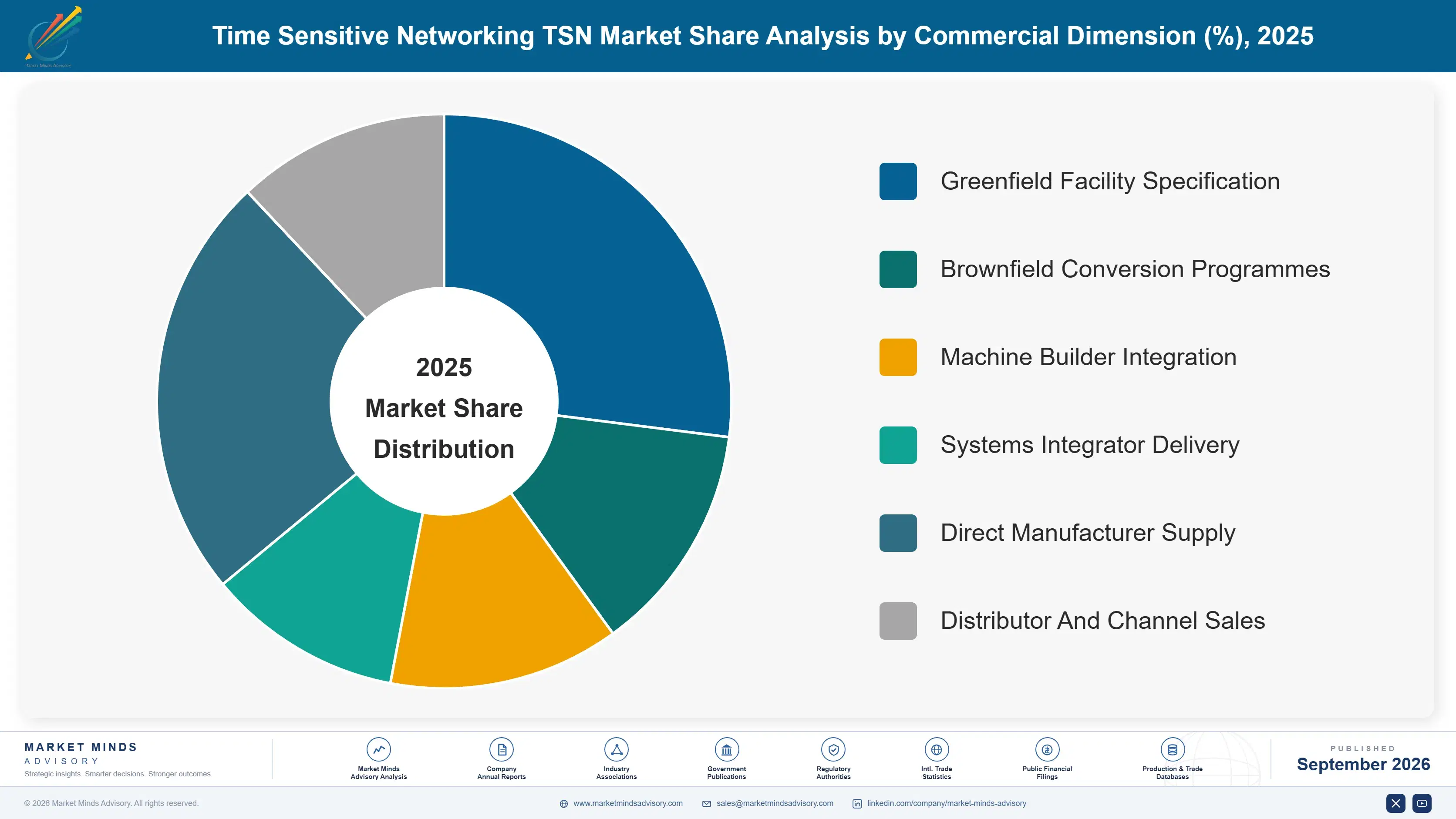
time-sensitive-networking-tsn-market-market-share-analysis-1789995062756

TSN-Capable Industrial Switches And Bridges

TSN-capable industrial switches and bridges grow at 22.1%, half again the market rate of 14.7%, because deterministic delivery within roughly a microsecond requires scheduling built directly into the switch silicon itself. An existing industrial switch simply cannot ever become capable through any software update, which makes every single conversion a hardware replacement programme rather than a configuration exercise. That is unwelcome news for the plant engineers who had budgeted for a firmware path, and rather good news indeed for the switch suppliers themselves. The segment also benefits considerably from greenfield construction, where roughly 41% of newly built manufacturing lines now specify deterministic networking during the design stage rather than afterwards.
CAGR 22.1%

Network Configuration And Scheduling Software

Network configuration and scheduling software compounds at 18.9%, because a deterministic network is only actually deterministic if somebody computes the schedule correctly, and doing that by hand across a plant of any real size is not remotely realistic. The software absorbs roughly 29% of total project spend, which routinely surprises buyers who had expected the cost to sit in the hardware. Its commercial position is considerably stronger than the hardware's in one particularly important respect: schedules are computed against a specific plant topology and configuration, so the tooling embeds itself inside the engineering workflow in a way that a replaceable piece of switch hardware never manages to achieve at all.
CAGR 18.9%
Full segment breakdown across 6 segments available in the complete report.

Regional Architecture and Country Demand Map

East Asia holds 36% of category spending, above the usual band ceiling, because manufacturing construction and automation equipment production are both heavily concentrated right across the region. Western Europe follows at 22% on automation vendor influence rather than on any deployment volume of its own.

East Asia

East Asia takes 36% of spending, above the 30% band ceiling, because manufacturing construction and automation equipment production both concentrate across the region rather than only one of them. Chinese factory building continues at a pace that nowhere else approaches, and those new lines carry no legacy protocol at all to accommodate. Japanese and South Korean automation suppliers manufacture equipment shipped worldwide, which gives the region influence beyond its own deployment. Taiwanese electronics assembly adopts selectively, wherever line synchronisation genuinely matters to the yield. Growth at 15.7% sits comfortably above the global rate, on new construction rather than on any conversion activity at existing sites. Domestic networking silicon suppliers are also expanding steadily.
Share: 36% | CAGR: 15.7% (2026 to 2036)

Western Europe

Western Europe accounts for 22% of spending, and its position rests on automation vendor influence considerably more than on deployment volume. Siemens and Belden both operate from European bases and supply worldwide, so the specification decisions taken here shape products that are then sold everywhere else. German machine builders ship capable controllers and drives into export markets worldwide, which pushes capability into installed bases very far from Europe. Existing German and Italian plants convert slowly indeed, since migration takes around 19 months and puts production at risk. Growth at 13.0% is comfortably the slowest of any region measured, on exactly that brownfield hesitancy across an installed base that works adequately.
Share: 22% | CAGR: 13.0% (2026 to 2036)
Regional intelligence for 5 additional markets available in the complete report: North America, South Asia and Pacific, Latin America, Middle East and Africa, Eastern Europe. Contact sales@marketmindsadvisory.com.
time-sensitive-networking-tsn-market-country-cagr-analysis-1789995063280

Where TSN Deals Are Actually Won

Conversion needs entirely new hardware rather than any firmware update, migration risk keeps running plants from moving at all, and the vendors who benefited most from incompatible networks have very limited reason to hurry. The four levers below follow those conditions rather than any argument about technical merits, which were settled several years ago.

Follow Construction Rather Than Conversion Programmes

Roughly 41% of all newly built manufacturing lines now specify deterministic networking during design, against a considerably lower rate at running plants, where conversion takes around 19 months and puts production at risk throughout. India compounds at 23.5% annually on manufacturing capacity that is being built entirely new from nothing. Suppliers organised around plant engineering at existing sites are calling on much the harder half of this market. Those following construction projects and machine builders instead reach the decision while it is still being made on paper rather than afterwards.
Market Impact: Roughly 41% of new lines already specify it

Sell Scheduling Software As The Durable Position

Configuration and scheduling software absorbs roughly 29% of total project spend, which routinely surprises buyers who expected the cost to sit in the hardware. It also embeds a great deal better: schedules are computed against a specific plant topology and configuration, so the tooling sits inside the engineering workflow while any individual switch stays entirely replaceable. Suppliers competing only on switch hardware are defending the genuinely substitutable part of the whole project. Those holding the scheduling tooling instead hold the part that the plant engineering team works with every single day.
Market Impact: Software absorbs fully 29% of the project spend

Reach Machine Builders Ahead Of End Customers

Original equipment manufacturers increasingly ship TSN-capable controllers and drives because their end customers ask about capability in tenders, whether or not any deployment plan exists behind the question at all. That pushes capability into installed bases ahead of adoption, and when a plant eventually converts, a meaningful share of its machinery already supports the standard. Suppliers selling to the machine builders are placed inside future conversions before those conversions have even been scheduled, which shortens the 19 month migration considerably and which no amount of direct end customer coverage ever achieves.
Market Impact: Prepositioning shortens all of those 19 month migrations

Compete Where No Legacy Position Needs Defending

Automation suppliers whose proprietary protocols created durable customer lock-in have very limited commercial reason to accelerate a standard that removes it, and their observable behaviour reflects that whatever their public position happens to say. Entrants without any legacy protocol business at all carry no such conflict, and can move at the pace that customers actually want them to. That is a genuine and durable advantage in a category where 5 incompatible protocols per plant continue to exist precisely because nobody involved ever had a commercial reason to fix any of it.
Market Impact: Plants still run 5 incompatible network protocols today

Who Controls the Margin Pool

Five suppliers hold 54% of TSN-capable equipment and silicon revenue, concentrated among firms that already held strong industrial automation positions long before this standard existed at all. Siemens, Cisco Systems, Rockwell Automation, Belden and Analog Devices lead. All participants here are assessed consistently on TSN-capable equipment and silicon revenue rather than on any broader automation or networking business that they also operate.
Competition runs on scheduling software and on conversion services considerably more than on switch hardware, since configuration absorbs roughly 29% of total project spend and embeds far more durably than any replaceable equipment does. The second dimension is legacy conflict, because suppliers whose proprietary protocols generated durable lock-in are now competing against a standard that removes precisely the historical advantage they spent decades building.

Pressure comes from enterprise networking suppliers entering industrial accounts while carrying no legacy protocol business at all to protect, which turns out to be a genuine competitive advantage in this particular category. Rankings shift wherever manufacturing is actually being built rather than where existing plants are being converted, which currently means India, Southeast Asia and Mexico above anywhere else.
time-sensitive-networking-tsn-market-company-positioning-matrix-1789995063807

Competitive Moat and Risk Dimensions

SIEMENS

Moat: Automation Installed Base Reach

Siemens holds controllers, drives and network equipment across an enormous installed base, which means a plant converting to deterministic networking is frequently converting equipment the company already supplied. That position lets it manage migration as an upgrade rather than a replacement, which addresses the production risk that stops most conversions. No entrant can reach those plants on comparable terms.
SIEMENS

Risk: Proprietary Protocol Conflict

A large installed base built on proprietary industrial protocols generated durable customer lock-in that an open standard removes. Accelerating adoption therefore erodes an advantage the company spent decades building. Customers notice that tension, and entrants without a legacy protocol business use it directly in competitive situations where the customer wants genuine vendor neutrality.
CISCO SYSTEMS

Moat: No Legacy Protocol Conflict

Cisco arrives from enterprise networking with no proprietary industrial protocol business to protect, which removes the conflict that constrains automation incumbents. That makes the company a credible advocate for genuine vendor neutrality, which is exactly what customers say they want from the standard. Scheduling and network management capability transfers directly from enterprise networking where it was already mature.
CISCO SYSTEMS

Risk: Industrial Operations Unfamiliarity

Enterprise networking experience does not automatically translate to plants where a dropped control message stops a production line and somebody is accountable for the output. Migration risk is an operations concern rather than a networking one, and plant engineers evaluate suppliers on whether they understand that. Building genuine industrial credibility takes deployments rather than product capability alone.

Players Tracked

Prominent Players

Siemens
Cisco Systems
Rockwell Automation
Belden
Analog Devices

Other Key Players

Moxa
Phoenix Contact
Beckhoff Automation
B&R Industrial Automation
Marvell Technology
NXP Semiconductors
Texas Instruments
Microchip Technology
Renesas Electronics
HMS Networks
TTTech Industrial
Broadcom
Advantech
Schneider Electric
Mitsubishi Electric

Recent Developments

MARCH 2025

Indian Manufacturing Programmes Specify Deterministic Networking

Indian manufacturing projects specified deterministic networking during facility design across several newly built plants, capacity development rather than any corporate transaction. A line that does not yet exist carries no migration risk and no installed protocol to accommodate, which removes the principal obstacle constraining adoption at established manufacturing sites everywhere.
Signal: A plant carrying no legacy network faces none of the migration risk that stops conversions everywhere else.
SEPTEMBER 2024

Machine Builders Extend Capable Controller And Drive Ranges

Production machinery manufacturers extended TSN-capable controller and drive ranges across product lines, organic development rather than any merger. End customers increasingly ask about capability in tenders whether or not they hold a deployment plan, which pushes support into installed bases well ahead of any actual network conversion.
Signal: Capability arriving inside the machinery itself prepositions suppliers for conversions that nobody has even scheduled yet.
JUNE 2025

Enterprise Networking Suppliers Broaden Industrial Account Coverage

Enterprise networking suppliers broadened commercial coverage of industrial manufacturing accounts, a commercial expansion rather than any acquisition. Entrants holding no proprietary industrial protocol business carry no conflict between advocating an open standard and protecting historical lock-in, which customers seeking genuine vendor neutrality tend to notice immediately.
Signal: Having nothing at all to defend becomes a real position when a standard removes everybody else's lock-in.

What TSN Equipment Costs

Switch silicon with hardware scheduling accounts for roughly 37% of TSN-capable switch cost, sourced from a small group of semiconductor suppliers that most equipment makers buy from rather than design themselves. Industrial-grade enclosures and thermal management take around 18%. Software development amortisation absorbs about 21%, and conformance testing with certification takes most of the remaining balance.
Networking semiconductor supply tightened through 2022 and 2023 as industrial and enterprise demand competed for the same limited foundry capacity, extending equipment lead times well beyond a year. Cisco Systems Annual Report 2023 and Analog Devices Annual Report 2023 both record component availability as a constraint on delivery during that period. Suppliers holding committed multi-year silicon allocation delivered considerably better through that period than those buying capacity against demand as it arrived.

The competitive disadvantage mechanism is software amortisation rather than silicon price. Scheduling and configuration software absorbs roughly 21% of cost and must be developed regardless of how many units a supplier ships, so a small-volume entrant carries a far higher per-unit software burden than an established supplier. Exposure concentrates among specialist entrants, whose engineering cost is comparable while their volume is nothing like it.
time-sensitive-networking-tsn-market-cost-volatility-analysis-1789995064004

Secure Networking Silicon Allocation Across Cycles

Switch silicon with hardware scheduling runs roughly 37% of equipment cost and comes from a small supplier group serving industrial and enterprise demand at once. Multi-year allocation lets a supplier quote delivery dates that plant projects can be planned around. Buying against demand means being unable to commit, which loses projects on schedule rather than capability.

Amortise Scheduling Software Across Wider Ranges

Software development absorbs roughly 21% of equipment cost and must be funded regardless of shipped volume, which penalises specialist entrants severely against established suppliers. Sharing scheduling and configuration software across switches, controllers and endpoint products spreads that expense considerably further. The discipline is product architecture rather than engineering capability, and it must be decided early rather than retrofitted afterwards.

Pool Conformance Testing Across Product Families

Conformance testing and certification absorb a meaningful share of cost and repeat for each product variant a supplier brings to market. Structuring test campaigns around product families rather than individual models spreads that work across considerably more revenue. Most suppliers discover this eventually and comparatively few organise their certification programmes deliberately around it from the start.

Portfolio Architecture for Margin Defence

Margin architecture separates on software content and replaceability. Legacy protocol gateway devices earn least, since they are transitional products competing on price and destined to disappear as conversion completes. Endpoint controller silicon sits above on integration content. Scheduling software, conformance testing tools and capable controllers earn most, because each embeds in engineering workflow or carries substantial software rather than assembled hardware.
The volume versus premium tension runs between switches and software. Switches carry the visible project volume and compete against capable competitors on delivered price. Scheduling software absorbs 29% of project spend at far better margin and embeds in the plant's engineering workflow. Suppliers organised entirely around hardware sales consistently underprice the software and then wonder where the account defensibility went.

High-value pools concentrate in scheduling software and in conversion services for running plants, neither reached through equipment capability. Scheduling software requires understanding plant topology and the engineering workflow around it. Conversion services require operational credibility that networking capability alone does not confer. Both of those take completed deployments to build, which is precisely why the current leaders are firms that were already inside these plants before the standard arrived.

Volume / Commodity-Adjacent

Legacy protocol gateway devices and basic bridging hardware, transitional products competing largely on price and destined to disappear as network conversion eventually completes. The ten point spread separates suppliers holding service attachment from those selling gateway hardware transactionally.
Gross Margin: 26% to 36%

Premium / Certified

TSN-capable switches, bridges and endpoint controller silicon, where hardware scheduling capability and industrial certification determine selection alongside price. The twelve point spread tracks silicon allocation security and software amortisation volume, both of which favour established suppliers considerably.
Gross Margin: 40% to 52%

Sustainability / Regulatory / Next-Generation

Scheduling and configuration software, conformance testing tools and TSN-capable controllers, each embedding in engineering workflow or carrying substantial software rather than assembled hardware. The sixteen point spread reflects how much is genuine software rather than tooling built per customer.
Gross Margin: 58% to 74%
time-sensitive-networking-tsn-market-portfolio-architecture-1789995064515

High-value Sub-segments and Strategic Watch-out

TSN-Capable Industrial Switches And Bridges

Grows at fully 22.1% because deterministic delivery needs scheduling built into the switch silicon rather than added afterwards through any software update. The twelve point spread here reflects silicon allocation security. Every conversion consequently becomes a full hardware replacement programme rather than a configuration exercise.
Gross Margin: 40% to 52%

Network Configuration And Scheduling Software

Grows at 18.9% because a deterministic network only works if somebody computes the schedule correctly across the whole plant topology. The sixteen point spread here reflects underlying software depth. It absorbs 29% of project spend and embeds far better than replaceable switch hardware ever does.
Gross Margin: 58% to 74%

TSN Endpoint Controllers And Interface Silicon

Grows at fully 17.4% as machine builders keep shipping capable controllers and drives well ahead of any actual customer deployment plans existing. The twelve point spread here reflects silicon integration content. Prepositioned capability shortens the later migrations that nobody has yet scheduled anywhere at all.
Gross Margin: 40% to 52%

Legacy Fieldbus Gateway Devices

Grows at 6.8%, slowest of the six product classes, on transitional products bridging old and new segments during phased plant conversions. The ten point spread here reflects service and support attachment. Demand disappears entirely as conversion completes, which every supplier involved already understands perfectly well.
Gross Margin: 26% to 36%

Why Network Choices Endure

The annuity here comes from engineering workflow rather than from any contract. A scheduling configuration is computed against a specific plant topology, and the tooling that computed it sits inside how the engineering team works every day. Switch hardware is replaceable; the schedule and the workflow around it are not, at least not without redoing work that took months. That asymmetry is why software positions outlast hardware ones in this category.
Depth varies sharply by product class. Scheduling software holding a plant's topology and configuration history is deeply embedded. Capable controllers and drives inside production machinery are fixed for the machine's operating life. Switches are genuinely replaceable between suppliers at the next refresh, and gateway devices are transitional by design. Suppliers frequently price all four as though the same defensibility applied, which it plainly does not.

The buyer has moved from plant network engineering toward facility design and machine procurement, which changes what wins. A plant engineer evaluated conversion risk against efficiency gain and mostly declined. A facility designer specifies deterministic networking during design where no risk exists. A machine builder ships capability because tenders ask. Suppliers still selling conversion to plant engineers address the buyer least likely to proceed.
time-sensitive-networking-tsn-market-end-use-penetration-index-1789995065006

What Decides TSN Adoption

These are among the four positions where our research anticipates prominent divergence between winners and laggards over the coming forecast period. Each is grounded in the demand model, the regulatory perimeter, and the announced capacity pipeline.
01 / CONSTRUCTION MARKET COVERAGE

Sell Into Lines That Do Not Exist Yet

Roughly 41% of newly built manufacturing lines now specify deterministic networking during the design stage, against a considerably lower rate at running plants where conversion takes around 19 months and puts production at risk throughout that period. India compounds at 23.5% annually on manufacturing capacity built entirely new, carrying no legacy protocols anywhere at all. Suppliers organised around plant engineering at existing sites are calling on much the harder half of this whole market, and frequently do not realise it.
02 / SCHEDULING SOFTWARE POSITION

Hold The Tooling, Not The Switches

Configuration and scheduling software absorbs roughly 29% of the total project spend, which routinely surprises buyers who had expected the cost to sit in the hardware instead. It also embeds a great deal better, since schedules are computed against a specific plant topology and the tooling then sits inside the engineering workflow, while any individual switch stays entirely replaceable. Suppliers competing only on switch hardware are defending the genuinely substitutable part of the project while quietly conceding the durable part of it.
03 / MACHINE BUILDER PREPOSITIONING

Get Inside Machinery Before Conversion Starts

Original equipment manufacturers increasingly ship capable controllers and drives because their end customers ask about capability in tenders, whether or not any deployment plan actually exists behind the question. That pushes support into installed bases well ahead of any adoption, and when a plant eventually does convert, a meaningful share of its machinery already supports the standard. Suppliers selling to the machine builders sit inside future conversions before anybody has even scheduled them, which no amount of direct coverage ever achieves.
04 / NEUTRAL POSITION ADVANTAGE

Having Nothing To Defend Sells Well

Automation suppliers whose proprietary protocols created durable customer lock-in have very limited commercial reason to accelerate a standard that removes exactly that advantage, and their observable behaviour reflects that whatever their public statements happen to say. Entrants carrying no legacy protocol business at all face no such conflict, and can move at the pace that customers actually want. That matters considerably in a category where 5 incompatible protocols per plant exist precisely because nobody involved ever wanted to fix it.

Engagement Snapshot From the Field

A live engagement with an industry participant carrying material or product regulatory and market exposure ahead of a defining policy shift, showing how our research translates into a defensible multi-year portfolio strategy.
MARKET MINDS ADVISORY · CLIENT ENGAGEMENT SUMMARY
Time Sensitive Networking TSN Producer Strategic Portfolio Review and Transition Roadmap 2026·Investment Scenario on Time Sensitive Networking TSN Exposure Evaluation 2025-26
CLIENT PROFILE
An automotive components manufacturer operating six plants across three countries, running four incompatible industrial protocols accumulated through two decades of equipment purchases and one acquisition. A new plant was already in design and the engineering team wanted to standardise the whole group on deterministic networking, which the board considered both expensive and quite possibly premature at this stage.
STRATEGIC CHALLENGE
Engineering wanted group-wide conversion on the argument that maintaining four protocols was wasteful, which was true but not obviously worth the disruption. Operations objected that conversion risked production at plants meeting their targets. Nobody had separated what the new plant should do from what the existing plants should do, and the two questions had entirely different answers.
MMA APPROACH
MMA costed deterministic networking in the new plant design against the conventional alternative, then separately modelled conversion at each existing site including production risk and the 19 month timeline. We audited which installed machinery already supported the standard, and assessed scheduling software options on how far they embedded in engineering workflow. Work drew on 47 expert interviews conducted in Q4 2025.
KEY FINDINGS
  1. Specifying deterministic networking in the new plant design cost barely more than the conventional alternative, since there was nothing at all to migrate.
  2. Conversion at the two oldest plants would have taken well over 2 years each and put production at risk on lines currently meeting every target.
  3. Around 4 in 10 of the installed machinery across the group already supported the standard, which nobody had audited before the engagement (client-reported, unverified by MMA).
  4. Scheduling software licensing decisions embedded far more deeply than switch selection did, and had been treated throughout as a fairly minor procurement item.
CLIENT PROFILE
An automotive components manufacturer operating six plants across three countries, running four incompatible industrial protocols accumulated through two decades of equipment purchases and one acquisition. A new plant was already in design and the engineering team wanted to standardise the whole group on deterministic networking, which the board considered both expensive and quite possibly premature at this stage.
STRATEGIC CHALLENGE
Engineering wanted group-wide conversion on the argument that maintaining four protocols was wasteful, which was true but not obviously worth the disruption. Operations objected that conversion risked production at plants meeting their targets. Nobody had separated what the new plant should do from what the existing plants should do, and the two questions had entirely different answers.
MMA APPROACH
MMA costed deterministic networking in the new plant design against the conventional alternative, then separately modelled conversion at each existing site including production risk and the 19 month timeline. We audited which installed machinery already supported the standard, and assessed scheduling software options on how far they embedded in engineering workflow. Work drew on 47 expert interviews conducted in Q4 2025.
KEY FINDINGS
  1. Specifying deterministic networking in the new plant design cost barely more than the conventional alternative, since there was nothing at all to migrate.
  2. Conversion at the two oldest plants would have taken well over 2 years each and put production at risk on lines currently meeting every target.
  3. Around 4 in 10 of the installed machinery across the group already supported the standard, which nobody had audited before the engagement (client-reported, unverified by MMA).
  4. Scheduling software licensing decisions embedded far more deeply than switch selection did, and had been treated throughout as a fairly minor procurement item.
RECOMMENDED STRATEGY
Phase 1: Phase one: specify deterministic networking fully in the new plant design, where the cost premium over conventional networking was negligible. Phase 2: Phase two: defer conversion at the two oldest plants until scheduled line rebuilds, rather than accepting production risk for efficiency gains. Phase 3: Phase three: select scheduling software on workflow fit rather than on price, since that decision embedded far deeper than any hardware choice.
OUTCOME
The manufacturer specified deterministic networking in the new plant and deferred conversion elsewhere to coincide with planned rebuilds (client-reported, unverified by MMA). Group network spending fell well below the original conversion proposal. Machinery capability is now audited before any network decision, which is the change that outlasted the engagement itself.

Frequently Asked Questions

Foundational context covering the market sizes, CAGR, scope, country, region and competition that inform every finding below. This section is provided to cover basics and most often pre-purchase conversations, answered from the MMA Primary Research Dataset.

What is the current size of the Time Sensitive Networking TSN Market?

Global value reaches USD 2.2 billion in 2026, measured as equipment and silicon revenue across six product classes. The 2025 base for the market is USD 1.9 billion.

How large will the Time Sensitive Networking TSN Market be by 2036?

The market reaches USD 8.6 billion by 2036, an increase of USD 6.4 billion across the forecast period. That represents 3.91 times expansion from the 2026 base.

What is the CAGR for the Time Sensitive Networking TSN Market 2026 to 2036?

The base case runs at 14.7% annually, with a bull case at 16.0% if automotive and semiconductor manufacturers standardise faster and a bear case at 13.4% if incumbent vendor reluctance continues slowing adoption.

Which segment is growing fastest?

TSN-capable industrial switches and bridges grow at 22.1%, half again the market rate of 14.7%. Deterministic traffic needs hardware scheduling that ordinary industrial switches cannot perform at all.

Who are the major companies in the Time Sensitive Networking TSN Market?

Siemens, Cisco Systems, Rockwell Automation, Belden and Analog Devices lead on equipment and silicon revenue, together holding 54%. Moxa, Phoenix Contact and TTTech Industrial hold smaller positions.

Which country is growing fastest?

India leads at 23.5%, on manufacturing capacity built entirely new that carries no legacy protocol and no migration risk whatsoever. Vietnam and Mexico follow behind it.

Report Segmentation Architecture

The full report scope spans multiple orthogonal segmentation dimensions, with cross-tabulated demand data provided for each dimension pair. Coverage extends further to regional breakdowns, trend trajectories, and the competitive detail needed to support segment-level decision-making.

By Product Class

  • TSN-Capable Industrial Switches And Bridges
  • Network Configuration And Scheduling Software
  • TSN Endpoint Controllers And Interface Silicon
  • TSN-Capable Industrial Controllers And Drives
  • Conformance Testing And Validation Tools
  • Legacy Fieldbus Gateway Devices

By End-Use Industry

  • Automotive And Component Manufacturing
  • Semiconductor And Electronics Assembly
  • Food And Beverage Processing
  • Pharmaceutical Production
  • Machine Tool And Packaging Equipment
  • Energy And Process Industries

By Commercial Dimension

  • Greenfield Facility Specification
  • Brownfield Conversion Programmes
  • Machine Builder Integration
  • Systems Integrator Delivery
  • Direct Manufacturer Supply
  • Distributor And Channel Sales

By Region

  • North America
  • Western Europe
  • East Asia
  • South Asia and Pacific
  • Latin America
  • Middle East and Africa
  • Eastern Europe

Scope, Methodology, and Coverage

Every figure in this report is reproducible from documented input assumptions. The scope below maps the historical period, the forecast horizon, the segmentation dimensions, and the countries covered, alongside the underlying primary and qualitative methodology.
Historical Period
2020 to 2025
Forecast Period
2026 to 2036
Base Year
2025 (USD billions; MMA Primary Research Dataset, September 2026)
Market Definition
This report covers time sensitive networking equipment and silicon by product class: TSN-capable industrial switches and bridges, TSN endpoint controllers and network interface silicon, network configuration and scheduling software, TSN-capable industrial controllers and drives, conformance testing and validation tools, and gateway devices bridging legacy fieldbus protocols. It excludes general enterprise networking equipment without deterministic scheduling, conventional industrial fieldbus hardware, wireless industrial networks, and network installation services.
Quantitative Units
USD millions, equipment and silicon revenue basis; deployed nodes; scheduling jitter in microseconds; migration duration in months; protocols per plant; software share of project spend as a percentage.
Segmentation Dimensions
Product class; end-use industry; deployment route and project type; geography across seven regions.
Regions Covered
North America, Western Europe, East Asia, South Asia and Pacific, Latin America, Middle East and Africa, Eastern Europe
Countries Covered
China, Japan, South Korea, Taiwan, India, Vietnam, Thailand, Australia, United States, Canada, Mexico, Brazil, Germany, Italy, France, Netherlands, Poland, Czechia, Saudi Arabia, South Africa.
Key Companies Profiled
Siemens, Cisco Systems, Rockwell Automation, Belden, Analog Devices, Moxa, Phoenix Contact, Beckhoff Automation, Marvell Technology, NXP Semiconductors, Texas Instruments, Renesas Electronics, HMS Networks, TTTech Industrial, Schneider Electric.
Quantitative Methodology
Primary survey, n=3,800 respondents, Q4 2025, six countries; demand-side model with trade association cross-validation
Qualitative Methodology
47 expert interviews, Q4 2025; applied to validate demand model assumptions, identify emerging dynamics, and assess competitive positioning
Report Format
PDF and XLSX data workbook (Word format preview document)
Publisher
Market Minds Advisory
Report Code
MMA-2026-TEC-771
Published
September 2026
Contact
sales@marketmindsadvisory.com | www.marketmindsadvisory.com

Purchase the full Time Sensitive Networking TSN Market Report (2026 to 2036).

This report sizes the global time sensitive networking market from 2026 to 2036 across six product classes, six end-use industries and seven regions. It explains why roughly 41% of newly built manufacturing lines adopt while running plants mostly defer, with conversion taking around 19 months and putting production at risk throughout. Scheduling software at 29% of project spend is analysed as the durable competitive position against replaceable switch hardware, alongside the commercial conflict facing automation vendors whose proprietary protocols created lock-in. Cost composition is sourced to company annual reports. Regional analysis explains why East Asia holds 36% of spending.
Six product classes sized through to 2036
Greenfield and brownfield adoption rates quantified separately
Scheduling software analysed as the durable competitive position
Twenty named suppliers assessed on equipment revenue
Four revenue levers with quantified commercial impact
Anonymised automotive manufacturer network engagement documented in full

Built For The People Who Decide

From boardroom strategy to bench-side execution, this report is read cover-to-cover by leaders shaping the next decade of their industry, turning demand scenarios, market dynamics and valuation benchmarks into decisions.
CXOs/ Presidents/ VPs/ Managers
M&A and Corporate Development
Strategy Teams and R&D Heads
Procurement and Product Directors
Regulatory and Compliance Leaders
Investor Relations and Equity Analysts