Market Minds Advisory
Tick Repellent Market

Tick Repellent Market: Tick Repellent Market: Permethrin On Clothing, The Mosquito Assumption and Where Lyme Disease Is Spreading

Most people buy insect repellent for mosquitoes and apply it to skin, which is close to the worst possible way to stop a tick reaching the back of a knee.

Lead Analyst

Published

September 2026

Make Smarter Decisions with Customized Research Insights

Request a free sample report and evaluate market opportunities, growth trends, and competitive dynamics relevant to your business needs.

2025 MARKET VALUE$1.6BMarket Size 2025
2036 FORECAST VALUE$3.1BBase Case , 2026 to 2036
CAGR 2026 TO 20366.2 %Bull 7.5% / Bear 4.9%
INCREMENTAL OPPORTUNITY$1.4BNet 10- year value creation
EXPANSION MULTIPLE1.82x2036 value over 2026 base
Strategic Levers
M&A Pipeline
Regional Outlook
Country Rankings
Competitive Intelligence
Segmental Deep-dive
Call-Us : 91 93563 13602

Executive Snapshot and Market Trajectory.

Ticks climb rather than fly, which means the product that works is treated clothing rather than skin spray. Almost the entire category is merchandised the other way around, next to mosquito repellent, in bottles designed for arms. The biology has been understood for decades and the planogram never reflected it.
Permethrin-treated clothing and gear grows at 9.3%, half again the market rate of 6.2%, because a treated sock and trouser leg stop the ascent at the point it starts. DEET and picaridin skin sprays follow at 6.6%. Natural and botanical repellents grow slowest at 3.1%, carrying efficacy that field data does not support against ticks specifically. Removal tools sit apart from all of them, bought at the moment of discovery.
Geography is moving faster than the industry is. Warmer winters have extended tick range northward across Europe and North America, and Poland grows fastest of any country covered at 10.4% as Lyme and tick-borne encephalitis incidence rises in areas that had neither. Concentration is moderate at 41% held by the top five. Households in newly affected areas have no inherited knowledge of ticks at all, which makes whichever brand explains the problem first the reference.
Market Definition
This market covers products sold specifically to prevent tick attachment on humans, spanning permethrin-treated clothing and gear, permethrin clothing treatment sprays, DEET and picaridin skin repellents, natural and botanical repellents, tick removal and detection tools, and area and yard treatments. Sizing is at manufacturer net revenue. Veterinary and companion animal tick products, agricultural acaricides, general mosquito-only repellents, and vaccines or therapeutics are excluded.
Base Year Value
$1.6B in 2025 (MMA Primary Research Dataset, September 2026)
Forecast Period
2026 to 2036, eleven discrete annual values
CAGR
6.2% base case. Bull 7.5%. Bear 4.9%.
Fastest Growth Segment
Permethrin-Treated Clothing And Gear: 9.3% CAGR
Fastest Growth Country
Poland: 10.4% CAGR
Fastest Growth Region
South Asia and Pacific: 8.1% CAGR
Largest Region
North America: 32% of 2025 global value
Market Leaders
SC Johnson, Spectrum Brands, Sawyer Products, Insect Shield, Reckitt Benckiser. Source: MMA Primary Research Dataset, July 2026.
Primary Survey
n=3,800 procurement and R&D decision-makers, Q4 2025, six countries
Methodology
Demand-side build-up, cross-validated against public data, 47 expert interviews

Tick Repellent Market Forecast Scenarios

tick-repellent-market-share-analysis-size-forecast-scenario-1790024000463
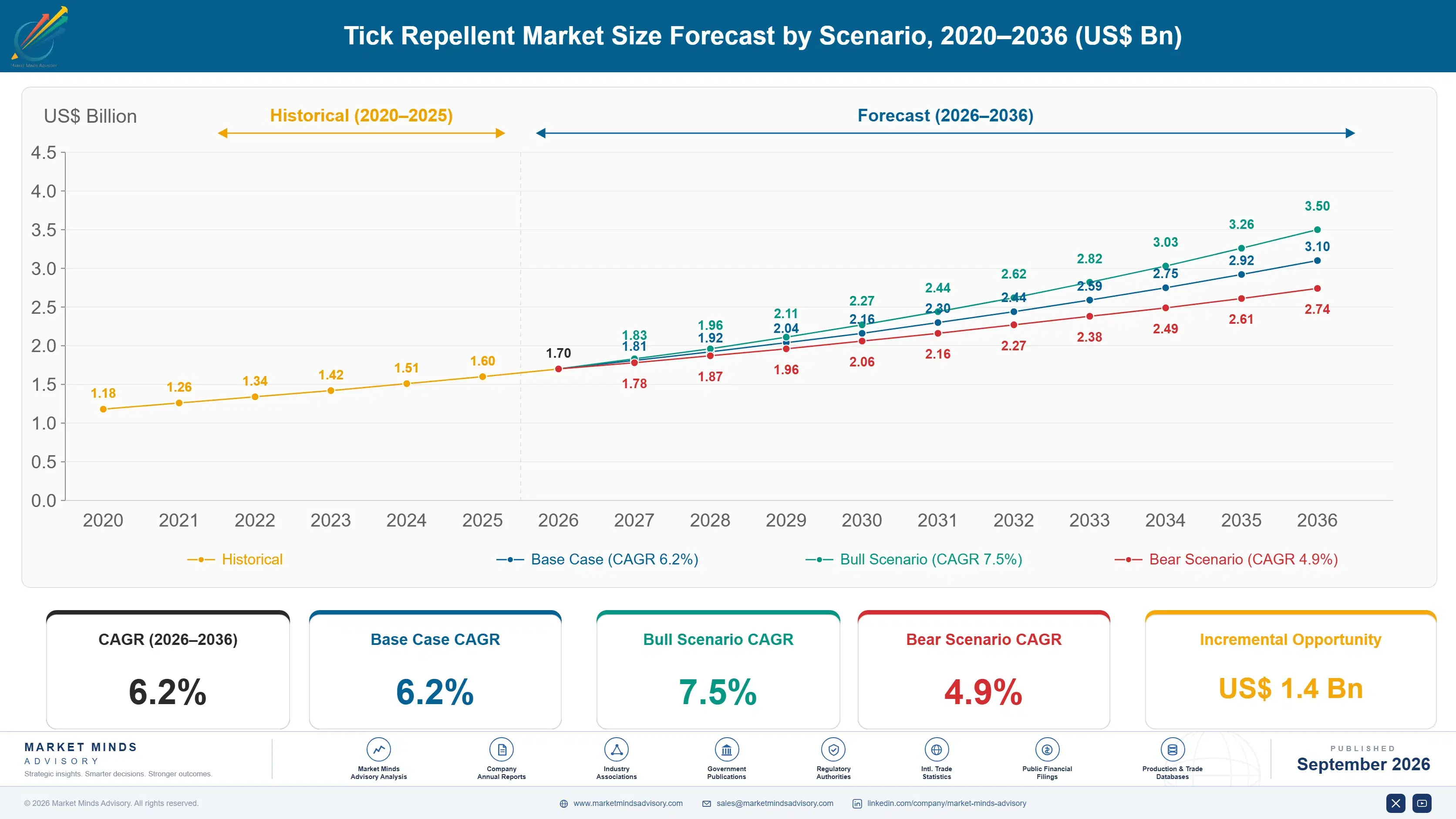
Growth of 5.0% between 2020 and 2025 came from behaviour and from climate at the same time. Outdoor recreation expanded sharply through 2020 and 2021 and pushed far more people into tick habitat than usual, while milder winters extended both the active season and the geographic range of the principal vector species. Neither effect reversed when recreation patterns normalised again from 2023 onward.
Three mechanisms carry the base case. Treated clothing grows at 9.3% as understanding spreads that ticks climb rather than fly. European range expansion continues, with Poland at 10.4% as encephalitis and Lyme incidence rises in previously unaffected areas. Public health messaging is shifting toward clothing treatment and tick checks rather than skin application, which changes what people buy rather than merely how much. All three are visible in incidence and shipment data.
The bull case is retail merchandising separating ticks from mosquitoes. A dedicated tick section with treated clothing at the front would convert buyers who currently reach for a mosquito spray by default. The bear case is a Lyme vaccine reaching market at scale. Candidates are in late-stage trials, and a licensed vaccine would reduce the perceived need for repellent considerably among the most concerned buyers.

Ticks Climb, Sprays Do Not

The biology and the merchandising point in opposite directions. Ticks quest from grass and low vegetation, grab a passing leg and climb upward looking for skin, which means the interception point is a sock, a boot and a trouser leg rather than a forearm. Permethrin-treated clothing delivers around 94% bite protection in published field testing. Around 11% of retailers separate tick products from mosquito products. Both products are classified as insect repellent internally, and the buying team treats them as a single shelf accordingly.
TOP FIVE CONCENTRATION41%Combined net revenue share held by the five largest participants
TREATED CLOTHING EFFICACY94%Bite protection from permethrin-treated garments in published field testing
AVERAGE RETAIL PRICEUSD 14Weighted retail price across every product type covered here
TICK AISLE SEPARATION11%Share of retailers merchandising tick products apart from mosquito
TREATMENT WASH DURABILITY70 washesLaundering cycles a factory-treated garment retains effectiveness through
SEASONAL SALES CONCENTRATION68%Portion of annual category revenue sold within four months
Permethrin behaves differently from anything else in the category and few buyers understand why. It binds to fabric rather than sitting on skin, survives roughly 70 washes on factory-treated garments, and kills or disables ticks on contact rather than merely deterring them. It is also not applied to the body at all, which removes the tolerability objection that limits DEET use on children.
Seasonality is severe, with about 68% of revenue moving in four months, and it is lengthening as winters warm. Retailers still plan the season on historic dates, which leaves shelves empty during an increasingly early spring. Ticks are questing well before the historic season start date, and the gap widens each year.
"The single most effective product in this category is a pair of treated socks, and it sits on a bottom shelf behind three brands of mosquito spray. Biology has been telling retailers what to do for years and the planogram has not listened."
Director, Specialty Chemicals and Consumer Health Practice · MMA Chemicals and Specialty Products Practice · September 2026

Market Trends

Treated Clothing Displaces Skin Application For Ticks

Permethrin-treated clothing and gear grows at 9.3% against 6.2% for the category because the intervention matches the biology rather than the habit. Ticks quest from vegetation and climb, so a treated sock and trouser leg intercept them before they reach skin at all, and published field testing puts bite protection around 94%. Factory treatment survives roughly 70 washes. Consumer understanding remains the constraint rather than product availability, since most buyers still assume repellent means something applied to the body. Nothing is applied to the body, which also removes the tolerability objection that limits skin repellent use on children.
Market Impact: Poland grows 4.2 points faster

Tick Range Extends Northward As Winters Warm

Milder winters have pushed the principal vector species into latitudes and altitudes that previously killed them off seasonally, extending both range and active season across Europe and North America together. Poland grows fastest of any country covered at 10.4% as Lyme and tick-borne encephalitis incidence rises in regions that recorded almost none a generation ago. Canadian and Scandinavian expansion follows the same pattern. Demand appears in markets with no established retail category and no consumer familiarity at all. That is a narrow window for whoever arrives first, and it closes once a reference brand establishes itself locally.
Market Impact: Guidance now covers 100% recommendation

Market Opportunities and Growth Drivers

European Encephalitis Incidence Drives Preventive Purchasing

Tick-borne encephalitis is endemic across central and eastern Europe and causes neurological disease serious enough that prevention is treated as a public health matter rather than as a comfort purchase. Austrian, German, Czech and Polish authorities run vaccination and awareness programmes, and that messaging creates repellent demand alongside it. The disease is considerably more feared than Lyme in those markets, which produces a willingness to buy preventive products that North American consumers do not generally show. Forest recreation and mushroom foraging put very large numbers of people into habitat on a routine basis across the region.
Market Impact: Only 11% separate the categories

Public Health Messaging Shifts Toward Clothing Treatment

Guidance from the CDC and European public health bodies increasingly recommends permethrin-treated clothing and systematic tick checks rather than skin repellent alone, which is a change in what is advised rather than simply more of the same advice. That reframing directly benefits the fastest-growing segment and gives participants an authoritative argument they did not previously have. Retail merchandising has not followed the guidance, which leaves a gap between what is recommended and what is easy to buy. Participants funding their own fixtures close that gap faster than category buyers, which is an unusual place for merchandising spend to pay.
Market Impact: Botanicals grow at 3.1% only

Market Restraints and Challenges

Retailers Merchandise Ticks Alongside Mosquitoes Everywhere

Around 11% of retailers separate tick products from general insect repellent, which leaves the most effective intervention sitting behind bottles designed for a different animal with different behaviour. The root cause is category management: both are classified as insect repellent and the buying team treats them as one shelf. Commercially it means buyers reach for a mosquito spray by default and get poor tick protection. Participants addressing it fund dedicated tick sections and supply their own fixtures. Sell-through on treated clothing rises sharply wherever that separation actually happens anywhere in practice.
Market Impact: Delivers around 94% bite protection

Botanical Claims Persist Without Supporting Field Data

Natural and botanical repellents grow slowest at 3.1% and much of what is sold carries efficacy claims that tick-specific field testing does not support, since data generated against mosquitoes is routinely extrapolated across species. The root cause is regulatory: minimum-risk exemptions in several jurisdictions allow marketing without efficacy submission. Commercially it damages confidence in the category when products fail. Mitigation runs to tick-specific testing and to retailers requiring species-specific data before listing. Two major European chains have already signalled that species-specific data will become a listing condition. Products relying on extrapolation will not survive that.
Market Impact: Poland grows at 10.4% annually
3 additional market trends, 4 additional growth drivers, and 2 additional restraints and challenges are covered in the full report. Contact sales@marketmindsadvisory.com to access the complete intelligence.

Segment CAGR and Growth Architecture

Segmentation follows intervention type, the dimension on which efficacy evidence, regulatory pathway, application method and price all divide together. Six intervention types are assessed at manufacturer net revenue. Veterinary tick products, agricultural acaricides, mosquito-only repellents, and vaccines or therapeutics sit outside the defined scope throughout this report. Efficacy evidence separates them more sharply than price does.
tick-repellent-market-share-analysis-market-share-analysis-1790024000998

Permethrin-Treated Clothing And Gear

Permethrin-treated clothing and gear grows at 9.3%, half again the market rate of 6.2%, because it is the only intervention that matches how ticks actually behave. They quest from low vegetation, attach to a passing leg and climb, which means treated socks, trousers and boots intercept them before skin is reached at all. Published field testing puts bite protection around 94%, and factory treatment survives roughly 70 laundering cycles. Nothing is applied to the body, which removes the tolerability concern that limits skin repellent use on children. The binding constraint is consumer understanding rather than availability or price. Most buyers still assume that repellent means something sprayed onto a human body.
CAGR 9.3%

DEET And Picaridin Skin Repellents

DEET and picaridin skin repellents grow at 6.6% and remain the largest segment by revenue, carried by familiarity more than by tick-specific performance. Both work, and picaridin in particular has improved tolerability enough that it has taken meaningful share from DEET in family purchasing. The limitation is application coverage: protection exists only where product was actually applied, and the ankle, sock line and waistband are exactly where people apply least and where ticks arrive most. The segment's real strength is that buyers already know what it is and where to find it. That familiarity is worth a great deal in a habitual seasonal purchase, and it is why the segment holds volume that the evidence alone would not support.
CAGR 6.6%
Full segment breakdown across 6 segments available in the complete report.

Regional Architecture and Country Demand Map

Shares record where products are sold rather than where actives are manufactured. Western and Eastern Europe both sit above their standard bands on tick-borne encephalitis endemicity, and East Asia below on limited disease burden and low consumer awareness. Each deviation carries a stated reason in the paragraph concerned.

North America

At 32% this sits inside the standard band and demand concentrates heavily in the northeastern and upper midwestern United States where Lyme incidence is highest. Awareness is strong in those areas and close to absent elsewhere, which makes the market unusually regional within a single country. Canadian demand is expanding quickly as tick range moves north into Ontario, Quebec and the Maritimes. Growth of 5.9% reflects a mature core market alongside genuinely new geographies, and retail still merchandises almost everything alongside mosquito product. Canadian public health authorities have begun issuing tick advisories in provinces that had none a decade ago, and retail there is building a category from nothing rather than reorganising an existing one.
Share: 32% | CAGR: 5.9% (2026 to 2036)

Western Europe

The 29% position sits above the standard band because tick-borne encephalitis is endemic across Germany, Austria and Switzerland and is taken considerably more seriously than Lyme. Vaccination programmes run alongside repellent messaging, and the combined public health attention produces preventive purchasing that North American consumers do not generally match. Nordic demand has grown sharply as range extends northward. Growth of 4.9% is the slowest of the seven regions only because the base is already large and awareness already high. Treated clothing has penetrated further here than anywhere else, partly because outdoor apparel brands adopted factory treatment early. Nordic demand has grown sharply as range extends northward into areas that previously killed the vector off each winter.
Share: 29% | CAGR: 4.9% (2026 to 2036)
Regional intelligence for 5 additional markets available in the complete report: Eastern Europe, East Asia, South Asia and Pacific, Latin America, Middle East and Africa. Contact sales@marketmindsadvisory.com.
tick-repellent-market-share-analysis-country-cagr-analysis-1790024001551

Four Moves Worth Making Now

These four address a category where the biology is well understood, the most effective product is merchandised in the wrong place, and the geography is expanding faster than retail planning cycles allow. Each has been executed by at least one participant with measured rather than asserted results. Three of the four cost nothing beyond a planning or merchandising decision.

Fund Dedicated Tick Sections In Retail

Around 11% of retailers separate tick products from general insect repellent, which leaves treated clothing behind bottles designed for mosquitoes. Supplying fixtures and funding a dedicated section costs merchandising investment rather than product development. Participants who did it report treated clothing sell-through rising roughly 2.8 times against the same product in a combined insect aisle, because a buyer who understands the distinction chooses differently once the choice is actually visible. Category buyers rarely initiate it themselves because both products are classified as insect repellent internally. Supplying the fixture removes the obstacle entirely.
Market Impact: Treated clothing sell-through rises roughly 2.8 times higher

Move Season Start Dates Forward Three Weeks

Around 68% of category revenue moves within four months, and that window is starting earlier as winters warm, yet retail planning still follows historic seasonal dates. Shelves sit empty through an increasingly early spring while ticks are already active. Participants who shifted delivery and merchandising windows forward by three weeks report capturing roughly 14% additional season revenue, on a planning change rather than any increase in production or promotional spending. Ticks are questing well before the historic date and nothing about the calendar is going to correct itself. The change costs a conversation with a retail planner.
Market Impact: Captures roughly 14% more revenue across the season

Commission Tick-Specific Field Efficacy Testing Programmes

Much of the botanical segment carries claims extrapolated from mosquito data, and tick-specific field testing is rarely commissioned because regulatory exemptions do not require it. Generating species-specific data costs a testing programme and converts a claim into evidence retailers can rely on. Participants who commissioned it report listing acceptance at major chains rising roughly 2.1 times, because category buyers are increasingly unwilling to carry unsupported efficacy claims on tick products. Two major European chains have already signalled that requirement is coming. Commissioning testing now is considerably cheaper than losing a listing later.
Market Impact: Listing acceptance at chains rises roughly 2.1 times

Enter European Markets Ahead Of Range Expansion

Tick range is moving north into Nordic and Baltic markets that have no established retail category and little consumer familiarity, while encephalitis incidence rises behind it. Entering before the category exists costs distribution investment against demand still building. Participants who entered early report holding share around 3.4 times that achieved by later entrants in comparable markets, because the first credible brand becomes the reference point in a category nobody knew existed. Households there have no inherited knowledge and no habits to displace, which is a receptiveness that does not last. Once a reference brand exists the window closes.
Market Impact: Holds share roughly 3.4 times later entrants do

Who Controls the Margin Pool

Concentration is moderate at 41% held by the top five, measured consistently on manufacturer net revenue rather than unit volume, which would overweight low-priced skin sprays against treated garments carrying far higher values. The leader to challenger gap is wide in skin repellent, where brand familiarity and retail relationships dominate, and narrow in treated clothing, where specialists hold positions the large brands have not contested seriously.
Competition runs on three dimensions currently. Retail shelf position decides skin repellent volume, since the purchase is habitual and brand recognition carries it. Efficacy evidence decides treated clothing and increasingly decides whether a botanical product gets listed at all. Geographic presence decides the expanding European markets, where the first credible brand in a new area becomes the default reference for a category consumers have not encountered before.

Pressure is building from two directions and rankings will move on both. Treated clothing specialists are growing at nearly half again the category rate while the large household brands remain weighted toward skin application. Meanwhile retailers are beginning to require tick-specific efficacy data before listing, which threatens botanical products that have relied on mosquito extrapolation and on regulatory exemptions rather than evidence.
tick-repellent-market-share-analysis-company-positioning-matrix-1790024002075

Competitive Moat and Risk Dimensions

SC JOHNSON

Moat: Household Brand Retail Position

Shelf presence across mass, grocery and pharmacy retail built over decades places product in front of buyers making a habitual seasonal purchase, and in a category where most shoppers do not distinguish ticks from mosquitoes, brand familiarity carries the decision more than efficacy does. That advantage weakens as understanding spreads.
SC JOHNSON

Risk: Skin Application Category Weighting

Revenue concentrated in skin repellent sits in the segment growing more slowly than treated clothing, and the public health guidance is moving toward the other intervention. Building credibility in treated fabric requires a different manufacturing base and a different retail conversation than a spray bottle needs.
INSECT SHIELD

Moat: Factory Treatment Technical Position

Registered factory permethrin treatment that survives roughly 70 laundering cycles, applied under licence across a wide range of apparel brands, gives a technical and regulatory position that a competitor would need years and registrations to replicate at comparable durability. Apparel brands adopt it rather than building an alternative.
INSECT SHIELD

Risk: Consumer Understanding Dependency

Growth depends on buyers grasping that ticks climb and that treated fabric outperforms skin spray, which is an education problem rather than a product one. The company controls the technology but not the merchandising, and around 11% of retailers separate the categories at all. Education is slow and expensive work.

Players Tracked

Prominent Players

SC Johnson
Spectrum Brands
Sawyer Products
Insect Shield
Reckitt Benckiser

Other Key Players

Tender Corporation
Coleman Company
Murphy's Naturals
Ranger Ready
Babyganics
Nobite
Anti Brumm
Care Plus
Zeckenzange
Autan
Jaico
Repel
Ben's
ThermaCell
Cutter

Recent Developments

FEBRUARY 2025

Insect Shield extends factory treatment licensing across European apparel

The company signed additional licensing agreements placing its registered factory permethrin treatment into European outdoor apparel ranges. These were licensing arrangements rather than an acquisition, merger or joint venture, with each brand retaining full control of its own products. Existing North American licensing arrangements continued without change.
Signal: Treated fabric spreads through apparel brands rather than repellent brands. Distribution follows apparel, not the insect aisle.
AUGUST 2024

Sawyer Products commissions tick-specific field efficacy programme

The manufacturer funded independent field testing measuring bite protection against tick species specifically rather than extrapolating from mosquito data. This was internally funded research with no partnership, acquisition or regulatory settlement behind the decision to commission it. Results were published rather than held internally for marketing use.
Signal: Species-specific evidence is becoming the condition for retail listing acceptance. Extrapolation from mosquito data is running out of time.
JUNE 2025

Spectrum Brands acquires European insect repellent brand

The company completed the acquisition of a European repellent business with established distribution across tick-endemic central European markets. This was a completed acquisition rather than a merger or joint venture, with the brand retained under its existing name. Manufacturing and distribution continued under existing management.
Signal: Encephalitis-endemic Europe is being bought into rather than entered organically. Distribution relationships there are hard to build from outside.

What The Actives Cost

Active ingredient cost varies enormously by intervention and a single figure would mislead. DEET runs roughly 23% of manufacturing cost in a skin spray, picaridin considerably more per unit of protection. Permethrin is cheap as a molecule but factory application to fabric carries process cost that puts treatment around 31% of a treated garment's manufacturing cost. Packaging, propellant and filling take the rest on sprays.
Petrochemical feedstock costs rose sharply through 2021 and 2022 and both DEET and picaridin synthesis carry that exposure, a movement the EIA documents across its petrochemical feedstock reporting for the period. Aerosol propellant and packaging costs climbed in the same window. Reckitt Benckiser and SC Johnson reporting for that year both identify input inflation as requiring pricing action. Both movements arrived inside a single selling season.

Exposure divides by intervention weighting rather than by company size. Skin repellent participants carry synthesis and packaging exposure together, since an aerosol is a far more complex package than a garment label. Treated clothing participants carry apparel manufacturing exposure instead, dominated by fabric and labour rather than by chemistry, which moves on a different cycle. Participants holding both absorbed 2022 better than specialists at either end.
tick-repellent-market-share-analysis-cost-volatility-analysis-1790024002272

Contract active ingredient supply across a full season

DEET and picaridin synthesis follows petrochemical feedstock pricing that moves independently of anything in this category, and a season's pricing is set before the selling window opens. Contracting supply stabilises the largest chemical input and preserves published retail pricing. The commitment lands ahead of the season generating cash, which deters smaller participants. Larger participants contract as standard practice.

Shift packaging from aerosol toward pump and lotion formats

Aerosol packaging carries propellant, pressurised container and specialised filling costs that pump formats avoid almost entirely. Moving portfolio weight toward pumps and lotions cuts packaging exposure and improves application precision at the ankle and sock line where it matters. The obstacle is that consumers associate aerosol with convenience and ease. Precision matters most exactly where ticks arrive.

Balance the portfolio across chemistry and treated apparel

Skin repellent carries petrochemical and packaging exposure while treated clothing carries fabric and apparel labour exposure, and the two cycles rarely move together. Holding both smooths input cost across a season. The requirement is genuinely different manufacturing and sourcing capability rather than an extension of what already exists. Very few participants currently hold both capabilities properly.

Portfolio Architecture for Margin Defence

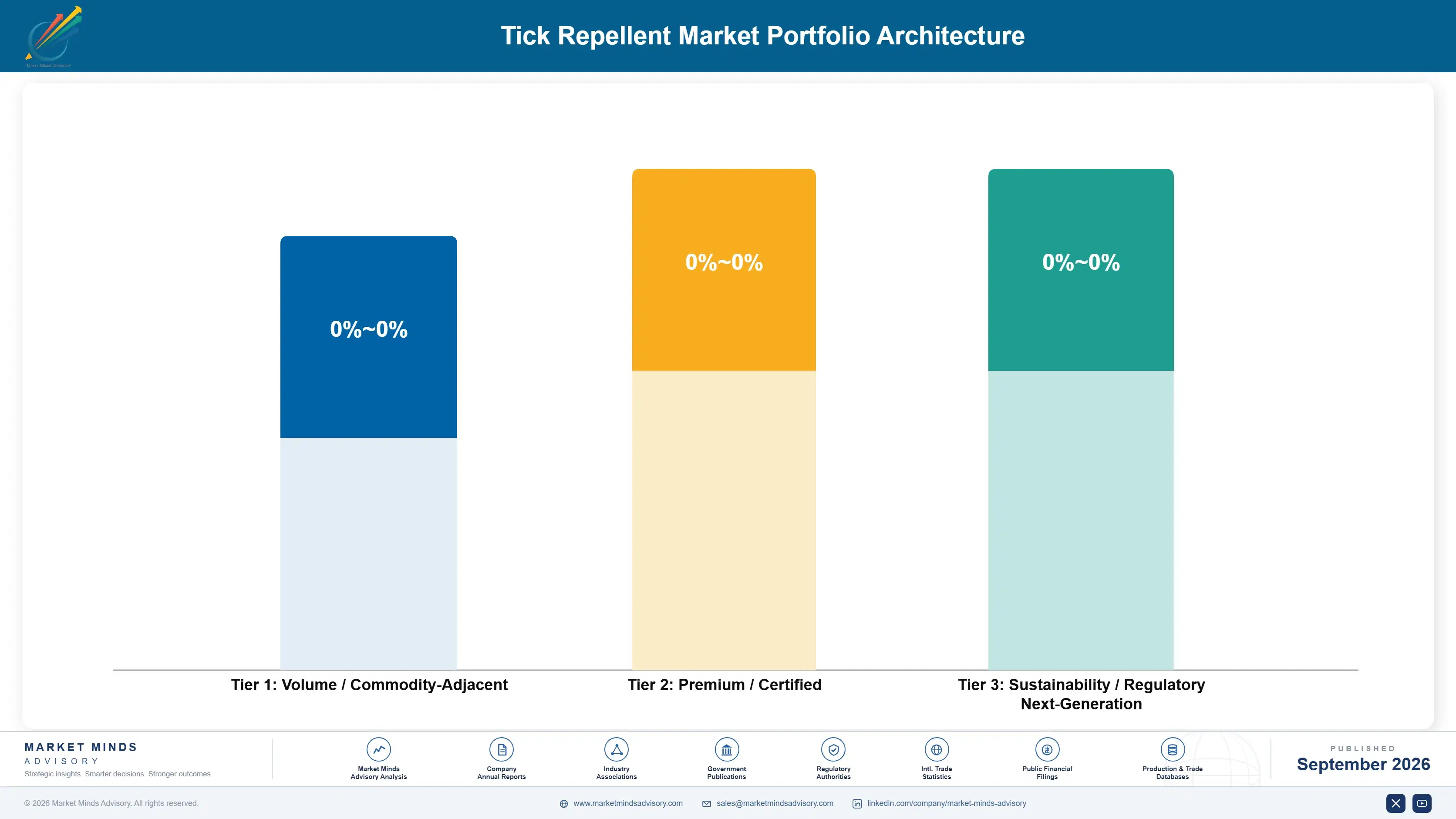
Margin architecture divides by whether the buyer understands what they are treating, which is not what a product catalogue would suggest. General insect aerosols sold through mass and grocery retail run at gross margins in the high twenties to high thirties, bought habitually by shoppers who do not distinguish between a tick and a mosquito and choose on brand and price. Nothing on the shelf helps them tell the two problems apart.
Tick-specific skin repellents and removal tools hold gross margins in the high thirties to high forties. The spread reflects how differently sprays and precision tools price against their cost. Removal tools in particular carry margins out of all proportion to their manufacturing cost, because a buyer who has just found a tick is not price sensitive at that moment at all.

The highest-value pool is factory-treated clothing and gear, at margins in the high forties to high fifties. Those buyers have understood the biology, are choosing on evidence and pay accordingly for durability measured in laundering cycles. General aerosols carry the volume and the shelf space. They do not defend anything against a competing household brand. Shelf space and seasonal volume are the argument for keeping them.

Volume / Commodity-Adjacent

General insect aerosols through mass and grocery retail, bought habitually by shoppers who do not distinguish ticks from mosquitoes. The ten point range reflects how differently branded and private label product price.
Gross Margin: 28 to 38%

Premium / Certified

Tick-specific skin repellents and removal tools. Removal tools carry margins out of proportion to manufacturing cost, because a buyer who has just found a tick is not price sensitive. Urgency rather than deliberation drives that purchase.
Gross Margin: 38 to 48%

Sustainability / Regulatory / Next-Generation

Factory-treated clothing and gear. Buyers have understood the biology, choose on published evidence and pay for durability measured in laundering cycles rather than in seasons. Consumer understanding rather than price is the binding constraint on volume.
Gross Margin: 47 to 58%
tick-repellent-market-share-analysis-portfolio-architecture-1790024002778

High-value Sub-segments and Strategic Watch-out

Factory-Treated Clothing And Gear

High value and fastest growth at 9.3%. It matches how ticks actually behave, delivers around 94% bite protection in field testing, and the constraint is consumer understanding rather than product availability anywhere. Retail merchandising rather than the product is what holds it back at the moment.
Gross Margin: 48 to 57%

Tick Removal And Detection Tools

High value and steady growth. Margins run out of all proportion to manufacturing cost because somebody who has just found an attached tick makes the purchase without considering price at all. That buyer also converts to treated clothing more readily than any other group does.
Gross Margin: 44 to 54%

DEET And Picaridin Skin Repellents

Volume core, growing at 6.6% and carried by familiarity rather than by tick-specific coverage. The ankle and sock line are exactly where people apply least and where ticks arrive most often. Brand recognition rather than published evidence carries the purchase decision here. Coverage is the weakness.
Gross Margin: 32 to 42%

Natural And Botanical Repellents

Strategic watch-out. Growing slowest at 3.1% with claims often extrapolated from mosquito data. The twenty point range reflects how differently evidenced and unevidenced products price within the same segment. Retailers tightening listing requirements will compress the unevidenced end considerably. Evidenced botanicals price and perform quite differently.
Gross Margin: 26 to 46%

How Purchase Actually Triggers

Demand here is triggered by events rather than by calendars, and the events are personal. Somebody who found an attached tick on a child buys immediately and without price sensitivity, and keeps buying for years afterward. Somebody who has never found one buys general repellent before a holiday and forgets about it. The category has two customers who share a shelf and almost nothing else.
Stickiness varies sharply by which of those two a buyer is. The event-triggered group is the most durable in the category, converts readily to treated clothing once the biology is explained, and checks the children after every walk. The holiday buyer churns completely and returns to whatever is on shelf. Very little marketing distinguishes between them, though the purchase records do.

Buyer profiles have shifted with the geography rather than with demographics. Households in newly affected areas across Canada, the Nordics and the Baltics have no inherited knowledge of ticks and no habits to displace, which makes them unusually receptive to whichever brand explains the problem first. That window closes once a reference brand is established, which is why entry timing matters more here than usual.
tick-repellent-market-share-analysis-end-use-penetration-index-1790024003272

Where The Evidence Points

These are among the four positions where our research anticipates prominent divergence between winners and laggards over the coming forecast period. Each is grounded in the demand model, the regulatory perimeter, and the announced capacity pipeline.
01 / RETAIL CATEGORY SEPARATION

Take ticks out of the mosquito aisle

Only about 11% of retailers separate tick products from general insect repellent, which leaves the most effective intervention sitting behind bottles designed for a completely different animal. Supplying fixtures and funding a dedicated section costs merchandising investment rather than any product development at all. Participants who did it report treated clothing sell-through rising roughly 2.8 times against identical product in a combined insect aisle, because a visible choice is a different choice, and the fixture investment is recovered inside a single season.
02 / SEASON TIMING DISCIPLINE

Stock three weeks before the calendar says

Around 68% of category revenue moves within four months and that window keeps starting earlier as winters warm, yet retail planning still follows the historic seasonal dates set years ago. Shelves sit empty through an increasingly early spring while the ticks are already questing out in the grass. Participants who moved delivery and merchandising windows forward three weeks report capturing roughly 14% additional season revenue on a planning change alone, with no increase in production or promotional spending required anywhere.
03 / SPECIES SPECIFIC EFFICACY EVIDENCE

Test against ticks, not against mosquitoes

Much of the whole botanical segment carries efficacy claims extrapolated from mosquito data, because regulatory exemptions in several jurisdictions do not require any species-specific submission before marketing. Commissioning tick-specific field testing costs a research programme and converts a marketing claim into evidence that a category buyer can rely on. Participants who commissioned it report listing acceptance at major chains rising roughly 2.1 times as retailers tighten requirements on unsupported claims, and two major European chains have already signalled that requirement.
04 / RANGE EXPANSION ENTRY

Arrive before the category exists there

Tick range is moving north into Nordic, Baltic and Canadian markets that have no established retail category and no inherited consumer knowledge to displace, while disease incidence rises behind it. Entering early costs distribution investment against demand that is still building toward real scale. Participants who entered ahead report holding share around 3.4 times later entrants, because the first credible brand becomes the reference in a category nobody knew existed, and the window closes permanently once that reference is established.

Engagement Snapshot From the Field

A live engagement with an industry participant carrying material or product regulatory and market exposure ahead of a defining policy shift, showing how our research translates into a defensible multi-year portfolio strategy.
MARKET MINDS ADVISORY · CLIENT ENGAGEMENT SUMMARY
Tick Repellent Producer Strategic Portfolio Review and Transition Roadmap 2026·Investment Scenario on Tick Repellent Exposure Evaluation 2025-26
CLIENT PROFILE
A European insect repellent manufacturer with net revenue near USD 63 million (client-reported, unverified by MMA), weighted approximately 74% to DEET and picaridin skin sprays, 19% to botanical products and 7% to removal tools. No treated clothing existed in the range. Distribution concentrated in Germany, Austria and Switzerland with no Nordic or Baltic presence. Removal tools were sold only in Germany.
STRATEGIC CHALLENGE
Revenue had grown modestly for three years while the tick-specific portion of the market grew far faster, and management attributed the gap to pricing pressure from larger household brands. A promotional programme had been approved. Nobody had examined which customers bought after a tick encounter or where range expansion was creating new demand.
MMA APPROACH
MMA separated purchase records into event-triggered and seasonal buyers using repeat frequency and basket composition. Botanical efficacy claims were tested against available tick-specific field data. Nordic and Baltic incidence trends were mapped against existing distribution, and treated clothing economics were modelled against the current spray portfolio. Findings were reconciled against retail sell-through records.
KEY FINDINGS
  1. Event-triggered buyers represented 19% of customers and 47% of revenue, purchased at four times the frequency of seasonal buyers, and received no differentiated marketing whatsoever.
  2. Botanical products accounting for 19% of revenue had no tick-specific efficacy data, and two major chains had already signalled listing requirements the range would fail.
  3. Encephalitis incidence in three Baltic markets had risen steeply while the client held no distribution there and no competitor had established a reference position.
  4. Modelled treated clothing carried gross margin 19 points above the spray portfolio and addressed the event-triggered segment that generated most revenue. and generated most of the client's total revenue.
CLIENT PROFILE
A European insect repellent manufacturer with net revenue near USD 63 million (client-reported, unverified by MMA), weighted approximately 74% to DEET and picaridin skin sprays, 19% to botanical products and 7% to removal tools. No treated clothing existed in the range. Distribution concentrated in Germany, Austria and Switzerland with no Nordic or Baltic presence. Removal tools were sold only in Germany.
STRATEGIC CHALLENGE
Revenue had grown modestly for three years while the tick-specific portion of the market grew far faster, and management attributed the gap to pricing pressure from larger household brands. A promotional programme had been approved. Nobody had examined which customers bought after a tick encounter or where range expansion was creating new demand.
MMA APPROACH
MMA separated purchase records into event-triggered and seasonal buyers using repeat frequency and basket composition. Botanical efficacy claims were tested against available tick-specific field data. Nordic and Baltic incidence trends were mapped against existing distribution, and treated clothing economics were modelled against the current spray portfolio. Findings were reconciled against retail sell-through records.
KEY FINDINGS
  1. Event-triggered buyers represented 19% of customers and 47% of revenue, purchased at four times the frequency of seasonal buyers, and received no differentiated marketing whatsoever.
  2. Botanical products accounting for 19% of revenue had no tick-specific efficacy data, and two major chains had already signalled listing requirements the range would fail.
  3. Encephalitis incidence in three Baltic markets had risen steeply while the client held no distribution there and no competitor had established a reference position.
  4. Modelled treated clothing carried gross margin 19 points above the spray portfolio and addressed the event-triggered segment that generated most revenue. and generated most of the client's total revenue.
RECOMMENDED STRATEGY
Phase 1: Phase one: cancel the promotional programme and commission tick-specific field testing across the botanical range immediately. Two lines were expected to fail testing. Phase 2: Phase two: license factory treatment technology and launch treated clothing into the event-triggered customer base. Licensing avoids a registration timeline entirely. Phase 3: Phase three: enter the three Baltic markets ahead of competitors while no reference brand exists. Incidence data supports all three markets.
OUTCOME
Gross margin improved by seven points across four quarters as treated clothing entered the mix (client-reported, unverified by MMA). Two botanical lines were withdrawn after testing failed to support their claims, and Baltic distribution reached 31% retail coverage in the first year with no established competitor present.

Frequently Asked Questions

Foundational context covering the market sizes, CAGR, scope, country, region and competition that inform every finding below. This section is provided to cover basics and most often pre-purchase conversations, answered from the MMA Primary Research Dataset.

What is the current size of the Tick Repellent Market?

The market was valued at USD 1.6 billion in 2025, rising to USD 1.7 billion in 2026. Sizing is at manufacturer net revenue across six intervention types.

How large will the Tick Repellent Market be by 2036?

MMA forecasts USD 3.1 billion by 2036, an increase of USD 1.4 billion over the 2026 base. That represents expansion of 1.82 times across the forecast period.

What is the CAGR for the Tick Repellent Market 2026 to 2036?

The base case CAGR is 6.2%, with a bull case of 7.5% and a bear case of 4.9%. Historical growth between 2020 and 2025 ran at 5.0%.

Which segment is growing fastest?

Permethrin-treated clothing and gear grows at 9.3%, half again the market rate, because it matches how ticks actually behave. Skin repellents follow at 6.6% and botanical products grow slowest at 3.1%.

Who are the major companies in the Tick Repellent Market?

SC Johnson, Spectrum Brands, Sawyer Products, Insect Shield and Reckitt Benckiser lead on net revenue, holding a combined 41%. Treated clothing specialists hold positions the household brands have not contested.

Which country is growing fastest?

Poland grows fastest at 10.4%, as tick-borne encephalitis and Lyme incidence rise in forest recreation areas and public health authorities drive awareness directly. Forest recreation puts large numbers into habitat routinely.

Report Segmentation Architecture

The full report scope spans multiple orthogonal segmentation dimensions, with cross-tabulated demand data provided for each dimension pair. Coverage extends further to regional breakdowns, trend trajectories, and the competitive detail needed to support segment-level decision-making.

By Intervention Type

  • Permethrin-Treated Clothing and Gear
  • Permethrin Clothing Treatment Sprays
  • DEET and Picaridin Skin Repellents
  • Natural and Botanical Repellents
  • Tick Removal and Detection Tools
  • Area and Yard Treatments

By End-Use Activity

  • Hiking and Trail Recreation
  • Gardening and Yard Use
  • Hunting and Field Sports
  • Children's Outdoor Play
  • Occupational Forestry and Utilities
  • Camping and Overnight Outdoors

By Commercial Dimension

  • Mass and Grocery Retail
  • Pharmacy and Drug Channel
  • Specialist Outdoor Retail
  • Brand Direct and Online
  • Apparel Brand Licensing
  • Occupational and Institutional Supply

By Region

  • North America
  • Western Europe
  • Eastern Europe
  • East Asia
  • South Asia and Pacific
  • Latin America
  • Middle East and Africa

Scope, Methodology, and Coverage

Every figure in this report is reproducible from documented input assumptions. The scope below maps the historical period, the forecast horizon, the segmentation dimensions, and the countries covered, alongside the underlying primary and qualitative methodology.
Historical Period
2020 to 2025
Forecast Period
2026 to 2036
Base Year
2025 (USD billions; MMA Primary Research Dataset, September 2026)
Market Definition
This market covers products sold specifically to prevent tick attachment on humans, spanning permethrin-treated clothing and gear, permethrin clothing treatment sprays, DEET and picaridin skin repellents, natural and botanical repellents, tick removal and detection tools, and area and yard treatments. Sizing is at manufacturer net revenue across mass, pharmacy, specialist, direct, apparel licensing and institutional channels. Veterinary and companion animal tick products, agricultural acaricides, general mosquito-only repellents, and vaccines or therapeutics are excluded throughout.
Quantitative Units
USD billions at manufacturer net revenue; volume in millions of units shipped; efficacy in percentage bite protection.
Segmentation Dimensions
Intervention type, end-use activity, commercial dimension, and geographic region.
Regions Covered
North America, Western Europe, Eastern Europe, East Asia, South Asia and Pacific, Latin America, Middle East and Africa
Countries Covered
United States, Germany, Poland, Austria, Australia, Canada
Key Companies Profiled
SC Johnson, Spectrum Brands, Sawyer Products, Insect Shield, Reckitt Benckiser, Tender Corporation, Coleman Company, Murphy's Naturals, Ranger Ready, Babyganics, Nobite, Anti Brumm, Care Plus, Zeckenzange, Autan, Jaico, Repel, Ben's, ThermaCell, Cutter
Quantitative Methodology
Primary survey, n=3,800 respondents, Q4 2025, six countries; demand-side model with trade association cross-validation
Qualitative Methodology
47 expert interviews, Q4 2025; applied to validate demand model assumptions, identify emerging dynamics, and assess competitive positioning
Report Format
PDF and XLSX data workbook (Word format preview document)
Publisher
Market Minds Advisory
Report Code
MMA-2026-CHM-800
Published
September 2026
Contact
sales@marketmindsadvisory.com | www.marketmindsadvisory.com

Purchase the full Tick Repellent Market Report (2026 to 2036).

The full report sizes the tick repellent market across six intervention types, six end-use activities and six commercial dimensions for all seven global regions through 2036. It separates event-triggered from seasonal buyers using repeat purchase frequency and basket composition rather than treating the category as one customer. Efficacy claims are tested against tick-specific field data rather than mosquito extrapolation. Disease incidence trends are mapped against existing retail distribution to identify range expansion gaps. Competitive assessment covers 20 participants on a consistent manufacturer net revenue basis.
Event-triggered and seasonal buyers separated by purchase behaviour
Efficacy claims tested against tick-specific field data
Disease incidence mapped against existing retail distribution
Treated clothing and spray economics compared directly
Six intervention types sized through 2036
Twenty participants assessed on manufacturer net revenue

Built For The People Who Decide

From boardroom strategy to bench-side execution, this report is read cover-to-cover by leaders shaping the next decade of their industry, turning demand scenarios, market dynamics and valuation benchmarks into decisions.
CXOs/ Presidents/ VPs/ Managers
M&A and Corporate Development
Strategy Teams and R&D Heads
Procurement and Product Directors
Regulatory and Compliance Leaders
Investor Relations and Equity Analysts