Market Minds Advisory
THz Spectroscopy Kit Market

THz Spectroscopy Kit Market: THz Spectroscopy Kit Market. Non-Destructive Sensing Meets Materials Research Demand

Research institutions and quality control labs are adopting terahertz spectroscopy kits for non-destructive material characterization, as pharmaceutical coating inspection and semiconductor defect detection push beyond infrared and X-ray sensing limits nationwide.

Lead Analyst

Published

September 2026

Make Smarter Decisions with Customized Research Insights

Request a free sample report and evaluate market opportunities, growth trends, and competitive dynamics relevant to your business needs.

2025 MARKET VALUE$0.4BMarket Size 2025
2036 FORECAST VALUE$1.2BBase Case , 2026 to 2036
CAGR 2026 TO 203610.5 %Bull 11.8% / Bear 9.2%
INCREMENTAL OPPORTUNITY$0.8BNet 10- year value creation
EXPANSION MULTIPLE2.70x2036 value over 2026 base
Strategic Levers
M&A Pipeline
Regional Outlook
Country Rankings
Competitive Intelligence
Segmental Deep-dive
Call-Us : 91 93563 13602

Executive Snapshot and Market Trajectory.

Research labs and quality control facilities worldwide are increasingly adopting terahertz spectroscopy kits as non-destructive characterization needs outpace what infrared and X-ray tools can reliably deliver for coating thickness, layer uniformity, and sub-surface defect inspection across pharmaceutical and semiconductor manufacturing lines today and going forward.
Fiber-coupled THz-TDS systems are growing fastest as compact, alignment-free designs make terahertz measurement accessible to quality control technicians without dedicated optics expertise or specialized laser alignment training previously required for bulk free-space systems used in earlier generation instruments. Pharmaceutical coating inspection and semiconductor defect detection drive the largest current share of demand, reflecting both industries' need for non-destructive, sub-surface measurement capability that traditional inspection tools cannot provide reliably at production line speeds and volumes.
Competitive intensity remains moderate as established photonics instrument makers defend university and national lab relationships while newer benchtop kit specialists compete on ease of use and total system cost rather than raw measurement bandwidth alone. Export control classifications on certain terahertz source and detector components are shaping which vendors can credibly serve customers across multiple international markets without lengthy licensing delays, compliance reviews, or shipment holds at customs.
Market Definition
This market covers terahertz time-domain spectroscopy instrumentation and benchtop kits used for non-destructive material characterization, thickness measurement, and defect detection in research, pharmaceutical, and semiconductor applications. It excludes terahertz imaging systems sold as standalone medical or security screening products outside laboratory research contexts.
Base Year Value
$0.4B in 2025 (MMA Primary Research Dataset, September 2026)
Forecast Period
2026 to 2036, eleven discrete annual values
CAGR
10.5% base case. Bull 11.8%. Bear 9.2%.
Fastest Growth Segment
Fiber-Coupled THz-TDS Systems: 14.0% CAGR
Fastest Growth Country
India: 13.5% CAGR
Fastest Growth Region
South Asia and Pacific: 12.5% CAGR
Largest Region
East Asia: 29% of 2025 global value
Market Leaders
Advantest, Menlo Systems, TeraView, Toptica Photonics, Zomega Terahertz
Primary Survey
n=3,800 procurement and R&D decision-makers, Q4 2025, six countries
Methodology
Demand-side build-up, cross-validated against public data, 47 expert interviews

THz Spectroscopy Kit Market Forecast Scenarios

thz-spectroscopy-kit-market-size-forecast-scenario-1788503357607
THz spectroscopy kit demand between 2020 and 2025 grew steadily as pharmaceutical manufacturers adopted terahertz coating inspection to meet tightening quality standards, and semiconductor makers began exploring the technology for advanced packaging defect detection. Component costs declined meaningfully as photonics manufacturing scaled, making benchtop systems accessible to a broader base of industrial quality control labs beyond pure academic research settings.
The base case assumes continued expansion driven by three commercial mechanisms: pharmaceutical manufacturers expanding coating inspection programs to meet evolving regulatory quality standards, semiconductor packaging makers adopting terahertz defect detection as advanced packaging architectures grow more complex, and university and national lab research funding continuing to support fundamental materials science applications using terahertz characterization. Component cost declines are also broadening the addressable customer base toward smaller industrial labs previously priced out of the category.
A bull scenario centers on semiconductor advanced packaging adoption accelerating faster than expected, pulling terahertz inspection into mainstream production quality control rather than remaining a specialized research tool. The bear risk is competing non-destructive inspection technologies achieving comparable measurement capability at lower cost, which would slow the terahertz adoption curve across industrial quality control applications.

Where Non-Destructive Sensing Meets Materials Science

THz spectroscopy kits sit at the intersection of photonics instrumentation and materials characterization, delivering non-destructive measurement capability that neither infrared nor X-ray techniques can match for coating thickness and layer uniformity applications across pharmaceutical and semiconductor production environments. The category expanded from pure academic research tools into industrial quality control equipment as component costs declined and system reliability improved considerably over the past decade.
MARKET CONCENTRATIONCR5 58%Top five vendors hold a substantial combined revenue share
AVERAGE SYSTEM PRICE$80K to $250KTypical benchtop system price range across research and industrial grades
TOP PRODUCING COUNTRY SHAREJapan leadsSingle country contributes the largest share of system production
ACADEMIC VS INDUSTRIAL SPLIT~55% academicPortion of installed systems used primarily in research settings
MEASUREMENT BANDWIDTH RANGE0.1 to 6 THzTypical frequency range covered by standard benchtop instruments
SERVICE CONTRACT ATTACH RATE~65% of salesShare of system sales including an ongoing maintenance agreement
Fiber-coupled architectures have displaced bulk free-space optical designs in most new industrial installations, since alignment-free operation lets quality control technicians operate systems without dedicated optics training or specialized laser safety certification requirements. Academic research applications remain significant, particularly in fundamental materials science and pharmaceutical formulation research where measurement flexibility matters more than production line throughput speed. University procurement cycles remain slower and more budget-constrained than industrial buyers, shaping vendor sales strategy considerably.
Competitive advantage increasingly rests on software analysis capability and application-specific calibration libraries rather than raw hardware specifications alone, since customers increasingly value turnkey measurement solutions over general-purpose instrumentation requiring extensive in-house expertise and dedicated technical staff. Vendors lacking demonstrated pharmaceutical or semiconductor application expertise face growing difficulty winning industrial quality control contracts against established application specialists with deeper domain knowledge.
"Nobody buys a THz system for the hardware anymore. They buy it for the calibration library that tells them what the spectrum actually means for their specific material."
Principal Analyst, Photonics and Materials Characterization Technology Practice · MMA Terahertz Time-Domain Spectroscopy Instrumentation and Benchtop Kits Practice · September 2026

Market Trends

Fiber-Coupled Systems Replace Bulk Free-Space Designs

Fiber-coupled THz-TDS architectures are steadily displacing bulk free-space optical designs in new system sales, since fiber delivery eliminates the precise optical alignment that traditionally required a trained physicist to operate and maintain terahertz instrumentation reliably. Menlo Systems and Toptica Photonics have both shifted their industrial product lines toward fiber-coupled designs specifically to serve quality control technicians without specialized optics backgrounds. This shift matters because it expands the addressable customer base considerably beyond research physicists into industrial quality control departments that previously found terahertz technology too operationally complex to deploy reliably on a production line.
Market Impact: Cuts sampling waste 12 percent
Semiconductor Packaging Adopts Terahertz Defect Detection

Advanced semiconductor packaging makers are adopting terahertz inspection to detect voids and delamination defects inside multi-layer packages that X-ray inspection struggles to resolve clearly at the resolution required for modern chip stacking architectures. This adoption represents a genuinely new application category beyond the pharmaceutical coating inspection that historically anchored industrial terahertz demand, diversifying the customer base meaningfully. Semiconductor customers also typically purchase higher-specification systems than pharmaceutical customers, supporting average selling price growth even as unit volume in the broader market grows more slowly than the semiconductor segment specifically. Vendors report semiconductor inquiries have accelerated meaningfully over two years.
Market Impact: Prices fell 25 percent since 2020

Market Opportunities and Growth Drivers

Pharmaceutical Quality Standards Drive Coating Inspection Adoption

Pharmaceutical regulators increasingly expect manufacturers to demonstrate coating uniformity and thickness consistency through validated non-destructive measurement methods rather than relying solely on destructive sampling that discards a portion of every production batch tested. Terahertz spectroscopy satisfies this requirement directly, letting manufacturers measure every tablet in a batch rather than a small destructive sample, improving both quality assurance confidence and production yield simultaneously. This regulatory expectation is spreading beyond leading pharmaceutical markets into emerging manufacturing regions building comparable quality infrastructure to meet export requirements demanded by major international pharmaceutical buyers and regulators.
Market Impact: Adds 2 to 4 months

Component Cost Declines Expand Addressable Customer Base

Terahertz source and detector component costs have declined steadily as photonics manufacturing scale increased, bringing benchtop system prices down enough to make the technology accessible to smaller industrial quality control labs previously priced out of the category entirely. This cost decline mirrors similar cost curves observed in other photonics-based instrumentation categories as component manufacturing matures and achieves meaningful production scale economics. Vendors report that customers previously renting or sharing access to terahertz systems increasingly purchase dedicated units once pricing crosses a threshold their budget can comfortably absorb. Financing options from vendors have also made ownership more attainable for budget-constrained labs.
Market Impact: Adds 3 to 6 months

Market Restraints and Challenges

Export Controls Limit International Component Sourcing

Certain terahertz source and detector components fall under export control classifications in several producing countries, creating licensing delays and compliance burden that slow international sales cycles considerably for vendors serving customers across multiple jurisdictions simultaneously. The root cause is that terahertz technology has dual-use applications in security screening and defense sensing that trigger export control review beyond purely commercial and academic research use cases. This friction particularly affects sales to certain international markets where licensing approval can take several months to clear regulatory review processes. Some vendors are mitigating this through regional manufacturing partnerships that reduce cross-border shipment requirements.
Market Impact: Expands buyers by 40 percent

Limited Technician Familiarity Slows Industrial Adoption

Industrial quality control technicians often lack familiarity with terahertz measurement principles compared to more established techniques like infrared spectroscopy that have decades of industrial training material and technician experience already built into standard quality control curricula. The root cause is that terahertz technology remained primarily an academic research tool until relatively recently, meaning the industrial training infrastructure and technician expertise pool has not yet matured to the same degree as older, more established inspection technologies. This unfamiliarity slows purchasing decisions and requires additional vendor-provided training investment. Vendors are mitigating this with simplified interfaces requiring less specialized physics knowledge.
Market Impact: Segment growing 18 percent yearly
3 additional market trends, 4 additional growth drivers, and 2 additional restraints and challenges are covered in the full report. Contact sales@marketmindsadvisory.com to access the complete intelligence.

Segment CAGR and Growth Architecture

THz spectroscopy kits segment by the core system architecture and delivery method, spanning fiber-coupled systems, bulk free-space systems, continuous-wave systems, pulsed time-domain systems, portable field-deployable units, and application-specific turnkey packages configured for pharmaceutical, semiconductor, or materials science customers with genuinely distinct measurement, throughput, budget, calibration, installation environment, technician skill, and ongoing support requirements today.
thz-spectroscopy-kit-market-market-share-analysis-1788503358144

Fiber-Coupled THz-TDS Systems

Fiber-coupled time-domain spectroscopy systems deliver terahertz pulses through flexible optical fiber rather than requiring free-space beam alignment, letting quality control technicians position measurement heads directly on production lines without dedicated optics training or specialized laser safety certification. Growth outpaces the broader market because fiber coupling directly addresses the operational complexity that historically limited terahertz adoption to research physicists working in controlled laboratory environments with dedicated optical tables. Menlo Systems and Toptica Photonics have both prioritized fiber-coupled product development specifically to capture this expanding industrial quality control customer base, which values operational simplicity over the marginal bandwidth advantages that bulk free-space systems still retain in specialized research applications. Service contracts also carry higher attach rates on fiber-coupled systems given industrial deployment.
CAGR 14.0%

Bulk Free-Space THz-TDS Systems

Bulk free-space time-domain spectroscopy systems remain the preferred architecture for demanding research applications requiring the widest possible measurement bandwidth and highest achievable signal-to-noise ratio, capabilities that fiber-coupled designs still cannot fully match despite recent technical improvements. This segment grows more slowly than fiber-coupled systems because its addressable customer base remains concentrated among university research groups and national laboratories rather than expanding into industrial quality control applications where operational simplicity matters more than raw measurement performance. Vendors serving this segment increasingly differentiate on specialized application support and customization capability rather than pursuing the broader industrial customer base that fiber-coupled competitors increasingly target. Government research funding remains the primary demand driver sustaining this segment's continued relevance.
CAGR 8.5%
Full segment breakdown across 6 segments available in the complete report.

Regional Architecture and Country Demand Map

East Asia leads given Japan's deep photonics component manufacturing base, Advantest's instrumentation leadership, and the region's concentration of advanced semiconductor fabrication capacity, while South Asia and Pacific posts the fastest growth as regional semiconductor fabs steadily expand their quality control instrumentation investment year after year.

North America

The United States hosts the deepest concentration of THz spectroscopy academic research activity, with major national laboratories and university photonics programs driving substantial fundamental research demand alongside growing pharmaceutical industry adoption. Zomega Terahertz and other domestic instrument makers benefit from proximity to this research base, though component sourcing for critical terahertz sources still often depends on international suppliers. Pharmaceutical manufacturers in the region increasingly adopt terahertz coating inspection to satisfy evolving regulatory quality expectations, extending demand beyond pure academic research settings into industrial quality control departments seeking non-destructive measurement alternatives. Canada's national research council also funds several photonics research programs contributing modestly to overall regional demand. Growing pharmaceutical export requirements further reinforce this steady demand base.
Share: 27% | CAGR: 11.5% (2026 to 2036)

Western Europe

Germany hosts the deepest concentration of terahertz photonics component manufacturing globally, with Menlo Systems and Toptica Photonics both headquartered domestically and supplying components to instrument makers worldwide beyond their own finished systems. The United Kingdom's TeraView pioneered early commercial terahertz imaging and spectroscopy applications, giving the region a genuine technology leadership legacy extending well beyond current market share figures alone. Pharmaceutical manufacturing concentration across the region also supports steady coating inspection adoption among established European pharmaceutical companies. France and the Netherlands contribute additional academic research demand through their established national physics research institutions. Regional vendors increasingly compete on specialized calibration and application support rather than raw system pricing alone. Regional pharmaceutical exporters also value this expertise highly.
Share: 20% | CAGR: 9.0% (2026 to 2036)
Regional intelligence for 5 additional markets available in the complete report: East Asia, South Asia and Pacific, Latin America, Middle East and Africa, Eastern Europe. Contact sales@marketmindsadvisory.com.
thz-spectroscopy-kit-market-country-cagr-analysis-1788503358660

Where THz Vendors Build Recurring Revenue

Beyond initial system sale price, terahertz spectroscopy vendors build durable revenue through mechanisms that deepen customer dependency and demonstrate measurable application value over multi-year instrument lifecycles, rewarding vendors that invest early in calibration library depth, service contract structuring, and application-specific software rather than pure hardware specification competition across every served industry segment and geography.

Selling Application-Specific Calibration Library Subscriptions Annually

Vendors increasingly charge separately for application-specific calibration libraries covering particular pharmaceutical coatings or semiconductor packaging materials, converting what was once a bundled software feature into a standalone recurring revenue stream tied to customer application needs. This library subscription model typically commands 5 to 8 percent of the original system price annually, providing meaningfully higher lifetime value per customer than a single hardware transaction alone. Customers increasingly accept this model because updated calibration libraries directly improve measurement accuracy for their specific materials without requiring an entirely new hardware purchase cycle. Vendors report this model improves customer retention across contract renewal cycles.
Market Impact: Library subscriptions add roughly 5 to 8pp yearly

Structuring Multi-Year Preventive Maintenance Service Contracts

Vendors are structuring multi-year preventive maintenance contracts that guarantee terahertz source and detector calibration stability, converting what was once occasional reactive repair revenue into predictable recurring service income tied directly to instrument uptime requirements. Industrial customers particularly value this predictability given the production line disruption that unplanned instrument downtime causes in quality control workflows. Service contract attach rates near 65 percent of new system sales demonstrate genuine customer willingness to pay for this uptime assurance rather than risk unplanned repair costs and delays later. Larger vendors increasingly bundle remote diagnostics into these preventive maintenance offerings.
Market Impact: Service attach rate reaches roughly 65pp of sales

Licensing Measurement Software to Third-Party Integrators

Vendors with mature measurement analysis software increasingly license that software separately to third-party system integrators building custom terahertz solutions for specialized industrial applications beyond the vendor's own standard catalog. This licensing revenue, typically worth 10 to 15 percent of development cost annually, monetizes an existing investment without requiring additional hardware manufacturing capacity, capturing incremental value from integrators serving niche applications the vendor's own sales team cannot efficiently reach. Early licensing partnerships have expanded vendor total addressable market meaningfully beyond direct system sales into a broader software revenue category. This channel builds relationships with integrators serving markets beyond direct reach.
Market Impact: Software licensing reaches roughly 10pp of total revenue

Offering Instrument-as-a-Service Rental and Leasing Programs

Vendors are increasingly offering instrument-as-a-service rental and leasing programs that let smaller industrial and academic customers access terahertz measurement capability without the substantial upfront capital expenditure that outright system purchase requires, broadening the addressable customer base considerably. This recurring revenue model also provides vendors with more predictable cash flow than lumpy one-time hardware sales, smoothing revenue recognition across a longer customer relationship period. Roughly 15 percent of new customers now choose leasing arrangements over outright purchase, a share vendors expect to grow further. Vendors expect this share to climb further as awareness of leasing options spreads.
Market Impact: Leasing now reaches roughly 15pp of new customers

Who Controls the Margin Pool

Concentration among the top five THz spectroscopy vendors sits at roughly fifty-eight percent, reflecting the category's meaningful barriers to entry around photonics component sourcing and application-specific calibration expertise built over years. Advantest and Menlo Systems lead on installed base and application breadth, while the gap separating them from mid-tier challengers like Zomega remains wide enough that displacing an incumbent typically requires a genuinely differentiated technology approach rather than incremental improvement.
Current competitive activity centers on fiber-coupled system development and calibration library expansion, since both directly address the operational complexity and application specificity that historically limited market growth beyond core research applications. Several vendors have also launched instrument-as-a-service leasing programs, lowering the adoption barrier for smaller industrial and academic customers previously priced out of ownership.

Emerging pressure comes from semiconductor test equipment makers entering the terahertz space directly, using existing chip fabrication customer relationships to cross-sell terahertz inspection capability alongside established test and measurement product lines. Ranking shifts are most likely among smaller specialist vendors lacking either broad application calibration libraries or established semiconductor customer relationships, since both dimensions increasingly separate durable leaders from vulnerable niche competitors.
thz-spectroscopy-kit-market-company-positioning-matrix-1788503359186

Competitive Moat and Risk Dimensions

ADVANTEST

Moat: Semiconductor Test Equipment Relationships

Advantest's existing relationships with semiconductor manufacturers through its core chip test equipment business give it a natural cross-selling channel for terahertz inspection tools that pure-play terahertz specialists lack access to without years of relationship building. This channel advantage lets Advantest reach semiconductor customers considerably faster than competitors starting from scratch.
ADVANTEST

Risk: Terahertz as Secondary Priority

Advantest's terahertz business remains a small fraction of its overall semiconductor test equipment revenue, creating risk that internal investment priority could shift away from terahertz product development during periods of broader semiconductor cycle downturn pressure. A prolonged semiconductor industry downturn could meaningfully reduce internal terahertz development funding as a result.
MENLO SYSTEMS

Moat: Deep Photonics Component Expertise

Menlo Systems maintains substantial in-house photonics component manufacturing capability spanning laser sources through detector systems, giving it supply chain control and technical depth that integrators purchasing components externally cannot easily replicate at comparable cost or reliability. This vertical integration also insulates Menlo Systems somewhat from the export control complications affecting component-dependent competitors.
MENLO SYSTEMS

Risk: Narrow Application Focus Risk

Menlo Systems has historically focused primarily on research-grade instrumentation rather than industrial quality control applications, potentially leaving it exposed if industrial demand growth outpaces the academic research demand that has traditionally anchored its business. Competitors with stronger industrial sales channels could capture more of this growing segment over time.

Players Tracked

Prominent Players

Advantest
Menlo Systems
TeraView
Toptica Photonics
Zomega Terahertz

Other Key Players

Luna Innovations
Terasense Group
Insight Product Company
Batop GmbH
Protemics
Fraunhofer HHI
Hübner Photonics
Gentec Electro-Optics
EKSPLA
NKT Photonics
Thorlabs
Newport Corporation (MKS Instruments)
Bruker Optics
Teraprobe
T-Ray Science

Recent Developments

MARCH 2026

Menlo Systems Launches Fiber-Coupled Industrial Product Line

Menlo Systems launched a new fiber-coupled terahertz product line specifically designed for industrial quality control applications, extending its traditional research-grade instrumentation portfolio into new production line deployment scenarios nationwide and abroad. The launch represents an internal product development effort building on existing photonics component manufacturing capability.
Signal: Demonstrates the fiber-coupled industrial expansion pattern this report identifies as a central revenue driver going forward
OCTOBER 2025

Advantest Acquires Terahertz Calibration Software Startup

Advantest acquired a smaller terahertz calibration software startup to accelerate development of application-specific calibration libraries for semiconductor packaging defect detection use cases across multiple chip architectures. The acquisition brought in specialized software algorithms that Advantest plans to integrate directly into its existing instrumentation product line.
Signal: Signals continued vendor investment in calibration library depth as a key competitive differentiator across the industry
JULY 2025

TeraView Signs Distribution Agreement With Asian Partner

TeraView signed a distribution agreement with a regional Asian instrumentation distributor to expand its market reach across several East Asian countries where it previously lacked direct sales presence. The agreement is a distribution partnership rather than an acquisition or joint venture between the two companies.
Signal: Extends an established vendor's reach into the region's largest and fastest-growing instrumentation market segment overall today

Photonics Component Cost Exposure

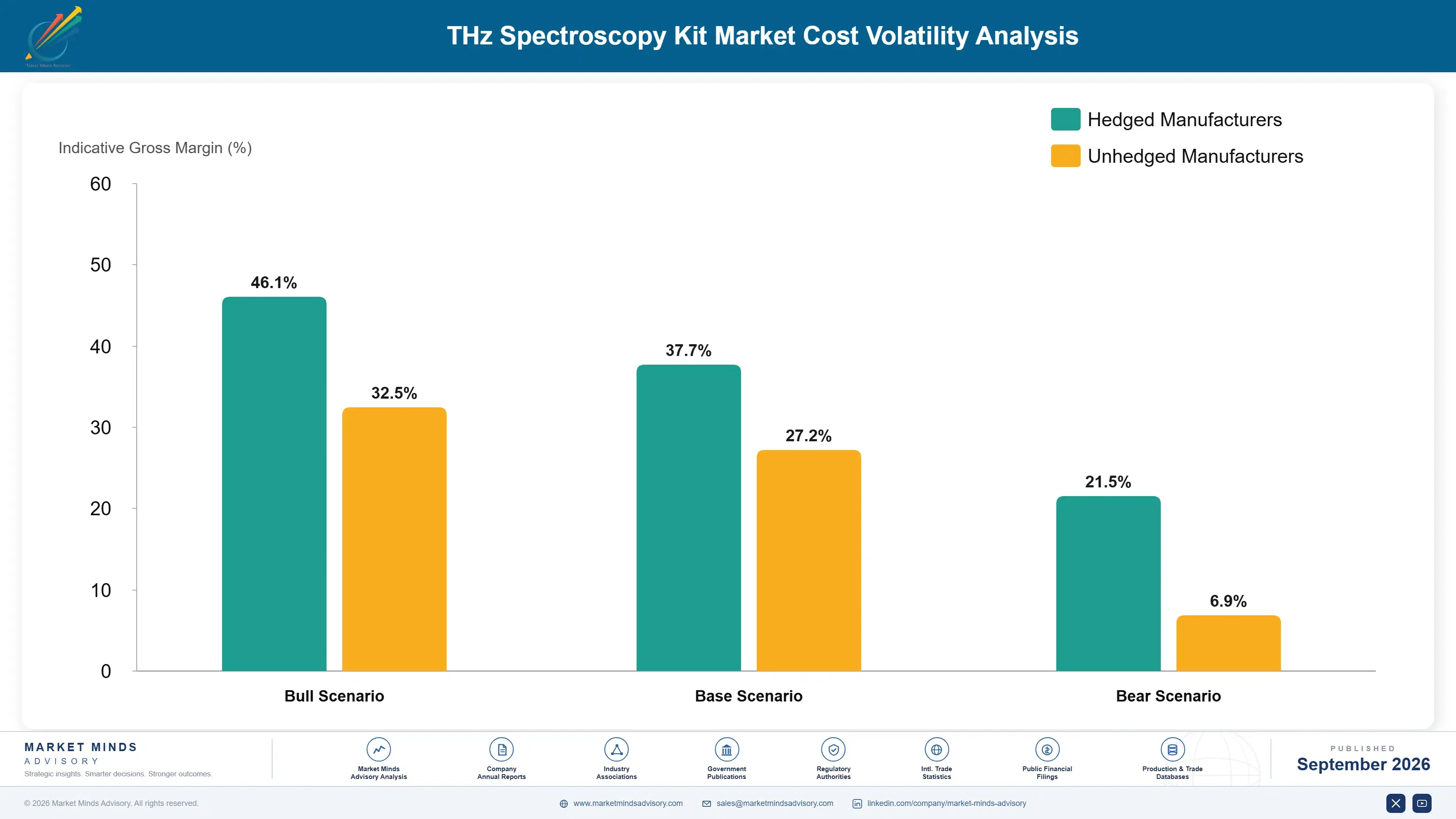
THz spectroscopy system cost structures are dominated by specialized photonics components including femtosecond laser sources, photoconductive antennas, and precision optical mounts, rather than commodity electronic parts or bulk materials. These specialized components require semiconductor-grade fabrication precision, concentrating supply among a limited number of qualified photonics component manufacturers primarily located in Germany, Japan, and the United States specifically.
Femtosecond laser source prices remained relatively stable through 2023 and 2024 despite broader semiconductor supply chain disruptions, since these specialized components draw on a distinct manufacturing base from mainstream digital semiconductor chips, according to component supplier annual reports and industry pricing data. However, photoconductive antenna substrate material costs rose meaningfully during this period as gallium arsenide demand from adjacent electronics categories increased overall market pricing pressure.

Smaller vendors lacking in-house photonics component manufacturing capability face a genuine competitive disadvantage versus vertically integrated competitors like Menlo Systems able to control component quality and cost more directly. This exposure varies by player type: vendors purchasing components externally face longer lead times and less pricing control than vertically integrated competitors during periods of component supply tightness across the broader photonics industry.
thz-spectroscopy-kit-market-cost-volatility-analysis-1788503359381

Vertically Integrate Critical Component Manufacturing

Vendors are vertically integrating femtosecond laser source and photoconductive antenna manufacturing internally rather than relying entirely on external suppliers, capturing margin previously paid to component vendors while gaining more direct control over quality and delivery timelines. This integration also shortens development cycles for new product features requiring custom component specifications not readily available from external suppliers.

Diversify Component Sourcing Across Multiple Suppliers

Vendors are qualifying multiple component suppliers for critical parts like photoconductive antennas rather than depending on a single source, reducing exposure to any individual supplier's capacity constraints or pricing changes during periods of tight photonics component supply. This diversification strategy has proven especially valuable during periods of geopolitical trade tension affecting specific component-producing countries and regions.

Negotiate Multi-Year Component Supply Agreements

Vendors are negotiating multi-year supply agreements with key photonics component manufacturers, locking in pricing and delivery commitments that reduce exposure to spot market price volatility while providing suppliers with the demand visibility needed to plan capacity investment. Vendors report these agreements have meaningfully reduced unplanned cost increases compared to spot market purchasing during periods of tight supply.

Portfolio Architecture for Margin Defence

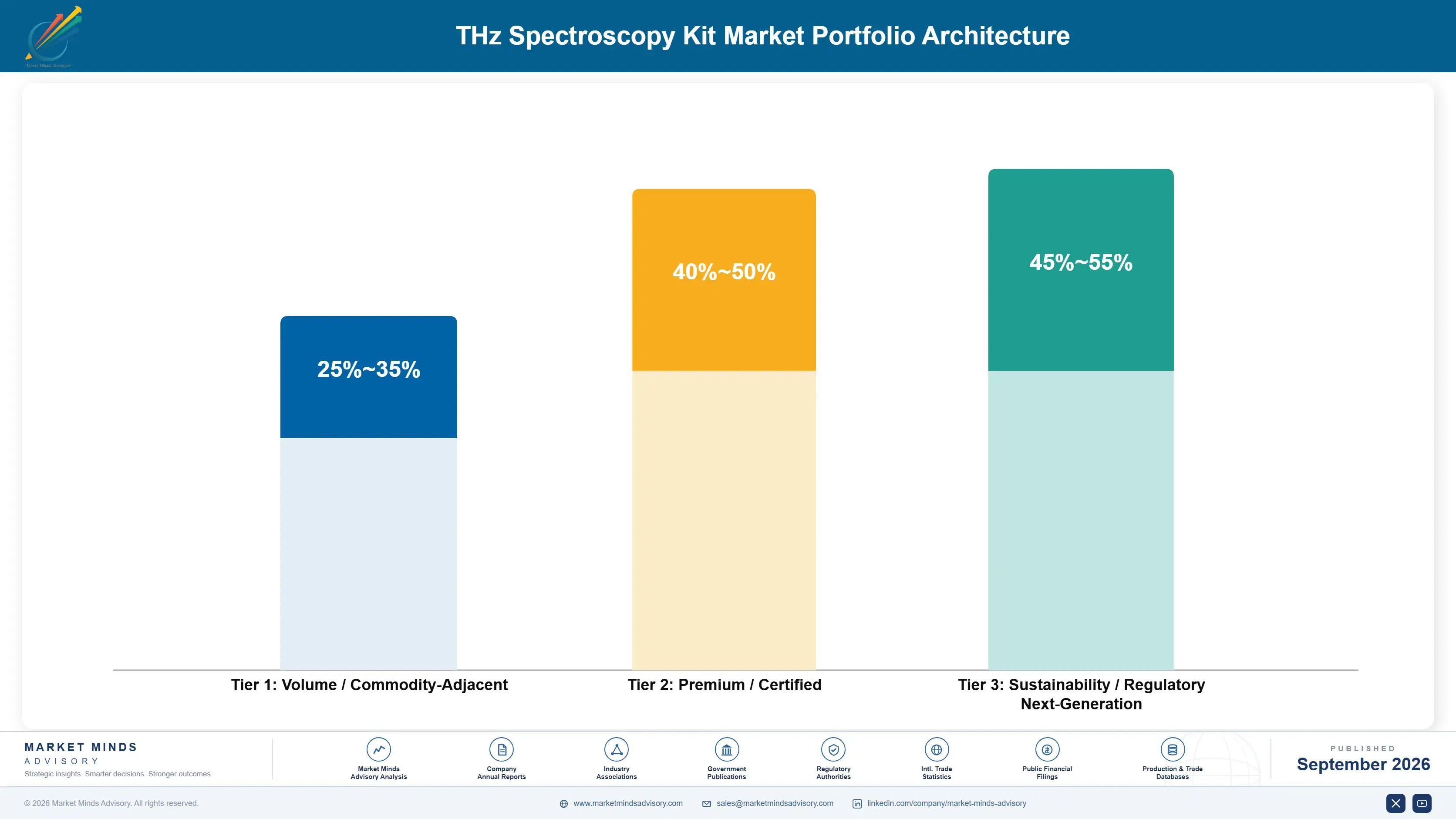
Portfolio economics across THz spectroscopy vendors split between standard research-grade systems competing largely on hardware specification and price, and application-specific industrial kits commanding meaningfully higher margins given calibration library depth and service contract attachment sold alongside the core instrument across every customer segment served today, from academic universities and national laboratories to pharmaceutical and semiconductor production quality control lines directly.
The tension between volume and premium positioning shows clearly in customer segment served: research-grade systems sold to universities compete on measurement bandwidth and price sensitivity, while industrial quality control kits sold to pharmaceutical and semiconductor customers command substantially higher effective margins through calibration and service revenue attached to the core hardware sale over the equipment's full multi-year operating lifecycle and beyond. Vendors serving both segments increasingly maintain distinct sales teams tailored to each customer type.

High-value margin pools concentrate around application-specific calibration libraries and multi-year service contracts, both requiring specialized domain expertise that smaller vendors cannot easily replicate without years of accumulated application knowledge, customer trust, and technical credibility. Vendors positioned purely as hardware manufacturers will struggle to capture this premium tier without meaningful, sustained investment in software and application engineering capability over multiple product generations.

Volume / Commodity-Adjacent

Standard research-grade benchtop systems competing largely on hardware specification and price against similar undifferentiated instrument offerings from established competitors, with margins typical of academic instrumentation sales cycles and budget-constrained university procurement.
Gross Margin: 25-35%

Premium / Certified

Application-specific industrial systems with dedicated calibration libraries sold to pharmaceutical and semiconductor customers requiring validated, turnkey measurement solutions that reduce implementation risk and technician training burden considerably compared to general-purpose research instruments.
Gross Margin: 40-50%

Sustainability / Regulatory / Next-Generation

Multi-year service contracts and software licensing arrangements requiring specialized domain expertise and accumulated application knowledge smaller vendors cannot easily replicate, commanding the category's strongest and most defensible margin position across the entire portfolio.
Gross Margin: 45-55%
thz-spectroscopy-kit-market-portfolio-architecture-1788503359882

High-value Sub-segments and Strategic Watch-out

Fiber-Coupled THz-TDS Systems

The fastest-growing, highest-value segment globally as alignment-free designs expand the addressable customer base beyond research physicists into industrial quality control departments broadly, letting technicians without specialized optics training operate systems reliably on active production lines across pharmaceutical and semiconductor facilities worldwide, today and going forward.
Gross Margin: 40-50%

Application-Specific Calibration Libraries

High-value and steadily growing overall as vendors monetize accumulated application expertise separately from hardware, capturing recurring revenue tied directly to measurement accuracy improvements that customers value highly for regulatory compliance and quality assurance purposes across every major served industry vertical, geography, and customer size tier.
Gross Margin: 45-55%

Bulk Free-Space Research Systems

The volume core of the academic research market today, generating steady revenue but facing slower growth as industrial applications increasingly favor fiber-coupled alternatives instead, concentrating this segment's remaining demand among specialized fundamental research applications requiring maximum measurement bandwidth, signal-to-noise performance, spectral resolution, and overall sensitivity.
Gross Margin: 25-35%

Competing Non-Destructive Inspection Tools

A strategic watch-out category where alternative non-destructive inspection technologies achieving comparable capability at lower cost could slow terahertz adoption meaningfully over time, potentially reshaping which vendors capture the industrial quality control opportunity this report identifies as the category's primary near-term growth driver and margin source.
Gross Margin: N/A, external

How Service Contracts Compound Value

Multi-year preventive maintenance service contracts function like an annuity once a customer's production line becomes dependent on continuous instrument calibration stability, since switching to a competing system mid-relationship risks disrupting the calibration library and measurement baseline built up over months of documented quality validation and regulatory approval that a new instrument would need to establish entirely from scratch, adding real cost.
Adoption stickiness varies by end-use vertical: pharmaceutical manufacturers show the deepest lock-in given regulatory validation requirements tied to specific instrument serial numbers and calibration records, while academic research customers switch more readily given simpler procurement processes and lower integration requirements tied to any single vendor's specific software platform or calibration methodology across a typical research group's equipment lifecycle. Switching costs extend well beyond a single instrument decision.

Generational shifts in laboratory technician training are reshaping buyer profiles, as newer quality control staff entering the workforce now expect touchscreen software interfaces and automated calibration routines as a baseline instrument capability rather than a premium feature reserved for the most expensive systems only. This mindset shift accelerates purchasing decisions toward vendors offering genuinely simplified operation. Vendors slow to modernize interfaces risk losing ground to newer entrants targeting this generational shift directly.
thz-spectroscopy-kit-market-end-use-penetration-index-1788503360393

MMA Verdict on THz Spectroscopy

These are among the four positions where our research anticipates prominent divergence between winners and laggards over the coming forecast period. Each is grounded in the demand model, the regulatory perimeter, and the announced capacity pipeline.
01 / FIBER COUPLING PRIORITY

Prioritize fiber-coupled designs for industrial market expansion

Vendors still emphasizing bulk free-space system development risk ceding the fastest-growing industrial quality control segment to competitors offering alignment-free fiber-coupled alternatives that require no specialized optics training to operate reliably on active production lines. This design shift expands the addressable customer base considerably beyond research physicists into quality control departments that previously found terahertz technology too operationally complex to deploy reliably on a production line. Vendors should prioritize this transition ahead of incremental bandwidth improvements that matter mainly to research customers.
02 / CALIBRATION LIBRARY INVESTMENT

Build application-specific calibration libraries as a moat

Vendors competing purely on hardware specifications will find margins compressing as component costs decline and competitors converge on comparable measurement performance across the category over successive product generations and design refresh cycles. Investing in application-specific calibration libraries for pharmaceutical coatings and semiconductor packaging materials creates a defensible advantage that accumulates over years of customer application data collection that new entrants cannot easily replicate quickly or affordably. This investment should be treated as a strategic priority alongside hardware development, not an afterthought.
03 / COMPONENT SUPPLY DIVERSIFICATION

Diversify photonics component sourcing across suppliers

Vendors dependent on a single photonics component supplier for critical parts like photoconductive antennas face genuine supply disruption risk during periods of tight component availability across the broader photonics manufacturing industry and its many customers worldwide. Qualifying multiple suppliers or building selective vertical integration capability reduces this exposure meaningfully, even at somewhat higher near-term qualification cost for engineering and procurement teams managing supplier relationships across regions. Vendors delaying this diversification risk production delays that damage customer relationships and contract renewal prospects.
04 / LEASING MODEL ADOPTION

Expand leasing programs to capture budget-constrained buyers

Vendors offering only outright purchase options leave meaningful revenue on the table by excluding smaller industrial and academic customers unable to justify the substantial upfront capital expenditure that terahertz systems traditionally require before any measurable financial return materializes. Expanding instrument-as-a-service leasing programs broadens the addressable customer base while also smoothing vendor revenue recognition across a longer, more predictable customer relationship period than lumpy one-time hardware sales alone provide. Vendors should treat leasing as a genuine growth lever worth pursuing seriously.

Engagement Snapshot From the Field

A live engagement with an industry participant carrying material or product regulatory and market exposure ahead of a defining policy shift, showing how our research translates into a defensible multi-year portfolio strategy.
MARKET MINDS ADVISORY · CLIENT ENGAGEMENT SUMMARY
THz Spectroscopy Kit Producer Strategic Portfolio Review and Transition Roadmap 2026·Investment Scenario on THz Spectroscopy Kit Exposure Evaluation 2025-26
CLIENT PROFILE
The client is a mid-sized generic pharmaceutical manufacturer operating three production facilities, currently using destructive sampling methods for tablet coating quality verification but facing rising regulatory pressure to adopt non-destructive testing methods across its full production volume. The company had no prior experience with terahertz instrumentation and needed guidance on vendor selection, expected accuracy performance, and production line integration requirements.
STRATEGIC CHALLENGE
Leadership needed to select a terahertz spectroscopy vendor capable of integrating coating thickness measurement directly into existing production lines, without requiring specialized optics expertise among quality control staff or creating production bottlenecks that could slow overall manufacturing throughput during the busiest seasonal production periods each calendar year across all three facilities.
MMA APPROACH
MMA conducted a structured vendor evaluation across four THz spectroscopy vendors, assessing fiber-coupled system availability, pharmaceutical calibration library depth, and production line integration complexity against the client's existing facility layout and staffing model, supplementing vendor-provided data with reference calls to comparable pharmaceutical manufacturing clients already using each evaluated vendor's systems.
KEY FINDINGS
  1. Two of four evaluated vendors lacked pre-validated calibration libraries for the client's specific tablet coating formulations, requiring supplemental development work before deployment.
  2. Fiber-coupled systems reduced technician training time considerably compared to bulk free-space alternatives requiring specialized optics alignment expertise and formal certification programs beforehand.
  3. The selected vendor's service contract included remote diagnostics capability, reducing expected production line downtime during unplanned instrument service events considerably across all facilities.
  4. Reference clients reported measurable reductions in destructive sampling waste after implementing comparable terahertz coating inspection systems across their own multi-facility production lines.
CLIENT PROFILE
The client is a mid-sized generic pharmaceutical manufacturer operating three production facilities, currently using destructive sampling methods for tablet coating quality verification but facing rising regulatory pressure to adopt non-destructive testing methods across its full production volume. The company had no prior experience with terahertz instrumentation and needed guidance on vendor selection, expected accuracy performance, and production line integration requirements.
STRATEGIC CHALLENGE
Leadership needed to select a terahertz spectroscopy vendor capable of integrating coating thickness measurement directly into existing production lines, without requiring specialized optics expertise among quality control staff or creating production bottlenecks that could slow overall manufacturing throughput during the busiest seasonal production periods each calendar year across all three facilities.
MMA APPROACH
MMA conducted a structured vendor evaluation across four THz spectroscopy vendors, assessing fiber-coupled system availability, pharmaceutical calibration library depth, and production line integration complexity against the client's existing facility layout and staffing model, supplementing vendor-provided data with reference calls to comparable pharmaceutical manufacturing clients already using each evaluated vendor's systems.
KEY FINDINGS
  1. Two of four evaluated vendors lacked pre-validated calibration libraries for the client's specific tablet coating formulations, requiring supplemental development work before deployment.
  2. Fiber-coupled systems reduced technician training time considerably compared to bulk free-space alternatives requiring specialized optics alignment expertise and formal certification programs beforehand.
  3. The selected vendor's service contract included remote diagnostics capability, reducing expected production line downtime during unplanned instrument service events considerably across all facilities.
  4. Reference clients reported measurable reductions in destructive sampling waste after implementing comparable terahertz coating inspection systems across their own multi-facility production lines.
RECOMMENDED STRATEGY
Phase 1: Phase one: deploy a single fiber-coupled system on one production line to validate measurement accuracy against existing destructive sampling methods. Phase 2: Phase two: expand deployment to remaining production lines once initial accuracy validation and technician training metrics clear defined internal thresholds. Phase 3: Phase three: transition fully away from destructive sampling as the primary verification method once regulatory documentation requirements are fully satisfied.
OUTCOME
The client deployed its pilot system on one production line, reporting measurement accuracy comparable to destructive sampling with a meaningful reduction in wasted product across the pilot line's full production run (client-reported, unverified by MMA). Leadership credited the phased deployment with limiting production disruption during the initial validation period.

Frequently Asked Questions

Foundational context covering the market sizes, CAGR, scope, country, region and competition that inform every finding below. This section is provided to cover basics and most often pre-purchase conversations, answered from the MMA Primary Research Dataset.

What is the current size of the THz Spectroscopy Kit Market?

The THz Spectroscopy Kit Market is valued at 0.4 billion dollars in 2025. It is expected to reach 0.44 billion dollars by 2026 as industrial adoption accelerates.

How large will the THz Spectroscopy Kit Market be by 2036?

The market is projected to reach 1.19 billion dollars by 2036, up from 0.44 billion dollars in 2026. That represents a 2.70 times expansion over the forecast period.

What is the CAGR for the THz Spectroscopy Kit Market 2026 to 2036?

The market is forecast to grow at a 10.5 percent compound annual growth rate between 2026 and 2036. This reflects steady demand from pharmaceutical and semiconductor quality control.

Which segment is growing fastest?

Fiber-Coupled THz-TDS Systems lead at a 14.0 percent CAGR, roughly 1.33 times the overall market rate. Alignment-free designs are driving this rapid industrial adoption nationwide.

Who are the major companies in the THz Spectroscopy Kit Market?

Leading vendors include Advantest, Menlo Systems, TeraView, Toptica Photonics, and Zomega Terahertz. Together these five vendors hold an estimated 58 percent combined market share globally.

Which country is growing fastest?

India leads at a 13.5 percent CAGR, driven by rapidly expanding semiconductor fabrication investment backed by government incentive programs. Pharmaceutical export quality requirements are also accelerating adoption.

Report Segmentation Architecture

The full report scope spans multiple orthogonal segmentation dimensions, with cross-tabulated demand data provided for each dimension pair. Coverage extends further to regional breakdowns, trend trajectories, and the competitive detail needed to support segment-level decision-making.

By Primary Market Dimension

  • Fiber-Coupled THz-TDS Systems
  • Bulk Free-Space THz-TDS Systems
  • Continuous-Wave Systems
  • Portable Field-Deployable Units
  • Application-Specific Turnkey Packages
  • Calibration Software and Libraries

By End-Use Industry

  • Pharmaceutical Manufacturing
  • Semiconductor and Electronics
  • Academic and National Laboratory Research
  • Materials Science and Polymers
  • Aerospace and Defense

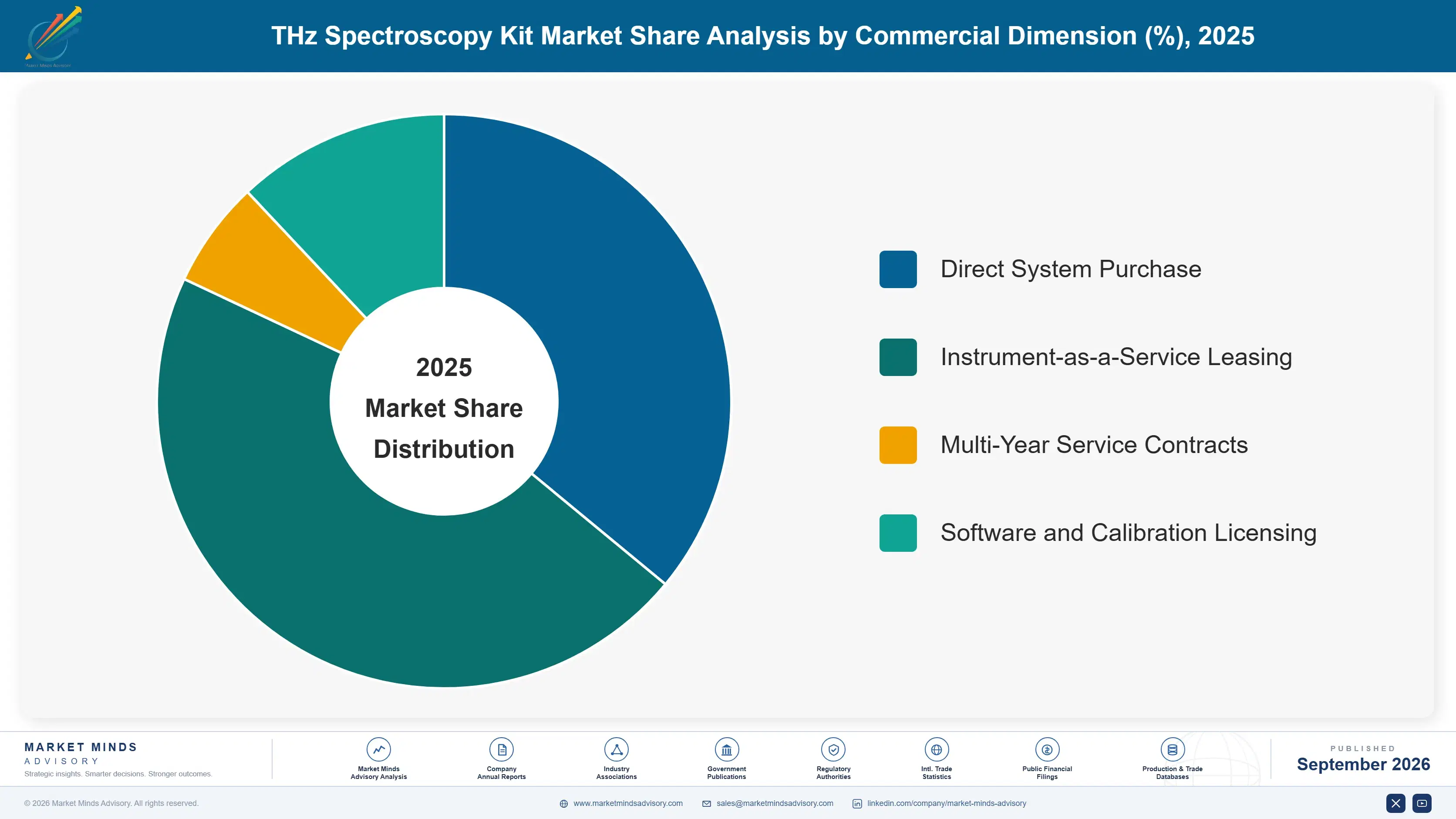
By Commercial Dimension

  • Direct System Purchase
  • Instrument-as-a-Service Leasing
  • Multi-Year Service Contracts
  • Software and Calibration Licensing

By Region

  • North America
  • Western Europe
  • East Asia
  • South Asia and Pacific
  • Latin America
  • Middle East and Africa
  • Eastern Europe

Scope, Methodology, and Coverage

Every figure in this report is reproducible from documented input assumptions. The scope below maps the historical period, the forecast horizon, the segmentation dimensions, and the countries covered, alongside the underlying primary and qualitative methodology.
Historical Period
2020 to 2025
Forecast Period
2026 to 2036
Base Year
2025 (USD billions; MMA Primary Research Dataset, September 2026)
Market Definition
This market covers terahertz time-domain spectroscopy instrumentation and benchtop kits used for non-destructive material characterization, thickness measurement, and defect detection in research, pharmaceutical, and semiconductor applications. It excludes terahertz imaging systems sold as standalone medical or security screening products outside laboratory research contexts.
Quantitative Units
USD billions, market share percentages, CAGR percentages
Segmentation Dimensions
System architecture type, end-use industry, commercial dimension, region
Regions Covered
North America, Western Europe, East Asia, South Asia and Pacific, Latin America, Middle East and Africa, Eastern Europe
Countries Covered
United States, Japan, Germany, United Kingdom, China, Taiwan, India, Brazil, United Arab Emirates, and 30 additional countries across all seven global regions
Key Companies Profiled
Advantest, Menlo Systems, TeraView, Toptica Photonics, Zomega Terahertz, and 15 additional vendors
Quantitative Methodology
Primary survey, n=3,800 respondents, Q4 2025, six countries; demand-side model with trade association cross-validation
Qualitative Methodology
47 expert interviews, Q4 2025; applied to validate demand model assumptions, identify emerging dynamics, and assess competitive positioning
Report Format
PDF and XLSX data workbook (Word format preview document)
Publisher
Market Minds Advisory
Report Code
MMA-2026-TEC-162
Published
September 2026
Contact
sales@marketmindsadvisory.com | www.marketmindsadvisory.com

Purchase the full THz Spectroscopy Kit Market Report (2026 to 2036).

This report examines the THz Spectroscopy Kit Market across its full 2026 to 2036 forecast horizon, covering market sizing, segmentation, competitive dynamics, and regional demand patterns in depth. It draws on primary survey data from 3,800 respondents and 47 expert interviews conducted in the fourth quarter of 2025. The analysis profiles twenty leading vendors and quantifies revenue levers, component cost exposure, and portfolio economics across the category's major segments. Strategic recommendations address fiber coupling priorities, calibration library investment, and leasing model adoption for vendors and investors.
Full 2026-2036 market sizing and forecast data
Seven-region demand and growth rate breakdown
Twenty-company competitive profiles and moat analysis
Segment-level CAGR and market share detail
Revenue lever and component cost exposure analysis
Anonymised client case study with strategy recommendations

Built For The People Who Decide

From boardroom strategy to bench-side execution, this report is read cover-to-cover by leaders shaping the next decade of their industry, turning demand scenarios, market dynamics and valuation benchmarks into decisions.
CXOs/ Presidents/ VPs/ Managers
M&A and Corporate Development
Strategy Teams and R&D Heads
Procurement and Product Directors
Regulatory and Compliance Leaders
Investor Relations and Equity Analysts