Market Minds Advisory
Three Phase Residential Voltage Regulator Market

Three Phase Residential Voltage Regulator Market: Three Phase Residential Voltage Regulator Market: Selling Against The Utility

Nobody buys one of these until the fridge dies. Two thirds of purchases happen after an appliance has already failed, which makes this a repair decision rather than any kind of plan.

Lead Analyst

Published

September 2026

Make Smarter Decisions with Customized Research Insights

Request a free sample report and evaluate market opportunities, growth trends, and competitive dynamics relevant to your business needs.

2025 MARKET VALUE$1.9BMarket Size 2025
2036 FORECAST VALUE$4.9BBase Case , 2026 to 2036
CAGR 2026 TO 20369.0 %Bull 10.2% / Bear 7.8%
INCREMENTAL OPPORTUNITY$2.8BNet 10- year value creation
EXPANSION MULTIPLE2.37x2036 value over 2026 base
Strategic Levers
M&A Pipeline
Regional Outlook
Country Rankings
Competitive Intelligence
Segmental Deep-dive
Call-Us : 91 93563 13602

Executive Snapshot and Market Trajectory.

This product exists because a distribution network does not deliver what it promised, which makes market size a function of grid quality rather than income. Some 68% of buyers act only after an appliance has failed, so the sale is a repair decision made in a hurry.
Solar-aware bidirectional regulators grow at 13.5%, half again the market rate of 9.0%, because rooftop export raises local feeder voltage until inverters trip themselves off, and 23% of systems now lose output that way. South Asia holds 34% of demand, far outside any normal band, on Indian supply instability and on three-phase domestic connections being ordinary rather than unusual there. A reliable grid has quietly created a voltage problem of its own instead.
Concentration is low at 34% of units shipped, because a voltage regulator is a transformer with a control loop and regional manufacturers build them wherever the grid is poor enough to need them. The commercially awkward fact is that every network reinforcement removes demand permanently, so this industry sells against its customers' own utility fixing the problem. Very few businesses are built on somebody else's failure to invest properly.
Market Definition
The three phase residential voltage regulator market covers equipment installed at dwellings to correct incoming supply voltage outside acceptable limits on three phase connections, spanning servo-controlled regulators, static thyristor regulators, relay-type step regulators, ferroresonant constant voltage transformers, solar-aware bidirectional regulators, and hybrid regulator and surge systems. Scope is measured as units shipped into residential and small premises installation. Excluded are uninterruptible power supplies and battery backup systems, single phase household stabilisers, industrial and commercial voltage regulation above domestic ratings, utility on-load tap changers and line regulators, and inverters supplied for solar generation.
Base Year Value
$1.9B in 2025 (MMA Primary Research Dataset, September 2026)
Forecast Period
2026 to 2036, eleven discrete annual values
CAGR
9.0% base case. Bull 10.2%. Bear 7.8%.
Fastest Growth Segment
Solar-Aware Bidirectional Regulators: 13.5% CAGR
Fastest Growth Country
India: 11.2% CAGR
Fastest Growth Region
South Asia and Pacific: 11.2% CAGR
Largest Region
South Asia and Pacific: 34% of 2025 global value
Market Leaders
V-Guard Industries, Servokon Systems, ORTEA, Ashley-Edison and Vertiv. Source: MMA Analysis, July 2026.
Primary Survey
n=3,800 procurement and R&D decision-makers, Q4 2025, six countries
Methodology
Demand-side build-up, cross-validated against public data, 47 expert interviews

Three Phase Residential Voltage Regulator Market Forecast Scenarios

three-phase-residential-voltage-regulator-market-size-forecast-scenario-1788410871736
Between 2020 and 2025 the sector compounded at 7.6% and two very different demands sat underneath it. Traditional stabiliser sales tracked distribution network quality in South Asia, Africa and Latin America, rising with electrification and falling wherever a utility actually reinforced a feeder. Separately, rooftop solar began creating over-voltage in networks that had never had a voltage problem, which nobody had forecast at all.
The 9.0% base case rests on three mechanisms. Distribution networks across South Asia, Africa and parts of Latin America continue carrying load beyond their design while connection numbers keep rising, which produces voltage excursions that no householder can address any other way. Rooftop solar export is creating over-voltage on feeders in developed markets. And appliance value per household keeps rising, which raises what a failure costs. None of the three depends on economic growth.
The bull case at 10.2% turns on solar over-voltage becoming a recognised installation requirement rather than a problem householders discover, which would move regulators into the standard rooftop package. The bear case at 7.8% is network investment: every reinforced feeder and every on-load tap changer installed at a distribution transformer removes local demand permanently, and utilities are investing more than they were.

A Problem Somebody Else Created

Almost every market for electrical equipment grows with income and this one grows with network failure, which inverts the usual analysis completely. A householder on a feeder delivering voltage 17% from nominal watches motors run hot and electronics fail early, and buys a regulator because no other remedy is available to somebody who does not own the network. Where supply is stable, the product has no purpose whatsoever.
TOP FIVE CONCENTRATION34%Share of units shipped held by five largest manufacturers
AVERAGE SELLING PRICEUSD 310Mean price per unit across all regulation technologies
SUPPLY VOLTAGE DEVIATION17%Typical excursion from nominal on an affected distribution feeder
PURCHASE AFTER FAILURE68%Portion of buyers acting only after an appliance was damaged
SOLAR OVER-VOLTAGE TRIPPING23%Portion of rooftop systems curtailed by voltage rise on feeders
REGULATOR SERVICE LIFE11 yearsWorking life before a unit is replaced or abandoned
The purchase is reactive and emotional rather than planned. Some 68% of buyers act only after an appliance has already failed, which means the sale happens under time pressure through whatever channel is nearest, usually a retailer or an electrician called to diagnose it. Nobody researches voltage regulation in advance, and manufacturers organised around specification selling are addressing a decision that is never made that way.
Something genuinely new is happening in networks that never had this problem. Rooftop solar exporting into a low voltage feeder raises local voltage, and inverters protecting themselves disconnect when it exceeds their limit, so 23% of installed systems now lose output to over-voltage tripping. The householder has paid for generation they cannot use, and a bidirectional regulator is among very few remedies they can buy.
"This industry has spent decades selling to people whose utility let them down, and it is now selling to people whose own solar panels are the problem. The second customer is wealthier, angrier and has no idea the product exists."
Director, Power Quality Equipment Practice · MMA Energy Practice · September 2026

Market Trends

Rooftop solar created over-voltage in reliable networks

Distributed generation exporting into low voltage feeders raises local voltage, and inverters are required to disconnect when it exceeds their operating limit, which means around 23% of rooftop systems now lose output to over-voltage tripping in networks with high solar penetration. The householder has paid for generation they cannot use and the utility has no obligation to fix it quickly. Bidirectional regulators addressing that grow at 13.5% against a market rate of 9.0%, and the affected customer has considerably more money and considerably less patience than the traditional one. Nobody is calling on them.
Market Impact: Concentrates 34% in 1 region

Appliance value raised what a voltage excursion costs

A household on an unstable feeder once risked a motor and some lighting, and now risks inverter-driven air conditioning, induction cooking, electronics and increasingly a vehicle charger and a heat pump, all of which are expensive and all of which are sensitive to supply quality in ways older appliances were not. The cost of a single failure has risen far faster than the price of a regulator, which changes the arithmetic entirely. That is why demand keeps rising in markets where network quality has been poor for decades without any change.
Market Impact: Widens across 3 major regions

Market Opportunities and Growth Drivers

Three phase domestic connections are ordinary in growth markets

Three phase supply to a dwelling is unusual across North America and much of Western Europe and entirely routine across India, parts of Southern Europe, the Gulf and much of Africa, where larger homes, farm connections and small premises take it as standard. That makes the addressable base for three phase regulation concentrate in exactly the geographies where supply quality is worst. South Asia holds 34% of demand on that combination alone, and manufacturers built around single phase household products cannot serve it without a different range entirely. A different range is required.
Market Impact: Removes demand from 1 feeder

Connection growth keeps outpacing network reinforcement

Distribution networks across South Asia, Africa and parts of Latin America are adding connections faster than feeders are being reinforced, which pushes voltage further from nominal at the end of every line as load grows on conductors sized for a smaller population. Utilities know this and reinforcement capital is finite and allocated politically. The gap between connections added and capacity added is the demand for this product, and it has widened rather than narrowed across most of these markets over the past decade. The gap has widened rather than narrowed across most of these markets over a decade.
Market Impact: Reaches 68% only after failure

Market Restraints and Challenges

Network reinforcement removes the demand permanently

A utility that reinforces a feeder, rebalances phases or installs an on-load tap changer at a distribution transformer fixes the voltage for every household on that line at once, and none of them ever buys a regulator again. The root cause is that this product treats a symptom of somebody else's underinvestment rather than solving anything at the household. Commercial impact is a market that shrinks wherever networks improve. Participants are responding by targeting geographies where reinforcement lags, by moving into solar over-voltage applications and by adding surge and monitoring functions.
Market Impact: Curtails 23% of rooftop systems

Nobody knows the product exists until they need it

Some 68% of purchases follow an appliance failure, which means the buyer is discovering the category at the moment they need it and buying whatever an electrician or a nearby retailer recommends within a day. The root cause is that voltage quality is invisible until something breaks. Commercial impact is that brand building reaches nobody and channel presence decides everything. Mitigation runs through electrician relationships, retail shelf position, appliance retailer partnerships and increasingly through solar installers who encounter the over-voltage problem directly. Brand building reaches nobody at all in a window that short.
Market Impact: Protects assets worth 30 units
3 additional market trends, 4 additional growth drivers, and 2 additional restraints and challenges are covered in the full report. Contact sales@marketmindsadvisory.com to access the complete intelligence.

Segment CAGR and Growth Architecture

Segmentation follows regulation technology, the dimension on which response speed, waveform handling and unit price all move together. Servo and relay designs carry the volume wherever supply is simply low or high. Static and bidirectional designs carry the growth, because both handle fast excursions and reverse power flow that older architectures were never built for.
three-phase-residential-voltage-regulator-market-market-share-analysis-1788410872274

Solar-Aware Bidirectional Regulators

Solar-aware bidirectional regulators grow at 13.5%, half again the market rate of 9.0%, and a problem that did not exist a decade ago created the entire segment. When rooftop generation exports into a low voltage feeder it raises local voltage, and inverters disconnect to protect themselves once it exceeds their limit, so around 23% of installed systems lose output that the householder has already paid for. A regulator handling power flowing in both directions holds the connection point within limits and keeps the inverter running. The customer is wealthier and considerably more motivated than the traditional buyer, and almost none of them know this equipment exists at all. Nobody is selling to them.
CAGR 13.5%

Static Thyristor Regulators

Static thyristor regulators at 9.0% correct voltage electronically rather than by moving a mechanical contact, which lets them respond within a cycle instead of over several seconds and removes the wearing parts that limit servo units. That speed matters where excursions are fast and frequent rather than simply sustained, which describes an increasing number of feeders as air conditioning, pumping and now vehicle charging load switches abruptly on and off. Unit prices run above servo equipment and reliability is considerably better, and the segment grows steadily as the installed servo population reaches the end of an eleven year working life. Servo replacement is steady demand nobody plans for, since the installed population reaches end of life on a predictable schedule.
CAGR 9.0%
Full segment breakdown across 6 segments available in the complete report.

Regional Architecture and Country Demand Map

South Asia takes 34%, far outside any normal band, on Indian supply instability and ordinary three phase domestic connections. Middle East and Africa reaches 16% on the same combination. Network quality rather than income decides every position here, which inverts how this equipment is normally analysed.

South Asia and Pacific

A 34% share far outside any normal band comes from two conditions coinciding that appear together almost nowhere else. Indian distribution networks carry load well beyond their design at the end of long feeders, producing voltage excursions that householders can address no other way, and three phase domestic connections are entirely ordinary for larger homes, farm supplies and small premises rather than being unusual as they are in most Western markets. Domestic manufacturers dominate the supply on price and distribution reach. Indian growth at 11.2% is the fastest of any country covered, and connection growth continues outpacing feeder reinforcement across most states. Reinforcement continues lagging connection growth across most states.
Share: 34% | CAGR: 11.2% (2026 to 2036)

East Asia

The 18% share sits below the usual band because Chinese and Japanese distribution networks are considerably better maintained than their South Asian equivalents, which removes the traditional demand almost entirely in urban areas. Rural Chinese feeders remain a genuine market and Chinese manufacturers serve it alongside a substantial export business into Africa and Southeast Asia at prices nobody else matches. Japanese and Korean demand is negligible on network quality grounds. Southeast Asian markets including Indonesia, Vietnam and the Philippines carry conditions much closer to South Asia and represent the growing part of this region. Southeast Asia is the growing part of this region and it looks far more like South Asia than like China does.
Share: 18% | CAGR: 9.8% (2026 to 2036)
Regional intelligence for 5 additional markets available in the complete report: North America, Western Europe, Latin America, Middle East and Africa, Eastern Europe. Contact sales@marketmindsadvisory.com.
three-phase-residential-voltage-regulator-market-country-cagr-analysis-1788410872797

Four Moves On A Reactive Purchase

None of these four is about better regulation, because a transformer with a control loop does what it does and every competent manufacturer builds one. Each works on the fact that the buyer discovers this category at the worst possible moment, and that a genuinely new customer has appeared without noticing. Both are channel problems.

Reach the solar installer, not the householder

Around 23% of rooftop systems lose output to over-voltage tripping and the householder frequently never learns why, because the inverter simply produces less than expected and nobody investigates. The solar installer returning to a complaint is the person who diagnoses it, and they currently have nothing to offer beyond an apology and a note to the utility. Putting a bidirectional regulator in that installer's hands converts a complaint call into a sale. Nobody in this industry is calling on solar installers at all. An apology becomes a sale. Nobody calls on installers.
Market Impact: Addresses 23% of all the curtailed rooftop systems

Be on the shelf where failures get diagnosed

Some 68% of buyers act after an appliance has already failed and buy within a day through whatever channel is nearest, usually an electrician called to diagnose or an electrical retailer they can reach immediately. Brand advertising reaches nobody in that window because the buyer was not in the market yesterday. Distribution density, electrician relationships and appliance retailer presence decide the sale entirely. Manufacturers running specification-led commercial models are addressing a decision that is never made that way anywhere. The buyer was not in this market yesterday and will not be tomorrow.
Market Impact: Captures the 68% who buy after a failure

Map the feeders rather than the country

Voltage problems concentrate on identifiable feeders at the end of long runs and in neighbourhoods that utilities have not reinforced, which means demand is geographically specific in a way national market data completely conceals. Utility complaint records and inverter curtailment data identify exactly which households sit on feeders deviating 17% from nominal. Concentrating distribution and installer relationships there costs analysis rather than capital. Almost every manufacturer here still allocates sales effort by population. Sales effort is still allocated by population almost everywhere. Analysis rather than capital is what this costs.
Market Impact: Targets the feeders now deviating 17% from nominal

Sell the protection, not the regulation

A household now connects inverter-driven air conditioning, induction cooking, electronics and increasingly a vehicle charger and heat pump to a supply that swings 17% from nominal, and the cost of a single failure has risen far faster than the USD 310 the regulator costs. Framing the purchase against the value of what it protects rather than against the electricity it corrects reaches a householder who has just replaced a compressor. It costs a change of message rather than product development. It costs a change of message rather than any product development at all.
Market Impact: Protects assets against a single USD 310 purchase

Who Controls the Margin Pool

CR5 stands at 34% of units shipped into residential installation, which is the only comparable basis since almost no participant reports this product separately. Concentration is low because a voltage regulator is a transformer with a control loop, manufacturing is not difficult, and regional producers have grown up in every market where the distribution network gave them a reason to exist. Regional producers exist wherever networks gave them a reason.
Competition runs on distribution density, electrician relationships and price. Distribution decides who is reachable within the day a buyer needs one. Electrician relationships decide what gets recommended when somebody diagnoses the problem. Price decides between comparable units in a purchase nobody researched. Technical performance differentiates almost nothing, since buyers cannot assess it and would not know how to. Buyers cannot assess performance anyway.

Rankings will move on the solar over-voltage market rather than the traditional one, because that customer is wealthier, reachable through a different channel and currently unserved by anybody. The pressure comes from a new application rather than from competitors, and the manufacturers who reach solar installers first will hold a position the incumbents have no route to at all. Incumbents have no route to that customer.
three-phase-residential-voltage-regulator-market-company-positioning-matrix-1788410873321

Competitive Moat and Risk Dimensions

V-GUARD INDUSTRIES

Moat: Distribution reach across affected geography

Retail and electrician distribution reaching deep into the Indian market puts the brand within a day of a household discovering it has a voltage problem, which is precisely the window in which this purchase happens. That network took decades to build. A better product with no distribution is simply absent when the decision is made.
V-GUARD INDUSTRIES

Risk: Network improvement erodes the base

Indian distribution investment is substantial and reinforcement removes demand from an entire feeder permanently rather than gradually, and the strongest position sits in exactly the geography receiving that investment. No product response addresses a problem being solved by somebody else. Diversifying toward solar over-voltage means reaching a different customer through a channel the company does not currently serve.
ORTEA

Moat: European technical position and solar

Established engineering credibility in European power quality applications positions the company where the solar over-voltage problem is emerging, in markets with three phase domestic supply and high rooftop penetration. That customer is wealthier and the application is technically demanding in ways the traditional product is not. Reaching it requires credibility rather than distribution density.
ORTEA

Risk: Small volumes against Asian producers

European manufacturing volumes are a fraction of Indian and Chinese output on a product where cost matters and technical differentiation is difficult for a buyer to assess at all. Competing outside specialised applications means facing a permanent cost gap. The position is narrow and depends on solar over-voltage staying a technical sale.

Players Tracked

Prominent Players

V-Guard Industries
Servokon Systems
ORTEA
Ashley-Edison
Vertiv

Other Key Players

Servomax
Bluebird Power Solutions
Schneider Electric
Socomec
Legrand
Delta Electronics
Riello Elettronica
Salicru
Kehua Tech
Baykee
Purevolt Products
Statcon Energiaa
Microtek International
Luminous Power Technologies
Zhejiang Kelong

Recent Developments

FEBRUARY 2025

Solar monitoring data quantified over-voltage curtailment losses

Aggregated inverter monitoring data across several high penetration markets quantified how much rooftop generation is lost to over-voltage tripping, showing a substantial share of installed systems curtailing regularly. Householders had generally attributed the shortfall to weather or panel performance rather than to feeder voltage at all.
Signal: Customers here have been losing generation for years without ever knowing what had actually caused it.
JUNE 2025

Indian distribution reinforcement removed demand across served feeders

State distribution reinforcement programmes upgraded feeders right across several Indian districts during the year, correcting voltage for entire neighbourhoods at once and eliminating all household regulator demand along those lines permanently. Manufacturers reported measurable regional volume decline in precisely the districts where that reinforcement work had completed.
Signal: This industry's demand disappears one feeder at a time and it never comes back to them afterwards.
OCTOBER 2025

Solar installers began offering voltage regulation as an option

Rooftop solar installers across high penetration European and Australian markets began routinely offering bidirectional voltage regulation alongside their own standard installation work, having encountered over-voltage curtailment complaints repeatedly across their customer base with no remedy previously available at all to offer any of those customers.
Signal: An entirely new channel has opened here and the incumbent manufacturers are not in it yet.

Copper, Steel And Electronics

Copper winding accounts for roughly 29% of unit cost, silicon steel core laminations around 21%, and control electronics with switching devices a further 18%. Enclosure, cooling and assembly make up most of the remainder. The product is fundamentally a transformer, which means metal content dominates and there is very little scope to design it out without failing the specification the customer bought it for.
Copper and silicon steel pricing moved sharply through recent years on electrification demand across every sector at once, which US Geological Survey mineral commodity reporting documented across the period. Manufacturers holding forward metal positions protected pricing into retail channels that set prices seasonally. Those buying on spot faced increases they could not pass to a retail buyer comparing units on a shelf, which removes the margin quickly.

The disadvantage falls on production location rather than on purchasing capability. A manufacturer producing inside the market it serves avoids freight on a heavy product and duty that most of these countries apply, on an identical transformer, and the delivered cost difference exceeds anything purchasing achieves. That is why regional manufacturers hold the volume positions in every market where the grid gave them a reason to exist.
three-phase-residential-voltage-regulator-market-cost-volatility-analysis-1788410873516

Hold forward copper positions against retail pricing

Copper and silicon steel together are half of unit cost and both move on electrification demand unconnected to this product, while retail channels set prices for a season at a time. Forward positions cost a premium against spot and protect margin on a product where a price increase simply loses the shelf. Manufacturers buying spot lost margin entirely last cycle.

Manufacture inside the markets that need the product

This is a heavy transformer and freight plus import duty exceed any purchasing advantage on an identical unit, which is why regional producers hold volume everywhere the grid creates demand. Local assembly or manufacture removes a cost gap that no procurement arrangement closes. Exporting from distant plants into these markets means competing at a permanent cost handicap.

Standardise cores across the rating range

Silicon steel laminations are 21% of cost and most manufacturers tool more core sizes than the rating range genuinely requires, which forfeits both material purchasing scale and winding line efficiency. Consolidating onto fewer core sizes with winding variation raises volume on each considerably. It costs some optimisation per rating and returns on every unit built afterwards.

Portfolio Architecture for Margin Defence

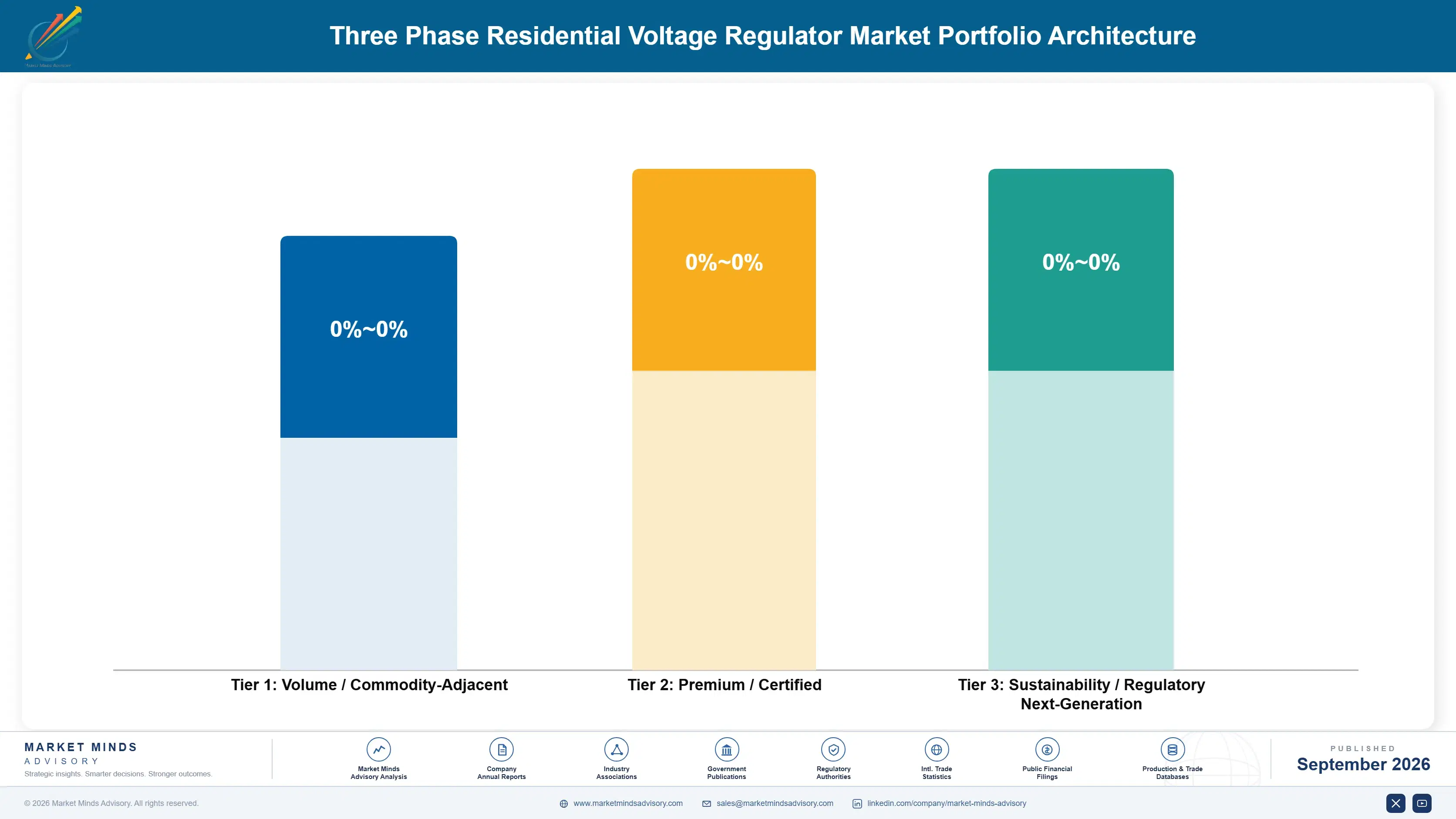
Margin here follows application rather than technology, which the product ranges do not reflect. A servo stabiliser sold through retail to a household whose fridge failed competes on price against identical units and earns very little. The same underlying transformer sold as a bidirectional regulator to a solar owner losing generation earns considerably more, because that buyer is wealthier and has quantified exactly what the problem is costing.
Volume and premium pull against each other through distribution rather than the factory. Traditional stabilisers carry the volume that justifies retail and electrician distribution across the geographies where the grid is poor, and that presence is what makes a manufacturer reachable in the day a buyer needs something. Abandoning the commodity product saves margin and removes the network everything else depends on reaching.

High-value pools sit in solar over-voltage regulation, in hybrid surge and regulation systems and in the installer channel nobody has built. The third is the most immediately available: solar installers encounter curtailment complaints regularly with nothing to offer, and putting a product in their hands converts an apology into a sale at no acquisition cost whatsoever.

Volume / Commodity-Adjacent

Servo and relay-type stabilisers sold through electrical retail and electricians into households on poor feeders. Units are interchangeable and price decides between them. The 8 point spread reflects manufacturing location and freight rather than any design difference.
Gross Margin: 14 to 22%

Premium / Certified

Static thyristor regulators offering cycle-speed correction and longer service life on feeders with fast and frequent excursions. Reliability and response rather than price support the margin. The 8 point spread reflects whether the unit is sold with installation and warranty support.
Gross Margin: 28 to 36%

Sustainability / Regulatory / Next-Generation

Solar-aware bidirectional regulators and hybrid regulation and surge systems sold through solar installers to customers losing generation. Margins are high because the customer has quantified the loss. The 18 point spread separates hardware supply from installed and monitored system offerings.
Gross Margin: 38 to 56%
three-phase-residential-voltage-regulator-market-portfolio-architecture-1788410874014

High-value Sub-segments and Strategic Watch-out

Solar-Aware Bidirectional Regulators

High value and high growth at 13.5%. Around 23% of rooftop systems curtail on over-voltage and the owner has already paid for generation they cannot use. The 8 point spread reflects whether the product reaches that customer through a solar installer or through general retail.
Gross Margin: 44 to 52%

Static Thyristor Regulators

High value with strong growth at 9.0%. Electronic correction responds within a cycle and removes the wearing contacts that limit servo units to an eleven year life. The 8 point spread reflects whether switching electronics are produced internally or bought in as modules. Replacement is predictable.
Gross Margin: 30 to 38%

Servo-Controlled Regulators

The volume core. It earns modestly and it carries the retail and electrician distribution that makes a manufacturer reachable on the day a household needs one. The 8 point spread reflects manufacturing location, since freight on a transformer decides these economics entirely. Freight decides everything.
Gross Margin: 16 to 24%

Ferroresonant Constant Voltage Transformers

The strategic watch-out. Heavy, inefficient and unable to handle modern non-linear loads well, they survive mainly in legacy replacement and specific industrial-adjacent applications. The 22 point spread separates those specialist applications from general household use that has effectively moved on. Legacy replacement only. Household use moved on.
Gross Margin: 10 to 32%

Eleven Years, Then Forgotten

The annuity here is a replacement cycle that almost nobody completes deliberately. A unit works for around eleven years and is then replaced, or increasingly is simply abandoned because the utility fixed the feeder in the meantime and the household never noticed the regulator had stopped mattering. That produces replacement demand that is real, predictable in aggregate and entirely unmanaged by any manufacturer.
Stickiness varies enormously by why the unit was bought. A household that experienced an expensive appliance failure replaces the regulator without hesitation and frequently with the same brand, because the association is strong and the sum involved is small against what it prevented. A household that bought one on a recommendation and never saw a problem afterwards concludes it was unnecessary and does not replace it at all.

Buyer profiles have shifted from householders with failing appliances toward solar owners losing generation, and manufacturers have not moved with them. The first buyer arrives through an electrician or a retailer after something broke. The second is reached through a solar installer investigating why a system underperforms, and that installer has never heard of this equipment. Nobody in this industry is calling on them at all.
three-phase-residential-voltage-regulator-market-end-use-penetration-index-1788410874507

Where The New Customer Is

These are among the four positions where our research anticipates prominent divergence between winners and laggards over the coming forecast period. Each is grounded in the demand model, the regulatory perimeter, and the announced capacity pipeline.
01 / SOLAR INSTALLER CHANNEL

Get into the hands of whoever investigates the complaint

Around 23% of rooftop solar systems lose output to over-voltage tripping and the householder frequently never discovers why, because the inverter simply produces less than expected and nobody investigates the feeder voltage behind it. The solar installer returning to that complaint is the person who diagnoses it, and they currently have nothing to offer beyond an apology and a note to the utility company. Putting a bidirectional regulator in that installer's hands converts a complaint call directly into a sale, and nobody in this industry is calling on them.
02 / REACTIVE CHANNEL PRESENCE

Be reachable on the day something breaks

Some 68% of buyers act only after an appliance has already failed and then buy within a day through whatever channel is nearest to them, usually an electrician called out to diagnose the fault or an electrical retailer they can reach immediately. Brand advertising reaches nobody at all in that window, because the buyer was not in this market yesterday and will not be tomorrow. Distribution density, electrician relationships and appliance retailer presence decide the sale, and specification-led commercial models address a decision never made that way.
03 / FEEDER LEVEL TARGETING

Sell to streets, not to countries

Voltage problems concentrate on identifiable feeders at the end of long runs and in neighbourhoods a utility has not yet reinforced, which means demand is geographically specific in a way that national market data conceals almost completely. Utility complaint records and increasingly inverter curtailment data from solar monitoring platforms identify precisely where the affected households actually are. Concentrating distribution and installer relationships on those locations costs analysis rather than capital, and almost every manufacturer in this sector still allocates its sales effort by population.
04 / PROTECTION VALUE FRAMING

Price against the compressor, not the electricity

A household now connects inverter-driven air conditioning, induction cooking, sensitive electronics and increasingly a vehicle charger and heat pump to a supply swinging 17% from nominal, and what a single failure costs has risen far faster than the USD 310 that a regulator costs to buy. Framing the purchase against the value of everything it protects, rather than against the electricity quality it corrects, reaches a householder who has just paid to replace a compressor. It costs a change of message rather than any development.

Engagement Snapshot From the Field

A live engagement with an industry participant carrying material or product regulatory and market exposure ahead of a defining policy shift, showing how our research translates into a defensible multi-year portfolio strategy.
MARKET MINDS ADVISORY · CLIENT ENGAGEMENT SUMMARY
Three Phase Residential Voltage Regulator Producer Strategic Portfolio Review and Transition Roadmap 2026·Investment Scenario on Three Phase Residential Voltage Regulator Exposure Evaluation 2025-26
CLIENT PROFILE
An Asian manufacturer of residential voltage regulators selling through electrical retail and electrician channels across six countries, with annual revenue in the tens of millions of dollars and volume declining in its largest market for three consecutive years (client-reported, unverified by MMA). Distribution reinforcement programmes were removing feeders steadily. Nobody had traced the underlying cause.
STRATEGIC CHALLENGE
Utility investment was fixing the voltage problems the client's product existed to solve, district by district, and no product improvement addressed a market disappearing because somebody else was doing their job. Management needed to find demand that network reinforcement would not eliminate, and had no idea where to look for it.
MMA APPROACH
MMA mapped the client's regional volumes against distribution reinforcement programmes and against rooftop solar penetration, separating traditional demand from over-voltage demand. Forty-seven expert interviews with electricians, solar installers, distribution engineers, retailers and householders established who encountered voltage problems and what they currently did about them. The correlation was almost exact throughout.
KEY FINDINGS
  1. Volume decline correlated almost exactly with completed feeder reinforcement, and the client had never once tracked those programmes despite all of them being published openly.
  2. Solar installers interviewed encountered over-voltage curtailment complaints regularly and had no product to offer, and none had ever been approached by any manufacturer.
  3. In 2 of the client's markets rooftop penetration was high enough that the over-voltage demand already exceeded whatever traditional demand still remained there.
  4. The client's product range had no bidirectional capability at all, and adding it required control changes rather than any new transformer design.
CLIENT PROFILE
An Asian manufacturer of residential voltage regulators selling through electrical retail and electrician channels across six countries, with annual revenue in the tens of millions of dollars and volume declining in its largest market for three consecutive years (client-reported, unverified by MMA). Distribution reinforcement programmes were removing feeders steadily. Nobody had traced the underlying cause.
STRATEGIC CHALLENGE
Utility investment was fixing the voltage problems the client's product existed to solve, district by district, and no product improvement addressed a market disappearing because somebody else was doing their job. Management needed to find demand that network reinforcement would not eliminate, and had no idea where to look for it.
MMA APPROACH
MMA mapped the client's regional volumes against distribution reinforcement programmes and against rooftop solar penetration, separating traditional demand from over-voltage demand. Forty-seven expert interviews with electricians, solar installers, distribution engineers, retailers and householders established who encountered voltage problems and what they currently did about them. The correlation was almost exact throughout.
KEY FINDINGS
  1. Volume decline correlated almost exactly with completed feeder reinforcement, and the client had never once tracked those programmes despite all of them being published openly.
  2. Solar installers interviewed encountered over-voltage curtailment complaints regularly and had no product to offer, and none had ever been approached by any manufacturer.
  3. In 2 of the client's markets rooftop penetration was high enough that the over-voltage demand already exceeded whatever traditional demand still remained there.
  4. The client's product range had no bidirectional capability at all, and adding it required control changes rather than any new transformer design.
RECOMMENDED STRATEGY
Phase 1: Phase one: develop bidirectional control on the existing transformer platform, since the change is electronic rather than requiring any new hardware design. Phase 2: Phase two: build a solar installer channel from nothing, since that is where the over-voltage customer is diagnosed and nobody is calling on them. Phase 3: Phase three: track published reinforcement programmes and redirect traditional distribution effort away from any districts already scheduled for feeder upgrade work.
OUTCOME
Within five quarters bidirectional units were shipping through solar installers in two markets and total volume had stabilised (client-reported, unverified by MMA). Traditional volume continued declining exactly as the reinforcement schedule predicted. The installer channel is being extended to a third market. Bidirectional units now carry the better margin.

Frequently Asked Questions

Foundational context covering the market sizes, CAGR, scope, country, region and competition that inform every finding below. This section is provided to cover basics and most often pre-purchase conversations, answered from the MMA Primary Research Dataset.

What is the current size of the Three Phase Residential Voltage Regulator Market?

The global three phase residential voltage regulator market was valued at USD 1.9 billion in 2025, covering equipment correcting supply voltage at dwellings. The 2026 figure reaches USD 2.07 billion.

How large will the Three Phase Residential Voltage Regulator Market be by 2036?

MMA forecasts USD 4.90 billion by 2036, an increase of USD 2.83 billion over the 2026 base. That represents an expansion multiple of 2.37 times across the forecast period.

What is the CAGR for the Three Phase Residential Voltage Regulator Market 2026 to 2036?

The base case compound annual growth rate is 9.0%, with a bull case at 10.2% and a bear case at 7.8%. Historical growth between 2020 and 2025 ran at 7.6%.

Which segment is growing fastest?

Solar-aware bidirectional regulators grow at 13.5%, half again the market rate of 9.0%, because rooftop export raises feeder voltage until inverters trip. Static thyristor units follow at 9.0%.

Who are the major companies in the Three Phase Residential Voltage Regulator Market?

V-Guard Industries, Servokon Systems, ORTEA, Ashley-Edison and Vertiv lead on units shipped into residential installation, with combined CR5 of 34%. Concentration is low because regional manufacturing is straightforward.

Which country is growing fastest?

India grows fastest at 11.2%, where connection growth outpaces feeder reinforcement and three phase domestic supply is ordinary. South Asia and Pacific leads regionally at 34% of demand.

Report Segmentation Architecture

The full report scope spans multiple orthogonal segmentation dimensions, with cross-tabulated demand data provided for each dimension pair. Coverage extends further to regional breakdowns, trend trajectories, and the competitive detail needed to support segment-level decision-making.

By Regulation Technology

  • Servo-Controlled Regulators
  • Static Thyristor Regulators
  • Relay-Type Step Regulators
  • Ferroresonant Constant Voltage Transformers
  • Solar-Aware Bidirectional Regulators
  • Hybrid Regulator and Surge Systems

By End-Use Industry

  • Urban Residential Dwellings
  • Rural and Farm Connections
  • Rooftop Solar Households
  • Apartment and Multi-Dwelling Blocks
  • Small Commercial Premises
  • Institutional and Community Buildings

By Commercial Dimension

  • Electrical Retail Channels
  • Electrician and Contractor Supply
  • Solar Installer Channels
  • Online and Direct Sales
  • Distributor and Wholesale Networks
  • Utility Programme Procurement

By Region

  • North America
  • Western Europe
  • East Asia
  • South Asia and Pacific
  • Latin America
  • Middle East and Africa
  • Eastern Europe

Scope, Methodology, and Coverage

Every figure in this report is reproducible from documented input assumptions. The scope below maps the historical period, the forecast horizon, the segmentation dimensions, and the countries covered, alongside the underlying primary and qualitative methodology.
Historical Period
2020 to 2025
Forecast Period
2026 to 2036
Base Year
2025 (USD billions; MMA Primary Research Dataset, September 2026)
Market Definition
The three phase residential voltage regulator market covers equipment installed at dwellings to correct incoming supply voltage outside acceptable limits on three phase connections, spanning servo-controlled regulators, static thyristor regulators, relay-type step regulators, ferroresonant constant voltage transformers, solar-aware bidirectional regulators, and hybrid regulator and surge systems. Scope is measured as units shipped into residential and small premises installation. Excluded are uninterruptible power supplies and battery backup systems, single phase household stabilisers, industrial and commercial voltage regulation above domestic ratings, utility on-load tap changers and line regulators, and inverters supplied for solar generation.
Quantitative Units
USD billion, 2025 base year, 2026 to 2036 forecast period
Segmentation Dimensions
Regulation technology, dwelling application, commercial channel, region
Regions Covered
North America, Western Europe, East Asia, South Asia and Pacific, Latin America, Middle East and Africa, Eastern Europe
Countries Covered
United States, Canada, Germany, Netherlands, Spain, Italy, Poland, Romania, China, Japan, Indonesia, India, Australia, Brazil, Mexico, Saudi Arabia, Nigeria, South Africa
Key Companies Profiled
20 companies across regional manufacturers, power quality specialists and electrical groups
Quantitative Methodology
Primary survey, n=3,800 respondents, Q4 2025, six countries; demand-side model with trade association cross-validation
Qualitative Methodology
47 expert interviews, Q4 2025; applied to validate demand model assumptions, identify emerging dynamics, and assess competitive positioning
Report Format
PDF and XLSX data workbook (Word format preview document)
Publisher
Market Minds Advisory
Report Code
MMA-2026-ENE-441
Published
September 2026
Contact
sales@marketmindsadvisory.com | www.marketmindsadvisory.com

Purchase the full Three Phase Residential Voltage Regulator Market Report (2026 to 2036).

The full MMA report on the three phase residential voltage regulator market runs to detailed technology and regional models across the 2026 to 2036 forecast period, with unit cost benchmarks separated by metal content and manufacturing location. It profiles 20 companies on a consistent units shipped basis, covering regional manufacturers, power quality specialists and electrical groups. Supply quality and solar over-voltage demand are modelled separately, since the two reach different customers. Regional chapters cover the seven MMA regions with country-level detail on the eighteen markets surveyed. Primary research draws on a quantitative survey of 3,800 respondents across six countries and 47 expert interviews conducted in Q4 2025.
Unit cost benchmarks by metal content and manufacturing location
Supply quality and solar over-voltage demand modelled entirely separately
Network reinforcement programmes mapped against regional demand erosion
Twenty company profiles on consistent units shipped basis
Rooftop solar curtailment analysed by penetration and feeder characteristics
Seven regional chapters with eighteen country detail tables

Built For The People Who Decide

From boardroom strategy to bench-side execution, this report is read cover-to-cover by leaders shaping the next decade of their industry, turning demand scenarios, market dynamics and valuation benchmarks into decisions.
CXOs/ Presidents/ VPs/ Managers
M&A and Corporate Development
Strategy Teams and R&D Heads
Procurement and Product Directors
Regulatory and Compliance Leaders
Investor Relations and Equity Analysts