Market Minds Advisory
Thionyl Chloride Market

Thionyl Chloride Market: handling capability, battery grade qualification and feedstock integration

A reagent most customers would rather not store for long, which makes handling capability and delivery proximity worth considerably more to a producer than anything happening inside the reactor itself.

Lead Analyst

Bilal Shaikh

Published

September 2026

Make Smarter Decisions with Customized Research Insights

Request a free sample report and evaluate market opportunities, growth trends, and competitive dynamics relevant to your business needs.

2025 MARKET VALUE$0.4BMarket Size 2025
2036 FORECAST VALUE$0.8BBase Case , 2026 to 2036
CAGR 2026 TO 20366.8 %Bull 8.0% / Bear 5.5%
INCREMENTAL OPPORTUNITY$0.4BNet 10- year value creation
EXPANSION MULTIPLE1.93x2036 value over 2026 base
Strategic Levers
M&A Pipeline
Regional Outlook
Country Rankings
Competitive Intelligence
Segmental Deep-dive
Call-Us : 91 93563 13602

Executive Snapshot and Market Trajectory

Thionyl chloride is bought reluctantly and stored as briefly as possible. It reacts with moisture, corrodes ordinary containment and requires handling systems most pharmaceutical and agrochemical customers would rather not install, which makes the producer's containment and delivery capability worth considerably more commercially than the reagent itself ever is.
Growth concentrates in battery grade material, expanding at 10.2%, where lithium thionyl chloride primary cells power utility meters, industrial sensors and connected devices that must run for a decade without replacement. East Asia holds 38% of value, the largest regional share, because Chinese capacity accounts for the great majority of installed global production and because the pharmaceutical, agrochemical and lithium cell customers consuming it increasingly sit alongside that capacity rather than importing from elsewhere.
The supplier base is tightly concentrated for a reagent this widely used, with the top five holding 54% of production capacity, and it splits between integrated chlorination specialists, Chinese volume producers and Indian fine chemical houses. Competition runs on containment and delivery capability rather than on assay. Battery grade purity qualification is the technical barrier now separating genuinely premium supply from ordinary industrial trade.
Market Definition
Thionyl chloride comprises the chlorinating and dehydrating reagent supplied across technical, pharmaceutical intermediate, agrochemical intermediate, battery, dye and pigment intermediate, and electronic and high-purity grades. Sizing covers material sold to industrial, pharmaceutical and battery customers at realised delivered price. Sulphuryl chloride, phosphorus oxychloride, oxalyl chloride and other chlorinating reagents, sulphur dioxide and sulphur monochloride sold separately, toll chlorination services performed on customer material, corrosion-rated containers sold as equipment, and finished batteries or active pharmaceutical ingredients all fall outside scope.
Base Year Value
$0.4B in 2025 (MMA Primary Research Dataset, August 2026)
Forecast Period
2026 to 2036, eleven discrete annual values
CAGR
6.8% base case. Bull 8.0%. Bear 5.5%.
Fastest Growth Segment
Battery Grade: 10.2% CAGR
Fastest Growth Country
India: 9.6% CAGR
Fastest Growth Region
South Asia and Pacific: 9.1% CAGR
Largest Region
East Asia: 38% of 2025 global value
Market Leaders
Transpek Industry, Lanxess, Shandong Kaisheng New Materials, Jiangxi Selon Industrial and CABB lead on production capacity across technical and specialty grades. Source: MMA Primary Research Dataset, July 2026.
Primary Survey
n=3,800 procurement and R&D decision-makers, Q4 2025, six countries
Methodology
Demand-side build-up, cross-validated against public data, 47 expert interviews

Thionyl Chloride Market Forecast Scenarios

thionyl-chloride-market-trends-size-forecast-scenario-1787310886822
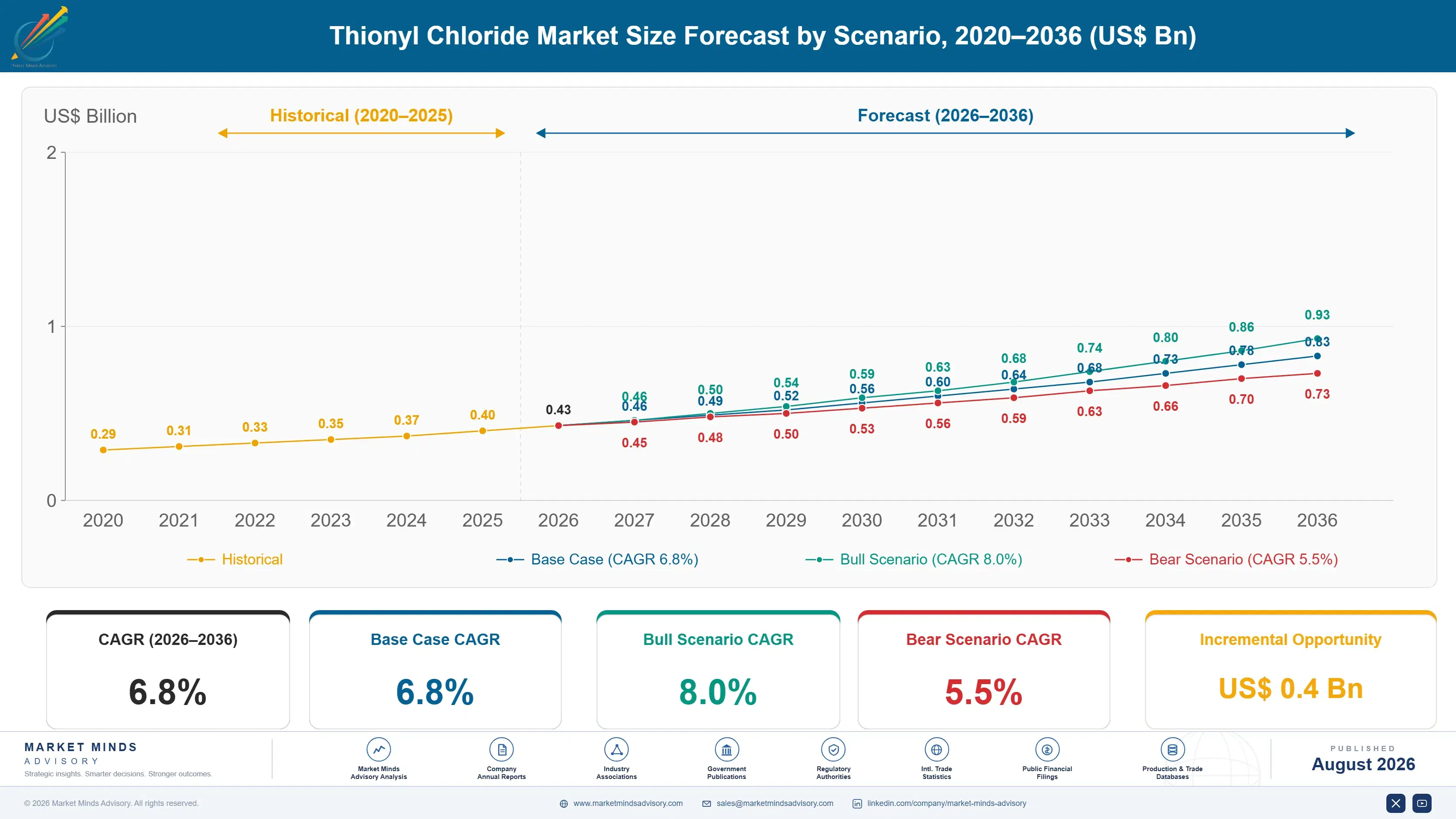
Growth of 5.6% across 2020 to 2025 tracked pharmaceutical and agrochemical activity closely and battery demand rather less predictably. Pharmaceutical intermediate demand held up through 2020 while dye and pigment volumes fell, and Chinese environmental inspections curtailed regional output for several quarters in 2021. Sulphur pricing then moved violently through 2022 on fertiliser demand, compressing margins for every producer without an indexed pass-through arrangement.
The base case at 6.8% rests on three mechanisms. Lithium thionyl chloride cells keep being specified into utility metering, industrial sensing and connected devices where a ten-year service life without replacement rules out rechargeable chemistry. Pharmaceutical intermediate demand grows steadily with small molecule manufacture, particularly across India where formulators have moved decisively upstream. And agrochemical intermediate consumption keeps rising as crop protection production shifts steadily toward Asian manufacture rather than European.
The bull case at 8.0% turns on utility smart metering programmes accelerating across South Asia and Africa faster than currently modelled, since each meter carries a primary cell nobody replaces for a decade. The bear case at 5.5% turns on substitution. Alternative chlorinating reagents and catalytic routes keep improving on handling and waste profile, and each one removes a handling problem the customer never wanted.

Thionyl chloride: handling capability against feedstock cost

The commercial value in this market sits in containment rather than in chemistry. Thionyl chloride reacts with moisture, attacks ordinary steel and requires corrosion-rated storage, transfer and scrubbing systems that a typical pharmaceutical plant does not want to build or maintain. A producer who can deliver in rated returnable containers, on a schedule tight enough that the customer holds almost no inventory, is selling something a competitor cannot match on price.
TOP FIVE CONCENTRATION54%Share of global production capacity held collectively worldwide
SULPHUR AND CHLORINE SHARE41% of COGSPortion of delivered cost tied to feedstock inputs
PHARMACEUTICAL APPLICATION SHARE36% of volumeLargest single application by consumed reagent tonnage globally
BATTERY GRADE SPECIFICATION99.95% minimumPurity demanded for lithium primary cell manufacture worldwide
HANDLING PLANT REQUIREMENTUSD 14 millionCorrosion-rated investment required before any production can begin
SINGLE COUNTRY CAPACITY SHARE62%Share of installed global capacity in one country
Cost structure sits in feedstock and in plant. Sulphur and chlorine together account for roughly 41% of delivered cost, and the corrosion-rated production plant itself requires around USD 14 million before a single tonne is made, which is why new entrants are genuinely rare and why fully 62% of installed global capacity sits inside one country. Feedstock and plant together explain the concentration.
Applications divide according to whether purity or delivered price governs the selection. Pharmaceutical intermediate duty takes 36% of volume and pays for documentation and consistency. Battery grade sits above it again on a 99.95% specification that very few producers hold, while dye, pigment and general industrial duty is decided almost entirely on delivered cost and availability.
"Customers in this market do not want to own this reagent for a day longer than necessary, and yet almost every supplier still sells it by the tonne against an assay. The producers earning real money sell containment and schedule, and price the chemistry as an afterthought."
Director, Specialty Reagents and Fine Chemicals Practice · MMA Chemicals and Mat

Market Trends

Lithium primary cells pulling battery grade demand sharply upward

Lithium thionyl chloride cells deliver a very low self-discharge rate and hold usable capacity for well over a decade, which is why utility meters, industrial sensors, pipeline monitoring and connected devices specify them where nobody intends to change a battery. That duty demands 99.95% minimum purity with tight control on dissolved sulphur dioxide, a specification most industrial grade producers cannot reach at all. Cell manufacture is concentrated in East Asia, which pulls qualified supply there alongside it. Producers holding battery grade qualification realise well above industrial pricing on volumes that keep expanding each year.
Market Impact: Grows 10.2% annually to 2036
Handling burden shifting supply toward regional producers with containment

Customers increasingly prefer suppliers who deliver in corrosion-rated returnable containers on tight schedules rather than shipping drum quantities they must then store, because storage is where the handling risk and the capital sit. That preference favours producers close enough to deliver frequently, which converts geography into a genuine commercial advantage rather than merely a freight cost. Regional producers with containment capability compete successfully against far larger volume suppliers on this basis alone. Volume producers without local containment and their own container fleets find themselves confined to price-driven industrial trade instead.
Market Impact: Delivers 36% of global volume

Market Opportunities and Growth Drivers

Utility metering and connected device deployment across emerging markets

Smart metering programmes across India, Southeast Asia and Africa install meters designed to run a decade without service, and lithium thionyl chloride cells are the only chemistry that reliably delivers that life at the temperatures involved. Industrial sensing, pipeline monitoring and asset tracking devices carry the same requirement, since sending an engineer to change a battery costs more than the entire device did. Each deployment therefore locks in primary cell demand for its whole service interval, which is why the demand is unusually predictable. Battery grade demand grows at 10.2% annually as a direct consequence.
Market Impact: Requires USD 14 million rated plant

Pharmaceutical intermediate manufacture shifting toward Indian production

Indian pharmaceutical manufacturers have moved steadily upstream from formulation into active ingredient and intermediate production, and chlorination steps using thionyl chloride appear across a wide range of established synthetic routes. That shift pulls reagent demand into the region directly rather than leaving it in Europe where most of those routes were originally developed. Indian producers holding corrosion-rated capacity and pharmaceutical documentation serve those customers on delivery schedules that imported supply simply cannot match. Pharmaceutical duty already accounts for 36% of global thionyl chloride volume measured across all producing regions together.
Market Impact: Exposes 41% of delivered cost

Market Restraints and Challenges

Handling and containment requirements deterring customer adoption entirely

Thionyl chloride reacts vigorously with moisture and attacks ordinary containment, so using it requires corrosion-rated storage, transfer and scrubbing systems together with trained operators and emergency planning. The root cause is intrinsic reactivity rather than any avoidable formulation issue, and no supplier can engineer that away. Commercially this means process chemists reach for alternative reagents wherever a route allows it, which removes demand permanently rather than repricing it. Producers are responding with returnable rated container systems, tighter delivery schedules that remove customer storage entirely, and handling support at the customer site.
Market Impact: Grows 10.2% annually through 2036

Sulphur and chlorine price volatility eroding contracted supply margins

Sulphur and chlorine together carry roughly 41% of delivered cost, and sulphur pricing moved by several multiples through 2022 as fertiliser demand competed for the same supply. The root cause is that sulphur arrives as a by-product of refining and gas processing, so output responds to fuel economics rather than to reagent demand, and no producer adjusts volume when chemical buyers need more. Commercially this destroys margin on annual contracts priced beforehand. Producers are responding with indexed pass-through terms, forward purchasing against contracted volumes and closer integration with chlorine supply.
Market Impact: Shifts 36% of pharmaceutical volume
2 additional market trends, 4 additional growth drivers, and 3 additional restraints and challenges are covered in the full report. Contact sales@marketmindsadvisory.com to access the complete intelligence.

Segment CAGR and Growth Architecture

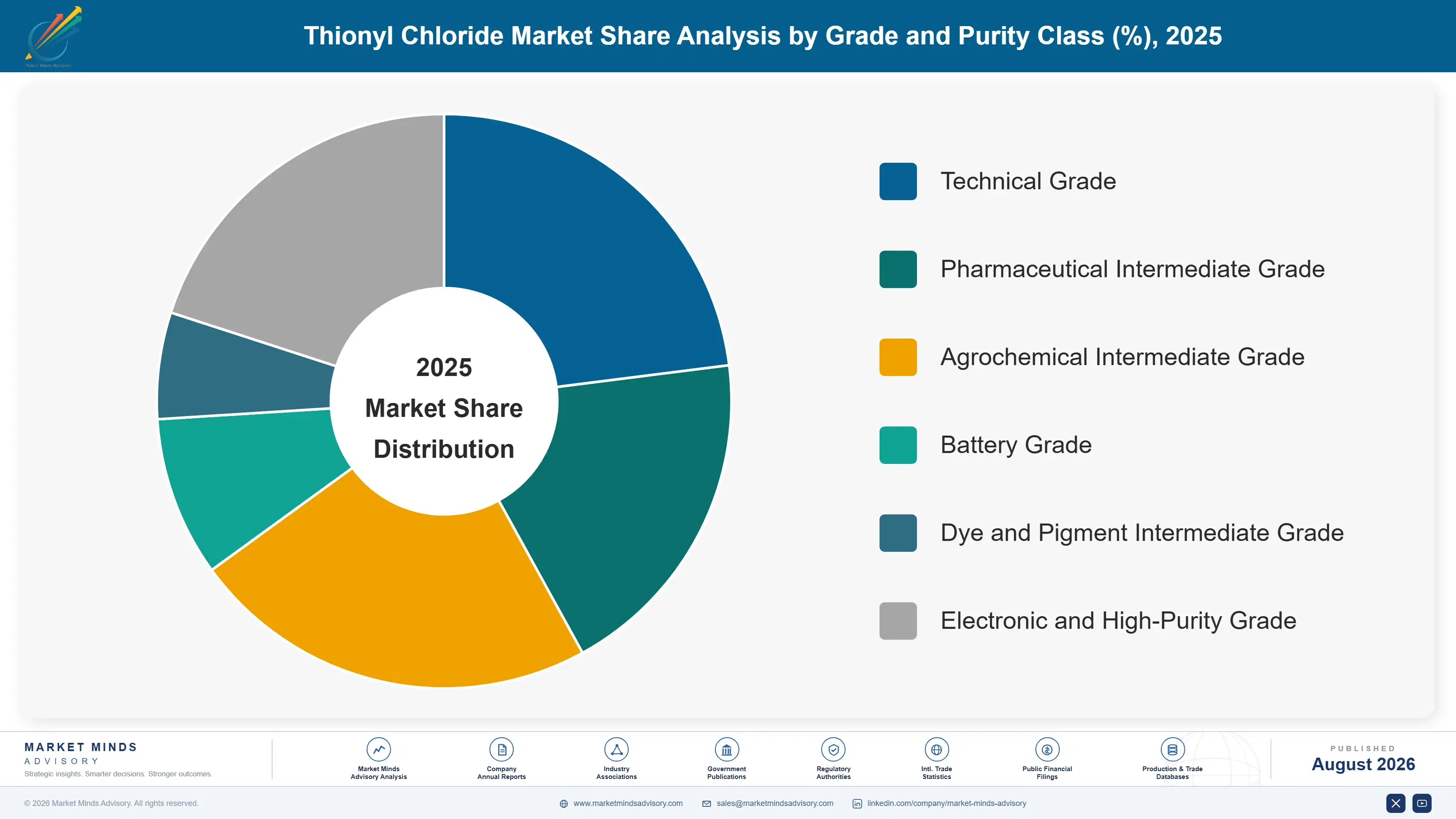
Segmentation follows grade and purity class, because the specification determines the purification burden carried, the documentation that must accompany the material, the containment standard required in transit and therefore the realised price achieved. Six grades cover the whole market, from bulk technical and dye intermediate duty through pharmaceutical service to battery and electronic purity.
thionyl-chloride-market-trends-market-share-analysis-1787310887349

Battery Grade

Expanding at 10.2%, a full 1.50 times the market rate, on material meeting a 99.95% minimum specification with tight control on dissolved sulphur dioxide and iron content, since either impurity degrades cell shelf life in ways that only appear years after manufacture. Lithium thionyl chloride cells power utility meters, industrial sensors and connected devices where a decade of service without replacement rules out rechargeable chemistry entirely. Cell manufacture concentrates heavily in East Asia, which pulls qualified reagent supply alongside it geographically rather than by choice. Very few producers hold the purification capability and analytical control that this specification demands, so realised pricing here runs well above industrial grade levels in every producing region.
CAGR 10.2%

Electronic and High-Purity Grade

Growing at 8.6% annually on very high purity material used right across semiconductor-adjacent chemistry, specialty electronic materials synthesis, and applications where trace metal content rather than assay alone governs the specification entirely. Purification requirements here exceed even battery grade specifications on trace metals, though sulphur dioxide control matters rather less, which means the two premium grades actually demand quite different capability from what is often the same plant. Volumes here are genuinely small and realised pricing runs at several times technical grade, reflecting both the purification cost involved and an extremely narrow qualified supplier field worldwide. Demand here tracks electronic materials manufacture rather than any pharmaceutical or agrochemical cycle whatsoever.
CAGR 8.6%
Full segment breakdown across 6 segments available in the complete report.

Regional Architecture and Country Demand Map

Thionyl chloride supply concentrates in corrosion-rated plants which cost genuine capital both to build and to permit, and demand now increasingly sits close to those plants, because customers would very much rather receive frequent deliveries than hold a reagent this reactive on their own premises.

East Asia

Thirty-eight percent of global value here, comfortably the largest regional share, because Chinese capacity accounts for the great majority of installed global production and because pharmaceutical, agrochemical and lithium cell customers increasingly sit alongside that capacity rather than importing from anywhere else. Note: this exceeds the standard regional band because roughly 62% of installed global capacity sits in China alone, a concentration that no demand-side measure would properly capture. Lithium thionyl chloride cell manufacture is concentrated here as well, which pulls battery grade qualification work into the region alongside it. Growth of 7.7% runs above the global rate, supported by rising battery grade demand and by pharmaceutical intermediate manufacture together.
Share: 38% | CAGR: 7.7% (2026 to 2036)

North America

Twenty-two percent of global value here, weighted heavily toward pharmaceutical intermediate supply, specialty chemical synthesis and a defence and industrial lithium cell position where qualification requirements are most demanding. Domestic corrosion-rated capacity is genuinely limited and a meaningful share of the material used is imported, which sits awkwardly against a customer preference for frequent local delivery that keeps strengthening. Contract development and manufacturing organisations consume steady volumes at both development and commercial scale, and they buy on documentation depth rather than on delivered price alone. Growth of 6.2% reflects steady pharmaceutical demand alongside industrial lithium cell manufacture that keeps expanding for metering and sensing applications across utilities and industry alike.
Share: 22% | CAGR: 6.2% (2026 to 2036)
Regional intelligence for 5 additional markets available in the complete report: Western Europe, South Asia and Pacific, Latin America, Middle East and Africa, Eastern Europe. Contact sales@marketmindsadvisory.com.
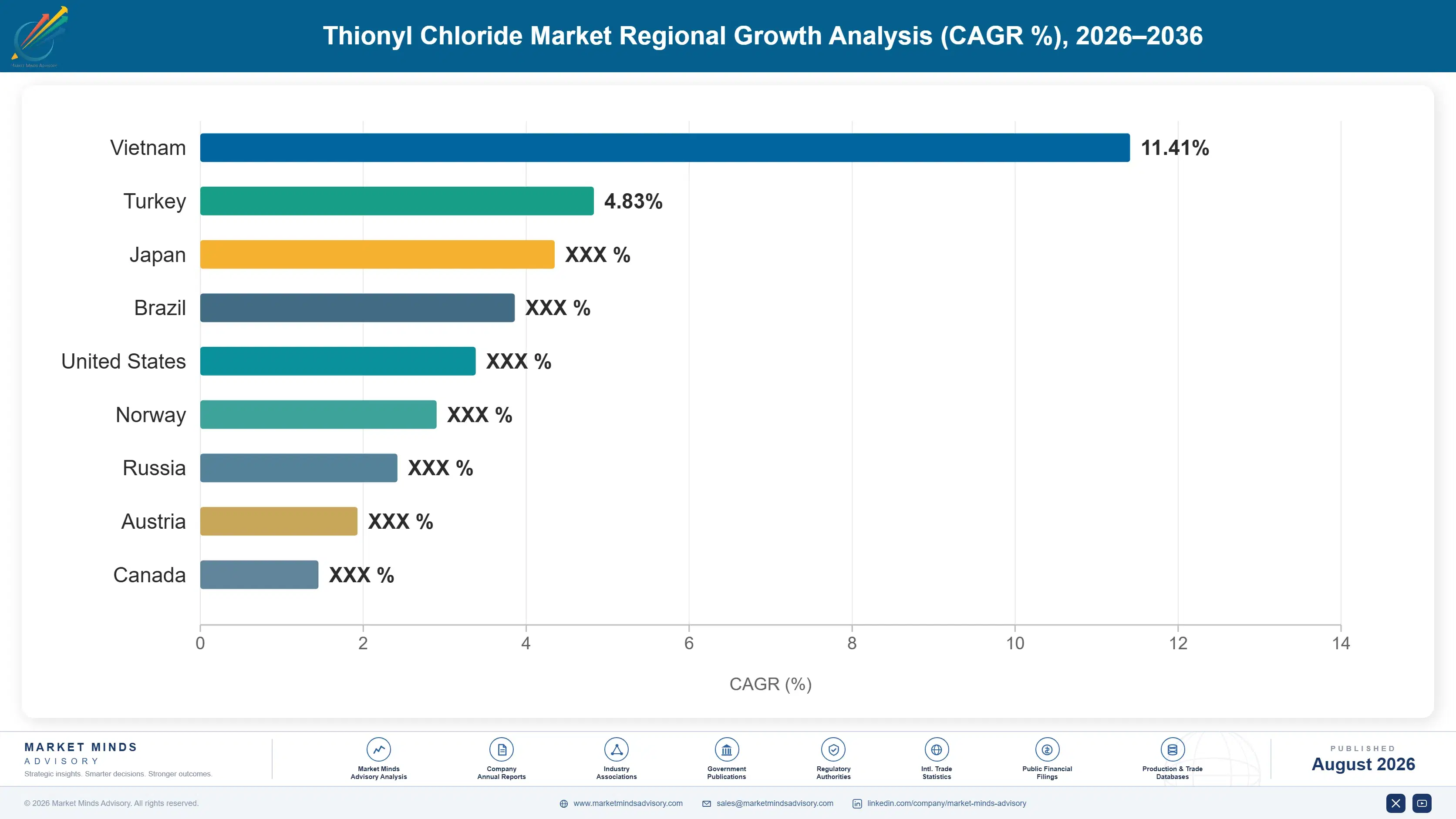
thionyl-chloride-market-trends-country-cagr-analysis-1787310887866

Where thionyl chloride margin actually sits

Four commercial positions separate the producers earning genuine specialty reagent economics from those simply selling tonnes against an assay certificate. Each one of them rests on something a competitor cannot assemble quickly: containment and rated container capability, battery grade purification, genuine feedstock integration, or else simple physical proximity inside a genuinely workable handling radius.

Sell containment and delivery schedule, not tonnes

Customers do not want to own this reagent any longer than necessary, because storage is where the handling risk, the capital and the regulatory burden all sit. Producers supplying in corrosion-rated returnable containers on schedules tight enough to remove customer storage entirely realise roughly 32% above competitors quoting tonnes against an assay. The container fleet involved is modest capital measured against a corrosion-rated production plant. Most producers still ship drums and let the customer solve the storage problem, which is exactly the problem the customer is willing to pay to avoid.
Market Impact: Realises roughly 32% above tonnage-

Qualify battery grade purity for lithium primary cells

Battery grade demands 99.95% minimum purity with tight control on dissolved sulphur dioxide and iron, since either impurity degrades cell shelf life in ways only visible years after manufacture. Producers holding that qualification realise roughly 2.5 times technical grade pricing, because cell makers cannot accept anything less and because the qualified field is genuinely narrow. Purification and analytical capability rather than reactor scale is what determines who can actually do it. Cell manufacture concentrates in East Asia, so qualification has to be pursued where the customers actually build the cells.
Market Impact: Realises roughly 2.5 times technica

Integrate sulphur and chlorine feedstock supply

Sulphur and chlorine together carry roughly 41% of delivered cost, and sulphur moved by several multiples through 2022 as fertiliser demand competed for the same by-product supply. Producers with integrated or contracted feedstock run roughly 24% below merchant buyers, and that gap widens sharply whenever either input tightens on economics unrelated to reagent demand. Adding reactor capacity without first securing the feedstock position has been a recurring error right across this industry. Merchant buyers become pure price takers in every tight market, which is precisely when the reagent is worth most.
Market Impact: Runs roughly 24% below merchant fee

Occupy the handling radius before a competitor does

Frequent delivery matters more than delivered price to any customer trying to avoid storing this reagent, which turns proximity into a defensible commercial position rather than a freight line. Producers established inside a customer cluster hold roughly 18% delivered cost and service advantage over distant suppliers shipping the same material. The advantage compounds over time, because the container fleet and the handling relationships both take years to build properly. Chinese volume producers competing on price alone cannot displace a regional producer who delivers weekly into a plant with no storage capability.
Market Impact: Holds roughly 18% delivered cost an

Who Controls the Margin Pool

Concentration is high for a widely used reagent, with the top five holding 54% of production capacity, the basis on which every participant here is assessed. Transpek and Lanxess lead through corrosion-rated capacity combined with pharmaceutical documentation depth, while the challenger group divides between Chinese volume producers operating at considerable scale, Indian fine chemical houses and a small number of Western specialty reagent suppliers.
Competition currently runs on containment capability, delivery schedule and grade qualification rather than on chemistry, which has been settled for a century. Customers who cannot store the reagent choose whoever removes that problem, which favours regional producers with container fleets over distant volume suppliers. Battery grade purification has become a genuine competitive dimension in its own right since lithium primary cell demand accelerated.

Emerging pressure comes from two directions at once. Chinese producers hold most installed capacity and increasingly qualify directly with battery and pharmaceutical customers rather than selling through intermediaries. And alternative chlorinating reagents keep improving on handling and waste profile, which means rankings may shift toward producers who also supply those alternatives rather than defending a single reagent position.
thionyl-chloride-market-trends-company-positioning-matrix-1787310888382

Competitive Moat and Risk Dimensions

TRANSPEK INDUSTRY

Moat: Rated capacity and delivery proximity

Corrosion-rated capacity located inside the Indian pharmaceutical and agrochemical cluster lets Transpek deliver frequently enough that customers need almost no storage, which is worth considerably more to them than any price concession. Building comparable capacity elsewhere requires both the capital and the permitting, and the container fleet and handling relationships take years to establish properly.
TRANSPEK INDUSTRY

Risk: Single reagent concentration exposure

A position concentrated in one chlorinating reagent leaves the company exposed as process chemists select alternatives with easier handling and waste profiles wherever a synthetic route permits it. Each substitution removes demand permanently rather than repricing it, and defending a single reagent is considerably harder than supplying whichever chlorinating agent the customer eventually chooses.
LANXESS

Moat: Pharmaceutical documentation and containment standards

Documentation depth, audit history and containment standards accumulated across decades of regulated supply give Lanxess a position that new entrants cannot assemble at speed, and pharmaceutical customers pay European pricing largely for that package. Permitting comparable corrosion-rated capacity in Europe today is close to impossible, which makes the incumbent position genuinely defensible.
LANXESS

Risk: European cost base disadvantage

European energy, labour and compliance costs sit well above Chinese and Indian equivalents, and as Asian producers accumulate audit histories that Western customers accept, the documentation premium narrows steadily. Pharmaceutical intermediate manufacture continues moving eastward regardless, which erodes the customer base that the European cost position depends upon.

Players Tracked

Prominent Players

Transpek Industry
Lanxess
Shandong Kaisheng New Materials
Jiangxi Selon Industrial
CABB

Other Key Players

Hubei Kaifeng Chemical
Jiangsu Zhongtai Chemical
Shandong Jinling Chemical
Weifang Longwei Industrial
Jiangxi Jinsen Chemical
Zhejiang Jiangshan Chemical
Aditya Birla Chemicals
Meghmani Finechem
Atul
Vishnu Chemicals
Merck KGaA
Thermo Fisher Scientific
Central Glass
Sumitomo Seika Chemicals
Hebei Chuxu Chemical

Recent Developments

FEBRUARY 2025

Producer qualifies battery grade for lithium cell manufacture

A thionyl chloride producer completed full qualification of its battery grade material with two lithium primary cell manufacturers, demonstrating dissolved sulphur dioxide and iron control tight enough to hold cell shelf life right across the full decade of service that utility metering applications actually require.
Signal: Battery grade purification capability rath
JUNE 2025

Customer moves to returnable container supply arrangement

A pharmaceutical intermediate manufacturer replaced its conventional drum purchasing arrangement with a returnable corrosion-rated container arrangement on a weekly scheduled delivery basis, thereby eliminating on-site storage entirely and transferring the handling capital and the regulatory burden back to the reagent producer actually supplying the material.
Signal: Removing the customer's storage burden is
OCTOBER 2025

Sulphur cost movement forces indexed contract renegotiation

Sustained sulphur price movement prompted several chlorinating reagent producers to renegotiate the feedstock pass-through terms written written across all of their annual supply contracts, after realised margins on volumes priced before the move proved wholly insufficient to cover the sulphur and chlorine content actually consumed during production.
Signal: Indexed feedstock pass-through is now beco

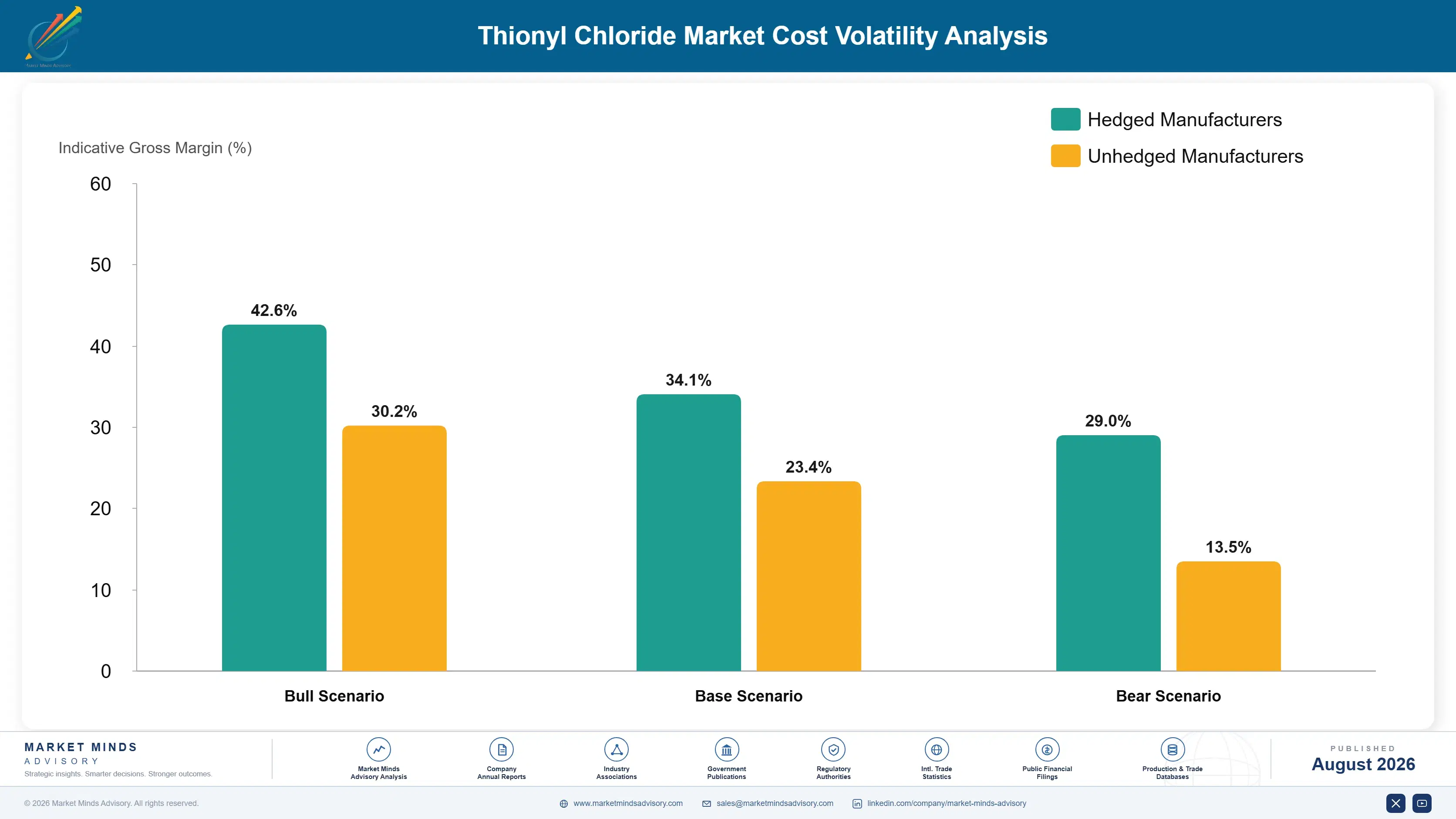
Sulphur and chlorine cost exposure

Sulphur and chlorine together account for roughly 41% of delivered thionyl chloride cost, sourced from refinery and gas processing by-product streams for sulphur and from chlor-alkali producers for chlorine, both regionally concentrated. Rated plant depreciation contributes about 17%, reaction and distillation energy around 12%, effluent scrubbing 9%, quality testing 6%, with rated containers, freight and working capital carrying the remaining 15%.
Sulphur was the defining exposure through the history. Prices rose by several multiples across 2021 and into 2022 as fertiliser demand competed for by-product supply refiners do not increase in response, and producers on annual contracts absorbed the difference for several quarters. Lanxess Annual Report 2022 recorded raw material and energy cost pressure across its specialty chemical operations, and Transpek Industry Annual Report 2023 noted input cost recovery lagging contracted pricing.

The competitive disadvantage mechanism runs through feedstock access and plant capital rather than through operating efficiency. Producers buying sulphur and chlorine merchant become price takers whenever either input tightens, which is exactly when the reagent commands the most. Those without rated container fleets cannot offer the storage-free supply customers now demand. Small producers typically carry both limitations, which confines them to price-driven industrial and dye intermediate trade.
thionyl-chloride-market-trends-cost-volatility-analysis-1787310888578

Index sulphur and chlorine pass-through across annual contracts

Sulphur moved by several multiples through 2022 while most reagent supply agreements remained priced flat for twelve months at a time, which cost producers more than any efficiency programme has ever returned. Indexed clauses tied to published references remove that exposure completely, and industrial customers accept them readily once the arithmetic is set out plainly.

Build a rated returnable container fleet for customers

Customers would very much rather receive frequent deliveries than hold this reagent on site at all, and a rated returnable container fleet converts that preference into a defensible commercial position. The capital involved is modest measured against corrosion-rated production plant, and it removes a handling and regulatory burden that the customer genuinely values being rid of entirely.

Secure chlorine supply from an integrated regional producer

Chlorine cannot be shipped far economically or safely, so reagent producers depend on whatever chlor-alkali capacity sits nearby and become price takers whenever that supply tightens. A multi-year arrangement with a regional integrated producer costs little beyond commercial discipline and it protects against an availability failure that would halt production entirely rather than merely raising cost.

Portfolio Architecture for Margin Defence

Margin architecture separates by purification capability and containment service rather than by reactor scale, which is not at all how most producers in this market present their own economics. Technical and dye intermediate grade material earns whatever assay-based competition permits, because the molecule is identical between producers and nothing at all beyond purity is being purchased here.
Value climbs wherever purification capability or documentation depth limits the qualified field. Pharmaceutical intermediate grade defends real premiums through impurity control, change control history and the containment standards that regulated customers require. Battery and electronic grades sit far higher, since the purity specifications involved demand analytical and purification capability that a great many producers simply do not hold at all.

The highest value pools now concentrate where battery grade purification meets a containment and delivery capability that removes customer storage entirely. Those pools are small measured in tonnage and quite disproportionate in realised margin terms. The commercial tension is that technical grade volume keeps a corrosion-rated plant loaded, which the plant economics genuinely require, while funding almost none of the purification investment that actually opens anything above it.

Volume / Commodity-Adjacent Tier

Technical grade and dye intermediate material supplied in drums against assay specifications into general industrial synthesis, where the molecule is identical between producers and delivered price decides nearly every enquiry received.
Gross Margin: 16-24%

Premium / Certified Tier

Pharmaceutical and agrochemical intermediate grade supplied with impurity documentation and rated container delivery. Documentation depth and containment capability defend pricing here. The ten-point range reflects drum supply against storage-free container arrangements.
Gross Margin: 28-38%

Sustainability / Regulatory / Next-Generation Tier

Battery grade and electronic high-purity material meeting 99.95% specifications with trace metal and sulphur dioxide control. Purification capability and narrow qualified fields defend pricing very strongly. The fourteen-point range reflects battery grade against emerging electronic purity economics.
Gross Margin: 44-58%
thionyl-chloride-market-trends-portfolio-architecture-1787310889079

High-value Sub-segments and Strategic Watch-out

Battery grade for lithium primary cells

High value and genuinely high growth together here, because dissolved sulphur dioxide and iron control decide cell shelf life years after manufacture, and remarkably few producers anywhere hold the purification and analytical capability that qualification actually requires today. Realised pricing reflects that scarcity very directly.
Gross Margin: 44-58%

Storage-free container supply arrangements

Strong realised value on genuinely steady underlying growth, because customers value removing their on-site storage far above any price concession they might otherwise extract, and because building a rated returnable container fleet takes years of patient relationship building to establish properly anywhere in the world.
Gross Margin: 36-48%

Technical and dye intermediate drum trade

The volume core of this entire market, keeping an expensive corrosion-rated plant properly loaded on a molecule that is identical between producers, while earning whatever assay-based competition happens to permit that quarter. Necessary for basic plant economics, but this tier funds nothing whatsoever above itself.
Gross Margin: 16-24%

Reagent substitution exposure across the portfolio

The strategic watch-out running right across this whole portfolio, given that process chemists will select alternative chlorinating reagents wherever a synthetic route reasonably permits it, and each such substitution then removes that demand permanently rather than merely repricing it downward for a period or two.
Gross Margin: 12-44%

How thionyl chloride demand behaves

Demand is reluctant, which is an unusual starting point for any market. Customers use this reagent because a route calls for it, not because they want it on site, and they drop it the moment an alternative becomes viable. That produces a pattern where the supplier's job is partly to make the reagent as easy to consume as possible, since every handling difficulty is an argument to design it out entirely.
Stickiness follows the regulatory filing and the storage arrangement rather than the chemistry. Technical and dye intermediate supply is loosest, substituted on delivered price with no cost beyond a purchase order. Pharmaceutical intermediate positions sit tighter, because impurity profiles carry into a filed process. Battery grade is stickiest of all, since cell manufacturers qualify suppliers against shelf life data that takes years to generate and nobody reopens casually.

The buyer profile splits between functions rather than by company scale. Regulated pharmaceutical and battery customers put quality and engineering in charge, evaluating impurity control and containment long before commercial discussion starts. Industrial and dye customers buy through procurement on assay and price, often from whichever producer can reach them at all, which is a shorter list than capacity numbers suggest.
thionyl-chloride-market-trends-end-use-penetration-index-1787310889574

What we would actually do here

These are among the four positions where our research anticipates prominent divergence between winners and laggards over the coming forecast period. Each is grounded in the demand model, the regulatory perimeter, and the announced capacity pipeline.
01 / CONTAINMENT SERVICE CAPABILITY

Sell the removal of storage, not the reagent

Customers do not want to own this reagent any longer than a process step requires, because on-site storage carries the handling risk, the capital and the regulatory burden all at once. Producers supplying in rated returnable containers on schedules tight enough to remove customer storage entirely realise roughly 32% above competitors quoting tonnes against an assay. The container fleet is modest capital beside a production plant, and most producers still ship drums and simply leave the customer to solve the problem themselves.
02 / BATTERY GRADE QUALIFICATION

Qualify where the cells are actually being built

Battery grade demands 99.95% minimum purity with tight dissolved sulphur dioxide and iron control, since either impurity degrades cell shelf life in ways visible only years after manufacture. Producers holding that qualification realise roughly 2.5 times technical grade pricing, because cell makers cannot accept less and the qualified field is genuinely narrow. Purification and analytical capability rather than reactor scale decides who can do it, and cell manufacture concentrates in East Asia, which is therefore where qualification has to be pursued.
03 / FEEDSTOCK INTEGRATION POSITION

Contract sulphur and chlorine before adding capacity

Sulphur and chlorine together carry roughly 41% of delivered cost, and sulphur alone moved by several multiples through 2022 as fertiliser demand competed for the same by-product supply. Producers with integrated or contracted feedstock run roughly 24% below merchant buyers, and the gap widens sharply whenever either input tightens on economics unrelated to reagents. Merchant buyers become pure price takers in every tight market, which is exactly the point at which this reagent is worth the most to its customers.
04 / REGIONAL HANDLING RADIUS

Own the delivery radius around the customer cluster

Frequent delivery matters far more than delivered price to any customer trying to avoid storing this reagent at all, which turns simple physical proximity into a defensible commercial position rather than a freight line item. Producers already established inside a customer cluster hold roughly 18% delivered cost and service advantage over distant suppliers shipping otherwise identical material. The advantage compounds over time, because container fleets and handling relationships both take years to build properly and cannot simply be bought in a hurry.

Engagement Snapshot From the Field

A live engagement with an industry participant carrying material or product regulatory and market exposure ahead of a defining policy shift, showing how our research translates into a defensible multi-year portfolio strategy.
MARKET MINDS ADVISORY · CLIENT ENGAGEMENT SUMMARY
Thionyl Chloride Producer Strategic Portfolio Review and Transition Roadmap 2026·Investment Scenario on Thionyl Chloride Exposure Evaluation 2025-26
CLIENT PROFILE
A specialty reagent producer operating corrosion-rated chlorination capacity at two sites in Western Europe and South Asia, supplying thionyl chloride and related chlorinating reagents to pharmaceutical, agrochemical and dye customers across three continents. Chlorinating reagent revenue approached EUR 87 million annually (client-reported, unverified by MMA), roughly two thirds of it technical and dye intermediate grade sold in drums against assay specifications.
STRATEGIC CHALLENGE
Margins had eroded for three years and management attributed the decline entirely to Chinese pricing, proposing a debottlenecking project at the European site. Battery grade opportunities were being lost without anybody establishing why they were lost. Sulphur and chlorine exposure across the annual contract book had never been quantified against realistic price movement.
MMA APPROACH
We assessed the portfolio by purification capability and containment service rather than by product family, quantified feedstock exposure across the contract book under historical price movements, and reconstructed nine lost battery grade opportunities through interviews with cell manufacturer quality functions rather than the purchasing contacts the client normally spoke to. Impurity profiles were benchmarked independently against four competitor products.
KEY FINDINGS
  1. Margin erosion traced principally to mix drifting toward drum-supplied technical grade, not to Chinese pricing, which had barely moved across the period under review.
  2. Eight of nine lost battery opportunities failed on dissolved sulphur dioxide and iron control rather than on price, delivery or documentation depth in any respect.
  3. Unhedged sulphur and chlorine exposure across the annual contract book exceeded a full year of divisional operating profit under the 2022 movement repeated.
  4. No rated returnable container fleet existed at either site, despite three of the five largest customers having asked specifically about storage-free supply arrangements.
CLIENT PROFILE
A specialty reagent producer operating corrosion-rated chlorination capacity at two sites in Western Europe and South Asia, supplying thionyl chloride and related chlorinating reagents to pharmaceutical, agrochemical and dye customers across three continents. Chlorinating reagent revenue approached EUR 87 million annually (client-reported, unverified by MMA), roughly two thirds of it technical and dye intermediate grade sold in drums against assay specifications.
STRATEGIC CHALLENGE
Margins had eroded for three years and management attributed the decline entirely to Chinese pricing, proposing a debottlenecking project at the European site. Battery grade opportunities were being lost without anybody establishing why they were lost. Sulphur and chlorine exposure across the annual contract book had never been quantified against realistic price movement.
MMA APPROACH
We assessed the portfolio by purification capability and containment service rather than by product family, quantified feedstock exposure across the contract book under historical price movements, and reconstructed nine lost battery grade opportunities through interviews with cell manufacturer quality functions rather than the purchasing contacts the client normally spoke to. Impurity profiles were benchmarked independently against four competitor products.
KEY FINDINGS
  1. Margin erosion traced principally to mix drifting toward drum-supplied technical grade, not to Chinese pricing, which had barely moved across the period under review.
  2. Eight of nine lost battery opportunities failed on dissolved sulphur dioxide and iron control rather than on price, delivery or documentation depth in any respect.
  3. Unhedged sulphur and chlorine exposure across the annual contract book exceeded a full year of divisional operating profit under the 2022 movement repeated.
  4. No rated returnable container fleet existed at either site, despite three of the five largest customers having asked specifically about storage-free supply arrangements.
RECOMMENDED STRATEGY
Phase 1: Phase one: index sulphur and chlorine pass-through across every annual supply contract and hedge the residual exposure on committed volumes immediately. Phase 2: Phase two: defer the debottlenecking project and redirect that capital toward purification capability for battery grade and a rated container fleet. Phase 3: Phase three: pursue battery grade qualification with two lithium primary cell manufacturers and convert the five largest accounts to container supply.
OUTCOME
The client deferred the debottlenecking project and committed the capital to purification and container capability instead. Two battery grade qualifications were underway within ten months, and realised margin on pharmaceutical and container-supplied volume improved by 20% (client-reported, unverified by MMA) against the prior year on broadly comparable tonnage.

Frequently Asked Questions

Foundational context covering the market sizes, CAGR, scope, country, region and competition that inform every finding below. This section is provided to cover basics and most often pre-purchase conversations, answered from the MMA Primary Research Dataset.

What is the current size of the Thionyl Chloride Market?

The market is valued at USD 0.4 billion in 2025, rising to USD 0.43 billion in 2026. Sizing covers material sold to industrial, pharmaceutical and battery customers at realised delivered price.

How large will the Thionyl Chloride Market be by 2036?

The market reaches USD 0.83 billion by 2036, an increase of USD 0.40 billion across the forecast period. That represents an expansion multiple of 1.93 times the 2026 base.

What is the CAGR for the Thionyl Chloride Market 2026 to 2036?

The base case CAGR is 6.8% across 2026 to 2036. The bull case reaches 8.0% on faster smart metering deployment, while the bear case sits at 5.5% under reagent substitution.

Which segment is growing fastest?

Battery grade grows fastest at 10.2%, a full 1.50 times the market rate. Lithium thionyl chloride cells power meters and sensors where a decade of service rules out rechargeable chemistry.

Who are the major companies in the Thionyl Chloride Market?

Transpek Industry, Lanxess, Shandong Kaisheng New Materials, Jiangxi Selon Industrial and CABB lead on capacity, holding 54% collectively. The remaining field is mostly Chinese and Indian producers.

Which country is growing fastest?

India grows fastest at 9.6%, driven by pharmaceutical and agrochemical intermediate manufacture expanding faster than anywhere else alongside domestic corrosion-rated capacity serving those customers directly.

Report Segmentation Architecture

The full report scope spans multiple orthogonal segmentation dimensions, with cross-tabulated demand data provided for each dimension pair. Coverage extends further to regional breakdowns, trend trajectories, and the competitive detail needed to support segment-level decision-making.

By Grade and Purity Class

  • Technical Grade
  • Pharmaceutical Intermediate Grade
  • Agrochemical Intermediate Grade
  • Battery Grade
  • Dye and Pigment Intermediate Grade
  • Electronic and High-Purity Grade

By End-Use Industry

  • Pharmaceutical Manufacturing
  • Agrochemical and Crop Protection
  • Lithium Primary Batteries
  • Dyes and Pigments
  • Specialty Chemical Synthesis
  • Electronic Materials

By Customer Type and Channel

  • Innovator Pharmaceutical Manufacturers
  • Generic and Intermediate Producers
  • Agrochemical Intermediate Manufacturers
  • Lithium Cell Manufacturers
  • Dye and Pigment Producers
  • Chemical Distribution Channels

By Region

  • North America
  • Western Europe
  • East Asia
  • South Asia and Pacific
  • Latin America
  • Middle East and Africa
  • Eastern Europe

Scope, Methodology, and Coverage

Every figure in this report is reproducible from documented input assumptions. The scope below maps the historical period, the forecast horizon, the segmentation dimensions, and the countries covered, alongside the underlying primary and qualitative methodology.
Historical Period
2020 to 2025
Forecast Period
2026 to 2036
Base Year
2025 (USD billions; MMA Primary Research Dataset, August 2026)
Market Definition
The market comprises thionyl chloride supplied as a chlorinating and dehydrating reagent, spanning technical grade, pharmaceutical intermediate grade, agrochemical intermediate grade, battery grade, dye and pigment intermediate grade, and electronic and high-purity grade specifications. Sizing captures product revenue at realised delivered price across pharmaceutical manufacturing, agrochemical and crop protection, lithium primary batteries, dyes and pigments, specialty chemical synthesis, and electronic materials applications. Sulphuryl chloride, phosphorus oxychloride, oxalyl chloride and other chlorinating reagents, sulphur dioxide and sulphur monochloride sold separately, toll chlorination services performed on customer material, corrosion-rated containers sold as equipment, and finished batteries or active pharmaceutical ingredients all fall outside scope.
Quantitative Units
USD billions (current prices); reagent shipped annually in thousands of tonnes; USD per kilogram at realised delivered price
Segmentation Dimensions
By Grade and Purity Class; By End-Use Industry; By Customer Type and Channel; By Region
Regions Covered
North America, Western Europe, East Asia, South Asia and Pacific, Latin America, Middle East and Africa, Eastern Europe
Countries Covered
USA, Canada, Mexico, UK, Germany, Switzerland, France, Italy, Spain, Netherlands, Poland, Hungary, Slovenia, Turkey, China, Japan, South Korea, Taiwan, India, Singapore, Malaysia, Thailand, Vietnam, Australia, Brazil, Argentina, Colombia, Egypt, Saudi Arabia, UAE, South Africa, and additional markets relevant to this sector
Key Companies Profiled
Transpek Industry, Lanxess, Shandong Kaisheng New Materials, Jiangxi Selon Industrial, CABB, Hubei Kaifeng Chemical, Jiangsu Zhongtai Chemical, Shandong Jinling Chemical, Weifang Longwei Industrial, Jiangxi Jinsen Chemical, Zhejiang Jiangshan Chemical, Aditya Birla Chemicals, Meghmani Finechem, Atul, Vishnu Chemicals, Merck KGaA, Thermo Fisher Scientific, Central Glass, Sumitomo Seika Chemicals, Hebei Chuxu Chemical.
Quantitative Methodology
Primary survey, n=3,800 respondents, Q4 2025, six countries; demand-side model with trade association cross-validation
Qualitative Methodology
47 expert interviews, Q4 2025; applied to validate demand model assumptions, identify emerging dynamics, and assess competitive positioning
Report Format
PDF and XLSX data workbook (Word format preview document)
Publisher
Market Minds Advisory
Report Code
MMA-2026-CHM-592
Published
August 2026
Contact
sales@marketmindsadvisory.com | www.marketmindsadvisory.com

Purchase the full Thionyl Chloride Market Report (2026 to 2036).

The full report sizes the thionyl chloride market across six grade and purity classes, six end-use industries, six customer channels and seven regions, with annual forecasts to 2036 in revenue and tonnage shipped. It quantifies what removing on-site storage is actually worth to customers by application, which is the analysis that establishes why containment capability outprices chemistry in this market. Twenty participants are assessed on a consistent production capacity basis, with purification and containment capability mapped separately from installed reactor capacity. Battery grade qualification positions are identified producer by producer.
Six grade and purity classes sized and forecast annually
Value of removing customer storage quantified by application
Twenty participants assessed on consistent production capacity basis
Purification and containment capability mapped separately from capacity
Battery grade qualification positions identified producer by producer
Corrosion-rated capacity mapped across every producing region

Built For The People Who Decide

From boardroom strategy to bench-side execution, this report is read cover-to-cover by leaders shaping the next decade of their industry, turning demand scenarios, market dynamics and valuation benchmarks into decisions.
CXOs/ Presidents/ VPs/ Managers
M&A and Corporate Development
Strategy Teams and R&D Heads
Procurement and Product Directors
Regulatory and Compliance Leaders
Investor Relations and Equity Analysts