Market Minds Advisory
Thin Film and Printed Batteries Market

Thin Film and Printed Batteries Market: Thin Film and Printed Batteries Market. Wearable Electronics Growth Meets Flexible Form Factor Demand

Wearable device makers and medical patch manufacturers are pushing battery suppliers toward ultra-thin, flexible cell designs, forcing chemistry developers to balance energy density against manufacturing yield and rising rare material costs.

Lead Analyst

Published

September 2026

Make Smarter Decisions with Customized Research Insights

Request a free sample report and evaluate market opportunities, growth trends, and competitive dynamics relevant to your business needs.

2025 MARKET VALUE$1.3BMarket Size 2025
2036 FORECAST VALUE$6.8BBase Case , 2026 to 2036
CAGR 2026 TO 203616.2 %Bull 17.6% / Bear 14.8%
INCREMENTAL OPPORTUNITY$5.3BNet 10- year value creation
EXPANSION MULTIPLE4.49x2036 value over 2026 base
Strategic Levers
M&A Pipeline
Regional Outlook
Country Rankings
Competitive Intelligence
Segmental Deep-dive
Call-Us : 91 93563 13602

Executive Snapshot and Market Trajectory.

Wearable health monitors and smart medical patches are pulling thin film battery demand toward flexible, ultra-thin form factors faster than device makers anticipated. Makers that spent years designing around bulky coin cells are now redesigning entire product lines around flexible power sources. Few predicted this shift moving so fast.
Solid-state printed batteries, which eliminate the liquid electrolyte fire risk that limited earlier flexible cell designs, are becoming the preferred chemistry for skin-contact medical devices as manufacturers scale production. Adoption concentrates most heavily in South Korea and among medical device makers facing tightening battery safety certification requirements. Vendors that can demonstrate proven safety certification are winning design contracts that legacy coin cell suppliers cannot match. Certification proof now shapes procurement decisions directly.
Competitive character is shifting from conventional coin cell suppliers toward specialized thin film manufacturers, a shift that rewards vendors with proven roll-to-roll printing capability over legacy battery producers. Rising rare material costs and manufacturing yield constraints are both slowing capacity expansion even as downstream device demand accelerates. Vendors slow to scale roll-to-roll production risk losing ground to better-capitalized entrants building dedicated printed battery lines. Timing matters.
Market Definition
This market covers thin film and printed battery cells manufactured using roll-to-roll or screen printing processes for wearable, medical patch, and flexible electronics applications. It excludes conventional coin cell, cylindrical, and pouch cell battery formats.
Base Year Value
$1.3B in 2025 (MMA Primary Research Dataset, September 2026)
Forecast Period
2026 to 2036, eleven discrete annual values
CAGR
16.2% base case. Bull 17.6%. Bear 14.8%.
Fastest Growth Segment
Solid-State Printed Batteries: 23.6% CAGR
Fastest Growth Country
South Korea: 20.1% CAGR
Fastest Growth Region
South Asia and Pacific: 18.2% CAGR
Largest Region
East Asia: 30% of 2025 global value
Market Leaders
Ilika plc, Blue Spark Technologies, Enfucell Oy, Cymbet Corporation, Prologium Technology. Source: MMA Analysis based on company annual reports.
Primary Survey
n=3,800 procurement and R&D decision-makers, Q4 2025, six countries
Methodology
Demand-side build-up, cross-validated against public data, 47 expert interviews

Thin Film and Printed Batteries Market Forecast Scenarios

thin-film-and-printed-batteries-market-size-forecast-scenario-1788415716907
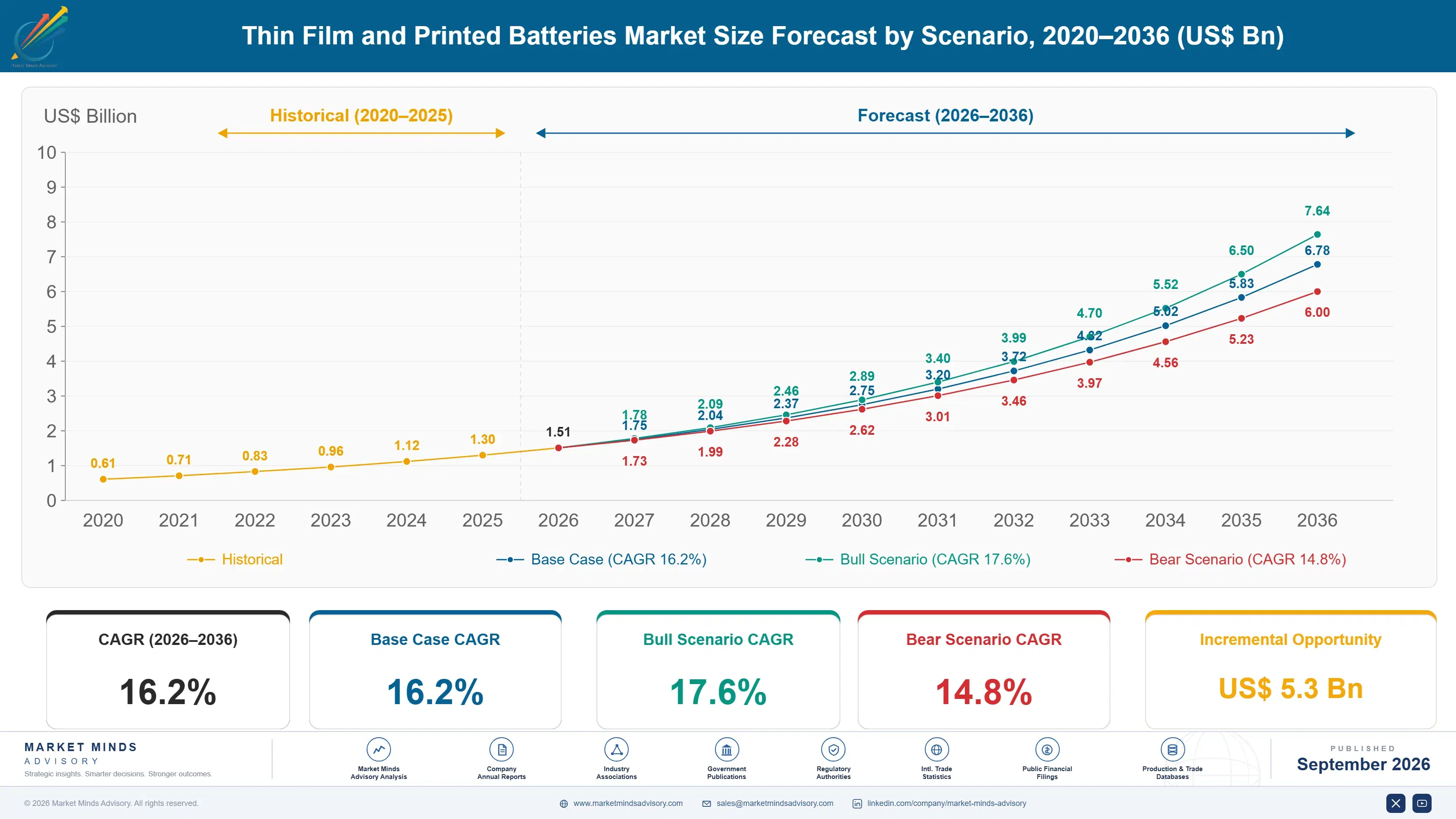
Thin film and printed battery adoption between 2020 and 2025 grew steadily as wearable device pilots expanded, though the historical growth rate of 15.0 percent understated a sharper acceleration that began once medical patch manufacturers started qualifying the technology seriously in the final two years. Suppliers that entered the period selling standard coin cell alternatives alone increasingly found device makers demanding flexible, printable form factors instead.
The base case rests on three commercial mechanisms: wearable device makers standardizing around flexible power sources, solid-state chemistry eliminating the fire risk that limited earlier liquid electrolyte designs, and medical device manufacturers expanding smart patch product lines requiring skin-safe batteries. Together these sustain strong double-digit growth through the forecast period. Suppliers that fail on any one of these three fronts risk ceding share to faster-moving competitors within a single product cycle.
The bull case assumes faster-than-expected manufacturing yield improvements let suppliers scale roll-to-roll production at lower unit cost, pulling forward device maker adoption. The bear case centers on rare material cost volatility and certification delays, which could slow qualification timelines and push cautious device makers back toward conventional coin cells. Either scenario reshapes supplier investment priorities meaningfully within the next several years.

Where Flexible Form Factors Meet Safety Standards

Thin film battery margin has historically compressed under manufacturing yield losses, but solid-state suppliers now carry wider margin as certification barriers limit competitive entry. Medical device customers increasingly negotiate multi-year supply contracts rather than one-time cell purchases. Suppliers unable to make that certification investment risk being squeezed out by competitors offering integrated safety documentation alongside cell delivery.
MARKET CONCENTRATIONCR5 48%Top five suppliers control just under half the market
AVERAGE CELL PRICE$2-$15/unitPrice varies by capacity and printing process complexity
LEADING MANUFACTURING COUNTRY SHARESouth Korea 29%South Korea leads global thin film battery production volume
SOLID-STATE ADOPTION RATE34%Share of new cells using solid-state electrolyte chemistry
MANUFACTURING YIELD RATE62-78%Typical usable output share across roll-to-roll production lines
AVERAGE CELL SERVICE LIFE1-3 yearsTypical operational lifespan before replacement or disposal occurs
Safety certification depth has become the primary purchase criterion ahead of raw energy density, since skin-contact medical devices carry liability exposure that device makers weigh as heavily as battery performance itself. Suppliers investing in medical-grade certification are winning design contracts over cheaper but uncertified competitors offering only consumer electronics specifications. That gap between certified leaders and uncertified laggards widens further as regulatory scrutiny over wearable medical devices intensifies globally.
Wearable device makers and medical patch manufacturers dominate demand volume, though smart packaging applications are adopting thin film batteries faster than any other segment tracked, driven by expanding cold chain monitoring requirements. RFID and IoT sensor tags remain a smaller but steadily growing adjacent demand category. Suppliers tailoring cell thickness to these smaller packaging formats are capturing share that bulkier conventional designs cannot easily serve.
"Suppliers that treat solid-state chemistry as a safety requirement rather than a performance upgrade are already ahead of competitors still comparing it to conventional liquid electrolyte designs. The fire risk it eliminates simply does not exist in printed formats."
Director, Advanced Materials and Energy Storage Practice · MMA Materials Practice · September 2026

Market Trends

Solid-State Chemistry Becomes Medical Device Standard

Medical patch manufacturers are moving away from liquid electrolyte designs toward solid-state printed batteries that eliminate leakage and fire risk entirely, a shift that happened faster than most conventional battery suppliers anticipated entering 2025. Solid-state cells now represent roughly thirty-four percent of new printed battery designs, up from a much smaller share only three years ago, as manufacturing yield has improved sixty-two to seventy-eight percent across leading production lines. Suppliers without a genuine solid-state offering are increasingly excluded from medical device qualification shortlists. Procurement teams increasingly name solid-state chemistry as a mandatory qualification requirement.
Market Impact: wearable shipments outpacing electronics growth 2x
Smart Packaging Adoption Accelerates Beyond Wearables

Cold chain logistics providers are adopting thin film batteries to power disposable temperature sensors embedded directly in pharmaceutical and food packaging, a use case previously associated almost exclusively with wearable consumer electronics. Several major logistics providers have deployed pilot programs tracking shipment integrity across cross-border pharmaceutical supply chains following documented spoilage losses. This adoption wave is pulling forward supplier investment that would otherwise have gone solely toward wearable device production capacity. Suppliers with existing wearable device relationships are capturing most of this wave, since procurement cycles favor proven vendors over new entrants.
Market Impact: device clearances up roughly 40%

Market Opportunities and Growth Drivers

Wearable Health Monitor Adoption Accelerates Globally

Consumer wearable health monitors are proliferating rapidly across fitness tracking, continuous glucose monitoring, and cardiac rhythm devices, each requiring thinner and lighter power sources than conventional coin cells can provide within tight form factor constraints. Industry shipment data shows wearable device unit volumes growing at a pace that outstrips general consumer electronics growth by a wide margin, pulling thin film battery demand along with it directly. Device makers increasingly specify flexible battery compatibility during early product design phases rather than as an afterthought. Vendors offering rapid prototyping support are winning design slots faster than those selling standard catalog parts.
Market Impact: yield losses average 22-38% per batch

Medical Patch Manufacturers Scale Smart Device Lines

Medical device manufacturers are scaling smart patch product lines for continuous drug delivery and vital sign monitoring, each application requiring skin-safe, ultra-thin batteries that conventional cells cannot satisfy under biocompatibility requirements. FDA device clearance data shows a meaningfully rising number of thin film battery-powered medical devices receiving approval in recent years, a trend that has pushed manufacturer procurement budgets toward certified flexible cell suppliers. Suppliers with medical-grade certification are winning contracts fastest across this expanding category. Regional certification variance across jurisdictions still adds meaningful qualification time for suppliers expanding into new markets.
Market Impact: material costs swung over 25% recently

Market Restraints and Challenges

Manufacturing Yield Losses Limit Cost Competitiveness

Roll-to-roll printing processes still lose a meaningful share of production to defects and inconsistent layer thickness, a yield gap that keeps thin film battery unit costs well above conventional coin cells despite falling material prices. The root cause is that printed battery manufacturing lacks the decades of process refinement that conventional battery lines have accumulated, leaving genuine engineering gaps across the supplier base. Suppliers are mitigating this by investing in inline optical inspection systems that catch defects earlier in the production run. Suppliers solving this quality control problem first gain a durable cost advantage over competitors still absorbing scrap losses.
Market Impact: solid-state share reached 34% of designs

Rare Material Cost Volatility Pressures Margin

Certain solid-state electrolyte formulations depend on rare earth and specialty ceramic materials whose pricing has swung sharply in recent years, squeezing supplier margin faster than downstream device pricing can adjust to compensate. The root cause traces to concentrated upstream supply from a small number of specialty material producers, leaving suppliers with limited negotiating leverage during price spikes. Some suppliers are mitigating this by qualifying alternative electrolyte chemistries that reduce dependence on the most volatile material inputs. Suppliers that diversify chemistry options earliest report steadier margin than those still dependent on a single volatile material input.
Market Impact: packaging deployments up 3x since 2023
3 additional market trends, 4 additional growth drivers, and 3 additional restraints and challenges are covered in the full report. Contact sales@marketmindsadvisory.com to access the complete intelligence.

Segment CAGR and Growth Architecture

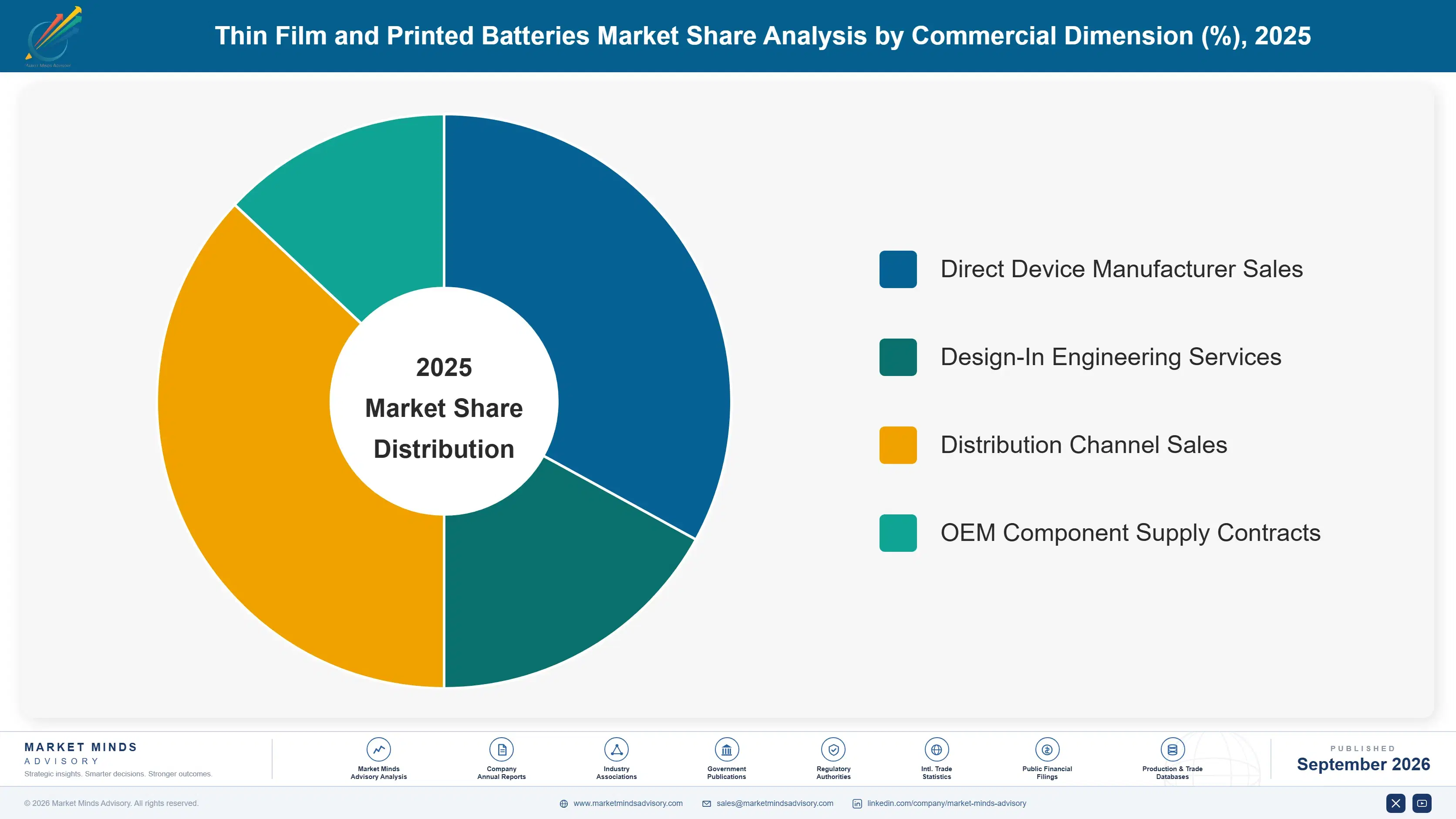
Thin film and printed batteries segment by cell chemistry and manufacturing process rather than by end-use application, since a single wearable device manufacturer typically evaluates multiple chemistry options across its product line depending on power requirements and certification needs. Suppliers treating manufacturing process and end-use application as separate purchasing decisions win more design-in contracts than those bundling both together.
thin-film-and-printed-batteries-market-market-share-analysis-1788415717440

Solid-State Printed Batteries

Solid-state printed batteries use a solid polymer or ceramic electrolyte rather than liquid electrolyte, eliminating leakage and fire risk entirely while enabling thinner cell profiles suited to skin-contact medical applications. Manufacturing yield has improved sixty-two to seventy-eight percent across leading production lines, a figure large enough to justify premium pricing on top of standard printed battery costs. Adoption is accelerating fastest in medical patch applications, where certification requirements make liquid electrolyte designs increasingly impractical. Suppliers are also extending solid-state chemistry to smart packaging applications, a use case that logistics providers specifically requested after early deployments focused only on wearable devices. Retailers of the technology increasingly value this addition as a genuine differentiator against competitors offering wearable-only chemistry options.
CAGR 23.6%

Wearable Consumer Electronics Batteries

Wearable consumer electronics batteries power fitness trackers, smartwatches, and hearing aids, typically bundling flexible form factor design with moderate capacity suited to daily recharge cycles. This segment represents the largest installed base by unit count, reflecting years of gradual adoption since flexible wearables first entered mainstream consumer markets, though unit growth now trails the faster-growing solid-state segment. Replacement cycles increasingly favor cells compatible with wireless charging integration. Hearing aid manufacturers outside mainstream wearables are adopting the same core cell platform, adapting form factor to smaller device housings rather than wrist-worn consumer designs. Replacement decisions increasingly hinge on charging compatibility rather than sticker price alone across most procurement evaluations today. Buyers value this highly.
CAGR 17.9%
Full segment breakdown across 6 segments available in the complete report.

Regional Architecture and Country Demand Map

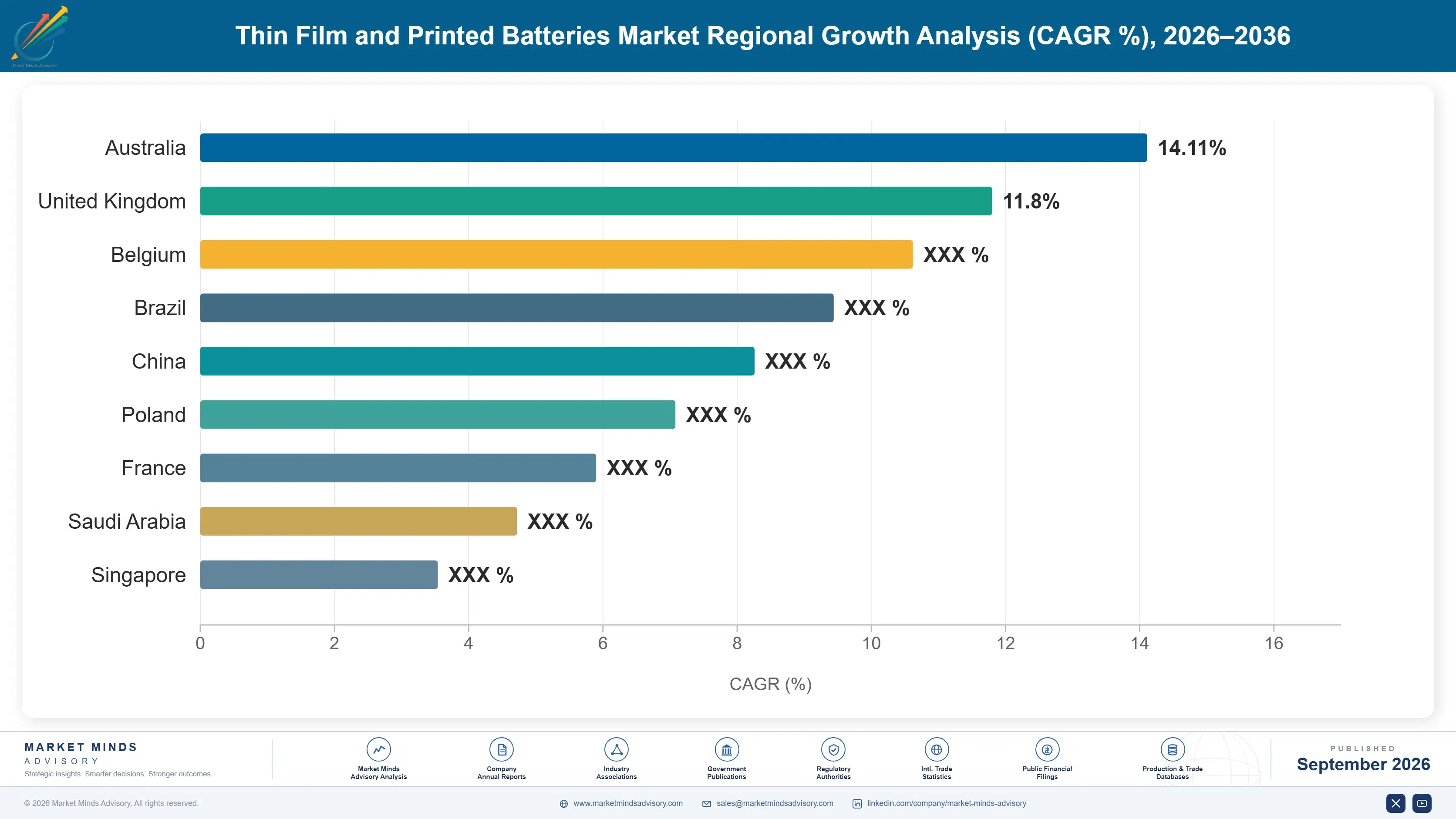
East Asia leads global production on the strength of South Korea and Japan's advanced battery manufacturing base, while South Asia and Pacific posts the fastest regional growth as India's wearable device assembly sector scales quickly from a small existing installed base today. Wearable makers everywhere are watching closely.

North America

United States wearable device makers and medical device manufacturers anchor North American demand, with major fitness tracker and continuous glucose monitor producers all sourcing thin film cells for next-generation product lines. FDA device clearance activity for battery-powered smart patches has grown meaningfully in recent years, pushing manufacturers toward certified flexible cell suppliers. Canadian medical device startups are following a similar pattern at a smaller scale, often sourcing from the same qualified United States supplier base rather than developing independent relationships. Vendors report United States buyers negotiate harder on long-term supply contract terms than on unit price alone, treating certification consistency as the more consequential decision. Contract renewal rates here run higher than in most other MMA-tracked regions.
Share: 24% | CAGR: 15.0% (2026 to 2036)

Western Europe

Germany's medical device sector, concentrated around established diagnostics and wearable health monitoring manufacturers, drives a meaningful share of Western European demand as regulatory scrutiny over device safety intensifies. United Kingdom and French wearable electronics startups contribute smaller but growing demand tied to expanding consumer health monitoring adoption. Regional growth trails the global average because much of the addressable medical device market already completed certification cycles during the prior product generation, leaving incremental upgrades rather than first-time adoption as the dominant purchase pattern. Nordic wearable startups are pursuing a comparable strategy, betting that certified solid-state chemistry can differentiate their products from mass-market competitors. Expect deployment to accelerate as national health regulators finalize wearable device safety guidance.
Share: 19% | CAGR: 14.6% (2026 to 2036)
Regional intelligence for 5 additional markets available in the complete report: East Asia, South Asia and Pacific, Latin America, Middle East and Africa, Eastern Europe. Contact sales@marketmindsadvisory.com.
thin-film-and-printed-batteries-market-country-cagr-analysis-1788415717952

Certification Depth Drives Premium Pricing

Suppliers that expand solid-state chemistry certification, bundle rapid prototyping services for device design-in engagements, and diversify into smart packaging applications capture disproportionate margin as certification barriers limit competitive entry across the fastest-growing segments. Suppliers slow to act cede share to faster-moving rivals within a single product cycle. First movers on each front are already pulling ahead noticeably.

Solid-State Chemistry Certification Expansion Program Strategy

Suppliers expanding solid-state chemistry certification across multiple medical device regulatory jurisdictions win design contracts that certification-lacking competitors cannot bid into, particularly for skin-contact continuous monitoring applications. Ilika plc and Cymbet Corporation have both invested heavily in cross-jurisdiction certification, and solid-state cells now represent roughly 34% of new printed battery designs, up sharply from a much smaller share three years ago. This certification depth also raises switching costs once a device manufacturer builds its regulatory submission around a specific supplier's documentation. Suppliers without comparable certification breadth are increasingly locked out of the largest medical device qualification opportunities.
Market Impact: certified suppliers win roughly 3x more design contracts

Rapid Prototyping Services for Design-In Engagements

Suppliers offering rapid prototyping services that let device manufacturers test multiple cell configurations within weeks rather than months convert a slow catalog sale into an embedded engineering partnership. Blue Spark Technologies has structured its commercial offering around this model, reporting design-in win rates roughly 35% higher for engagements including prototyping support than for standard catalog quote requests. This approach also locks in follow-on volume once a device design is finalized around a specific cell footprint. Suppliers without this rapid turnaround capability are ceding design wins to competitors better equipped to support fast product cycles.
Market Impact: prototyping engagements lift win rates by roughly 35%

Smart Packaging Vertical Market Diversification Strategy

Suppliers diversifying into smart packaging applications for cold chain pharmaceutical monitoring capture volume that pure wearable device demand cannot sustain alone, particularly as logistics providers scale disposable sensor deployment. Enfucell Oy has expanded a dedicated packaging-focused product line separate from its wearable device offering, reporting unit shipments in this category up 3x faster than its core wearable business over the past two years. This diversification also reduces supplier exposure to any single end-use vertical's demand cycle. Suppliers without a dedicated packaging line are ceding this fast-growing channel to competitors better suited to non-wearable applications.
Market Impact: packaging segment shipments up 3x since 2023 overall

Manufacturing Yield Improvement Investment Program Plan

Suppliers investing in inline optical inspection systems that catch printing defects earlier in the production run capture margin that yield-constrained competitors cannot match at comparable unit pricing. Prologium Technology has deployed automated inspection across its primary production lines, reporting yield improvements that cut scrap costs by roughly 30% compared to suppliers still relying on manual quality checks. This investment converts a persistent cost disadvantage into a genuine competitive edge over slower-adopting rivals. Suppliers slower to invest in inspection technology still absorb scrap losses that keep unit costs above better-equipped competitors. Timing matters as competitors close in.
Market Impact: yield gains cut scrap costs by roughly 30%

Who Controls the Margin Pool

Five suppliers control forty-eight percent of global thin film and printed battery revenue on a production capacity basis, with Ilika plc and Blue Spark Technologies holding the two largest positions. The gap between the leader and the nearest mid-tier challenger has widened as certification barriers rise faster than smaller suppliers can absorb. That widening reflects how quickly certification breadth has become the deciding factor in rollout contracts.
Current competitive activity centers on solid-state certification and rapid prototyping services rather than unit price, since manufacturers treat certification breadth and design support as more consequential than marginal cost differences. Several suppliers have restructured commercial teams around design-in engineering support over the past two years. Suppliers slow to reorganize report weaker contract renewal rates than those that adapted early.

Emerging pressure comes from Chinese printed electronics manufacturers scaling domestic solid-state capability quickly, a shift that could erode the top five's combined share if certification barriers ease. Rankings among the second tier remain fluid as smaller specialists pursue smart packaging niches the largest wearable-focused players have been slower to prioritize. Traditional suppliers are responding by acquiring smaller solid-state specialists rather than building comparable capability.
thin-film-and-printed-batteries-market-company-positioning-matrix-1788415718474

Competitive Moat and Risk Dimensions

ILIKA PLC

Moat: Solid-State Certification Depth

Ilika holds the broadest solid-state chemistry certification portfolio across medical device jurisdictions, built over years of dedicated regulatory investment that newer entrants cannot easily replicate quickly. That breadth lets the company offer certified cells matching nearly any medical device application a customer proposes. That trust took years to build carefully.
ILIKA PLC

Risk: Manufacturing Scale Constraints

The company's production capacity remains smaller than larger battery manufacturers entering the segment, limiting how quickly it can fulfill large-volume device manufacturer orders. Competitors with existing large-scale manufacturing infrastructure can undercut on lead time for high-volume contracts. Ilika has begun expanding capacity through partnership agreements to address this gap over the coming years.
BLUE SPARK TECHNOLOGIES

Moat: Rapid Prototyping Capability

Blue Spark Technologies built its position on fast design-in engineering support, letting device manufacturers test multiple cell configurations within weeks rather than the months competitors typically require. This speed advantage locks in early design relationships before competitors can even respond to a request for quote.
BLUE SPARK TECHNOLOGIES

Risk: Limited Chemistry Diversity

The company's product portfolio concentrates heavily on a narrower set of chemistry options than larger diversified competitors offer, risking exposure if customer demand shifts toward alternatives it has not developed. Broadening chemistry offerings requires investment the company has been slower to commit relative to peers.

Players Tracked

Prominent Players

Ilika plc
Blue Spark Technologies
Enfucell Oy
Cymbet Corporation
Prologium Technology

Other Key Players

STMicroelectronics
Panasonic Energy
Imprint Energy
Front Edge Technology
Excellatron Solid State
Solidenergy Systems
Nanoramic Laboratories
Molex LLC
NGK Insulators
Samsung SDI
LG Energy Solution
TDK Corporation
Applied Materials
Jenax Inc
Brightvolt

Recent Developments

APRIL 2026

Ilika Expands Solid-State Manufacturing Capacity in South Korea

Ilika plc commissioned expanded solid-state printed battery manufacturing capacity at a facility near Seoul, South Korea, specifically targeting medical device and wearable electronics customers. The expansion adds roll-to-roll production lines dedicated to certified medical-grade cells, cutting expected lead times for large device manufacturer orders. Local hiring accompanies the expansion.
Signal: Signals suppliers are localizing production much closer to South Korea's concentrated device manufacturing customer base nationwide.
DECEMBER 2025

Blue Spark Technologies Acquires Rapid Prototyping Startup

Blue Spark Technologies acquired a smaller rapid prototyping startup based in San Jose, California, adding automated cell configuration testing capability to its existing design-in engineering service. The deal closed for an undisclosed sum and folds the acquired testing capability directly into Blue Spark's commercial engineering offering.
Signal: Confirms prototyping speed, not chemistry innovation alone, is quickly becoming the primary competitive differentiator industry-wide today.
AUGUST 2025

Cymbet Signs Multi-Year Contract With Medical Device Manufacturer

Cymbet Corporation signed a multi-year supply agreement with a major continuous glucose monitor manufacturer to provide certified solid-state cells across the company's next two product generations. The agreement is a supply commitment rather than an equity stake or joint venture, and locks in volume ahead of expected device shipment growth.
Signal: Shows medical device manufacturers now locking in long-term cell supply well ahead of product launches broadly.

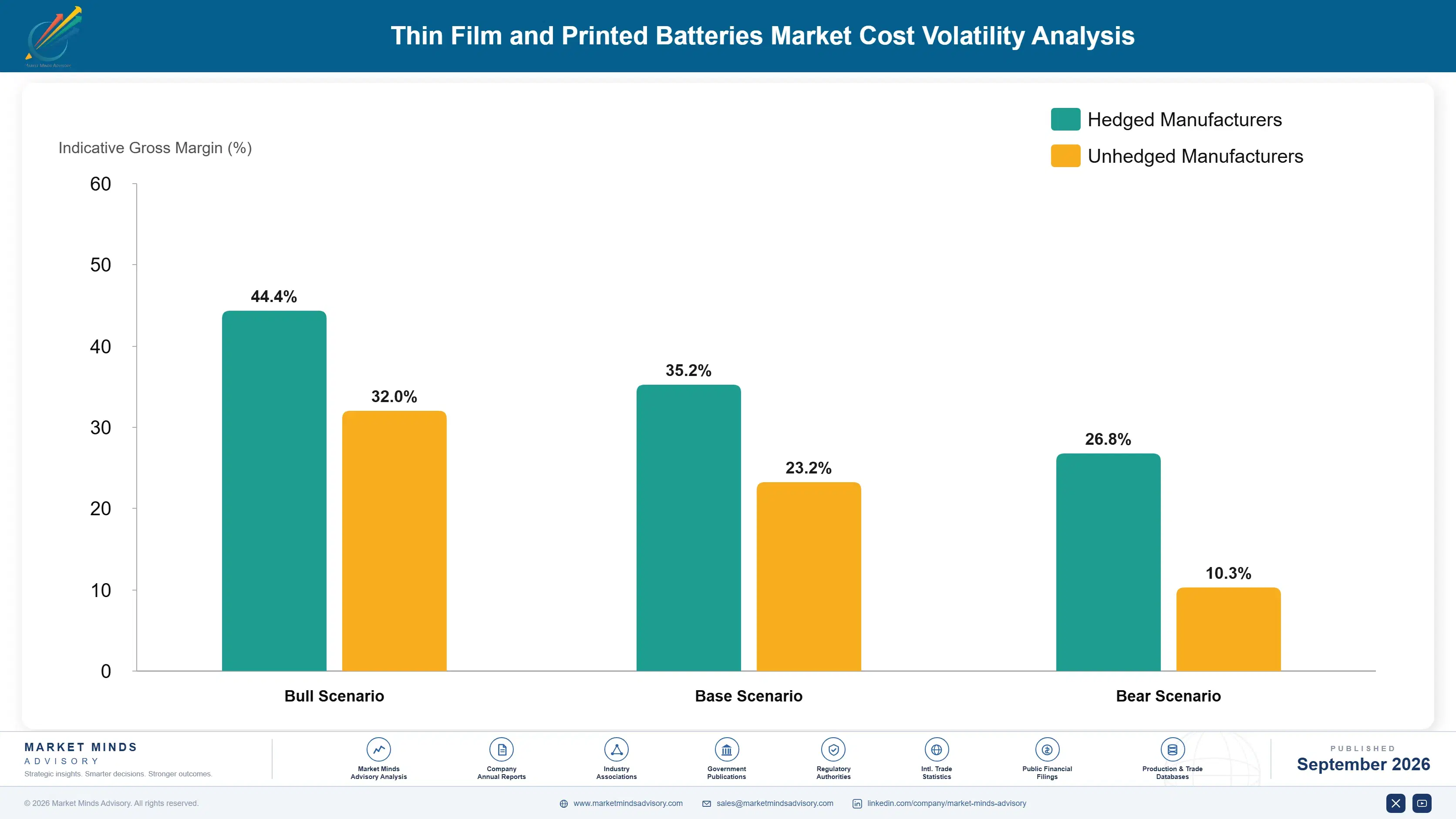
Rare Material and Yield Cost Exposure

Specialty electrolyte materials and printing substrate together account for roughly thirty-eight percent of a thin film battery's cost of goods sold, with the remainder split between manufacturing yield losses, testing, and assembly labor. Most specialty electrolyte materials originate from a concentrated set of South Korean and Japanese chemical suppliers, concentrating meaningful upstream cost exposure outside manufacturer control.
Specialty ceramic electrolyte pricing swung more than twenty-five percent within a single year during the 2023 to 2024 period, driven by a supply disruption that the IEA's 2024 critical minerals report attributed to constrained rare earth processing capacity following export restriction announcements. Several manufacturers delayed new product qualification temporarily rather than absorbing the full price increase, pushing some device launches back by a full fiscal quarter.

Smaller manufacturers without long-term material purchase agreements face sharper margin compression during price spikes than the top five, who typically lock multi-year pricing with upstream chemical partners. This gap widens further for manufacturers concentrated in a single sourcing region, since they lack the flexibility larger competitors use to shift orders toward whichever regional supplier offers the better terms that quarter. This dependency worsens further.
thin-film-and-printed-batteries-market-cost-volatility-analysis-1788415718668

Multi-Year Electrolyte Material Purchase Agreements

Leading manufacturers now lock specialty electrolyte pricing into multi-year agreements with South Korean and Japanese partners, trading some upside flexibility for predictable input costs across budget cycles. This shields margin during commodity spikes. Manufacturers without such agreements have historically absorbed a larger share of spot-price volatility directly into quarterly margin figures. This gap widens further during extended volatility.

Alternative Chemistry Qualification Strategy

Manufacturers qualifying alternative electrolyte formulations that reduce dependence on the most volatile rare earth inputs can shift production toward whichever chemistry offers better cost stability in a given quarter. Smaller manufacturers rarely qualify alternatives. Building that second qualified chemistry option takes significant research investment, keeping this advantage concentrated among the largest manufacturers currently. This gap should narrow gradually over time.

Inline Manufacturing Yield Improvement Investment

Several manufacturers have invested in inline optical inspection systems that catch printing defects earlier in the production run, letting them negotiate better material pricing tied to lower waste volumes. Adoption remains uneven across the manufacturer base. Manufacturers that invested earliest report meaningfully lower scrap costs than competitors still relying on manual quality inspection processes.

Portfolio Architecture for Margin Defence

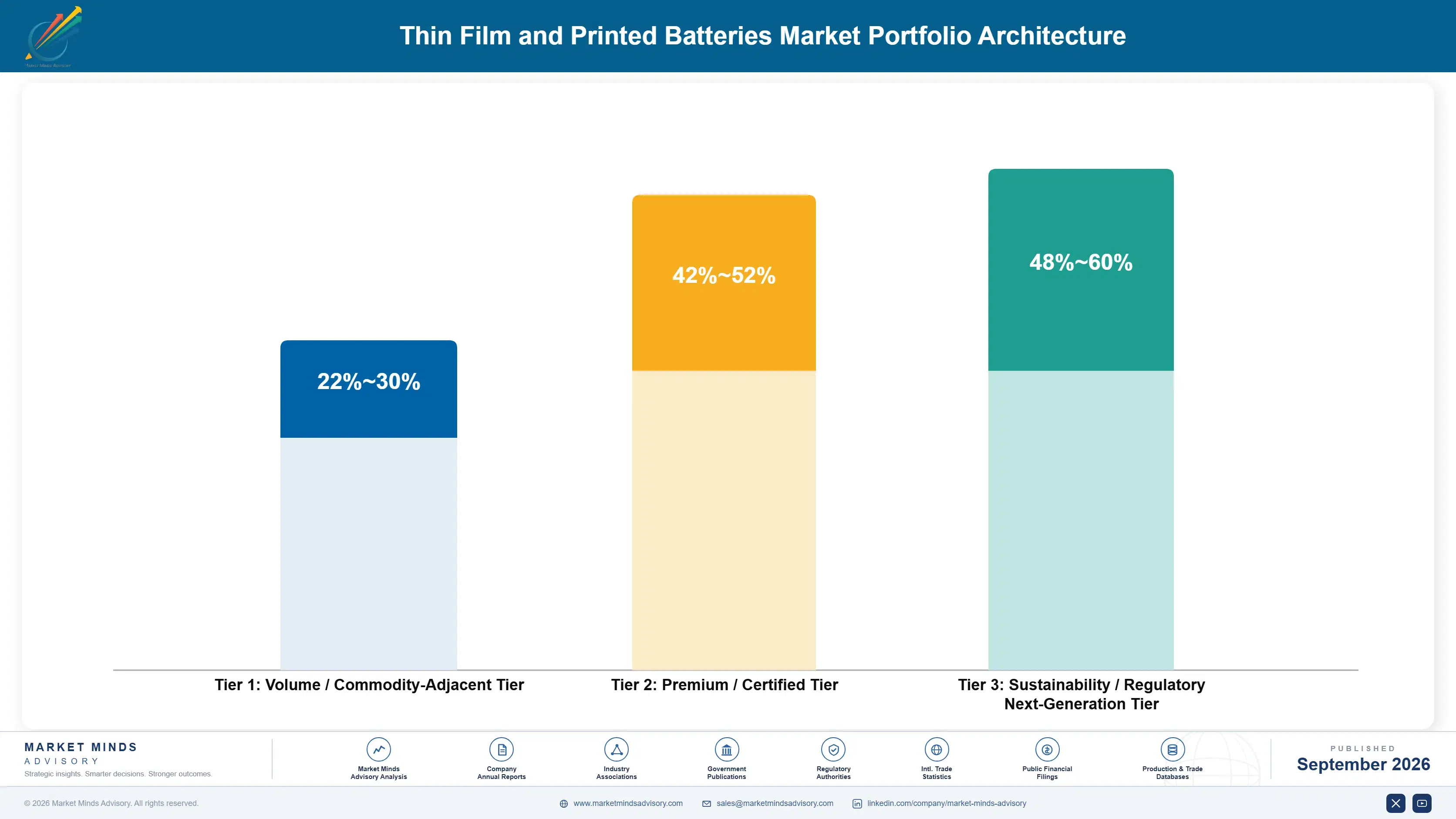
Thin film battery margin economics split across three tiers, with commodity consumer wearable cells competing on volume pricing while solid-state and medical-certified products command materially wider gross margin. Volume wearable cells still generate the bulk of unit shipments even as revenue concentrates increasingly in the higher tiers. That gap has widened as certification requirements tighten, making uncertified cells a poor allocation for manufacturers with a credible upgrade path.
The tension between volume and premium is sharpest in medical devices, where a manufacturer's average selling price can differ by a factor of three between a consumer-grade cell and a medical-certified solid-state equivalent serving similar capacity. Manufacturers chasing volume alone cede the margin pool to competitors willing to invest in certification. That gap has widened over the past several years as manufacturers weigh certification proof more heavily than raw capacity specifications.

High-value margin pools concentrate in solid-state medical-certified cells and emerging smart packaging formats, both requiring upfront certification and engineering investment that smaller manufacturers frequently cannot justify against uncertain design-win probability. This concentration is expected to deepen as medical device adoption keeps expanding. Manufacturers positioned early in both capture disproportionate revenue growth relative to unit volume growth across the decade ahead.

Volume / Commodity-Adjacent Tier

Standard consumer wearable cells sold on price into fitness trackers and general electronics, competing primarily on manufacturing scale rather than certification depth. Chinese entrants apply steady price pressure here. Established consumer brands still hold a meaningful share of this segment.
Gross Margin: 22-30%

Premium / Certified Tier

Solid-state medical-certified cells sold at a durable premium, defended by regulatory certification barriers competitors cannot easily replicate without years of dedicated qualification work. Established manufacturers with proven certification hold this ground firmly against newer entrants.
Gross Margin: 42-52%

Sustainability / Regulatory / Next-Generation Tier

Emerging smart packaging and cold chain sensor cells combining printed battery technology with disposable monitoring, carrying the widest margins as early scaled volume remains constrained. Scale should follow as buyer confidence in disposable sensor accuracy grows over the coming years.
Gross Margin: 48-60%
thin-film-and-printed-batteries-market-portfolio-architecture-1788415719160

High-value Sub-segments and Strategic Watch-out

High-value high-growth segment

Solid-state printed batteries sit at the intersection of premium margin and the fastest unit volume growth, as medical device manufacturers standardize around certified solid-state chemistry rather than legacy liquid electrolyte designs across new product qualification cycles. This is the clearest growth vector across the entire forecast decade.
Gross Margin: 42-52%

High-value moderate-growth segment

Rapid prototyping design-in engagements carry strong recurring margins tied to manufacturer confidence in fast product iteration, though adoption grows more gradually as suppliers build the engineering capacity needed to support multiple concurrent device programs. Suppliers treat this as a durable, if slower-building, opportunity worth pursuing.
Gross Margin: 38-48%

Volume core segment

Standard consumer wearable cells remain the largest unit volume base across established fitness tracker and smartwatch markets globally, sustaining steady if unremarkable margins as the category matures and price competition among established manufacturers intensifies nationwide. Scale determines share here overall. Volume here funds the fixed cost base broadly.
Gross Margin: 22-30%

Strategic watch-out segment

Chinese printed electronics manufacturers scaling domestic solid-state capability rapidly threaten to erode the top five's combined share over the coming decade, particularly where price-sensitive consumer wearable buyers favor lower-cost alternatives over medical-certified products. This shift bears close monitoring ahead. Established manufacturers are responding through acquisition and partnership.
Gross Margin: n/a

Design Wins Behave Like Annuities

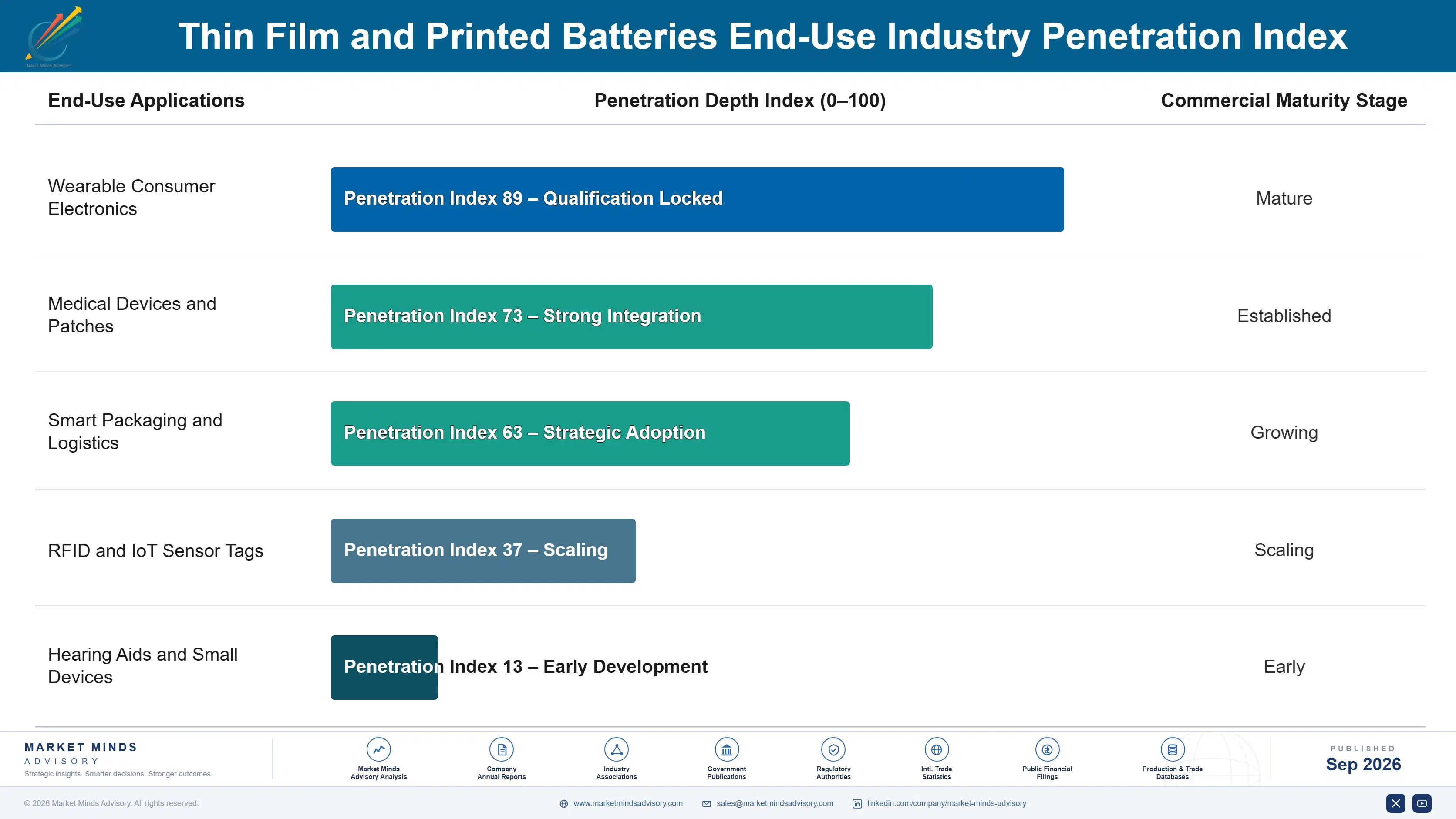
A thin film battery design win functions like an annuity rather than a single transaction, since device manufacturers rarely requalify a working power source decision once a product line enters volume production. A single medical device design win can generate revenue across an entire product generation lasting three to five years, turning one qualification cycle into a durable, multi-year revenue stream for the winning supplier.
Adoption depth varies sharply by end-use vertical. Medical device manufacturers embed cell relationships into multi-year contracts tied to regulatory certification requirements, while wearable consumer electronics makers treat purchases as more opportunistic, product-by-product decisions. Smart packaging providers sit between the two, favoring qualified suppliers for disposable applications where field failure carries real logistical cost. That spread explains why unit volume and margin diverge sharply across these verticals.

Buyer profiles are shifting generationally as well. A newer cohort of device engineers, trained on flexible power design from the start of their careers, increasingly defaults to printed cells over legacy coin cells even in mature product categories. Older engineering teams in established electronics accounts still specify coin cells out of long familiarity, though retirement and workforce turnover are steadily closing that generational gap across the forecast decade.
thin-film-and-printed-batteries-market-end-use-penetration-index-1788415719647

Where Suppliers Should Focus

These are among the four positions where our research anticipates prominent divergence between winners and laggards over the coming forecast period. Each is grounded in the demand model, the regulatory perimeter, and the announced capacity pipeline.
01 / SOLID-STATE CERTIFICATION PRIORITY

Expand certification breadth before medical qualification windows close

Solid-state certification already commands the widest margins in the category, and that gap is widening as device manufacturers increasingly treat certification breadth as essential to any new product qualification rather than a discretionary feature layered on top. Suppliers without proven certification depth risk exclusion from the fastest-growing medical device design bids within the next several years, not just margin erosion, since procurement contracts increasingly name certification as a scoring criterion. Building that depth now, ahead of full market consolidation, converts a regulatory investment into a lasting contract advantage.
02 / RAPID PROTOTYPING INVESTMENT STRATEGY

Build fast design-in capability before competitors close the speed gap

Rapid prototyping speed increasingly determines which supplier wins a device manufacturer's design contract, more so than raw energy density in most competitive design reviews conducted today. Suppliers that demonstrate proven fast-turnaround capability capture design wins that slower-responding competitors cannot match, since manufacturers lock supplier decisions early and rarely revisit a working power source choice. This advantage compounds as device product cycles keep shortening across the forecast decade, rewarding whoever iterates fastest with the largest cumulative share of new design wins.
03 / SMART PACKAGING DIVERSIFICATION STRATEGY

Build packaging vertical presence before pure wearable growth slows

Smart packaging applications for cold chain monitoring are growing faster than any segment tracked, rewarding suppliers that diversify beyond pure wearable device demand over those remaining concentrated in a single end-use vertical. Suppliers that establish packaging vertical credibility now capture volume that competitors without a dedicated non-wearable line simply cannot bid on, since logistics providers require proven disposable sensor reliability at scale. Waiting until this vertical matures further will make this positioning meaningfully harder and more costly to establish afterward.
04 / CHINA CAPABILITY RESPONSE STRATEGY

Deepen certification moats before domestic Chinese rivals scale further

Chinese printed electronics manufacturers building domestic solid-state capability threaten to erode established suppliers' combined share as China's own wearable device assembly base grows large enough to sustain fully domestic supply chains. Global suppliers that deepen certification moats and rapid prototyping capability now retain differentiated positioning rather than competing purely on manufacturing cost against faster-scaling domestic entrants across the region. Waiting until domestic Chinese capability matures further will make this positioning meaningfully harder, slower, and considerably more costly to achieve overall.

Engagement Snapshot From the Field

A live engagement with an industry participant carrying material or product regulatory and market exposure ahead of a defining policy shift, showing how our research translates into a defensible multi-year portfolio strategy.
MARKET MINDS ADVISORY · CLIENT ENGAGEMENT SUMMARY
Thin Film and Printed Batteries Producer Strategic Portfolio Review and Transition Roadmap 2026·Investment Scenario on Thin Film and Printed Batteries Exposure Evaluation 2025-26
CLIENT PROFILE
The client is a mid-size medical device manufacturer producing continuous patient monitoring patches, with annual battery component spending in the tens of millions of dollars (client-reported, unverified by MMA). The manufacturer had historically sourced conventional coin cell batteries without evaluating thin film alternatives. Rising patient safety concerns around device thickness prompted leadership to reconsider its battery sourcing strategy.
STRATEGIC CHALLENGE
Growing patient demand for slimmer, more comfortable monitoring patches forced the manufacturer to reconsider its battery sourcing strategy within a compressed product development budget cycle. Management needed to decide whether to qualify solid-state printed batteries across its full product line, pilot the technology in a subset of devices first, or maintain existing coin cells despite the ongoing design constraints.
MMA APPROACH
MMA conducted structured interviews with the manufacturer's product engineering and regulatory affairs leadership alongside a benchmarking exercise against three peer medical device manufacturers' battery sourcing decisions and supplier relationships across comparable product lines. The engagement combined primary qualitative interviews with MMA's proprietary thin film battery market dataset to assess supplier claims, certification timelines, and total cost under each sourcing option.
KEY FINDINGS
  1. Solid-state printed batteries reduced device thickness by roughly forty percent compared to conventional coin cells in prototype testing (client-reported, unverified by MMA).
  2. Peer medical device manufacturers that piloted solid-state cells before full qualification reported fewer regulatory submission delays than those switching immediately. Vendor support quality during certification mattered as much as raw thinness claims.
  3. Full product-line qualification would have required certification investment the engagement estimated at fourteen months beyond the manufacturer's current budget cycle. Budget timing constraints made a phased approach the more practical path forward.
  4. Manufacturers that piloted solid-state cells in flagship product lines first captured most of the design benefit at a fraction of full qualification cost.
CLIENT PROFILE
The client is a mid-size medical device manufacturer producing continuous patient monitoring patches, with annual battery component spending in the tens of millions of dollars (client-reported, unverified by MMA). The manufacturer had historically sourced conventional coin cell batteries without evaluating thin film alternatives. Rising patient safety concerns around device thickness prompted leadership to reconsider its battery sourcing strategy.
STRATEGIC CHALLENGE
Growing patient demand for slimmer, more comfortable monitoring patches forced the manufacturer to reconsider its battery sourcing strategy within a compressed product development budget cycle. Management needed to decide whether to qualify solid-state printed batteries across its full product line, pilot the technology in a subset of devices first, or maintain existing coin cells despite the ongoing design constraints.
MMA APPROACH
MMA conducted structured interviews with the manufacturer's product engineering and regulatory affairs leadership alongside a benchmarking exercise against three peer medical device manufacturers' battery sourcing decisions and supplier relationships across comparable product lines. The engagement combined primary qualitative interviews with MMA's proprietary thin film battery market dataset to assess supplier claims, certification timelines, and total cost under each sourcing option.
KEY FINDINGS
  1. Solid-state printed batteries reduced device thickness by roughly forty percent compared to conventional coin cells in prototype testing (client-reported, unverified by MMA).
  2. Peer medical device manufacturers that piloted solid-state cells before full qualification reported fewer regulatory submission delays than those switching immediately. Vendor support quality during certification mattered as much as raw thinness claims.
  3. Full product-line qualification would have required certification investment the engagement estimated at fourteen months beyond the manufacturer's current budget cycle. Budget timing constraints made a phased approach the more practical path forward.
  4. Manufacturers that piloted solid-state cells in flagship product lines first captured most of the design benefit at a fraction of full qualification cost.
RECOMMENDED STRATEGY
Phase 1: Phase 1 (Months 1-4): Qualify solid-state printed batteries in the flagship continuous monitoring patch identified through historical design and cost review data. Phase 2: Phase 2 (Months 5-10): Evaluate pilot performance carefully and expand qualification to additional product lines based on demonstrated design outcomes. Phase 3: Phase 3 (Months 11-19): Negotiate a long-term supply agreement with the qualified vendor covering full product-line coverage across the following fiscal cycle.
OUTCOME
Within nineteen months of implementation, the manufacturer reported a reduction in device thickness tied to solid-state cell qualification of approximately thirty-eight percent (client-reported, unverified by MMA). The phased approach demonstrated sufficient design improvement to justify expanded qualification, and the manufacturer has since committed to a fully solid-state battery strategy across its entire monitoring patch product line.

Frequently Asked Questions

Foundational context covering the market sizes, CAGR, scope, country, region and competition that inform every finding below. This section is provided to cover basics and most often pre-purchase conversations, answered from the MMA Primary Research Dataset.

What is the current size of the Thin Film and Printed Batteries Market?

The Thin Film and Printed Batteries Market reached an estimated 1.3 billion dollars in 2025. Growth is driven by rising wearable device adoption and expanding medical patch manufacturing worldwide.

How large will the Thin Film and Printed Batteries Market be by 2036?

MMA projects the market will reach approximately 6.78 billion dollars by 2036 under the base case scenario. This represents more than four times the 2026 opening value over the ten year forecast window.

What is the CAGR for the Thin Film and Printed Batteries Market 2026 to 2036?

The base case compound annual growth rate is 16.2 percent across the forecast period. Bull and bear scenarios range from 17.6 percent to 14.8 percent depending on certification adoption pace.

Which segment is growing fastest?

Solid-State Printed Batteries is the fastest growing segment, expanding at 23.6 percent annually. That is roughly 1.46 times the overall market growth rate through 2036.

Who are the major companies in the Thin Film and Printed Batteries Market?

Leading participants include Ilika plc, Blue Spark Technologies, Enfucell Oy, Cymbet Corporation, and Prologium Technology. Together these five companies hold a combined production share estimated near 48 percent.

Which country is growing fastest?

India is the fastest growing country market, supported by its expanding wearable device assembly sector and rising consumer health monitoring demand. Demand is further reinforced by government electronics manufacturing incentive programs nationwide.

Report Segmentation Architecture

The full report scope spans multiple orthogonal segmentation dimensions, with cross-tabulated demand data provided for each dimension pair. Coverage extends further to regional breakdowns, trend trajectories, and the competitive detail needed to support segment-level decision-making.

By Primary Market Dimension

  • Solid-State Printed Batteries
  • Liquid Electrolyte Printed Batteries
  • Wearable Consumer Electronics Batteries
  • Medical-Grade Certified Batteries
  • Smart Packaging Sensor Batteries
  • Multi-Layer Stacked Cell Batteries

By End-Use Industry

  • Wearable Consumer Electronics
  • Medical Devices and Patches
  • Smart Packaging and Logistics
  • RFID and IoT Sensor Tags
  • Hearing Aids and Small Devices

By Commercial Dimension

  • Direct Device Manufacturer Sales
  • Design-In Engineering Services
  • Distribution Channel Sales
  • OEM Component Supply Contracts

By Region

  • North America
  • Western Europe
  • East Asia
  • South Asia and Pacific
  • Latin America
  • Middle East and Africa
  • Eastern Europe

Scope, Methodology, and Coverage

Every figure in this report is reproducible from documented input assumptions. The scope below maps the historical period, the forecast horizon, the segmentation dimensions, and the countries covered, alongside the underlying primary and qualitative methodology.
Historical Period
2020 to 2025
Forecast Period
2026 to 2036
Base Year
2025 (USD billions; MMA Primary Research Dataset, September 2026)
Market Definition
This market covers thin film and printed battery cells manufactured using roll-to-roll or screen printing processes for wearable, medical patch, and flexible electronics applications. It excludes conventional coin cell, cylindrical, and pouch cell battery formats.
Quantitative Units
USD billions (current prices); unit shipment volume where noted
Segmentation Dimensions
By Primary Market Dimension; By End-Use Industry; By Commercial Dimension; By Region
Regions Covered
North America, Western Europe, East Asia, South Asia and Pacific, Latin America, Middle East and Africa, Eastern Europe
Countries Covered
USA, Canada, Germany, UK, France, Japan, South Korea, China, Taiwan, India, Australia, Brazil, Mexico, Argentina, UAE, Saudi Arabia, Israel, South Africa, Egypt, Poland, Czech Republic, Hungary, Romania, Slovakia, Netherlands, Italy, Spain, Sweden, Singapore, Vietnam, and additional markets relevant to this sector
Key Companies Profiled
Ilika plc, Blue Spark Technologies, Enfucell Oy, Cymbet Corporation, Prologium Technology, STMicroelectronics, Panasonic Energy, Imprint Energy, Front Edge Technology, Excellatron Solid State, Solidenergy Systems, Nanoramic Laboratories, Molex LLC, NGK Insulators, Samsung SDI, LG Energy Solution, TDK Corporation, Applied Materials, Jenax Inc, Brightvolt
Quantitative Methodology
Primary survey, n=3,800 respondents, Q4 2025, six countries; demand-side model with trade association cross-validation
Qualitative Methodology
47 expert interviews, Q4 2025; applied to validate demand model assumptions, identify emerging dynamics, and assess competitive positioning
Report Format
PDF and XLSX data workbook (Word format preview document)
Publisher
Market Minds Advisory
Report Code
MMA-2026-CHM-175
Published
September 2026
Contact
sales@marketmindsadvisory.com | www.marketmindsadvisory.com

Purchase the full Thin Film and Printed Batteries Market Report (2026 to 2036).

This report provides comprehensive analysis of the Thin Film and Printed Batteries Market, covering size, forecasts, segmentation, and regional dynamics through 2036. It examines competitive positioning among leading battery manufacturers, input cost exposure across the specialty electrolyte and substrate supply chain, and portfolio economics across volume, premium, and next-generation tiers. The analysis draws on primary survey data covering 3,800 respondents and 47 expert interviews conducted in the fourth quarter of 2025. Buyers receive a complete strategic view suitable for investment planning, procurement strategy, and competitive benchmarking decisions across the flexible electronics value chain.
Full ten-year market and segment forecasts through 2036
Regional analysis across all seven MMA-tracked geographies
Competitive benchmarking of top five and fifteen additional players
Electrolyte and substrate input cost exposure analysis
Revenue lever framework tied to quantified commercial impact
Anonymised medical device case study with strategy phasing

Built For The People Who Decide

From boardroom strategy to bench-side execution, this report is read cover-to-cover by leaders shaping the next decade of their industry, turning demand scenarios, market dynamics and valuation benchmarks into decisions.
CXOs/ Presidents/ VPs/ Managers
M&A and Corporate Development
Strategy Teams and R&D Heads
Procurement and Product Directors
Regulatory and Compliance Leaders
Investor Relations and Equity Analysts