Market Minds Advisory
Thermal-Wet Gas Abatement System Market

Thermal-Wet Gas Abatement System Market: Thermal-Wet Gas Abatement System Market. Point-of-Use Treatment Meets the Advanced Node Fab Expansion Shift

Advanced node fabs are shifting toward point-of-use abatement to handle rising process gas volumes, reshaping which equipment vendors capture margin as global semiconductor capacity expansion accelerates across leading manufacturing regions.

Lead Analyst

Published

September 2026

Make Smarter Decisions with Customized Research Insights

Request a free sample report and evaluate market opportunities, growth trends, and competitive dynamics relevant to your business needs.

2025 MARKET VALUE$1.3BMarket Size 2025
2036 FORECAST VALUE$3.2BBase Case , 2026 to 2036
CAGR 2026 TO 20368.6 %Bull 9.8% / Bear 7.4%
INCREMENTAL OPPORTUNITY$1.8BNet 10- year value creation
EXPANSION MULTIPLE2.28x2036 value over 2026 base
Strategic Levers
M&A Pipeline
Regional Outlook
Country Rankings
Competitive Intelligence
Segmental Deep-dive
Call-Us : 91 93563 13602

Executive Snapshot and Market Trajectory.

Advanced node fabs are shifting toward point-of-use abatement to handle rising process gas volumes, and that shift is reshaping which equipment vendors capture the strongest position in new fab tool procurement. Buyers now treat destruction efficiency certification as a baseline procurement requirement rather than a specialty engineering feature.
Commercial momentum concentrates around combined thermal-wet systems capable of destroying multiple gas species in a single pass, since fabs increasingly value footprint efficiency alongside destruction performance. East Asia accounts for the overwhelming majority of near-term order volume, reflecting the concentration of advanced node fab capacity in Taiwan, South Korea, and China relative to every other producing region. Vendors without proven advanced node compatibility increasingly struggle to win specification in new leading-edge fab construction projects.
Competition splits between large industrial gas and vacuum equipment conglomerates offering integrated abatement portfolios and specialist manufacturers selling standalone point-of-use units. Rising per-tool gas consumption at advanced nodes and tightening emissions regulation are increasingly shaping which abatement architectures fabs standardize around for the next generation of process technology. Fab operators are increasingly favoring modular abatement designs as tool density and floor space constraints continue tightening steadily.
Market Definition
This market covers thermal-wet gas abatement systems used to destroy and neutralize hazardous process gases exhausted from semiconductor fabrication equipment, combining thermal combustion with wet scrubbing in a single system. It excludes standalone dry scrubbers, plasma-only abatement units, and general facility exhaust ventilation equipment.
Base Year Value
$1.3B in 2025 (MMA Primary Research Dataset, September 2026)
Forecast Period
2026 to 2036, eleven discrete annual values
CAGR
8.6% base case. Bull 9.8%. Bear 7.4%.
Fastest Growth Segment
Point-of-Use Abatement Systems: 14.2% CAGR
Fastest Growth Country
Taiwan: 11.6% CAGR
Fastest Growth Region
Largest Region
Market Leaders
Ebara Corporation, Edwards Vacuum LLC, DAS Environmental Expert GmbH, Kanken Techno Co Ltd, CS Clean Solutions AG. Source: MMA Analysis based on company annual reports.
Primary Survey
n=3,800 procurement and R&D decision-makers, Q4 2025, six countries
Methodology
Demand-side build-up, cross-validated against public data, 47 expert interviews

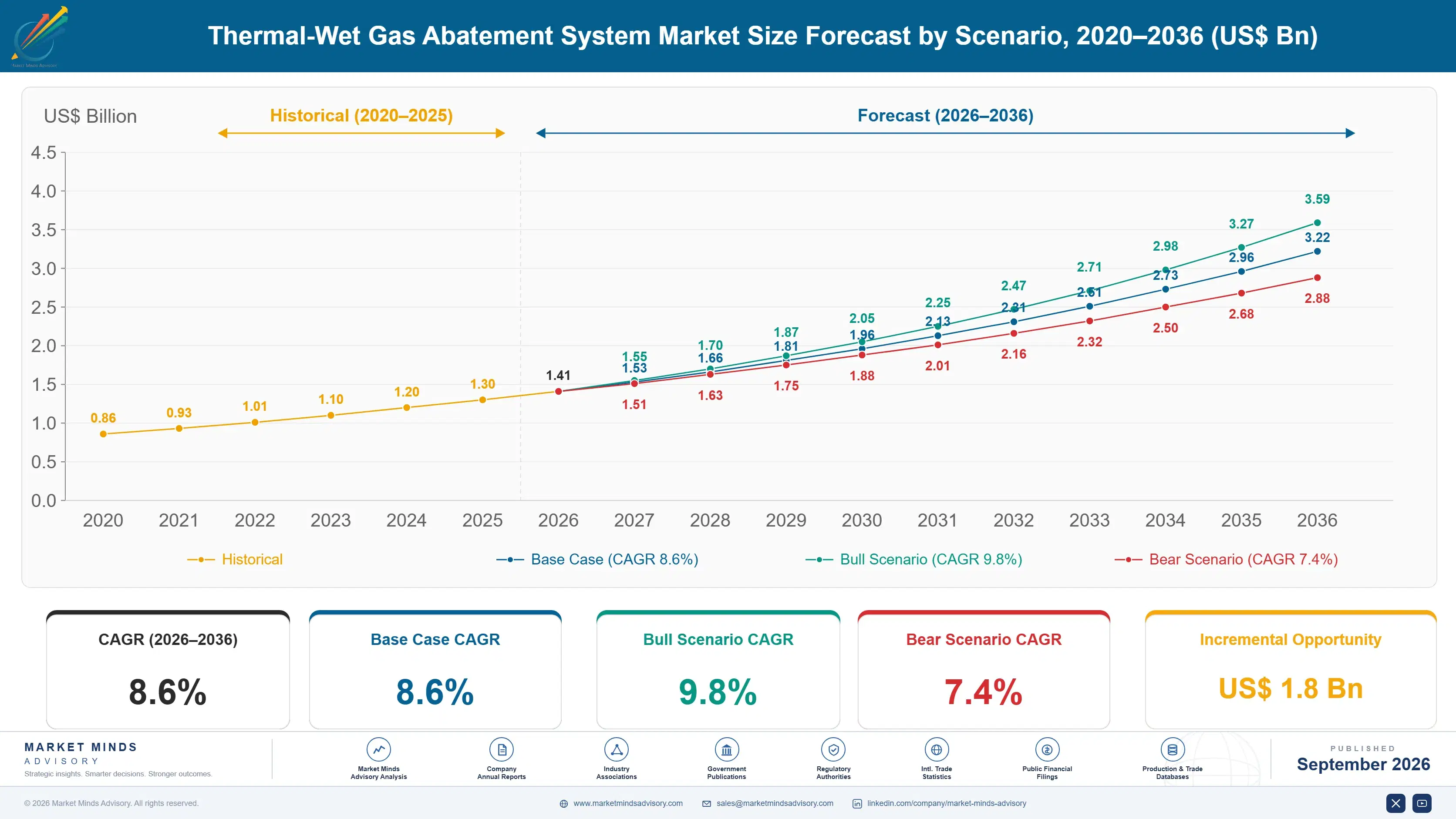
Thermal-Wet Gas Abatement System Market Forecast Scenarios

thermal-wet-gas-abatement-system-market-size-forecast-scenario-1788255361007
Between 2020 and 2025, thermal-wet gas abatement system demand grew steadily as semiconductor fab construction accelerated across Taiwan, South Korea, and the United States following supply chain disruption and subsidy-driven capacity expansion. Historical growth ran close to 7.8 percent annually over that period. Equipment vendors with pre-qualified process compatibility captured the strongest order gains as fab operators raced to secure delivery slots.
The base case assumes continued fab-driven growth, supported by three commercial mechanisms working together: advanced node process technology requiring higher per-tool gas consumption and abatement capacity, government semiconductor subsidy programmes pulling new fab construction into additional regions, and tightening emissions regulation pushing fabs toward higher destruction efficiency abatement systems during scheduled upgrade cycles. These mechanisms sustain steady high-single-digit growth even as semiconductor capital spending cycles vary considerably year to year.
A bull scenario assumes faster advanced node capacity expansion and broader point-of-use adoption across additional fab construction, pushing growth toward the top of the forecast range. The bear risk centers on semiconductor cycle timing: if chip demand softens meaningfully, some planned fab construction projects could be deferred, slowing equipment demand. Either scenario leaves demand above the flat growth rates typical of the most mature process equipment categories.

Where Fab Expansion Meets Gas Destruction Economics

Converging forces are reshaping this category: record advanced node fab construction, rising per-tool process gas consumption, and tightening emissions regulation are pushing abatement system specification from routine facility infrastructure into a genuine strategic capital planning priority. Board-level scrutiny of emissions compliance risk has made abatement system selection a standing capital planning priority across most major fab construction projects.
MARKET CONCENTRATIONCR5 58%top five vendors hold well over half of global share
AVERAGE SYSTEM ASP$120K-$580K per unitvaries with gas destruction capacity and process compatibility required
LEADING MANUFACTURING COUNTRY SHARETaiwan 29% of installed basereflecting the country's concentration of advanced node fab capacity
POINT-OF-USE ADOPTION RATE34% of new tool installationsrising steadily as advanced node process gas volumes increase
DESTRUCTION EFFICIENCY REQUIREMENTaverage 98-99.9% PFC destructionreflecting tightening emissions regulation across major producing jurisdictions
EQUIPMENT LEAD TIME EXPOSUREaverage 9-15 monthsreinforcing the value of early equipment order placement strategies
Commercial character in this market splits between large industrial gas and vacuum equipment conglomerates offering integrated abatement portfolios and specialist manufacturers selling standalone point-of-use units through direct fab procurement channels. Process gas compatibility certification and destruction efficiency depth increasingly determine which vendors win specification in new leading-edge fab awards. Vendors that lack established advanced node process gas compatibility increasingly struggle to win specification against incumbents with proven multi-decade operating track records.
Point-of-use adoption, rising per-tool gas consumption at advanced nodes, and tightening emissions regulation will shape vendor strategy and product design over the next decade. Vendors that delay point-of-use investment risk losing specification to better-positioned rivals with proven modular product lines. That lock-in dynamic already favors early movers who invested in modular product platforms well ahead of the broader industry shift now underway.
"Everyone assumes gas abatement is a back-of-fab afterthought, but the vendors actually winning leading-edge contracts are the ones who solved destruction efficiency at the tool level years before regulators tightened emissions rules."
Director, Technology Practice · MMA Technology Practice · September 2026

Market Trends

Point-of-Use Systems Displace Centralized Facility Abatement

Advanced node fabs are increasingly installing point-of-use abatement units directly at individual process tools rather than routing all exhaust to a centralized facility-wide system, since higher gas volumes at advanced nodes make centralized routing increasingly impractical from a piping and capacity perspective. Ebara and Edwards Vacuum have both expanded point-of-use product lines within the past two years, and installed base data suggests point-of-use units already account for a meaningfully growing share of new tool installations, a pace that smaller manufacturers are increasingly racing to match through their own compact system development investment across comparable process node applications.
Impact : +0.9 PPT to base CAGR

Tightening Emissions Regulation Raises Destruction Efficiency Requirements

Regulators in several major semiconductor manufacturing jurisdictions are tightening PFC and other greenhouse gas destruction efficiency requirements, pushing fabs toward higher-performance abatement systems capable of meeting stricter compliance thresholds than legacy equipment could achieve. Taiwan and South Korea have both introduced updated environmental compliance standards specifically targeting semiconductor fab emissions within the past two years, a regulatory pace that is reshaping how fab operators plan equipment procurement well beyond routine replacement cycles. Vendors without established compliance certification increasingly struggle to win specification in these newly regulated jurisdictions against better-positioned competitors.
Impact : +0.9 PPT to base CAGR
4 additional market trends, 0 additional growth drivers, and 0 additional restraints and challenges are covered in the full report. Contact sales@marketmindsadvisory.com to access the complete intelligence.

Segment CAGR and Growth Architecture

Section default visual
Full segment breakdown across 7 segments available in the complete report.

Regional Architecture and Country Demand Map

Regional intelligence for 0 additional markets available in the complete report: . Contact sales@marketmindsadvisory.com.
Section default visual

Where revenue compounds.

Who Controls the Margin Pool

thermal-wet-gas-abatement-system-market-market-share-analysis-1788255361604

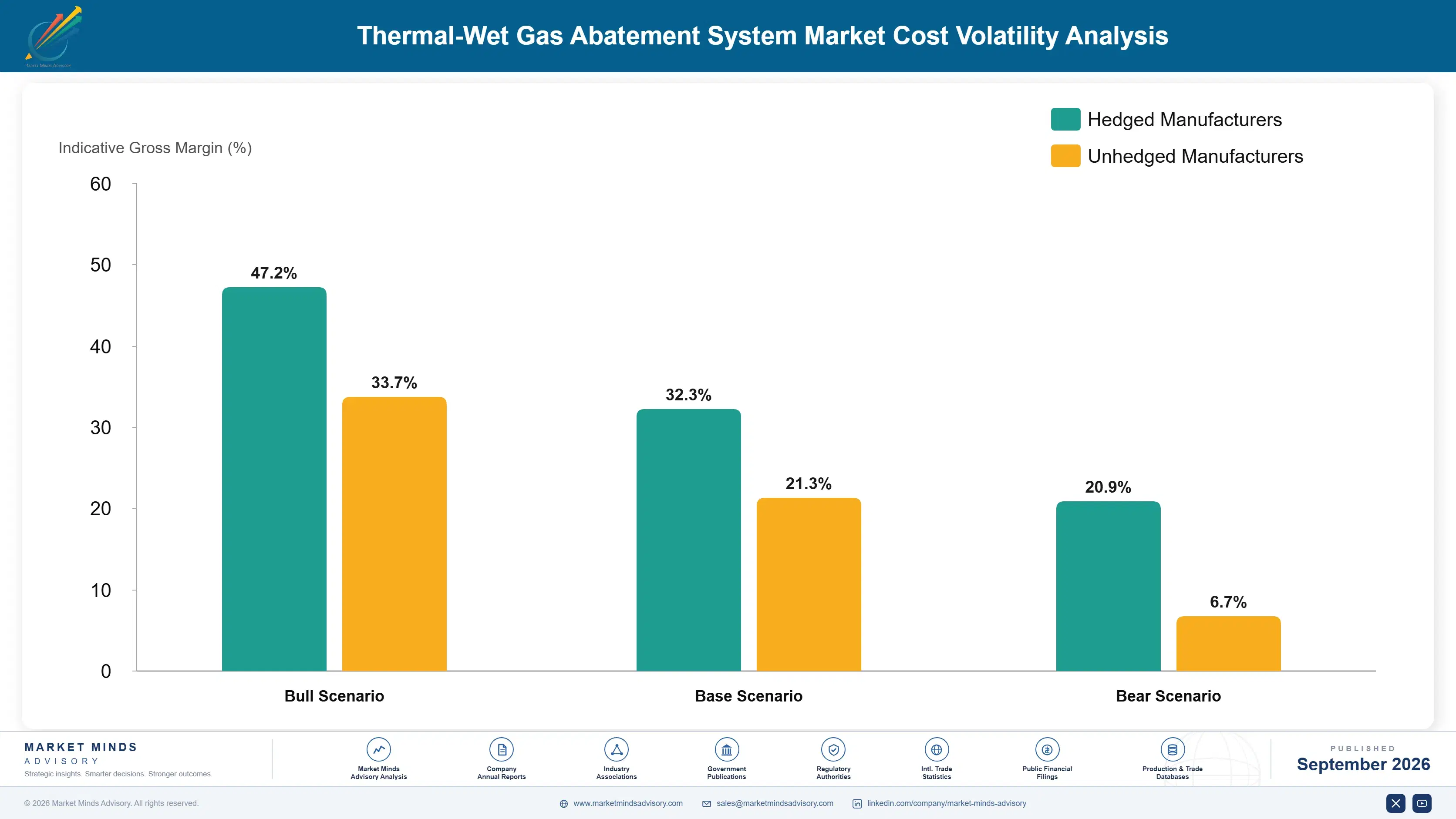
Input cost volatility and margin defence.

thermal-wet-gas-abatement-system-market-country-cagr-analysis-1788255361848

Portfolio Architecture for Margin Defence

Section default visual

End-use penetration and the annuity logic.

Section default visual

Four calls that define the decade.

These are among the four positions where our research anticipates prominent divergence between winners and laggards over the coming forecast period. Each is grounded in the demand model, the regulatory perimeter, and the announced capacity pipeline.

Engagement Snapshot From the Field

A live engagement with an industry participant carrying material or product regulatory and market exposure ahead of a defining policy shift, showing how our research translates into a defensible multi-year portfolio strategy.
MARKET MINDS ADVISORY · CLIENT ENGAGEMENT SUMMARY
Thermal-Wet Gas Abatement System Producer Strategic Portfolio Review and Transition Roadmap 2026·Investment Scenario on Thermal-Wet Gas Abatement System Exposure Evaluation 2025-26
CLIENT PROFILE
STRATEGIC CHALLENGE
MMA APPROACH
KEY FINDINGS
    CLIENT PROFILE
    STRATEGIC CHALLENGE
    MMA APPROACH
    KEY FINDINGS
      RECOMMENDED STRATEGY
      OUTCOME

      Frequently Asked Questions

      Foundational context covering the market sizes, CAGR, scope, country, region and competition that inform every finding below. This section is provided to cover basics and most often pre-purchase conversations, answered from the MMA Primary Research Dataset.

      Report Segmentation Architecture

      The full report scope spans multiple orthogonal segmentation dimensions, with cross-tabulated demand data provided for each dimension pair. Coverage extends further to regional breakdowns, trend trajectories, and the competitive detail needed to support segment-level decision-making.

      By Region

        Scope, Methodology, and Coverage

        Every figure in this report is reproducible from documented input assumptions. The scope below maps the historical period, the forecast horizon, the segmentation dimensions, and the countries covered, alongside the underlying primary and qualitative methodology.
        Historical Period
        2020 to 2025
        Forecast Period
        2026 to 2036
        Base Year
        2025 (USD billions; MMA Primary Research Dataset, September 2026)
        Market Definition
        This market covers thermal-wet gas abatement systems used to destroy and neutralize hazardous process gases exhausted from semiconductor fabrication equipment, combining thermal combustion with wet scrubbing in a single system. It excludes standalone dry scrubbers, plasma-only abatement units, and general facility exhaust ventilation equipment.
        Quantitative Units
        USD billions
        Segmentation Dimensions
        Regions Covered
        Countries Covered
        Key Companies Profiled
        Quantitative Methodology
        Primary survey, n=3,800 respondents, Q4 2025, six countries; demand-side model with trade association cross-validation
        Qualitative Methodology
        47 expert interviews, Q4 2025; applied to validate demand model assumptions, identify emerging dynamics, and assess competitive positioning
        Report Format
        PDF and XLSX data workbook (Word format preview document)
        Publisher
        Market Minds Advisory
        Report Code
        MMA-2026-TEC-146
        Published
        September 2026
        Contact
        sales@marketmindsadvisory.com | www.marketmindsadvisory.com

        Purchase the full Thermal-Wet Gas Abatement System Market Report (2026 to 2036).

        Built For The People Who Decide

        From boardroom strategy to bench-side execution, this report is read cover-to-cover by leaders shaping the next decade of their industry, turning demand scenarios, market dynamics and valuation benchmarks into decisions.
        CXOs/ Presidents/ VPs/ Managers
        M&A and Corporate Development
        Strategy Teams and R&D Heads
        Procurement and Product Directors
        Regulatory and Compliance Leaders
        Investor Relations and Equity Analysts