Market Minds Advisory
Thermal Management Market

Thermal Management Market: Thermal Management: No Longer an Efficiency Upgrade but a Precondition

Air handling stops working somewhere around thirty five kilowatts a rack, which means liquid cooling is not a saving anybody is buying but permission for the hardware to run at all.

Lead Analyst

Bilal Shaikh

Published

August 2026

Make Smarter Decisions with Customized Research Insights

Request a free sample report and evaluate market opportunities, growth trends, and competitive dynamics relevant to your business needs.

2025 MARKET VALUE$18.6BMarket Size 2025
2036 FORECAST VALUE$52.0BBase Case , 2026 to 2036
CAGR 2026 TO 20369.8 %Bull 11.0% / Bear 8.6%
INCREMENTAL OPPORTUNITY$31.6BNet 10- year value creation
EXPANSION MULTIPLE2.55x2036 value over 2026 base
Strategic Levers
M&A Pipeline
Regional Outlook
Country Rankings
Competitive Intelligence
Segmental Deep-dive
Call-Us : 91 93563 13602

Executive Snapshot and Market Trajectory.

Cooling stopped being an efficiency argument the moment rack power density passed what air can remove. Air handling fails somewhere around 35 kilowatts a rack, so liquid cooling is not a saving being sold to a reluctant buyer but the condition under which the hardware runs at all.
That inversion also creates a two tier installed base. Only about 18% of existing facilities can accept liquid cooling without substantial rebuilding, because floor loading, water distribution, coolant unit space and facility loops all have to exist beforehand. The rest cannot upgrade, which pushes demand into new build and strands considerable capacity. That constraint is civil and mechanical rather than electrical, and no product resolves it from inside the rack.
Underneath the systems argument sits an unglamorous one. Around 40% of thermal path resistance sits at the interface, and a bond line at 100 microns instead of 25 discards the performance a heat sink was specified to deliver. It is the cheapest place in the whole system to recover performance That is process control rather than materials specification, and almost nobody sells against it. Assembly variability decides what performance actually arrives at the customer.
Market Definition
Materials, components and systems removing heat from electronic and electrical equipment, covering air cooling hardware, thermal interface materials, liquid cooling systems, heat pipes and vapour chambers, thermal management substrates and housings, and phase change and advanced materials. Measured at supplier selling value. Excludes building heating and ventilation systems, industrial process cooling, refrigeration equipment, semiconductor packaging services, and facility construction or mechanical installation work.
Base Year Value
$18.6B in 2025 (MMA Primary Research Dataset, August 2026)
Forecast Period
2026 to 2036, eleven discrete annual values
CAGR
9.8% base case. Bull 11.0%. Bear 8.6%.
Fastest Growth Segment
Liquid Cooling Systems: 14.7% CAGR
Fastest Growth Country
Malaysia: 16.4% CAGR
Fastest Growth Region
South Asia and Pacific: 11.8% CAGR
Largest Region
East Asia: 30% of 2025 global value
Market Leaders
Vertiv, Boyd Corporation, Henkel, Parker Hannifin, Schneider Electric. Source: MMA Primary Research Dataset, July 2026.
Primary Survey
n=3,800 procurement and R&D decision-makers, Q4 2025, six countries
Methodology
Demand-side build-up, cross-validated against public data, 47 expert interviews

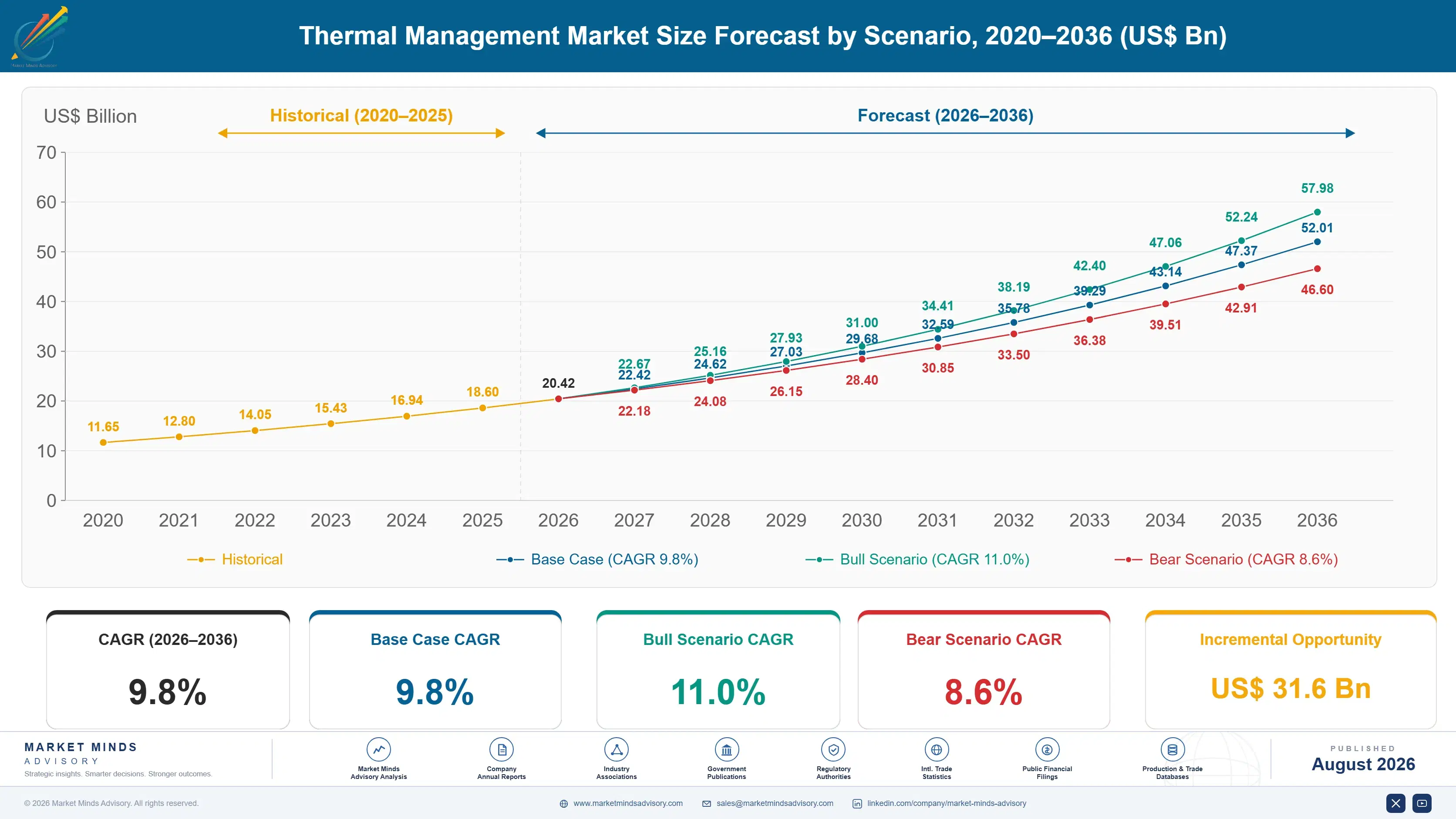
Thermal Management Market Forecast Scenarios

thermal-management-market-trends-size-forecast-scenario-1787639897233
Growth ran near 8.2% between 2020 and 2025, and the composition changed far more than the total did. Accelerated computing pushed rack densities beyond what air handling can remove, which converted liquid cooling from a specialist option into a requirement for a growing share of new deployments. Battery pack thermal design became a safety and warranty question rather than an efficiency one.
Base case 9.8% rests on three mechanisms. Liquid cooling grows at 14.7% because accelerated computing racks cannot operate on air at all above roughly 35 kilowatts. Heat pipes and vapour chambers grow at 11.6% as device and battery designs need heat moved before it can be rejected. And Malaysia grows fastest of any country at 16.4% on data centre construction and semiconductor packaging capacity arriving together. None of the three depends on efficiency arguments at all.
The bull case at 11.0% assumes accelerated computing deployment continuing at current pace, which would exhaust air cooled capacity faster than facilities can be built to replace it. The bear case at 8.6% is data centre construction constrained by power availability rather than by cooling, since a facility that cannot secure grid connection does not need a cooling system of any kind.

Permission to Deploy, Not a Saving

The commercial logic of this market inverted when computing density outran air. A rack drawing beyond roughly 35 kilowatts cannot be cooled by moving air through it at any reasonable expense. Liquid cooling stopped being an efficiency proposition sold against payback. It became the condition under which equipment operates, and a supplier now sells permission to deploy rather than savings.
TOP FIVE CONCENTRATION32%Systems, materials and components suppliers occupy quite different positions
AIR COOLING CEILING35 kWRack power density beyond which air handling stops working
BOND LINE TARGET25 micronsInterface layer needed to achieve rated heat transfer performance
BATTERY DEGRADATION THRESHOLD45 CCell temperature above which calendar life falls sharply
RETROFIT FEASIBLE FACILITIES18%Existing sites able to accept liquid cooling without substantial rebuilding
INTERFACE SHARE OF RESISTANCE40%Portion of the thermal path resistance sitting at the joint
That has produced a two tier installed base that nobody planned for. Around 18% of existing facilities can accept liquid cooling without substantial rebuilding, because floor loading, water distribution, coolant distribution unit space and facility water loops all have to be present before anything can be connected. The remainder cannot be upgraded economically, which forces demand into new build and strands capacity.
Underneath the systems argument sits a quieter one that receives far less attention. Around 40% of total thermal path resistance sits at the interface between component and heat sink, and a bond line applied at 100 microns rather than 25 discards most of the performance the heat sink was specified to provide. That is assembly process control rather than materials specification, and remarkably few suppliers compete on it.
"Everybody argues about heat sink performance and the heat is being lost in a paste layer that a machine applied badly at three in the morning. The interface is where specifications go to die, and it is the cheapest place in the whole system to recover performance."
Director, Electronics Thermal and Power Systems Practice · MMA Technology and Electronics Practice · August 2026

Market Trends

Rack density exhausting air cooling as a viable option

Accelerated computing has pushed rack power beyond roughly 35 kilowatts, which is where moving air through a cabinet stops removing heat at any reasonable cost or acoustic penalty. Liquid cooling grows at 14.7% because the alternative is not a less efficient deployment but no deployment at all. That converts the commercial argument from payback calculation into feasibility, and it changes who inside a customer organisation actually holds the decision on the specification. Facility engineering rather than equipment procurement now holds the decision, which most suppliers have not adjusted their commercial coverage to reflect.
Market Impact: Malaysia growing fastest at 16.4%
Retrofit infeasibility stranding a large installed base

Only around 18% of existing facilities can accept liquid cooling without substantial rebuilding, because floor loading, water distribution, coolant unit space and facility loops must all exist before any connection is possible. The remainder can host only air cooled equipment, which strands capacity as workloads move toward densities that capacity cannot serve. That constraint is civil and mechanical rather than electrical, and no cooling product resolves it from inside the rack. Demand therefore concentrates in new construction, and suppliers reaching design firms shape architecture that procurement teams later simply execute.
Market Impact: Life falls above 45 degrees

Market Opportunities and Growth Drivers

Data centre construction concentrating where power is available

Malaysia grows fastest of any country at 16.4% as data centre construction concentrates where grid connection, land and cooling water are all available together, alongside semiconductor packaging capacity arriving in the same region. New facilities are designed for liquid cooling from the outset rather than retrofitted afterwards. Suppliers tracking construction pipelines reach specification decisions during design, which is the only point at which cooling architecture is genuinely contestable. Construction pipelines are published years ahead and remarkably few suppliers track them systematically at all. Specification is genuinely contestable only during design, and nowhere afterwards.
Market Impact: Interface carries 40% of resistance

Battery pack thermal design becoming a warranty and safety question

Cell calendar life falls sharply above roughly 45 degrees and thermal runaway propagation is a safety requirement rather than a performance preference, which puts battery thermal management into pack architecture at design stage rather than into a component tender afterwards. Fast charging rejects considerable heat in a short period. Suppliers reaching vehicle platform design teams hold positions for the life of the platform, and those arriving later cannot displace them. Component merit cannot displace an incumbent once the pack has been designed around what is already specified. Arriving later means quoting into a decision already made.
Market Impact: Caps racks below 35 kilowatts

Market Restraints and Challenges

Interface application variability discarding specified performance

Around 40% of thermal path resistance sits at the component to heat sink interface, and bond line thickness applied at 100 microns rather than 25 loses most of what the heat sink was specified to deliver. The root cause is high volume assembly process variability rather than any materials shortcoming. Commercially it means specification improvements are frequently invisible in finished product. Application equipment, dispensing control and pre-applied interface formats are the mitigations that actually work. Conductivity improvements are frequently invisible in finished product. Materials science is not the binding constraint here at all.
Market Impact: Air fails beyond 35 kilowatts

Power availability constraining deployment before cooling does

A data centre that cannot secure grid connection does not need a cooling system, and power availability has become the binding constraint on construction across several major markets. The root cause is transmission capacity and interconnection queues rather than anything in the cooling chain. Commercially it caps demand regardless of how densely equipment could be packed. Siting where power exists and on-site generation are the responses operators are pursuing rather than any cooling solution. Interconnection queues have become the binding constraint on new capacity across several major markets, which caps demand however dense the equipment could theoretically be packed.
Market Impact: Only 18% can accept retrofit
4 additional market trends, 3 additional growth drivers, and 2 additional restraints and challenges are covered in the full report. Contact sales@marketmindsadvisory.com to access the complete intelligence.

Segment CAGR and Growth Architecture

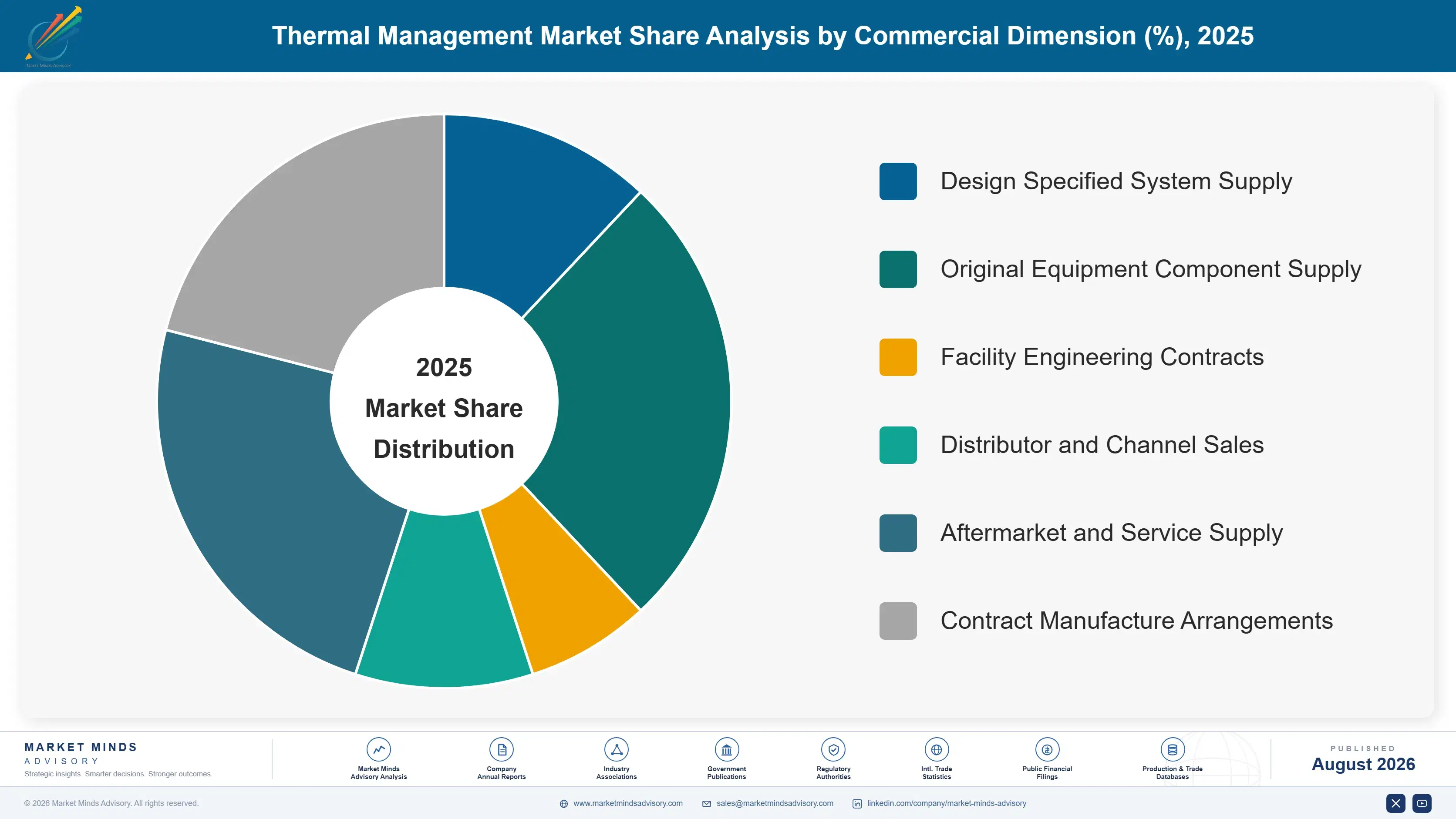
Six segments are split by cooling technology, because technology determines heat flux capability, the facility infrastructure required, the design stage at which it must be specified and the supplier capability needed. Format and capacity variants sit inside each technology. Application and channel are handled separately in the framework. Facility requirements follow the technology closely.
thermal-management-market-trends-market-share-analysis-1787639897791

Liquid Cooling Systems

Growing at 14.7%, half again the market rate of 9.8%, direct to chip and immersion liquid cooling remove heat at densities where air handling simply cannot function, which is anything beyond roughly 35 kilowatts a rack. The commercial argument is feasibility rather than payback, since the alternative is not deploying the hardware. Only around 18% of existing facilities can accept these systems without substantial rebuilding, which concentrates demand into new construction and makes design stage engagement the only route to specification. Procurement executes an architecture decided elsewhere, frequently years earlier and by a different organisation entirely. Facility engineering firms and construction designers hold that decision, which puts them years ahead of any procurement conversation.
CAGR 14.7%

Heat Pipes and Vapour Chambers

At 11.6% heat pipes and vapour chambers move heat away from a concentrated source before it can be rejected, which matters in devices and battery packs where the heat generating component sits nowhere near the surface available for rejection. They are passive, sealed and highly reliable, which suits applications where a pump or fan failure is unacceptable. Manufacturing is concentrated among Asian suppliers with wick structure and sealing capability that newer entrants find genuinely difficult to replicate. Reliability matters here because a sealed passive device has no pump or fan to fail, which suits applications where a cooling failure would be unacceptable rather than merely inconvenient. Wick structure and sealing capability keep the qualified field narrow.
CAGR 11.6%
Full segment breakdown across 6 segments available in the complete report.

Regional Architecture and Country Demand Map

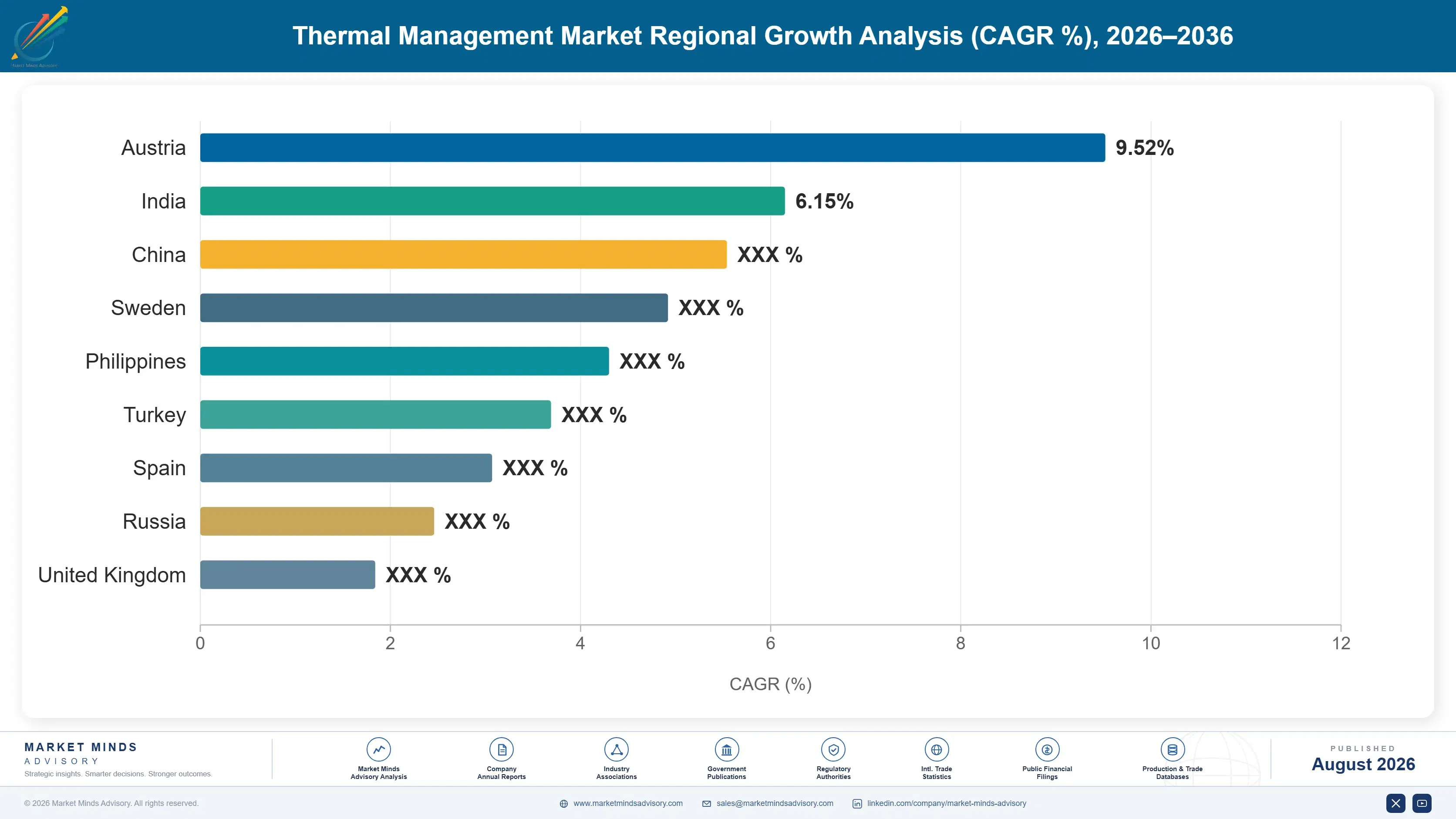
East Asia holds 30% of value on electronics manufacturing scale and component supply that no other region approaches. North America follows at 28% on data centre construction and accelerated computing deployment. South Asia and Pacific grows fastest of the seven regions covered here. Malaysia leads all countries covered.

North America

Accelerated computing deployment is heaviest here and has exhausted air cooled capacity faster than facilities can be built to replace it, which makes liquid cooling a construction question rather than a procurement one. Power availability and interconnection queues have become the binding constraint on new capacity in several markets. Automotive battery thermal design is concentrated with vehicle platform teams. Growth at 9.0% reflects deployment demand running well ahead of what grid connection permits in practice. Cooling capability stopped being the limiting factor once grid connection became one, which few suppliers have built into their own forecasting. Design stage engagement matters more here than anywhere, because construction volume is largest and architecture decisions correspondingly numerous.
Share: 28% | CAGR: 9.0% (2026 to 2036)

Western Europe

Data centre construction faces power availability and planning constraints more acutely than most regions, which caps deployment regardless of cooling capability. Energy efficiency regulation on facilities is the strictest anywhere and favours liquid cooling on heat reuse grounds as well as density. Automotive thermal management capability is strong and tied to European vehicle platform development. Growth of 8.2% is the slowest anywhere on construction constraints rather than any weakness in underlying demand. Heat reuse into district networks is a genuine driver here in a way it is nowhere else, and it favours liquid systems specifically. Suppliers with heat reuse capability hold an argument here that carries no weight at all in other regions.
Share: 18% | CAGR: 8.2% (2026 to 2036)
Regional intelligence for 5 additional markets available in the complete report: East Asia, South Asia and Pacific, Latin America, Middle East and Africa, Eastern Europe. Contact sales@marketmindsadvisory.com.
thermal-management-market-trends-country-cagr-analysis-1787639898316

Four Moves at Design Stage

Cooling architecture is fixed when a facility or a vehicle platform is designed, and almost nothing can be changed afterwards. What remains available is reaching design teams before the decision, recovering the performance lost at the interface, and following construction to wherever power actually exists. All four require reaching people procurement never introduces. Design teams decide everything.

Reach facility design before architecture is fixed

Only around 18% of existing facilities can accept liquid cooling without substantial rebuilding, which means cooling architecture is effectively decided when a building is designed rather than when equipment is procured. Suppliers reaching engineering and design teams during that phase shape specification, while those arriving at procurement are quoting against a decision already taken. Construction pipelines are public years ahead and remarkably few suppliers track them systematically. Following construction pipelines is a straightforward reallocation of commercial effort that very few suppliers have actually made. Design stage engagement is the only route to specification in new construction.
Market Impact: Reaches well beyond the 18% retrofittable installed base

Sell interface process control rather than material specification

Around 40% of thermal path resistance sits at the interface and a bond line at 100 microns instead of 25 discards most of a heat sink's rated performance, which makes application process the binding constraint rather than material properties. Dispensing control, pre-applied formats and application equipment address it directly. Suppliers competing on conductivity figures are improving a number that assembly variability routinely throws away in production. Application equipment and pre-applied formats cost far less than the performance they recover in production. Application equipment costs far less than the performance it recovers in production.
Market Impact: Recovers up to 40% of the thermal path resistance

Enter vehicle platform thermal design at architecture stage

Cell life falls sharply above roughly 45 degrees and runaway propagation is a safety requirement, which places battery thermal management inside pack architecture rather than in any component tender. Suppliers reaching platform design teams hold positions for the life of the vehicle programme, typically many years. Those arriving after architecture is frozen cannot displace an incumbent whatever the component merits, because the pack was designed around what is already there. Programme life is typically many years, which makes the position unusually durable once secured properly. Pack architecture is engineered around whatever cooling approach was specified first.
Market Impact: Protects cells operating safely below 45 degrees centigrade

Follow construction to where power is actually available

Data centre siting is now decided by grid connection, land and water rather than by proximity to demand, which is why Malaysia grows at 16.4% and established markets grow considerably more slowly. Suppliers organised around historic data centre geography are covering regions where construction has stalled on interconnection queues. Following power availability rather than existing customer concentration is a straightforward reallocation that few have made. Historic customer concentration is a poor guide to where capacity is now being built. Grid connection, land and cooling water now decide siting rather than proximity to demand does.
Market Impact: Follows 16.4% Malaysian data centre construction growth annually

Who Controls the Margin Pool

Participation is measured on annual revenue from thermal management materials, components and systems, and the top five hold 32%. Concentration is moderate because systems suppliers, materials formulators and component manufacturers occupy quite different positions with different customers. Vertiv and Boyd Corporation lead through systems capability and design engagement rather than through component manufacturing advantage. The gap to challengers differs entirely between segments. Basis is held consistently throughout the analysis.
Competition runs on three fronts. Design stage engagement decides facility and vehicle platform specification, which is where architecture is genuinely settled. Manufacturing scale decides component supply, where Asian producers hold clear cost positions. And application support decides whether interface materials deliver their specified performance in actual production. Power availability has become a fourth constraint that no supplier influences and every supplier shares. Each front rewards a different capability entirely.

Pressure ahead comes from liquid cooling displacing air in new construction and from power availability constraining deployment overall. Expect systems suppliers with design capability to gain against component vendors. Rankings shift on who reaches the facility engineering firms designing capacity that does not exist yet. Concentration should stay moderate given segment differences. Component vendors without design capability look most exposed.
thermal-management-market-trends-company-positioning-matrix-1787639898839

Competitive Moat and Risk Dimensions

VERTIV

Moat: Facility systems and design engagement

Facility level cooling systems combined with engagement during data centre design reaches the point where cooling architecture is actually decided, rather than competing for equipment supply after a building's mechanical design has fixed what is possible. That design relationship is difficult to displace because the facility was engineered around the approach that supplier proposed.
VERTIV

Risk: Power constrained construction exposure

Demand depends on data centre construction, which is increasingly limited by grid interconnection queues rather than by anything in the cooling chain, and a facility that cannot secure power never needs a system at all. That exposure is entirely outside the company's influence and affects every supplier serving the same construction pipeline simultaneously.
BOYD CORPORATION

Moat: Materials and component integration breadth

Combining interface materials, heat pipes, cold plates and engineered components lets the business supply a complete thermal solution rather than one element, which matters when the interface between parts carries a large share of total resistance. That breadth also positions it inside design conversations that a single component supplier cannot readily enter.
BOYD CORPORATION

Risk: Asian component cost competition

Heat pipe, vapour chamber and fan manufacture is concentrated among Asian suppliers with cost positions that no western manufacturer approaches, which puts commodity component volume under continuous pressure. Defending it requires engineering content that a customer will pay for, and that content is difficult to demonstrate on standard parts.

Players Tracked

Prominent Players

Vertiv
Boyd Corporation
Henkel
Parker Hannifin
Schneider Electric

Other Key Players

LiquidStack
CoolIT Systems
Asetek
Laird Performance Materials
Shin-Etsu Chemical
Dow
3M
Fujipoly
Delta Electronics
Sunon
AVC
Auras Technology
Nidec
Modine Manufacturing
Dana Incorporated

Recent Developments

MARCH 2026

Operator designs new facility for liquid cooling from the outset

A data centre operator designed a new facility for direct to chip liquid cooling from the beginning rather than retrofitting later, after concluding that existing air cooled capacity could not host the accelerated computing workloads it had already contracted. Existing air cooled halls were left for older workloads.
Signal: Cooling architecture is decided at the building design stage and cannot be revisited afterwards by anyone
SEPTEMBER 2025

Assembly audit finds interface bond lines far above specification

A manufacturing audit found thermal interface bond line thickness routinely exceeding specification across a high volume assembly line, discarding a substantial share of the heat sink performance the design had been validated against. Dispensing control had drifted without anybody noticing. Validation data no longer matched production.
Signal: Interface application variability quietly removes the thermal performance that the original specification had promised buyers in production
JANUARY 2026

Interconnection queue delays data centre despite cooling readiness

A planned data centre was delayed by grid interconnection scheduling rather than by any construction or cooling constraint, confirming that power availability now limits deployment more tightly than thermal capability does in several markets. Cooling equipment was already contracted. Construction had otherwise been ready to proceed on schedule.
Signal: Cooling capability stopped being the real constraint on deployment once grid connection became one instead entirely

Copper, Aluminium and Engineering

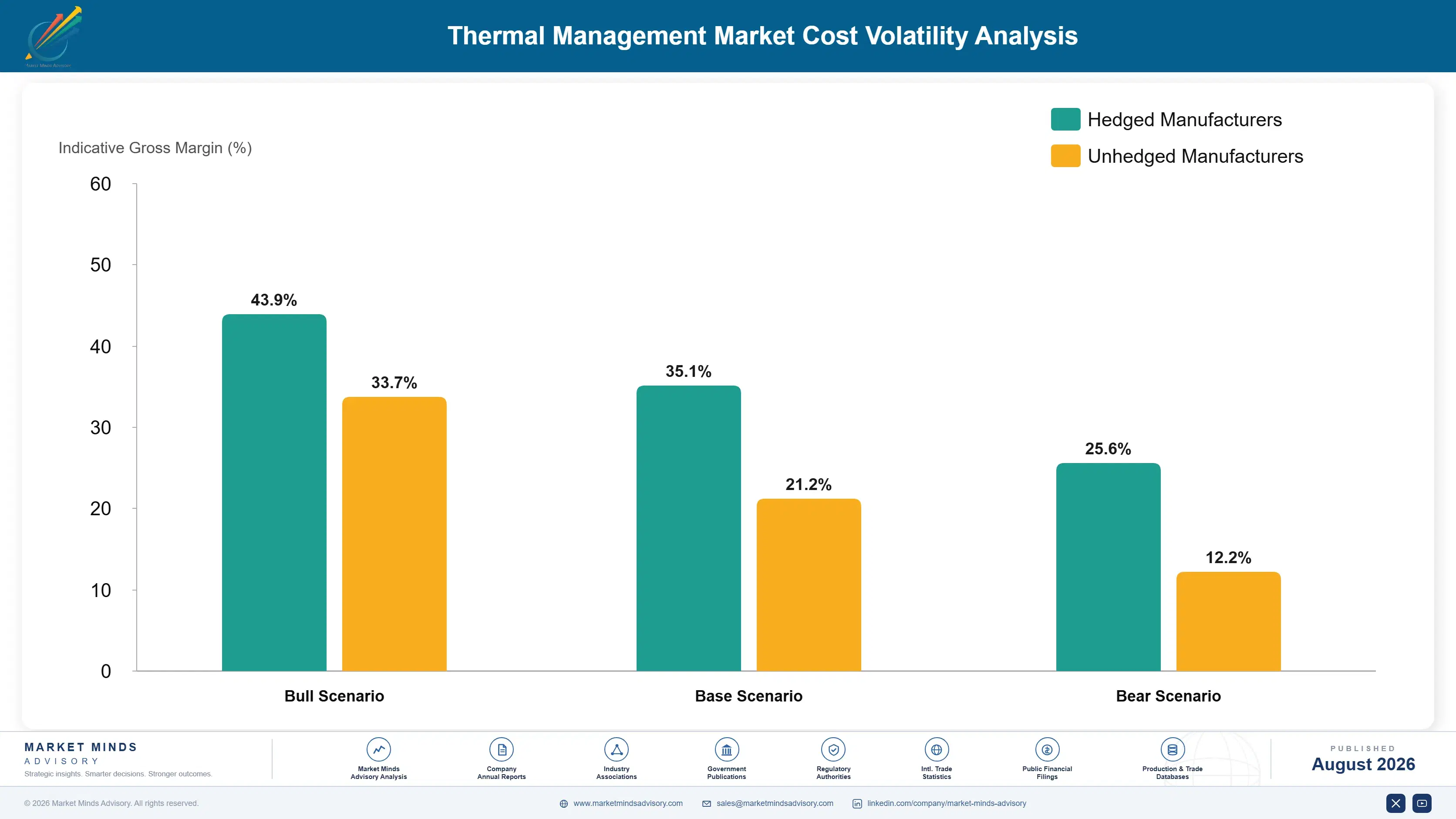
Copper carries around 27% of heat pipe, cold plate and vapour chamber cost, priced on metal exchanges no supplier influences. Aluminium takes about 19% across heat sinks, housings and extruded components. Silicone, filler and polymer chemistry account for around 16% of interface material cost. Pumps, coolant distribution equipment, engineering design and installation support absorb the balance across systems suppliers.
Copper and aluminium pricing both moved sharply across recent years alongside energy costs, per published metals market reporting and Vertiv and Boyd Corporation annual reporting for 2025 on materials cost commentary. Component manufacturers absorbed those movements while systems suppliers passed considerably more through, because a facility level contract carries engineering content that a commodity component contract does not. Indexation has become considerably more common in component agreements since.

Exposure divides on product type rather than on scale. A heat pipe or cold plate manufacturer carries copper across more than a quarter of cost with limited substitution available. An interface material formulator carries silicone and filler chemistry moving on quite different drivers. A systems supplier carries pumps, distribution equipment and engineering labour, which is a more diverse and considerably more manageable exposure than either component position.
thermal-management-market-trends-cost-volatility-analysis-1787639899033

Index metal exposure into component supply agreements

Copper and aluminium together carry close to half of component manufacturing cost and move on exchanges no supplier influences at all. Indexation clauses shift that exposure to where it originates, and customers accustomed to metal indexed pricing in other component categories generally accept the mechanism once it is set out clearly for them. Customers accept it readily.

Shift revenue toward engineering content and systems supply

Commodity components compete against Asian manufacturing cost positions that western suppliers cannot match, while systems and engineering content carries pricing that reflects design capability rather than material weight. Moving mix reduces metal exposure and improves margin at the same time, which is unusual and worth pursuing deliberately. Margin and exposure improve together. Mix change is worth pursuing deliberately.

Design interface materials for application rather than conductivity

Bond line thickness variability discards more performance than any conductivity difference recovers, so materials designed for reliable application, including pre-applied and phase change formats, deliver more real world performance per unit cost. That reframes development spending from a specification race toward a manufacturing problem worth solving. Real performance is what customers experience. Development spending shifts accordingly.

Portfolio Architecture for Margin Defence

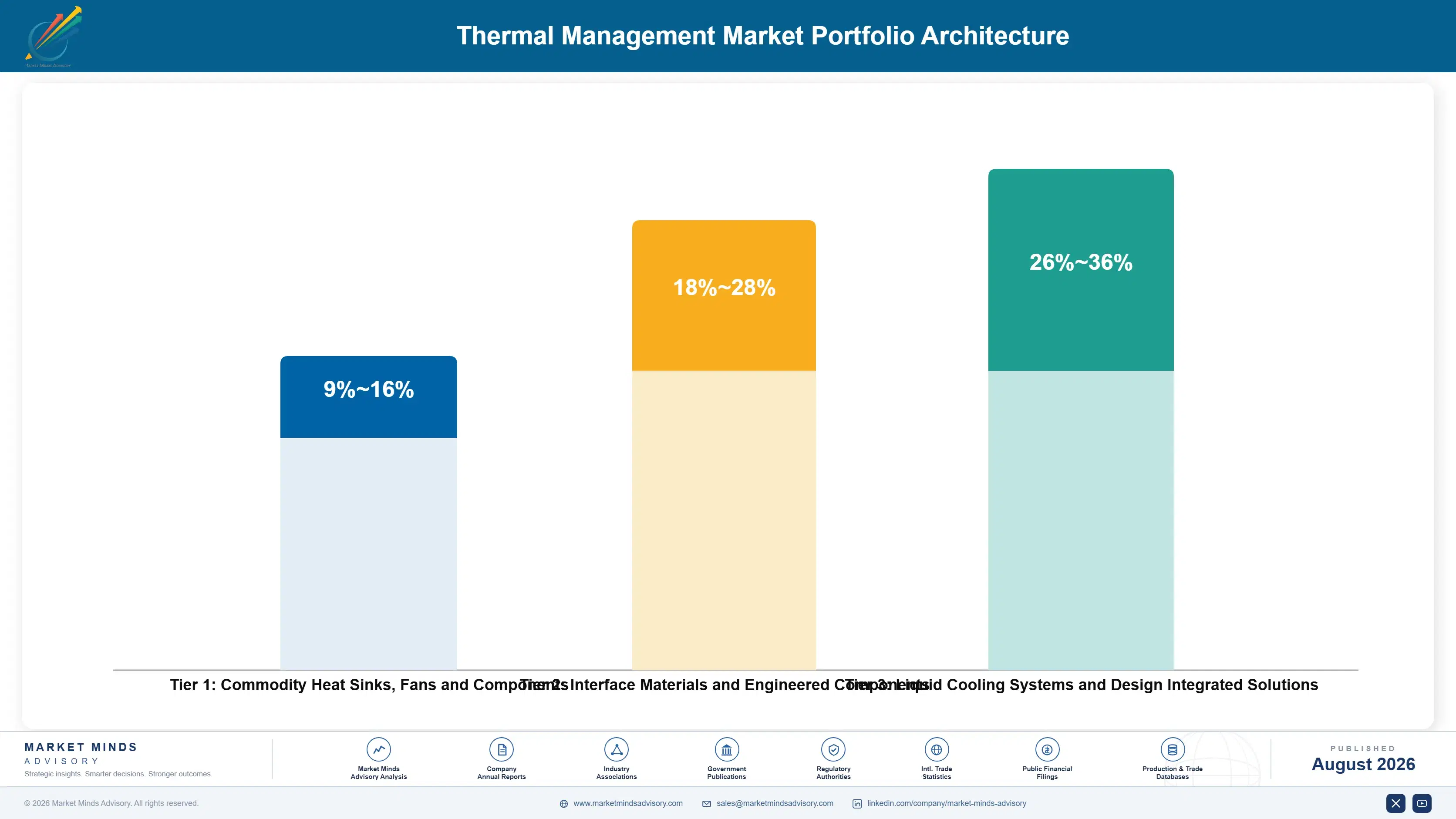
Margin here follows engineering content rather than thermal performance, because a component sold against a drawing competes on cost while a system designed into a facility competes on nothing at all. Commodity heat sinks, fans and standard components earn margins in the high single digits to mid teens, where Asian manufacturing sets pricing and specifications are met identically by many suppliers. Nothing distinguishes one supplier from another there.
Interface materials and engineered components do better in the high teens to high twenties, because formulation, qualification and application support all narrow the field, though conductivity claims are frequently undone by assembly variability that the supplier does not control. Assembly variability the supplier does not control routinely undoes conductivity claims in production. Support content separates suppliers more than formulation does.

Liquid cooling systems and design integrated solutions hold the strongest position, reaching into the mid thirties, where architecture is decided with the supplier present and the facility is engineered around the approach. Those margins reflect design engagement and engineering capability rather than any advantage in component manufacturing cost. Changing later means rebuilding rather than reprocuring, which protects the position completely. Component manufacturing cost advantage is largely irrelevant at this level.

Commodity Heat Sinks, Fans and Components

Standard parts supplied against drawings where Asian manufacturing sets the price. The seven point range reflects metal cost position and manufacturing scale rather than any performance difference between suppliers. Volume is the only real lever.
Gross Margin: 9-16%

Interface Materials and Engineered Components

Formulated materials and engineered parts requiring qualification and application support. The ten point range reflects formulation capability and how much application support the supplier provides in production. Qualification narrows the field considerably here.
Gross Margin: 18-28%

Liquid Cooling Systems and Design Integrated Solutions

Facility and platform systems specified during design with engineering content attached. The ten point range reflects design engagement depth and whether the architecture was built around the supplier's approach. Displacement means rebuilding rather than reprocuring.
Gross Margin: 26-36%
thermal-management-market-trends-portfolio-architecture-1787639899539

High-value Sub-segments and Strategic Watch-out

Liquid Cooling Systems

High value and the fastest growth at 14.7%, sold as feasibility rather than payback because air handling fails beyond roughly 35 kilowatts a rack and the alternative is not deploying at all. Design engagement decides who supplies it. Only new construction can host it properly.
Gross Margin: 28-36%

Heat Pipes and Vapour Chambers

High value and growing at 11.6% as devices and battery packs need heat moved before rejection. Wick structure and sealing capability keep the qualified manufacturing field genuinely narrow. Passive reliability matters where failure is unacceptable. Asian manufacturers hold the qualified capacity almost entirely. Entry is genuinely difficult.
Gross Margin: 20-28%

Commodity Air Cooling Components

The volume core, supplied against drawings where Asian manufacturing sets pricing and the installed base that uses it cannot host the densities workloads are moving toward. Standard parts are genuinely interchangeable between manufacturers. Asian cost positions set the price everywhere. Margins compress steadily. Density limits constrain it.
Gross Margin: 9-16%

Interface Application Exposure

The strategic watch-out. Around 40% of thermal resistance sits at the joint, and the range reflects whether a supplier addresses application process or continues competing on conductivity figures. Process control rather than materials science solves it. Conductivity competition misses the binding constraint entirely here. Process control resolves it.
Gross Margin: 7-34%

Decided at Design Freeze

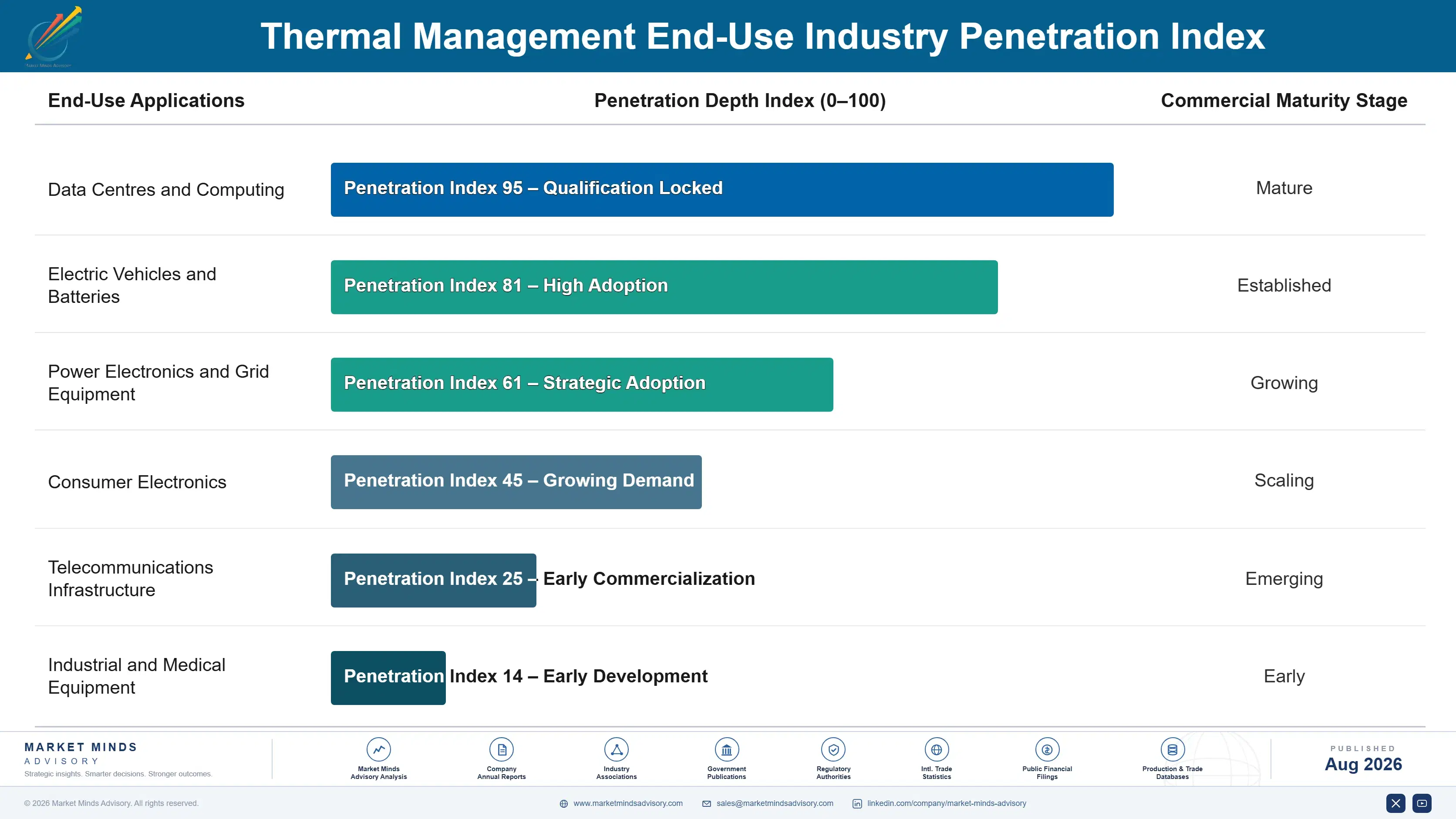
Demand here is settled long before any purchase order exists. A data centre's cooling architecture is fixed when the building is designed, because floor loading, water distribution and plant space either exist or they do not. A vehicle platform's battery thermal approach is fixed at design freeze. Neither can be revisited afterwards, which makes procurement an execution function rather than a decision one. Architecture is the decision. Purchase orders record it rather than making it.
Stickiness follows that architecture completely. A facility engineered around one cooling approach keeps it for the building's operating life, since changing means rebuilding rather than reprocuring. A vehicle platform keeps its thermal supplier for the programme life. Commodity component supply reopens constantly, because standard parts against a drawing are genuinely interchangeable between manufacturers.

The deciding functions sit further upstream than most suppliers reach. Facility engineering firms and construction designers decide data centre cooling architecture. Vehicle platform engineering decides battery thermal approach. Procurement executes both. A supplier organised around purchasing relationships is talking to people implementing choices made by others, frequently years earlier and in a different building. Most suppliers never meet them. Coverage built on purchasing relationships misses the decision.
thermal-management-market-trends-end-use-penetration-index-1787639900030

Where We Would Put Effort

These are among the four positions where our research anticipates prominent divergence between winners and laggards over the coming forecast period. Each is grounded in the demand model, the regulatory perimeter, and the announced capacity pipeline.
01 / DESIGN STAGE ENGAGEMENT

The building decides, not the buyer

Only around 18% of existing facilities can accept liquid cooling without substantial rebuilding, because floor loading, water distribution and plant space have to exist before anything connects. Cooling architecture is therefore settled when a building is designed rather than when equipment is procured by anybody. Suppliers reaching engineering and design firms during that phase shape the specification directly, while those arriving at procurement are quoting against a decision that somebody else took years earlier in a different organisation entirely, and no commercial effort recovers it.
02 / INTERFACE PROCESS CONTROL

Performance dies in the paste layer

Around 40% of total thermal path resistance sits at the component interface, and a bond line applied at 100 microns rather than 25 discards most of the performance a heat sink was specified and validated to deliver. The binding constraint is assembly process variability rather than material conductivity. Dispensing control, application equipment and pre-applied interface formats all address that variability directly, and remarkably few suppliers compete on the one thing that actually determines what performance a customer receives in production.
03 / PLATFORM ARCHITECTURE ENTRY

Battery packs are designed around the cooling

Cell calendar life falls sharply above roughly 45 degrees and thermal runaway propagation is a safety requirement rather than a performance preference, which puts battery thermal management inside pack architecture at design freeze. Suppliers reaching vehicle platform engineering teams during that phase hold their positions for the whole programme life, which typically runs to many years. Those arriving after design freeze cannot displace an incumbent on component merit alone, because the entire pack architecture was engineered around whatever cooling approach was already specified for it.
04 / CONSTRUCTION GEOGRAPHY FOLLOWING

Go where the grid connection exists

Data centre siting is now decided by grid connection, land and cooling water availability rather than by proximity to demand, which is why Malaysia grows fastest of any country at 16.4% while established markets grow considerably more slowly. Suppliers still organised around historic data centre geography are covering regions where construction has largely stalled in grid interconnection queues. Following power availability rather than existing customer concentration is a straightforward reallocation of commercial effort that remarkably few suppliers have actually made yet.

Engagement Snapshot From the Field

A live engagement with an industry participant carrying material or product regulatory and market exposure ahead of a defining policy shift, showing how our research translates into a defensible multi-year portfolio strategy.
MARKET MINDS ADVISORY · CLIENT ENGAGEMENT SUMMARY
Thermal Management Producer Strategic Portfolio Review and Transition Roadmap 2026·Investment Scenario on Thermal Management Exposure Evaluation 2025-26
CLIENT PROFILE
A thermal components manufacturer supplying heat sinks, fans and interface materials to electronics and data centre equipment makers across European and North American markets, at annual revenue near 240 million dollars (client-reported, unverified by MMA). Systems capability was absent and commercial effort ran through procurement relationships. Design firm relationships were absent. Liquid cooling opportunities were reaching the business only after tenders had issued.
STRATEGIC CHALLENGE
Commodity component margins had been compressing against Asian manufacturing for years, and the business was being excluded from liquid cooling opportunities it discovered only when equipment tenders were already issued. Management wanted to know whether to compete on cost or change what it was selling. A strategy decision was pending.
MMA APPROACH
MMA traced how cooling architecture was actually decided across the client's target facilities, measured interface bond line variability at customer assembly lines, mapped data centre construction pipelines against the client's commercial coverage, and assessed the engineering capability required for systems supply. Interviews with 47 experts covered data centre engineering, electronics assembly and battery thermal design.
KEY FINDINGS
  1. Cooling architecture at every facility examined had been fixed during building design by engineering firms the client had no relationship with and had never contacted.
  2. Interface bond line thickness at customer assembly lines routinely exceeded specification, discarding heat sink performance the client had spent development money achieving in the first place.
  3. Construction pipelines had shifted toward regions selected for power availability, and the client's commercial coverage still followed historic data centre geography almost exactly.
  4. Systems supply carried engineering content and margins several times commodity component levels, and required capability the client could assemble through partnership rather than acquisition.
CLIENT PROFILE
A thermal components manufacturer supplying heat sinks, fans and interface materials to electronics and data centre equipment makers across European and North American markets, at annual revenue near 240 million dollars (client-reported, unverified by MMA). Systems capability was absent and commercial effort ran through procurement relationships. Design firm relationships were absent. Liquid cooling opportunities were reaching the business only after tenders had issued.
STRATEGIC CHALLENGE
Commodity component margins had been compressing against Asian manufacturing for years, and the business was being excluded from liquid cooling opportunities it discovered only when equipment tenders were already issued. Management wanted to know whether to compete on cost or change what it was selling. A strategy decision was pending.
MMA APPROACH
MMA traced how cooling architecture was actually decided across the client's target facilities, measured interface bond line variability at customer assembly lines, mapped data centre construction pipelines against the client's commercial coverage, and assessed the engineering capability required for systems supply. Interviews with 47 experts covered data centre engineering, electronics assembly and battery thermal design.
KEY FINDINGS
  1. Cooling architecture at every facility examined had been fixed during building design by engineering firms the client had no relationship with and had never contacted.
  2. Interface bond line thickness at customer assembly lines routinely exceeded specification, discarding heat sink performance the client had spent development money achieving in the first place.
  3. Construction pipelines had shifted toward regions selected for power availability, and the client's commercial coverage still followed historic data centre geography almost exactly.
  4. Systems supply carried engineering content and margins several times commodity component levels, and required capability the client could assemble through partnership rather than acquisition.
RECOMMENDED STRATEGY
Phase 1: Phase one: build relationships with facility engineering and design firms, since cooling architecture is decided there rather than in any procurement conversation. Phase 2: Phase two: sell interface application control rather than conductivity, because assembly variability discards the performance the specification promised. Application equipment costs less than the performance it recovers. Phase 3: Phase three: reallocate commercial coverage toward construction pipelines wherever power availability has moved them. Historic geography is now a poor guide to where capacity is built.
OUTCOME
The manufacturer established design firm relationships during 2026 and introduced application support alongside interface material supply (client-reported, unverified by MMA). Commercial coverage was reallocated toward active construction regions, and a systems partnership was signed for the following year. Commodity component promotion was reduced. Systems capability arrived through partnership rather than acquisition.

Frequently Asked Questions

Foundational context covering the market sizes, CAGR, scope, country, region and competition that inform every finding below. This section is provided to cover basics and most often pre-purchase conversations, answered from the MMA Primary Research Dataset.

What is the current size of the Thermal Management Market?

MMA sizes it at USD 18.6 billion in 2025, rising to USD 20.42 billion in 2026. The figure covers materials, components and systems removing heat from electronic equipment at supplier selling value.

How large will the Thermal Management Market be by 2036?

USD 52.01 billion by 2036, an incremental USD 31.59 billion over the 2026 base and an expansion multiple of 2.55 times. Liquid cooling accounts for a disproportionate share of that.

What is the CAGR for the Thermal Management Market 2026 to 2036?

9.8% in the base case, with a bull case at 11.0% and a bear case at 8.6%. The spread turns largely on whether power availability constrains data centre construction further.

Which segment is growing fastest?

Liquid cooling systems at 14.7%, half again the market rate of 9.8%. Air handling fails beyond roughly 35 kilowatts a rack, which makes liquid a precondition rather than an upgrade.

Who are the major companies in the Thermal Management Market?

Vertiv, Boyd Corporation, Henkel, Parker Hannifin and Schneider Electric lead on thermal management revenue. Fifteen further participants are profiled in the full report on the same consistent basis throughout.

Which country is growing fastest?

Malaysia at 16.4%, as data centre construction concentrates where grid connection, land and cooling water are available together alongside semiconductor packaging capacity arriving in the same region at the same time.

Report Segmentation Architecture

The full report scope spans multiple orthogonal segmentation dimensions, with cross-tabulated demand data provided for each dimension pair. Coverage extends further to regional breakdowns, trend trajectories, and the competitive detail needed to support segment-level decision-making.

By Cooling Technology

  • Air Cooling Hardware
  • Thermal Interface Materials
  • Liquid Cooling Systems
  • Heat Pipes and Vapour Chambers
  • Thermal Management Substrates and Housings
  • Phase Change and Advanced Materials

By End-Use Industry

  • Data Centres and Computing
  • Electric Vehicles and Batteries
  • Power Electronics and Grid Equipment
  • Consumer Electronics
  • Telecommunications Infrastructure
  • Industrial and Medical Equipment

By Commercial Dimension

  • Design Specified System Supply
  • Original Equipment Component Supply
  • Facility Engineering Contracts
  • Distributor and Channel Sales
  • Aftermarket and Service Supply
  • Contract Manufacture Arrangements

By Region

  • North America
  • Western Europe
  • East Asia
  • South Asia and Pacific
  • Latin America
  • Middle East and Africa
  • Eastern Europe

Scope, Methodology, and Coverage

Every figure in this report is reproducible from documented input assumptions. The scope below maps the historical period, the forecast horizon, the segmentation dimensions, and the countries covered, alongside the underlying primary and qualitative methodology.
Historical Period
2020 to 2025
Forecast Period
2026 to 2036
Base Year
2025 (USD billions; MMA Primary Research Dataset, August 2026)
Market Definition
Materials, components and systems removing heat from electronic and electrical equipment, covering air cooling hardware, thermal interface materials, liquid cooling systems, heat pipes and vapour chambers, thermal management substrates and housings, and phase change and advanced materials. Measured at supplier selling value. Building heating and ventilation systems, industrial process cooling, refrigeration equipment, semiconductor packaging services, and facility construction or mechanical installation work are excluded from scope.
Quantitative Units
USD billions (current prices); units and system capacity shipped; USD per unit by technology
Segmentation Dimensions
Cooling technology; end-use industry; commercial dimension; region
Regions Covered
North America, Western Europe, East Asia, South Asia and Pacific, Latin America, Middle East and Africa, Eastern Europe
Countries Covered
United States, Canada, Mexico, Germany, Netherlands, Ireland, United Kingdom, France, China, Japan, South Korea, Taiwan, India, Malaysia, Singapore, Australia, Brazil, Chile, Saudi Arabia, Poland
Key Companies Profiled
Vertiv, Boyd Corporation, Henkel, Parker Hannifin, Schneider Electric, LiquidStack, CoolIT Systems, Asetek, Laird Performance Materials, Shin-Etsu Chemical, Dow, 3M, Fujipoly, Delta Electronics, Sunon, AVC, Auras Technology, Nidec, Modine Manufacturing, Dana Incorporated
Quantitative Methodology
Primary survey, n=3,800 respondents, Q4 2025, six countries; demand-side model with trade association cross-validation
Qualitative Methodology
47 expert interviews, Q4 2025; applied to validate demand model assumptions, identify emerging dynamics, and assess competitive positioning
Report Format
PDF and XLSX data workbook (Word format preview document)
Publisher
Market Minds Advisory
Report Code
MMA-2026-TEC-119
Published
August 2026
Contact
sales@marketmindsadvisory.com | www.marketmindsadvisory.com

Purchase the full Thermal Management Market Report (2026 to 2036).

The full report treats cooling as a deployment precondition rather than an efficiency choice, because rack densities have passed what air can remove and the commercial logic inverted with them. It sizes all six technologies independently through 2036, quantifies retrofit feasibility across the installed facility base, and models interface application variability against specified performance. Regional chapters cover all seven regions with construction pipelines assessed against power availability. Competitive profiling covers 20 participants on one consistent revenue basis throughout. Design decision routes are mapped by application throughout.
Six cooling technologies sized independently through 2036
Retrofit feasibility quantified across the installed facility base
Interface application variability measured against specified thermal performance
Construction pipelines assessed against grid interconnection availability by region
Battery thermal architecture decisions tracked by vehicle platform
Twenty participants profiled on one consistent revenue basis

Built For The People Who Decide

From boardroom strategy to bench-side execution, this report is read cover-to-cover by leaders shaping the next decade of their industry, turning demand scenarios, market dynamics and valuation benchmarks into decisions.
CXOs/ Presidents/ VPs/ Managers
M&A and Corporate Development
Strategy Teams and R&D Heads
Procurement and Product Directors
Regulatory and Compliance Leaders
Investor Relations and Equity Analysts