

Market Minds Advisory
Thermal Energy Harvesting Market

Thermal Energy Harvesting Market: Thermal Energy Harvesting Market. Thermoelectric, Pyroelectric, and Thermomagnetic Generators for Industrial IoT, 2026 to 2036

Wireless sensor networks are outgrowing battery replacement schedules field technicians cannot keep up with, pushing industrial operators toward thermoelectric and pyroelectric generators that scavenge waste heat directly from equipment already running on factory floors.

Lead Analyst

Published

September 2026

Make Smarter Decisions with Customized Research Insights

Request a free sample report and evaluate market opportunities, growth trends, and competitive dynamics relevant to your business needs.

2025 MARKET VALUE$0.9BMarket Size 2025
2036 FORECAST VALUE$3.6BBase Case , 2026 to 2036
CAGR 2026 TO 203613.5 %Bull 14.8% / Bear 12.2%
INCREMENTAL OPPORTUNITY$2.6BNet 10- year value creation
EXPANSION MULTIPLE3.55x2036 value over 2026 base
Strategic Levers
M&A Pipeline
Regional Outlook
Country Rankings
Competitive Intelligence
Segmental Deep-dive
Call-Us : 91 93563 13602

Executive Snapshot and Market Trajectory.

Industrial operators deploying thousands of wireless sensors are discovering that battery replacement labor cost now exceeds the sensors' own hardware cost, making thermal energy harvesting the difference between a maintenance program that scales and one that collapses entirely under its own mounting logistics across a large industrial facility.
Thermoelectric generators still dominate installed volume, but pyroelectric and thermomagnetic technologies are gaining ground rapidly in applications with fluctuating rather than steady-state heat sources, since thermoelectric conversion efficiency drops sharply without a consistent temperature gradient sustained across the module over time. German and Japanese materials manufacturers lead module efficiency improvements, concentrating early commercial deployment disproportionately in advanced manufacturing hubs building out dense industrial IoT sensor networks across multiple production sites and facilities.
Competitive intensity is rising as established thermoelectric material suppliers face pressure from smaller specialized firms commercializing pyroelectric and thermomagnetic alternatives, while industrial IoT platform vendors increasingly specify harvesting compatibility as a procurement requirement rather than a nice-to-have feature, a shift that has accelerated meaningfully since major smart factory standards bodies updated sensor power guidance in 2024, forcing even conservative buyers to finally reconsider battery-only designs.
Market Definition
The Thermal Energy Harvesting Market covers thermoelectric, pyroelectric, and thermomagnetic generator modules that convert ambient or waste heat into usable electrical power for wireless sensors and low-power electronics. It excludes large-scale waste heat recovery power plants, solar thermal generation, and battery storage systems unrelated to direct thermal-to-electric conversion.
Base Year Value
$0.9B in 2025 (MMA Primary Research Dataset, September 2026)
Forecast Period
2026 to 2036, eleven discrete annual values
CAGR
13.5% base case. Bull 14.8%. Bear 12.2%.
Fastest Growth Segment
Thermomagnetic Generators: 17.0% CAGR
Fastest Growth Country
Germany: 17.5% CAGR
Fastest Growth Region
South Asia and Pacific: 15.5% CAGR
Largest Region
East Asia: 30% of 2025 global value
Market Leaders
Ferrotec, Laird Thermal Systems, II-VI (Coherent), TEGnology, and Evident Thermoelectrics lead by module shipment volume. Source: MMA Primary Research Dataset, July 2026.
Primary Survey
n=3,800 procurement and R&D decision-makers, Q4 2025, six countries
Methodology
Demand-side build-up, cross-validated against public data, 47 expert interviews

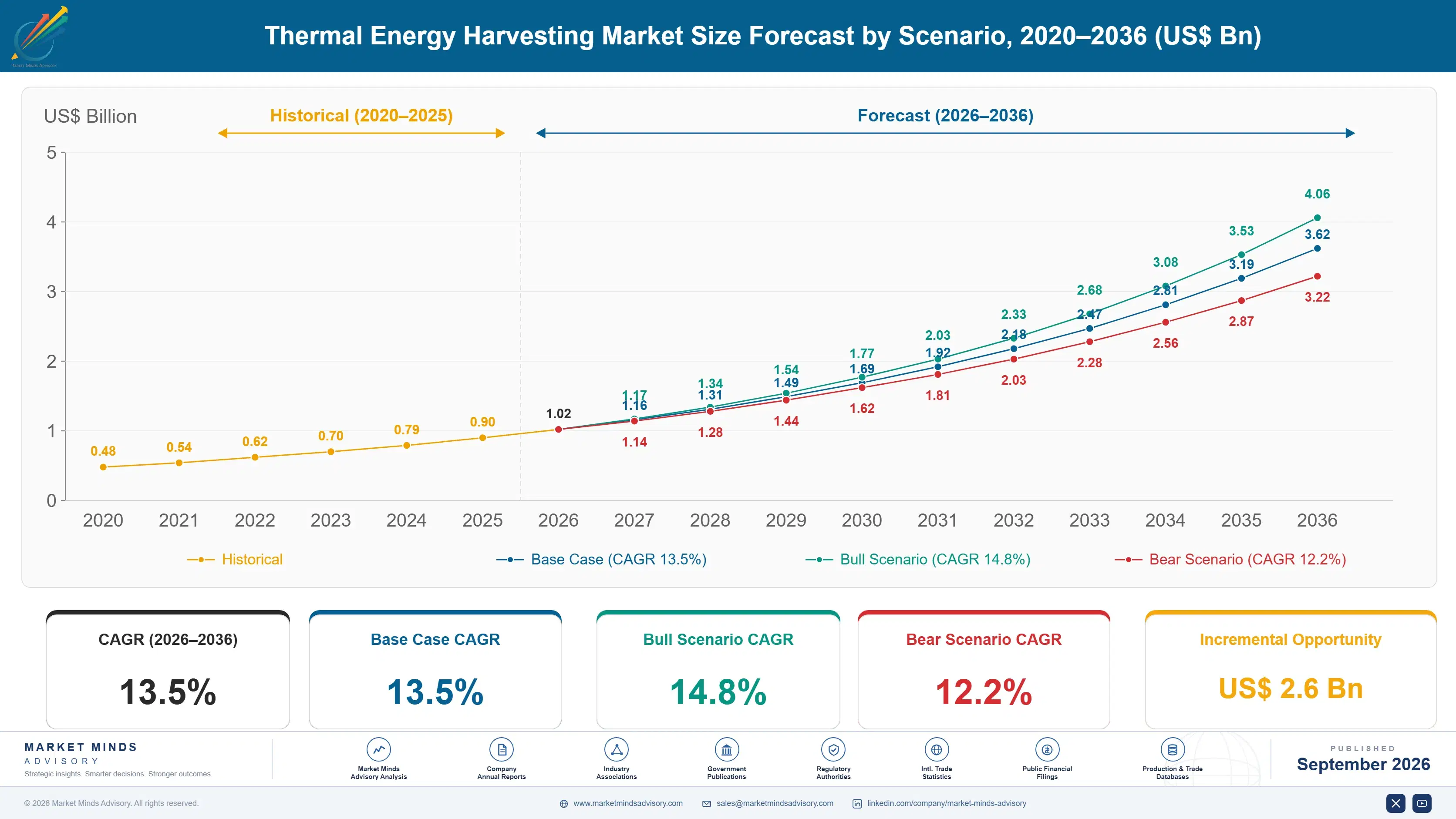
Thermal Energy Harvesting Market Forecast Scenarios

thermal-energy-harvesting-market-size-forecast-scenario-1789988095581
Between 2020 and 2025, thermal energy harvesting grew from a niche academic and defense application into a genuine commercial category as industrial IoT sensor deployments scaled faster than battery maintenance budgets could reasonably support, pushing early adopters toward harvesting modules despite their still-premium pricing relative to conventional battery replacement programs across most industrial facility types.
The base case assumes continued expansion of industrial IoT sensor networks requiring maintenance-free power sources, steady module efficiency improvements narrowing the cost gap against battery replacement programs, and growing smart factory standards adoption that increasingly specifies harvesting compatibility as a baseline procurement requirement. Together these three mechanisms sustain strong double-digit growth through 2036, with East Asian materials manufacturers leading module efficiency gains that Western competitors are still working to match at comparable cost.
A bull scenario assumes faster-than-expected module efficiency breakthroughs pulling forward adoption across cost-sensitive industrial applications previously unable to justify the premium price point at all entirely. A bear scenario assumes battery technology improvements, particularly longer-life industrial cells, narrow the total cost of ownership gap enough to slow harvesting adoption meaningfully across price-sensitive market segments still on the fence.

Where Heat Source Stability Determines Module Choice

Thermal energy harvesting has moved from laboratory curiosity to a genuine industrial procurement category as maintenance teams tally the true labor cost of climbing into hard-to-reach equipment to replace sensor batteries on a recurring schedule across large facilities. That labor cost, not the harvesting module's own price tag, increasingly drives the purchase decision for facility managers.
MARKET CONCENTRATION (CR5)32%Top five module suppliers hold roughly a third of shipments
AVERAGE MODULE CONVERSION EFFICIENCY6.5%Typical thermal-to-electric conversion rate for commercial thermoelectric modules
EAST ASIA MANUFACTURING SHARE38%Modules produced in this region using advanced materials processes
BATTERY REPLACEMENT PAYBACK2.5 yearsTime required for harvesting modules to offset upfront cost
MATERIALS SHARE OF COGS45%Portion of total module cost attributable to rare thermoelectric materials
SENSOR NODE POWER DRAW50 microwattsTypical continuous power requirement for a low-duty-cycle wireless sensor
East Asian manufacturers, particularly Japanese and South Korean materials specialists, lead module conversion efficiency improvements, drawing on decades of thermoelectric materials research originally developed for other industrial and consumer applications long before industrial IoT existed as a category. This head start shows up directly in module cost per watt compared to newer Western entrants still scaling production volume and refining manufacturing yield across their own facilities.
Payback economics vary considerably by application, with modules deployed against genuinely steady industrial heat sources like furnace exteriors or pipeline surfaces achieving payback periods well under two years, while applications with intermittent or fluctuating heat availability struggle to justify the premium over simply replacing batteries more frequently on a recurring maintenance cycle. This gap increasingly determines where harvesting adoption concentrates first across different industrial verticals.
"Every facility manager we talk to already knows their real battery cost is the technician climbing a ladder, not the battery itself. Harvesting modules only have to beat that number, not beat free."
Director, Industrial IoT Power Systems Practice · MMA Energy Practice · September 2026

Market Trends

Smart Factory Standards Now Mandate Harvesting Compatibility

Major industrial IoT standards bodies updated sensor power guidance during 2024 to explicitly favor harvesting-compatible sensor designs over pure battery-powered alternatives, formalizing a preference that early adopters had already established informally through their own procurement practices. This shift gives facility engineers a standards-backed justification for specifying harvesting compatibility in new sensor deployment contracts, removing much of the internal debate that previously slowed adoption in more conservative industrial organizations. Sensor manufacturers have responded quickly, redesigning product lines to support harvesting modules as a standard configuration option rather than a specialized custom request requiring separate engineering.
Market Impact: Labor costs run 3x hardware cost

Pyroelectric Materials Improve for Fluctuating Heat Sources

New pyroelectric material formulations introduced since 2024 capture usable energy from temperature fluctuations rather than requiring the steady thermal gradient thermoelectric generators depend on, opening harvesting to applications with cyclical or intermittent heat sources previously unsuitable for thermal harvesting entirely. Early industrial deployments report meaningful energy capture even from equipment that cycles on and off throughout a normal operating day, a use case thermoelectric technology could not economically address. This expands the addressable application base considerably beyond the steady-state furnace and pipeline applications that dominated early market adoption across most industrial sectors.
Market Impact: East Asia holds 38% of manufacturing

Market Opportunities and Growth Drivers

Battery Replacement Labor Cost Exceeds Sensor Hardware

Industrial operators managing thousands of wireless sensors have discovered that technician labor to access and replace batteries in hard-to-reach locations now costs more annually than the sensors themselves originally cost to purchase and install. This economic reality has flipped the purchase calculus for facility managers who previously viewed harvesting modules purely as an unnecessary premium feature rather than a genuine cost reduction. Large industrial operators with the most extensive sensor networks feel this pressure earliest and most acutely, making them the natural first adopters driving current harvesting module demand across heavy manufacturing and energy sector facilities.
Market Impact: Efficiency remains below 8 percent

Advanced Materials Manufacturing Concentrates in East Asia

Japanese and South Korean materials specialists have built multi-decade expertise in bismuth telluride and related thermoelectric compounds originally developed for other electronics applications, giving East Asian manufacturers a genuine cost and efficiency advantage over newer entrants elsewhere. This concentration of manufacturing expertise has made East Asia the default sourcing region for harvesting modules even among Western industrial buyers, similar to patterns seen in other advanced materials categories where manufacturing know-how concentrated regionally decades ago and has proven difficult for other regions to replicate quickly despite meaningful capital investment and effort.
Market Impact: Modules cost 5 times more upfront

Market Restraints and Challenges

Low Conversion Efficiency Limits Suitable Applications

Commercial thermoelectric modules convert only a small single-digit percentage of available heat into usable electricity, and the root cause is a fundamental materials science limitation that decades of research have improved only incrementally rather than dramatically. The commercial impact restricts harvesting to applications with genuinely abundant waste heat, ruling out many lower-temperature-differential use cases where the module simply cannot generate enough power to be useful. Researchers and manufacturers are mitigating this by pairing harvesting modules with ultra-low-power sensor electronics designed specifically to operate on microwatt-scale power budgets rather than waiting for a materials breakthrough that may be years away.
Market Impact: Adds harvesting support to 40 percent

Upfront Module Cost Deters Price-Sensitive Buyers

Harvesting modules carry meaningfully higher upfront cost than a simple battery, and the root cause is the specialized materials and precision manufacturing required to achieve even modest conversion efficiency at commercial scale. The commercial impact falls hardest on smaller industrial operators and price-sensitive applications where the payback period extends well beyond the typical equipment lifespan considered acceptable by conservative capital budgeting processes. Manufacturers are mitigating this by introducing lower-cost module tiers targeting shorter payback applications specifically, accepting reduced efficiency in exchange for a price point closer to premium battery alternatives.
Market Impact: Expands addressable applications by roughly 30%
4 additional market trends, 3 additional growth drivers, and 3 additional restraints and challenges are covered in the full report. Contact sales@marketmindsadvisory.com to access the complete intelligence.

Segment CAGR and Growth Architecture

Thermal energy harvesting divides into five categories distinguished by conversion mechanism and the type of heat source each technology exploits most effectively across different industrial settings. Thermoelectric generators, pyroelectric generators, thermomagnetic generators, thermal storage-integrated harvesting modules, and wearable body-heat harvesting devices each carry distinct efficiency profiles and suit fundamentally different industrial and consumer applications.
thermal-energy-harvesting-market-market-share-analysis-1789988096190

Thermomagnetic Generators

Thermomagnetic generators have become the fastest-growing category because they exploit temperature-dependent magnetic phase transitions rather than requiring a continuous temperature gradient, making them uniquely suited to cyclical industrial processes where heat availability fluctuates throughout a normal operating cycle rather than remaining constant across the full production run. Early commercial deployments concentrate in metal processing and glass manufacturing, where equipment cycles between high and low temperature phases repeatedly during production. Materials science advances since 2023 have improved thermomagnetic module efficiency considerably, narrowing the gap against mature thermoelectric alternatives while retaining the fundamental advantage of working effectively without a steady thermal gradient most other harvesting technologies still require to function at all.
CAGR 17.0%

Wearable and Body-Heat Harvesting Devices

Wearable and body-heat harvesting devices convert the small but continuous temperature differential between human skin and ambient air into usable power for medical monitoring and consumer wearable electronics, an application space growing quickly as continuous health monitoring devices proliferate across aging populations in developed markets worldwide today. Power output remains modest compared to industrial applications given the limited temperature differential available, but it proves sufficient for ultra-low-power biosensors and activity trackers that previously relied entirely on small disposable batteries requiring frequent replacement. Medical device manufacturers in particular are investing heavily in this category to extend continuous monitoring device operating life without requiring patients to manage battery charging routines themselves each day.
CAGR 16.0%
Full segment breakdown across 5 segments available in the complete report.

Regional Architecture and Country Demand Map

East Asia leads global thermal energy harvesting revenue, reflecting Japanese and South Korean materials manufacturers' multi-decade thermoelectric expertise built over many years. North America follows closely on strong industrial IoT deployment, while South Asia and Pacific posts the fastest regional growth rate as manufacturing digitization accelerates rapidly.

North America

North America holds the second-largest regional share, driven by extensive industrial IoT sensor deployment across oil and gas, manufacturing, and utility infrastructure where maintenance labor cost for remote sensor locations runs particularly high given the sheer scale of typical facilities spread across the region today. Domestic module suppliers have grown steadily but still rely partly on East Asian materials imports for the most efficient thermoelectric compounds, creating a supply chain dependency the region is actively working hard to reduce through targeted domestic materials investment programs launched recently. Adoption concentrates heavily among large industrial operators with the scale to justify harvesting module procurement programs across thousands of sensor deployment points nationwide.
Share: 28% | CAGR: 13.5% (2026 to 2036)

Western Europe

Western Europe's harvesting revenue reflects strong industrial automation adoption, particularly across German manufacturing and Nordic energy infrastructure, though the region's growth trails East Asia and North America as legacy sensor networks migrate toward harvesting compatibility more gradually than newer greenfield deployments built elsewhere in the world today. European Union energy efficiency regulation has indirectly supported harvesting adoption by pushing industrial operators toward comprehensive energy monitoring programs that favor maintenance-free sensor power sources over conventional battery alternatives across most facility types. German materials research institutions continue contributing meaningfully to thermoelectric and pyroelectric efficiency improvements, even though commercial-scale manufacturing has concentrated more heavily in East Asia than domestically within the region itself.
Share: 18% | CAGR: 12.0% (2026 to 2036)
Regional intelligence for 5 additional markets available in the complete report: East Asia, South Asia and Pacific, Latin America, Middle East and Africa, Eastern Europe. Contact sales@marketmindsadvisory.com.
thermal-energy-harvesting-market-country-cagr-analysis-1789988096709

Where Harvesting Suppliers Are Building Margin

Harvesting module suppliers are testing new commercial structures to capture more value from a product category that has historically competed almost entirely on unit price and conversion efficiency specifications alone across the broader industry today. The levers below reflect where the industry is actively investing to build higher-margin revenue beyond the basic module sale.

Bundling Modules With Ultra-Low-Power Sensor Electronics

Suppliers are packaging harvesting modules together with ultra-low-power sensor electronics specifically designed to operate on the modest power budget available, rather than selling modules as a standalone component customers must integrate separately with their own electronics. This bundled approach commands a 20 to 25 percent price premium over module-only sales, since customers value the reduced integration engineering effort considerably. Early adopters report faster sales cycles as well, since a proven bundled reference design removes much of the technical risk a customer previously had to evaluate independently before committing to a purchase.
Market Impact: Commands a premium of 20 to 25 percent

Offering Contractual Efficiency Performance Guarantees to Buyers

Suppliers are increasingly offering contractual performance guarantees on module conversion efficiency, backed by a service agreement that replaces underperforming units at no additional cost during a defined multi-year warranty window covering the full expected product lifespan. This structure lets suppliers charge 10 to 15 percent more upfront while giving risk-averse industrial buyers the confidence to commit to harvesting technology without absorbing performance risk themselves. Suppliers report this approach converts previously hesitant buyers considering harvesting for the first time at a noticeably higher rate than standard product warranties alone typically achieve.
Market Impact: Charges roughly 10 to 15 percent more upfront

Licensing Proprietary Materials Formulations to Smaller Manufacturers

Larger materials manufacturers with proprietary thermoelectric and pyroelectric formulations are increasingly licensing that intellectual property to smaller regional manufacturers lacking the research budget to develop comparable materials independently, capturing licensing revenue on top of any direct module sales already generated. This mirrors licensing strategies common in other advanced materials categories, letting formulation owners monetize research investment across a broader manufacturing base than their own production capacity alone could support. Licensing fees typically run 12 to 18 percent of the licensee's resulting module revenue, a meaningful ongoing royalty stream for the formulation owner.
Market Impact: Licensing fees run 12 to 18 percent typically

Selling Predictive Maintenance Data Alongside Harvesting Modules

Suppliers are increasingly bundling basic predictive maintenance analytics software with harvesting modules, since the module's own power output data can reveal early signs of equipment degradation before a full failure occurs. This adds a recurring software subscription revenue stream worth roughly 5 to 8 percent of the original module sale price annually, requiring minimal incremental engineering investment since the underlying sensor data already exists for other purposes. Industrial buyers increasingly expect this bundled analytics capability as a standard feature rather than treating it as a genuinely optional add-on purchase available only at extra cost.
Market Impact: Adds 5 to 8 percent in recurring revenue

Who Controls the Margin Pool

Thermal energy harvesting module shipment volume concentrates moderately at the top, with the five leading suppliers holding roughly 32 percent combined share while a long tail of smaller specialized materials firms competes for the remainder. Ferrotec and Laird Thermal Systems lead by this measure, drawing on established thermoelectric materials manufacturing scale that newer pyroelectric and thermomagnetic entrants are still building. II-VI trails the leaders somewhat in pure harvesting module volume, though it holds meaningful advantages in adjacent thermal management product lines that support cross-selling.
Current competitive activity centers on efficiency improvement and application-specific module design, as suppliers move beyond generic modules toward variants optimized for specific industrial heat source profiles. Several suppliers have announced bundled sensor-and-module reference designs, simplifying integration for customers previously required to source components separately. Materials licensing activity has picked up as smaller manufacturers seek access to proprietary formulations.

Emerging pressure comes from pyroelectric and thermomagnetic specialists capturing share in fluctuating-heat applications that thermoelectric technology historically could not address economically. Rankings among established thermoelectric suppliers are likely to shift as these newer technologies mature, particularly among suppliers unable to diversify beyond steady-state thermoelectric products into the fluctuating-heat application segment now growing fastest.
thermal-energy-harvesting-market-company-positioning-matrix-1789988097240

Competitive Moat and Risk Dimensions

FERROTEC

Moat: Vertically Integrated Materials Supply

Ferrotec controls its own thermoelectric materials production rather than sourcing bismuth telluride compounds from third parties, giving it cost and supply reliability advantages competitors dependent on external materials suppliers cannot easily match. This vertical integration proved particularly valuable during the 2022 to 2023 materials price volatility period, when Ferrotec maintained more stable module pricing than less integrated rivals.
FERROTEC

Risk: Concentrated in Mature Thermoelectric Technology

Ferrotec's manufacturing scale and expertise concentrate heavily in mature thermoelectric technology, leaving it less positioned than smaller specialized rivals to capture share in the faster-growing pyroelectric and thermomagnetic segments now expanding at a considerably quicker pace. This risks ceding the newest, highest-growth application categories to more nimble specialized competitors focused entirely on emerging harvesting technologies.
LAIRD THERMAL SYSTEMS

Moat: Deep Industrial Application Engineering

Laird Thermal Systems draws on decades of thermal management engineering experience across demanding industrial and defense applications, giving it credibility with conservative industrial buyers who prioritize proven reliability over the lowest unit price available. This application engineering depth lets Laird command premium pricing on custom module designs for genuinely demanding heat source conditions.
LAIRD THERMAL SYSTEMS

Risk: Premium Positioning Limits Volume Reach

Laird's premium engineering-led positioning limits its addressable market among cost-sensitive industrial buyers seeking the lowest possible unit price for large-scale sensor network deployments, ceding this volume tier to lower-cost East Asian competitors. As harvesting adoption broadens beyond early premium adopters toward mainstream cost-conscious buyers, Laird's positioning may constrain its share of the fastest-growing volume segment specifically.

Players Tracked

Prominent Players

Ferrotec
Laird Thermal Systems
II-VI (Coherent)
TEGnology
Evident Thermoelectrics

Other Key Players

European Thermodynamics
Micropelt
KELK
Yamaha Corporation
Gentherm
TE Technology
Custom Thermoelectric
RGS Development
Crystal Ltd
Kryotherm
Thermonamic Electronics
Wurth Elektronik
Enocean
Phononic
Hi-Z Technology

Recent Developments

JANUARY 2026

Ferrotec Improves Materials Formulation

Ferrotec announced a new bismuth telluride materials formulation improving module conversion efficiency, targeting industrial customers with steady but moderate-temperature heat sources previously underserved by standard thermoelectric product lines. The formulation extends Ferrotec's addressable application range without requiring customers to switch to a fundamentally different harvesting technology.
Signal: Signals incremental thermoelectric efficiency gains remain a viable competitive strategy alongside newer harvesting technologies overall today
OCTOBER 2025

Laird Launches Bundled Reference Design

Laird Thermal Systems launched a bundled reference design pairing its harvesting modules with ultra-low-power sensor electronics, responding to customer demand for simplified integration rather than separately sourced components purchased from multiple vendors. The bundled design targets industrial customers building large-scale sensor network deployments requiring rapid rollout.
Signal: Signals bundled reference designs are becoming a standard competitive response to integration complexity concerns industry-wide overall
JUNE 2025

Thermomagnetic Startup Announces Materials Breakthrough

A specialized thermomagnetic generator startup announced a materials breakthrough improving conversion efficiency meaningfully for cyclical industrial heat applications, attracting investment from established thermoelectric suppliers seeking exposure to the fastest-growing harvesting technology segment currently available anywhere. The breakthrough targets metal processing and glass manufacturing applications specifically.
Signal: Signals established suppliers are investing directly in emerging technologies rather than developing comparable capability entirely internally instead

What Drives Harvesting Module Manufacturing Cost

Thermoelectric materials represent the dominant input cost for harvesting modules, typically running 45 to 50 percent of total manufacturing cost, sourced primarily from bismuth telluride and related rare compounds processed mainly in East Asian materials facilities with decades of specialized expertise. Precision assembly labor and thermal interface materials round out the remaining major cost categories.
Bismuth telluride pricing rose meaningfully during 2022 and 2023 as broader rare materials supply constraints, documented in International Energy Agency critical minerals reports covering that period, tightened availability across multiple electronics-adjacent industries competing for the same limited processed material supply chains globally. Manufacturers without long-term supply agreements faced considerably higher spot market pricing during the tightest months of that period, squeezing margins on fixed-price customer contracts signed earlier.

Smaller manufacturers without long-term materials supply agreements absorb price volatility directly into module cost, pricing them out of competing for the largest volume industrial contracts against better-capitalized rivals with locked-in supply terms. This dynamic favors vertically integrated suppliers like Ferrotec that control their own materials production, while smaller specialized firms dependent on the open market face considerably thinner margins on comparable products.
thermal-energy-harvesting-market-cost-volatility-analysis-1789988097438

Securing Long-Term Materials Supply Agreements

Manufacturers are locking in multi-year bismuth telluride supply agreements with East Asian materials processors, trading some pricing flexibility for protection against the spot market volatility that squeezed margins badly during 2022 and 2023 across the broader industry. This approach requires sufficient purchasing volume to interest suppliers in long-term commitments, favoring larger manufacturers over smaller regional firms.

Developing Alternative Materials Formulations

Materials researchers are developing thermoelectric formulations using more abundant elements as partial substitutes for bismuth telluride, reducing exposure to a single concentrated supply chain even if the resulting modules carry somewhat lower conversion efficiency initially compared to established formulations. This remains an early-stage mitigation still several years from reaching significant commercial production volume industry-wide.

Vertically Integrating Materials Production Internally

Larger manufacturers are acquiring or building internal materials processing capability rather than remaining dependent on external bismuth telluride suppliers, capturing margin previously paid to third parties while gaining direct control over supply reliability during periods of market volatility. This requires substantial capital investment smaller manufacturers typically cannot justify independently given their more limited production volume.

Portfolio Architecture for Margin Defence

Thermal energy harvesting splits into three margin tiers reflecting different conversion technologies and application sophistication levels across the broader market. Standardized thermoelectric modules for steady-state industrial applications run on volume economics with thinner per-unit margins, while pyroelectric and thermomagnetic modules for fluctuating heat sources command materially higher margins given their specialized materials and newer technology status.
Tension between volume and premium tiers shows up in how suppliers allocate research investment, since newer pyroelectric and thermomagnetic technologies require ongoing materials science work that standardized thermoelectric products no longer need at the same intensity as before across most product lines. Suppliers increasingly treat mature thermoelectric products as a stable cash generator, funding premium technology research and development from that steadier baseline revenue stream.

High-value margin pools concentrate specifically in pyroelectric and thermomagnetic modules and in materials licensing arrangements, all of which combine strong pricing power with meaningful barriers to entry from specialized materials science expertise across the industry today. Standardized thermoelectric modules represent the largest volume pool but the thinnest margins, having become increasingly commoditized as East Asian manufacturing scale drives unit pricing down steadily each year.

Volume / Commodity-Adjacent

Standardized thermoelectric modules for steady-state industrial heat sources sold at accessible unit pricing across mass-deployment sensor networks to maximize shipment volume broadly across the market and its many industrial verticals.
Gross Margin: 25-32%

Premium / Certified

Application-specific thermoelectric and early pyroelectric modules sold as differentiated products commanding stronger per-unit pricing power than commodity steady-state alternatives available broadly across the market and its industrial customer base today.
Gross Margin: 38-46%

Sustainability / Regulatory / Next-Generation

Thermomagnetic generators and wearable body-heat harvesting devices addressing fluctuating heat sources and consumer applications representing the industry's newest commercial technology frontier right now and for many years to come ahead.
Gross Margin: 42-52%
thermal-energy-harvesting-market-portfolio-architecture-1789988097948

High-value Sub-segments and Strategic Watch-out

Thermomagnetic Generators

Thermomagnetic generators combine the strongest growth with strong margins, driven by cyclical industrial heat applications previously unsuited to thermoelectric technology and by materials science breakthroughs since 2023 that meaningfully narrowed the efficiency gap against more mature harvesting alternatives across metal processing and glass manufacturing applications specifically.
Gross Margin: 44-52%

Wearable and Body-Heat Harvesting Devices

Wearable and body-heat harvesting devices post healthy margins and strong growth as continuous health monitoring proliferates across aging populations worldwide, though absolute revenue remains smaller than industrial categories given the modest power output available from human body heat differentials alone compared to industrial waste heat.
Gross Margin: 40-48%

Thermoelectric Generators

Standardized thermoelectric modules remain the volume core of the market, shipping into the majority of steady-state industrial applications at accessible pricing, and suppliers rely on this segment for stable baseline revenue even as margins continue compressing steadily under East Asian manufacturing scale pressure over time.
Gross Margin: 25-30%

Thermal Storage-Integrated Harvesting Modules

Thermal storage-integrated harvesting modules warrant close monitoring as adjacent battery technology improvements threaten to narrow the total cost of ownership advantage this category depends on, particularly for applications where storage integration adds meaningful cost without much proportional benefit relative to simpler harvesting-only alternatives available today.
Gross Margin: 32-40%

Why Harvesting Adoption Compounds Facility-Wide

Thermal energy harvesting behaves like an annuity investment once a facility commits to harvesting-based sensor power, since the maintenance labor savings compound across every additional sensor deployed on the same equipment rather than resetting with each new installation. Facilities that adopt harvesting for one production line frequently expand it across the entire site within several years as the labor savings prove out.
Adoption stickiness varies considerably by end-use vertical: heavy industrial operators with genuinely steady, high-temperature heat sources like furnaces and pipelines adopt harvesting fastest and most completely, while facilities with intermittent or lower-temperature heat sources adopt more cautiously and often wait for pyroelectric or thermomagnetic alternatives to mature before committing meaningfully. This uneven adoption pattern shapes which suppliers win which customer segments first.

Buyer profiles are shifting generationally as facility engineering teams increasingly include dedicated energy and sustainability specialists rather than relying solely on traditional maintenance engineering leadership, pushing harvesting module suppliers to demonstrate total cost of ownership credibility alongside basic technical specifications during procurement evaluation. This generational shift favors suppliers who can speak credibly to both energy economics and traditional industrial engineering requirements simultaneously.
thermal-energy-harvesting-market-end-use-penetration-index-1789988098447

Priorities for Thermal Harvesting Suppliers

These are among the four positions where our research anticipates prominent divergence between winners and laggards over the coming forecast period. Each is grounded in the demand model, the regulatory perimeter, and the announced capacity pipeline.
01 / FLUCTUATING HEAT TECHNOLOGY INVESTMENT

Invest in Pyroelectric and Thermomagnetic Alternatives Now

Thermoelectric technology cannot economically address applications with fluctuating rather than steady-state heat sources, ceding an expanding share of new industrial deployment opportunities to pyroelectric and thermomagnetic specialists positioned to capture this growing application category across multiple industrial verticals. Suppliers who invest in these newer technologies now, rather than waiting for the segment to mature further, are positioned to establish customer relationships before competitors catch up on materials science capability. Waiting risks permanent share loss in the fastest-growing part of the market.
02 / LONG-TERM MATERIALS SUPPLY SECURITY

Lock in Multi-Year Bismuth Telluride Supply Agreements

Materials price volatility during 2022 and 2023 squeezed margins hardest for manufacturers dependent on spot market bismuth telluride purchasing rather than locked-in long-term supply relationships with established East Asian processors and refiners. Suppliers who secure multi-year agreements trade some short-term pricing flexibility for protection against future volatility, a trade generally worth making given the frequency of past materials supply disruptions seen across the broader industry. Manufacturers still purchasing entirely on the spot market face real earnings volatility risk going forward.
03 / BUNDLED SENSOR INTEGRATION STRATEGY

Bundle Modules With Sensor Electronics Rather Than Sell Alone

Customers increasingly prefer bundled harvesting-and-sensor reference designs over sourcing components separately, since bundled offerings remove integration engineering risk and shorten deployment timelines considerably for facility teams managing large sensor network rollouts across multiple production sites and facilities. Suppliers who build genuine bundled offerings capture meaningful pricing premiums over module-only sales while also winning faster sales cycles, a combination that compounds advantage over competitors still selling components in isolation. This shift favors suppliers with electronics design capability beyond core materials expertise.
04 / APPLICATION-SPECIFIC DESIGN FOCUS

Design Modules for Specific Heat Source Profiles

Generic, one-size-fits-all module designs increasingly lose ground to application-specific variants optimized for particular industrial heat source profiles, since customers achieve meaningfully better payback economics from modules genuinely matched to their actual operating conditions on the factory floor itself. Suppliers who build application-specific design capability, rather than continuing to sell generic catalog products, can command premium pricing and win the largest volume contracts from sophisticated industrial buyers now demanding this level of engineering customization. Generic suppliers risk commoditization pressure over time.

Engagement Snapshot From the Field

A live engagement with an industry participant carrying material or product regulatory and market exposure ahead of a defining policy shift, showing how our research translates into a defensible multi-year portfolio strategy.
MARKET MINDS ADVISORY · CLIENT ENGAGEMENT SUMMARY
Thermal Energy Harvesting Producer Strategic Portfolio Review and Transition Roadmap 2026·Investment Scenario on Thermal Energy Harvesting Exposure Evaluation 2025-26
CLIENT PROFILE
The client is a mid-size chemical processing operator running three production facilities with roughly 4,200 wireless sensors monitoring temperature, pressure, and vibration across critical process equipment throughout each site. Battery replacement labor had grown into a significant recurring maintenance line item as the sensor network expanded steadily over the prior five years without a coordinated power strategy.
STRATEGIC CHALLENGE
The operator needed to decide whether to continue expanding its battery-powered sensor network further or transition instead toward thermal energy harvesting for equipment with suitable waste heat profiles, within a compressed budget cycle that required demonstrating clear payback economics to finance leadership before any approval could proceed to the next stage.
MMA APPROACH
MMA conducted a facility-wide heat source audit identifying exactly which equipment carried sufficiently steady, high-temperature waste heat to support economical thermoelectric harvesting deployment, then carefully modeled payback period and total cost of ownership against continued battery replacement for each identified opportunity across all three facilities and their full equipment inventories.
KEY FINDINGS
  1. Roughly 60 percent of the sensor network sat on equipment with suitable steady-state heat sources for economical thermoelectric harvesting deployment across the facilities.
  2. Payback period for harvesting-suitable locations averaged under two years, meaningfully faster than the operator's standard capital investment approval threshold of three years.
  3. Battery replacement labor cost for the remaining unsuitable locations continued at prior levels, requiring no operational change to existing maintenance procedures at all.
  4. Total maintenance labor cost across the sensor network is projected to decline by roughly 35 percent within three years of full harvesting deployment.
CLIENT PROFILE
The client is a mid-size chemical processing operator running three production facilities with roughly 4,200 wireless sensors monitoring temperature, pressure, and vibration across critical process equipment throughout each site. Battery replacement labor had grown into a significant recurring maintenance line item as the sensor network expanded steadily over the prior five years without a coordinated power strategy.
STRATEGIC CHALLENGE
The operator needed to decide whether to continue expanding its battery-powered sensor network further or transition instead toward thermal energy harvesting for equipment with suitable waste heat profiles, within a compressed budget cycle that required demonstrating clear payback economics to finance leadership before any approval could proceed to the next stage.
MMA APPROACH
MMA conducted a facility-wide heat source audit identifying exactly which equipment carried sufficiently steady, high-temperature waste heat to support economical thermoelectric harvesting deployment, then carefully modeled payback period and total cost of ownership against continued battery replacement for each identified opportunity across all three facilities and their full equipment inventories.
KEY FINDINGS
  1. Roughly 60 percent of the sensor network sat on equipment with suitable steady-state heat sources for economical thermoelectric harvesting deployment across the facilities.
  2. Payback period for harvesting-suitable locations averaged under two years, meaningfully faster than the operator's standard capital investment approval threshold of three years.
  3. Battery replacement labor cost for the remaining unsuitable locations continued at prior levels, requiring no operational change to existing maintenance procedures at all.
  4. Total maintenance labor cost across the sensor network is projected to decline by roughly 35 percent within three years of full harvesting deployment.
RECOMMENDED STRATEGY
Phase 1: Phase one: conduct a facility-wide heat source audit identifying equipment suitable for economical thermoelectric harvesting deployment across all three locations. Phase 2: Phase two: deploy harvesting modules on the highest-priority equipment identified, prioritizing locations with the shortest projected payback periods first overall. Phase 3: Phase three: expand harvesting deployment to remaining suitable equipment while monitoring actual payback performance against the original modeled projections closely.
OUTCOME
The phased harvesting deployment reduced projected battery replacement labor cost meaningfully across the operator's three facilities, with actual payback periods tracking close to modeled projections during the first deployment phase (client-reported, unverified by MMA). The operator has committed to expanding harvesting deployment to two additional facilities.

Frequently Asked Questions

Foundational context covering the market sizes, CAGR, scope, country, region and competition that inform every finding below. This section is provided to cover basics and most often pre-purchase conversations, answered from the MMA Primary Research Dataset.

What is the current size of the Thermal Energy Harvesting Market?

The Thermal Energy Harvesting Market was valued at $0.9 billion in 2025. This figure covers thermoelectric, pyroelectric, and thermomagnetic generator modules for wireless sensors and low-power electronics.

How large will the Thermal Energy Harvesting Market be by 2036?

MMA projects the market will reach $3.62 billion by 2036, up from $1.02 billion in 2026. This represents a 3.55-times expansion over the forecast decade.

What is the CAGR for the Thermal Energy Harvesting Market 2026 to 2036?

The market is projected to grow at a 13.5% compound annual growth rate between 2026 and 2036. This compares to a historical CAGR of roughly 12.5% between 2020 and 2025.

Which segment is growing fastest?

Thermomagnetic generators lead all segments at a 17.0% CAGR, roughly 1.26 times the overall market rate. Wearable and body-heat harvesting devices follow closely at 16.0%.

Who are the major companies in the Thermal Energy Harvesting Market?

Ferrotec, Laird Thermal Systems, II-VI (Coherent), TEGnology, and Evident Thermoelectrics lead by module shipment volume. European Thermodynamics and Micropelt hold strong specialized positions in niche application segments.

Which country is growing fastest?

Germany is the fastest-growing major market at a 17.5% CAGR, driven by Industry 4.0 sensor deployment and materials research collaboration between manufacturers and universities. Adoption compounds facility by facility.

Report Segmentation Architecture

The full report scope spans multiple orthogonal segmentation dimensions, with cross-tabulated demand data provided for each dimension pair. Coverage extends further to regional breakdowns, trend trajectories, and the competitive detail needed to support segment-level decision-making.

By Primary Market Dimension

  • Thermoelectric Generators
  • Pyroelectric Generators
  • Thermomagnetic Generators
  • Thermal Storage-Integrated Harvesting Modules
  • Wearable and Body-Heat Harvesting Devices

By End-Use Industry

  • Chemical and Process Manufacturing
  • Oil and Gas
  • Automotive and Industrial Equipment
  • Healthcare and Wearables
  • Utilities and Energy Infrastructure

By Commercial Dimension

  • OEM-Embedded Module Sales
  • Bundled Sensor-and-Module Reference Designs
  • Materials Licensing Arrangements

By Region

  • North America
  • Western Europe
  • East Asia
  • South Asia and Pacific
  • Latin America
  • Middle East and Africa
  • Eastern Europe

Scope, Methodology, and Coverage

Every figure in this report is reproducible from documented input assumptions. The scope below maps the historical period, the forecast horizon, the segmentation dimensions, and the countries covered, alongside the underlying primary and qualitative methodology.
Historical Period
2020 to 2025
Forecast Period
2026 to 2036
Base Year
2025 (USD billions; MMA Primary Research Dataset, September 2026)
Market Definition
The Thermal Energy Harvesting Market covers thermoelectric, pyroelectric, and thermomagnetic generator modules that convert ambient or waste heat into usable electrical power for wireless sensors and low-power electronics. It excludes large-scale waste heat recovery power plants, solar thermal generation, and battery storage systems unrelated to direct thermal-to-electric conversion.
Quantitative Units
USD Billion, Module Conversion Efficiency %, CAGR %
Segmentation Dimensions
Conversion Technology, End-Use Industry, Commercial Dimension, Region
Regions Covered
North America, Western Europe, East Asia, South Asia and Pacific, Latin America, Middle East and Africa, Eastern Europe
Countries Covered
United States, Canada, Germany, France, United Kingdom, Japan, South Korea, China, India, Australia, Brazil, Mexico, United Arab Emirates, South Africa, Poland
Key Companies Profiled
Ferrotec, Laird Thermal Systems, II-VI (Coherent), TEGnology, Evident Thermoelectrics, European Thermodynamics, Micropelt, KELK, Yamaha Corporation, Gentherm, TE Technology, Custom Thermoelectric, RGS Development, Crystal Ltd, Kryotherm, Thermonamic Electronics, Wurth Elektronik, Enocean, Phononic, Hi-Z Technology
Quantitative Methodology
Primary survey, n=3,800 respondents, Q4 2025, six countries; demand-side model with trade association cross-validation
Qualitative Methodology
47 expert interviews, Q4 2025; applied to validate demand model assumptions, identify emerging dynamics, and assess competitive positioning
Report Format
PDF and XLSX data workbook (Word format preview document)
Publisher
Market Minds Advisory
Report Code
MMA-2026-ENE-134
Published
September 2026
Contact
sales@marketmindsadvisory.com | www.marketmindsadvisory.com

Purchase the full Thermal Energy Harvesting Market Report (2026 to 2036).

This report examines the Thermal Energy Harvesting Market across five conversion technology categories and seven demand regions. It analyzes the competitive dynamics reshaping how suppliers price and deliver harvesting modules to industrial and consumer buyers worldwide today. The analysis quantifies market size, growth, and segment-level trends through 2036, drawing on primary survey data covering three thousand eight hundred respondents and forty-seven expert interviews conducted in the fourth quarter of 2025. It also covers input cost pressure and revenue strategies available to suppliers navigating this nascent but rapidly scaling category.
Ten-Year Market Sizing and Forecast Model
Five-Segment MECE Conversion Technology Classification Taxonomy
Seven-Region Demand Breakdown and Growth Analysis
Competitive Benchmarking of Twenty Named Suppliers
Revenue Lever and Margin Economics Analysis
Anonymized Client Engagement Case Study Review

Built For The People Who Decide

From boardroom strategy to bench-side execution, this report is read cover-to-cover by leaders shaping the next decade of their industry, turning demand scenarios, market dynamics and valuation benchmarks into decisions.
CXOs/ Presidents/ VPs/ Managers
M&A and Corporate Development
Strategy Teams and R&D Heads
Procurement and Product Directors
Regulatory and Compliance Leaders
Investor Relations and Equity Analysts