Market Minds Advisory
Textile Staples Market

Textile Staples Market: The Spinning Machine Chose the Fibre Years Ago

A mill's installed spinning technology was bought decades ago and cannot change for a fibre order, which means specification is downstream of a capital decision nobody selling fibre was part of.

Lead Analyst

Bilal Shaikh

Published

September 2026

Make Smarter Decisions with Customized Research Insights

Request a free sample report and evaluate market opportunities, growth trends, and competitive dynamics relevant to your business needs.

2025 MARKET VALUE$26.4BMarket Size 2025
2036 FORECAST VALUE$44.2BBase Case , 2026 to 2036
CAGR 2026 TO 20364.8 %Bull 6.0% / Bear 3.6%
INCREMENTAL OPPORTUNITY$16.6BNet 10- year value creation
EXPANSION MULTIPLE1.60x2036 value over 2026 base
Strategic Levers
M&A Pipeline
Regional Outlook
Country Rankings
Competitive Intelligence
Segmental Deep-dive
Call-Us : 91 93563 13602

Executive Snapshot and Market Trajectory

Fibre specification is decided by machinery, not by fibre producers. Ring, rotor, air-jet and vortex spinning each demand different staple length, fineness and strength, and a mill runs its installed technology for around 22 years, which means the machine chose the fibre long before any salesperson arrived.
The property that actually decides yarn quality is also not the one that gets traded. Short fibre content below about 12 millimetres drives imperfections and spinning breaks far more than nominal cut length does, and nearly all commercial trading happens on the nominal figure. Producers competing on stated length are competing on the wrong number entirely. Mills discover the difference during production rather than during purchasing.
Contamination is the third quiet problem. A foreign or coloured fibre in a bale becomes visible only after dyeing, four processing stages downstream, which makes it the most expensive defect in the chain to discover. Uzbekistan grows fastest anywhere at 9.4% as cotton-to-textile integration policy pulls spinning capacity into the country. Baling discipline is worth more to a mill than any specification improvement. Detection equipment costs a great deal more than either.
Market Definition
Staple fibre supplied for textile yarn spinning, covering polyester staple for textiles, viscose staple, acrylic staple, polypropylene and polyamide staple, specialty and functional staple, and blended and bicomponent staple. Measured at producer selling value for fibre destined for spun yarn manufacture. Excludes staple fibre for nonwoven and industrial applications, filament yarn, natural fibres including cotton and wool, spun yarn and fabric, and textile auxiliaries or finishing chemicals.
Base Year Value
$26.4B in 2025 (MMA Primary Research Dataset, August 2026)
Forecast Period
2026 to 2036, eleven discrete annual values
CAGR
4.8% base case. Bull 6.0%. Bear 3.6%.
Fastest Growth Segment
Specialty and Functional Staple: 7.2% CAGR
Fastest Growth Country
Uzbekistan: 9.4% CAGR
Fastest Growth Region
South Asia and Pacific: 6.6% CAGR
Largest Region
East Asia: 40% of 2025 global value
Market Leaders
Reliance Industries, Indorama Ventures, Tongkun Group, Aditya Birla Group, Sateri. Source: MMA Primary Research Dataset, July 2026.
Primary Survey
n=3,800 procurement and R&D decision-makers, Q4 2025, six countries
Methodology
Demand-side build-up, cross-validated against public data, 47 expert interviews

Textile Staples Market Forecast Scenarios

textile-staples-market-trends-size-forecast-scenario-1787639859823
Growth ran near 3.8% between 2020 and 2025, tracking apparel production rather than any change in fibre technology. Blend ratios moved with cotton pricing rather than with performance requirements, which meant synthetic staple competed against a natural fibre harvest more than against another synthetic. Asian capacity additions kept commodity pricing under continuous pressure while specialty grades held considerably better throughout the period.
Base case 4.8% rests on three mechanisms. Specialty and functional staple grows at 7.2% as performance apparel and technical textile demand pulls fibre with defined properties rather than commodity specification. Blended and bicomponent staple grows at 6.4% on processing and handle advantages that spinning mills value. And Uzbekistan grows fastest of any country at 9.4% as cotton-to-textile integration policy pulls spinning capacity into the country. None of the three depends on apparel volumes rising.
The bull case at 6.0% assumes contamination control and short fibre specification becoming genuine purchasing criteria, which would reward producers who invest in them and reprice the category upward. The bear case at 3.6% is continued commodity competition on nominal specification, with Asian capacity growth outpacing apparel demand and blend ratios shifting back toward cotton whenever harvests are strong.

Specified by a Machine Bought Long Ago

The most consequential decision about any fibre order was made before the fibre existed. Ring spinning tolerates longer staple and produces stronger yarn, rotor spinning takes shorter fibre at higher throughput and accounts for around 34% of short staple capacity, and air-jet and vortex systems have their own requirements. A mill runs that installed technology for roughly 22 years, which means specification follows machinery that nobody selling fibre was consulted about.
TOP FIVE CONCENTRATION24%A long tail of Asian producers keeps concentration extremely low
SHORT FIBRE THRESHOLD8%Proportion above which yarn imperfections rise sharply in spinning
ROTOR SPINNING SHARE34%World short staple spindle capacity using open end technology
CONTAMINATION DETECTION DELAY4 stagesProcessing steps before a foreign fibre fault becomes visible
DOMINANT BLEND RATIO65%Synthetic proportion in the leading apparel blend specification today
SPINNING ASSET LIFE22 yearsPeriod a mill runs installed spinning technology before replacement
The property deciding yarn quality is also not the one that gets traded. Short fibre content, meaning the proportion below roughly 12 millimetres, drives imperfections, ends down and spinning breaks considerably more than nominal cut length does, yet almost all commercial specification happens on the nominal figure. A producer competing on stated length is winning an argument unconnected to how the yarn will actually run.
Contamination is the expensive one. A single foreign or coloured fibre in a bale passes through opening, carding, drawing and spinning without detection and appears only after dyeing, four stages downstream, by which time the value added to the faulty material is many times the fibre cost. Baling discipline and transport handling are worth more to a mill than any specification improvement.
"Fibre salespeople talk about tenacity and elongation to buyers whose real problem is a blue polypropylene thread that turns up after the dyehouse. Whoever solves contamination properly will be selling something a mill genuinely cannot get elsewhere."
Director, Fibres and Textile Manufacturing Practice · MMA Chemicals and Materials Practice · August 2026

Market Trends

Specification following installed spinning technology rather than performance

Ring, rotor, air-jet and vortex spinning each demand different staple length, fineness and strength, and a mill runs its installed system for roughly 22 years without any realistic prospect of changing it for a fibre order. That makes fibre specification a downstream consequence of a capital decision taken decades earlier. Producers offering a technically superior fibre into a mill whose machinery cannot use it are selling a property that will never reach the yarn at all. Mapping customer spinning installations and engineering fibre accordingly is what actually addresses the constraint rather than working around it.
Market Impact: Uzbekistan growing fastest at 9.4%

Short fibre content deciding quality while nominal length trades

Short fibre content above roughly 8% drives yarn imperfections, ends down and spinning breaks considerably more than nominal cut length does, and almost every commercial specification is written on the nominal figure instead. Mills discover the difference during production rather than during purchasing. Producers who measure and guarantee length distribution offer something a competitor selling on stated length cannot match, and mills experiencing spinning problems recognise the value immediately. Producers who measure and guarantee distribution offer something competitors selling on stated length cannot match, and mills experiencing spinning problems recognise the value immediately.
Market Impact: Specialty grades growing at 7.2%

Market Opportunities and Growth Drivers

Cotton-to-textile integration policy pulling spinning capacity eastward

Uzbekistan grows fastest of any country at 9.4% as policy directing domestic cotton into local spinning rather than export has built substantial capacity within a few years. That capacity buys both cotton and synthetic staple for blending, which creates fibre demand where none previously existed. Similar integration policies in other cotton producing countries have the same effect, and fibre producers tracking spinning installation rather than apparel output see the demand considerably earlier. That demand appears years before any apparel output statistic would reflect it anywhere. Tracking spinning installation is the useful indicator.
Market Impact: Appears 4 stages downstream

Performance apparel pulling defined property fibre from commodity

Specialty and functional staple grows at 7.2% as performance apparel, activewear and technical textiles require moisture management, thermal behaviour or defined handle rather than commodity specification. Those fibres are qualified into a yarn programme rather than bought against a price sheet, and the resulting positions hold for years. Volume per programme is modest compared with commodity supply, and pricing holds considerably better through the cycles that flatten standard grades. Qualification into a programme removes the cotton price comparison that governs commodity supply entirely. Positions hold across successive seasons. Price sheets rarely feature.
Market Impact: Blends run around 65% synthetic

Market Restraints and Challenges

Contamination detected four processing stages after it enters

A foreign or coloured fibre entering a bale passes through opening, carding, drawing and spinning undetected and becomes visible only after dyeing, by which point the value added to faulty material greatly exceeds the fibre cost. The root cause is that contamination is invisible in white fibre. Commercially it makes the defect the most expensive in the chain. Baling discipline, transport handling and detection equipment are the mitigations, and the first two cost almost nothing. Mills raise it more often than any specification issue. Detection equipment helps at higher cost.
Market Impact: Spinning assets run 22 years

Blend ratios set by cotton pricing rather than performance

The dominant apparel blend runs around 65% synthetic and mills move that ratio with cotton pricing rather than with any performance requirement, which means synthetic staple competes against a harvest instead of against another synthetic fibre. The root cause is that blends in volume apparel are cost engineering rather than product design. Commercially it makes demand depend on agricultural conditions. Specialty and functional positioning is the only route out of that comparison. Qualification into yarn programmes prices on properties instead, which is the only genuine escape from an agricultural variable nobody in this industry influences.
Market Impact: Imperfections rise above 8%
4 additional market trends, 3 additional growth drivers, and 2 additional restraints and challenges are covered in the full report. Contact sales@marketmindsadvisory.com to access the complete intelligence.

Segment CAGR and Growth Architecture

Six segments are split by fibre type, because type determines the polymer and its processing behaviour, the spinning systems that can run it, the blends it enters and the price it commands against cotton. Denier and cut length variants sit inside each type. Spinning system and channel are handled separately in the framework. Qualification route follows fibre type too.
textile-staples-market-trends-market-share-analysis-1787639860420

Specialty and Functional Staple

Growing at 7.2%, half again the market rate of 4.8%, these fibres carry defined moisture management, thermal, antimicrobial or handle properties required by performance apparel, activewear and technical textiles rather than commodity specification. They are qualified into a yarn programme rather than purchased against a price sheet, which makes positions durable and considerably less exposed to cotton pricing than standard grades. Volume per programme is modest against commodity supply, and pricing holds through cycles that flatten everything else in this market. Positions hold across successive seasons without competitive tender, which is unusual in this market. Development capability rather than manufacturing scale decides who can participate in this segment at all.
CAGR 7.2%

Blended and Bicomponent Staple

At 6.4% bicomponent and pre-blended staple deliver processing behaviour and handle that a mill cannot achieve by blending separate fibres at the opening line, which matters where consistency across a large yarn programme is difficult to hold. Sheath and core constructions allow one component to control surface properties while another carries strength. Spinning mills value the reduced blending variability as much as the technical properties, and that operational argument frequently closes the sale where the technical one alone would not. Consistency across a large yarn programme is genuinely difficult to hold when blending separate fibres at the opening line, and mills that have experienced the variability value the alternative considerably.
CAGR 6.4%
Full segment breakdown across 6 segments available in the complete report.

Regional Architecture and Country Demand Map

East Asia holds 40% of value and South Asia and Pacific 26%, both far above the standard bands, because textile spinning has relocated almost entirely into Asia over three decades of manufacturing migration. North America and Western Europe fall well below theirs for the same reason.

North America

Share sits at 9%, far below the standard band, because spinning capacity left the region decades ago and fibre demand follows mills rather than consumers. What remains concentrates in specialty and functional fibre for performance apparel and technical textiles, where defined properties command genuine premiums and qualification barriers protect positions. Contamination standards are demanding and mills pay for baling discipline. Growth at 3.8% reflects specialty demand expanding against a commodity spinning base that continues shrinking steadily. Qualification barriers protect the specialty positions that remain, which is why they survive against far cheaper Asian supply. Contamination standards are demanding and mills genuinely pay for baling discipline in a way most regions do not.
Share: 9% | CAGR: 3.8% (2026 to 2036)

Western Europe

At 10% the share also falls well below the standard band for the same reason, since volume spinning relocated to Asia and only specialty and technical production remains. European producers hold strong positions in functional and bicomponent fibre where qualification depth matters more than delivered cost. Environmental regulation on fibre production is the strictest anywhere and shapes what can be manufactured locally. Growth of 3.4% is the slowest anywhere across a specialised and contracting base. Functional and bicomponent capability rather than manufacturing scale is what European producers now sell into Asian mills. Environmental regulation on fibre production is the strictest anywhere and shapes what can be manufactured locally at all.
Share: 10% | CAGR: 3.4% (2026 to 2036)
Regional intelligence for 5 additional markets available in the complete report: East Asia, South Asia and Pacific, Latin America, Middle East and Africa, Eastern Europe. Contact sales@marketmindsadvisory.com.
textile-staples-market-trends-country-cagr-analysis-1787639860939

Four Moves the Spinning Mill Will Notice

Producers compete on nominal specification against a machine that was chosen decades ago and a cotton price nobody controls. What a mill actually cares about is whether the yarn runs, whether a coloured fibre appears after dyeing, and whether the blend behaves the same in every bale it opens. Those three decide retention. Nothing else.

Sell length distribution rather than nominal cut length

Short fibre content above roughly 8% drives imperfections, ends down and spinning breaks far more than nominal length does, and almost every commercial specification is written on the nominal figure regardless. Measuring and guaranteeing distribution offers a mill something competitors selling on stated length simply cannot match. Mills experiencing spinning problems recognise the value immediately, which makes this an unusually easy technical argument to land with the right person. It also reaches mill quality managers rather than purchasing, which is a different and considerably more receptive audience. Purchasing rarely hears about it.
Market Impact: Holds short fibre content below the 8% threshold

Solve contamination before the dyehouse finds it

A foreign fibre entering a bale becomes visible only after dyeing, four processing stages downstream, by which point the value added to faulty material vastly exceeds the fibre cost. Baling discipline, transport handling and detection equipment address it, and the first two cost almost nothing to implement properly. A producer guaranteeing contamination performance is offering the mill relief from the most expensive defect it encounters anywhere in its process. The fault surfaces 4 stages downstream after dyeing, which is why mills value the guarantee far above any specification improvement. Quality managers judge it.
Market Impact: Prevents faults appearing fully 4 processing stages downstream

Match fibre to installed spinning technology deliberately

Rotor spinning accounts for around 34% of short staple capacity and requires quite different fibre from ring or vortex systems, and a mill runs its installation for roughly 22 years without changing it. Producers who map customer spinning technology and offer fibre engineered for it are solving the actual constraint. Those selling a single specification into every mill are wasting the properties on customers whose machinery cannot use them at all. Wasting properties on machinery that cannot use them is expensive for the producer and invisible to the customer. Mapping installations is cheap.
Market Impact: Serves the 34% running rotor spinning systems today

Build specialty positions outside the cotton comparison

Volume blends run around 65% synthetic and mills move that ratio with cotton pricing rather than performance, which means commodity staple competes against a harvest. Specialty and functional fibre grows at 7.2% and is qualified into yarn programmes rather than bought against a price sheet, which removes the comparison entirely. Volume per programme is modest and pricing holds through cycles that flatten commodity grades completely. Programme volume is modest and pricing holds through cycles that flatten commodity grades completely. Cotton harvests decide commodity demand and nobody in this industry has any influence over them.
Market Impact: Escapes the 65% blend ratio cotton comparison entirely

Who Controls the Margin Pool

Participation is measured on annual staple fibre tonnage supplied into textile spinning, and the top five hold only 24%. Concentration is exceptionally low because polyester staple capacity is widely distributed across a long tail of Asian producers with modest technical barriers to entry. Reliance Industries and Indorama Ventures lead through feedstock integration rather than through any advantage in fibre engineering. The gap to challengers is feedstock position rather than fibre capability.
Competition runs on three fronts. Feedstock integration decides commodity polyester economics, since conversion value above monomer is minimal. Specialty capability decides access to functional and bicomponent programmes where qualification protects positions. And contamination performance decides which suppliers mills keep, though very few producers compete on it explicitly. Quality manager relationships have become a fourth front, and almost no producer has built them deliberately.

Pressure ahead comes from continued Asian capacity growth compressing commodity pricing and from specialty demand pulling toward defined property fibre. Expect producers with functional capability to separate from commodity suppliers. Rankings shift on who makes contamination and length distribution a commercial argument first. Concentration should stay very low across commodity supply.
textile-staples-market-trends-company-positioning-matrix-1787639861461

Competitive Moat and Risk Dimensions

RELIANCE INDUSTRIES

Moat: Feedstock integration and domestic scale

Integration from refinery through to polyester staple removes exposure across most of a cost structure where conversion value above monomer is minimal, in a product where nothing else differentiates commodity grades. Combined with proximity to one of the largest spinning industries anywhere, that produces a cost and supply position no non-integrated producer can approach.
RELIANCE INDUSTRIES

Risk: Commodity specification competition

Commodity staple competes on delivered price against Asian capacity that keeps expanding, and cost advantage from integration erodes as competitors integrate themselves. Specialty and functional positions require different capability entirely, and building them means competing against producers whose whole business was constructed around qualification rather than scale.
SATERI

Moat: Cellulosic capability and pulp certification

Viscose and lyocell capacity at scale combined with audited forest sourcing certification meets requirements that exclude competitors outright rather than merely disadvantaging them, in a fibre segment where brand customers audit the chain. Building both the capacity and the certification history takes years and cannot be shortened by any amount of capital.
SATERI

Risk: Dissolving pulp cost exposure

Dissolving pulp dominates viscose production cost and is priced on international pulp markets that no fibre producer influences, which leaves margin exposed to movements outside the company's control entirely. Capital intensity in cellulosic production also makes capacity decisions difficult to reverse if apparel demand disappoints materially.

Players Tracked

Prominent Players

Reliance Industries
Indorama Ventures
Tongkun Group
Aditya Birla Group
Sateri

Other Key Players

Hengli Petrochemical
Xinfengming Group
Zhejiang Hengyi
Far Eastern New Century
Nan Ya Plastics
Lenzing
Kelheim Fibres
Toray Industries
Teijin Frontier
Bombay Dyeing
Jiangsu Sanfangxiang
Aksa Akrilik
Thai Acrylic Fibre
Sanyou Chemical Fibre
Yizheng Chemical Fibre

Recent Developments

MARCH 2026

Spinning mill switches supplier after contamination appears post dyeing

A spinning mill changed fibre supplier after coloured foreign fibre appeared in dyed fabric, four processing stages beyond where the contamination had entered, with the value added to the faulty material vastly exceeding the original fibre cost. The supplier was never told why the volume moved elsewhere.
Signal: Contamination is discovered at the most expensive possible point in the whole chain for any mill
SEPTEMBER 2025

Producer guarantees length distribution rather than nominal cut length

A fibre producer began guaranteeing short fibre content rather than nominal cut length alone, offering mills a specification that corresponds to spinning performance rather than to the trading convention the industry has always used. Trading conventions across the industry remained unchanged. Mills responded immediately to it.
Signal: Specifying the property that decides yarn quality separates a supplier immediately from every competitor straight away
JANUARY 2026

Integration policy directs domestic cotton into local spinning capacity

Cotton-to-textile integration policy directed domestic cotton into local spinning rather than raw export, building substantial capacity that buys both cotton and synthetic staple for blending where no fibre demand had previously existed. Spinning capacity arrived before any apparel output did. Blending demand followed immediately. Fibre demand appeared first.
Signal: Spinning installation creates fibre demand years before apparel output reflects it for prepared suppliers every time

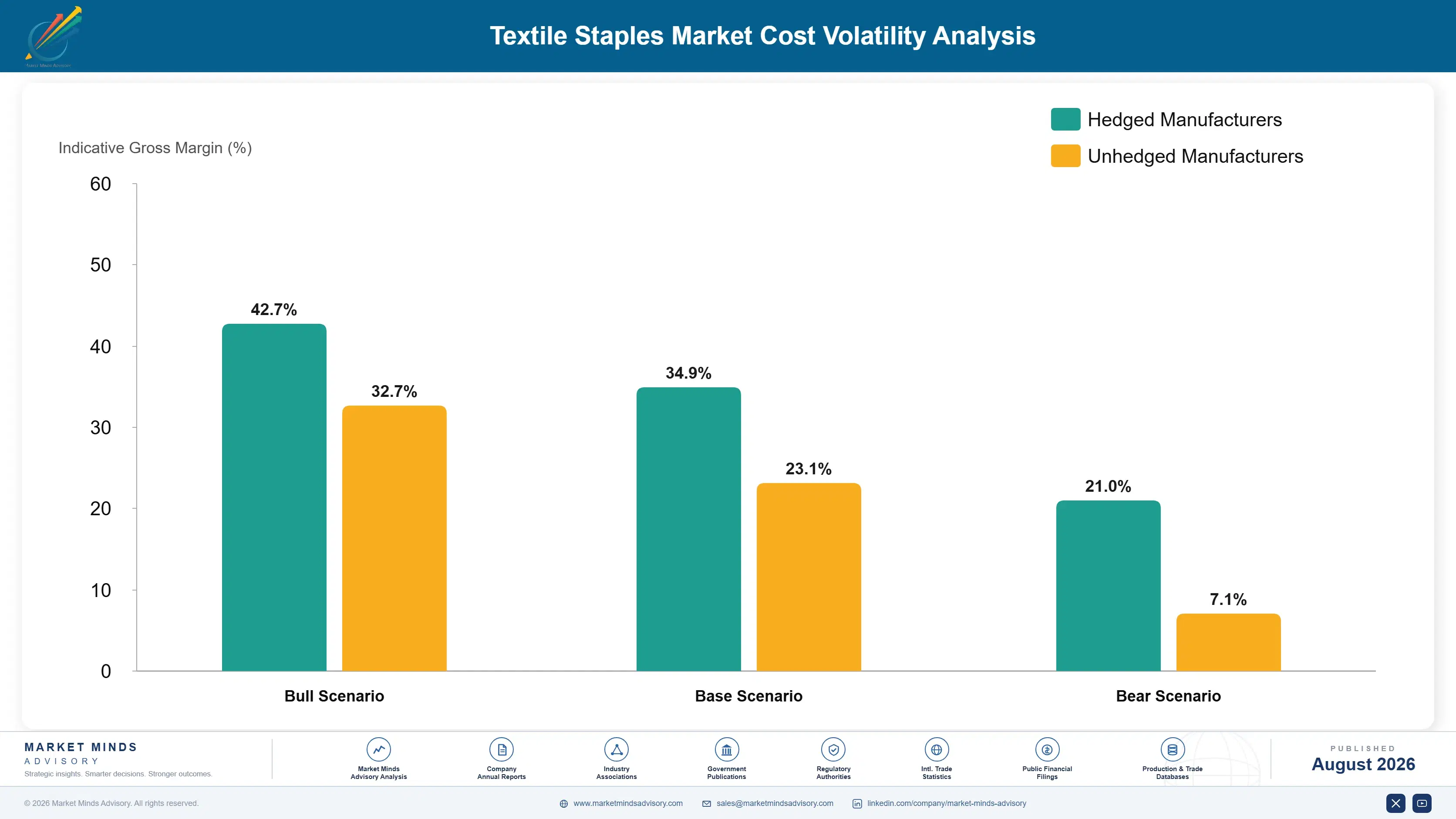
Monomer, Pulp and Energy

Purified terephthalic acid and monoethylene glycol together carry around 66% of polyester staple cost, tracking paraxylene and ethylene pricing that follows oil and gas markets closely. Dissolving pulp carries a comparable share of viscose staple cost on international pulp pricing. Energy takes about 13% across both routes. Spin finish, chemicals, labour, baling and freight absorb the balance across most producers.
Paraxylene and energy pricing both moved sharply through 2022, per IEA petrochemical and energy reporting alongside Indorama Ventures and Lenzing annual reporting for 2025 on feedstock exposure. Non-integrated producers absorbed those movements in full while integrated ones passed considerably less through, and several smaller Asian spinning fibre producers suspended output rather than run at negative conversion margins. Integration decided survival through that period rather than operating efficiency.

Exposure divides on integration and fibre type rather than on scale. An integrated polyester producer carries far less of the monomer swing than a converter buying chips on market terms. A cellulosic producer carries pulp pricing moving on entirely separate drivers. Specialty producers carry additive and process cost against pricing that holds through cycles, which is a considerably more comfortable position than either commodity route.
textile-staples-market-trends-cost-volatility-analysis-1787639861661

Integrate backward or contract monomer on multi-year terms

Feedstock carries roughly two thirds of commodity staple cost and moves on petrochemical markets no fibre producer influences at all. Integration is expensive and multi-year indexed contracting is not, and either beats absorbing swings that have repeatedly forced smaller producers to suspend output rather than sell below cost into contracted volumes. Contracting is the practical route.

Invest in baling and handling discipline rather than specification

Contamination costs a mill more than any specification shortfall because it surfaces four stages downstream after dyeing, and the fixes are baling discipline, covered transport and handling procedure rather than capital equipment. Those cost almost nothing and address the defect mills complain about most frequently across every region. Complaints fall almost immediately. Mills notice within weeks.

Shift mix toward specialty grades priced outside cotton

Commodity blends move with cotton harvests rather than with anything a synthetic producer does, while specialty and functional fibre is qualified into yarn programmes and priced on properties instead. Moving mix reduces exposure to an agricultural variable entirely outside the industry, which is the only genuine escape from that comparison. Programmes hold through cycles.

Portfolio Architecture for Margin Defence

Margin here follows qualification rather than production capability, because commodity staple is made by dozens of producers to identical nominal specifications and mills compare delivered cost directly. Standard polyester and acrylic staple earn margins in the low to high single digits, since conversion value above feedstock is minimal and blend ratios move with cotton rather than with anything a producer controls. Nothing else separates one producer from another.
Viscose and contamination assured grades do better in the low to high teens, because pulp access and handling discipline both narrow the field somewhat, and a mill that has stopped seeing coloured fibre after dyeing will not casually change a supplier that solved the problem. Quality managers rather than buyers judge that performance, and they hold real influence over retention.

Specialty, functional and bicomponent grades hold the strongest position, reaching into the mid twenties, where qualification into yarn programmes protects positions and pricing rests on defined properties rather than on any comparison with cotton. Those margins reflect development capability and qualification depth rather than feedstock cost position. Requalifying a yarn programme is disruptive enough that these positions hold for years.

Standard Polyester and Acrylic Staple

Commodity fibre made to identical nominal specifications and bought on delivered cost. The five point range reflects feedstock integration rather than any property a spinning mill could actually detect. Cotton sets the ratio.
Gross Margin: 4-9%

Viscose and Contamination Assured Grades

Fibre where pulp access or handling discipline narrows the supplier field meaningfully. The seven point range reflects contamination performance and certification depth rather than any nominal specification difference. Handling discipline decides retention.
Gross Margin: 12-19%

Specialty, Functional and Bicomponent Grades

Defined property fibre qualified into yarn programmes rather than sold against a price sheet. The nine point range reflects development capability and how deeply the fibre is embedded in the programme.
Gross Margin: 18-27%
textile-staples-market-trends-portfolio-architecture-1787639862168

High-value Sub-segments and Strategic Watch-out

Specialty and Functional Grades

High value and the fastest growth at 7.2%, qualified into yarn programmes on defined properties rather than purchased against a price sheet, which removes the cotton comparison governing everything else. Brand product development qualifies them years ahead. Requalification is disruptive enough to protect positions. Tenders rarely occur.
Gross Margin: 20-27%

Contamination Assured Supply

High value and defensible because the defect surfaces four stages downstream after dyeing, and a mill that stops seeing coloured fibre rarely risks changing the supplier that solved it. Baling discipline costs almost nothing to implement properly. Quality managers judge it rather than purchasing contacts.
Gross Margin: 13-19%

Standard Commodity Staple

The volume core, made to identical nominal specifications by dozens of producers where feedstock integration decides cost and blend ratios move with cotton harvests rather than performance. Nominal specification is all that gets traded. Feedstock integration decides who earns anything at all. Conversion value is minimal.
Gross Margin: 4-9%

Cotton Price Exposure

The strategic watch-out. Volume blends run around 65% synthetic and mills adjust that with cotton pricing, and the range reflects how far a producer has built specialty positions outside the comparison. Agricultural conditions decide the ratio each season. Specialty positioning is the only genuine escape available.
Gross Margin: 3-25%

Machinery, Harvests and Programmes

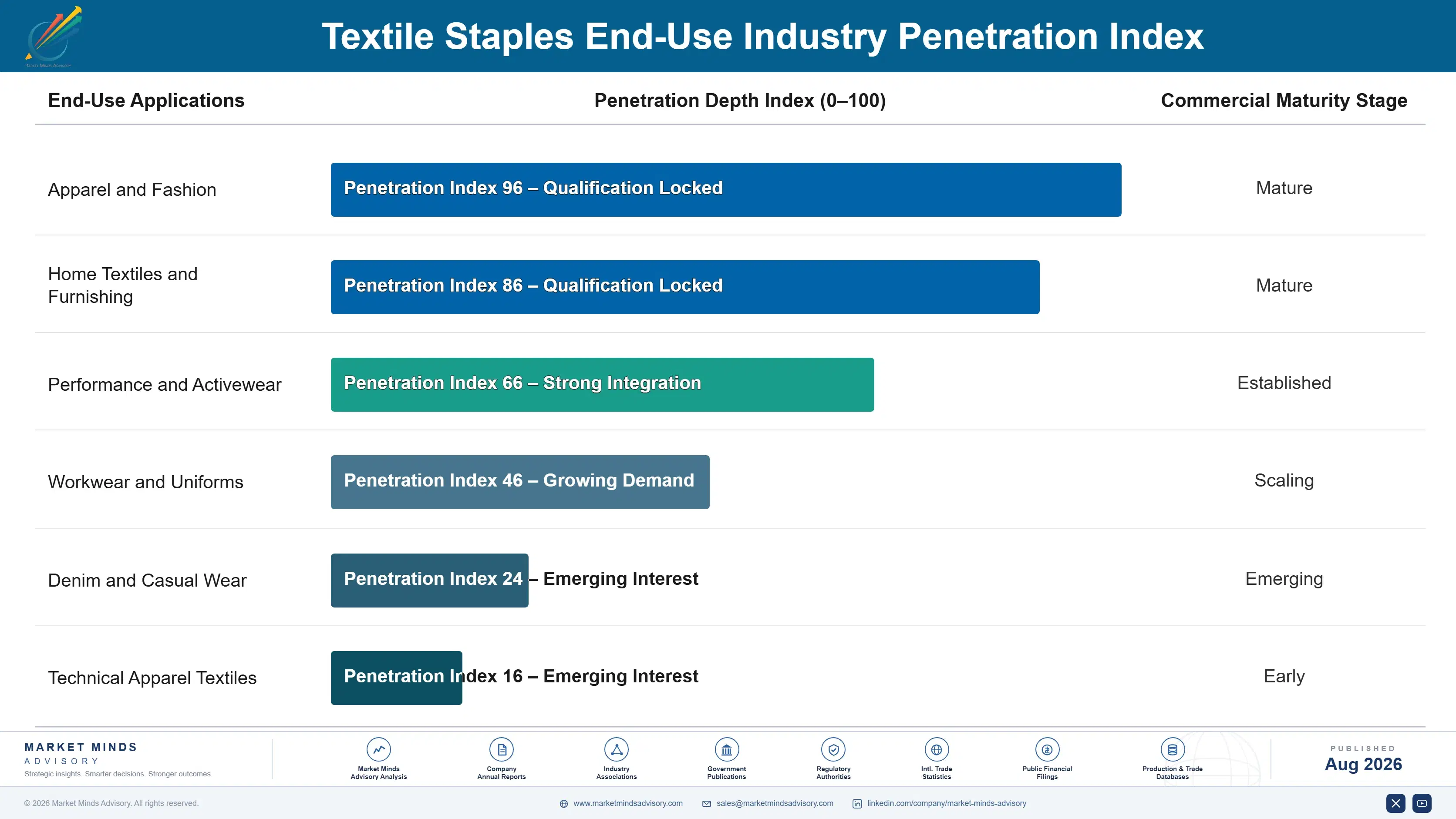
Demand here is shaped by three things a fibre producer does not control. Installed spinning technology decides which fibre a mill can physically run and lasts around 22 years. Cotton harvests decide blend ratios in volume apparel, which move on agriculture rather than performance. Brand yarn programmes decide specialty demand, and those are qualified years ahead of any commercial order being placed. None of the three responds to a sales call.
Stickiness follows qualification and problem solving rather than price. Commodity supply reopens at every contract because nominal specifications are met identically by many producers. Specialty positions hold across seasons because requalifying a yarn programme is disruptive. Contamination assured relationships hold because a mill that has stopped seeing faults after dyeing does not experiment with the supplier that fixed it.

The deciding functions vary by segment in ways producers frequently misjudge. Commodity purchasing sits with mill buyers comparing delivered cost. Specialty specification sits with brand product development years before an order. Contamination performance is judged by mill quality managers who rarely speak to fibre salespeople at all, and who hold considerable influence over which suppliers get retained. Most producers reach only the first.
textile-staples-market-trends-end-use-penetration-index-1787639862658

Where We Would Put Effort

These are among the four positions where our research anticipates prominent divergence between winners and laggards over the coming forecast period. Each is grounded in the demand model, the regulatory perimeter, and the announced capacity pipeline.
01 / LENGTH DISTRIBUTION SELLING

Sell the number that predicts performance

Short fibre content above roughly 8% drives yarn imperfections, ends down and spinning breaks considerably more than nominal cut length does, and yet almost every commercial specification in this industry is still written on the nominal figure instead. Measuring and then guaranteeing that distribution offers a mill something competitors selling on stated length simply cannot provide at all. Mills already experiencing spinning problems recognise that value immediately, which makes it an unusually easy technical argument to land with the right person.
02 / CONTAMINATION PERFORMANCE GUARANTEE

The defect appears after the dyehouse

A single foreign or coloured fibre entering a bale passes through opening, carding, drawing and spinning undetected and appears only after dyeing, by which time the value added to the faulty material vastly exceeds what the fibre ever cost. Baling discipline, covered transport and careful handling procedure all address it, and the first two cost almost nothing to implement. A producer guaranteeing contamination performance relieves a spinning mill of the single most expensive defect it encounters anywhere in its entire process.
03 / SPINNING TECHNOLOGY MAPPING

The machine was bought before you called

Rotor spinning accounts for around 34% of world short staple capacity and demands quite different fibre from ring or vortex systems, and a mill runs its installed technology for roughly 22 years without any realistic prospect at all of changing it for a fibre order. Producers who map their customers' spinning installations and engineer fibre accordingly are addressing the actual constraint that governs specification here. Producers selling a single grade into every mill are simply wasting properties on machinery that physically cannot use them.
04 / COTTON COMPARISON ESCAPE

Stop competing against a harvest

Volume apparel blends run around 65% synthetic and mills move that ratio with cotton pricing rather than with any performance requirement, which means commodity staple ends up competing against agricultural conditions rather than against another synthetic fibre. Specialty and functional grades grow at 7.2% against a market rate of 4.8%, and they are qualified into yarn programmes rather than bought against any price sheet. Programme volume per customer is modest and pricing holds through cycles that flatten commodity grades entirely.

Engagement Snapshot From the Field

A live engagement with an industry participant carrying material or product regulatory and market exposure ahead of a defining policy shift, showing how our research translates into a defensible multi-year portfolio strategy.
MARKET MINDS ADVISORY · CLIENT ENGAGEMENT SUMMARY
Textile Staples Producer Strategic Portfolio Review and Transition Roadmap 2026·Investment Scenario on Textile Staples Exposure Evaluation 2025-26
CLIENT PROFILE
An Asian polyester staple producer supplying spinning mills across regional and export markets, at annual revenue near 520 million dollars (client-reported, unverified by MMA). Commercial effort was organised around nominal specification and delivered price, with no measurement of length distribution or contamination performance. Quality manager relationships did not exist. Contamination was not tracked. Specialty capability was absent.
STRATEGIC CHALLENGE
Margins on commodity staple had been negative in two of the previous four quarters, and several long standing mill customers had moved volume to competitors without giving any clear reason. Management wanted to understand what those customers were actually deciding on. A capacity decision was pending. A decision was overdue.
MMA APPROACH
MMA interviewed mill quality managers rather than purchasing contacts about why suppliers were retained or dropped, measured short fibre content across the client's output, mapped installed spinning technology at the client's customer base, and sized specialty and functional fibre demand independently. Interviews with 47 experts covered fibre production, spinning technology and yarn quality management.
KEY FINDINGS
  1. Mill quality managers cited contamination far more often than any specification issue when explaining supplier changes, and none of them had ever spoken to the client's sales organisation.
  2. Short fibre content across the client's output varied considerably between production lines, and no customer had ever been told because the property was not being measured at all.
  3. Roughly a third of the client's customers ran rotor spinning requiring fibre the client supplied to a single ring spinning specification, which wasted properties nobody could use.
  4. Specialty and functional demand within the client's own markets was growing faster than commodity volume and carried margins several times higher across every programme examined.
CLIENT PROFILE
An Asian polyester staple producer supplying spinning mills across regional and export markets, at annual revenue near 520 million dollars (client-reported, unverified by MMA). Commercial effort was organised around nominal specification and delivered price, with no measurement of length distribution or contamination performance. Quality manager relationships did not exist. Contamination was not tracked. Specialty capability was absent.
STRATEGIC CHALLENGE
Margins on commodity staple had been negative in two of the previous four quarters, and several long standing mill customers had moved volume to competitors without giving any clear reason. Management wanted to understand what those customers were actually deciding on. A capacity decision was pending. A decision was overdue.
MMA APPROACH
MMA interviewed mill quality managers rather than purchasing contacts about why suppliers were retained or dropped, measured short fibre content across the client's output, mapped installed spinning technology at the client's customer base, and sized specialty and functional fibre demand independently. Interviews with 47 experts covered fibre production, spinning technology and yarn quality management.
KEY FINDINGS
  1. Mill quality managers cited contamination far more often than any specification issue when explaining supplier changes, and none of them had ever spoken to the client's sales organisation.
  2. Short fibre content across the client's output varied considerably between production lines, and no customer had ever been told because the property was not being measured at all.
  3. Roughly a third of the client's customers ran rotor spinning requiring fibre the client supplied to a single ring spinning specification, which wasted properties nobody could use.
  4. Specialty and functional demand within the client's own markets was growing faster than commodity volume and carried margins several times higher across every programme examined.
RECOMMENDED STRATEGY
Phase 1: Phase one: begin measuring and guaranteeing short fibre content, which corresponds to spinning performance rather than to the trading convention. Phase 2: Phase two: invest in baling discipline and handling, since contamination rather than specification is what actually loses accounts. It costs almost nothing. Phase 3: Phase three: build specialty and functional capability, escaping a commodity comparison that moves with cotton harvests. Harvests decide commodity demand.
OUTCOME
The producer began measuring length distribution and improved baling discipline during 2026, reporting contamination complaints falling sharply across its customer base (client-reported, unverified by MMA). Specialty development was funded, and quality manager relationships were established alongside purchasing contacts. Commodity promotion was reduced deliberately. Specialty volumes began growing.

Frequently Asked Questions

Foundational context covering the market sizes, CAGR, scope, country, region and competition that inform every finding below. This section is provided to cover basics and most often pre-purchase conversations, answered from the MMA Primary Research Dataset.

What is the current size of the Textile Staples Market?

MMA sizes it at USD 26.4 billion in 2025, rising to USD 27.67 billion in 2026. The figure covers staple fibre for textile yarn spinning at producer selling value across all fibre types.

How large will the Textile Staples Market be by 2036?

USD 44.22 billion by 2036, an incremental USD 16.55 billion over the 2026 base and an expansion multiple of 1.60 times. Specialty grades account for a disproportionate share.

What is the CAGR for the Textile Staples Market 2026 to 2036?

4.8% in the base case, with a bull case at 6.0% and a bear case at 3.6%. The spread turns on whether contamination and length distribution become genuine purchasing criteria.

Which segment is growing fastest?

Specialty and functional staple at 7.2%, half again the market rate of 4.8%. These fibres are qualified into yarn programmes rather than purchased against a price sheet.

Who are the major companies in the Textile Staples Market?

Reliance Industries, Indorama Ventures, Tongkun Group, Aditya Birla Group and Sateri lead on tonnage supplied, and fifteen further participants are profiled in the full report on that basis.

Which country is growing fastest?

Uzbekistan at 9.4%, as cotton-to-textile integration policy directs domestic cotton into local spinning and builds capacity buying both cotton and synthetic staple. Capacity arrived within a few years.

Report Segmentation Architecture

The full report scope spans multiple orthogonal segmentation dimensions, with cross-tabulated demand data provided for each dimension pair. Coverage extends further to regional breakdowns, trend trajectories, and the competitive detail needed to support segment-level decision-making.

By Fibre Type

  • Polyester Staple for Textiles
  • Viscose Staple
  • Acrylic Staple
  • Polypropylene and Polyamide Staple
  • Specialty and Functional Staple
  • Blended and Bicomponent Staple

By End-Use Industry

  • Apparel and Fashion
  • Home Textiles and Furnishing
  • Performance and Activewear
  • Workwear and Uniforms
  • Denim and Casual Wear
  • Technical Apparel Textiles

By Commercial Dimension

  • Direct Spinning Mill Supply
  • Distributor and Trading Channels
  • Brand Nominated Yarn Programmes
  • Contract Volume Agreements
  • Toll Processing Arrangements
  • Export and Cross-Border Supply

By Region

  • North America
  • Western Europe
  • East Asia
  • South Asia and Pacific
  • Latin America
  • Middle East and Africa
  • Eastern Europe

Scope, Methodology, and Coverage

Every figure in this report is reproducible from documented input assumptions. The scope below maps the historical period, the forecast horizon, the segmentation dimensions, and the countries covered, alongside the underlying primary and qualitative methodology.
Historical Period
2020 to 2025
Forecast Period
2026 to 2036
Base Year
2025 (USD billions; MMA Primary Research Dataset, August 2026)
Market Definition
Staple fibre supplied for textile yarn spinning, covering polyester staple for textiles, viscose staple, acrylic staple, polypropylene and polyamide staple, specialty and functional staple, and blended and bicomponent staple. Measured at producer selling value for fibre destined for spun yarn manufacture. Staple fibre for nonwoven and industrial applications, filament yarn, natural fibres including cotton and wool, spun yarn and fabric, and textile auxiliaries or finishing chemicals are excluded from scope.
Quantitative Units
USD billions (current prices); million tonnes supplied; USD per tonne by fibre type
Segmentation Dimensions
Fibre type; end-use industry; commercial dimension; region
Regions Covered
North America, Western Europe, East Asia, South Asia and Pacific, Latin America, Middle East and Africa, Eastern Europe
Countries Covered
China, India, Bangladesh, Vietnam, Indonesia, Pakistan, Uzbekistan, Turkey, Egypt, Ethiopia, Germany, Italy, Spain, United States, Mexico, Brazil, Colombia, Japan, South Korea, Poland
Key Companies Profiled
Reliance Industries, Indorama Ventures, Tongkun Group, Aditya Birla Group, Sateri, Hengli Petrochemical, Xinfengming Group, Zhejiang Hengyi, Far Eastern New Century, Nan Ya Plastics, Lenzing, Kelheim Fibres, Toray Industries, Teijin Frontier, Bombay Dyeing, Jiangsu Sanfangxiang, Aksa Akrilik, Thai Acrylic Fibre, Sanyou Chemical Fibre, Yizheng Chemical Fibre
Quantitative Methodology
Primary survey, n=3,800 respondents, Q4 2025, six countries; demand-side model with trade association cross-validation
Qualitative Methodology
47 expert interviews, Q4 2025; applied to validate demand model assumptions, identify emerging dynamics, and assess competitive positioning
Report Format
PDF and XLSX data workbook (Word format preview document)
Publisher
Market Minds Advisory
Report Code
MMA-2026-CHM-144
Published
August 2026
Contact
sales@marketmindsadvisory.com | www.marketmindsadvisory.com

Purchase the full Textile Staples Market Report (2026 to 2036).

The full report starts from the spinning machine rather than the fibre, because installed technology decides specification and runs for around two decades without changing. It sizes all six fibre types independently through 2036, maps spinning technology installation against fibre requirements by region, and quantifies contamination and length distribution effects that nominal specification never captures. Regional chapters cover all seven regions with spinning capacity assessed alongside fibre production. Competitive profiling covers 20 participants on one consistent tonnage basis. Contamination performance is assessed by producer throughout.
Six fibre types sized independently through 2036
Spinning technology installation mapped against fibre requirements by region
Short fibre content effects quantified against yarn quality outcomes
Contamination cost modelled across downstream processing stages
Blend ratio behaviour tracked against cotton pricing movements
Twenty participants profiled on one consistent tonnage basis

Built For The People Who Decide

From boardroom strategy to bench-side execution, this report is read cover-to-cover by leaders shaping the next decade of their industry, turning demand scenarios, market dynamics and valuation benchmarks into decisions.
CXOs/ Presidents/ VPs/ Managers
M&A and Corporate Development
Strategy Teams and R&D Heads
Procurement and Product Directors
Regulatory and Compliance Leaders
Investor Relations and Equity Analysts