

Market Minds Advisory
Testosterone Booster Market

Testosterone Booster Market: A Claim the Buyer Never Measures

Fewer than one buyer in ten measures a hormone level before or after purchase, which means the central product claim in this category cannot be checked by the person paying for it.

Lead Analyst

Alice Ballenger

Published

September 2026

Make Smarter Decisions with Customized Research Insights

Request a free sample report and evaluate market opportunities, growth trends, and competitive dynamics relevant to your business needs.

2025 MARKET VALUE$1.4BMarket Size 2025
2036 FORECAST VALUE$3.1BBase Case , 2026 to 2036
CAGR 2026 TO 20367.4 %Bull 8.6% / Bear 6.2%
INCREMENTAL OPPORTUNITY$1.6BNet 10- year value creation
EXPANSION MULTIPLE2.04x2036 value over 2026 base
Strategic Levers
M&A Pipeline
Regional Outlook
Country Rankings
Competitive Intelligence
Segmental Deep-dive
Call-Us : 91 93563 13602

Executive Snapshot and Market Trajectory

Around 9% of buyers measure a hormone level before starting one of these products. The claim on the label is therefore unfalsifiable in the hands of the person paying for it, and what the customer actually purchases is an explanation for tiredness, low mood or poor gym progress.
Cheap at-home hormone testing is the genuine threat and it is arriving dressed as an adjacency. A consumer who tests finds either a normal level, in which case the product has nothing to correct, or a genuinely low one, in which case they need a clinician rather than a supplement. Neither outcome supports a repeat purchase. A brand offering the test controls the framing. Neither result supports another purchase.
Ashwagandha grows fastest at 11.1% and its evidence is mostly about cortisol rather than testosterone, with controlled work showing reductions around 23%. It is a stress and sleep product wearing a hormone label, which is a considerably more defensible position than the rest of the category currently occupies. Consumers perceive stress and sleep effects directly, which a hormone claim never allowed. Perceptibility rather than efficacy is what actually sustains a purchasing habit here.
Market Definition
Over the counter supplement products marketed to support or raise male testosterone levels, covering herbal extract blends, ashwagandha and adaptogen formulations, vitamin and mineral based formulations, amino acid and direct precursor products, combination performance stacks, and clinically positioned branded formulations. Measured at manufacturer selling value. Excludes prescription testosterone replacement therapy, anabolic steroids and selective androgen receptor modulators, general sports nutrition without hormone claims, and clinical hormone testing services.
Base Year Value
$1.4B in 2025 (MMA Primary Research Dataset, August 2026)
Forecast Period
2026 to 2036, eleven discrete annual values
CAGR
7.4% base case. Bull 8.6%. Bear 6.2%.
Fastest Growth Segment
Ashwagandha and Adaptogen Formulations: 11.1% CAGR
Fastest Growth Country
Mexico: 12.4% CAGR
Fastest Growth Region
South Asia and Pacific: 9.6% CAGR
Largest Region
North America: 30% of 2025 global value
Market Leaders
Nestle Health Science, Onnit, Force Factor, GNC, Iovate Health Sciences. Source: MMA Primary Research Dataset, July 2026.
Primary Survey
n=3,800 procurement and R&D decision-makers, Q4 2025, six countries
Methodology
Demand-side build-up, cross-validated against public data, 47 expert interviews

Testosterone Booster Market Forecast Scenarios

testosterone-booster-market-size-forecast-scenario-1787639836893
Growth ran near 6.2% between 2020 and 2025, driven by male wellness marketing and online direct selling rather than by any change in the underlying evidence. Ashwagandha formulations expanded fastest as adaptogen positioning reached mainstream retail. Enforcement findings of undeclared pharmaceutical ingredients recurred through the period and damaged category credibility without materially reducing overall consumption anywhere.
Base case 7.4% rests on three mechanisms. Ashwagandha and adaptogen formulations grow at 11.1% on stress and sleep positioning that carries considerably better evidence than direct hormone claims do. Combination performance stacks grow at 9.4% as products broaden into energy, body composition and recovery. And Mexico grows fastest of any country at 12.4% on gym culture and online supplement retail expanding together. None of the three rests on hormone evidence improving.
The bull case at 8.6% assumes reformulation toward stress, sleep and energy claims that consumers can actually perceive, which would raise a repeat purchase rate currently near 31%. The bear case at 6.2% is at-home hormone testing reaching enough buyers to expose the claim, since a measured normal level removes the reason to buy and a measured low one sends the customer to a clinician.

Nobody Checks Whether It Worked

The commercial mechanism in this category is that the claim cannot be checked. Around 9% of buyers measure a hormone level before starting a product and fewer measure afterwards, which means the label promise is unfalsifiable in the hands of the person paying for it. What a consumer buys is an explanation for tiredness or a stalled training plateau, and the product delivers that regardless of what it does biochemically.
TOP FIVE CONCENTRATION21%Online direct brands keep this field extremely fragmented
BUYERS TESTING BEFOREHAND9%Consumers measuring hormone levels before starting a product
REPEAT PURCHASE RATE31%Buyers returning to the same product after their first purchase
ADULTERATED SAMPLE FINDINGS12%Sampled products containing undeclared pharmaceutical ingredients on testing
CORTISOL REDUCTION RECORDED23%Stress hormone decrease measured in controlled adaptogen trial work
CONSUMER HORMONE PANEL COST$45Price of an at-home hormone test available online today
At-home hormone testing threatens that mechanism directly, and it is arriving at around 45 dollars a panel through the same online channels that sell the supplements. A consumer who tests learns either that the level is normal, in which case the explanation collapses, or that it is genuinely low, in which case a clinician is the appropriate response. Neither supports repeat purchase.
The best evidenced ingredient is not really about testosterone at all. Ashwagandha shows reasonably consistent effects on cortisol, with controlled work recording reductions around 23%, and considerably weaker effects on testosterone in men with normal levels. It grows fastest at 11.1% because it makes people feel better, which is a stress and sleep proposition that happens to be sold under a hormone heading.
"The single most dangerous product in this category is a forty five dollar blood test, and it is being sold by the same websites. Brands positioning on stress, sleep and energy will survive that. Brands positioning on a number the customer is about to measure will not."
Director, Consumer Health and Nutrition Practice · MMA Healthcare and Life Sciences Practice · August 2026

Market Trends

Consumer hormone testing threatening the central product claim

At-home hormone panels now cost around 45 dollars and sell through the same online channels as the supplements themselves, which makes measurement available to a customer base where only about 9% currently tests. Either result undermines the purchase, since a normal level removes the problem the product claims to solve and a low one requires clinical management instead. Brands positioned on measurable hormone claims face an existential problem that brands positioned on perceived wellbeing do not. Brands positioned on perceived wellbeing rather than on a measurable number face nothing comparable at all.
Market Impact: Mexico growing fastest at 12.4%
Adaptogen positioning replacing direct hormone claims quietly

Ashwagandha formulations grow at 11.1% and their evidence base concerns cortisol and perceived stress considerably more than testosterone, with controlled work recording reductions near 23% in stress hormone. Brands increasingly lead on energy, stress and sleep while retaining hormone language in secondary copy. That repositioning is commercially sensible because consumers can perceive the benefit directly, which is precisely what a hormone claim never allowed them to do. It also supports repeat purchase in a way the original positioning never managed, which matters when the category loses roughly two buyers in three after a first purchase.
Market Impact: Stacks growing at 9.4% annually

Market Opportunities and Growth Drivers

Male wellness retail expanding across Latin American markets

Mexico grows fastest of any country at 12.4% as gym membership, male grooming and wellness retail expand together and online supplement channels reach consumers that traditional pharmacy distribution never did. Category entry is easy, brand loyalty is limited and price points are considerably lower than in North America. Adulteration enforcement is weaker, which grows the category quickly and carries a credibility risk that legitimate brands end up sharing with everybody else. Legitimate brands operating there end up sharing a credibility problem they had no part in creating. Enforcement is weaker there than in developed markets.
Market Impact: Around 12% of samples adulterated

Broader performance positioning widening the addressable occasion

Combination stacks grow at 9.4% by claiming energy, body composition, recovery and libido together rather than a single hormone effect, which widens the occasions on which a consumer might buy and reduces dependence on any one claim surviving scrutiny. It also allows a brand to retain a customer whose original reason for buying has faded. Bundling is a defensive as well as an expansionary move, and most established brands have now made it. Concentrated claim risk is exactly what a single hormone promise creates, and broadening the offer removes most of it.
Market Impact: Repeat purchase sits near 31%

Market Restraints and Challenges

Adulteration findings damaging brands that comply properly

Around 12% of sampled products in this category have been found containing undeclared pharmaceutical ingredients, and enforcement findings reach consumers as a statement about the whole category rather than about individual offenders. The root cause is low barriers to entry combined with online distribution that outpaces inspection. Commercially it means compliant brands carry reputational cost created by others. Third party testing certification and transparent sourcing are the mitigations legitimate brands actually use. Consumers increasingly look for that certification before buying anything here. Third party testing and published batch results are the practical answer available.
Market Impact: Testing costs around 45 dollars

Underlying causes that supplements do not address at all

The strongest determinants of low testosterone in the target population are body composition and sleep quality, neither of which a capsule changes, and appetite suppressing medication is now addressing the first far more effectively than any supplement ever has. The root cause is physiological rather than nutritional. Commercially it means the category competes against interventions that genuinely work. Repositioning toward stress and sleep is the mitigation available, and it is already happening. Repositioning toward stress and sleep is already happening across the larger brands, which is a tacit acknowledgement of the underlying problem.
Market Impact: Cortisol falls around 23%
4 additional market trends, 3 additional growth drivers, and 2 additional restraints and challenges are covered in the full report. Contact sales@marketmindsadvisory.com to access the complete intelligence.

Segment CAGR and Growth Architecture

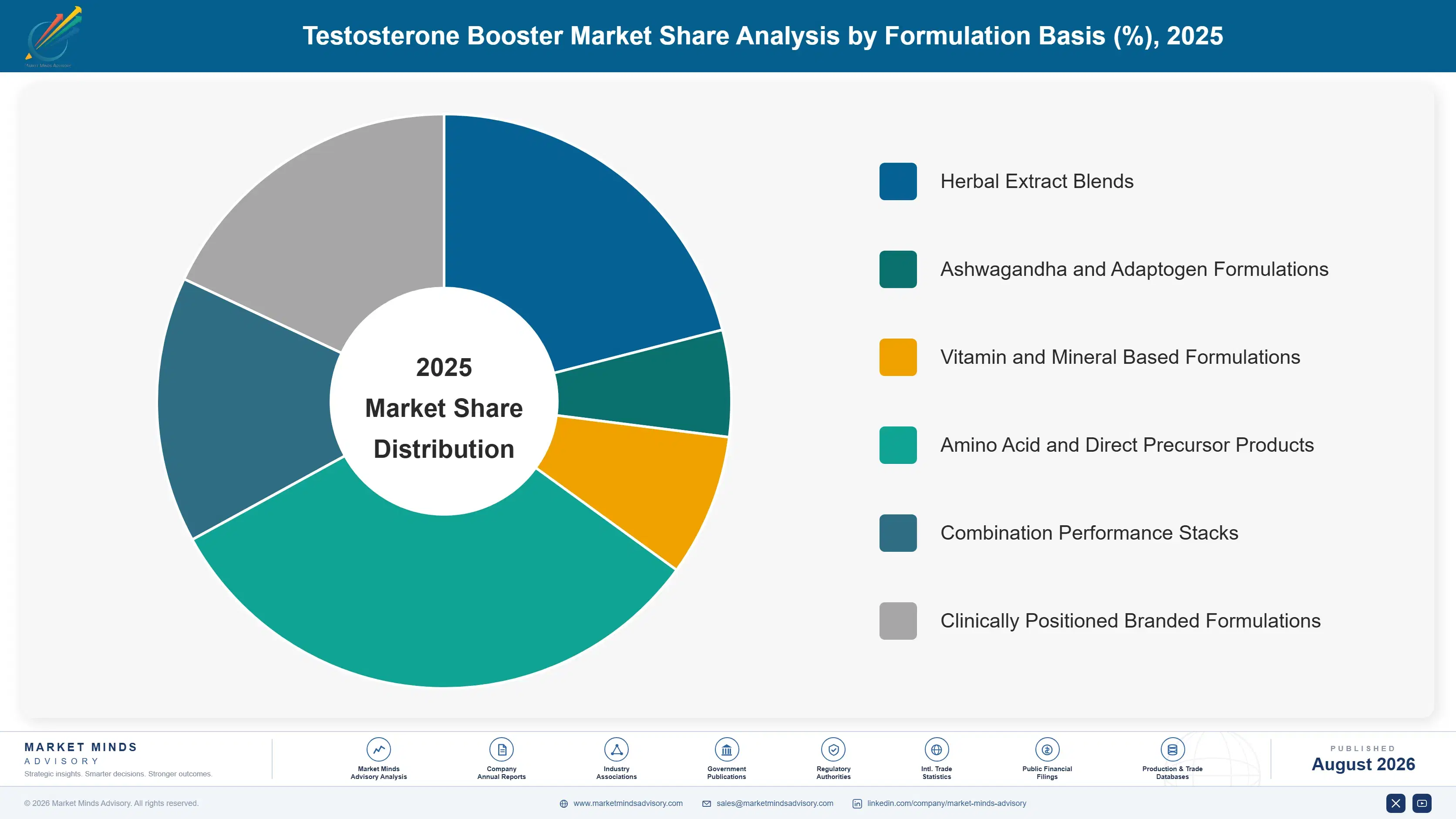
Six segments are split by formulation basis, because the ingredient system determines the evidence available behind it, the claim a brand can defend, how perceptible any effect is and the regulatory attention it attracts. Dose and format variants sit inside each system. Channel and buyer type are handled separately in the framework. Regulatory attention follows the claim closely.
testosterone-booster-market-market-share-analysis-1787639837452

Ashwagandha and Adaptogen Formulations

Growing at 11.1%, half again the market rate of 7.4%, these formulations carry the best evidence in the category and most of it concerns cortisol rather than testosterone, with controlled work recording stress hormone reductions around 23%. Consumers perceive the effect directly through sleep and stress, which supports repeat purchase in a way that an unmeasured hormone claim never has. Brands increasingly lead on those perceptible benefits while retaining hormone language in secondary copy, which is a sensible commercial position rather than an evasive one. Consumers notice sleep improving in a way they never noticed a hormone level changing. That perceptibility is the whole commercial advantage, and it survives cheap testing entirely intact.
CAGR 11.1%

Combination Performance Stacks

At 9.4% combination products claim energy, body composition, recovery and libido together rather than resting on a single hormone effect, which widens the occasions on which somebody might buy and reduces dependence on any one claim surviving scrutiny. It also retains customers whose original reason for purchasing has faded, which matters when repeat purchase sits near 31% across the category. Bundling is defensive as much as expansionary, and almost every established brand has now adopted some version of it. Broadening the offer also reduces exposure to any one claim failing under regulatory scrutiny or under a customer's own blood test result, which is a real possibility now. Most established brands have already adopted it.
CAGR 9.4%
Full segment breakdown across 6 segments available in the complete report.

Regional Architecture and Country Demand Map

North America holds 32% of value on sports nutrition and supplement spending per head exceeding any other region, alongside the direct online channels that built this category originally. East Asia follows at 22% and South Asia and Pacific grows fastest of the seven regions. All shares hold band.

North America

Supplement spending per head exceeds any other region and direct online selling built this category before mainstream retail carried it, which gives the region its leading position. At-home hormone testing is more available and more heavily marketed here than anywhere, which makes the measurement threat most immediate in exactly the largest market. Enforcement findings of undeclared pharmaceutical ingredients recur regularly. Growth at 6.4% reflects a mature base repositioning toward stress and energy claims rather than expanding on hormone messaging. Brands repositioning ahead of routine testing will hold customers that hormone claim brands are about to lose. Enforcement findings of undeclared pharmaceutical ingredients recur regularly and reach consumers as statements about the category rather than the sellers.
Share: 30% | CAGR: 6.4% (2026 to 2036)

Western Europe

Health claim regulation restricts what can be said about hormone effects considerably more than in North America, which has pushed brands toward energy, tiredness and general wellbeing language for years. That regulatory pressure produced repositioning ahead of the rest of the world and left European formulations better placed for the measurement threat now arriving elsewhere. Enforcement of adulterated imports is comparatively strict. Growth of 5.8% is the slowest anywhere on constrained claims and mature demand. Claim restriction here effectively forced early repositioning, which now looks like foresight rather than the constraint it was. Enforcement of adulterated imports is comparatively strict, which limits the category reputation problem that affects other regions.
Share: 20% | CAGR: 5.8% (2026 to 2036)
Regional intelligence for 5 additional markets available in the complete report: East Asia, South Asia and Pacific, Latin America, Middle East and Africa, Eastern Europe. Contact sales@marketmindsadvisory.com.
testosterone-booster-market-country-cagr-analysis-1787639837994

Four Moves Before the Blood Test

The category rests on a claim the customer cannot check, and a forty five dollar panel sold through the same websites is about to let them. What survives that is positioning on effects people can actually perceive, evidence that holds up, and a reason to buy again that does not depend on a number. All four are available now.

Reposition onto effects the consumer can perceive

Repeat purchase sits near 31% because a customer cannot tell whether an unmeasured hormone claim worked, while stress, sleep and energy effects are noticed directly. Ashwagandha grows at 11.1% on exactly that perceptibility, with controlled work showing cortisol reductions around 23%. Moving the primary claim onto what a buyer can feel converts a one-off purchase into a habit, and it survives the arrival of cheap testing entirely intact. It is the single change with the largest effect on lifetime value available to anybody in this category. Nothing else compares. Habit is worth more.
Market Impact: Lifts repeat purchase above the 31% current baseline

Own the testing rather than being exposed by it

At-home panels cost around 45 dollars and sell through the same channels as these products, which means testing is arriving whether brands like it or not. A brand offering testing alongside its product controls the conversation about the result and can direct genuinely low readings toward clinical referral rather than losing the customer entirely. Ignoring it means a competitor or a testing company frames the finding instead. A testing company has no interest whatsoever in retaining the customer afterwards. A brand framing the result keeps the relationship whichever way the number falls.
Market Impact: Addresses the 9% of buyers who currently test

Certify against the adulteration problem visibly

Around 12% of sampled products contain undeclared pharmaceutical ingredients, and enforcement findings reach consumers as a statement about the whole category. Third party testing certification, published batch results and transparent sourcing separate a compliant brand from that reputation at very modest cost. It is cheap insurance against damage created entirely by other people, and consumers increasingly look for it before purchasing anything in this aisle. It costs a very modest share of product cost and functions as a consumer facing claim rather than a compliance exercise. Consumers look for it before buying now.
Market Impact: Separates from the 12% adulteration finding rate entirely

Bundle occasions rather than defending one claim

Combination stacks grow at 9.4% by claiming energy, recovery, body composition and libido together, which widens buying occasions and retains customers whose original reason has faded. That breadth also reduces exposure to any single claim failing scrutiny, whether from regulation or from a customer measuring something. It is defensive as much as expansionary, and the brands that have not done it are carrying concentrated claim risk unnecessarily. Brands still resting on a single hormone promise carry concentrated claim risk unnecessarily. Regulation and consumer testing both threaten a single promise, and breadth answers both.
Market Impact: Serves the 9.4% combination stack segment growth annually

Who Controls the Margin Pool

Participation is measured on annual retail sales value of testosterone positioned supplements, and the top five hold only 21%. Concentration is exceptionally low because online direct selling has almost no entry barrier, contract manufacture is widely available and brand loyalty is limited. Nestle Health Science and Onnit lead through mainstream retail distribution rather than through any formulation advantage over smaller competitors. The gap to challengers is distribution rather than formulation.
Competition runs on three fronts. Retail distribution decides mainstream volume, where shelf access is genuinely scarce. Online acquisition efficiency decides direct brand economics, and it has become considerably more expensive. And ingredient credibility decides which brands survive scrutiny, whether from regulators, journalists or consumers with a blood test. Claim defensibility has become a fourth front as testing availability spreads through the same channels.

Pressure ahead comes from consumer testing exposing hormone claims and from adaptogen positioning displacing direct ones. Expect brands with perceptible benefit claims to hold repeat purchase better. Rankings shift on who repositions before testing becomes routine rather than after. Concentration should stay very low given entry barriers. Testing availability keeps spreading meanwhile.
testosterone-booster-market-company-positioning-matrix-1787639838509

Competitive Moat and Risk Dimensions

NESTLE HEALTH SCIENCE

Moat: Mainstream retail distribution reach

Mainstream grocery and pharmacy distribution reaches consumers who would never buy from a direct online brand, and shelf access in those channels is genuinely scarce and slow to obtain. That reach also carries an implicit credibility signal in a category where roughly one sampled product in eight contains undeclared pharmaceutical ingredients, which matters more here than in most supplement segments.
NESTLE HEALTH SCIENCE

Risk: Category reputation contamination

Adulteration enforcement findings reach consumers as statements about the whole category rather than about specific offenders, which means a compliant brand in mainstream retail carries reputational cost created entirely by online sellers it has no connection with. That exposure cannot be managed through product quality and requires visible certification to counter at all.
ONNIT

Moat: Direct brand and content positioning

Direct consumer relationships built through content and community reach buyers who distrust mainstream supplement brands and reward perceived authenticity, which is a genuinely different customer from the retail shopper. That relationship also supports broader product ranges and repeat purchase across occasions rather than depending on any single claim holding up.
ONNIT

Risk: Online acquisition cost inflation

Direct brand economics depend on customer acquisition costs that have risen substantially across digital channels, and repeat purchase near 31% across the category leaves limited lifetime value to recover that spending. Any further increase in acquisition cost compresses a model that was built when reaching consumers online was considerably cheaper.

Players Tracked

Prominent Players

Nestle Health Science
Onnit
Force Factor
GNC
Iovate Health Sciences

Other Key Players

Glanbia Performance Nutrition
Nutrabolt
Ancient Nutrition
Jarrow Formulas
NOW Foods
Swanson Health Products
Himalaya Wellness
Dabur India
Patanjali Ayurved
Bulk
Myprotein
Hims and Hers
Thorne HealthTech
Life Extension
Nutricost

Recent Developments

MARCH 2026

Supplement brand launches hormone testing alongside its own product

A supplement brand began offering at-home hormone testing alongside its products, framing normal results as confirmation of wellbeing and low results as grounds for clinical referral rather than continued supplementation without any medical involvement. Retention improved among customers who tested. The framing mattered considerably. Retention rose measurably.
Signal: Owning the measurement beats being exposed by somebody else's testing service for the brand involved now
SEPTEMBER 2025

Enforcement sampling finds undeclared pharmaceuticals across category products

Regulatory sampling found undeclared pharmaceutical ingredients across a meaningful proportion of tested products in this category, with findings reported as a statement about the product type rather than about the individual sellers involved. Compliant brands reported consumer questions rising afterwards. Individual sellers were rarely named.
Signal: Compliant brands absorb reputational damage created entirely by sellers they never meet through no fault of theirs
DECEMBER 2025

Leading brand shifts primary claim from hormone to stress support

An established brand moved its primary product claim from testosterone support to stress, sleep and energy, retaining hormone language only in secondary copy, and reported repeat purchase improving across the reformulated range afterwards. Hormone messaging was reduced to a supporting mention. Customers stayed considerably longer.
Signal: Perceptible benefits generate repeat purchase that unmeasurable hormone claims never could for these brands at all

Extracts, Encapsulation and Acquisition

Botanical extracts and active ingredients carry around 29% of product cost, with standardised ashwagandha and other characterised extracts priced well above commodity herbal powders. Encapsulation, tableting and packaging take about 22%. Third party testing and certification account for around 7% where brands undertake it. Customer acquisition absorbs the balance for direct brands, and retail margin does the equivalent for shelf based ones.
Botanical extract pricing moved with harvest conditions and demand growth across recent years, per published botanical ingredient market commentary and Glanbia and Nestle Health Science annual reporting for 2025 on ingredient cost. Standardised ashwagandha specifically tightened as demand outgrew certified cultivation, and brands substituting cheaper unstandardised material found their own evidence claims difficult to defend. Contracting across seasons has become considerably more common since. Substitution damages the claim.

Exposure divides on channel and on ingredient quality rather than on manufacturing scale. A direct online brand carries acquisition cost as its dominant expense, which has been rising faster than anything in the bill of materials. A retail brand carries trade margin instead. Brands using standardised characterised extracts carry ingredient cost that unstandardised competitors avoid entirely, along with the evidence position that justifies it.
testosterone-booster-market-cost-volatility-analysis-1787639838704

Contract standardised extract supply against demand growth

Standardised ashwagandha and comparable characterised extracts have tightened as demand outgrew certified cultivation, and brands substituting cheaper unstandardised material lose the evidence position that justified their claims. Multi-season contracting secures both supply and the specification that the published trial work actually used, which is what a defensible claim depends on. Specification is the claim.

Shift acquisition spending toward retention and repeat purchase

Repeat purchase near 31% leaves limited lifetime value to recover acquisition costs that have risen sharply across digital channels. Spending on perceptible benefit positioning and post purchase engagement improves retention, which is considerably cheaper than replacing every customer annually through paid acquisition that keeps getting more expensive. Replacement is expensive. Retention is far cheaper than acquisition.

Treat third party certification as marketing rather than compliance

Testing and certification costs a modest share of product cost and separates a brand from a category where roughly one sampled product in eight contains undeclared pharmaceuticals. Treating it as a visible consumer claim rather than a compliance exercise converts cost into differentiation. Competitors avoiding the cost cannot match it. Competitors avoiding it cannot match the claim.

Portfolio Architecture for Margin Defence

Margin here follows repeat purchase rather than gross margin per unit, because a category selling at roughly a third repeat rate spends most of its gross margin replacing customers. Commodity herbal blend products earn margins in the low to high teens after acquisition cost, where ingredients are cheap, differentiation is minimal and buyers churn almost completely. Churn is close to total each year.
Standardised extract and certified formulations do better in the mid twenties to mid thirties, because characterised ingredients support claims that survive scrutiny and third party certification separates the product from a category carrying visible adulteration findings against it. Visible certification is what separates them from the adulteration findings. Characterised ingredients cost more and defend a claim that assertion cannot.

Testing integrated and clinically positioned offerings hold the strongest position, reaching into the low forties, where the brand controls the measurement conversation and retains customers through a result rather than losing them to it. Those margins reflect retention economics rather than any advantage in ingredient cost or manufacturing efficiency. Managing a result the brand did not control is the capability that matters. Retention economics rather than unit margin decide value here.

Commodity Herbal Blend Products

Low cost formulations sold on price and claim volume with minimal differentiation. The seven point range reflects channel structure and acquisition efficiency rather than any difference in what the products contain.
Gross Margin: 12-19%

Standardised Extract and Certified Formulations

Characterised ingredients matching published trial specifications with third party testing behind them. The eleven point range reflects certification visibility and how far claims rest on evidence rather than assertion. Evidence supports the claim.
Gross Margin: 24-35%

Testing Integrated and Clinically Positioned Offerings

Products sold alongside measurement with clinical referral pathways for genuinely low results. The eleven point range reflects retention performance and how well the brand manages a result it did not control.
Gross Margin: 31-42%
testosterone-booster-market-portfolio-architecture-1787639839200

High-value Sub-segments and Strategic Watch-out

Adaptogen and Stress Positioned Products

High value and the fastest growth at 11.1%, resting on cortisol evidence around 23% reduction that consumers perceive directly. Perceptible benefit supports repeat purchase that unmeasurable hormone claims never generated. Sleep and stress are noticed immediately. Repeat purchase follows perceptibility rather than efficacy. Evidence sits mostly on cortisol.
Gross Margin: 26-35%

Testing Integrated Offerings

High value and emerging as at-home panels reach around 45 dollars through the same channels. Owning the measurement beats being exposed by a testing company that has no interest in retaining the customer. Framing the result is the whole opportunity. Clinical referral retains customers a bare result loses.
Gross Margin: 33-42%

Commodity Herbal Blends

The volume core, sold on assertion rather than evidence into a market where repeat purchase sits near 31% and acquisition costs keep rising across every digital channel available. Differentiation is essentially absent. Acquisition costs keep rising across every digital channel available. Assertion carries the claim.
Gross Margin: 12-19%

Claim Falsifiability Exposure

The strategic watch-out. Only around 9% of buyers currently test, and the range reflects whether a brand has moved its primary claim onto something a consumer can actually perceive. Testing is arriving through the same channels. Repositioning ahead of that is the only durable answer.
Gross Margin: 10-40%

Buying an Explanation, Not a Hormone

Demand originates in a feeling rather than a diagnosis. A man who is tired, gaining weight or making no progress in the gym encounters an explanation that names a cause and offers a remedy, and around 9% of them measure anything before buying. The purchase resolves uncertainty as much as it addresses physiology, which is why the evidence base has never determined category performance. Evidence has never driven this category.
Stickiness follows perceptibility rather than efficacy. A product whose effect a consumer can feel, through sleep or stress or energy, generates repeat purchase. A product resting on an unmeasured hormone claim does not, which is why the category repeat rate sits near 31%. Brands that reposition onto perceptible benefits keep customers, and those that do not replace their entire customer base annually.

The influences shaping purchase have shifted online almost entirely. Retail pharmacy and mainstream grocery still carry volume, but the claim, the framing and the perceived credibility are established through content, community and search well before anybody reaches a shelf. A brand competing only for shelf position is arriving after the decision has effectively been made elsewhere. Shelf competition arrives far too late.
testosterone-booster-market-end-use-penetration-index-1787639839691

Where We Would Put Effort

These are among the four positions where our research anticipates prominent divergence between winners and laggards over the coming forecast period. Each is grounded in the demand model, the regulatory perimeter, and the announced capacity pipeline.
01 / PERCEPTIBLE CLAIM REPOSITIONING

Sell what the customer can actually feel

Repeat purchase sits near 31% largely because a buyer cannot tell whether an unmeasured hormone claim actually worked, while stress, sleep and energy effects register with the customer directly and almost immediately. Ashwagandha grows at 11.1% against a market rate of 7.4% on exactly that perceptibility, with controlled work recording cortisol reductions around 23%. Moving the primary claim onto something a customer notices converts a one-off purchase into a habit, and it survives the arrival of cheap testing entirely intact.
02 / HORMONE MEASUREMENT OWNERSHIP

Sell the test before somebody else does

At-home hormone panels now cost around 45 dollars and sell through exactly the same online channels as these supplements do, which means consumer measurement is arriving whether or not brands in this category welcome it. A brand that offers testing alongside its own product frames the result and can route a genuinely low reading toward clinical referral rather than losing the customer completely. Ignoring it hands the framing to a testing company that has no interest whatsoever in retaining that customer.
03 / THIRD PARTY CERTIFICATION VISIBILITY

Buy separation from your own category

Around 12% of sampled products across this category have been found to contain undeclared pharmaceutical ingredients, and enforcement findings reach consumers as statements about the product type rather than about whichever specific sellers were actually responsible. Third party testing, published batch results and transparent sourcing together cost only a modest share of total product cost. It amounts to cheap insurance against reputational damage created entirely by other people, and consumers now increasingly look for exactly that before buying anything in this aisle.
04 / PURCHASE OCCASION BROADENING

One claim is a concentrated risk

Combination stacks grow at 9.4% by claiming energy, recovery, body composition and libido together, which widens the occasions on which somebody might buy and retains customers whose original reason for buying has since faded away. That breadth also reduces exposure to any single claim failing under regulatory scrutiny or a customer's own blood test. It is a defensive move quite as much as an expansionary one, and brands that have not made it carry an unnecessary concentration of claim risk.

Engagement Snapshot From the Field

A live engagement with an industry participant carrying material or product regulatory and market exposure ahead of a defining policy shift, showing how our research translates into a defensible multi-year portfolio strategy.
MARKET MINDS ADVISORY · CLIENT ENGAGEMENT SUMMARY
Testosterone Booster Producer Strategic Portfolio Review and Transition Roadmap 2026·Investment Scenario on Testosterone Booster Exposure Evaluation 2025-26
CLIENT PROFILE
A direct to consumer supplement brand selling testosterone positioned formulations across North American and European online channels, at annual revenue near 42 million dollars (client-reported, unverified by MMA). Marketing led entirely on hormone support claims and no testing offering existed anywhere in the range. Retention had never been analysed by claim type. Certification was not published.
STRATEGIC CHALLENGE
Customer acquisition costs had risen for three consecutive years while repeat purchase stayed close to a third, which made the direct model progressively harder to operate profitably. Management wanted to know whether the problem was the marketing, the product or the claim itself. A funding round was approaching. A decision was due.
MMA APPROACH
MMA compared retention across the client's hormone claim products and its adaptogen positioned range, surveyed buyers on whether they had measured hormone levels, assessed at-home testing availability in the client's channels, and modelled lifetime value against rising acquisition costs. Interviews with 47 experts covered consumer health marketing, supplement regulation and endocrinology.
KEY FINDINGS
  1. Retention on adaptogen positioned products ran materially above the hormone claim range, because customers reported perceiving sleep and stress effects that no hormone claim delivered.
  2. Fewer than one buyer in ten had measured a hormone level, and those who had were substantially more likely to stop purchasing after receiving a normal result back.
  3. At-home hormone panels were being advertised alongside the client's own products in the same channels, at prices low enough for routine consumer purchase without any clinical involvement.
  4. Acquisition costs had risen beyond what a repeat rate near a third could economically recover, which meant the direct model was failing on arithmetic rather than on execution.
CLIENT PROFILE
A direct to consumer supplement brand selling testosterone positioned formulations across North American and European online channels, at annual revenue near 42 million dollars (client-reported, unverified by MMA). Marketing led entirely on hormone support claims and no testing offering existed anywhere in the range. Retention had never been analysed by claim type. Certification was not published.
STRATEGIC CHALLENGE
Customer acquisition costs had risen for three consecutive years while repeat purchase stayed close to a third, which made the direct model progressively harder to operate profitably. Management wanted to know whether the problem was the marketing, the product or the claim itself. A funding round was approaching. A decision was due.
MMA APPROACH
MMA compared retention across the client's hormone claim products and its adaptogen positioned range, surveyed buyers on whether they had measured hormone levels, assessed at-home testing availability in the client's channels, and modelled lifetime value against rising acquisition costs. Interviews with 47 experts covered consumer health marketing, supplement regulation and endocrinology.
KEY FINDINGS
  1. Retention on adaptogen positioned products ran materially above the hormone claim range, because customers reported perceiving sleep and stress effects that no hormone claim delivered.
  2. Fewer than one buyer in ten had measured a hormone level, and those who had were substantially more likely to stop purchasing after receiving a normal result back.
  3. At-home hormone panels were being advertised alongside the client's own products in the same channels, at prices low enough for routine consumer purchase without any clinical involvement.
  4. Acquisition costs had risen beyond what a repeat rate near a third could economically recover, which meant the direct model was failing on arithmetic rather than on execution.
RECOMMENDED STRATEGY
Phase 1: Phase one: move the primary claim onto stress, sleep and energy where consumers perceive the effect, retaining hormone language only in secondary copy. Phase 2: Phase two: offer at-home testing alongside the product, framing results and routing genuinely low readings toward clinical referral rather than losing the customer. Phase 3: Phase three: redirect acquisition spending toward retention, since lifetime value no longer supports replacing the customer base annually. Lifetime value no longer supports it.
OUTCOME
The brand repositioned its primary claims during 2026 and introduced testing alongside its range, reporting repeat purchase improving on the repositioned products (client-reported, unverified by MMA). Paid acquisition spending was reduced and redirected toward retention programmes instead. Hormone claim products were gradually deprioritised. Certification was published for every batch.

Frequently Asked Questions

Foundational context covering the market sizes, CAGR, scope, country, region and competition that inform every finding below. This section is provided to cover basics and most often pre-purchase conversations, answered from the MMA Primary Research Dataset.

What is the current size of the Testosterone Booster Market?

MMA sizes it at USD 1.42 billion in 2025, rising to USD 1.53 billion in 2026. The figure covers over the counter supplements marketed for testosterone support at manufacturer selling value.

How large will the Testosterone Booster Market be by 2036?

USD 3.12 billion by 2036, an incremental USD 1.59 billion over the 2026 base and an expansion multiple of 2.04 times. Adaptogen formulations account for a disproportionate share.

What is the CAGR for the Testosterone Booster Market 2026 to 2036?

7.4% in the base case, with a bull case at 8.6% and a bear case at 6.2%. The spread turns largely on whether consumer hormone testing reaches enough buyers to expose claims.

Which segment is growing fastest?

Ashwagandha and adaptogen formulations at 11.1%, half again the market rate of 7.4%. Their evidence concerns cortisol more than testosterone, and consumers perceive that effect directly.

Who are the major companies in the Testosterone Booster Market?

Nestle Health Science, Onnit, Force Factor, GNC and Iovate Health Sciences lead on retail sales value. Fifteen further participants are profiled in the full report on that basis.

Which country is growing fastest?

Mexico at 12.4%, as gym culture, male grooming and online supplement retail expand together and reach consumers that traditional pharmacy distribution never served. Loyalty remains limited there.

Report Segmentation Architecture

The full report scope spans multiple orthogonal segmentation dimensions, with cross-tabulated demand data provided for each dimension pair. Coverage extends further to regional breakdowns, trend trajectories, and the competitive detail needed to support segment-level decision-making.

By Formulation Basis

  • Herbal Extract Blends
  • Ashwagandha and Adaptogen Formulations
  • Vitamin and Mineral Based Formulations
  • Amino Acid and Direct Precursor Products
  • Combination Performance Stacks
  • Clinically Positioned Branded Formulations

By End-Use Industry

  • Sports and Fitness Consumers
  • General Male Wellness
  • Older Adult Vitality
  • Men's Health Telehealth Services
  • Gym and Fitness Retail
  • Pharmacy and Health Retail

By Commercial Dimension

  • Direct to Consumer Online Sales
  • Mainstream Grocery and Pharmacy Retail
  • Specialist Supplement Retail
  • Marketplace and Platform Channels
  • Subscription Programmes
  • Private Label Manufacture

By Region

  • North America
  • Western Europe
  • East Asia
  • South Asia and Pacific
  • Latin America
  • Middle East and Africa
  • Eastern Europe

Scope, Methodology, and Coverage

Every figure in this report is reproducible from documented input assumptions. The scope below maps the historical period, the forecast horizon, the segmentation dimensions, and the countries covered, alongside the underlying primary and qualitative methodology.
Historical Period
2020 to 2025
Forecast Period
2026 to 2036
Base Year
2025 (USD billions; MMA Primary Research Dataset, August 2026)
Market Definition
Over the counter supplement products marketed to support or raise male testosterone levels, covering herbal extract blends, ashwagandha and adaptogen formulations, vitamin and mineral based formulations, amino acid and direct precursor products, combination performance stacks, and clinically positioned branded formulations. Measured at manufacturer selling value. Prescription testosterone replacement therapy, anabolic steroids and selective androgen receptor modulators, general sports nutrition without hormone claims, and clinical hormone testing services are excluded from scope.
Quantitative Units
USD billions (current prices); units and subscription counts; USD per unit by formulation basis
Segmentation Dimensions
Formulation basis; consumer segment; commercial dimension; region
Regions Covered
North America, Western Europe, East Asia, South Asia and Pacific, Latin America, Middle East and Africa, Eastern Europe
Countries Covered
United States, Canada, Mexico, United Kingdom, Germany, France, Spain, Italy, China, Japan, South Korea, India, Indonesia, Australia, Thailand, Brazil, Colombia, United Arab Emirates, South Africa, Poland
Key Companies Profiled
Nestle Health Science, Onnit, Force Factor, GNC, Iovate Health Sciences, Glanbia Performance Nutrition, Nutrabolt, Ancient Nutrition, Jarrow Formulas, NOW Foods, Swanson Health Products, Himalaya Wellness, Dabur India, Patanjali Ayurved, Bulk, Myprotein, Hims and Hers, Thorne HealthTech, Life Extension, Nutricost
Quantitative Methodology
Primary survey, n=3,800 respondents, Q4 2025, six countries; demand-side model with trade association cross-validation
Qualitative Methodology
47 expert interviews, Q4 2025; applied to validate demand model assumptions, identify emerging dynamics, and assess competitive positioning
Report Format
PDF and XLSX data workbook (Word format preview document)
Publisher
Market Minds Advisory
Report Code
MMA-2026-HLT-131
Published
August 2026
Contact
sales@marketmindsadvisory.com | www.marketmindsadvisory.com

Purchase the full Testosterone Booster Market Report (2026 to 2036).

The full report treats claim falsifiability as the governing commercial variable, because a product nobody measures behaves entirely differently from one a customer can check. It sizes all six formulation bases independently through 2036, compares retention between perceptible and unmeasurable claim positioning, and models how consumer hormone testing availability changes purchasing behaviour. Regional chapters cover all seven regions with claim regulation and certification practice assessed alongside consumption. Competitive profiling covers 20 participants on one consistent retail value basis throughout. Retention is analysed by claim type throughout.
Six formulation bases sized independently through 2036
Retention compared across perceptible and unmeasurable claim positioning
Consumer hormone testing availability modelled against purchase behaviour
Adulteration findings assessed against category reputation effects
Acquisition cost trajectories compared with category lifetime value
Twenty participants profiled on one consistent retail value basis

Built For The People Who Decide

From boardroom strategy to bench-side execution, this report is read cover-to-cover by leaders shaping the next decade of their industry, turning demand scenarios, market dynamics and valuation benchmarks into decisions.
CXOs/ Presidents/ VPs/ Managers
M&A and Corporate Development
Strategy Teams and R&D Heads
Procurement and Product Directors
Regulatory and Compliance Leaders
Investor Relations and Equity Analysts