
Market Minds Advisory
Consumer Health & Functional Wellness

Broad Spectrum CBD Gummies Market : Functional Wellness Confectionery and the Decade of Regulated Demand

Broad-spectrum CBD gummies sit at the crossroads of supplements, confectionery, and a regulatory framework that is still being written. This collateral maps the global value pool, the two segments and two geographies pulling growth fastest, and the commercial mechanics that separate brands earning premium margins from those caught in a price war.

Lead Analyst

Bilal Shaikh

Published

August 2026

Make Smarter Decisions with Customized Research Insights

Request a free sample report and evaluate market opportunities, growth trends, and competitive dynamics relevant to your business needs.

2025 Market Value$2.4BMMA Primary Research
2036 Forecast Value$7.9BBase case
CAGR 2026 to 203611.5%Bull 13.0% / Bear 10.0%
Incremental Opportunity$5.2B10-year net add
Value Expansion2.93x2036 over 2026
M&A pipeline
M&A pipeline
M&A pipeline
M&A pipeline
M&A pipeline
Call-Us : 91 93563 13602

Market at a Glance

A single-screen reference for the numbers analysts ask for first. Full segment, regional, and company economics sit in the sections below and in the complete report.

A single-screen reference for the numbers analysts ask for first. Full segment, regional, and company economics sit in the sections below and in the complete report.

A single-screen reference for the numbers analysts ask for first. Full segment, regional, and company economics sit in the sections below and in the complete report.


Market Definition
Ingestible gummy confectionery formulated with broad-spectrum hemp-derived cannabidiol, defined as extract retaining the minor cannabinoid and terpene profile with tetrahydrocannabinol removed to non-detect. Excludes full-spectrum (THC-bearing) and isolate-only gummies, beverages, tinctures, and topicals.
Base Year Value
$2.4 billion (2025)
Forecast Period
2026 to 2036
CAGR
11.5% base case (bull 13.0%, bear 10.0%)
Fastest Growth Segment
Functional Mushroom & Adaptogen Blends, 16.2%
Fastest Growth Country
Thailand, 15.1%
Fastest Growth Region
South Asia & Pacific, 13.6%
Largest Region
North America, 42% share
Market Leaders
Charlotte's Web, CBDistillery, cbdMD, Green Roads, Medterra
Primary Survey
n=3,800 consumers, Q4 2025, 6 countries
Methodology
Bottom-up demand model cross-validated against company segment disclosures and 47 expert interviews.

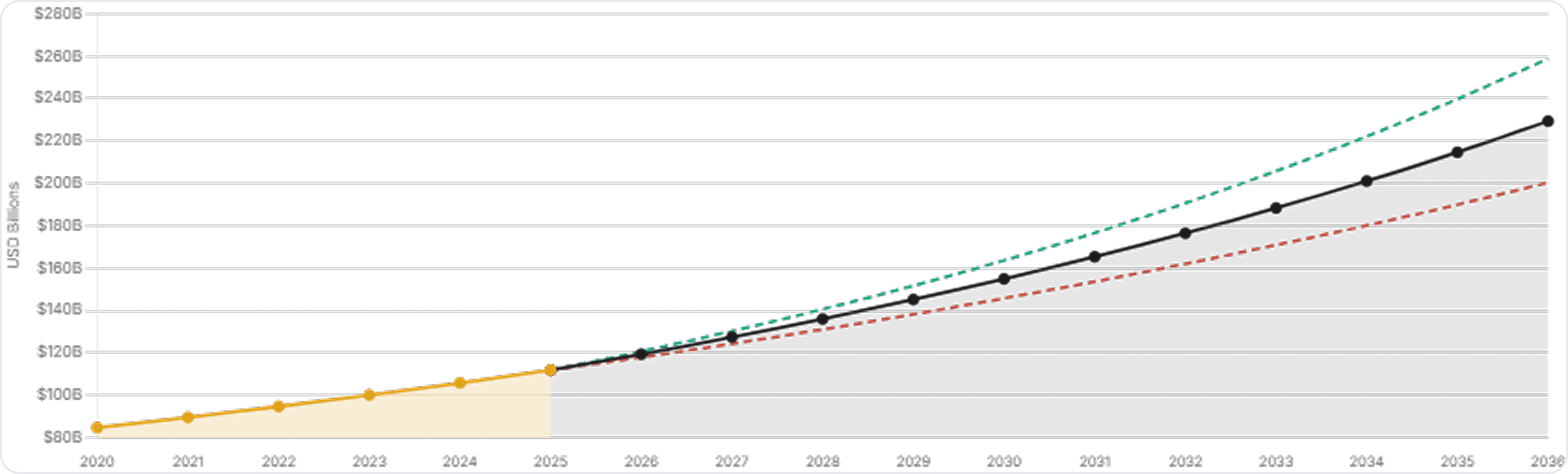
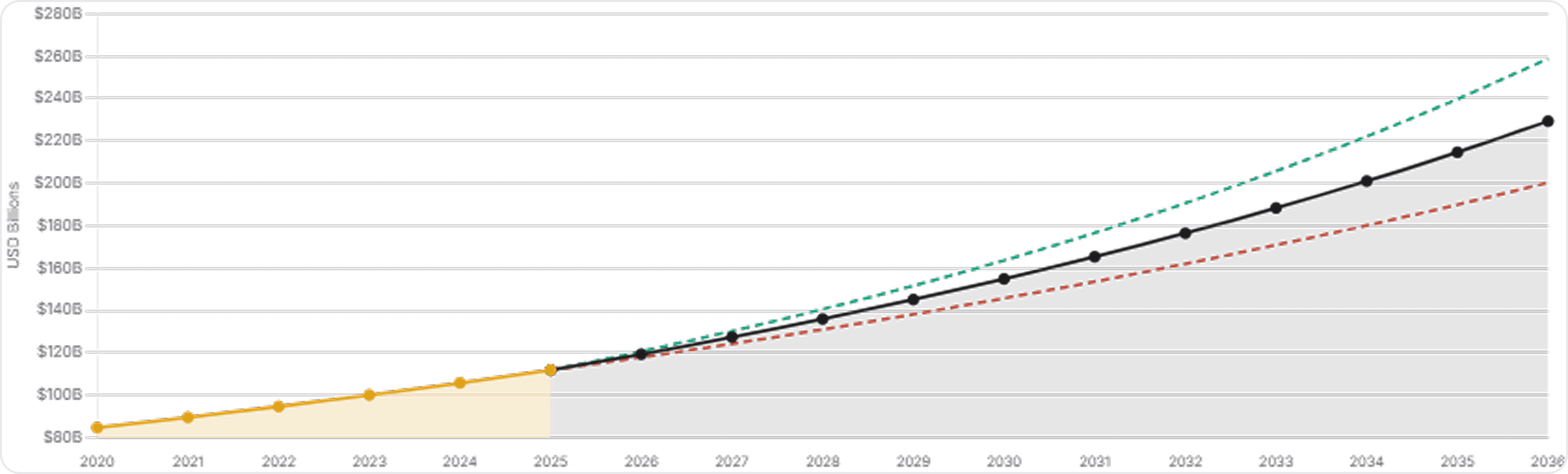
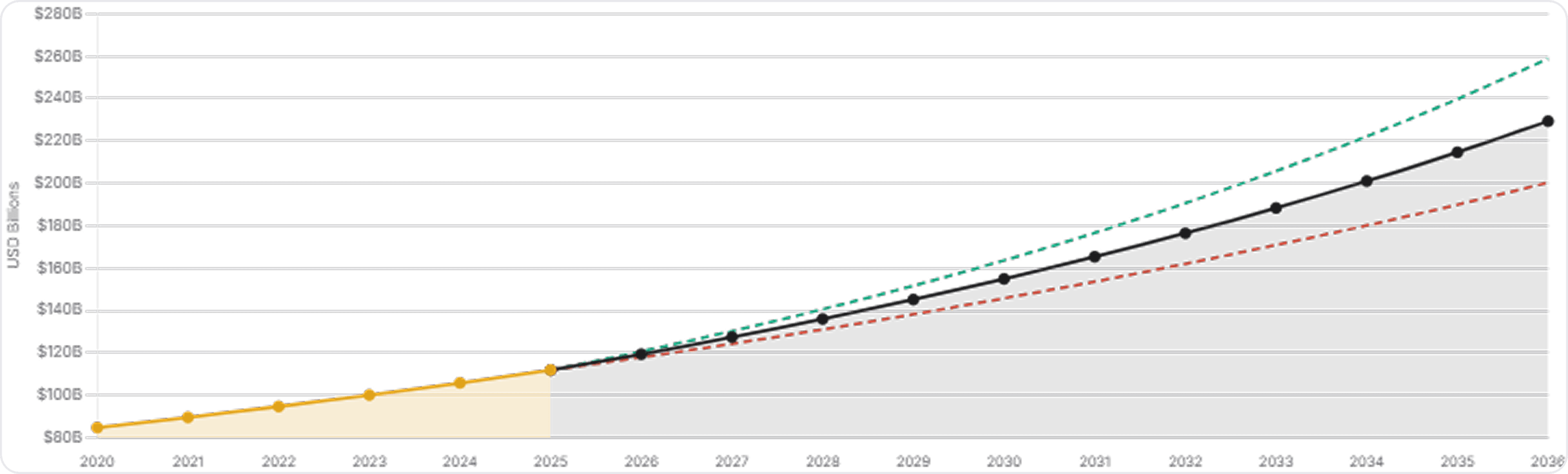
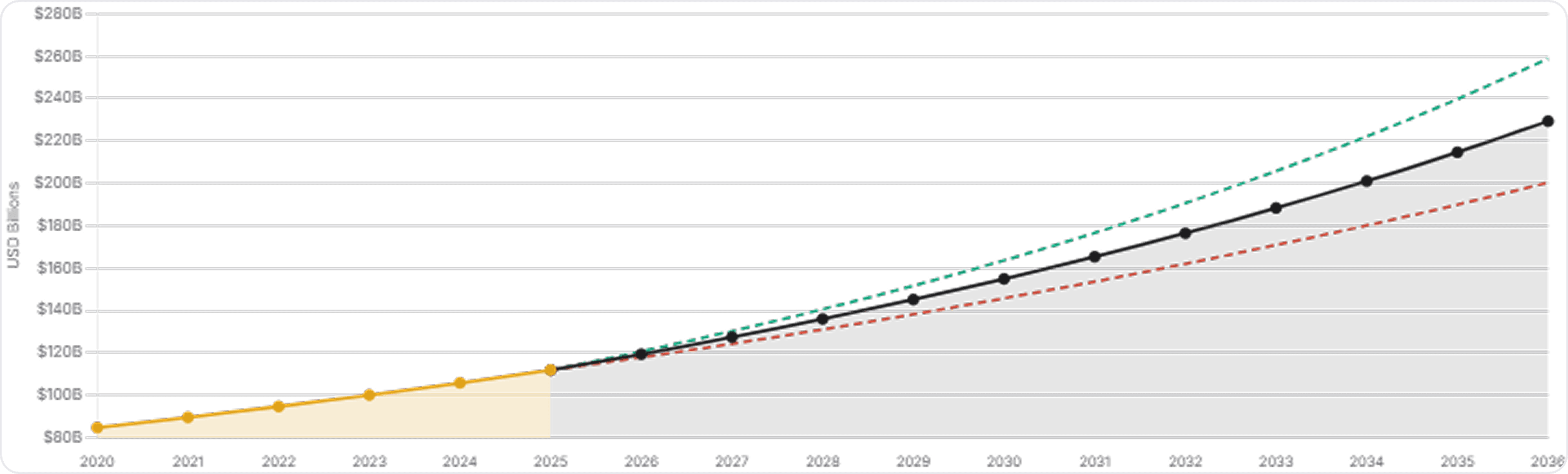
Market Size Trajectory 2020 to 2036

95-2-1786355406537
MMA Primary Research Dataset, April 2026. Forecast derived from a bottom-up demand model combining household penetration survey data (n=3,800) with channel velocity inputs and company segment disclosures

Market Overview


The category grew up on the internet. Direct-to-consumer brands built the broad-spectrum gummy as a way to sell a calming, no-high wellness product to buyers who wanted the minor cannabinoids without the psychoactive load, and they did it largely outside conventional retail because conventional retail would not stock them. That is changing. Pharmacy chains, club stores, and national grocers have started carving out shelf space as testing standards firmed up and as the 2018 US Farm Bill kept h

Repeat Purchase Rate61%of category buyers reorder within 90 days
DTC Share of Revenue54%direct channel still leads US sales
Avg Selling Price$0.11per mg CBD, broad-spectrum format
Tier-3 Gross Margin65-75%functional blend formats
Mass Retail SKUs3,400+listed across US chains, 2025
Survey Base3,800consumers, 6 countries, Q4 2025

The category grew up on the internet. Direct-to-consumer brands built the broad-spectrum gummy as a way to sell a calming, no-high wellness product to buyers who wanted the minor cannabinoids without the psychoactive load, and they did it largely outside conventional retail because conventional retail would not stock them. That is changing. Pharmacy chains, club stores, and national grocers have started carving out shelf space as testing standards firmed up and as the 2018 US Farm Bill kept hemp-derived CBD in a workable legal posture for ingestibles.


Three forces are converging right now. Regulatory clarity is arriving unevenly but arriving: Japan revised its cannabis statute in 2024 to a THC-threshold model, the European bloc is slowly clearing its Novel Food backlog, and several Latin American regulators have opened import pathways. Formulation is the second force. Brands have learned that a plain CBD gummy commoditizes fast, so they stack it with melatonin, L-theanine, ashwagandha, and functional mushrooms to defend price and differentiate. The third is channel migration, which rewires the unit economics of the whole category as DTC-native brands chase the velocity of a national retail endcap.


"

The plain CBD gummy is already a commodity. The interesting money is in the blend: a sleep stack or an adaptogen formula that a consumer can't price-compare to a 1,000mg jar on a marketplace, because there's nothing identical to compare it to. That's where the margin lives, and that's where the regulatory risk lives too.

"
MMA Lead Analyst, Consumer Health Practice

Growth Drivers

Japan's 2024 cannabis law revision opens a compliant East Asian channel

Japan moved from a plant-based prohibition to a THC-threshold framework with its revised Cannabis Control Act, effective from December 2024. Broad-spectrum formulations that hold tetrahydrocannabinol below the residual limit become importable and shelf-legal, converting a previously isolate-only market into one that accepts the fuller cannabinoid profile.

+12% addressable East Asia retail SKUs by 2027
Functional stacking with adaptogens and sleep actives

Blending cannabidiol with melatonin, L-theanine, ashwagandha, and functional mushroom extracts moves the product out of direct price comparison with single-ingredient gummies. The supplement category's familiarity with these actives gives brands a credibility bridge and a reason for buyers to pay more per unit.

Blended SKUs hold a 22 to 30% price premium (MMA E

4 additional growth drivers are covered in the full report.

Segmentation Analysis

Seven functional segments compete for the same shelf. Two of them grow well ahead of the category. The fastest expands at 1.41x the market rate.


95-4-1786355406540

Functional Mushroom & Adaptogen Blends

Gummies pairing broad-spectrum CBD with lion's mane, reishi, cordyceps, or ashwagandha sell against a stress-and-focus need state rather than against other CBD products. The format carries the highest margin in the category and the lowest direct-price comparability, which is exactly why it leads on growth.

CAGR 16.2%

Sleep & Relaxation (Melatonin-Blended)

The melatonin-plus-CBD night gummy is the category's most reliable repeat purchaser, anchored to a daily ritual that drives the 61% reorder rate. Retail buyers favour it because the use case is legible to a mass shopper who may never have bought a cannabinoid product before.

CAGR 14.8%

Full segment breakdown across 7 segments available in the complete report.

Regional Analysis


North America holds the value. The growth premium sits elsewhere, in two regions where regulatory pathways are opening from a low base.

South Asia & Pacific

Australia anchors this region. The Therapeutic Goods Administration down-scheduled low-dose CBD to allow pharmacist-supervised over-the-counter sale, and pharmacy distribution converts a clinical product into a wellness purchase with a trusted gatekeeper attached. New Zealand's medicinal scheme and a widening grey-to-formal transition across Southeast Asian e-commerce add the rest of the 13.6% growth.

CAGR 13.6%

Latin America

Regulatory reform is the engine here, not income growth. Mexico's framework changes and Brazil's expanding ANVISA import authorizations are pulling formal supply into markets that previously ran on informal channels, while Colombia's cultivation-export base gives domestic brands a low-cost extract supply other regions lack. That cost position underpins a 13.1% rate.

CAGR 13.1%

Regional intelligence for 5 additional markets available in the complete report.

95-5-1786355406541

Strategic Revenue Levers

Above-market margin in this category comes from owning the reorder and from formats a marketplace can't price-match. These four levers are where it is won.

Convert one-time buyers to auto-ship subscriptions

The night-time and adaptogen rituals make this a daily-use category, which is the precondition for a subscription model. Locking in the reorder removes the constant reacquisition cost that erodes DTC profitability.


Auto-ship subscribers show 2.4x annual repeat valu

Stack third-party certifications as a pricing and shelf-access moat

USHA, NSF, and ISO certified-tested marks do double duty: they let a brand defend a premium and they reduce the delisting risk a retail buyer fears when stocking a cannabinoid product. Certification is cheaper than the shelf space it protects.

Certified SKUs sustain an 18 to 24% price premium

Extend into adaptogen and sleep blends to lift basket size

A buyer who trusts a brand's plain gummy will pay more for its sleep stack and its focus blend. The blend portfolio raises average order value without raising customer acquisition cost.

Blended formats lift average order value by roughl

Migrate from DTC-only into national mass-retail placement

Pharmacy, grocery, and club shelf placement reaches buyers who will never visit a CBD website. Velocity at shelf can run several times DTC volume at a materially lower cost to acquire each customer.

National chain placement can 3x unit velocity at l

Competitive Landscape

The top five brands hold a combined 56% of value, a range that looks concentrated until you account for how it was built. CBD's marketing restrictions blocked the usual paid-acquisition arms race, so early scale went to brands that won on retail relationships, certification credibility, or founder genetics rather than ad spend. That keeps the leaderboard relatively stable year to year. The remaining 44% is fragmented across hundreds of regional and private-label players, which is where most c

The 8 percentage point spread within the top tier reflects a real divergence between Solvay and SABIC's broad portfolio reach and Celanese's narrower position post the DuPont Mobility & Materials transaction. The remaining 47% is fragmented across regional specialists, Japanese producers with deep electronics relationships, and Chinese national champions building scale in PEEK, PPS, and LCP. Chinese domestic substitution has moved roughly 18% of China's PEEK demand to local supply since 2022. Four private equity transactions above $200M have closed on mid-cap bio-based polymer producers in the past 18 months according to company press disclosures.

95-7-1786355406542
Moat

Charlotte's Web

Proprietary Stanley Brothers cultivar genetics plus the deepest mass-retail distribution in the category give it a supply and shelf position rivals cannot copy quickly.

Moat

CBDistillery

Price-value leadership at high certified volume. Its cost position lets it set the category's value floor and absorb margin pressure that smaller brands cannot.

Moat

cbdMD

Athlete partnerships and a patented broad-spectrum formulation anchor a recognisable brand identity in the recovery and performance use case.

Moat

Medterra

NSF and clinical-grade certification across a wide isolate-and-broad range builds trust with cautious retail buyers and regulated international channels.

Risk

Charlotte's Web

Premium pricing faces real pressure as the plain-gummy tier commoditizes and private label undercuts the value proposition.

Risk

CBDistillery

Thin margins and a blended isolate-and-broad mix dilute the brand's premium positioning and leave little buffer in a price war.

Risk

cbdMD

High marketing burn and public-company scrutiny pressure the path to sustained profitability.

Risk

Green Roads

Pharmacist-formulated credibility has not yet translated into a meaningful international footprint, capping its growth runway.

Recent Development

Q4 2024

Japan revises Cannabis Control Act to a THC-threshold model

The revision, effective December 2024, replaced a plant-based prohibition with a residual-THC limit, allowing compliant broad-spectrum products into a market that previously accepted isolate only.

Signal: brands with documented non-detect THC supp
2024

US mass-retail chains expand CBD ingestible shelf programmes

Several national pharmacy and grocery chains broadened ingestible CBD assortments after tightening their own potency and contaminant testing requirements for suppliers.

Signal: certification depth is becoming the gate t
2023 to 2025

Functional blend launches accelerate across leading brands

Category leaders pushed sleep, calm, and adaptogen blends to defend margin as the plain-gummy tier commoditized, with mushroom-blend formats entering several mainstream lineups.

Signal: the competitive battle is moving from mill

Input Cost & Margin Risk

Bulk broad-spectrum distillate is the single largest cost input at roughly 32% of COGS, followed by the gummy base of gelatin or pectin and sweeteners at about 24%, packaging at 18%, co-packing labour and energy at 14%, and third-party testing and compliance at 12%. The distillate line is the volatile one. After the 2018 US hemp expansion, oversupply collapsed wholesale CBD distillate pricing from above $2,000 per kilogram to under $400 within a few years, then a partial recovery followed as

A brand that locked into long-dated distillate contracts during the glut won a durable cost advantage; one that did not, and that also absorbed the 2022 to 2023 run-up in sugar and gelatin prices, found its gross margin compressed from two directions at once. Energy costs at the co-packing stage add a third sensitivity, tracked through EIA industrial energy data and reflected in contract manufacturer pricing. The disadvantage mechanism is simple: an unhedged manufacturer competing against a hedged one on a commoditizing plain-gummy shelf cannot match price without bleeding margin.


95-8-1786355406543

Forward extract contracts

Multi-quarter purchase agreements with extractors lock distillate cost and smooth the volatility that has historically swung wholesale pricing by a multiple within a single cycle.

Dual-source supply

Qualifying a second extractor in a different jurisdiction, such as a Colombian cultivation-export supplier, hedges both price and regulatory single-point risk.

Pectin reformulation

Moving from gelatin to pectin bases hedges animal-protein input inflation and opens the vegan segment at the same time, turning a cost defence into a demand lever.

Forward extract contracts

Multi-quarter purchase agreements with extractors lock distillate cost and smooth the volatility that has historically swung wholesale pricing by a multiple within a single cycle.

Dual-source supply

Qualifying a second extractor in a different jurisdiction, such as a Colombian cultivation-export supplier, hedges both price and regulatory single-point risk.

Pectin reformulation

Moving from gelatin to pectin bases hedges animal-protein input inflation and opens the vegan segment at the same time, turning a cost defence into a demand lever.

Portfolio Strategy

Every brand in this category faces the same tension. The plain broad-spectrum gummy is what builds trial and retail listings, but it is also the format racing toward commodity margins. The premium and functional tiers carry the profit, yet they depend on the trust the entry tier earns. Pricing a portfolio across all three without cannibalising the high-margin top is the core architecture problem.

Three sub-segments reward focus: melatonin sleep stacks with their reliable reorder behaviour, adaptogen and mushroom blends with the category's best margin and lowest price comparability, and sugar-free or vegan clean-label formats that travel into channels and demographics the standard gummy cannot reach.

Volume Broad-Spectrum Gummies

The trial-driving, shelf-winning entry format. Necessary for distribution and brand recognition, but exposed to private-label and marketplace price pressure as the format commoditizes.

GM 45 to 55%

Premium Certified Broad-Spectrum

Third-party tested, certified, branded gummies sold on transparency and consistency. The certification depth is the moat that supports the premium and the retail listing.

GM 58 to 68%

Functional & Next-Generation Blends

Adaptogen, sleep-stack, and nano-emulsion formats sold against a need state, not a milligram count. Highest margin and lowest direct price comparability in the portfolio.

GM 65 to 75%
95-9-1786355406544

Melatonin Sleep Stack

Highest reorder reliability in the category, anchored to a nightly ritual. The format mass retail understands best.


High-value sub-segment

Adaptogen & Mushroom Blend

Best margin, lowest price comparability, fastest growth. The format that most resists commoditization.

High-value sub-segment

Sugar-Free / Vegan Clean-Label

Reaches diabetic, vegan, and clean-label buyers and travels into grocery and pharmacy channels the standard gummy struggles to enter.

High-value sub-segment

Regulatory Whiplash Watch-Out

An over-concentrated functional-blend portfolio is exposed if a regulator reclassifies a stacked active such as a specific mushroom extract or melatonin dosage. Diversify the blend bench.

Strategic watch-out

Demand Architecture

The economics of this category rest on the reorder. A daily sleep or calm gummy behaves like an annuity: once a buyer builds the product into a nightly routine, the 61% ninety-day repeat rate compounds lifetime value far past the cost of the first sale. That is why subscription conversion sits at the top of the lever list and why brands fight so hard for the reorder rather than the trial.

Stickiness comes from ritual and from trust. A buyer who has vetted a brand's testing once is reluctant to re-run that diligence on a cheaper competitor, so certification depth doubles as a retention mechanism. The switching cost is not contractual; it is the cognitive cost of re-trusting a cannabinoid product, and that cost is real.

95-10-1786355406544

MMA Strategic Verdict

These are the four positions where MMA expects the largest divergence between winners and laggards over the eleven-year forecast period. Each is grounded in the demand model, the regulatory perimeter, and the announced capacity pipeline.

01 / Formulation as Defence

Margin migrates to the blend, not the milligram

The plain gummy is a commodity in motion. Functional and sleep blends are where pricing power and the fastest growth concentrate. A brand without a credible blend bench is competing on cost alone.

02 / Certification Gate

Testing depth is now the entry ticket to shelf

Retail buyers gate cannabinoid listings on contaminant and potency testing. Certification has shifted from a premium signal to a precondition. Brands that under-invest here lose distribution before they lose price.

03 / Regulatory Asymmetry

Growth follows the regulators that are opening up

Japan's 2024 revision and Latin American import reform create growth pockets disconnected from population size. The fastest regional rates sit where rules are loosening from a low base, not where the market is largest.

04 / Reorder Economics

The annuity beats the acquisition

A 61% repeat rate makes the reorder, not the first sale, the real prize. Subscription conversion and ritual-anchored formats compound lifetime value and decide which DTC brands survive rising acquisition costs.

Case Study

A live engagement with a European specialty polymer producer carrying material fluoropolymer exposure ahead of the EU PFAS file, showing how MMA's research translates to a defensible 36-month portfolio strategy


Client Profile
A founder-led US broad-spectrum CBD gummy brand with roughly $58 million in annual revenue (client-reported, unverified by MMA), about 70% of it through direct-to-consumer channels, weighing European entry and a national retail push at the same time.
Strategic Challenge
Customer acquisition cost on the DTC side had climbed for six consecutive quarters and was compressing contribution margin, while the plain-gummy tier faced marketplace and private-label price pressure. Management needed to decide where the next dollar of growth investment should go.
MMA Approach
We built a channel-level unit economics model, ran a 14-market regulatory readiness screen, and conducted nine expert interviews across retail buying, contract manufacturing, and compliance to test feasibility before recommending capital allocation.
Key Findings
  1. DTC reacquisition cost had risen to a point where one-time buyers were marginally unprofitable; subscription conversion was the only path back to healthy contribution.
  2. European entry carried a Novel Food authorisation timeline long enough to delay revenue by 18 to 24 months, making it the slower of the two options.
  3. The brand's adaptogen blend, a minor SKU, quietly carried the portfolio's highest margin and lowest return rate.
  4. National pharmacy placement was achievable within two quarters given the brand's existing NSF certification, at a customer acquisition cost well below DTC
Recommended Strategy
Phase one: convert the DTC base to subscription and reposition the adaptogen blend as a hero SKU. Phase two: pursue national pharmacy and grocery placement on the strength of existing certification, and defer European entry until the retail channel was contributing.
Outcome
Within three quarters the client reported subscription mix rising from 19% to 34% of DTC revenue and a national pharmacy listing secured, with blended contribution margin recovering by roughly 6 points (client-reported, unverified by MMA). European entry was rescheduled to follow the retail ramp.

Frequently Asked Questions

The questions clients raise most often in pre-purchase conversations, answered against the MMA Primary Research Dataset, April 2026.

What is the current size of the Broad Spectrum CBD Gummies Market?

The global market reached $2.4 billion in 2025 (MMA Primary Research Dataset, April 2026). This covers ingestible broad-spectrum gummies and excludes isolate-only and full-spectrum formats.

How large will the Broad Spectrum CBD Gummies Market be by 2036?

The base case forecast is $7.9 billion by 2036, an incremental opportunity of $5.2 billion over the 2026 base. That represents a 2.93x value expansion across the forecast decade

What is the CAGR for the Broad Spectrum CBD Gummies Market 2026 to 2036?

The base case CAGR is 11.5%, with a bull scenario of 13.0% and a bear scenario of 10.0%. The spread reflects how much of the growth depends on the pace of regulatory clarity.

Which segment is growing fastest?

Functional Mushroom & Adaptogen Blends lead at 16.2%, which is 1.41x the market rate. Melatonin sleep blends follow at 14.8%.

Who are the major companies in the Broad Spectrum CBD Gummies Market?

The five leaders are Charlotte's Web, CBDistillery, cbdMD, Green Roads, and Medterra, holding a combined 56% of value. Challengers include Joy Organics, Cornbread Hemp, Five CBD, and Lord Jones.

Market Segmentation Tree


The full report scope covers four orthogonal segmentation dimensions, with cross-tabulated demand data for each dimension pair.

By Formulation Type

  • Functional Mushroom & Adaptogen
  • Sleep & Relaxation (Melatonin)
  • Daytime Calm & Stress
  • Recovery & Pain Relief
  • Sugar-Free & Vegan Clean-Label
  • Immunity & Wellness Blends
  • Energy & Focus

By End-Use Need State

  • Sleep Support
  • Stress & Anxiety Wellness
  • Post-Exercise Recovery
  • Joint & Mobility Comfort
  • Focus & Productivity
  • Beauty & Skin-From-Within

By Distribution Channel

  • Direct-to-Consumer / Subscription
  • Online Marketplace
  • Pharmacy & Drug Store
  • Grocery & Mass Retail
  • Club & Warehouse
  • Specialty & Dispensary

By Region

  • North America
  • Western Europe
  • East Asia
  • South Asia & Pacific
  • Latin America
  • Middle East & Africa
  • Eastern Europe

Report Scope

Ingestible gummy confectionery formulated with broad-spectrum hemp-derived cannabidiol, defined as extract retaining the minor cannabinoid and terpene profile with tetrahydrocannabinol removed to non-detect levels. The scope excludes full-spectrum (THC-bearing) gummies, isolate-only gummies, and all non-gummy formats including beverages, tinctures, capsules, and topicals.

Historical Period

2020 to 2025

Forecast Period

2026 to 2036

Base Year

2025, $2.4 billion (MMA Primary Research Dataset, April 2026)

Market Definition

Ingestible gummy confectionery formulated with broad-spectrum hemp-derived cannabidiol, defined as extract retaining the minor cannabinoid and terpene profile with tetrahydrocannabinol removed to non-detect levels. The scope excludes full-spectrum (THC-bearing) gummies, isolate-only gummies, and all non-gummy formats including beverages, tinctures, capsules, and topicals.

Quantitative Units

Revenue in USD billions; segment and regional CAGR in percent; price per milligram of CBD.

Segmentation Dimensions

Formulation type, end-use need state, distribution channel, region.

Regions Covered

North America, Western Europe, East Asia, South Asia & Pacific, Latin America, Middle East & Africa, Eastern Europe.

Countries Covered

USA, China, Germany, France, UK, Japan, South Korea, India, Australia, Canada, Brazil, Mexico, Indonesia, Vietnam, Thailand, Malaysia, UAE, Saudi Arabia, South Africa, Nigeria, Turkey, Poland, Netherlands, Italy, Spain, Sweden, Switzerland, Argentina, Colombia, Singapore, Chile, New Zealand, Belgium.

Purchase the Full Broad Spectrum CBD Gummies Report (2026 to 2036)

The complete report opens all 7 segments and all 7 regions with full data, profiles the 12 named companies with share and positioning detail, and adds the 4 gated growth drivers, the full 34-country model, and the underlying Excel demand appendix. Built for teams making channel, formulation, and market-entry decisions in a category where the regulation is still moving.

Full CAGR and revenue data for all 7 functional segments
Regional intelligence across all 7 markets, not just the two fastest
Company-level share, moat, and positioning for 12 brands
34-country demand model with regulatory readiness scoring
Input cost and margin sensitivity scenarios with hedging playbook
Three-tier portfolio margin architecture and pricing guidance
Full CAGR and revenue data for all 7 functional segments
Regional intelligence across all 7 markets, not just the two fastest
Company-level share, moat, and positioning for 12 brands
34-country demand model with regulatory readiness scoring
Input cost and margin sensitivity scenarios with hedging playbook
Three-tier portfolio margin architecture and pricing guidance

Built for the
people who decide.

From boardroom strategy to bench-side R&D, this report is read cover-to-cover by leaders shaping the next decade of specialty pharmaceuticals — turning penetration scenarios, capacity data, and valuation benchmarks into decisions.

Strategy Teams at Specialty Producers
M&A and Corporate Development
Product Directors and R&D VPs
Procurement and Supply Chain
Regulatory Affairs Leaders
Investor Relations and Equity Analysts