Market Minds Advisory
Terminal Sterilization Services Market

Terminal Sterilization Services Market: Capacity Set by Nuclear Scheduling and Air Quality Rules

Cobalt decays whether anybody uses it and ethylene oxide faces emissions rules that close plants, so this industry's capacity is governed by decisions taken in reactors and regulators rather than boardrooms.

Lead Analyst

Alice Ballenger

Published

September 2026

Make Smarter Decisions with Customized Research Insights

Request a free sample report and evaluate market opportunities, growth trends, and competitive dynamics relevant to your business needs.

2025 MARKET VALUE$4.8BMarket Size 2025
2036 FORECAST VALUE$9.7BBase Case , 2026 to 2036
CAGR 2026 TO 20366.6 %Bull 7.8% / Bear 5.4%
INCREMENTAL OPPORTUNITY$4.6BNet 10- year value creation
EXPANSION MULTIPLE1.89x2036 value over 2026 base
Strategic Levers
M&A Pipeline
Regional Outlook
Country Rankings
Competitive Intelligence
Segmental Deep-dive
Call-Us : 91 93563 13602

Executive Snapshot and Market Trajectory

Two inputs govern this industry and no participant controls either. Cobalt-60 loses around 12% of its activity to decay every year regardless of use, and it comes from roughly eight reactor sites operating on schedules that nuclear utilities set for reasons entirely unconnected to sterilisation demand.
The second is regulatory. Ethylene oxide handles around 48% of medical device sterilisation and faces emissions rules that have already closed facilities and produced device shortages. Customers cannot simply move elsewhere, because a device validated on one modality needs roughly 14 months of revalidation work to qualify on another, which is a genuine trap rather than an inconvenience. A closure turns a capacity problem into a product availability crisis for everybody validated on that facility.
X-ray is the one modality that escapes both constraints, using the same photon physics as gamma without any radioisotope supply chain behind it. It grows fastest at 9.9% on that basis alone. Costa Rica leads all countries at 11.6% as medical device manufacturing clusters there build sterilisation capacity alongside the plants they serve. Capital cost is high and the capacity can actually be scheduled.
Market Definition
Contract and in-house terminal sterilisation of finished medical devices, pharmaceuticals and packaging in their final containers, covering ethylene oxide sterilisation, gamma irradiation, electron beam irradiation, X-ray irradiation, steam and moist heat, and novel chemical modalities. Measured at service provider selling value including validation and dosimetry services. Excludes sterilisation equipment sold as capital goods, aseptic processing and filling, hospital reprocessing of reusable instruments, food irradiation, and packaging materials.
Base Year Value
$4.8B in 2025 (MMA Primary Research Dataset, August 2026)
Forecast Period
2026 to 2036, eleven discrete annual values
CAGR
6.6% base case. Bull 7.8%. Bear 5.4%.
Fastest Growth Segment
X-Ray Irradiation: 9.9% CAGR
Fastest Growth Country
Costa Rica: 11.6% CAGR
Fastest Growth Region
South Asia and Pacific: 8.6% CAGR
Largest Region
North America: 32% of 2025 global value
Market Leaders
Sotera Health, Steris, Cosmed Group, BGS Beta-Gamma-Service, Ionisos. Source: MMA Primary Research Dataset, July 2026.
Primary Survey
n=3,800 procurement and R&D decision-makers, Q4 2025, six countries
Methodology
Demand-side build-up, cross-validated against public data, 47 expert interviews

Terminal Sterilization Services Market Forecast Scenarios

terminal-sterilization-services-market-size-forecast-scenario-1787639813811
Growth ran near 5.4% between 2020 and 2025, constrained by capacity rather than by demand at several points. Ethylene oxide facility closures under emissions enforcement produced localised device shortages and forced customers into revalidation programmes they had not budgeted for. Cobalt supply tightened as reactor scheduling and decay together outpaced replenishment, and X-ray capacity began being installed as a direct response to both problems.
Base case 6.6% rests on three mechanisms. X-ray irradiation grows at 9.9% because it delivers photon sterilisation without any radioisotope supply chain and without ethylene oxide emissions exposure. Electron beam grows at 8.4% where product geometry permits it. And Costa Rica grows fastest of any country at 11.6% as medical device manufacturing clusters install sterilisation capacity alongside production rather than shipping product abroad. None of the three depends on device volumes rising at all.
The bull case at 7.8% assumes accelerated modality transition as customers absorb revalidation costs to escape supply and regulatory exposure, which would pull demand forward considerably. The bear case at 5.4% is revalidation cost and timeline keeping customers locked to modalities under pressure, which constrains capacity utilisation across the industry without reducing underlying device volumes at all.

A Reactor Schedule and an Emissions Rule

Sterilisation capacity is not built the way industrial capacity usually is. Cobalt-60 has a half life of a little over five years, which means installed activity falls around 12% annually whether anybody irradiates anything, and it is produced at roughly eight reactor sites on schedules nuclear utilities set for their own operational reasons. A provider wanting more gamma capacity negotiates with an industry treating it as a by-product.
TOP FIVE CONCENTRATION68%Capital intensity and licensing keep the provider field narrow
COBALT ANNUAL DECAY12%Installed radioisotope activity lost to decay every year
REVALIDATION TIMELINE14 monthsPeriod required to qualify a device onto a different modality
CHEMICAL MODALITY SHARE48%Medical devices sterilised using the chemical route today
SERVICE FREIGHT RADIUS900 kmDistance beyond which shipping product for treatment becomes uneconomic
RADIOISOTOPE REACTOR SOURCES8Reactor sites worldwide producing medical grade radioisotope material
The other half of capacity faces regulation rather than physics. Ethylene oxide handles around 48% of medical device sterilisation, and emissions rules have already closed facilities and produced localised device shortages in the process. Neither constraint responds to demand, which makes this an industry where a supply crisis can arrive from a reactor outage or an air quality ruling with no warning that any customer would recognise.
What makes both constraints genuinely serious is that customers cannot move. A device is validated for a specific modality and dose, and qualifying it onto another takes roughly 14 months of work plus regulatory submission, which for a complex device is expensive and slow. When a facility closes, customers choose between a revalidation programme and not shipping at all.
"Every other service industry can add capacity when demand justifies it. This one waits for a Canadian reactor to load cobalt targets on a schedule set for electricity generation, and finds out what its ethylene oxide plants can emit from an air quality regulator. Neither of those people is thinking about medical devices."
Director, Medical Device Manufacturing Services Practice · MMA Medical Devices Practice · August 2026

Market Trends

X-ray capacity installed to escape both supply constraints

X-ray irradiation uses the same photon physics as gamma while generating radiation electrically, which removes the radioisotope supply chain entirely and carries no emissions exposure either. Growth at 9.9% follows from escaping both constraints rather than from any performance advantage over established modalities. Capital cost is high and utilisation must be strong to justify it, but a provider installing X-ray is buying capacity it can actually schedule rather than capacity that decays at 12% a year regardless. Utilisation has to be strong to justify the capital, which favours providers with dense manufacturing clusters within economic freight distance of the site.
Market Impact: Costa Rica growing at 11.6%
Emissions enforcement closing chemical sterilisation facilities

Ethylene oxide emissions rules have closed facilities and produced localised device shortages, in a modality still handling around 48% of medical device sterilisation. Remaining capacity has invested heavily in emissions control to continue operating. The commercial consequence reaches beyond the closures themselves, because customers now carry a risk they had never previously priced and are beginning to qualify second modalities defensively rather than waiting to discover a facility has stopped accepting their product. Providers offering a second modality under one quality system are the direct beneficiaries of that behaviour change.
Market Impact: Avoids 14 month revalidation delay

Market Opportunities and Growth Drivers

Device manufacturing clusters building sterilisation capacity locally

Costa Rica grows fastest of any country at 11.6% as medical device manufacturing clusters install sterilisation capacity alongside production rather than shipping finished product across borders and back. Freight economics make treatment uneconomic beyond roughly 900 kilometres, which means capacity follows manufacturing rather than the other way around. Similar patterns hold in Malaysia, the Dominican Republic and parts of Eastern Europe wherever device assembly has concentrated over the past decade. Providers tracking where assembly is concentrating can site capacity before plants commission, which is a considerably stronger position than arriving afterwards.
Market Impact: Locks customers for 14 months

Defensive second modality qualification spreading among manufacturers

Manufacturers who watched customers of closed ethylene oxide facilities face 14 month revalidation programmes have begun qualifying second modalities before they are forced to, which converts a contingency into a planned expenditure. That behaviour creates validation service demand independent of production volume and builds redundancy the industry has never previously had. It also gives providers offering multiple modalities under one quality system a considerable commercial advantage over single modality operators. Validation service demand therefore rises independently of production volume, which is unusual in a business otherwise tied entirely to throughput.
Market Impact: Produced at only 8 reactor sites

Market Restraints and Challenges

Validation lock preventing customers moving between modalities

A device validated on one modality requires roughly 14 months of qualification work plus regulatory submission to move to another, which means a customer facing a facility closure cannot simply switch providers. The root cause is regulatory validation design rather than any technical incompatibility. Commercially it turns a capacity problem into a product availability crisis. Defensive second modality qualification and multi-modality provider relationships are the mitigations manufacturers have started adopting deliberately. Nobody completes a revalidation programme twice if it can be avoided. Providers holding multiple modalities under one quality system are the direct beneficiaries.
Market Impact: Escapes 12% annual decay entirely

Radioisotope supply governed by nuclear operating schedules

Cobalt-60 is produced at roughly eight reactor sites on schedules set by utilities for electricity generation, and installed activity decays around 12% annually regardless of demand. The root cause is that medical isotope production is a by-product of a business with entirely different priorities. Commercially it means gamma capacity cannot be added in response to demand. X-ray installation and long term cobalt supply agreements are the mitigations available, and only the first genuinely solves it. Expanding gamma capacity means competing for isotope allocation against every other operator facing exactly the same annual decay on their own installed activity.
Market Impact: Affects 48% of device sterilisation
4 additional market trends, 3 additional growth drivers, and 2 additional restraints and challenges are covered in the full report. Contact sales@marketmindsadvisory.com to access the complete intelligence.

Segment CAGR and Growth Architecture

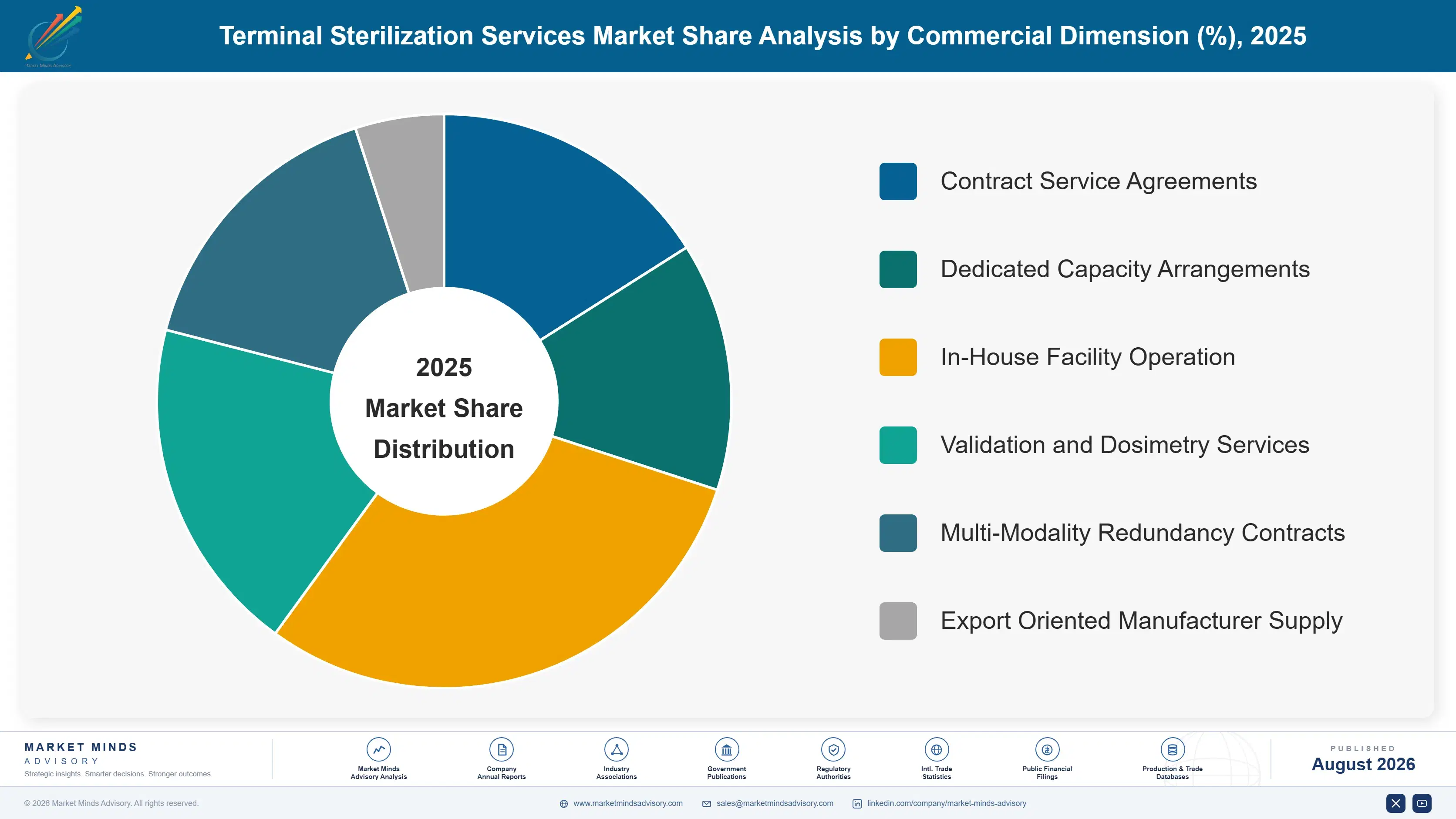
Six segments are split by sterilisation modality, because modality determines the physics or chemistry involved, the supply constraints behind it, the products it can treat and the validation required before use. Dose and cycle variants sit inside each modality. Service model and channel are handled separately in the framework. Supply exposure differs sharply by modality.
terminal-sterilization-services-market-market-share-analysis-1787639814396

X-Ray Irradiation

Growing at 9.9%, half again the market rate of 6.6%, X-ray delivers photon sterilisation using the same physics as gamma while generating the radiation electrically, which removes the radioisotope supply chain and its 12% annual decay entirely. Penetration is comparable to gamma, which makes it the most credible substitute for customers seeking to escape cobalt exposure. Capital cost is substantial and utilisation must be high to justify it, though a provider gains capacity it can genuinely schedule rather than capacity that shrinks whether or not anybody uses it. Customers seeking to escape cobalt exposure find this the most credible substitute available anywhere. Providers commissioning it choose supply certainty over lower capital cost.
CAGR 9.9%

Electron Beam Irradiation

At 8.4% electron beam offers rapid dose delivery without any isotope supply chain, constrained by limited penetration depth that restricts it to lower density products and thinner packaging configurations. That geometric limitation means it substitutes for gamma in some applications and not others, which customers discover during validation rather than during commercial discussion. Throughput is high once product suits the modality, and providers holding both electron beam and X-ray can direct product to whichever fits its density and packaging best. Customers discover the geometric limitation during validation rather than during any commercial discussion, which makes early technical assessment more valuable than a quotation. Providers holding both can route product by density instead.
CAGR 8.4%
Full segment breakdown across 6 segments available in the complete report.

Regional Architecture and Country Demand Map

North America holds 32% of value on medical device manufacturing scale and the largest contract sterilisation industry anywhere, alongside the emissions enforcement that has reshaped chemical modality capacity. Western Europe and East Asia follow at 22% each, and South Asia and Pacific grows fastest of the seven regions.

North America

Ethylene oxide emissions enforcement has been most consequential here, with facility closures producing localised device shortages and forcing customers into revalidation programmes they had not planned or budgeted for. Remaining chemical capacity has invested heavily in emissions control. X-ray installation is proceeding faster than in any other region as providers seek capacity outside both the isotope and emissions constraints. Growth at 5.8% reflects capacity limitation rather than any weakness in underlying device manufacturing demand. Customers here have been forced into revalidation programmes more often than anywhere, which has changed how they plan modality redundancy. Remaining chemical capacity has invested heavily in emissions control to continue operating at all, and that investment continues to rise year on year.
Share: 32% | CAGR: 5.8% (2026 to 2036)

Western Europe

Contract sterilisation capacity is well established and gamma remains substantial, which leaves the region exposed to cobalt supply scheduling and annual decay in the same way as everywhere else. Regulatory scrutiny of ethylene oxide is tightening though it has not produced the closure pattern seen in North America. Device manufacturing is dispersed enough that freight radius genuinely shapes provider siting. Growth of 5.2% is the slowest anywhere on mature manufacturing volumes and capacity constraint. Providers with facilities positioned inside device manufacturing regions hold advantages that no pricing decision can offset. Regulatory scrutiny of chemical modalities is tightening steadily without yet producing the facility closure pattern seen across North America. Capacity is well established.
Share: 22% | CAGR: 5.2% (2026 to 2036)
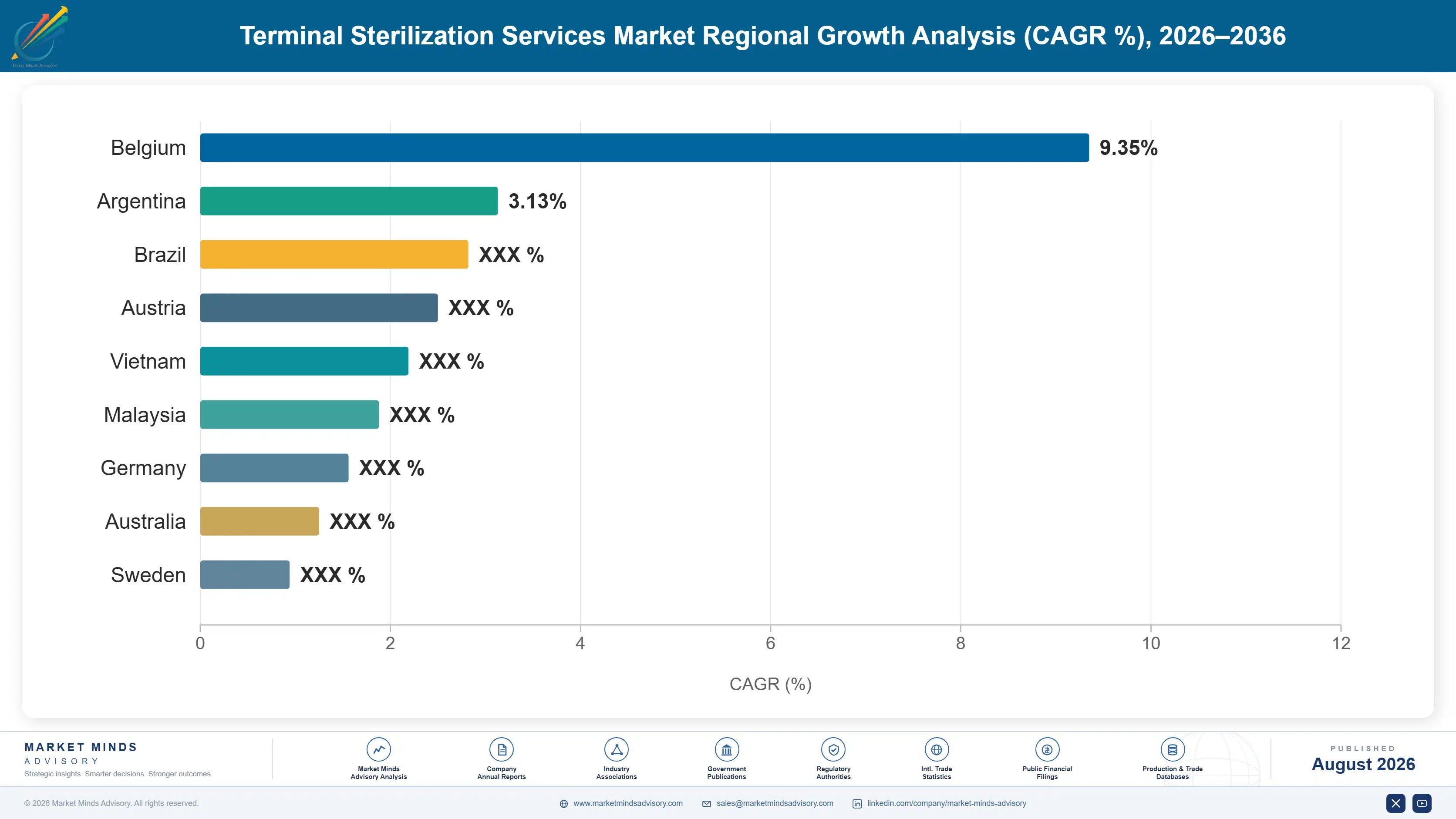
Regional intelligence for 5 additional markets available in the complete report: East Asia, South Asia and Pacific, Latin America, Middle East and Africa, Eastern Europe. Contact sales@marketmindsadvisory.com.
terminal-sterilization-services-market-country-cagr-analysis-1787639814945

Four Moves Around Uncontrollable Supply

Cobalt decays on a physical schedule and ethylene oxide operates at a regulator's discretion, neither of which responds to demand. What a provider actually controls is which modalities it offers, where it sites capacity, and whether it helps customers escape a validation lock before a closure forces the question. All four are within reach.

Install X-ray capacity to escape both constraints

X-ray delivers gamma comparable penetration using electrically generated photons, which removes the radioisotope supply chain and the 12% annual decay entirely while carrying no emissions exposure either. Capital cost is substantial and utilisation must be high, but the capacity can actually be scheduled rather than shrinking whether or not anybody uses it. Providers installing it are buying supply certainty that no cobalt contract can offer at any price. Utilisation must be strong to justify the investment, which makes cluster siting and X-ray investment the same decision in practice. Supply certainty is what is being purchased.
Market Impact: Removes the entire 12% annual isotope decay exposure

Fund customer revalidation onto a second modality

Revalidation takes around 14 months and customers who watched ethylene oxide closures have begun qualifying second modalities defensively rather than waiting to be forced. A provider funding or subsidising that qualification captures the customer onto its own second modality rather than a competitor's, and creates redundancy inside its own book. It converts a customer's contingency planning into a commercial relationship the provider actually controls. It converts contingency planning that would otherwise happen at a competitor into a relationship the provider controls, and the customer gains redundancy either way. Redundancy arrives either way.
Market Impact: Removes the whole 14 month validation lock-in period

Site capacity inside device manufacturing clusters

Freight beyond roughly 900 kilometres makes shipping product for treatment uneconomic, which means capacity has to follow manufacturing rather than the other way around. Costa Rica grows at 11.6% on exactly that logic as device clusters build sterilisation alongside production. Providers tracking where device assembly is concentrating can site capacity before manufacturers commission plants, which is a considerably stronger position than arriving afterwards. Arriving after a cluster has already commissioned capacity means the validated work is placed and effectively unreachable for years afterwards. Manufacturing location decides everything here. Nothing else matters as much.
Market Impact: Serves everything within a 900 kilometre freight radius

Hold multiple modalities under one quality system

A manufacturer wanting redundancy prefers a provider that can offer a second modality without a new supplier qualification, which is a documentation and audit advantage rather than a technical one. Around 48% of devices sit on the modality under regulatory pressure, so the demand for that redundancy is substantial and growing. Single modality providers cannot answer it, however good their capacity or pricing happens to be. Documentation and audit advantage rather than technical capability is what actually delivers this, which makes it available without any capital investment. No capital is required at all.
Market Impact: Addresses the full 48% chemical modality exposure directly

Who Controls the Margin Pool

Participation is measured on annual sterilisation service revenue across all modalities, and the top five hold 68%. Concentration is high because facilities are capital intensive, radiologically licensed and audited by device regulators, none of which a new entrant assembles quickly. Sotera Health and Steris lead through multi-modality networks positioned inside device manufacturing regions rather than through any single technology advantage. The gap to challengers is licensing and audit history rather than capital.
Competition runs on three fronts. Facility location decides which manufacturers can economically use a provider at all, given freight limits. Modality breadth decides whether a customer can add redundancy without qualifying a new supplier. And quality system standing decides whether a provider can serve export oriented manufacturers facing destination regulator audits. Supply certainty has become a fourth front, and customers now ask about it directly during qualification.

Pressure ahead comes from X-ray capacity displacing gamma and from emissions enforcement continuing to constrain chemical capacity. Expect multi-modality providers to gain against single modality operators. Rankings shift on who installs X-ray capacity inside the right manufacturing clusters first. Concentration should hold given licensing barriers. Customers now ask about supply certainty.
terminal-sterilization-services-market-company-positioning-matrix-1787639815466

Competitive Moat and Risk Dimensions

SOTERA HEALTH

Moat: Multi-modality network and location

A network spanning ethylene oxide, gamma and X-ray positioned inside major device manufacturing regions lets customers add modality redundancy without qualifying a new supplier, which is exactly what manufacturers began seeking after chemical facility closures. Replicating that network requires capital, radiological licensing and regulatory audit history that cannot be acquired at speed by anybody.
SOTERA HEALTH

Risk: Emissions enforcement facility exposure

Substantial ethylene oxide capacity sits in a modality facing emissions rules that have already closed facilities and produced litigation, which is a regulatory exposure rather than a commercial one. Investment in emissions control mitigates without removing it, and community and legal pressure operates on timelines that no operating improvement influences at all.
STERIS

Moat: Service breadth and equipment integration

Combining contract sterilisation services with sterilisation equipment manufacture and hospital infection prevention reaches customers across their whole sterility assurance requirement rather than at one point. That breadth supports relationships that survive individual facility or modality decisions, and it provides technical depth in validation that pure service providers assemble more slowly.
STERIS

Risk: Gamma capacity supply dependence

Gamma capacity depends on cobalt produced at roughly eight reactor sites on schedules set by nuclear utilities, with installed activity decaying around 12% annually regardless of use. That dependence cannot be contracted away entirely, and expanding gamma capacity means competing for isotope allocation against every other operator facing the same decay.

Players Tracked

Prominent Players

Sotera Health
Steris
Cosmed Group
BGS Beta-Gamma-Service
Ionisos

Other Key Players

E-BEAM Services
Gamma-Service Medical
Sterilization Services of Tennessee
Steri-Tek
Rad Source Technologies
IBA Industrial
Nordion
Andersen Sterilizers
Noxilizer
Getinge
Belimed
Tuttnauer
Shinva Medical
Midmark
Matachana

Recent Developments

MARCH 2026

Device manufacturer qualifies second modality before any closure occurs

A medical device manufacturer completed defensive qualification of a second sterilisation modality without waiting for any facility disruption, converting a contingency into planned expenditure after watching competitors face 14 month revalidation programmes unexpectedly. The expenditure was planned rather than urgent. Costs were considerably lower as a result.
Signal: Manufacturers now treat modality redundancy as planning rather than as crisis response across the industry now
SEPTEMBER 2025

Provider commissions X-ray capacity replacing planned gamma expansion

A contract sterilisation provider commissioned X-ray capacity in place of a planned gamma expansion, citing radioisotope supply scheduling and annual decay rather than any performance difference between the two photon based modalities. Supply certainty rather than throughput drove the decision entirely. Performance was identical between them.
Signal: Supply certainty rather than technical performance is driving modality investment decisions now for everybody for good
JANUARY 2026

Emissions ruling forces chemical sterilisation facility capacity reduction

An emissions ruling required capacity reduction at a chemical sterilisation facility, with customers holding devices validated only on that modality facing either extended lead times or a revalidation programme lasting well over a year. Some customers had no qualified alternative at all. Lead times extended considerably.
Signal: A regulatory decision becomes a device availability problem because customers cannot move anywhere else for a year

Isotope, Electricity and Compliance

Cobalt-60 supply carries around 31% of gamma service cost, priced against reactor production schedules and replenishing activity that decays roughly 12% annually. Electricity carries about 26% of X-ray and electron beam operating cost, which is the dominant variable for those modalities. Ethylene oxide, abatement and emissions control account for around 24% of chemical service cost. Facility licensing, dosimetry, validation and quality systems absorb the balance.
Industrial electricity pricing rose sharply through 2022 and remains elevated in Europe, per IEA industrial energy reporting alongside Sotera Health and Steris annual reporting for 2025 on cost and capacity commentary. That movement affected X-ray and electron beam operations considerably more than gamma, which briefly narrowed the operating cost advantage that isotope free modalities had been building against cobalt supply exposure. That gap has narrowed again as electricity pricing has stabilised somewhat.

Exposure divides on modality rather than on scale. A gamma operator carries isotope replenishment cost it cannot avoid, since decay proceeds regardless of throughput. An X-ray operator carries electricity as the dominant variable and capital charges on considerably higher equipment cost. A chemical operator carries abatement investment and regulatory compliance that has been rising steadily and shows no sign of levelling off anywhere.
terminal-sterilization-services-market-cost-volatility-analysis-1787639815661

Contract cobalt supply against multi-year replenishment requirements

Installed activity decays around 12% annually whether or not throughput justifies it, which makes replenishment a fixed obligation rather than a variable purchase. Multi-year supply agreements against reactor production schedules secure allocation that spot purchasing increasingly cannot, particularly as demand from other operators facing identical decay continues rising. Spot purchasing is tightening steadily. Allocation is the binding issue.

Match modality to product density rather than to available capacity

Electron beam suits lower density product and X-ray handles denser configurations at gamma comparable penetration, and directing product to whichever fits improves both throughput and dose uniformity. A provider holding both can route work by product characteristics rather than by whichever facility happens to have a free slot that week. Dose uniformity improves alongside throughput.

Site electrically intensive capacity against industrial power pricing

Electricity carries over a quarter of X-ray and electron beam operating cost, which makes regional industrial power pricing a genuine competitive variable rather than an operating detail. Siting must still respect the freight radius that limits what a facility can serve, so the two constraints frequently pull in opposite directions and require deliberate trade-off. Freight radius constrains the choice.

Portfolio Architecture for Margin Defence

Margin here follows supply certainty rather than throughput, because a modality whose capacity shrinks or faces closure prices differently from one a provider can genuinely schedule. Steam and commodity chemical sterilisation earns margins in the low to high teens, where capacity is widely available, validation is straightforward and customers compare price per pallet directly. Providers are largely interchangeable there. Validation is straightforward and quickly completed.
Gamma irradiation does better in the high teens to high twenties, because capacity is genuinely constrained by isotope supply and decay, which supports pricing even though the underlying service is well understood and the provider controls almost nothing about its own input availability. A provider controls almost nothing about its own input availability in that modality. Scarcity rather than service quality supports the pricing entirely.

X-ray and multi-modality redundancy services hold the strongest position, reaching into the mid thirties, where a provider offers capacity it can schedule and validation flexibility a customer cannot obtain elsewhere. Those margins reflect supply certainty and quality system breadth rather than any advantage in the physics or the operating cost. Customers feeling their own exposure acutely pay for redundancy they previously never considered.

Steam and Commodity Chemical Sterilisation

Widely available capacity treating straightforward products against simple validation. The seven point range reflects facility location and utilisation rather than any difference in the service being delivered to customers. Price decides awards.
Gross Margin: 12-19%

Gamma Irradiation Services

Capacity constrained by isotope supply and annual decay, which supports pricing on scarcity. The ten point range reflects cobalt contract position and how tightly local capacity is running against regional demand.
Gross Margin: 18-28%

X-Ray and Multi-Modality Redundancy Services

Schedulable capacity and validation flexibility customers cannot obtain from single modality providers. The ten point range reflects modality breadth and how acutely the customer feels its own supply exposure. Redundancy is the product.
Gross Margin: 26-36%
terminal-sterilization-services-market-portfolio-architecture-1787639816163

High-value Sub-segments and Strategic Watch-out

X-Ray Irradiation Capacity

High value and the fastest growth at 9.9%, delivering gamma comparable penetration with no radioisotope supply chain and no emissions exposure. Capacity can actually be scheduled rather than decaying regardless of use. Utilisation must be strong to justify the capital. Cluster siting and X-ray investment are effectively the same decision.
Gross Margin: 28-36%

Multi-Modality Redundancy Services

High value and growing as manufacturers qualify second modalities defensively after watching 14 month revalidation programmes. Single modality providers cannot answer that requirement at any price. Documentation advantage rather than technical capability delivers it. Around 48% of devices sit on the modality under regulatory pressure today.
Gross Margin: 26-34%

Commodity Steam and Chemical Services

The volume core, where capacity is widely available and customers compare price per pallet with validation requirements straightforward enough to make providers largely interchangeable. Validation requirements are straightforward throughout. Capacity is widely available and customers compare price per pallet across providers. Nothing differentiates. Price decides.
Gross Margin: 12-19%

Isotope and Emissions Exposure

The strategic watch-out. Cobalt decays 12% annually from eight reactor sites and emissions rules close chemical facilities, and the range reflects how far a provider has diversified beyond both. Neither constraint responds to demand at all. Diversification is the only genuine answer available to anybody.
Gross Margin: 10-34%

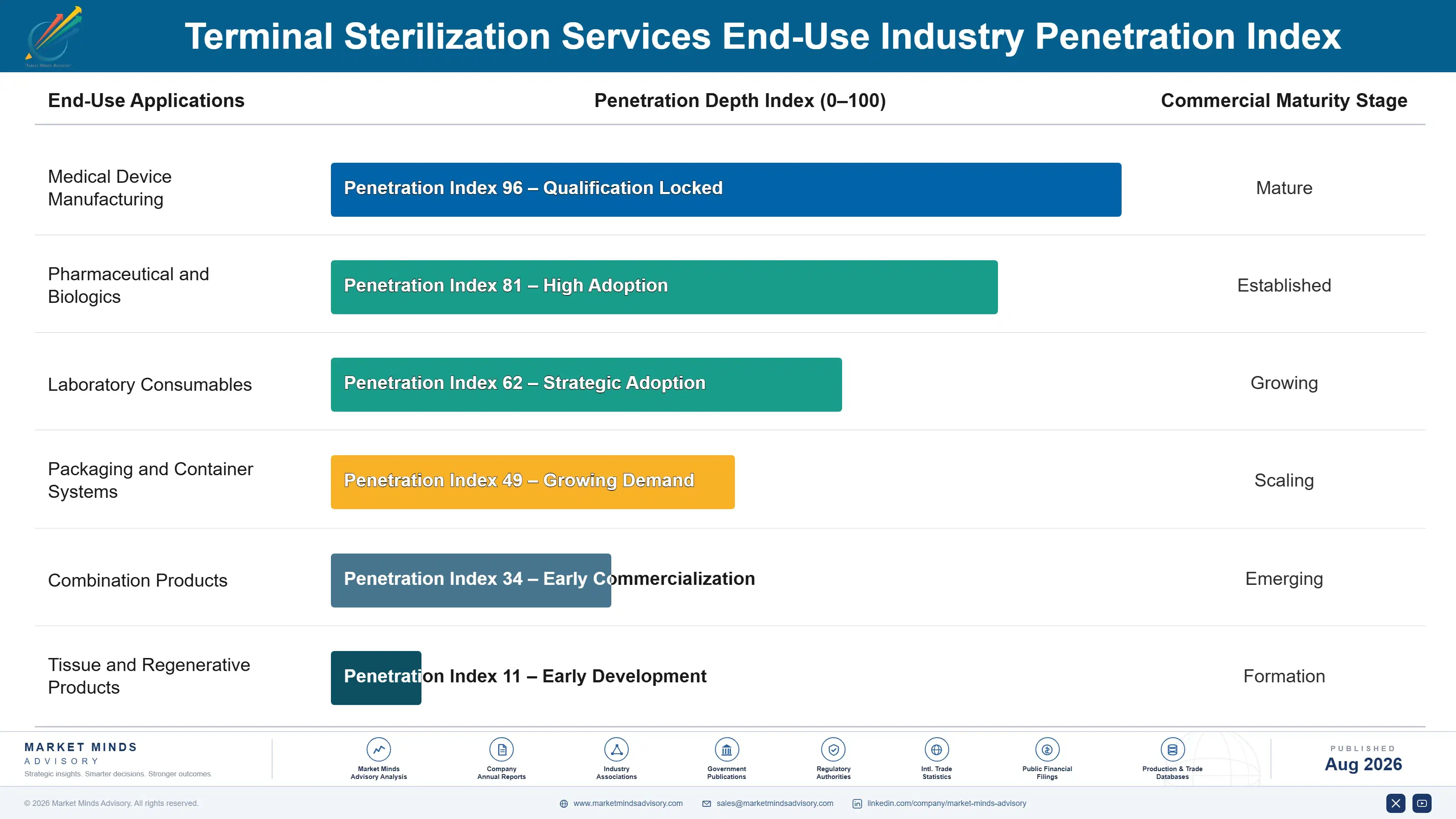
Validation Locks the Customer In

Demand here is almost perfectly inelastic in the short run, because a device validated on one modality at one dose cannot be treated any other way without roughly 14 months of qualification work and a regulatory submission. A manufacturer does not choose a provider each quarter. It chose a modality years ago during product development, and everything since has followed from that decision. Everything since has followed from that.
Stickiness is therefore extreme and entirely one directional. A provider holding validated work keeps it until something forces a change, and the things that force changes are facility closures and capacity shortages rather than commercial competition. When a customer does move, they generally move permanently, because nobody completes a revalidation programme twice if it can possibly be avoided.

The deciding functions sit further upstream than providers usually reach. Modality selection happens during device development, with regulatory affairs and quality functions choosing what to validate. Procurement handles the resulting service contract but cannot change the modality. A provider selling to procurement is talking to somebody executing a decision taken by people it has probably never met. Very few providers reach development teams.
terminal-sterilization-services-market-end-use-penetration-index-1787639816661

Where We Would Put Effort

These are among the four positions where our research anticipates prominent divergence between winners and laggards over the coming forecast period. Each is grounded in the demand model, the regulatory perimeter, and the announced capacity pipeline.
01 / SCHEDULABLE CAPACITY INVESTMENT

Buy capacity you can actually control

X-ray delivers gamma comparable penetration using electrically generated photons, which removes both the radioisotope supply chain and the 12% annual decay that shrinks installed gamma activity whether anybody uses it or not. Capital cost is substantial and utilisation must be strong enough to justify committing to it. What a provider buys is capacity it can genuinely schedule rather than capacity produced at eight reactor sites on somebody else's operating timetable, which no supply contract with any isotope producer can replicate.
02 / CUSTOMER REVALIDATION FUNDING

Pay for the escape before somebody else does

Revalidation of a device onto a second modality takes around 14 months of qualification work, and manufacturers who watched chemical facility closures have begun qualifying alternatives defensively rather than waiting to be forced into doing it under time pressure. A provider funding or subsidising that qualification captures the customer onto its own second modality rather than a competitor's. It converts contingency planning that would otherwise happen elsewhere into a durable commercial relationship that the provider actually controls and benefits from directly.
03 / CLUSTER SITING DISCIPLINE

Capacity has to follow the factories

Freight beyond roughly 900 kilometres makes shipping finished product out for treatment plainly uneconomic, which means sterilisation capacity has to follow device manufacturing rather than ever attracting it. Costa Rica grows fastest of any country at 11.6% on precisely that logic, as manufacturing clusters install their own capacity alongside production lines. Providers who track where device assembly is concentrating can site their capacity before those plants commission, which is a considerably stronger position than arriving once local alternatives already exist.
04 / UPSTREAM SPECIFICATION ACCESS

The modality was chosen during development

Modality selection happens early during device development, and it is decided by regulatory affairs and quality functions years before any service contract is ever negotiated by anybody sitting in procurement. A provider selling into procurement is therefore addressing people executing a decision they had no part in making. Reaching development teams while modality selection remains open is the only moment at which the choice is genuinely contestable, and remarkably few providers organise any part of their commercial effort that way.

Engagement Snapshot From the Field

A live engagement with an industry participant carrying material or product regulatory and market exposure ahead of a defining policy shift, showing how our research translates into a defensible multi-year portfolio strategy.
MARKET MINDS ADVISORY · CLIENT ENGAGEMENT SUMMARY
Terminal Sterilization Services Producer Strategic Portfolio Review and Transition Roadmap 2026·Investment Scenario on Terminal Sterilization Services Exposure Evaluation 2025-26
CLIENT PROFILE
A contract sterilisation provider operating gamma and ethylene oxide facilities serving medical device manufacturers across two continents, at annual revenue near 210 million dollars (client-reported, unverified by MMA). X-ray capacity did not exist and commercial effort was organised around procurement relationships at existing accounts. Cluster siting had not been reviewed. Development team access was minimal.
STRATEGIC CHALLENGE
Cobalt allocation had tightened and emissions compliance costs had risen sharply at two chemical facilities, while a planned gamma expansion looked increasingly difficult to supply. Management needed to decide between expanding within existing modalities or committing capital to something different. A capital decision was due. Time was limited. A decision was overdue.
MMA APPROACH
MMA modelled cobalt availability against decay and replenishment across the client's facilities, assessed emissions compliance trajectories at chemical sites, sized defensive revalidation activity among the client's customer base, and mapped where device manufacturing was concentrating relative to existing facility locations. Interviews with 47 experts covered sterilisation operations, device regulatory affairs and isotope supply.
KEY FINDINGS
  1. Cobalt replenishment sufficient to hold existing gamma capacity was already difficult to secure, which meant the planned expansion could not realistically be supplied at all.
  2. Several customers had begun qualifying second modalities defensively, and none of that work was being directed toward the client because it offered no third modality option.
  3. Emissions compliance investment at the chemical facilities was rising on a trajectory that would consume most of the capital allocated to the gamma expansion within a few years.
  4. Two device manufacturing clusters had grown beyond economic freight distance from the client's nearest facility, and competitors had commissioned capacity inside both of them.
CLIENT PROFILE
A contract sterilisation provider operating gamma and ethylene oxide facilities serving medical device manufacturers across two continents, at annual revenue near 210 million dollars (client-reported, unverified by MMA). X-ray capacity did not exist and commercial effort was organised around procurement relationships at existing accounts. Cluster siting had not been reviewed. Development team access was minimal.
STRATEGIC CHALLENGE
Cobalt allocation had tightened and emissions compliance costs had risen sharply at two chemical facilities, while a planned gamma expansion looked increasingly difficult to supply. Management needed to decide between expanding within existing modalities or committing capital to something different. A capital decision was due. Time was limited. A decision was overdue.
MMA APPROACH
MMA modelled cobalt availability against decay and replenishment across the client's facilities, assessed emissions compliance trajectories at chemical sites, sized defensive revalidation activity among the client's customer base, and mapped where device manufacturing was concentrating relative to existing facility locations. Interviews with 47 experts covered sterilisation operations, device regulatory affairs and isotope supply.
KEY FINDINGS
  1. Cobalt replenishment sufficient to hold existing gamma capacity was already difficult to secure, which meant the planned expansion could not realistically be supplied at all.
  2. Several customers had begun qualifying second modalities defensively, and none of that work was being directed toward the client because it offered no third modality option.
  3. Emissions compliance investment at the chemical facilities was rising on a trajectory that would consume most of the capital allocated to the gamma expansion within a few years.
  4. Two device manufacturing clusters had grown beyond economic freight distance from the client's nearest facility, and competitors had commissioned capacity inside both of them.
RECOMMENDED STRATEGY
Phase 1: Phase one: redirect the planned gamma expansion capital toward X-ray capacity, which can be supplied and scheduled without any isotope dependence. Phase 2: Phase two: fund customer revalidation onto that X-ray capacity, capturing defensive qualification work currently going to competitors instead. Competitors are taking it now. Phase 3: Phase three: site new capacity inside the device manufacturing clusters that have grown beyond reach of existing facilities. Freight decides reachability.
OUTCOME
The provider redirected its expansion capital to X-ray during 2026 and began funding customer revalidation onto the new capacity (client-reported, unverified by MMA). Gamma capacity was held rather than expanded, and a cluster sited facility was approved for the following year. Emissions investment was capped deliberately.

Frequently Asked Questions

Foundational context covering the market sizes, CAGR, scope, country, region and competition that inform every finding below. This section is provided to cover basics and most often pre-purchase conversations, answered from the MMA Primary Research Dataset.

What is the current size of the Terminal Sterilization Services Market?

MMA sizes it at USD 4.8 billion in 2025, rising to USD 5.12 billion in 2026. The figure covers contract and in-house terminal sterilisation at service provider selling value across all modalities.

How large will the Terminal Sterilization Services Market be by 2036?

USD 9.70 billion by 2036, an incremental USD 4.58 billion over the 2026 base and an expansion multiple of 1.89 times. X-ray irradiation accounts for a disproportionate share.

What is the CAGR for the Terminal Sterilization Services Market 2026 to 2036?

6.6% in the base case, with a bull case at 7.8% and a bear case at 5.4%. The spread turns on how quickly customers absorb revalidation cost to change modality.

Which segment is growing fastest?

X-ray irradiation at 9.9%, half again the market rate of 6.6%. It delivers gamma comparable penetration with no radioisotope supply chain and no emissions exposure behind it.

Who are the major companies in the Terminal Sterilization Services Market?

Sotera Health, Steris, Cosmed Group, BGS Beta-Gamma-Service and Ionisos lead on sterilisation service revenue, and fifteen further participants are profiled in the full report on that basis.

Which country is growing fastest?

Costa Rica at 11.6%, as medical device manufacturing clusters install sterilisation capacity alongside production rather than shipping finished product across borders for treatment. Freight decides the siting.

Report Segmentation Architecture

The full report scope spans multiple orthogonal segmentation dimensions, with cross-tabulated demand data provided for each dimension pair. Coverage extends further to regional breakdowns, trend trajectories, and the competitive detail needed to support segment-level decision-making.

By Sterilisation Modality

  • Ethylene Oxide Sterilisation
  • Gamma Irradiation
  • Electron Beam Irradiation
  • X-Ray Irradiation
  • Steam and Moist Heat
  • Novel Chemical Modalities

By End-Use Industry

  • Medical Device Manufacturing
  • Pharmaceutical and Biologics
  • Laboratory Consumables
  • Packaging and Container Systems
  • Combination Products
  • Tissue and Regenerative Products

By Commercial Dimension

  • Contract Service Agreements
  • Dedicated Capacity Arrangements
  • In-House Facility Operation
  • Validation and Dosimetry Services
  • Multi-Modality Redundancy Contracts
  • Export Oriented Manufacturer Supply

By Region

  • North America
  • Western Europe
  • East Asia
  • South Asia and Pacific
  • Latin America
  • Middle East and Africa
  • Eastern Europe

Scope, Methodology, and Coverage

Every figure in this report is reproducible from documented input assumptions. The scope below maps the historical period, the forecast horizon, the segmentation dimensions, and the countries covered, alongside the underlying primary and qualitative methodology.
Historical Period
2020 to 2025
Forecast Period
2026 to 2036
Base Year
2025 (USD billions; MMA Primary Research Dataset, August 2026)
Market Definition
Contract and in-house terminal sterilisation of finished medical devices, pharmaceuticals and packaging in their final containers, covering ethylene oxide sterilisation, gamma irradiation, electron beam irradiation, X-ray irradiation, steam and moist heat, and novel chemical modalities. Measured at service provider selling value including validation and dosimetry services. Sterilisation equipment sold as capital goods, aseptic processing and filling, hospital reprocessing of reusable instruments, food irradiation, and packaging materials are excluded from scope.
Quantitative Units
USD billions (current prices); pallet equivalents processed; USD per pallet by modality
Segmentation Dimensions
Sterilisation modality; end-use industry; commercial dimension; region
Regions Covered
North America, Western Europe, East Asia, South Asia and Pacific, Latin America, Middle East and Africa, Eastern Europe
Countries Covered
United States, Canada, Mexico, Germany, France, Netherlands, Belgium, Ireland, China, Japan, South Korea, Taiwan, India, Malaysia, Australia, Costa Rica, Dominican Republic, Brazil, Poland, Hungary
Key Companies Profiled
Sotera Health, Steris, Cosmed Group, BGS Beta-Gamma-Service, Ionisos, E-BEAM Services, Gamma-Service Medical, Sterilization Services of Tennessee, Steri-Tek, Rad Source Technologies, IBA Industrial, Nordion, Andersen Sterilizers, Noxilizer, Getinge, Belimed, Tuttnauer, Shinva Medical, Midmark, Matachana
Quantitative Methodology
Primary survey, n=3,800 respondents, Q4 2025, six countries; demand-side model with trade association cross-validation
Qualitative Methodology
47 expert interviews, Q4 2025; applied to validate demand model assumptions, identify emerging dynamics, and assess competitive positioning
Report Format
PDF and XLSX data workbook (Word format preview document)
Publisher
Market Minds Advisory
Report Code
MMA-2026-MED-120
Published
August 2026
Contact
sales@marketmindsadvisory.com | www.marketmindsadvisory.com

Purchase the full Terminal Sterilization Services Market Report (2026 to 2036).

The full report treats capacity rather than demand as the governing variable, because cobalt decays on a physical schedule and chemical capacity operates at a regulator's discretion. It sizes all six modalities independently through 2036, models isotope availability against decay and reactor scheduling, and quantifies validation lock-in effects on customer mobility during facility disruption. Regional chapters cover all seven regions with capacity mapped against device manufacturing location. Competitive profiling covers 20 participants on one consistent revenue basis. Modality selection timing is mapped by device category.
Six sterilisation modalities sized independently through 2036
Isotope availability modelled against decay and reactor scheduling
Validation lock-in quantified against customer mobility during disruption
Capacity mapped against device manufacturing cluster locations
Emissions compliance trajectories assessed across chemical facilities
Twenty participants profiled on one consistent service revenue basis

Built For The People Who Decide

From boardroom strategy to bench-side execution, this report is read cover-to-cover by leaders shaping the next decade of their industry, turning demand scenarios, market dynamics and valuation benchmarks into decisions.
CXOs/ Presidents/ VPs/ Managers
M&A and Corporate Development
Strategy Teams and R&D Heads
Procurement and Product Directors
Regulatory and Compliance Leaders
Investor Relations and Equity Analysts