Market Minds Advisory
Tennis Shoes Market

Tennis Shoes Market: Tennis Shoes Market. Performance Footwear Innovation, Participation Growth, and Retail Consolidation Through 2036

Court surface specificity and biomechanical support engineering are becoming the decisive purchase factor as recreational players increasingly buy tennis shoes tuned to hard, clay, or grass court movement patterns rather than generic athletic footwear.

Lead Analyst

Published

September 2026

Make Smarter Decisions with Customized Research Insights

Request a free sample report and evaluate market opportunities, growth trends, and competitive dynamics relevant to your business needs.

2025 MARKET VALUE$6.8BMarket Size 2025
2036 FORECAST VALUE$12.1BBase Case , 2026 to 2036
CAGR 2026 TO 20365.4 %Bull 6.7% / Bear 4.1%
INCREMENTAL OPPORTUNITY$5.0BNet 10- year value creation
EXPANSION MULTIPLE1.69x2036 value over 2026 base
Strategic Levers
M&A Pipeline
Regional Outlook
Country Rankings
Competitive Intelligence
Segmental Deep-dive
Call-Us : 91 93563 13602

Executive Snapshot and Market Trajectory.

Tennis shoe demand is riding a genuine participation wave as recreational play surged following the pandemic-era outdoor sports boom, sustaining momentum well beyond the initial spike that many analysts expected to fade quickly. Retailers report growing confidence in the category's sustained year-over-year sell-through pattern beyond the initial recovery surge.
Commercial demand concentrates around hard court performance shoes and lightweight all-court hybrid formats, the two fastest-growing segments tracked in this report, while North America and East Asia carry the deepest participation growth given established collegiate and club tennis infrastructure alongside China's rapidly expanding recreational player base feeding sustained retail demand. Brands are securing exclusive club and academy partnerships ahead of competitors, a strategy increasingly determining which footwear wins professional endorsement visibility.
Competitive intensity is rising as athletic footwear majors acquire specialty tennis brands to capture performance credibility rather than build proprietary court-specific engineering in-house, while durability testing standards for outsole compounds are becoming a measurable, quantifiable factor in professional endorsement decisions. Regulatory scrutiny of synthetic outsole material sourcing is also intensifying steadily across several jurisdictions. Several manufacturers are investing directly in recycled synthetic material sourcing programs.
Market Definition
The Tennis Shoes Market covers performance and recreational footwear engineered for tennis play, including hard court, clay court, and all-court formats, sold through sporting goods, specialty, and direct-to-consumer channels. It excludes general athletic sneakers not specifically engineered for tennis court movement patterns.
Base Year Value
$6.8B in 2025 (MMA Primary Research Dataset, September 2026)
Forecast Period
2026 to 2036, eleven discrete annual values
CAGR
5.4% base case. Bull 6.7%. Bear 4.1%.
Fastest Growth Segment
Hard Court Performance Tennis Shoes: 8.6% CAGR
Fastest Growth Country
China: 7.9% CAGR
Fastest Growth Region
South Asia and Pacific: 7.6% CAGR
Largest Region
North America: 27% of 2025 global value
Market Leaders
Nike, Adidas, ASICS, New Balance, and Wilson Sporting Goods lead the category. Source: MMA Primary Research Dataset, July 2026.
Primary Survey
n=3,800 procurement and R&D decision-makers, Q4 2025, six countries
Methodology
Demand-side build-up, cross-validated against public data, 47 expert interviews

Tennis Shoes Market Forecast Scenarios

tennis-shoes-market-size-forecast-scenario-1790018936868
Between 2020 and 2025 the category grew steadily at a 4.8 percent historical CAGR as outdoor recreational sports participation surged following pandemic-era lockdowns, with tennis specifically benefiting from its natural social distancing appeal compared to indoor group fitness activities. Manufacturers with diversified court-surface footwear portfolios weathered demand swings considerably better than single-format specialists during this period.
The base case assumes 5.4 percent annual growth through 2036, anchored by three mechanisms: expanding recreational participation in China and other emerging tennis markets still building club infrastructure, rising performance footwear replacement frequency among serious recreational players, and growing collegiate and youth academy tennis program enrollment driving first-time purchase volume. Specialty tennis retailers report growing confidence in the category's steady participation-driven demand pattern globally. Coastal metro markets are adopting fastest among participants.
The bull case, 6.7 percent, assumes a major tennis tournament generates sustained participation growth similar to prior Grand Slam viewership spikes. The bear case, 4.1 percent, assumes athletic footwear category fatigue and rising input costs slow replacement purchase frequency meaningfully across the category's largest markets. Both scenarios hinge heavily on how quickly emerging markets build durable club and academy infrastructure.

Court-Specific Engineering Redefines Performance Purchasing

Tennis shoes sit at the intersection of performance athletic engineering and lifestyle fashion appeal, a combination that gives the category cross-promotional reach through both professional tennis and streetwear culture simultaneously rather than depending on either alone. Sneaker resale platforms and streetwear collaborations increasingly cross-promote tennis footwear directly to fashion buyers, a distribution advantage pure running shoe categories rarely enjoy.
MARKET CONCENTRATIONCR5 62%Top five brands hold substantial performance footwear category share
AVERAGE SELLING PRICE$95/pairBlended price across hard court and all-court formats sold
TOP PRODUCING COUNTRY SHAREVietnam 31%Reflects concentrated athletic footwear manufacturing and export infrastructure
REPLACEMENT CYCLE LENGTH8 monthsAverage usage period before serious recreational player replacement
PROFESSIONAL ENDORSEMENT SHARE34%Share of units sold under professional player endorsement contracts
MATERIAL COST SHARE41%Reflects synthetic upper and rubber outsole as largest input
Retail distribution splits between specialty tennis pro shops and mass sporting goods chains, with direct-to-consumer online sales increasingly capturing serious recreational players seeking specific court-surface engineering that general retail associates rarely understand well enough to recommend confidently. Several specialty retailers have begun dedicating permanent court-fitting stations after years of treating tennis footwear as a generic athletic category, a shift signaling growing confidence in sustained specialty demand beyond casual purchase patterns.
Manufacturing capacity remains concentrated among a handful of contract manufacturers in Vietnam and Indonesia, creating a production dependency that shapes margin structure across nearly every brand in the category regardless of positioning or target price tier. Brands with vertically integrated outsole compound production, still rare in this category, are starting to command a pricing premium over competitors dependent on third-party suppliers, a gap likely to widen as the category matures.
"The real differentiator isn't the brand logo anymore, it's whether the outsole compound actually matches the court surface a player spends most of their time competing on."
Senior Analyst, Consumer Goods and Apparel Practice · MMA Consumer Goods and Apparel Practice · September 2026

Market Trends

Hard Court Performance Shoes Drive Premium Segment Growth

Brands moved decisively toward specialized hard court outsole compounds during 2025, addressing the documented durability problem that left serious players replacing shoes every few months on abrasive hard court surfaces specifically. This shift widened the addressable premium buyer pool considerably, since durability improvements justified higher price points that casual players previously resisted paying for generic athletic footwear. Manufacturers report hard court performance shoe unit sales roughly doubling within two years of introducing improved outsole compounds, validating the strategic bet on court-specific engineering over generic all-purpose durability claims. Retail partners report this as the strongest driver of premium revenue.
Market Impact: Grows Chinese sales 35 percent faster
Collegiate and Academy Programs Expand First-Time Buyer Volume

Collegiate tennis programs and youth academies are expanding enrollment significantly, driving first-time purchase volume among players who had never owned performance-specific tennis footwear before joining structured programs. This adoption pathway lends genuine long-term commercial value to brands securing academy partnerships, since first purchase experience strongly influences brand loyalty throughout a player's competitive career. Brands with academy partnerships report player lifetime purchase volume roughly 45 percent higher than players acquired through pure retail channels. Coaches increasingly serve as informal brand ambassadors within these structured programs nationwide. Adoption is expected to broaden.
Market Impact: Lifts sell-through rates by 28 percent

Market Opportunities and Growth Drivers

China Participation Growth Expands Addressable Player Base

Recreational tennis participation in China is expanding rapidly as urban middle-class households adopt the sport following heavy government investment in public court infrastructure ahead of major international tournament hosting commitments. This participation wave is opening a genuinely new addressable buyer base that brands had not accessed meaningfully before this decade, since previous tennis participation concentrated among a narrow, affluent urban segment. Manufacturers report Chinese market unit sales growing roughly 35 percent faster than the global category average over the past two years. Adoption is expected to broaden across additional emerging metro markets.
Market Impact: Cuts volatility by 18 percent

Professional Endorsement Deals Drive Recreational Purchase Intent

Professional player endorsement contracts continue driving recreational purchase intent, since amateur players closely watch which footwear top-ranked professionals wear during televised tournament coverage throughout the season. This endorsement effect gives major brands with deep professional sponsorship budgets a persistent advantage over smaller competitors lacking comparable visibility during marquee tournament broadcasts. Brands with top-ranked player endorsements report recreational segment sell-through rates roughly 28 percent higher than unendorsed comparable models. Retailers increasingly stock endorsed models in prominent, easily accessible locations year-round to capture this visibility effect. Adoption is expected to broaden further.
Market Impact: Cuts counterfeit share by 22 percent

Market Restraints and Challenges

Rubber Price Volatility Compresses Manufacturer Margins

Natural and synthetic rubber prices swing considerably with global commodity cycles, a root cause traced to rubber's exposure to broader industrial demand fluctuations well beyond the footwear category itself. Manufacturers with thin inventory buffers struggle to pass sudden cost increases through to retail pricing quickly, absorbing margin compression during volatile periods that better-capitalized competitors can weather more comfortably. Manufacturers are responding by diversifying outsole compound formulations toward more stable synthetic alternatives, a shift that early data suggests reduces margin volatility by roughly 18 percent compared to natural-rubber-dependent product lines. Procurement teams are watching commodity trends closely.
Market Impact: Doubles sales within 2 years

Counterfeit Products Erode Brand Value in Emerging Markets

Counterfeit tennis footwear remains widespread across several emerging markets, a root cause tied to weak intellectual property enforcement infrastructure and genuine price sensitivity among recreational players unable to afford authentic performance footwear. This counterfeit volume creates real brand value erosion, since poor-quality imitations damage performance reputation among players who unknowingly purchase fakes. Brands are responding by investing in authentication technology and retail partner vetting, an approach that early data suggests cuts counterfeit market share by roughly 22 percent in markets with active enforcement programs. Marketing teams continue refining anti-counterfeit messaging strategy accordingly.
Market Impact: Lifts purchase volume by 45 percent
3 additional market trends, 4 additional growth drivers, and 3 additional restraints and challenges are covered in the full report. Contact sales@marketmindsadvisory.com to access the complete intelligence.

Segment CAGR and Growth Architecture

Six formats define the category: hard court performance shoes, clay court specific formats, grass court shoes, all-court hybrid designs, junior and youth academy formats, and lifestyle tennis-inspired sneakers sold across performance and casual retail channels. Two formats now account for the fastest-growing share of new unit sales across major performance markets tracked. Wear rates vary notably.
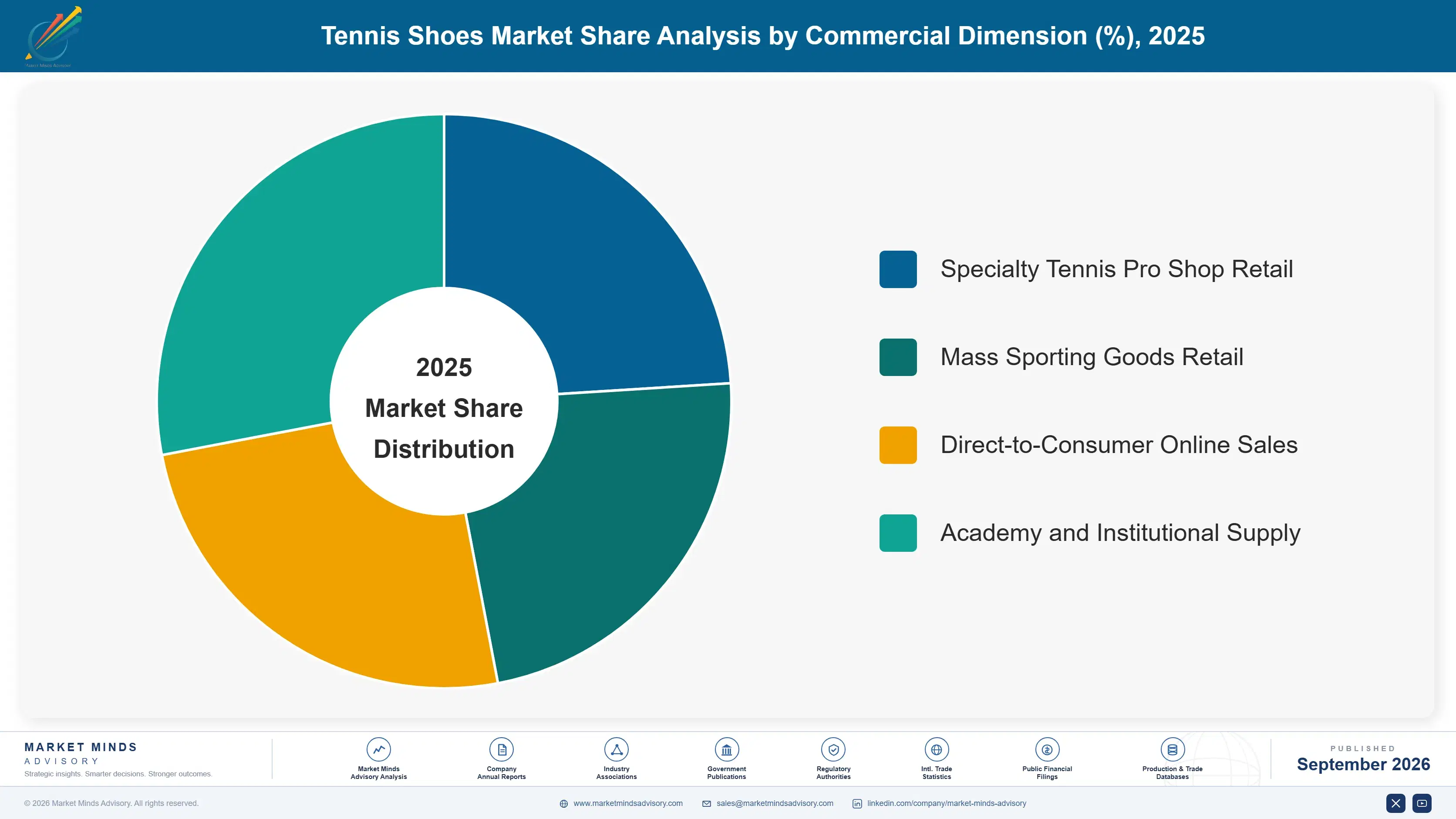
tennis-shoes-market-market-share-analysis-1790018937404

Hard Court Performance Tennis Shoes

Hard court shoes use durable outsole compounds engineered specifically to withstand abrasive concrete and asphalt court surfaces, commanding the highest average selling price in the category given their engineering complexity and shorter effective lifespan under heavy play. This segment benefits directly from hard courts representing the dominant playing surface across North America and much of Asia, since surface prevalence drives natural demand concentration toward hard court-specific engineering. Manufacturers are racing to expand outsole compound research ahead of competitors entering this increasingly important segment of the broader category. Manufacturing scale-up remains the clearest bottleneck constraining faster growth across this premium segment specifically. Several manufacturers expect capacity constraints to ease gradually as new production lines come online next year.
CAGR 8.6%

All-Court Hybrid Tennis Shoes

All-court hybrid shoes balance durability, traction, and cushioning across multiple surface types, appealing strongly to recreational players who play across varied venues rather than committing to a single home court surface exclusively. This segment carries the broadest addressable buyer base of any format, since versatility appeals to casual players unwilling to own multiple surface-specific shoe types simultaneously. Producers report the strongest first-time buyer conversion rate of any segment, reflecting genuine appeal among players new to structured performance footwear purchasing. Retail partners increasingly recommend this format to buyers uncertain of their preferred playing surface. Producers view this segment as a genuine bridge into more specialized purchases over time. Growth continues outpacing narrow surface-specific formats.
CAGR 7.4%
Full segment breakdown across 6 segments available in the complete report.

Regional Architecture and Country Demand Map

North America and East Asia carry the deepest participation density and retail infrastructure, while South Asia and Pacific posts the fastest regional growth as rising disposable income and expanding court infrastructure accelerate recreational adoption among younger players. Retail expansion continues broadening the category's reach across nearly every income tier globally.

North America

Collegiate and club tennis infrastructure across the United States and Canada gives the category a participation base built over decades of structured amateur competition unavailable at comparable scale elsewhere. Sporting goods retailers have expanded dedicated court-fitting sections faster than most other regions, and professional tournament visibility through major broadcast networks sustains consistent recreational purchase intent. Canada trails the United States modestly but shows comparable participation growth patterns. Big sporting goods chains are simultaneously carving out dedicated performance sections, pushing smaller retailers to expand court-specific offerings or lose customer traffic considerably. Retail buyers now track outsole durability scores when negotiating new performance listings each cycle. Loyalty apps are increasingly bundled with court-fitting consultations to justify premium pricing among serious players.
Share: 27% | CAGR: 6.2% (2026 to 2036)

Western Europe

France and the United Kingdom carry the deepest clay and grass court tennis culture in the world, giving footwear brands a distribution pathway that combines tournament heritage with specialty retail credibility unavailable in most other markets. European Union material sourcing regulation has pushed manufacturers toward documented sustainability claims earlier than most other markets, giving regional distributors meaningful export credibility when entering certification-conscious markets elsewhere. Southern European countries show particularly high adoption tied to strong recreational club culture. Export volume into North America continues rising steadily. Manufacturers targeting this region increasingly emphasize sustainability certification given stronger regulatory scrutiny overall. Independent tennis clubs continue outperforming department store sporting counters on performance sell-through rates this cycle.
Share: 22% | CAGR: 3.9% (2026 to 2036)
Regional intelligence for 5 additional markets available in the complete report: East Asia, South Asia and Pacific, Latin America, Middle East and Africa, Eastern Europe. Contact sales@marketmindsadvisory.com.
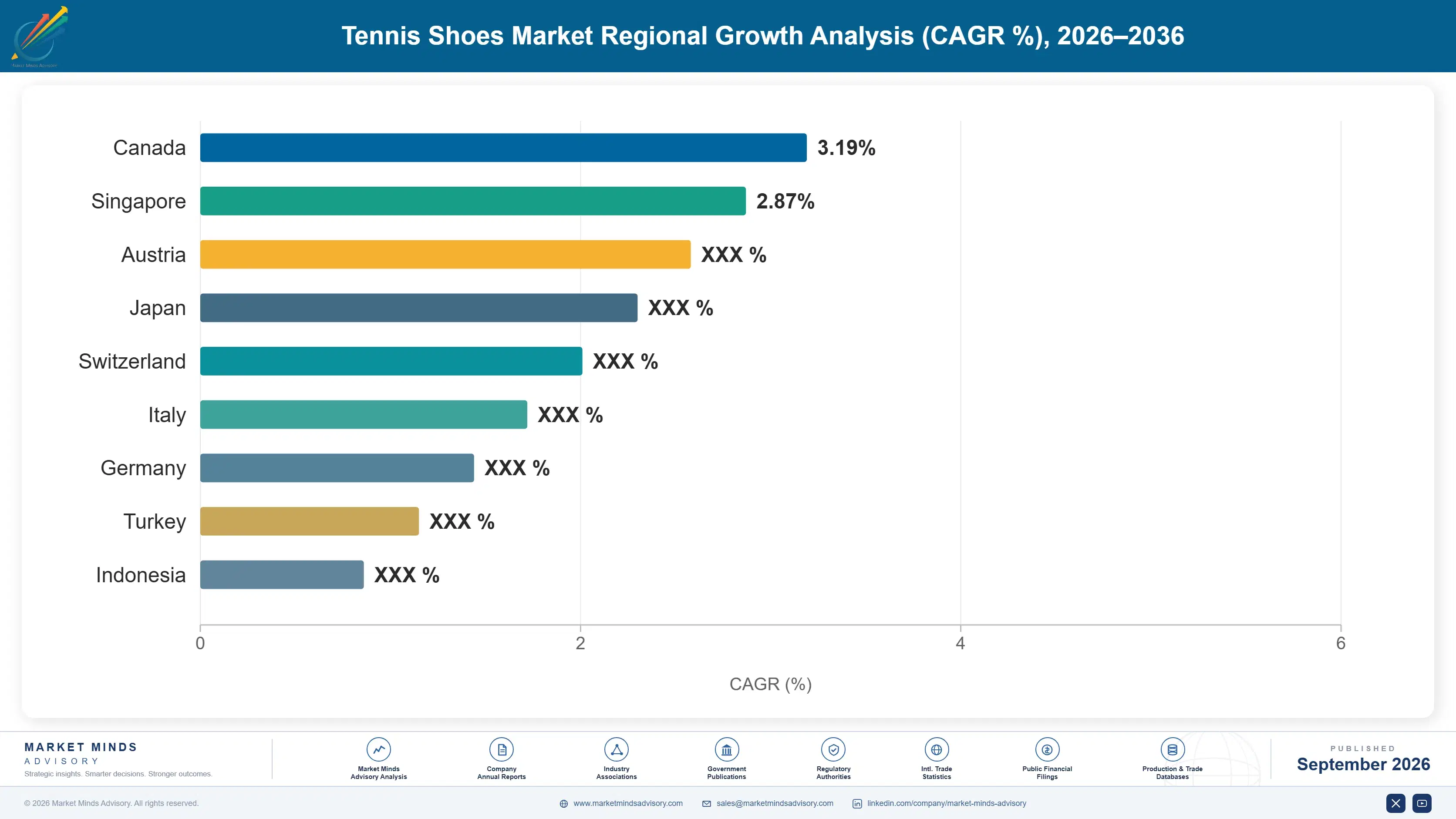
tennis-shoes-market-country-cagr-analysis-1790018937920

Where Margin Sits Beyond Base Footwear

Base tennis shoe sales carry thin margin once retail listing fees and material costs are counted against the sale price. The larger commercial opportunity sits in academy partnership licensing, professional endorsement bundling, and direct-to-consumer subscription programs that justify premium pricing well above commodity athletic footwear benchmarks industry wide. Brands combining all three approaches report stronger unit economics overall.

Collegiate and Academy Partnership Licensing Programs

Brands are securing exclusive footwear supply agreements with collegiate tennis programs and youth academies, generating guaranteed volume commitments that run alongside standard retail sales entirely. These partnerships typically span three to five years and carry minimum unit volume requirements that generate predictable revenue while building long-term brand loyalty among players early in their competitive careers. Several brands report academy partnership revenue approaching 12 percent of total segment sales, a share expected to keep climbing as more programs seek exclusive footwear sponsors. Adoption is expected to broaden across additional collegiate conferences over time.
Market Impact: Generates up to 12 percent of segment revenue

Building Professional Endorsement Bundle Cross-Selling Programs

Bundling professional-endorsed footwear models with matching apparel and accessory lines increases average transaction value meaningfully compared to standalone footwear sales through either retail or direct channels. Bundle attach rates run considerably higher among recreational players following professional tournament coverage closely, since matching endorsed gear carries genuine aspirational appeal beyond pure functional need. Brands offering structured bundles report average order value running roughly 32 percent higher than single-product footwear purchases across tracked retail channels. Retention data increasingly guides how brands price new bundle tiers offered. This shift shapes marketing strategy decisions.
Market Impact: Lifts average order value by roughly 32 percent

Growing Direct-to-Consumer Court-Fitting Subscription Programs Now

Offering direct-to-consumer court-fitting consultations paired with replacement subscription plans locks serious players into a replenishment cycle that generates significantly higher lifetime value than single-purchase retail transactions. Subscription pricing runs meaningfully higher margin than traditional retail given the elimination of intermediary distribution costs entirely. Brands offering subscription fitting services report repeat purchase rates near 70 percent within twelve months of initial enrollment. Several brands have extended similar structures to complementary apparel offerings. Manufacturers increasingly view this consumer relationship as more valuable than a single transaction. Adoption is spreading fast. Growth remains meaningful.
Market Impact: Lifts repeat purchase rate to nearly 70 percent

Who Controls the Margin Pool

Concentration is unusually high at a CR5 near 62 percent measured on global unit shipment volume, reflecting the dominance of major athletic footwear conglomerates over specialty tennis brands. Nike and Adidas hold the clearest leads on professional endorsement depth and global distribution scale, while smaller specialty manufacturers compete mainly on court-specific engineering credibility rather than brand recognition, leaving a real capability gap between leaders and the fragmented middle tier.
Current competitive activity centers on academy partnership expansion, professional endorsement renewal, and outsole compound research rather than pure design feature races. Several brands have launched sustainability-focused product lines to access environmentally conscious buyers, while others are racing to secure exclusive rubber supply agreements ahead of competitors facing volatility. Retail listing negotiations increasingly hinge on durability substantiation rather than price alone.

Emerging pressure is coming from specialty court-surface-focused startups entering Western markets through e-commerce rather than traditional wholesale distribution, bypassing incumbent retail relationships entirely. Running shoe brands with existing cushioning expertise are also testing tennis footwear entry, a signal that category boundaries may blur further over the coming decade. Rankings among mid-tier challengers could shift quickly once any single brand proves academy partnership economics work reliably at scale.
tennis-shoes-market-company-positioning-matrix-1790018938442

Competitive Moat and Risk Dimensions

NIKE

Moat: Professional Endorsement Network Depth

Nike built the category's deepest professional player endorsement network over several decades of continuous sponsorship investment, giving it a recreational purchase intent advantage newer entrants cannot replicate quickly. Its global distribution scale secures prominent retail placement that smaller manufacturers are still negotiating access to establish.
NIKE

Risk: Generic Athletic Brand Perception Risk

Nike's broad athletic brand positioning sometimes dilutes perceived tennis-specific engineering credibility compared to specialty competitors focused entirely on court-surface performance. This constrains its appeal among serious competitive players seeking narrow performance specialization over broad brand recognition. Competitors focused purely on court-specific engineering are increasingly exploiting this exact gap in marketing.
ADIDAS

Moat: European Tournament Heritage Depth

Adidas's long-standing European tournament sponsorship history gives it clay and grass court credibility that competitors entering primarily through hard court markets struggle to match at comparable depth. Its established European retail relationships secure distribution advantages unavailable to newer entrants. This positioning has proven durable across several tournament cycles and market conditions.
ADIDAS

Risk: Limited North American Market Share

Adidas's tennis footwear share in North America trails significantly behind its European position, leaving it more exposed to competitors with deeper collegiate and club partnerships in the region's largest addressable market by revenue. Competitors with established collegiate partnerships are increasingly targeting this exact gap directly.

Players Tracked

Prominent Players

Nike
Adidas
ASICS
New Balance
Wilson Sporting Goods

Other Key Players

Babolat VS
Head NV
Yonex Company
Lotto Sport Italia
K-Swiss Inc
Prince Global Sports
Fila Holdings
Diadora SPA
Mizuno Corporation
Puma SE
Skechers Performance
Under Armour
Salomon Group
On Holding AG
Hoka One One

Recent Developments

FEBRUARY 2026

Nike Launches New Hard Court Outsole Compound

Nike launched a new hard court outsole compound across its full performance tennis lineup, extending durability testing results to consumers after eighteen months of pilot testing across professional and collegiate partnerships. The launch targets the fast-growing hard court segment increasingly displacing generic athletic footwear as the category's primary growth driver.
Signal: Signals broader push toward court-specific engineering over generic athletic positioning. Analysts expect similar launches across the category.
JUNE 2025

ASICS Signs Distribution Agreement With Major Retailer

ASICS signed a multi-year distribution agreement with a major sporting goods retailer, securing permanent floor space across several hundred store locations rather than seasonal tournament placement. The agreement covers guaranteed shelf commitment rather than an equity or acquisition arrangement between the two companies involved. Terms were undisclosed.
Signal: Confirms retail permanence as a key strategic priority for major footwear brands. Rivals may pursue similar deals.
OCTOBER 2025

Wilson Sporting Goods Acquires Outsole Technology Startup

Wilson Sporting Goods acquired a small outsole technology startup specializing in durable rubber compound formulations, adding proprietary material intellectual property to its existing footwear portfolio ahead of planned expansion into 2027. Deal terms were not publicly disclosed by either company involved. Wilson plans to integrate the technology next year.
Signal: Confirms outsole material intellectual property as a growing acquisition target. It signals rising interest in outsole material innovation.

Rubber and Synthetic Material Exposure

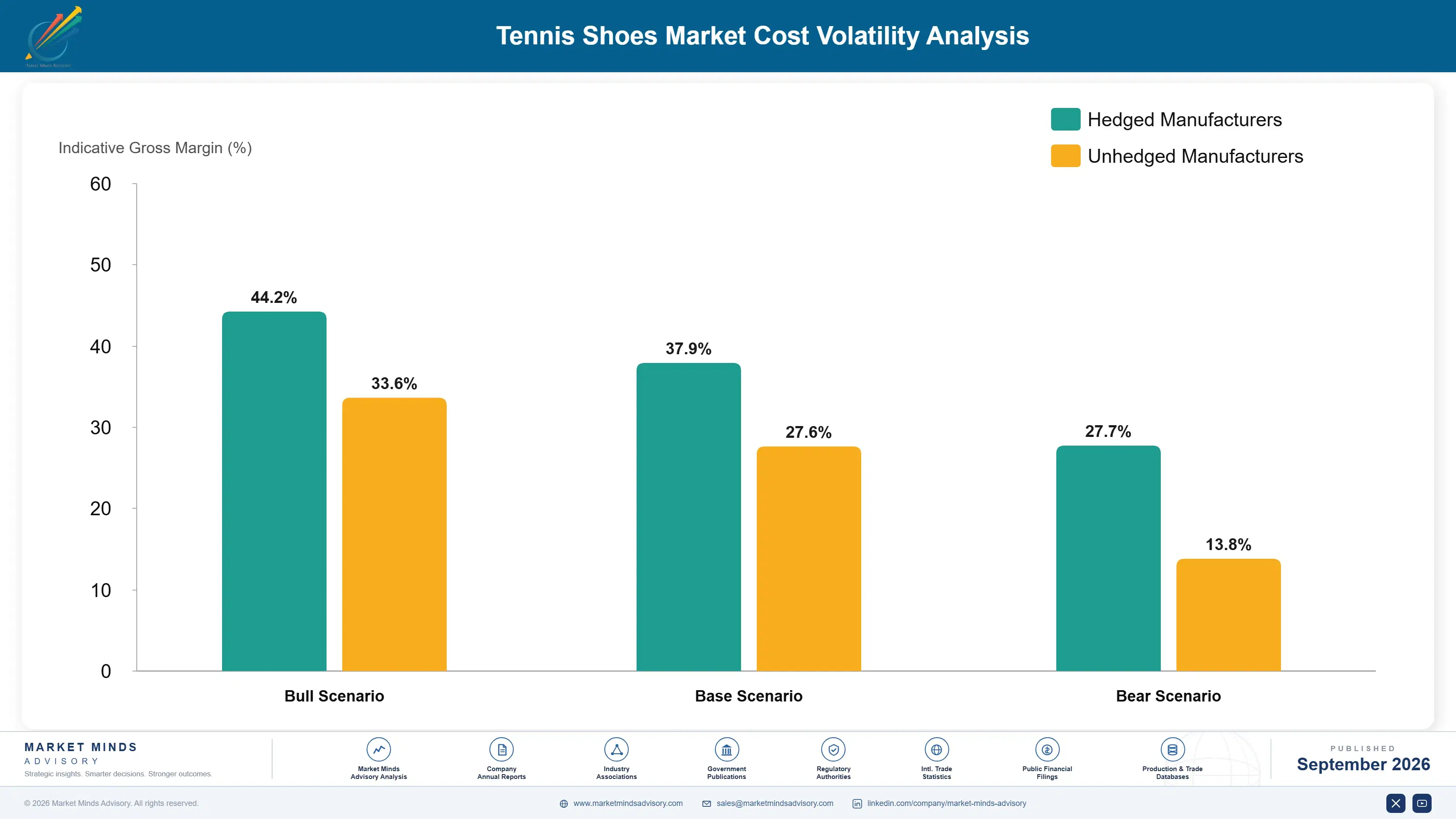
Synthetic upper material and rubber outsole compounds represent roughly forty one percent of cost of goods sold for a typical tennis shoe, with cushioning foam adding another sixteen percent. Vietnam and Indonesia supply most global athletic footwear assembly capacity, while specialty rubber compound chemistry remains concentrated among a small number of suppliers in Thailand and Malaysia.
Global rubber price volatility during 2022 and 2023, driven by adverse weather in major producing regions, pushed rubber compound prices up more than twenty eight percent within several quarters according to IEA industrial input tracking data. Manufacturers without long-term supply contracts absorbed the bulk of that increase directly into shrinking gross margin rather than passing costs through to retail pricing immediately. Several manufacturers have since diversified toward Southeast Asian producers to reduce exposure meaningfully.

Smaller independent manufacturers face materially higher exposure than larger, better-capitalized competitors able to negotiate multi-year fixed-price rubber agreements directly with producers. Geographic concentration compounds this disadvantage: manufacturers sourcing exclusively from a single Southeast Asian supplier carry meaningfully more volatility risk than diversified competitors spanning multiple manufacturing regions and supplier relationships. MMA Analysis expects this gap to widen further as certification requirements tighten.
tennis-shoes-market-cost-volatility-analysis-1790018938638

Multi-Year Fixed Price Rubber Supply Agreements

Leading manufacturers are locking in three to five year fixed price agreements directly with rubber compound producers, trading pricing flexibility for protection against the sharp spot market swings seen during the 2022 to 2023 rubber price disruption across major producing regions. Several suppliers now offer volume-linked pricing tiers that reward early multi-year commitment across the category.

Supplier Base Diversification Across Regions

Several manufacturers are qualifying secondary rubber suppliers across South America and Africa to reduce dependence on any single country, accepting modestly higher unit costs in exchange for meaningfully lower exposure to any single regional supply disruption event. Manufacturers pursuing this strategy report smoother quarterly margin performance even when rubber prices swing sharply in either direction.

Portfolio Architecture for Margin Defence

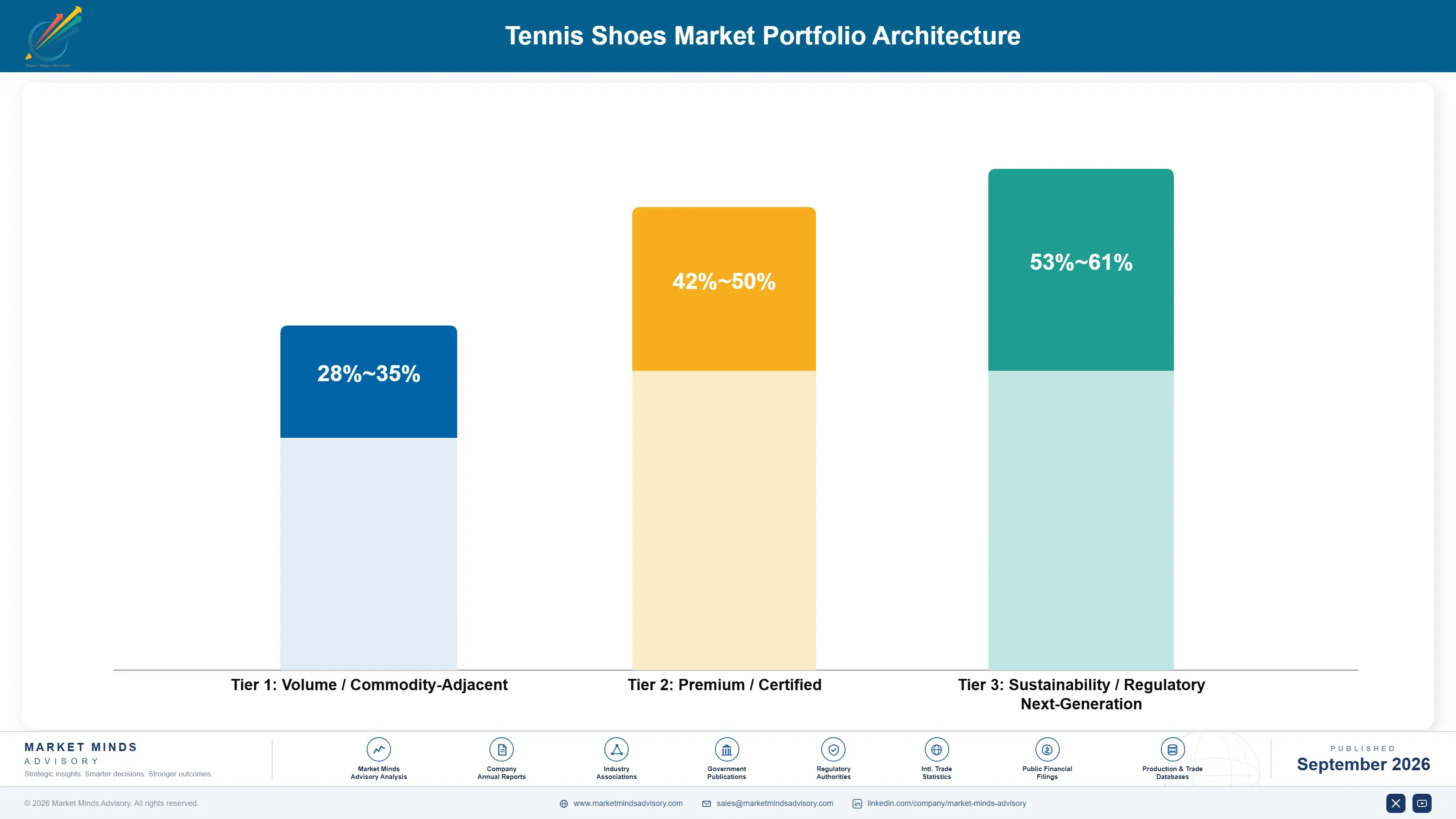
The category splits into three margin tiers running from commodity-adjacent lifestyle sneakers through certified premium hard court performance shoes to next-generation academy and professional endorsement formats. Gross margin roughly doubles moving from the volume tier to the top professional tier, reflecting how much endorsement and engineering cost gets embedded in premium pricing across most retail channels tracked. Manufacturers investing early in professional partnerships are best positioned to capture that widening spread.
Volume tier products compete almost entirely on price and distribution breadth, while premium and professional tiers compete on court-specific engineering and endorsement credentials that justify considerably higher retail pricing. Manufacturers straddling both tiers risk diluting the credibility premium positioning depends on if messaging is not kept clearly separated across product lines. Retailers increasingly enforce category separation on shelf.

High-value margin pools concentrate heavily in hard court performance tennis shoes and all-court hybrid formats, the two fastest-growing segments identified earlier in this report. Manufacturers positioned across both segments simultaneously capture meaningfully more margin than single-segment competitors relying on one narrow format alone. MMA Analysis expects this concentration to deepen further as endorsement requirements tighten. Growth remains meaningful.

Volume / Commodity-Adjacent

Lifestyle and casual tennis-inspired sneakers sold through mass retail channels on price and shelf availability rather than court-specific engineering or endorsement claims. Larger buyers negotiate aggressively on unit pricing given thin margins throughout the category.
Gross Margin: 28-35%

Premium / Certified

Hard court and all-court performance shoes carrying durability substantiation, sold through specialty retail at meaningfully higher price points. Retailers require documented durability testing before granting new shelf placement. This substantiation requirement is becoming standard across most retail procurement processes.
Gross Margin: 42-50%

Sustainability / Regulatory / Next-Generation

Professional endorsement and academy-certified formats meeting stringent performance standards, commanding the highest margin of any tier in the category given the endorsement investment embedded in the price. Endorsement investment made early tends to pay back through faster market entry.
Gross Margin: 53-61%
tennis-shoes-market-portfolio-architecture-1790018939136

High-value Sub-segments and Strategic Watch-out

Hard Court Performance Tennis Shoes

The fastest-growing segment in the category, combining premium engineering pricing with the strongest professional endorsement attach rate. Gross margin sits at the top of the category as manufacturers capture value from outsole compound research embedded in every transaction. Early movers are locking in loyal customers ahead of wider competition.
Gross Margin: 53-61%

All-Court Hybrid Tennis Shoes

Strong growth driven by recreational players seeking versatile surface performance. Margin runs high given engineering cost, though slightly below hard court shoes since hybrid differentiation is comparatively easier for competitors to replicate quickly. Manufacturers investing early in versatile engineering are best positioned as competition intensifies further.
Gross Margin: 45-53%

Standard Lifestyle Tennis Sneakers

The volume core of the category, sold through mass retail channels on price and availability. Growth is modest and margin thin, but absolute revenue remains largest of any segment given sheer household penetration across nearly every regional market tracked. Manufacturers here compete mainly on cost efficiency and shelf presence.
Gross Margin: 26-33%

Imported Counterfeit Performance Formats

A strategic watch-out as low-cost counterfeit imported performance shoes gain share in price-sensitive channels, pressuring branded volume tier pricing. Enforcement crackdowns on counterfeit sellers could compress branded manufacturer margin meaningfully if the trend accelerates. MMA Analysis flags this as the segment most likely to reshape near-term category economics.
Gross Margin: 18-25%

Replacement Frequency and Player Loyalty

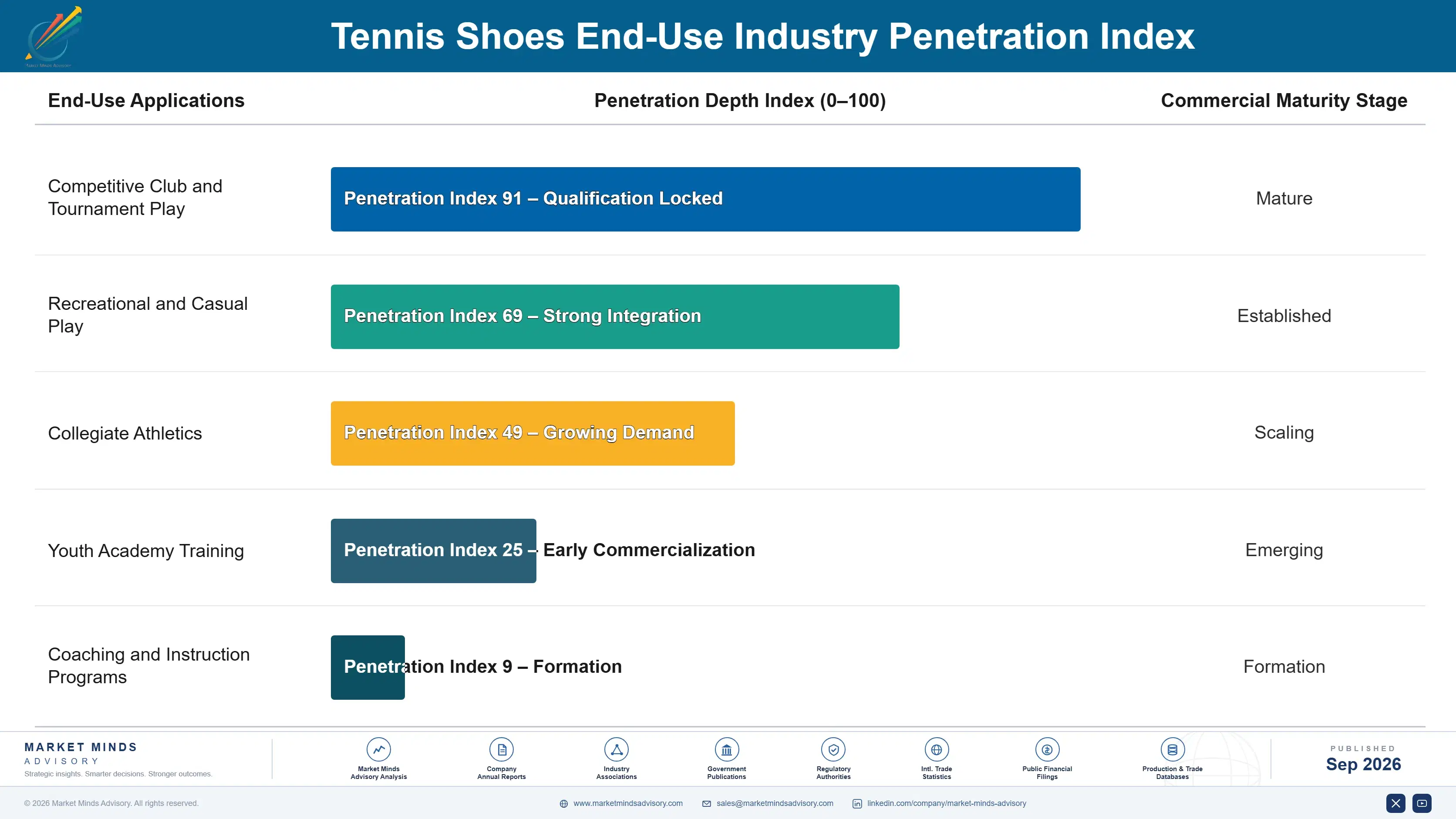
Tennis shoe demand runs on a genuinely short replacement cycle, since serious players wear through outsole compound within months of regular hard court play, creating annuity-like repurchase revenue once a player commits to a given brand and court-surface model. This replacement pattern gives the category revenue characteristics closer to running shoes than casual sneakers, distinguishing it from fashion-driven footwear categories entirely. Brands under-investing in outsole durability risk elevated churn once wear shows.
Adoption stickiness varies considerably by end-use vertical. Competitive club players show the deepest brand loyalty once a specific court-surface model proves reliable, since switching means relearning movement feel during actual match play. Recreational players show more willingness to switch brands given lower performance sensitivity, while youth academy players purchase based mainly on coach recommendation rather than personal brand preference. Club players churn slowest of any vertical tracked, a pattern brands cultivate.

Early buyers skewed toward competitive club and tournament players purchasing performance-specific models, but the buyer base is shifting toward casual recreational players seeking comfort and lifestyle appeal alongside baseline performance. This generational shift is pulling design priorities toward hybrid all-court versatility rather than narrow court-surface specialization alone. Product roadmaps are adjusting accordingly across most major brands.
tennis-shoes-market-end-use-penetration-index-1790018939626

Priorities For Category Participants

These are among the four positions where our research anticipates prominent divergence between winners and laggards over the coming forecast period. Each is grounded in the demand model, the regulatory perimeter, and the announced capacity pipeline.
01 / HARD COURT ENGINEERING INVESTMENT

Fund outsole research before competitors close the gap

Hard court performance shoe unit sales roughly doubled within two years of manufacturers introducing improved outsole compounds, showing consumers already accept meaningfully higher premium pricing for genuine durability improvement. Manufacturers that delay building this capability risk steadily losing the most design-conscious, highest-margin performance buyers available to whichever competitor scales outsole research first. MMA Analysis expects hard court engineering to become table stakes across the premium tier within three years, not a differentiator, and laggards risk permanent share loss to better-prepared rivals.
02 / CHINA MARKET PRIORITY

Prioritize China expansion as participation growth accelerates

Chinese market unit sales are growing at a rate roughly 35 percent faster than the global category average overall, and brands without meaningful China presence are missing the fastest-expanding addressable buyer base in the category entirely. Building credible China distribution takes many months, meaning delayed investment compounds steadily into a widening competitive gap that becomes genuinely difficult to close quickly. Brands should prioritize China market investment even when it reduces near-term marketing budget elsewhere, since the resulting distribution compounds into durable regional advantage.
03 / ACADEMY PARTNERSHIP EXPANSION

Expand academy deals to secure lifetime player loyalty

Brands with academy partnerships report player lifetime purchase volume roughly 45 percent higher than players acquired through pure retail channels, showing first purchase experience genuinely shapes long-term brand loyalty. Brands relying purely on retail acquisition are steadily missing the category's clearest path to durable customer relationships, one that requires comparatively modest incremental investment to access. Expanding academy partnerships now, well ahead of competitors recognizing the same opportunity, offers a meaningful and durable head start heading into the next several years.
04 / COUNTERFEIT ENFORCEMENT PRIORITY

Invest in authentication technology as counterfeiting grows

Counterfeit tennis footwear remains widespread across several major emerging markets tracked in this report, and brands without authentication technology risk continued, steady brand value erosion among players who unknowingly purchase counterfeit products. Brands that delay investing in retail partner vetting and authentication systems risk lasting, hard-to-reverse reputational damage in markets where counterfeit volume continues expanding entirely unchecked and unaddressed. Investing in enforcement now, well before counterfeit penetration deepens further across additional emerging markets, offers a meaningful and durable brand protection advantage.

Engagement Snapshot From the Field

A live engagement with an industry participant carrying material or product regulatory and market exposure ahead of a defining policy shift, showing how our research translates into a defensible multi-year portfolio strategy.
MARKET MINDS ADVISORY · CLIENT ENGAGEMENT SUMMARY
Tennis Shoes Producer Strategic Portfolio Review and Transition Roadmap 2026·Investment Scenario on Tennis Shoes Exposure Evaluation 2025-26
CLIENT PROFILE
The client is a mid-tier athletic footwear manufacturer headquartered in North America with an established portfolio of lifestyle sneakers sold across mass retail and department store channels. Annual revenue reported at approximately 290 million dollars (client-reported, unverified by MMA) across its footwear division, with no prior investment in tennis-specific engineering capability ahead of this engagement.
STRATEGIC CHALLENGE
The client's generic athletic sneaker growth was slowing as the category matured, and leadership sought a new performance footwear category with stronger recurring replacement economics. Tennis appealed given adjacent cushioning technology expertise, but leadership needed a market entry strategy that avoided direct competition with entrenched category leaders on brand recognition alone.
MMA APPROACH
MMA conducted primary interviews with sporting goods retail buyers alongside proprietary survey data across six countries to size addressable demand by segment and region. The engagement mapped competitive positioning against the client's existing footwear brand equity and modeled academy partnership economics against comparable category benchmarks. Findings were validated against company disclosed segment margins and benchmarked against comparable market entries.
KEY FINDINGS
  1. All-court hybrid tennis shoes, an underserved format between narrow hard court specialization and generic athletic sneakers, offered the clearest entry path given the client's existing cushioning technology expertise.
  2. The client's existing mass retail distribution offered a credible cross-sell channel unavailable to specialty tennis brands lacking any prior direct-to-consumer relationship with casual recreational households.
  3. Professional endorsement access proved the single largest barrier to premium segment entry, with major sporting goods chains increasingly favoring brands holding documented sponsorship credentials over unverified performance claims.
  4. Licensing proprietary outsole compound technology from an established tennis specialty partner emerged as a faster entry path than internal development, cutting estimated time to market by roughly fourteen months.
CLIENT PROFILE
The client is a mid-tier athletic footwear manufacturer headquartered in North America with an established portfolio of lifestyle sneakers sold across mass retail and department store channels. Annual revenue reported at approximately 290 million dollars (client-reported, unverified by MMA) across its footwear division, with no prior investment in tennis-specific engineering capability ahead of this engagement.
STRATEGIC CHALLENGE
The client's generic athletic sneaker growth was slowing as the category matured, and leadership sought a new performance footwear category with stronger recurring replacement economics. Tennis appealed given adjacent cushioning technology expertise, but leadership needed a market entry strategy that avoided direct competition with entrenched category leaders on brand recognition alone.
MMA APPROACH
MMA conducted primary interviews with sporting goods retail buyers alongside proprietary survey data across six countries to size addressable demand by segment and region. The engagement mapped competitive positioning against the client's existing footwear brand equity and modeled academy partnership economics against comparable category benchmarks. Findings were validated against company disclosed segment margins and benchmarked against comparable market entries.
KEY FINDINGS
  1. All-court hybrid tennis shoes, an underserved format between narrow hard court specialization and generic athletic sneakers, offered the clearest entry path given the client's existing cushioning technology expertise.
  2. The client's existing mass retail distribution offered a credible cross-sell channel unavailable to specialty tennis brands lacking any prior direct-to-consumer relationship with casual recreational households.
  3. Professional endorsement access proved the single largest barrier to premium segment entry, with major sporting goods chains increasingly favoring brands holding documented sponsorship credentials over unverified performance claims.
  4. Licensing proprietary outsole compound technology from an established tennis specialty partner emerged as a faster entry path than internal development, cutting estimated time to market by roughly fourteen months.
RECOMMENDED STRATEGY
Phase 1: Phase 1 (Months 1-6): License outsole compound technology and launch a limited pilot targeting existing sneaker retail accounts across North America. Phase 2: Phase 2 (Months 7-14): Expand pilot data into a full durability certification package supporting broader retail listing negotiations across additional markets. Phase 3: Phase 3 (Months 15-24): Scale academy partnership development further and evaluate a second product format launch using validated pilot data.
OUTCOME
Within the first year following the engagement, the client reported cross-sell conversion of 17 percent among existing retail accounts and incremental revenue of approximately 26 million dollars (client-reported, unverified by MMA) attributable to the new tennis footwear line, ahead of internal targets set at project outset for the pilot phase.

Frequently Asked Questions

Foundational context covering the market sizes, CAGR, scope, country, region and competition that inform every finding below. This section is provided to cover basics and most often pre-purchase conversations, answered from the MMA Primary Research Dataset.

What is the current size of the Tennis Shoes Market?

The Tennis Shoes Market reached 6.8 billion dollars in base year 2025. Growth is driven by recreational participation expansion and rising performance footwear replacement frequency.

How large will the Tennis Shoes Market be by 2036?

The market is forecast to reach 12.13 billion dollars by 2036, roughly a 1.69 times expansion from 2026 levels. Growth concentrates in hard court and all-court hybrid segments.

What is the CAGR for the Tennis Shoes Market 2026 to 2036?

The market is projected to grow at a 5.4 percent compound annual growth rate between 2026 and 2036. Bull and bear scenarios range from 4.1 to 6.7 percent depending on participation trends.

Which segment is growing fastest?

Hard Court Performance Tennis Shoes lead at an 8.6 percent CAGR, roughly 1.59 times the overall market rate. All-Court Hybrid Tennis Shoes follow closely at 7.4 percent annual growth.

Who are the major companies in the Tennis Shoes Market?

Nike, Adidas, ASICS, New Balance, and Wilson Sporting Goods lead the category. Together they hold a CR5 near 62 percent measured on global unit shipment volume.

Which country is growing fastest?

China leads country-level growth at a 7.9 percent CAGR, driven by expanding recreational participation and public court infrastructure investment. The United States remains the largest single market by revenue.

Report Segmentation Architecture

The full report scope spans multiple orthogonal segmentation dimensions, with cross-tabulated demand data provided for each dimension pair. Coverage extends further to regional breakdowns, trend trajectories, and the competitive detail needed to support segment-level decision-making.

By Court Surface Format

  • Hard Court Performance Tennis Shoes
  • Clay Court Specific Formats
  • Grass Court Tennis Shoes
  • All-Court Hybrid Designs
  • Junior and Youth Academy Formats
  • Lifestyle Tennis-Inspired Sneakers

By End-Use Industry

  • Competitive Club and Tournament Play
  • Recreational and Casual Play
  • Collegiate Athletics
  • Youth Academy Training
  • Coaching and Instruction Programs

By Commercial Dimension

  • Specialty Tennis Pro Shop Retail
  • Mass Sporting Goods Retail
  • Direct-to-Consumer Online Sales
  • Academy and Institutional Supply

By Region

  • North America
  • Western Europe
  • East Asia
  • South Asia and Pacific
  • Latin America
  • Middle East and Africa
  • Eastern Europe

Scope, Methodology, and Coverage

Every figure in this report is reproducible from documented input assumptions. The scope below maps the historical period, the forecast horizon, the segmentation dimensions, and the countries covered, alongside the underlying primary and qualitative methodology.
Historical Period
2020 to 2025
Forecast Period
2026 to 2036
Base Year
2025 (USD billions; MMA Primary Research Dataset, September 2026)
Market Definition
The Tennis Shoes Market covers performance and recreational footwear engineered for tennis play, including hard court, clay court, and all-court formats, sold through sporting goods, specialty, and direct-to-consumer channels. It excludes general athletic sneakers not specifically engineered for tennis court movement patterns.
Quantitative Units
USD billions (current prices); unit volume in million pairs where applicable
Segmentation Dimensions
By Court Surface Format; By End-Use Industry; By Commercial Dimension; By Region
Regions Covered
North America, Western Europe, East Asia, South Asia and Pacific, Latin America, Middle East and Africa, Eastern Europe
Countries Covered
USA, China, Germany, France, UK, Japan, South Korea, India, Australia, Canada, Brazil, Mexico, Indonesia, Vietnam, Thailand, Malaysia, UAE, Saudi Arabia, South Africa, Nigeria, Turkey, Poland, Netherlands, Italy, Spain, Sweden, Switzerland, Argentina, Colombia, Singapore, and additional markets relevant to this sector
Key Companies Profiled
Nike, Adidas, ASICS, New Balance, Wilson Sporting Goods, Babolat VS, Head NV, Yonex Company, Lotto Sport Italia, K-Swiss Inc, Prince Global Sports, Fila Holdings, Diadora SPA, Mizuno Corporation, Puma SE, Skechers Performance, Under Armour, Salomon Group, On Holding AG, Hoka One One
Quantitative Methodology
Primary survey, n=3,800 respondents, Q4 2025, six countries; demand-side model with trade association cross-validation
Qualitative Methodology
47 expert interviews, Q4 2025; applied to validate demand model assumptions, identify emerging dynamics, and assess competitive positioning
Report Format
PDF and XLSX data workbook (Word format preview document)
Publisher
Market Minds Advisory
Report Code
MMA-2026-CON-318
Published
September 2026
Contact
sales@marketmindsadvisory.com | www.marketmindsadvisory.com

Purchase the full Tennis Shoes Market Report (2026 to 2036).

The full report provides granular segmentation across court surface format, end-use industry, and commercial channel, with ten-year forecasts through 2036 for all seven global regions. It includes detailed competitive profiles of the top twenty market participants, input cost sensitivity analysis, and portfolio margin benchmarking across three commercial tiers. Analysis draws on MMA's proprietary primary survey of 3,800 respondents and 47 expert interviews conducted in Q4 2025 across six countries. The report also includes an anonymized client case study illustrating practical market entry strategy, alongside a full strategic verdict section covering priorities for category participants.
Ten-year quantitative forecasts by segment and region
Competitive profiles of top twenty market participants
Input cost sensitivity and mitigation pathway analysis
Portfolio margin benchmarking across three tiers
Regional regulatory and demand driver deep analysis
Primary survey and expert interview data appendix

Built For The People Who Decide

From boardroom strategy to bench-side execution, this report is read cover-to-cover by leaders shaping the next decade of their industry, turning demand scenarios, market dynamics and valuation benchmarks into decisions.
CXOs/ Presidents/ VPs/ Managers
M&A and Corporate Development
Strategy Teams and R&D Heads
Procurement and Product Directors
Regulatory and Compliance Leaders
Investor Relations and Equity Analysts