Market Minds Advisory
Tendonitis Treatment Market

Tendonitis Treatment Market: The Condition Is Not Inflamed and the Drugs Assume It Is

Biopsies find inflammatory cells in a small minority of cases, which means most of the spending in this market treats a mechanism that is largely absent from the tissue itself.

Lead Analyst

Alice Ballenger

Published

September 2026

Make Smarter Decisions with Customized Research Insights

Request a free sample report and evaluate market opportunities, growth trends, and competitive dynamics relevant to your business needs.

2025 MARKET VALUE$4.2BMarket Size 2025
2036 FORECAST VALUE$7.8BBase Case , 2026 to 2036
CAGR 2026 TO 20365.8 %Bull 7.0% / Bear 4.6%
INCREMENTAL OPPORTUNITY$3.4BNet 10- year value creation
EXPANSION MULTIPLE1.76x2036 value over 2026 base
Strategic Levers
M&A Pipeline
Regional Outlook
Country Rankings
Competitive Intelligence
Segmental Deep-dive
Call-Us : 91 93563 13602

Executive Snapshot and Market Trajectory

The name is wrong and the treatment follows the name. Around 12% of biopsied cases show the inflammatory cells the condition is named after, and the rest show collagen disorganisation and failed healing, which anti-inflammatory drugs do not address in any way at all.
Corticosteroid injection is a harder problem still. It relieves pain quickly and produces worse recovery at twelve months than doing nothing, in randomised trials across several tendon sites. It remains routinely delivered because the patient walks out feeling better that afternoon and the follow up that would reveal the difference generally never happens. The evidence has been available for well over a decade without changing that at all.
What works is loading. Twelve weeks of progressive resistance remodels the tendon and only around 34% of patients complete a prescribed programme, which is why recurrence reaches 42% within two years. Shockwave grows fastest at 8.7% largely because it makes loading tolerable, and South Korea leads all countries at 9.6% on private rehabilitation utilisation. The intervention that works is the least monetisable and the least completed, which is the central commercial fact here.
Market Definition
Products and services used to treat tendinopathy and related tendon disorders, covering oral and topical anti-inflammatory drugs, corticosteroid and local injection therapy, physiotherapy and loading programmes, extracorporeal shockwave and energy devices, orthobiologic injection therapies, and surgical intervention and repair. Measured at manufacturer and provider selling value. Excludes general musculoskeletal pain products without tendon indications, acute tendon rupture repair implants, orthotics and bracing sold separately, and diagnostic imaging services.
Base Year Value
$4.2B in 2025 (MMA Primary Research Dataset, August 2026)
Forecast Period
2026 to 2036, eleven discrete annual values
CAGR
5.8% base case. Bull 7.0%. Bear 4.6%.
Fastest Growth Segment
Extracorporeal Shockwave and Energy Devices: 8.7% CAGR
Fastest Growth Country
South Korea: 9.6% CAGR
Fastest Growth Region
South Asia and Pacific: 7.8% CAGR
Largest Region
North America: 32% of 2025 global value
Market Leaders
Enovis, Storz Medical, Zimmer MedizinSysteme, Johnson and Johnson, Pfizer. Source: MMA Primary Research Dataset, July 2026.
Primary Survey
n=3,800 procurement and R&D decision-makers, Q4 2025, six countries
Methodology
Demand-side build-up, cross-validated against public data, 47 expert interviews

Tendonitis Treatment Market Forecast Scenarios

tendonitis-treatment-market-size-forecast-scenario-1787639795424
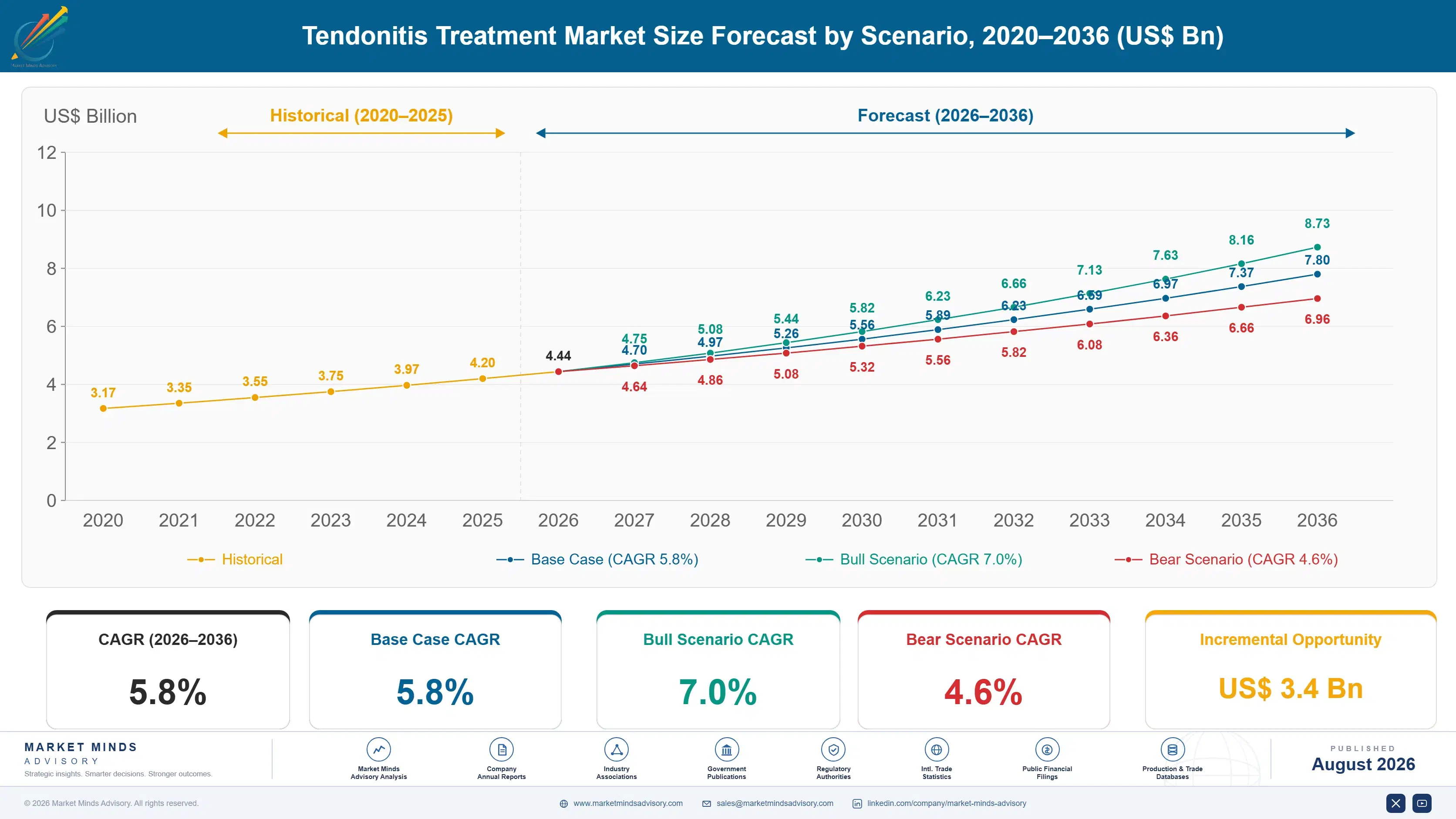
Growth ran near 4.6% between 2020 and 2025, with anti-inflammatory drug volume broadly flat while device and rehabilitation spending expanded steadily. Corticosteroid injection use declined slowly in specialist practice as long term outcome evidence accumulated, though it remained common in primary care where follow up is rare. Shockwave device installation grew across private clinics faster than any pharmaceutical category managed.
Base case 5.8% rests on three mechanisms. Extracorporeal shockwave grows at 8.7% as clinics adopt it to make loading programmes tolerable rather than as a standalone cure. Physiotherapy and loading programmes grow at 8.0% as payers and clinicians recognise that the only intervention changing tendon structure is also the least monetised one. And South Korea grows fastest of any country at 9.6% on private rehabilitation utilisation. Only one of the three involves a pharmaceutical product.
The bull case at 7.0% assumes adherence support technology lifting programme completion meaningfully above 34%, which would reduce a 42% recurrence rate and shift spending toward the interventions that work. The bear case at 4.6% is continued symptomatic treatment dominance, since a patient wanting relief this week and a clinician with ten minutes both prefer the injection.

Treating a Mechanism That Is Not There

The condition carries a name describing a mechanism that is usually absent. Around 12% of biopsied tendinopathy shows inflammatory cell infiltration, while the overwhelming majority shows disorganised collagen, increased ground substance and failed healing response. Anti-inflammatory drugs address the minority finding and relieve pain in the rest through a general analgesic effect, which is useful and is not treatment of the underlying problem.
TOP FIVE CONCENTRATION18%Services and generic drugs leave the field extremely fragmented
INFLAMMATORY CELLS PRESENT12%Biopsies showing the inflammation this condition is named after
STEROID OUTCOME RATIO0.8xRecovery against no intervention twelve months after injection
LOADING PROGRAMME DURATION12 weeksProgressive exercise period required for full tendon remodelling
PROGRAMME COMPLETION RATE34%Patients finishing a prescribed loading programme in full
RECURRENCE WITHIN TWO YEARS42%Patients presenting again after symptomatic treatment used alone
Corticosteroid injection presents a sharper version of the same difficulty. Randomised evidence across lateral epicondylitis and plantar heel pain shows excellent short term relief and worse recovery at twelve months than no intervention at all. It continues to be delivered widely because the patient feels dramatically better the same day, the clinician sees a satisfied outcome, and nobody involved is present at the point where the difference actually appears.
The intervention that changes tendon structure is progressive loading over around twelve weeks, and it generates almost no product revenue for anybody. Only about 34% of patients complete a prescribed programme, which is the single most consequential number in this market, and recurrence reaches 42% within two years where symptomatic treatment was used alone. The effective treatment is the least monetisable one and the least completed.
"The commercially interesting question is not which product works, because that argument was settled twenty years ago and the answer was exercise. It is what makes a patient finish twelve weeks of it, and whoever solves that owns the outcome rather than the appointment."
Director, Musculoskeletal Care and Rehabilitation Practice · MMA Healthcare and Life Sciences Practice · August 2026

Market Trends

Shockwave adopted to make loading programmes tolerable

Extracorporeal shockwave grows at 8.7% and the clinics adopting it increasingly present it as an adjunct that reduces pain enough for a patient to load the tendon properly, rather than as a treatment in its own right. That framing matches the evidence considerably better and it aligns the device with the intervention that actually remodels tissue. Clinics using it as a standalone cure generate short term satisfaction and the same recurrence pattern as any other symptomatic approach. That eventually damages the clinic's reputation and the whole device category's credibility with referring clinicians.
Market Impact: South Korea growing at 9.6%

Steroid injection declining in specialist practice only

Long term outcome evidence has moved specialist practice away from corticosteroid injection, where recovery at twelve months runs below no intervention at all, while primary care use remains common because follow up rarely occurs and the immediate result looks excellent. That divergence produces a market where the same intervention is contracting in one setting and holding in another, and where the evidence has been available for well over a decade without changing either. Suppliers reading aggregate volume as stability are averaging two settings moving in opposite directions for entirely different reasons.
Market Impact: Recurrence reaches 42% otherwise

Market Opportunities and Growth Drivers

Private rehabilitation utilisation expanding across East Asian markets

South Korea grows fastest of any country at 9.6% on private rehabilitation and orthopaedic clinic utilisation that exceeds most developed markets, with shockwave device density among the highest anywhere. Patients attend more frequently and expect active intervention, which supports both device and programme revenue in a way that most publicly funded systems do not. Similar patterns hold in Taiwan and parts of China where private musculoskeletal care is expanding quickly. Clinics compete partly on equipment there, which supports device adoption beyond what clinical protocols alone would drive. Device density is already very high there.
Market Impact: Only 34% complete the programme

Payers recognising recurrence cost of symptomatic treatment alone

Recurrence reaches 42% within two years where symptomatic treatment is used without loading, and payers examining musculoskeletal cost have begun noticing that repeat episodes consume more than a completed rehabilitation programme would have. Physiotherapy and loading programmes grow at 8.0% as that arithmetic reaches commissioning decisions. It is a cost argument rather than a clinical one, which is why it moves budgets that two decades of evidence never managed to move. It is a financial argument reaching budget holders rather than a clinical one reaching clinicians, which is exactly why it works.
Market Impact: Relief arrives within 1 day

Market Restraints and Challenges

Programme completion collapsing before tendon remodelling occurs

Tendon remodelling requires around twelve weeks of progressive loading and only about 34% of patients complete a prescribed programme, which means most treatment fails through non-completion rather than through any deficiency in the intervention itself. The root cause is that the programme is uncomfortable, slow and unsupervised between appointments. Commercially it wastes most of what is spent on rehabilitation. Remote adherence support and pain reduction adjuncts are the mitigations with any evidence behind them. Most rehabilitation spending is therefore wasted rather than ineffective. Adherence support and pain reduction that permits loading are the only mitigations with any evidence behind them.
Market Impact: Shockwave growing at 8.7% annually

Immediate relief preferred by patient and clinician alike

A patient wants to feel better this week and a clinician has ten minutes, which makes an injection offering same day relief far easier to deliver than a twelve week programme requiring explanation and follow up. The root cause is incentive alignment rather than any disagreement about evidence. Commercially it sustains interventions whose twelve month outcomes are poor. Payment models rewarding outcome rather than encounter are the mitigation, and they remain rare in musculoskeletal care. Payment models rewarding outcome rather than encounter would change it, and they remain genuinely rare across musculoskeletal care anywhere.
Market Impact: Recovery ratio around 0.8 times
4 additional market trends, 3 additional growth drivers, and 2 additional restraints and challenges are covered in the full report. Contact sales@marketmindsadvisory.com to access the complete intelligence.

Segment CAGR and Growth Architecture

Six segments are split by intervention type, because intervention determines what is actually being treated, whether tendon structure changes at all, the setting and clinician delivering it and how the episode is paid for. Product and device variants sit inside each intervention. Care setting and channel are handled separately in the framework instead. Payment route follows intervention closely.
tendonitis-treatment-market-market-share-analysis-1787639795956

Extracorporeal Shockwave and Energy Devices

Growing at 8.7%, half again the market rate of 5.8%, shockwave and related energy devices are increasingly adopted as adjuncts reducing pain enough for a patient to complete progressive loading rather than as standalone treatments in their own right. That framing fits the evidence considerably better and aligns the device with the only intervention that remodels tendon tissue. Clinics positioning it as a cure generate the same recurrence pattern as any symptomatic approach, which eventually damages both the clinic's reputation and the device category's credibility. Referring clinicians notice recurrence patterns even when individual patients do not. Manufacturers marketing standalone cures buy short term adoption and long term professional scepticism, which this market has already experienced with other interventions entirely.
CAGR 8.7%

Physiotherapy and Loading Programmes

At 8.0% progressive resistance loading over around twelve weeks is the only intervention that demonstrably changes tendon structure, and it generates the least product revenue of anything in this market. Only about 34% of patients complete a prescribed programme, so most of what is spent here is wasted through non-completion rather than through any failure of the approach. Payer recognition of a 42% recurrence rate under symptomatic treatment alone is what has begun moving commissioning budgets toward it after two decades of evidence. Group delivery and remote progression monitoring both improve the economics without compromising the individual assessment decisions that genuinely require a clinician present in the room. Wage inflation passes through in full.
CAGR 8.0%
Full segment breakdown across 6 segments available in the complete report.

Regional Architecture and Country Demand Map

North America holds 32% of value on musculoskeletal spending per head, sports medicine volume and private physiotherapy utilisation all exceeding any other region by a considerable margin. Western Europe and East Asia follow at 22% each, and South Asia and Pacific grows fastest of the seven regions.

North America

Musculoskeletal spending per head exceeds any other region and sports medicine volume is substantial, which supports device adoption and private rehabilitation at scale. Corticosteroid injection remains common in primary care where follow up rarely happens, while specialist practice has moved away from it on outcome evidence. Payer scrutiny of musculoskeletal cost is intensifying and recurrence economics are entering commissioning discussions. Growth at 5.0% reflects a large mature base with spending shifting between interventions rather than expanding overall. Sports medicine volume supports device adoption at a scale no other region approaches at present. Payer scrutiny of musculoskeletal cost is intensifying and recurrence economics are entering commissioning discussions across several large systems.
Share: 32% | CAGR: 5.0% (2026 to 2036)

Western Europe

Publicly funded systems commission musculoskeletal care against protocol and waiting time targets, which favours interventions that can be delivered quickly and disadvantages twelve week programmes requiring repeated attendance. Specialist practice has largely abandoned corticosteroid injection for tendinopathy on outcome grounds. Private physiotherapy fills part of the gap for patients able to pay. Shockwave adoption is growing in both settings. Growth of 4.4% is the slowest anywhere on constrained public commissioning and mature demand. Waiting time targets favour interventions delivered in a single visit over programmes requiring twelve weeks of repeated attendance. Private physiotherapy fills part of the gap for patients able to pay, which fragments provision considerably across national systems.
Share: 22% | CAGR: 4.4% (2026 to 2036)
Regional intelligence for 5 additional markets available in the complete report: East Asia, South Asia and Pacific, Latin America, Middle East and Africa, Eastern Europe. Contact sales@marketmindsadvisory.com.
tendonitis-treatment-market-country-cagr-analysis-1787639796478

Four Moves Toward Programme Completion

The intervention that works has been known for two decades, generates the least revenue and is completed by a third of patients. Everything worth doing here raises completion, aligns products with loading rather than against it, or reaches the payer who is quietly counting what recurrence costs. Nothing else changes outcomes. Completion is the lever.

Build products around programme completion, not relief

Only about 34% of patients finish a twelve week loading programme and recurrence reaches 42% where they do not, which makes completion the variable determining almost every outcome in this market. Adherence support, remote progression monitoring and pain reduction that permits loading all attack it directly. A supplier improving completion is improving the effectiveness of the whole episode rather than adding another symptomatic product to a market already saturated with them. It is the only variable in this market where improvement compounds across every other intervention being delivered. Everything else is secondary.
Market Impact: Raises programme completion above the 34% current baseline

Position devices as loading adjuncts rather than cures

Shockwave grows at 8.7% and the clinics achieving durable results use it to reduce pain enough for progressive loading rather than as a standalone treatment. That positioning matches the evidence, produces better outcomes and protects the device category from the recurrence pattern that follows any purely symptomatic approach. Manufacturers marketing standalone cures generate short term adoption and long term scepticism, which this market has already seen with other interventions. Referring clinicians eventually notice recurrence patterns whatever the marketing says. Positioning it correctly also protects the device category from a recurrence pattern that would eventually attach to the technology itself.
Market Impact: Serves the 8.7% shockwave device segment growth annually

Sell recurrence economics to payers directly

Recurrence reaches 42% within two years where symptomatic treatment is used alone, and a repeat episode costs a payer more than completing a rehabilitation programme would have. That is a cost argument rather than a clinical one, which is precisely why it moves commissioning budgets that twenty years of outcome evidence never managed to shift. Physiotherapy and loading programmes grow at 8.0% as that arithmetic reaches the people holding musculoskeletal budgets. Commissioners respond to arithmetic that clinicians have been unable to move for twenty years. Physiotherapy programmes grow at 8.0% on that basis.
Market Impact: Addresses the 42% two year recurrence rate directly

Support the primary care consultation that lacks time

A clinician with ten minutes will deliver an injection rather than explain a twelve week programme, which sustains an intervention whose twelve month outcome runs below no treatment at all. Structured programme prescription, patient materials and referral pathways that fit inside a short consultation change what is feasible in that setting. It is unglamorous support work and it addresses where most tendinopathy is actually first managed. Recovery at twelve months runs around 0.8 times no intervention where the injection is used alone. A twelve week programme cannot be explained inside ten minutes unaided.
Market Impact: Improves on the 0.8 times steroid outcome ratio

Who Controls the Margin Pool

Participation is measured on annual revenue from tendinopathy specific products and services, and the top five hold only 18%. Concentration is exceptionally low because the market spans generic pharmaceuticals, capital devices, professional services and injectable biologics, none of which shares a customer or a channel. Enovis and Storz Medical lead within devices rather than across the market as a whole. The gap to challengers differs entirely by segment.
Competition runs on three fronts. Device installed base decides shockwave and energy therapy volume in private clinics, which compete partly on equipment. Clinical evidence decides which interventions specialists will use and which payers will fund. And consultation economics decide what actually happens in primary care, where most tendinopathy is first seen. Payer commissioning has become a fourth front and it reaches budgets that clinical selling never has.

Pressure ahead comes from payers examining recurrence cost and from evidence steadily displacing corticosteroid injection in specialist practice. Expect suppliers aligning products with loading to gain against symptomatic approaches. Rankings shift on who improves programme completion in any measurable way. Concentration should stay very low given the fragmentation. Evidence keeps moving specialist practice.
tendonitis-treatment-market-company-positioning-matrix-1787639796998

Competitive Moat and Risk Dimensions

ENOVIS

Moat: Rehabilitation device breadth and channel

Breadth across rehabilitation devices, bracing and clinic equipment reaches physiotherapy and orthopaedic practices through a single channel, which lets the business serve a clinic across its whole equipment requirement rather than at one point. That channel position is expensive to replicate and it matters in a market where the buyer is a small clinic rather than an institution.
ENOVIS

Risk: Symptomatic product exposure

Parts of the portfolio serve symptomatic management rather than tendon remodelling, and payer attention to recurrence economics works against exactly those interventions over time. That exposure is evidence driven rather than competitive, so no commercial response addresses it, and the direction of clinical opinion has been consistent for two decades.
STORZ MEDICAL

Moat: Shockwave evidence and installed base

Accumulated clinical evidence in extracorporeal shockwave combined with a large installed base among private clinics creates a position that newer device entrants cannot claim, since clinics select partly on published outcome data and partly on what colleagues already use. Both accumulate slowly and neither can be purchased by a competitor arriving with comparable hardware.
STORZ MEDICAL

Risk: Standalone positioning credibility risk

Where clinics use shockwave as a standalone cure rather than as an adjunct enabling loading, outcomes revert to the recurrence pattern of any symptomatic treatment, and the resulting disappointment attaches to the device category rather than to the protocol. That risk is created by customers rather than by the manufacturer and is difficult to control.

Players Tracked

Prominent Players

Enovis
Storz Medical
Zimmer MedizinSysteme
Johnson and Johnson
Pfizer

Other Key Players

Haemonetics
Arthrex
Regen Lab
Terumo BCT
Bausch Health
Teva Pharmaceutical
Viatris
GSK
Sanofi
Smith and Nephew
Stryker
BTL Industries
EMS Electro Medical Systems
Richard Wolf
Softwave Tissue Regeneration

Recent Developments

MARCH 2026

Payer commissions loading programmes on recurrence cost analysis

A health payer commissioned structured loading programmes for tendinopathy after analysis showed repeat episodes following symptomatic treatment costing more than completing rehabilitation would have, which moved budget that clinical evidence alone had not shifted. Clinical evidence had been available for two decades without moving it.
Signal: Recurrence economics move commissioning budgets where outcome evidence alone has failed for good at long last
SEPTEMBER 2025

Specialist guideline further restricts corticosteroid injection use

A specialist guideline further restricted corticosteroid injection for tendinopathy on twelve month outcome grounds, while noting that primary care use remains widespread because follow up rarely occurs and immediate relief appears entirely satisfactory. Immediate relief continued to look entirely satisfactory to everybody involved. Primary care practice remained unchanged.
Signal: Guidelines change specialist behaviour and leave primary care practice almost entirely untouched almost everywhere every single time
JANUARY 2026

Clinic group repositions shockwave as loading programme adjunct

A private clinic group repositioned extracorporeal shockwave as an adjunct enabling patients to tolerate progressive loading rather than as a standalone treatment, reporting materially better completion rates across its rehabilitation programmes afterwards. Patients tolerated the progressive resistance considerably better afterwards. Recurrence fell across the group.
Signal: Pain reduction that permits loading beats pain reduction that replaces it entirely in every setting without exception

Devices, Clinician Time and Evidence

Clinician time is the dominant cost in rehabilitation delivery, accounting for around 61% of programme cost and scaling directly with attendance rather than with any product. Device manufacture carries components, transducers and control electronics at roughly 34% of equipment cost. Injectable biologics carry disposable kit and processing cost. Clinical evidence generation, regulatory work and training absorb the balance across manufacturers.
Clinician labour cost rose sharply across most developed health systems through recent years, per published health workforce reporting and Enovis and Smith and Nephew annual reporting for 2025 on service and device cost commentary. Rehabilitation delivery absorbed that movement in full because it cannot be automated, while device and pharmaceutical suppliers carried nothing comparable across the same period. That divergence keeps widening as wage pressure continues.

Exposure divides on delivery model rather than on scale. A service provider carries clinician time as the dominant variable cost, which does not scale and rises with wage inflation. A device manufacturer carries capital equipment economics against a clinic buyer's financing capacity. Pharmaceutical suppliers carry almost nothing beyond generic manufacturing, which is consistent with the pricing their products command.
tendonitis-treatment-market-cost-volatility-analysis-1787639797193

Shift supervision between appointments to remote monitoring

Clinician time carries most of rehabilitation delivery cost and completion sits near a third, which means much of that time is spent on programmes patients will not finish. Remote progression monitoring between appointments raises completion while reducing in person attendance, which addresses cost and outcome simultaneously rather than trading one against the other. Both improve together.

Group deliver early stage loading programmes where clinically appropriate

Progressive loading is protocol driven for a substantial part of its course, which makes small group delivery clinically acceptable for many patients while cutting clinician time per patient sharply. Individual assessment and progression decisions remain one to one, which preserves the parts of the programme that genuinely require it. Protocol driven stages suit it well.

Align device pricing with clinic financing rather than capital budgets

Shockwave and energy device buyers are generally small private clinics financing equipment rather than institutions with capital budgets, which makes monthly payment and utilisation the deciding numbers. Placement and per treatment structures reach clinics that outright purchase pricing simply cannot, and they align supplier revenue with clinic activity. Utilisation decides value. Clinics finance rather than purchase.

Portfolio Architecture for Margin Defence

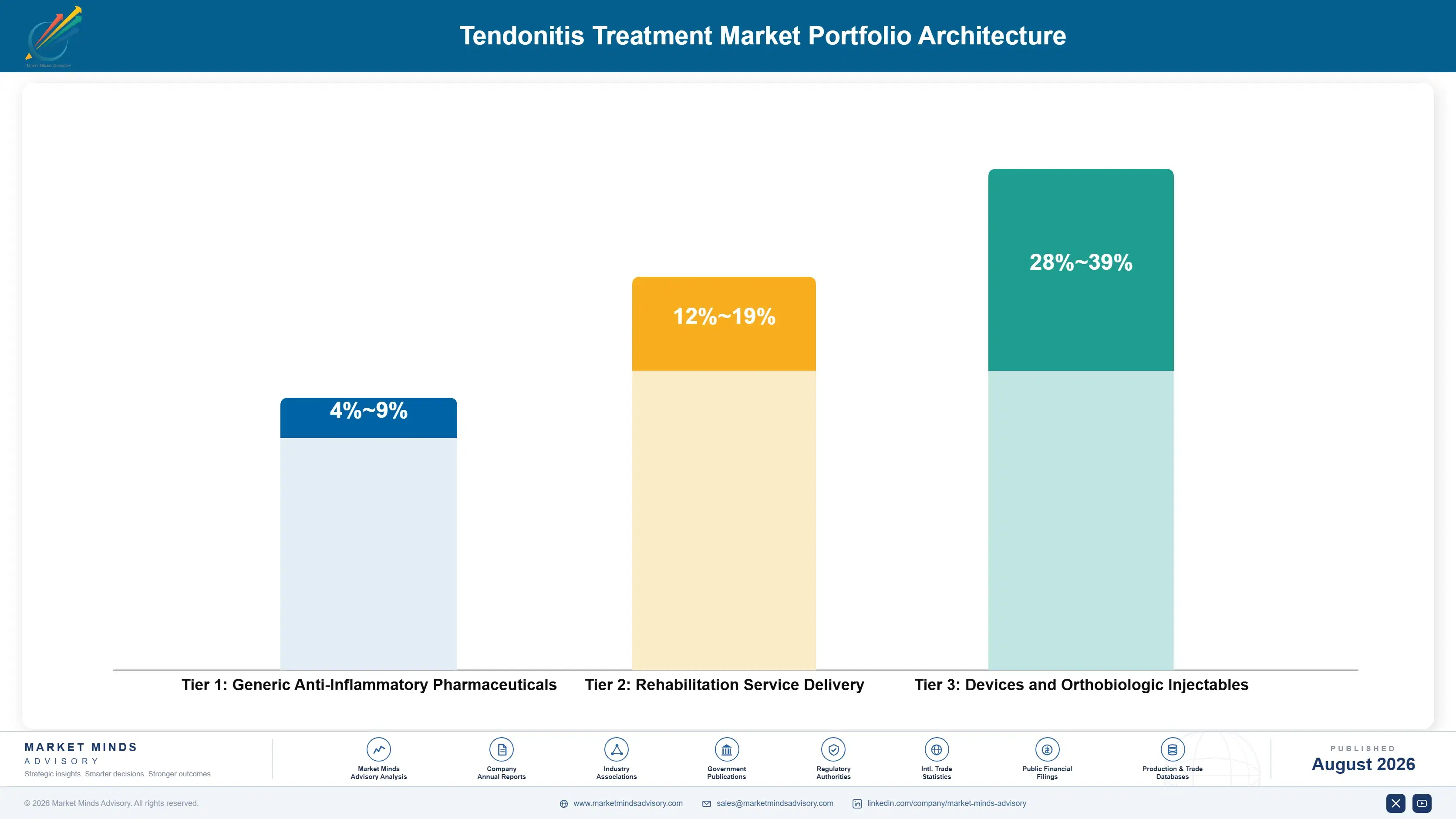
Margin here follows whether the payer is a patient, a clinic or a health system, because each accepts entirely different pricing for interventions of comparable clinical value. Generic anti-inflammatory drugs earn margins in the low to high single digits, where the products are commoditised, prescribed by habit and priced against decades old molecules with no differentiation available. Prescribing habit rather than evidence sustains the volume. No differentiation exists at all.
Rehabilitation service delivery does modestly better in the low to high teens, because clinician time is the dominant cost and does not scale, though group delivery and remote supervision improve that arithmetic where clinical protocols permit them without compromising individual progression decisions. Wage inflation passes through in full because the delivery cannot be automated at all.

Devices and orthobiologic injectables hold the strongest position, reaching into the high thirties, where patients frequently pay directly, clinics compete on equipment and pricing is set against willingness to pay rather than against cost. Those margins reflect direct payment and clinic differentiation rather than any advantage in clinical evidence. Willingness to pay rather than evidence quality sets the price in that segment.

Generic Anti-Inflammatory Pharmaceuticals

Commoditised drugs prescribed by habit against decades old molecules with no differentiation available. The five point range reflects manufacturing scale and channel structure rather than any clinical distinction between products.
Gross Margin: 4-9%

Rehabilitation Service Delivery

Programme delivery where clinician time dominates cost and does not scale with volume. The seven point range reflects group delivery capability and how much supervision has been moved to remote monitoring between appointments.
Gross Margin: 12-19%

Devices and Orthobiologic Injectables

Capital devices and injectables where patients often pay directly and clinics compete on equipment. The eleven point range reflects evidence position and how far pricing is set against willingness to pay.
Gross Margin: 28-39%
tendonitis-treatment-market-portfolio-architecture-1787639797697

High-value Sub-segments and Strategic Watch-out

Shockwave and Energy Devices

High value and the fastest growth at 8.7%, best positioned as an adjunct enabling progressive loading rather than as a standalone cure that produces the usual recurrence pattern afterwards. Referring clinicians notice recurrence patterns eventually. Standalone positioning produces the usual recurrence pattern afterwards. Adjunct use works.
Gross Margin: 30-39%

Loading Programme Delivery

Growing at 8.0% as payers recognise that a 42% recurrence rate costs more than completing rehabilitation. It is the only intervention that changes tendon structure and the least monetised in this market. Completion rather than protocol quality limits the outcome. Tendon tissue changes only here.
Gross Margin: 13-19%

Symptomatic Drug and Injection Treatment

The volume core, sustained by consultation economics and immediate patient satisfaction rather than by outcomes, with corticosteroid recovery at twelve months running below no intervention at all. Follow up rarely happens in primary care. Immediate patient satisfaction sustains it regardless of outcomes. Follow up never happens.
Gross Margin: 4-11%

Completion Rate Exposure

The strategic watch-out. Only around 34% of patients finish a prescribed programme, and the range reflects whether a supplier has built anything that improves completion or simply sells into the failure. Adherence support is where the opportunity sits. Most rehabilitation spending is wasted through non-completion.
Gross Margin: 3-37%

Ten Minutes Against Twelve Weeks

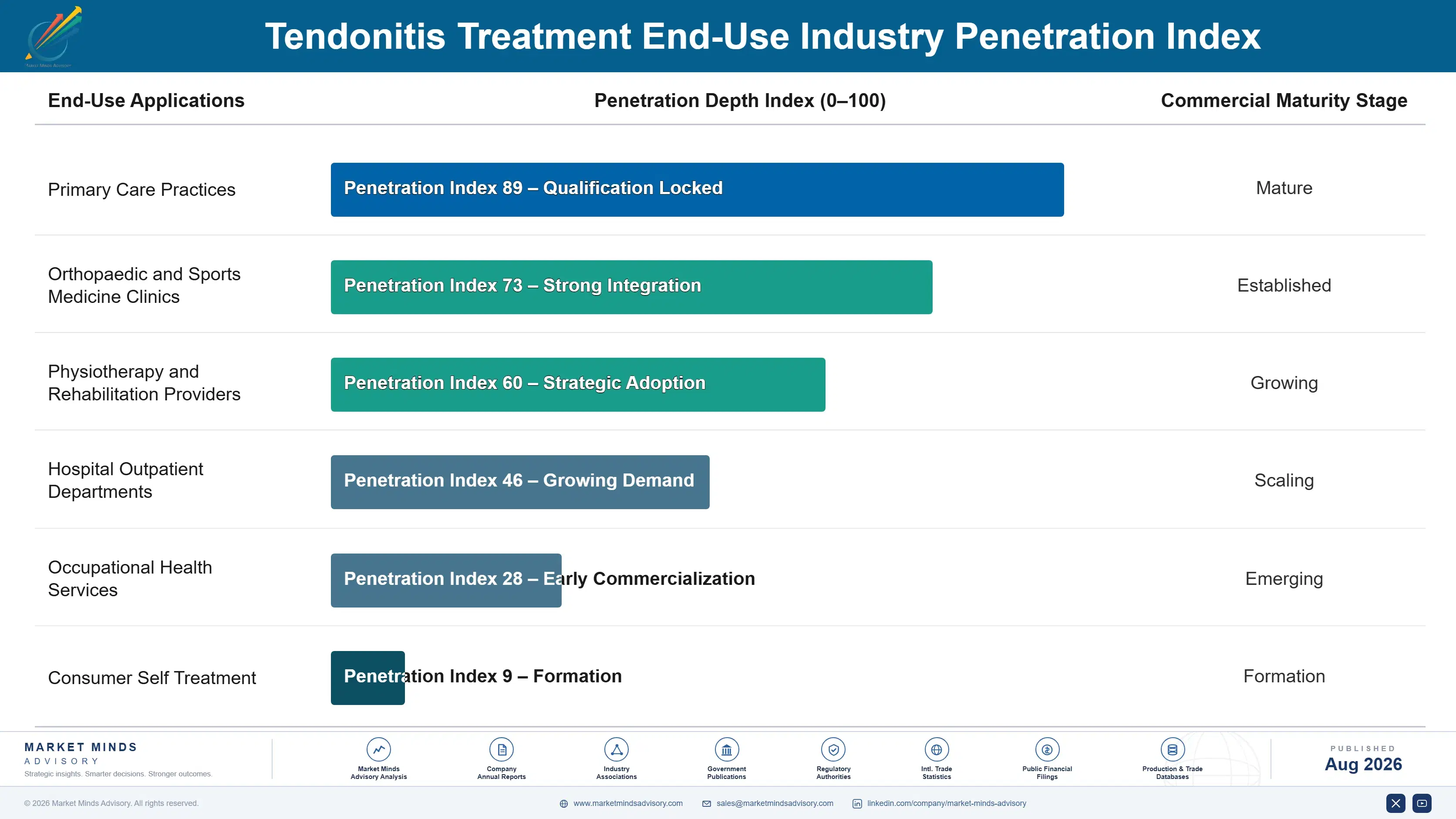
Demand is shaped by a mismatch between what the condition needs and what a consultation can deliver. Tendon remodelling requires around twelve weeks of progressive loading. A primary care appointment lasts ten minutes and an injection fits inside it comfortably while a programme explanation does not. That asymmetry rather than any disagreement about evidence explains most of what gets prescribed. Consultation length shapes the prescription.
Stickiness follows setting rather than product. Specialist practice changes with guideline updates and moves away from interventions the evidence undermines. Primary care practice is remarkably stable, because the immediate result looks good and follow up rarely happens. Private clinic device use holds while the equipment is financed, which ties adoption to a payment schedule rather than to any clinical review cycle.

The deciding voices are beginning to shift. Clinicians decided almost everything historically and payers are now entering through recurrence cost analysis, which is a financial argument reaching budgets that clinical evidence never moved. Patients paying directly for devices and injectables form a third group whose willingness to pay sets pricing independently of what any evidence review concludes about effectiveness. Three groups now decide what once one did.
tendonitis-treatment-market-end-use-penetration-index-1787639798187

Where We Would Put Effort

These are among the four positions where our research anticipates prominent divergence between winners and laggards over the coming forecast period. Each is grounded in the demand model, the regulatory perimeter, and the announced capacity pipeline.
01 / COMPLETION RATE IMPROVEMENT

A third of patients finish the programme

Tendon remodelling requires around twelve weeks of progressive loading and only about 34% of patients complete a prescribed course, with recurrence reaching 42% within two years in the cases where they do not. That makes completion the single variable determining clinical outcomes right across this entire market. Adherence support, remote progression monitoring and pain reduction permitting loading all attack it directly, and improving it makes the entire treatment episode work rather than adding yet another symptomatic product to a crowded market.
02 / ADJUNCT POSITIONING DISCIPLINE

Enable the loading, do not replace it

Shockwave grows at 8.7% against a market rate of 5.8%, and the clinics achieving durable results use it to reduce pain enough for progressive loading rather than as a treatment intended to stand on its own at all. That positioning matches the published evidence far better, produces better outcomes and protects the whole device category from the recurrence pattern following any symptomatic approach. Manufacturers marketing standalone cures buy short term adoption and long term professional scepticism from the clinicians who refer.
03 / PAYER ECONOMICS SELLING

Recurrence costs more than rehabilitation

Repeat episodes following symptomatic treatment alone consume rather more payer budget than completing a structured loading programme would have, and recurrence reaches 42% within two years wherever loading is skipped entirely. That is a cost argument rather than a clinical one, which is exactly why it moves the commissioning budgets that twenty years of outcome evidence never once managed to shift at all. Physiotherapy and loading programmes grow at 8.0% as exactly that arithmetic reaches the people actually holding musculoskeletal budgets.
04 / PRIMARY CARE CONSULTATION SUPPORT

Ten minutes is the real constraint

A clinician with ten minutes delivers an injection rather than explaining a twelve week programme, which sustains an intervention whose recovery at twelve months runs below doing nothing at all. The binding constraint here is consultation time rather than any disagreement about what the evidence actually shows. Structured prescription tools, printed patient materials and referral pathways that fit inside a short appointment change what is feasible in the setting in the setting where most tendinopathy is actually first managed by anybody.

Engagement Snapshot From the Field

A live engagement with an industry participant carrying material or product regulatory and market exposure ahead of a defining policy shift, showing how our research translates into a defensible multi-year portfolio strategy.
MARKET MINDS ADVISORY · CLIENT ENGAGEMENT SUMMARY
Tendonitis Treatment Producer Strategic Portfolio Review and Transition Roadmap 2026·Investment Scenario on Tendonitis Treatment Exposure Evaluation 2025-26
CLIENT PROFILE
A rehabilitation device manufacturer selling extracorporeal shockwave and energy therapy systems to private physiotherapy and orthopaedic clinics across European and Asian markets, at annual revenue near 96 million euros (client-reported, unverified by MMA). Marketing positioned the devices as standalone treatments for tendinopathy. Loading programme support was not offered. Payer relationships did not exist anywhere. Training was not provided.
STRATEGIC CHALLENGE
Clinic reorder rates for consumables were falling and several accounts had stopped using installed systems entirely, while newer competitors were winning placements on price. Management could not tell whether the problem was the product, the pricing or something about how the devices were being used. A pricing review was underway.
MMA APPROACH
MMA tracked patient outcomes across clinics using the client's devices as standalone treatments against those using them alongside structured loading, examined completion rates for loading programmes at both, assessed payer attitudes toward recurrence cost, and reviewed how devices were financed by clinic buyers. Interviews with 47 experts covered musculoskeletal medicine, physiotherapy and clinic management.
KEY FINDINGS
  1. Clinics using the devices as standalone treatments produced recurrence patterns indistinguishable from symptomatic care, and those were precisely the accounts that had stopped using the equipment.
  2. Clinics combining shockwave with structured loading reported substantially better completion rates, because pain reduction allowed patients to tolerate the progressive resistance the programme required.
  3. Payers in two of the client's markets had begun commissioning loading programmes on recurrence cost analysis, creating a route the client's device positioning did not connect with at all.
  4. Device buyers were small clinics financing equipment rather than institutions, which made monthly payment and utilisation the deciding numbers rather than any capital price comparison.
CLIENT PROFILE
A rehabilitation device manufacturer selling extracorporeal shockwave and energy therapy systems to private physiotherapy and orthopaedic clinics across European and Asian markets, at annual revenue near 96 million euros (client-reported, unverified by MMA). Marketing positioned the devices as standalone treatments for tendinopathy. Loading programme support was not offered. Payer relationships did not exist anywhere. Training was not provided.
STRATEGIC CHALLENGE
Clinic reorder rates for consumables were falling and several accounts had stopped using installed systems entirely, while newer competitors were winning placements on price. Management could not tell whether the problem was the product, the pricing or something about how the devices were being used. A pricing review was underway.
MMA APPROACH
MMA tracked patient outcomes across clinics using the client's devices as standalone treatments against those using them alongside structured loading, examined completion rates for loading programmes at both, assessed payer attitudes toward recurrence cost, and reviewed how devices were financed by clinic buyers. Interviews with 47 experts covered musculoskeletal medicine, physiotherapy and clinic management.
KEY FINDINGS
  1. Clinics using the devices as standalone treatments produced recurrence patterns indistinguishable from symptomatic care, and those were precisely the accounts that had stopped using the equipment.
  2. Clinics combining shockwave with structured loading reported substantially better completion rates, because pain reduction allowed patients to tolerate the progressive resistance the programme required.
  3. Payers in two of the client's markets had begun commissioning loading programmes on recurrence cost analysis, creating a route the client's device positioning did not connect with at all.
  4. Device buyers were small clinics financing equipment rather than institutions, which made monthly payment and utilisation the deciding numbers rather than any capital price comparison.
RECOMMENDED STRATEGY
Phase 1: Phase one: reposition the devices as adjuncts enabling progressive loading, and support customer clinics in delivering the loading programme alongside them. Phase 2: Phase two: build the payer recurrence cost argument into commissioning conversations, where clinical evidence alone has consistently failed to move budgets. Phase 3: Phase three: offer placement and per treatment structures, since clinic buyers finance rather than purchase and utilisation decides value. Payment terms decide it.
OUTCOME
The manufacturer repositioned around loading adjunct use during 2026 and reported consumable reorder rates recovering across retrained accounts (client-reported, unverified by MMA). Placement structures were introduced, and standalone treatment marketing was withdrawn entirely. Clinic training was introduced alongside every installation. Standalone marketing was withdrawn from every market.

Frequently Asked Questions

Foundational context covering the market sizes, CAGR, scope, country, region and competition that inform every finding below. This section is provided to cover basics and most often pre-purchase conversations, answered from the MMA Primary Research Dataset.

What is the current size of the Tendonitis Treatment Market?

MMA sizes it at USD 4.2 billion in 2025, rising to USD 4.44 billion in 2026. The figure covers products and services treating tendinopathy at manufacturer and provider selling value.

How large will the Tendonitis Treatment Market be by 2036?

USD 7.80 billion by 2036, an incremental USD 3.36 billion over the 2026 base and an expansion multiple of 1.76 times. Shockwave devices account for a disproportionate share of that.

What is the CAGR for the Tendonitis Treatment Market 2026 to 2036?

5.8% in the base case, with a bull case at 7.0% and a bear case at 4.6%. The spread turns largely on whether programme completion rates can be improved meaningfully.

Which segment is growing fastest?

Extracorporeal shockwave and energy devices at 8.7%, half again the market rate of 5.8%. Clinics increasingly adopt them to make progressive loading tolerable rather than as standalone cures.

Who are the major companies in the Tendonitis Treatment Market?

Enovis, Storz Medical, Zimmer MedizinSysteme, Johnson and Johnson and Pfizer lead on tendinopathy related revenue, and fifteen further participants are profiled in the full report on that same consistent basis.

Which country is growing fastest?

South Korea at 9.6%, on private rehabilitation and orthopaedic clinic utilisation exceeding most developed markets and shockwave device density among the highest anywhere. Clinics compete on equipment.

Report Segmentation Architecture

The full report scope spans multiple orthogonal segmentation dimensions, with cross-tabulated demand data provided for each dimension pair. Coverage extends further to regional breakdowns, trend trajectories, and the competitive detail needed to support segment-level decision-making.

By Intervention Type

  • Oral and Topical Anti-Inflammatory Drugs
  • Corticosteroid and Local Injection Therapy
  • Physiotherapy and Loading Programmes
  • Extracorporeal Shockwave and Energy Devices
  • Orthobiologic Injection Therapies
  • Surgical Intervention and Repair

By End-Use Industry

  • Primary Care Practices
  • Orthopaedic and Sports Medicine Clinics
  • Physiotherapy and Rehabilitation Providers
  • Hospital Outpatient Departments
  • Occupational Health Services
  • Consumer Self Treatment

By Commercial Dimension

  • Clinic Capital Device Sales
  • Device Placement and Per Treatment Billing
  • Payer Commissioned Programme Delivery
  • Retail Pharmacy Distribution
  • Direct Patient Payment
  • Distributor and Dealer Channels

By Region

  • North America
  • Western Europe
  • East Asia
  • South Asia and Pacific
  • Latin America
  • Middle East and Africa
  • Eastern Europe

Scope, Methodology, and Coverage

Every figure in this report is reproducible from documented input assumptions. The scope below maps the historical period, the forecast horizon, the segmentation dimensions, and the countries covered, alongside the underlying primary and qualitative methodology.
Historical Period
2020 to 2025
Forecast Period
2026 to 2036
Base Year
2025 (USD billions; MMA Primary Research Dataset, August 2026)
Market Definition
Products and services used to treat tendinopathy and related tendon disorders, covering oral and topical anti-inflammatory drugs, corticosteroid and local injection therapy, physiotherapy and loading programmes, extracorporeal shockwave and energy devices, orthobiologic injection therapies, and surgical intervention and repair. Measured at manufacturer and provider selling value. General musculoskeletal pain products without tendon indications, acute tendon rupture repair implants, orthotics and bracing sold separately, and diagnostic imaging services are excluded from scope.
Quantitative Units
USD billions (current prices); treatment episodes and device units; USD per episode or device
Segmentation Dimensions
Intervention type; care setting; commercial dimension; region
Regions Covered
North America, Western Europe, East Asia, South Asia and Pacific, Latin America, Middle East and Africa, Eastern Europe
Countries Covered
United States, Canada, Mexico, United Kingdom, Germany, France, Italy, Spain, South Korea, Japan, China, Taiwan, India, Australia, Thailand, Brazil, Argentina, United Arab Emirates, South Africa, Poland
Key Companies Profiled
Enovis, Storz Medical, Zimmer MedizinSysteme, Johnson and Johnson, Pfizer, Haemonetics, Arthrex, Regen Lab, Terumo BCT, Bausch Health, Teva Pharmaceutical, Viatris, GSK, Sanofi, Smith and Nephew, Stryker, BTL Industries, EMS Electro Medical Systems, Richard Wolf, Softwave Tissue Regeneration
Quantitative Methodology
Primary survey, n=3,800 respondents, Q4 2025, six countries; demand-side model with trade association cross-validation
Qualitative Methodology
47 expert interviews, Q4 2025; applied to validate demand model assumptions, identify emerging dynamics, and assess competitive positioning
Report Format
PDF and XLSX data workbook (Word format preview document)
Publisher
Market Minds Advisory
Report Code
MMA-2026-HLT-130
Published
August 2026
Contact
sales@marketmindsadvisory.com | www.marketmindsadvisory.com

Purchase the full Tendonitis Treatment Market Report (2026 to 2036).

The full report begins from the histology rather than the name, because inflammation is present in a small minority of cases while most spending assumes otherwise. It sizes all six intervention types independently through 2036, quantifies programme completion and recurrence across care settings, and models the payer economics that are beginning to move commissioning budgets. Regional chapters cover all seven regions with care setting analysed alongside intervention choice. Competitive profiling covers 20 participants on one consistent revenue basis throughout. Completion rates are tracked by delivery model throughout.
Six intervention types sized independently through 2036
Programme completion and recurrence quantified across care settings
Payer recurrence economics modelled against commissioning decisions
Corticosteroid outcome evidence assessed by setting and specialty
Device positioning compared between standalone and adjunct use
Twenty participants profiled on one consistent revenue basis

Built For The People Who Decide

From boardroom strategy to bench-side execution, this report is read cover-to-cover by leaders shaping the next decade of their industry, turning demand scenarios, market dynamics and valuation benchmarks into decisions.
CXOs/ Presidents/ VPs/ Managers
M&A and Corporate Development
Strategy Teams and R&D Heads
Procurement and Product Directors
Regulatory and Compliance Leaders
Investor Relations and Equity Analysts