Market Minds Advisory
Temporary Tattoos Market

Temporary Tattoos Market: Temporary Tattoos Market. Brand Collaborations and Metallic Formats Redefine Novelty Body Art.

Metallic and brand-licensed temporary tattoo formats increasingly capture festival and gifting demand away from basic waterslide designs, pushing manufacturers toward celebrity-collaboration and custom-printing investment or risk losing shelf priority to faster-moving direct-to-consumer challengers.

Lead Analyst

Published

September 2026

Make Smarter Decisions with Customized Research Insights

Request a free sample report and evaluate market opportunities, growth trends, and competitive dynamics relevant to your business needs.

2025 MARKET VALUE$0.9BMarket Size 2025
2036 FORECAST VALUE$2.0BBase Case , 2026 to 2036
CAGR 2026 TO 20366.8 %Bull 8.0% / Bear 5.6%
INCREMENTAL OPPORTUNITY$0.9BNet 10- year value creation
EXPANSION MULTIPLE1.93x2036 value over 2026 base
Strategic Levers
M&A Pipeline
Regional Outlook
Country Rankings
Competitive Intelligence
Segmental Deep-dive
Call-Us : 91 93563 13602

Executive Snapshot and Market Trajectory.

Metallic and jewelry-style temporary tattoos have become the dominant growth narrative in novelty body art today, with festival organizers and retailers increasingly screening new product launches on visual-impact and social-media shareability rather than durability alone, reshaping which brands win seasonal retail floor-space commitments across specialty and mass-market beauty channels.
Classic waterslide transfer tattoos remain the dominant purchase category by unit volume across children's novelty and party-goods retail, while metallic and custom brand-licensed formats carry the fastest unit growth and increasingly command premium pricing once reserved for body-jewelry accessories. Manufacturing concentrates heavily in East Asia, where printing and adhesive-substrate production scale gives regional producers a durable cost advantage over smaller Western converters, even as North American festival and gifting demand continues climbing steadily.
Competitive intensity centers on brand-licensing depth and direct-to-consumer design catalogs rather than raw printing cost alone, with Inkbox and Tattly anchoring the premium tier through distinctive design libraries and social-media-driven customer acquisition built over multiple years. Regulatory scrutiny toward ink-pigment safety standards continues tightening product-development timelines, while smaller regional manufacturers increasingly undercut pricing in commodity waterslide categories across e-commerce and dollar-store retail channels.
Market Definition
The temporary tattoos market covers non-permanent skin decoration products including waterslide transfer, metallic, henna-style, airbrush, and brand-licensed formats applied and removed within days to weeks. It excludes permanent tattoo services, tattoo equipment and ink used by professional tattoo artists, and semi-permanent cosmetic microblading procedures.
Base Year Value
$0.9B in 2025 (MMA Primary Research Dataset, September 2026)
Forecast Period
2026 to 2036, eleven discrete annual values
CAGR
6.8% base case. Bull 8.0%. Bear 5.6%.
Fastest Growth Segment
Metallic and Jewelry-Style Temporary Tattoos: 11.0% CAGR
Fastest Growth Country
China: 9.5% CAGR
Fastest Growth Region
South Asia and Pacific: 8.8% CAGR
Largest Region
East Asia: 30% of 2025 global value
Market Leaders
Inkbox (Sonar Studios Inc), Tattly LLC, Flash Tattoos LLC, Prinker Corporation, Ephemeral Tattoo Inc. Source: MMA Analysis, company annual reports.
Primary Survey
n=3,800 procurement and R&D decision-makers, Q4 2025, six countries
Methodology
Demand-side build-up, cross-validated against public data, 47 expert interviews

Temporary Tattoos Market Forecast Scenarios

temporary-tattoos-market-size-forecast-scenario-1790022679778
The 2020 to 2025 period saw temporary-tattoo demand accelerate as social-media-driven novelty purchasing and festival attendance both recovered from pandemic-era disruption, with metallic and brand-licensed formats gaining share faster than the category overall. Supply-chain disruption briefly constrained specialty-adhesive availability in 2021 and 2022, but manufacturers expanded sourcing in response. Historical growth of 6.0% reflects this lasting step-change in novelty-purchasing behavior across major consumer markets served today.
Base-case growth of 6.8% through 2036 rests on three mechanisms: continued substitution of metallic and jewelry-style formats for basic waterslide designs across festival and gifting occasions nationwide and internationally, expanding brand-licensing partnerships that pair temporary tattoos with entertainment and fashion marketing campaigns worldwide, and rising direct-to-consumer custom-design demand enabled by digital printing technology. Together these mechanisms support durable volume growth even as basic novelty-tattoo demand in mature Western markets moderates.
The bull case centers on accelerated celebrity and entertainment brand-licensing partnerships pushing category growth faster than currently expected across specialty and mass retail channels. The bear risk is tightening ink-pigment safety regulation in mature markets restricting formulation flexibility and import approval, particularly where regulators increasingly scrutinize allergenic reactions linked to certain metallic and henna-style formulations.

Metallic Formats and Brand Licensing Redraw the Temporary Tattoo Landscape

The temporary tattoo category spans waterslide transfer, metallic, henna-style, airbrush, and brand-licensed formats sold across children's novelty, festival, and adult body-jewelry channels, with metallic and jewelry-style designs now the fastest-expanding format across nearly every major retail segment. Classic waterslide transfers still account for the largest share of unit volume worldwide, anchored by deep printing and substrate manufacturing bases in East Asia that supply both domestic novelty demand and export markets simultaneously.
MARKET CONCENTRATION18%Top five brands hold a modest combined market share
AVERAGE UNIT PRICE$2.50Blended price spans basic sheets to premium metallic sets
CHINA PRODUCTION SHARE45%Chinese manufacturers supply nearly half of global units sold
CAPACITY UTILIZATION68%Most tattoo printing plants run moderately below full capacity
IMPORT TRADE INTENSITY40%Cross-border trade covers a large share of total consumption
REPURCHASE CYCLE LENGTH3 monthsConsumers typically repurchase new designs every few months
Growth through 2036 depends heavily on continued substitution of metallic and custom formats for basic waterslide designs across festival, gifting, and social-media-driven purchase occasions. Entertainment and fashion brands increasingly license temporary tattoo lines as low-cost marketing extensions, extending demand beyond traditional novelty retail into branded promotional and collaboration channels that were previously dominated by stickers and other simple giveaway items.
Distribution runs through mass-market retail, specialty gift and festival vendors, and direct-to-consumer e-commerce channels that each reward different manufacturer capabilities. Mass-market retail rewards manufacturing scale and consistent supply, while direct-to-consumer brands reward design catalog depth and social-media marketing reach that smaller regional producers struggle to match consistently. Manufacturers with the broadest licensing relationships and deepest design libraries hold durable advantages in capturing premium-format demand.
"Metallic and jewelry-style tattoos have quietly become the category's real profit pool, not basic waterslide sheets. Manufacturers still treating temporary tattoos as a low-margin party-favor category are ceding premium shelf space faster than their catalogs suggest."
Practice Lead, Consumer Products and Novelty Goods Practice · MMA Chemicals and Materials Practice · September 2026

Market Trends

Metallic and Jewelry-Style Formats Displace Basic Waterslide Designs

Metallic and jewelry-style temporary tattoos now capture roughly 26% of festival and gifting purchase occasions in mature markets, up sharply from a much smaller share a decade ago, as consumers favor visually striking designs suited to social-media sharing over basic single-color waterslide sheets. Flash Tattoos and Inkbox have each expanded metallic-format manufacturing and design-catalog depth since 2022, moving beyond single-sheet novelty items toward curated multi-piece jewelry-style sets. Retailers are responding by expanding metallic and premium-format shelf space while trimming basic waterslide SKUs, particularly in specialty gift and festival-vendor channels where margin per unit sold matters most.
Market Impact: Drives 50% of category revenue

Brand and Entertainment Licensing Partnerships Expand Rapidly

Entertainment studios and fashion brands increasingly license temporary tattoo lines as low-cost promotional extensions, a shift that has lifted branded-collaboration revenue by roughly 15% annually across major manufacturer catalogs and distribution programs. Tattly and Prinker have both expanded formal licensing programs with entertainment properties and fashion labels, moving beyond generic novelty designs toward recognizable branded content that commands premium retail pricing across specialty and mass-market channels alike. Retailers increasingly dedicate specific shelf space to licensed-collaboration product lines, extending demand well beyond traditional novelty-aisle placement into promotional and gift-with-purchase retail programs.
Market Impact: Grows custom-design segment 12% yearly

Market Opportunities and Growth Drivers

Festival and Social-Media Culture Sustains Novelty Purchase Demand

Festival attendance and social-media-driven novelty purchasing have both remained elevated well above pre-2020 baselines, supporting roughly 50% of category revenue through occasion-driven purchases rather than routine children's-novelty replacement across major markets. Consumers increasingly buy temporary tattoos specifically for photo-sharing occasions, favoring metallic and premium designs suited to visual impact over basic single-color sheets common a decade earlier. This occasion-driven demand base proves more resilient to broader discretionary-spending cycles than routine novelty-item demand, since festival and gifting purchases rarely depend on general economic conditions in the same way everyday impulse purchases typically do.
Market Impact: Adds 6-month regulatory delay risk

Rising Direct-to-Consumer Custom-Design Printing Lifts Premium Sales

Direct-to-consumer digital printing technology now enables custom temporary tattoo designs at roughly 12% annual growth, letting consumers order personalized artwork rather than selecting from fixed retail catalogs alone across most major markets served today. Inkbox and Prinker have both built proprietary digital printing and design-upload platforms that let customers create fully custom designs, capturing premium pricing that standard retail-catalog products cannot command at comparable scale. This direct-to-consumer growth is expected to continue outpacing traditional retail-channel growth in mature Western markets through the forecast period, as social-media discovery increasingly drives traffic directly to brand websites.
Market Impact: Displaces roughly 8% of licensed sales

Market Restraints and Challenges

Ink-Pigment Safety Regulation Tightens Product Development Timelines

Regulators in several major markets are moving toward stricter ink-pigment safety and allergen-disclosure standards for temporary tattoos, a shift driven by documented skin-reaction cases linked to certain metallic and dark-henna formulations sold through unregulated channels. Reformulation to meet stricter standards can extend development timelines by several months, as manufacturers must generate safety-testing data that many novelty-product teams have limited experience producing. This raises cost and delays launch calendars for smaller manufacturers already operating on thin research budgets, though several are mitigating the impact by licensing pre-tested pigment formulations from established chemical suppliers.
Market Impact: Adds 26% festival category share

Counterfeit and Unlicensed Designs Undermine Brand Licensing Revenue

Counterfeit and unlicensed reproductions of popular branded and artist designs continue circulating through online marketplaces and gray-market distribution channels, undermining both licensing revenue and brand-partner trust across the category and its retail relationships worldwide and across multiple continents. Regulators and platform operators in several major markets have increased enforcement action against counterfeit sellers, but enforcement capacity remains uneven across jurisdictions with differing intellectual-property protections and staffing levels available to customs officials. Licensed manufacturers are mitigating this by expanding authenticated packaging and partnering with e-commerce platforms to flag and remove suspected counterfeit listings proactively across major channels.
Market Impact: Lifts licensing revenue 15% yearly
3 additional market trends, 4 additional growth drivers, and 2 additional restraints and challenges are covered in the full report. Contact sales@marketmindsadvisory.com to access the complete intelligence.

Segment CAGR and Growth Architecture

The temporary tattoos market splits into six product categories defined by application method and design style, spanning established waterslide and henna-style formats through rapidly expanding metallic and custom brand-licensed categories. Growth concentrates most heavily in formats that pair visual impact with social-media shareability, while basic single-color designs grow more slowly as buyers trade up.
temporary-tattoos-market-market-share-analysis-1790022680362

Metallic and Jewelry-Style Temporary Tattoos

Metallic and jewelry-style temporary tattoos are the fastest-growing category, expanding at roughly 11.0% annually as consumers favor visually striking, foil-based designs suited to festival and social-media occasions over basic single-color waterslide sheets common elsewhere in the category. These products combine gold and silver foil accents with intricate patterns resembling body jewelry, letting manufacturers command pricing several times above standard transfer designs sold through mass retail. Flash Tattoos and Inkbox have both expanded metallic-format manufacturing and design-catalog depth since 2022, and festival vendors increasingly dedicate specific booth space to metallic and premium-format products. Retailers continue expanding shelf space for this category, often at the direct expense of basic waterslide and children's novelty aisles nationwide.
CAGR 11.0%

Custom and Brand-Licensed Temporary Tattoos

Custom and brand-licensed temporary tattoos form the second-fastest category, growing at roughly 9.0% annually as entertainment studios and fashion brands increasingly license temporary tattoo lines as low-cost promotional extensions beyond traditional novelty retail and party-goods channels. These products combine recognizable branded content or fully custom digital designs with premium retail pricing that standard catalog products cannot command at comparable manufacturing cost. Tattly and Prinker both maintain formal licensing and custom-design platforms targeting direct-to-consumer and promotional-partnership channels rather than basic retail alone. Growth here tracks entertainment marketing cycles and social-media discovery more closely than routine seasonal novelty-purchasing patterns, giving it a somewhat different demand rhythm than other categories in the broader portfolio.
CAGR 9.0%
Full segment breakdown across 7 segments available in the complete report.

Regional Architecture and Country Demand Map

East Asia leads global temporary tattoo value on manufacturing and printing-substrate production scale, with North America following on festival culture and brand-licensing spending. Western Europe holds a solid third position on similar festival demand, while South Asia and Pacific shows the fastest regional growth as disposable income expands.

North America

North America's temporary tattoo demand runs heavily through festival, gifting, and brand-licensing occasions rather than routine children's-novelty replacement alone, with metallic and premium formats capturing the largest share of discretionary purchase spending nationwide and across most demographic groups. Flash Tattoos and Inkbox both maintain extensive direct-to-consumer and specialty-retail distribution, giving the region a dense premium-format supply chain built over the past decade of steady investment. Entertainment and fashion brand-licensing partnerships command premium pricing here more than in any other region, reflecting buyer willingness to fund collaboration-driven design catalogs. Growth tracks festival attendance and social-media adoption more closely than routine seasonal novelty-purchasing patterns, which have moderated somewhat in recent years across mass-market retail.
Share: 26% | CAGR: 7.2% (2026 to 2036)

Western Europe

Festival culture across Western Europe closely mirrors North America's occasion-driven purchase pattern, with major music festivals and seasonal gift-giving both supporting steady temporary-tattoo demand across the region and its major cities and popular tourist destinations. Germany, France, and the United Kingdom account for most regional demand, concentrated among younger consumers already active on social-media platforms that drive novelty-product discovery and purchase decisions. Growth trails North America and East Asia as the region's festival calendar and retail infrastructure are already comparatively mature, limiting the pace of new premium-format adoption. Metallic and brand-licensed formats retain strong positioning among specialty retailers willing to stock premium designs beyond basic children's novelty categories sold nationwide.
Share: 20% | CAGR: 5.2% (2026 to 2036)
Regional intelligence for 5 additional markets available in the complete report: East Asia, South Asia and Pacific, Latin America, Middle East and Africa, Eastern Europe. Contact sales@marketmindsadvisory.com.
temporary-tattoos-market-country-cagr-analysis-1790022680886

Where Tattoo Brands Can Expand Margin

Manufacturers hold four practical levers to expand margin beyond commodity-waterslide volume: premium metallic upselling, entertainment and fashion brand-licensing partnerships, private-label supply to party-goods retailers, and direct-to-consumer custom-design repeat-purchase programs built around proprietary design platforms today. Each addresses a different point in the value chain, from product mix through channel relationships and repeat-purchase behavior nationwide.

Upselling Basic Buyers Into Metallic Formats

Manufacturers that convert basic waterslide buyers into metallic and jewelry-style purchasers capture meaningfully higher revenue per transaction, since metallic formats carry average selling prices roughly 300% above basic sheets while requiring comparable printing and packaging effort and shelf space. Flash Tattoos and Inkbox both merchandise metallic options prominently alongside basic products at festival and specialty-retail points of sale, positioning visual impact as justification for the price premium over standard alternatives. This upsell motion costs little beyond merchandising and packaging investment, making it one of the highest-return options available to manufacturers with established retail-shelf presence.
Market Impact: Lifts revenue per transaction by roughly 300% overall

Building Entertainment and Fashion Licensing Partnerships

Manufacturers that secure entertainment studio and fashion brand licensing agreements capture premium promotional shelf placement that generic novelty producers cannot access, with licensed-collaboration products commanding roughly 45% higher pricing than comparable unlicensed designs sold through the same retail channels nationwide. Tattly and Prinker both maintain formal licensing programs specifically tied to entertainment property release calendars, timing product launches to align with film and television marketing campaigns for maximum retail impact. This partnership approach costs meaningfully less than building proprietary entertainment-property development internally from scratch, while still capturing the specification advantage licensing provides.
Market Impact: Commands roughly 45% pricing premium over generic designs

Supplying Private-Label Products to Party-Goods Retailers

Manufacturers with spare printing capacity increasingly supply private-label temporary tattoo lines to large party-goods and costume retailers, generating incremental volume at lower marketing cost than building competing branded distribution from scratch entirely on their own. Private-label arrangements typically carry margins roughly 10 to 14 percentage points below branded product lines but require minimal incremental sales investment, since the retailer handles marketing and shelf placement entirely on its own without additional support from the manufacturer. This arrangement works best for manufacturers with underutilized printing capacity, converting otherwise idle production into incremental revenue.
Market Impact: Adds 10 to 14 points of lower margin

Expanding Custom-Design Direct-to-Consumer Repeat Purchase Programs

Direct-to-consumer custom-design platforms let manufacturers capture repeat-purchase revenue independent of retail-shelf cycles, with customers who order one custom design reportedly returning for additional purchases at roughly 40% higher rates than one-time retail buyers shopping through mass-market channels nationwide and abroad each year. This recurring revenue stream carries higher margin than wholesale retail distribution, meaningfully improving blended profitability for manufacturers able to build genuinely useful design-customization tools rather than offering only fixed catalog options. Inkbox and Prinker both built proprietary design-upload platforms specifically to capture this repeat-purchase relationship with existing customers.
Market Impact: Reaches roughly 40% higher repeat-purchase rate than average

Who Controls the Margin Pool

The top five temporary tattoo manufacturers hold a combined 18% of category value, evaluated on a revenue basis, leaving a fragmented long tail of regional novelty and printing manufacturers. Inkbox and Tattly command the clearest leadership positions in premium and direct-to-consumer channels specifically, each having built distinctive design catalogs and social-media-driven brand recognition, while smaller regional producers still compete primarily on price in basic waterslide categories.
Current competitive activity concentrates on three fronts: expanding metallic and jewelry-style product lines to capture continued festival and gifting demand, securing entertainment and fashion brand-licensing partnerships that open premium promotional placement, and building direct-to-consumer custom-design platforms that capture repeat-purchase revenue independent of retail-shelf cycles. Manufacturers lacking resources to compete on all three fronts simultaneously increasingly specialize by design category or distribution channel rather than compete broadly.

Rankings are most likely to shift among mid-tier direct-to-consumer challengers rather than at the very top, as digitally native brands move faster on custom-design technology than established mass-market manufacturers burdened by legacy catalog-printing processes. Manufacturers investing early in licensing relationships and digital-printing capability are positioning to capture share from slower-moving rivals still reliant on basic waterslide product lines.
temporary-tattoos-market-company-positioning-matrix-1790022681414

Competitive Moat and Risk Dimensions

INKBOX (SONAR STUDIOS INC)

Moat: Digital Printing Design Platform

Inkbox's proprietary digital design-upload and semi-permanent printing technology gives it a direct-to-consumer relationship competitors relying on wholesale distribution cannot replicate quickly or cheaply. This platform lets Inkbox capture repeat-purchase revenue and design-customization pricing power unavailable to catalog-only manufacturers selling through traditional wholesale retail channels alone.
INKBOX (SONAR STUDIOS INC)

Risk: Narrow Semi-Permanent Category Focus

Inkbox's core semi-permanent product line faces direct pressure from broader-catalog competitors offering both basic and premium formats under one brand umbrella. If Inkbox's semi-permanent category growth slows relative to metallic and licensed formats elsewhere in the market, its narrower product focus could limit share capture.
TATTLY LLC

Moat: Distinctive Artist-Designed Catalog

Tattly's artist-collaboration design catalog carries a decade of brand credibility and distinctive visual identity that newer entrants cannot replicate without years of consistent design-partnership investment and relationship-building with artists directly. This catalog depth supports premium pricing and strong customer loyalty across Tattly's direct-to-consumer and specialty-retail channels alike.
TATTLY LLC

Risk: Limited Metallic Format Presence

Tattly's brand strength concentrates heavily in artist-designed waterslide formats, leaving it comparatively underrepresented in the faster-growing metallic and jewelry-style category where specialist brands hold stronger consumer recognition today across most major markets. Building metallic-format presence from a weaker starting position could take years of sustained product investment.

Players Tracked

Prominent Players

Inkbox (Sonar Studios Inc)
Tattly LLC
Flash Tattoos LLC
Prinker Corporation
Ephemeral Tattoo Inc

Other Key Players

Tinsley Transfers Inc
Savvi Tattoo Company
Momentary Ink
Tattoo Stickers Manufacturing Co Ltd
The Topps Company Inc
Panini S.p.A.
Amscan Inc
Xpres Corporation
Herma GmbH
Chameleon Tattoos Ltd
Rockstar Tattoos LLC
Twinkle Temporary Tattoos
Golden Ratio Tattoos
HYPE Tattoo Co
Design Express Inc

Recent Developments

MARCH 2025

Inkbox Expands Digital Design Platform Capacity

Inkbox expanded its digital design-upload platform capacity in March 2025, adding new printing infrastructure dedicated to custom semi-permanent tattoo orders processed directly through its website and mobile app. The expansion positions Inkbox to defend its direct-to-consumer leadership as custom-design demand continues growing faster than wholesale retail sales.
Signal: Signals digitally native brands are investing directly in production capacity rather than relying on third-party printing partners alone.
JUNE 2025

Tattly Signs Entertainment Studio Licensing Agreement

Tattly signed a multi-year licensing agreement with a major entertainment studio in June 2025, securing exclusive rights to produce temporary tattoos tied to an upcoming film franchise. The agreement expands Tattly's promotional-retail presence beyond its traditional artist-designed catalog into licensed entertainment content for the first time in company history.
Signal: Signals entertainment licensing is becoming a competitive priority as brands seek premium promotional shelf placement nationwide.
OCTOBER 2025

Flash Tattoos Acquires Metallic-Printing Manufacturer

Flash Tattoos completed a targeted acquisition of a specialty metallic-printing manufacturer in October 2025, expanding its foil-application production capacity ahead of peak festival-season demand across major markets. The acquisition strengthens Flash Tattoos' position in the metallic and jewelry-style category specifically, reinforcing its leadership in premium formats.
Signal: Signals established metallic-format leaders are consolidating specialized manufacturing capability rather than outsourcing it to third parties.

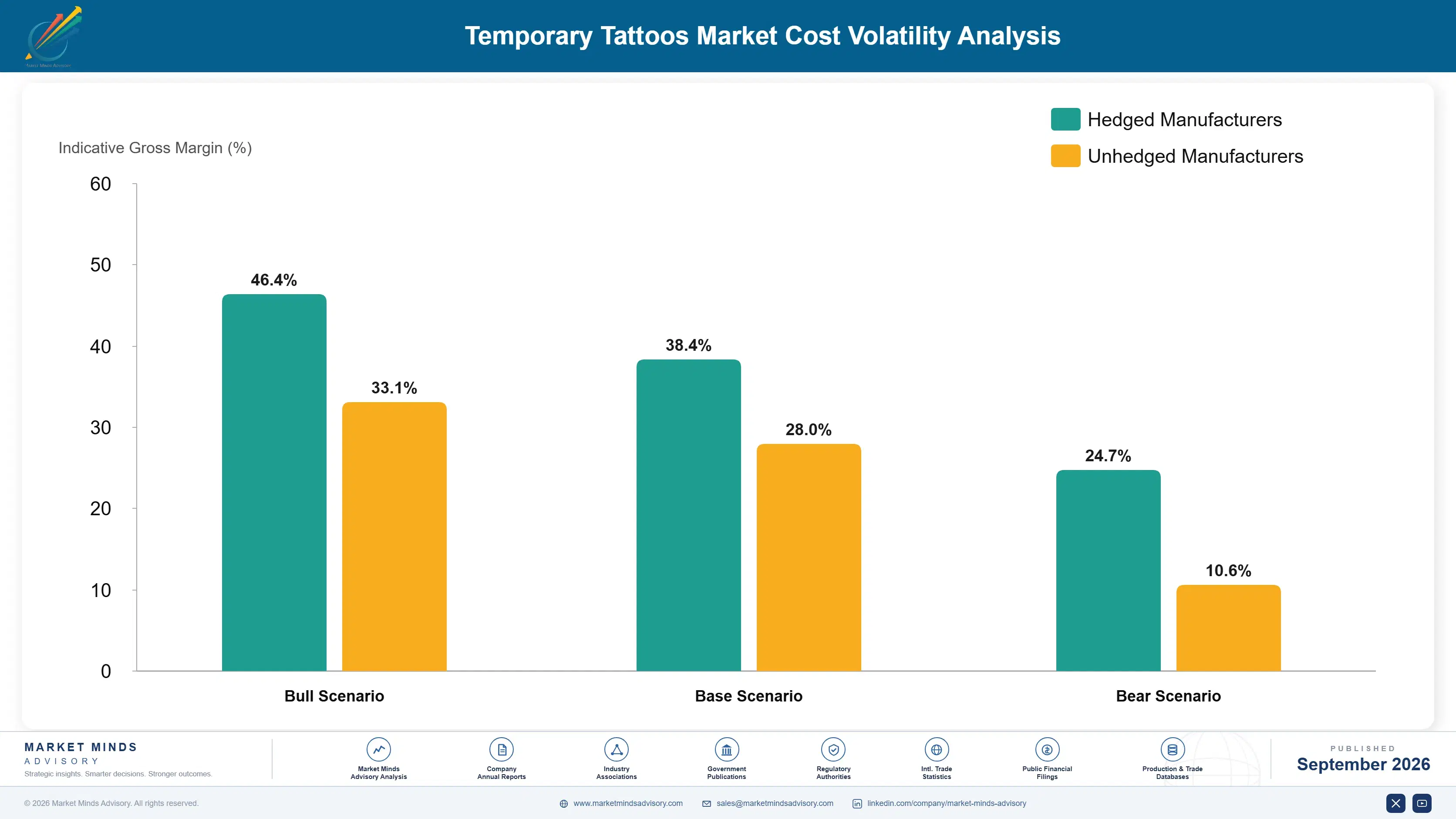
Ink and Substrate Costs Shape Margins

Specialty inks, transfer-paper substrate, and metallic foil together account for roughly 40% of temporary tattoo cost of goods sold, with pigment and resin inputs sourced primarily from petrochemical producers in East Asia and North America across multiple countries. Transfer-paper substrate comes predominantly from regional pulp-and-paper converters, while metallic foil is sourced from specialized foil-stamping suppliers concentrated in China and South Korea.
The EIA's 2025 petrochemical outlook documented specialty-pigment and resin price swings exceeding 18% within a single year, driven by natural gas feedstock volatility and shifting global solvent-capacity additions concentrated in East Asia and neighboring markets. Temporary tattoo manufacturers reliant on printed-ink formulations absorbed comparable input-cost volatility during the same period, with several manufacturers citing pigment cost pressure directly in their 2025 annual reports as a factor compressing basic waterslide-category margin specifically.

Smaller regional manufacturers without long-term pigment and substrate supply contracts absorb price swings directly into margin, since they lack the purchasing scale to negotiate fixed pricing that larger competitors secure across most sourcing regions. Manufacturers concentrated in metallic-foil production face greater specialty-material exposure than basic waterslide competitors, which draw on simpler, less volatile paper and standard-ink input structures overall.
temporary-tattoos-market-cost-volatility-analysis-1790022681609

Securing Multi-Year Fixed-Price Pigment Agreements

Larger manufacturers increasingly negotiate multi-year fixed-price agreements directly with pigment and resin suppliers, trading some pricing flexibility for budget certainty across product-development cycles and multiple annual planning periods. This approach requires meaningful purchase-volume commitments that smaller manufacturers often cannot offer, reinforcing scale advantages for established players able to guarantee consistent order volumes years into the future.

Diversifying Substrate Sourcing Across Multiple Regions

Manufacturers are qualifying second and third paper and foil suppliers across East Asia and other regions rather than depending on a single sourcing country, reducing exposure to any one country's tariff policy or supply disruption. This diversification adds qualification cost upfront but meaningfully lowers the risk of production stoppages tied to a single geography's regulatory or trade decisions.

Standardizing Ink Formulations Across Product Lines

Some manufacturers are standardizing pigment formulations across multiple product lines, reducing the number of distinct inks requiring separate supplier negotiations and inventory management across the broader catalog and design library. This shared-formulation approach lowers per-unit material cost through higher aggregate purchase volume while also simplifying quality-control processes across the entire printed-product portfolio over time.

Portfolio Architecture for Margin Defence

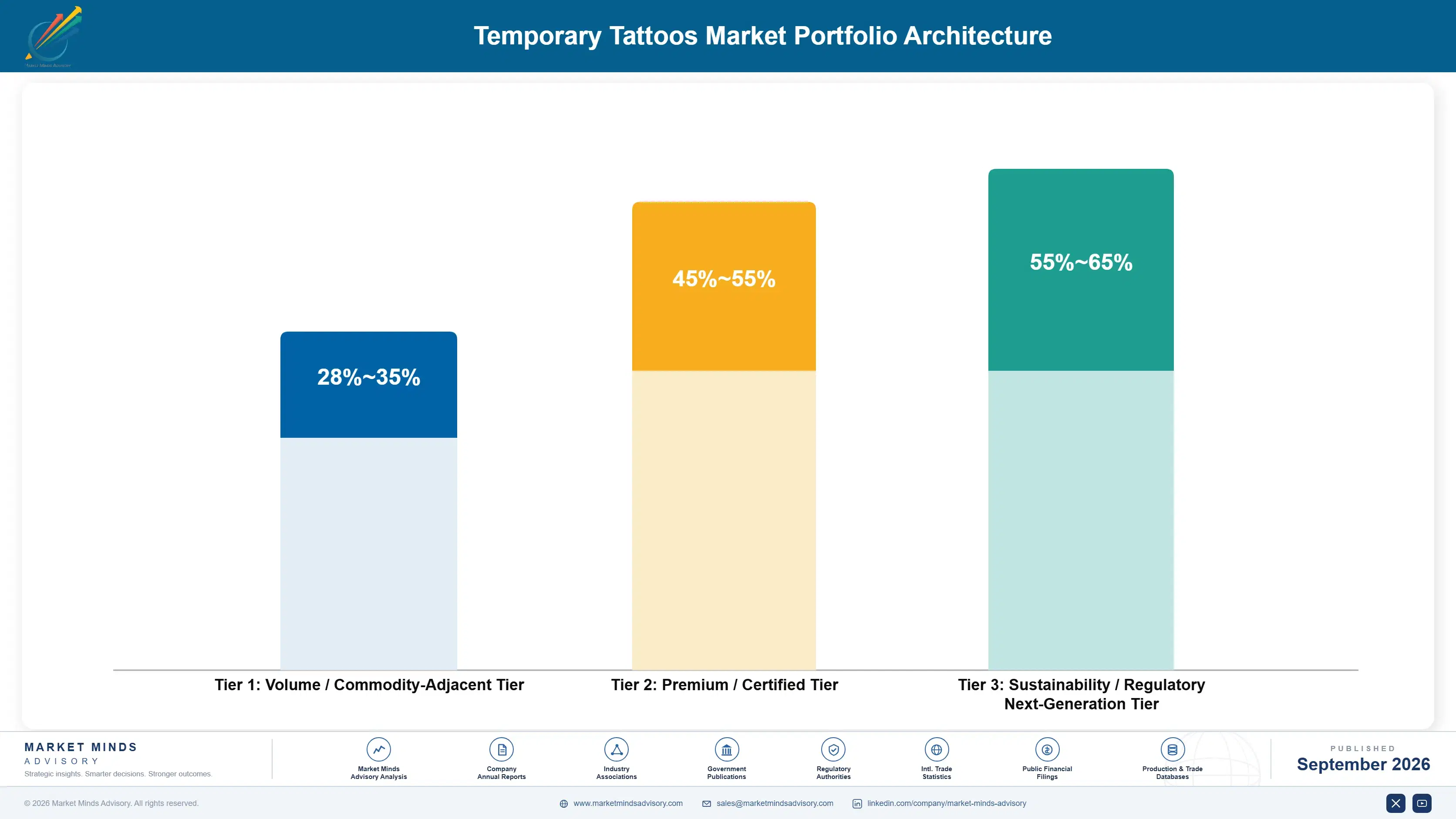
The temporary tattoo portfolio splits into three margin tiers, from commodity-adjacent basic waterslide designs sold mainly on price through certified premium metallic formats carrying distinctive design catalogs, up to next-generation custom and brand-licensed products commanding the industry's highest gross margins. Margin expands steadily as products move up this ladder, rewarding manufacturers willing to fund the design and licensing investment that separates each tier from the one immediately below it.
Volume and premium strategies pull manufacturers in different directions: chasing unit volume in the commodity tier requires aggressive price competition against low-cost importers, while premium positioning demands sustained investment in design catalogs and licensing relationships that smaller manufacturers struggle to fund on their own. Few manufacturers successfully straddle both tiers simultaneously, and most eventually specialize toward one end of this spectrum as import price pressure intensifies.

High-value margin pools concentrate overwhelmingly in custom and brand-licensed formats, where entertainment partnerships and direct-to-consumer design platforms both support pricing power unavailable to standard waterslide products sold at lower price points across mass-market channels. Manufacturers positioned there capture disproportionate profit relative to their unit-volume share of the category, and that gap continues widening each year.

Volume / Commodity-Adjacent Tier

Basic waterslide and children's novelty designs sold primarily through mass-market retail and dollar-store channels, competing chiefly on price against low-cost imports rather than design or licensing differentiation, with limited brand loyalty across the category.
Gross Margin: 28-35%

Premium / Certified Tier

Metallic and jewelry-style temporary tattoos carrying distinctive design-catalog identity, sold through specialty and festival-vendor channels that reward visual impact and reliable repeat-purchase behavior from an established, style-conscious customer base built over time.
Gross Margin: 45-55%

Sustainability / Regulatory / Next-Generation Tier

Custom and brand-licensed temporary tattoos combining direct-to-consumer design platforms with entertainment and fashion licensing partnerships, commanding the category's highest prices, supported by ongoing catalog investment and promotional-partnership relationships nationwide and abroad.
Gross Margin: 55-65%
temporary-tattoos-market-portfolio-architecture-1790022682111

High-value Sub-segments and Strategic Watch-out

Metallic and Jewelry-Style Temporary Tattoos

Metallic and jewelry-style temporary tattoos combine the category's fastest unit growth with strong gross margins, driven by festival demand and premium pricing that neither basic waterslide nor henna-style formats can match at comparable manufacturing cost today. This segment is where most new design investment concentrates across major producers.
Gross Margin: 50-58%

Custom and Brand-Licensed Temporary Tattoos

Custom and brand-licensed temporary tattoos retain strong, growing margins tied to entertainment partnerships and direct-to-consumer platforms, though unit growth trails metallic formats as this category depends more heavily on licensing-relationship depth and design-technology investment than broad retail availability across mass-market channels served today across the industry.
Gross Margin: 45-53%

Classic Waterslide Transfer Tattoos

Classic waterslide transfer tattoos remain the category's volume anchor, generating steady unit sales at moderate margins that fund broader manufacturing scale across mass-market and specialty channels alike, even as growth shifts toward higher-margin premium formats elsewhere in the broader portfolio and overall product lineup available nationwide.
Gross Margin: 28-34%

Airbrush Temporary Tattoos

Airbrush temporary tattoos face rising commoditization risk as generic manufacturers enter with lower-cost alternatives lacking design differentiation, compressing margins for branded incumbents that have not diversified into metallic or custom-licensed formats within the past several years and beyond across most major retail markets served today.
Gross Margin: 20-26%

Repeat Purchases Sustain Recurring Revenue Cycles

Temporary tattoos generate recurring, annuity-like revenue less through subscription models than through repeat-purchase behavior tied to festival calendars and entertainment-licensing renewal cycles that recur year after year. Manufacturers with strong direct-to-consumer design platforms capture repeat purchases from the same customers occasion after occasion, converting a single design relationship into a multi-year revenue stream that new entrants find difficult to replicate quickly at comparable scale.
Adoption depth varies meaningfully by end-use vertical: festival and gifting buyers show high purchase frequency tied to seasonal occasions, while entertainment-licensing partnerships generate concentrated demand spikes tied to film and television release calendars rather than steady year-round purchasing across the calendar year. Children's novelty buyers show the most routine, predictable purchase patterns of any vertical, though at meaningfully lower price points than premium metallic and licensed categories sold elsewhere.

Younger consumers discovering temporary tattoos through social-media platforms increasingly expect custom-design and metallic options as standard choices rather than premium add-ons, reshaping product expectations for manufacturers still selling primarily basic catalog designs without any digital-customization component. Older buyers, who adopted temporary tattoos through traditional retail and children's novelty categories years earlier, remain comparatively more loyal to established basic-format brands over newer digital-native challengers entering the market today.
temporary-tattoos-market-end-use-penetration-index-1790022682599

Where Manufacturers Should Focus Next

These are among the four positions where our research anticipates prominent divergence between winners and laggards over the coming forecast period. Each is grounded in the demand model, the regulatory perimeter, and the announced capacity pipeline.
01 / METALLIC FORMAT INVESTMENT

Expand Metallic Manufacturing Before Festival Season Windows Close

Manufacturers still reliant primarily on basic waterslide designs are ceding the category's fastest-growing segment to competitors investing directly in metallic manufacturing capacity today, at real cost to their long-term positioning and shelf presence. The window to build metallic-format catalog depth is narrowing as more competitors expand simultaneously, reducing the differentiation advantage available to early movers in this specific product category. Those that continue delaying this investment risk permanent relegation to slower-growing, import-exposed commodity categories where price competition alone determines retail placement.
02 / ENTERTAINMENT LICENSING DEVELOPMENT

Build Licensing Relationships Before Competitors Lock Studios In

Entertainment and fashion licensing partnerships increasingly determine which manufacturers earn premium promotional shelf placement and studio-partner loyalty over multiple release cycles across major markets. Manufacturers without formal licensing relationships risk losing promotional opportunities to competitors offering better catalog depth and production reliability, even where underlying design quality is genuinely comparable across brands sold today. Building this infrastructure takes years of sustained investment, making early action considerably more valuable than waiting for competitive pressure to force a reactive response later on.
03 / DIRECT-TO-CONSUMER PLATFORM GROWTH

Build Custom-Design Platforms Before Digital Challengers Consolidate Share

Direct-to-consumer custom-design platforms capture higher-margin, repeat-purchase revenue than wholesale retail distribution, but building this technology takes years of sustained engineering investment that cannot be rushed through marketing spend alone or acquisition of a smaller rival brand active in the category. Manufacturers without existing digital-platform presence face a widening gap against digitally native brands who started earlier and now capture disproportionate share of repeat-purchase revenue nationwide and abroad. Building this capability now, even slowly, remains more defensible than competing purely on wholesale-retail shelf visibility.
04 / PIGMENT SUPPLY DIVERSIFICATION

Diversify Pigment Sourcing Before Petrochemical Volatility Compounds Further

Pigment and resin price volatility continues compressing basic-category margin for manufacturers without diversified sourcing or supplier relationships in place today across most regional markets, product lines, and supplier bases worldwide. Manufacturers concentrated in single-region pigment sourcing face the steepest margin exposure, while those with meaningful multi-region supplier relationships carry considerably more insulation from any single geography's trade or tariff decisions made by regulators. Diversifying pigment sourcing now is considerably more defensible than attempting to absorb volatility through pricing adjustments alone.

Engagement Snapshot From the Field

A live engagement with an industry participant carrying material or product regulatory and market exposure ahead of a defining policy shift, showing how our research translates into a defensible multi-year portfolio strategy.
MARKET MINDS ADVISORY · CLIENT ENGAGEMENT SUMMARY
Temporary Tattoos Producer Strategic Portfolio Review and Transition Roadmap 2026·Investment Scenario on Temporary Tattoos Exposure Evaluation 2025-26
CLIENT PROFILE
The client is a mid-sized novelty products manufacturer with an established basic waterslide temporary tattoo product line generating approximately $45 million in annual revenue (client-reported, unverified by MMA), sold primarily through mass-market retail and dollar-store channels. The company had not yet invested in metallic-format manufacturing capacity and lacked formal entertainment-licensing relationships, leaving it exposed to both import price competition and premium-format substitution.
STRATEGIC CHALLENGE
Leadership recognized that competitors were rapidly expanding metallic-format manufacturing capacity while import-sourced basic products continued compressing pricing in the client's core commodity categories. The client needed to determine whether to invest in metallic manufacturing internally, pursue an entertainment-licensing partnership arrangement, or defend its existing commodity-tier position through cost reduction rather than capital investment.
MMA APPROACH
MMA conducted primary interviews with retailers, festival vendors, and competing manufacturers to map metallic-format capacity expansion plans and entertainment-licensing requirements now shaping retail shelf placement across the category. The engagement combined this primary research with MMA's proprietary competitive-benchmarking dataset to quantify the margin gap between commodity and premium categories, then modeled three distinct capital-allocation paths against the client's existing balance-sheet capacity.
KEY FINDINGS
  1. Regional retailers confirmed that metallic-format product availability had become a formal stocking requirement at three major festival-season accounts within the past eighteen months.
  2. Partnering with an established platform for entertainment-licensing content would cost meaningfully less over five years than building equivalent capability from scratch internally.
  3. The client's existing retail relationships showed strong willingness to expand metallic-format orders if the client could guarantee consistent supply and competitive pricing.
  4. Competitors that delayed metallic-format investment by more than one product cycle lost measurable retail shelf space to faster-moving rivals during the same period.
CLIENT PROFILE
The client is a mid-sized novelty products manufacturer with an established basic waterslide temporary tattoo product line generating approximately $45 million in annual revenue (client-reported, unverified by MMA), sold primarily through mass-market retail and dollar-store channels. The company had not yet invested in metallic-format manufacturing capacity and lacked formal entertainment-licensing relationships, leaving it exposed to both import price competition and premium-format substitution.
STRATEGIC CHALLENGE
Leadership recognized that competitors were rapidly expanding metallic-format manufacturing capacity while import-sourced basic products continued compressing pricing in the client's core commodity categories. The client needed to determine whether to invest in metallic manufacturing internally, pursue an entertainment-licensing partnership arrangement, or defend its existing commodity-tier position through cost reduction rather than capital investment.
MMA APPROACH
MMA conducted primary interviews with retailers, festival vendors, and competing manufacturers to map metallic-format capacity expansion plans and entertainment-licensing requirements now shaping retail shelf placement across the category. The engagement combined this primary research with MMA's proprietary competitive-benchmarking dataset to quantify the margin gap between commodity and premium categories, then modeled three distinct capital-allocation paths against the client's existing balance-sheet capacity.
KEY FINDINGS
  1. Regional retailers confirmed that metallic-format product availability had become a formal stocking requirement at three major festival-season accounts within the past eighteen months.
  2. Partnering with an established platform for entertainment-licensing content would cost meaningfully less over five years than building equivalent capability from scratch internally.
  3. The client's existing retail relationships showed strong willingness to expand metallic-format orders if the client could guarantee consistent supply and competitive pricing.
  4. Competitors that delayed metallic-format investment by more than one product cycle lost measurable retail shelf space to faster-moving rivals during the same period.
RECOMMENDED STRATEGY
Phase 1: Phase 1 (Months 1 to 6): Partner with an established platform for entertainment-licensing content rather than building relationships from scratch internally. Phase 2: Phase 2 (Months 7 to 12): Launch a limited metallic-format product line through existing retail relationships, prioritizing current accounts over new-account acquisition. Phase 3: Phase 3 (Months 13 to 20): Build formal licensing partnership infrastructure using launch performance data to support expanded retail specification commitments.
OUTCOME
Within twenty months of implementing the phased partnership and retail-launch approach, the client reported securing metallic-format stocking commitments at two additional major retail accounts (client-reported, unverified by MMA). Metallic-format product sales reportedly generated a meaningfully higher average selling price than the client's existing basic-waterslide portfolio, supporting continued premium-format investment.

Frequently Asked Questions

Foundational context covering the market sizes, CAGR, scope, country, region and competition that inform every finding below. This section is provided to cover basics and most often pre-purchase conversations, answered from the MMA Primary Research Dataset.

What is the current size of the Temporary Tattoos Market?

The temporary tattoos market reached approximately $0.95 billion in 2025, driven by sustained festival culture and rising adoption of metallic and brand-licensed formats across major consumer markets.

How large will the Temporary Tattoos Market be by 2036?

The market is projected to reach approximately $2.0 billion by 2036, roughly doubling from its 2025 base as metallic and custom-design formats continue gaining share of total demand.

What is the CAGR for the Temporary Tattoos Market 2026 to 2036?

The temporary tattoos market is projected to grow at a 6.8% CAGR between 2026 and 2036, reflecting sustained festival demand and rising brand-licensing partnership activity across major markets.

Which segment is growing fastest?

Metallic and jewelry-style temporary tattoos are the fastest-growing segment, expanding at roughly 11.0% annually, about 1.6 times the overall market's growth rate through the forecast period.

Who are the major companies in the Temporary Tattoos Market?

Major companies include Inkbox, Tattly LLC, Flash Tattoos LLC, Prinker Corporation, and Ephemeral Tattoo Inc, competing chiefly on design-catalog depth and licensing partnerships across the industry.

Which country is growing fastest?

China is the fastest-growing country, expanding at roughly 9.5% annually, supported by deep printing-manufacturing capacity and rising domestic consumer adoption of premium temporary tattoo formats.

Report Segmentation Architecture

The full report scope spans multiple orthogonal segmentation dimensions, with cross-tabulated demand data provided for each dimension pair. Coverage extends further to regional breakdowns, trend trajectories, and the competitive detail needed to support segment-level decision-making.

By Primary Market Dimension

  • Classic Waterslide Transfer Tattoos
  • Metallic and Jewelry-Style Temporary Tattoos
  • Henna-Style and Semi-Permanent Tattoos
  • Airbrush Temporary Tattoos
  • Glow-in-the-Dark and UV-Reactive Tattoos
  • Custom and Brand-Licensed Temporary Tattoos

By End-Use Industry

  • Children's Novelty and Party Goods
  • Festival and Live Events
  • Entertainment and Fashion Marketing
  • Body Jewelry and Beauty Accessories
  • Costume and Seasonal Celebrations

By Commercial Dimension

  • Mass-Market and Dollar-Store Retail
  • Specialty and Festival-Vendor Retail
  • Direct-to-Consumer E-Commerce
  • Private-Label and Licensing Supply

By Region

  • North America
  • Western Europe
  • East Asia
  • South Asia and Pacific
  • Latin America
  • Middle East and Africa
  • Eastern Europe

Scope, Methodology, and Coverage

Every figure in this report is reproducible from documented input assumptions. The scope below maps the historical period, the forecast horizon, the segmentation dimensions, and the countries covered, alongside the underlying primary and qualitative methodology.
Historical Period
2020 to 2025
Forecast Period
2026 to 2036
Base Year
2025 (USD billions; MMA Primary Research Dataset, September 2026)
Market Definition
The temporary tattoos market covers non-permanent skin decoration products including waterslide transfer, metallic, henna-style, airbrush, and brand-licensed formats applied and removed within days to weeks. It excludes permanent tattoo services, tattoo equipment and ink used by professional tattoo artists, and semi-permanent cosmetic microblading procedures.
Quantitative Units
USD billions (current prices); unit shipment volumes where applicable
Segmentation Dimensions
Product/Design Type; End-Use Industry; Commercial Dimension; By Region
Regions Covered
North America, Western Europe, East Asia, South Asia and Pacific, Latin America, Middle East and Africa, Eastern Europe
Countries Covered
USA, China, Germany, France, UK, Japan, South Korea, India, Australia, Canada, Brazil, Mexico, Indonesia, Vietnam, Thailand, Malaysia, UAE, Saudi Arabia, South Africa, Nigeria, Turkey, Poland, Netherlands, Italy, Spain, Sweden, Switzerland, Argentina, Colombia, Singapore, and additional markets relevant to this sector
Key Companies Profiled
Inkbox (Sonar Studios Inc), Tattly LLC, Flash Tattoos LLC, Prinker Corporation, Ephemeral Tattoo Inc, Tinsley Transfers Inc, Savvi Tattoo Company, Momentary Ink, Tattoo Stickers Manufacturing Co Ltd, The Topps Company Inc, Panini S.p.A., Amscan Inc, Xpres Corporation, Herma GmbH, Chameleon Tattoos Ltd, Rockstar Tattoos LLC, Twinkle Temporary Tattoos, Golden Ratio Tattoos, HYPE Tattoo Co, Design Express Inc
Quantitative Methodology
Primary survey, n=3,800 respondents, Q4 2025, six countries; demand-side model with trade association cross-validation
Qualitative Methodology
47 expert interviews, Q4 2025; applied to validate demand model assumptions, identify emerging dynamics, and assess competitive positioning
Report Format
PDF and XLSX data workbook (Word format preview document)
Publisher
Market Minds Advisory
Report Code
MMA-2026-CHM-193
Published
September 2026
Contact
sales@marketmindsadvisory.com | www.marketmindsadvisory.com

Purchase the full Temporary Tattoos Market Report (2026 to 2036).

The full report provides a comprehensive assessment of the global temporary tattoos market, covering sizing, segmentation, and detailed forecasts through 2036 across all major product categories and design formats available today. It profiles twenty manufacturers in depth, benchmarking design-catalog depth, licensing partnerships, and direct-to-consumer platform investment across the industry. Regional analysis spans all seven world regions, with country-level detail for thirty markets and their respective festival and gifting calendars. The report also includes revenue-lever analysis, input-cost exposure, and a strategic verdict section designed for direct use in planning decisions.
Ten-Year Global Market Sizing and Forecast Model
Segment-Level CAGR and Market Share Breakdown
Seven-Region Demand, Share, and Growth Analysis
Twenty-Company Competitive Benchmarking and Profile Set
Input-Cost Exposure and Supply Mitigation Guidance
Strategic Verdict and Revenue-Lever Recommendations Summary

Built For The People Who Decide

From boardroom strategy to bench-side execution, this report is read cover-to-cover by leaders shaping the next decade of their industry, turning demand scenarios, market dynamics and valuation benchmarks into decisions.
CXOs/ Presidents/ VPs/ Managers
M&A and Corporate Development
Strategy Teams and R&D Heads
Procurement and Product Directors
Regulatory and Compliance Leaders
Investor Relations and Equity Analysts