

Market Minds Advisory
Temperature Monitoring Devices Market

Temperature Monitoring Devices Market: The Oldest Vital Sign, Measured the Least Useful Way

A healthy body swings half a degree across the day, which makes a single spot reading close to meaningless and the trend against a personal baseline the only thing worth capturing.

Lead Analyst

Alice Ballenger

Published

September 2026

Make Smarter Decisions with Customized Research Insights

Request a free sample report and evaluate market opportunities, growth trends, and competitive dynamics relevant to your business needs.

2025 MARKET VALUE$1.9BMarket Size 2025
2036 FORECAST VALUE$3.8BBase Case , 2026 to 2036
CAGR 2026 TO 20366.4 %Bull 7.6% / Bear 5.2%
INCREMENTAL OPPORTUNITY$1.8BNet 10- year value creation
EXPANSION MULTIPLE1.86x2036 value over 2026 base
Strategic Levers
M&A Pipeline
Regional Outlook
Country Rankings
Competitive Intelligence
Segmental Deep-dive
Call-Us : 91 93563 13602

Executive Snapshot and Market Trajectory

A healthy person's temperature moves around half a degree across a normal day, varies by measurement site and differs from the next person's baseline. A single reading therefore carries far less information than clinicians and consumers both assume, and almost the entire installed base produces exactly that.
The pandemic made this worse in two ways at once. It pulled roughly nine years of replacement demand into eighteen months, leaving a hole that is still being worked through. It also put thermal screening cameras at building entrances detecting perhaps 40% of infections, which taught a great many buyers that temperature measurement does not do what they were told. That distrust reaches well beyond screening applications.
Continuous wearable sensing is where the category recovers, growing at 9.6% by sampling every minute and building the personal baseline that makes any single reading interpretable. The applications are ovulation tracking, hospital sepsis early warning and post-surgical infection monitoring rather than fever detection. Egypt grows fastest anywhere at 10.6% on hospital expansion under insurance reform. Manufacturers still competing on spot accuracy are improving a specification that was never the clinical constraint on this measurement.
Market Definition
Devices measuring human body temperature for clinical and consumer use, covering digital contact thermometers, non-contact infrared thermometers, continuous wearable temperature sensors, tympanic and temporal artery devices, invasive and core temperature probes, and thermal imaging screening systems. Measured at manufacturer selling value including disposable probe covers and sensor patches. Excludes cold chain and environmental temperature monitoring, industrial process instrumentation, veterinary devices, and multiparameter patient monitors without dedicated temperature function.
Base Year Value
$1.9B in 2025 (MMA Primary Research Dataset, August 2026)
Forecast Period
2026 to 2036, eleven discrete annual values
CAGR
6.4% base case. Bull 7.6%. Bear 5.2%.
Fastest Growth Segment
Continuous Wearable Temperature Sensors: 9.6% CAGR
Fastest Growth Country
Egypt: 10.6% CAGR
Fastest Growth Region
South Asia and Pacific: 8.2% CAGR
Largest Region
East Asia: 28% of 2025 global value
Market Leaders
Becton Dickinson, Cardinal Health, Omron Healthcare, Masimo, Baxter. Source: MMA Primary Research Dataset, July 2026.
Primary Survey
n=3,800 procurement and R&D decision-makers, Q4 2025, six countries
Methodology
Demand-side build-up, cross-validated against public data, 47 expert interviews

Temperature Monitoring Devices Market Forecast Scenarios

temperature-monitoring-devices-market-size-forecast-scenario-1787639777000
Growth ran near 5.2% between 2020 and 2025, and the shape of it was extraordinary rather than merely strong. Purchasing surged through the acute pandemic period and then collapsed, because households and institutions had bought devices with service lives measured in years and had no reason to buy again. Thermal screening systems were installed at scale and now sit largely idle.
Base case 6.4% rests on three mechanisms. Continuous wearable sensors grow at 9.6% as ovulation tracking, sepsis early warning and post-surgical monitoring create genuine demand for trend data rather than spot readings. Invasive and core probes grow at 7.8% with surgical and critical care volumes. And Egypt grows fastest of any country at 10.6% as hospital capacity expands under health insurance reform. Only one of the three depends on consumer purchasing recovering at all.
The bull case at 7.6% assumes continuous temperature entering routine hospital protocols for sepsis surveillance, which would convert a promising application into a standard of care. The bear case at 5.2% is the replacement hole persisting longer than expected while consumer devices bought during the pandemic continue functioning, since a digital thermometer that works has no natural replacement trigger.

One Reading Tells You Almost Nothing

Body temperature is the oldest vital sign and it is routinely measured in the way that extracts least information from it. A healthy person swings around half a degree across a normal circadian day, readings differ by site, and individual baselines differ from one another by more than the threshold most people treat as fever. A single spot reading therefore tells a clinician less than the confidence attached to it suggests.
TOP FIVE CONCENTRATION41%Hospital and consumer channels are served by different groups
DAILY TEMPERATURE VARIATION0.5 CNormal swing across a healthy individual's own daily cycle
INFRARED ACCURACY LIMIT0.3 CBest achievable tolerance for non-contact forehead measurement today
SCREENING DETECTION RATE40%Infections identified through mass entrance temperature screening programmes
DEMAND PULLED FORWARD9 yearsReplacement purchasing consumed during the acute pandemic period
CONTINUOUS SAMPLING INTERVAL60 secondsReading frequency a wearable sensor delivers throughout the day
The pandemic then damaged the category twice over. Purchasing pulled roughly nine years of replacement demand into eighteen months, and a working thermometer generates no replacement trigger. Meanwhile thermal screening at building entrances detected something like 40% of infections, which is close to useless as a control measure and taught many institutional buyers to distrust temperature measurement generally.
Continuous sensing is the answer to the original problem rather than to the pandemic one. Sampling every minute builds a personal baseline against which a half degree rise means something, which is why the growing applications are ovulation tracking, hospital sepsis early warning and post-surgical infection detection. None of those is fever screening, and manufacturers still selling spot accuracy compete on a specification that was never the constraint.
"The industry spent two decades improving the accuracy of a measurement that was never the limiting factor, because the limitation was always that one number carries no context. The companies building baselines rather than better readings are the only ones solving the actual problem."
Director, Patient Monitoring and Diagnostic Devices Practice · MMA Medical Devices Practice · August 2026

Market Trends

Continuous baselines making individual readings interpretable

A wearable sampling every sixty seconds builds a personal baseline against which a half degree rise carries genuine meaning, which is exactly what a spot reading cannot provide however accurate the device happens to be. Growth at 9.6% comes from ovulation tracking, hospital sepsis early warning and post-surgical infection monitoring, all of which depend on deviation from an individual's own pattern. Manufacturers still competing on spot accuracy are improving a specification that was never what limited the measurement clinically. Buyers increasingly grasp that distinction, which changes what a technical presentation needs to argue for.
Market Impact: Egypt growing fastest at 10.6%
Screening credibility damage outlasting the screening programmes

Mass entrance temperature screening detected roughly 40% of infections, which is poor enough to have provided very little protection while consuming considerable capital and attention. The installed thermal imaging base now sits largely idle. The commercial consequence is that institutional buyers who funded those systems approach temperature measurement with scepticism that extends well beyond screening applications, and vendors selling genuinely useful clinical monitoring encounter it before any technical discussion begins. Vendors selling genuinely useful clinical monitoring encounter that scepticism before any technical discussion begins, and pretending otherwise invites the assumption that the new claim is equally unreliable.
Market Impact: Core probes growing at 7.8%

Market Opportunities and Growth Drivers

Hospital expansion under health insurance reform programmes

Egypt grows fastest of any country at 10.6% as hospital capacity expands under universal health insurance implementation, with new facilities equipping monitoring from scratch rather than replacing ageing devices. That produces demand for complete monitoring specifications rather than for individual thermometer replacement, which favours suppliers able to serve a whole ward rather than a single product line. Similar programmes across other emerging markets create the same procurement pattern at different scales. Suppliers able to serve a whole ward rather than a single product line are considerably better placed in those tenders.
Market Impact: Pulled forward roughly 9 years

Sepsis surveillance protocols pulling continuous monitoring into wards

Sepsis outcomes depend heavily on how early deterioration is recognised, and continuous temperature trend is one of the few signals that moves before a patient looks unwell to anybody. Hospitals piloting early warning protocols increasingly include continuous temperature alongside heart rate and respiratory monitoring. Invasive and core probes grow at 7.8% on critical care volumes while wearable patches reach the general wards where nurse to patient ratios make intermittent observation genuinely unreliable. Nurse to patient ratios on general wards make intermittent observation genuinely unreliable, which is the gap continuous sensing fills rather than any accuracy improvement.
Market Impact: Achieves 0.3 degrees at best

Market Restraints and Challenges

Replacement hole left by pandemic purchasing still working through

Roughly nine years of replacement demand was pulled into an eighteen month period, and a digital thermometer that continues working generates no replacement trigger whatsoever. The root cause is device longevity meeting a demand shock. Commercially it means consumer and institutional spot device volumes will stay depressed for years regardless of any product improvement. New applications rather than replacement cycles are the only route through it, which is why continuous sensing matters so much. Nothing else generates a purchase for most households. Continuous sensing matters precisely because it creates demand that has nothing to do with replacement cycles.
Market Impact: Samples every 60 seconds continuously

Accuracy limits constraining non-contact clinical credibility

Non-contact infrared measurement achieves around 0.3 degrees tolerance at best and degrades further with ambient variation, forehead perfusion and operator technique, which is comfortably adequate for a parent and inadequate for neonatal or critical care decisions. The root cause is the physics of surface measurement standing in for core temperature. Commercially it caps where the format can be used. Contact and invasive measurement remain necessary wherever a decision depends on the number. Contact and invasive measurement therefore remain necessary wherever a clinical decision genuinely turns on the number rather than on a general impression of the patient.
Market Impact: Detected around 40% of infections
4 additional market trends, 3 additional growth drivers, and 2 additional restraints and challenges are covered in the full report. Contact sales@marketmindsadvisory.com to access the complete intelligence.

Segment CAGR and Growth Architecture

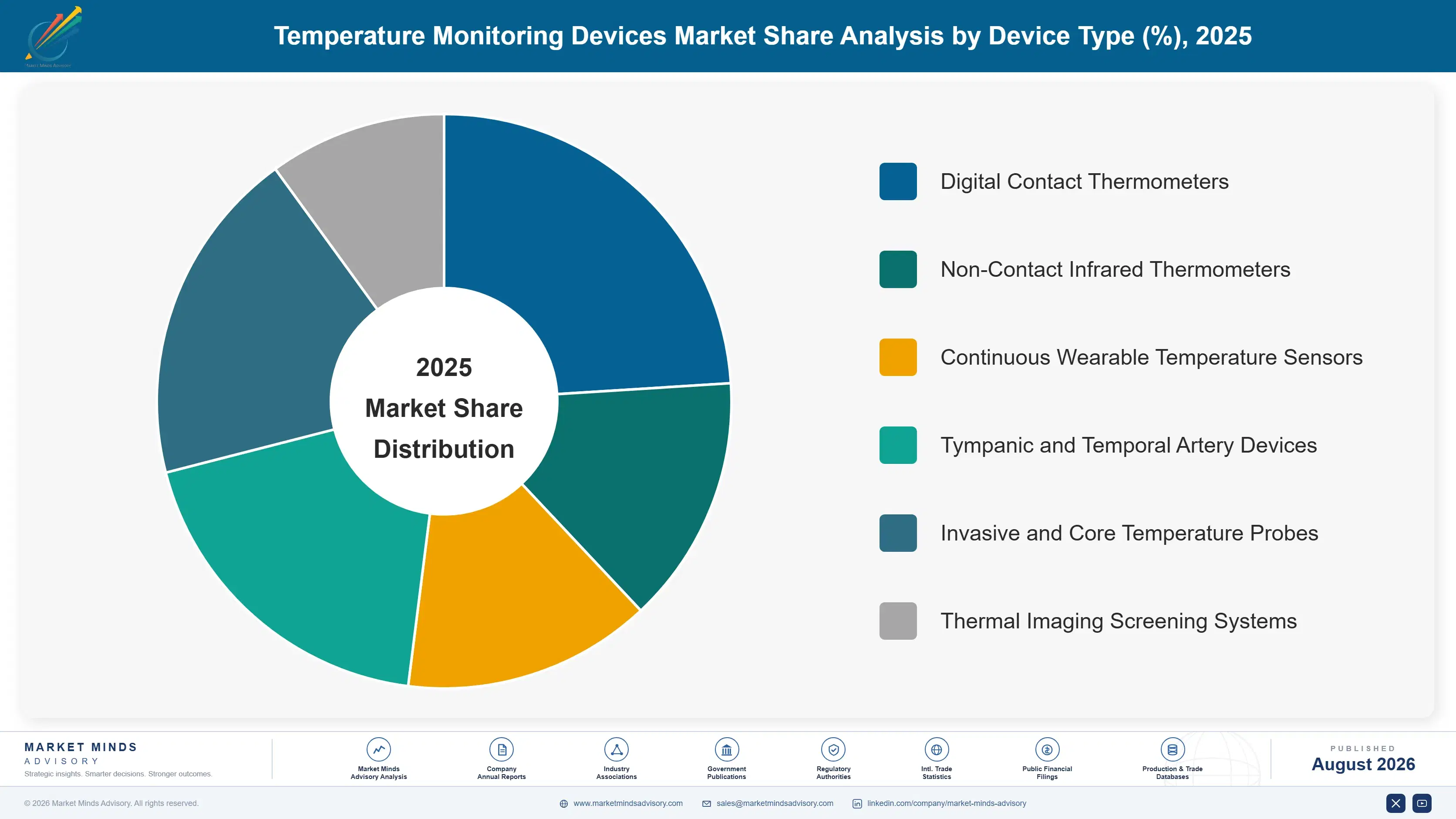
Six segments are split by device type, because type determines the measurement site and its relationship to core temperature, the accuracy achievable, whether readings are intermittent or continuous and the clinical decisions the output can support. Consumer and professional variants sit inside each type. Care setting and channel are handled separately in the framework. Regulatory pathway follows device type too.
temperature-monitoring-devices-market-market-share-analysis-1787639777586

Continuous Wearable Temperature Sensors

Growing at 9.6%, half again the market rate of 6.4%, these adhesive patches and wearable sensors sample around every sixty seconds and build the personal baseline that makes any individual reading interpretable in the first place. Applications are ovulation tracking, hospital sepsis early warning and post-surgical infection monitoring, none of which is fever screening. Consumer and clinical versions have quite different regulatory pathways and price points, and the clinical side requires validation work that consumer wearable manufacturers have generally not undertaken at all. Entering clinical protocol development rather than device tendering is what puts a supplier inside the eventual standard of care. Consumer wearable manufacturers have generally not undertaken the clinical validation work that hospital use actually requires of them.
CAGR 9.6%

Invasive and Core Temperature Probes

At 7.8% oesophageal, bladder, rectal and pulmonary artery probes measure core temperature directly where a clinical decision genuinely depends on the number, which surface measurement cannot support at any accuracy claim. Demand follows surgical and critical care volumes rather than general ward activity or consumer behaviour. Disposable probes and covers generate recurring revenue considerably more predictable than device sales, and infection control requirements have progressively moved this segment from reusable toward single use across most developed hospital systems. Recurring consumable revenue tracks procedure volume rather than device replacement, which is why this segment survived the pandemic demand hole almost entirely intact while capital equipment sales collapsed. Compatibility with installed devices frequently decides the account.
CAGR 7.8%
Full segment breakdown across 6 segments available in the complete report.

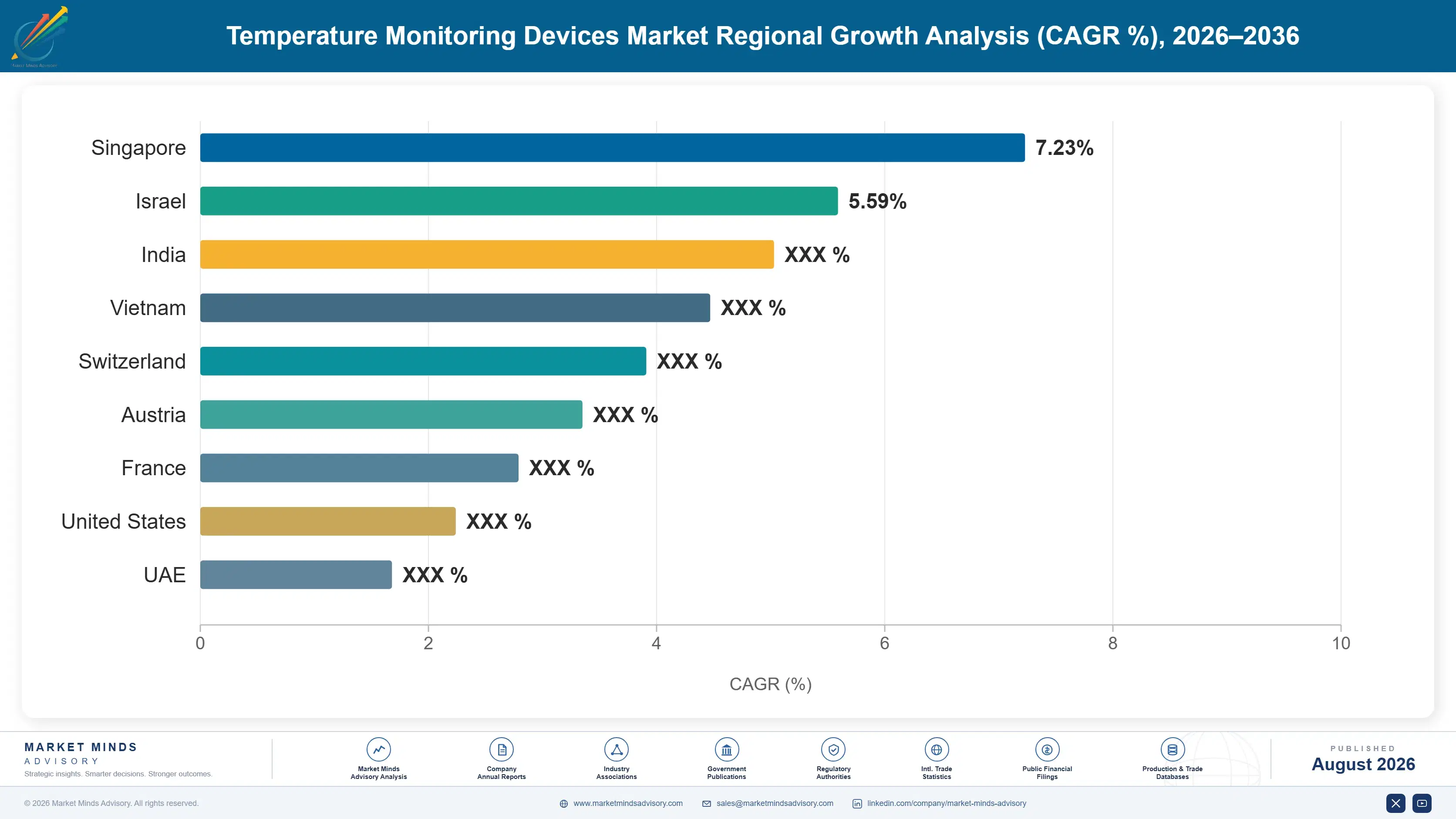
Regional Architecture and Country Demand Map

East Asia holds 28% of value on manufacturing scale and very large consumer volumes. North America follows at 26% on hospital monitoring specification and continuous sensing adoption running ahead of other regions. South Asia and Pacific grows fastest of the seven regions covered here. Shares hold band.

North America

Hospital adoption of continuous monitoring runs ahead of other regions, with sepsis early warning protocols and post-surgical infection surveillance both driving wearable sensor evaluation across large health systems. Consumer spot device volumes remain depressed by pandemic purchasing that pulled years of replacement demand forward. Thermal screening systems installed during that period sit largely unused. Growth at 5.8% reflects clinical continuous adoption offsetting a consumer replacement hole that will take several more years to work through fully. Clinical governance committees rather than purchasing functions are making the continuous monitoring decisions, which many suppliers have yet to recognise. Thermal screening systems installed during the pandemic sit largely unused across most institutions that funded them.
Share: 26% | CAGR: 5.8% (2026 to 2036)

Western Europe

Public health systems procure monitoring against protocol and budget rather than through individual device purchasing, which slows continuous sensor adoption relative to North America despite comparable clinical interest in sepsis surveillance. Medical device regulation raises the validation burden for clinical wearables considerably. Consumer replacement demand is similarly depressed. Reprocessing and single use policy on probes varies by national system. Growth of 5.0% is the slowest anywhere on procurement structure and a mature installed base. Protocol committees rather than device tenders decide continuous adoption, which slows the process but makes the eventual position considerably more durable. Reprocessing and single use policy on probes varies considerably between national health systems, which fragments what would otherwise be a single regional consumable market.
Share: 21% | CAGR: 5.0% (2026 to 2036)
Regional intelligence for 5 additional markets available in the complete report: East Asia, South Asia and Pacific, Latin America, Middle East and Africa, Eastern Europe. Contact sales@marketmindsadvisory.com.
temperature-monitoring-devices-market-country-cagr-analysis-1787639778126

Four Moves Toward the Trend

Accuracy on a single reading has been improved for two decades and was never the limitation, because one number without a baseline carries no context. The moves that matter build baselines, follow the clinical protocols that need trend data, and rebuild credibility that mass screening spent on the industry's behalf. Credibility has to be rebuilt first.

Sell baseline capability rather than reading accuracy

A healthy person varies around half a degree across a normal day and individual baselines differ from one another by more than most fever thresholds, which means a single reading of any accuracy carries limited information. Continuous sampling every sixty seconds produces the context that makes deviation meaningful. Manufacturers competing on spot accuracy are improving a specification that never limited the measurement clinically, and buyers increasingly understand that distinction. Sampling at 60 second intervals is what produces the context, and no spot device of any accuracy can supply it. The argument is straightforward.
Market Impact: Captures variation across the full 0.5 degree range

Attach to sepsis and post-surgical surveillance protocols

Continuous temperature trend moves before a deteriorating patient looks unwell, which is exactly what early warning protocols need and what intermittent nursing observation cannot reliably provide on a general ward. Wearable sensors grow at 9.6% on that clinical logic rather than on any consumer demand. Entering protocol development rather than device tendering positions a supplier inside the standard of care rather than competing for a line item afterwards. Guideline committees rather than purchasing functions decide it, which most device suppliers have yet to recognise properly. Tenders arrive far too late.
Market Impact: Serves the 9.6% wearable sensor segment growth annually

Build recurring disposable revenue alongside device sales

Invasive and core probe demand grows at 7.8% and infection control has moved most developed hospital systems toward single use, which generates recurring consumable revenue considerably more predictable than capital device sales. That recurring stream also survives the replacement hole left by pandemic purchasing, since it depends on procedure volume rather than on device longevity. Suppliers selling only capital equipment are exposed to a demand cycle they cannot influence. Consumable revenue proved almost immune to the demand hole that removed most capital device purchasing. Capital equipment exposure to that hole is total.
Market Impact: Follows the 7.8% core probe segment growth annually

Address the screening credibility damage directly

Mass entrance screening detected around 40% of infections and institutional buyers who funded it now approach temperature measurement sceptically, which vendors encounter before any technical conversation begins. Acknowledging plainly that screening was a poor application while clinical trend monitoring is a good one separates a supplier from that history. Pretending the distinction does not exist leaves a buyer to assume the new claim is as unreliable as the previous one. Buyers raise it unprompted, which means somebody is going to have the conversation regardless. Silence on the point is read as evasion.
Market Impact: Answers the 40% screening detection failure head on

Who Controls the Margin Pool

Participation is measured on annual device and disposable unit revenue, and the top five hold 41%. Concentration is moderate because hospital and consumer channels are served by largely different groups, with clinical suppliers holding regulatory and procurement positions that consumer brands do not. Becton Dickinson and Cardinal Health lead through hospital channel depth and disposable supply rather than through device technology. The gap to challengers is channel position rather than sensing technology.
Competition runs on three fronts. Hospital procurement position decides clinical device and disposable volume, which is where recurring revenue sits. Regulatory validation decides which continuous wearables can make clinical claims at all. And retail distribution decides consumer volume, where Chinese manufacturing sets pricing everybody else works against. Protocol inclusion has become a fourth front, and it is decided by committees no sales organisation currently calls upon.

Pressure ahead comes from continuous sensing displacing intermittent observation in wards, and from consumer replacement demand staying depressed. Expect clinical validated wearables to separate from consumer devices. Rankings shift on who enters hospital early warning protocols before they standardise. Concentration should hold while channel position dominates. Consumer volumes stay depressed meanwhile.
temperature-monitoring-devices-market-company-positioning-matrix-1787639778643

Competitive Moat and Risk Dimensions

BECTON DICKINSON

Moat: Hospital channel and disposable supply

Hospital procurement relationships combined with disposable probe and cover supply generate recurring revenue tied to procedure volume rather than to device replacement cycles, which insulates the position from the demand hole that pandemic purchasing created across capital equipment. That channel depth took decades to build and is not contestable by a device manufacturer without comparable supply breadth.
BECTON DICKINSON

Risk: Continuous monitoring displacement

Continuous wearable sensing addresses the general ward monitoring that intermittent probe measurement currently serves, which puts a substantial disposable revenue stream at risk from a technology the company does not lead. That displacement is clinical rather than commercial, and it would proceed regardless of any pricing or channel response available.
MASIMO

Moat: Continuous monitoring platform integration

Continuous temperature integrated into an established multiparameter monitoring platform reaches hospital early warning protocols as part of a system clinicians already trust, rather than as a standalone sensor requiring separate workflow and validation. That integration position is genuinely difficult to attack, because a hospital will not add a second monitoring system for one parameter.
MASIMO

Risk: Protocol standardisation timing

Continuous temperature is being evaluated within sepsis early warning protocols that have not yet standardised, and the eventual specification may or may not include it as a required parameter. That outcome is decided by clinical evidence and guideline committees rather than by any commercial effort the company can apply to it.

Players Tracked

Prominent Players

Becton Dickinson
Cardinal Health
Omron Healthcare
Masimo
Baxter

Other Key Players

Braun
Exergen
Microlife
Terumo
A and D Medical
Withings
VivaLNK
Blue Spark Technologies
Draegerwerk
Philips Healthcare
GE HealthCare
Medtronic
iHealth Labs
Beurer
Rossmax

Recent Developments

MARCH 2026

Health system adds continuous temperature to sepsis early warning protocol

A hospital system added continuous temperature trend to its sepsis early warning protocol alongside heart rate and respiratory monitoring, on evidence that deviation from a patient's own baseline preceded clinical deterioration more reliably than intermittent observation did. Purchasing was not involved in the decision at all.
Signal: Protocol inclusion rather than device tendering is how this technology actually enters wards in practice today
SEPTEMBER 2025

Institution decommissions idle thermal screening installation

An institution decommissioned thermal entrance screening equipment installed during the pandemic, having concluded that detection performance never justified the capital or the operational disruption it required across the building's main entrances. The equipment had been idle for a considerable period. Nobody proposed replacing it. Nobody objected.
Signal: The screening experience left buyers sceptical of temperature measurement well beyond screening for years afterwards now
JANUARY 2026

Consumer thermometer replacement demand remains below pre-pandemic levels

Consumer thermometer sales remained below pre-pandemic levels as devices purchased during the acute period continued functioning, confirming that a working digital thermometer generates no replacement trigger for households that already own one. Households had no reason to buy again. Retail volumes stayed flat. Nine years of demand had gone.
Signal: Device longevity turns a demand surge into a hole that lasts most of a decade for this category

Sensors, Adhesives and Validation

Thermistor and infrared sensing components carry around 26% of device cost, sourced from established electronics suppliers with reasonable alternatives available. Electronics, displays and battery systems take about 21%. Adhesives and skin contact materials account for around 14% in wearable formats, where biocompatibility requirements exceed anything a handheld device needs. Assembly, regulatory validation, packaging and distribution absorb the balance.
Electronic component availability tightened through recent years alongside broader semiconductor constraints, per published medical device sector reporting and Masimo and Omron Healthcare annual reporting for 2025 on component and supply commentary. Manufacturers holding allocation shipped through the acute demand period while others could not, and that shortage coincided precisely with the largest surge in thermometer demand ever recorded. Allocation discipline has become considerably more common across the industry since.

Exposure divides on format and on regulatory pathway rather than on scale. A consumer spot device carries component cost against retail pricing set by Chinese manufacturing. A clinical wearable carries biocompatibility, validation and regulatory cost that consumer products avoid entirely. Disposable probe suppliers carry material and sterilisation cost against recurring revenue, which is a considerably more comfortable position than either.
temperature-monitoring-devices-market-cost-volatility-analysis-1787639778839

Shift revenue toward disposables tied to procedure volume

Capital device sales collapsed after pandemic purchasing pulled years of replacement demand forward, while disposable probe and cover revenue follows procedure volume and continued largely unaffected. Growing that share insulates a supplier from a device replacement cycle nobody can influence, and infection control policy has been moving hospitals toward single use anyway. Procedure volume is predictable.

Separate consumer and clinical regulatory pathways deliberately

Clinical claims require validation and regulatory work that consumer wearable manufacturers have generally not undertaken, and attempting a single product across both markets means carrying clinical cost at consumer pricing. Running deliberately separate product lines lets each carry only the cost its market will actually pay for. Each market pays only for what it values.

Hold component allocation against demand volatility

The largest demand surge this category has recorded coincided exactly with the tightest electronic component availability, and manufacturers holding allocation captured share that competitors simply could not supply. Allocation agreements cost commitment rather than capital, and this market has demonstrated that its demand can move faster than any supply chain. Demand can outrun supply here.

Portfolio Architecture for Margin Defence

Margin here follows whether revenue recurs, because a device sold once into a market that just bought nine years of supply is a very different business from a consumable tied to procedure volume. Consumer spot thermometers earn margins in the mid single digits to low teens, where Chinese manufacturing sets pricing and retail buyers treat devices as interchangeable at a given accuracy claim. Retail buyers see no difference between them.
Professional handheld and tympanic devices do better in the low to high teens, because hospital procurement values validated accuracy, service support and probe cover compatibility, though the device itself remains a capital purchase exposed to the same replacement hole as consumer equipment. Probe cover compatibility is frequently what actually retains the account rather than the device itself.

Continuous clinical wearables and disposable probes hold the strongest position, reaching into the mid thirties, where regulatory validation narrows the field and revenue recurs with procedure or patient volume rather than device replacement. Those margins reflect validation investment and recurring supply rather than any advantage in sensing component cost. Protocol inclusion is what makes those positions genuinely durable over time.

Consumer Spot Thermometers

Retail devices compared on accuracy claim and price where Chinese manufacturing sets the floor. The seven point range reflects brand position and channel structure rather than any measurable difference in clinical performance.
Gross Margin: 5-12%

Professional Handheld and Tympanic Devices

Validated devices sold into hospital procurement with service and probe cover compatibility attached. The six point range reflects channel position and how much recurring cover revenue accompanies each installed device.
Gross Margin: 13-19%

Continuous Wearables and Disposable Probes

Regulatory validated continuous sensors and single use probes generating recurring revenue with patient volume. The ten point range reflects validation depth and whether the product sits inside an established clinical protocol.
Gross Margin: 26-36%
temperature-monitoring-devices-market-portfolio-architecture-1787639779331

High-value Sub-segments and Strategic Watch-out

Continuous Clinical Wearables

High value and the fastest growth at 9.6%, building the personal baseline that makes any single reading interpretable. Sepsis early warning and post-surgical surveillance rather than fever detection drive the clinical case. Guideline committees rather than purchasing decide adoption. Protocol inclusion makes the position durable.
Gross Margin: 28-36%

Disposable Probes and Covers

High value and growing at 7.8% with surgical and critical care volumes, generating recurring revenue tied to procedures rather than device replacement, which survived the pandemic demand hole almost entirely. Infection control policy has moved hospitals toward single use. Compatibility retains the account. Volumes are predictable.
Gross Margin: 26-34%

Consumer Spot Thermometers

The volume core, sitting inside a replacement hole roughly nine years deep because devices bought during the pandemic continue working and generate no replacement trigger for any household. Chinese manufacturing sets the pricing everybody works against. No replacement trigger exists at all. Devices simply keep working.
Gross Margin: 5-12%

Screening Credibility Exposure

The strategic watch-out. Entrance screening detected around 40% of infections and left institutional buyers sceptical, and the range reflects whether a vendor addresses that history or hopes buyers forgot. Buyers raise the screening experience unprompted. Addressing it directly separates a supplier. Scepticism persists widely. Silence reads badly.
Gross Margin: 3-34%

Protocols, Procedures and Households

Demand arises from three quite separate mechanisms. Hospital continuous monitoring follows clinical protocol decisions taken by guideline committees rather than by purchasing. Disposable probe consumption follows surgical and critical care procedure volume, which is predictable and largely independent of anything a supplier does. Consumer purchasing follows household device failure, which after a nine year demand pull forward means almost nothing is happening. Almost nothing links the three.
Stickiness follows protocol inclusion above everything else. A device written into a sepsis early warning protocol stays until the protocol changes, which happens on evidence review cycles rather than commercial ones. Disposable supply holds while compatibility and contract terms hold. Consumer purchasing has no stickiness at all, since a household buying once every nine years has no relationship with anybody.

The deciding voices have moved upward in clinical settings. Individual device selection once sat with nursing and biomedical engineering, and continuous monitoring decisions now involve clinical governance, guideline committees and infection control together. A supplier presenting device specifications to a purchasing function is addressing the group that executes a decision rather than the one that makes it. Most suppliers still call on purchasing.
temperature-monitoring-devices-market-end-use-penetration-index-1787639779821

Where We Would Put Effort

These are among the four positions where our research anticipates prominent divergence between winners and laggards over the coming forecast period. Each is grounded in the demand model, the regulatory perimeter, and the announced capacity pipeline.
01 / BASELINE CAPABILITY POSITIONING

Accuracy was never the actual limitation

A healthy person varies around half a degree across a normal circadian day and individual baselines differ from each other by more than most fever thresholds, which means a single reading of any accuracy at all carries strictly limited information. Continuous sampling every sixty seconds supplies the context that makes deviation genuinely meaningful. Manufacturers competing on spot accuracy have spent two decades improving a specification that never limited the measurement clinically, and buyers across clinical settings increasingly grasp that distinction themselves.
02 / PROTOCOL ENTRY TIMING

Get written into the guideline, not the tender

Continuous temperature trend moves before a deteriorating patient looks unwell, which is what sepsis early warning protocols need and what intermittent nursing observation on a busy general ward cannot reliably deliver at all. Wearable sensors grow at 9.6% against a market rate of 6.4% on exactly that clinical logic rather than on demand. Entering protocol development rather than device tendering places a supplier inside the standard of care rather than competing for a line item in a tender issued long afterwards.
03 / RECURRING REVENUE BUILDING

Procedure volume beats device replacement

Disposable probe and cover demand grows at 7.8% with surgical and critical care volumes and continued almost unaffected through a period that removed roughly nine years of capital device replacement demand from this market entirely. Infection control policy has been moving hospitals steadily toward single use regardless of anything else. Suppliers selling only capital equipment remain exposed to a replacement cycle that nobody can influence, while consumable revenue tracks procedure volume, which is considerably more predictable than anything else here.
04 / CREDIBILITY REPAIR WORK

Say plainly that screening did not work

Mass entrance screening detected around 40% of infections, which provided very little real protection while consuming considerable capital and attention, and the institutional buyers who funded it now approach temperature measurement with a scepticism that reaches well beyond screening itself. Acknowledging plainly that screening was a poor application while clinical trend monitoring is a good one separates a supplier from that history. Pretending the distinction does not exist simply invites a buyer to assume the new claim will prove equally unreliable.

Engagement Snapshot From the Field

A live engagement with an industry participant carrying material or product regulatory and market exposure ahead of a defining policy shift, showing how our research translates into a defensible multi-year portfolio strategy.
MARKET MINDS ADVISORY · CLIENT ENGAGEMENT SUMMARY
Temperature Monitoring Devices Producer Strategic Portfolio Review and Transition Roadmap 2026·Investment Scenario on Temperature Monitoring Devices Exposure Evaluation 2025-26
CLIENT PROFILE
A medical device manufacturer producing professional handheld and tympanic thermometers for hospital and clinic customers across European and North American markets, at annual revenue near 130 million dollars (client-reported, unverified by MMA). Continuous wearable capability did not exist and disposable revenue was modest relative to device sales. Protocol committee relationships did not exist. Wearable capability was absent.
STRATEGIC CHALLENGE
Device volumes had fallen sharply after the pandemic purchasing surge and showed no sign of recovering, while hospital customers had begun asking about continuous monitoring the business could not supply. Management needed to know whether the decline was cyclical or permanent before committing to a restructuring. A restructuring plan was drafted.
MMA APPROACH
MMA modelled the replacement cycle against pandemic era purchasing to establish how long the demand hole would persist, sized continuous monitoring adoption within sepsis and post-surgical protocols, assessed the client's disposable revenue against procedure volume, and tested customer attitudes toward temperature measurement following screening experience. Interviews with 47 experts covered hospital monitoring, clinical governance and device regulation.
KEY FINDINGS
  1. The replacement hole extended several years beyond management's own assumptions, because devices purchased during the surge had service lives longer than the planning horizon being used.
  2. Hospital customers evaluating continuous monitoring were doing so through clinical governance and protocol committees, not through the purchasing contacts the client's sales organisation actually knew.
  3. Disposable probe cover revenue had continued almost unaffected through the device collapse, because it followed procedure volume rather than any device replacement decision at all.
  4. Institutional customers repeatedly raised the entrance screening experience unprompted, treating temperature measurement generally as a technology that had promised more than it delivered.
CLIENT PROFILE
A medical device manufacturer producing professional handheld and tympanic thermometers for hospital and clinic customers across European and North American markets, at annual revenue near 130 million dollars (client-reported, unverified by MMA). Continuous wearable capability did not exist and disposable revenue was modest relative to device sales. Protocol committee relationships did not exist. Wearable capability was absent.
STRATEGIC CHALLENGE
Device volumes had fallen sharply after the pandemic purchasing surge and showed no sign of recovering, while hospital customers had begun asking about continuous monitoring the business could not supply. Management needed to know whether the decline was cyclical or permanent before committing to a restructuring. A restructuring plan was drafted.
MMA APPROACH
MMA modelled the replacement cycle against pandemic era purchasing to establish how long the demand hole would persist, sized continuous monitoring adoption within sepsis and post-surgical protocols, assessed the client's disposable revenue against procedure volume, and tested customer attitudes toward temperature measurement following screening experience. Interviews with 47 experts covered hospital monitoring, clinical governance and device regulation.
KEY FINDINGS
  1. The replacement hole extended several years beyond management's own assumptions, because devices purchased during the surge had service lives longer than the planning horizon being used.
  2. Hospital customers evaluating continuous monitoring were doing so through clinical governance and protocol committees, not through the purchasing contacts the client's sales organisation actually knew.
  3. Disposable probe cover revenue had continued almost unaffected through the device collapse, because it followed procedure volume rather than any device replacement decision at all.
  4. Institutional customers repeatedly raised the entrance screening experience unprompted, treating temperature measurement generally as a technology that had promised more than it delivered.
RECOMMENDED STRATEGY
Phase 1: Phase one: grow disposable revenue deliberately, since it tracks procedure volume and survived the device collapse almost entirely intact. It is the steadier revenue. Phase 2: Phase two: build or partner for continuous clinical wearable capability and enter protocol development rather than device tendering with it. Phase 3: Phase three: address the screening credibility issue explicitly in clinical selling rather than allowing customers to raise it first. Buyers raise it anyway.
OUTCOME
The manufacturer restructured around disposable revenue during 2026 and entered a continuous monitoring partnership, reporting recurring revenue rising as a share of turnover (client-reported, unverified by MMA). Capital device forecasting was rebuilt on a considerably longer replacement assumption. Capital device promotion was substantially reduced. Recurring revenue share rose.

Frequently Asked Questions

Foundational context covering the market sizes, CAGR, scope, country, region and competition that inform every finding below. This section is provided to cover basics and most often pre-purchase conversations, answered from the MMA Primary Research Dataset.

What is the current size of the Temperature Monitoring Devices Market?

MMA sizes it at USD 1.94 billion in 2025, rising to USD 2.06 billion in 2026. The figure covers body temperature measurement devices and associated disposables at manufacturer selling value.

How large will the Temperature Monitoring Devices Market be by 2036?

USD 3.83 billion by 2036, an incremental USD 1.77 billion over the 2026 base and an expansion multiple of 1.86 times. Continuous wearables account for a disproportionate share.

What is the CAGR for the Temperature Monitoring Devices Market 2026 to 2036?

6.4% in the base case, with a bull case at 7.6% and a bear case at 5.2%. The spread turns on continuous monitoring entering protocols against a persistent replacement hole.

Which segment is growing fastest?

Continuous wearable temperature sensors at 9.6%, half again the market rate of 6.4%. Sampling every sixty seconds builds the personal baseline that makes single readings interpretable.

Who are the major companies in the Temperature Monitoring Devices Market?

Becton Dickinson, Cardinal Health, Omron Healthcare, Masimo and Baxter lead on device and disposable revenue. Fifteen further participants are profiled in the full report on that basis.

Which country is growing fastest?

Egypt at 10.6%, as hospital capacity expands under universal health insurance implementation and new facilities equip monitoring from scratch rather than replacing ageing devices. Facilities equip from scratch.

Report Segmentation Architecture

The full report scope spans multiple orthogonal segmentation dimensions, with cross-tabulated demand data provided for each dimension pair. Coverage extends further to regional breakdowns, trend trajectories, and the competitive detail needed to support segment-level decision-making.

By Device Type

  • Digital Contact Thermometers
  • Non-Contact Infrared Thermometers
  • Continuous Wearable Temperature Sensors
  • Tympanic and Temporal Artery Devices
  • Invasive and Core Temperature Probes
  • Thermal Imaging Screening Systems

By End-Use Industry

  • Hospitals and Acute Care
  • Primary Care and Clinics
  • Home and Consumer Use
  • Long Term and Aged Care
  • Occupational and Institutional Screening
  • Fertility and Wellness Applications

By Commercial Dimension

  • Hospital Procurement Contracts
  • Retail and Pharmacy Distribution
  • Group Purchasing Organisation Agreements
  • Disposable Supply Contracts
  • Direct to Consumer Sales
  • Distributor and Dealer Channels

By Region

  • North America
  • Western Europe
  • East Asia
  • South Asia and Pacific
  • Latin America
  • Middle East and Africa
  • Eastern Europe

Scope, Methodology, and Coverage

Every figure in this report is reproducible from documented input assumptions. The scope below maps the historical period, the forecast horizon, the segmentation dimensions, and the countries covered, alongside the underlying primary and qualitative methodology.
Historical Period
2020 to 2025
Forecast Period
2026 to 2036
Base Year
2025 (USD billions; MMA Primary Research Dataset, August 2026)
Market Definition
Devices measuring human body temperature for clinical and consumer use, covering digital contact thermometers, non-contact infrared thermometers, continuous wearable temperature sensors, tympanic and temporal artery devices, invasive and core temperature probes, and thermal imaging screening systems. Measured at manufacturer selling value including disposable probe covers and sensor patches. Cold chain and environmental temperature monitoring, industrial process instrumentation, veterinary devices, and multiparameter patient monitors without dedicated temperature function are excluded from scope.
Quantitative Units
USD billions (current prices); device and disposable units shipped; USD per unit by device type
Segmentation Dimensions
Device type; care setting; commercial dimension; region
Regions Covered
North America, Western Europe, East Asia, South Asia and Pacific, Latin America, Middle East and Africa, Eastern Europe
Countries Covered
United States, Canada, Mexico, Germany, United Kingdom, France, Italy, Netherlands, China, Japan, South Korea, Taiwan, India, Indonesia, Australia, Brazil, Egypt, Saudi Arabia, South Africa, Poland
Key Companies Profiled
Becton Dickinson, Cardinal Health, Omron Healthcare, Masimo, Baxter, Braun, Exergen, Microlife, Terumo, A and D Medical, Withings, VivaLNK, Blue Spark Technologies, Draegerwerk, Philips Healthcare, GE HealthCare, Medtronic, iHealth Labs, Beurer, Rossmax
Quantitative Methodology
Primary survey, n=3,800 respondents, Q4 2025, six countries; demand-side model with trade association cross-validation
Qualitative Methodology
47 expert interviews, Q4 2025; applied to validate demand model assumptions, identify emerging dynamics, and assess competitive positioning
Report Format
PDF and XLSX data workbook (Word format preview document)
Publisher
Market Minds Advisory
Report Code
MMA-2026-MED-119
Published
August 2026
Contact
sales@marketmindsadvisory.com | www.marketmindsadvisory.com

Purchase the full Temperature Monitoring Devices Market Report (2026 to 2036).

The full report starts from what a single temperature reading cannot tell anybody, because normal daily variation exceeds the precision the industry has spent two decades improving. It sizes all six device types independently through 2036, models the replacement hole created by pandemic purchasing, and assesses continuous monitoring adoption against clinical protocol development rather than device tendering. Regional chapters cover all seven regions with clinical and consumer demand separated throughout. Competitive profiling covers 20 participants on one consistent revenue basis. Protocol committee decision routes are mapped by market.
Six device types sized independently through 2036
Replacement hole modelled against pandemic era purchasing volumes
Continuous monitoring adoption assessed through clinical protocol development
Disposable revenue tracked against surgical and critical care volumes
Screening credibility effects measured across institutional buyer attitudes
Twenty participants profiled on one consistent revenue basis

Built For The People Who Decide

From boardroom strategy to bench-side execution, this report is read cover-to-cover by leaders shaping the next decade of their industry, turning demand scenarios, market dynamics and valuation benchmarks into decisions.
CXOs/ Presidents/ VPs/ Managers
M&A and Corporate Development
Strategy Teams and R&D Heads
Procurement and Product Directors
Regulatory and Compliance Leaders
Investor Relations and Equity Analysts