Market Minds Advisory
Temperature Controlled Vaccine Packaging Market

Temperature Controlled Vaccine Packaging Market: mRNA Cold Chain and the Ultra-Low Temperature Buildout

Vaccine manufacturers are locking in multi-year cold chain packaging contracts as mRNA platforms extend ultra-low temperature requirements beyond COVID-era volumes, even as reusable container return logistics gaps keep failure rates stubbornly above target in lower-infrastructure markets.

Lead Analyst

Bilal Shaikh

Published

September 2026

Make Smarter Decisions with Customized Research Insights

Request a free sample report and evaluate market opportunities, growth trends, and competitive dynamics relevant to your business needs.

2025 MARKET VALUE$3.8BMarket Size 2025
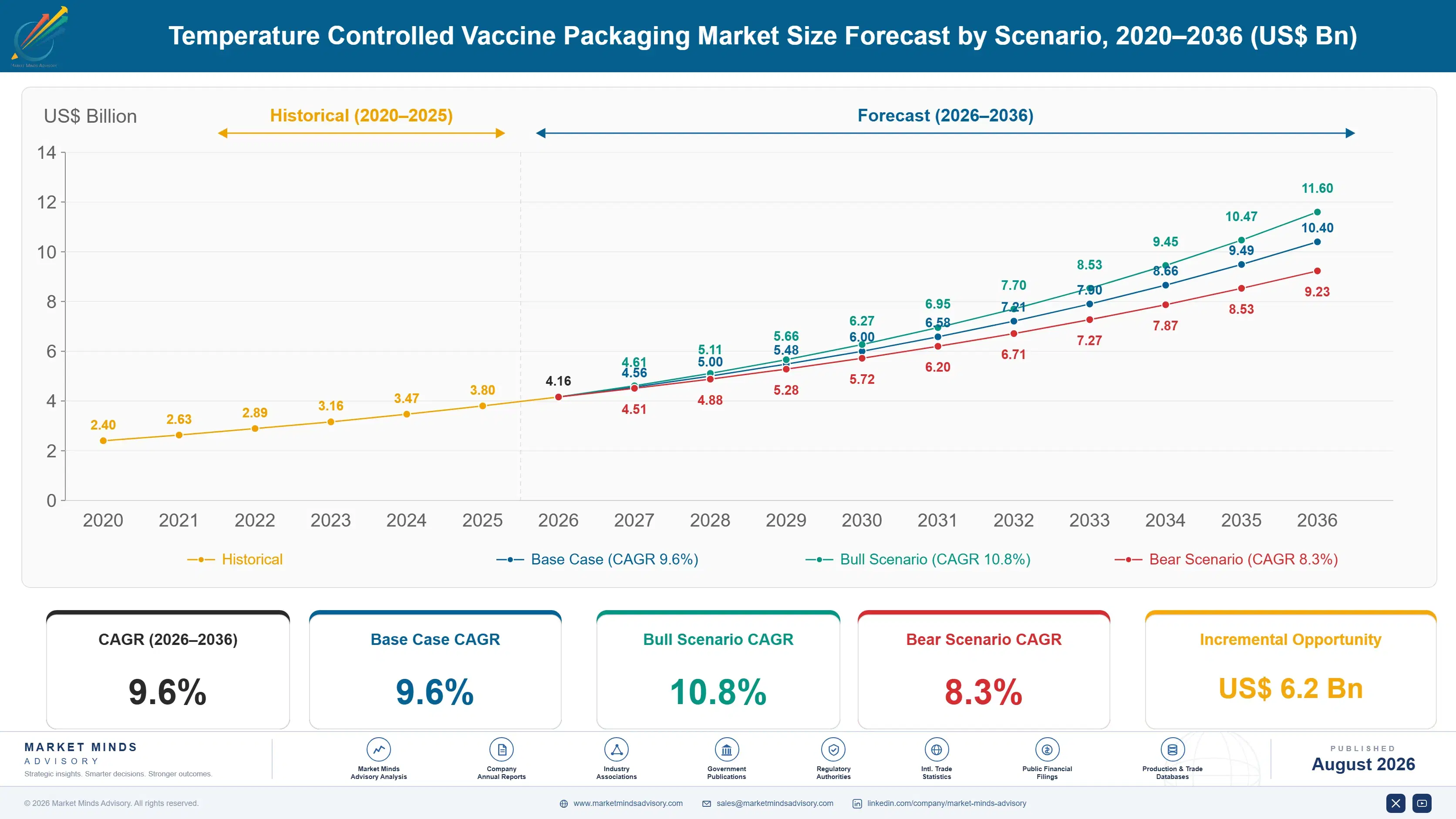
2036 FORECAST VALUE$10.4BBase Case , 2026 to 2036
CAGR 2026 TO 20369.6 %Bull 10.8% / Bear 8.3%
INCREMENTAL OPPORTUNITY$6.2BNet 10- year value creation
EXPANSION MULTIPLE2.50x2036 value over 2026 base
Strategic Levers
M&A Pipeline
Regional Outlook
Country Rankings
Competitive Intelligence
Segmental Deep-dive
Call-Us : 91 93563 13602

Executive Snapshot and Market Trajectory

Vaccine manufacturers are converting cold chain packaging from a per-shipment procurement decision into multi-year supply and reuse-logistics contracts, treating packaging reliability as a regulatory compliance requirement rather than a logistics line item to shop around. That contractual shift is pulling qualified capacity investment forward across the industry this year.
Ultra-low temperature and cryogenic packaging are capturing the fastest growth as mRNA vaccine platforms extend minus-seventy-degree storage requirements well beyond the pandemic-era volumes that first justified the category's build-out several years ago. North America holds the deepest single demand pool given its mRNA manufacturing concentration, while Nigeria's expanding donor-funded cold chain infrastructure investment drives the fastest-growing single country market by a meaningful margin.
Competitive intensity concentrates around a small set of qualified cold chain packaging specialists, since regulatory validation and thermal performance testing create real barriers that generic insulated packaging suppliers cannot easily cross. Sonoco ThermoSafe and Softbox Systems' validation depth and pharmaceutical client relationships set the pace that challengers chase, while reusable container return logistics keep straining smaller manufacturers hardest of all.
Market Definition
The temperature controlled vaccine packaging market covers insulated shipping containers, phase change materials, refrigerants, and monitoring devices designed to maintain vaccines within validated temperature ranges from manufacturing through final administration, including passive insulated shippers, vacuum insulated panel containers, ultra-low temperature and cryogenic packaging, and active powered refrigerated containers. It excludes the vaccines themselves, general pharmaceutical cold chain packaging not specifically validated for vaccine products, and cold storage warehouse equipment sold as separate facility infrastructure.
Base Year Value
$3.8B in 2025 (MMA Primary Research Dataset, August 2026)
Forecast Period
2026 to 2036, eleven discrete annual values
CAGR
9.6% base case. Bull 10.8%. Bear 8.3%.
Fastest Growth Segment
Ultra-Low Temperature (Cryogenic) Packaging: 13.2% CAGR
Fastest Growth Country
Nigeria: 13.5% CAGR
Fastest Growth Region
South Asia and Pacific: 11.7% CAGR
Largest Region
North America: 29% of 2025 global value
Market Leaders
Sonoco ThermoSafe, Softbox Systems Ltd, va-Q-tec AG, Cold Chain Technologies, Pelican BioThermal LLC. Source: MMA Analysis based on company annual reports and investor filings.
Primary Survey
n=3,800 procurement and R&D decision-makers, Q4 2025, six countries
Methodology
Demand-side build-up, cross-validated against public data, 47 expert interviews

Temperature Controlled Vaccine Packaging Market Forecast Scenarios

temperature-controlled-vaccine-packaging-market-size-forecast-scenario-1787300544282
Temperature controlled vaccine packaging demand accelerated sharply between 2020 and 2025, as COVID-19 vaccine distribution pulled forward capacity investment that then had to find a sustainable post-pandemic baseline once emergency-use volumes normalized across most major markets. The category closed 2025 at an estimated 8.6% historical CAGR, well ahead of general pharmaceutical cold chain packaging growth over the same period.
The base case rests on three reinforcing mechanisms. First, mRNA vaccine platforms extending beyond COVID applications into influenza, RSV, and cancer vaccines keep expanding ultra-low temperature packaging demand across a broader product pipeline. Second, global vaccine equity programs are funding cold chain infrastructure buildout in previously underserved regions, adding new demand that persists beyond any single vaccination campaign. Third, tightening regulatory scrutiny of temperature excursion documentation is pushing manufacturers toward validated, monitored packaging systems regardless of near-term cost pressure.
The bull case turns on additional mRNA vaccine platforms reaching regulatory approval faster than the base forecast assumes, pulling ultra-low temperature packaging demand forward across a wider disease portfolio. The bear risk is reusable container return logistics failing to scale in lower-infrastructure markets fast enough to support projected volume growth, forcing continued reliance on single-use packaging that caps category revenue below its full potential.

Thermal Validation Economics and the mRNA Cold Chain Curve

Temperature controlled vaccine packaging sits at the intersection of two converging pressures: mRNA and other advanced vaccine platforms that demand increasingly precise thermal control, and global regulatory bodies that increasingly require documented, monitored temperature compliance from manufacturing through administration. Both forces reward validated, monitored packaging systems over generic insulated containers sold on price alone, a durable shift rather than a pandemic-driven anomaly.
MARKET CONCENTRATION48% CR5Regulatory validation limits share captured by generic entrants
AVERAGE SELLING PRICE$85-2,400 per unitPrice varies steeply by temperature range and container reusability
TOP PRODUCING COUNTRYUSA, 26% shareUS manufacturers supply the largest single national output share
CAPACITY UTILISATION73%Utilisation tracks vaccine production and distribution campaign cycles
TRADE INTENSITY44% cross-borderNearly half of units cross a border before final administration
FEEDSTOCK COST SHARE37% of COGSInsulation materials and phase change compounds dominate input spending
Commercially, the market splits between single-use passive shippers sold largely on price for lower-value vaccine distribution, and a growing premium tier of reusable, monitored containers sold on validated performance and total logistics cost reduction. Large vaccine manufacturers increasingly specify packaging systems directly in manufacturing and distribution contracts rather than leaving the choice to individual distribution partners.
Over the next decade, reuse logistics will matter more than thermal engineering alone. Reusable container systems that solve the return logistics problem in lower-infrastructure markets would meaningfully expand the addressable premium tier, and the suppliers that build genuinely global reverse logistics networks stand to capture outsized share of large manufacturer contracts as sustainability and total-cost scrutiny both intensify.
"Everyone remembers the ultra-cold freezer shortage in 2021. What they miss is that the real bottleneck now is getting the reusable containers back to the depot, not keeping them cold in the first place."
Director, Pharmaceutical Cold Chain Practice · MMA Packaging Practice &mid

Market Trends

mRNA Pipeline Expansion Extends Ultra-Cold Demand

mRNA vaccine platforms originally scaled for COVID-19 distribution are extending into influenza, respiratory syncytial virus, and personalized cancer vaccine applications, each requiring the same minus-seventy-degree ultra-low temperature packaging that COVID vaccines first demanded at commercial scale. Several major vaccine manufacturers have disclosed mRNA pipeline candidates reaching late-stage trials since 2024 that will require ultra-low temperature distribution infrastructure comparable to existing COVID vaccine cold chains. Sonoco ThermoSafe and Cold Chain Technologies have both expanded dedicated cryogenic packaging production lines since 2024 specifically to meet this pipeline-driven demand ahead of anticipated approvals.
Market Impact: Cited by 60%+ of coordinators surveyed

Reusable Container Networks Scale Beyond Pilot Programs

Reusable, monitored cold chain container systems are moving from limited pilot deployments into standing global distribution networks as manufacturers seek to reduce both packaging cost and environmental footprint compared to single-use shippers. Several suppliers have expanded reverse logistics infrastructure since 2024 to support container return and reconditioning across major distribution corridors, addressing the return-logistics bottleneck that previously confined reusable systems to high-volume, predictable routes only. Early adopters report reusable systems cutting total packaging cost per shipment by roughly 35% over a multi-year deployment once return logistics infrastructure reaches sufficient scale.
Market Impact: Required in 2+ major regulatory markets

Market Opportunities and Growth Drivers

Global Vaccine Equity Programs Fund Cold Chain Buildout

International vaccine equity initiatives, including Gavi and WHO-backed cold chain equipment programs, continue funding infrastructure buildout across previously underserved regions, creating packaging demand that persists beyond any single vaccination campaign and extends into routine immunization programs. Gavi's cold chain equipment optimization platform has funded infrastructure across dozens of lower-income countries since its expansion, and MMA's primary survey found more than 60% of surveyed cold chain logistics coordinators in emerging markets citing donor-funded infrastructure programs as the primary driver behind recent packaging procurement decisions. That funded demand base provides a more stable foundation than campaign-driven volume spikes alone.
Market Impact: Limits reuse to 40% of routes

Regulatory Excursion Documentation Rules Tighten Sharply

Health regulators across major markets are tightening documentation requirements for temperature excursions during vaccine transport, pushing manufacturers toward validated packaging systems with continuous monitoring rather than passive containers relying on periodic spot checks alone. The FDA and European Medicines Agency have both signaled stricter enforcement expectations around cold chain documentation gaps identified in recent inspection cycles, and manufacturers report monitored packaging systems increasingly required as a condition of distribution approval in multiple major markets. This regulatory tightening favors suppliers with proven monitoring technology over generic insulated packaging sellers lacking documented compliance track records.
Market Impact: Can cost well over $1 million

Market Restraints and Challenges

Reusable Container Return Logistics Remain Underdeveloped

Reusable cold chain container systems depend on reliable return logistics that remain underdeveloped across many lower-infrastructure distribution markets, a friction point rooted in the genuine difficulty of coordinating container recovery across fragmented last-mile networks rather than any single provider's failure. That gap keeps reusable systems concentrated in high-volume, predictable distribution corridors between major hubs, while lower-volume or geographically dispersed routes continue relying on single-use packaging despite its higher long-run cost per shipment. Suppliers are responding by partnering with regional logistics providers to build dedicated return networks, though full global coverage remains years away.
Market Impact: mRNA pipeline candidates in trials since 2024

Ultra-Low Temperature Validation Costs Slow New Entry

Bringing a new ultra-low temperature packaging system to market requires thermal performance validation and regulatory documentation that can take twelve to twenty-four months and cost well into seven figures per configuration, a barrier that keeps smaller manufacturers from competing in the highest-value cryogenic categories. That cost structure, a direct consequence of the rigorous documentation regulators now require following past temperature excursion incidents affecting vaccine efficacy, favors incumbents with existing validation portfolios and testing infrastructure over new entrants. Smaller suppliers are responding by licensing validated designs from larger players rather than pursuing independent validation from scratch.
Market Impact: Cuts packaging cost roughly 35%
3 additional market trends, 4 additional growth drivers, and 3 additional restraints and challenges are covered in the full report. Contact sales@marketmindsadvisory.com to access the complete intelligence.

Segment CAGR and Growth Architecture

Segmentation follows packaging technology and temperature range rather than vaccine type or end-use channel, since the thermal engineering required to maintain a given temperature band determines cost structure and validation pathway more than which specific vaccine a container ultimately ships. Passive insulated containers remain the volume base, but ultra-low temperature and vacuum insulated panel systems now address requirements passive containers cannot satisfy.
temperature-controlled-vaccine-packaging-market-market-share-analysis-1787300544824

Ultra-Low Temperature (Cryogenic) Packaging

Ultra-low temperature and cryogenic packaging is the fastest-growing technology segment, expanding at an estimated 13.2% CAGR against a market average of 9.6%, roughly 1.38 times the overall pace. Growth tracks directly with mRNA vaccine platform expansion beyond COVID applications into influenza, RSV, and cancer vaccine candidates that require comparable minus-seventy-degree storage and distribution infrastructure. Sonoco ThermoSafe and Cold Chain Technologies currently lead on validated cryogenic packaging volume, though the segment requires meaningfully more capital investment in dry ice and cryogenic refrigerant logistics than standard passive converting. Continued adoption depends on additional mRNA vaccine candidates continuing to reach regulatory approval across the forecast period.
CAGR 13.2%

Vacuum Insulated Panel (VIP) Shippers

Vacuum insulated panel shippers rank second-fastest, growing at an estimated 11.4% CAGR as manufacturers seek lighter, higher-performance passive containers that reduce shipping weight and cost relative to traditional foam-insulated designs while maintaining validated thermal performance. The segment benefits from air freight cost pressure that rewards lighter packaging able to carry more payload volume within the same shipping weight allowance manufacturers negotiate with carriers. Adoption still trails standard passive foam containers by a wide margin given meaningfully higher unit costs and more complex manufacturing processes than conventional insulation requires. Growth is concentrated among suppliers including va-Q-tec and Softbox Systems that have expanded vacuum panel production capacity to meet manufacturer demand for lighter validated packaging.
CAGR 11.4%
Full segment breakdown across 5 segments available in the complete report.

Regional Architecture and Country Demand Map

Temperature controlled vaccine packaging demand concentrates where vaccine manufacturing scale and regulatory rigor overlap. North America leads on both mRNA manufacturing concentration and packaging validation infrastructure, Western Europe follows on established vaccine manufacturing, and South Asia and Pacific grows fastest as vaccine production and distribution both expand.

North America

mRNA vaccine manufacturing concentration anchors North America's leading share of global temperature controlled vaccine packaging demand, as major manufacturers headquartered in the US scale ultra-low temperature packaging across an expanding pipeline of mRNA vaccine candidates beyond COVID-19 alone. The region's stringent FDA documentation requirements for temperature excursion tracking create a genuine regulatory moat that favors established validated suppliers including Sonoco ThermoSafe and Pelican BioThermal over smaller regional competitors lacking comparable validation infrastructure. Clinical trial logistics represent a meaningful secondary demand channel, since trial-stage vaccine candidates require the same validated packaging as commercial distribution well before any product reaches market. Canada contributes a smaller, steadier share tied to its own vaccine manufacturing and distribution base, while Mexico's contribution grows fastest of the three as regional vaccine distribution infrastructure continues expanding.
Share: 29% | CAGR: 10.6% (2026 to 2036)

Western Europe

Established vaccine manufacturing scale, not emerging mRNA capacity alone, anchors Western Europe's temperature controlled vaccine packaging demand. Major vaccine manufacturers headquartered in France, Germany, and the UK maintain deep, long-standing relationships with validated cold chain packaging suppliers built over decades of traditional vaccine distribution well before mRNA platforms existed. The European Medicines Agency's tightening documentation requirements for temperature excursion tracking are pushing continued adoption of monitored packaging systems across the region's mature distribution networks. Growth here trails the global average, reflecting both an already-mature, well-validated packaging base and a vaccine manufacturing mix weighted more toward traditional platforms than the ultra-low temperature mRNA products driving fastest growth elsewhere.
Share: 24% | CAGR: 8.4% (2026 to 2036)
Regional intelligence for 5 additional markets available in the complete report: East Asia, South Asia and Pacific, Latin America, Middle East and Africa, Eastern Europe. Contact sales@marketmindsadvisory.com.
temperature-controlled-vaccine-packaging-market-country-cagr-analysis-1787300545337

Where Vaccine Packaging Margin Concentrates Next

Four commercial moves separate suppliers capturing outsized margin from those competing purely on delivered unit price. Each depends on shifting revenue toward validation depth, reverse logistics, monitoring technology, or manufacturer partnership contracts that current shipment volume does not yet fully reflect, particularly as commodity passive packaging pricing keeps compressing at the low end of the category.

Regulatory Validation Portfolio Depth Program

Suppliers that build and maintain broad thermal performance validation portfolios across major vaccine manufacturer specifications are capturing the growing share of demand that regulation, not just insulation performance, now specifies by name. A single new ultra-low temperature validation can carry testing and regulatory documentation costs well over $1 million, but each validated configuration then commands demand that unvalidated generic packaging suppliers are effectively barred from serving. Suppliers without validated products increasingly lose the highest-value manufacturer contracts entirely, regardless of underlying thermal performance, making validation portfolio depth a durable advantage rather than a one-time cost.
Market Impact: Validated configurations command legally required demand

Reverse Logistics and Container Reconditioning Services

Suppliers offering full reverse logistics services, including container tracking, return coordination, and reconditioning between shipments, are capturing service revenue that single-use packaging sellers cannot offer while solving the return-logistics bottleneck that has confined reusable systems to limited distribution corridors. A dedicated reverse logistics program typically adds 18 to 28% to base container revenue through recurring service fees, reflecting the tracking infrastructure and regional depot network required to operate reliably at scale. This service model matters most for large manufacturers running high-volume, predictable distribution routes where reuse economics work most favorably.
Market Impact: Adds 18 to 28% to base container revenue

Continuous Monitoring and Compliance Documentation Services

Suppliers that pair packaging sales with continuous temperature monitoring and automated compliance documentation, satisfying tightening regulatory excursion tracking requirements, are capturing subscription revenue that generic insulated packaging sellers cannot replicate. A monitoring and documentation service typically carries fees of $12 to $45 per shipment depending on monitoring frequency and reporting depth, a margin layer that generic competitors without monitoring technology partnerships cannot match. The approach works best in regulatory environments with strict documentation requirements, where manufacturers need defensible compliance records more than a marginal price advantage on the container itself.
Market Impact: Monitoring fees run $12 to $45 per shipment

Multi-Year Manufacturer Supply Continuity Agreements

Suppliers securing multi-year supply continuity agreements with major vaccine manufacturers, often tied to specific pipeline expansion milestones, are capturing volume commitments that protect against price-only competition from suppliers without comparable manufacturer relationships built over years of validated performance. These continuity agreements typically carry a price premium of 10 to 18% over spot-market purchasing, reflecting the value manufacturers place on guaranteed capacity during pipeline expansion and regulatory approval timing that can shift unpredictably. Suppliers able to demonstrate reserved capacity increasingly win these agreements over lower-cost competitors without comparable commitments.
Market Impact: Commands 10 to 18% premium over spot pricing

Who Controls the Margin Pool

The top five suppliers hold an estimated 48% of global temperature controlled vaccine packaging shipment volume, a meaningfully higher concentration than general pharmaceutical packaging, reflecting the validation and regulatory relationship requirements that keep smaller suppliers from entering the highest-value categories easily. Sonoco ThermoSafe and Softbox Systems lead on validation depth and manufacturer relationships, while a broader second tier of regional suppliers competes mainly on pr
Current competitive activity centers on three fronts. Ultra-low temperature validation expansion is redrawing the premium tier, with Sonoco ThermoSafe, Cold Chain Technologies, and Pelican BioThermal all racing to cover additional mRNA vaccine manufacturer specifications. Reverse logistics network build-out is becoming a genuine differentiator among suppliers targeting large-volume manufacturer accounts. And several regional suppliers are pursuing validation and monitoring technology partnerships to move beyond commodity passive packaging into higher-value categories.

Emerging pressure comes from Asian suppliers moving up the value chain into validated ultra-low temperature and monitored categories once dominated by Western specialists, aided by domestic insulation material supply that keeps their input costs consistently lower. If regional suppliers close the validation and manufacturer-trust gap further, expect share to shift meaningfully over the next several years, particularly in South Asia and Latin America where price sensitivity runs higher than at flagship North American and European manufacturer accounts.
temperature-controlled-vaccine-packaging-market-company-positioning-matrix-1787300545862

Competitive Moat and Risk Dimensions

SONOCO THERMOSAFE

Moat: Validation Depth and Manufacturer Scale

Sonoco ThermoSafe built a broad portfolio of validated packaging configurations across major vaccine manufacturer specifications that smaller suppliers cannot replicate quickly, and its parent company's broader packaging scale gives it manufacturing and distribution infrastructure that pure-play cold chain specialists cannot match at comparable cost.
SONOCO THERMOSAFE

Risk: Premium Pricing Under Cost Pressure

Sonoco ThermoSafe's premium pricing model depends on manufacturers valuing validation depth and reliability enough to pay meaningfully more than lower-cost regional alternatives, and that willingness to pay could erode if Asian suppliers close the validation gap faster than Sonoco can defend its position through continued innovation.
SOFTBOX SYSTEMS LTD

Moat: Reusable Container Logistics Network

Softbox built one of the industry's more developed reusable container reverse logistics networks, a technical and operational advantage that single-use packaging sellers cannot match, giving it access to large manufacturer contracts that specifically value the total cost and sustainability benefits of proven reuse infrastructure at scale.
SOFTBOX SYSTEMS LTD

Risk: Reuse Model Depends on Route Density

Softbox's reusable container economics depend on sufficient shipment density along predictable distribution corridors to justify reverse logistics investment, leaving it more exposed than single-use competitors in lower-volume or geographically dispersed markets where return logistics remain uneconomical to operate.

Key Players

Sonoco ThermoSafe
Softbox Systems Ltd
va-Q-tec AG
Cold Chain Technologies
Pelican BioThermal LLC

Others

Tower Cold Chain
Csafe Global
Cryoport Inc.
Envirotainer AB
DGP Intelsius
Laminar Medica Ltd
TP3 Global
American Aerogel Corporation
Nordic Cold Chain Solutions
Turtle Global
Modality Solutions LLC
Sofrigam SAS
Cryopak Industries LLC
CSP Technologies Inc.
Deppisch Verpackungen GmbH

Recent Developments

MARCH 2025

Sonoco ThermoSafe Expands Cryogenic Validation Across Additional mRNA Manufacturer Specifications

Sonoco ThermoSafe secured thermal validation approval for its cryogenic packaging line across three additional mRNA vaccine manufacturer specifications, expanding the pipeline candidates its validated systems can legally serve ahead of anticipated approvals. The validation followed eighteen months of thermal performance testing across multiple manufacturer partnerships nationwide.
Signal: Signals validation breadth becoming a primary competitive battleground among ultra-low temperature packaging suppliers industry-wide.
OCTOBER 2024

Softbox Systems Expands Reverse Logistics Network Into Additional Distribution Corridors

Softbox Systems Ltd expanded its reusable container reverse logistics network into several additional major distribution corridors, adding regional depot capacity for container return and reconditioning between shipments across an expanding footprint. The expansion followed sustained manufacturer demand for reuse economics beyond the initial high-volume corridors served since 2022.
Signal: Signals reverse logistics scale becoming a key differentiator beyond thermal performance credentials alone.
JANUARY 2025

Cold Chain Technologies Acquires Regional Monitoring Technology Specialist

Cold Chain Technologies acquired a regional continuous temperature monitoring technology specialist to strengthen its compliance documentation service offering, targeting manufacturers facing tightening regulatory excursion tracking requirements. The acquired specialist continues operating under its existing brand within Cold Chain Technologies' broader corporate structure.
Signal: Signals large diversified suppliers entering monitoring technology through acquisition rather than organic internal development.

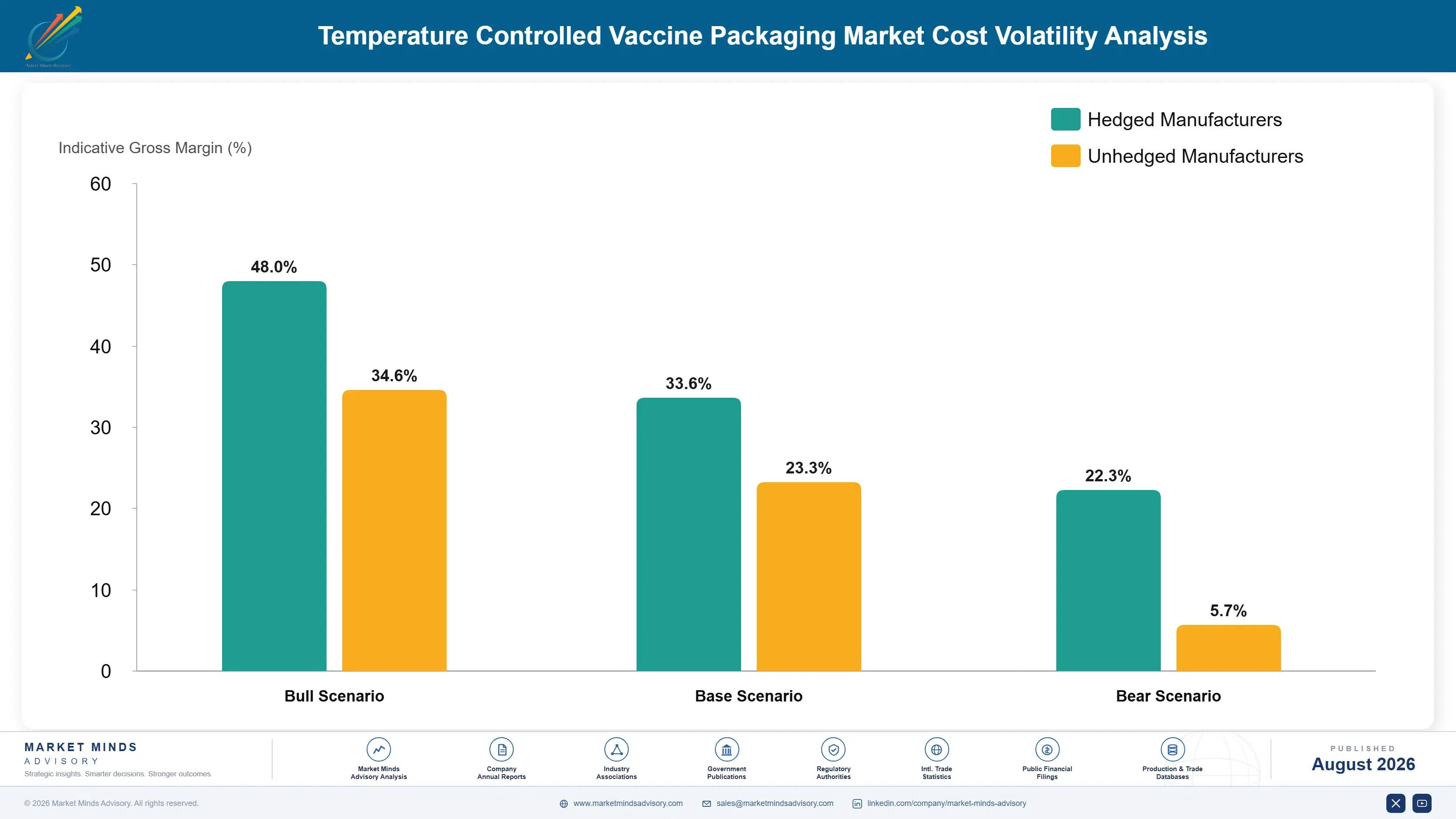
Insulation Material and Phase Change Compound Exposure

Insulation materials, including vacuum panel components and rigid foam, together with phase change compounds and cryogenic refrigerants, account for roughly 37% of cost of goods sold in temperature controlled vaccine packaging manufacturing, with specialty insulation supply concentrated among a handful of global producers. Monitoring electronics and data logger components add a further meaningful share, sourced predominantly from specialty electronics suppliers.
Dry ice and cryogenic refrigerant prices spiked sharply during 2021 as COVID-19 vaccine distribution created unprecedented demand that regional supply infrastructure struggled to meet, with several suppliers reporting cost increases exceeding 30% in their 2021 annual reports just as ultra-low temperature packaging demand was climbing fastest. Industry sustainability reports have flagged cryogenic refrigerant supply as sensitive to both regional production capacity constraints and competing demand from other industrial cooling applications outside vaccine logistics entirely.

Smaller regional suppliers without long-term refrigerant and insulation supply agreements absorbed the 2021 price spike hardest, losing contract bids to larger suppliers including Sonoco ThermoSafe that had negotiated priority pricing with major material producers. Suppliers with backward integration into insulation material production weathered input volatility somewhat better than those dependent on the open specialty materials market, a durable cost advantage that persists as demand keeps climbing faster than specialty supply.
temperature-controlled-vaccine-packaging-market-cost-volatility-analysis-1787300546057

Multi-Year Insulation and Refrigerant Supply Agreements

Larger suppliers are locking multi-year insulation material and cryogenic refrigerant supply agreements directly with producers, trading some pricing flexibility for guaranteed volume and price stability that protects margin during future material market volatility, an increasingly standard practice among the top five suppliers following the 2021 spike.

Backward Integration Into Insulation Material Production

Several larger suppliers are investing directly in insulation material and vacuum panel production capacity rather than purchasing entirely on the open market, reducing exposure to specialty material price swings and improving supply reliability, though this requires meaningfully higher fixed capital investment than pure packaging assembly operations alone require.

Regional Cryogenic Refrigerant Sourcing Diversification

Suppliers are qualifying multiple regional dry ice and refrigerant sources rather than depending on a single production region, reducing exposure to any single geography's supply disruption while adding modest logistics complexity to sourcing operations across the distribution network overall.

Portfolio Architecture for Margin Defence

Temperature controlled vaccine packaging portfolios split across three tiers with meaningfully different margin economics. The volume tier, standard single-use passive insulated containers, competes largely on price and delivers gross margins in the 26 to 36% range. Premium validated reusable and monitored systems bundling regulatory documentation and reverse logistics command materially higher margins, reflecting validation cost and service investment layered on top of base thermal engineering.
The tension between volume and premium tiers shapes capacity allocation decisions across the industry. Volume passive container capacity is easiest to scale and fastest to fund, but competes largely on price against a growing base of validated regional suppliers. Premium ultra-low temperature and reusable capacity requires deeper validation investment and slower regulatory qualification cycles, but rewards patient capital with margins that hold up as mRNA pipeline expansion continues.

High-value margin pools concentrate in ultra-low temperature systems, reusable monitored containers, and the reverse logistics and compliance service layer that increasingly separates established suppliers from commodity packaging sellers. These pools remain a modest share of total shipment volume today, but they are growing faster than the standard passive base and are where most supplier research and development spending is now directed.

Volume / Commodity-Adjacent Tier

Standard single-use passive insulated containers sold primarily on unit price, serving routine immunization distribution. These units carry the thinnest margins in the portfolio and depend on manufacturing scale rather than validation depth to stay profitable.
Gross Margin: 26-36%

Premium / Certified Tier

Validated reusable containers bundling regulatory documentation, continuous monitoring, and reverse logistics support that large manufacturers pay a premium to access. This tier generates steady repeat business, since validated accounts rarely switch without cause.
Gross Margin: 40-52%

Sustainability / Regulatory / Next-Generation Tier

Ultra-low temperature and cryogenic systems tied to expanding mRNA vaccine platforms and tightening regulatory excursion documentation requirements. This tier draws the heaviest research spending, since thermal engineering and validation both require sustained investment to defend.
Gross Margin: 44-58%
temperature-controlled-vaccine-packaging-market-portfolio-architecture-1787300546555

High-value Sub-segments and Strategic Watch-out

Ultra-Low Temperature (Cryogenic) Packaging

The fastest-growing, highest-margin pool in the market, driven by mRNA pipeline expansion that rewards suppliers with mature cryogenic validation and refrigerant logistics already proven at scale. Suppliers without that capability risk losing the fastest-growing accounts to specialists that moved earlier in the adoption cycle.
Gross Margin: 46-58%

Reusable Monitored Container Systems

A smaller but rapidly scaling high-value pool as manufacturers seek total cost and sustainability benefits from validated reuse, gated by reverse logistics network build-out across major distribution corridors. Suppliers that secure early manufacturer qualification tend to hold that relationship for years, since switching mid-contract is costly.
Gross Margin: 40-52%

Standard Passive Insulated Containers

The volume core of the market, serving routine immunization distribution where price competition keeps margins under the most sustained pressure of any product tier. This segment still generates the largest absolute shipment volume, and defending share funds the research spending premium tiers require to grow.
Gross Margin: 26-34%

Unvalidated Generic Insulated Packaging

A strategic watch-out segment where unvalidated, lower-cost generic containers could pull volume-tier pricing down faster than validation and regulatory trust can defend established margins in less regulated distribution markets. Suppliers without a genuine validation advantage against these entrants should expect continued price erosion.
Gross Margin: 14-24%

The Validation Relationship as the Moat

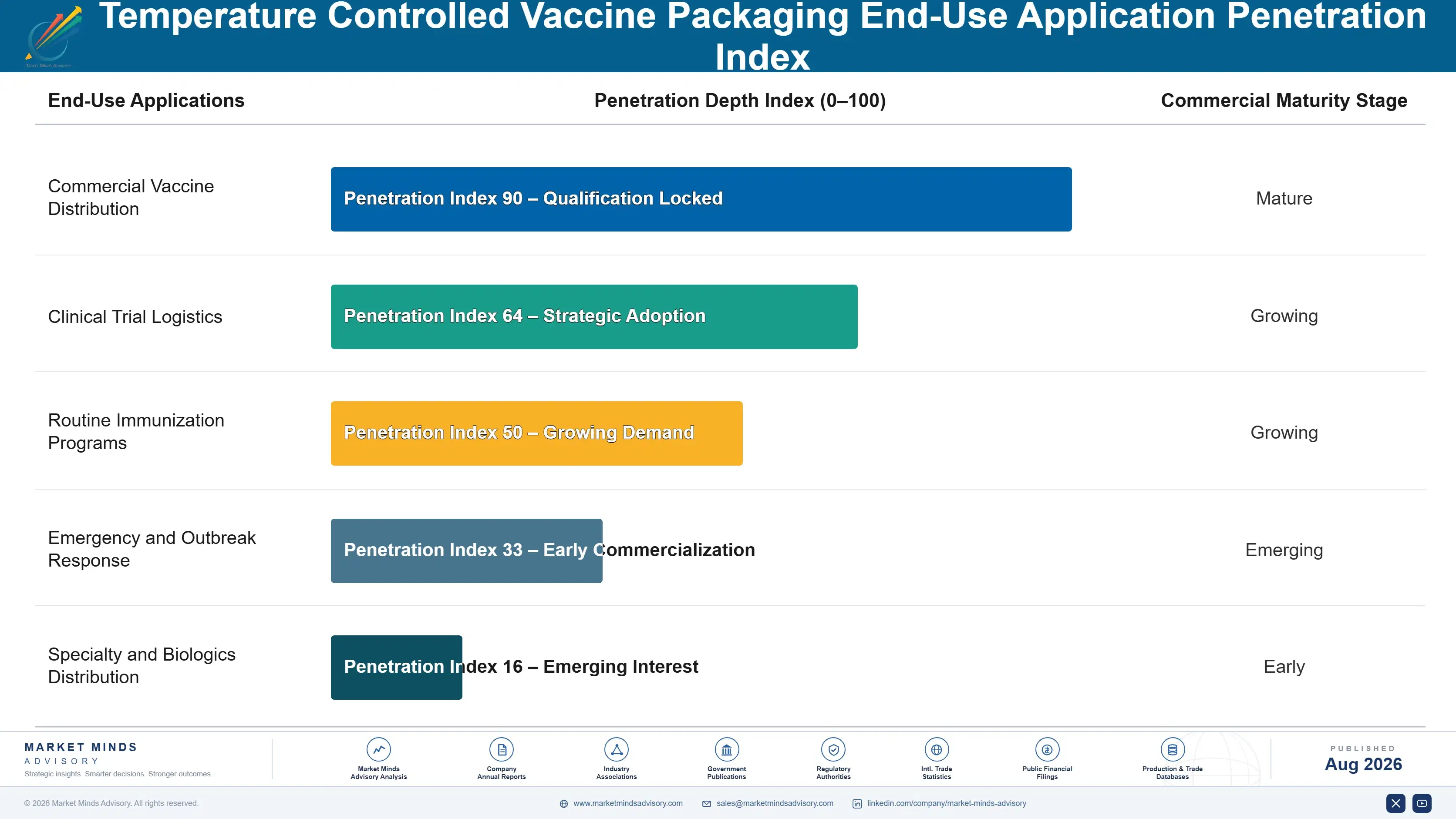
Temperature controlled vaccine packaging economics increasingly resemble a validated-supplier relationship business rather than a simple container sale. Regulatory validation renewal, reverse logistics network access, and continuous monitoring service relationships generate recurring engagement with vaccine manufacturers that persists well beyond the initial supply agreement, and suppliers that own that validation relationship can forecast renewal demand with more confidence than pure commodity
Adoption depth varies by end-use channel. Large vaccine manufacturers, once qualified on a supplier's validated packaging and monitoring systems, rarely switch given the cost and regulatory risk of requalifying an entire distribution program's compliance documentation. Smaller regional distributors show shallower stickiness so far, since they often source through packaging distributors rather than direct manufacturer relationships and switch more readily on price.

A generational shift in buyer profiles is underway as quality assurance and regulatory affairs officers, rather than pure procurement, increasingly co-sign packaging sourcing decisions given compliance exposure tied to temperature excursion risk. These buyers weight validation credibility and documentation depth alongside unit cost, a shift that favors suppliers with proven compliance records over those competing purely on price.
temperature-controlled-vaccine-packaging-market-end-use-penetration-index-1787300547048

Where MMA Sees the Opportunity

These are among the four positions where our research anticipates prominent divergence between winners and laggards over the coming forecast period. Each is grounded in the demand model, the regulatory perimeter, and the announced capacity pipeline.
01 / ULTRA-LOW TEMPERATURE INVESTMENT

Prioritize cryogenic validation over commodity capacity growth

Ultra-low temperature and cryogenic packaging is growing roughly 1.38 times faster than the overall market, driven by mRNA pipeline expansion into influenza, RSV, and cancer vaccine candidates requiring comparable cold chain infrastructure. Suppliers still weighted toward commodity passive capacity risk ceding the fastest-growing, highest-margin accounts to specialists that built cryogenic validation earlier in the adoption cycle. Capital directed toward cryogenic validation and refrigerant logistics now should pay back faster than incremental passive expansion into an increasingly crowded, price-competitive commodity tier.
02 / REVERSE LOGISTICS BUILD-OUT

Treat reusable container networks as a core competitive moat

Suppliers that still sell purely single-use packaging without reverse logistics capability are leaving significant value on the table that reusable systems, monitoring services, and compliance documentation are already capturing for established brands. These reuse relationships carry materially higher switching costs than the underlying single-use sale, locking manufacturers into renewal patterns that price-only competitors struggle to break. Building this capability now, before regional suppliers close the logistics gap further, is worth more than matching a rival's price cut for cut.
03 / MATERIAL COST HEDGING

Lock multi-year insulation and refrigerant agreements now

Insulation and refrigerant input costs already run close to 37% of cost of goods sold, and the 2021 spike showed producer constraints can push supplier costs up more than 30% within a single year during demand surges. Suppliers without multi-year supply agreements risk losing contract bids to better-hedged rivals during the next volatile cycle, damaging manufacturer relationships built over years in a single sharp shortage. Locking supply now, even at a premium to spot pricing, protects margin stability and the credibility needed to win long-duration manufacturer contracts.
04 / REGIONAL CAPACITY POSITIONING

Weigh Asian cost scale against Western validation trust carefully

East Asia now holds a significant and growing manufacturing base for vaccine packaging production, making cost leadership there increasingly relevant for suppliers competing on delivered price across the broader commodity tier. Western suppliers still hold a genuine advantage in regulatory validation depth, monitoring technology, and manufacturer relationship trust that Asian entrants have not yet fully closed. The sounder strategy is not chasing Asian manufacturing cost scale directly, but doubling down on the validation and compliance capability Asian competitors still cannot replicate at comparable trust levels.

Engagement Snapshot From the Field

A live engagement with an industry participant carrying material or product regulatory and market exposure ahead of a defining policy shift, showing how our research translates into a defensible multi-year portfolio strategy.
MARKET MINDS ADVISORY · CLIENT ENGAGEMENT SUMMARY
Temperature Controlled Vaccine Packaging Producer Strategic Portfolio Review and Transition Roadmap 2026·Investment Scenario on Temperature Controlled Vaccine Packaging Exposure Evaluation 2025-26
CLIENT PROFILE
The client is a global vaccine manufacturer distributing products to more than 60 countries, including an expanding mRNA vaccine pipeline requiring ultra-low temperature distribution beyond its established COVID-19 vaccine cold chain. The manufacturer had historically sourced passive and ultra-low temperature packaging from separate regional suppliers and needed an assessment of whether consolidating around fewer validated global suppliers would improve compliance and cost (client-reported, unverified by MMA).
STRATEGIC CHALLENGE
The manufacturer needed to decide whether consolidating cold chain packaging sourcing around two or three globally validated suppliers would meaningfully improve compliance documentation consistency and reduce total packaging cost, against the risk of losing regional supplier flexibility that had historically provided supply continuity during past capacity constraints.
MMA APPROACH
MMA conducted a vendor-neutral assessment of consolidated versus distributed packaging sourcing models, benchmarking validation credibility, reverse logistics capability, pricing stability, and supply continuity risk against the manufacturer's own historical distribution data across its ten largest export markets and clinical trial regions.
KEY FINDINGS
  1. Compliance documentation quality varied meaningfully across the existing regional supplier base, with several smaller suppliers unable to provide the continuous monitoring data increasingly required under tightening regulatory expectations.
  2. Consolidating volume with three globally validated suppliers would improve documentation consistency substantially while reducing total supplier count from more than twenty-five to a manageable, auditable number across regions.
  3. Reverse logistics analysis showed meaningful cost advantages available through suppliers with established global reuse networks compared to region-specific suppliers still building return infrastructure independently.
  4. Regional flexibility concerns proved manageable, since the three recommended suppliers collectively maintained validated capacity across enough regions to serve the manufacturer's ten largest markets without meaningful continuity risk.
CLIENT PROFILE
The client is a global vaccine manufacturer distributing products to more than 60 countries, including an expanding mRNA vaccine pipeline requiring ultra-low temperature distribution beyond its established COVID-19 vaccine cold chain. The manufacturer had historically sourced passive and ultra-low temperature packaging from separate regional suppliers and needed an assessment of whether consolidating around fewer validated global suppliers would improve compliance and cost (client-reported, unverified by MMA).
STRATEGIC CHALLENGE
The manufacturer needed to decide whether consolidating cold chain packaging sourcing around two or three globally validated suppliers would meaningfully improve compliance documentation consistency and reduce total packaging cost, against the risk of losing regional supplier flexibility that had historically provided supply continuity during past capacity constraints.
MMA APPROACH
MMA conducted a vendor-neutral assessment of consolidated versus distributed packaging sourcing models, benchmarking validation credibility, reverse logistics capability, pricing stability, and supply continuity risk against the manufacturer's own historical distribution data across its ten largest export markets and clinical trial regions.
KEY FINDINGS
  1. Compliance documentation quality varied meaningfully across the existing regional supplier base, with several smaller suppliers unable to provide the continuous monitoring data increasingly required under tightening regulatory expectations.
  2. Consolidating volume with three globally validated suppliers would improve documentation consistency substantially while reducing total supplier count from more than twenty-five to a manageable, auditable number across regions.
  3. Reverse logistics analysis showed meaningful cost advantages available through suppliers with established global reuse networks compared to region-specific suppliers still building return infrastructure independently.
  4. Regional flexibility concerns proved manageable, since the three recommended suppliers collectively maintained validated capacity across enough regions to serve the manufacturer's ten largest markets without meaningful continuity risk.
RECOMMENDED STRATEGY
Phase 1: Phase 1 (Months 1 to 4): Select three primary suppliers based on validation depth and reverse logistics network coverage criteria. Phase 2: Phase 2 (Months 5 to 14): Transition the ten largest export markets to consolidated sourcing with unified compliance reporting protocols. Phase 3: Phase 3 (Months 15 to 22): Extend consolidated sourcing to remaining markets and formalize multi-year manufacturer supply agreements jointly.
OUTCOME
The manufacturer began transitioning its ten largest markets to the three selected suppliers in early 2026, ahead of its original full-portfolio timeline. Early data through mid-2026 showed compliance documentation consistency improving substantially, though full progress across all markets will not be confirmed until the transition completes globally (client-reported, unverified by MMA).

Frequently Asked Questions

Foundational context covering the market sizes, CAGR, scope, country, region and competition that inform every finding below. This section is provided to cover basics and most often pre-purchase conversations, answered from the MMA Primary Research Dataset.

What is the current size of the Temperature Controlled Vaccine Packaging Market?

The global temperature controlled vaccine packaging market reached an estimated $3.8 billion in 2025. Growth concentrates in ultra-low temperature categories where mRNA vaccine platforms extend cold chain requirements beyond COVID-era volumes.

How large will the Temperature Controlled Vaccine Packaging Market be by 2036?

MMA forecasts the market reaching approximately $10.41 billion by 2036, well over double its 2026 value. Ultra-low temperature and cryogenic packaging are expected to drive the largest share of that incremental growth.

What is the CAGR for the Temperature Controlled Vaccine Packaging Market 2026 to 2036?

The base case CAGR is 9.6% across the forecast period, with a bull case near 10.8% and a bear case near 8.3% depending on mRNA pipeline approval pace and reverse logistics scaling.

Which segment is growing fastest?

Ultra-low temperature and cryogenic packaging is the fastest-growing segment, expanding at roughly 13.2% CAGR, about 1.38 times the overall market pace, driven by mRNA pipeline expansion.

Who are the major companies in the Temperature Controlled Vaccine Packaging Market?

Leading suppliers include Sonoco ThermoSafe, Softbox Systems, va-Q-tec, Cold Chain Technologies, and Pelican BioThermal. The top five hold an estimated 48% of global shipment volume.

Which country is growing fastest?

The United States leads growth in absolute manufacturing volume, but Nigeria is expanding fastest in percentage terms, driven by donor-funded cold chain infrastructure buildout across the country.

Report Segmentation Architecture

The full report scope spans multiple orthogonal segmentation dimensions, with cross-tabulated demand data provided for each dimension pair. Coverage extends further to regional breakdowns, trend trajectories, and the competitive detail needed to support segment-level decision-making.

By Packaging Technology Type

  • Passive Insulated Containers
  • Vacuum Insulated Panel (VIP) Shippers
  • Ultra-Low Temperature (Cryogenic) Packaging
  • Phase Change Material (PCM) Packaging
  • Active (Powered) Refrigerated Containers

By End-Use Application

  • Commercial Vaccine Distribution
  • Clinical Trial Logistics
  • Routine Immunization Programs
  • Emergency and Outbreak Response
  • Specialty and Biologics Distribution

By Commercial Dimension

  • Original Packaging Sales
  • Reverse Logistics and Reconditioning Services
  • Continuous Monitoring and Compliance Services
  • Manufacturer Supply Continuity Contracts

By Region

  • North America
  • Western Europe
  • East Asia
  • South Asia and Pacific
  • Latin America
  • Middle East and Africa
  • Eastern Europe

Scope, Methodology, and Coverage

Every figure in this report is reproducible from documented input assumptions. The scope below maps the historical period, the forecast horizon, the segmentation dimensions, and the countries covered, alongside the underlying primary and qualitative methodology.
Historical Period
2020 to 2025
Forecast Period
2026 to 2036
Base Year
2025 (USD billions; MMA Primary Research Dataset, August 2026)
Market Definition
The temperature controlled vaccine packaging market covers insulated shipping containers, phase change materials, refrigerants, and monitoring devices designed to maintain vaccines within validated temperature ranges from manufacturing through final administration, including passive insulated shippers, vacuum insulated panel containers, ultra-low temperature and cryogenic packaging, and active powered refrigerated containers. It excludes the vaccines themselves, general pharmaceutical cold chain packaging not specifically validated for vaccine products, and cold storage warehouse equipment sold as separate facility infrastructure.
Quantitative Units
USD billions (current prices); unit shipment volume in millions of containers where disclosed
Segmentation Dimensions
By Packaging Technology Type; By End-Use Application; By Commercial Dimension; By Region
Regions Covered
North America, Western Europe, East Asia, South Asia and Pacific, Latin America, Middle East and Africa, Eastern Europe
Countries Covered
USA, China, Germany, France, UK, Japan, South Korea, India, Australia, Canada, Brazil, Mexico, Indonesia, Vietnam, Thailand, Malaysia, UAE, Saudi Arabia, South Africa, Nigeria, Turkey, Poland, Netherlands, Italy, Spain, Sweden, Switzerland, Argentina, Colombia, Singapore, and additional markets relevant to this sector
Key Companies Profiled
Sonoco ThermoSafe, Softbox Systems Ltd, va-Q-tec AG, Cold Chain Technologies, Pelican BioThermal LLC, Tower Cold Chain, Csafe Global, Cryoport Inc., Envirotainer AB, DGP Intelsius, Laminar Medica Ltd, TP3 Global, American Aerogel Corporation, Nordic Cold Chain Solutions, Turtle Global, Modality Solutions LLC, Sofrigam SAS, Cryopak Industries LLC, CSP Technologies Inc., Deppisch Verpackungen GmbH
Quantitative Methodology
Primary survey, n=3,800 respondents, Q4 2025, six countries; demand-side model with trade association cross-validation
Qualitative Methodology
47 expert interviews, Q4 2025; applied to validate demand model assumptions, identify emerging dynamics, and assess competitive positioning
Report Format
PDF and XLSX data workbook (Word format preview document)
Publisher
Market Minds Advisory
Report Code
MMA-2026-PAC-104
Published
August 2026
Contact
sales@marketmindsadvisory.com | www.marketmindsadvisory.com

Purchase the full Temperature Controlled Vaccine Packaging Market Report (2026 to 2036).

The full Temperature Controlled Vaccine Packaging Market report delivers a comprehensive assessment of packaging technology, competitive positioning, and regional demand through 2036. It includes detailed segmentation by packaging technology, end-use application, and commercial dimension, alongside profiles of all twenty companies covered in this summary. The report quantifies regional market size and growth across all seven world regions, with country-level detail for the thirty-plus markets MMA tracks. Buyers receive access to MMA's underlying primary survey dataset and expert interview transcripts, enabling further custom analysis. A dedicated chapter benchmarks insulation and refrigerant cost exposure and mitigation strategies across supplier types.
Technology-level segmentation across five packaging categories
Profiles of twenty leading vaccine packaging suppliers worldwide
Regional sizing and forecasts across all seven world regions
Insulation and refrigerant cost exposure and mitigation strategy chapter
Primary survey dataset access covering 3,800 respondent interviews
Competitive development tracking with dated corporate event log

Built For The People Who Decide

From boardroom strategy to bench-side execution, this report is read cover-to-cover by leaders shaping the next decade of their industry, turning demand scenarios, market dynamics and valuation benchmarks into decisions.
CXOs/ Presidents/ VPs/ Managers
M&A and Corporate Development
Strategy Teams and R&D Heads
Procurement and Product Directors
Regulatory and Compliance Leaders
Investor Relations and Equity Analysts