Market Minds Advisory
Teledentistry Market

Teledentistry Market: The Diagnosis Needs an Instrument in the Mouth

Around three quarters of dental conditions cannot be assessed without probing, radiographs or percussion, so this technology extends a clinician rather than replacing the visit that most of dentistry actually requires.

Lead Analyst

Alice Ballenger

Published

September 2026

Make Smarter Decisions with Customized Research Insights

Request a free sample report and evaluate market opportunities, growth trends, and competitive dynamics relevant to your business needs.

2025 MARKET VALUE$0.9BMarket Size 2025
2036 FORECAST VALUE$3.2BBase Case , 2026 to 2036
CAGR 2026 TO 203612.6 %Bull 14.0% / Bear 11.2%
INCREMENTAL OPPORTUNITY$2.2BNet 10- year value creation
EXPANSION MULTIPLE3.28x2036 value over 2026 base
Strategic Levers
M&A Pipeline
Regional Outlook
Country Rankings
Competitive Intelligence
Segmental Deep-dive
Call-Us : 91 93563 13602

Executive Snapshot and Market Trajectory

Dentistry is the branch of medicine least suited to remote practice, because around 74% of conditions cannot be assessed without a probe, a radiograph or percussion. No camera resolves that. What remote work genuinely does is extend a clinician's reach rather than substitute for the physical examination itself.
The category also carries damage inflicted by its own largest adopter. Direct to consumer aligner businesses used remote monitoring to remove the dentist from the process entirely, produced regulatory action and malpractice claims, and left the whole category associated with an approach that most practising dentists actively distrust. That reputational debt was not created by the technology. Legitimate vendors inherited that suspicion undeservedly. The profession knows this and reacts accordingly to anything described as teledentistry.
Where it works is workforce extension. Asynchronous review grows at 18.9% as hygienists and nurses capture images in schools, care homes and rural clinics for a remote dentist to assess, funded by public health budgets rather than by patients. India grows fastest anywhere at 20.4%, where urban practitioners outnumber rural ones roughly six to one. Public funding sidesteps the annual benefit maximum entirely. Commissioners measure population coverage rather than chair time.
Market Definition
Software platforms, services and connected devices enabling remote dental assessment and care coordination, covering synchronous video consultation, asynchronous store-and-forward review, remote orthodontic monitoring, triage and emergency assessment, specialist referral and second opinion services, and remote patient education and compliance. Measured at vendor and service provider selling value. Excludes clear aligners and orthodontic appliances, intraoral scanners and imaging hardware sold for in-practice use, dental practice management software without remote care function, and in-person clinical services.
Base Year Value
$0.9B in 2025 (MMA Primary Research Dataset, August 2026)
Forecast Period
2026 to 2036, eleven discrete annual values
CAGR
12.6% base case. Bull 14.0%. Bear 11.2%.
Fastest Growth Segment
Asynchronous Store-and-Forward Review: 18.9% CAGR
Fastest Growth Country
India: 20.4% CAGR
Fastest Growth Region
South Asia and Pacific: 14.8% CAGR
Largest Region
North America: 30% of 2025 global value
Market Leaders
Align Technology, Dental Monitoring, MouthWatch, Denteractive, Teledentix. Source: MMA Primary Research Dataset, July 2026.
Primary Survey
n=3,800 procurement and R&D decision-makers, Q4 2025, six countries
Methodology
Demand-side build-up, cross-validated against public data, 47 expert interviews

Teledentistry Market Forecast Scenarios

teledentistry-market-size-forecast-scenario-1787639758495
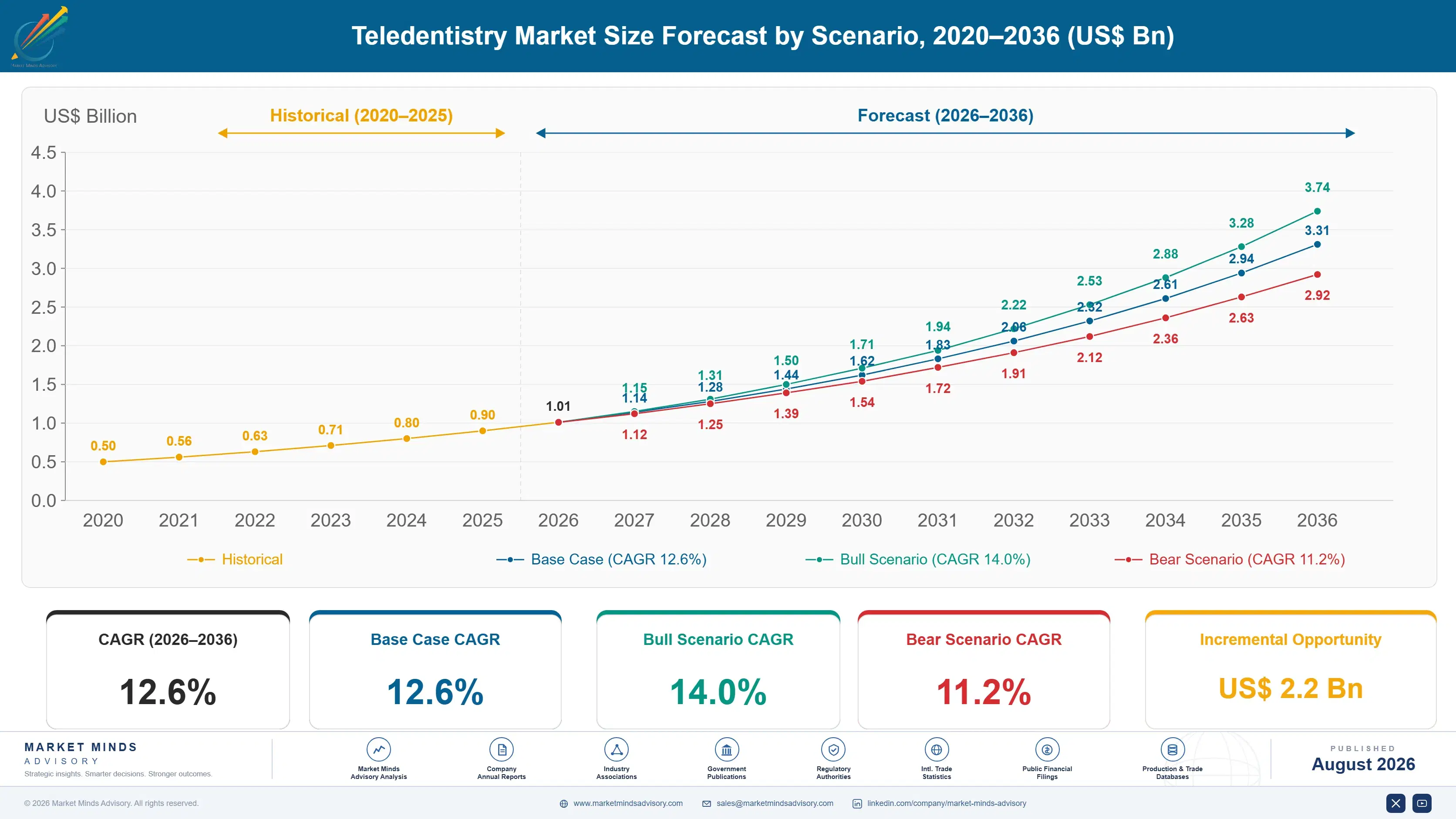
Growth ran near 11.0% between 2020 and 2025, with an initial surge during clinic closures giving way to a considerably narrower set of durable applications afterwards. Direct to consumer aligner monitoring expanded quickly and then contracted sharply amid regulatory action and business failure, taking much of the category's credibility with it. Public health funded asynchronous programmes grew steadily throughout without attracting much attention.
Base case 12.6% rests on three mechanisms. Asynchronous store-and-forward review grows at 18.9% as workforce extension programmes reach schools, care homes and rural populations on public health funding. Remote orthodontic monitoring grows at 14.6% within dentist supervised practice rather than in the consumer channel that damaged it. And India grows fastest of any country at 20.4% on a practitioner distribution gap around six to one between urban and rural areas. Only one of the three depends on private reimbursement at all.
The bull case at 14.0% assumes image quality improving enough through guided capture and automated assessment that the diagnostic ceiling genuinely rises. The bear case at 11.2% is reimbursement remaining weak, since dental benefit design applies an annual maximum near 1,500 dollars and any remote consultation consumes benefit the patient would otherwise spend on treatment.

Extending a Clinician, Not Replacing One

The physical constraint here is absolute and it decides everything else. Around 74% of dental conditions require a probe measuring pocket depth, a bitewing radiograph revealing interproximal decay, or percussion establishing whether a tooth hurts under load. A camera pointed at the front teeth shows none of that. Anybody selling teledentistry as a substitute for examination is selling something the profession will reject, correctly.
TOP FIVE CONCENTRATION26%A fragmented field of platforms and practice software vendors
INSTRUMENT DEPENDENT DIAGNOSES74%Dental conditions requiring physical examination to assess properly
ANNUAL BENEFIT MAXIMUM$1,500Yearly limit most dental insurance plans apply per patient
STORE AND FORWARD SHARE58%Encounters completed without any live clinician interaction at all
RURAL PRACTITIONER GAP6xUrban against rural dentist availability across emerging markets
IMAGE CAPTURE FAILURE RATE23%Patient captured images unusable for any clinical assessment
The category's reputational problem came from exactly that overreach. Direct to consumer aligner businesses used remote monitoring to bypass the dentist rather than to extend one, drew regulatory action and malpractice litigation, and one prominent operator failed publicly. Practising dentists now approach the whole category with suspicion earned by a business model rather than by any technology, and vendors serving legitimate clinical uses inherited that suspicion without deserving it.
What works is a clinician using it to reach patients they could not otherwise see. A hygienist captures images at a school or care home and a dentist reviews them later, which is why around 58% of encounters involve no live interaction at all. That model is funded by public health budgets rather than dental benefits, which matters given plans capping annual benefit near 1,500 dollars.
"The single most damaging thing that happened to teledentistry was its most successful commercial application, which taught an entire profession to distrust it. The programmes quietly working are in school gyms and nursing homes, and almost nobody writes about those."
Director, Digital Health and Dental Practice Technology · MMA Healthcare and Life Sciences Practice · August 2026

Market Trends

Workforce extension programmes reaching populations without dentists

Asynchronous review grows at 18.9% because a hygienist or trained nurse can capture images in a school, care home, prison or rural clinic for a dentist to assess afterwards, which multiplies a scarce clinician's reach without pretending to replace an examination. Around 58% of encounters now involve no live interaction at all. Public health budgets rather than dental benefits fund this work, which insulates it entirely from the reimbursement problems that constrain everything else in the category. Commissioners measure population coverage rather than chair time, a different buyer with a different budget.
Market Impact: India growing fastest at 20.4%

Consumer aligner failures still shaping professional attitudes

Direct to consumer aligner businesses used remote monitoring to remove the dentist from treatment rather than to extend one, and the resulting regulatory action, malpractice claims and public business failure left the profession deeply sceptical of anything described as teledentistry. That damage attaches to a commercial model rather than to any technology, but vendors serving legitimate clinical applications have to overcome it before any conversation about their own product can begin properly. Regulators have begun distinguishing dentist supervised remote care from the consumer models that prompted enforcement, which slowly separates the legitimate use from the damaged one.
Market Impact: Orthodontic monitoring growing at 14.6%

Market Opportunities and Growth Drivers

Practitioner maldistribution creating unmet need in rural populations

India grows fastest of any country at 20.4% because dentists concentrate in cities at roughly six times rural density while most of the population lives outside them, which produces genuine unmet need rather than a convenience opportunity. Asynchronous review lets a small urban clinician group serve a far larger population through trained local capture. Similar patterns hold across Indonesia, the Philippines and much of Africa, where the constraint is practitioner supply rather than patient willingness. Programme funding rather than patient payment supports almost all of the activity in those settings.
Market Impact: Caps benefit near 1,500 dollars

Supervised orthodontic monitoring recovering inside dental practice

Remote monitoring of aligner and appliance progress grows at 14.6% within dentist supervised treatment, where it reduces routine review appointments without removing clinical responsibility from anybody. That is the same technology the consumer channel misused, applied in a way the profession accepts because a practitioner remains accountable throughout. Practices adopting it recover chair time for procedures rather than reviews, which is a productivity argument rather than a patient convenience one. Presenting it as patient convenience instead invites immediate comparison with the consumer model and generally loses the meeting outright. Productivity arguments close far faster.
Market Impact: Around 23% of images unusable

Market Restraints and Challenges

Benefit maximums making remote consultation compete with treatment

Dental insurance applies an annual maximum near 1,500 dollars per patient, so any benefit consumed by a remote consultation is benefit unavailable for the restorative work the patient actually needs. The root cause is dental benefit design rather than any view about telehealth. Commercially it means patients and practices both avoid billing remote encounters even where codes exist. Public health funded programmes and practice absorbed costs are the routes that actually work around it. Codes exist and largely go unused as a result. Practices absorb the cost or skip the encounter entirely, which suppresses recorded volume across every private market.
Market Impact: Around 58% need no live contact

Patient captured image quality limiting what can be assessed

Around 23% of images captured by patients on their own devices are unusable for clinical assessment, because lighting, angle, focus and retraction all defeat an untrained person holding a phone. The root cause is that intraoral photography is genuinely difficult without instruments. Commercially it wastes clinician time and produces inconclusive encounters. Guided capture prompts, disposable retractors and trained intermediaries are the mitigations, and the third works considerably better than the others. Programmes using hygienists and nurses produce assessable images consistently while consumer capture frequently does not, which is the clearest evidence available about where this technology actually works.
Market Impact: Fails on 74% of diagnoses
4 additional market trends, 3 additional growth drivers, and 2 additional restraints and challenges are covered in the full report. Contact sales@marketmindsadvisory.com to access the complete intelligence.

Segment CAGR and Growth Architecture

Six segments are split by service model, because model determines whether a clinician is present in real time, who captures the images, which conditions can be assessed and who pays. Platform and device variants sit inside each model rather than beside them. Care setting and channel are handled separately in the framework. Funding source follows the model closely.
teledentistry-market-market-share-analysis-1787639759031

Asynchronous Store-and-Forward Review

Growing at 18.9%, half again the market rate of 12.6%, this covers images and records captured by a hygienist, nurse or trained assistant and reviewed by a dentist afterwards, which is why around 58% of encounters involve no live interaction. It multiplies a scarce clinician's reach across schools, care homes, prisons and rural clinics without pretending to substitute for examination. Public health budgets rather than dental benefits fund most of it, which insulates the model from the annual maximum problem constraining everything else in this market. Contracts run multi-year and reopen through tender rather than gradually, which makes the revenue durable. Image quality is reliably better than anything patient capture produces on its own.
CAGR 18.9%

Remote Orthodontic Monitoring

At 14.6% remote monitoring of aligner and appliance progress within dentist supervised treatment reduces routine review appointments while leaving clinical responsibility exactly where it was. This is the same capability the direct to consumer channel misused, and the profession accepts it here precisely because a practitioner remains accountable throughout the course. Practices adopt it to recover chair time for procedures rather than reviews, which makes it a productivity argument rather than a patient convenience one, and productivity arguments close considerably faster. Regulators have begun clarifying supervision requirements for exactly this arrangement, which distinguishes it formally from the direct to consumer models that drew enforcement action in several jurisdictions. Chair time is the argument.
CAGR 14.6%
Full segment breakdown across 6 segments available in the complete report.

Regional Architecture and Country Demand Map

North America holds 32% of value because dental benefit infrastructure, orthodontic volume and public programme funding are all largest there, and the technology was commercialised in that market first. South Asia and Pacific grows fastest of the seven regions covered here. All shares hold inside band.

North America

Commercialisation happened here first and so did the damage, with direct to consumer aligner businesses drawing regulatory action across multiple state dental boards and leaving practitioners cautious about the whole category. Dental benefit design applies annual maximums that make remote consultation compete against restorative treatment for the same limited pot. Public programme funding for school and care home dentistry is substantial and growing. Growth at 11.6% reflects a large base recovering credibility rather than expanding rapidly from nothing. Practitioner scepticism remains the binding commercial constraint rather than technology capability or price. Public programme funding for school and care home dentistry is substantial and expanding steadily across several states. Scepticism is the constraint.
Share: 30% | CAGR: 11.6% (2026 to 2036)

Western Europe

Public dental provision varies considerably between national systems, which produces quite different teledentistry economics across neighbouring markets. Where dentistry is publicly funded, workforce extension into care homes and underserved areas is commissioned directly and grows steadily. Where provision is private, benefit design constrains adoption much as it does in North America. Regulatory clarity on remote prescribing and supervision is better established here than elsewhere. Growth of 10.8% is the slowest anywhere on fragmented national systems. Commissioned workforce extension is where regional growth concentrates rather than in private practice adoption. Regulatory clarity on remote supervision is better established here than in any other region covered. Fragmented national systems make a single regional commercial approach genuinely difficult to construct.
Share: 22% | CAGR: 10.8% (2026 to 2036)
Regional intelligence for 5 additional markets available in the complete report: East Asia, South Asia and Pacific, Latin America, Middle East and Africa, Eastern Europe. Contact sales@marketmindsadvisory.com.
teledentistry-market-country-cagr-analysis-1787639759551

Four Moves the Profession Will Accept

The physical examination cannot be replaced and the category's own most visible application tried to replace it, which is why practitioners are suspicious. Everything worth doing here extends a clinician rather than removing one, gets funded by somebody other than the patient's annual benefit, and puts trained hands on the camera. Overclaiming is what created the problem.

Sell workforce extension to public health commissioners

Asynchronous review grows at 18.9% because it lets a scarce clinician reach schools, care homes, prisons and rural populations through trained local image capture, and public health budgets rather than dental benefits pay for it. That funding route avoids the annual maximum problem entirely and reaches a buyer who measures population coverage rather than chair time. Commissioners are also considerably less influenced by the consumer aligner history than practising dentists are. Contracts run multi-year and reopen through tender, which makes the revenue considerably more durable than practice subscriptions. Tenders reward coverage evidence.
Market Impact: Serves the 18.9% asynchronous review segment growth annually

Position monitoring as chair time recovery, not convenience

Remote orthodontic monitoring grows at 14.6% inside supervised practice, and the argument that closes is productivity rather than patient experience. A practice replacing routine reviews with remote checks recovers chair time for procedures that actually generate revenue, while clinical responsibility stays exactly where the regulator expects it. Presenting it as patient convenience invites comparison with the consumer model that damaged the whole category and will lose the meeting. Clinical responsibility staying exactly where the regulator expects it is the second half of the same argument. Convenience framing loses the meeting outright.
Market Impact: Captures the 14.6% remote monitoring segment growth annually

Put trained hands between the patient and the camera

Around 23% of patient captured images are unusable, because intraoral photography is genuinely difficult without instruments, training or retraction. Guided prompts help a little and a trained intermediary helps enormously, which is why programmes using hygienists and nurses produce assessable images and consumer capture frequently does not. Building the intermediary into the service model raises the diagnostic ceiling more than any software feature currently available does. It also lowers cost per useful encounter, because clinician time spent on inconclusive images is wasted entirely. Untrained capture defeats even good platforms consistently.
Market Impact: Reduces the 23% rate of clinically unusable images

State the diagnostic limits before anybody else does

Around 74% of dental conditions require instrumentation to assess, and a vendor who says so plainly separates itself from the history that made dentists suspicious in the first place. Overclaiming is what created the problem and continuing to overclaim keeps a vendor inside it. Practitioners respond well to a supplier that defines what the technology cannot do, because it makes the claims about what it can do considerably more credible. Practitioners respond unusually well to a supplier willing to define the boundary honestly. Defining the boundary makes every other claim credible.
Market Impact: Acknowledges the 74% requiring a physical examination first

Who Controls the Margin Pool

Participation is measured on annual platform and service revenue from remote dental care, and the top five hold 26%. Concentration is low because software barriers are modest and the market divides between orthodontic monitoring specialists, practice software vendors adding remote modules and public health service providers. Align Technology and Dental Monitoring lead through orthodontic installed base rather than any general teledentistry position. The gap to challengers is installed base rather than platform capability.
Competition runs on three fronts. Orthodontic installed base decides monitoring adoption, since practices use what integrates with the aligner system they already run. Public programme contracting decides asynchronous volume, which is won through tenders rather than through practice sales. And practice software integration decides whether a remote module gets used at all after purchase. Regulatory positioning has become a fourth front, since vendors must now separate themselves from the consumer history before selling anything.

Pressure ahead comes from automated image assessment raising what can be evaluated remotely, and from public commissioning expanding faster than private practice adoption. Expect practice software vendors to absorb standalone platforms. Rankings shift on who wins public health contracts as those programmes scale. Concentration should rise as practice software vendors consolidate.
teledentistry-market-company-positioning-matrix-1787639760106

Competitive Moat and Risk Dimensions

ALIGN TECHNOLOGY

Moat: Orthodontic installed base integration

Remote monitoring integrated with the aligner system a practice already uses removes the workflow friction that defeats standalone platforms, because a practitioner will not run two systems for one patient. That installed base position took years to build through the underlying treatment business and cannot be attacked by a monitoring product on its own merits at any price.
ALIGN TECHNOLOGY

Risk: Consumer channel reputational association

The direct to consumer aligner failures attached to clear aligner treatment generally rather than to any single operator, which leaves the whole orthodontic remote monitoring category explaining itself to practitioners before any product discussion begins. That association is historical rather than technical and it fades slowly, particularly among the practitioners who saw the litigation.
DENTAL MONITORING

Moat: Automated assessment and clinical workflow

Automated image assessment applied within dentist supervised treatment addresses the image quality and clinician time problems together, which is what converts remote monitoring from an administrative burden into a productivity gain for a practice. That combination of algorithm and clinical workflow design takes years of accumulated data and practitioner feedback to build properly.
DENTAL MONITORING

Risk: Practice software integration dependence

A monitoring platform that does not sit inside the practice management system a clinic already runs adds a workflow step, and workflow steps get abandoned within months regardless of clinical value. That dependence puts a critical part of the customer experience in the hands of software vendors who may eventually offer competing modules themselves.

Players Tracked

Prominent Players

Align Technology
Dental Monitoring
MouthWatch
Denteractive
Teledentix

Other Key Players

Overjet
Pearl
VideaHealth
Toothpic
SmileSnap
The TeleDentists
Virtudent
DentalXChange
Adit
Weave
Simplifeye
Dentsply Sirona
Planmeca
Carestream Dental
Henry Schein One

Recent Developments

MARCH 2026

Public health authority commissions school based asynchronous screening

A public health authority commissioned asynchronous dental screening across school populations, with hygienists capturing images for remote dentist review and referral, funded through population health budgets rather than through any dental insurance mechanism at all. Hygienists captured images and referral followed remote review. No insurance mechanism was involved.
Signal: Public commissioning avoids the benefit maximum problem that constrains private adoption entirely for these programmes now
SEPTEMBER 2025

Practice group adopts remote monitoring to recover chair time

A dental practice group adopted remote orthodontic monitoring to replace routine review appointments with remote checks, presenting the case internally as chair time recovery for revenue generating procedures rather than as any patient convenience improvement. Patient convenience was deliberately excluded from the internal case. Convenience never featured.
Signal: Productivity closes these sales where patient experience arguments consistently fail to with practice owners almost every time
DECEMBER 2025

Study finds high failure rate in patient captured intraoral images

A clinical study found a substantial proportion of patient captured intraoral images unusable for assessment, with lighting, focus and retraction failures dominating, confirming that untrained capture limits what remote review can achieve regardless of platform quality. Platform quality made no difference to the outcome. Retraction failures dominated.
Signal: Trained hands on the camera raise the diagnostic ceiling more than any software feature currently available

Engineering, Clinical Time and Trust

Software engineering and platform development carry around 34% of vendor cost, with clinical algorithm work and validation adding a further 16% for products offering automated assessment. Clinician time for remote review is the dominant cost in service delivery models rather than platform ones. Integration engineering with practice management systems accounts for around 12%. Sales, regulatory affairs and customer support absorb the balance.
Clinical validation and regulatory pathway costs rose across recent years as dental boards and device regulators clarified requirements for automated assessment, per published dental sector regulatory commentary and Align Technology annual reporting for 2025 on regulatory and development expenditure. Vendors offering automated diagnostic support carry validation burdens that pure workflow platforms avoid entirely, which shapes what each can credibly claim. That distinction shapes what each type of vendor can credibly claim commercially.

Exposure divides on business model rather than on scale. A software platform carries development and integration cost against recurring subscription revenue. A service provider carries clinician time as the dominant variable cost, which does not scale the way software does. Public programme providers carry contracting and reporting overhead that private practice vendors avoid, and it is substantial relative to the contract values involved.
teledentistry-market-cost-volatility-analysis-1787639760302

Integrate with practice management systems rather than beside them

A remote care module that sits outside the software a practice already runs adds a workflow step, and workflow steps get abandoned within months whatever their clinical merit. Integration engineering costs money upfront and protects the recurring revenue that justifies the whole business model, which makes it the highest return development spending available. Nothing else protects recurring revenue as effectively.

Use trained intermediaries to reduce clinician review time

Clinician time dominates service delivery cost and around 23% of patient captured images are unusable, which wastes that time entirely on inconclusive encounters. Trained hygienist or nurse capture produces assessable images consistently, which raises the proportion of reviews reaching a conclusion and lowers cost per useful encounter substantially. Cost per useful encounter falls substantially.

Separate workflow platforms from regulated diagnostic claims

Automated assessment carries clinical validation and device regulatory burdens that workflow and communication platforms avoid completely. Keeping the two clearly separated lets a vendor sell workflow capability immediately while validation proceeds on the diagnostic component, rather than delaying the whole product behind the slowest regulatory element. Validation timelines do not then hold the whole product back.

Portfolio Architecture for Margin Defence

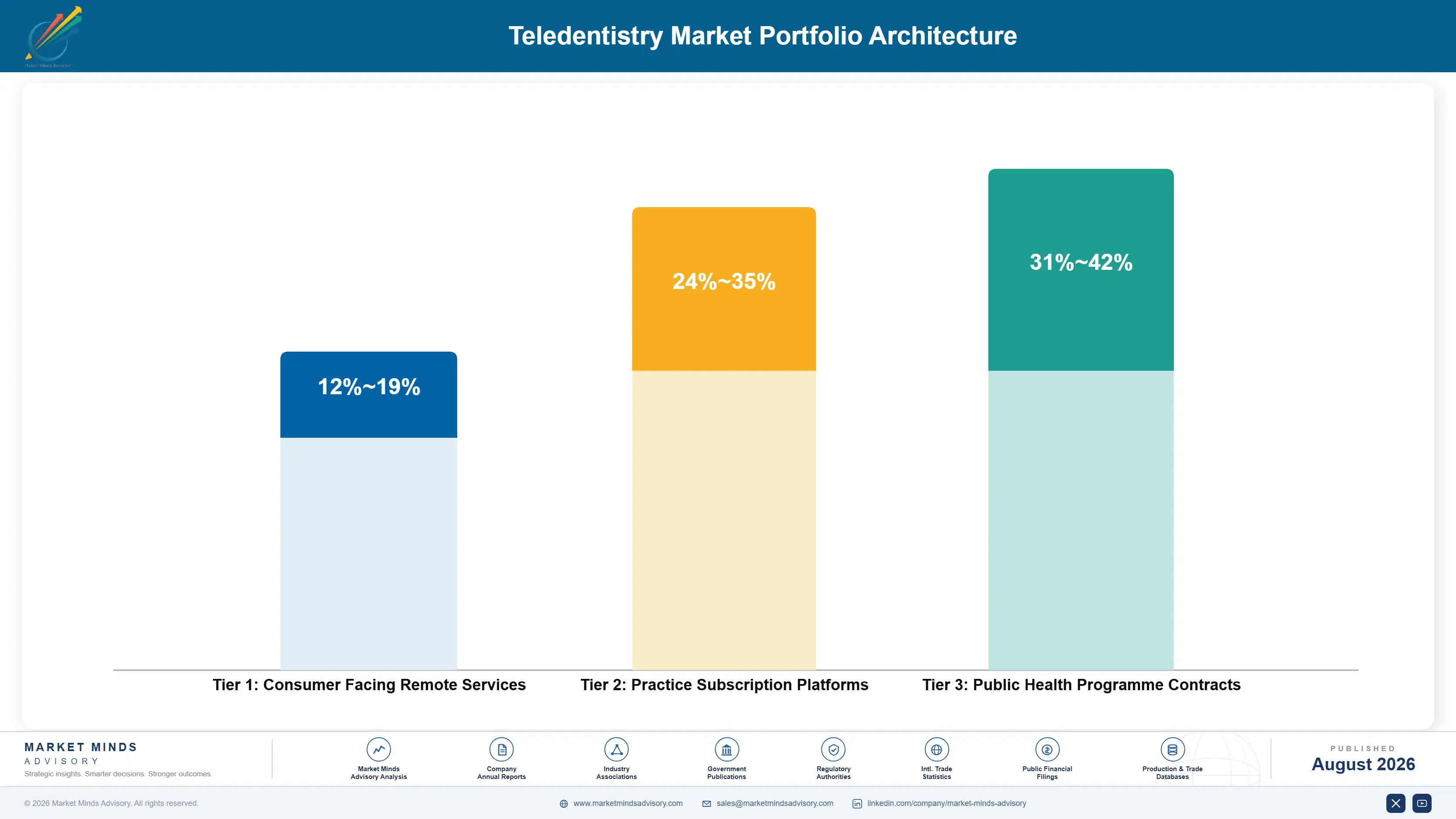
Margin here follows who is paying rather than what the technology does, because a public health contract, a practice subscription and a consumer service produce entirely different economics from broadly similar capability. Consumer facing services earn margins in the low to high teens, where acquisition cost is high, retention is poor and the category's reputation works actively against the offer. Acquisition economics rarely work at that scale.
Practice subscription platforms do better in the mid twenties to mid thirties, because software economics apply once integration is complete and a practice that has built remote monitoring into its scheduling does not readily remove it, which produces genuinely recurring revenue at low incremental cost. A tool sitting beside the practice system rather than inside it gets abandoned within months regardless of merit.

Public health programme contracts hold the strongest position, reaching into the high thirties, where multi-year commissioning, population coverage targets and reporting requirements produce durable revenue that no competitor can approach without winning a tender. Those margins reflect contracting capability rather than any advantage in platform technology or clinical algorithm quality. Winning a tender is the only route in, which makes incumbency unusually valuable.

Consumer Facing Remote Services

Direct patient services carrying high acquisition cost and poor retention against a category reputation the consumer channel damaged. The seven point range reflects marketing efficiency rather than any difference in clinical capability offered.
Gross Margin: 12-19%

Practice Subscription Platforms

Software sold to practices on productivity grounds and embedded into scheduling workflow. The eleven point range reflects integration depth with practice management systems and how firmly the tool has entered daily routine.
Gross Margin: 24-35%

Public Health Programme Contracts

Multi-year commissioned programmes serving population coverage targets with reporting obligations attached. The eleven point range reflects contracting capability and whether the provider holds the clinical network to deliver at scale.
Gross Margin: 31-42%
teledentistry-market-portfolio-architecture-1787639760803

High-value Sub-segments and Strategic Watch-out

Public Programme Asynchronous Delivery

High value and the fastest growth at 18.9%, funded by population health budgets rather than by dental benefits, which sidesteps the annual maximum constraining every privately funded remote encounter entirely. Commissioners measure coverage rather than chair time. Contracts run multi-year and reopen through tender rather than gradually.
Gross Margin: 33-42%

Supervised Orthodontic Monitoring

High value and growing at 14.6% inside dentist supervised treatment, where chair time recovery rather than patient convenience is the argument that actually closes with practice owners. Clinical responsibility stays with the practitioner throughout. Regulators have begun clarifying supervision requirements for exactly this arrangement. Chair time decides it.
Gross Margin: 26-35%

Consumer Direct Services

The reputationally damaged segment, carrying high acquisition cost and the association with a business model that drew regulatory action and left practitioners deeply sceptical of everything. Churn has always been continuous in this channel. Regulatory action against several operators damaged the whole category. Scepticism persists widely.
Gross Margin: 12-19%

Diagnostic Ceiling Exposure

The strategic watch-out. Around 74% of conditions need instrumentation and 23% of patient images are unusable, and the range reflects whether a vendor has built trained capture into the service model. Trained capture raises the ceiling more than software. Overclaiming keeps a vendor inside the reputation problem.
Gross Margin: 10-40%

Three Payers, Three Arguments

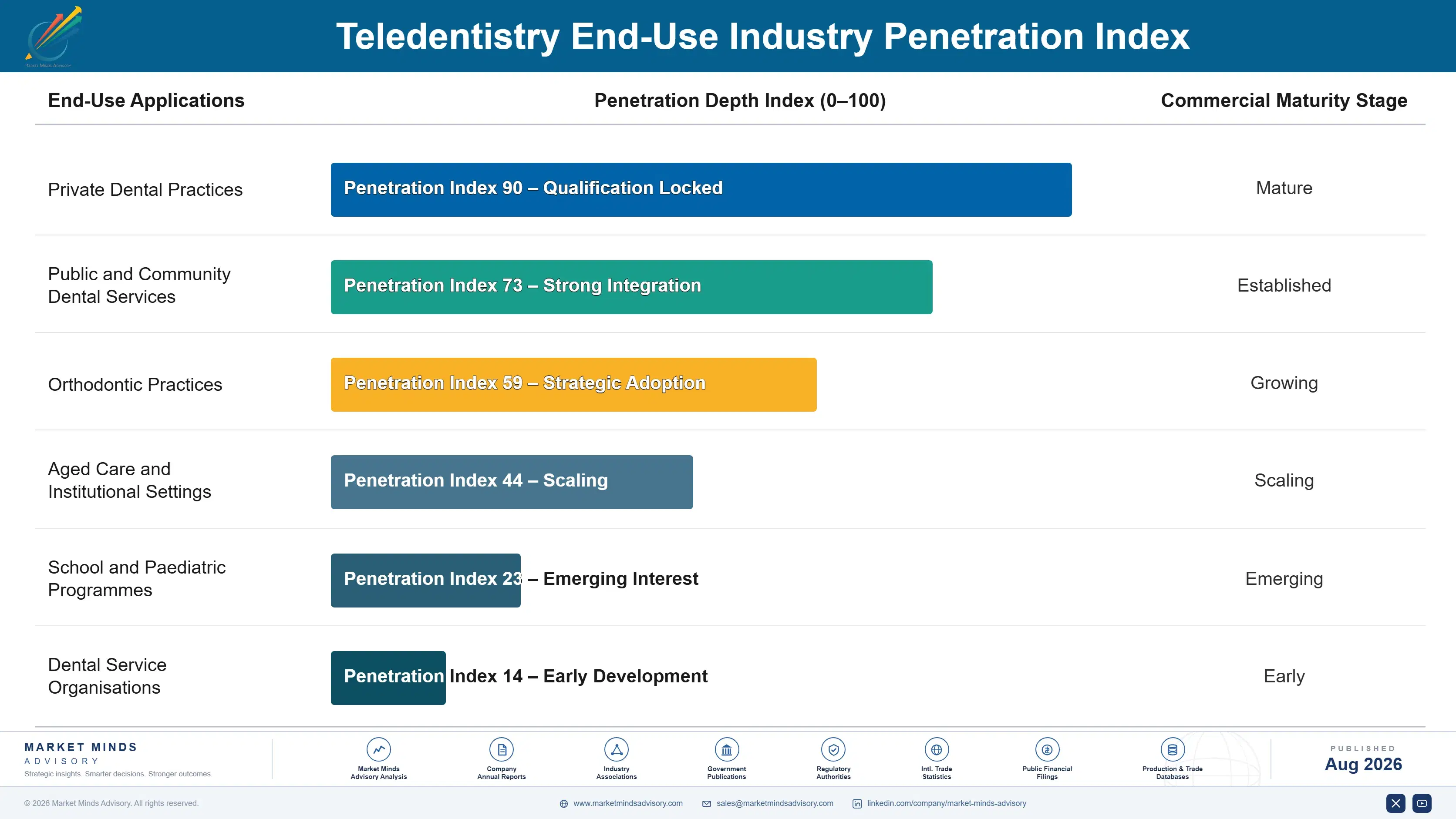
Demand comes from three payers who want quite different things. A public health commissioner buys population coverage and reports on it. A practice owner buys chair time recovery and measures it against procedure revenue. A patient paying directly buys convenience, and is the payer whose annual benefit maximum near 1,500 dollars makes remote encounters compete against the treatment they actually need. The three want almost nothing in common.
Stickiness follows contract structure and workflow embedding. Public programmes run multi-year and reopen through tender rather than gradually, which makes them durable and decisively lost. Practice subscriptions hold as long as the tool sits inside daily scheduling and disappear within months if it sits beside it. Consumer services churn continuously and always have. Workflow embedding decides which of them lasts.

The deciding voices differ accordingly. Commissioners evaluate coverage, cost per patient reached and reporting capability. Practice owners evaluate chair time against subscription cost, usually alone and quickly. Patients evaluate convenience against benefit consumption. A vendor presenting one argument across all three is persuading only whichever payer that argument happened to fit. Most vendors present a single argument to all three.
teledentistry-market-end-use-penetration-index-1787639761290

Where We Would Put Effort

These are among the four positions where our research anticipates prominent divergence between winners and laggards over the coming forecast period. Each is grounded in the demand model, the regulatory perimeter, and the announced capacity pipeline.
01 / PUBLIC COMMISSIONING FOCUS

Somebody other than the patient should pay

Asynchronous review grows at 18.9% against a market rate of 12.6% because public health budgets fund workforce extension into schools, care homes, prisons and rural populations without touching any part of a patient's own dental benefit at all. That funding route entirely sidesteps the annual benefit maximum near 1,500 dollars that makes private remote consultation compete against restorative treatment. Commissioners are also far less influenced by the consumer aligner history than the practising dentists who watched the litigation remain today.
02 / PRODUCTIVITY ARGUMENT DISCIPLINE

Chair time, never patient convenience

Remote orthodontic monitoring grows at 14.6% against a market rate of 12.6% inside dentist supervised practice, and the argument that actually closes with a practice owner is simply recovered chair time for revenue generating procedures rather than anything about patient experience. Presenting patient convenience instead invites immediate comparison with the direct to consumer model that damaged this whole category, and it will lose the meeting outright. Clinical responsibility staying exactly with the practitioner is the necessary second half of that same argument.
03 / TRAINED CAPTURE DESIGN

Put a hygienist between phone and patient

Around 23% of patient captured intraoral images turn out to be unusable because lighting, focus and retraction all defeat an untrained person holding a phone at arm's length. Guided capture prompts help only marginally while a trained intermediary helps enormously, which is why hygienist led programmes produce assessable images reliably while consumer capture frequently does not. Building that trained intermediary into the service model itself raises the diagnostic ceiling considerably further than any software feature currently on offer from anybody anywhere.
04 / DIAGNOSTIC LIMITATION TRANSPARENCY

Say what it cannot do first

Around 74% of dental conditions require a probe, a radiograph or percussion to assess properly, and a vendor that states this plainly separates itself immediately from the overclaiming that made practitioners suspicious of this whole category in the first place. Continuing to overclaim keeps a vendor firmly inside the reputation problem rather than outside it. Dentists respond unusually well to any supplier prepared to define that boundary clearly, because doing so makes every remaining claim considerably more credible to them.

Engagement Snapshot From the Field

A live engagement with an industry participant carrying material or product regulatory and market exposure ahead of a defining policy shift, showing how our research translates into a defensible multi-year portfolio strategy.
MARKET MINDS ADVISORY · CLIENT ENGAGEMENT SUMMARY
Teledentistry Producer Strategic Portfolio Review and Transition Roadmap 2026·Investment Scenario on Teledentistry Exposure Evaluation 2025-26
CLIENT PROFILE
A digital health vendor selling a teledentistry platform to private dental practices across North American and European markets, at annual revenue near 18 million dollars (client-reported, unverified by MMA). Positioning emphasised patient convenience and access, and public health commissioning had never been pursued as a channel. Public tendering capability did not exist. Positioning had never been tested.
STRATEGIC CHALLENGE
Practice sales cycles were unusually long and conversion poor despite favourable product feedback, with practitioners repeatedly raising the direct to consumer aligner failures unprompted during demonstrations. Management could not tell whether the product, the pricing or the positioning was the actual problem. A funding round was approaching. A decision was needed.
MMA APPROACH
MMA interviewed practices that had evaluated and declined the platform, tested alternative positioning against practice owner priorities, sized public health commissioning opportunities independently, and assessed image quality outcomes across the client's existing deployments by capture method. Interviews with 47 experts covered dental practice management, public dental commissioning and digital health regulation.
KEY FINDINGS
  1. Practitioners raised the consumer aligner failures unprompted in most evaluations examined, treating the category rather than the product as the thing requiring justification before anything else.
  2. Practice owners responded considerably better to chair time recovery framing than to patient access framing, and the client had led with access in every sales conversation reviewed.
  3. Public health commissioning in the client's own markets was expanding and funded outside dental benefits, and the business had no contracting capability or tender experience whatsoever.
  4. Deployments using hygienist captured images produced assessable results far more consistently than patient captured ones, which the client had not measured or used commercially.
CLIENT PROFILE
A digital health vendor selling a teledentistry platform to private dental practices across North American and European markets, at annual revenue near 18 million dollars (client-reported, unverified by MMA). Positioning emphasised patient convenience and access, and public health commissioning had never been pursued as a channel. Public tendering capability did not exist. Positioning had never been tested.
STRATEGIC CHALLENGE
Practice sales cycles were unusually long and conversion poor despite favourable product feedback, with practitioners repeatedly raising the direct to consumer aligner failures unprompted during demonstrations. Management could not tell whether the product, the pricing or the positioning was the actual problem. A funding round was approaching. A decision was needed.
MMA APPROACH
MMA interviewed practices that had evaluated and declined the platform, tested alternative positioning against practice owner priorities, sized public health commissioning opportunities independently, and assessed image quality outcomes across the client's existing deployments by capture method. Interviews with 47 experts covered dental practice management, public dental commissioning and digital health regulation.
KEY FINDINGS
  1. Practitioners raised the consumer aligner failures unprompted in most evaluations examined, treating the category rather than the product as the thing requiring justification before anything else.
  2. Practice owners responded considerably better to chair time recovery framing than to patient access framing, and the client had led with access in every sales conversation reviewed.
  3. Public health commissioning in the client's own markets was expanding and funded outside dental benefits, and the business had no contracting capability or tender experience whatsoever.
  4. Deployments using hygienist captured images produced assessable results far more consistently than patient captured ones, which the client had not measured or used commercially.
RECOMMENDED STRATEGY
Phase 1: Phase one: reposition practice selling entirely around chair time recovery, and state the diagnostic limits explicitly at the start of every evaluation. Phase 2: Phase two: build public health commissioning capability, since that funding avoids benefit maximums and reaches a buyer unaffected by the consumer history. Phase 3: Phase three: design trained capture into the service model rather than relying on patients holding phones. Hygienists produce assessable images consistently.
OUTCOME
The vendor repositioned around chair time recovery during 2026 and reported practice conversion improving materially, while a first public commissioning contract was secured in one market (client-reported, unverified by MMA). Consumer facing positioning was discontinued entirely. Trained capture was designed into the service model. Sales cycles shortened noticeably.

Frequently Asked Questions

Foundational context covering the market sizes, CAGR, scope, country, region and competition that inform every finding below. This section is provided to cover basics and most often pre-purchase conversations, answered from the MMA Primary Research Dataset.

What is the current size of the Teledentistry Market?

MMA sizes it at USD 0.86 billion in 2025, rising to USD 0.97 billion in 2026. The figure covers platforms, services and connected devices for remote dental care at provider selling value.

How large will the Teledentistry Market be by 2036?

USD 3.18 billion by 2036, an incremental USD 2.21 billion over the 2026 base and an expansion multiple of 3.28 times. Asynchronous review accounts for a disproportionate share.

What is the CAGR for the Teledentistry Market 2026 to 2036?

12.6% in the base case, with a bull case at 14.0% and a bear case at 11.2%. The spread turns on public commissioning expanding against persistently weak private reimbursement.

Which segment is growing fastest?

Asynchronous store-and-forward review at 18.9%, half again the market rate of 12.6%. Trained capture and later dentist review extends a scarce clinician across underserved populations.

Who are the major companies in the Teledentistry Market?

Align Technology, Dental Monitoring, MouthWatch, Denteractive and Teledentix lead on platform and service revenue. Fifteen further participants are profiled in the full report on that basis.

Which country is growing fastest?

India at 20.4%, where dentists concentrate in cities at roughly six times rural density while most of the population lives outside them, producing genuine unmet need.

Report Segmentation Architecture

The full report scope spans multiple orthogonal segmentation dimensions, with cross-tabulated demand data provided for each dimension pair. Coverage extends further to regional breakdowns, trend trajectories, and the competitive detail needed to support segment-level decision-making.

By Service Model

  • Synchronous Video Consultation
  • Asynchronous Store-and-Forward Review
  • Remote Orthodontic Monitoring
  • Triage and Emergency Assessment
  • Specialist Referral and Second Opinion
  • Remote Patient Education and Compliance

By End-Use Industry

  • Private Dental Practices
  • Public and Community Dental Services
  • Orthodontic Practices
  • Aged Care and Institutional Settings
  • School and Paediatric Programmes
  • Dental Service Organisations

By Commercial Dimension

  • Practice Subscription Licensing
  • Public Health Programme Contracts
  • Enterprise Dental Group Agreements
  • Consumer Direct Services
  • Practice Software Integration Partnerships
  • Insurer and Payer Arrangements

By Region

  • North America
  • Western Europe
  • East Asia
  • South Asia and Pacific
  • Latin America
  • Middle East and Africa
  • Eastern Europe

Scope, Methodology, and Coverage

Every figure in this report is reproducible from documented input assumptions. The scope below maps the historical period, the forecast horizon, the segmentation dimensions, and the countries covered, alongside the underlying primary and qualitative methodology.
Historical Period
2020 to 2025
Forecast Period
2026 to 2036
Base Year
2025 (USD billions; MMA Primary Research Dataset, August 2026)
Market Definition
Software platforms, services and connected devices enabling remote dental assessment and care coordination, covering synchronous video consultation, asynchronous store-and-forward review, remote orthodontic monitoring, triage and emergency assessment, specialist referral and second opinion services, and remote patient education and compliance. Measured at vendor and service provider selling value. Clear aligners and orthodontic appliances, intraoral scanners and imaging hardware sold for in-practice use, dental practice management software without remote care function, and in-person clinical services are excluded from scope.
Quantitative Units
USD billions (current prices); remote encounters completed; USD per encounter or practice subscription
Segmentation Dimensions
Service model; care setting; commercial dimension; region
Regions Covered
North America, Western Europe, East Asia, South Asia and Pacific, Latin America, Middle East and Africa, Eastern Europe
Countries Covered
United States, Canada, Mexico, United Kingdom, Germany, France, Netherlands, Sweden, China, Japan, South Korea, India, Indonesia, Philippines, Australia, Brazil, Chile, United Arab Emirates, South Africa, Poland
Key Companies Profiled
Align Technology, Dental Monitoring, MouthWatch, Denteractive, Teledentix, Overjet, Pearl, VideaHealth, Toothpic, SmileSnap, The TeleDentists, Virtudent, DentalXChange, Adit, Weave, Simplifeye, Dentsply Sirona, Planmeca, Carestream Dental, Henry Schein One
Quantitative Methodology
Primary survey, n=3,800 respondents, Q4 2025, six countries; demand-side model with trade association cross-validation
Qualitative Methodology
47 expert interviews, Q4 2025; applied to validate demand model assumptions, identify emerging dynamics, and assess competitive positioning
Report Format
PDF and XLSX data workbook (Word format preview document)
Publisher
Market Minds Advisory
Report Code
MMA-2026-HLT-129
Published
August 2026
Contact
sales@marketmindsadvisory.com | www.marketmindsadvisory.com

Purchase the full Teledentistry Market Report (2026 to 2036).

The full report begins from what remote dentistry cannot do, because around three quarters of conditions require instrumentation and every commercial failure in this category came from ignoring that. It sizes all six service models independently through 2036, separates public commissioned from privately funded demand, and quantifies image quality outcomes by capture method. Regional chapters cover all seven regions with funding mechanism assessed alongside adoption. Competitive profiling covers 20 participants on one consistent revenue basis throughout the report. Practitioner attitude is tracked by market throughout.
Six service models sized independently through 2036
Public commissioned demand separated from privately funded encounters
Image quality outcomes quantified by capture method and setting
Reimbursement and benefit design assessed across major markets
Practitioner attitudes measured against the consumer channel history
Twenty participants profiled on one consistent revenue basis

Built For The People Who Decide

From boardroom strategy to bench-side execution, this report is read cover-to-cover by leaders shaping the next decade of their industry, turning demand scenarios, market dynamics and valuation benchmarks into decisions.
CXOs/ Presidents/ VPs/ Managers
M&A and Corporate Development
Strategy Teams and R&D Heads
Procurement and Product Directors
Regulatory and Compliance Leaders
Investor Relations and Equity Analysts