Market Minds Advisory
Telecom Site Management Software Market

Telecom Site Management Software Market: Telecom Site Management Software Market. 5G Small Cell Densification Reshapes Tower Portfolio Economics.

Explosive small cell site count growth from 5G densification is pushing tower operators toward integrated site management platforms, replacing spreadsheet-based lease and inventory tracking that no longer scales across portfolios.

Lead Analyst

Published

September 2026

Make Smarter Decisions with Customized Research Insights

Request a free sample report and evaluate market opportunities, growth trends, and competitive dynamics relevant to your business needs.

2025 MARKET VALUE$2.6BMarket Size 2025
2036 FORECAST VALUE$7.6BBase Case , 2026 to 2036
CAGR 2026 TO 203610.0 %Bull 11.2% / Bear 8.8%
INCREMENTAL OPPORTUNITY$4.7BNet 10- year value creation
EXPANSION MULTIPLE2.59x2036 value over 2026 base
Strategic Levers
M&A Pipeline
Regional Outlook
Country Rankings
Competitive Intelligence
Segmental Deep-dive
Call-Us : 91 93563 13602

Executive Snapshot and Market Trajectory.

Tower operators managing tens of thousands of new small cell sites are abandoning spreadsheet-based lease and inventory tracking for integrated site management platforms faster than most enterprise software vendors anticipated, as manual processes buckle under 5G densification volume, a shift few predicted quite this soon.
Explosive small cell site count growth and rising energy cost pressure are the dominant commercial forces, with small cell and DAS site management software growing fastest as operators struggle to track site inventory at densities conventional macro tower software was never designed for. North America leads platform revenue through major publicly traded tower REIT concentration, even as India's tower expansion program drives the fastest regional growth rate tracked across all seven regions closely.
Competitive intensity remains fragmented across generalist enterprise asset management vendors and specialized telecom site software providers, none commanding dominant overall share, since platform capability varies considerably by portfolio scale and site type mix. GIS and asset management incumbents continue adding telecom-specific modules, forcing standalone site management vendors to specialize narrowly around lease negotiation and permitting workflow depth. Rankings shift slowly given how long procurement cycles lock in vendor relationships.
Market Definition
The telecom site management software market covers software for lease and contract management, tower inventory and asset tracking, site audits, energy monitoring, small cell and DAS management, and site acquisition workflows used by tower operators and telecom carriers. It excludes network management software, radio access network optimization tools, and the physical tower and site infrastructure itself.
Base Year Value
$2.6B in 2025 (MMA Primary Research Dataset, September 2026)
Forecast Period
2026 to 2036, eleven discrete annual values
CAGR
10.0% base case. Bull 11.2%. Bear 8.8%.
Fastest Growth Segment
Small Cell and DAS Site Management Software: 16.5% CAGR
Fastest Growth Country
India: 14.0% CAGR
Fastest Growth Region
South Asia and Pacific: 12.0% CAGR
Largest Region
North America: 29% of 2025 global value
Market Leaders
IBM Corporation, Accruent, Comarch, Amdocs, ServiceNow lead the field. Source: MMA Primary Research Dataset, July 2026.
Primary Survey
n=3,800 procurement and R&D decision-makers, Q4 2025, six countries
Methodology
Demand-side build-up, cross-validated against public data, 47 expert interviews

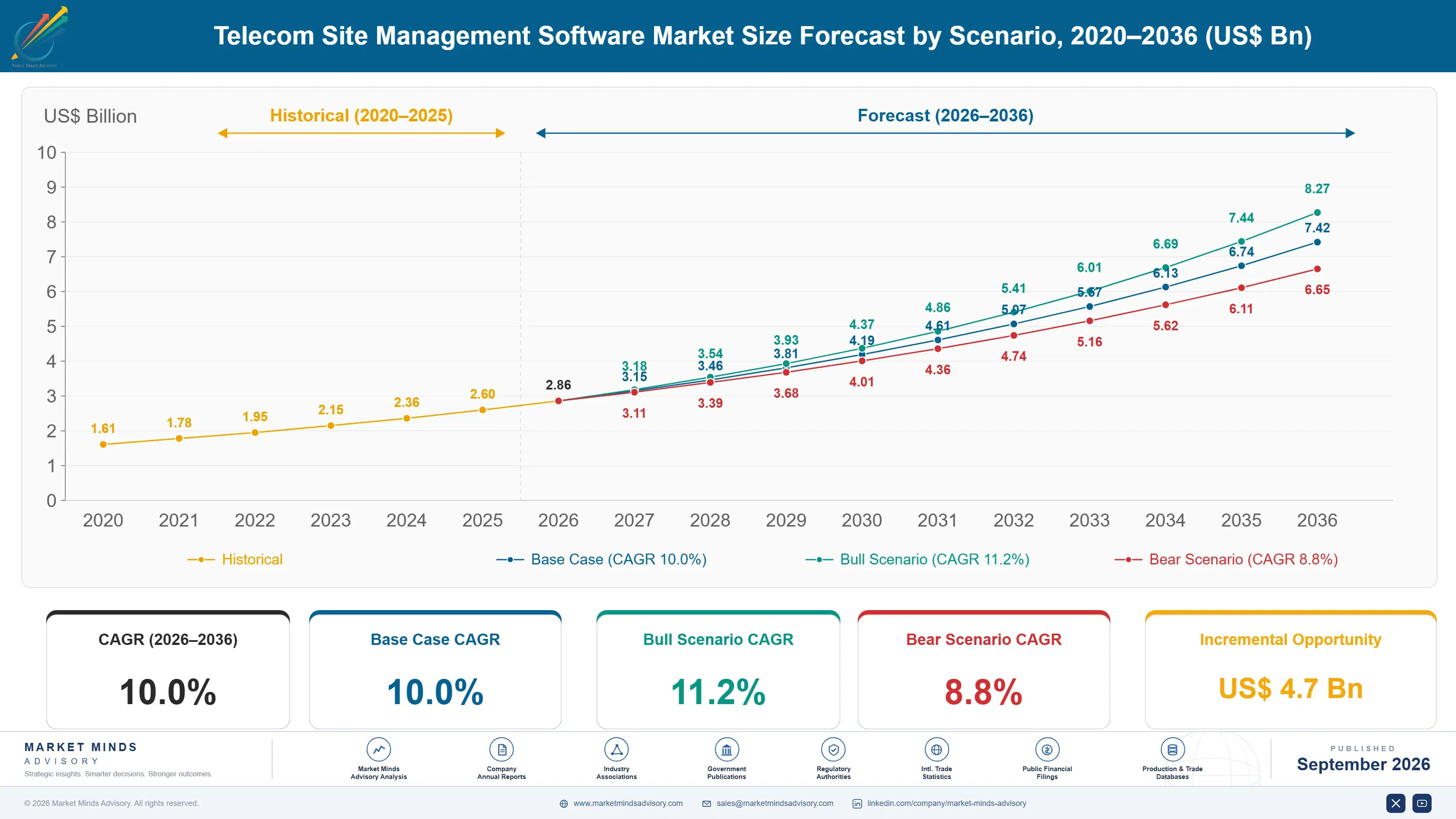
Telecom Site Management Software Market Forecast Scenarios

telecom-site-management-software-market-size-forecast-scenario-1788421147443
Between 2020 and 2025 the telecom site management software market grew steadily as 5G rollout accelerated tower portfolio growth and energy cost volatility pushed operators toward more disciplined site-level cost tracking across their networks. Pandemic-era supply disruptions briefly slowed deployment schedules in 2021. The historical annual growth rate held near 8.7 percent across the period.
The base case assumes small cell and DAS site counts keep expanding faster than macro tower counts as 5G densification continues, energy cost pressure keeps pushing operators toward automated monitoring across remote sites, and tower REIT consolidation keeps driving demand for unified portfolio management across acquired site inventories. These three mechanisms together sustain a forecast compound annual growth rate near 10.0 percent through 2036, with small cell management software capturing an outsized share of incremental revenue.
The bull case assumes 5G densification accelerates faster than current forecasts anticipate, pushing growth toward 11.2 percent as small cell site counts expand rapidly across major metropolitan markets nationwide. The bear case assumes tower portfolio consolidation slows new site management software adoption, capping growth near 8.8 percent as operators delay platform upgrades pending clearer capital spending signals.

Telecom-Specific Workflow Depth Commands Premium Pricing

Platform economics hinge on the trade-off between generalist enterprise asset management flexibility and telecom-specific workflow depth, since tower operators increasingly want purpose-built lease negotiation and permitting workflows rather than adapting general-purpose asset tracking software. Vendors that deliver deep telecom-specific functionality capture premium pricing over generalist platforms, even when raw underlying database and reporting capability is otherwise comparable between competing products.
MARKET CONCENTRATION32% CR5Top five vendors hold well under half revenue overall
AVERAGE CONTRACT VALUE$450,000 annuallyTypical annual platform contract cost per tower operator
TOP DEPLOYING COUNTRY SHARE28%United States accounts for largest single-country revenue share
DEPLOYMENT CYCLE LENGTH9 monthsAverage months from contract signing to full portfolio migration
SOFTWARE ATTACH RATE46%Share of tower sites managed through dedicated platform software
CONTRACT RENEWAL RATE87%Share of operators renewing platform contracts every year
Market concentration remains low, with the top five vendors controlling roughly 32 percent of revenue, reflecting a fragmented landscape spanning generalist enterprise asset management vendors, telecom-specific software specialists, and large IT services firms bundling implementation services. Deployment cycles run considerably longer than typical enterprise software because operators migrate decades of accumulated lease and inventory data before committing to full portfolio-wide rollout across thousands of sites.
Average contract values vary enormously by portfolio scale and site type mix, from single-market regional operator licenses to enterprise-wide multi-national tower REIT platforms commanding contract values many times higher per account. Vendors increasingly bundle energy monitoring and predictive maintenance modules into core lease and inventory platforms, since operators value proactive site health monitoring as much as pure lease administration functionality when evaluating platform selection.
"Every tower company thinks its portfolio is unique until it tries to run the whole thing off a spreadsheet during a hundred-site acquisition and watches the deal timeline slip by months. The operators who digitized early are closing acquisitions faster than everyone else."
Lead Analyst, Telecom Infrastructure Technology Practice · MMA Technology Practice · September 2026

Market Trends

Small Cell Site Counts Overwhelm Legacy Tracking Tools

5G densification is pushing small cell and distributed antenna system site counts far beyond what conventional macro tower inventory software was ever designed to track efficiently, since a single macro tower footprint might now correspond to dozens of small cell locations across a metropolitan area. Vendors report small cell management module revenue growing over 50 percent faster than conventional macro tower software revenue during 2025, confirming the category's outsized momentum among operators expanding urban density. This shift is reshaping vendor product roadmaps industry-wide, pulling engineering investment away from macro-tower-centric interfaces that once represented the bulk of new feature development spending.
Market Impact: Consolidation drives 30 percent of contracts
Energy Cost Volatility Drives Monitoring Software Demand

Rising and volatile electricity costs at remote tower sites, many of which rely on grid power supplemented by diesel or battery backup, are pushing operators to adopt energy monitoring software that identifies cost anomalies and optimizes power consumption patterns across their portfolios. Energy monitoring module attach rates grew roughly 40 percent in 2025 as more operators sought visibility into site-level power costs previously tracked only through aggregated utility billing statements. This shift is expanding the addressable software market beyond pure lease and inventory tracking into ongoing operational cost optimization that persists throughout a site's operating lifetime.
Market Impact: Permitting software cuts approval time 25%

Market Opportunities and Growth Drivers

Tower Portfolio Consolidation Drives Platform Standardization

Ongoing tower REIT mergers and acquisitions continue combining previously separate site portfolios that historically ran on completely different software systems, creating fresh demand for unified platform migration and portfolio standardization projects. Each acquisition typically requires migrating tens of thousands of individual site records onto the acquiring operator's chosen platform, generating substantial one-time implementation revenue alongside ongoing subscription fees. Portfolio consolidation activity has driven roughly 30 percent of new platform contract signings in 2025, as acquiring operators standardize newly combined portfolios onto a single management system rather than maintaining separate legacy systems indefinitely.
Market Impact: Adds 3 months to migration

Permitting Complexity Expands Site Acquisition Software Demand

Small cell deployment increasingly requires navigating complex municipal permitting processes that vary considerably by jurisdiction, creating demand for specialized site acquisition and permitting workflow software that tracks application status across hundreds of simultaneous municipal filings nationwide each quarter. Operators using dedicated permitting software report meaningfully faster average approval timelines than operators still tracking applications through spreadsheets and email, according to primary industry interviews conducted this year. This shift is pushing vendors to invest in municipality-specific permitting requirement databases that update automatically as local regulations change across thousands of jurisdictions nationwide.
Market Impact: Adds 4 weeks per jurisdiction

Market Restraints and Challenges

Historical Data Migration Complicates Platform Transitions

Migrating decades of accumulated lease, inventory, and maintenance history from legacy systems onto a new platform requires extensive data cleansing and validation work, since historical records often contain inconsistent formatting and incomplete information accumulated across multiple prior system transitions. The root cause is that tower portfolios frequently change ownership through mergers and acquisitions, with each transaction historically preserving whatever data quality the acquired operator happened to maintain. Vendors are mitigating this through automated data validation tools and dedicated migration services teams, a mitigation path that reduces but does not eliminate manual data cleanup work required.
Market Impact: Small cell revenue grew 50 percent

Fragmented Municipal Regulations Slow Software Standardization

Permitting and zoning regulations governing telecom site placement vary enormously across thousands of individual municipal jurisdictions, making it difficult for vendors to build a single standardized permitting workflow that works reliably everywhere without extensive local customization. The root cause is that telecom infrastructure siting authority remains fragmented across local government levels in most countries, unlike more centralized regulatory frameworks governing other infrastructure categories. Vendors are mitigating this by building crowdsourced regulatory databases that pool customer knowledge of specific municipal requirements, gradually improving coverage as more operators contribute jurisdiction-specific data over time.
Market Impact: Energy monitoring attach grew 40 percent
4 additional market trends, 3 additional growth drivers, and 2 additional restraints and challenges are covered in the full report. Contact sales@marketmindsadvisory.com to access the complete intelligence.

Segment CAGR and Growth Architecture

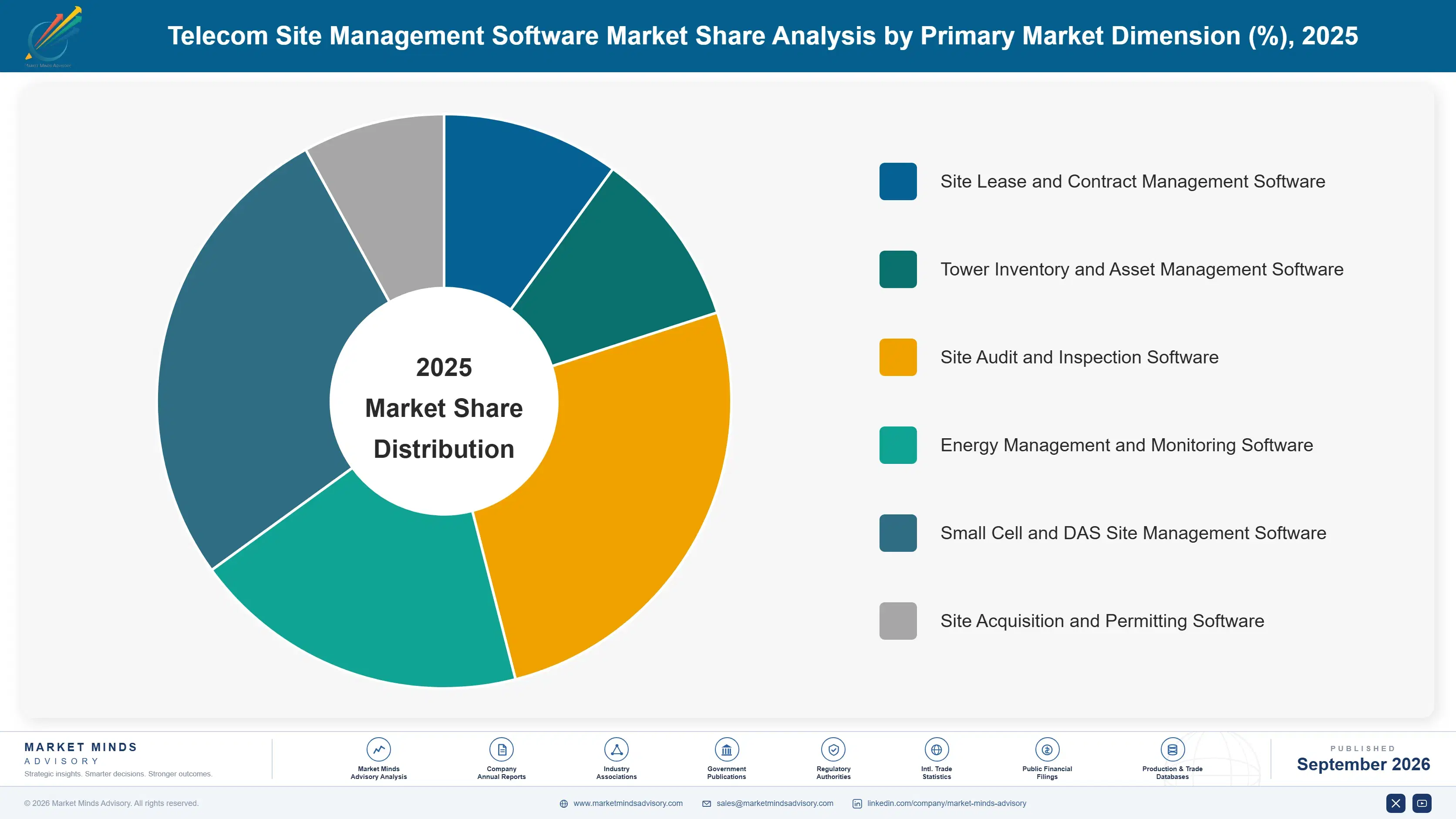
The telecom site management software market segments by primary software function, spanning site lease and contract management, tower inventory and asset management, site audit and inspection, energy management and monitoring, small cell and DAS site management, and site acquisition and permitting software. Pricing models and adoption timelines vary considerably across these six categories tracked here.
telecom-site-management-software-market-market-share-analysis-1788421148003

Small Cell and DAS Site Management Software

Small cell and DAS site management software tracks the rapidly multiplying inventory of small cell and distributed antenna system installations that 5G densification requires, handling site-level details that macro tower software was never designed to manage at this density or scale. This segment is growing fastest because small cell site counts are expanding far faster than macro tower counts in most metropolitan markets, creating a genuinely new management challenge rather than an incremental extension of existing macro tower workflows. Vendors have invested heavily in mobile-first field data collection tools that let technicians update site records directly from the field, since small cell sites are visited far more frequently than macro towers for maintenance and inspection work.
CAGR 16.5%

Energy Management and Monitoring Software

Energy management and monitoring software tracks power consumption, backup battery health, and grid versus generator usage patterns across a portfolio of remote tower and small cell sites, identifying cost anomalies and optimization opportunities that manual utility bill review historically missed. Growth is strong as electricity costs rise and volatility increases, pushing operators to treat energy management as a genuine cost optimization opportunity rather than a routine operational expense to simply pay without scrutiny. Operators increasingly demand platforms that integrate directly with smart meter data feeds, letting energy anomalies trigger automated maintenance alerts before minor issues become costly site outages. Several major tower operators have already standardized on specific energy monitoring platforms across their portfolios.
CAGR 13.5%
Full segment breakdown across 7 segments available in the complete report.

Regional Architecture and Country Demand Map

North America leads platform revenue through major publicly traded tower REIT concentration nationwide, while East Asia follows closely behind through rapid 5G small cell deployment scale across the region, and South Asia and Pacific posts the fastest regional growth off a comparatively smaller current base.

North America

Major publicly traded tower REITs headquartered in the United States, including American Tower, Crown Castle, and SBA Communications, drive this region's leading platform revenue share, managing tens of thousands of macro and small cell sites across their portfolios. Persistent 5G densification investment gives American operators the strongest commercial incentive to modernize site management quickly, and several mid-size regional carriers have followed the largest tower companies into procurement decisions this year. Canada contributes a smaller but growing deployment base tied to shared North American telecom infrastructure standards. Vendor headquarters concentration in this region also shortens integration timelines for domestic operator customers. Financing structures common in this market let mid-size regional operators join without heavy budget strain.
Share: 29% | CAGR: 11.0% (2026 to 2036)

Western Europe

Germany's and the United Kingdom's telecom infrastructure sharing arrangements anchor this region's platform demand, particularly for lease management software tied to complex multi-operator site sharing agreements common across the continent. France contributes meaningful demand tied to its own domestic tower company consolidation activity and 5G rollout timeline commitments. The region hosts a more fragmented tower ownership structure than North America, with independent tower companies, mobile network operators, and infrastructure funds all requiring coordination software. The region's growth trails North America and East Asia as infrastructure sharing complexity slows platform standardization relative to more unified American tower ownership structures. Nordic countries add modest additional demand tied to their own infrastructure sharing ambitions.
Share: 20% | CAGR: 8.5% (2026 to 2036)
Regional intelligence for 5 additional markets available in the complete report: East Asia, South Asia and Pacific, Latin America, Middle East and Africa, Eastern Europe. Contact sales@marketmindsadvisory.com.
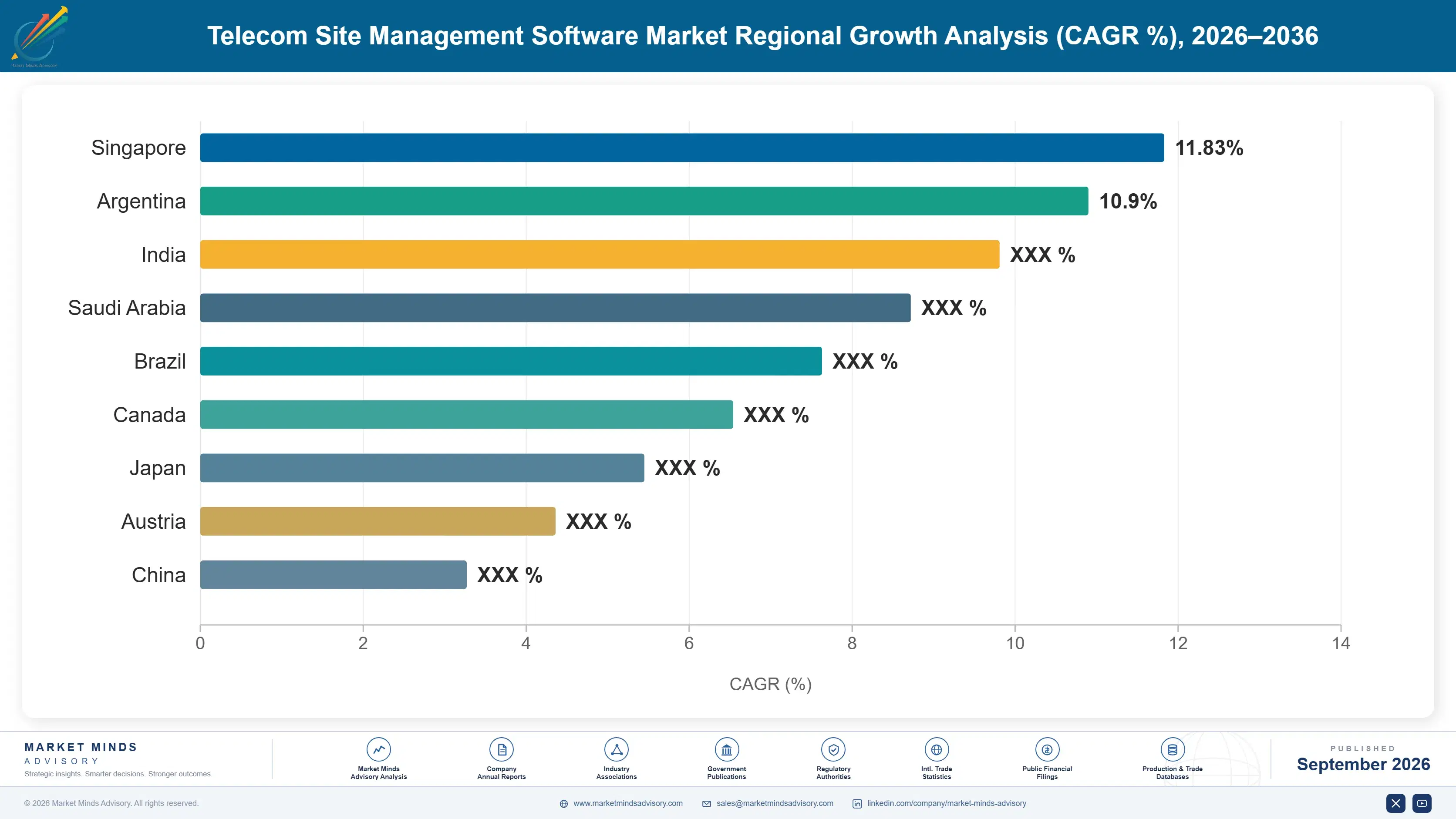
telecom-site-management-software-market-country-cagr-analysis-1788421148533

Where Site Software Margins Concentrate

Vendor profitability increasingly concentrates in energy monitoring subscriptions and small cell specialization rather than one-time lease management licenses, as leading players bundle predictive maintenance and portfolio analytics into multi-year operator contracts that reduce reliance on implementation fees. This shift rewards the deepest telecom-specific workflow depth. Fewer vendors compete effectively across every one of these dimensions simultaneously today.

Bundling Energy Monitoring Into Core Platforms

Vendors that bundle energy monitoring capability directly into core lease and inventory platforms capture recurring subscription revenue that persists across a tower operator's entire portfolio ownership lifecycle rather than selling a standalone monitoring module separately. This shifts vendor economics toward a unified platform model with considerably higher overall retention than point solutions competing purely on feature depth alone. Vendors offering this bundle report attach rates averaging 40 percent among existing lease management customers, a figure growing steadily as operators consolidate vendor relationships to simplify their technology stack. Vendors extend this bundling model to smaller operators each year as pricing standardizes.
Market Impact: Bundle attach rate now reaches roughly 40 percent

Charging Portfolio Consolidation Migration Service Fees

Vendors offering dedicated portfolio migration services during tower company mergers and acquisitions capture premium one-time project fees independent of the ongoing subscription pricing, protecting against the risk that standard subscription pricing undervalues the specialized data cleansing expertise required. This migration service layer requires specialized experience navigating inconsistent legacy data formats that only vendors with established acquisition integration track records can credibly deliver to skeptical operator customers. Migration service fees on major portfolio consolidation projects now average 18 percent of total first-year contract value, rewarding vendors willing to invest in this specialized capability.
Market Impact: Migration fees now reach roughly 18 percent overall

Expanding Distribution Through Tower Equipment Partnerships

Vendors partnering directly with tower construction and equipment manufacturers to bundle software with new site deployment projects are capturing distribution reach that pure direct-to-operator marketing simply cannot match at comparable customer acquisition cost. This channel commands premium customer lifetime value since manufacturer-referred operators show meaningfully higher retention than operators acquired through generic direct sales campaigns competing on price alone. Manufacturer-channel customer acquisition costs run roughly 22 percent lower than direct sales acquisition, rewarding vendors that invest early in building these strategic distribution partnerships across the industry. Vendors without manufacturer relationships face a persistent, hard-to-close cost disadvantage.
Market Impact: Manufacturer channel now cuts costs by 22 percent

Offering Financing For Smaller Operator Platform Rollouts

Vendors offering flexible financing structures that spread enterprise platform costs across monthly operating budgets rather than large annual licensing commitments are capturing smaller regional operators previously priced out of full portfolio digitization. This financing approach lowers the barrier to entry meaningfully for regional operators competing against larger tower REITs on operational sophistication and lease revenue optimization. Roughly 26 percent of new enterprise contracts signed in 2025 used this subscription financing structure, expanding the addressable customer base considerably beyond the largest publicly traded tower companies alone. Adoption keeps accelerating among smaller regional operators each quarter.
Market Impact: Roughly 26 percent of new enterprise deals financed

Who Controls the Margin Pool

Competitive concentration sits at a low 32 percent CR5, reflecting a fragmented landscape spanning generalist enterprise asset management vendors, telecom-specific specialists, and large IT services firms bundling implementation. Participants are evaluated here on revenue, the most commercially consistent basis across vendors with very different business models. The gap between IBM, the clear leader through its broad enterprise asset management portfolio, and the fifth-ranked competitor remains moderate.
Current activity centers on small cell management module development, as vendors race to add capability fast enough to track site inventory at densities conventional macro tower software was never designed for. Several vendors have also expanded energy monitoring offerings, bundling smart meter data integration into core lease and inventory platforms. Portfolio migration service capacity has intensified as vendors seek differentiation during tower consolidation waves.

Emerging pressure is coming from GIS and enterprise asset management incumbents adding telecom-specific modules, threatening standalone site management specialists that built their entire business on independent lease and inventory tracking software. This threatens established specialists' pricing power in general asset tracking functionality specifically. Rankings are most likely to shift as small cell management depth, not macro tower feature breadth, increasingly determines which vendors win the largest tower operator accounts.
telecom-site-management-software-market-company-positioning-matrix-1788421149066

Competitive Moat and Risk Dimensions

IBM CORPORATION

Moat: Broadest Enterprise Asset Management Reach

IBM's Maximo platform maintains the broadest enterprise asset management deployment base across industries, letting it serve tower operators seeking a single vendor relationship spanning telecom-specific and general facility asset management needs simultaneously. This breadth reduces switching costs for existing IBM customers considering competing point solutions, since replacing Maximo means replacing multiple integrated asset workflows rather than one standalone telecom module.
IBM CORPORATION

Risk: Generalist Platform Lags Telecom Specialists

IBM's generalist enterprise asset management heritage sometimes leaves it slower to develop deeply specialized telecom site workflows compared to smaller competitors focused narrowly on tower and small cell management from the outset, creating an opening for specialist vendors to win early relationships with growing operators.
AMDOCS LIMITED

Moat: Deep Telecom Billing Integration

Amdocs has built extensive integration capability connecting site management data directly with telecom operator billing and network operations systems, giving it credibility with carriers that pure-play site management vendors struggle to establish quickly. This integration depth continues expanding as the company accumulates more carrier-specific operational data connections each year across product generations.
AMDOCS LIMITED

Risk: Carrier Focus Limits Broader Reach

Amdocs's telecom carrier heritage sometimes limits its appeal to independent tower companies and infrastructure funds that prioritize pure real estate and lease management functionality over deep carrier billing system integration capability, creating an opening for real estate-focused competitors to win these accounts instead over time.

Players Tracked

Prominent Players

IBM Corporation
Accruent LLC
Comarch SA
Amdocs Limited
ServiceNow Inc

Other Key Players

Nokia Corporation
Ericsson AB
Cellwize Wireless Technologies
iBwave Solutions Inc
Trimble Inc
Bentley Systems Inc
SAP SE
Oracle Corporation
Hexagon AB
Esri Inc
Cyient Limited
Wipro Limited
Tata Consultancy Services
Capgemini SE
Atos SE

Recent Developments

FEBRUARY 2026

IBM Launches Enhanced Small Cell Management Module

IBM launched a new small cell and DAS site management module for its Maximo platform, adding density-appropriate tracking capability for the rapidly multiplying small cell inventory 5G densification requires. The launch responds directly to operator demand for tools built specifically for small cell scale rather than adapted macro tower software.
Signal: Signals that leading vendors are now quite actively racing to add small cell density capability meaningfully.
SEPTEMBER 2025

Accruent Wins Major Tower Portfolio Migration Contract

Accruent secured a multi-year contract with a major tower operator to migrate several hundred thousand site records following a large acquisition, consolidating multiple legacy systems onto a single unified platform. The contract covers portfolio-wide data cleansing and validation work across the newly combined tower inventory.
Signal: Signals that tower portfolio consolidation is now quite actively driving demand for unified platform migration services.
DECEMBER 2025

Comarch Acquires Energy Monitoring Analytics Startup

Comarch acquired a smaller energy monitoring analytics startup specializing in smart meter data integration for remote infrastructure sites, adding new capability to its existing telecom site management software portfolio. The acquisition strengthens Comarch's ability to compete against vendors expanding into recurring energy analytics subscription revenue.
Signal: Signals that established vendors are now quite actively building energy analytics capability through targeted acquisition strategically.

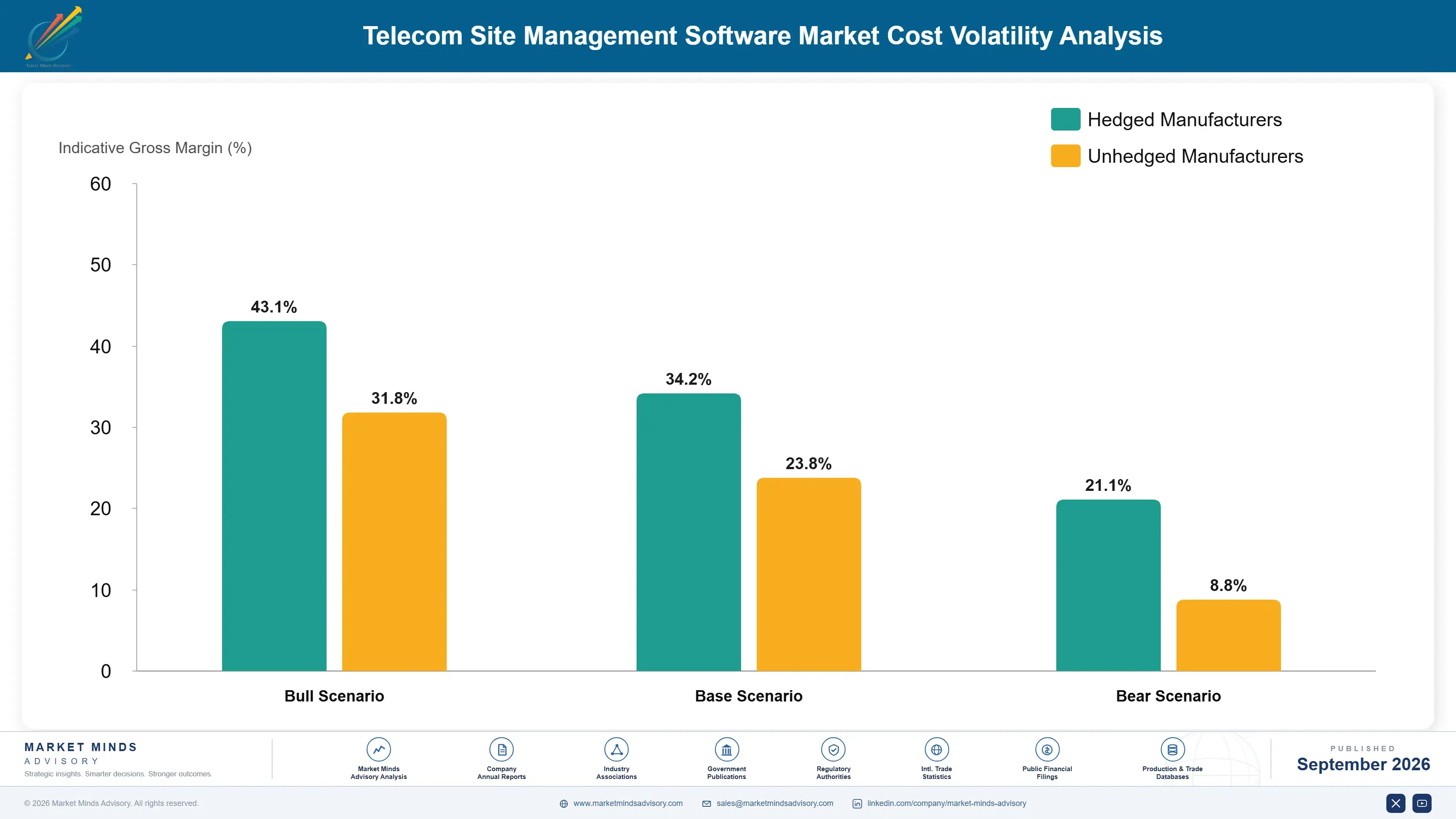
Cloud Infrastructure And Migration Talent Cost

Cloud compute infrastructure and specialized data migration engineering staff together account for roughly 50 percent of total operating cost for telecom site management vendors, reflecting the intensive data cleansing work required during large portfolio migration and acquisition integration projects. Sales and customer success staff make up most of the remainder, concentrated primarily in regions with established tower operator relationships.
Cloud compute pricing rose meaningfully during 2024 and into 2025 as major providers passed through higher data center construction and power costs tied to broader AI infrastructure demand documented in provider annual reports and IEA energy market analyses. This compressed gross margins for vendors running compute-intensive portfolio migration projects for tower operators completing major acquisitions, particularly those without long-term cloud provider pricing commitments already in place.

Vendors without efficient automated data migration tooling face a meaningful competitive disadvantage as talent costs keep rising, since manual data cleansing requires considerably more staff time than automated validation workflows built for large-scale portfolio consolidation projects. This exposure varies by vendor scale: larger vendors like IBM can invest in proprietary migration automation that smaller specialists simply cannot afford to build at comparable depth and reliability.
telecom-site-management-software-market-cost-volatility-analysis-1788421149262

Building Automated Data Migration Tooling

Leading vendors now invest heavily in automated data validation and cleansing tools that reduce dependence on expensive additional migration engineer headcount for routine portfolio consolidation projects across most operator segments served nationwide. This tooling requires meaningful upfront engineering investment before reducing ongoing project cost, a trade-off only well-capitalized vendors can consistently afford to make.

Negotiating Long-Term Cloud Compute Pricing Agreements

Vendors are negotiating multi-year cloud compute pricing agreements with major providers, locking in predictable unit economics before customer portfolio migration volume grows further across their entire installed base of operators. This requires committing to minimum spend commitments well ahead of confirmed project revenue, a trade-off only well-capitalized vendors can consistently afford to make comfortably.

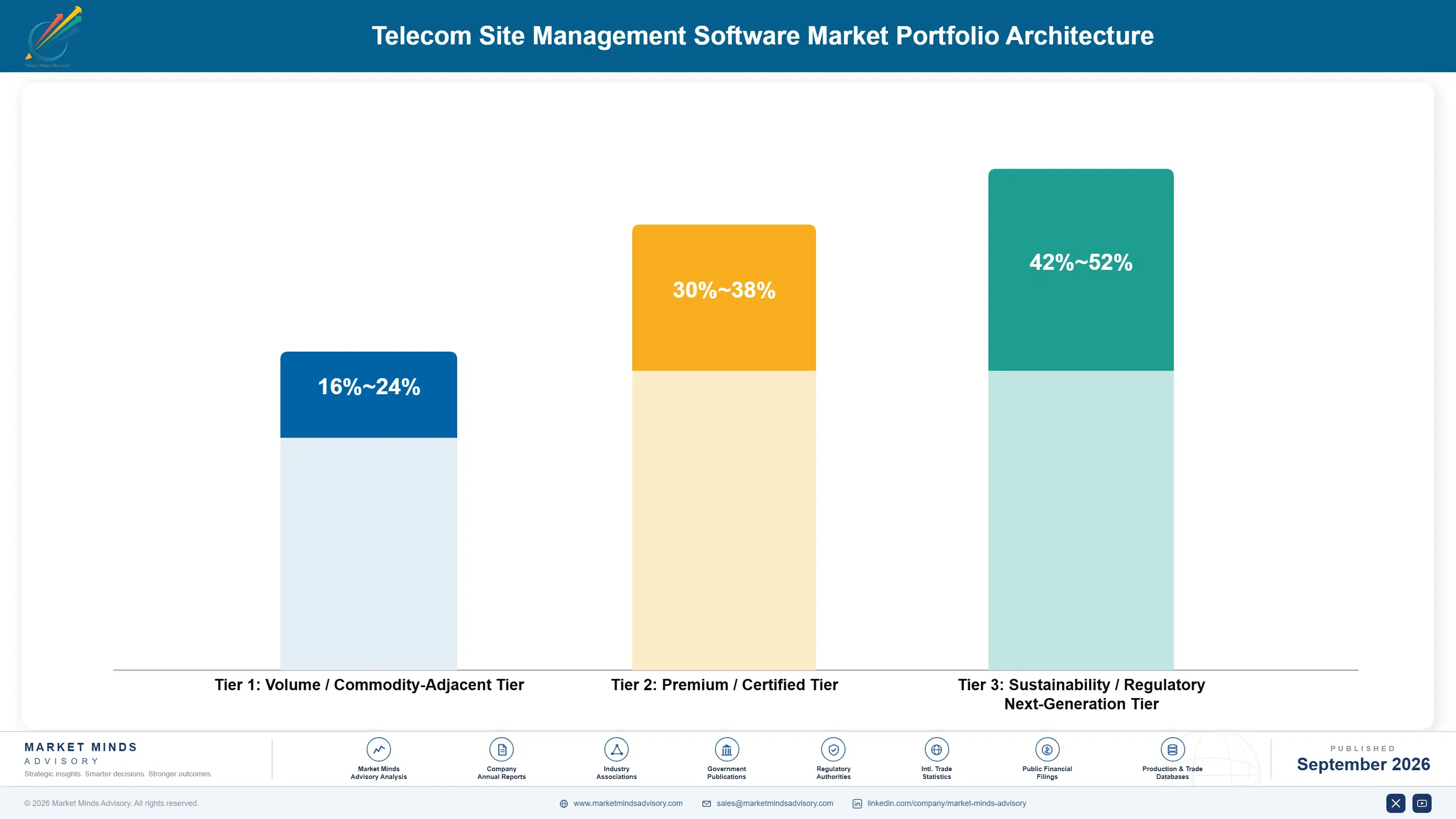
Portfolio Architecture for Margin Defence

Portfolio economics split across three tiers running from basic lease and inventory software sold near commodity pricing up through certified enterprise integration platforms and next-generation small cell and energy analytics bundled together. Gross margin widens considerably moving up this ladder, since telecom-specific workflow depth and analytics sophistication create defensibility that pure record-keeping functionality alone cannot provide. Investors increasingly value vendors by their revenue mix across these three tiers.
Volume tier software competes almost entirely on subscription price and basic record-keeping feature parity, leaving vendors with thin margins that depend on scale to remain profitable across smaller regional operator accounts. Premium tier platforms instead compete on telecom-specific workflow depth and carrier billing integration, letting vendors charge meaningfully more per contract while facing far less price pressure during renewal negotiations. This tension shapes capital allocation across every vendor's roadmap.

High-value margin pools concentrate almost entirely in the next-generation tier, where small cell management bundled with energy analytics generates premium recurring revenue unavailable to vendors still selling standalone lease tracking software. Vendors positioned only in the volume tier face real profitability ceilings that next-generation-tier competitors do not share, regardless of contract volume signed across any given fiscal year of operation.

Volume / Commodity-Adjacent Tier

Basic lease and inventory tracking software sold mainly to small independent operators prioritizing cost over feature depth, competing largely on subscription price against several established suppliers operating broadly across the market.
Gross Margin: 16-24%

Premium / Certified Tier

Certified enterprise integration platforms supporting multiple carrier billing and network operations system connections simultaneously, commanding premium pricing from customers requiring deep multi-system data integration and quite detailed usage reporting capability.
Gross Margin: 30-38%

Sustainability / Regulatory / Next-Generation Tier

Next-generation small cell management platforms bundled with energy analytics services, positioned for large tower operators prioritizing portfolio-wide visibility well above pure record-keeping cost considerations entirely each full contract cycle today.
Gross Margin: 42-52%
telecom-site-management-software-market-portfolio-architecture-1788421149755

High-value Sub-segments and Strategic Watch-out

Small Cell and DAS Site Management Software

Small cell and DAS site management software sits in the high-value high-growth quadrant, combining the fastest revenue growth rate tracked with the widest gross margin band once field data collection premiums layer on top of subscription pricing, making it the clearest priority for vendor capital allocation this decade.
Gross Margin: 42-52%

Energy Management and Monitoring Software

Energy management and monitoring software occupies the high-value moderate-growth quadrant, generating strong recurring margin from cost optimization adoption even though growth trails small cell management, because energy monitoring still depends heavily on smart meter integration availability that varies quite considerably by utility jurisdiction and region.
Gross Margin: 30-38%

Tower Inventory and Asset Management Software

Tower inventory and asset management software remains the volume core segment, generating the bulk of current license shipments at thinner margins, still essential for vendor scale economics even as growth slows relative to small cell and energy alternatives entering the category more aggressively with each successive generation.
Gross Margin: 16-24%

Site Audit and Inspection Software

Site audit and inspection software forms the strategic watch-out segment, facing real commoditization risk as broader asset management platforms increasingly absorb basic inspection scheduling functionality natively at no added cost today, threatening standalone vendors that never expanded beyond simple inspection checklists into much richer categories.
Gross Margin: 18-24%

Bundled Subscriptions Extend Tower Operator Relationships

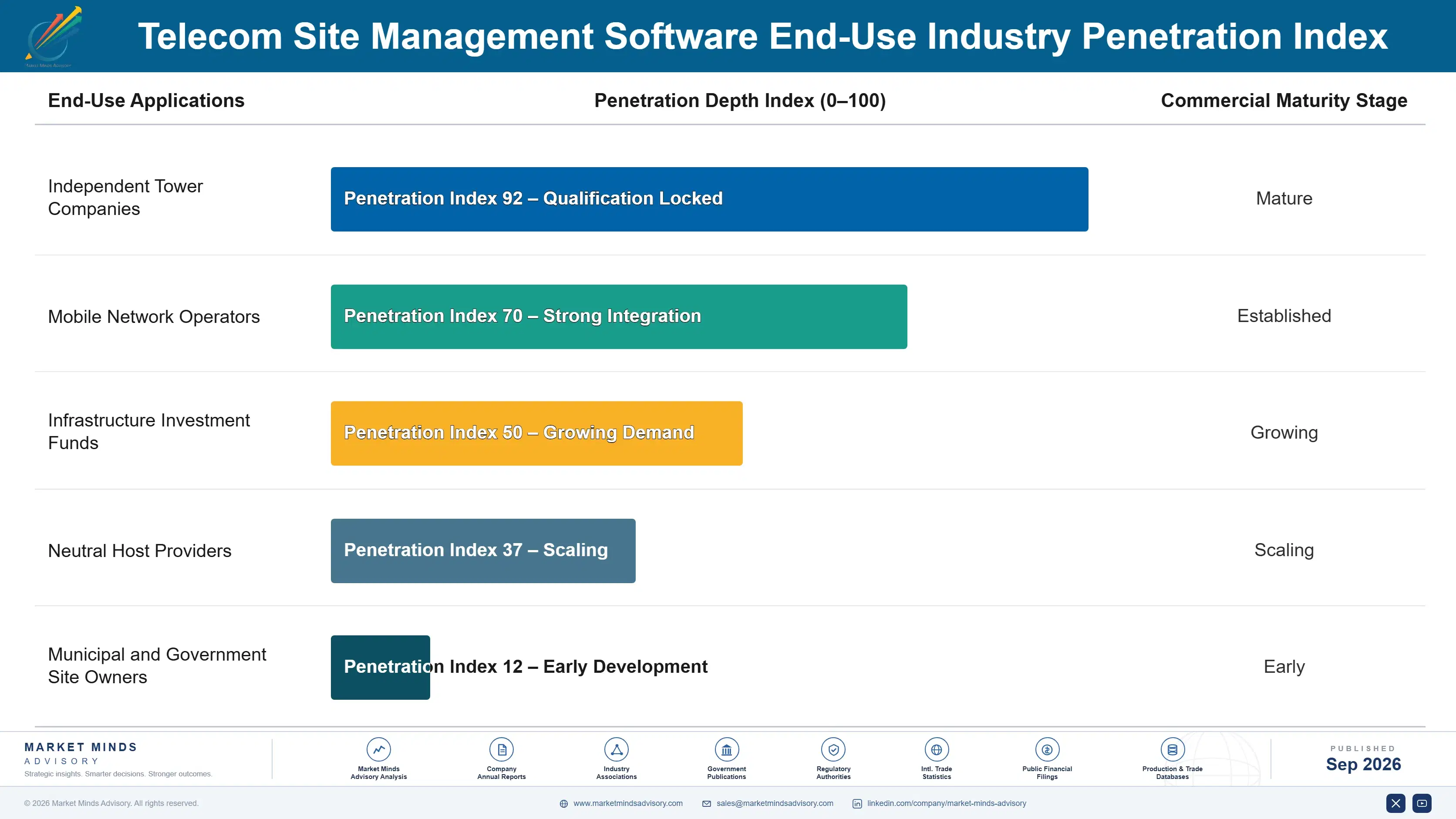
Vendors increasingly bundle lease management, energy monitoring, and predictive maintenance into a single recurring subscription fee, converting what was once a one-time software license purchase into a longer-tail relationship spanning a tower operator's entire portfolio ownership lifecycle. This bundled model gives vendors recurring revenue visibility through portfolio growth rather than relying entirely on one-time initial migration project fees. Investors increasingly value vendors on this recurring subscription revenue mix rather than one-time license count alone.
Adoption depth varies sharply by operator size: major publicly traded tower REITs commit to enterprise-wide multi-country platforms and rarely switch vendors once historical lease data migration is complete, while smaller regional operators remain more price-sensitive at each renewal decision. Telecom carriers operating owned sites sit between these extremes, valuing integration with existing network operations systems. This tension shapes vendor product roadmap priorities across every major operator segment.

Buyer profiles are shifting generationally as portfolio analytics-trained real estate managers, rather than traditional field technicians, increasingly drive platform vendor selection given growing emphasis on lease revenue optimization alongside pure site inventory tracking. This generational shift is reshaping which platform features vendors prioritize, favoring predictive lease renewal analytics over the reactive maintenance ticketing that historically dominated early platform generations.
telecom-site-management-software-market-end-use-penetration-index-1788421150245

Where Site Software Vendors Should Focus

These are among the four positions where our research anticipates prominent divergence between winners and laggards over the coming forecast period. Each is grounded in the demand model, the regulatory perimeter, and the announced capacity pipeline.
01 / SMALL CELL CAPABILITY INVESTMENT

Build Small Cell Density Capability Before Demand Consolidates

Vendors still built primarily around macro tower workflows are missing the fastest-growing opportunity in the industry, since small cell management module revenue is growing over 50 percent faster than conventional macro tower software revenue this year and every quarter since. Vendors with early small cell capability investment are capturing operator relationships that competitors focused on macro-tower-centric interfaces cannot match today. Vendors slow to redirect engineering resources risk ceding the highest-growth customer segment entirely to faster-moving competitors within the next two product cycles.
02 / ENERGY ANALYTICS BUNDLING

Bundle Energy Monitoring Into Every Core Platform Contract

Vendors without energy monitoring bundling are missing attach rates growing roughly 40 percent as operators seek visibility into site-level power costs previously tracked only through aggregated monthly utility billing statements across their entire global portfolios nationwide and abroad. Vendors offering this capability are capturing recurring subscription revenue that persists across an operator's entire portfolio ownership lifecycle rather than ending at initial implementation. Vendors should prioritize this bundling now, since energy cost pressure shows no signs of easing across most markets.
03 / PORTFOLIO MIGRATION SPECIALIZATION

Build Migration Expertise Before Consolidation Wave Peaks

Vendors without dedicated portfolio migration service capability are missing project fees averaging 18 percent of total first-year contract value on major tower consolidation projects happening across the industry this year and every year ahead of it. Vendors with established migration track records are capturing acquiring operators who need proven data cleansing expertise that generalist competitors simply cannot deliver reliably at comparable speed. Vendors should invest in this specialization now, since consolidation activity shows no signs of slowing across most regional markets.
04 / MANUFACTURER CHANNEL PARTNERSHIPS

Pursue Equipment Distribution Before Rivals Lock In Deals

Vendors relying entirely on direct-to-operator marketing are missing a distribution channel that cuts customer acquisition costs by roughly 22 percent compared to generic sales campaigns competing purely on price across most operator segments served nationwide today. Vendors with established manufacturer partnerships are capturing dealer network reach that standalone marketing simply cannot replicate at comparable cost or speed today or tomorrow. Vendors should pursue these partnerships now, before the largest equipment manufacturers consolidate exclusive software relationships with fewer preferred vendors going forward.

Engagement Snapshot From the Field

A live engagement with an industry participant carrying material or product regulatory and market exposure ahead of a defining policy shift, showing how our research translates into a defensible multi-year portfolio strategy.
MARKET MINDS ADVISORY · CLIENT ENGAGEMENT SUMMARY
Telecom Site Management Software Producer Strategic Portfolio Review and Transition Roadmap 2026·Investment Scenario on Telecom Site Management Software Exposure Evaluation 2025-26
CLIENT PROFILE
The client operates a regional tower portfolio across the southwestern United States, having recently acquired a smaller competitor's site inventory that roughly doubled its total managed sites. Facing the challenge of consolidating two legacy site management systems with inconsistent data quality onto a single platform, leadership needed a vendor selection framework. Annual revenue was reported at approximately 340 million dollars (client-reported, unverified by MMA).
STRATEGIC CHALLENGE
Leadership faced a choice between an established enterprise asset management vendor with broad functionality but limited telecom-specific workflows and a specialized telecom site vendor with deep domain expertise but a smaller implementation team available for the migration. Operations teams worried about data quality issues surfacing mid-migration given the acquired portfolio's inconsistent records.
MMA APPROACH
MMA conducted a comparative data migration risk and total cost of ownership assessment across both vendors, incorporating primary interview data on each vendor's prior acquisition integration track record from comparable tower operator consolidations. The analysis modeled data cleansing effort required under each vendor's proposed migration methodology. Findings were presented to the client's executive team alongside a recommended vendor and phased migration plan.
KEY FINDINGS
  1. The specialized telecom vendor's deeper domain expertise meaningfully reduced data cleansing effort compared to the generalist vendor's more generic migration methodology and tooling.
  2. The generalist vendor's broader functionality offered meaningfully less value than expected given the client's narrow focus on tower-specific lease and inventory workflows.
  3. Phasing migration by acquired site cluster rather than attempting a single company-wide cutover reduced measured data quality risk considerably during the transition.
  4. Data quality issues surfaced primarily in older sites from the acquired portfolio, confirming the value of targeted cleansing effort concentrated there first.
CLIENT PROFILE
The client operates a regional tower portfolio across the southwestern United States, having recently acquired a smaller competitor's site inventory that roughly doubled its total managed sites. Facing the challenge of consolidating two legacy site management systems with inconsistent data quality onto a single platform, leadership needed a vendor selection framework. Annual revenue was reported at approximately 340 million dollars (client-reported, unverified by MMA).
STRATEGIC CHALLENGE
Leadership faced a choice between an established enterprise asset management vendor with broad functionality but limited telecom-specific workflows and a specialized telecom site vendor with deep domain expertise but a smaller implementation team available for the migration. Operations teams worried about data quality issues surfacing mid-migration given the acquired portfolio's inconsistent records.
MMA APPROACH
MMA conducted a comparative data migration risk and total cost of ownership assessment across both vendors, incorporating primary interview data on each vendor's prior acquisition integration track record from comparable tower operator consolidations. The analysis modeled data cleansing effort required under each vendor's proposed migration methodology. Findings were presented to the client's executive team alongside a recommended vendor and phased migration plan.
KEY FINDINGS
  1. The specialized telecom vendor's deeper domain expertise meaningfully reduced data cleansing effort compared to the generalist vendor's more generic migration methodology and tooling.
  2. The generalist vendor's broader functionality offered meaningfully less value than expected given the client's narrow focus on tower-specific lease and inventory workflows.
  3. Phasing migration by acquired site cluster rather than attempting a single company-wide cutover reduced measured data quality risk considerably during the transition.
  4. Data quality issues surfaced primarily in older sites from the acquired portfolio, confirming the value of targeted cleansing effort concentrated there first.
RECOMMENDED STRATEGY
Phase 1: Phase 1 (Months 1 to 2): Migrate the client's original, higher-quality site portfolio first to establish a solid data baseline. Phase 2: Phase 2 (Months 3 to 6): Migrate the acquired portfolio in clusters, applying targeted data cleansing to identified problem sites. Phase 3: Phase 3 (Months 7 to 8): Validate combined portfolio data accuracy and complete final platform standardization across the entire company.
OUTCOME
The client completed migration across its combined portfolio within the recommended eight-month timeline, avoiding an estimated 1.1 million dollars (client-reported, unverified by MMA) in projected data quality remediation costs compared to the generalist vendor's approach. Lease revenue optimization improved measurably following the consolidated migration effort.

Frequently Asked Questions

Foundational context covering the market sizes, CAGR, scope, country, region and competition that inform every finding below. This section is provided to cover basics and most often pre-purchase conversations, answered from the MMA Primary Research Dataset.

What is the current size of the Telecom Site Management Software Market?

The telecom site management software market reached approximately 2.92 billion dollars in 2026, according to MMA Primary Research Dataset, July 2026. This figure covers lease management, inventory, energy monitoring, and small cell software revenue combined globally.

How large will the Telecom Site Management Software Market be by 2036?

MMA projects the market will reach approximately 7.57 billion dollars by 2036 under the base case scenario. That represents roughly a 2.59 times expansion over the ten-year forecast period from 2026 through 2036.

What is the CAGR for the Telecom Site Management Software Market 2026 to 2036?

The base case compound annual growth rate is 10.0 percent through 2036. Bull and bear scenarios range from 11.2 percent to 8.8 percent depending on 5G densification pace and adoption conditions.

Which segment is growing fastest?

Small cell and DAS site management software is growing fastest at 16.5 percent CAGR, roughly 1.65 times the overall market rate. 5G densification is driving this segment's outsized expansion versus conventional macro tower software.

Who are the major companies in the Telecom Site Management Software Market?

Leading companies include IBM Corporation, Accruent, Comarch, Amdocs, and ServiceNow, spanning both generalist enterprise asset management platforms and telecom-specific specialists. These five players hold a combined 32 percent share on a revenue basis.

Which country is growing fastest?

India is growing fastest at approximately 14.0 percent CAGR, driven by massive tower expansion tied to Reliance Jio and Bharti Airtel network buildout. This outpaces the United States and other established software markets considerably.

Report Segmentation Architecture

The full report scope spans multiple orthogonal segmentation dimensions, with cross-tabulated demand data provided for each dimension pair. Coverage extends further to regional breakdowns, trend trajectories, and the competitive detail needed to support segment-level decision-making.

By Primary Market Dimension

  • Site Lease and Contract Management Software
  • Tower Inventory and Asset Management Software
  • Site Audit and Inspection Software
  • Energy Management and Monitoring Software
  • Small Cell and DAS Site Management Software
  • Site Acquisition and Permitting Software

By End-Use Industry

  • Independent Tower Companies
  • Mobile Network Operators
  • Infrastructure Investment Funds
  • Neutral Host Providers
  • Municipal and Government Site Owners

By Commercial Dimension

  • Direct Operator Sales
  • Equipment Manufacturer Channel
  • System Integrator Partnership
  • Cloud Subscription

By Region

  • North America
  • Western Europe
  • East Asia
  • South Asia and Pacific
  • Latin America
  • Middle East and Africa
  • Eastern Europe

Scope, Methodology, and Coverage

Every figure in this report is reproducible from documented input assumptions. The scope below maps the historical period, the forecast horizon, the segmentation dimensions, and the countries covered, alongside the underlying primary and qualitative methodology.
Historical Period
2020 to 2025
Forecast Period
2026 to 2036
Base Year
2025 (USD billions; MMA Primary Research Dataset, September 2026)
Market Definition
The telecom site management software market covers software for lease and contract management, tower inventory and asset tracking, site audits, energy monitoring, small cell and DAS management, and site acquisition workflows used by tower operators and telecom carriers. It excludes network management software, radio access network optimization tools, and the physical tower and site infrastructure itself.
Quantitative Units
USD billions (current prices); managed site count where applicable
Segmentation Dimensions
By Software Function Type; By End-Use Industry; By Commercial Dimension; By Region
Regions Covered
North America, Western Europe, East Asia, South Asia and Pacific, Latin America, Middle East and Africa, Eastern Europe
Countries Covered
USA, China, Germany, France, UK, Japan, South Korea, India, Australia, Canada, Brazil, Mexico, Indonesia, Vietnam, Thailand, Malaysia, UAE, Saudi Arabia, South Africa, Nigeria, Turkey, Poland, Netherlands, Italy, Spain, Sweden, Switzerland, Argentina, Colombia, Singapore, and additional markets relevant to this sector
Key Companies Profiled
IBM Corporation, Accruent LLC, Comarch SA, Amdocs Limited, ServiceNow Inc, Nokia Corporation, Ericsson AB, Cellwize Wireless Technologies, iBwave Solutions Inc, Trimble Inc, Bentley Systems Inc, SAP SE, Oracle Corporation, Hexagon AB, Esri Inc, Cyient Limited, Wipro Limited, Tata Consultancy Services, Capgemini SE, Atos SE
Quantitative Methodology
Primary survey, n=3,800 respondents, Q4 2025, six countries; demand-side model with trade association cross-validation
Qualitative Methodology
47 expert interviews, Q4 2025; applied to validate demand model assumptions, identify emerging dynamics, and assess competitive positioning
Report Format
PDF and XLSX data workbook (Word format preview document)
Publisher
Market Minds Advisory
Report Code
MMA-2026-TEC-704
Published
September 2026
Contact
sales@marketmindsadvisory.com | www.marketmindsadvisory.com

Purchase the full Telecom Site Management Software Market Report (2026 to 2036).

This report delivers a comprehensive assessment of the global telecom site management software market, covering historical performance from 2020 through 2025 and forecasts through 2036 across all seven major world regions. It profiles the twenty leading vendors shaping lease management, small cell tracking, and energy monitoring software, including detailed competitive positioning and recent product developments. The analysis quantifies segment-level growth across six software function categories and evaluates revenue diversification opportunities including migration services and manufacturer distribution. Primary research draws on a 3,800-respondent survey and 47 expert interviews conducted in Q4 2025.
Ten-year revenue forecast by segment and region
Competitive benchmarking of twenty profiled vendors
Regional demand driver analysis across seven markets
Cloud infrastructure and migration talent cost assessment
Revenue diversification and migration service lever analysis
Anonymized client case study with strategic recommendations

Built For The People Who Decide

From boardroom strategy to bench-side execution, this report is read cover-to-cover by leaders shaping the next decade of their industry, turning demand scenarios, market dynamics and valuation benchmarks into decisions.
CXOs/ Presidents/ VPs/ Managers
M&A and Corporate Development
Strategy Teams and R&D Heads
Procurement and Product Directors
Regulatory and Compliance Leaders
Investor Relations and Equity Analysts