Market Minds Advisory
Telecom Power Systems Market

Telecom Power Systems Market: Telecom Power Systems Market. Backup Battery, Rectifier, and Hybrid Renewable Power Solutions, 2026 to 2036

Mobile network operators expanding tower coverage into unreliable-grid regions are forcing power system vendors to prove hybrid renewable and lithium-ion reliability rather than diesel generator backup capacity alone at every site.

Lead Analyst

Published

September 2026

Make Smarter Decisions with Customized Research Insights

Request a free sample report and evaluate market opportunities, growth trends, and competitive dynamics relevant to your business needs.

2025 MARKET VALUE$9.2BMarket Size 2025
2036 FORECAST VALUE$20.4BBase Case , 2026 to 2036
CAGR 2026 TO 20367.5 %Bull 8.8% / Bear 6.2%
INCREMENTAL OPPORTUNITY$10.5BNet 10- year value creation
EXPANSION MULTIPLE2.06x2036 value over 2026 base
Strategic Levers
M&A Pipeline
Regional Outlook
Country Rankings
Competitive Intelligence
Segmental Deep-dive
Call-Us : 91 93563 13602

Executive Snapshot and Market Trajectory.

Telecom power systems have shifted decisively from diesel-dependent backup infrastructure toward lithium-ion battery and hybrid renewable systems as operators chase both lower operating cost and sustainability commitments across their expanding network infrastructure footprint worldwide, reshaping decades-old procurement standards entirely across the entire global industry.
Lithium-ion backup battery systems are growing fastest as operators replace aging lead-acid battery banks with lighter, longer-lasting lithium alternatives that reduce site visit frequency and total cost of ownership across thousands of tower locations nationwide and beyond. Sub-Saharan Africa leads regional demand growth given its combination of expanding mobile network coverage and unreliable grid electricity that makes dependable backup power an operational necessity rather than a discretionary investment decision made lightly by operators.
Competitive character increasingly centers on remote monitoring and predictive maintenance software bundled with hardware rather than raw power output specifications alone, since operators managing thousands of remote sites value visibility into battery health and fuel levels without dispatching a technician for routine inspection each time. Vendors offering integrated monitoring platforms win disproportionate share of new network deployment contracts across operators expanding coverage into difficult-to-access regions each fiscal year.
Market Definition
The Telecom Power Systems Market covers backup battery, rectifier, generator, hybrid renewable, and power distribution equipment that supplies and protects electrical power for mobile network towers, central offices, and telecom data centers. It excludes general commercial and industrial uninterruptible power supply systems, consumer battery products, and utility-scale grid power generation equipment.
Base Year Value
$9.2B in 2025 (MMA Primary Research Dataset, September 2026)
Forecast Period
2026 to 2036, eleven discrete annual values
CAGR
7.5% base case. Bull 8.8%. Bear 6.2%.
Fastest Growth Segment
Lithium-Ion Backup Battery Systems: 13.0% CAGR
Fastest Growth Country
Nigeria: 12.0% CAGR
Fastest Growth Region
South Asia and Pacific: 9.5% CAGR
Largest Region
East Asia: 26% of 2025 global value
Market Leaders
Leading vendors: Vertiv, Huawei, ZTE, Delta Electronics, Eaton. Source: MMA Primary Research Dataset, July 2026.
Primary Survey
n=3,800 procurement and R&D decision-makers, Q4 2025, six countries
Methodology
Demand-side build-up, cross-validated against public data, 47 expert interviews

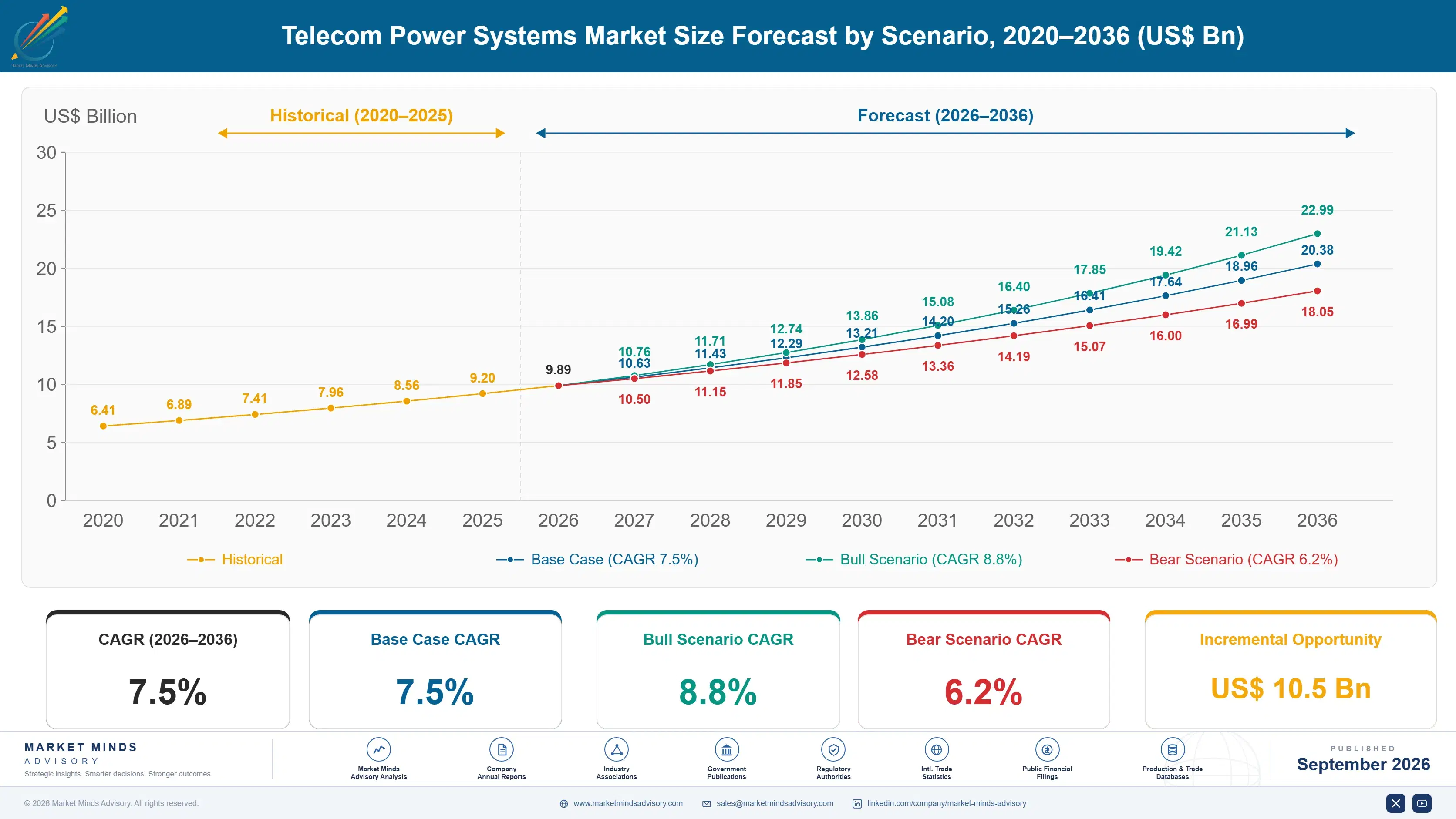
Telecom Power Systems Market Forecast Scenarios

telecom-power-systems-market-size-forecast-scenario-1789998192144
Growth through 2020 to 2025 was steady as 5G network densification required additional power infrastructure at both new and existing tower sites across most major markets, while lithium-ion battery costs declined enough to make replacement of aging lead-acid systems economically attractive across most operator budgets and multi-year network expansion plans already underway across major markets globally.
Base case growth through 2036 rests on three commercial mechanisms: continued 5G and eventual 6G network densification requiring power infrastructure at a growing number of smaller cell sites across dense urban environments and suburban corridors, expanding mobile coverage into unreliable-grid regions of Africa and South Asia requiring hybrid renewable and battery backup systems built for harsh conditions, and growing sustainability commitments pushing operators toward lower-emission power solutions replacing diesel generator backup entirely across most network deployments.
A bull scenario turns on faster lithium-ion battery cost declines that make replacement of remaining lead-acid and diesel backup systems economically compelling across nearly every existing tower site regardless of location. The bear risk is that slower-than-expected network expansion in emerging markets due to spectrum licensing delays or capital constraints compresses near-term power infrastructure investment relative to current growth expectations.

The Uptime Economics Behind Every Tower Site

Vendors no longer compete primarily on raw power output capacity or backup runtime hours alone, since most operators have long settled on standardized specifications adequate for their network requirements across the board and industry, but rather on total cost of ownership across the equipment's full operating lifecycle including maintenance visits and battery replacement cycles.
MARKET CONCENTRATIONCR5: 38%Top five vendors hold well under half the total market
SITE POWER SYSTEM COST$18,500Typical installed cost for a standard tower power system
TOP PRODUCING COUNTRY SHAREChina: 33%Reflects concentration of power equipment manufacturing capacity globally
RATED BACKUP RUNTIME8 hoursTypical rated battery backup duration under normal load conditions
LITHIUM-ION CONVERSION RATE44%Share of new deployments choosing lithium over lead-acid batteries
REMOTE MONITORING ATTACH RATE52%Share of installations bundled with remote monitoring software platforms
Pricing has shifted from simple hardware sales toward bundled hardware-plus-monitoring-plus-maintenance service contracts, since operators managing thousands of remote sites increasingly value predictable operating expense and remote visibility over marginal upfront equipment price differences between competing vendors offering similar core specifications and warranty terms. Vendors offering comprehensive service bundles win larger multi-year network deployment contracts more consistently than hardware-only suppliers competing on price alone.
Lithium-ion battery adoption has become the single largest differentiator behind vendor selection in new network deployments, since lithium systems require dramatically fewer site visits and last considerably longer than legacy lead-acid alternatives despite a higher upfront purchase price paid at installation. Vendors offering mature lithium-ion product lines report meaningfully higher win rates in new deployment bids than those still relying primarily on lead-acid battery technology across their portfolio.
"Nobody asks how many watts a system can deliver anymore. They ask how many times a year someone has to drive out to a tower in the middle of nowhere to fix it."
Practice Lead, Telecom Infrastructure and Power Systems Research · MMA Technology Practice · September 2026

Market Trends

Lithium-Ion Batteries Replace Lead-Acid Across New Deployments

Vendors have shifted rapidly from lead-acid battery banks requiring frequent replacement and heavy site visits toward lithium-ion alternatives that last considerably longer and weigh a fraction of the equivalent lead-acid capacity, reducing both maintenance frequency and structural loading concerns at tower sites with weight restrictions across every deployment type and site configuration nationwide today. Roughly 44 percent of new telecom power system deployments in 2025 now specify lithium-ion battery technology, up sharply from under 18 percent just three years earlier as component costs declined enough to justify the switch industrywide.
Market Impact: 890,000 new small cell sites deployed

Remote Monitoring Platforms Cut Unplanned Site Visits

Vendors increasingly bundle cloud-connected remote monitoring platforms with power system hardware, letting operators track battery health, fuel levels, and system alarms from a centralized network operations center rather than relying on scheduled or reactive physical site visits to detect emerging equipment problems before they cause an outage across the entire deployed network. Roughly 52 percent of new installations in 2025 now include remote monitoring capability as a standard feature, up from under 25 percent just four years earlier as connectivity costs declined and platform reliability improved considerably across the industry.
Market Impact: 42,000 towers converted to hybrid power

Market Opportunities and Growth Drivers

5G Densification Multiplies Power Infrastructure Requirements

5G network deployment requires substantially more cell sites per coverage area than previous generations, since higher-frequency spectrum bands travel shorter distances and require denser small cell placement across urban and suburban environments to maintain consistent coverage and capacity for growing data traffic demand across every metropolitan market, corridor, and district. Roughly 890,000 new small cell sites requiring dedicated power infrastructure were deployed globally during 2025 according to industry infrastructure tracking, each requiring its own backup power system regardless of the relatively modest power draw compared with traditional macro tower sites.
Market Impact: Theft affects 8% of vulnerable sites

Unreliable Grid Electricity Drives Hybrid System Adoption

Mobile network operators expanding coverage into regions with unreliable or nonexistent grid electricity increasingly deploy hybrid solar-battery-generator systems rather than relying on diesel generators alone, since fuel theft, delivery logistics, and rising fuel costs make pure diesel backup an increasingly expensive and operationally difficult solution to sustain across thousands of remote sites spread across vast geographic distances, terrain, and climates. Roughly 42,000 telecom towers were converted from diesel-only to hybrid renewable power systems during 2025 across Sub-Saharan Africa and South Asia according to operator infrastructure disclosures reviewed by MMA analysts.
Market Impact: Conversion delays stretch past 3 years

Market Restraints and Challenges

Battery Theft and Vandalism Raise Operating Costs Sharply

Telecom towers in regions with high theft rates suffer chronic battery and equipment theft, since lithium-ion and lead-acid batteries alike carry meaningful resale value in informal secondary markets that thieves can access relatively easily at remote, poorly secured sites. The root cause is that many tower sites in affected regions lack adequate physical security infrastructure given the high cost of guarding thousands of geographically dispersed locations continuously. Some operators report losing equipment at roughly 8 percent of vulnerable sites annually. Vendors now offer tamper-resistant enclosures and remote alarm systems engineered to deter theft and alert operators when a breach occurs.
Market Impact: 44% of deployments now use lithium-ion

Capital Constraints Delay Diesel-to-Hybrid Conversion Projects

Converting an existing diesel-powered tower site to hybrid renewable power requires meaningful upfront capital investment that many operators, particularly smaller regional carriers, struggle to justify against competing network investment priorities like spectrum acquisition and coverage expansion into new areas. The underlying cause is that hybrid conversion delivers savings gradually over several years rather than immediately, making the investment case harder to prioritize against capital projects with faster visible returns. This capital constraint routinely delays conversion projects by several years beyond initial planning. Several vendors now offer financing arrangements that let operators pay for conversions from realized fuel savings.
Market Impact: 52% of installations now include monitoring
3 additional market trends, 4 additional growth drivers, and 3 additional restraints and challenges are covered in the full report. Contact sales@marketmindsadvisory.com to access the complete intelligence.

Segment CAGR and Growth Architecture

The market splits by power system technology rather than by site type or deployment scale, since procurement cycles, maintenance requirements, and pricing structures vary sharply across each specific category and buyer type. Six categories cover the field: lithium-ion backup batteries, DC rectifiers, hybrid renewable systems, diesel generators, power distribution units, and uninterruptible power supplies.
telecom-power-systems-market-market-share-analysis-1789998192705

Lithium-Ion Backup Battery Systems

Lithium-ion backup battery systems are the fastest-growing category by a wide margin, driven by operators replacing aging lead-acid battery banks with lighter, longer-lasting alternatives that reduce site visit frequency and total cost of ownership across thousands of individual tower locations spread across a wide geographic footprint. Adoption started among operators in developed markets seeking to reduce maintenance labor cost but has spread rapidly into emerging markets where site accessibility challenges make reduced visit frequency especially valuable. Pricing has shifted from simple per-unit battery sales toward bundled hardware-plus-monitoring packages, and vendors increasingly integrate remote health monitoring directly into the battery management system rather than selling monitoring as a separate add-on hardware component to the same operator customer.
CAGR 13.0%

Hybrid Renewable Power Systems

Hybrid renewable power systems address a genuinely distinct commercial need, since towers located in regions with unreliable or nonexistent grid electricity require solar, wind, or fuel-cell generation combined with battery storage rather than simply a backup power source for occasional grid outages. Adoption has concentrated among operators expanding coverage across Sub-Saharan Africa, South Asia, and remote parts of Latin America where grid infrastructure investment has historically lagged population and economic growth. This category commands premium engineering and installation costs relative to grid-connected backup systems given the site-specific renewable resource assessment required, and vendors report that hybrid systems increasingly determine which operators can profitably expand coverage into previously uneconomic rural areas.
CAGR 11.5%
Full segment breakdown across 6 segments available in the complete report.

Regional Architecture and Country Demand Map

East Asia leads on power equipment manufacturing scale and domestic network expansion, Nigeria leads on the fastest growth rate through off-grid tower power investment, and Middle East and Africa contributes an outsized share tied to widespread unreliable grid electricity across most of the entire broader region.

North America

US and Canadian mobile network operators drive substantial regional demand as 5G network densification requires additional power infrastructure at both new small cell sites and existing tower locations across dense urban and suburban corridors. Grid reliability across most of the region remains high, so demand concentrates on lithium-ion battery replacement of aging lead-acid systems and remote monitoring capability rather than off-grid hybrid power solutions common in less developed markets. The region's demand reflects genuine buyer sophistication around total cost of ownership rather than any unique manufacturing advantage held only by vendors headquartered here specifically. Federal broadband expansion programs have separately added demand for power infrastructure in newly served rural areas.
Share: 24% | CAGR: 7.0% (2026 to 2036)

Western Europe

Germany and the United Kingdom lead regional enterprise adoption, driven by 5G network densification and grid modernization programs that increasingly require backup power systems capable of supporting critical telecom infrastructure during grid instability events. The region's strong grid reliability limits demand for hybrid renewable systems common in emerging markets, concentrating investment instead on lithium-ion battery upgrades and remote monitoring platforms. Growth trails East Asia and emerging markets meaningfully since the region's network buildout is largely complete, limiting new site power infrastructure demand relative to markets still actively expanding coverage. Nordic countries have moved fastest within the region on lithium-ion battery replacement programs specifically. Italian and Spanish operators are following the German pattern from a somewhat smaller installed base.
Share: 18% | CAGR: 6.0% (2026 to 2036)
Regional intelligence for 5 additional markets available in the complete report: East Asia, South Asia and Pacific, Latin America, Middle East and Africa, Eastern Europe. Contact sales@marketmindsadvisory.com.
telecom-power-systems-market-country-cagr-analysis-1789998193222

Where Power Vendors Actually Capture Margin

Bare hardware sales have thinned as competition intensifies among established power equipment vendors, so the strongest performers capture additional margin through remote monitoring software, managed maintenance contracts, financing arrangements, and long-term supply agreements layered on top of the base equipment sale rather than through unit price alone across every deployed site and customer account and region.

Bundle Remote Monitoring Software Into Equipment Sales

Vendors that bundle cloud-connected remote monitoring software directly into power system sales capture 20 to 30 percent more revenue per site than those selling bare hardware alone, since operators managing thousands of sites value centralized visibility enough to pay a recurring subscription fee on top of the initial equipment purchase price. This recurring revenue model also builds a durable, ongoing relationship that extends well beyond the initial hardware sale itself and its warranty period. Contract renewal conversations increasingly start from this monitoring baseline directly rather than from a bare hardware price quote.
Market Impact: Monitoring bundles add 20 to 30% more revenue

Sell Managed Maintenance Contracts for Remote Sites

Vendors increasingly sell multi-year managed maintenance contracts covering preventive site visits and emergency response, capturing a price premium of roughly 25 to 35 percent above hardware-only sales, since operators managing geographically dispersed sites value predictable maintenance cost over managing service relationships independently across dozens of separate local contractors scattered across the territory. Vendors offering comprehensive managed service contracts report considerably longer average customer relationships than hardware-only suppliers competing on price alone. Renewal rates in these managed maintenance accounts run noticeably higher than the broader average seen across the entire industry.
Market Impact: Maintenance contracts command 25 to 35% more premium

Offer Financing Arrangements for Hybrid System Conversions

Vendors increasingly offer financing arrangements that let operators pay for diesel-to-hybrid conversion projects from realized fuel savings rather than large upfront capital outlays, capturing financing revenue worth 10 to 15 percent of the total project value while removing the capital budget objection that otherwise delays conversion decisions for years at a time. This financing model has become especially popular among smaller regional operators lacking access to low-cost capital markets and credit facilities. Larger conversion projects spanning hundreds of sites routinely generate revenue well above this stated baseline figure each time.
Market Impact: Financing arrangements add 10 to 15% more revenue

Charge Volume-Tiered Pricing for Long-Term Supply Contracts

Vendors negotiate multi-year volume-tiered supply agreements with large mobile network operators, trading guaranteed order volume for pricing that still captures 15 to 20 percent more margin than spot-market equipment sales, since operators value supply security and standardized equipment across their network highly enough to accept less aggressive price negotiation than a one-time transactional purchase would otherwise produce for them. This arrangement also locks operators into a specific vendor's equipment platform and standards. Larger network operators with extensive site portfolios routinely exceed this baseline margin considerably each and every contract year.
Market Impact: Volume contracts capture 15 to 20% more margin

Who Controls the Margin Pool

CR5 sits at 38 percent, evaluated on annual telecom power system revenue across each vendor's full product portfolio, leaving this market meaningfully more fragmented than adjacent telecom infrastructure hardware categories with fewer viable suppliers. Vertiv holds the clearest lead given its broad power and thermal management portfolio, though the gap to Huawei has narrowed noticeably as Chinese vendors expand aggressively into emerging market network deployments.
Competitive activity today centers on remote monitoring software depth and hybrid renewable system engineering rather than raw power output specifications alone, which have largely converged across leading vendors for most standard applications. Vertiv, Huawei, and ZTE have all expanded dedicated lithium-ion and hybrid renewable product lines over the past two years, while smaller regional vendors focus on localized service and installation support larger vendors deprioritize in remote markets.

Emerging pressure comes from Chinese vendors offering meaningfully lower equipment prices for standard rectifier and battery systems, undercutting established Western vendors particularly in cost-sensitive emerging market deployments across Africa and South Asia. Rankings are most likely to shift in the hybrid renewable segment, where site-specific engineering expertise and local installation capability matter more than brand recognition alone, giving specialist regional entrants a genuine opening against established incumbents.
telecom-power-systems-market-company-positioning-matrix-1789998193750

Competitive Moat and Risk Dimensions

VERTIV

Moat: Broad Power and Thermal Portfolio

Vertiv's combined power and thermal management portfolio lets it offer integrated solutions spanning multiple equipment categories under one vendor relationship, an integration advantage that narrower point-solution competitors cannot easily replicate when operators prefer consolidating their overall vendor count and management overhead considerably across every site.
VERTIV

Risk: Premium Pricing in Price-Sensitive Markets

Vertiv's premium pricing positioning, while sustainable in developed markets, increasingly struggles to compete in price-sensitive emerging markets where Chinese vendors offer meaningfully lower-cost alternatives that many operators find entirely adequate for their specific operational needs, capital budgets, and individual site requirements across each fiscal year and market.
HUAWEI

Moat: Integrated Network Equipment Bundling

Huawei's ability to bundle power systems directly with its broader telecom network equipment portfolio gives it a distribution advantage among operators already purchasing network hardware, letting it win power system contracts as part of larger integrated infrastructure deals negotiated together across multiple equipment categories simultaneously.
HUAWEI

Risk: Restricted Regional Market Access

Huawei's exclusion from network infrastructure procurement in several developed markets due to ongoing security and trade policy restrictions limits its overall addressable market considerably to regions where these specific government restrictions do not currently apply or exist at all today or in the foreseeable future.

Players Tracked

Prominent Players

Vertiv
Huawei
ZTE
Delta Electronics
Eaton

Other Key Players

Schneider Electric
ABB
Cummins
Generac
EnerSys
Socomec
Emerson Electric
Mitsubishi Electric
Toshiba
Legrand
Enatel
Piller Power Systems
Riello UPS
Kohler
Caterpillar

Recent Developments

JANUARY 2026

Vertiv Launches Next-Generation Lithium-Ion Battery Platform

Vertiv launched a new lithium-ion battery platform specifically designed for telecom tower applications, featuring integrated remote monitoring and predictive maintenance software targeting operators managing large, geographically dispersed network deployments across multiple regions, climate conditions, terrains, and grid reliability environments spread across the entire world today.
Signal: Confirms integrated monitoring capability has become the standard across leading vendor product launches across the industry.
SEPTEMBER 2025

Huawei Expands Hybrid Renewable Power System Deployment

Huawei expanded its hybrid solar-battery power system offering to additional Sub-Saharan African markets, targeting operators facing chronic grid reliability challenges and seeking to reduce diesel fuel dependency across newly deployed and existing tower sites nationwide, regionally, and across several bordering and neighboring countries as well.
Signal: Shows Chinese vendors continuing to expand aggressively into emerging market hybrid power deployments broadly and quickly.
MAY 2025

Eaton Acquires Remote Monitoring Software Startup

Eaton acquired a smaller remote monitoring software startup to strengthen its telecom power system platform capability, adding new predictive analytics features that closed a specific capability gap identified by operator customers evaluating competing platforms, vendors, and other readily available third-party service providers across every market.
Signal: Signals established power equipment vendors continuing to acquire software capability rather than build it entirely in-house.

Battery Cell Cost Behind Every Tower

Lithium-ion battery cells account for roughly 42 percent of cost of goods sold for a typical telecom power system vendor, with the remainder split across power electronics, enclosures, and installation labor expenses paid throughout the equipment lifecycle. Battery cell manufacturing concentrates heavily in China and South Korea rather than the markets where finished power systems are ultimately deployed at tower sites.
A 2025 surge in lithium carbonate pricing during a period of unusually high demand from both electric vehicle and stationary storage markets, documented in commodity pricing disclosures reviewed by MMA analysts, pushed battery cell costs up roughly 19 percent industrywide within a single year as available raw material supply tightened sharply across multiple end markets competing simultaneously. Vendors without long-term supply agreements already in place absorbed the increase immediately.

Smaller power system vendors relying entirely on spot-market battery cell purchases face far more cost volatility than the largest vendors that negotiate long-term supply agreements directly with battery cell manufacturers at meaningful volume. That negotiating advantage increasingly determines which vendors can guarantee reliable delivery timelines and stable pricing to network operators who plan multi-year infrastructure budgets months or years in advance around a specific vendor's confirmed pricing and availability.
telecom-power-systems-market-cost-volatility-analysis-1789998193947

Reserve Battery Cell Supply Through Long-Term Contracts

Larger vendors negotiate multi-year battery cell supply agreements directly with cell manufacturers, trading a volume commitment for pricing roughly 15 to 20 percent below spot rates, shielding them from the sharp cost swings smaller vendors face during periods of unusually high raw material demand across the entire global industry each and every fiscal year.

Diversify Across Multiple Battery Chemistries and Suppliers

Several vendors now design product lines supporting multiple battery chemistries and supplier relationships rather than depending entirely on a single cell technology, reducing exposure to any one supplier's pricing changes or capacity constraints while enabling cost-optimized sourcing across whichever chemistry offers the best available pricing at any given time or moment in the cycle.

Extend Battery Warranty Periods to Improve Total Value

Vendors increasingly extend battery warranty periods well beyond historical industry norms and typical expectations, improving the total value proposition for operators evaluating competing bids without necessarily lowering the upfront unit price, effectively shifting competitive positioning toward lifecycle value rather than pure acquisition cost comparison across vendors, product lines, and every standard warranty term offered.

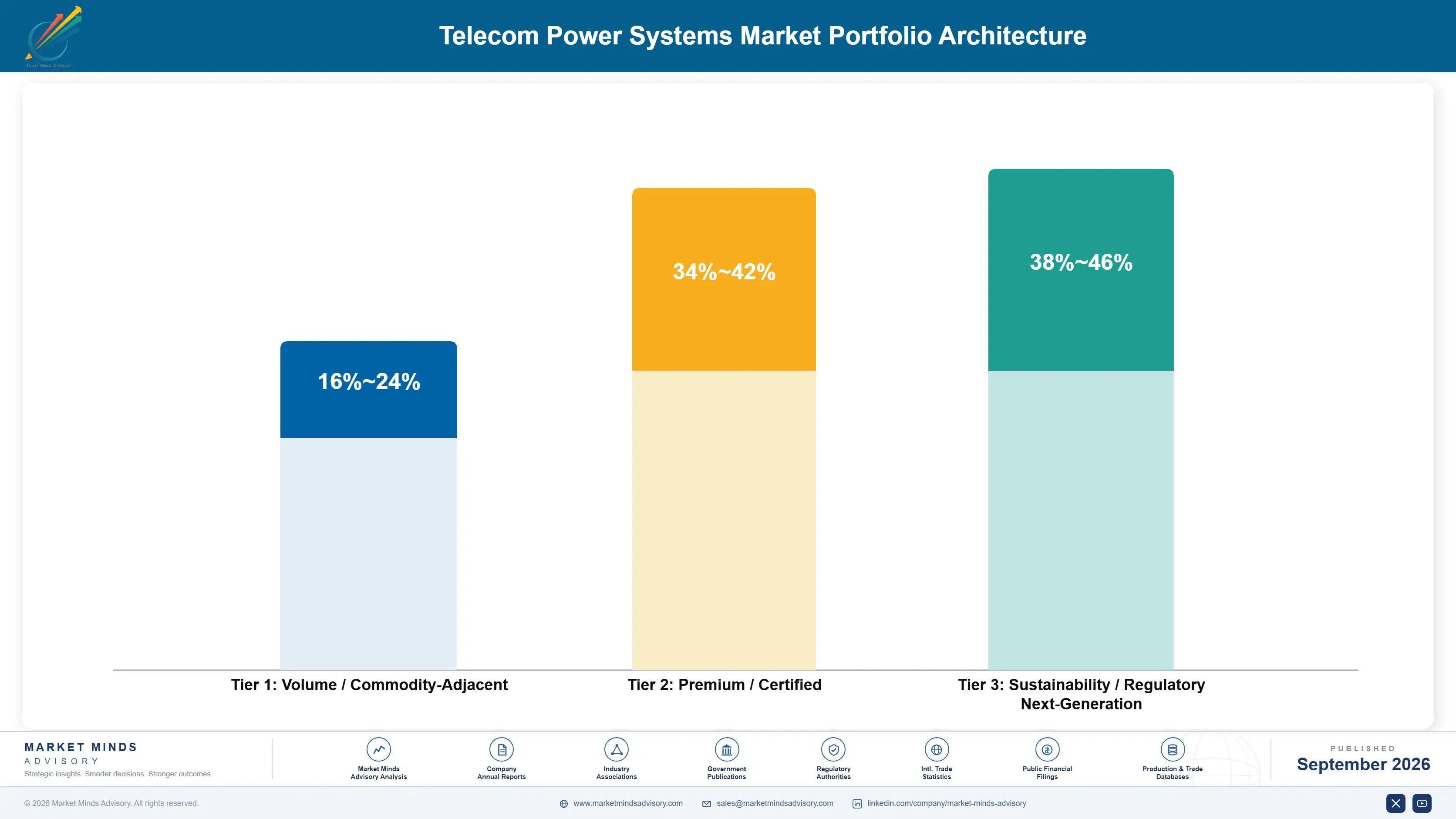
Portfolio Architecture for Margin Defence

Gross margin in telecom power systems spreads widely depending on how much of the revenue comes from bare hardware versus premium monitoring software and managed maintenance contracts layered on top. A commodity rectifier or generator sold at competitive pricing clears margin well below what a fully bundled, monitoring-enabled hybrid power platform commands, since the latter embeds specialized software and site engineering that buyers pay a real, sustained premium to access reliably.
Volume and premium tiers pull vendors toward genuinely different customer bases and engineering investment levels. Volume players compete on low-cost, standard rectifier and battery hardware sold broadly into grid-connected sites, while premium players concentrate on operators willing to pay substantially more for hybrid renewable engineering, remote monitoring, and managed maintenance built directly into the offering. Few vendors execute both strategies at once, since engineering investment and service delivery diverge sharply.

High-value margin pools concentrate specifically in remote monitoring software, managed maintenance contracts, and hybrid renewable system engineering rather than in bare hardware sales, which increasingly function as a low-margin, high-volume entry point that funds the engineering infrastructure supporting the much higher-margin monitoring and service business built on top of that same underlying power platform.

Volume / Commodity-Adjacent

Standard rectifiers and lead-acid battery systems sold at low, competitive pricing into grid-connected sites, competing mainly on unit price, delivery lead time, and broad distributor availability across every region worldwide.
Gross Margin: 16-24%

Premium / Certified

Lithium-ion battery systems bundled with remote monitoring software, managed maintenance contracts, and dedicated field service sold to large operator accounts across every major market, region, network, country, and territory worldwide.
Gross Margin: 34-42%

Sustainability / Regulatory / Next-Generation

Hybrid renewable power systems meeting emerging carbon reduction and off-grid reliability standards demanded by operators expanding coverage into unreliable-grid regions requiring specialized site engineering, design, and installation expertise nationwide and abroad.
Gross Margin: 38-46%
telecom-power-systems-market-portfolio-architecture-1789998194457

High-value Sub-segments and Strategic Watch-out

Hybrid Renewable Engineering Services

The highest-margin pool in the category, growing fastest as operators expanding into unreliable-grid regions demand specialized solar-battery-generator engineering rather than standard grid-connected backup power alone or entirely by any measure. Larger operators with continent-wide footprints drive most of this demand and revenue growth each year.
Gross Margin: 40-48%

Remote Monitoring Software Platforms

High-value, recurring revenue commanding strong margin as operators managing thousands of geographically dispersed sites value centralized visibility into battery health and fuel levels remotely and continuously. Renewal and expansion rates in these accounts run consistently higher than the base tier. Adoption keeps rising sharply among the largest network operators.
Gross Margin: 38-46%

Commodity Grid-Connected Backup

The largest volume core of the market, mature and increasingly low-margin, facing continued commoditization pressure as Chinese vendors steadily close the technical gap on both price and overall quality. Vendors increasingly treat this tier as a lead generation channel for premium upsell. This tier increasingly funds premium upsell opportunities elsewhere.
Gross Margin: 16-24%

Diesel Generator Substitution Risk

A strategic watch-out segment where lithium-ion and hybrid renewable systems increasingly displace diesel generator backup entirely, threatening a historically stable revenue segment for legacy vendors specifically. Vendors must diversify into hybrid engineering to offset this ongoing revenue decline. This trend accelerates as component costs keep falling steadily.
Gross Margin: N/A

Why Power Contracts Last Site Lifetimes

A telecom power system contract behaves more like an annuity than a one-time hardware sale once a vendor's remote monitoring platform, spare parts inventory, and field service relationships become embedded across an operator's network footprint. Replacing an incumbent vendor across thousands of geographically dispersed sites means retraining field technicians, requalifying spare parts logistics, and migrating monitoring data to a new platform, a cost most operators would rather avoid entirely across their entire network.
Stickiness varies sharply by deployment scale and monitoring platform integration achieved during initial rollout. Large operators with standardized, network-wide vendor relationships show the deepest lock-in, since switching vendors across thousands of sites simultaneously proves genuinely disruptive to ongoing network operations and maintenance scheduling. Smaller regional operators with fewer sites show comparatively shallower stickiness, since switching a limited number of installations requires far less coordination and operational risk overall.

Buyer profiles are shifting generationally as dedicated network operations and sustainability teams, rather than pure procurement staff focused solely on unit price, increasingly drive vendor selection decisions. This generational shift favors vendors offering strong monitoring analytics and hybrid renewable engineering expertise over vendors competing primarily on hardware price and basic backup runtime specifications alone.
telecom-power-systems-market-end-use-penetration-index-1789998194951

Where to Compete in Telecom Power

These are among the four positions where our research anticipates prominent divergence between winners and laggards over the coming forecast period. Each is grounded in the demand model, the regulatory perimeter, and the announced capacity pipeline.
01 / HYBRID RENEWABLE INVESTMENT

Build off-grid engineering capability before rivals scale it

Hybrid renewable engineering already commands the highest margin in the category, yet many vendors still treat off-grid deployment as a niche capability rather than a core competency worth genuinely dedicated long-term investment. A challenger investing early in real hybrid engineering expertise can win emerging market network expansion contracts before larger incumbents redirect meaningful resources toward this specific capability at scale and speed. That window narrows measurably each year as component costs decline and hybrid systems become mainstream across the industry.
02 / MONITORING SOFTWARE DEPTH

Build monitoring platforms before operators standardize on rivals

Remote monitoring software already commands meaningfully higher recurring revenue for vendors with mature platforms, yet many smaller vendors still offer only basic alarm notifications rather than genuine predictive maintenance analytics capability already fully built in from the start. A vendor investing early in sophisticated monitoring capability can win large network-wide contracts before operators standardize on a competitor's platform across their entire footprint and installed base of active sites. This differentiation window narrows as monitoring technology matures broadly across the entire industry.
03 / BATTERY SUPPLY DIVERSIFICATION

Diversify battery sourcing before the next cell price shock

The 2025 lithium carbonate pricing surge demonstrated clearly how exposed single-chemistry vendors are to sudden raw material cost spikes entirely beyond their direct control or influence over available global supply chains and distribution networks. Vendors that diversify across multiple battery chemistries and cell suppliers now protect their own margin against the next inevitable shock far better than competitors dependent on just one single technology and supplier alone without alternatives. This diversification decision increasingly separates resilient vendors from fragile, exposed ones.
04 / EMERGING MARKET FINANCING

Offer financing arrangements before competitors close the conversion gap

Diesel-to-hybrid conversion projects remain capital-constrained for many operators despite offering genuinely compelling long-term fuel savings that would justify the upfront investment on a pure financial return basis alone over the entire equipment lifecycle and beyond. A vendor offering creative financing arrangements now can win conversion projects before operators secure financing through a competing vendor or third-party lender instead entirely on their own initiative. This financing opportunity narrows as more vendors recognize the same underlying commercial pattern and begin offering comparable terms.

Engagement Snapshot From the Field

A live engagement with an industry participant carrying material or product regulatory and market exposure ahead of a defining policy shift, showing how our research translates into a defensible multi-year portfolio strategy.
MARKET MINDS ADVISORY · CLIENT ENGAGEMENT SUMMARY
Telecom Power Systems Producer Strategic Portfolio Review and Transition Roadmap 2026·Investment Scenario on Telecom Power Systems Exposure Evaluation 2025-26
CLIENT PROFILE
The client operates a mobile network spanning roughly 3,200 towers across three West African countries, reporting client-reported annual revenue of approximately $680 million (client-reported, unverified by MMA). Facing rising diesel fuel costs and chronic battery theft at remote sites, leadership sought an independent evaluation of hybrid renewable power conversion before committing to a multi-year infrastructure modernization program across its network.
STRATEGIC CHALLENGE
The client's diesel-dependent power infrastructure faced escalating fuel costs and chronic theft losses at many remote sites, yet converting thousands of towers to hybrid renewable power required substantial upfront capital investment that competed directly against network coverage expansion priorities already firmly committed under the client's existing multi-year capital budget plan.
MMA APPROACH
MMA analysts modeled total cost of ownership comparing continued diesel operation against hybrid renewable conversion across the client's full tower portfolio, prioritized conversion candidates based on grid reliability, theft incidence, and fuel logistics cost, and evaluated financing structures that would let conversion be funded from realized fuel savings rather than upfront capital.
KEY FINDINGS
  1. Towers with the highest theft incidence showed a payback period of under 18 months once tamper-resistant hybrid systems replaced vulnerable diesel and lead-acid equipment entirely.
  2. Fuel logistics costs varied sharply by site accessibility, ranging from modest costs at roadside towers to over five times that amount at the most remote locations.
  3. None of the three financing vendors evaluated offered a complete solution covering both equipment and ongoing multi-year maintenance without requiring separate, additional contracts to be signed.
  4. The selected hybrid conversion program, once fully modeled, would reduce annual fuel and theft-related costs by roughly $9.2 million (client-reported, unverified by MMA) across the network.
CLIENT PROFILE
The client operates a mobile network spanning roughly 3,200 towers across three West African countries, reporting client-reported annual revenue of approximately $680 million (client-reported, unverified by MMA). Facing rising diesel fuel costs and chronic battery theft at remote sites, leadership sought an independent evaluation of hybrid renewable power conversion before committing to a multi-year infrastructure modernization program across its network.
STRATEGIC CHALLENGE
The client's diesel-dependent power infrastructure faced escalating fuel costs and chronic theft losses at many remote sites, yet converting thousands of towers to hybrid renewable power required substantial upfront capital investment that competed directly against network coverage expansion priorities already firmly committed under the client's existing multi-year capital budget plan.
MMA APPROACH
MMA analysts modeled total cost of ownership comparing continued diesel operation against hybrid renewable conversion across the client's full tower portfolio, prioritized conversion candidates based on grid reliability, theft incidence, and fuel logistics cost, and evaluated financing structures that would let conversion be funded from realized fuel savings rather than upfront capital.
KEY FINDINGS
  1. Towers with the highest theft incidence showed a payback period of under 18 months once tamper-resistant hybrid systems replaced vulnerable diesel and lead-acid equipment entirely.
  2. Fuel logistics costs varied sharply by site accessibility, ranging from modest costs at roadside towers to over five times that amount at the most remote locations.
  3. None of the three financing vendors evaluated offered a complete solution covering both equipment and ongoing multi-year maintenance without requiring separate, additional contracts to be signed.
  4. The selected hybrid conversion program, once fully modeled, would reduce annual fuel and theft-related costs by roughly $9.2 million (client-reported, unverified by MMA) across the network.
RECOMMENDED STRATEGY
Phase 1: Phase 1 (Months 1 to 6): Convert the 400 highest-theft, highest-fuel-cost towers first to capture the fastest payback and validate the conversion approach. Phase 2: Phase 2 (Months 7 to 18): Expand conversion to remaining remote and moderate-priority towers while refining the financing structure based on early results. Phase 3: Phase 3 (Months 19 to 24): Complete conversion across the full network and formally transition remaining diesel generators to emergency backup status only.
OUTCOME
The client completed the first phase of tower conversions roughly one month ahead of schedule and reported fuel cost savings of approximately 42 percent (client-reported, unverified by MMA) at converted sites within the first six months. Theft incidents at converted sites declined sharply following tamper-resistant enclosure installation.

Frequently Asked Questions

Foundational context covering the market sizes, CAGR, scope, country, region and competition that inform every finding below. This section is provided to cover basics and most often pre-purchase conversations, answered from the MMA Primary Research Dataset.

What is the current size of the Telecom Power Systems Market?

The Telecom Power Systems Market reached $9.2 billion in base-year value in 2025, spanning backup batteries, rectifiers, hybrid renewable systems, and generators for telecom infrastructure worldwide.

How large will the Telecom Power Systems Market be by 2036?

The market is projected to reach $20.38 billion by 2036, expanding roughly 2.06 times its 2026 value as 5G densification and off-grid coverage expansion continue.

What is the CAGR for the Telecom Power Systems Market 2026 to 2036?

The market is forecast to grow at a compound annual growth rate of 7.5 percent between 2026 and 2036, driven by lithium-ion adoption and hybrid renewable conversion.

Which segment is growing fastest?

Lithium-ion backup battery systems lead all segments at a 13.0 percent CAGR, roughly 1.73 times the overall market rate, as operators replace aging lead-acid battery banks.

Who are the major companies in the Telecom Power Systems Market?

Vertiv, Huawei, ZTE, Delta Electronics, and Eaton lead the competitive field, evaluated on annual telecom power system revenue across every product portfolio and world region.

Which country is growing fastest?

Nigeria leads all countries tracked at a 12.0 percent CAGR, fueled by chronically unreliable grid electricity driving widespread hybrid renewable tower power investment nationwide today.

Report Segmentation Architecture

The full report scope spans multiple orthogonal segmentation dimensions, with cross-tabulated demand data provided for each dimension pair. Coverage extends further to regional breakdowns, trend trajectories, and the competitive detail needed to support segment-level decision-making.

By Primary Market Dimension

  • Lithium-Ion Backup Battery Systems
  • DC Power Rectifier Systems
  • Hybrid Renewable Power Systems
  • Diesel and Fuel-Based Generators
  • Power Distribution and Monitoring Units
  • Uninterruptible Power Supply Systems

By End-Use Industry

  • Mobile Network Operators
  • Fixed-Line and Broadband Carriers
  • Telecom Data Centers
  • Government and Defense Communications
  • Satellite and Broadcast Infrastructure

By Commercial Dimension

  • Direct Hardware Sale
  • Bundled Monitoring Subscription
  • Managed Maintenance Contract
  • Financing and Leasing Arrangement

By Region

  • North America
  • Western Europe
  • East Asia
  • South Asia and Pacific
  • Latin America
  • Middle East and Africa
  • Eastern Europe

Scope, Methodology, and Coverage

Every figure in this report is reproducible from documented input assumptions. The scope below maps the historical period, the forecast horizon, the segmentation dimensions, and the countries covered, alongside the underlying primary and qualitative methodology.
Historical Period
2020 to 2025
Forecast Period
2026 to 2036
Base Year
2025 (USD billions; MMA Primary Research Dataset, September 2026)
Market Definition
The Telecom Power Systems Market covers backup battery, rectifier, generator, hybrid renewable, and power distribution equipment that supplies and protects electrical power for mobile network towers, central offices, and telecom data centers. It excludes general commercial and industrial uninterruptible power supply systems, consumer battery products, and utility-scale grid power generation equipment.
Quantitative Units
USD billions (current prices); site unit shipment volume where applicable
Segmentation Dimensions
By Primary Market Dimension; By End-Use Industry; By Commercial Dimension; By Region
Regions Covered
North America, Western Europe, East Asia, South Asia and Pacific, Latin America, Middle East and Africa, Eastern Europe
Countries Covered
USA, China, Germany, France, UK, Japan, South Korea, India, Australia, Canada, Brazil, Mexico, Indonesia, Vietnam, Thailand, Malaysia, UAE, Saudi Arabia, South Africa, Nigeria, Turkey, Poland, Netherlands, Italy, Spain, Sweden, Switzerland, Argentina, Colombia, Singapore, and additional markets relevant to this sector
Key Companies Profiled
Vertiv, Huawei, ZTE, Delta Electronics, Eaton, Schneider Electric, ABB, Cummins, Generac, EnerSys, Socomec, Emerson Electric, Mitsubishi Electric, Toshiba, Legrand, Enatel, Piller Power Systems, Riello UPS, Kohler, Caterpillar
Quantitative Methodology
Primary survey, n=3,800 respondents, Q4 2025, six countries; demand-side model with trade association cross-validation
Qualitative Methodology
47 expert interviews, Q4 2025; applied to validate demand model assumptions, identify emerging dynamics, and assess competitive positioning
Report Format
PDF and XLSX data workbook (Word format preview document)
Publisher
Market Minds Advisory
Report Code
MMA-2026-TEC-216
Published
September 2026
Contact
sales@marketmindsadvisory.com | www.marketmindsadvisory.com

Purchase the full Telecom Power Systems Market Report (2026 to 2036).

This report delivers a comprehensive assessment of the Telecom Power Systems Market from 2026 through 2036, covering sizing, segmentation, and regional demand patterns across all seven world regions tracked. It profiles twenty companies competing on hybrid renewable engineering depth, remote monitoring software maturity, and field service reach rather than raw power output specifications alone. Readers get detailed analysis of revenue levers, battery cell cost exposure, and portfolio margin economics specific to this hardware category and its buyers. The report closes with a strategic verdict identifying exactly where new capital should concentrate over the coming decade.
Full seven-region market sizing and forecast data
Twenty-company competitive profiling and moat analysis
Segment-level CAGR and market share breakdown
Battery cost exposure and mitigation pathway analysis
Revenue lever and portfolio margin economics detail
Anonymized client case study with recommended strategy

Built For The People Who Decide

From boardroom strategy to bench-side execution, this report is read cover-to-cover by leaders shaping the next decade of their industry, turning demand scenarios, market dynamics and valuation benchmarks into decisions.
CXOs/ Presidents/ VPs/ Managers
M&A and Corporate Development
Strategy Teams and R&D Heads
Procurement and Product Directors
Regulatory and Compliance Leaders
Investor Relations and Equity Analysts