Market Minds Advisory
Teaseed Cake Market

Teaseed Cake Market: A By-Product Whose Main Job Is Killing Fish

Shrimp farmers use it to clear wild fish out of ponds before stocking, which is really a pesticide application of an agricultural residue that holds formal registration in almost nowhere.

Lead Analyst

Bilal Shaikh

Published

September 2026

Make Smarter Decisions with Customized Research Insights

Request a free sample report and evaluate market opportunities, growth trends, and competitive dynamics relevant to your business needs.

2025 MARKET VALUE$0.3BMarket Size 2025
2036 FORECAST VALUE$0.6BBase Case , 2026 to 2036
CAGR 2026 TO 20366.2 %Bull 7.4% / Bear 5.0%
INCREMENTAL OPPORTUNITY$0.2BNet 10- year value creation
EXPANSION MULTIPLE1.83x2036 value over 2026 base
Strategic Levers
M&A Pipeline
Regional Outlook
Country Rankings
Competitive Intelligence
Segmental Deep-dive
Call-Us : 91 93563 13602

Executive Snapshot and Market Trajectory

The largest use of this residue is killing things. Shrimp farmers apply it at around 25 parts per million to clear wild fish from ponds before stocking, because the saponins it contains lyse fish gill cells while leaving crustaceans unharmed at that dose. Farmers have done it for generations.
That is a pesticide application, and it holds formal product registration in only about 19% of the markets where it happens. The practice has been routine for decades and nobody minded while aquaculture served domestic markets. Export certification schemes and importing country residue scrutiny are now making an unregistered input a genuine commercial exposure for the farms using it. Registered alternatives cost more and work less well.
Supply answers to somebody else entirely. Cake volume follows camellia oil pressing rather than cake demand, and the presser optimises for oil yield rather than for the saponin left behind, so cold pressing retains around 78% of the active while hot routes destroy more. The most valuable property is decided by a decision taken for a different product. Extraction buyers know exactly what they are getting, and the pressers do not.
Market Definition
Camellia oleifera seed residue remaining after oil extraction, supplied across aquaculture pond preparation, saponin extraction for surfactants, organic fertiliser and soil amendment, biopesticide and molluscicide formulation, animal feed applications, and industrial uses. Measured at producer selling value in cake, powder and pelleted forms. Excludes camellia seed oil itself, tea leaf and tea waste products, other oilseed meals, purified saponin sold as a finished chemical, and formulated pesticide products.
Base Year Value
$0.3B in 2025 (MMA Primary Research Dataset, August 2026)
Forecast Period
2026 to 2036, eleven discrete annual values
CAGR
6.2% base case. Bull 7.4%. Bear 5.0%.
Fastest Growth Segment
Saponin Extraction for Surfactants: 9.3% CAGR
Fastest Growth Country
Thailand: 10.4% CAGR
Fastest Growth Region
South Asia and Pacific: 8.2% CAGR
Largest Region
East Asia: 42% of 2025 global value
Market Leaders
Jiangxi Qiyunshan Food, Hunan Dashawan Camellia Oil, Zhejiang Camellia Industry, Guangxi Fenghua Camellia, Changsha Vigorous-Tech. Source: MMA Primary Research Dataset, July 2026.
Primary Survey
n=3,800 procurement and R&D decision-makers, Q4 2025, six countries
Methodology
Demand-side build-up, cross-validated against public data, 47 expert interviews

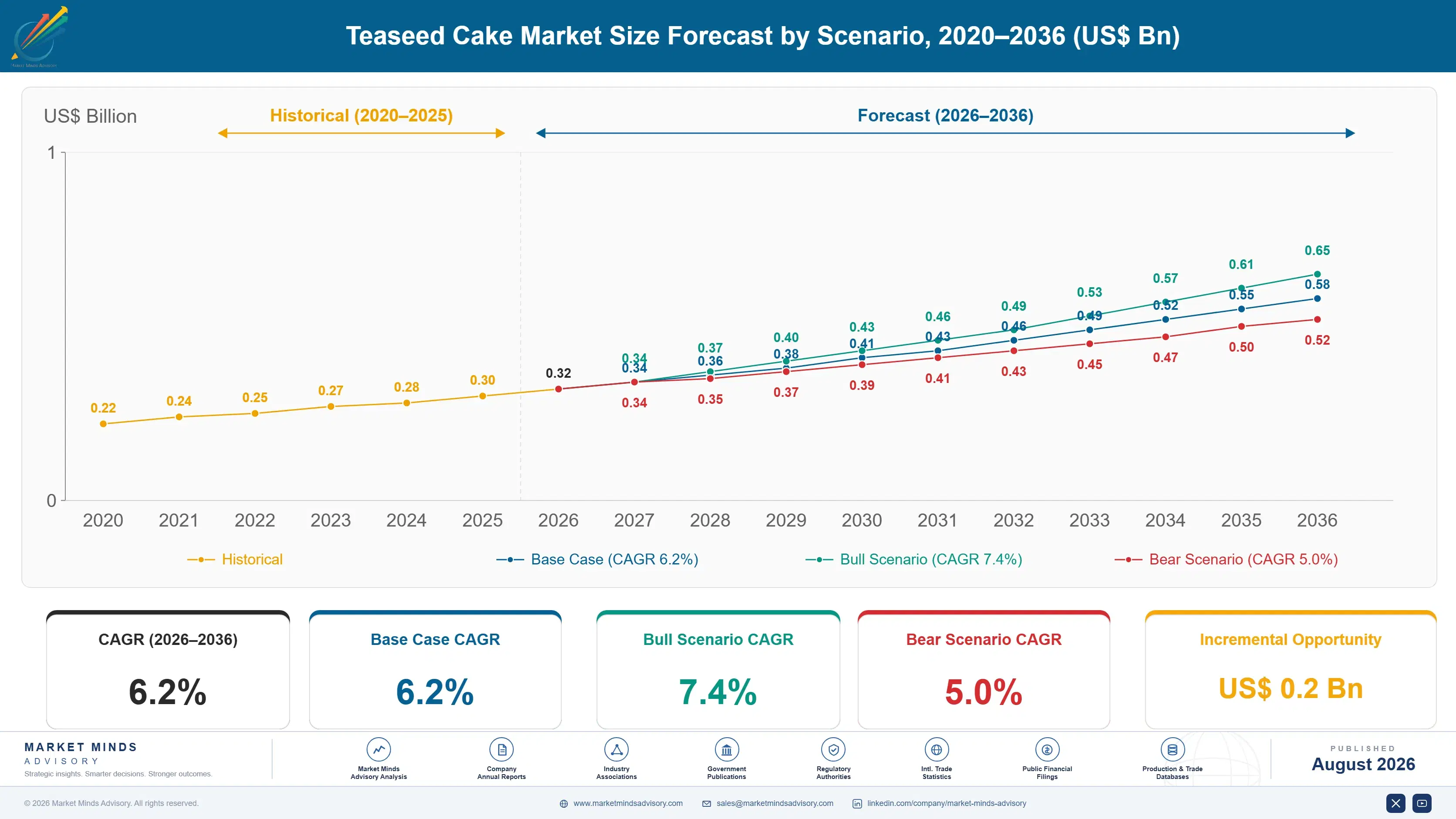
Teaseed Cake Market Forecast Scenarios

teaseed-cake-market-trends-size-forecast-scenario-1787639740279
Growth ran near 5.0% between 2020 and 2025, tracking Chinese camellia oil pressing volumes rather than any demand signal from cake buyers. Aquaculture pond use remained the dominant application throughout and expanded with shrimp farming across Southeast Asia. Saponin extraction for industrial surfactants grew faster than anything else, though from a base small enough that it barely moved the aggregate figure at all.
Base case 6.2% rests on three mechanisms. Saponin extraction for surfactants grows at 9.3% as natural surfactant demand expands and tea saponin remains one of few plant saponins available at industrial scale. Organic fertiliser use grows at 7.0% on certified organic acreage expanding across Asia. And Thailand grows fastest of any country at 10.4% on shrimp farming intensity and pond turnover rates. None of the three depends on camellia oil demand at all.
The bull case at 7.4% assumes saponin extraction capacity expanding to capture more of the active currently applied to ponds and then lost, which would move value up the chain considerably. The bear case at 5.0% is certification schemes restricting unregistered pond inputs, which would remove the largest application faster than extraction and fertiliser demand could absorb the displaced volume.

A Residue Sold as a Poison

Teaseed cake is what remains after camellia seed is pressed for oil, and its dominant commercial use is as a selective poison. Applied to shrimp ponds at around 25 parts per million, the saponins lyse fish gill cell membranes and clear wild fish and predators before stocking, while crustaceans tolerate that concentration without harm. It is effective, cheap, biodegradable and used by farmers for generations.
TOP FIVE CONCENTRATION22%Thousands of small pressers supply a genuinely fragmented market
SAPONIN CONTENT13%Active fraction present in well pressed residue material
POND APPLICATION RATE25 ppmConcentration used to clear wild fish before stocking shrimp
COLD PRESS SAPONIN RETENTION78%Active surviving where oil is extracted without applied heat
CAKE VALUE AGAINST OIL4%Residue worth relative to the oil pressed from identical seed
REGISTRATION COVERAGE19%Markets where pond application holds formal product registration
It is also, in regulatory terms, a pesticide being applied without registration in roughly four cases out of five. Around 19% of the markets where pond application is routine have any formal product registration covering it, because it arrived as an agricultural residue rather than through a pesticide approval pathway. Nobody minded while the shrimp went to domestic markets, and export certification schemes have started minding a great deal.
The supply side answers to a different product entirely. Cake volume follows camellia oil pressing decisions in China, and the presser is optimising oil yield rather than the saponin content of what is left over. Cold pressing retains around 78% of the active while hot routes destroy far more, so the cake's most valuable property is set by a choice made for other reasons.
"This is one of the few agricultural residues where the active ingredient is worth several times the material and almost nobody separates it. The pressers are selling saponin by the tonne of bulk cake, and the extraction companies buying it know exactly what they are getting."
Director, Agricultural By-Products and Bio-Based Chemicals Practice · MMA Agriculture and Food Practice · August 2026

Market Trends

Certification scrutiny reaching an unregistered pond input

Aquaculture certification schemes and importing country residue programmes have begun examining pond preparation inputs that farms have used for decades without formal registration, and teaseed cake holds product registration in only around 19% of the markets where it is applied. The practice is neither hidden nor new, it simply predates the certification frameworks now being applied to export shrimp. Farms serving certified export chains face a choice between an unregistered input and a considerably more expensive alternative. Registered alternatives are considerably more expensive and in several cases less effective, which is why no farm switched before it was asked to.
Market Impact: Thailand growing fastest at 10.4%
Natural surfactant demand pulling value toward extraction

Tea saponin is one of very few plant derived saponins available at industrial scale, and natural surfactant demand across detergents, agrochemical adjuvants and personal care has grown steadily enough to support dedicated extraction. Growth at 9.3% follows that pull rather than anything happening in aquaculture. Extraction economics require cake with high residual saponin, which means cold pressed material at around 78% retention rather than the hot pressed residue most oil producers actually generate. Extraction companies have begun contracting pressing route directly rather than buying bulk cake from traders, which is a meaningful change in how this chain works.
Market Impact: Fertiliser use growing at 7.0%

Market Opportunities and Growth Drivers

Southeast Asian shrimp pond turnover driving application volume

Thailand grows fastest of any country at 10.4% because pond preparation is required before every stocking cycle and intensive farms run multiple cycles annually, which makes consumption a function of turnover rather than of pond area. Vietnamese, Indonesian and Indian shrimp farming follows similar patterns at different intensities. The material is applied by farmers rather than specified by anybody, which makes distribution reach more commercially decisive than any technical argument about it. Certification pressure reaches those farmers through export buyers rather than through any regulator they deal with directly. Dealer reach decides supply.
Market Impact: Unregistered in 81% of markets

Certified organic acreage absorbing residue as soil amendment

Organic fertiliser use grows at 7.0% as certified organic acreage expands across Asia, with the residue supplying organic matter, potassium and a degree of natural nematode and snail suppression from the saponins that survive composting. Certification frameworks accept it readily as a plant derived amendment, which contrasts sharply with the regulatory awkwardness surrounding pond application. Value per tonne is lower than aquaculture use and the volumes absorbed are considerably larger. That regulatory comfort makes it the natural home for material that extraction and aquaculture buyers cannot use, which matters if pond demand is ever disrupted.
Market Impact: Worth 4% of the oil value

Market Restraints and Challenges

Unregistered pesticide status threatening the largest application

Pond application is a pesticide use holding formal registration in only around 19% of the markets where it occurs, because the material entered use as an agricultural residue rather than through any approval pathway. The root cause is regulatory classification rather than any safety finding. Commercially it puts the dominant application at risk as certification schemes tighten. Registration in key aquaculture markets is the obvious mitigation, and the cost falls on nobody in particular, which is why it has not happened. Whoever funds registration gains a defensible position nobody else holds.
Market Impact: Registered in only 19% of markets

Supply determined entirely by camellia oil pressing decisions

Cake volume follows oil pressing rather than cake demand, and the residue is worth around 4% of the oil pressed from the same seed, which means no presser adjusts anything for it. The root cause is by-product economics. Commercially it means demand growth cannot pull supply and saponin content varies with a pressing choice made for oil yield. Contracting cold pressed material and paying for saponin content are the mitigations extraction companies have begun using. Demand growth cannot pull supply at all, which is an unusual constraint and one that caps how quickly the extraction segment can actually scale.
Market Impact: Extraction growing at 9.3% annually
3 additional market trends, 4 additional growth drivers, and 2 additional restraints and challenges are covered in the full report. Contact sales@marketmindsadvisory.com to access the complete intelligence.

Segment CAGR and Growth Architecture

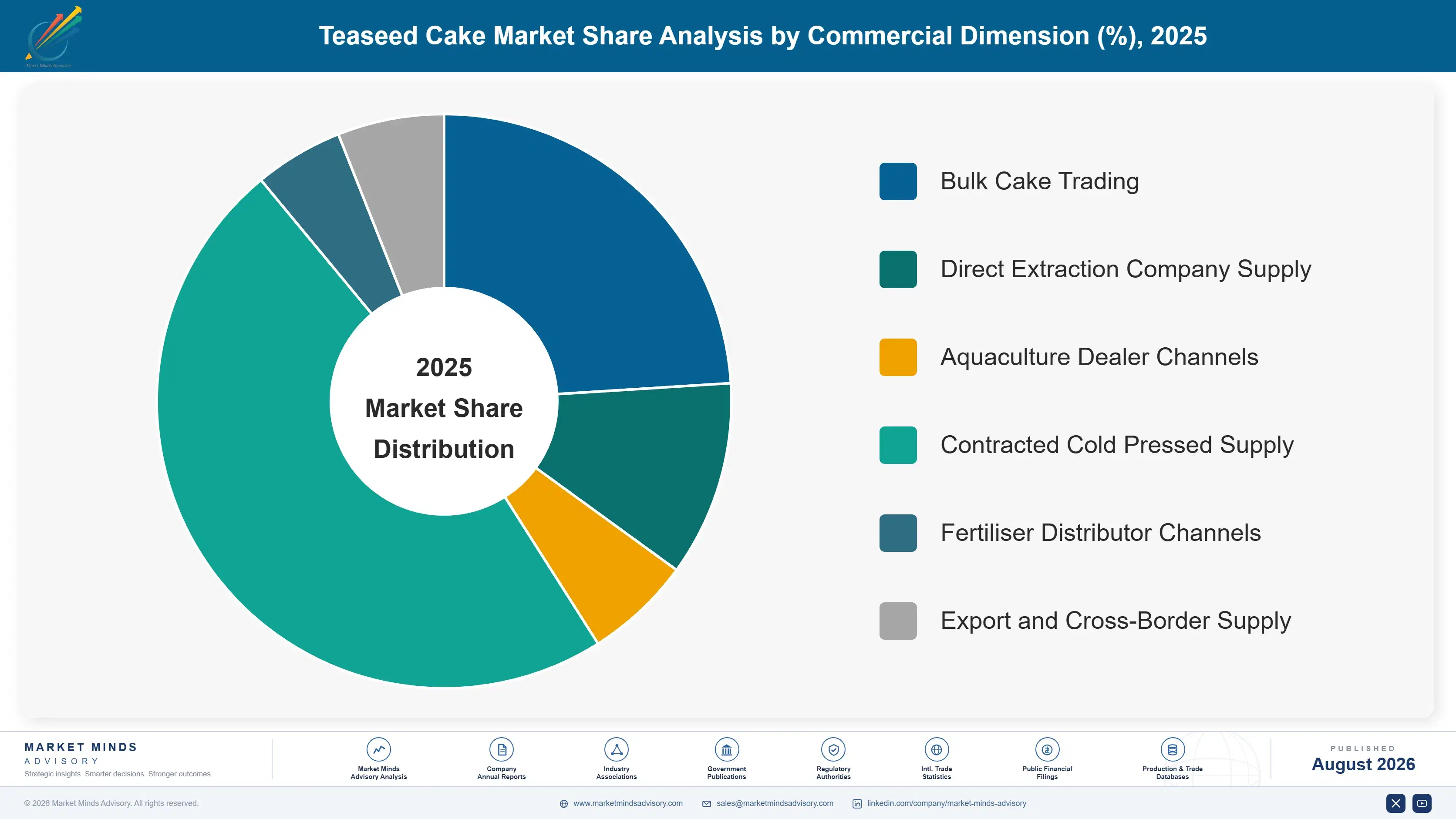
Six segments are split by application, because application determines the saponin content required, the regulatory framework governing use, the form supplied and the value per tonne a buyer will pay. Powder and pellet variants sit inside each application. Pressing route and channel are handled separately in the framework. Regulatory position differs sharply by application.
teaseed-cake-market-trends-market-share-analysis-1787639740808

Saponin Extraction for Surfactants

Growing at 9.3%, half again the market rate of 6.2%, this covers cake purchased specifically to extract tea saponin for detergents, agrochemical adjuvants, personal care and industrial emulsifiers, where it is one of very few plant saponins available at genuine industrial scale. Extraction economics depend on residual saponin content, which means cold pressed material retaining around 78% of the active rather than the hot pressed residue most oil producers generate. Extraction companies increasingly contract pressing route and pay for content rather than buying bulk cake by weight. Capital and process capability rather than raw material access decide who participates here. Extraction companies increasingly test incoming cake and pay against measured content rather than accepting whatever the pressing route left behind.
CAGR 9.3%

Organic Fertiliser and Soil Amendment

At 7.0% the residue supplies organic matter, potassium and a degree of natural nematode and snail suppression from saponins surviving composting, which certification frameworks accept readily as a plant derived amendment. That regulatory comfort contrasts sharply with the awkwardness surrounding pond application of the same material. Value per tonne is considerably lower than aquaculture or extraction use and the volumes absorbed are much larger, which makes it the application that clears surplus rather than the one that earns. Certification frameworks accept it without difficulty, which is a striking contrast with the regulatory awkwardness attaching to pond application of exactly the same material at a different dose. Volumes absorbed are considerably larger than either other application takes.
CAGR 7.0%
Full segment breakdown across 6 segments available in the complete report.

Regional Architecture and Country Demand Map

East Asia holds 42% of value, above the standard band, because Chinese camellia pressing produces essentially the whole world supply. South Asia and Pacific reaches 30% on shrimp aquaculture consuming most of it. North America, Western Europe and Eastern Europe all fall below their bands for the same reason.

North America

Share sits at 8%, below the standard band, because this material is produced and consumed almost entirely in Asia while North American participation runs through saponin extract purchasing for surfactant and adjuvant formulation. Regulatory status is clear for those industrial uses, which contrasts with the awkwardness of pond application elsewhere. Domestic shrimp farming is minimal and the aquaculture application barely features. Growth at 6.6% follows natural surfactant demand rather than any movement in agricultural or aquaculture consumption. Purified saponin rather than bulk cake is what reaches the region, and it arrives against analytical specification rather than by the tonne. Aquaculture use barely features at all and is unlikely to develop within the forecast period.
Share: 8% | CAGR: 6.6% (2026 to 2036)

Western Europe

At 8% the share falls below the standard band for the same reason, since production and bulk consumption both sit in Asia. European participation is concentrated in purified saponin purchasing for detergent, personal care and agrochemical adjuvant formulation, where natural surfactant positioning commands genuine premiums. Regulatory frameworks for those uses are well established. Import residue scrutiny on Asian shrimp is exercised here, which indirectly affects pond application practice. Growth of 4.8% is the slowest anywhere on mature industrial demand. Natural surfactant positioning commands genuine premiums here, which is why purified material rather than residue is what actually crosses the border. Import residue scrutiny exercised here reaches back into Asian pond practice indirectly, which is how the regulatory pressure actually travels.
Share: 8% | CAGR: 4.8% (2026 to 2036)
Regional intelligence for 5 additional markets available in the complete report: East Asia, South Asia and Pacific, Latin America, Middle East and Africa, Eastern Europe. Contact sales@marketmindsadvisory.com.
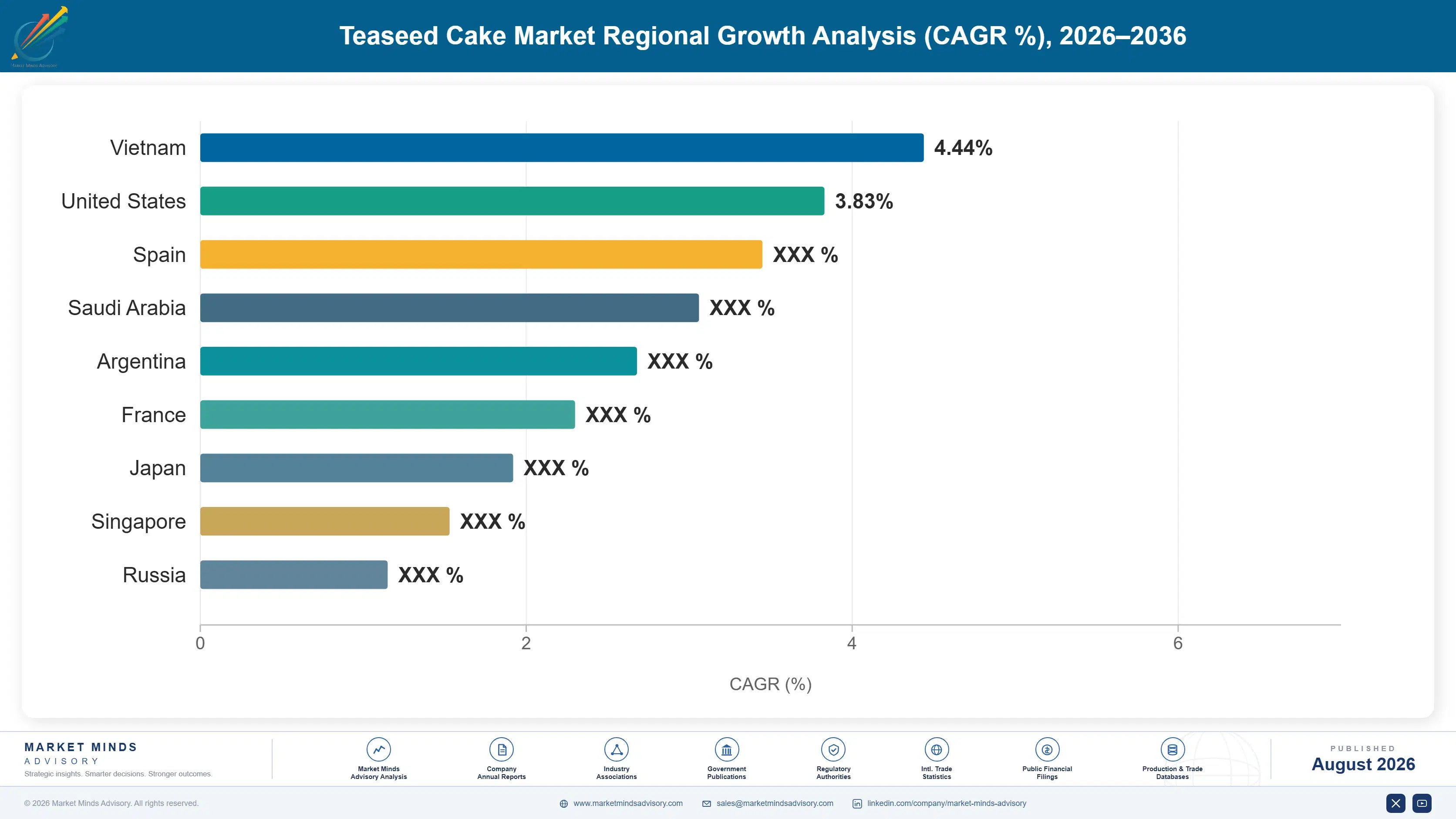
teaseed-cake-market-trends-country-cagr-analysis-1787639741333

Four Moves Toward the Active Ingredient

Pressers sell saponin by the tonne of bulk cake without pricing it, and the largest application is a pesticide use nobody registered. The moves worth making capture the active rather than the material, secure the pressing route that preserves it, and fix a regulatory gap that threatens most of the current volume. All four are available now.

Contract pressing route rather than buying bulk cake

Cold pressing retains around 78% of the saponin while hot and solvent routes destroy considerably more, and the presser chooses on oil yield because the cake is worth roughly 4% of the oil from the same seed. An extraction buyer contracting the pressing route and paying for content rather than weight secures material that competitors purchasing bulk cake simply cannot obtain, at a premium that costs the presser nothing to accept. Testing on receipt and paying against measured content aligns the presser's incentive with the buyer's requirement for the first time.
Market Impact: Secures around 78% of the available saponin retention

Move up the chain into saponin extraction

Tea saponin is one of very few plant saponins available at industrial scale and natural surfactant demand grows at 9.3%, while cake applied to a shrimp pond at 25 parts per million destroys the active entirely for a very low value use. Extraction capacity captures several times the material value from the same tonne. It requires capital and a technical capability most pressers lack, which is exactly why the opportunity remains open. The material applied to a pond at 25 parts per million is gone entirely, which wastes an active worth several times the residue.
Market Impact: Captures the full value in 13% saponin content

Fund pesticide registration in key aquaculture markets

Pond application holds registration in only around 19% of markets where it occurs, and certification schemes are beginning to examine it. Registration costs money that falls on no participant in particular, which is precisely why nobody has done it. A supplier funding registration in Thailand, Vietnam or India secures the largest application against certification pressure and gains a defensible position while competitors continue selling an unregistered input. Certification schemes have already started asking, which shortens the time available to act. Nobody else has chosen to fund it anywhere in this industry to date.
Market Impact: Addresses 81% of the unregistered market exposure directly

Build organic amendment volume as a surplus outlet

Organic fertiliser use grows at 7.0% and absorbs large volumes at low value per tonne, which makes it the application that clears surplus rather than the one that earns. Certification frameworks accept it readily, in sharp contrast to pond application of identical material. Holding that outlet gives a supplier somewhere to place volume if aquaculture demand is disrupted, which is a real possibility rather than a hypothetical one. Supply cannot be reduced in response to weak demand, because it follows oil pressing rather than anything a cake seller decides. Volume arrives regardless.
Market Impact: Absorbs surplus volume that grows at 7.0% annually

Who Controls the Margin Pool

Participation is measured on annual cake tonnage supplied, and the top five hold only 22%. Concentration is exceptionally low because the material is a by-product of thousands of small and medium camellia oil pressing operations across southern China, none of which treats cake as a primary business. Extraction companies rather than pressers hold the commercially interesting positions in this market. The gap is extraction capability rather than access to raw material.
Competition runs on three fronts. Delivered cost decides bulk cake supply into aquaculture and fertiliser use, where the material is treated as interchangeable. Saponin content decides extraction supply, where buyers increasingly test rather than assume. And distribution reach decides aquaculture volume, since the material is bought by farmers rather than specified by anybody. Registration status is becoming a fourth front, and no participant has yet chosen to fund it anywhere.

Pressure ahead comes from certification scrutiny on unregistered pond inputs and from extraction capacity pulling higher content material away from bulk uses. Expect extraction companies to contract pressing routes directly. Rankings shift on who secures cold pressed supply before the extraction segment scales. Concentration should stay very low across bulk trading.
teaseed-cake-market-trends-company-positioning-matrix-1787639741851

Competitive Moat and Risk Dimensions

JIANGXI QIYUNSHAN FOOD

Moat: Pressing scale and regional aggregation

Camellia oil pressing at scale combined with aggregation from smaller regional operations produces cake volumes that individual pressers cannot match, in a market where consistency of supply matters to any buyer running continuous extraction. That aggregation network took years to build across a fragmented producer base and is difficult for a newcomer to assemble quickly.
JIANGXI QIYUNSHAN FOOD

Risk: By-product pricing indifference

Cake is worth around 4% of the oil from the same seed, which means pressing decisions are taken entirely for oil yield and the saponin content of the residue is whatever it happens to be. That indifference caps the value the business can extract from a stream it treats as secondary, however valuable the active inside it becomes.
CHANGSHA VIGOROUS-TECH

Moat: Saponin extraction and purification capability

Extraction and purification capability captures several times the material value from the same tonne of cake, reaching detergent, adjuvant and personal care buyers who pay for a defined active rather than for bulk residue. That capability requires capital and process knowledge that pressing operations do not hold, which keeps the competitive field considerably narrower than the raw material market suggests.
CHANGSHA VIGOROUS-TECH

Risk: Feedstock content variability

Extraction yield depends on residual saponin in purchased cake, which varies with a pressing route chosen for oil recovery rather than for anything the extractor needs. Securing cold pressed material requires contracting upstream with pressers who have little commercial interest in the outcome, and supply consistency remains a genuine operating problem.

Players Tracked

Prominent Players

Jiangxi Qiyunshan Food
Hunan Dashawan Camellia Oil
Zhejiang Camellia Industry
Guangxi Fenghua Camellia
Changsha Vigorous-Tech

Other Key Players

Xi'an Lyphar Biotech
Shaanxi Undersun Biomedtech
Hunan Nutramax
Nanjing Zelang Medical
Jiangxi Global Natural Spice
Xi'an Sgonek Biological
Hunan Sunfull Bio-tech
Bolise
Naturalin Bio-Resources
Xi'an Rainbow Biotech
Shaanxi Guanjie Technology
Hunan Warrant Chiral
Ji'an Zhongxiang Natural Plants
Yichun Dahua Bio
Guilin Layn Natural Ingredients

Recent Developments

MARCH 2026

Certification scheme queries unregistered pond preparation inputs

An aquaculture certification scheme began querying pond preparation inputs lacking formal pesticide registration in the country of use, affecting a practice that shrimp farms across Southeast Asia have relied upon for decades without any regulatory difficulty. Farms had used the material for generations without difficulty.
Signal: A practice can be routine for generations and still fail a certification audit written recently indeed
SEPTEMBER 2025

Extraction company contracts cold pressed cake supply directly

A saponin extraction company contracted cold pressed cake supply directly with camellia oil pressers, paying a premium for pressing route rather than purchasing bulk cake by weight from traders on the open market as it previously had. Bulk traders lost that volume without ever knowing why.
Signal: Buyers who pay for saponin content secure material that weight based purchasing cannot reach at all
DECEMBER 2025

Natural surfactant formulator qualifies tea saponin for detergent range

A detergent formulator qualified tea saponin into a natural surfactant range, valuing plant origin and foaming performance alongside availability at industrial scale, which very few plant derived saponins currently offer to formulators. Foaming performance was comparable to established alternatives throughout testing. Industrial availability decided the qualification.
Signal: Industrial scale availability rather than performance is what distinguishes this saponin commercially against synthetic surfactants too

Seed, Pressing and Freight

Camellia seed carries essentially all of the raw material cost, though it is allocated almost entirely to the oil, leaving cake carrying around 4% of seed value on any conventional allocation. Pressing and drying energy takes about 21% of the cake's own cost structure. Milling, pelleting and packaging account for around 18%. Inland collection from fragmented pressing operations and ocean freight absorb the balance.
Chinese camellia plantation expansion has continued under state support, per published Chinese agricultural sector reporting and camellia industry association commentary for 2025, which has raised seed and therefore cake volumes independently of any demand from cake buyers. Ocean freight into Southeast Asian aquaculture markets moved sharply through recent years and matters disproportionately for a low value bulk material. Cake supply therefore grows whether or not anybody wants more of it.

Exposure divides on application and on freight distance rather than on scale. A bulk supplier into aquaculture carries freight across a substantial share of delivered cost for material worth very little per tonne. An extraction buyer carries saponin content variability instead, which is a yield exposure rather than a price one. Fertiliser buyers carry almost nothing, which is consistent with what they are prepared to pay.
teaseed-cake-market-trends-cost-volatility-analysis-1787639742048

Aggregate collection across fragmented pressing operations

Cake comes from thousands of small and medium pressing operations across southern China, which makes collection cost a meaningful share of delivered value for a material worth very little per tonne. Aggregation networks reduce that cost and secure supply consistency at the same time, which matters for continuous extraction. Consistency matters as much as cost.

Pay for saponin content rather than for tonnage delivered

Residual saponin varies with a pressing route chosen entirely for oil yield, so buying cake by weight means accepting whatever content results. Testing on receipt and paying against measured content aligns the presser's incentive with the buyer's requirement, and it costs the presser nothing to supply cold pressed material once somebody pays for it. Incentives align immediately.

Place surplus volume into organic amendment outlets

Fertiliser use absorbs large volumes at low value and accepts material of any saponin content, which makes it the natural home for cake that extraction and aquaculture cannot use. Holding that outlet prevents distress selling when aquaculture demand moves, and it is the only application whose regulatory position is entirely comfortable. Distress selling disappears with it.

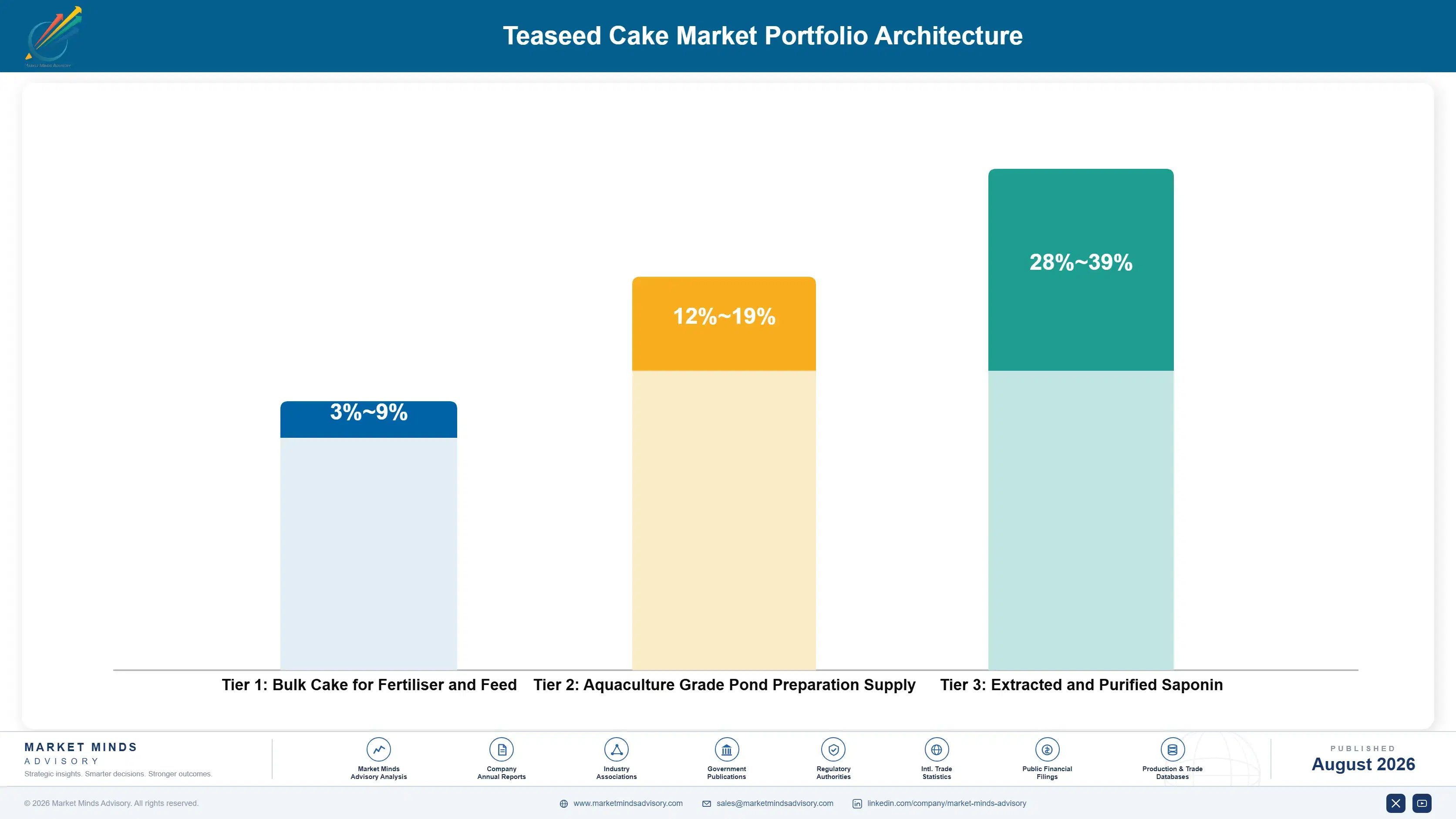
Portfolio Architecture for Margin Defence

Margin here follows how far a participant sits from bulk residue trading, because cake sold by the tonne into aquaculture or fertiliser use carries almost no value beyond collection and freight. Bulk cake supply into fertiliser and feed earns margins in the low to high single digits, where the material is interchangeable and buyers compare delivered cost alone. Collection and freight are the whole cost structure.
Aquaculture grade supply does modestly better in the low to high teens, because pond performance depends on saponin content and farms that have found a reliable source rarely change it, though the absence of formal registration makes the whole position more precarious than the margins suggest. Farmers who have found something reliable rarely experiment with alternatives at all.

Extracted and purified saponin holds the strongest position, reaching into the high thirties, where a defined active reaches detergent, adjuvant and personal care formulators who pay for specification rather than for residue. Those margins reflect extraction capability and purification capacity rather than any advantage in access to raw cake. Requalifying a natural surfactant supply is disruptive enough that these positions hold for years.

Bulk Cake for Fertiliser and Feed

Untreated residue sold by weight where saponin content barely matters to the buyer. The six point range reflects collection and freight position rather than any difference in the material being supplied at all.
Gross Margin: 3-9%

Aquaculture Grade Pond Preparation Supply

Material selected for saponin content and supplied into shrimp pond preparation. The seven point range reflects content consistency and distribution reach into farming areas rather than any formal product specification.
Gross Margin: 12-19%

Extracted and Purified Saponin

Defined active supplied to detergent, adjuvant and personal care formulators against specification. The eleven point range reflects purification capability and how demanding the formulator's requirements actually are. Purification capacity is scarce.
Gross Margin: 28-39%
teaseed-cake-market-trends-portfolio-architecture-1787639742550

High-value Sub-segments and Strategic Watch-out

Extracted Saponin Supply

High value and the fastest growth at 9.3%, capturing several times the material value from the same tonne. Tea saponin is one of very few plant saponins available at genuine industrial scale. Capital and process capability decide participation. Pressers do not hold either. Scale is genuinely rare.
Gross Margin: 30-39%

Organic Amendment Supply

Growing at 7.0% and regulatorily comfortable in a way pond application is not. It absorbs large volumes at low value, which makes it the outlet that clears surplus rather than the one that earns. Certification frameworks accept it without difficulty. Value per tonne remains low throughout.
Gross Margin: 5-11%

Aquaculture Pond Preparation

The volume core, applied at around 25 parts per million before every stocking cycle by farmers who have used it for generations without any formal registration covering the practice. Export buyers are now asking what went into the pond. Registration exists almost nowhere. Practice predates certification.
Gross Margin: 12-19%

Registration Status Exposure

The strategic watch-out. Around 81% of markets where pond application occurs have no registration covering it, and the range reflects whether a participant has moved value toward extraction instead. Registration costs fall on nobody in particular. Extraction is the obvious hedge available. Timing is now short.
Gross Margin: 3-37%

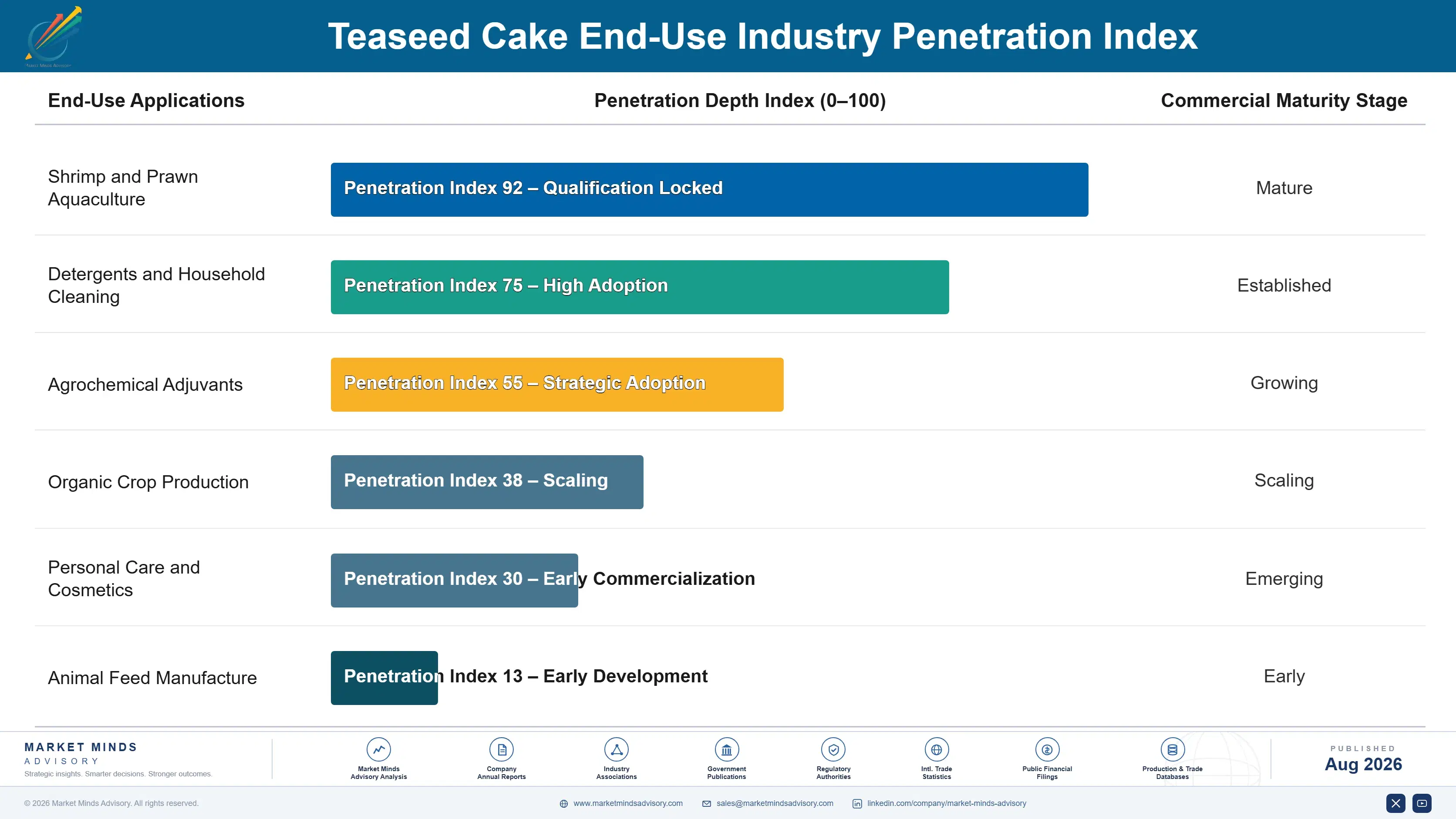
Farmers Buy, Formulators Specify

Demand comes from two buyers who behave nothing alike. A shrimp farmer buys pond preparation material through a local dealer on price and reputation, applies it before every stocking cycle and has done so for years without consulting any specification. A detergent or adjuvant formulator buys a defined saponin against an analytical certificate and qualifies the supplier before anything is purchased at all. One buys residue and the other buys a molecule.
Stickiness follows testing rather than relationship. Bulk cake supply reopens constantly because the material is treated as interchangeable and traders compete on delivered cost. Aquaculture positions hold while performance holds, since a farmer who has found something reliable rarely experiments. Extraction and formulator positions hold for years, because requalifying a natural surfactant supply is genuinely disruptive to a finished product.

The deciding influences are shifting on one side only. Farmer purchasing has been unchanged for decades and is now being reached indirectly by certification auditors and export buyers asking what went into the pond. Formulator purchasing was always specification led. That asymmetry is why the regulatory question lands entirely on the aquaculture application and barely touches anything else in this market. That asymmetry defines the whole market.
teaseed-cake-market-trends-end-use-penetration-index-1787639743037

Where We Would Put Effort

These are among the four positions where our research anticipates prominent divergence between winners and laggards over the coming forecast period. Each is grounded in the demand model, the regulatory perimeter, and the announced capacity pipeline.
01 / PRESSING ROUTE CONTRACTING

Buy the process, not the tonnage

Cold pressing retains around 78% of the saponin while hot and solvent routes destroy considerably more, and the presser chooses the route purely on oil yield because the cake is worth roughly 4% of the oil pressed from identical seed. A buyer that contracts the pressing route and pays against measured saponin content secures material that weight based purchasing simply cannot reach. It costs the presser nothing to supply once somebody is actually paying them for the difference in the residue.
02 / EXTRACTION VALUE CAPTURE

The active is worth more than the cake

Tea saponin is one of very few plant saponins available at industrial scale and natural surfactant demand grows at 9.3% against a market rate of 6.2%, while cake applied to a shrimp pond destroys that same active entirely for remarkably little money. Extraction captures several times the material value out of the very same tonne of residue. It requires capital and process capability that pressing operations do not hold, which is precisely why the opportunity has remained open for so long.
03 / REGISTRATION FUNDING INVESTMENT

Somebody has to pay for the paperwork

Pond application holds formal pesticide registration in only around 19% of the markets where it routinely occurs, because the material entered use as an agricultural residue rather than through any approval pathway at all. Certification schemes have now started asking about it directly. Registration costs money that falls on no participant in particular, which is exactly why nobody has funded it, and whoever does secures the largest application while competitors continue selling an input that holds no registration at all.
04 / SURPLUS OUTLET SECURITY

Have somewhere to put the volume

Organic amendment use grows at 7.0% and absorbs large volumes at low value per tonne, with a regulatory position that is entirely comfortable in sharp contrast to pond application of identical material. Holding that outlet gives a supplier somewhere to place volume if certification pressure disrupts aquaculture demand, which is a genuine possibility over the forecast rather than a hypothetical one. Supply cannot be reduced in response, because cake volume follows oil pressing rather than anything a cake seller decides.

Engagement Snapshot From the Field

A live engagement with an industry participant carrying material or product regulatory and market exposure ahead of a defining policy shift, showing how our research translates into a defensible multi-year portfolio strategy.
MARKET MINDS ADVISORY · CLIENT ENGAGEMENT SUMMARY
Teaseed Cake Producer Strategic Portfolio Review and Transition Roadmap 2026·Investment Scenario on Teaseed Cake Exposure Evaluation 2025-26
CLIENT PROFILE
A trading business aggregating camellia seed cake from Chinese pressing operations and supplying aquaculture and fertiliser buyers across Southeast Asia, at annual revenue near 22 million dollars (client-reported, unverified by MMA). All volume moved as bulk cake sold by weight with no content testing at any point. Extraction buyers were not served. Registration status was unexamined.
STRATEGIC CHALLENGE
Margins on bulk cake had been thin for years and several aquaculture customers had begun asking about registration status ahead of certification audits. Management wanted to understand whether the business had a future selling residue or needed to change what it was actually selling. A decision was due that year.
MMA APPROACH
MMA tested saponin content across the client's supply by pressing route, sized extraction and surfactant demand independently of aquaculture volume, assessed registration status across the client's aquaculture markets, and modelled the value captured at each point in the chain from press to formulator. Interviews with 47 experts covered camellia processing, saponin extraction and aquaculture certification.
KEY FINDINGS
  1. Saponin content across the client's supply varied by more than half depending on pressing route, and the business had never tested it or priced against it in any transaction.
  2. Extraction buyers were paying substantial premiums for cold pressed material while the client sold identical cake into aquaculture at bulk pricing without distinguishing between the two.
  3. Registration for pond application existed in none of the client's three largest aquaculture markets, and certification audits had already begun raising the question with farms directly.
  4. Fertiliser demand across the same markets was growing steadily and carried no regulatory difficulty at all, though at value per tonne well below either aquaculture or extraction use.
CLIENT PROFILE
A trading business aggregating camellia seed cake from Chinese pressing operations and supplying aquaculture and fertiliser buyers across Southeast Asia, at annual revenue near 22 million dollars (client-reported, unverified by MMA). All volume moved as bulk cake sold by weight with no content testing at any point. Extraction buyers were not served. Registration status was unexamined.
STRATEGIC CHALLENGE
Margins on bulk cake had been thin for years and several aquaculture customers had begun asking about registration status ahead of certification audits. Management wanted to understand whether the business had a future selling residue or needed to change what it was actually selling. A decision was due that year.
MMA APPROACH
MMA tested saponin content across the client's supply by pressing route, sized extraction and surfactant demand independently of aquaculture volume, assessed registration status across the client's aquaculture markets, and modelled the value captured at each point in the chain from press to formulator. Interviews with 47 experts covered camellia processing, saponin extraction and aquaculture certification.
KEY FINDINGS
  1. Saponin content across the client's supply varied by more than half depending on pressing route, and the business had never tested it or priced against it in any transaction.
  2. Extraction buyers were paying substantial premiums for cold pressed material while the client sold identical cake into aquaculture at bulk pricing without distinguishing between the two.
  3. Registration for pond application existed in none of the client's three largest aquaculture markets, and certification audits had already begun raising the question with farms directly.
  4. Fertiliser demand across the same markets was growing steadily and carried no regulatory difficulty at all, though at value per tonne well below either aquaculture or extraction use.
RECOMMENDED STRATEGY
Phase 1: Phase one: begin testing saponin content and segregating cold pressed material, which extraction buyers already pay a premium for without the business capturing any of it. Phase 2: Phase two: build direct supply relationships with saponin extraction companies rather than selling identical material into bulk aquaculture channels. Traders capture none of it. Phase 3: Phase three: develop organic amendment outlets as a surplus destination, since certification pressure on pond use is a genuine risk.
OUTCOME
The trader began content testing and segregation during 2026 and opened supply relationships with two extraction companies (client-reported, unverified by MMA). Bulk aquaculture volume was retained but no longer expanded, and fertiliser outlets were developed as a surplus destination. Content testing became standard across all incoming material.

Frequently Asked Questions

Foundational context covering the market sizes, CAGR, scope, country, region and competition that inform every finding below. This section is provided to cover basics and most often pre-purchase conversations, answered from the MMA Primary Research Dataset.

What is the current size of the Teaseed Cake Market?

MMA sizes it at USD 0.28 billion in 2025, rising to USD 0.30 billion in 2026. The figure covers camellia seed residue at producer selling value across cake, powder and pelleted forms.

How large will the Teaseed Cake Market be by 2036?

USD 0.55 billion by 2036, an incremental USD 0.25 billion over the 2026 base and an expansion multiple of 1.83 times. Saponin extraction accounts for a disproportionate share of that.

What is the CAGR for the Teaseed Cake Market 2026 to 2036?

6.2% in the base case, with a bull case at 7.4% and a bear case at 5.0%. The spread turns on extraction capacity expanding against certification pressure on unregistered pond use.

Which segment is growing fastest?

Saponin extraction for surfactants at 9.3%, half again the market rate of 6.2%. Tea saponin is one of very few plant saponins available at genuine industrial scale.

Who are the major companies in the Teaseed Cake Market?

Jiangxi Qiyunshan Food, Hunan Dashawan, Zhejiang Camellia Industry, Guangxi Fenghua and Changsha Vigorous-Tech lead on tonnage supplied. Fifteen further participants are profiled in the full report.

Which country is growing fastest?

Thailand at 10.4%, because pond preparation is required before every stocking cycle and intensive farms run multiple cycles annually, making consumption a function of turnover.

Report Segmentation Architecture

The full report scope spans multiple orthogonal segmentation dimensions, with cross-tabulated demand data provided for each dimension pair. Coverage extends further to regional breakdowns, trend trajectories, and the competitive detail needed to support segment-level decision-making.

By Application

  • Aquaculture Pond Preparation
  • Saponin Extraction for Surfactants
  • Organic Fertiliser and Soil Amendment
  • Biopesticide and Molluscicide Formulation
  • Animal Feed Ingredient
  • Industrial and Other Applications

By End-Use Industry

  • Shrimp and Prawn Aquaculture
  • Detergents and Household Cleaning
  • Agrochemical Adjuvants
  • Organic Crop Production
  • Personal Care and Cosmetics
  • Animal Feed Manufacture

By Commercial Dimension

  • Bulk Cake Trading
  • Direct Extraction Company Supply
  • Aquaculture Dealer Channels
  • Contracted Cold Pressed Supply
  • Fertiliser Distributor Channels
  • Export and Cross-Border Supply

By Region

  • North America
  • Western Europe
  • East Asia
  • South Asia and Pacific
  • Latin America
  • Middle East and Africa
  • Eastern Europe

Scope, Methodology, and Coverage

Every figure in this report is reproducible from documented input assumptions. The scope below maps the historical period, the forecast horizon, the segmentation dimensions, and the countries covered, alongside the underlying primary and qualitative methodology.
Historical Period
2020 to 2025
Forecast Period
2026 to 2036
Base Year
2025 (USD billions; MMA Primary Research Dataset, August 2026)
Market Definition
Camellia oleifera seed residue remaining after oil extraction, supplied across aquaculture pond preparation, saponin extraction for surfactants, organic fertiliser and soil amendment, biopesticide and molluscicide formulation, animal feed applications, and industrial uses. Measured at producer selling value in cake, powder and pelleted forms. Camellia seed oil itself, tea leaf and tea waste products, other oilseed meals, purified saponin sold as a finished chemical, and formulated pesticide products are excluded from scope.
Quantitative Units
USD billions (current prices); thousand tonnes supplied; USD per tonne by application grade
Segmentation Dimensions
Application; end-use industry; commercial dimension; region
Regions Covered
North America, Western Europe, East Asia, South Asia and Pacific, Latin America, Middle East and Africa, Eastern Europe
Countries Covered
China, Japan, South Korea, Taiwan, Thailand, Vietnam, Indonesia, India, Philippines, Malaysia, Bangladesh, Ecuador, Mexico, Brazil, United States, Germany, France, United Kingdom, Egypt, Saudi Arabia
Key Companies Profiled
Jiangxi Qiyunshan Food, Hunan Dashawan Camellia Oil, Zhejiang Camellia Industry, Guangxi Fenghua Camellia, Changsha Vigorous-Tech, Xi'an Lyphar Biotech, Shaanxi Undersun Biomedtech, Hunan Nutramax, Nanjing Zelang Medical, Jiangxi Global Natural Spice, Xi'an Sgonek Biological, Hunan Sunfull Bio-tech, Bolise, Naturalin Bio-Resources, Xi'an Rainbow Biotech, Shaanxi Guanjie Technology, Hunan Warrant Chiral, Ji'an Zhongxiang Natural Plants, Yichun Dahua Bio, Guilin Layn Natural Ingredients
Quantitative Methodology
Primary survey, n=3,800 respondents, Q4 2025, six countries; demand-side model with trade association cross-validation
Qualitative Methodology
47 expert interviews, Q4 2025; applied to validate demand model assumptions, identify emerging dynamics, and assess competitive positioning
Report Format
PDF and XLSX data workbook (Word format preview document)
Publisher
Market Minds Advisory
Report Code
MMA-2026-AGR-198
Published
August 2026
Contact
sales@marketmindsadvisory.com | www.marketmindsadvisory.com

Purchase the full Teaseed Cake Market Report (2026 to 2036).

The full report follows the saponin rather than the cake, because the active is worth several times the material and almost nobody in this chain prices it separately. It sizes all six applications independently through 2036, quantifies saponin retention by pressing route, and assesses registration status for pond application across every aquaculture market where the practice is routine. Regional chapters cover all seven regions with production separated from consumption throughout. Competitive profiling covers 20 participants on one consistent tonnage basis. Pressing route is tracked against downstream application throughout.
Six applications sized independently through 2036
Saponin retention quantified by pressing route and processing method
Registration status assessed across every routine aquaculture market
Extraction economics modelled against bulk cake trading margins
Camellia plantation output tracked against downstream cake availability
Twenty participants profiled on one consistent supplied tonnage basis

Built For The People Who Decide

From boardroom strategy to bench-side execution, this report is read cover-to-cover by leaders shaping the next decade of their industry, turning demand scenarios, market dynamics and valuation benchmarks into decisions.
CXOs/ Presidents/ VPs/ Managers
M&A and Corporate Development
Strategy Teams and R&D Heads
Procurement and Product Directors
Regulatory and Compliance Leaders
Investor Relations and Equity Analysts