Market Minds Advisory
Teak Decking Market

Teak Decking Market: Superyacht Demand Meets Genuine Supply Scarcity

Superyacht build volume, tightening plantation certification requirements, and genuine old-growth teak scarcity are pushing decking suppliers toward engineered and thermally modified formats that stretch limited raw material further than solid milled planking ever could.

Lead Analyst

Bilal Shaikh

Published

September 2026

Make Smarter Decisions with Customized Research Insights

Request a free sample report and evaluate market opportunities, growth trends, and competitive dynamics relevant to your business needs.

2025 MARKET VALUE$0.8BMarket Size 2025
2036 FORECAST VALUE$1.6BBase Case , 2026 to 2036
CAGR 2026 TO 20365.8 %Bull 6.9% / Bear 4.7%
INCREMENTAL OPPORTUNITY$0.7BNet 10- year value creation
EXPANSION MULTIPLE1.76x2036 value over 2026 base
Strategic Levers
M&A Pipeline
Regional Outlook
Country Rankings
Competitive Intelligence
Segmental Deep-dive
Call-Us : 91 93563 13602

Executive Snapshot and Market Trajectory

Teak decking demand is running into a genuine supply constraint, as decades of old-growth depletion and tightening plantation certification requirements push the market toward engineered formats that stretch scarce raw teak across more finished square footage. This scarcity is reshaping how the entire category now thinks about material specification decisions.
Commercial demand concentrates among superyacht builders specifying solid teak for its saltwater durability and non-slip texture, and premium residential and hospitality buyers who increasingly accept certified plantation or engineered alternatives given rising solid teak cost. Western Europe accounts for close to a quarter of global consumption, anchored by the concentration of the world's largest superyacht builders across Italy, the Netherlands, and France.
Competition remains fragmented relative to broader building materials categories, with the top five holding well under half of global capacity given the niche, relationship-driven nature of marine and premium decking supply. Teakdecking Systems and Bruynzeel Multipanel hold the deepest shipyard relationships, while engineered and thermally modified formats are opening a genuinely new category that addresses supply scarcity directly. Newer entrants remain years behind on the certification and engineering depth this segment now requires.
Market Definition
This market covers teak decking, including solid milled planking, reclaimed teak, certified plantation-grown teak, and engineered or thermally modified teak decking formats used in marine, residential, and commercial outdoor applications. It excludes non-teak hardwood decking and synthetic composite decking not incorporating teak veneer or fiber content.
Base Year Value
$0.8B in 2025 (MMA Primary Research Dataset, August 2026)
Forecast Period
2026 to 2036, eleven discrete annual values
CAGR
5.8% base case. Bull 6.9%. Bear 4.7%.
Fastest Growth Segment
Engineered and Thermally Modified Teak Decking: 8.1% CAGR
Fastest Growth Country
China: 7.4% CAGR
Fastest Growth Region
South Asia and Pacific: 7.8% CAGR
Largest Region
Western Europe: 26% of 2025 global value
Market Leaders
Teakdecking Systems Inc., Bruynzeel Multipanel B.V., Perum Perhutani (Persero), Wijma Kampen B.V., Siva Group. Source: MMA Analysis based on company annual reports.
Primary Survey
n=3,800 procurement and R&D decision-makers, Q4 2025, six countries
Methodology
Demand-side build-up, cross-validated against public data, 47 expert interviews

Teak Decking Market Forecast Scenarios

teak-decking-market-trends-size-forecast-scenario-1787311039977
Teak decking demand grew steadily through 2020 to 2025 as superyacht order books expanded and premium residential outdoor living investment increased. The market grew at an estimated 5.1% historical CAGR across the period, with engineered and certified plantation formats consistently outpacing solid old-growth-adjacent teak growth after 2022. Reclaimed teak volume grew more modestly, tracking a smaller, more specialized buyer segment.
The base case assumes 5.8% CAGR through 2036, driven by three mechanisms operating together. First, continued superyacht order growth keeps pulling solid teak demand even as raw material scarcity pushes pricing higher across the category. Second, tightening plantation certification requirements and consumer sustainability awareness are accelerating adoption of certified and engineered formats that address supply chain transparency concerns. Third, premium residential and hospitality outdoor living investment continues expanding the addressable market beyond marine applications alone.
The bull case (6.9% CAGR) assumes faster-than-expected superyacht order growth and premium residential investment pulls demand forward across both solid and engineered decking formats. The bear case (4.7% CAGR) reflects the risk that raw teak scarcity and certification-driven cost increases push a meaningful share of buyers toward non-teak hardwood or synthetic composite alternatives faster than currently expected.

Genuine Scarcity Reshapes Format Specification

Teak decking economics increasingly reward suppliers that can document legitimate, certified supply chains, since buyers, particularly superyacht builders serving reputation-conscious owners, face growing scrutiny over sourcing legality following decades of documented old-growth depletion and illegal logging concerns tied to the category. This documentation requirement rewards suppliers with established plantation relationships over those competing purely on price for undocumented material. Prod
CR5 CONCENTRATION38%share held by the top five global suppliers
AVERAGE SELLING PRICE$45-180/m2range spanning engineered to premium solid grades today
TOP PRODUCING COUNTRY SHAREIndonesia, 24%share of global certified plantation teak production now
CAPACITY UTILIZATION66%average operating rate across qualified milling and finishing facilities
TRADE INTENSITY58%of finished decking volume crossing borders before installation
FEEDSTOCK COST SHARE61% of COGSraw teak log and milling input costs combined together
Marine and premium residential buyers behave differently as customers. Superyacht builders specify solid teak against detailed grain and durability requirements, running lengthy qualification and sourcing verification before approving a supplier, while residential and hospitality buyers show more willingness to accept engineered or certified plantation alternatives that deliver comparable appearance at meaningfully lower cost. This divergence in buying behavior requires distinctly different commercial approaches for each customer type.
Over the next decade, two forces will determine winners. Continued superyacht order growth will keep expanding the addressable premium solid teak segment even as scarcity pushes pricing higher, while engineered and thermally modified formats add a second growth vector that rewards producers investing early in raw material efficiency technology. Producers investing in both vectors stand to capture the broadest share of growth.
"Teak decking is one of the few building materials categories where the supply story matters as much as the demand story. You cannot simply build more capacity when the constraint is decades of tree growth, so the producers winning right now are the ones who solved the material efficiency problem rather than the volume problem."
Director, Specialty Building Materials Practice · MMA Chemicals and Materials Pr

Market Trends

Engineered Teak Formats Stretch Scarce Raw Material Further

Producers have commercialized engineered teak decking formats that bond a thin teak veneer or reconstituted teak fiber layer onto a composite or plantation hardwood core, delivering the appearance and surface feel of solid teak while using a fraction of the raw teak volume per finished square foot. This approach directly addresses the genuine raw material scarcity facing the category, since old-growth teak stock continues depleting while plantation teak takes decades to reach commercial maturity. Several producers have expanded engineered production to serve customers unwilling to pay solid teak pricing, positioning this format as a genuine middle tier.
Market Impact: Adds 1.2 million sqft demand

Superyacht Sourcing Scrutiny Favors Certified Supply Chains

Superyacht builders and their reputation-conscious owners face growing scrutiny over teak sourcing legality, following years of documented concern about illegal logging and old-growth depletion tied to teak harvested from Myanmar and other historically undocumented sources. This scrutiny has pushed major shipyards toward suppliers who can document Forest Stewardship Council certification or equivalent chain-of-custody verification, even where certified material carries a meaningful price premium over undocumented alternatives. Several prominent shipyards have publicly committed to certified-only teak sourcing policies, a shift that has accelerated demand for suppliers able to provide credible documentation across their entire supply chain.
Market Impact: Adds 7% premium residential segment

Market Opportunities and Growth Drivers

Superyacht Order Book Growth Sustains Premium Demand

Global superyacht order books have expanded across major shipyards in Italy, the Netherlands, and Germany, sustaining demand for solid teak decking as builders continue specifying it for flagship vessel decks despite rising raw material cost. This demand has made superyacht construction the single largest driver of premium solid teak pricing power, since builders serving ultra-high-net-worth owners face less price sensitivity than residential or commercial buyers evaluating decking within a broader renovation budget. Suppliers securing early qualification with shipyards developing new vessel programs gain multi-year revenue visibility, and shipyards favor suppliers with proven certified sourcing documentation.
Market Impact: Adds 15% cost inflation

Premium Residential Outdoor Living Investment Continues

Premium residential and hospitality property owners continue investing in outdoor living space upgrades, and teak decking, whether solid, certified plantation, or engineered format, remains a specified premium material choice given its established reputation for durability and aesthetic appeal relative to alternative hardwoods. This demand has proven more resilient than some analysts expected given broader housing market volatility, since premium renovation spending tends to track high-net-worth wealth levels more closely than broader consumer housing activity. Producers serving this demand increasingly emphasize engineered and certified formats that deliver comparable appearance at more accessible price points than solid marine-grade material.
Market Impact: Adds 12 percent certification compl

Market Restraints and Challenges

Raw Teak Scarcity Drives Persistent Cost Increases

Decades of old-growth teak depletion, combined with export restrictions imposed by Myanmar since 2014 on unprocessed teak logs, have constrained the global supply of premium-grade solid teak, driving persistent cost increases that outpace general building materials inflation. This scarcity represents a genuine multi-decade supply constraint rather than a cyclical price movement, since plantation teak requires twenty to thirty years to reach commercial maturity, meaning supply cannot respond quickly to rising demand regardless of price signals. Producers are addressing this through engineered format development and expanded plantation investment, though these measures take years to meaningfully affect available supply volume.
Market Impact: Adds 10% engineered format segment

Certification Documentation Adds Cost and Complexity

Forest Stewardship Council certification and equivalent chain-of-custody documentation require sustained investment in supply chain tracking and verification infrastructure that smaller producers often lack the scale to justify, limiting how many suppliers can credibly serve reputation-conscious superyacht and premium buyers regardless of their underlying material quality. This documentation barrier has kept the certified segment more concentrated than the broader teak decking market, where verification requirements are less demanding. Smaller producers are addressing this through certification partnerships with larger aggregators, though this approach adds cost compared to in-house verification capability. Larger producers with dedicated verification staff have adopted this discipline most consistently.
Market Impact: Adds 8% certified supply chain dema
3 additional market trends, 4 additional growth drivers, and 3 additional restraints and challenges are covered in the full report. Contact sales@marketmindsadvisory.com to access the complete intelligence.

Segment CAGR and Growth Architecture

MMA segments this market by decking format, the classification builders and buyers use when specifying teak material for a given application. This lens separates solid, reclaimed, certified plantation, and engineered decking formats by underlying material sourcing and construction rather than end application alone, reflecting genuinely different supply chains. Regional origin is treated as a separate dimension.
teak-decking-market-trends-market-share-analysis-1787311040509

Engineered and Thermally Modified Teak Decking

Engineered and thermally modified teak decking is the fastest-growing segment by a wide margin, expanding directly alongside raw material scarcity as producers develop formats that deliver authentic teak surface appearance while using meaningfully less raw teak volume than solid planking. This material efficiency directly addresses the category's genuine supply constraint, since old-growth depletion and multi-decade plantation maturation timelines cannot be solved through capacity investment alone. Bruynzeel Multipanel and Wijma Kampen hold strong technical positions in this segment, having invested years in veneer bonding and thermal modification process refinement to achieve durable, authentic-feeling surface performance. Growth here concentrates among premium residential and hospitality buyers seeking authentic appearance without marine-grade pricing, giving producers exposure to the category's most accessible growth pool.
CAGR 8.1%

Certified Plantation Teak Decking

Certified plantation teak decking demand is expanding faster than the broader solid teak base, driven by superyacht builder and premium buyer scrutiny over sourcing legality that favors suppliers able to document Forest Stewardship Council certification or equivalent chain-of-custody verification. This segment commands meaningfully higher pricing than undocumented solid teak, reflecting the additional verification infrastructure investment required to maintain credible certification across the supply chain. Perum Perhutani and Siva Group maintain strong positions given established plantation operations with documented sourcing history built over years of forestry management. Growth here remains tied closely to continued reputational scrutiny among marine and premium residential buyers rather than pure cost economics alone. This growth spans multiple buyer categories rather than superyacht builders alone.
CAGR 7.0%
Full segment breakdown across 6 segments available in the complete report.

Regional Architecture and Country Demand Map

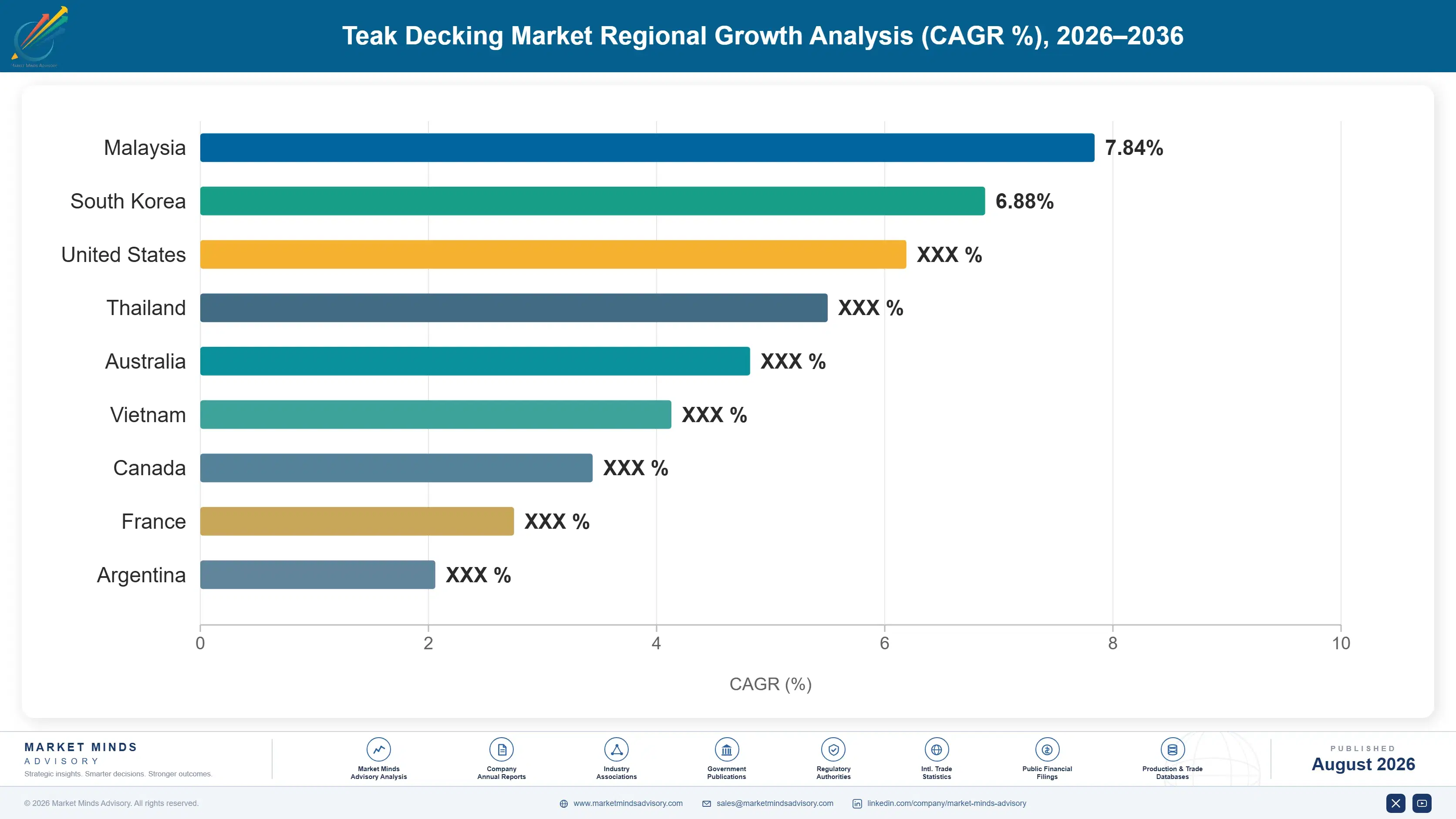
Western Europe leads teak decking consumption given the concentration of the world's largest superyacht builders across Italy, the Netherlands, and France, with East Asia and North America following through growing luxury marine and premium residential demand. South Asia posts the fastest regional growth given its established plantation base.

North America

United States premium residential and hospitality outdoor living investment anchors North American teak decking demand, concentrated among high-net-worth homeowners and resort developers in coastal and warm-climate markets. Teakdecking Systems, headquartered in Florida, maintains the deepest domestic marine industry relationships, supplying decking for both superyacht refits and premium recreational boat builders across the region. Canada contributes through smaller premium residential demand rather than significant marine industry activity comparable to United States coastal markets. Growing recreational boating and marina development along both coasts adds steady secondary demand beyond flagship superyacht applications. Growth trails the fastest-expanding Asian markets but benefits from steady premium residential renovation spending across the region's affluent coastal and suburban markets.
Share: 24% | CAGR: 6.5% (2026 to 2036)

Western Europe

Italy, the Netherlands, and France host the world's largest concentration of superyacht builders, anchoring European teak decking demand through flagship vessel construction programs that specify solid teak for flagship deck applications despite rising raw material cost. Bruynzeel Multipanel and Wijma Kampen, both headquartered in the Netherlands, maintain deep technical and sourcing relationships built over decades of marine industry supply. European Union timber legality regulation has pushed sourcing documentation requirements further in this region than in most other markets, accelerating certified and engineered format adoption among reputation-conscious builders. Premium residential demand across Southern Europe adds further consumption tied to Mediterranean outdoor living culture. Growth trails faster-expanding Asian markets given the region's already mature marine and premium residential base.
Share: 26% | CAGR: 4.5% (2026 to 2036)
Regional intelligence for 5 additional markets available in the complete report: East Asia, South Asia and Pacific, Latin America, Middle East and Africa, Eastern Europe. Contact sales@marketmindsadvisory.com.
teak-decking-market-trends-country-cagr-analysis-1787311041016

Where Teak Decking Suppliers Can Expand Margins

Suppliers create outsized value not from standard solid teak tonnage but from certification documentation depth, engineered format technology, and long-term shipyard relationships. The levers below identify where margin expands fastest, moving beyond commodity plank sales toward certified supply chains, material-efficient formats, and application-specific technical support. This favors producers investing ahead of visible demand signals.

Certification Documentation Commands Premium Market Pricing

Suppliers that maintain credible Forest Stewardship Council certification and chain-of-custody documentation capture meaningfully higher realized pricing than undocumented solid teak, often 25 to 35% more per unit volume, because reputation-conscious superyacht builders and their owners pay for sourcing legality assurance as much as the material itself. This documentation requires sustained investment in supply chain verification infrastructure, but suppliers that achieve it gain access to the highest-margin segment of the entire market well ahead of competitors still selling undocumented material. Several producers have built entire brand positioning around this documentation depth.
Market Impact: Adds 300 to 400 basis points gross

Engineered Format Technology Stretches Material Value

Suppliers that commercialize engineered teak formats using veneer bonding or thermal modification technology deliver authentic surface appearance while using meaningfully less raw teak volume per finished unit, directly addressing the category's genuine scarcity constraint. This technology requires sustained process development investment, but suppliers achieving it capture volume from an expanding addressable market of buyers unwilling to pay solid teak pricing, typically at gross margins 8 to 12% above what equivalent solid material would deliver given lower raw material intensity. This material efficiency has become a genuine competitive advantage as raw teak scarcity continues intensifying across the category.
Market Impact: Adds 8 to 12 percentage points of m

Shipyard Technical Support Deepens Builder Relationships

Suppliers that embed technical representatives to support shipyard installation crews, addressing specific vessel deck design and fastening requirements, capture value well beyond raw material sales through deepened builder relationships. Teakdecking Systems and Bruynzeel Multipanel both maintain dedicated technical support capability alongside major shipyards, providing installation guidance that smaller material-only suppliers cannot match, typically adding 10 to 15% to effective pricing beyond raw material value. Suppliers offering this support report measurably deeper shipyard relationships than commodity material sellers. This engineering layer has become a meaningful differentiator among shipyards evaluating competing material suppliers for flagship vessel programs.
Market Impact: Adds a 10 to 15 percent effective p

Long-Term Shipyard Supply Qualification Partnerships Pay Off

Suppliers that invest in joint qualification programs with major shipyards, embedding technical staff to co-develop decking specifications for specific vessel programs, secure supply relationships that persist across multiple vessel builds once qualified. Qualification with a major shipyard typically takes 6 to 12 months but results in multi-year supply commitments that are difficult for competitors to displace afterward, since requalifying an alternative supplier carries real sourcing verification cost that most shipyards avoid absorbing without strong cause. Suppliers value this predictability highly given the relationship-driven nature of this market. This predictability supports better capacity planning.
Market Impact: Secures a 6 to 12 month qualificati

Who Controls the Margin Pool

CR5 stands at 38%, reflecting a genuinely fragmented market given the relationship-driven, niche nature of marine and premium decking supply where many regional and specialty suppliers compete for individual shipyard and builder relationships. The gap between these five leaders and smaller regional suppliers is widest in certification documentation depth and established shipyard relationships built over decades. This concentration has persisted for years given the relationship-driven nature of t
Competition currently plays out across three dimensions: certification documentation depth among suppliers serving reputation-conscious superyacht builders, engineered format technology development among producers addressing raw material scarcity, and plantation supply chain control among the largest integrated forestry operations. Smaller regional suppliers compete primarily on price for less-documented material, where certification barriers remain less relevant to price-sensitive residential buyers.

Emerging pressure comes from two directions. Engineered format technology could reorder competitive rankings if raw material scarcity accelerates faster than currently expected, favoring producers with early technology investment over those relying on solid material alone. Certification requirements spreading beyond marine applications into broader premium residential specification could also favor documented suppliers over price-focused competitors lacking verification infrastructure. Neither trend is likely to reorder the top five within a few years.
teak-decking-market-trends-company-positioning-matrix-1787311041538

Competitive Moat and Risk Dimensions

TEAKDECKING SYSTEMS INC.

Moat: Deepest Superyacht Shipyard Relationships

Teakdecking Systems has built extensive relationships across major superyacht shipyards, built over decades of flagship vessel deck supply, giving it preferred supplier status when builders plan new vessel programs requiring proven, reliable teak sourcing and installation support. This depth is difficult for smaller competitors to replicate quickly.
TEAKDECKING SYSTEMS INC.

Risk: Concentrated Marine Segment Exposure

Teakdecking Systems' revenue base remains concentrated in marine applications, leaving it more exposed than diversified competitors to any slowdown in superyacht order activity, a cyclical dynamic tied closely to ultra-high-net-worth wealth trends and discretionary luxury spending patterns. This exposure has become a more prominent concern during recent periods of softer luxury spending.
BRUYNZEEL MULTIPANEL B.V.

Moat: Engineered Format Technical Depth

Bruynzeel Multipanel has invested substantially in engineered and thermally modified teak format technology, positioning it well to serve both marine and premium residential customers seeking material efficiency that competitors relying purely on solid teak supply cannot match. This positioning, built through sustained investment, remains difficult for competitors to replicate quickly.
BRUYNZEEL MULTIPANEL B.V.

Risk: Smaller Upstream Scale

Bruynzeel Multipanel operates at smaller overall scale than the largest integrated forestry and plantation operators, limiting its ability to control upstream raw material costs as directly as vertically integrated competitors with their own plantation operations. This gap could widen further as raw material scarcity continues intensifying across the category.

Players Tracked

Prominent Players

Teakdecking Systems Inc.
Bruynzeel Multipanel B.V.
Perum Perhutani (Persero)
Wijma Kampen B.V.
Siva Group

Other Key Players

PT Sumber Graha Sejahtera
Danzer Group
James Latham plc
International Wood Products LLC
UPM Timber
Myanmar Timber Enterprise
Vietnam Forestry Corporation (Vinafor)
Flexiteek International AS
Esthec B.V.
Marinedeck
Robbins Timber Ltd.
Nova USA Wood Products LLC
Timbmet Group Ltd.
Interholco AG
Metsä Group

Recent Developments

MARCH 2025

Bruynzeel Multipanel Expands Engineered Teak Production in the Netherlands

Bruynzeel Multipanel announced completion of a capacity expansion at its Dutch production facility, adding qualified engineered teak decking capacity to serve growing premium residential and hospitality demand. The expansion follows several years of veneer bonding process refinement supporting authentic surface performance. The expansion targets continued demand from cost-sensitive premium buyers.
Signal: Confirms leading producers are dedicating
AUGUST 2025

Perum Perhutani Expands Certified Plantation Capacity in Indonesia

Perum Perhutani announced expansion of its certified teak plantation operations across Java, adding documented sustainable supply capacity to serve growing demand from reputation-conscious marine and premium residential buyers. The expansion follows years of forestry management investment supporting certification credibility. Analysts view this as evidence of continued certification investment.
Signal: Signals major plantation operators are sca
JANUARY 2026

Teakdecking Systems and a Major Shipyard Sign Multi-Year Supply Agreement

Teakdecking Systems signed a multi-year supply agreement with a major European superyacht builder covering certified solid teak decking for a series of flagship vessel programs. The agreement secures forward volume for Teakdecking Systems at negotiated pricing ahead of the builder's planned production schedule. The agreement reflects tightening scrutiny industry-wide.
Signal: Signals shipyards are increasingly securin

Raw Teak Log and Milling Feedstock Exposure

Raw teak log procurement and milling costs together account for roughly 61% of cost of goods sold across finished decking production, with pricing driven by genuine scarcity dynamics rather than typical commodity supply and demand cycles given multi-decade plantation maturation timelines. Producers without long-term plantation supply relationships face direct exposure to spot market scarcity pricing.
Raw teak log prices rose sharply across 2023 and 2024, documented in company annual reports and Indonesian forestry ministry disclosures, as continued export restrictions from Myanmar and growing global demand pulled available certified supply tighter than in prior years. Several producers reported compressed margins during this period, since customer pricing on longer-term shipyard contracts could not be renegotiated quickly enough to reflect rising log cost, illustrating how directly feedstock scarcity can affect near-term profitability.

This exposure disadvantages producers without established plantation relationships relative to larger competitors with direct sourcing agreements or vertically integrated plantation operations, widening margin gaps during periods of tightening supply that cannot be resolved through efficiency gains alone. Producers without formal supply agreements absorb scarcity pricing directly in margin, while larger integrated players like Perum Perhutani control cost through direct plantation ownership.
teak-decking-market-trends-cost-volatility-analysis-1787311041733

Direct Plantation Supply Agreements

Producers are securing long-term supply agreements directly with plantation operators, reducing exposure to spot market scarcity pricing that has affected undocumented supply chains most severely. This approach has become more common since 2023 as producers sought greater sourcing security following recent tightening. Larger producers with global sourcing networks have adopted this approach most consistently.

Vertical Integration Into Plantation Ownership

Larger producers are investing directly in plantation ownership or long-term forestry management agreements, capturing more value from the supply chain while gaining greater control over future raw material availability. This integration requires substantial capital investment but insulates future supply from spot market volatility. This integration has proven especially valuable during recent periods of tightening supply.

Engineered Format Material Efficiency

Producers are shifting production mix toward engineered and thermally modified formats that use meaningfully less raw teak volume per finished unit, directly reducing exposure to raw material scarcity pricing. This approach has become increasingly attractive as the cost gap between solid and engineered formats has widened. Several major producers now treat this as a core strategic priority.

Portfolio Architecture for Margin Defence

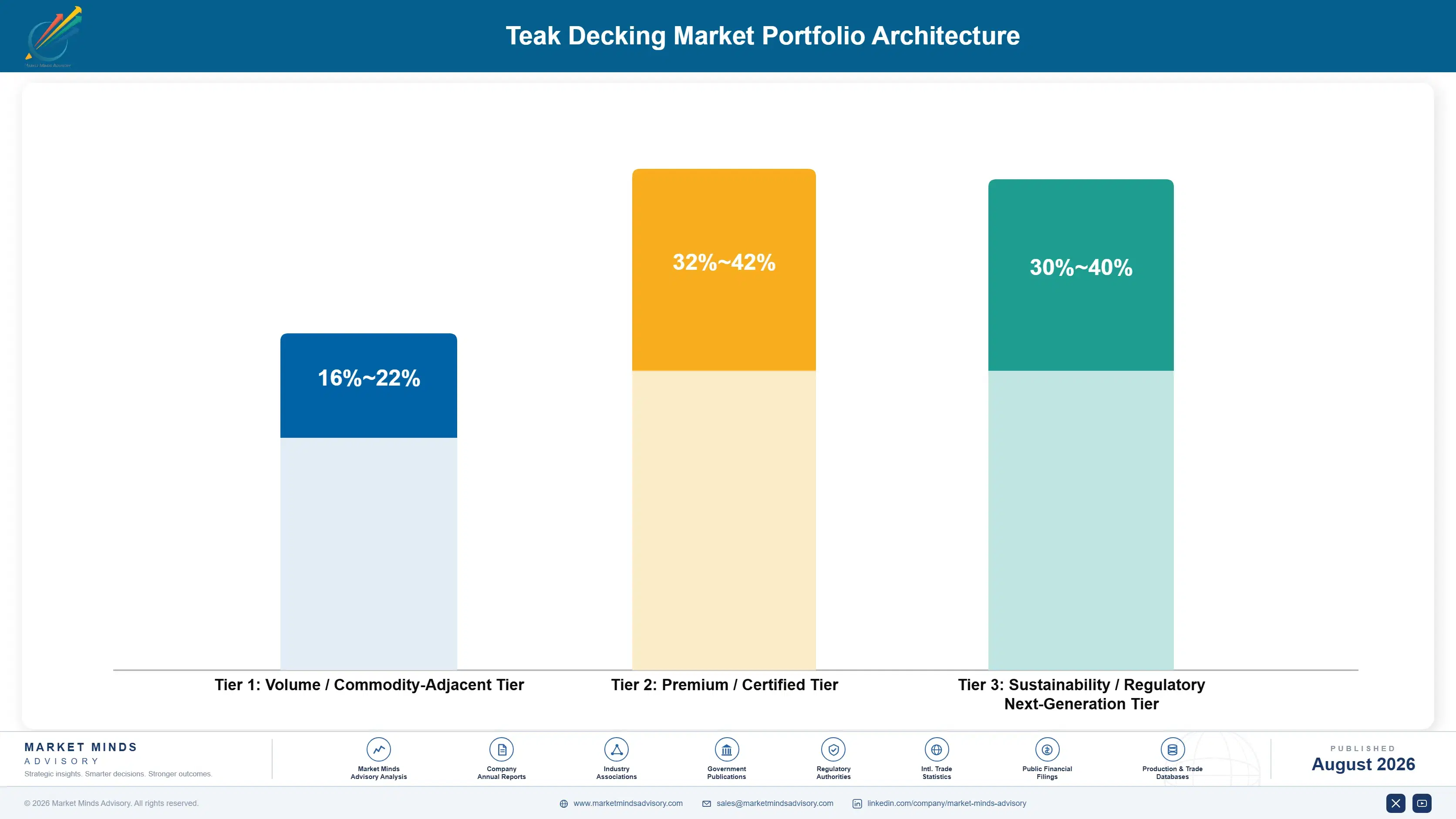
MMA organizes this market into three tiers by material sourcing and margin profile. The volume tier covers standard undocumented or lower-grade teak sold into cost-sensitive residential applications, competing primarily on price. The premium tier covers certified solid teak qualified for superyacht and reputation-conscious buyer applications, commanding higher margins through documentation and shipyard relationships. The sustainability tier captures engineered and thermally modified formats stil
Volume tier producers compete on price and material access with moderate margins, while premium tier suppliers protect pricing power through certification and relationship barriers that keep new entrants out for years. This creates real tension inside diversified producers, since capital allocated to sustaining standard supply competes directly with capital needed to fund certification infrastructure and engineered format development, and most large producers now favor the latter given superior long-term returns.

The highest-value pools concentrate in certified solid teak for superyacht applications and engineered formats addressing raw material scarcity, where documentation barriers and durable shipyard relationships combine to support the strongest pricing power in the entire market. Vertically integrated plantation operations are emerging as a further high-value position as raw material scarcity continues intensifying.

Volume / Commodity-Adjacent Tier

Standard undocumented or lower-grade teak decking sold into cost-sensitive residential applications, competing primarily on price with limited certification or technical differentiation between suppliers. Material access and price dominate purchasing decisions in this tier for most buyers.
Gross Margin: 16-22%

Premium / Certified Tier

Certified solid teak decking qualified for superyacht and reputation-conscious premium buyer applications, commanding higher margins through documentation barriers and long-term shipyard supply relationships. Suppliers here typically hold multi-year shipyard relationships built through sustained collaboration.
Gross Margin: 32-42%

Sustainability / Regulatory / Next-Generation Tier

Engineered and thermally modified teak decking formats positioned ahead of intensifying raw material scarcity, commanding premium pricing from technically demanding early-adopter customers. Scale remains modest today but growth here outpaces the rest of the market by a wide margin.
Gross Margin: 30-40%
teak-decking-market-trends-portfolio-architecture-1787311042238

High-value Sub-segments and Strategic Watch-out

Certified Solid Teak for Superyacht Applications

This segment combines the highest documentation barriers in the market with steady, reputation-driven demand tied to ultra-high-net-worth spending rather than broader housing cycles. Qualified suppliers hold a durable advantage. New entrants face years of relationship building before reaching comparable qualification depth. This barrier persists for years.
Gross Margin: 36-46%

Engineered and Thermally Modified Formats

Raw material scarcity is driving steady demand growth largely independent of broader premium building material cycles, with established process technology providing meaningful competitive protection against new entrants lacking comparable depth. Established process technology provides meaningful protection against new entrants lacking equivalent depth. This growth compounds steadily each year.
Gross Margin: 32-42%

Standard Residential-Grade Teak Decking

The largest volume base by installed area, this segment covers standard-grade decking sold into cost-sensitive residential applications, where competition is driven mostly by price rather than deep technical or certification differentiation. Distribution reach and price consistency matter more than technical differentiation in this segment. Scale still matters here.
Gross Margin: 14-20%

Vertically Integrated Plantation Operations

Large forestry operators are investing in direct plantation ownership to control future raw material availability, a trajectory worth monitoring closely by non-integrated competitors over the coming several years. Established non-integrated suppliers are watching this trajectory closely as scarcity keeps intensifying. This trend bears close watching.
Gross Margin: 20-28%

Shipyard Relationship Depth and Buyer Loyalty

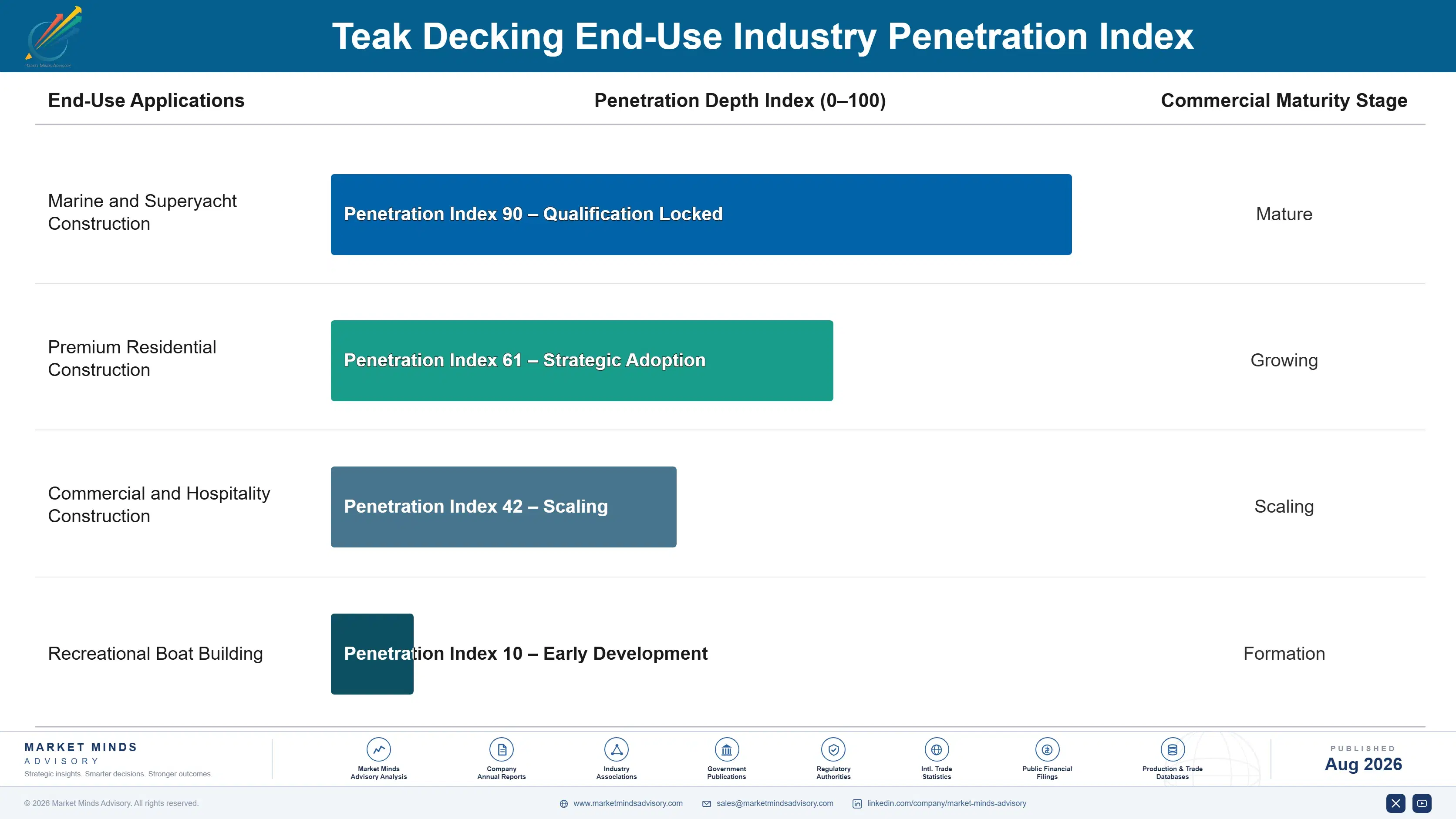
Once a supplier is qualified into a shipyard's approved material list, that relationship typically persists across multiple vessel programs, since requalifying an alternative supplier carries real sourcing verification cost that most shipyards avoid absorbing without strong cause. This creates durable, low-churn revenue characteristics once qualification is achieved, distinct from the more competitive initial qualification-seeking phase. Merchant relationships without formal qualification show m
Adoption depth varies sharply by vertical. Superyacht shipyards show the deepest stickiness once a supplier is qualified, since switching requires extensive sourcing documentation review that most builders avoid mid-program. Premium residential and hospitality buyers show moderate stickiness tied to project-specific specification decisions. Standard residential buyers show the least stickiness of the three, since these purchases occur infrequently and reopen sourcing decisions each time without any established supplier relationship carrying forward.

Buyer profiles are shifting generationally as superyacht owners and premium residential buyers increasingly weigh sourcing legality and sustainability credentials, not just appearance and durability, as explicit material selection criteria. Younger builder and procurement teams increasingly favor suppliers with credible certification and engineered format positioning, a consideration barely present in sourcing decisions before recent sustainability awareness intensified significantly.
teak-decking-market-trends-end-use-penetration-index-1787311042726

Where MMA Sees the Opportunity

These are among the four positions where our research anticipates prominent divergence between winners and laggards over the coming forecast period. Each is grounded in the demand model, the regulatory perimeter, and the announced capacity pipeline.
01 / CERTIFICATION INFRASTRUCTURE INVESTMENT

Build Credible Certification Documentation Ahead of Scrutiny

Certification documentation commands the strongest pricing power in the entire market, and suppliers that invest in supply chain verification infrastructure now position themselves ahead of continued reputational scrutiny among superyacht builders and premium buyers through 2036. This investment requires sustained commitment to sourcing transparency, but suppliers that achieve credible certification gain access to the highest-margin segment of the entire market well ahead of competitors still selling undocumented material. Waiting until scrutiny intensifies further risks ceding this documentation advantage to suppliers who invested earlier.
02 / ENGINEERED FORMAT DEVELOPMENT

Commercialize Engineered Formats Ahead of Scarcity Intensification

Raw teak scarcity represents a genuine, multi-decade supply constraint that capacity investment alone cannot solve, and suppliers that commercialize engineered format technology now position themselves as the material-efficient alternative buyers will increasingly need as scarcity intensifies further. This technology requires sustained process development investment, but suppliers achieving it capture volume from an expanding addressable market of buyers unwilling to pay solid teak pricing. This positioning also provides a durable hedge against continued raw material cost inflation over the coming decade.
03 / PLANTATION VERTICAL INTEGRATION

Pursue Plantation Ownership to Control Future Supply

Vertically integrated plantation ownership provides the most durable long-term protection against continued raw material scarcity, and producers that invest in direct plantation relationships or ownership now secure future supply access that non-integrated competitors will struggle to match as scarcity intensifies. This investment requires substantial capital and multi-decade patience given plantation maturation timelines, but producers that commit early capture a durable advantage over competitors relying entirely on spot market sourcing. This advantage compounds further as scarcity intensifies across the broader category over time.
04 / SHIPYARD TECHNICAL SUPPORT

Deepen Shipyard Technical Support to Extend Qualification Life

Shipyards value technical support that reduces installation risk and extends the practical life of qualified supply relationships across multiple vessel programs, a service layer that generic material-only suppliers cannot easily replicate. Suppliers that embed technical representatives to support shipyard installation crews deepen relationships and improve retention meaningfully compared to commodity material sellers competing purely on price. This capability requires technical staff investment but is considerably less capital-intensive than building new plantation capacity, making it accessible even to mid-scale suppliers with limited capital budgets.

Engagement Snapshot From the Field

A live engagement with an industry participant carrying material or product regulatory and market exposure ahead of a defining policy shift, showing how our research translates into a defensible multi-year portfolio strategy.
MARKET MINDS ADVISORY · CLIENT ENGAGEMENT SUMMARY
Teak Decking Producer Strategic Portfolio Review and Transition Roadmap 2026·Investment Scenario on Teak Decking Exposure Evaluation 2025-26
CLIENT PROFILE
The client is a mid-sized European superyacht builder generating approximately $420 million in annual revenue (client-reported, unverified by MMA) from custom vessel construction serving ultra-high-net-worth owners. The builder faced growing pressure from prospective clients requesting documented sustainable teak sourcing for flagship deck material amid increasing media scrutiny of the marine industry's environmental practices. The builder had built its reputation on custom, high-specification vessel construction.
STRATEGIC CHALLENGE
The client needed to decide whether to transition its entire teak decking supply chain to fully certified plantation sources, at an estimated cost premium of approximately 30% (client-reported, unverified by MMA) over its existing supplier relationships, or maintain its current mixed sourcing approach while risking client-facing reputational exposure on sourcing documentation requests.
MMA APPROACH
MMA's advisory team conducted primary interviews with certified teak suppliers about available capacity and pricing, and surveyed comparable superyacht builders about client sourcing documentation requests to assess how quickly reputational risk was actually increasing across the industry. The analysis weighed the cost premium against genuine commercial risk of losing high-value client relationships over sourcing transparency concerns.
KEY FINDINGS
  1. Survey data indicated that sourcing documentation requests from prospective clients had increased significantly over the prior two years, with several comparable builders reporting lost bids specifically tied to sourcing transparency concerns.
  2. Certified supplier capacity was sufficient to serve the client's full annual decking requirements without significant lead time extension, based on interviews with the client's two largest prospective certified suppliers.
  3. The 30% cost premium represented a modest share of total vessel construction cost, given decking represents a small fraction of overall build value for a typical flagship vessel program.
  4. Comparable builders that completed similar certification transitions reported improved ability to win bids specifically citing sourcing transparency as a competitive differentiator against builders unable to provide comparable documentation.
CLIENT PROFILE
The client is a mid-sized European superyacht builder generating approximately $420 million in annual revenue (client-reported, unverified by MMA) from custom vessel construction serving ultra-high-net-worth owners. The builder faced growing pressure from prospective clients requesting documented sustainable teak sourcing for flagship deck material amid increasing media scrutiny of the marine industry's environmental practices. The builder had built its reputation on custom, high-specification vessel construction.
STRATEGIC CHALLENGE
The client needed to decide whether to transition its entire teak decking supply chain to fully certified plantation sources, at an estimated cost premium of approximately 30% (client-reported, unverified by MMA) over its existing supplier relationships, or maintain its current mixed sourcing approach while risking client-facing reputational exposure on sourcing documentation requests.
MMA APPROACH
MMA's advisory team conducted primary interviews with certified teak suppliers about available capacity and pricing, and surveyed comparable superyacht builders about client sourcing documentation requests to assess how quickly reputational risk was actually increasing across the industry. The analysis weighed the cost premium against genuine commercial risk of losing high-value client relationships over sourcing transparency concerns.
KEY FINDINGS
  1. Survey data indicated that sourcing documentation requests from prospective clients had increased significantly over the prior two years, with several comparable builders reporting lost bids specifically tied to sourcing transparency concerns.
  2. Certified supplier capacity was sufficient to serve the client's full annual decking requirements without significant lead time extension, based on interviews with the client's two largest prospective certified suppliers.
  3. The 30% cost premium represented a modest share of total vessel construction cost, given decking represents a small fraction of overall build value for a typical flagship vessel program.
  4. Comparable builders that completed similar certification transitions reported improved ability to win bids specifically citing sourcing transparency as a competitive differentiator against builders unable to provide comparable documentation.
RECOMMENDED STRATEGY
Phase 1: Phase 1 (Months 1-3): Qualify two certified plantation suppliers capable of meeting the client's annual volume requirements across current and planned vessel programs. Phase 2: Phase 2 (Months 4-8): Transition current vessel programs to certified material sourcing, prioritizing flagship builds most likely to face client sourcing documentation requests. Phase 3: Phase 3 (Months 9-12): Complete the full sourcing transition and incorporate certification documentation into standard client-facing sales and marketing materials going forward.
OUTCOME
The client completed the certified sourcing transition within the planned twelve-month window and reported winning two subsequent vessel program bids where prospective clients specifically cited sourcing transparency as a factor in the builder selection decision. The client estimated the transition secured $85 million (client-reported, unverified by MMA) in new revenue that competitors lacking documentation could not match.

Frequently Asked Questions

Foundational context covering the market sizes, CAGR, scope, country, region and competition that inform every finding below. This section is provided to cover basics and most often pre-purchase conversations, answered from the MMA Primary Research Dataset.

What is the current size of the Teak Decking Market?

The Teak Decking Market was valued at $0.85 billion in 2025. MMA projects it will reach $0.9 billion in 2026 as superyacht and premium residential demand both continue expanding.

How large will the Teak Decking Market be by 2036?

MMA forecasts the market will reach $1.58 billion by 2036, up from $0.9 billion in 2026. That represents a 1.76 times expansion over the ten-year forecast window.

What is the CAGR for the Teak Decking Market 2026 to 2036?

The market is projected to grow at a 5.8% CAGR between 2026 and 2036. MMA's bull and bear scenarios range from 6.9% to 4.7% depending on superyacht order growth and raw material scarcity.

Which segment is growing fastest?

Engineered and Thermally Modified Teak Decking is the fastest-growing segment, expanding at an 8.1% CAGR, roughly 1.40 times the overall market rate as raw material scarcity accelerates adoption.

Who are the major companies in the Teak Decking Market?

Teakdecking Systems, Bruynzeel Multipanel, Perum Perhutani, Wijma Kampen, and Siva Group lead the market, together holding an estimated 38% of global supply. This fragmentation reflects the niche, relationship-driven nature of this market.

Which country is growing fastest?

China is the fastest-growing country market, expanding at an estimated 7.4% CAGR as its domestic luxury boat building and premium residential markets continue rapid expansion.

Report Segmentation Architecture

The full report scope spans multiple orthogonal segmentation dimensions, with cross-tabulated demand data provided for each dimension pair. Coverage extends further to regional breakdowns, trend trajectories, and the competitive detail needed to support segment-level decision-making.

By Primary Market Dimension

  • Solid Milled Teak Decking
  • Reclaimed Teak Decking
  • Certified Plantation Teak Decking
  • Engineered and Thermally Modified Teak Decking
  • Marine-Grade Solid Teak Decking
  • Residential-Grade Teak Decking

By End-Use Industry

  • Marine and Superyacht Construction
  • Premium Residential Construction
  • Commercial and Hospitality Construction
  • Recreational Boat Building

By Commercial Dimension

  • Shipyard Direct Supply
  • Builder and Contractor Supply
  • Distribution and Trading
  • Plantation Direct Sales

By Region

  • North America
  • Western Europe
  • East Asia
  • South Asia and Pacific
  • Latin America
  • Middle East and Africa
  • Eastern Europe

Scope, Methodology, and Coverage

Every figure in this report is reproducible from documented input assumptions. The scope below maps the historical period, the forecast horizon, the segmentation dimensions, and the countries covered, alongside the underlying primary and qualitative methodology.
Historical Period
2020 to 2025
Forecast Period
2026 to 2036
Base Year
2025 (USD billions; MMA Primary Research Dataset, August 2026)
Market Definition
This report covers teak decking, including solid milled planking, reclaimed teak, certified plantation-grown teak, and engineered or thermally modified teak decking formats used in marine, residential, and commercial outdoor applications. It excludes non-teak hardwood decking and synthetic composite decking not incorporating teak veneer or fiber content.
Quantitative Units
USD billions (current prices); square meters of installed decking area where applicable
Segmentation Dimensions
By Decking Format; By End-Use Industry; By Commercial Dimension; By Region
Regions Covered
North America, Western Europe, East Asia, South Asia and Pacific, Latin America, Middle East and Africa, Eastern Europe
Countries Covered
USA, China, Germany, France, UK, Japan, South Korea, India, Australia, Canada, Brazil, Mexico, Indonesia, Vietnam, Thailand, Malaysia, UAE, Saudi Arabia, South Africa, Nigeria, Turkey, Poland, Netherlands, Italy, Spain, Sweden, Switzerland, Argentina, Colombia, Singapore, and additional markets relevant to this sector
Key Companies Profiled
Teakdecking Systems Inc., Bruynzeel Multipanel B.V., Perum Perhutani (Persero), Wijma Kampen B.V., Siva Group, PT Sumber Graha Sejahtera, Danzer Group, James Latham plc, International Wood Products LLC, UPM Timber, Myanmar Timber Enterprise, Vietnam Forestry Corporation (Vinafor), Flexiteek International AS, Esthec B.V., Marinedeck, Robbins Timber Ltd., Nova USA Wood Products LLC, Timbmet Group Ltd., Interholco AG, Metsä Group
Quantitative Methodology
Primary survey, n=3,800 respondents, Q4 2025, six countries; demand-side model with trade association cross-validation
Qualitative Methodology
47 expert interviews, Q4 2025; applied to validate demand model assumptions, identify emerging dynamics, and assess competitive positioning
Report Format
PDF and XLSX data workbook (Word format preview document)
Publisher
Market Minds Advisory
Report Code
MMA-2026-CHM-113
Published
August 2026
Contact
sales@marketmindsadvisory.com | www.marketmindsadvisory.com

Purchase the full Teak Decking Market Report (2026 to 2036).

The full Teak Decking Market report delivers ten-year forecasts across all seven regions, six product segments, and the full competitive landscape of twenty profiled suppliers. It includes detailed analysis of certification documentation economics, engineered format technology, and demand drivers spanning marine, residential, and hospitality construction applications. Buyers receive segment-level margin benchmarking across the volume, premium, and sustainability tiers identified in this summary. The report also includes primary survey data from 3,800 respondents and 47 expert interviews conducted in the fourth quarter of 2025, supporting every demand and pricing assumption in the forecast.
Ten-year regional and segment-level forecast models
Competitive profiles covering twenty decking suppliers
Certification documentation economics and case data
Engineered format technology and scarcity mapping
Portfolio margin benchmarking across three commercial tiers
Primary survey and expert interview data appendix

Built For The People Who Decide

From boardroom strategy to bench-side execution, this report is read cover-to-cover by leaders shaping the next decade of their industry, turning demand scenarios, market dynamics and valuation benchmarks into decisions.
CXOs/ Presidents/ VPs/ Managers
M&A and Corporate Development
Strategy Teams and R&D Heads
Procurement and Product Directors
Regulatory and Compliance Leaders
Investor Relations and Equity Analysts