Market Minds Advisory
Target Unmanned Aerial Vehicles Market

Target Unmanned Aerial Vehicles Market: Target Unmanned Aerial Vehicles: Ammunition Economics, Threat Representativeness and the Pull Downmarket

Air defence crews now train against drones costing twenty thousand dollars, and a supersonic target priced at well over a million cannot replicate that threat, which is pulling an entire product line downmarket.

Lead Analyst

Published

September 2026

Make Smarter Decisions with Customized Research Insights

Request a free sample report and evaluate market opportunities, growth trends, and competitive dynamics relevant to your business needs.

2025 MARKET VALUE$2.0BMarket Size 2025
2036 FORECAST VALUE$5.0BBase Case , 2026 to 2036
CAGR 2026 TO 20368.6 %Bull 9.9% / Bear 7.4%
INCREMENTAL OPPORTUNITY$2.8BNet 10- year value creation
EXPANSION MULTIPLE2.27x2036 value over 2026 base
Strategic Levers
M&A Pipeline
Regional Outlook
Country Rankings
Competitive Intelligence
Segmental Deep-dive
Call-Us : 91 93563 13602

Executive Snapshot and Market Trajectory.

Target drones are the only defence product whose commercial success requires its own destruction. That has always made the economics closer to ammunition than to aircraft. What changed recently is the threat being replicated: crews now need to train against drones costing twenty thousand dollars, not missiles costing millions.
Two commercial forces dominate. Air defence expansion across East Asia and South Asia is adding live-fire training requirements faster than range capacity can absorb them, and the one-way attack drone has forced every major air arm to buy cheap swarm-capable targets it never previously specified. Expendable swarm targets grow fastest at 12.9%, half again the market rate of 8.6%, from a small base.
Five suppliers hold 58% of deliveries and the field is stable, but not for the usual reason. Certification barely matters here. What protects incumbents is the test range relationship: a target that has flown successfully on a customer's range and integrated with its scoring and telemetry systems is difficult to displace. The pressure now comes from below, as low-cost entrants sell swarm targets at prices established suppliers cannot reach with their existing airframe designs.
Market Definition
Target unmanned aerial vehicles are recoverable or expendable air vehicles flown to represent a threat during weapons testing, air defence qualification and live-fire crew training. Scope covers subsonic and supersonic jet targets, full-scale converted aircraft targets, subscale propeller and rotary targets, expendable swarm-capable targets, and ballistic or hypersonic target vehicles, together with the mission payloads that make them representative. Excluded are ground and naval surface targets, towed targets, launch and recovery infrastructure sold separately, range instrumentation and scoring systems, and operational reconnaissance or strike unmanned aircraft.
Base Year Value
$2.0B in 2025 (MMA Primary Research Dataset, September 2026)
Forecast Period
2026 to 2036, eleven discrete annual values
CAGR
8.6% base case. Bull 9.9%. Bear 7.4%.
Fastest Growth Segment
Expendable Swarm-Capable Aerial Targets: 12.9% CAGR
Fastest Growth Country
India: 12.2% CAGR
Fastest Growth Region
South Asia and Pacific: 10.9% CAGR
Largest Region
North America: 35% of 2025 global value
Market Leaders
Kratos Defense and Security Solutions, QinetiQ Target Systems, Airbus Defence and Space, Northrop Grumman, Leonardo. Source: MMA Analysis based on annual target vehicle deliveries and contracted programme value, July 2026.
Primary Survey
n=3,800 procurement and R&D decision-makers, Q4 2025, six countries
Methodology
Demand-side build-up, cross-validated against public data, 47 expert interviews

Target Unmanned Aerial Vehicles Market Forecast Scenarios

target-unmanned-aerial-vehicles-market-size-forecast-scenario-1790025819958
The 2020 to 2025 period split cleanly in two. Training activity fell through 2020 and 2021 as ranges cut operating tempo, then rebounded hard from 2022 as European and Asian air arms rebuilt readiness and air defence expenditure rose across almost every budget line. Growth across the period averaged 7.3%, with consumption in the final two years well ahead of that figure.
Base case growth of 8.6% rests on three mechanisms. Sustained air defence procurement across East Asia and South Asia creates qualification requirements for every new interceptor that enters service. The one-way attack drone threat has created demand for a cheap target class that barely existed in 2020. And US Navy and Air Force target programmes are moving to multi-year delivery contracts, which converts annual budget exposure into committed production volume for the suppliers holding them.
The bull case at 9.9% assumes swarm target procurement scales to the volumes air defence commanders are requesting rather than the volumes currently funded. Ranges would need to expand to absorb it. The bear case at 7.4% follows from range capacity rather than budgets: live-fire training is constrained by airspace and safety footprint, and targets cannot be consumed faster than ranges host them.

Consumption Economics and the Threat Representativeness Problem

Nothing about this market behaves like an aircraft market. Revenue depends on how many targets customers destroy, which means supplier forecasting rests on range activity and interceptor test schedules rather than fleet size. A good year for a target supplier is a year when air defence units shot well and shot often.
FIVE-FIRM CONCENTRATION58%Range relationships rather than certification protect incumbent positions
AVERAGE TARGET UNIT PRICEUSD 0.9MBlended across subsonic, supersonic and expendable vehicle classes
TOP PROCURING COUNTRY SHARE31%Single national share of annual target vehicle consumption
ANNUAL CONSUMPTION RATE1,450 unitsTargets expended or lost across all customer ranges
RECOVERABLE SORTIE LIFE18 sortiesAverage flights achieved before loss on recoverable airframes
PROPULSION COST SHARE27%Small turbojet content as portion of delivered cost
Threat representativeness is where the commercial argument now sits. Air defence crews spent thirty years training against targets that emulated aircraft and cruise missiles, and those targets were expensive because the threats were. Cheap one-way attack drones broke that logic completely. A target priced above a million dollars cannot replicate a threat costing twenty thousand, and no amount of performance margin fixes that. Every major supplier is now building downmarket, which is uncomfortable work for firms whose engineering culture was built around supersonic performance.
Range capacity is the constraint nobody in the supply chain controls. Live-fire engagements need cleared airspace, a safety footprint and recovery arrangements, and the number of ranges able to host supersonic profiles is small. That ceiling explains why consumption grows more slowly than air defence procurement, and why range-adjacent services have become a defensible revenue line for suppliers able to offer them.
"Everyone in this industry can tell you the top speed of their target. Very few can tell you what it costs per successful engagement, which is the only number the customer is actually managing."
Director, Defence Test and Training Systems Practice · MMA Defence Systems / Test and Training Equipment Practice · September 2026

Market Trends

Swarm Replication Becomes A Standard Training Requirement

Air defence units that once qualified against a single inbound target now need to face several simultaneously, because that is how one-way attack drones are actually employed. Replicating it requires numbers rather than performance, and numbers require unit costs an order of magnitude below the established target classes. Suppliers have responded with simplified airframes, commercial propulsion and reduced recoverability, accepting that these targets are consumed rather than reused. The engineering is straightforward; the commercial adjustment is not, because gross margin per unit falls even as unit volume rises sharply. Volume, not performance, now decides these competitions.
Market Impact: Consumes 340 test vehicles annually

Target Suppliers Move Into Range Operation Services

Selling targets is a transaction. Operating a customer's target programme, including launch, control, recovery and scoring support, is an annuity. Several suppliers have moved deliberately toward service contracts where the customer buys successful presentations rather than airframes, which shifts attrition risk onto the supplier and rewards whoever understands their own reliability best. QinetiQ Target Systems built much of its position on this model in Europe and the Gulf. The commercial attraction is contract duration: service agreements run five to ten years against target orders that are annual. Attrition data becomes the supplier's most valuable asset.
Market Impact: Adds 11 new national programmes

Market Opportunities and Growth Drivers

Interceptor Qualification Programmes Generate Non-Discretionary Target Demand

Every surface-to-air missile entering service has to be qualified against representative targets, and the test article count is fixed by the qualification plan rather than by budget preference. With air defence procurement running at elevated levels across Europe, East Asia and the Gulf, that creates a demand floor independent of training activity. Programmes such as the US Navy's supersonic sea-skimming target work exist purely to support interceptor qualification. Roughly 340 target vehicles a year are consumed in test rather than training, and that share has been rising since 2022. Test demand holds even when training budgets tighten.
Market Impact: Caps consumption growth 3 points

Asian Air Defence Expansion Adds New Qualification Customers

India, South Korea, Japan and Taiwan are all fielding indigenous or co-developed air defence systems that need their own target programmes rather than access to somebody else's. India's high-speed expendable aerial target work under its defence research organisation is the clearest case, because it establishes domestic capability and a domestic requirement simultaneously. The commercial consequence is that target suppliers face a choice between export sales and technology partnership, since most of these customers attach local production conditions. Around 11 new national target programmes have started since 2021. Partnership terms now decide access more than product merit.
Market Impact: Delays deliveries 9 months typically

Market Restraints and Challenges

Range Capacity Caps Consumption Regardless Of Budget

A live-fire engagement needs cleared airspace, a safety footprint large enough for debris, and recovery arrangements over water or unpopulated ground. Very few ranges worldwide can host supersonic target profiles. The root cause is land and airspace availability, which no supplier or customer can procure, and which competing civil aviation demand makes worse every year. The commercial effect is a hard ceiling on consumption growth. Participants are answering with shared range access agreements, deployable launch systems that bring targets to austere sites, and simulation to reduce live sorties per qualification.
Market Impact: Multiplies target consumption 4 times

Export Licensing Slows Delivery Into Growing Markets

Target vehicles carry threat-representative signatures, seekers and electronic payloads, which places them inside export control regimes even though they carry no weapon. Licensing for a target with realistic radar cross-section emulation can take longer than for the interceptor being tested against it. The root cause is that representativeness itself is the controlled technology. Delivery slips of 9 months against contracted dates are common. Suppliers are mitigating through in-country assembly, payload configurations tailored to licence categories, and partnerships that place sensitive subsystems with a local partner instead. None of these mitigations shortens the licence itself.
Market Impact: Extends contract duration 7 years
3 additional market trends, 4 additional growth drivers, and 2 additional restraints and challenges are covered in the full report. Contact sales@marketmindsadvisory.com to access the complete intelligence.

Segment CAGR and Growth Architecture

Targets are segmented here by vehicle class, because performance class determines price, range requirement and the customer that buys it. Mixing vehicle class with mission payload type or service delivery model creates categories that overlap on every real programme. Six classes cover the field from expendable swarm vehicles through to ballistic target boosters, and margin varies widely across them.
target-unmanned-aerial-vehicles-market-market-share-analysis-1790025820581

Expendable Swarm-Capable Aerial Targets

Growing at 12.9%, half again the market rate of 8.6%, this class barely existed before 2021. It exists now because air defence units need to train against multiple cheap inbound drones rather than one expensive one, and no established target could be bought in those numbers. Airframes are simple, propulsion is commercial, and recoverability is usually abandoned entirely. Unit prices sit an order of magnitude below subsonic jet targets, which is precisely the point. The commercial risk for established suppliers is obvious: volume rises while revenue per engagement falls, and new entrants with consumer drone manufacturing experience compete credibly here for the first time. Volume arrives; margin per unit does not follow it.
CAGR 12.9%

Ballistic And Hypersonic Target Vehicles

The highest value class in the market and the most technically demanding, these vehicles exist to qualify missile defence interceptors against manoeuvring and high-speed threats. Growth of 11.2% follows directly from missile defence investment across the United States, Japan and several European states, and each vehicle costs a substantial multiple of a conventional target. Supply is concentrated among very few firms because the propulsion, separation and telemetry engineering has almost nothing in common with jet target work. Programmes are long, unit counts are small, and customer relationships are effectively permanent once a vehicle has flown successfully against a live interceptor. Qualification history on a live interceptor is the entire barrier here.
CAGR 11.2%
Full segment breakdown across 6 segments available in the complete report.

Regional Architecture and Country Demand Map

Consumption follows range capacity and live-fire tempo rather than population or air force size. North America dominates because it operates the largest number of instrumented ranges and the most active interceptor test programmes, while Asian growth reflects new national target requirements arriving alongside indigenous air defence systems.

North America

Share here reaches 35%, above the 22 to 32% band applied elsewhere in this report, and the reason is concentration of test infrastructure rather than force size: the United States operates more instrumented live-fire ranges and more active interceptor qualification programmes than the rest of the world combined, and target consumption follows ranges. Multi-year delivery contracts for the Air Force subscale target and the Navy subsonic and supersonic targets provide committed production volume that no other customer matches. Canadian participation is smaller but technically significant through range services. Growth of 8.1% is close to the market rate, reflecting a mature consumption base rather than new programme starts. Range access, not demand, sets the pace.
Share: 35% | CAGR: 8.1% (2026 to 2036)

Western Europe

Rebuilt readiness is what drives this region. Air defence units across Germany, the Netherlands, Italy and the Nordic states have raised live-fire tempo since 2022, and several had allowed target programmes to lapse almost entirely during the previous decade. Procurement here favours the service model, where a supplier operates the target programme and the customer buys successful presentations, partly because national ranges are small and shared. The region also hosts three significant suppliers, so a meaningful share of revenue is intra-regional. Growth of 7.0% sits below the market rate because range capacity is genuinely limited and several countries rely on allied ranges abroad for supersonic profiles. Shared range arrangements shape procurement more than budgets do.
Share: 21% | CAGR: 7.0% (2026 to 2036)
Regional intelligence for 5 additional markets available in the complete report: East Asia, South Asia and Pacific, Latin America, Middle East and Africa, Eastern Europe. Contact sales@marketmindsadvisory.com.
target-unmanned-aerial-vehicles-market-country-cagr-analysis-1790025821112

Where Target Programmes Actually Generate Profit

Unit sales are the visible revenue in this market and rarely the profitable part. Attrition risk, payload content and range service scope are where delivered margin is decided. The four levers below reflect positions participants have used to improve programme economics measurably rather than to raise headline order value. Each has been tested on delivered contracts.

Sell Successful Presentations Instead Of Airframes

Contracting on presentations delivered rather than vehicles supplied transfers attrition risk to the supplier, which sounds unattractive until the reliability data is examined. Suppliers who know their own loss rates precisely price that risk better than customers can, and delivered margin on presentation contracts has run about 11 points above equivalent unit sales. The model also converts annual orders into agreements of five to ten years. It requires disciplined reliability engineering and the willingness to absorb a bad quarter, which is why most competitors avoid it. Customers rarely re-tender a programme that is working.
Market Impact: Delivered margin improves by roughly 11 points higher

Own The Threat Payload Rather Than The Airframe

Representativeness comes from the payload: radar cross-section augmentation, infrared signature emulation, seeker stimulation and electronic countermeasure replication. Payload content carries gross margin roughly double the airframe it flies on, and it is the element customers specify most tightly. Suppliers who own payload technology can also sell it onto competitors' airframes, which reaches install bases they never won. The strategic point is that airframes are becoming commodity items in the expendable classes while payload sophistication is rising, so the value is migrating. Payload content typically runs 34% of delivered programme value on premium vehicles.
Market Impact: Payload gross margin runs roughly 2 times airframe margin

Build A Genuinely Cheap Expendable Product Line

Established suppliers attempting swarm targets by simplifying existing airframes consistently land at unit costs two to three times what customers will accept, because the cost base was designed for recoverable performance vehicles. Building a separate product line with commercial propulsion, commercial avionics and no recovery provision reaches the price point. Suppliers doing this properly have achieved unit costs around 78% below their subsonic jet targets. The organisational difficulty is real: it means running two manufacturing cultures and accepting far lower margin per unit. Two manufacturing cultures inside one company is the real cost.
Market Impact: Dedicated line unit cost falls roughly 78% lower

Position Deployable Launch To Bypass Range Limits

Range capacity caps consumption, so suppliers who can bring launch and control equipment to austere sites open sorties that fixed ranges cannot host. Deployable launch has let customers run qualification events at temporary coastal sites, and suppliers offering it have raised annual target consumption per customer by roughly 24%. The investment is modest against that return. It also creates a service relationship in markets where no permanent range exists, which is most of the growth in this market. Temporary coastal sites have hosted qualification events that no fixed range could accommodate.
Market Impact: Annual consumption per customer rises roughly 24% higher

Who Controls the Margin Pool

Concentration is high at 58% for the top five, measured on annual target vehicle deliveries and contracted programme value, the basis used throughout this section. The gap to the next tier is wide, but the protection is unusual: certification counts for little, and what defends a position is the accumulated record of a target having flown successfully on a specific customer's range and integrated with its scoring and telemetry equipment.
Competition currently turns on three things. Attrition risk appetite decides who can offer presentation-based contracts. Payload ownership decides who captures the high-margin content rather than supplying an airframe for somebody else's. And unit cost in the expendable classes decides who serves the fastest-growing requirement at all. Established suppliers are strong on the first two dimensions and weak on the third, which is the opposite of comfortable.

Rankings will move where cheap volume meets threat replication. Entrants from commercial drone manufacturing bring cost bases that established target firms cannot match, and they need only credible signature emulation rather than supersonic performance. Incumbents holding payload technology are better placed than those holding airframe capability alone, and several have begun partnering with low-cost manufacturers rather than competing on unit price directly.
target-unmanned-aerial-vehicles-market-company-positioning-matrix-1790025821641

Competitive Moat and Risk Dimensions

KRATOS DEFENSE AND SECURITY SOLUTIONS

Moat: Multi-Year Programme Delivery Position

Kratos holds the long-running United States subscale and subsonic target programmes under multi-year delivery arrangements, which gives it committed production volume that no competitor can approach and a unit cost advantage that follows from it. The firm also builds its own small turbojet propulsion, removing a supply dependency that constrains rivals during periods of engine shortage.
KRATOS DEFENSE AND SECURITY SOLUTIONS

Risk: Concentrated Single-Customer Exposure

A very large share of target revenue depends on United States government programmes, so appropriation timing and programme restructuring move results directly. That concentration also shapes product development toward one customer's requirements, which has historically slowed responses to export opportunities where local assembly conditions or different payload configurations are attached to the award.
QINETIQ TARGET SYSTEMS

Moat: Presentation-Based Service Model

QinetiQ Target Systems built its European and Gulf position on operating customer target programmes rather than selling airframes, which gives it contract durations measured in years and detailed reliability data competitors lack. Customers buying successful presentations rarely re-tender, because the supplier's range knowledge and scoring integration become part of how the programme works.
QINETIQ TARGET SYSTEMS

Risk: Limited High-End Vehicle Range

The portfolio is strongest in subsonic and subscale classes and thinner at the supersonic and ballistic end, where unit values and margins are highest. As missile defence qualification grows faster than conventional training, that gap becomes more costly, and closing it means propulsion and separation engineering well outside the firm's established capability base.

Players Tracked

Prominent Players

Kratos Defense and Security Solutions
QinetiQ Target Systems
Airbus Defence and Space
Northrop Grumman
Leonardo

Other Key Players

Boeing
BAE Systems
Rafael Advanced Defense Systems
Israel Aerospace Industries
Griffon Aerospace
Denel Dynamics
Turkish Aerospace Industries
Korea Aerospace Industries
Aviation Industry Corporation of China
Hindustan Aeronautics Limited
EDGE Group
Sistemas de Control Remoto
Aerotargets International
Robonic
Sierra Nevada Corporation

Recent Developments

FEBRUARY 2025

US Navy extends subsonic aerial target production under multi-year arrangement

The Navy placed a further production order for its subsonic aerial target under an existing multi-year delivery arrangement. This was a contract award against an established programme rather than a new competition, and it confirms the shift from annual quantities toward committed multi-year production volume.
Signal: Committed multi-year volume widens the unit cost gap between incumbent suppliers and any credible challenger entering today
SEPTEMBER 2024

European supplier launches low-cost expendable target for swarm replication

A European target manufacturer introduced a simplified expendable vehicle intended for multiple simultaneous presentations, using commercial propulsion and no recovery provision. The product was an organic development rather than an acquisition, and it prices well below the firm's established subsonic jet target line by a wide margin.
Signal: Established suppliers now accept that swarm replication needs a separate product line rather than a simplified airframe
JULY 2025

Indian indigenous expendable target programme enters user trials

India's defence research organisation moved its high-speed expendable aerial target into user trials with the armed forces, following earlier development flights. The milestone was a programme progression rather than any corporate transaction, and it establishes a domestic supply route for a market previously served by imports.
Signal: Domestic capability in the fastest-growing national market converts foreign suppliers from vendors into partnership candidates almost overnight

What Sets Delivered Target Cost

Four inputs dominate delivered cost. Small turbojet propulsion runs roughly 27% of cost of goods sold, composite airframe structures about 19%, flight control and navigation avionics close to 16%, and assembly plus acceptance test labour the remaining 38%. Propulsion supply is concentrated among a few manufacturers in the United States, Czech Republic and United Kingdom, while carbon fibre precursor production sits mainly in Japan, the United States and China.
Carbon fibre supply produced the clearest recent cost event. Aerospace demand recovery from 2022 tightened intermediate modulus prepreg availability while European energy costs raised acrylonitrile precursor production cost, with EIA natural gas price data showing that energy movement. Target suppliers reported extended composite lead times through 2023, and Kratos discussed lead time pressure in its annual reporting that year. Fixed-price target contracts absorbed the difference.

The disadvantage mechanism is straightforward: suppliers without captive propulsion compete against those who build their own engines, and in a shortage they wait. That asymmetry is the largest cost exposure in the market. Geographically, North American suppliers sit closest to both propulsion and composite supply, while Asian entrants building expendable targets avoid the exposure entirely by using commercial engines and aluminium structures.
target-unmanned-aerial-vehicles-market-cost-volatility-analysis-1790025821837

Bring small turbojet propulsion inside the company

Owning engine design and production removes the single worst supply dependency in the market and takes a large slice of cost of goods sold in-house at better margin. It is expensive and slow, which is why only one major supplier has done it fully. The alternative is allocation agreements with engine manufacturers, which help availability but not cost.

Design expendable classes around commercial propulsion and metal structures

Expendable targets do not need aerospace-qualified composite airframes or purpose-built turbojets, and specifying them anyway imports cost volatility the product cannot carry. Commercial engines and aluminium or moulded structures cut both cost and exposure. The trade is performance and recoverability, neither of which matters for a vehicle designed to be consumed on its first sortie.

Index fixed-price contracts to named material and propulsion inputs

Target contracts have historically been firm fixed price over multi-year delivery periods, which places every input movement on the supplier. Indexation clauses tied to published material and component indices shift that risk back toward the customer. Government buyers resist, but multi-year arrangements make the case easier, because the exposure period is long enough that both parties see the problem.

Portfolio Architecture for Margin Defence

Margin architecture here separates cleanly by what the customer is really buying. Airframe supply sits at the bottom, competitive against specification and increasingly commoditised in the expendable classes. Certified vehicle programmes with integrated threat payloads sit in the middle at considerably better economics. Payload technology and ballistic target vehicles sit at the top, where very few suppliers can compete at all.
The volume-versus-premium tension is unusually stark because the fastest growth sits in the lowest margin tier. Expendable swarm targets grow at 12.9% and carry the thinnest margins in the market, while ballistic target vehicles carry the best margins and grow at 11.2% on tiny unit counts. Suppliers chasing the volume tier must build a separate cost base to reach the price point, and suppliers defending the premium tier face a shrinking share of total consumption.

High-value pools concentrate in three places: threat payload technology sold onto any airframe, ballistic and hypersonic target vehicles where competition is minimal, and presentation-based service contracts that monetise reliability engineering. None of the three depends on winning an airframe competition at all, which is exactly why they hold their margins so well.

Volume / Commodity-Adjacent Tier

Expendable swarm targets and subscale gunnery targets sold on unit price against a written specification. Margin is thin and falling as commercial drone manufacturers enter. The eight point range reflects whether the supplier built a dedicated low-cost line or simplified an existing airframe.
Gross Margin: 16-24%

Premium / Certified Tier

Subsonic and supersonic jet targets with integrated threat payloads, qualified on specific customer ranges. Range history and scoring integration defend pricing here. The nine point range tracks whether the supplier owns propulsion, which changes cost structure materially at these volumes.
Gross Margin: 32-41%

Sustainability / Regulatory / Next-Generation Tier

Ballistic and hypersonic target vehicles, advanced threat payload technology and presentation-based service agreements. Competition is minimal because the engineering base barely overlaps with jet targets. The twelve point range reflects very small unit counts and programme-specific pricing with no comparable benchmark.
Gross Margin: 44-56%
target-unmanned-aerial-vehicles-market-portfolio-architecture-1790025822340

High-value Sub-segments and Strategic Watch-out

Threat Payload Technology

Highest margin content in the market and sellable onto competitors' airframes, which reaches programmes the supplier never won. Growth tracks threat evolution rather than vehicle volume. The ten point range reflects how differently signature augmentation and seeker stimulation products are priced across individual programmes and customers.
Gross Margin: 48-58%

Ballistic And Hypersonic Target Vehicles

High value and growing at 11.2% on missile defence investment, with competition limited to a handful of firms holding the propulsion and separation engineering. Unit counts are small and programmes long, so revenue is lumpy. The twelve point range reflects genuinely programme-specific pricing throughout the class.
Gross Margin: 44-56%

Subsonic Jet Target Supply

The volume core of established revenue, growing at 7.9% on training tempo and interceptor qualification. Multi-year delivery arrangements make this the most predictable line in the market, though unit growth is slow. Margin depends heavily on whether propulsion is bought in or built in-house at scale.
Gross Margin: 32-41%

Full-Scale Converted Aircraft Targets

Slowest growing at 5.2% and dependent on the availability of retiring airframes suitable for conversion, which is a shrinking pool. Conversion work is labour intensive with limited margin, and customers increasingly question the cost per presentation against subscale alternatives offering broadly similar training value at lower cost.
Gross Margin: 22-30%

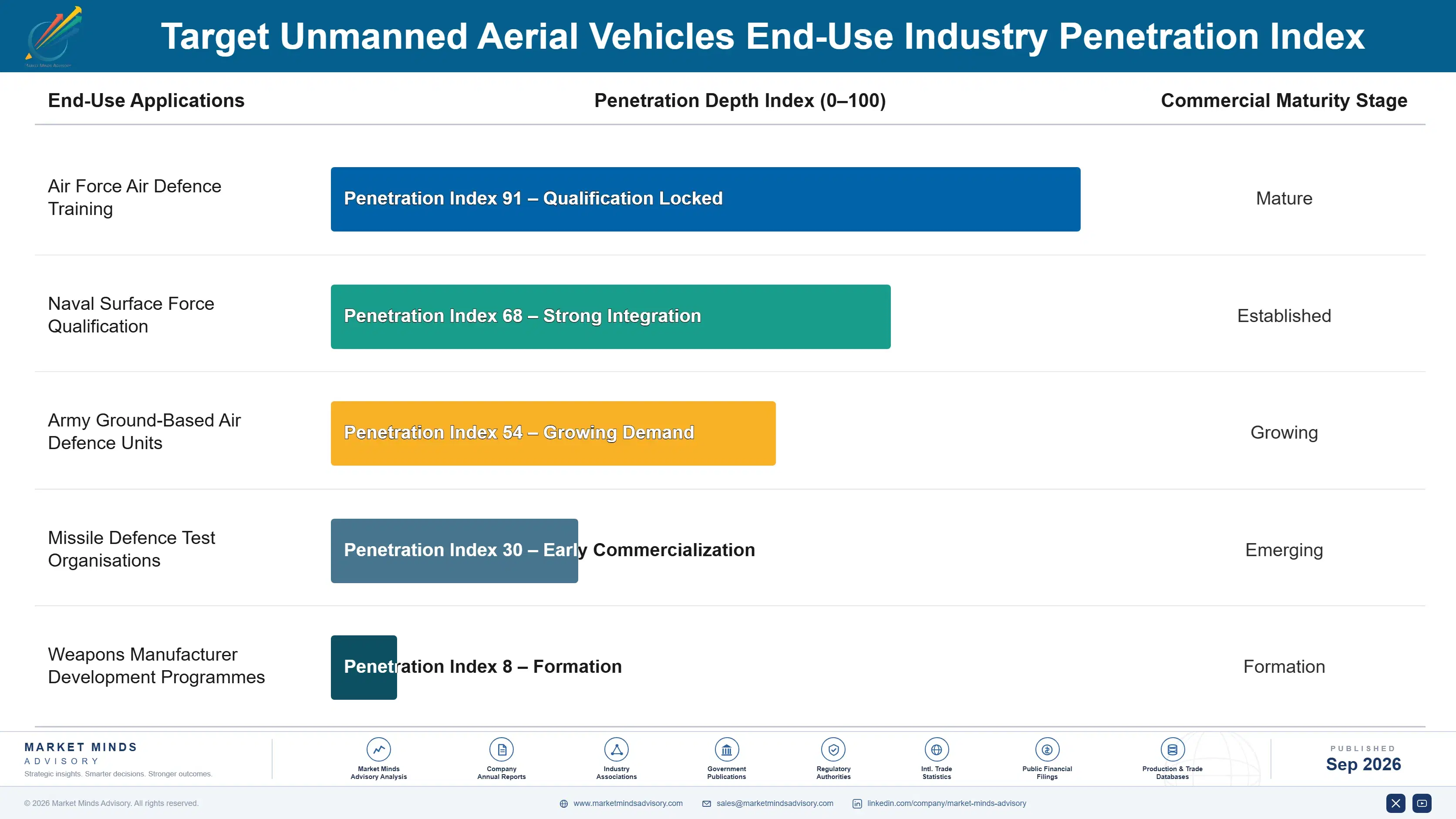
What Customers Keep Buying Annually

Consumption is the annuity in this market, and it is a genuinely good one. A customer running an active air defence training programme expends targets every year, and the supplier whose vehicle is integrated with that range's scoring and telemetry equipment captures the repeat volume almost automatically. Requalifying an alternative costs range time the customer would rather spend training, which is why incumbency here outlasts most procurement cycles.
Adoption depth varies sharply by customer type. Major air arms with dedicated ranges run the full spectrum including supersonic and ballistic profiles, and they buy payload upgrades continuously as threats change. Second-tier air forces typically buy subscale and subsonic targets only, and they buy in campaigns rather than annually. Missile defence organisations sit apart entirely: very few vehicles, very high unit values, and procurement driven by interceptor test schedules rather than crew training calendars.

The buyer has shifted generationally. Target procurement once sat with test range engineers who valued performance envelope above everything. Increasingly the requirement comes from air defence commanders asking whether the target resembles what their crews will actually face, and that question favours cheap numbers over fast singles.
target-unmanned-aerial-vehicles-market-end-use-penetration-index-1790025822835

Where The Money Actually Sits

These are among the four positions where our research anticipates prominent divergence between winners and laggards over the coming forecast period. Each is grounded in the demand model, the regulatory perimeter, and the announced capacity pipeline.
01 / PAYLOAD TECHNOLOGY OWNERSHIP

Own threat payloads, treat airframes as replaceable content

Payload content carries gross margin roughly double the airframe it flies on, and it is the element customers specify most tightly because representativeness is what they are actually buying. Airframes in the expendable classes are heading toward commodity pricing as commercial drone manufacturers enter, while signature emulation and seeker stimulation requirements grow more demanding every year. Suppliers owning payload technology can sell it onto competitors' airframes, reaching programmes they lost, which no supplier holding airframe capability alone is able to do.
02 / LOW-COST LINE DISCIPLINE

Build a separate cheap product line, not a simplified one

Established suppliers simplifying existing airframes consistently land two to three times above the price customers will pay for swarm targets, because the cost base was built for recoverable performance vehicles. A dedicated line using commercial propulsion, commercial avionics and no recovery provision reaches unit costs around 78% below subsonic jet targets. The organisational cost is running two manufacturing cultures simultaneously, which is genuinely difficult, but the alternative is conceding the fastest-growing class in the market to competitors that did not exist five years ago.
03 / ATTRITION RISK PRICING

Sell presentations delivered and price the attrition yourself

Presentation-based contracts transfer attrition risk to the supplier, and suppliers holding accurate reliability data price that risk better than any customer can from the outside. Delivered margin on these agreements has run about 11 points above equivalent unit sales, and contract durations stretch from annual orders to five or ten years. The requirement is disciplined reliability engineering and a balance sheet able to absorb a bad quarter, which is precisely why most competitors in this market will not attempt it at all.
04 / RANGE ACCESS POSITIONING

Solve range capacity and you remove the market's ceiling

Live-fire consumption is capped by airspace and safety footprint rather than by budget, and that ceiling is the reason consumption grows more slowly than air defence procurement across every region. Deployable launch and control equipment lets customers run qualification events at temporary sites, and suppliers offering it have lifted annual consumption per customer by roughly 24%. In growth markets without permanent ranges this is not an incremental advantage, it is the entire route to market access in the first place.

Engagement Snapshot From the Field

A live engagement with an industry participant carrying material or product regulatory and market exposure ahead of a defining policy shift, showing how our research translates into a defensible multi-year portfolio strategy.
MARKET MINDS ADVISORY · CLIENT ENGAGEMENT SUMMARY
Target Unmanned Aerial Vehicles Producer Strategic Portfolio Review and Transition Roadmap 2026·Investment Scenario on Target Unmanned Aerial Vehicles Exposure Evaluation 2025-26
CLIENT PROFILE
A European manufacturer of subsonic and subscale aerial targets with roughly USD 210 million in annual revenue (client-reported, unverified by MMA). The company held strong positions with four national air arms and operated two customer target programmes under service contracts, but had no product below its established subsonic jet target and was losing swarm replication requirements to newer competitors it did not recognise as peers.
STRATEGIC CHALLENGE
Engineering had proposed a simplified version of the existing jet target to address swarm demand. Costing work indicated a unit price still roughly triple what customers were paying competitors. The board needed to know whether a dedicated low-cost line justified the investment, or whether the segment would remain too small and too thin on margin to matter commercially.
MMA APPROACH
MMA sized swarm target demand by customer across Europe and the Gulf, then modelled unit economics for three routes: simplified existing airframe, clean-sheet dedicated line, and partnership with a commercial drone manufacturer. Expert interviews with air defence training staff established what representativeness customers would actually accept at the lower price point.
KEY FINDINGS
  1. Customers accepted far lower performance than the client assumed, provided radar signature augmentation was credible, which meant airframe cost could fall much further than engineering had modelled.
  2. The simplified airframe route could not reach the required price point at any realistic volume, because the underlying cost base carried recoverability and acceptance testing the product did not need.
  3. Swarm demand across the client's existing customer base alone supported roughly 340 units annually by 2028, well above the threshold the board had set for investment.
  4. Partnership with a commercial manufacturer reached the price point fastest but gave away the payload integration position that carried most of the available margin.
CLIENT PROFILE
A European manufacturer of subsonic and subscale aerial targets with roughly USD 210 million in annual revenue (client-reported, unverified by MMA). The company held strong positions with four national air arms and operated two customer target programmes under service contracts, but had no product below its established subsonic jet target and was losing swarm replication requirements to newer competitors it did not recognise as peers.
STRATEGIC CHALLENGE
Engineering had proposed a simplified version of the existing jet target to address swarm demand. Costing work indicated a unit price still roughly triple what customers were paying competitors. The board needed to know whether a dedicated low-cost line justified the investment, or whether the segment would remain too small and too thin on margin to matter commercially.
MMA APPROACH
MMA sized swarm target demand by customer across Europe and the Gulf, then modelled unit economics for three routes: simplified existing airframe, clean-sheet dedicated line, and partnership with a commercial drone manufacturer. Expert interviews with air defence training staff established what representativeness customers would actually accept at the lower price point.
KEY FINDINGS
  1. Customers accepted far lower performance than the client assumed, provided radar signature augmentation was credible, which meant airframe cost could fall much further than engineering had modelled.
  2. The simplified airframe route could not reach the required price point at any realistic volume, because the underlying cost base carried recoverability and acceptance testing the product did not need.
  3. Swarm demand across the client's existing customer base alone supported roughly 340 units annually by 2028, well above the threshold the board had set for investment.
  4. Partnership with a commercial manufacturer reached the price point fastest but gave away the payload integration position that carried most of the available margin.
RECOMMENDED STRATEGY
Phase 1: Phase 1 (nine months): Establish a separate low-cost product line with commercial propulsion and no recovery provision, sited away from the existing plant. Phase 2: Phase 2 (15 months): Qualify credible signature augmentation on the cheap airframe and offer it to existing service contract customers first, before open competition. Phase 3: Phase 3 (24 months): Extend the payload product to run on competitor airframes and sell it into programmes the company lost on vehicle competition.
OUTCOME
The client established the separate line and reached a unit cost roughly 71% below its jet target (client-reported, unverified by MMA). Swarm target orders reached 190 units in the first full year, and the payload product won its first placement on a competitor airframe, adding revenue the company had previously written off entirely.

Frequently Asked Questions

Foundational context covering the market sizes, CAGR, scope, country, region and competition that inform every finding below. This section is provided to cover basics and most often pre-purchase conversations, answered from the MMA Primary Research Dataset.

What is the current size of the Target Unmanned Aerial Vehicles Market?

The market was worth USD 2.0 billion in 2025 and reaches USD 2.2 billion in 2026. That covers subsonic, supersonic, full-scale, subscale, expendable and ballistic target vehicles with their threat payloads.

How large will the Target Unmanned Aerial Vehicles Market be by 2036?

MMA forecasts USD 5.0 billion by 2036, an increase of USD 2.8 billion over the 2026 base. That represents an expansion multiple of 2.27 times across the forecast period.

What is the CAGR for the Target Unmanned Aerial Vehicles Market 2026 to 2036?

The base case CAGR is 8.6%, with a bull case of 9.9% if swarm target procurement scales to requested rather than funded volumes. The bear case of 7.4% reflects range capacity limits.

Which segment is growing fastest?

Expendable swarm-capable aerial targets grow at 12.9%, half again the market rate of 8.6%. The class barely existed before 2021 and exists now because crews must train against multiple cheap inbound drones.

Who are the major companies in the Target Unmanned Aerial Vehicles Market?

Kratos Defense and Security Solutions, QinetiQ Target Systems, Airbus Defence and Space, Northrop Grumman and Leonardo lead on annual deliveries and contracted programme value. Boeing, BAE Systems and Rafael follow.

Which country is growing fastest?

India leads at 12.2%, driven by indigenous high-speed expendable target development that creates domestic capability and requirement simultaneously. Indigenous content rules mean foreign suppliers participate through partnership rather than direct sale.

Report Segmentation Architecture

The full report scope spans multiple orthogonal segmentation dimensions, with cross-tabulated demand data provided for each dimension pair. Coverage extends further to regional breakdowns, trend trajectories, and the competitive detail needed to support segment-level decision-making.

By Target Vehicle Class

  • Subsonic Jet-Powered Aerial Targets
  • Supersonic Sea-Skimming Aerial Targets
  • Full-Scale Converted Aircraft Targets
  • Subscale Propeller And Rotary Targets
  • Expendable Swarm-Capable Aerial Targets
  • Ballistic And Hypersonic Target Vehicles

By End-Use Industry

  • Air Force Air Defence Training
  • Naval Surface Force Qualification
  • Army Ground-Based Air Defence Units
  • Missile Defence Test Organisations
  • Weapons Manufacturer Development Programmes

By Commercial Dimension

  • Direct Vehicle Sale
  • Presentation-Based Service Contract
  • Multi-Year Production Arrangement
  • Licensed Local Assembly And Partnership

By Region

  • North America
  • Western Europe
  • East Asia
  • South Asia and Pacific
  • Latin America
  • Middle East and Africa
  • Eastern Europe

Scope, Methodology, and Coverage

Every figure in this report is reproducible from documented input assumptions. The scope below maps the historical period, the forecast horizon, the segmentation dimensions, and the countries covered, alongside the underlying primary and qualitative methodology.
Historical Period
2020 to 2025
Forecast Period
2026 to 2036
Base Year
2025 (USD billions; MMA Primary Research Dataset, September 2026)
Market Definition
This report covers target unmanned aerial vehicles: recoverable or expendable air vehicles flown to represent a threat during weapons testing, air defence system qualification and live-fire crew training. Scope includes subsonic and supersonic jet targets, full-scale converted aircraft targets, subscale propeller and rotary targets, expendable swarm-capable targets, ballistic and hypersonic target vehicles, and the threat replication payloads integrated onto them. Excluded are ground and naval surface targets, towed targets, separately procured launch and recovery infrastructure, range instrumentation and scoring systems, and operational reconnaissance or strike unmanned aircraft.
Quantitative Units
USD billions (current prices); annual target vehicle deliveries; units expended per year; average unit price by class
Segmentation Dimensions
By Target Vehicle Class; By End-Use Industry; By Commercial Dimension; By Region
Regions Covered
North America, Western Europe, East Asia, South Asia and Pacific, Latin America, Middle East and Africa, Eastern Europe
Countries Covered
USA, China, Germany, France, UK, Japan, South Korea, India, Australia, Canada, Brazil, Mexico, Indonesia, Vietnam, Thailand, Malaysia, UAE, Saudi Arabia, South Africa, Nigeria, Turkey, Poland, Netherlands, Italy, Spain, Sweden, Switzerland, Argentina, Colombia, Singapore, and additional markets relevant to this sector
Key Companies Profiled
Kratos Defense and Security Solutions, QinetiQ Target Systems, Airbus Defence and Space, Northrop Grumman, Leonardo, Boeing, BAE Systems, Rafael Advanced Defense Systems, Israel Aerospace Industries, Griffon Aerospace, Denel Dynamics, Turkish Aerospace Industries, Korea Aerospace Industries, Aviation Industry Corporation of China, Hindustan Aeronautics Limited, EDGE Group, Sistemas de Control Remoto, Aerotargets International, Robonic, Sierra Nevada Corporation
Quantitative Methodology
Primary survey, n=3,800 respondents, Q4 2025, six countries; demand-side model with trade association cross-validation
Qualitative Methodology
47 expert interviews, Q4 2025; applied to validate demand model assumptions, identify emerging dynamics, and assess competitive positioning
Report Format
PDF and XLSX data workbook (Word format preview document)
Publisher
Market Minds Advisory
Report Code
MMA-2026-CON-902
Published
September 2026
Contact
sales@marketmindsadvisory.com | www.marketmindsadvisory.com

Purchase the full Target Unmanned Aerial Vehicles Market Report (2026 to 2036).

The full report sizes the target unmanned aerial vehicle market across six vehicle classes and all seven regions, with annual consumption counts and unit pricing behind every figure. It quantifies the swarm replication requirement separately from established target classes, because the two behave as different markets with different suppliers and different economics. Competitive analysis covers 20 participants on annual deliveries and contracted programme value, including payload ownership and attrition risk appetite. Range capacity is modelled as a consumption ceiling by region, which is the constraint most demand forecasts in this market ignore. Margin architecture is built by tier with presentation-based service economics assessed against unit sales.
Six-class sizing with annual consumption counts
Swarm replication demand modelled as separate requirement
Range capacity ceilings quantified by region
Twenty-participant assessment on deliveries and programme value
Payload versus airframe margin split by class
Presentation-based service economics against unit sale margins

Built For The People Who Decide

From boardroom strategy to bench-side execution, this report is read cover-to-cover by leaders shaping the next decade of their industry, turning demand scenarios, market dynamics and valuation benchmarks into decisions.
CXOs/ Presidents/ VPs/ Managers
M&A and Corporate Development
Strategy Teams and R&D Heads
Procurement and Product Directors
Regulatory and Compliance Leaders
Investor Relations and Equity Analysts