Market Minds Advisory
Tank Insulation Market

Tank Insulation Market: The Failure Happens Under the Cladding Where Nobody Looks

Most of what actually goes wrong in this market is water reaching steel beneath a jacket nobody removes for years, and specifications are still written almost entirely around thermal conductivity.

Lead Analyst

Bilal Shaikh

Published

September 2026

Make Smarter Decisions with Customized Research Insights

Request a free sample report and evaluate market opportunities, growth trends, and competitive dynamics relevant to your business needs.

2025 MARKET VALUE$5.8BMarket Size 2025
2036 FORECAST VALUE$10.6BBase Case , 2026 to 2036
CAGR 2026 TO 20365.6 %Bull 6.8% / Bear 4.4%
INCREMENTAL OPPORTUNITY$4.4BNet 10- year value creation
EXPANSION MULTIPLE1.72x2036 value over 2026 base
Strategic Levers
M&A Pipeline
Regional Outlook
Country Rankings
Competitive Intelligence
Segmental Deep-dive
Call-Us : 91 93563 13602

Executive Snapshot and Market Trajectory

Around 62% of tank insulation failures are corrosion under insulation rather than thermal failure. Water gets past a vapour barrier, sits against steel behind cladding nobody removes, and does its work invisibly for years while the system continues meeting every thermal specification it was written to.
The specification is therefore aimed at the wrong property. Buyers compare thermal conductivity because that is what a data sheet reports, while the failure mode is moisture management and the cost of finding it is roughly four times the material itself, because cladding has to come off before anybody can look at anything. Nobody inspects until they must, so condition is genuinely unknown. Data sheets report the wrong number entirely.
Cryogenic work is a separate business that shares a name. An ammonia or liquid hydrogen tank moves through roughly 200 degrees of contraction and the insulation system has to accommodate that without cracking, which is engineering rather than material supply. Qatar grows fastest of any country at 10.6% on exactly that kind of capacity. It is sold to designers years before construction rather than to procurement. Procurement never sees that decision being taken at all.
Market Definition
Thermal insulation systems for industrial and energy storage tanks, covering polyurethane and polyisocyanurate foam, cellular glass, perlite and expanded mineral systems, mineral and glass wool, aerogel blankets and composites, and vacuum and advanced panel systems. Measured at material supplier selling value including jacketing and vapour barrier components. Excludes pipe and equipment insulation, building insulation, refractory linings, tank fabrication, and installation or scaffolding services.
Base Year Value
$5.8B in 2025 (MMA Primary Research Dataset, August 2026)
Forecast Period
2026 to 2036, eleven discrete annual values
CAGR
5.6% base case. Bull 6.8%. Bear 4.4%.
Fastest Growth Segment
Aerogel Blankets and Composites: 8.4% CAGR
Fastest Growth Country
Qatar: 10.6% CAGR
Fastest Growth Region
South Asia and Pacific: 7.4% CAGR
Largest Region
East Asia: 28% of 2025 global value
Market Leaders
Owens Corning, Rockwool, Kingspan, Johns Manville, Aspen Aerogels. Source: MMA Primary Research Dataset, July 2026.
Primary Survey
n=3,800 procurement and R&D decision-makers, Q4 2025, six countries
Methodology
Demand-side build-up, cross-validated against public data, 47 expert interviews

Tank Insulation Market Forecast Scenarios

tank-insulation-market-trends-size-forecast-scenario-1787639679746
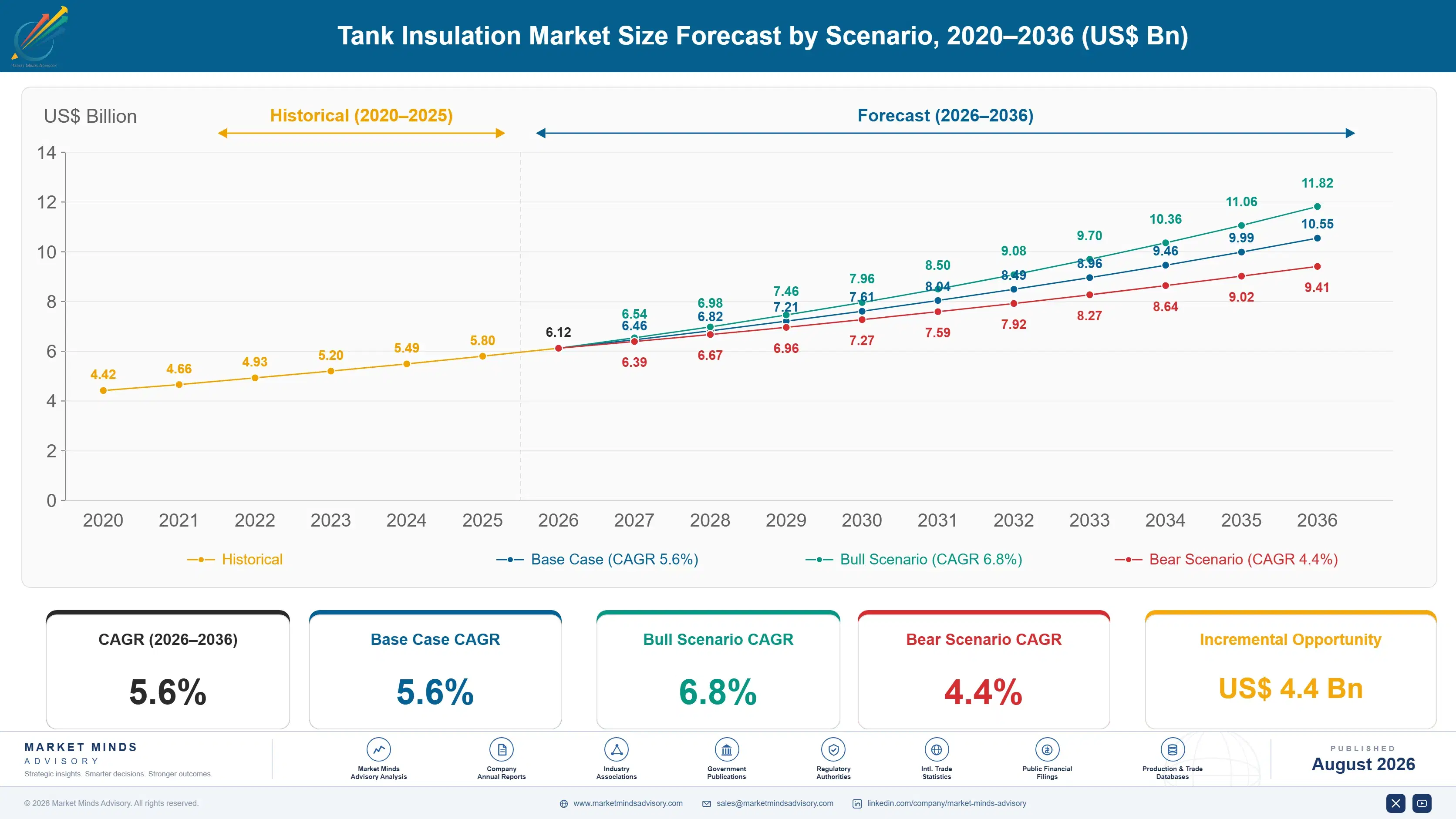
Growth ran near 4.6% between 2020 and 2025, following industrial and energy storage construction rather than any change in insulation practice. Corrosion under insulation remained the dominant failure mode throughout without materially changing how systems were specified. Cryogenic demand grew faster than ambient work as liquefied gas storage expanded, and aerogel adoption progressed steadily in retrofits where installed thickness was genuinely constrained.
Base case 5.6% rests on three mechanisms. Aerogel blankets grow at 8.4% because thermal performance around three times better per unit of thickness makes them the only workable option in congested and offshore installations. Vacuum and advanced panels grow at 7.2% on the same constraint at higher performance. And Qatar grows fastest of any country at 10.6% as liquefied gas storage capacity commissions on an exceptional scale. Two of the three sit outside conventional ambient tank work entirely.
The bull case at 6.8% assumes corrosion under insulation being priced into specifications properly, which would move buying toward moisture managing systems and reprice the category upward. The bear case at 4.4% is energy project deferral slowing cryogenic tank construction while ambient work remains a thermal conductivity comparison decided on delivered material cost alone. Specification practice decides which case arrives.

Moisture, Not Conductivity

The dominant failure mode in this market is not thermal. Around 62% of tank insulation failures are corrosion under insulation, where water penetrates a damaged vapour barrier or a cladding joint, reaches the steel and corrodes it steadily behind a jacket nobody has any reason to remove. The insulation keeps performing thermally throughout, which is precisely why the problem goes unnoticed until something more serious happens.
TOP FIVE CONCENTRATION38%Regional installers and material suppliers share a fragmented field
CORROSION FAILURE SHARE62%Tank insulation failures traced to water reaching the steel
CRYOGENIC TEMPERATURE SPAN200 CRange the insulation system must accommodate through thermal contraction
INSPECTION STRIPPING COST4xCost of removing cladding against the insulation material itself
AEROGEL THICKNESS ADVANTAGE3xThermal performance achieved per unit of installed thickness
DESIGN SERVICE LIFE25 yearsPeriod a tank insulation system is specified to perform for
Specification practice has not caught up with that. Buyers compare thermal conductivity because it is the number on a data sheet and it is easy to tender against, while moisture management, closed cell structure, joint detailing and jacketing integrity decide whether a system reaches its 25 year design life. Inspection costs roughly four times the material because cladding must come off first, so nobody inspects until they must.
Cryogenic work sits inside this market and behaves like a different industry. An ammonia, ethylene or liquid hydrogen tank cycles through roughly 200 degrees between ambient and service, and the insulation system must accommodate that contraction without cracking or losing continuity. That is a structural engineering problem solved with cellular glass, perlite and engineered support systems, and it is sold to designers rather than to procurement.
"Every tender I see compares lambda values to three decimal places, and the tanks that fail do so because water found a way in through a joint detail nobody costed. The industry is optimising the property it can measure cheaply rather than the one that actually ends the system's life."
Director, Industrial Insulation and Storage Systems Practice · MMA Construction and Industrial Equipment Practice · August 2026

Market Trends

Corrosion under insulation driving asset integrity spending

Around 62% of tank insulation failures involve water reaching the steel rather than any loss of thermal performance, and asset integrity programmes across refining and chemicals have begun treating insulation as a corrosion risk rather than an energy saving measure. That reframing changes who specifies it, moving the decision toward integrity engineers who care about moisture ingress and inspection access. Suppliers competing on thermal conductivity are answering a question that group has stopped asking. Integrity budgets are also larger than the procurement budgets that historically bought insulation, which changes the commercial arithmetic as well as the technical conversation.
Market Impact: Qatar growing fastest at 10.6%
Thickness constraints pushing aerogel into congested installations

Aerogel delivers roughly three times the thermal performance per unit of installed thickness, which is irrelevant in an open tank farm and decisive in a congested plant, an offshore module or a retrofit where the space between tank and surrounding steelwork was fixed decades ago. Growth at 8.4% comes almost entirely from those constrained situations rather than from any general preference. Cost per square metre is high and cost per millimetre of retained space frequently is not. Retained clearance rather than thermal performance is what makes the pricing defensible. Cost per millimetre of retained space is frequently favourable.
Market Impact: Spans roughly 200 degrees contraction

Market Opportunities and Growth Drivers

Gulf liquefied gas storage commissioning at exceptional scale

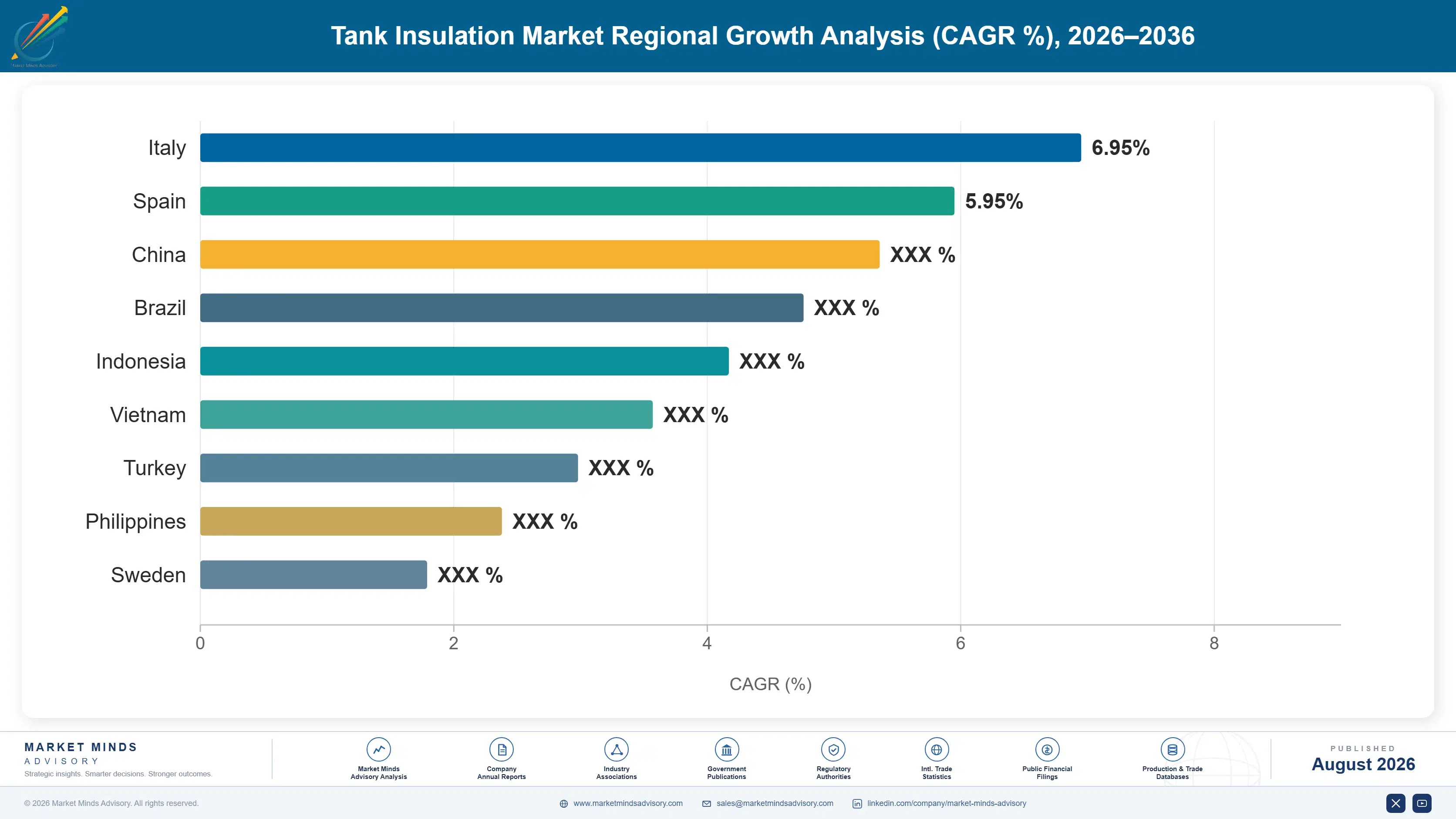
Qatar grows fastest of any country at 10.6% as liquefied natural gas storage capacity commissions on a scale no other market approaches, with ammonia storage following behind it as export projects develop. Cryogenic tank insulation is specified during engineering design and carried through construction, which makes engineering contractor relationships the commercially decisive ones. Volume arrives in large discrete projects rather than steadily, so pipeline visibility matters considerably more than account management does. Suppliers organised around maintenance accounts are covering the wrong part of their own market entirely. Pipeline visibility matters far more than account management here.
Market Impact: Inspection costs 4 times material

Ammonia and hydrogen storage extending cryogenic requirements

Ammonia as a hydrogen carrier and liquid hydrogen storage both create tank duties at temperatures and cycling regimes with limited operating history behind them, which pushes specification toward conservative engineered systems rather than familiar materials. Contraction across roughly 200 degrees governs the design and the insulation must maintain continuity throughout. Suppliers with cryogenic engineering capability rather than material supply alone are the ones being consulted during those design processes. Limited operating history pushes designers toward conservative engineered systems rather than familiar materials, which advantages suppliers holding genuine cryogenic capability. Operating history is thin.
Market Impact: Specified against 25 year life

Market Restraints and Challenges

Inspection cost keeping insulation condition genuinely unknown

Finding corrosion under insulation costs roughly four times the insulation material itself, because cladding must be removed, scaffolding erected and the system reinstated afterwards. The root cause is that the failure is hidden by design. Commercially it means operators do not know the condition of most installed systems and cannot justify preventive replacement. Inspection windows, moisture sensing and non-intrusive techniques are the mitigations being adopted, and none is yet standard practice. Retrofitting access after installation costs considerably more than designing it in. Preventive replacement therefore rarely gets funded at all, and work happens after failure instead.
Market Impact: Causes 62% of system failures

Thermal conductivity tendering excluding the deciding property

Tenders compare thermal conductivity because it is measurable, comparable and easy to specify, while moisture management, joint detailing and jacketing integrity determine whether a system reaches its 25 year life. The root cause is that procurement needs a number it can rank suppliers against. Commercially it pushes buying toward the cheapest material meeting a thermal figure. Whole life specification and integrity engineer involvement are the mitigations, and both are organisational rather than technical. Integrity engineers evaluating the same system reach a completely different conclusion, which is why the deciding function matters more here than the argument does.
Market Impact: Delivers 3 times thermal performance
3 additional market trends, 4 additional growth drivers, and 2 additional restraints and challenges are covered in the full report. Contact sales@marketmindsadvisory.com to access the complete intelligence.

Segment CAGR and Growth Architecture

Six segments are split by insulation material, because material determines the temperature range it can serve, its behaviour when wet, the installed thickness required and whether the system is engineered or simply specified. Facing and jacketing options sit inside each material. Tank duty and channel are handled separately in the framework. Engineering content varies sharply by material.
tank-insulation-market-trends-market-share-analysis-1787639680281

Aerogel Blankets and Composites

Growing at 8.4%, half again the market rate of 5.6%, aerogel delivers roughly three times the thermal performance per unit of installed thickness, which matters only where space is genuinely constrained. Congested brownfield plants, offshore modules and retrofits into fixed clearances are where that constraint binds, and in those situations the material has no realistic competition at any price. It is hydrophobic and breathable, which addresses moisture ingress rather better than closed cell foams do once damage occurs. Growth comes almost entirely from constrained situations rather than from any general preference for the material, and cost per square metre remains difficult to justify wherever space is not the binding constraint at all.
CAGR 8.4%

Vacuum and Advanced Panel Systems

At 7.2% vacuum insulation panels deliver the highest thermal performance per unit of thickness available and carry a corresponding vulnerability, since any breach of the envelope removes the performance entirely rather than degrading it gradually. That makes them suitable where installation can be controlled and protected, and unsuitable where mechanical damage is likely during service. Applications concentrate in cryogenic and highly space constrained duties, and the engineering support required around them exceeds what conventional insulation supply involves. Handling and protection during installation matter more than the material specification itself, and the engineering support required around these systems exceeds anything conventional insulation supply involves. Applications concentrate in cryogenic and highly space constrained duties where nothing else performs.
CAGR 7.2%
Full segment breakdown across 6 segments available in the complete report.

Regional Architecture and Country Demand Map

East Asia holds 28% of value on petrochemical and gas storage construction at scale. Middle East and Africa reaches 9%, above its standard band, on Gulf liquefied gas and ammonia storage commissioning. South Asia and Pacific grows fastest of the seven regions covered here. Others hold band.

North America

A very large installed base of refining, chemical and gas storage tanks carries steady replacement and maintenance demand, much of it ageing beyond original design assumptions. Corrosion under insulation is well recognised here and asset integrity programmes increasingly treat insulation as an integrity item rather than an energy measure. Liquefied gas export terminal construction adds cryogenic demand. Growth at 4.8% reflects maintenance driven replacement alongside selective new construction across the energy sector. Integrity budgets are larger than the procurement budgets that historically bought insulation, which is changing who suppliers need to reach across the region. Liquefied gas export terminal construction continues to add cryogenic tank capacity across the Gulf coast steadily.
Share: 26% | CAGR: 4.8% (2026 to 2036)

Western Europe

The installed base is mature and much of it operating well past original design life, which makes inspection and replacement the dominant demand driver rather than new construction. Energy efficiency regulation supports insulation upgrades on hot service tanks. Ammonia and hydrogen storage projects are being designed, though at smaller scale than in the Gulf. Regional suppliers hold strong engineering capability in cryogenic systems. Growth of 4.2% is the slowest anywhere on limited new construction activity. Inspection findings rather than energy calculations increasingly trigger replacement work, which shifts the specification toward moisture managing systems on some assets. European suppliers hold engineering capability that travels to Gulf and Asian projects better than their manufactured product does.
Share: 20% | CAGR: 4.2% (2026 to 2036)
Regional intelligence for 5 additional markets available in the complete report: East Asia, South Asia and Pacific, Latin America, Middle East and Africa, Eastern Europe. Contact sales@marketmindsadvisory.com.
tank-insulation-market-trends-country-cagr-analysis-1787639680806

Four Moves Beyond the Lambda Value

Tenders rank suppliers on thermal conductivity and tanks fail because water reached the steel, which means the industry competes on the property it can measure rather than the one that ends the system. The moves that matter reach integrity engineers, follow cryogenic project pipelines and sell space rather than heat. All four reach different people.

Sell to integrity engineers rather than procurement

Around 62% of failures are corrosion under insulation, which makes this an asset integrity item rather than an energy saving one, and integrity engineers care about moisture ingress, joint detailing and inspection access rather than about conductivity. They also hold budgets that procurement does not, and they are already spending roughly four times material cost on inspection. Reaching that function reframes the entire purchase before any tender is written. That budget is already funding inspection at roughly four times material cost, which makes the conversation about avoided spending rather than added spending.
Market Impact: Addresses 62% of all the observed system failures

Design inspection access into the system deliberately

Inspection costs roughly four times the insulation material because cladding must be stripped and scaffolding erected, which is why operators do not know the condition of most installed systems. Removable inspection windows, moisture sensing and non-intrusive access designed in at installation cost very little and change the operator's economics permanently. A supplier offering that is selling an integrity capability rather than a commodity insulating material. Designing access in at installation costs a small fraction of the 4 times inspection burden it removes, and it converts an unknown condition into a managed one.
Market Impact: Cuts into the 4 times inspection cost burden

Follow cryogenic project pipelines into engineering design

Cryogenic tank insulation is specified during engineering design and carried through construction, and Qatar grows at 10.6% as liquefied gas capacity commissions in large discrete phases. Reaching the engineering contractor while design is open is the only moment the specification is genuinely contestable. Project pipelines are public years ahead, and suppliers organised around maintenance accounts are following the wrong part of their own market entirely. Pipelines are published years ahead and very few suppliers systematically track them. Suppliers organised around maintenance accounts are following the wrong half of their own market entirely.
Market Impact: Follows 10.6% Qatari capacity growth in every year

Sell aerogel on retained space rather than on conductivity

Aerogel costs considerably more per square metre and delivers roughly three times the performance per unit of thickness, which is worthless in an open tank farm and decisive in a congested retrofit. Framing the value as clearance retained, scaffolding avoided or a vessel that fits where a thicker system would not reaches a different argument entirely. Growth at 8.4% comes almost entirely from situations where that framing already applies. Scaffolding avoided and steelwork left unmodified frequently exceed the material premium entirely. Growth at 8.4% arises almost wholly from situations where that framing already applies naturally.
Market Impact: Serves 8.4% aerogel segment growth in every year

Who Controls the Margin Pool

Participation is measured on annual insulation material volume supplied into tank applications, and the top five hold 38%. Concentration is moderate because ambient duties are served by many regional manufacturers while cryogenic engineering capability sits with a much smaller group. Owens Corning and Rockwool lead on manufacturing breadth, while cryogenic positions depend on engineering capability rather than production scale. The gap to challengers is engineering depth rather than manufacturing capacity.
Competition runs on three fronts. Delivered material cost decides ambient tank work tendered on thermal conductivity, which is most of the volume. Engineering capability decides cryogenic specification, where the material is part of a designed system. And integrity positioning decides the maintenance and replacement work that an ageing installed base generates. Complete system supply including jacketing has become a fourth front, since jacketing decides whether water reaches anything at all.

Pressure ahead comes from asset integrity budgets reframing insulation as a corrosion item, and from cryogenic construction concentrating in the Gulf and Asia. Expect suppliers with engineering capability to separate from material manufacturers. Rankings shift on who reaches integrity engineers and design offices first. Concentration should stay moderate given regional manufacturing.
tank-insulation-market-trends-company-positioning-matrix-1787639681325

Competitive Moat and Risk Dimensions

OWENS CORNING

Moat: Manufacturing breadth and distribution

Manufacturing across multiple insulation materials with distribution reaching contractors and distributors in most industrial markets covers the ambient tank work that carries the bulk of volume. That breadth lets the business serve a tender whatever material the specification names, which a single material producer cannot do without partnering or losing the enquiry entirely.
OWENS CORNING

Risk: Conductivity tender commoditisation

Ambient tank work tendered purely on thermal conductivity reduces the offer to delivered cost per square metre, where Chinese and regional manufacturers compete effectively and manufacturing breadth adds very little. That exposure grows as long as specifications continue ignoring the moisture management that actually determines system life.
ASPEN AEROGELS

Moat: Aerogel capability and thickness advantage

Aerogel manufacture at industrial scale addresses the constrained installations where roughly three times the performance per unit of thickness makes the material the only workable option, and where no conventional alternative competes at any price. That capability is capital intensive and technically demanding, which keeps the competitive field genuinely narrow.
ASPEN AEROGELS

Risk: Constrained application dependency

The value proposition depends on installations where thickness is limited, which excludes the open tank farm work that represents most of the market by area. Growth is therefore capped by how many genuinely constrained situations exist, and cost per square metre remains difficult to justify wherever space is not the binding constraint.

Players Tracked

Prominent Players

Owens Corning
Rockwool
Kingspan
Johns Manville
Aspen Aerogels

Other Key Players

Armacell
Knauf Insulation
Saint-Gobain
BASF
Cabot Corporation
Etex
Recticel
Huntsman
Dow
Paroc
Alkegen
Sika
Nichias
Zhejiang Zhenshen Insulation
Jiangsu Jiuding New Material

Recent Developments

MARCH 2026

Operator moves tank insulation budget into asset integrity programme

A refining operator reassigned tank insulation specification and budget from energy management into its asset integrity programme, following corrosion findings under systems that were still meeting every thermal performance requirement written into the original specification. The budget moved with the specification authority. Procurement was no longer deciding.
Signal: Insulation is being reclassified as a corrosion item, which changes who specifies and pays for suppliers
SEPTEMBER 2025

Gulf ammonia storage project specifies engineered cryogenic system

A Gulf ammonia storage project specified an engineered cryogenic insulation system during design, selecting on contraction accommodation across the full temperature span rather than on thermal conductivity or delivered material cost. Material cost was a secondary consideration throughout the evaluation. Engineering governed it. Delivered cost never entered the discussion.
Signal: Cryogenic specification is an engineering decision taken years before any material is ordered by anybody involved
JANUARY 2026

Retrofit selects aerogel on clearance rather than thermal grounds

A brownfield retrofit selected aerogel insulation because the clearance between tank and surrounding steelwork could not accommodate the thickness a conventional system required, at a material cost several times higher per square metre. Scaffolding and steelwork modification costs would have exceeded the material premium several times over.
Signal: Retained clearance rather than conductivity is what actually justifies aerogel pricing once the alternatives are properly costed

Polymer, Mineral and Cladding

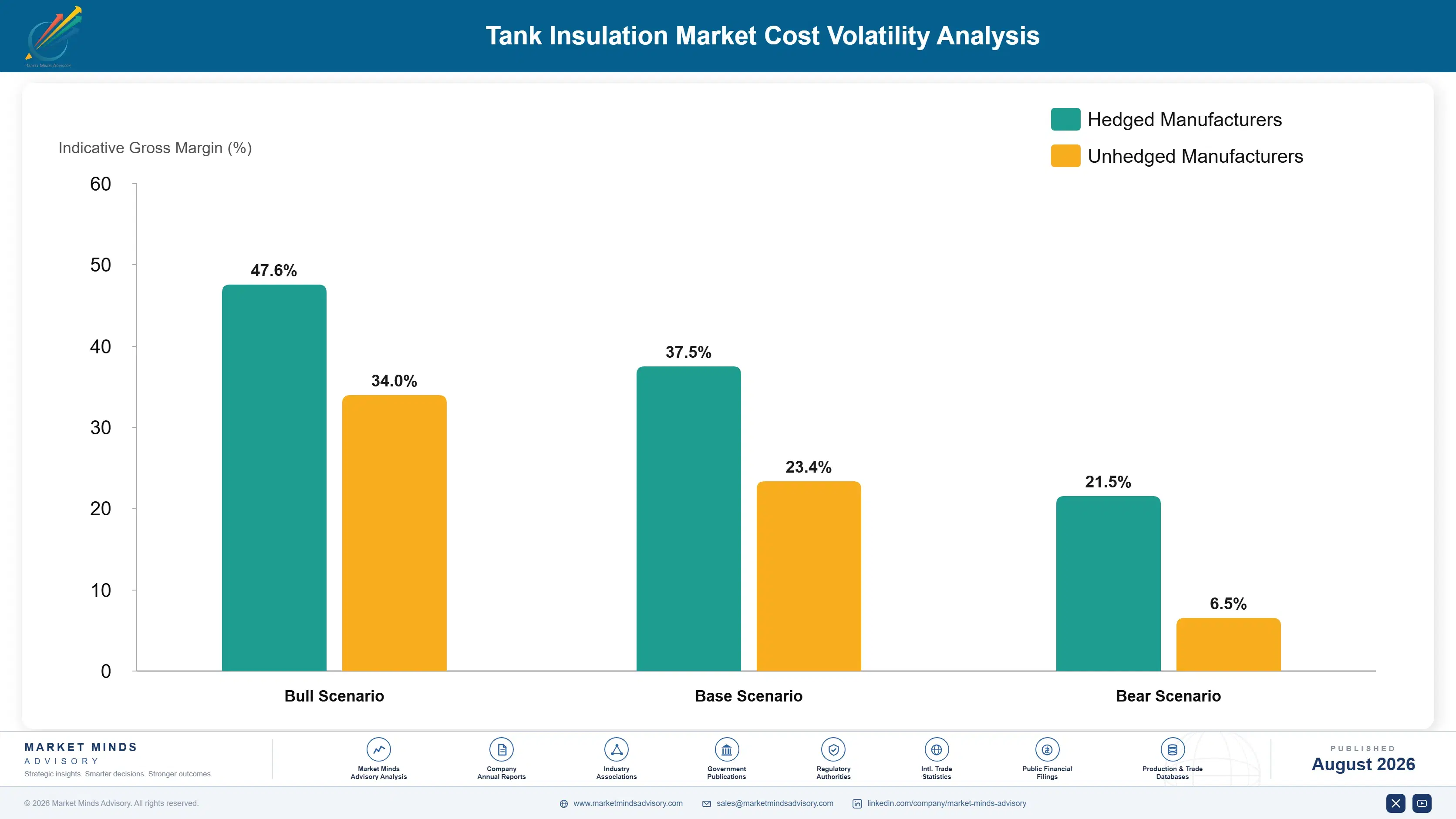
Polymer chemistry for foam systems carries around 34% of material cost, tracking isocyanate and polyol pricing that follows petrochemical markets. Mineral feedstock and the energy to melt or expand it takes about 22% for wool, cellular glass and perlite products. Aluminium and stainless jacketing accounts for around 19%. Vapour barriers, adhesives, fixings, packaging and freight absorb the balance across most suppliers.
Industrial energy and aluminium pricing both moved sharply through 2022, per IEA industrial energy reporting alongside Rockwool and Owens Corning annual reporting for 2025 on energy and raw material exposure. Mineral wool and cellular glass manufacture absorbed the energy movement heavily because both require sustained high temperature melting, while foam products carried petrochemical exposure moving on different drivers entirely. Indexation clauses have become considerably more common on large projects since.

Exposure divides on material chemistry rather than on scale. A foam producer carries isocyanate and polyol pricing linked to crude oil. A mineral wool or cellular glass producer carries melting energy across roughly a fifth of cost. Everybody carries aluminium jacketing, which is frequently overlooked because it is treated as an accessory rather than as the component protecting the whole system from water.
tank-insulation-market-trends-cost-volatility-analysis-1787639681520

Treat jacketing as a system component rather than an accessory

Aluminium and stainless jacketing carries close to a fifth of material cost and determines whether water reaches the insulation at all, yet it is frequently specified and purchased separately from the insulation it protects. Supplying and warranting the complete system addresses the failure mode directly and captures value currently leaking to jacketing distributors. Warranting the whole system changes the conversation.

Balance manufacturing mix across foam and mineral chemistries

Isocyanate pricing follows crude oil and melting energy follows industrial power markets, and the two rarely move together. A supplier holding meaningful capacity in both smooths an exposure that a single chemistry manufacturer carries in full, which matters in a business where project pricing is fixed well ahead of delivery. Mix balance smooths the exposure.

Index project pricing against material cost movements

Large tank projects fix pricing during engineering and deliver material a year or more later, which leaves a supplier carrying commodity exposure it never chose to take. Indexation clauses tied to published polymer and aluminium pricing shift that risk back to the project, and engineering contractors increasingly accept them when the exposure is explained. Contractors accept it when explained.

Portfolio Architecture for Margin Defence

Margin here follows whether the material is part of an engineered system or an item on a tender comparison. Ambient tank insulation tendered on thermal conductivity earns margins in the high single digits to mid teens, where regional manufacturers compete on delivered cost per square metre and specifications treat materials as interchangeable at equivalent performance. Delivered cost per square metre decides it. Specifications treat qualified materials as interchangeable.
Integrity specified and moisture managing systems do better in the high teens to high twenties, because the buyer is an integrity engineer solving a corrosion problem rather than a procurement function ranking conductivity figures, and the budget comes from a different place entirely. Warranting the complete system including jacketing is what distinguishes a supplier from a material manufacturer here. The budget comes from a different place entirely.

Engineered cryogenic and constrained space systems hold the strongest position, reaching into the mid thirties, where contraction accommodation or retained clearance decide the specification and very few suppliers can serve the requirement. Those margins reflect engineering capability and material scarcity rather than any manufacturing cost advantage. Very few suppliers hold the engineering capability those duties actually require.

Ambient Tank Insulation on Conductivity Tender

Conventional material tendered against a thermal figure where suppliers are treated as interchangeable. The seven point range reflects manufacturing cost and freight position rather than any difference in delivered system performance.
Gross Margin: 9-16%

Integrity Specified Moisture Managing Systems

Systems specified by integrity engineers against corrosion risk rather than energy performance. The ten point range reflects how far the supplier warrants the complete system including jacketing and inspection access provisions.
Gross Margin: 18-28%

Engineered Cryogenic and Constrained Space Systems

Engineered systems accommodating contraction or delivering performance within fixed clearances. The ten point range reflects engineering capability depth and how few suppliers can meet the particular duty required. Very few can serve it.
Gross Margin: 26-36%
tank-insulation-market-trends-portfolio-architecture-1787639682025

High-value Sub-segments and Strategic Watch-out

Engineered Cryogenic Systems

High value and growing with liquefied gas and ammonia storage construction, where roughly 200 degrees of contraction governs design. Specification happens during engineering years before any material is ordered for delivery. Contraction accommodation rather than conductivity governs the design entirely. Replacement means taking the tank out of service.
Gross Margin: 28-36%

Aerogel Constrained Space Supply

High value and the fastest growth at 8.4%, delivering roughly three times the performance per unit of thickness where clearance is fixed. No conventional alternative competes at any price in those situations. Growth is capped by how many genuinely constrained installations exist. Retained clearance is the real argument.
Gross Margin: 26-35%

Ambient Conductivity Tendered Work

The volume core, tendered on a thermal figure where regional manufacturers compete on delivered cost and the property deciding system life never enters the comparison at all. Moisture management never enters the tender comparison at all. Regional manufacturers compete hard on delivered cost per square metre.
Gross Margin: 9-16%

Corrosion Under Insulation Exposure

The strategic watch-out. Around 62% of failures involve water reaching steel, and the range reflects whether a supplier warrants a complete system or supplies material into somebody else's detailing. Jacketing integrity decides whether water reaches anything. Complete system supply is the only real answer available.
Gross Margin: 7-34%

Two Budgets and a Design Office

Demand arrives from three quite separate places. New construction specifies during engineering, which fixes material and system design years before delivery. Maintenance and replacement is funded from operating budgets and triggered by inspection findings or failure. Energy efficiency upgrades are funded separately again and justified on thermal payback, which is the only place conductivity genuinely matters commercially. Each is funded and decided quite separately. Only one of the three is genuinely about heat.
Stickiness follows specification authority rather than any commercial relationship. A cryogenic system designed into a project is fixed for the tank's life, since replacing it means taking the tank out of service entirely. Ambient tender work reopens at every project. Integrity specified maintenance work holds where a supplier has built credibility with the engineers who commission inspection.

The deciding functions are moving. Insulation was historically specified by process or energy engineers on thermal performance and purchased by procurement on price. Asset integrity teams are increasingly taking that decision because they carry the corrosion consequence, and they evaluate moisture management and inspection access instead. A supplier still presenting conductivity data is addressing the outgoing decision maker. That handover is well underway.
tank-insulation-market-trends-end-use-penetration-index-1787639682513

Where We Would Put Effort

These are among the four positions where our research anticipates prominent divergence between winners and laggards over the coming forecast period. Each is grounded in the demand model, the regulatory perimeter, and the announced capacity pipeline.
01 / INTEGRITY FUNCTION SELLING

The corrosion budget is the real one

Around 62% of tank insulation failures are corrosion under insulation rather than any measurable loss of thermal performance at all, which makes this an asset integrity item that happens to save energy along the way. Integrity engineers instead evaluate moisture ingress, joint detailing and inspection access, and they already spend roughly four times the material cost simply on finding those problems. Reaching that function reframes the whole purchase before any tender is written by anybody sitting in a procurement function.
02 / INSPECTION ACCESS DESIGN

Nobody knows what their tanks look like

Stripping cladding to inspect costs roughly four times the insulation material underneath it, which is exactly why operators do not know the condition of most of their installed systems and cannot justify preventive replacement to anybody. Removable inspection windows, moisture sensing and non-intrusive access designed in at installation cost very little at the time and change those economics permanently thereafter. A supplier offering that is selling an integrity capability rather than a commodity insulating material sold by the square metre.
03 / CRYOGENIC DESIGN COVERAGE

Specified in engineering, delivered years later

Cryogenic tank insulation accommodates roughly 200 degrees of contraction and is specified during engineering design, and and then carried entirely unchanged through construction and the whole of the tank's operating life afterwards. Qatar grows fastest of any country at 10.6% as exactly that capacity commissions in large discrete phases. Reaching the engineering contractor while that design still remains open is the only moment the specification is genuinely contestable, and those project pipelines are published years ahead of any award being made.
04 / CLEARANCE VALUE FRAMING

Aerogel sells space, not heat

Aerogel costs considerably more per square metre and delivers roughly three times the thermal performance per unit of installed thickness, which is worth nothing at all in an open tank farm and decisive in a congested brownfield retrofit. Framing the value as retained clearance, avoided steelwork modification or a system that fits where nothing else would reaches an entirely different and considerably stronger argument. Growth at 8.4% comes almost wholly from the situations where that framing already applies quite naturally.

Engagement Snapshot From the Field

A live engagement with an industry participant carrying material or product regulatory and market exposure ahead of a defining policy shift, showing how our research translates into a defensible multi-year portfolio strategy.
MARKET MINDS ADVISORY · CLIENT ENGAGEMENT SUMMARY
Tank Insulation Producer Strategic Portfolio Review and Transition Roadmap 2026·Investment Scenario on Tank Insulation Exposure Evaluation 2025-26
CLIENT PROFILE
An industrial insulation manufacturer supplying foam and mineral wool systems for tank applications across European and Middle Eastern markets, at annual revenue near 210 million euros (client-reported, unverified by MMA). Commercial effort was organised around contractor tenders and specifications written on thermal conductivity alone. No integrity function relationships existed. System supply had never been offered.
STRATEGIC CHALLENGE
Tender win rates had fallen against lower cost regional manufacturers and margins had compressed for three consecutive years, while several large Gulf cryogenic projects had been awarded to competitors the business had not been invited to bid on at all. A restructuring decision was pending. A decision was overdue. Time was short.
MMA APPROACH
MMA analysed why the client had lost twelve recent tenders, traced how cryogenic project specifications were actually set, examined failure records across systems the client had supplied to identify the dominant mode, and assessed the commercial reach of the client's technical organisation. Interviews with 47 experts covered asset integrity, cryogenic engineering and industrial insulation contracting.
KEY FINDINGS
  1. Every lost tender examined had been decided on delivered cost against a thermal conductivity requirement, with no specification addressing moisture management or inspection access at all.
  2. Failure records from the client's own supplied systems showed corrosion under insulation dominating, in systems that had continued meeting their thermal specification throughout their service life.
  3. Gulf cryogenic projects had been specified during engineering design by contractors the client had no relationship with, and the awards were settled before any tender was issued.
  4. Asset integrity teams at several existing customers held budgets larger than the procurement functions the client sold to, and evaluated entirely different properties when they specified anything.
CLIENT PROFILE
An industrial insulation manufacturer supplying foam and mineral wool systems for tank applications across European and Middle Eastern markets, at annual revenue near 210 million euros (client-reported, unverified by MMA). Commercial effort was organised around contractor tenders and specifications written on thermal conductivity alone. No integrity function relationships existed. System supply had never been offered.
STRATEGIC CHALLENGE
Tender win rates had fallen against lower cost regional manufacturers and margins had compressed for three consecutive years, while several large Gulf cryogenic projects had been awarded to competitors the business had not been invited to bid on at all. A restructuring decision was pending. A decision was overdue. Time was short.
MMA APPROACH
MMA analysed why the client had lost twelve recent tenders, traced how cryogenic project specifications were actually set, examined failure records across systems the client had supplied to identify the dominant mode, and assessed the commercial reach of the client's technical organisation. Interviews with 47 experts covered asset integrity, cryogenic engineering and industrial insulation contracting.
KEY FINDINGS
  1. Every lost tender examined had been decided on delivered cost against a thermal conductivity requirement, with no specification addressing moisture management or inspection access at all.
  2. Failure records from the client's own supplied systems showed corrosion under insulation dominating, in systems that had continued meeting their thermal specification throughout their service life.
  3. Gulf cryogenic projects had been specified during engineering design by contractors the client had no relationship with, and the awards were settled before any tender was issued.
  4. Asset integrity teams at several existing customers held budgets larger than the procurement functions the client sold to, and evaluated entirely different properties when they specified anything.
RECOMMENDED STRATEGY
Phase 1: Phase one: redirect technical resource toward asset integrity functions, who hold larger budgets and evaluate the property that actually ends system life. Phase 2: Phase two: build engineering contractor coverage for Gulf and Asian cryogenic projects, where specification is fixed years before any tender exists. Phase 3: Phase three: develop complete system supply including jacketing and inspection access rather than supplying material into somebody else's detailing. Jacketing decides everything.
OUTCOME
The manufacturer established an asset integrity commercial function during 2026 and secured engineering coverage on two Gulf cryogenic projects (client-reported, unverified by MMA). Conductivity led tender participation was deliberately reduced, and complete system supply was piloted with three operators. Technical headcount was redeployed rather than reduced.

Frequently Asked Questions

Foundational context covering the market sizes, CAGR, scope, country, region and competition that inform every finding below. This section is provided to cover basics and most often pre-purchase conversations, answered from the MMA Primary Research Dataset.

What is the current size of the Tank Insulation Market?

MMA sizes it at USD 5.8 billion in 2025, rising to USD 6.12 billion in 2026. The figure covers thermal insulation systems for industrial and energy storage tanks at supplier selling value.

How large will the Tank Insulation Market be by 2036?

USD 10.55 billion by 2036, an incremental USD 4.43 billion over the 2026 base and an expansion multiple of 1.72 times. Aerogel accounts for a disproportionate share of that growth.

What is the CAGR for the Tank Insulation Market 2026 to 2036?

5.6% in the base case, with a bull case at 6.8% and a bear case at 4.4%. The spread turns on whether corrosion risk gets priced into specifications properly.

Which segment is growing fastest?

Aerogel blankets and composites at 8.4%, half again the market rate of 5.6%. Roughly three times the performance per unit of thickness decides constrained and retrofit installations.

Who are the major companies in the Tank Insulation Market?

Owens Corning, Rockwool, Kingspan, Johns Manville and Aspen Aerogels lead on material volume supplied. Fifteen further participants are profiled in the full report on that basis.

Which country is growing fastest?

Qatar at 10.6%, as liquefied natural gas storage capacity commissions on a scale no other market approaches, with ammonia storage projects following behind it. Ammonia projects follow behind.

Report Segmentation Architecture

The full report scope spans multiple orthogonal segmentation dimensions, with cross-tabulated demand data provided for each dimension pair. Coverage extends further to regional breakdowns, trend trajectories, and the competitive detail needed to support segment-level decision-making.

By Insulation Material

  • Polyurethane and Polyisocyanurate Foam
  • Cellular Glass
  • Perlite and Expanded Mineral Systems
  • Mineral and Glass Wool
  • Aerogel Blankets and Composites
  • Vacuum and Advanced Panel Systems

By End-Use Industry

  • Petroleum Refining
  • Petrochemicals and Chemicals
  • Liquefied Gas Storage and Terminals
  • Power Generation
  • Food, Beverage and Pharmaceutical Storage
  • Water and Municipal Storage

By Commercial Dimension

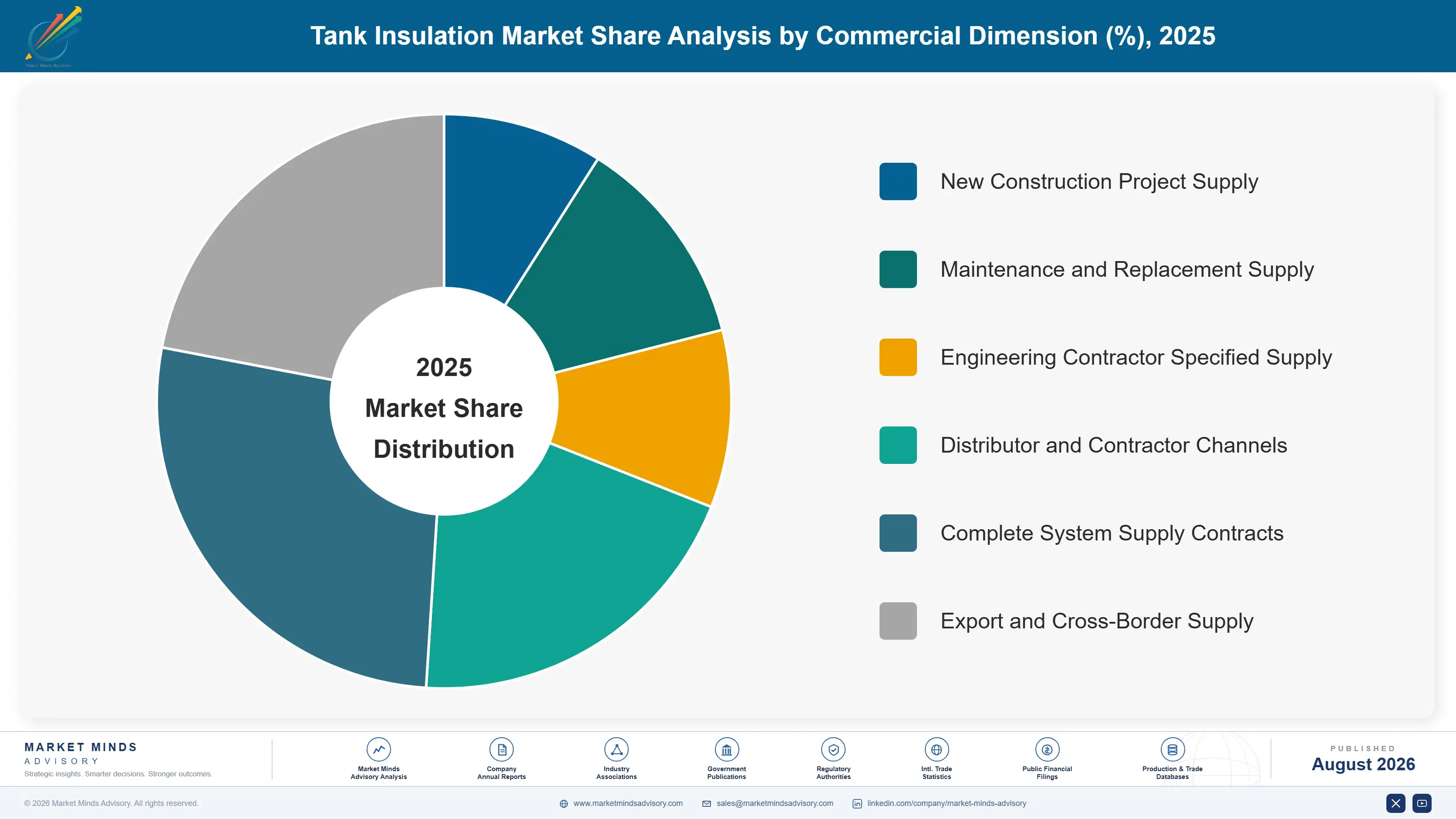
  • New Construction Project Supply
  • Maintenance and Replacement Supply
  • Engineering Contractor Specified Supply
  • Distributor and Contractor Channels
  • Complete System Supply Contracts
  • Export and Cross-Border Supply

By Region

  • North America
  • Western Europe
  • East Asia
  • South Asia and Pacific
  • Latin America
  • Middle East and Africa
  • Eastern Europe

Scope, Methodology, and Coverage

Every figure in this report is reproducible from documented input assumptions. The scope below maps the historical period, the forecast horizon, the segmentation dimensions, and the countries covered, alongside the underlying primary and qualitative methodology.
Historical Period
2020 to 2025
Forecast Period
2026 to 2036
Base Year
2025 (USD billions; MMA Primary Research Dataset, August 2026)
Market Definition
Thermal insulation systems for industrial and energy storage tanks, covering polyurethane and polyisocyanurate foam, cellular glass, perlite and expanded mineral systems, mineral and glass wool, aerogel blankets and composites, and vacuum and advanced panel systems. Measured at material supplier selling value including jacketing and vapour barrier components. Pipe and equipment insulation, building insulation, refractory linings, tank fabrication, and installation or scaffolding services are excluded from scope.
Quantitative Units
USD billions (current prices); million square metres supplied; USD per square metre by material
Segmentation Dimensions
Insulation material; end-use industry; commercial dimension; region
Regions Covered
North America, Western Europe, East Asia, South Asia and Pacific, Latin America, Middle East and Africa, Eastern Europe
Countries Covered
United States, Canada, Mexico, Germany, Netherlands, Belgium, France, United Kingdom, China, Japan, South Korea, India, Singapore, Australia, Brazil, Qatar, Saudi Arabia, United Arab Emirates, Nigeria, Poland
Key Companies Profiled
Owens Corning, Rockwool, Kingspan, Johns Manville, Aspen Aerogels, Armacell, Knauf Insulation, Saint-Gobain, BASF, Cabot Corporation, Etex, Recticel, Huntsman, Dow, Paroc, Alkegen, Sika, Nichias, Zhejiang Zhenshen Insulation, Jiangsu Jiuding New Material
Quantitative Methodology
Primary survey, n=3,800 respondents, Q4 2025, six countries; demand-side model with trade association cross-validation
Qualitative Methodology
47 expert interviews, Q4 2025; applied to validate demand model assumptions, identify emerging dynamics, and assess competitive positioning
Report Format
PDF and XLSX data workbook (Word format preview document)
Publisher
Market Minds Advisory
Report Code
MMA-2026-CON-117
Published
August 2026
Contact
sales@marketmindsadvisory.com | www.marketmindsadvisory.com

Purchase the full Tank Insulation Market Report (2026 to 2036).

The full report treats corrosion under insulation as the central commercial fact in this market, because it causes most failures while specifications continue ranking suppliers on thermal conductivity alone. It sizes all six materials independently through 2036, quantifies inspection and replacement economics across an ageing installed base, and maps cryogenic project pipelines against specification timing. Regional chapters cover all seven regions with new construction separated from maintenance demand. Competitive profiling covers 20 participants on one consistent supplied area basis. Specification authority is tracked by function throughout.
Six insulation materials sized independently through 2036
Corrosion under insulation failure economics quantified against inspection cost
Cryogenic project pipelines mapped against specification timing by region
New construction demand separated from maintenance and replacement
Aerogel adoption assessed against clearance constrained installation counts
Twenty participants profiled on one consistent supplied area basis

Built For The People Who Decide

From boardroom strategy to bench-side execution, this report is read cover-to-cover by leaders shaping the next decade of their industry, turning demand scenarios, market dynamics and valuation benchmarks into decisions.
CXOs/ Presidents/ VPs/ Managers
M&A and Corporate Development
Strategy Teams and R&D Heads
Procurement and Product Directors
Regulatory and Compliance Leaders
Investor Relations and Equity Analysts