Market Minds Advisory
Tampon Market

Tampon Market: Tampon Market. Organic Fiber Innovation and Global Access Programs Reshape a Mature Hygiene Category.

Organic fiber innovation and expanding menstrual health access programs across developing markets are reshaping demand in a category long defined by mature, stable consumption patterns across Western developed economies specifically.

Lead Analyst

Published

September 2026

Make Smarter Decisions with Customized Research Insights

Request a free sample report and evaluate market opportunities, growth trends, and competitive dynamics relevant to your business needs.

2025 MARKET VALUE$3.6BMarket Size 2025
2036 FORECAST VALUE$6.5BBase Case , 2026 to 2036
CAGR 2026 TO 20365.5 %Bull 6.8% / Bear 4.2%
INCREMENTAL OPPORTUNITY$2.7BNet 10- year value creation
EXPANSION MULTIPLE1.71x2036 value over 2026 base
Strategic Levers
M&A Pipeline
Regional Outlook
Country Rankings
Competitive Intelligence
Segmental Deep-dive
Call-Us : 91 93563 13602

Executive Snapshot and Market Trajectory.

Tampon demand is bifurcating sharply between mature Western markets defending brand loyalty against organic entrants and developing markets where new access programs are introducing tampons to first-time users at meaningful scale for the first time in their entire national histories, reshaping the category's growth geography.
Organic and chemical-free formulations are pulling share away from conventional cotton-rayon blends fastest, as ingredient transparency concerns push repeat buyers toward certified organic cotton products carrying real price premiums over mainstream brands nationwide. North America and Western Europe still concentrate the bulk of category revenue given decades of established tampon adoption, while South Asian government and NGO menstrual health programs are expanding the addressable user base considerably across previously underserved rural populations.
Brand concentration remains high relative to most consumer hygiene categories, with a handful of multinational personal care companies controlling the majority of shelf space through decades of retail relationships and marketing investment built over several generations. Direct-to-consumer organic brands are the primary source of competitive pressure, winning younger consumers through ingredient transparency messaging that incumbent brands have been slower to adopt at comparable credibility and marketing scale nationally.
Market Definition
The Tampon Market covers manufactured intravaginal absorbent menstrual products, including applicator and applicator-free formats across organic and conventional fiber compositions. It excludes sanitary pads, menstrual cups and discs, and period underwear, which represent separate menstrual care product categories.
Base Year Value
$3.6B in 2025 (MMA Primary Research Dataset, September 2026)
Forecast Period
2026 to 2036, eleven discrete annual values
CAGR
5.5% base case. Bull 6.8%. Bear 4.2%.
Fastest Growth Segment
Organic and Chemical-Free Tampons: 9.0% CAGR
Fastest Growth Country
India: 9.8% CAGR
Fastest Growth Region
South Asia and Pacific: 7.6% CAGR
Largest Region
North America: 30% of 2025 global value
Market Leaders
Procter & Gamble Company, Edgewell Personal Care Company, Kimberly-Clark Corporation, Johnson & Johnson, Unicharm Corporation. Source: MMA Analysis, company annual reports.
Primary Survey
n=3,800 procurement and R&D decision-makers, Q4 2025, six countries
Methodology
Demand-side build-up, cross-validated against public data, 47 expert interviews

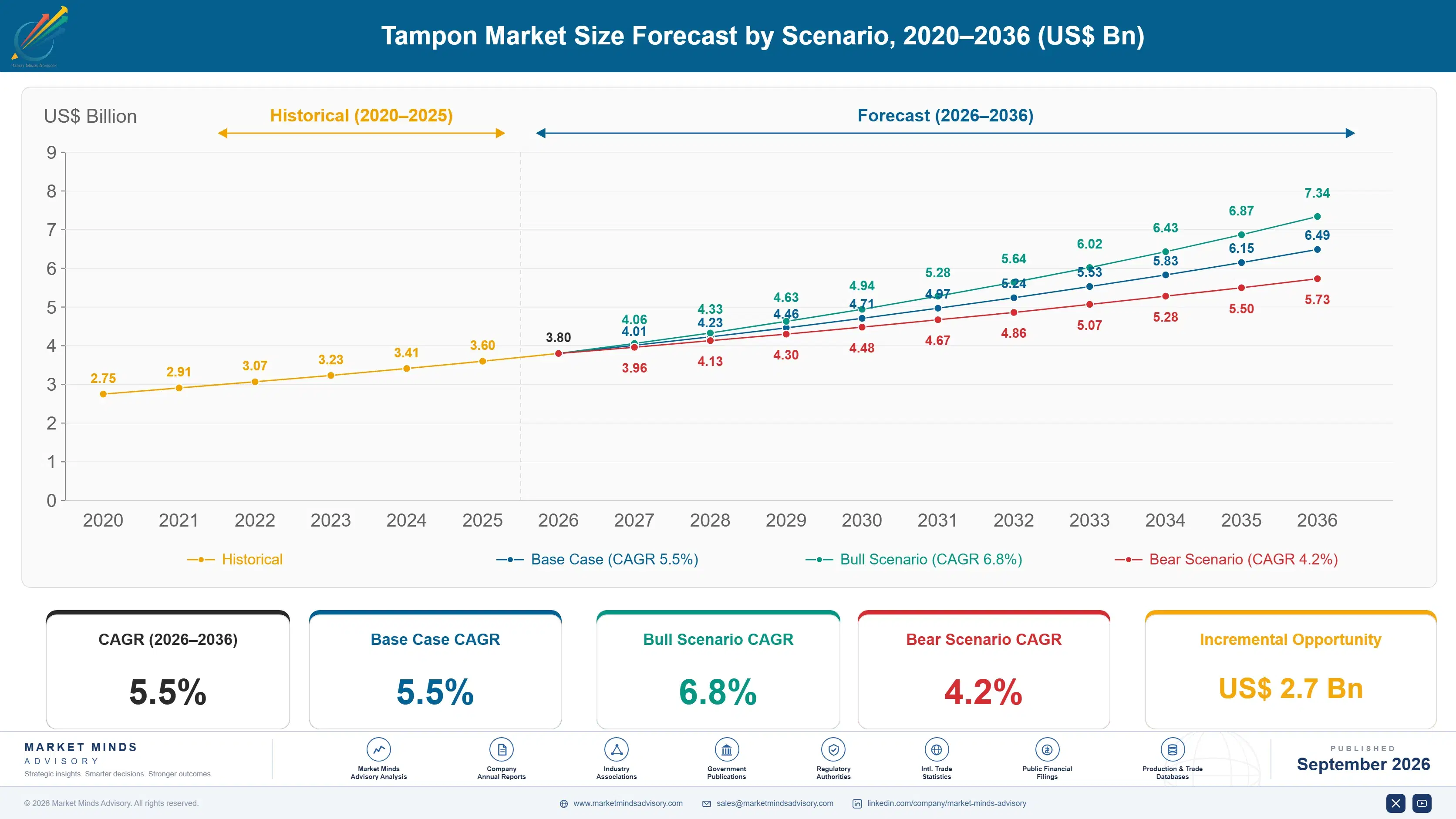
Tampon Market Forecast Scenarios

tampon-market-size-forecast-scenario-1790025306357
Between 2020 and 2025 the tampon market grew at a modest 4.5 percent historical CAGR, reflecting an already mature Western consumer base and gradual expansion into developing markets through NGO distribution and government menstrual health programs launched over that period. Pandemic-era supply disruptions briefly slowed distribution in several developing markets before recovering steadily by 2023.
The base case projects 5.5 percent annual growth through 2036, anchored by three mechanisms: continued organic and chemical-free product premiumization among existing Western users willing to pay meaningfully more for ingredient transparency and certified sourcing, expanding first-time adoption across South Asian and Sub-Saharan African markets as access programs mature and scale nationally, and steady applicator-free format growth among environmentally conscious younger consumers seeking reduced plastic packaging waste across most retail channels.
A bull scenario built on accelerated government procurement for school-based menstrual health programs across multiple developing regions could push growth toward 6.8 percent annually through the forecast window. A bear case tied to slower organic premiumization and persistent cultural stigma limiting adoption in conservative markets would compress growth toward 4.2 percent, primarily by delaying first-time user expansion rather than eroding the established Western consumer base.

Ingredient Transparency Redefines Category Purchasing Behavior

Tampons remain one of the most brand-loyal categories in consumer packaged goods, with repeat purchase behavior driven by product familiarity and comfort rather than price sensitivity for most established users worldwide today. This loyalty gives incumbent brands durable shelf presence but also makes them slower to respond to ingredient transparency demands than newer direct-to-consumer entrants targeting younger, considerably more skeptical buyers.
MARKET CONCENTRATIONCR5 58%top five brand owners hold the majority of category revenue
AVERAGE SELLING PRICE$6.50 per boxstandard eighteen-count regular absorbency applicator tampon retail box
TOP CONSUMING COUNTRYUnited States 24% sharereflects the highest per-capita tampon usage rate globally
ORGANIC SEGMENT GROWTH9.0% CAGRfastest expanding segment driven by ingredient transparency demand
REPLACEMENT FREQUENCYEvery 4 to 8 hourstypical usage interval driving recurring monthly purchase behavior
COTTON INPUT COST SHARE22% of COGSorganic cotton fiber sourcing as share of production cost
The United States leads per-capita consumption by a wide margin, reflecting decades of cultural normalization around tampon use compared with markets where sanitary pads remain the dominant menstrual product format by far. Organic cotton sourcing now represents a meaningful share of production cost for premium brands, creating real margin pressure as certified organic fiber supply remains limited relative to rising demand across most Western retail channels.
Government and NGO-funded menstrual health access programs are introducing tampons to first-time users across South Asia and Sub-Saharan Africa, expanding the addressable market well beyond its historically Western consumer base considerably. Retail distribution remains concentrated among a handful of multinational brand owners, though direct-to-consumer organic brands are steadily building independent distribution through subscription and specialty retail channels nationwide.
"Tampons are one of the last consumer categories where the biggest brands still win almost entirely on trust rather than price. That is exactly why ingredient transparency is such a dangerous flank."
Practice Lead, Feminine Hygiene and Menstrual Care Practice · MMA Feminine Hygiene and Menstrual Care Products Practice · September 2026

Market Trends

Organic Cotton Certification Becomes a Retail Shelf Requirement

Major retailers increasingly require organic certification documentation before granting premium shelf placement, pushing brands that previously marketed generic cotton content as organic to pursue formal third-party certification instead of relying on vague labeling language across product packaging and marketing materials nationwide. This shift is raising compliance costs across the category while simultaneously giving certified brands a credible differentiation point over competitors making unverified claims. Certification bodies report growing application volume from established brands that previously relied on conventional cotton-rayon blends, signaling the transition is reaching mainstream product lines broadly and quickly.
Market Impact: 4.5% historical CAGR sustained since 2020
Government Procurement Programs Scale Menstrual Health Access

National and regional governments across South Asia and Sub-Saharan Africa are expanding procurement programs that distribute tampons through school and public health systems, introducing the product to millions of first-time users who previously relied exclusively on sanitary pads or improvised materials during their monthly cycles each and every single year. These programs typically favor lower-cost applicator-free formats for logistics simplicity, creating a distinct government-channel product specification separate from retail-oriented premium branding entirely. Program funding increasingly comes from a mix of domestic health budgets and international development agency grants and partnerships.
Market Impact: 7.5% CAGR in applicator-free format

Market Opportunities and Growth Drivers

Rising Female Labor Force Participation Sustains Baseline Demand

Growing female workforce participation across developing economies is expanding the population of women who need discreet, reliable menstrual products compatible with formal workplace environments rather than traditional cloth or improvised materials used at home historically and out of necessity. Tampons in particular appeal to women in physically active occupations and hot climates where sanitary pads can feel less comfortable during extended wear throughout the workday. This demand mechanism runs largely independently of marketing spend, since it tracks underlying labor market participation rates rather than brand preference or advertising exposure alone.
Market Impact: 0.5 cases per 100,000 users annually

Applicator-Free Format Growth Reflects Sustainability Purchasing Preferences

Environmentally conscious consumers, particularly younger buyers in Western markets, increasingly favor applicator-free tampons that eliminate plastic waste associated with disposable applicators, a preference retailers are responding to with expanded shelf space for compact and applicator-free product lines across most major retail chains nationally. This shift also aligns with broader plastic reduction packaging regulations taking effect across several European Union member states, which are beginning to restrict single-use plastic applicator distribution in retail settings. Brands slow to introduce applicator-free options risk losing meaningful shelf space to competitors better positioned for this transition.
Market Impact: Under 10% penetration in affected regions

Market Restraints and Challenges

Toxic Shock Syndrome Concerns Persist Despite Modern Safety Standards

Toxic shock syndrome remains a persistent public health concern associated with tampon use, and periodic media coverage of individual cases continues to generate consumer anxiety despite modern manufacturing standards having reduced incidence rates dramatically since the 1980s. The root cause traces to extended wear time beyond recommended usage windows rather than any inherent product defect, but public understanding of this distinction remains limited among casual users. The commercial impact falls hardest on brands during any high-profile incident, regardless of fault. Manufacturers increasingly print usage duration warnings more prominently on packaging to address the concern directly.
Market Impact: 9.0% CAGR in certified organic segment

Cultural Stigma Limits Adoption in Several Developing Markets

Cultural and religious taboos around insertable menstrual products limit tampon adoption in several Middle Eastern, South Asian, and East Asian markets, where sanitary pads remain culturally preferred despite growing product availability through modern retail channels. The root cause traces to deeply held beliefs about virginity and modesty specific to insertable products rather than menstrual hygiene generally, making this a harder barrier to shift through simple education campaigns alone. The commercial impact caps addressable market size in these regions well below overall menstrual care category growth rates. NGO-led education programs are slowly working to shift attitudes among younger demographics.
Market Impact: 14% of first-time users reached
3 additional market trends, 4 additional growth drivers, and 3 additional restraints and challenges are covered in the full report. Contact sales@marketmindsadvisory.com to access the complete intelligence.

Segment CAGR and Growth Architecture

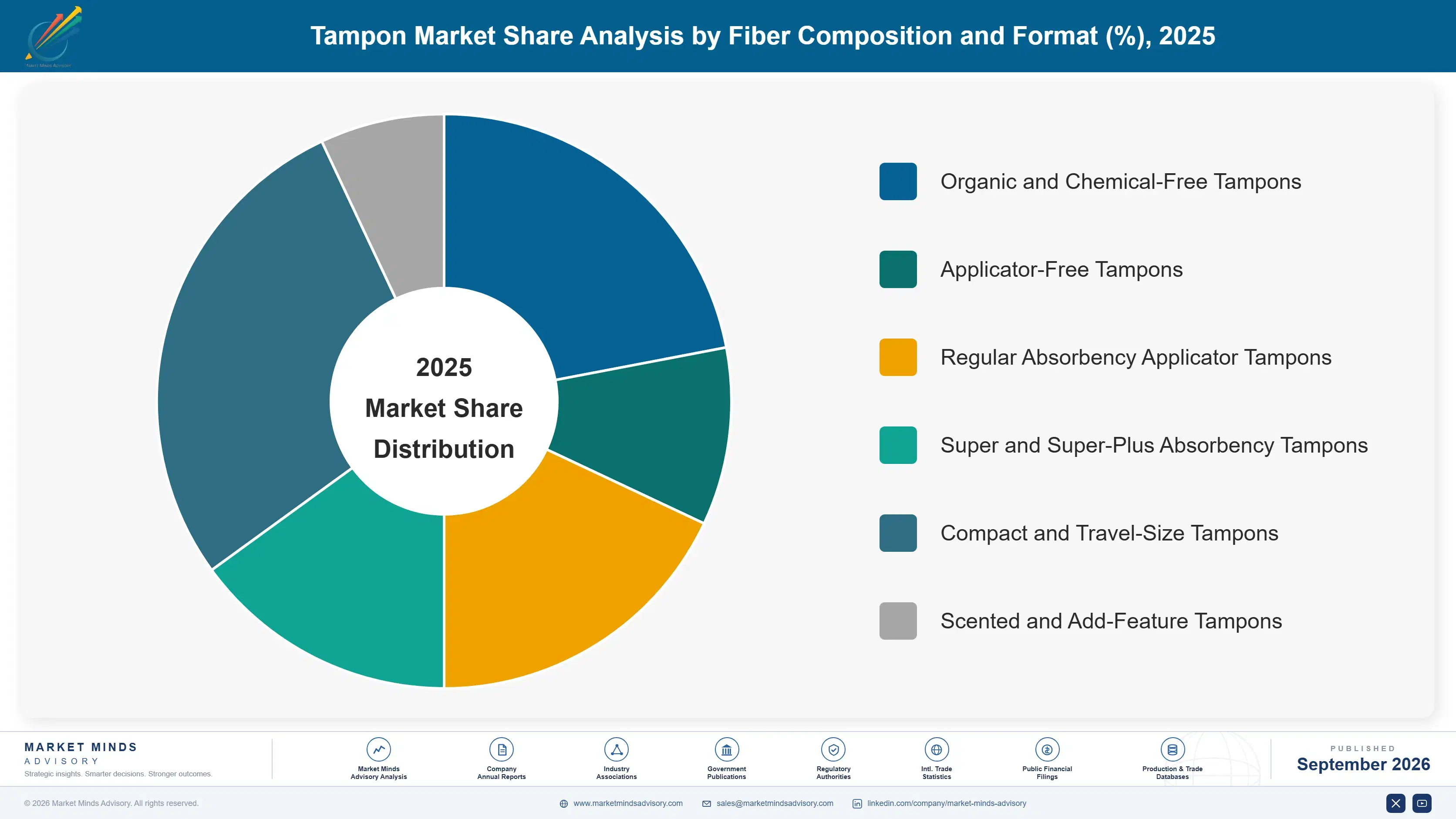
Segment logic follows fiber composition and applicator format rather than absorbency alone, since these two dimensions drive the category's real purchasing decisions and price differentiation across most retail channels. Six segments span organic and conventional fiber composition, applicator presence, absorbency level, and travel-oriented packaging formats, reflecting how consumers actually choose between competing products on shelf.
tampon-market-market-share-analysis-1790025306903

Organic and Chemical-Free Tampons

Organic and chemical-free tampons are the category's fastest-growing segment, driven by consumer concern over synthetic fiber content, chlorine bleaching residue, and fragrance additives found in conventional products sold at most mainstream retail chains nationwide and internationally. These products command meaningful price premiums, often double or more the cost of standard tampons, reflecting genuinely higher organic cotton input costs and third-party certification expenses incurred throughout the supply chain. Direct-to-consumer brands built entirely around organic positioning have captured disproportionate growth relative to their retail shelf footprint, using subscription models and ingredient transparency marketing to build loyal customer bases that incumbent brands are now racing to replicate through their own organic product line extensions.
CAGR 9.0%

Applicator-Free Tampons

Applicator-free tampons appeal to environmentally conscious consumers seeking to eliminate plastic waste and to buyers who value the more compact, discreet packaging these products offer compared with applicator formats sold at most retail chains nationwide and internationally. European regulatory pressure around single-use plastics has accelerated retailer interest in this format well beyond its traditional niche positioning among sustainability-focused shoppers. Adoption still trails applicator formats significantly in North America, where consumer familiarity with manual insertion remains considerably lower than in markets with longer applicator-free product history. Manufacturers are investing in educational packaging and in-store demonstration programs to address this comfort gap directly, particularly among first-time applicator-free buyers switching from traditional formats.
CAGR 7.5%
Full segment breakdown across 6 segments available in the complete report.

Regional Architecture and Country Demand Map

Consumption patterns diverge sharply from typical industrial goods, since cultural acceptance of insertable products, not manufacturing location, drives regional demand. North America and Western Europe concentrate spend on decades of established use, while East Asian and Middle Eastern markets trail well behind their overall population and income levels.

North America

North America holds the largest share by a wide margin, reflecting decades of cultural normalization around tampon use that began well before most other regions adopted the product category at any meaningful scale whatsoever. The United States alone accounts for the bulk of regional volume, driven by high per-capita usage rates and strong brand loyalty built through generations of consistent marketing investment and retail partnership. Organic and premium formats have gained the most traction here of any region, as disposable income and ingredient transparency awareness both run considerably higher than the global average. Canada mirrors similar consumption patterns at a smaller absolute scale, with comparable premium segment growth trends emerging steadily.
Share: 30% | CAGR: 4.5% (2026 to 2036)

Western Europe

Western Europe trails North America on both share and growth, though tampon adoption remains well established across the United Kingdom, France, and Germany, where usage rates rank among the highest globally after North America itself. Growth here runs slower than the global average largely because the installed consumer base is already quite mature, leaving little first-time adoption to drive incremental volume forward each year. Organic and sustainability-focused product lines are gaining share faster here than in most other regions, supported by regulatory pressure on single-use plastics across the European Union. Southern European markets show comparatively lower per-capita usage than northern member states, reflecting more entrenched sanitary pad preference in those countries.
Share: 24% | CAGR: 4.0% (2026 to 2036)
Regional intelligence for 5 additional markets available in the complete report: East Asia, South Asia and Pacific, Latin America, Middle East and Africa, Eastern Europe. Contact sales@marketmindsadvisory.com.
tampon-market-country-cagr-analysis-1790025307463

Where Tampon Brand Margin Actually Concentrates

Margin in the tampon category concentrates disproportionately around organic certification, subscription retention, and government contract scale rather than unit volume alone. Brands winning on ingredient transparency and direct distribution capture meaningfully wider margins than incumbents competing purely on shelf presence and advertising reach, particularly as younger consumers increasingly research ingredient sourcing before committing to a brand.

Certified Organic Cotton Product Line Extensions

Brands introducing certified organic cotton lines alongside conventional products capture meaningfully wider margins from consumers already loyal to their core brand but willing to pay a premium for ingredient transparency. This extension strategy avoids the customer acquisition cost of building an entirely new brand, since it converts existing buyers into higher-value purchases rather than competing for new customer attention. Early data from brands pursuing this strategy shows organic line extensions carrying gross margins roughly 15 percentage points above conventional product lines, a gap that has persisted as certified organic cotton sourcing costs have stabilized.
Market Impact: 15 percentage point margin premium on organic lines

Direct-to-Consumer Subscription Delivery Programs for Retention

Subscription-based delivery models eliminate retail markup and build predictable recurring revenue while giving brands direct customer relationships that traditional retail distribution never provides at comparable depth or consistency over time. This model works particularly well for a genuinely predictable consumption product like tampons, where purchase timing correlates closely with a known monthly cycle rather than variable discretionary demand patterns seen elsewhere. Subscription brands report customer lifetime value roughly 42 percent higher than comparable retail-only customers, driven by both improved retention and the elimination of retailer margin sharing on every unit sold.
Market Impact: 42 percent higher lifetime value via subscription model

Government and NGO Bulk Procurement Contracts

Winning long-term government or NGO bulk procurement contracts for menstrual health access programs provides guaranteed volume at meaningful scale, even though per-unit pricing runs considerably below standard retail price levels. Suppliers that secure these contracts gain forecastable revenue and can plan production capacity well ahead of need, reducing exposure to retail demand volatility that affects smaller brands more severely. Contract terms typically run 2 to 4 years and can represent a meaningful share of a supplier's total annual volume, particularly for suppliers focused on applicator-free formats favored by procurement programs.
Market Impact: Contracts covering up to 18% of annual volume

Premium Compact and Travel-Format Packaging Lines

Compact and travel-oriented packaging formats command a real price premium over standard boxes despite containing meaningfully fewer units per package, reflecting the convenience value consumers place on discreet, purse-sized packaging for on-the-go use throughout the day and week. Retailers increasingly dedicate checkout-adjacent shelf space to these formats specifically, giving brands with strong compact lines additional visibility beyond their core aisle placement. Compact format products carry per-unit pricing roughly 28 percent above standard box pricing, a premium consumers appear willing to pay consistently across most income segments and purchase occasions nationwide.
Market Impact: 28 percent per-unit price premium on compact formats

Who Controls the Margin Pool

Concentration is high for a consumer hygiene category, with a CR5 near 58 percent reflecting decades of consolidated brand ownership across a handful of multinational personal care companies with deep retail relationships. Procter & Gamble and Edgewell hold the clearest leadership positions through Tampax and o.b. respectively, with a meaningful gap separating them from smaller regional and organic challenger brands still building national distribution.
Most current competitive activity centers on ingredient transparency and organic certification rather than price, as incumbent brands race to launch credible organic lines to counter direct-to-consumer challengers built entirely around clean-label positioning and subscription convenience. Several players are also expanding applicator-free product lines to capture sustainability-focused demand across younger demographics. Regional manufacturers in developing markets compete primarily on price for government procurement contracts rather than brand positioning or marketing reach.

Emerging pressure comes from direct-to-consumer organic brands winning younger consumers through subscription models and ingredient transparency marketing incumbents have been slower to match at comparable credibility. Rankings are most likely to shift in developing markets, where government procurement contracts and NGO distribution partnerships are redrawing competitive positioning away from traditional retail brand loyalty and marketing spend.
tampon-market-company-positioning-matrix-1790025307988

Competitive Moat and Risk Dimensions

PROCTER & GAMBLE COMPANY

Moat: Decades of Retail Shelf Dominance

Procter & Gamble's Tampax brand carries decades of national retail relationships and marketing investment that give it category-leading shelf space across nearly every major grocery and pharmacy chain. This distribution depth lets Tampax launch new product variants with immediate national availability, a speed advantage smaller challenger brands cannot match without years of relationship building.
PROCTER & GAMBLE COMPANY

Risk: Slow Organic Line Credibility

Tampax's organic product extensions face credibility skepticism among ingredient-conscious consumers who associate the brand with decades of conventional cotton-rayon formulations rather than clean-label positioning. Building genuine trust in this segment requires sustained marketing investment and third-party certification that dedicated organic brands already possess and have built over years.
EDGEWELL PERSONAL CARE COMPANY

Moat: Established Applicator-Free Format Leadership

Edgewell's o.b. brand has built genuine category leadership in the applicator-free format over several decades, giving it credibility with sustainability-minded consumers that competitors entering this format recently cannot easily replicate. This positioning benefits directly from growing regulatory pressure on single-use plastic applicators across European markets.
EDGEWELL PERSONAL CARE COMPANY

Risk: Limited Emerging Market Distribution

Edgewell's distribution network remains concentrated in North America and Western Europe relative to competitors with stronger established presence in Asia and Latin America. This limits Edgewell's ability to capture first-time adoption growth in developing markets where menstrual health access programs are expanding the category fastest.

Players Tracked

Prominent Players

Procter & Gamble Company
Edgewell Personal Care Company
Kimberly-Clark Corporation
Johnson & Johnson
Unicharm Corporation

Other Key Players

Essity AB
Natracare (Bodywise UK Ltd)
Cora
LOLA
The Honey Pot Company
Rael Inc
Seventh Generation Inc
DSG International (Asia) Ltd
First Quality Enterprises Inc
Ontex Group NV
Kao Corporation
Hengan International Group
Veeda AS
This Is L. Inc
Grace & Green Ltd

Recent Developments

FEBRUARY 2026

Kimberly-Clark Launches Certified Organic Kotex Product Line

Kimberly-Clark launched a certified organic cotton extension of its Kotex brand, following growing retailer demand for ingredient transparency documentation before granting premium shelf placement. The launch marks the company's first formal entry into certified organic tampons, following similar moves by smaller competitors that had previously captured this positioning largely unopposed.
Signal: Signals large incumbent brands are treating organic certification as a competitive necessity rather than a niche positioning choice.
JUNE 2025

Unicharm Expands India Manufacturing Capacity for Applicator-Free Tampons

Unicharm expanded domestic Indian manufacturing capacity dedicated to applicator-free tampons, positioning the company to supply both retail growth and government procurement programs directly from local production rather than imports. The expansion reduces landed cost for government-channel products and shortens delivery timelines for large institutional orders tied to school distribution programs.
Signal: Signals multinational manufacturers are building dedicated local capacity to serve government procurement channels in high-growth developing markets.
NOVEMBER 2025

Johnson & Johnson Acquires Direct-to-Consumer Organic Tampon Brand

Johnson & Johnson acquired a mid-sized direct-to-consumer organic tampon brand to gain immediate credibility and subscription infrastructure in the clean-label segment rather than building comparable positioning internally over several years. The acquisition brings an established subscriber base and organic certification relationships the company previously lacked entirely.
Signal: Signals large incumbents increasingly prefer acquiring organic credibility outright over attempting much slower internal brand development.

Cotton Sourcing Costs Across Fiber Grades

Cotton and cotton-rayon blend fiber represent the largest cost component in tampon manufacturing, typically 22 to 28 percent of cost of goods sold, with certified organic cotton commanding a substantial premium over conventional supply. Organic cotton sourcing concentrates in India, Turkey, and the United States, while conventional cotton and rayon inputs draw from a more globally distributed base.
Global cotton prices spiked sharply during 2021 and 2022 as weather disruptions reduced harvest yields across major growing regions simultaneously, a volatility event documented in Procter & Gamble's fiscal year annual report covering that period. Manufacturers without forward cotton purchasing agreements absorbed cost increases directly into thinning margins, since tampons cannot easily substitute alternative fibers without losing absorbency certification. Organic cotton supply proved especially constrained given its smaller certified growing base.

Larger manufacturers with vertically integrated fiber sourcing or long-term supply contracts absorb cotton price swings more easily than smaller organic brands that buy certified fiber on limited spot markets and must pass costs directly to price-sensitive consumers. This exposure gap widens further for direct-to-consumer organic brands, which typically lack the purchasing scale to negotiate favorable forward contracts that multinational incumbents secure routinely.
tampon-market-cost-volatility-analysis-1790025308197

Forward Cotton Purchasing Agreements

Larger manufacturers increasingly lock in cotton fiber prices through forward purchasing agreements spanning six to twelve months, insulating margins from short-term weather-driven harvest volatility across major growing regions. This requires working capital most smaller organic brands lack access to, concentrating the practice among top-tier multinational suppliers with established banking relationships and stronger balance sheets.

Diversified Organic Cotton Sourcing Regions

Some brands are qualifying certified organic cotton suppliers across multiple growing regions, including India, Turkey, and Texas, to reduce dependence on any single harvest and its associated weather risk during peak growing seasons. Diversification adds supplier qualification cost in the near term but meaningfully reduces exposure to any single region's crop failure over the longer term.

Alternative Fiber Blend Research

Several manufacturers are researching bamboo and other alternative natural fiber blends that could reduce dependence on cotton specifically while maintaining absorbency certification standards across most product lines. Adoption remains early since alternative fibers require extensive safety and absorbency testing before regulatory approval, but successful blends could meaningfully diversify the category's fiber input base over the longer term.

Portfolio Architecture for Margin Defence

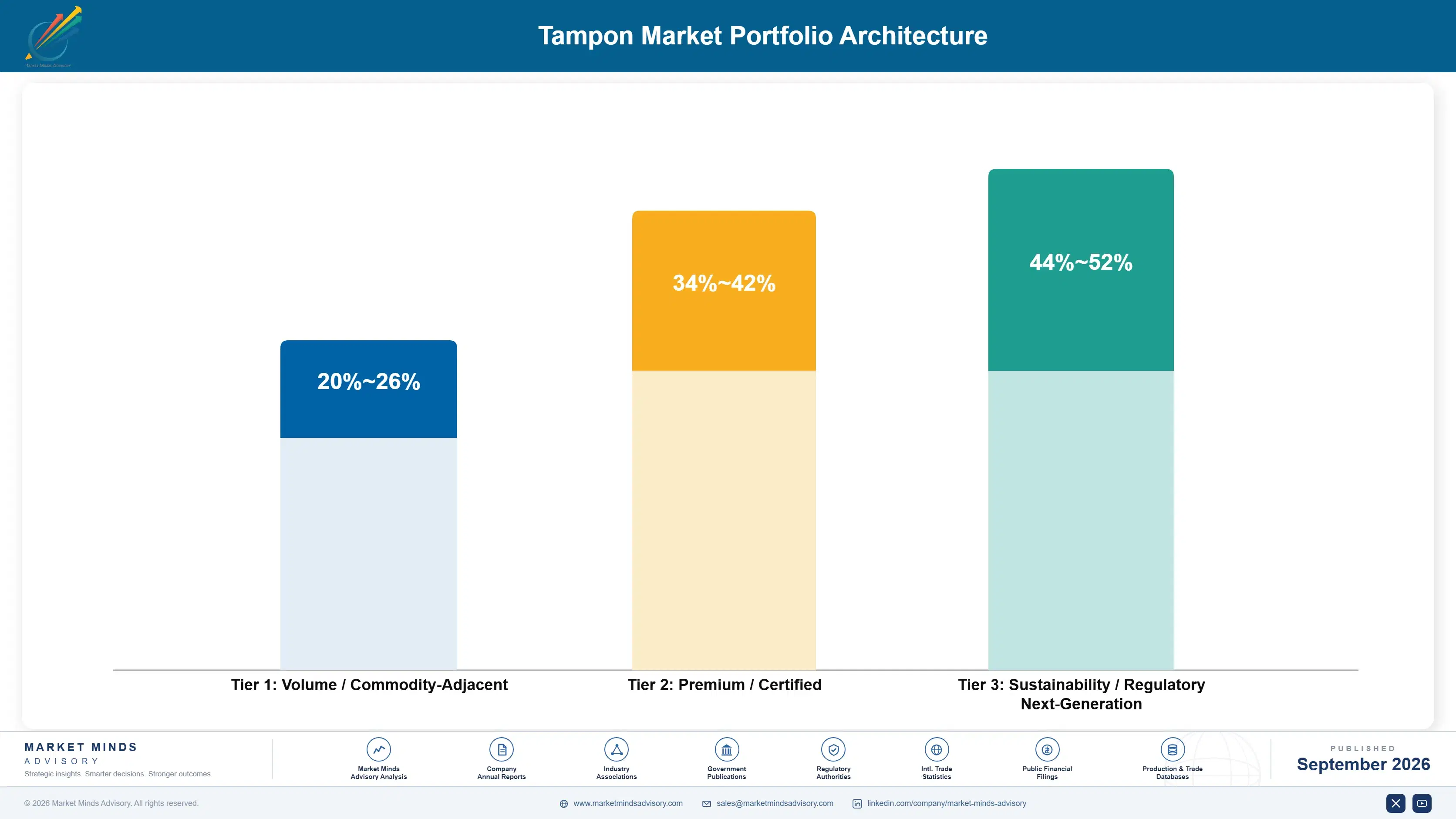
The tampon category spans a wide margin range from private-label commodity products to certified organic and subscription-based premium lines, with gross margins varying meaningfully across that spectrum depending heavily on brand positioning and distribution model chosen by each manufacturer. Volume-tier products compete on price and retail availability, while premium and next-generation tiers compete on ingredient transparency and direct customer relationships built over time.
The tension between volume and premium positioning shapes brand strategy across the category more than in most comparable consumer hygiene segments today. Multinational incumbents defending mass retail presence must hold competitive pricing even as cotton costs fluctuate seasonally and unpredictably, while direct-to-consumer organic brands sustain meaningfully wider margins tied to subscription retention and certification credibility rather than shelf volume alone.

High-value margin pools concentrate specifically around certified organic lines, subscription delivery programs, and premium compact packaging formats, none of which represent the bulk of unit volume sold globally at any given time or season. Brands that can straddle both volume and premium positioning simultaneously, rather than choosing one exclusively, capture the widest share of total category profit pools over the entire forecast period.

Volume / Commodity-Adjacent

Private-label and value-tier conventional tampons sold through mass retail and pharmacy channels nationwide, competing chiefly on unit price with limited brand differentiation beyond package count and absorbency labeling across most stores.
Gross Margin: 20-26%

Premium / Certified

Branded conventional and applicator-free tampons carrying established brand loyalty and moderate certification claims, purchased through mainstream retail channels at established price points above private label across most developed markets and mid-tier retail chains.
Gross Margin: 34-42%

Sustainability / Regulatory / Next-Generation

Certified organic, subscription-delivered, and sustainability-positioned tampons serving ingredient-conscious consumers willing to pay meaningfully more for transparency and direct brand relationships built through digital subscription models and specialty retail channels over time.
Gross Margin: 44-52%
tampon-market-portfolio-architecture-1790025308717

High-value Sub-segments and Strategic Watch-out

Organic and Chemical-Free Tampons

Organic and chemical-free tampons combine the category's fastest unit growth with its widest margins, driven by ingredient-conscious consumers willing to pay meaningfully more for certified sourcing and third-party testing. This segment concentrates brand profitability and is attracting the most competitive investment across incumbent and challenger brands alike.
Gross Margin: 44-52%

Applicator-Free Tampons

Applicator-free tampons pair solid growth with meaningful margin advantages tied to sustainability positioning and lower per-unit packaging cost, as environmentally conscious buyers and tightening regulatory pressure both favor this format increasingly across most Western retail markets. Margins trail the organic tier but exceed conventional applicator pricing overall.
Gross Margin: 36-42%

Regular Absorbency Applicator Tampons

Standard regular absorbency applicator tampons remain the category's volume core, sustaining baseline unit demand across most established markets nationwide even as growth concentrates elsewhere in the portfolio. Thin margins and intense private-label competition make this segment a scale business rather than a profit driver for most suppliers.
Gross Margin: 20-26%

Scented and Add-Feature Tampons

Scented and add-feature tampons carry the slowest growth and warrant close monitoring for consolidation risk, as ingredient transparency concerns increasingly work against fragrance additives specifically across most markets. Consumer skepticism toward added chemicals threatens continued demand for this segment even as overall category volume keeps growing.
Gross Margin: 22-28%

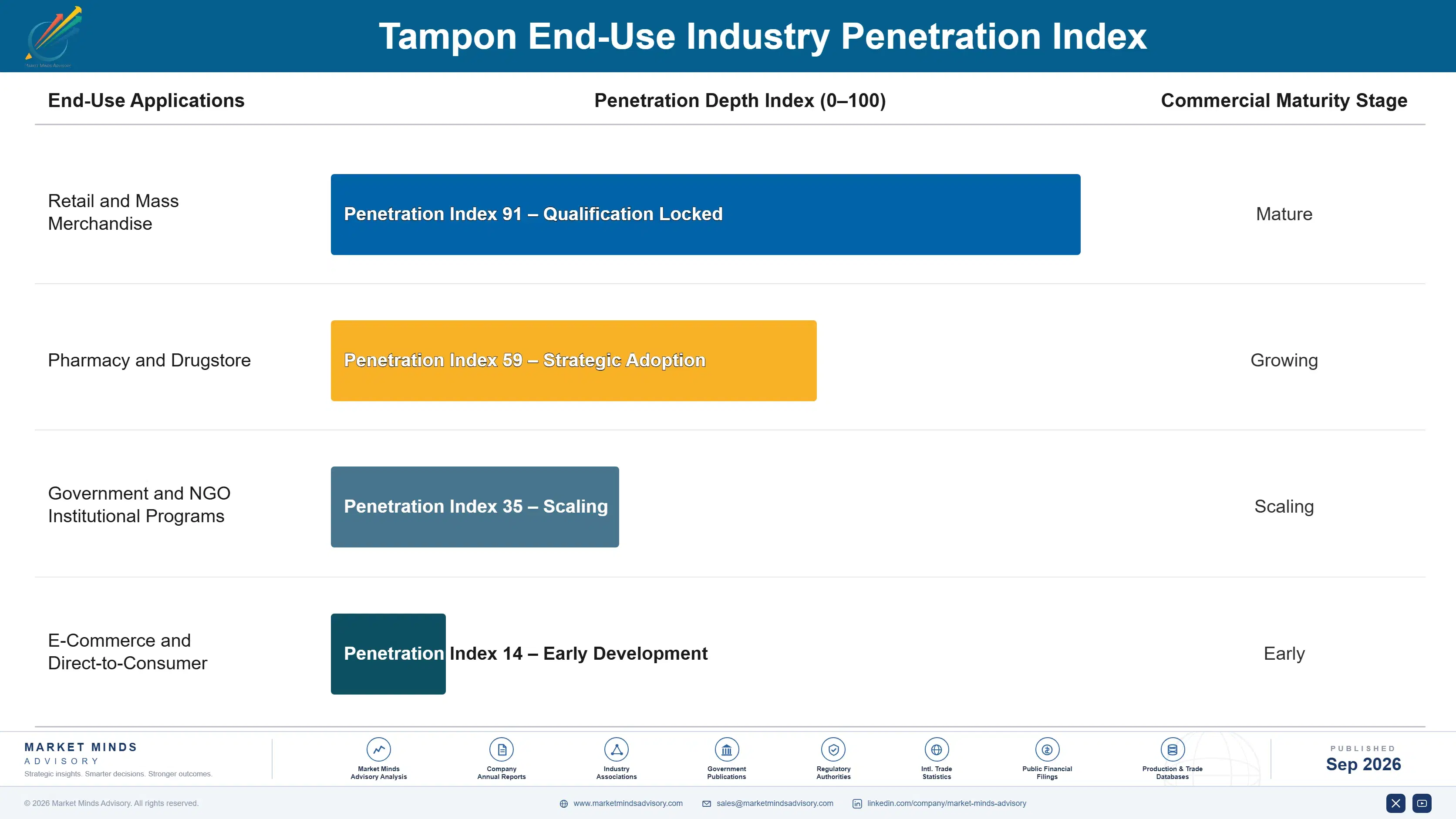
The Recurring Economics of Monthly Purchase

Tampons function closer to a recurring subscription-like expense than a discretionary purchase, since biological cycle timing mandates repurchase on a predictable monthly schedule for most users throughout their entire reproductive years and well beyond. This built-in repurchase cycle gives brands a demand base that persists independent of broader consumer spending cycles or discretionary budget cuts during economic downturns and recessions nationwide.
Adoption stickiness varies meaningfully by end-use context across the entire category. Users who adopt tampons during adolescence typically maintain brand loyalty for decades, making early-life brand acquisition disproportionately valuable relative to overall customer lifetime revenue. Athletes and physically active users show particularly strong format loyalty once they find a comfortable absorbency and applicator combination, switching brands far less frequently than average category buyers do.

Buyer profiles are shifting generationally as younger consumers increasingly expect ingredient transparency and direct brand relationships that older incumbent brands built on pure retail distribution scale are considerably slower to offer credibly at comparable trust levels. Younger buyers entering the category also show greater willingness to try subscription and direct-to-consumer models over traditional retail purchasing habits and long-standing loyalty patterns.
tampon-market-end-use-penetration-index-1790025309215

MMA Verdict on Category Direction

These are among the four positions where our research anticipates prominent divergence between winners and laggards over the coming forecast period. Each is grounded in the demand model, the regulatory perimeter, and the announced capacity pipeline.
01 / CERTIFICATION INVESTMENT PRIORITY

Prioritize certified organic transparency over incremental brand marketing

Organic and chemical-free tampons carry the category's widest margins and fastest growth, yet incumbent brands remain slower than direct-to-consumer challengers to build credible ingredient transparency positioning across most Western retail markets. Brands that invest in genuine third-party organic certification now, rather than marketing language alone, secure a multi-year trust advantage before challenger brands can out-market them on transparency claims specifically and credibly. This window narrows every year as more incumbents launch credible organic line extensions of their own at growing scale.
02 / SUBSCRIPTION MODEL EXPANSION

Build direct-to-consumer subscription infrastructure before challengers lock in loyalty

Subscription delivery models eliminate retail markup and build customer lifetime value roughly 42 percent higher than comparable retail-only relationships, yet most multinational incumbents still rely primarily on traditional retail distribution for the bulk of their overall volume today. Brands that build genuine direct-to-consumer subscription infrastructure now capture margin and customer data advantages that pure retail competitors simply cannot replicate through shelf presence and advertising alone. Incumbents delaying this transition risk ceding the most loyal, highest-value customer segment entirely to newer entrants.
03 / COTTON SOURCING RISK MANAGEMENT

Diversify organic cotton sourcing before the next harvest volatility cycle

Cotton feedstock pricing has already demonstrated its capacity to compress margins sharply during weather-driven harvest volatility, and smaller organic brands without forward purchasing agreements bore the brunt of the last cycle documented across multiple company filings. Vertically integrated multinational players weathered the same period with meaningfully smaller margin swings, a gap the market clearly rewards over time as organic cotton supply remains tightly constrained. Brands should diversify sourcing regions and lock in pricing mechanisms now rather than waiting for the next volatility event to force reactive decisions.
04 / EMERGING MARKET ENTRY SEQUENCING

Prioritize government procurement channels over premium retail in developing markets

Government and NGO procurement programs are introducing tampons to first-time users across India and Sub-Saharan Africa at genuinely national scale, creating meaningful first-mover advantages for suppliers who establish government-channel supply relationships early in that ongoing transition. These programs favor lower-cost applicator-free formats over premium retail branding, requiring a distinct product and pricing strategy from standard Western consumer marketing approaches. Suppliers treating developing markets as a smaller version of Western retail risk losing these contracts entirely to competitors purpose-built for procurement-channel economics.

Engagement Snapshot From the Field

A live engagement with an industry participant carrying material or product regulatory and market exposure ahead of a defining policy shift, showing how our research translates into a defensible multi-year portfolio strategy.
MARKET MINDS ADVISORY · CLIENT ENGAGEMENT SUMMARY
Tampon Producer Strategic Portfolio Review and Transition Roadmap 2026·Investment Scenario on Tampon Exposure Evaluation 2025-26
CLIENT PROFILE
The client is a mid-sized personal care company with an established conventional tampon brand carrying meaningful national retail distribution but no organic or chemical-free product line whatsoever in its portfolio. Leadership had observed direct-to-consumer organic competitors capturing disproportionate growth and sought to understand whether launching an organic extension made commercial sense given the brand's existing conventional positioning.
STRATEGIC CHALLENGE
The client risked losing younger, ingredient-conscious consumers to direct-to-consumer organic brands but was uncertain whether an organic extension would cannibalize existing conventional sales or genuinely expand the customer base. Leadership also needed clarity on realistic pricing and margin expectations before committing meaningful capital to organic certification and supply chain development.
MMA APPROACH
MMA conducted consumer segmentation research to identify which existing customers would likely trade up to an organic line versus which represented genuinely new demand, then modeled cannibalization risk against incremental revenue scenarios. The engagement included organic cotton supplier landscape mapping and price elasticity testing across several proposed price points before finalizing recommendations.
KEY FINDINGS
  1. Consumer segmentation research found that 68 percent of projected organic line buyers (client-reported, unverified by MMA) represented genuinely new customers rather than cannibalized existing sales.
  2. Price elasticity testing identified an optimal premium of roughly 90 percent over the conventional line, balancing volume against per-unit margin across tested price points.
  3. Organic cotton supplier mapping identified three qualified regional sourcing partners capable of meeting projected volume within the client's required eighteen-month launch timeline.
  4. Post-launch tracking showed organic line sales reaching 12 percent of total brand revenue (client-reported, unverified by MMA) within the first full year on shelf.
CLIENT PROFILE
The client is a mid-sized personal care company with an established conventional tampon brand carrying meaningful national retail distribution but no organic or chemical-free product line whatsoever in its portfolio. Leadership had observed direct-to-consumer organic competitors capturing disproportionate growth and sought to understand whether launching an organic extension made commercial sense given the brand's existing conventional positioning.
STRATEGIC CHALLENGE
The client risked losing younger, ingredient-conscious consumers to direct-to-consumer organic brands but was uncertain whether an organic extension would cannibalize existing conventional sales or genuinely expand the customer base. Leadership also needed clarity on realistic pricing and margin expectations before committing meaningful capital to organic certification and supply chain development.
MMA APPROACH
MMA conducted consumer segmentation research to identify which existing customers would likely trade up to an organic line versus which represented genuinely new demand, then modeled cannibalization risk against incremental revenue scenarios. The engagement included organic cotton supplier landscape mapping and price elasticity testing across several proposed price points before finalizing recommendations.
KEY FINDINGS
  1. Consumer segmentation research found that 68 percent of projected organic line buyers (client-reported, unverified by MMA) represented genuinely new customers rather than cannibalized existing sales.
  2. Price elasticity testing identified an optimal premium of roughly 90 percent over the conventional line, balancing volume against per-unit margin across tested price points.
  3. Organic cotton supplier mapping identified three qualified regional sourcing partners capable of meeting projected volume within the client's required eighteen-month launch timeline.
  4. Post-launch tracking showed organic line sales reaching 12 percent of total brand revenue (client-reported, unverified by MMA) within the first full year on shelf.
RECOMMENDED STRATEGY
Phase 1: Phase one: consumer segmentation research and organic cotton supplier landscape mapping across three qualified regional sourcing candidates and supply partners. Phase 2: Phase two: price elasticity testing across multiple proposed retail price points, followed by a limited regional retail pilot launch program. Phase 3: Phase three: national rollout with post-launch cannibalization tracking and ongoing supplier relationship management through the entire first full operating year.
OUTCOME
The client successfully launched its organic tampon line within the planned eighteen-month window, achieving 12 percent of total brand revenue (client-reported, unverified by MMA) within the first full year. Cannibalization of the conventional line remained minimal, confirming the segmentation research's projection that most organic buyers represented genuinely new demand rather than a shift within the existing customer base.

Frequently Asked Questions

Foundational context covering the market sizes, CAGR, scope, country, region and competition that inform every finding below. This section is provided to cover basics and most often pre-purchase conversations, answered from the MMA Primary Research Dataset.

What is the current size of the Tampon Market?

The Tampon Market is valued at 3.6 billion dollars in 2025. This reflects mature Western consumption alongside steadily expanding developing market access programs and initiatives.

How large will the Tampon Market be by 2036?

MMA projects the market will reach approximately 6.49 billion dollars by 2036. Organic premiumization and steadily expanding first-time adoption together drive this growth trajectory forward.

What is the CAGR for the Tampon Market 2026 to 2036?

The market is forecast to grow at a 5.5 percent compound annual growth rate between 2026 and 2036. This places it within the growth specialty band.

Which segment is growing fastest?

Organic and chemical-free tampons are the fastest-growing segment at a 9.0 percent CAGR, roughly 1.6 times the overall market rate. Ingredient transparency demand drives this.

Who are the major companies in the Tampon Market?

Leading companies include Procter & Gamble, Edgewell Personal Care, Kimberly-Clark, Johnson & Johnson, and Unicharm. These five companies hold a combined CR5 of approximately 58 percent.

Which country is growing fastest?

India leads country-level growth at a 9.8 percent CAGR, driven by government and NGO menstrual health access programs. This outpaces the broader South Asia and Pacific region.

Report Segmentation Architecture

The full report scope spans multiple orthogonal segmentation dimensions, with cross-tabulated demand data provided for each dimension pair. Coverage extends further to regional breakdowns, trend trajectories, and the competitive detail needed to support segment-level decision-making.

By Fiber Composition and Format

  • Organic and Chemical-Free Tampons
  • Applicator-Free Tampons
  • Regular Absorbency Applicator Tampons
  • Super and Super-Plus Absorbency Tampons
  • Compact and Travel-Size Tampons
  • Scented and Add-Feature Tampons

By End-Use Industry

  • Retail and Mass Merchandise
  • Pharmacy and Drugstore
  • Government and NGO Institutional Programs
  • E-Commerce and Direct-to-Consumer

By Commercial Dimension

  • Direct Retail Purchase
  • Subscription Delivery Model
  • Government Procurement Contract
  • Bulk Institutional Distribution

By Region

  • North America
  • Western Europe
  • East Asia
  • South Asia and Pacific
  • Latin America
  • Middle East and Africa
  • Eastern Europe

Scope, Methodology, and Coverage

Every figure in this report is reproducible from documented input assumptions. The scope below maps the historical period, the forecast horizon, the segmentation dimensions, and the countries covered, alongside the underlying primary and qualitative methodology.
Historical Period
2020 to 2025
Forecast Period
2026 to 2036
Base Year
2025 (USD billions; MMA Primary Research Dataset, September 2026)
Market Definition
The Tampon Market covers manufactured intravaginal absorbent menstrual products, including applicator and applicator-free formats across organic and conventional fiber compositions. It excludes sanitary pads, menstrual cups and discs, and period underwear, which represent separate menstrual care product categories.
Quantitative Units
USD billions, unit volume in millions of boxes
Segmentation Dimensions
Fiber composition and format, end-use industry, commercial dimension
Regions Covered
North America, Western Europe, East Asia, South Asia and Pacific, Latin America, Middle East and Africa, Eastern Europe
Countries Covered
35+ countries across seven global regions
Key Companies Profiled
Procter & Gamble Company, Edgewell Personal Care Company, Kimberly-Clark Corporation, Johnson & Johnson, Unicharm Corporation, and 15 additional participants
Quantitative Methodology
Primary survey, n=3,800 respondents, Q4 2025, six countries; demand-side model with trade association cross-validation
Qualitative Methodology
47 expert interviews, Q4 2025; applied to validate demand model assumptions, identify emerging dynamics, and assess competitive positioning
Report Format
PDF and XLSX data workbook (Word format preview document)
Publisher
Market Minds Advisory
Report Code
MMA-2026-HLT-218
Published
September 2026
Contact
sales@marketmindsadvisory.com | www.marketmindsadvisory.com

Purchase the full Tampon Market Report (2026 to 2036).

The full Tampon Market report delivers a complete forecast model spanning 2026 through 2036. Granular segmentation spans fiber composition and format, end-use industry, and commercial dimension. It includes detailed competitive profiles for all twenty tracked participants, regional demand analysis across seven geographies, and input cost exposure modeling grounded in primary survey and expert interview data. The report further examines portfolio margin economics, revenue lever strategies, and demand architecture across the category's replacement cycle dynamics. A fully anonymized client engagement case study illustrates practical application of the underlying research findings across comparable consumer hygiene markets.
Full regional breakdown across all seven global markets
Company-level competitive benchmarking with moat and risk assessment
Segment-by-segment growth rate forecasts through 2036
Input cost exposure analysis and mitigation pathway detail
Portfolio tiering framework with margin economics detail
Primary survey data collected across six countries

Built For The People Who Decide

From boardroom strategy to bench-side execution, this report is read cover-to-cover by leaders shaping the next decade of their industry, turning demand scenarios, market dynamics and valuation benchmarks into decisions.
CXOs/ Presidents/ VPs/ Managers
M&A and Corporate Development
Strategy Teams and R&D Heads
Procurement and Product Directors
Regulatory and Compliance Leaders
Investor Relations and Equity Analysts