Market Minds Advisory
Tagatose Market

Tagatose Market: Substrate Route Economics, Labelling Advantage and the Allulose Comparison, 2026 to 2036

Tagatose has spent two decades priced out of the applications it suits best, and the enzymatic route from cheap fructose rather than expensive galactose is what finally changes that arithmetic.

Lead Analyst

Lisa Gevelber

Published

September 2026

Make Smarter Decisions with Customized Research Insights

Request a free sample report and evaluate market opportunities, growth trends, and competitive dynamics relevant to your business needs.

2025 MARKET VALUE$0.1BMarket Size 2025
2036 FORECAST VALUE$0.3BBase Case , 2026 to 2036
CAGR 2026 TO 203611.4 %Bull 12.7% / Bear 10.1%
INCREMENTAL OPPORTUNITY$0.2BNet 10- year value creation
EXPANSION MULTIPLE2.94x2036 value over 2026 base
Strategic Levers
M&A Pipeline
Regional Outlook
Country Rankings
Competitive Intelligence
Segmental Deep-dive
Call-Us : 91 93563 13602

Executive Snapshot and Market Trajectory

Substrate choice has decided this market for twenty years. Producing tagatose from galactose recovered out of whey gives poor yields and expensive purification, which held pricing at ten to fifteen times sucrose and confined the ingredient to niche formulations that nobody ever scaled properly.
Enzymatic conversion from fructose grows at 17.1%, a full 1.50 times the market rate, because fructose is abundant, cheap and readily available anywhere that a corn or cane processor happens to operate. East Asia holds 36% of global value, above the standard regional band, because Korean producers commercialised tagatose before anyone else and Chinese enzyme and rare sugar capacity has scaled very rapidly behind them since 2020.
Concentration is very high at 76% for the top five, which is what a market looks like when enzyme and process patents rather than plant capacity decide participation. The commercial pressure that matters most is comparison: allulose occupies nearly identical labelling and functional territory at lower production cost, and formulators evaluating a rare sugar increasingly reach for allulose first, considering tagatose only where its specific properties matter. That comparison shapes every commercial decision here.
Market Definition
The market covers D-tagatose supplied as a crystalline or liquid rare sugar sweetener and functional ingredient for food, beverage, confectionery, pharmaceutical and personal care applications. It spans enzymatic conversion from fructose, whole-cell biocatalysis, enzymatic conversion from lactose or galactose, chemical isomerisation and blended or co-crystallised formats. It excludes allulose, erythritol and other polyols, stevia, monk fruit and high-intensity sweeteners, conventional sugars and syrups, and finished sweetener blends sold as consumer table-top products.
Base Year Value
$0.1B in 2025 (MMA Primary Research Dataset, August 2026)
Forecast Period
2026 to 2036, eleven discrete annual values
CAGR
11.4% base case. Bull 12.7%. Bear 10.1%.
Fastest Growth Segment
Enzymatic Conversion From Fructose: 17.1% CAGR
Fastest Growth Country
India: 15.2% CAGR
Fastest Growth Region
South Asia and Pacific: 13.7% CAGR
Largest Region
East Asia: 36% of 2025 global value
Market Leaders
CJ CheilJedang, Samyang Corporation, Baolingbao Biology, Bonumose, Nutrilab. Source: MMA Primary Research Dataset, July 2026.
Primary Survey
n=3,800 procurement and R&D decision-makers, Q4 2025, six countries
Methodology
Demand-side build-up, cross-validated against public data, 47 expert interviews

Tagatose Market Forecast Scenarios

tagatose-market-trends-size-forecast-scenario-1787312663053
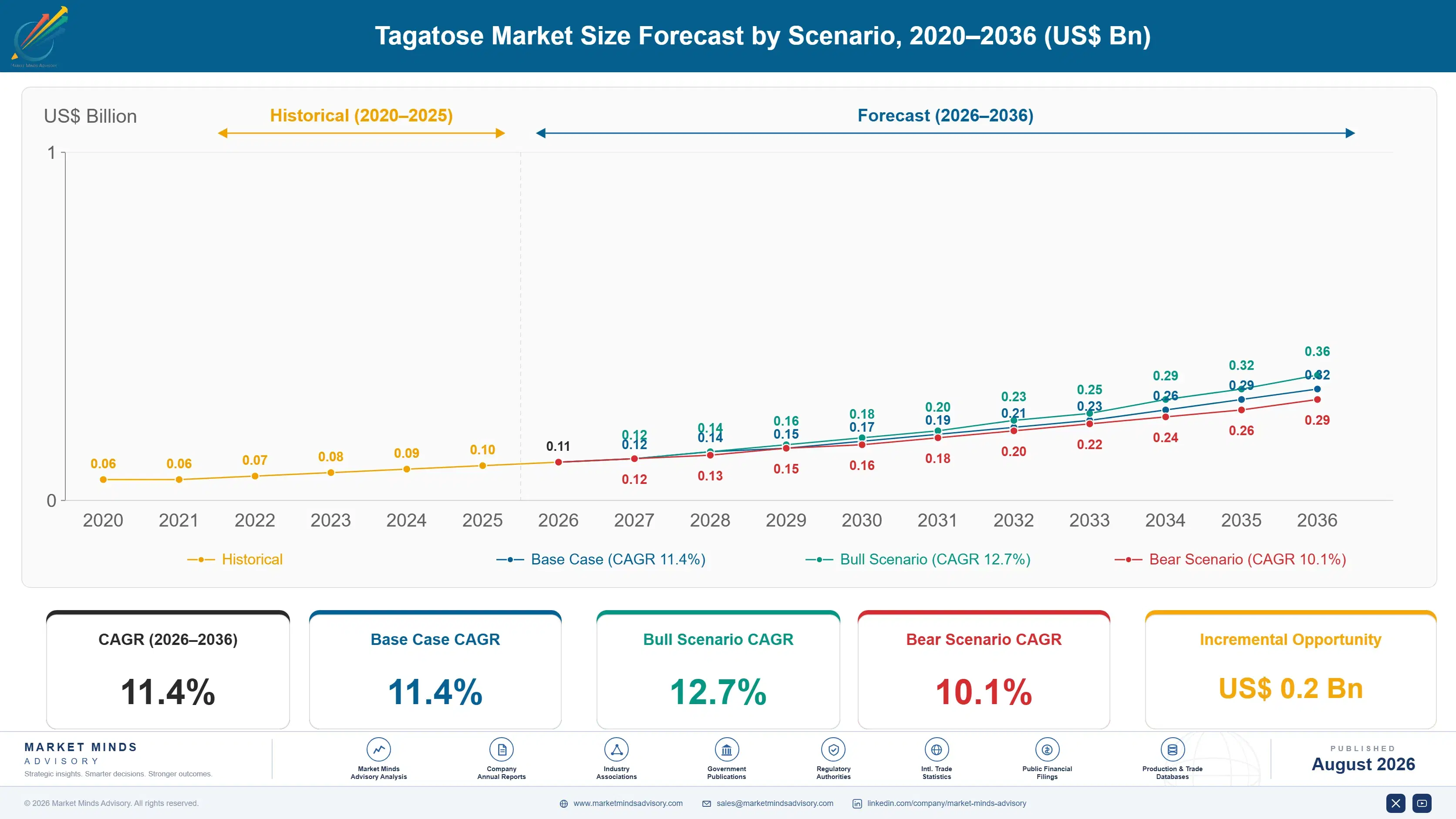
The market compounded at 9.9% between 2020 and 2025 from a very small base, and regulation did more for it than any technical development. United States labelling guidance excluding tagatose from the added sugars declaration removed the single biggest formulation objection. Production cost fell steadily as enzymatic routes matured, though volumes stayed modest because pricing remained far above bulk alternatives.
The 11.4% base case rests on three mechanisms. First, enzymatic conversion from fructose keeps cutting production cost toward the level where mainstream beverage and confectionery formulation becomes viable rather than merely possible. Second, labelling treatment in the United States and comparable jurisdictions gives formulators a sugar reduction claim without the taste penalty high-intensity sweeteners carry. Third, prebiotic and glycaemic positioning supports pharmaceutical and medical nutrition applications that pay well above food pricing.
The bull case at 12.7% assumes fructose-route capacity additions bring cost close enough to allulose that tagatose competes on its genuine sensory advantages. The bear case at 10.1% turns on that same comparison: allulose already produces at lower cost with similar labelling treatment, and if its capacity keeps expanding faster, tagatose stays confined to applications where its specific properties genuinely matter rather than reaching mainstream volume.

Why Substrate Choice Governs Everything

Tagatose has always been a good ingredient trapped inside bad economics. It tastes like sugar because it essentially is one, delivers 92% of sucrose sweetness with 1.5 kilocalories per gram, browns properly in baking and carries a prebiotic and low glycaemic profile that no polyol matches.
TOP FIVE CONCENTRATION76%Combined position of the five largest tagatose producing companies
AVERAGE SELLING PRICE$18 per kilogramTypical realised price across food and beverage grades
RELATIVE SWEETNESS92% of sucrosePerceived sweetness intensity compared against ordinary table sugar
CALORIC CONTRIBUTION1.5 kcal per gramEnergy delivered per gram against conventional refined sugar
SUBSTRATE COST SHARE44% of COGSFructose or galactose feedstock share of total production cost
CONVERSION YIELD68%Share of substrate converted into saleable rare sugar
The problem was the substrate. Commercial production began from galactose obtained by hydrolysing lactose out of whey, which is a by-product stream of limited volume, variable price and awkward purification chemistry. Conversion yields were modest, downstream separation was expensive, and the resulting ingredient cost ten to fifteen times sucrose. At that price it belonged in medical nutrition and premium confectionery and nowhere else, which is where it stayed for two decades.
Enzymatic conversion from fructose changes the input side completely. Fructose is abundant wherever corn or cane is processed, it costs a fraction of purified galactose, and immobilised isomerase systems convert it directly. Yields at 68% remain the limiting factor and purification is still not trivial, but the cost trajectory now points somewhere the old route never could. Whether it points far enough is the whole question, because allulose is travelling the same road with a head start.
"Tagatose is the better-tasting rare sugar and allulose is the cheaper one, and in bulk sweetener markets the cheaper one usually wins regardless of what the sensory panel says. The tagatose producers who will still matter in ten years are the ones targeting applications where the sensory difference is worth paying for, not the ones chasing cola."
Principal Analyst, Sweeteners and Functional Carbohydrates Practice · MMA Chemic

Market Trends

Labelling Treatment Removes The Main Formulation Objection

United States regulatory guidance excludes tagatose from the added sugars declaration on the Nutrition Facts panel, which means a formulator can deliver genuine sugar taste and browning while showing a reduced added sugars figure. That single regulatory treatment removed the objection that had blocked mainstream adoption for years. Comparable regulatory positions now apply across several other major jurisdictions as well. Roughly 61% of new tagatose formulations launched in 2025 cited the labelling position as the primary reason for selection, ahead of taste performance, glycaemic profile or any prebiotic function claim.
Market Impact: Covers 2,900 committed product refo
Enzymatic Routes Displace Whey-Derived Galactose Entirely

Immobilised isomerase and whole-cell biocatalysis systems working on fructose have moved from laboratory to commercial scale, and they sidestep the volume and price constraints that whey-derived galactose always imposed. Production cost on the fructose route runs roughly 40% below the galactose route at comparable purity. Substrate availability is effectively unlimited anywhere a corn or cane wet mill happens to operate. Producers still running galactose chemistry face a cost position that cannot be closed by operational improvement, since the disadvantage sits entirely in the raw material rather than anywhere in the plant.
Market Impact: Takes 14% of volume at premium

Market Opportunities and Growth Drivers

Sugar Reduction Targets Reach Reformulation Deadlines

Sugar reduction commitments made by food and beverage manufacturers across the United Kingdom, several European states and increasingly Latin America have moved from voluntary aspiration into dated targets with public reporting attached. Formulators reducing sucrose face a taste and texture problem that high-intensity sweeteners handle poorly in baked goods, dairy and confectionery. Roughly 2,900 branded products across the major markets now carry public sugar reduction commitments requiring genuine reformulation. Tagatose solves the browning and bulking problem that stevia and sucralose simply cannot, which is precisely where its genuine opportunity sits.
Market Impact: Undercuts tagatose across 3 routes

Medical Nutrition Values The Glycaemic And Prebiotic Profile

Tagatose produces a minimal glycaemic response and ferments in the colon in a way that supports beneficial microbiota, which makes it genuinely useful in diabetic nutrition, enteral formulations and clinical products. Those applications pay several times food pricing and specify purity levels ordinary food grades never reach. Medical and pharmaceutical use accounts for roughly 14% of total volume at a considerably larger share of overall value. Buyers here also qualify slowly and change suppliers reluctantly, which makes this demand far steadier than any food or beverage application ever manages to be.
Market Impact: Limits intake to 30 grams

Market Restraints and Challenges

Allulose Occupies The Same Territory More Cheaply

Allulose delivers comparable labelling treatment, similar caloric contribution and adequate sensory performance at production costs meaningfully below tagatose on either route. The root cause is process chemistry: allulose isomerisation from fructose runs at higher yield with simpler separation. Commercially this means formulators evaluating a rare sugar reach for allulose first and consider tagatose only where its specific sensory or functional properties justify the difference. Participants are responding by targeting applications where browning behaviour, prebiotic function or sensory quality genuinely matter rather than attempting to compete on cost per unit of sweetness.
Market Impact: Cited by 61% of new formulations

Gastrointestinal Tolerance Caps Inclusion Per Serving

Tagatose ferments in the colon, and intake above roughly 30 grams in a single serving produces bloating and laxation in a meaningful proportion of consumers. The root cause is the same fermentation that delivers the prebiotic benefit, so the two cannot be separated. Commercially this caps how much sucrose a single product can replace and rules out the highest-dose applications entirely. Participants manage it through blending with other sweeteners to spread the load, through portion guidance, and by concentrating on categories where per-serving sugar levels are moderate to begin with.
Market Impact: Cuts production cost roughly 40%
2 additional market trends, 4 additional growth drivers, and 3 additional restraints and challenges are covered in the full report. Contact sales@marketmindsadvisory.com to access the complete intelligence.

Segment CAGR and Growth Architecture

Segmentation here follows production route, meaning the substrate used and the biological or chemical mechanism that actually converts it. That single dimension determines raw material cost, achievable yield, purification difficulty, capital intensity and ultimately whether a producer can ever reach the price point at which mainstream food and beverage formulation becomes genuinely viable at all.
tagatose-market-trends-market-share-analysis-1787312663592

Enzymatic Conversion From Fructose

The fastest segment at 17.1%, a full 1.50 times the market rate, covering tagatose produced by immobilised isomerase acting directly on fructose rather than on galactose recovered from whey. The advantage here is entirely upstream: fructose is available wherever corn or cane is wet milled, costs a fraction of purified galactose, and it carries none of the volume constraint that a dairy by-product stream inevitably imposes. Production cost on this route runs roughly 40% below the galactose alternative at entirely comparable purity. Conversion yield at around 68% and the separation of unreacted fructose remain the technical limits, and closing both of them is where essentially all current process development effort now concentrates.
CAGR 17.1%

Whole-Cell Biocatalysis and Fermentation

Growing at 14.8% annually on engineered whole-cell systems that carry out the isomerisation inside a living microbial host rather than through any purified immobilised enzyme. The attraction of this route is capital rather than chemistry: fermentation infrastructure already exists at scale across the biotechnology industry and can often be accessed on toll terms, which avoids the dedicated enzyme reactor investment that immobilised systems require. Product purity and downstream separation are both harder here, because the broth contains cell mass and metabolites. Several producers treat this as the route to commodity-scale cost, though none of them has yet demonstrated it at anything like the volumes that such a claim would require.
CAGR 14.8%
Full segment breakdown across 5 segments available in the complete report.

Regional Architecture and Country Demand Map

East Asia leads on early Korean commercialisation combined with rapidly scaling Chinese enzyme and rare sugar capacity. South Asia and Pacific grows fastest as Indian sugar reduction reformulation accelerates. North America holds the most favourable labelling treatment anywhere and the largest volume of formulation activity.

East Asia

Thirty-six percent of global value sits here. Note: this exceeds the standard regional band because Korean producers commercialised tagatose before anyone else and Chinese enzyme and rare sugar capacity has scaled very rapidly behind them since 2020. CJ CheilJedang and Samyang built the original commercial positions and retain substantial process knowledge. Chinese producers compete on cost using fructose substrate from domestic corn wet milling, and several have moved from contract manufacture into branded ingredient supply. Growth of 12.6% reflects domestic beverage and confectionery reformulation alongside export demand. Japanese functional food regulation supports specific claims that assist premium positioning considerably. Process knowledge remains concentrated among the Korean incumbents. Export volumes serve Western reformulation demand.
Share: 36% | CAGR: 12.6% (2026 to 2036)

North America

Twenty-five percent of global value, and this is where the regulatory position is most favourable anywhere in the world. Exclusion from the added sugars declaration on the Nutrition Facts panel gives formulators a genuine reduced-sugar claim without the sensory penalty high-intensity sweeteners impose. Growth of 10.8% reflects reformulation activity across beverages, dairy, confectionery and baked goods together. Domestic production capacity has grown as enzymatic routes matured, and abundant fructose from corn wet milling gives producers a substrate advantage. Allulose competes directly here and holds more shelf presence, which caps how quickly tagatose adoption advances. Corn wet milling gives domestic producers a genuine substrate cost advantage over importers. Allulose holds more shelf presence than tagatose.
Share: 25% | CAGR: 10.8% (2026 to 2036)
Regional intelligence for 5 additional markets available in the complete report: Western Europe, South Asia and Pacific, Latin America, Middle East and Africa, Eastern Europe. Contact sales@marketmindsadvisory.com.
tagatose-market-trends-country-cagr-analysis-1787312664106

Where Rare Sugar Margin Accumulates

Four commercial moves separate the producers building a genuinely durable position from those simply waiting for production cost to fall far enough. Each depends on holding something a formulator cannot obtain from an allulose supplier: sensory advantage in specific applications, pharmaceutical grade qualification, substrate integration, or the blend formulation capability that manages the per-serving tolerance ceiling.

Target Applications Where Browning Genuinely Matters

Tagatose participates fully in Maillard browning in a way that allulose does only partially and high-intensity sweeteners not at all, which matters considerably in baked goods, cereals, confectionery coatings and dairy desserts alike. Producers concentrating deliberately on those categories realise pricing 20% to 30% above bulk beverage supply and face considerably less direct allulose competition in every one of them. The commercial discipline required is refusing the volume opportunities where price decides, which boards find genuinely difficult when a beverage tender offers exactly the tonnage their plant could obviously fill.
Market Impact: Realises up to 30% above bulk bever

Qualify Pharmaceutical And Medical Nutrition Grades

Diabetic nutrition, enteral formulations and clinical products all pay several times food pricing and specify purity levels that ordinary food grades never reach. Site qualification and supporting documentation cost roughly $3 million to $6 million and take about two years to complete. Those customers qualify slowly, change suppliers very reluctantly and do not compare against allulose at all, because the glycaemic and prebiotic profile is precisely what those buyers are actually purchasing. Medical and pharmaceutical use already takes 14% of volume at a considerably larger share of total market value.
Market Impact: Serves 14% of volume at several tim

Integrate Backward Into Fructose Substrate Supply

Substrate accounts for 44% of cost of goods, and the fructose route only works economically where that fructose is both cheap and consistently available in volume. Producers sited beside corn or cane wet milling, or holding long-term high-fructose syrup supply agreements, run substrate costs 15% to 22% below those buying on the open market. Locating a plant beside a wet mill rather than close to the customer is the single decision that most determines long-run cost position, and it cannot be reversed at all once the site has been built.
Market Impact: Cuts substrate cost by up to 22% ov

Sell Blends That Manage The Tolerance Ceiling

Gastrointestinal tolerance caps tagatose at roughly 30 grams per serving, which limits how much sucrose any single product can realistically replace using it alone. Producers supplying formulated blends that combine tagatose with allulose, soluble fibre or high-intensity sweeteners let a formulator reach full sugar replacement without ever crossing that threshold. Blends realise 12% to 18% above straight tagatose supply, because the producer is selling formulation work rather than a commodity ingredient, and the customer avoids having to do that formulation work internally. Blend demand also grows faster than straight ingredient supply.
Market Impact: Earns up to 18% above straight ingr

Who Controls the Margin Pool

Concentration is very high at 76% for the five largest producers, measured on tagatose revenue across all participants, which is what a market looks like when enzyme and process patents rather than plant capacity decide participation. CJ CheilJedang leads on commercial history and process depth, and the gap to the second tier is widest in application development support rather than in production capability.
Competition runs on three dimensions. Production cost decides who can serve beverage and bulk food formulation at all, and substrate route rather than plant efficiency determines it. Application development capability decides which formulators adopt, since tagatose behaves differently from sucrose in ways needing laboratory work. Price competition is fiercest against allulose rather than between tagatose producers, which is unusual and shapes how the whole category positions itself.

Two pressures are building. Chinese producers using domestic corn fructose are approaching cost positions that Korean incumbents built their businesses above, which will compress pricing across the food grades. Meanwhile allulose capacity continues expanding faster than tagatose capacity, widening the cost gap in exactly the bulk applications tagatose producers hoped to reach. Rankings shift where substrate integration meets application development depth, since cost alone will never win against allulose.
tagatose-market-trends-company-positioning-matrix-1787312664625

Competitive Moat and Risk Dimensions

CJ CHEILJEDANG

Moat: Deepest commercial process knowledge

Two decades of commercial tagatose production give the company process understanding across substrate handling, conversion and separation that newer entrants are still developing. That knowledge shows up in yield and purity consistency rather than in any patent position, which makes it slow to erode and awkward for a competitor to acquire by hiring.
CJ CHEILJEDANG

Risk: Legacy route cost disadvantage

Established capacity was configured around substrate economics that the fructose enzymatic route has since improved upon considerably. Reconfiguring an operating plant is expensive and disruptive, while newer entrants build directly to the better route. The accumulated process knowledge is genuine but it does not offset a raw material cost gap that sits at forty percent.
SAMYANG CORPORATION

Moat: Integrated starch and sugar platform

Operating starch sweetener and specialty sugar businesses alongside tagatose gives the company fructose substrate access at internal transfer economics rather than open market pricing. In a product where substrate is forty-four percent of cost of goods, that integration is worth considerably more than any process advantage a standalone producer could develop.
SAMYANG CORPORATION

Risk: Allulose competition within portfolio

The same integrated platform that supplies tagatose substrate also supports allulose production, and allulose costs less to make from the identical feedstock. Internal capital and commercial attention naturally follow the cheaper product. Tagatose therefore competes for resources against a portfolio sibling that is winning the same customer conversations more easily.

Players Tracked

Prominent Players

CJ CheilJedang
Samyang Corporation
Baolingbao Biology
Bonumose
Nutrilab

Other Key Players

Ingredion
Tate and Lyle
ASR Group
Hebei Huaxu
Zhengzhou Ruipu Biological
Shandong Fuyang Biotechnology
Damin Foodstuff
Apura Ingredients
Cargill
Roquette
Beijing Yuanhe
Hunan Huacheng Biotech
BioNeutra
Sweet Green Fields
Arla Foods Ingredients

Recent Developments

MARCH 2025

Bonumose commissions enzymatic tagatose production capacity

Commercial capacity using enzymatic conversion from plant starch derived substrate entered service at a United States site, targeting the cost position that whey-derived galactose chemistry could never reach and opening up the bulk food formulation opportunities that had previously been closed on price grounds alone.
Signal: Substrate route rather than plant scale is
JULY 2025

Baolingbao expands rare sugar capacity using domestic fructose

Additional rare sugar conversion capacity entered commercial service at a Shandong site drawing its fructose substrate directly from domestic corn wet milling operations, extending a cost position that the Korean incumbents, configured around different and considerably more expensive substrate economics, cannot readily match at all.
Signal: Chinese producers are now approaching the
NOVEMBER 2025

CJ CheilJedang launches formulated rare sugar blend range

A range of formulated rare sugar blends combining tagatose with complementary sweeteners was introduced across food and beverage customers during the quarter, letting formulators reach full sugar replacement without crossing the gastrointestinal tolerance threshold that caps tagatose inclusion at roughly thirty grams in any single serving.
Signal: Producers are now selling formulation work

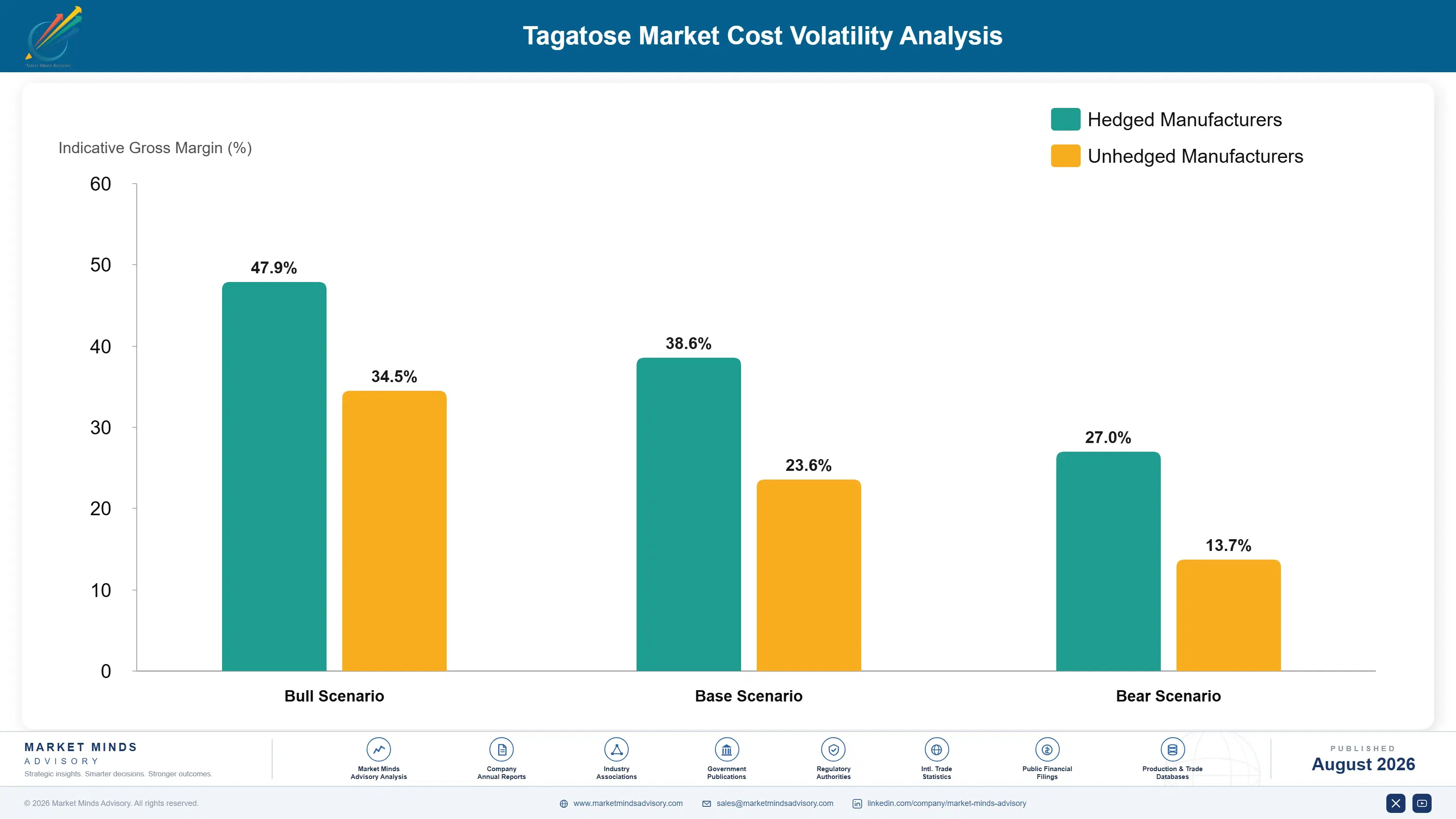
What Drives Delivered Sweetener Cost

Substrate accounts for roughly 44% of cost of goods, and the whole cost story sits in whether that substrate is cheap fructose or expensive purified galactose. Enzyme and biocatalyst supply contributes 14%, downstream separation and crystallisation 19% because unreacted substrate must be removed cleanly, and energy for evaporation and drying a further 11% of the total delivered cost.
The 2022 energy episode hit crystallisation economics rather than substrate. European and Korean producers faced sharply higher evaporation and drying costs at exactly the point when separation was already the most expensive part of the process. CJ CheilJedang disclosures across its bio and food ingredient businesses documented input cost pressure through the period. Chinese producers with cheaper industrial power gained relative position without any process improvement of their own whatsoever.

The competitive disadvantage mechanism runs through substrate route and plant siting. A producer running galactose chemistry carries raw material cost roughly forty percent above the fructose route and cannot close it operationally. One running fructose but buying syrup on the open market carries fifteen to twenty percent more than a producer sited beside a wet mill. Those disadvantages compound, and carrying both rules out bulk food applications entirely.
tagatose-market-trends-cost-volatility-analysis-1787312664819

Site conversion capacity beside fructose wet milling

Substrate is forty-four percent of cost of goods and high-fructose syrup transports poorly relative to its value. Locating conversion capacity beside a corn or cane wet mill rather than near the customer cuts substrate cost by fifteen to twenty-two percent, and it remains the single siting decision that most determines a producer's long-run competitiveness.

Recover and recycle unreacted substrate streams

Conversion yield at roughly 68% means nearly a third of the substrate leaves unreacted, and separating it is already the most expensive downstream step. Recycling that stream back into conversion rather than selling it as syrup improves effective yield by six to nine percentage points, at a retrofit cost near $3 million for each conversion line treated.

Move evaporation load toward lower carbon grid power

Crystallisation and drying together dominate energy use and expose producers directly to industrial power pricing, as 2022 demonstrated painfully across both European and Korean operations alike. Electrified evaporation using mechanical vapour recompression cuts energy cost of goods by around four percentage points wherever grid power happens to be cheap and reasonably low in carbon intensity.

Portfolio Architecture for Margin Defence

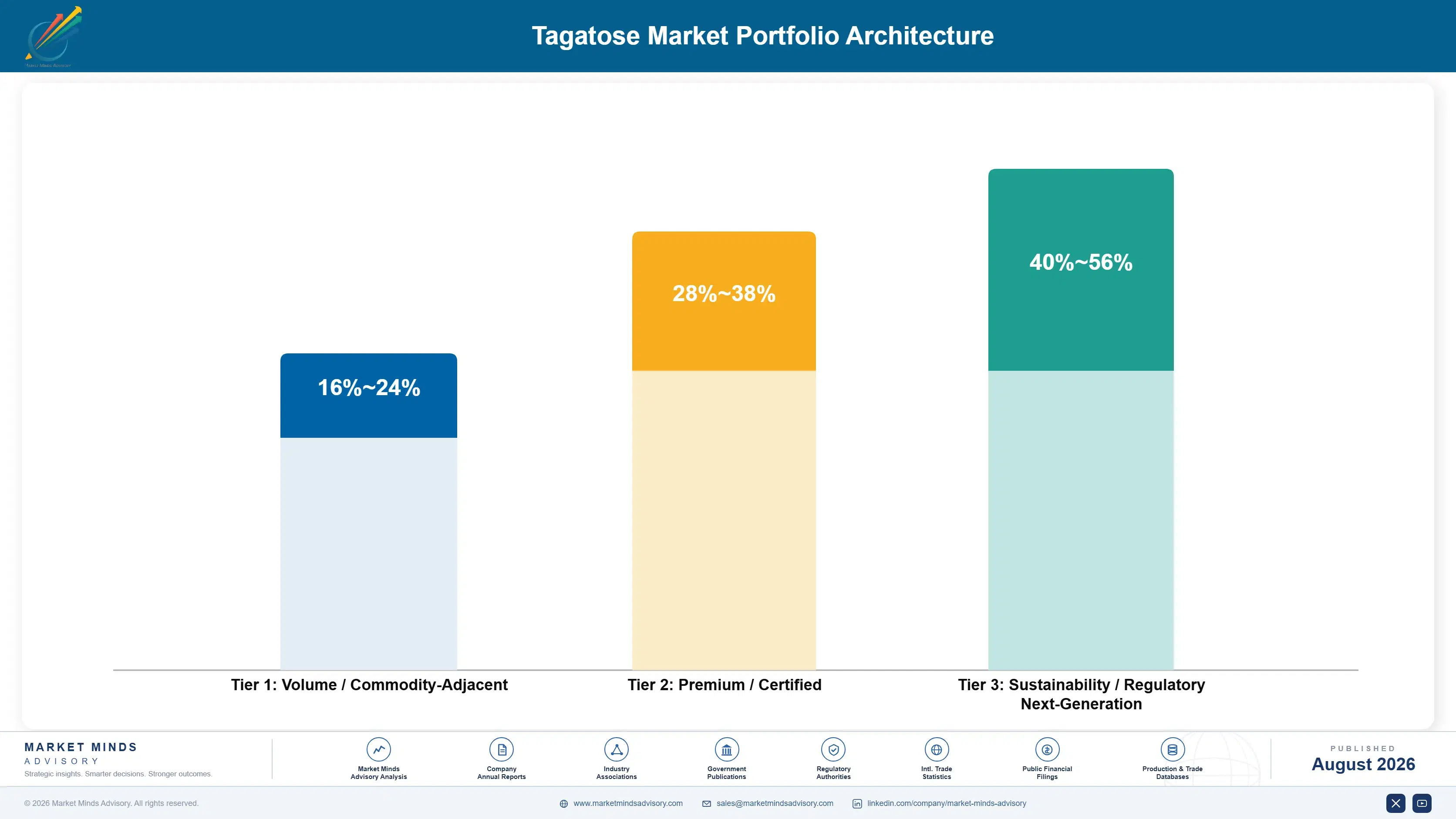
Margin architecture separates on whether the buyer is comparing against allulose. Bulk beverage and general food supply runs at gross margins in the high teens, because the formulator holds an allulose quote in the other hand and the comparison is close to arithmetic. Applications valuing browning or clinical function earn far more.
The volume-versus-premium tension is unusually sharp because conversion plants need throughput. Bulk food and beverage volume is what fills a line, yet it is precisely where the allulose comparison is most damaging and where margin is thinnest. Producers who chase that tonnage find themselves in a cost race they may not win. Those who refuse it entirely struggle to load an asset whose economics assume continuous operation. Nobody has resolved that comfortably.

Value concentrates where allulose cannot follow. Baked goods, cereals and confectionery coatings needing genuine Maillard browning sit at the top, because tagatose participates in that reaction properly and its rivals do not. Medical and pharmaceutical nutrition sits alongside on glycaemic and prebiotic logic, and those buyers never make the allulose comparison at all. Bulk beverage supply sits at the other extreme, where cost per unit of sweetness settles the entire discussion.

Volume / Commodity-Adjacent

Bulk food and beverage supply where tagatose competes directly against allulose on cost per unit of sweetness. Formulators hold competing quotes and the comparison is close to arithmetic. This volume exists to load conversion capacity rather than to generate meaningful margin.
Gross Margin: 16-24%

Premium / Certified

Baked goods, cereal, dairy and confectionery applications where Maillard browning and bulking behaviour matter and where high-intensity sweeteners perform poorly. Functional performance rather than cost supports pricing. Range reflects the spread across application categories and formulation complexity.
Gross Margin: 28-38%

Sustainability / Regulatory / Next-Generation

Pharmaceutical and medical nutrition grades plus formulated blends managing the tolerance ceiling. Site qualification, purity documentation and formulation service rather than the underlying sugar justify the pricing achieved throughout this tier.
Gross Margin: 40-56%
tagatose-market-trends-portfolio-architecture-1787312665317

High-value Sub-segments and Strategic Watch-out

Medical Nutrition Grades

High value on solid growth, and the only pool where buyers never make the allulose comparison at all, because the glycaemic and prebiotic profile is precisely what they are purchasing. Site qualification takes fully two years to complete, and customers then change suppliers exceptionally reluctantly afterwards.
Gross Margin: 44-56%

Browning-Dependent Applications

Strong margins on good underlying growth across baked goods, cereals and confectionery coatings where Maillard browning genuinely matters. Tagatose participates in that reaction properly while allulose does so only partially, which is genuinely the one durable sensory advantage this ingredient actually holds over its rivals.
Gross Margin: 30-38%

Bulk Beverage Supply

The throughput that loads conversion capacity, earning gross margins in the high teens against an allulose quote the formulator is holding in the other hand. Producers chasing this tonnage enter a cost race which substrate route and plant siting decisions have largely already decided for them.
Gross Margin: 16-24%

Formulated Blend Products

The strategic watch-out sitting squarely in this portfolio. Blends do manage the thirty gram tolerance ceiling and they earn genuine formulation margin, but they also require the producer to supply competing sweeteners alongside its own, which quietly dilutes the very position the producer is attempting to build.
Gross Margin: 26-36%

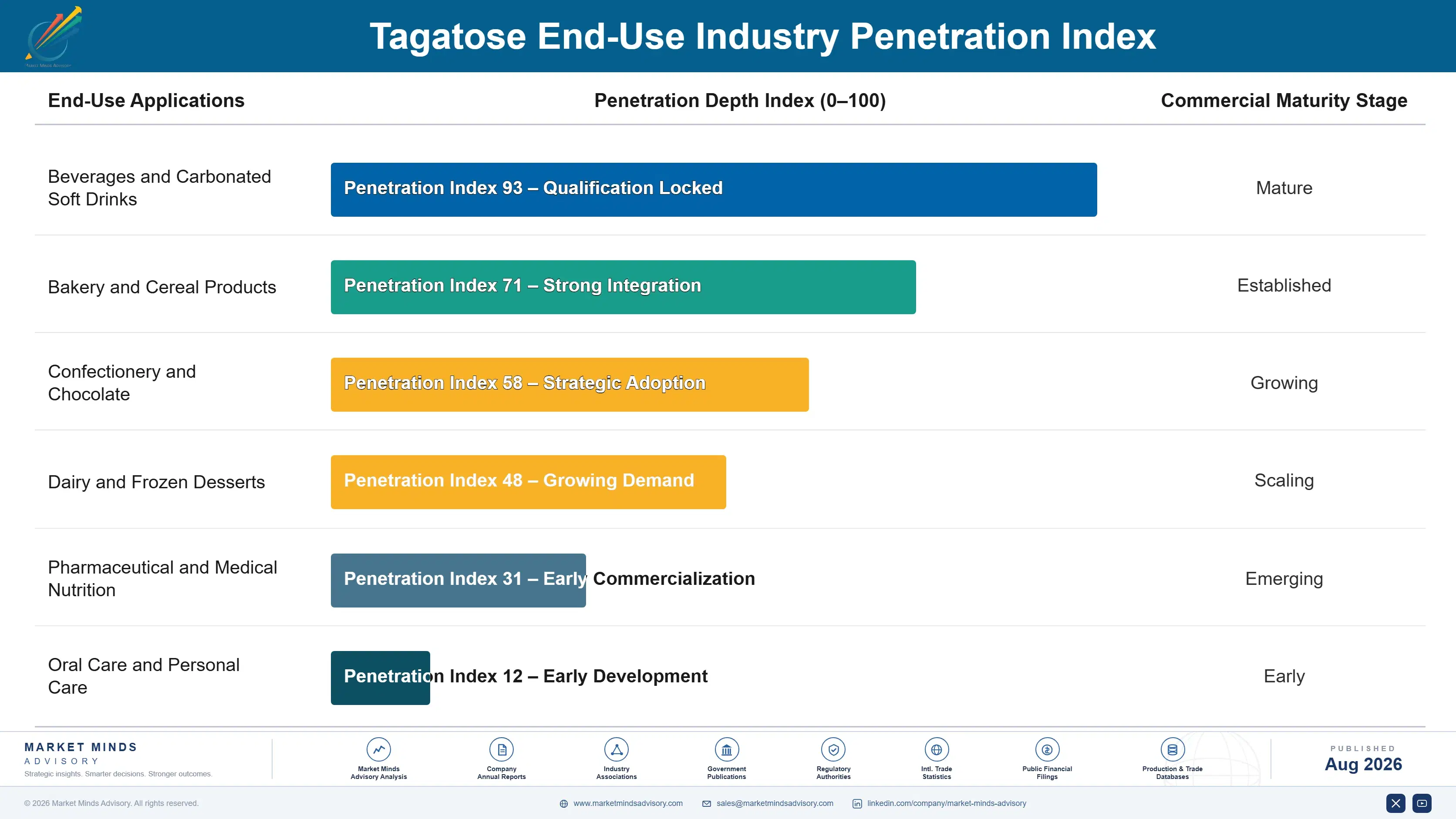
How This Demand Actually Repeats

Sweetener demand behaves as an annuity attached to a formulation rather than to any buying relationship. Once tagatose is designed into a product, it ships against every production run for years, because changing a sweetener means reworking taste, texture, browning and the nutrition panel declaration all at once.
Stickiness varies sharply by application. Medical and pharmaceutical nutrition is the tightest, since site qualification and clinical documentation make a supplier change a genuine regulatory project. Baked goods and confectionery sit close behind, held by browning and texture behaviour that a substitute would visibly alter. Dairy and general food is moderately sticky. Bulk beverage formulation is barely sticky at all, with formulators reoptimising sweetener systems whenever the allulose or high-intensity sweetener arithmetic shifts against tagatose.

Buyer profiles have changed as the labelling position settled. Selection once sat with product developers comparing sweetness curves and cost per unit of sweetness. It now frequently involves regulatory affairs, nutrition and marketing functions asking about added sugars declaration treatment, health claim substantiation and per-serving tolerance guidance. Producers whose commercial approach still leads with a technical data sheet find themselves talking to people whose first question concerns the Nutrition Facts panel.
tagatose-market-trends-end-use-penetration-index-1787312665802

Where To Place Capital

These are among the four positions where our research anticipates prominent divergence between winners and laggards over the coming forecast period. Each is grounded in the demand model, the regulatory perimeter, and the announced capacity pipeline.
01 / SUBSTRATE ROUTE COMMITMENT

Fructose enzymatic or nothing at all

Galactose chemistry carries a raw material cost roughly 40% above the fructose enzymatic route and no operational improvement closes that gap, because the disadvantage sits entirely in the feedstock rather than anywhere in the plant. Producers still running whey-derived substrate face a position that worsens steadily as fructose-route capacity continues scaling up. Reconfiguring an operating plant is expensive and disruptive, but continuing without doing so means being priced out of every application except the handful where sensory properties genuinely decide the outcome.
02 / PLANT SITING DECISION

Build beside the wet mill, not the customer

Substrate is 44% of cost of goods and high-fructose syrup transports poorly relative to its value, so producers sited beside corn or cane wet milling run substrate costs 15% to 22% below open market buyers. That is the single siting decision that most determines long-run competitiveness, and it cannot be reversed at all once the plant has been built. Boards routinely site for customer proximity instead, which is precisely the wrong instinct in a cost structure this heavily dominated by substrate.
03 / APPLICATION SELECTION DISCIPLINE

Compete where allulose genuinely cannot follow

Allulose delivers comparable labelling treatment at lower production cost, so any application where cost per unit of sweetness decides the outcome is a race that tagatose producers will struggle to win. Browning-dependent categories and medical nutrition are quite different, realising 20% to 30% above bulk supply because the functional or clinical property is exactly what the buyer needs. The hard part is refusing beverage tonnage that would obviously fill the plant, which most boards find genuinely difficult to approve in practice.
04 / TOLERANCE CEILING MANAGEMENT

Sell blends rather than fight the thirty gram limit

Gastrointestinal tolerance caps tagatose at roughly 30 grams per serving, which limits how much sucrose any single product can realistically replace using it on its own. Formulated blends combining tagatose with complementary sweeteners let a formulator reach full sugar replacement without ever crossing that threshold, and those blends realise 12% to 18% above straight ingredient supply into the same customers. The producer sells formulation work rather than tonnage, though it does also mean supplying competing sweeteners alongside its own product.

Engagement Snapshot From the Field

A live engagement with an industry participant carrying material or product regulatory and market exposure ahead of a defining policy shift, showing how our research translates into a defensible multi-year portfolio strategy.
MARKET MINDS ADVISORY · CLIENT ENGAGEMENT SUMMARY
Tagatose Producer Strategic Portfolio Review and Transition Roadmap 2026·Investment Scenario on Tagatose Exposure Evaluation 2025-26
CLIENT PROFILE
An Asian specialty sweetener producer with annual revenue near $72 million (client-reported, unverified by MMA), operating tagatose capacity configured around galactose substrate recovered from imported whey permeate. Roughly 76% of volume was sold into beverage and general food formulation on price, with no medical nutrition qualification and no formulated blend capability at either of its two sites.
STRATEGIC CHALLENGE
Two beverage customers had switched to allulose within a single year on cost grounds, and the client could not match the pricing without selling below its own conversion cost. The board needed to decide whether to reconfigure for fructose substrate, pursue medical nutrition qualification, or exit bulk beverage supply entirely, and had capital for only one path.
MMA APPROACH
MMA modelled substrate route economics under three configurations, sized the browning-dependent and medical nutrition application pools the client could realistically address, and benchmarked competitor substrate positions across Korea, China and the United States. Findings were tested against 47 expert interviews covering formulator sweetener selection practice, allulose competitive positioning and pharmaceutical grade qualification requirements.
KEY FINDINGS
  1. Galactose substrate cost sat roughly 43% above the fructose enzymatic route, and no operational improvement identified could recover more than a fraction of that gap.
  2. Beverage volume was being sold at contribution close to zero once substrate cost was fully allocated, meaning the customers lost to allulose had been loss-making anyway.
  3. Medical nutrition qualification would cost approximately $4.3 million (client-reported estimate, unverified by MMA) over two years and address demand that never compares against allulose.
  4. Browning-dependent baked goods and confectionery applications realised 26% above the beverage pricing the client had been defending, and faced far less direct competition.
CLIENT PROFILE
An Asian specialty sweetener producer with annual revenue near $72 million (client-reported, unverified by MMA), operating tagatose capacity configured around galactose substrate recovered from imported whey permeate. Roughly 76% of volume was sold into beverage and general food formulation on price, with no medical nutrition qualification and no formulated blend capability at either of its two sites.
STRATEGIC CHALLENGE
Two beverage customers had switched to allulose within a single year on cost grounds, and the client could not match the pricing without selling below its own conversion cost. The board needed to decide whether to reconfigure for fructose substrate, pursue medical nutrition qualification, or exit bulk beverage supply entirely, and had capital for only one path.
MMA APPROACH
MMA modelled substrate route economics under three configurations, sized the browning-dependent and medical nutrition application pools the client could realistically address, and benchmarked competitor substrate positions across Korea, China and the United States. Findings were tested against 47 expert interviews covering formulator sweetener selection practice, allulose competitive positioning and pharmaceutical grade qualification requirements.
KEY FINDINGS
  1. Galactose substrate cost sat roughly 43% above the fructose enzymatic route, and no operational improvement identified could recover more than a fraction of that gap.
  2. Beverage volume was being sold at contribution close to zero once substrate cost was fully allocated, meaning the customers lost to allulose had been loss-making anyway.
  3. Medical nutrition qualification would cost approximately $4.3 million (client-reported estimate, unverified by MMA) over two years and address demand that never compares against allulose.
  4. Browning-dependent baked goods and confectionery applications realised 26% above the beverage pricing the client had been defending, and faced far less direct competition.
RECOMMENDED STRATEGY
Phase 1: Phase one: exit bulk beverage supply deliberately rather than defending it, since the volume was contributing nothing once substrate cost was properly allocated. Phase 2: Phase two: begin medical nutrition qualification immediately, as it addresses demand insulated entirely from the allulose comparison that caused the problem. Phase 3: Phase three: reconfigure a single line for fructose substrate, sized deliberately against browning-dependent food applications rather than against beverage tonnage.
OUTCOME
The client withdrew from bulk beverage supply within seven months and began medical nutrition qualification, reporting blended gross margin improving by roughly nine points despite volume falling by a third (client-reported, unverified by MMA). Fructose line reconfiguration was approved on that basis, and browning-dependent food applications now represent the largest share of remaining volume.

Frequently Asked Questions

Foundational context covering the market sizes, CAGR, scope, country, region and competition that inform every finding below. This section is provided to cover basics and most often pre-purchase conversations, answered from the MMA Primary Research Dataset.

What is the current size of the Tagatose Market?

The market was worth $0.1 billion in 2025 and is forecast to reach $0.11 billion in 2026. Medical and pharmaceutical nutrition accounts for 14% of that volume at a much larger share of value.

How large will the Tagatose Market be by 2036?

MMA forecasts $0.32 billion by 2036, an expansion multiple of 2.94 times the 2026 base. That represents $0.21 billion of incremental value across the forecast period.

What is the CAGR for the Tagatose Market 2026 to 2036?

The base case compound annual growth rate is 11.4%, with a bull case of 12.7% and a bear case of 10.1%. Historical growth from 2020 to 2025 ran at 9.9%.

Which segment is growing fastest?

Enzymatic conversion from fructose at 17.1%, a full 1.50 times the market rate. Fructose substrate costs a fraction of the purified galactose that earlier routes required.

Who are the major companies in the Tagatose Market?

CJ CheilJedang, Samyang Corporation, Baolingbao Biology, Bonumose and Nutrilab lead, holding 76% of revenue between them. Fifteen further producers and ingredient houses hold smaller positions.

Which country is growing fastest?

India at 15.2%, as diabetes prevalence and sugar reduction awareness both rise and domestic manufacturers reformulate for urban consumers. No local production capacity yet operates at scale.

Report Segmentation Architecture

The full report scope spans multiple orthogonal segmentation dimensions, with cross-tabulated demand data provided for each dimension pair. Coverage extends further to regional breakdowns, trend trajectories, and the competitive detail needed to support segment-level decision-making.

By Production Route

  • Enzymatic Conversion From Fructose
  • Whole-Cell Biocatalysis and Fermentation
  • Enzymatic Conversion From Lactose or Galactose
  • Blended and Co-Crystallised Formats
  • Chemical Isomerisation From Galactose

By End-Use Industry

  • Beverages and Carbonated Soft Drinks
  • Bakery and Cereal Products
  • Confectionery and Chocolate
  • Dairy and Frozen Desserts
  • Pharmaceutical and Medical Nutrition
  • Oral Care and Personal Care

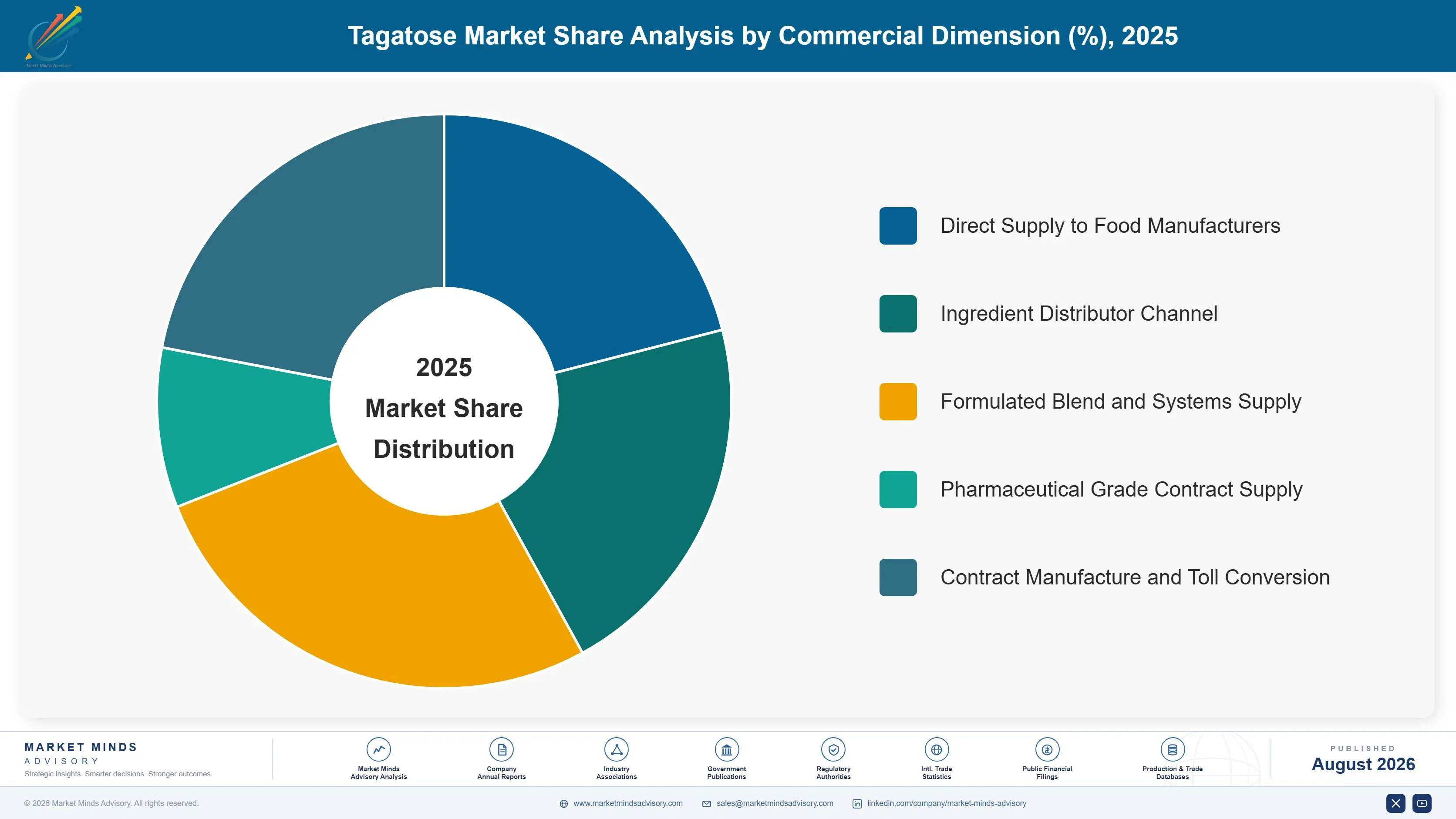
By Commercial Dimension

  • Direct Supply to Food Manufacturers
  • Ingredient Distributor Channel
  • Formulated Blend and Systems Supply
  • Pharmaceutical Grade Contract Supply
  • Contract Manufacture and Toll Conversion

By Region

  • North America
  • Western Europe
  • East Asia
  • South Asia and Pacific
  • Latin America
  • Middle East and Africa
  • Eastern Europe

Scope, Methodology, and Coverage

Every figure in this report is reproducible from documented input assumptions. The scope below maps the historical period, the forecast horizon, the segmentation dimensions, and the countries covered, alongside the underlying primary and qualitative methodology.
Historical Period
2020 to 2025
Forecast Period
2026 to 2036
Base Year
2025 (USD billions; MMA Primary Research Dataset, August 2026)
Market Definition
This report covers D-tagatose supplied as a crystalline or liquid rare sugar sweetener and functional ingredient for food, beverage, confectionery, pharmaceutical and personal care applications. Coverage spans enzymatic conversion from fructose, whole-cell biocatalysis and fermentation, enzymatic conversion from lactose or galactose, chemical isomerisation, and blended or co-crystallised formats supplied with formulation support. Allulose, erythritol and other polyols, stevia, monk fruit and high-intensity sweeteners, conventional sugars and syrups, and finished consumer table-top sweetener products are excluded from scope.
Quantitative Units
USD billions at producer realised prices; volume in thousand tonnes; gross margin percentages and conversion yields by production route.
Segmentation Dimensions
Production route, end-use industry, commercial dimension, region.
Regions Covered
North America, Western Europe, East Asia, South Asia and Pacific, Latin America, Middle East and Africa, Eastern Europe
Countries Covered
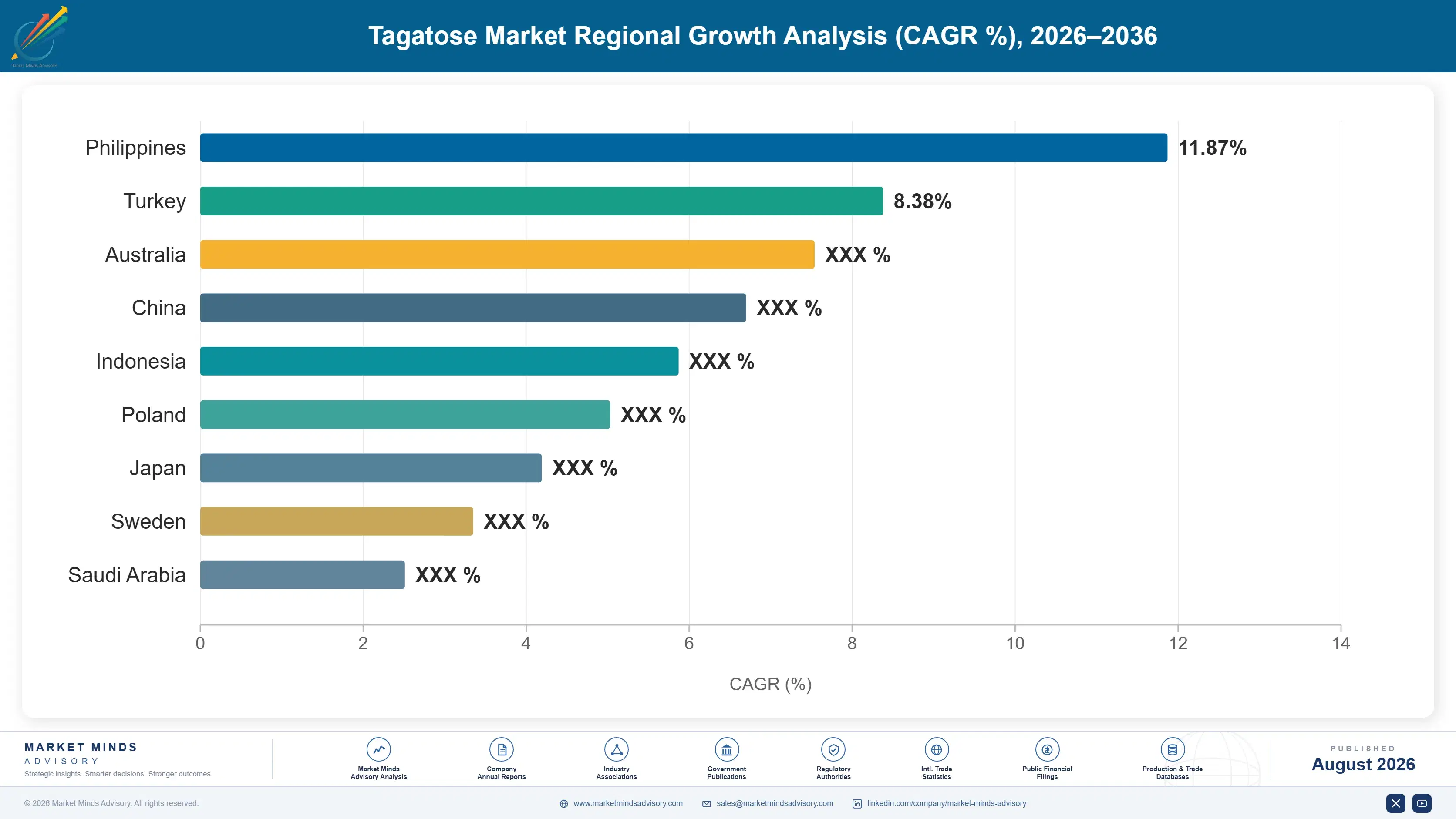
South Korea, China, Japan, India, Thailand, Malaysia, Australia, United States, Canada, Mexico, United Kingdom, Germany, Netherlands, France, Brazil, Poland, Turkey, Israel, Saudi Arabia, South Africa.
Key Companies Profiled
CJ CheilJedang, Samyang Corporation, Baolingbao Biology, Bonumose, Nutrilab, Ingredion, Tate and Lyle, Roquette, Arla Foods Ingredients, Hunan Huacheng Biotech, and ten further producers.
Quantitative Methodology
Primary survey, n=3,800 respondents, Q4 2025, six countries; demand-side model with trade association cross-validation
Qualitative Methodology
47 expert interviews, Q4 2025; applied to validate demand model assumptions, identify emerging dynamics, and assess competitive positioning
Report Format
PDF and XLSX data workbook (Word format preview document)
Publisher
Market Minds Advisory
Report Code
MMA-2026-CHM-823
Published
August 2026
Contact
sales@marketmindsadvisory.com | www.marketmindsadvisory.com

Purchase the full Tagatose Market Report (2026 to 2036).

The full report sets out ten-year forecasts for tagatose by production route, end-use industry and commercial model across seven regions. It compares substrate route economics directly, quantifying the cost gap between fructose and galactose chemistry at each stage of conversion and separation. Competitive assessment covers twenty producers on a consistent revenue basis, mapping substrate integration and application development capability separately from installed capacity. Allulose competitive positioning is modelled application by application, identifying where tagatose holds a defensible functional advantage. Findings draw on a quantitative survey of 3,800 respondents across six countries and 47 expert interviews conducted during the fourth quarter of 2025.
Ten-year forecasts by production route and region
Substrate route economics compared stage by stage
Allulose competitive position modelled application by application
Twenty-producer assessment on consistent revenue basis
Labelling treatment compared across major regulatory jurisdictions
Margin architecture across three commercial portfolio tiers

Built For The People Who Decide

From boardroom strategy to bench-side execution, this report is read cover-to-cover by leaders shaping the next decade of their industry, turning demand scenarios, market dynamics and valuation benchmarks into decisions.
CXOs/ Presidents/ VPs/ Managers
M&A and Corporate Development
Strategy Teams and R&D Heads
Procurement and Product Directors
Regulatory and Compliance Leaders
Investor Relations and Equity Analysts