Market Minds Advisory
Tactical Sensor Fusion Software Market

Tactical Sensor Fusion Software Market: Tactical Sensor Fusion Software Market: Data Access, Cheap Sensors and Open Architecture Mandates, 2026 to 2036

The algorithms were solved decades ago and the barrier is getting at the data, because sensor makers keep interfaces closed to protect an aftermarket that fusion would otherwise open up.

Lead Analyst

Published

September 2026

Make Smarter Decisions with Customized Research Insights

Request a free sample report and evaluate market opportunities, growth trends, and competitive dynamics relevant to your business needs.

2025 MARKET VALUE$2.8BMarket Size 2025
2036 FORECAST VALUE$12.1BBase Case , 2026 to 2036
CAGR 2026 TO 203614.2 %Bull 15.6% / Bear 12.8%
INCREMENTAL OPPORTUNITY$8.9BNet 10- year value creation
EXPANSION MULTIPLE3.77x2036 value over 2026 base
Strategic Levers
M&A Pipeline
Regional Outlook
Country Rankings
Competitive Intelligence
Segmental Deep-dive
Call-Us : 91 93563 13602

Executive Snapshot and Market Trajectory.

Fusion mathematics has been settled for decades and it has never been the obstacle. Around 43% of integration effort goes into obtaining access to sensor data, because sensor manufacturers keep interfaces proprietary to protect the aftermarket that open data would expose. Engineering effort has never solved a commercial problem.
Two things are forcing that open. Procurement mandates requiring open architecture conformance have reached 34% of fielded sensors and are written into new programmes rather than requested. And the counter-drone problem cannot be solved any other way, since no single sensor type detects small uncrewed aircraft reliably and 5 types are needed together. That segment grows at 21.3%, half again the market rate of 14.2%. Combining them correctly is the whole capability being bought.
Five suppliers hold 39% of measured contracted software value, which is fragmented for defence. The harder shift is that fusion now means combining thousands of cheap, unreliable, intermittently connected sensors rather than a handful of expensive ones, and the algorithmic problem has become trust and provenance rather than track correlation. Legacy vendors are poorly positioned for that. Decades of classical investment confer no advantage here.
Market Definition
The tactical sensor fusion software market covers software that combines data from multiple dissimilar sensors into correlated tracks and a coherent operational picture for defence and security users, spanning platform track fusion, common operating picture correlation, counter-uncrewed systems fusion, distributed low-cost sensor fusion, electronic warfare and signals fusion, and maritime and undersea fusion. Sizing is measured at contracted software and integration revenue. Sensor hardware, communications equipment, command platforms, effectors and general purpose analytics tooling sold separately are excluded.
Base Year Value
$2.8B in 2025 (MMA Primary Research Dataset, September 2026)
Forecast Period
2026 to 2036, eleven discrete annual values
CAGR
14.2% base case. Bull 15.6%. Bear 12.8%.
Fastest Growth Segment
Counter-Uncrewed Systems Fusion: 21.3% CAGR
Fastest Growth Country
Poland: 19.8% CAGR
Fastest Growth Region
South Asia and Pacific: 16.2% CAGR
Largest Region
North America: 44% of 2025 global value
Market Leaders
Palantir Technologies, Lockheed Martin, RTX, Leonardo, Anduril Industries. Source: MMA Analysis based on company annual reports and measured contracted software value.
Primary Survey
n=3,800 procurement and R&D decision-makers, Q4 2025, six countries
Methodology
Demand-side build-up, cross-validated against public data, 47 expert interviews

Tactical Sensor Fusion Software Market Forecast Scenarios

tactical-sensor-fusion-software-market-size-forecast-scenario-1788414425540
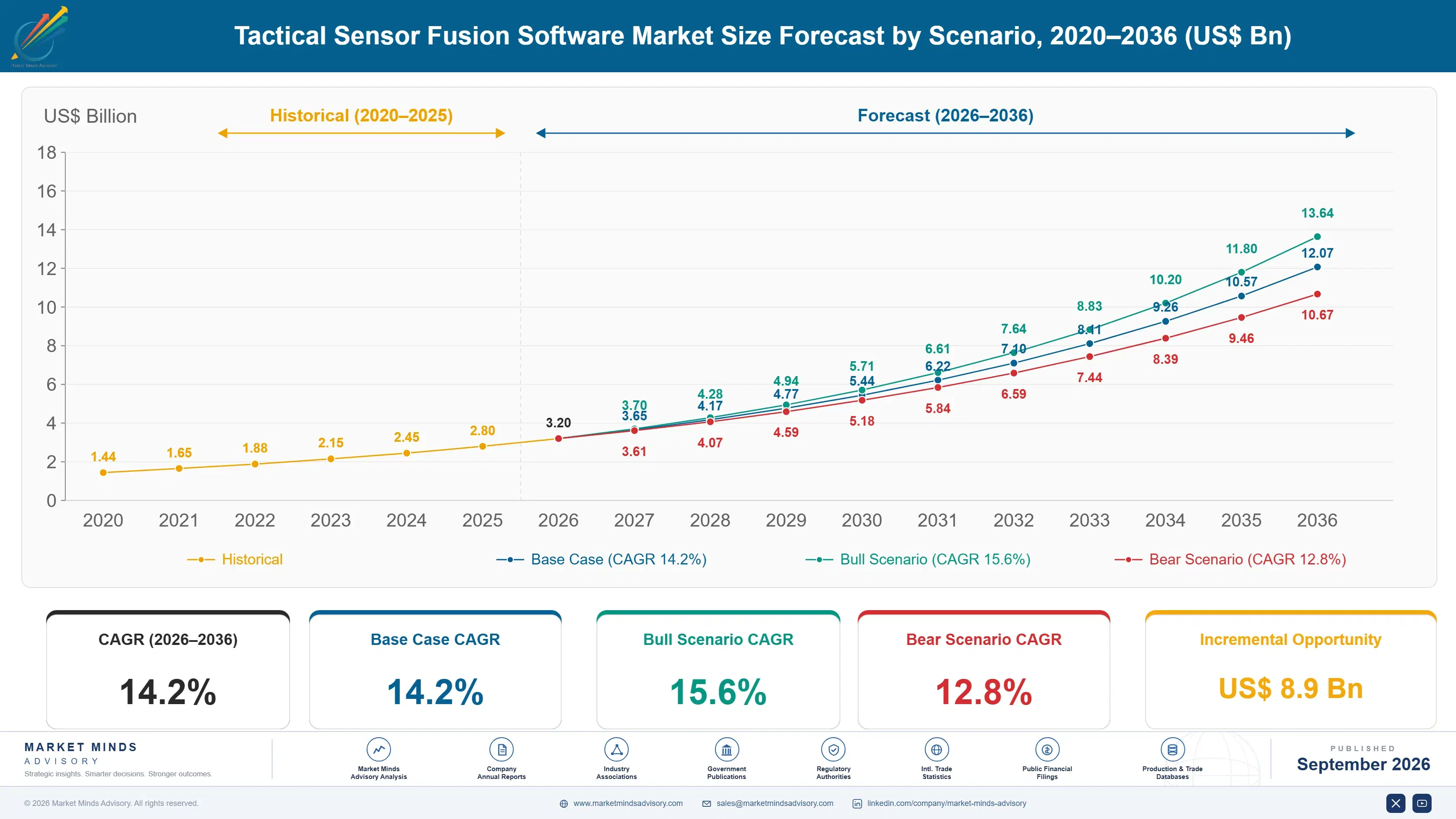
Between 2020 and 2025 the market compounded at 12.8%, with almost all growth arriving in the second half of the period. Fusion had been a platform engineering discipline delivered inside major programmes on cycles measured in decades. Sustained conflict in Europe changed both the requirement and the timescale, showing that thousands of cheap sensors beat a few excellent ones when software handles the noise.
The 14.2% base case rests on three commercial mechanisms. Counter-drone requirements are spreading from military bases to airports, energy sites and public events, and no single sensor type solves the problem so fusion is mandatory rather than preferred. Open architecture conformance mandates are being written into procurement, which removes the data access barrier that has constrained this market for thirty years. And European defence budgets are rising on multi-year commitments.
The bull case is open architecture conformance reaching the majority of fielded sensors, which would let software vendors compete on algorithms rather than on negotiated access and open the market considerably. The bear case is prime contractors absorbing fusion into platform deliveries as included capability, which would return the discipline to programme engineering and remove the independent software market almost entirely.

The Hard Part Is Getting At The Data

Multi-sensor fusion is a solved mathematical problem and long has been, which makes the difficulty of doing it in the field surprising until the commercial structure is clear. A sensor manufacturer earns from support, upgrades and integration on its own equipment, and publishing an open interface invites somebody else to take that work. Roughly 43% of integration effort therefore goes into obtaining data access rather than processing anything.
TOP FIVE CONCENTRATION39%Share of measured contracted software value held by leaders
OPEN ARCHITECTURE CONFORMANCE34%Portion of fielded sensors exposing data through open interfaces
COUNTER-DRONE SENSOR TYPES5 typesSensor types required to detect small uncrewed aircraft reliably
TRACK CORRELATION LATENCY400 msTime from detection to correlated track in tactical systems
PROGRAMME AWARD CYCLE38 monthsTime from requirement definition to software programme award
DATA ACCESS EFFORT SHARE43%Portion of integration effort spent obtaining sensor data access
Procurement is what breaks that, not engineering. Open architecture conformance requirements written into acquisition contracts oblige sensor suppliers to expose data through defined interfaces as a condition of selling, and roughly 34% of fielded sensors now do. Each conformant sensor becomes available to any fusion vendor rather than only to its manufacturer, which is a commercial change disguised as a technical standard.
The requirement itself has changed more than the industry has adjusted to. Fusion used to mean combining a few expensive, accurate, permanently connected sensors on a platform. It now means combining thousands of cheap ones that fail, disconnect, get jammed and sometimes report things that are not there, which makes trust and provenance the hard problem rather than track correlation. That is different software written by different people.
"The uncomfortable finding is that the best fusion capability of the last three years was built by people with no defence pedigree, working on commercial hardware, under conditions that made elegance irrelevant. The established vendors solved a harder problem that turned out not to be the one that mattered."
Director, Defence Software and Sensor Systems Practice · MMA Technology and Defence Systems Practice · September 2026

Market Trends

Counter-Drone Detection Makes Fusion Genuinely Mandatory

No single sensor detects small uncrewed aircraft reliably. Radar struggles with low radar cross section at low altitude among clutter, radio frequency detection fails entirely against autonomous drones flying without a link, acoustic sensing works only at short range and optical needs cueing before it can look anywhere. Detection therefore requires 5 sensor types working together, and combining them is not an improvement but the whole capability. That makes counter-drone the one application where fusion software is the product rather than a feature, and it grows at 21.3% against a market at 14.2%.
Market Impact: Reaches 4 civil site types
Cheap Distributed Sensors Change The Software Problem

Fusion was built for a handful of expensive, accurate, permanently connected sensors on a platform, and the field has moved to thousands of inexpensive ones that fail, disconnect, get jammed and occasionally report things that never happened. Correlating tracks from trusted sources is straightforward mathematics. Deciding which of a thousand unreliable reports to believe is a different discipline entirely, closer to information provenance than to estimation theory. Growth at 18.6% reflects that shift, and the vendors doing it well are frequently not the ones who spent decades perfecting the older problem.
Market Impact: Grows at 19.8% annually

Market Opportunities and Growth Drivers

Counter-Drone Requirements Spread Beyond Military Sites

Airports, energy infrastructure, prisons, stadiums and public events are all acquiring uncrewed aircraft detection capability, driven by incidents rather than by doctrine, and the buyers are civil operators with no defence procurement experience. The technical requirement is identical to the military one, since the same 5 sensor types are needed, but the contracting, security clearance and price expectations are entirely different. That opens a customer base far larger than defence alone and one that established suppliers find awkward to serve properly. Incidents rather than doctrine are what trigger these purchases, which makes demand lumpy and difficult to forecast.
Market Impact: Consumes 43% of integration effort

European Rearmament Funds Multi-Year Software Commitments

European defence budgets are rising on commitments that extend beyond individual political cycles, and a substantial share is directed at capability that software rather than platforms delivers. Poland grows at 19.8%, the fastest of any country in this market, on a rearmament programme unusual in both scale and speed. Baltic and Nordic buyers are procuring distributed sensing and fusion for territorial surveillance. The requirement definitions being written now reflect operational experience rather than peacetime doctrine, which changes what the software must actually do. Requirements written now reflect what actually worked rather than what doctrine expected.
Market Impact: Delays 9 months per hire

Market Restraints and Challenges

Sensor Data Access Remains Commercially Withheld

Around 43% of integration effort goes into obtaining access to sensor data rather than doing anything with it, because manufacturers earn from support and upgrades on their own equipment and open interfaces invite competition for that work. The root cause is commercial rather than technical, which is why engineering effort has never solved it. Commercial impact is integration cost that buyers attribute to fusion vendors rather than to the sensor suppliers causing it. Mitigation runs through conformance mandates written into procurement, reverse engineering where contracts permit, and buyers refusing to purchase sensors that will not expose data.
Market Impact: Requires 5 sensor types together

Cleared Engineering Talent Is Genuinely Scarce

Software engineers holding current security clearances are a small population that defence programmes, intelligence agencies and technology companies all compete for simultaneously, and clearance processing takes many months before a hire becomes productive. The root cause is that clearance cannot be acquired commercially or accelerated with money. Commercial impact is programme schedules set by staffing rather than by engineering difficulty. Participants mitigate through unclassified development environments that defer clearance requirements, sponsoring clearances for promising engineers years ahead of need, and structuring work so that only integration requires cleared personnel. Money cannot accelerate it.
Market Impact: Handles 1,000 unreliable sources
4 additional market trends, 3 additional growth drivers, and 2 additional restraints and challenges are covered in the full report. Contact sales@marketmindsadvisory.com to access the complete intelligence.

Segment CAGR and Growth Architecture

Segmentation follows the fusion function performed, which determines the data involved, the latency required and the customer purchasing it. Platform track fusion, common operating picture correlation, counter-uncrewed systems, distributed low-cost sensing, electronic warfare and maritime fusion each demand different software and are bought by different parts of a defence organisation. Very few suppliers serve more than two of them.
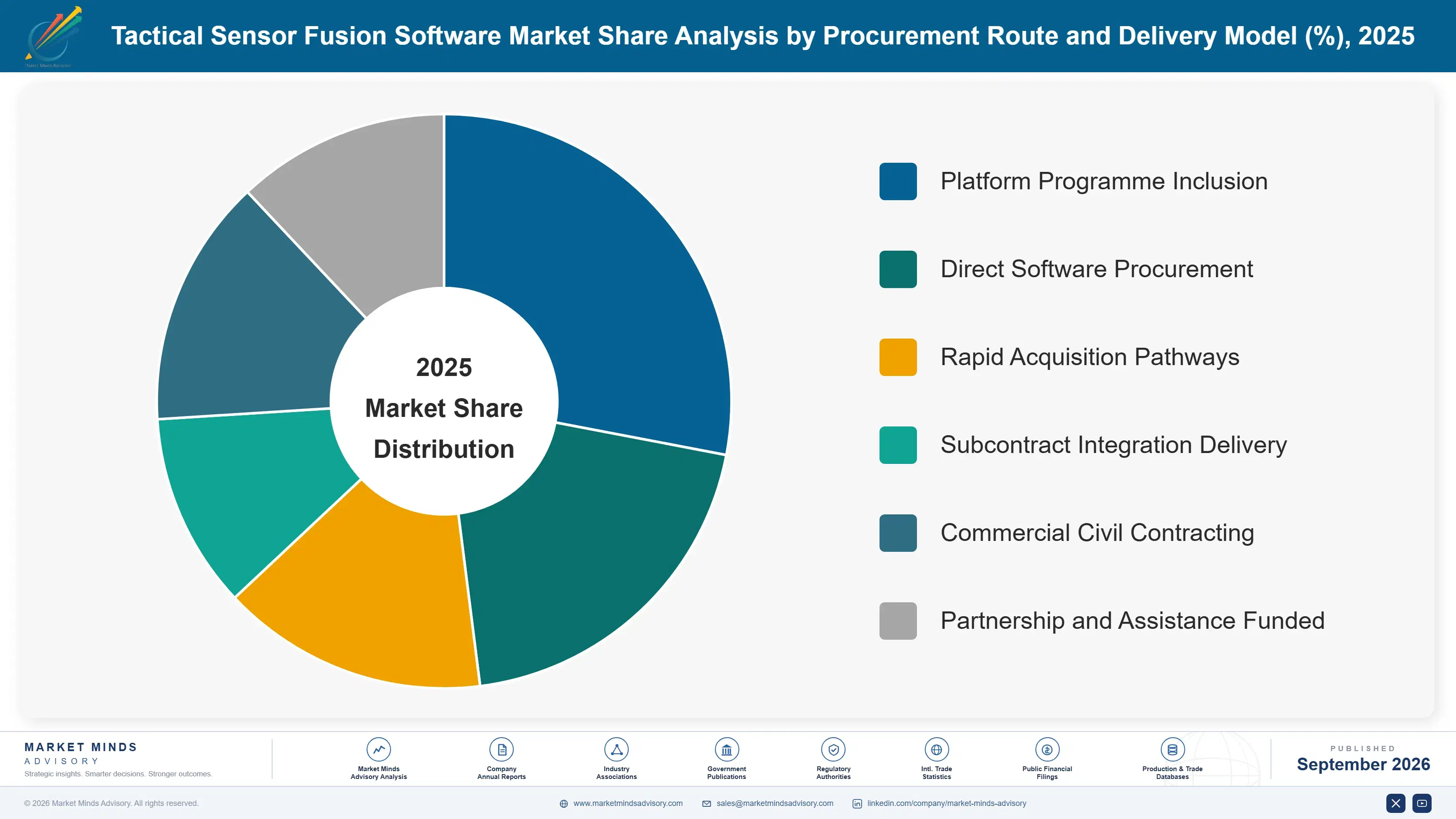
tactical-sensor-fusion-software-market-market-share-analysis-1788414426083

Counter-Uncrewed Systems Fusion

This is the one application where fusion software is unambiguously the product rather than a feature of something else. No single sensor detects small uncrewed aircraft reliably, so detection requires radar, radio frequency, acoustic, optical and infrared sensing working together, and combining them correctly is the entire capability being purchased. Demand is spreading well beyond military sites to airports, energy infrastructure and public events, where buyers have no defence procurement experience and different price expectations. Growth at 21.3% is half again the market rate of 14.2%. False alarm rate rather than detection range is what separates good systems from unusable ones. Civil buyers have no defence procurement experience and different price expectations.
CAGR 21.3%

Distributed Low-Cost Sensor Fusion

Combining thousands of inexpensive sensors that fail, disconnect, get jammed and sometimes report things that did not happen is a genuinely different problem from correlating tracks between a few trusted sources. The difficulty moves from estimation theory toward provenance, trust scoring and graceful degradation when a large fraction of inputs are simply wrong. Growth at 18.6% reflects operational experience showing that many cheap sensors outperform a few excellent ones when the software copes with noise. Vendors succeeding here are frequently newer entrants without decades of investment in solving the earlier and harder-looking problem. Graceful degradation when a large fraction of inputs are simply wrong is the property that matters, and classical fusion engineering never optimised for it.
CAGR 18.6%
Full segment breakdown across 6 segments available in the complete report.

Regional Architecture and Country Demand Map

Demand follows defence software procurement rather than armed forces size, and open architecture policy shapes who can compete for it. North America leads because its acquisition budgets and its conformance mandates are both larger than anywhere else. Armed forces size is a poor guide to any of it.

North America

United States acquisition budgets for defence software exceed those of every other market combined, which puts the region at 44%, far above the 32% ceiling of the standard band, and the concentration is a budgetary fact rather than a measurement artefact. Open architecture conformance mandates originated here and are written into new sensor programmes as a condition of award. Faster software acquisition routes have been created specifically to escape multi-year programme cycles. Counter-drone requirements around military installations and increasingly around civil infrastructure are the fastest growing demand within the region. Counter-drone requirements around military installations and increasingly around civil infrastructure are the fastest growing demand anywhere in the region. Budget scale explains everything.
Share: 44% | CAGR: 13.6% (2026 to 2036)

Western Europe

Rearmament has lifted budgets substantially and a meaningful share is directed at capability delivered through software rather than through platforms, which suits this market directly. Multinational programmes create fusion requirements across national systems that were never designed to interoperate, and that integration problem is genuinely difficult and well funded. Sovereignty concerns restrict which vendors may hold certain data, which advantages European suppliers on specific programmes. Growth of 12.6% is the slowest of any region and reflects a large base and procurement processes that remain slow despite the urgency. Multinational programmes create fusion requirements across national systems never designed to interoperate, which is genuinely difficult work and unusually well funded when it is finally scoped.
Share: 20% | CAGR: 12.6% (2026 to 2036)
Regional intelligence for 5 additional markets available in the complete report: East Asia, Eastern Europe, South Asia and Pacific, Middle East and Africa, Latin America. Contact sales@marketmindsadvisory.com.
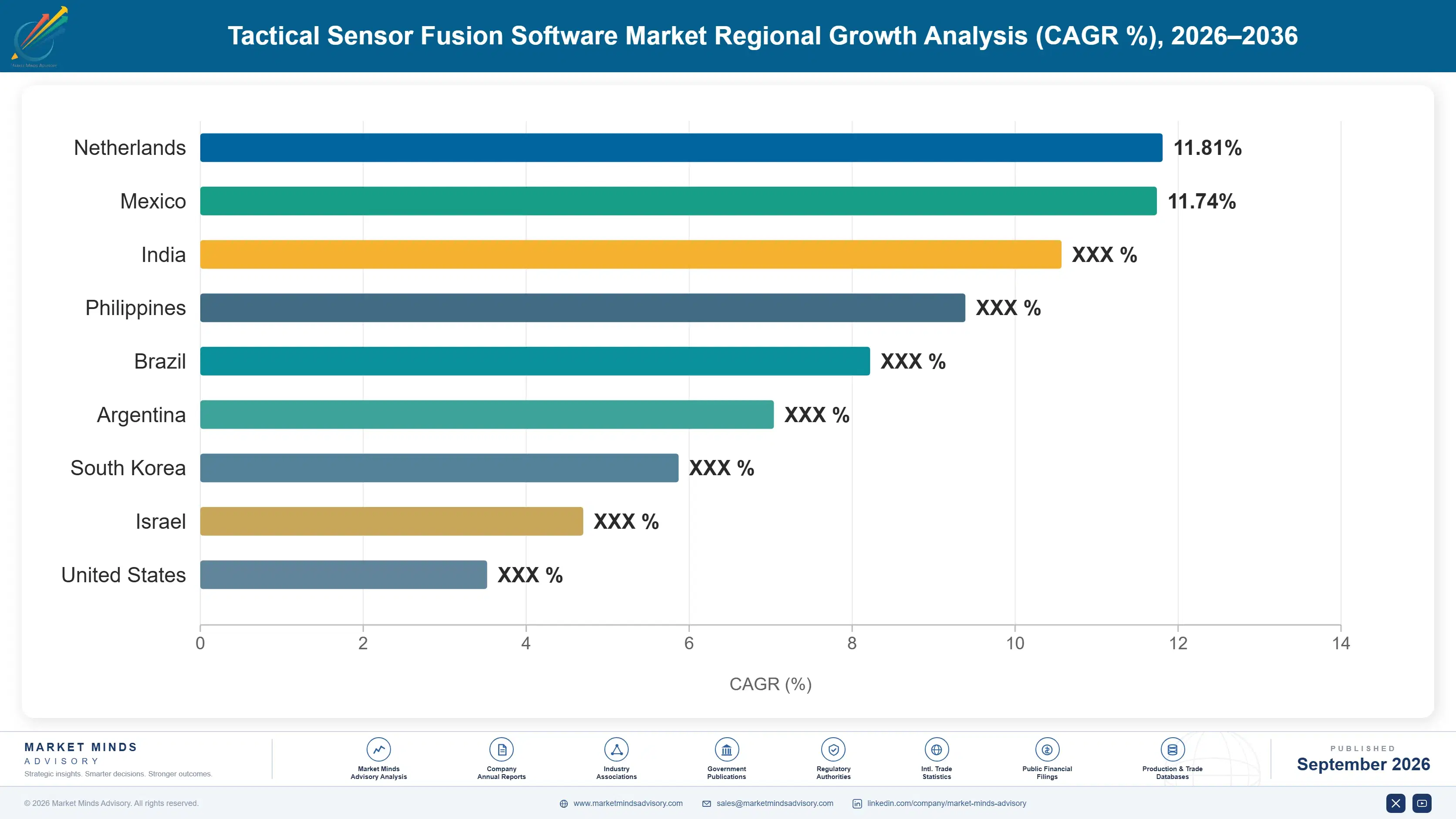
tactical-sensor-fusion-software-market-country-cagr-analysis-1788414426611

Where Fusion Software Actually Earns

Four positions carry margin in a market where the mathematics is public and the barriers are commercial. Each involves getting past a gate that has nothing to do with algorithm quality, which is why technically excellent vendors have so often failed to build businesses here over the past two decades. Algorithm quality decides very little.

Attach To Open Architecture Conformance Mandates

Conformance requirements oblige sensor suppliers to expose data as a condition of award, and each conformant sensor becomes available to any fusion vendor rather than only to its manufacturer. Around 34% of fielded sensors now conform and the share rises with every new programme. Vendors building against those interfaces reach sensors they could never negotiate access to individually, which removes the 43% of integration effort that data access currently consumes. Tracking acquisition policy matters more here than tracking any competitor does. Policy tracking matters more than competitor tracking here. Nothing about this is technical.
Market Impact: Reaches the 34% of sensors now already conformant

Own The Counter-Drone Application End To End

Counter-drone is the one application where fusion software is the product rather than a feature inside somebody else's platform, because detection genuinely requires 5 sensor types working together and combining them is the whole capability. It grows at 21.3% against a market at 14.2% and is spreading to civil buyers with no defence procurement experience. False alarm rate rather than detection range decides these awards, which favours vendors with real operational data. Selling to airports and energy sites needs a commercial motion defence organisations lack. Civil selling requires a commercial motion defence organisations do not have.
Market Impact: Grows at 21.3% against a 14.2% market overall

Build For Unreliable Sensors Rather Than Good Ones

Operational experience showed that a thousand cheap sensors beat a handful of excellent ones when software copes with the noise, which turns the problem from estimation theory into provenance and trust scoring. Handling 1,000 unreliable inputs is different software written by different engineers, and decades of investment in the harder-looking classical problem confers no advantage whatsoever. Newer entrants are winning here precisely because they carry no such investment. Established vendors need to hire against the new problem rather than extend the old solution. Hiring against the new problem beats extending the old solution.
Market Impact: Handles up to 1,000 unreliable sensor inputs properly

Sponsor Clearances Years Before They Are Needed

Cleared software engineers are a small population every defence and intelligence buyer competes for, and clearance processing adds around 9 months before a hire becomes productive on classified work. Sponsoring promising engineers well ahead of any specific programme converts a hiring constraint into an asset competitors cannot buy at any price. Structuring development so that only integration requires cleared staff extends the same scarce resource considerably further. Most vendors begin recruiting only once a contract is signed and then miss the schedule. Most competitors start recruiting only once a contract is signed.
Market Impact: Removes 9 months from every single cleared hire

Who Controls the Margin Pool

Measured on contracted software value, the basis used throughout this section, the top five hold 39%. That is fragmented by defence standards and reflects a market where platform primes, software specialists and newer entrants compete from genuinely different positions rather than as direct rivals. The gap between leaders and the rest is programme access and cleared delivery capacity rather than any measurable difference in fusion performance.
Competition runs on programme incumbency, open architecture positioning and increasingly on demonstrated performance against cheap unreliable sensors rather than on classical track quality metrics. Platform primes hold fusion inside deliveries where a customer buys capability rather than software. Software specialists compete on integration speed and data handling. Newer entrants compete on having built for the current problem rather than the previous one.

Pressure builds from two directions. Open architecture conformance erodes the data access advantage that sensor manufacturers and their preferred integrators have relied on, opening programmes that were previously closed. And prime contractors are absorbing fusion into platform deliveries where they can, which would return the discipline to programme engineering. Rankings shift where vendors built against conformant interfaces and hired for provenance problems rather than extending classical correlation work.
tactical-sensor-fusion-software-market-company-positioning-matrix-1788414427139

Competitive Moat and Risk Dimensions

PALANTIR TECHNOLOGIES

Moat: Data integration and deployment speed

Capability in integrating heterogeneous and unreliable data sources maps directly onto what fusion has become, and deployment cycles measured in weeks rather than programme years suit customers who have created faster acquisition routes specifically to escape those cycles. Cleared delivery capacity at scale is genuinely hard to assemble. Existing programme positions provide access that new entrants spend years pursuing.
PALANTIR TECHNOLOGIES

Risk: Platform primes absorbing capability

Prime contractors increasingly deliver fusion inside platform contracts where the customer buys capability rather than software, which removes the procurement in which an independent software vendor can compete at all. Concentration in a small number of very large government customers means political and budgetary shifts arrive across the whole business simultaneously. Pricing has attracted scrutiny from those same customers.
LOCKHEED MARTIN

Moat: Programme incumbency across platforms

Fusion delivered inside major platform programmes reaches the field without any separate software procurement, which means the capability ships automatically with systems the customer has already committed to for decades. Access to sensor data on its own platforms is unrestricted where independent vendors must negotiate. Cleared engineering capacity and accredited facilities exist at a scale few competitors can match anywhere.
LOCKHEED MARTIN

Risk: Open architecture erodes access advantage

Conformance mandates deliberately remove the privileged data access that platform incumbency has historically conferred, opening sensors to competitors who could not previously reach them at all. Programme engineering cadence sits poorly against customers now demanding incremental software delivery. Newer entrants building for unreliable distributed sensing have advanced faster than large programme organisations have adapted.

Players Tracked

Prominent Players

Palantir Technologies
Lockheed Martin
RTX
Leonardo
Anduril Industries

Other Key Players

BAE Systems
Thales
Northrop Grumman
L3Harris Technologies
General Dynamics Mission Systems
Saab
Elbit Systems
Rheinmetall
Hensoldt
Systematic
Sierra Nevada Corporation
Shield AI
Dedrone
DroneShield
Fortem Technologies

Recent Developments

APRIL 2025

Defence department tightens open architecture conformance on sensor awards

Acquisition guidance strengthened requirements for sensor suppliers to expose data through defined open interfaces as a condition of contract award. Conformance moved from a stated preference within programme documentation to an eligibility criterion applied at evaluation rather than afterwards. Existing programmes were given transition periods.
Signal: Procurement policy is quietly achieving what three decades of voluntary technical standards work never once did.
JANUARY 2025

European buyer awards multi-site counter-drone fusion contract

A European government awarded a contract covering counter-uncrewed aircraft detection and fusion across multiple military and civil infrastructure sites, an award decision rather than any corporate transaction. False alarm performance rather than detection range was reported as the deciding evaluation criterion. Multiple sensor types were mandated.
Signal: False alarms rather than missed detections are what really make these systems unusable in daily practice.
SEPTEMBER 2024

Defence software company acquires counter-drone fusion specialist

A defence technology company acquired a specialist in counter-uncrewed systems sensor fusion, an acquisition rather than any joint venture or partnership. Access to operational performance data across deployed sites was cited alongside the engineering team as the principal rationale for the transaction. Deployment references transferred too.
Signal: Operational false alarm data is now a considerably more valuable asset than the algorithms processing it.

Cleared Engineering And Accredited Facilities

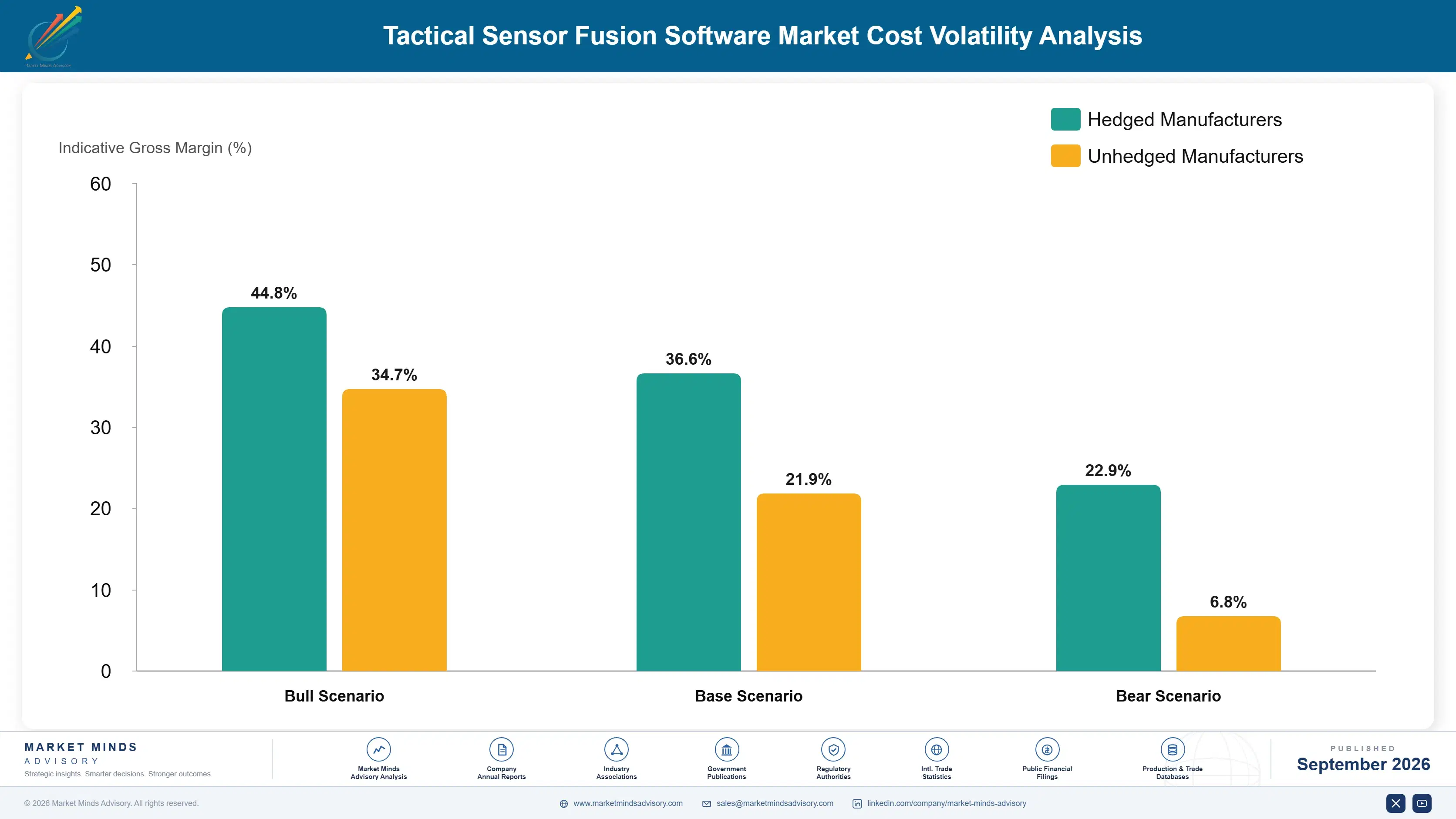
Cleared software engineering labour accounts for roughly 58% of delivered cost, accredited facility and classified infrastructure around 16%, certification and accreditation activity between 9 and 14%, and programme management and overhead the balance. The labour is not general software labour: cleared engineers command a substantial premium, and United States Bureau of Labor Statistics occupational data shows the underlying software categories growing far more slowly than defence demand requires.
Compensation for cleared engineers rose sharply as defence programmes, intelligence work and commercial technology all competed for the same people, and several suppliers disclosed increased programme costs attributed to staffing in results covering the period. Accreditation of classified computing environments became slower as demand rose against fixed assessment capacity, adding schedule cost that no engineering improvement addresses. Both set schedules by staffing rather than engineering.

The disadvantage mechanism is clearance inventory rather than scale. A supplier holding cleared engineers already in place can staff a programme immediately; one recruiting after award waits around 9 months per hire and misses the schedule regardless of technical capability. Accredited facility capacity behaves identically. Neither can be purchased quickly at any price, which is why schedules here are set by staffing rather than engineering.
tactical-sensor-fusion-software-market-cost-volatility-analysis-1788414427335

Unclassified development with classified integration only

Structuring software so that the majority of development happens in unclassified environments and only integration requires cleared staff extends the scarce resource considerably and shortens hiring lead time. It demands architectural discipline from the start and cannot be retrofitted to a codebase that assumed classified development throughout. Retrofitting it to an existing codebase is effectively impossible.

Clearance sponsorship ahead of programme award

Sponsoring promising engineers well before any specific contract exists converts a hiring constraint into an asset competitors cannot purchase at any price. It requires carrying cost against work that has not yet been won, which finance functions resist consistently until a schedule has already been missed for exactly this reason. Schedules get missed for exactly this reason.

Accreditation reuse across programmes and customers

Reusing accredited environments, security documentation and control evidence across programmes avoids repeating assessment work that has become slower as demand outruns assessor capacity. It requires designing for reuse rather than treating each programme as sovereign, which programme managers measured individually rarely choose to do. Assessment capacity is fixed and demand is not. Programme managers rarely choose it.

Portfolio Architecture for Margin Defence

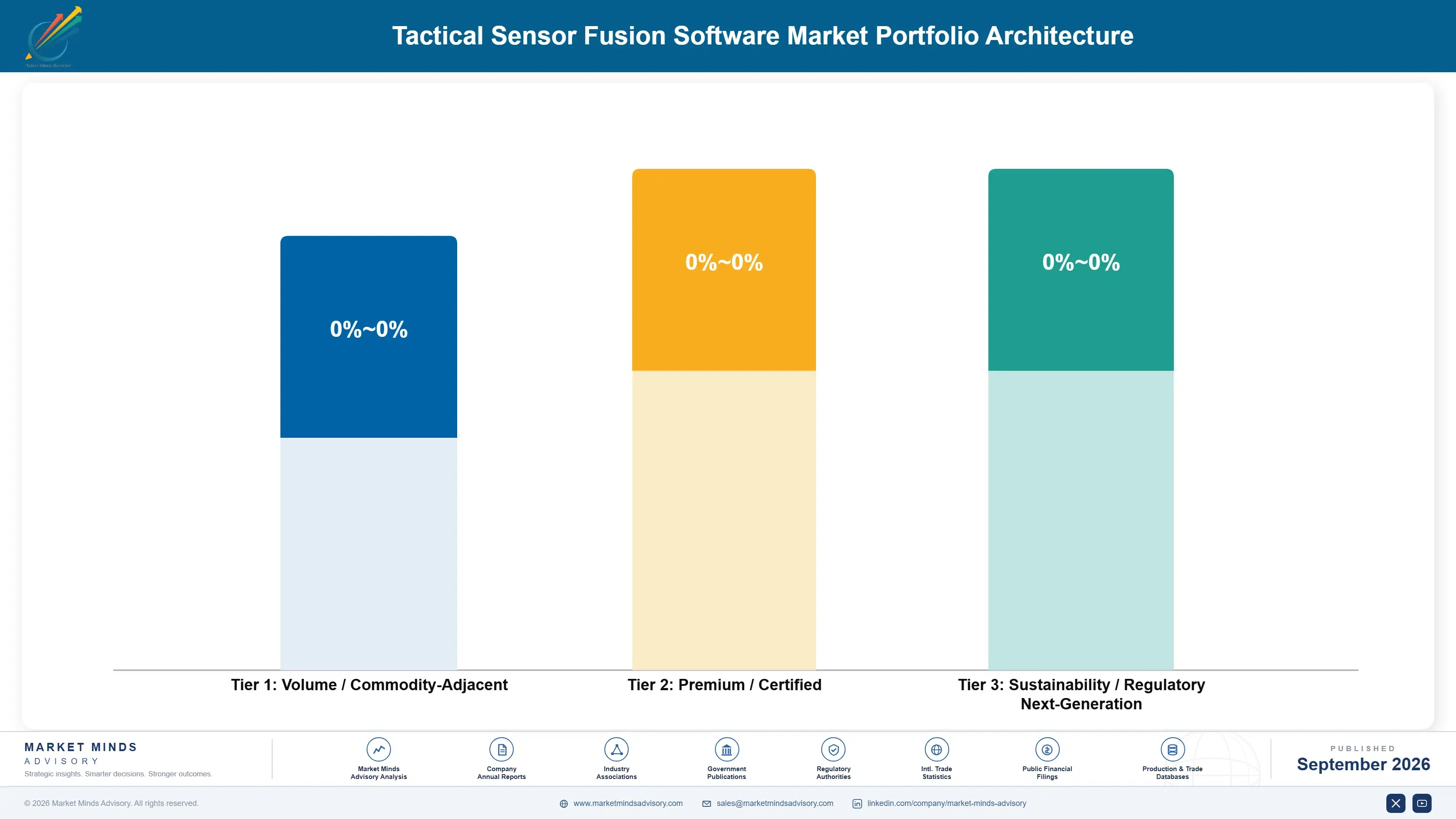
Margin separates by whether the software is bought as software. Fusion delivered inside a platform programme is priced as part of a capability the customer already committed to, with the prime holding the commercial relationship and the margin. Fusion bought directly, particularly counter-drone systems where the software is unambiguously the product, is priced against what it delivers, and the vendor holds the customer rather than sitting beneath somebody else.
The volume against premium tension runs through programme work. Platform integration contracts are large, predictable and consume the cleared engineering capacity that is this industry's binding constraint, so accepting them fills the business but forecloses the direct opportunities that carry better margin. Vendors treating programme work as a capacity floor rather than as a growth strategy are reading it correctly, and most large suppliers are not.

High-value pools sit where a mandate or an application creates direct procurement: counter-drone systems, conformant-interface fusion that any vendor can now compete for, and civil infrastructure buyers with no defence procurement habits. Each is bought as software rather than absorbed into a platform. The pools are smaller than programme work and carry a considerably larger share of the profit.

Volume / Commodity-Adjacent

Subcontract integration work delivered beneath a platform prime on cost-plus or fixed-price terms. Consumes cleared engineering capacity, provides predictable loading and leaves the customer relationship and most of the margin with somebody else entirely.
Gross Margin: 24 to 34%

Premium / Certified

Direct fusion software contracts with defence customers on programmes procured as software rather than as platform capability. The 12 point range reflects whether the vendor holds programme incumbency or is competing against an established supplier.
Gross Margin: 44 to 56%

Sustainability / Regulatory / Next-Generation

Counter-drone systems where software is the product, conformant-interface fusion opened by mandate, and civil infrastructure buyers. The 16 point range reflects how differently civil and defence customers price identical technical capability.
Gross Margin: 54 to 70%
tactical-sensor-fusion-software-market-portfolio-architecture-1788414427828

High-value Sub-segments and Strategic Watch-out

Counter-Drone Detection Systems

The one application where fusion software is unambiguously the product rather than a feature, growing at 21.3% and spreading well beyond military sites. False alarm rate rather than detection range decides every one of these awards. Operational performance data is what decides who wins them.
Gross Margin: 58 to 70%

Civil Infrastructure Protection

Airports, energy sites, prisons and stadiums buying identical technical capability through commercial rather than defence contracting. Established defence suppliers find this customer awkward, which leaves the position open to anyone with a commercial sales motion. Contracting and clearance expectations differ completely from established defence practice.
Gross Margin: 52 to 64%

Conformant Interface Fusion

Opened by procurement mandate rather than by any technical advance, letting vendors reach sensors they could never negotiate access to. Around 34% of fielded sensors now conform and the share rises with each new programme award. Policy rather than any engineering advance opened this position.
Gross Margin: 48 to 60%

Platform Subcontract Integration

Predictable, large and consuming the cleared engineering capacity that constrains everything else this industry wants to do. Useful as a capacity floor rather than as any kind of growth position worth pursuing deliberately. The customer relationship and most of the margin stay with the prime.
Gross Margin: 24 to 34%

How Fusion Software Gets Bought

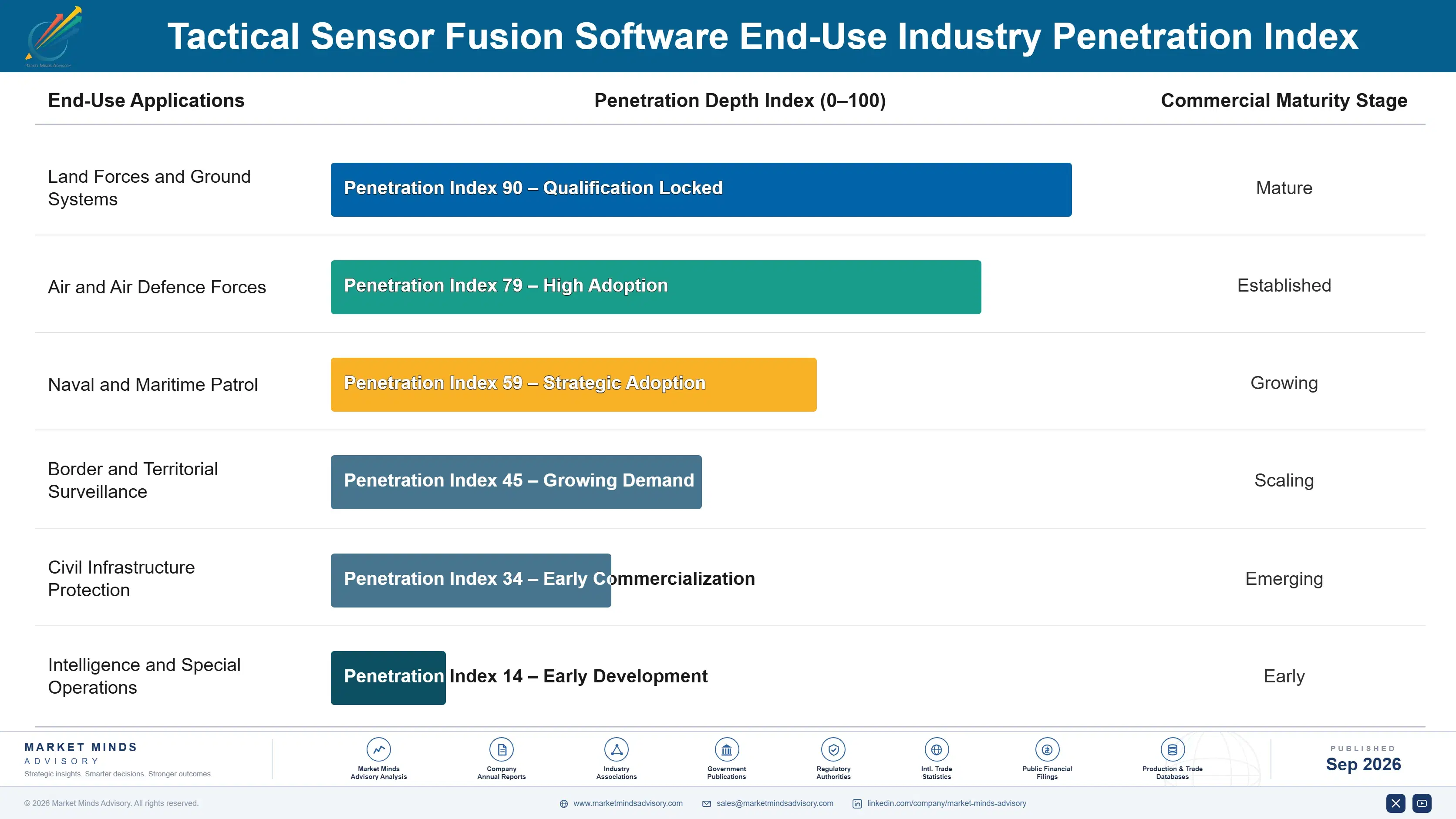
Annuity economics come from programme inclusion rather than from any renewal cycle. Software written into a platform programme ships with every unit for the programme's life and generates sustainment revenue for decades, without competing for anything again. Software bought directly renews on demonstrated performance and can be displaced, which is less comfortable and considerably better paid. The two are reported together and behave nothing alike.
Adoption depth varies sharply by customer type. Defence programme offices specify deeply, run extensive evaluation and change supplier essentially never once a capability is fielded. Rapid acquisition routes specify outcomes rather than requirements and accept incremental delivery, which is a genuinely different relationship. Civil infrastructure buyers specify loosely, rely heavily on supplier guidance and evaluate almost entirely on how often the system produces false alarms in their own environment.

The buyer profile is broadening rather than shifting. Fusion was procured by platform programme offices inside capability acquisitions, and it still largely is. What has been added is a rapid software acquisition route buying capability incrementally, and a civil market buying counter-drone protection through commercial contracting. Serving all three demands different contracting, different security postures and different sales organisations, which few suppliers have built.
tactical-sensor-fusion-software-market-end-use-penetration-index-1788414428314

Where Suppliers Should Compete

These are among the four positions where our research anticipates prominent divergence between winners and laggards over the coming forecast period. Each is grounded in the demand model, the regulatory perimeter, and the announced capacity pipeline.
01 / CONFORMANCE MANDATE ATTACHMENT

Build against open interfaces, not negotiated access

Conformance requirements oblige sensor suppliers to expose data as a condition of award, and each conformant sensor becomes available to any fusion vendor rather than only to its own original manufacturer. Around 34% of fielded sensors already conform and that share rises with each and every new programme awarded. Building against those interfaces removes most of the 43% of integration effort that data access currently consumes, which is why tracking acquisition policy matters more than tracking any competitor does here.
02 / COUNTER-DRONE APPLICATION OWNERSHIP

Own the one application where software is the product

Counter-drone detection genuinely requires five sensor types working together, so combining them correctly is the entire capability rather than an improvement to something else, and the software is therefore purchased directly instead of absorbed into somebody else's platform delivery. The segment grows at 21.3% against a market at 14.2% and it is spreading rapidly to civil infrastructure buyers too. False alarm rate rather than detection range decides these awards, which favours whoever holds genuine operational performance data from deployed sites.
03 / PROVENANCE ENGINEERING HIRING

Hire for unreliable data, not for classical estimation

Operational experience established that a thousand cheap sensors outperform a handful of excellent ones once software copes properly with the noise, which turns the problem from estimation theory into provenance and trust scoring instead. Decades of investment in the harder-looking classical problem confer no advantage at all at all in that particular work. Newer entrants are winning precisely because they carry none of it, and established suppliers must hire against the new problem rather than merely extend the old solution further.
04 / CLEARANCE INVENTORY BUILDING

Sponsor cleared engineers long before contract award

Cleared software engineers are a small population that every defence and intelligence buyer competes for, and clearance processing adds around nine months before any hire becomes productive on any classified work at all. Sponsoring promising engineers well ahead of any specific programme converts a hiring constraint into an asset that no competitor can purchase at any price whatsoever, however urgent. Most suppliers begin recruiting only after a contract is signed and then miss the schedule for reasons that were entirely predictable.

Engagement Snapshot From the Field

A live engagement with an industry participant carrying material or product regulatory and market exposure ahead of a defining policy shift, showing how our research translates into a defensible multi-year portfolio strategy.
MARKET MINDS ADVISORY · CLIENT ENGAGEMENT SUMMARY
Tactical Sensor Fusion Software Producer Strategic Portfolio Review and Transition Roadmap 2026·Investment Scenario on Tactical Sensor Fusion Software Exposure Evaluation 2025-26
CLIENT PROFILE
A European supplier of defence software and systems integration with annual revenue reported at approximately USD 280 million (client-reported, unverified by MMA). Most revenue came from subcontract integration work delivered beneath platform primes, the business held no direct counter-drone position, and its fusion engineering team had been built entirely around classical multi-sensor track correlation methods.
STRATEGIC CHALLENGE
Margin on subcontract work had compressed for three consecutive years while newer entrants with no defence pedigree were winning direct awards the client could not reach. A counter-drone opportunity had been declined for lack of relevant capability. Management could not tell whether the problem was technical, commercial or organisational. Each explanation had internal supporters.
MMA APPROACH
MMA assessed how the client's fusion capability performed against unreliable distributed sensor inputs rather than against classical track quality measures, mapped which procurement routes were open to the client and which were closed, and benchmarked cleared engineering capacity against competitors winning the direct awards in question. Award criteria were examined directly.
KEY FINDINGS
  1. The client's fusion engineering was excellent against trusted sensor inputs and performed poorly against the unreliable distributed sources that current requirements actually specify.
  2. Around 43% of the client's integration effort was consumed by sensor data access negotiation, work that conformant open interfaces would have removed almost entirely.
  3. Subcontract programme work was consuming the cleared engineering capacity that direct opportunities required, so capacity rather than commercial intent was blocking the shift.
  4. Counter-drone awards were being decided on false alarm rates in the customer's own environment, and the client held no operational performance data of any kind.
CLIENT PROFILE
A European supplier of defence software and systems integration with annual revenue reported at approximately USD 280 million (client-reported, unverified by MMA). Most revenue came from subcontract integration work delivered beneath platform primes, the business held no direct counter-drone position, and its fusion engineering team had been built entirely around classical multi-sensor track correlation methods.
STRATEGIC CHALLENGE
Margin on subcontract work had compressed for three consecutive years while newer entrants with no defence pedigree were winning direct awards the client could not reach. A counter-drone opportunity had been declined for lack of relevant capability. Management could not tell whether the problem was technical, commercial or organisational. Each explanation had internal supporters.
MMA APPROACH
MMA assessed how the client's fusion capability performed against unreliable distributed sensor inputs rather than against classical track quality measures, mapped which procurement routes were open to the client and which were closed, and benchmarked cleared engineering capacity against competitors winning the direct awards in question. Award criteria were examined directly.
KEY FINDINGS
  1. The client's fusion engineering was excellent against trusted sensor inputs and performed poorly against the unreliable distributed sources that current requirements actually specify.
  2. Around 43% of the client's integration effort was consumed by sensor data access negotiation, work that conformant open interfaces would have removed almost entirely.
  3. Subcontract programme work was consuming the cleared engineering capacity that direct opportunities required, so capacity rather than commercial intent was blocking the shift.
  4. Counter-drone awards were being decided on false alarm rates in the customer's own environment, and the client held no operational performance data of any kind.
RECOMMENDED STRATEGY
Phase 1: Phase one: rebuild the fusion engineering team around provenance and trust scoring rather than extending existing classical correlation capability further. Phase 2: Phase two: deliberately decline the lowest margin subcontract work available to release cleared engineering capacity for the direct opportunities instead. Phase 3: Phase three: acquire or partner for operational counter-drone performance data before bidding for any further civil infrastructure opportunities at all.
OUTCOME
Within fourteen months the client had rebuilt its fusion team, deliberately declined two subcontract renewals, and won its first direct counter-drone award against established competition (client-reported, unverified by MMA). Blended gross margin rose 7.2 percentage points despite revenue growing only modestly across the whole period.

Frequently Asked Questions

Foundational context covering the market sizes, CAGR, scope, country, region and competition that inform every finding below. This section is provided to cover basics and most often pre-purchase conversations, answered from the MMA Primary Research Dataset.

What is the current size of the Tactical Sensor Fusion Software Market?

The market was valued at USD 2.8 billion in 2025 and reaches USD 3.20 billion in 2026. Counter-drone and distributed sensing requirements drive most of the current growth.

How large will the Tactical Sensor Fusion Software Market be by 2036?

MMA forecasts USD 12.07 billion by 2036, an increase of USD 8.87 billion over the 2026 base. That represents an expansion multiple of 3.77 times.

What is the CAGR for the Tactical Sensor Fusion Software Market 2026 to 2036?

The base case CAGR is 14.2%, with a bull case of 15.6% and a bear case of 12.8%. The historical rate between 2020 and 2025 was 12.8%.

Which segment is growing fastest?

Counter-uncrewed systems fusion grows at 21.3%, half again the market rate of 14.2%. No single sensor type detects small drones reliably, so fusion is mandatory.

Who are the major companies in the Tactical Sensor Fusion Software Market?

Palantir Technologies, Lockheed Martin, RTX, Leonardo and Anduril Industries lead on measured contracted software value. Together they account for roughly 39% of a fragmented market.

Which country is growing fastest?

Poland grows fastest at 19.8%, on a rearmament programme unusual in both its scale and its speed, with requirements shaped directly by recent operational experience.

Report Segmentation Architecture

The full report scope spans multiple orthogonal segmentation dimensions, with cross-tabulated demand data provided for each dimension pair. Coverage extends further to regional breakdowns, trend trajectories, and the competitive detail needed to support segment-level decision-making.

By Fusion Function

  • Platform Sensor Track Fusion
  • Common Operating Picture Correlation
  • Counter-Uncrewed Systems Fusion
  • Distributed Low-Cost Sensor Fusion
  • Electronic Warfare and Signals Fusion
  • Maritime and Undersea Fusion

By End-Use Industry

  • Land Forces and Ground Systems
  • Air and Air Defence Forces
  • Naval and Maritime Patrol
  • Border and Territorial Surveillance
  • Civil Infrastructure Protection
  • Intelligence and Special Operations

By Procurement Route and Delivery Model

  • Platform Programme Inclusion
  • Direct Software Procurement
  • Rapid Acquisition Pathways
  • Subcontract Integration Delivery
  • Commercial Civil Contracting
  • Partnership and Assistance Funded

By Region

  • North America
  • Western Europe
  • East Asia
  • Eastern Europe
  • South Asia and Pacific
  • Middle East and Africa
  • Latin America

Scope, Methodology, and Coverage

Every figure in this report is reproducible from documented input assumptions. The scope below maps the historical period, the forecast horizon, the segmentation dimensions, and the countries covered, alongside the underlying primary and qualitative methodology.
Historical Period
2020 to 2025
Forecast Period
2026 to 2036
Base Year
2025 (USD billions; MMA Primary Research Dataset, September 2026)
Market Definition
The tactical sensor fusion software market covers software that combines data from multiple dissimilar sensors into correlated tracks and a coherent operational picture for defence and security users, spanning platform track fusion, common operating picture correlation, counter-uncrewed systems fusion, distributed low-cost sensor fusion, electronic warfare and signals fusion, and maritime and undersea fusion. Sizing is measured at contracted software and integration revenue. Sensor hardware, communications equipment, command platforms, effectors and general purpose analytics tooling sold separately are excluded.
Quantitative Units
USD billions at contracted software and integration revenue, with supporting programme counts and fielded sensor conformance rates by region
Segmentation Dimensions
Fusion function, end-use industry, procurement route and delivery model, region
Regions Covered
North America, Western Europe, East Asia, Eastern Europe, South Asia and Pacific, Middle East and Africa, Latin America
Countries Covered
United States, Canada, United Kingdom, France, Germany, Italy, Sweden, Netherlands, Poland, Romania, Finland, Japan, South Korea, Taiwan, India, Australia, Israel, Saudi Arabia
Key Companies Profiled
Palantir Technologies, Lockheed Martin, RTX, Leonardo, Anduril Industries, BAE Systems, Thales, Northrop Grumman, L3Harris Technologies, General Dynamics Mission Systems, Saab, Elbit Systems, Rheinmetall, Hensoldt, Systematic, Sierra Nevada Corporation, Shield AI, Dedrone, DroneShield, Fortem Technologies
Quantitative Methodology
Primary survey, n=3,800 respondents, Q4 2025, six countries; demand-side model with trade association cross-validation
Qualitative Methodology
47 expert interviews, Q4 2025; applied to validate demand model assumptions, identify emerging dynamics, and assess competitive positioning
Report Format
PDF and XLSX data workbook (Word format preview document)
Publisher
Market Minds Advisory
Report Code
MMA-2026-TEC-671
Published
September 2026
Contact
sales@marketmindsadvisory.com | www.marketmindsadvisory.com

Purchase the full Tactical Sensor Fusion Software Market Report (2026 to 2036).

The full report treats data access rather than algorithm quality as the binding constraint, which is the framing that explains why a solved mathematical problem produced such a difficult commercial market. It sizes six fusion functions with individual growth rates, seven regions built from defence software procurement and open architecture policy, and the shift from a few trusted sensors to thousands of unreliable ones. Competitive analysis covers twenty suppliers on a consistent contracted software value basis, with conformant interface access and cleared delivery capacity treated as the decisive variables. Input cost modelling breaks out cleared labour and accreditation exposure by delivery structure.
Six fusion functions with individual growth rates
Open architecture conformance mapped across fielded sensors
Counter-drone sensor requirements analysed by detection mode
Cleared engineering capacity as programme constraint
Twenty suppliers on consistent contracted value basis
Cleared labour and accreditation cost exposure

Built For The People Who Decide

From boardroom strategy to bench-side execution, this report is read cover-to-cover by leaders shaping the next decade of their industry, turning demand scenarios, market dynamics and valuation benchmarks into decisions.
CXOs/ Presidents/ VPs/ Managers
M&A and Corporate Development
Strategy Teams and R&D Heads
Procurement and Product Directors
Regulatory and Compliance Leaders
Investor Relations and Equity Analysts