Market Minds Advisory
Tactical Data Link Market

Tactical Data Link Market: Tactical Data Link Market: Interoperability Mandates, Waveform Migration and the Coalition Problem 2026 to 2036

A data link is worth nothing unless the other side runs the same one. That single fact makes this a market where standards bodies decide procurement outcomes far more reliably than capability does.

Lead Analyst

Published

September 2026

Make Smarter Decisions with Customized Research Insights

Request a free sample report and evaluate market opportunities, growth trends, and competitive dynamics relevant to your business needs.

2025 MARKET VALUE$9.6BMarket Size 2025
2036 FORECAST VALUE$24.1BBase Case , 2026 to 2036
CAGR 2026 TO 20368.7 %Bull 10.0% / Bear 7.4%
INCREMENTAL OPPORTUNITY$13.6BNet 10- year value creation
EXPANSION MULTIPLE2.30x2036 value over 2026 base
Strategic Levers
M&A Pipeline
Regional Outlook
Country Rankings
Competitive Intelligence
Segmental Deep-dive
Call-Us : 91 93563 13602

Executive Snapshot and Market Trajectory.

A tactical data link is worth precisely nothing unless the force on the other side runs the same one. That single fact makes standards bodies rather than capability the thing that decides procurement outcomes here. Every other consideration in a link procurement follows from it, including price.
The market reaches USD 10.5 billion in 2026 and USD 24.1 billion by 2036, a 2.30 times expansion at 8.7% annually. Resilient waveform and anti-jam terminals grow at 13.1%, half again the market rate of 8.7%, as jamming moved from exercise scenario to routine operating condition. North America holds 36% of spending, above the usual band, and India compounds fastest at 14.2%. Gateway equipment takes a further 22% of spending.
Five suppliers hold 63% of terminal and integration revenue, which is high and reflects certification rather than technology. L3Harris Technologies, Collins Aerospace, Viasat, Leonardo and Thales lead. Interoperability certification takes around 26 months per platform integration, and that gate protects position better than any waveform advantage. Certification coverage across allied platform types is what separates the leaders from a long list of technically capable suppliers who cannot bid at all. Concentration has barely moved.
Market Definition
This report covers tactical data link terminals, waveform software, gateway and translation equipment, platform integration services, and network management and planning systems for military tactical networks. It excludes strategic satellite communications, commercial satellite services, ground command and control centres, intelligence dissemination networks, radio systems without tactical link waveforms, and the platforms into which terminals are integrated.
Base Year Value
$9.6B in 2025 (MMA Primary Research Dataset, September 2026)
Forecast Period
2026 to 2036, eleven discrete annual values
CAGR
8.7% base case. Bull 10.0%. Bear 7.4%.
Fastest Growth Segment
Resilient Waveform And Anti-Jam Terminals: 13.1% CAGR
Fastest Growth Country
India: 14.2% CAGR
Fastest Growth Region
South Asia and Pacific: 10.7% CAGR
Largest Region
North America: 36% of 2025 global value
Market Leaders
L3Harris Technologies, Collins Aerospace, Viasat, Leonardo and Thales lead on tactical data link terminal and integration revenue. Source: MMA Analysis.
Primary Survey
n=3,800 procurement and R&D decision-makers, Q4 2025, six countries
Methodology
Demand-side build-up, cross-validated against public data, 47 expert interviews

Tactical Data Link Market Forecast Scenarios

tactical-data-link-market-size-forecast-scenario-1789997631057
The category compounded at 7.6% between 2020 and 2025, and the pattern was upgrade rather than expansion. Forces already held links, so spending went into making older terminals talk to newer ones and into gateways that translate between waveforms nobody wants to retire. Coalition operations exposed how badly that translation worked, which turned a nuisance into a priority.
The base case runs 8.7% on three mechanisms. Jamming became a routine operating condition rather than an exercise scenario, which pushed resilient waveform terminals from optional to required. Coalition interoperability mandates now shape national procurement more tightly than national requirements do. And uncrewed platforms need links sized and priced for aircraft that are expendable, which existing terminals were never designed to be. Each of those runs independently of the other two.
The bull case at 10.0% assumes uncrewed platform fielding accelerates as announced, since each airframe needs a link and the volumes involved dwarf crewed fleets. The bear case at 7.4% is certification backlog, where interoperability testing capacity constrains fielding regardless of how much equipment gets ordered or how quickly it is manufactured. Testing ranges and representative platforms do not scale with order volume at all.

Standards Decide, Not Capability

This market runs on a rule that has nothing to do with performance. A link is worth nothing unless the force on the other side runs the same one, which means the standards body decides the procurement outcome and the supplier with better technology and no certification does not compete at all. Interoperability certification takes around 26 months per platform integration, and that number governs fielding schedules far more tightly than manufacturing does.
TOP FIVE CONCENTRATION63%Held by suppliers carrying certification history across allied platforms
INTEROPERABILITY CERTIFICATION PERIOD26 monthsPer platform integration before any operational fielding is permitted
LEGACY WAVEFORM SHARE54%Terminals still running links standardised before the current century
GATEWAY EQUIPMENT SHARE22%Spending going to translation between waveforms nobody will retire
TERMINAL SERVICE LIFE18 yearsTypical fielded life before replacement rather than software upgrade
INTEGRATION COST SHARE47%Programme cost sitting in platform integration rather than the terminal
Nobody retires anything, which is why gateways exist. Roughly 54% of fielded terminals still run links standardised before this century, and about 22% of spending goes to translation equipment that lets old and new talk to each other. That translation layer is pure overhead in engineering terms and entirely unavoidable in operational ones, since a coalition partner running a forty year old link is still a coalition partner you have to reach.
Jamming changed the requirement rather than the architecture. Resilient waveform and anti-jam terminals grow at 13.1% against 8.7% for the market, because contested spectrum moved from exercise scenario to routine operating condition across most theatres. Integration remains where the money goes: roughly 47% of programme cost sits in fitting the terminal to the platform.
"Everybody in this business talks about waveform performance and almost nobody wins on it. You win by being certified on the platforms the customer already flies, and by having been certified before anybody else asked. That is a scheduling advantage dressed up as a technology one."
Director, Defence Communications and Networking Practice · MMA Technology Practice · September 2026

Market Trends

Contested Spectrum Made Resilience A Baseline Requirement

Jamming moved from an exercise scenario to a routine operating condition across most theatres, which changed what a tactical link has to survive rather than what it has to deliver. Resilient waveform and anti-jam terminals grow at 13.1% against 8.7% for the market as forces retrofit fleets that were specified when spectrum was assumed to be available. The engineering is genuinely difficult and the certification burden on top of it is heavier still, which narrows the supplier field considerably. Suppliers whose experience comes from commercial radio work find that almost none of it transfers into anti-jam design.
Market Impact: Certification consumes 26 months each
Gateways Absorb What Nobody Will Retire

Roughly 54% of fielded terminals still run links standardised before this century, and no force is willing to give up reaching a partner who has not upgraded. About 22% of spending therefore goes to gateway and translation equipment that exists purely to bridge waveform generations. In engineering terms that layer is overhead. In operational terms it is unavoidable, and suppliers who treat gateway work as a distraction from terminal sales are misreading roughly a fifth of the market. Translation demand grows precisely because retirement schedules keep slipping rather than being executed.
Market Impact: India compounds at 14.2% yearly

Market Opportunities and Growth Drivers

Coalition Mandates Override National Procurement Preferences

Allied interoperability requirements now shape national tactical link procurement more tightly than national requirements do, because a force that cannot exchange track data with partners has bought equipment it cannot use in the operations it will actually fight. Certification against allied standards takes around 26 months per platform integration and gates fielding entirely. Suppliers holding that certification across multiple allied platform types reach procurements that a technically superior uncertified competitor cannot even bid for. National capability arguments lose to interoperability arguments almost every time these days, which is a reversal from how these programmes ran twenty years ago.
Market Impact: Testing consumes 26 months each

Uncrewed Platforms Need Links Priced To Be Lost

India compounds at 14.2% and uncrewed fielding is a large part of why, across India and several other forces expanding rapidly. An expendable airframe cannot carry a terminal costing more than the aircraft, which is a pricing and design problem existing terminals were never built to solve. Volumes involved dwarf crewed fleets considerably. Suppliers who cannot reach that price point are watching the fastest growing platform category field links from somebody else entirely. Reaching that price point requires design decisions taken early rather than discounting applied late. Volume rather than margin is what that category offers.
Market Impact: Integration takes 47% of cost

Market Restraints and Challenges

Certification Capacity Constrains Fielding Regardless Of Orders

Interoperability certification takes around 26 months per platform integration, and the testing facilities and ranges that perform it are finite and shared across allied programmes. The root cause is that certification requires representative platforms and spectrum access, neither of which scales quickly with demand. Commercially this caps fielding rates independently of manufacturing or order volume. Mitigation runs through modelling and simulation acceptance, through reciprocal recognition between allied authorities, and through terminals designed for certification reuse across platform families. None of those routes removes the queue; they only shorten the time any single programme spends waiting in it.
Market Impact: Anti-jam terminals grow at 13.1%

Integration Cost Dominates The Terminal Purchase

Roughly 47% of programme cost sits in fitting a terminal to a platform rather than in the terminal itself, which distorts every procurement decision made on unit price. The root cause is that military platforms carry bespoke wiring, cooling, antenna placement and airworthiness constraints that vary by airframe and by block. Commercially it means the cheaper terminal frequently costs more installed. Mitigation runs through common form factor standards and through integration kits qualified once across a platform family. Buyers evaluating on unit price alone reliably choose the more expensive installed system.
Market Impact: Gateways take 22% of spending
3 additional market trends, 4 additional growth drivers, and 2 additional restraints and challenges are covered in the full report. Contact sales@marketmindsadvisory.com to access the complete intelligence.

Segment CAGR and Growth Architecture

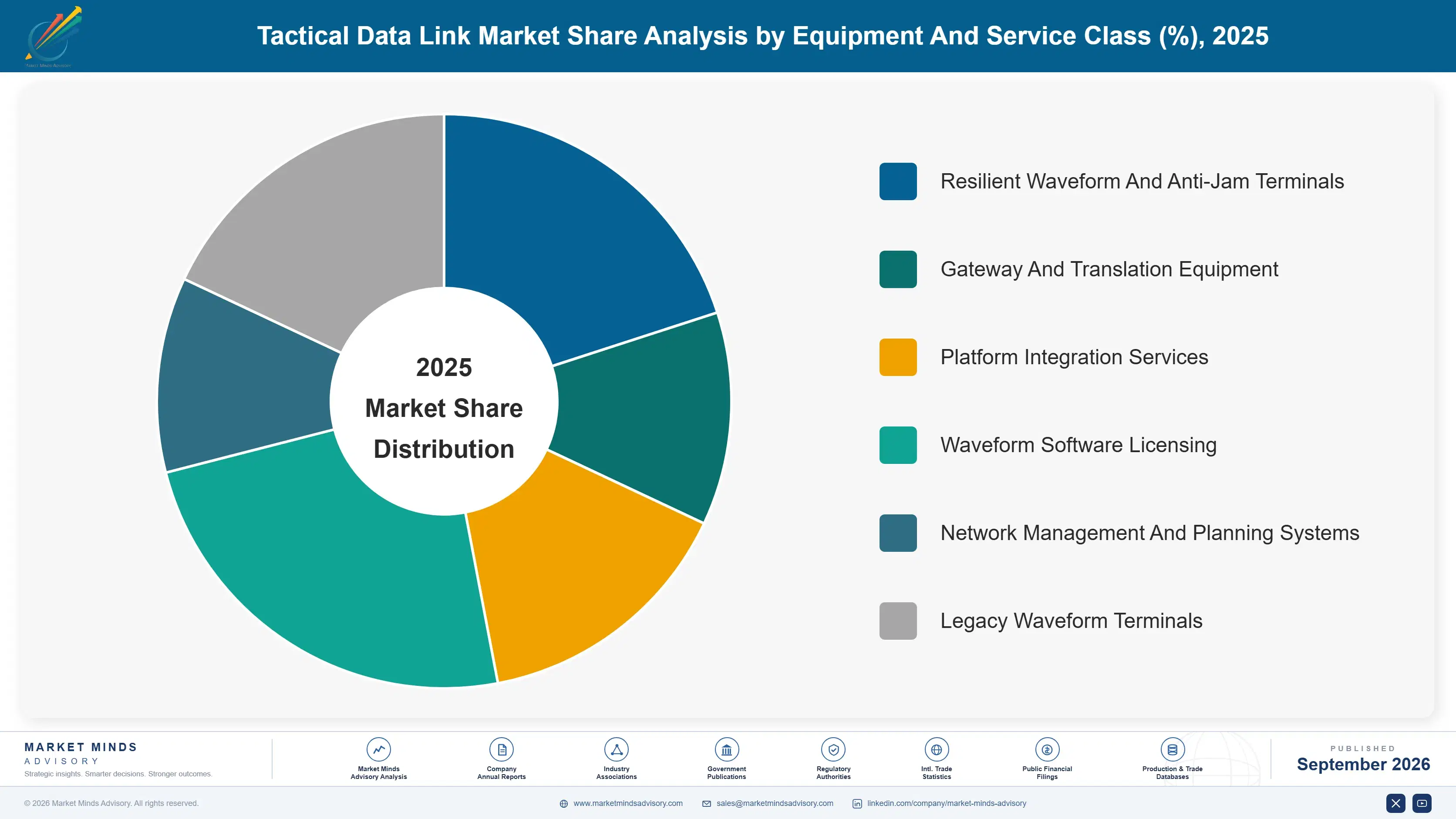
Segmentation follows equipment and service class, since each carries different certification burden, different buyer behaviour and quite different exposure to waveform migration. Six classes cover the market: resilient waveform terminals, legacy waveform terminals, gateway and translation equipment, platform integration services, network management systems, and waveform software licensing. Platform type and procurement route are handled separately.
tactical-data-link-market-market-share-analysis-1789997631620

Resilient Waveform And Anti-Jam Terminals

Resilient waveform and anti-jam terminals grow at 13.1%, half again the market rate of 8.7%, because jamming stopped being an exercise scenario and became a routine operating condition across most theatres where allied forces expect to operate. Fleets specified when spectrum was assumed available are being retrofitted, which is a large installed base moving at once rather than any new platform demand. The engineering is genuinely difficult and the certification burden sitting on top of it is heavier still, which narrows the supplier field to those already holding allied certification across the relevant platform types. Commercial radio experience transfers into anti-jam design barely at all. Certification history across the relevant platform types decides the outcome before capability is assessed.
CAGR 13.1%

Gateway And Translation Equipment

Gateway and translation equipment compounds at 10.4% and takes roughly 22% of total spending, because no force is willing to give up reaching a coalition partner who has not upgraded anything. Around 54% of fielded terminals still run links standardised before this century and will keep running them for years yet. In engineering terms this translation layer is pure overhead that ought not to exist. In operational terms it is completely unavoidable, and suppliers who treat gateway work as a distraction from terminal sales misread roughly a fifth of the addressable market. Gateway position also reaches platforms a supplier does not otherwise touch, which converts into terminal opportunity later. Retirement keeps slipping.
CAGR 10.4%
Full segment breakdown across 6 segments available in the complete report.

Regional Architecture and Country Demand Map

North America holds 36% of tactical data link spending, above the usual band, because allied waveform standards are set there and the largest fielded platform inventory sits there too. Western Europe follows at 25% on coalition programmes. India drives the fastest regional growth at 14.2% on uncrewed platform fielding.

North America

North America takes 36% of tactical data link spending, above the 32% band ceiling, because allied waveform standards are largely set here and the largest fielded platform inventory sits here as well. That combination means certification decisions made in this region govern procurement outcomes across every allied force. L3Harris Technologies, Collins Aerospace and Viasat all operate from here. Uncrewed platform fielding is adding terminal volume at rates crewed fleets never produced. Growth at 9.0% runs above the global rate on resilient waveform retrofit across a very large installed base. Certification queues here constrain fielding for allied buyers as much as for domestic ones. Domestic suppliers hold the deepest certification coverage of any region by a wide margin.
Share: 36% | CAGR: 9.0% (2026 to 2036)

Western Europe

Western Europe accounts for 25% of spending, driven by coalition interoperability programmes rather than by any independent national requirement setting. Leonardo and Thales hold genuine terminal and integration capability, and both compete on certification history accumulated across allied platform types over decades. European procurement distributes work across participating nations, which shapes supplier selection independently of capability assessments. Legacy waveform inventory here is substantial and gateway demand follows from it directly. Growth at 7.4% is the slowest of any region, on constrained defence budgets and long certification queues. Uncrewed fielding is expanding but from a smaller base than either North America or India. Certification queue position constrains European fielding as tightly as budget does.
Share: 25% | CAGR: 7.4% (2026 to 2036)
Regional intelligence for 5 additional markets available in the complete report: East Asia, South Asia and Pacific, Latin America, Middle East and Africa, Eastern Europe. Contact sales@marketmindsadvisory.com.
tactical-data-link-market-country-cagr-analysis-1789997632162

Where Link Programmes Are Won

Certification decides procurement outcomes rather than capability, integration absorbs roughly half of programme cost, and nobody retires a waveform anybody still flies. The four levers below follow those conditions rather than any argument about terminal performance, which is where most suppliers waste their positioning effort. Each addresses a procurement condition rather than an engineering one.

Certify Ahead Of The Requirement Being Written

Interoperability certification takes around 26 months per platform integration, which means a supplier certifying after a requirement appears has already lost that competition on schedule regardless of capability. Certifying against platform types the customer already flies, before anybody asks, converts a technology conversation into an availability one. That is expensive and speculative and it is also the only reliable route into allied procurements. Suppliers waiting for a requirement to justify certification investment are late to every competition they enter by roughly two years. Certifying across 3 platform families before a requirement appears costs less than losing one programme.
Market Impact: Certification now consumes fully 26 months per platform

Sell Integration Rather Than Terminal Unit Price

Roughly 47% of programme cost sits in fitting the terminal to the platform rather than in the terminal, so a competitor winning on unit price frequently delivers a more expensive installed system. Suppliers who quote installed cost and carry integration risk reframe the comparison onto ground they can defend. That requires genuine platform engineering depth rather than a manufacturing position, and it is where the margin actually sits across most programmes in this market. A terminal 20% cheaper on unit price frequently installs at higher total cost. Programme offices increasingly ask for installed cost directly.
Market Impact: Integration absorbs a full 47% of programme cost

Build Gateway Products Rather Than Resenting Them

Around 22% of spending goes to gateway and translation equipment because roughly 54% of fielded terminals still run pre-century waveforms nobody will retire. Suppliers treating translation as a distraction from terminal sales are declining a fifth of the market on aesthetic grounds. Gateway products also create position on platforms the supplier does not otherwise reach, which converts into terminal opportunity when those platforms eventually recapitalise and the incumbent is already on board. Around 54% of fielded inventory keeps that demand alive indefinitely. Suppliers who build translation products deliberately reach customers that terminal sales alone never open.
Market Impact: Gateways now carry a full 22% of spending

Price Terminals For Platforms Designed To Be Lost

An expendable uncrewed airframe cannot carry a terminal costing more than the aircraft, and volumes across those platforms dwarf crewed fleets by a considerable margin. India compounds at 14.2% substantially on that fielding. Existing terminals were designed for platforms worth protecting and price accordingly, which excludes their suppliers from the fastest growing platform category entirely. Reaching that price point requires design decisions taken early rather than discounting applied late. An uncrewed fleet of 200 airframes needs 200 terminals at prices no crewed programme ever demanded, which is a manufacturing problem before it is a commercial one.
Market Impact: India now compounds at fully 14.2% every year

Who Controls the Margin Pool

Five suppliers hold 63% of tactical data link terminal and integration revenue, which is high even by defence standards and reflects accumulated certification history rather than any technology position. L3Harris Technologies, Collins Aerospace, Viasat, Leonardo and Thales lead. Concentration has moved very little across a decade despite considerable new entry, which tells you what actually governs selection here.
Competition runs on certification coverage across platform types far more than on waveform performance, since a supplier without certification on the customer's fleet cannot bid at all. The second dimension is integration engineering depth, because roughly 47% of programme cost sits there and the supplier carrying that risk usually carries the programme. Unit price competes a distant third behind both of those. All participants are assessed on terminal, gateway and integration revenue.

Pressure is emerging from uncrewed platform pricing, where terminals must cost less than airframes designed to be lost and incumbent cost structures cannot reach that. Rankings shift where uncrewed fielding accelerates and where legacy inventory retires, particularly across India, the Gulf and Eastern Europe. Certification queues slow every entrant equally. Suppliers organised entirely around crewed fleet retrofit are serving the slowest growing platform category in this market.
tactical-data-link-market-company-positioning-matrix-1789997632688

Competitive Moat and Risk Dimensions

L3HARRIS TECHNOLOGIES

Moat: Broad Certification Coverage

L3Harris holds interoperability certification across an unusually wide range of allied platform types, accumulated over decades of terminal and integration work. Since certification takes around 26 months per platform and gates fielding entirely, that coverage lets the company bid competitions competitors cannot enter. The barrier is scheduling rather than technical, which makes it harder to overcome.
L3HARRIS TECHNOLOGIES

Risk: Legacy Portfolio Weight

Broad certification coverage was built across platform types that are largely crewed and largely legacy, which is where growth is slowest. Resilient waveform retrofit and expendable uncrewed fielding both demand different engineering and different cost structures. Coverage satisfies the interoperability gate and does not by itself deliver either of those requirements.
VIASAT

Moat: Resilient Waveform Depth

Viasat built genuine anti-jam and resilient waveform engineering when contested spectrum was still treated as an exercise scenario rather than a routine operating condition. That segment now grows at 13.1% against 8.7% for the market as fleets retrofit. The engineering is difficult and the certification burden heavier still, which keeps the field narrow.
VIASAT

Risk: Uncrewed Price Exposure

Resilient waveform terminals are engineered for platforms worth protecting and priced accordingly, while the fastest growing platform category is expendable airframes that cannot carry a terminal costing more than the aircraft. Cost structures built around difficult engineering do not reduce easily. That leaves position concentrated in the slower growing crewed fleet retrofit rather than in volume fielding.

Players Tracked

Prominent Players

L3Harris Technologies
Collins Aerospace
Viasat
Leonardo
Thales

Other Key Players

BAE Systems
Northrop Grumman
General Dynamics Mission Systems
Rohde and Schwarz
Elbit Systems
Israel Aerospace Industries
Hensoldt
Indra Sistemas
Curtiss-Wright
Data Link Solutions
ViaLite
Kongsberg Defence and Aerospace
Bharat Electronics
Mitsubishi Electric
Hanwha Systems

Recent Developments

MARCH 2025

Allied Authorities Expand Reciprocal Certification Recognition

Allied certification authorities expanded mutual recognition of interoperability test results, a procedural development rather than any corporate transaction. Certification takes around 26 months per platform integration and testing capacity is finite and shared, so recognition of another authority's results relieves a queue that constrains fielding regardless of order volume.
Signal: Testing capacity rather than manufacturing capacity is what actually caps allied fielding rates in practice today.
SEPTEMBER 2024

Uncrewed Programmes Specify Terminals Below Airframe Cost

Several uncrewed platform programmes specified data link terminals priced below the airframes carrying them, a requirement development rather than any procurement award. Existing terminals were engineered for platforms worth protecting and price accordingly, which excludes most incumbent suppliers from the fastest growing platform category entirely.
Signal: A terminal costing more than the aircraft cannot fly on anything deliberately designed to be lost.
JUNE 2025

Gateway Procurement Grows As Legacy Retirement Slips

Forces across several allied nations expanded gateway and translation procurement as legacy waveform retirement schedules slipped again, an operating decision rather than any corporate event. Roughly 54% of fielded terminals still run pre-century links, and reaching a partner who has not upgraded remains an operational necessity.
Signal: Translation demand keeps growing precisely because legacy retirement is postponed again rather than ever actually executed.

What A Terminal Costs

Radio frequency and signal processing components absorb roughly 31% of terminal cost, sourced from a small group of suppliers producing defence qualified parts at modest volume. Certification and test campaigns take around 24% and recur with every platform integration. Cryptographic and security modules absorb about 17%, and precision machining plus environmental qualification take most of the remaining balance across small production runs.
Defence qualified semiconductor supply tightened through 2022 and 2023 as commercial demand competed for the same specialist foundry capacity that low volume defence parts depend on. L3Harris Technologies Annual Report 2024 and Thales Annual Report 2024 both record component availability and certification cost as principal operating variables. Suppliers holding multi-year component agreements delivered materially better than those buying against programme award timing. Programme schedules slipped wherever allocation could not be secured against fielding dates.

The competitive disadvantage mechanism is certification amortisation rather than component price. A supplier spreading around 26 months of certification work across many platform integrations carries far lower cost per programme than one certifying afresh for each. Exposure concentrates among suppliers with narrow platform coverage, since every new customer means starting the certification clock again while broadly certified competitors bid immediately.
tactical-data-link-market-cost-volatility-analysis-1789997632885

Design Terminals For Certification Reuse Across Platform Families

Certification and test campaigns absorb roughly 24% of terminal cost and recur with every platform integration undertaken. Designing so one campaign covers a platform family rather than a single airframe spreads that expense considerably further. The discipline is architectural and has to be decided early, since retrofitting certification reuse into a bespoke terminal design is not realistically achievable afterwards.

Contract Defence Qualified Component Supply Well Ahead

Radio frequency and processing components run roughly 31% of terminal cost and come from a small group of suppliers whose capacity is shared with commercial demand. Multi-year agreements secure allocation and let a supplier quote delivery a programme office can plan around. Buying against award timing means being unable to commit, which loses competitions on schedule rather than on capability.

Qualify Integration Kits Once Per Platform Family

Integration absorbs roughly 47% of programme cost, and most of that expense repeats whenever a terminal meets a new airframe configuration for the first time. Qualifying a common integration kit across a platform family converts repeated engineering into repeated installation. The saving compounds across fleet sizes and is largest precisely where platform inventories are big and configurations vary.

Portfolio Architecture for Margin Defence

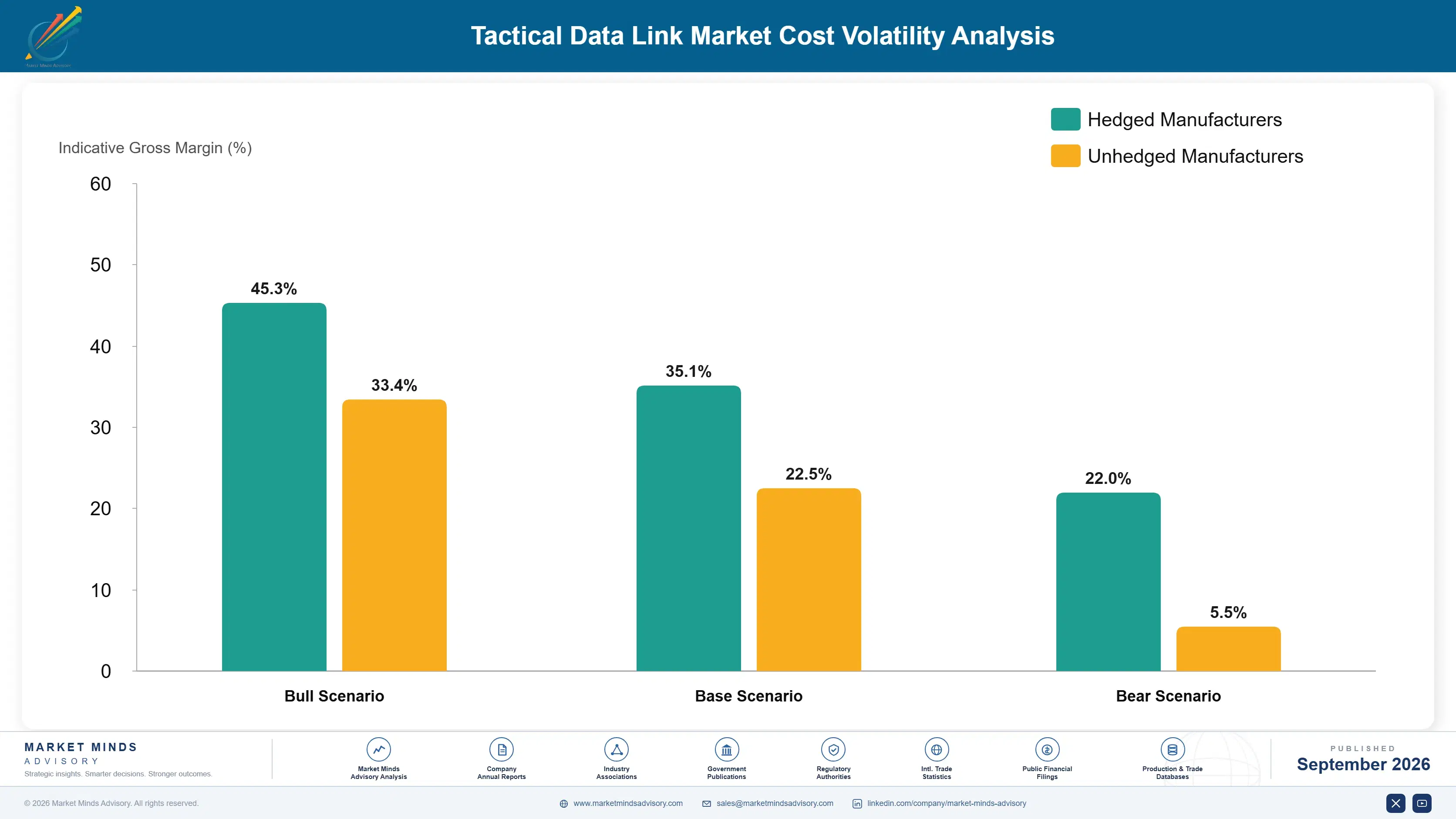
Margin architecture separates on certification scarcity rather than on manufacturing difficulty. Legacy waveform terminals earn least, since the technology is settled and several suppliers hold equivalent certification. Gateway equipment and network management sit above on integration complexity. Resilient waveform terminals, platform integration services and waveform software licensing earn most, each combining difficult engineering with certification very few suppliers actually hold.
The volume versus premium tension runs between uncrewed platform fielding and crewed fleet retrofit, which reward opposite cost structures entirely. Uncrewed programmes need terminals priced below airframes designed to be lost. Crewed retrofit pays properly for resilience on platforms worth protecting. Suppliers attempting both from one cost base usually fail at the volume end rather than the premium one. Choosing one deliberately beats serving both indifferently, and most suppliers discover that late.

High-value pools concentrate in resilient waveform terminals and in integration services, and neither is reached through general terminal manufacturing capability. Resilience requires anti-jam engineering that commercial radio experience does not transfer into. Integration requires platform engineering depth accumulated airframe by airframe over years. Both take certification time on top, which is exactly why the same suppliers keep holding those positions.

Volume / Commodity-Adjacent

Legacy waveform terminals and replacement units at settled specifications, where several suppliers hold equivalent certification and the technology has not moved in years. The eleven point spread separates suppliers with amortised certification from those still carrying it against modest production volumes.
Gross Margin: 16% to 27%

Premium / Certified

Gateway and translation equipment and network management systems, where integration complexity and multi-waveform certification determine selection rather than any unit cost comparison. The thirteen point spread tracks how many waveform generations a supplier has certified against and how recently that work was completed.
Gross Margin: 32% to 45%

Sustainability / Regulatory / Next-Generation

Resilient waveform terminals, platform integration services and waveform software licensing, each combining difficult engineering with certification coverage very few suppliers hold. The seventeen point spread reflects anti-jam depth and platform engineering breadth, neither of which transfers from commercial radio work.
Gross Margin: 49% to 66%
tactical-data-link-market-portfolio-architecture-1789997633390

High-value Sub-segments and Strategic Watch-out

Resilient Waveform And Anti-Jam Terminals

Grows at 13.1% as contested spectrum became a routine operating condition rather than an exercise scenario. The seventeen point spread reflects anti-jam engineering depth. Retrofit across existing fleets drives most of the volume rather than any new platform demand. Certification burden narrows the field further still.
Gross Margin: 49% to 66%

Platform Integration Services

Grows at 9.8% and absorbs roughly 47% of programme cost, which makes it larger than most terminal suppliers acknowledge. The seventeen point spread reflects platform engineering breadth. Airframe by airframe depth accumulates slowly and transfers between programmes poorly. Most terminal suppliers subcontract this work entirely.
Gross Margin: 49% to 66%

Gateway And Translation Equipment

Grows at 10.4% on legacy retirement schedules that keep slipping rather than on any new capability requirement. The thirteen point spread reflects waveform coverage breadth. Roughly 54% of fielded terminals still run links standardised before this century. No force will give up reaching an unupgraded partner.
Gross Margin: 32% to 45%

Legacy Waveform Terminals

Grows at 3.1%, slowest of the six classes, on replacement demand for fielded inventory nobody is willing to retire outright. The eleven point spread reflects certification amortisation. New programme awards have thinned considerably as resilient waveform requirements spread. Replacement demand persists across large fielded inventories.
Gross Margin: 16% to 27%

Why Certification Holds Position

The annuity here is certification rather than any contract or installed base. A terminal certified on a platform type satisfies the interoperability gate for every subsequent procurement involving that platform, and reaching certification took around 26 months and testing capacity somebody had to queue for. A supplier holding broad certification competes on ground competitors cannot reach without first spending the same time.
Depth varies by how much certification carries forward between platforms. A terminal architected for family-level certification accumulates coverage with every integration and applies it repeatedly across the fleet. A bespoke integration generates coverage that transfers poorly to anything else. Suppliers who designed for reuse hold compounding positions across allied inventories, while those certifying afresh per airframe restart the clock on every programme they win.

The buyer has changed more than the technology has. A crewed platform programme office evaluated resilience and integration risk across years of study and testing. An uncrewed programme evaluates unit cost against an airframe designed to be lost. A coalition partner evaluates whether the terminal talks to allies at all before considering anything else. Suppliers organised entirely around the first buyer are serving the slowest growing part of this market.
tactical-data-link-market-end-use-penetration-index-1789997633880

What Wins Link Programmes

These are among the four positions where our research anticipates prominent divergence between winners and laggards over the coming forecast period. Each is grounded in the demand model, the regulatory perimeter, and the announced capacity pipeline.
01 / CERTIFICATION TIMING DISCIPLINE

Certify Before The Requirement Exists

Interoperability certification takes around 26 months per platform integration, so a supplier beginning after a requirement appears has already lost that competition on schedule no matter how good the terminal is. Certifying against platform types the customer already flies, before anybody asks for it, converts a technology conversation into an availability one that competitors cannot enter. That investment is speculative and expensive and it remains the only reliable route into allied procurement at all, and the pipeline it opens is worth several times the investment.
02 / INSTALLED COST FRAMING

Quote The Installation, Not The Box

Roughly 47% of programme cost sits in fitting a terminal to a platform rather than in the terminal itself, so a competitor winning on unit price frequently delivers a more expensive installed system to the customer. Suppliers who quote installed cost and carry integration risk move the comparison onto ground they can actually defend. That requires genuine platform engineering depth rather than a manufacturing position, and it is where programme margin sits on almost every programme where the terminal reaches a platform for the first time.
03 / GATEWAY PRODUCT COMMITMENT

Build The Translation Layer Deliberately

Around 22% of spending goes to gateway and translation equipment because roughly 54% of fielded terminals still run pre-century waveforms that nobody is willing to retire while partners still fly them. Suppliers treating translation work as a distraction from proper terminal sales are declining a fifth of the market on aesthetic grounds alone. Gateway position also reaches platforms that convert into terminal opportunity when recapitalisation eventually arrives, which is a second return most suppliers never count at all when they decline the work.
04 / EXPENDABLE PLATFORM PRICING

Price For Aircraft Designed To Be Lost

An expendable uncrewed airframe cannot carry a terminal costing more than the aircraft, and volumes across those platforms dwarf crewed fleets by a considerable margin at current fielding rates. India compounds at 14.2% substantially on that basis. Existing terminals were engineered for platforms worth protecting and price accordingly, which excludes their suppliers from the fastest growing platform category in this market entirely, and no amount of late discounting reaches a price point that the underlying cost structure simply cannot support.

Engagement Snapshot From the Field

A live engagement with an industry participant carrying material or product regulatory and market exposure ahead of a defining policy shift, showing how our research translates into a defensible multi-year portfolio strategy.
MARKET MINDS ADVISORY · CLIENT ENGAGEMENT SUMMARY
Tactical Data Link Producer Strategic Portfolio Review and Transition Roadmap 2026·Investment Scenario on Tactical Data Link Exposure Evaluation 2025-26
CLIENT PROFILE
A tactical radio supplier with genuine anti-jam waveform engineering, certified on two platform types and losing competitions on fleets where it held no certification at all. Management read the losses as a pricing problem and had approved further discounting, without anybody establishing at what stage in evaluation the company was actually being eliminated. The pattern across the losses had never been examined.
STRATEGIC CHALLENGE
Sales wanted deeper discounting to win a reference fleet. Engineering wanted further waveform investment to widen the technical margin. Neither had established whether either would have changed any outcome, and three competitions were closing within two quarters on fleets where the company held no certification whatsoever. Both proposals assumed the company was reaching evaluation at all.
MMA APPROACH
MMA reviewed the lost competitions to establish at what evaluation stage elimination occurred and on what recorded grounds. We costed certification against the platform types where the addressable fleet was largest, and modelled which forthcoming competitions would open once that coverage existed. Work drew on 47 expert interviews conducted in Q4 2025 with programme offices, integrators and certification authorities.
KEY FINDINGS
  1. All 4 lost competitions had eliminated the company at certification screening, well before any technical or commercial evaluation had begun in them.
  2. Further discounting would have changed nothing at all, because elimination occurred well before pricing was examined by anybody on the evaluation team.
  3. Certifying against 2 additional platform families would open roughly 60% of the forthcoming addressable pipeline for the company (client-reported, unverified by MMA).
  4. Certification queue position, rather than certification cost itself, was the binding constraint on how quickly that platform coverage could realistically be reached.
CLIENT PROFILE
A tactical radio supplier with genuine anti-jam waveform engineering, certified on two platform types and losing competitions on fleets where it held no certification at all. Management read the losses as a pricing problem and had approved further discounting, without anybody establishing at what stage in evaluation the company was actually being eliminated. The pattern across the losses had never been examined.
STRATEGIC CHALLENGE
Sales wanted deeper discounting to win a reference fleet. Engineering wanted further waveform investment to widen the technical margin. Neither had established whether either would have changed any outcome, and three competitions were closing within two quarters on fleets where the company held no certification whatsoever. Both proposals assumed the company was reaching evaluation at all.
MMA APPROACH
MMA reviewed the lost competitions to establish at what evaluation stage elimination occurred and on what recorded grounds. We costed certification against the platform types where the addressable fleet was largest, and modelled which forthcoming competitions would open once that coverage existed. Work drew on 47 expert interviews conducted in Q4 2025 with programme offices, integrators and certification authorities.
KEY FINDINGS
  1. All 4 lost competitions had eliminated the company at certification screening, well before any technical or commercial evaluation had begun in them.
  2. Further discounting would have changed nothing at all, because elimination occurred well before pricing was examined by anybody on the evaluation team.
  3. Certifying against 2 additional platform families would open roughly 60% of the forthcoming addressable pipeline for the company (client-reported, unverified by MMA).
  4. Certification queue position, rather than certification cost itself, was the binding constraint on how quickly that platform coverage could realistically be reached.
RECOMMENDED STRATEGY
Phase 1: Phase one: stop bidding competitions on platforms where the company holds no certification, since elimination happens before pricing is ever examined. Phase 2: Phase two: queue certification against the two platform families covering the largest addressable fleet, starting immediately rather than on award. Phase 3: Phase three: redirect the discounting budget into certification and integration engineering rather than into further bids that cannot reach evaluation.
OUTCOME
The supplier withdrew from uncertified competitions and queued certification against two platform families instead (client-reported, unverified by MMA). Bid costs fell immediately and the addressable pipeline expanded substantially once coverage landed. Certification status is now checked before any bid decision, which is the change that outlasted the engagement.

Frequently Asked Questions

Foundational context covering the market sizes, CAGR, scope, country, region and competition that inform every finding below. This section is provided to cover basics and most often pre-purchase conversations, answered from the MMA Primary Research Dataset.

What is the current size of the Tactical Data Link Market?

Global value reaches USD 10.5 billion in 2026, measured as terminal, gateway and integration revenue. The 2025 base was USD 9.6 billion on the same basis.

How large will the Tactical Data Link Market be by 2036?

The market reaches USD 24.1 billion by 2036, an increase of USD 13.6 billion across the forecast period. That represents 2.30 times expansion from the 2026 base.

What is the CAGR for the Tactical Data Link Market 2026 to 2036?

The base case runs at 8.7% annually, with a bull case at 10.0% if uncrewed fielding accelerates as announced and a bear case at 7.4% if certification capacity constrains fielding.

Which segment is growing fastest?

Resilient waveform and anti-jam terminals grow at 13.1%, half again the market rate of 8.7%. Contested spectrum became a routine operating condition rather than an exercise scenario.

Who are the major companies in the Tactical Data Link Market?

L3Harris Technologies, Collins Aerospace, Viasat, Leonardo and Thales lead on terminal and integration revenue, holding 63% between them. BAE Systems and Elbit Systems hold smaller positions.

Which country is growing fastest?

India leads at 14.2%, on uncrewed platform fielding alongside a national push for domestic terminal capability rather than continued import. Poland and Saudi Arabia follow.

Report Segmentation Architecture

The full report scope spans multiple orthogonal segmentation dimensions, with cross-tabulated demand data provided for each dimension pair. Coverage extends further to regional breakdowns, trend trajectories, and the competitive detail needed to support segment-level decision-making.

By Equipment And Service Class

  • Resilient Waveform And Anti-Jam Terminals
  • Gateway And Translation Equipment
  • Platform Integration Services
  • Waveform Software Licensing
  • Network Management And Planning Systems
  • Legacy Waveform Terminals

By End-Use Industry

  • Fixed Wing Combat Aviation
  • Uncrewed Aerial Platforms
  • Naval Surface And Subsurface
  • Ground Manoeuvre Formations
  • Rotary Wing Aviation
  • Air And Missile Defence

By Commercial Dimension

  • Prime Contractor Subcontract Supply
  • Direct Government Procurement
  • Foreign Military Sales Channel
  • Coalition Programme Consortium
  • Platform Upgrade And Retrofit
  • Domestic Capability Transfer Agreements

By Region

  • North America
  • Western Europe
  • East Asia
  • South Asia and Pacific
  • Latin America
  • Middle East and Africa
  • Eastern Europe

Scope, Methodology, and Coverage

Every figure in this report is reproducible from documented input assumptions. The scope below maps the historical period, the forecast horizon, the segmentation dimensions, and the countries covered, alongside the underlying primary and qualitative methodology.
Historical Period
2020 to 2025
Forecast Period
2026 to 2036
Base Year
2025 (USD billions; MMA Primary Research Dataset, September 2026)
Market Definition
This report covers tactical data link terminals, waveform software, gateway and translation equipment, platform integration services, and network management and planning systems for military tactical networks. It excludes strategic satellite communications, commercial satellite services, ground command and control centres, intelligence dissemination networks, radio systems without tactical link waveforms, and the platforms into which terminals are integrated.
Quantitative Units
USD millions, terminal, gateway and integration revenue basis; fielded terminals; certification periods in months; integration share of programme cost as a percentage; legacy waveform share of fielded inventory; terminal service life in years.
Segmentation Dimensions
Equipment and service class; end-use platform type; commercial procurement route; geography across seven regions.
Regions Covered
North America, Western Europe, East Asia, South Asia and Pacific, Latin America, Middle East and Africa, Eastern Europe
Countries Covered
United States, Canada, United Kingdom, France, Germany, Italy, Spain, Netherlands, Norway, Poland, Romania, Japan, South Korea, Taiwan, India, Australia, Brazil, Israel, Saudi Arabia, United Arab Emirates.
Key Companies Profiled
L3Harris Technologies, Collins Aerospace, Viasat, Leonardo, Thales, BAE Systems, Northrop Grumman, General Dynamics Mission Systems, Rohde and Schwarz, Elbit Systems, Hensoldt, Indra Sistemas, Kongsberg Defence and Aerospace, Bharat Electronics, Hanwha Systems.
Quantitative Methodology
Primary survey, n=3,800 respondents, Q4 2025, six countries; demand-side model with trade association cross-validation
Qualitative Methodology
47 expert interviews, Q4 2025; applied to validate demand model assumptions, identify emerging dynamics, and assess competitive positioning
Report Format
PDF and XLSX data workbook (Word format preview document)
Publisher
Market Minds Advisory
Report Code
MMA-2026-TEC-901
Published
September 2026
Contact
sales@marketmindsadvisory.com | www.marketmindsadvisory.com

Purchase the full Tactical Data Link Market Report (2026 to 2036).

This report sizes the global tactical data link market from 2026 to 2036 across six equipment and service classes, six platform types and seven regions. It explains why interoperability certification taking around 26 months per platform decides procurement outcomes more reliably than waveform capability does. Integration absorbing roughly 47% of programme cost is analysed as the reason unit price comparisons mislead buyers. Gateway demand is examined against the 54% of fielded terminals still running pre-century links. Regional analysis explains why North America holds 36% of spending.
Six equipment and service classes sized to 2036
Certification periods quantified as a competitive barrier
Integration cost share analysed across platform types
Twenty named suppliers assessed on terminal revenue
Four revenue levers with quantified commercial impact
Anonymised radio supplier entry engagement documented in full

Built For The People Who Decide

From boardroom strategy to bench-side execution, this report is read cover-to-cover by leaders shaping the next decade of their industry, turning demand scenarios, market dynamics and valuation benchmarks into decisions.
CXOs/ Presidents/ VPs/ Managers
M&A and Corporate Development
Strategy Teams and R&D Heads
Procurement and Product Directors
Regulatory and Compliance Leaders
Investor Relations and Equity Analysts