

Market Minds Advisory
Sweat Pad Market

Sweat Pad Market: Sweat Pad Market: Adhesion Rather Than Absorbency, Clinical Need Behind A Convenience Claim and The Stain Nobody Prevents, 2026 to 2036

Nearly two thirds of complaints in this category are about the pad falling off, and the industry has spent a decade competing on absorbent capacity nobody was ever short of.

Lead Analyst

Published

September 2026

Make Smarter Decisions with Customized Research Insights

Request a free sample report and evaluate market opportunities, growth trends, and competitive dynamics relevant to your business needs.

2025 MARKET VALUE$0.8BMarket Size 2025
2036 FORECAST VALUE$1.7BBase Case , 2026 to 2036
CAGR 2026 TO 20366.8 %Bull 8.0% / Bear 5.6%
INCREMENTAL OPPORTUNITY$0.8BNet 10- year value creation
EXPANSION MULTIPLE1.89x2036 value over 2026 base
Strategic Levers
M&A Pipeline
Regional Outlook
Country Rankings
Competitive Intelligence
Segmental Deep-dive
Call-Us : 91 93563 13602

Executive Snapshot and Market Trajectory.

About 64% of complaints in this category concern the pad detaching, bunching, or leaving marks on a garment. Absorbent capacity appears in a small minority of them, and absorbent capacity is what almost every product claim leads with. Development budgets follow the claim rather than the complaint.
Reusable washable pads grow at 10.2%, half again the market rate of 6.8%, on packaging waste and cost per wear rather than on performance. Repurchase runs at only 19%, because a washable pad needs a hot wash that delicate garments cannot take and shows through fitted clothing. Integrated garment shield systems follow at 8.9% and avoid both problems. Basic adhesive disposables grow at barely half that rate.
Roughly 43% of buyers purchase because antiperspirant does not adequately control their perspiration, which makes this a medical-adjacent category marketed as a convenience one. Those buyers judge products on whether they stay attached through a working day, and they are considerably less price sensitive than the positioning assumes. Meanwhile the yellow staining most buyers want prevented comes from aluminium in the antiperspirant they are still wearing underneath the pad, which no pad addresses at all.
Market Definition
This market covers absorbent pads worn against the body inside clothing to manage perspiration, including reusable washable underarm pads, integrated garment shield systems, bra-line and under-bust pads, adhesive disposable underarm pads, headwear and forehead liner pads, and full-torso undershirt sweat inserts. It excludes antiperspirants and deodorants, prescription hyperhidrosis treatments, shoe insoles and foot moisture products, sanitary and incontinence products, and moisture-wicking performance apparel.
Base Year Value
$0.8B in 2025 (MMA Primary Research Dataset, September 2026)
Forecast Period
2026 to 2036, eleven discrete annual values
CAGR
6.8% base case. Bull 8.0%. Bear 5.6%.
Fastest Growth Segment
Reusable Washable Underarm Pads: 10.2% CAGR
Fastest Growth Country
India: 13.2% CAGR
Fastest Growth Region
South Asia and Pacific: 8.8% CAGR
Largest Region
East Asia: 38% of 2025 global value
Market Leaders
Kobayashi Pharmaceutical, Kao Corporation, Unicharm, Shiseido, and Lion Corporation lead the field. Source: MMA Primary Research Dataset, July 2026.
Primary Survey
n=3,800 procurement and R&D decision-makers, Q4 2025, six countries
Methodology
Demand-side build-up, cross-validated against public data, 47 expert interviews

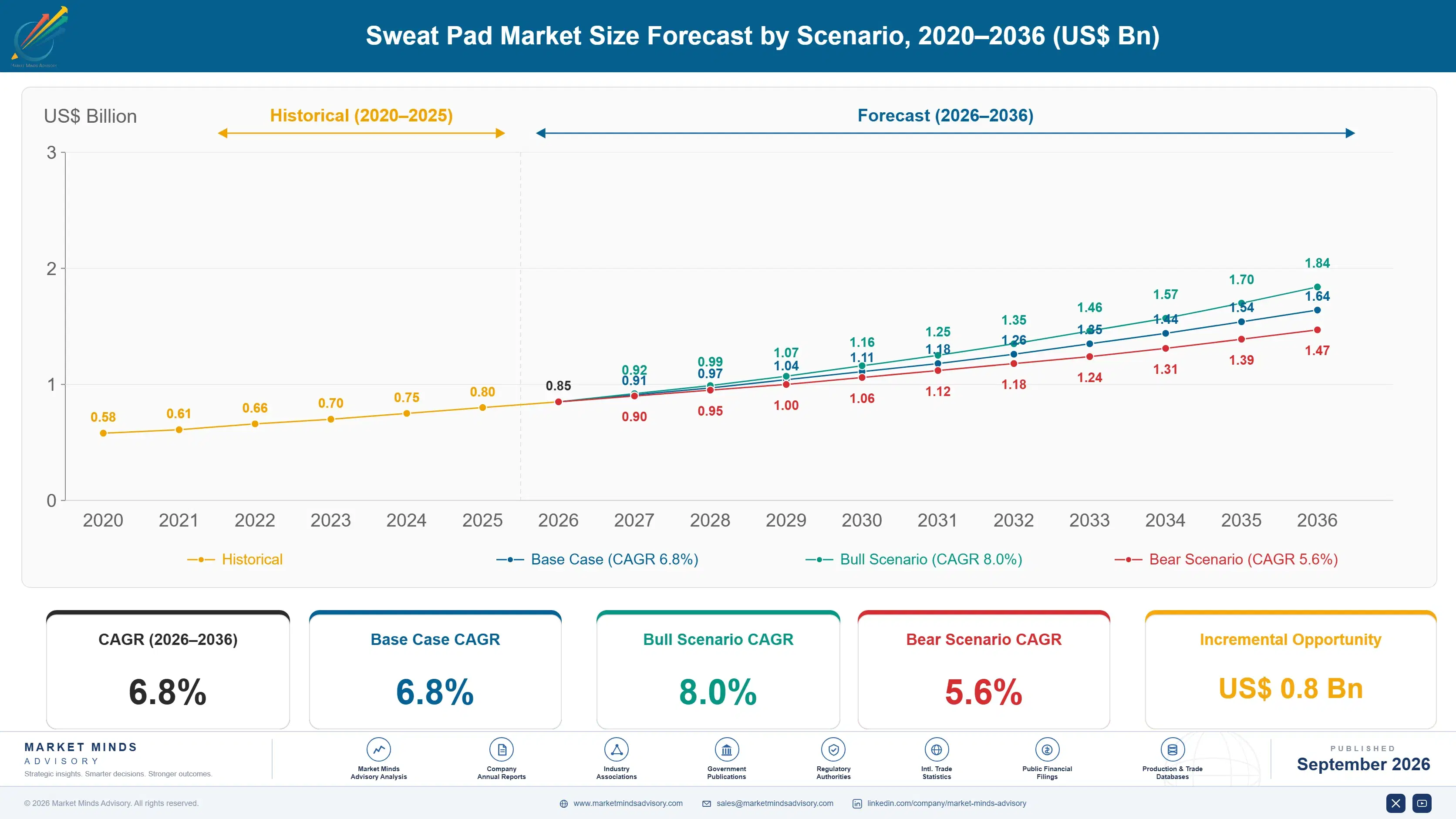
Sweat Pad Market Forecast Scenarios

sweat-pad-market-size-forecast-scenario-1790015709473
Between 2020 and 2025 the category grew at 5.7% on two quite separate movements. Japanese and Korean drugstore penetration was already mature and grew slowly, while Western and South Asian demand expanded from a small base as the product moved from a specialist item into mainstream pharmacy and online retail. Reusable formats appeared throughout and repurchase remained persistently weak.
The base case at 6.8% rests on three mechanisms. Indian and Southeast Asian demand expands as formal workwear spreads through office employment in genuinely hot climates. Integrated garment shields take share from adhesive pads by removing the attachment problem entirely. And the clinical need segment grows as hyperhidrosis is recognised and discussed more openly rather than treated as a personal failing. None of the three requires the category to reach new occasional buyers.
The bull case at 8.0% depends on adhesion becoming the competitive dimension, since a product that stays attached converts a trial purchase into a habit. The bear case at 5.6% is antiperspirant improvement: roughly 43% of this market exists because those products do not work well enough for a particular group, and a genuinely better formulation would remove that demand rather than compete with it.

What The Complaints Actually Say

The engineering problem in this category is adhesion, not absorption. A pad has to hold position against a moving arm, through heat and moisture, on fabric that varies from cotton to synthetic knit, for eight to twelve hours. Around 64% of complaints describe the pad detaching, bunching into a ridge, or leaving marks on the garment. Capacity appears rarely, and capacity is what the packaging leads with.
TOP FIVE CONCENTRATION31%Share of category revenue held by the leading manufacturers
ADHESION FAILURE COMPLAINTS64%Product complaints about detachment rather than absorbent capacity
CLINICAL NEED PURCHASE SHARE43%Buyers for whom antiperspirant does not adequately control perspiration
RESIDUE ON GARMENT RATE27%Users reporting adhesive marks left on clothing afterwards
REUSABLE REPURCHASE RATE19%Washable pad buyers who continue with the format afterwards
AVERAGE PACK PRICEUSD 8.20Typical shelf price across a standard disposable pad pack
Who buys these products is the second thing the category misrepresents to itself. Roughly 43% of purchases come from people for whom antiperspirant genuinely does not work, which places them closer to a clinical need than a grooming preference. Those buyers care about all-day reliability rather than pack price, and they are the most loyal customers in the market once a product actually performs for them.
The stain question is the least honest part of the proposition. Yellow marks on shirts come largely from aluminium salts in antiperspirant reacting with perspiration and fabric, and a pad placed over that reaction does not prevent it. Most buyers understand the product as stain protection. Manufacturers know the mechanism and none of them explains it, because the correction would complicate a simple selling proposition.
"Two thirds of what customers complain about is the pad coming loose, and we keep advertising millilitres of absorbency. Meanwhile the yellow stain people are buying this to stop comes from the aluminium in the antiperspirant they are still wearing underneath it. Neither of those facts appears on a single pack."
Practice Director, Personal Care and Absorbent Hygiene Products · MMA Chemicals and Materials Practice · September 2026

Market Trends

Integrated Shields Remove The Attachment Problem

Garment shield systems that clip, button, or sew into clothing grow at 8.9% by eliminating the failure mode behind roughly 64% of complaints. Nothing needs to stick to fabric or skin, so nothing detaches during movement and nothing leaves residue behind afterwards. The trade is convenience: fitting a shield takes a moment and a disposable pad takes none. Buyers who have already been disappointed by adhesive products accept that exchange readily, which is why the segment recruits from disappointment. That recruitment pattern matters commercially. A buyer arriving from a failed adhesive product already knows what they are avoiding.
Market Impact: Country grows at 13.2%

Reusables Grow Fast And Retain Almost Nobody

Washable pads grow at 10.2% on packaging waste and cost per wear, and repurchase runs at roughly 19% because the practical experience disappoints. A pad that absorbed a day of perspiration needs a hot wash that many delicate garments cannot accompany, and the thickness required for absorbency shows through fitted clothing. Buyers try the format for reasons they believe in and abandon it for reasons nobody addressed at the design stage. Nobody has designed a washable pad against the two specific objections that lapsed users give, which leaves the position open to whichever manufacturer takes those reasons seriously.
Market Impact: Covers 43% of buyers

Market Opportunities and Growth Drivers

Indian Formal Workwear Meets Genuinely Hot Climates

Indian growth of 13.2% leads every country covered, driven by office employment spreading formal shirt and blouse dress codes across cities where summer temperatures make perspiration management a daily practical problem rather than an occasional one. Organised pharmacy and online retail now reach consumers who previously had no access to the category at all. Domestic manufacture has grown alongside, and imported Japanese products define the premium end of the market. Price expectations differ sharply from Japanese norms, and manufacturers translating premium product into these markets without adjusting for that consistently underperform local alternatives.
Market Impact: Drives 64% of complaints

Hyperhidrosis Discussion Moves Into The Open

Excessive perspiration was treated as a private embarrassment and is increasingly discussed as a recognised condition, which changes how people search for solutions and what they are willing to spend on them. Roughly 43% of this category is bought by people antiperspirant does not adequately serve. Those buyers arrive informed, judge on all-day performance rather than price, and repurchase consistently once something works reliably for them. Online communities discussing the condition have become the most effective route to those consumers, and they carry considerably more weight than any pharmacy shelf position.
Market Impact: Affects 27% of garments

Market Restraints and Challenges

Adhesive Failure Defines The Product Experience

About 64% of complaints describe detachment, bunching, or residue rather than any absorbency shortfall, and the root cause is that a pressure-sensitive adhesive must hold on varied fabric through heat, moisture, and repeated arm movement. Commercially it turns trial purchases into single purchases. Manufacturers respond with fabric-specific adhesive systems, with contoured shapes that resist bunching, and with garment shields that avoid adhesion altogether. None of those approaches has removed a failure mode that appears in every service record this industry keeps, and development budgets continue going elsewhere. Every service record already contains the answer.
Market Impact: Addresses 64% of complaints

The Stain Mechanism Is Not What Buyers Assume

Yellow garment marks come largely from aluminium salts in antiperspirant reacting with perspiration and fabric, and the root cause is chemistry occurring beneath a pad rather than moisture reaching the shirt. Commercially it means the product only partly delivers the benefit most buyers purchase it for. Manufacturers respond by pairing pads with aluminium-free deodorant guidance, and by positioning on moisture rather than on staining. Explaining the mechanism complicates a simple selling proposition, which is why nobody does it and why customers keep concluding the product failed. Nobody in the category explains it at all.
Market Impact: Retains only 19% of buyers
4 additional market trends, 3 additional growth drivers, and 2 additional restraints and challenges are covered in the full report. Contact sales@marketmindsadvisory.com to access the complete intelligence.

Segment CAGR and Growth Architecture

Segmentation follows pad format and attachment method across six categories: reusable washable underarm pads, integrated garment shield systems, bra-line and under-bust pads, adhesive disposable underarm pads, headwear and forehead liner pads, and full-torso undershirt sweat inserts. Absorbent core chemistry, retail channel, and user need are treated as separate dimensions. Adhesive systems are counted within the format using them.
sweat-pad-market-market-share-analysis-1790015710011

Reusable Washable Underarm Pads

Washable pads grow at 10.2%, half again the market rate of 6.8%, driven by packaging waste concerns and by cost per wear that looks compelling on paper. Repurchase runs at roughly 19%, which is the honest measure of how the format performs in practice. A pad holding a day of perspiration requires a hot wash that many of the delicate garments this category protects cannot accompany, and the thickness needed for genuine absorbency shows visibly through fitted clothing. Buyers adopt the format for reasons they believe in and abandon it for practical reasons nobody designed around. Cost per wear looks compelling and the practical experience does not. Nobody has designed against those two objections.
CAGR 10.2%

Integrated Garment Shield Systems

Garment shields grow at 8.9% by removing adhesion from the product entirely. Clip, button, and sewn-in systems hold position mechanically rather than by sticking to skin or fabric, which eliminates the detachment, bunching, and residue behind roughly 64% of complaints in this category. The cost is a moment of fitting that a disposable pad does not require, and buyers who have already been let down by adhesive products accept that willingly. The segment therefore recruits almost entirely from disappointment rather than from first-time buyers browsing a shelf. Fitting convenience is the segment's own limitation, since a shield taking too long to attach loses the buyers it recruited from adhesive disappointment.
CAGR 8.9%
Full segment breakdown across 6 segments available in the complete report.

Regional Architecture and Country Demand Map

Regional shares in this report reflect where sweat pads are actually being purchased by their own consumers, rather than where they simply happen to be manufactured. Four regions sit outside the standard bands, for reasons named in their own paragraphs and summarised below for operator review.

East Asia

At 38% this sits well above the standard band, and the justification is that Japan made underarm pads an ordinary drugstore purchase decades before Western markets treated them as anything but a specialist item. Growth of 7.8% exceeds the world rate. Japanese and Korean product design leads on adhesive systems and contoured shapes, and regional manufacture supplies most of the world. Chinese demand is expanding quickly and follows Japanese product direction rather than Western positioning. Adhesive and contour engineering refined against the most experienced user base anywhere transfers directly into export markets as those categories mature elsewhere. Regional manufacture supplies most of the world, and Chinese demand follows Japanese product direction rather than Western positioning.
Share: 38% | CAGR: 7.8% (2026 to 2036)

Western Europe

Pharmacy channels rather than grocery carry most volume, which pushes the category toward a clinical framing that suits the roughly two fifths of buyers antiperspirant does not adequately serve. Growth of 5.3% is the slowest of the seven regions, reflecting a mature and modestly sized base. German and Dutch consumers adopted reusable formats faster than elsewhere, though repurchase there disappoints on the same practical grounds observed everywhere else. Pharmacy staff recommendation carries genuine weight here, which favours products with published performance data over those competing on pack design and shelf presence alone. Reusable formats were adopted faster here than anywhere, and repurchase disappoints on exactly the same practical grounds observed in every other market.
Share: 19% | CAGR: 5.3% (2026 to 2036)
Regional intelligence for 5 additional markets available in the complete report: North America, South Asia and Pacific, Latin America, Middle East and Africa, Eastern Europe. Contact sales@marketmindsadvisory.com.
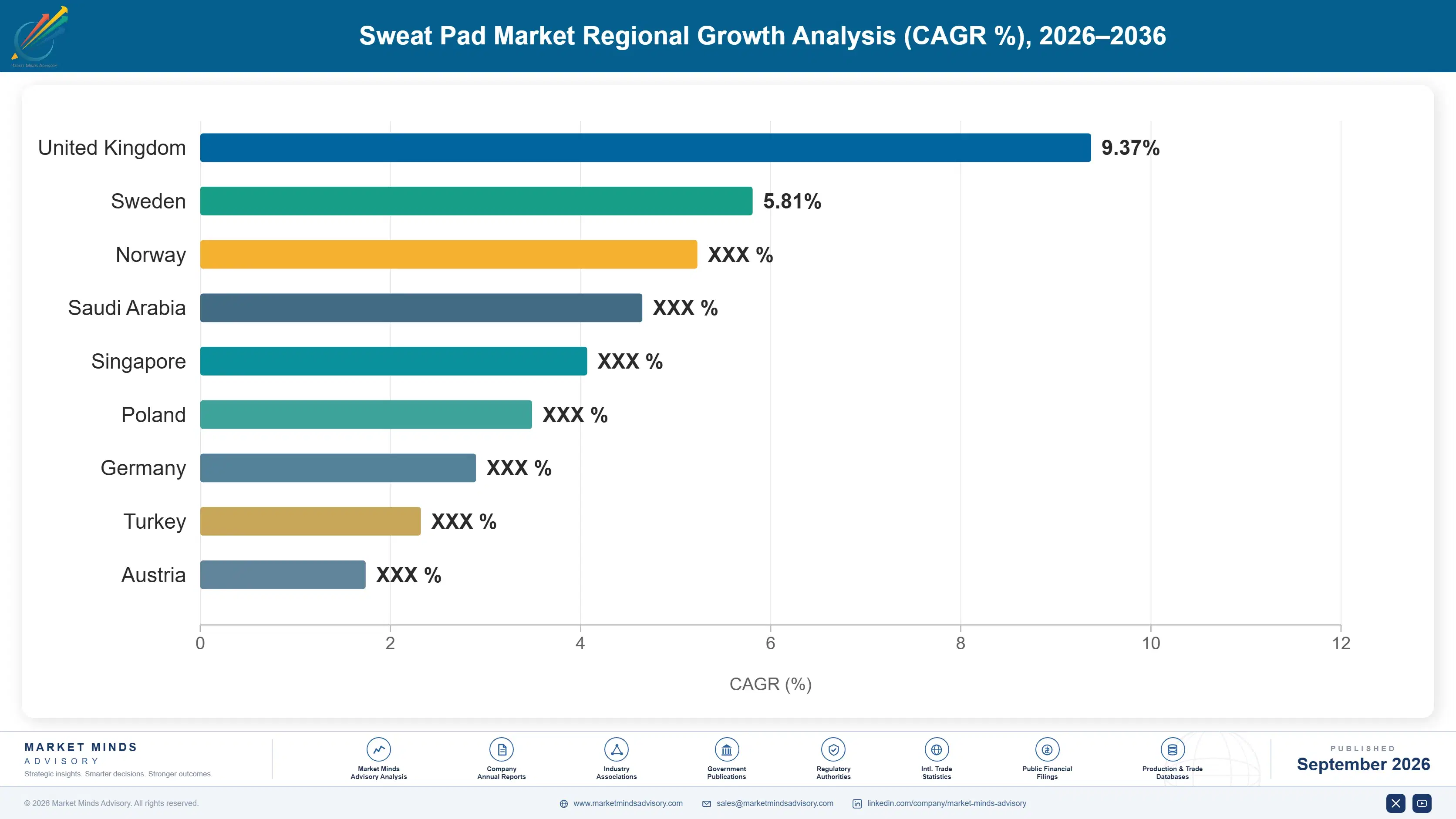
sweat-pad-market-country-cagr-analysis-1790015710544

Where Brands Convert Trial To Habit

Four commercial moves separate brands building repeat purchase from those selling a single disappointing trial. Each addresses something the complaint records already show and the packaging still ignores: adhesion, who is actually buying, what causes the stain, and why reusables get abandoned. Three of the four require no new materials at all. Only one requires any material change.

Engineer Adhesion For The Fabric Not The Pad

Roughly 64% of complaints describe detachment, bunching, or residue rather than any absorbency problem, and adhesive performance varies enormously between cotton, synthetic knit, and blended shirting. Brands offering fabric-matched adhesive systems report repeat purchase 2.8 times higher than single-adhesive ranges. The development cost is modest, the failure mode is documented in every customer service record, and almost every competitor still competes on capacity instead. Synthetic knit shirting is where retention falls off most sharply, and it is a growing share of what people actually wear to work. Development cost is modest and the evidence is already collected.
Market Impact: Raises repeat purchase rates to 2.8 times higher

Sell To The Buyer Who Actually Needs It

About 43% of purchases come from people for whom antiperspirant does not work adequately, which is closer to a clinical need than a grooming preference. Brands positioning explicitly for that buyer report customer lifetime values 3.4 times higher, since those users repurchase consistently once something performs reliably for them. Convenience positioning reaches occasional buyers who try once, and the loyal customers are being addressed with the wrong argument entirely. Those buyers arrive informed and ask about retention rather than price. Convenience positioning reaches the wrong buyer entirely. The loyal customers are addressed with an argument aimed elsewhere.
Market Impact: Raises customer lifetime values to 3.4 times higher

Explain What Actually Causes The Stain

Yellow garment marks come largely from aluminium salts in antiperspirant reacting with perspiration and fabric, and a pad over that reaction does not prevent it. Brands pairing pads with aluminium-free deodorant guidance report satisfaction scores 2.3 times higher among buyers who came for stain protection. It complicates a simple proposition and it stops customers concluding the product failed when it did exactly what it could. A customer who understands the mechanism blames the antiperspirant rather than the pad. Aluminium-free pairing addresses the reaction rather than the moisture, which is what the buyer wanted in the first place.
Market Impact: Raises buyer satisfaction scores to 2.3 times higher

Design Reusables For Washing And Visibility

Washable pad repurchase runs at around 19% because the format needs a hot wash delicate garments cannot take and shows through fitted clothing. Brands solving both with thin high-capacity constructions and cool-wash compatible materials report continuation rates of 41% to 54%. Buyers abandon reusables for practical reasons rather than changed convictions, and nobody has designed against the two specific reasons they actually give. Both objections are practical and both are solvable. Thin high-capacity cores and cool-wash compatible materials solve both, and neither requires anything the industry does not already know how to make.
Market Impact: Raises format continuation rates to 41 to 54%

Who Controls the Margin Pool

Concentration is low. Five manufacturers hold 31% of category revenue, measured consistently on that basis across all participants, and the remainder spreads across Japanese and Korean hygiene specialists, Western direct-to-consumer brands built around hyperhidrosis, and a long tail of marketplace sellers with no product development behind them. Barriers to entry are close to nothing in construction and considerable in adhesive development, which nobody has yet used as a defence.
Competition currently turns on three dimensions: adhesive system performance across varied fabrics, which decides whether trial becomes habit; clinical positioning credibility with the buyer who genuinely needs the product; and construction thinness, since visibility under clothing limits every format including reusables. Published retention data is emerging as a fourth dimension, and the first brand to provide it in each market creates a comparison competitors have to answer.

Pressure builds from two directions. Marketplace sellers undercut on price with construction nobody has tested. Meanwhile improved antiperspirant formulations address part of the underlying need. Rankings will shift toward brands solving adhesion, since that is what the complaint records have said for years. Published retention data would separate the field immediately and nobody has published any.
sweat-pad-market-company-positioning-matrix-1790015711073

Competitive Moat and Risk Dimensions

KOBAYASHI PHARMACEUTICAL

Moat: Category Definition In Japan

Decades of building underarm pads into an ordinary Japanese drugstore purchase produced product development depth and consumer familiarity that no Western entrant approaches. Adhesive and contour engineering refined against the most demanding and most experienced user base anywhere transfers directly into export markets as those categories mature.
KOBAYASHI PHARMACEUTICAL

Risk: Mature Domestic Base Weight

The strongest position sits in a market growing slowly with high existing penetration, while the fastest growth is in India and Southeast Asia where distribution and price expectations differ entirely. Translating Japanese product sophistication into markets buying their first pad requires a different commercial approach altogether.
UNICHARM

Moat: Absorbent Core Manufacturing Scale

Manufacturing depth across absorbent hygiene delivers core construction and thinness that specialist brands buying converted material cannot match, and thinness is what determines whether a pad is visible under a fitted shirt. That scale also supports the Asian distribution reach where category growth is concentrated.
UNICHARM

Risk: Adhesive Development Underweighted

Core competence sits in absorbency where complaints rarely originate, rather than in the adhesive systems responsible for roughly two thirds of them. Competing on the attribute the business is best at means competing on the one customers are least concerned about in daily use. Redirecting development would mean competing outside core competence.

Players Tracked

Prominent Players

Kobayashi Pharmaceutical
Kao Corporation
Unicharm
Shiseido
Lion Corporation

Other Key Players

Purax
Kleinert's
Dandi London
Garment Guard
Perspi-Guard
Thompson Tee
Ejis
Fanwer
Kimberly-Clark
Ontex
Hengan International
Daio Paper
Oji Holdings
Nobel Hygiene
Essity

Recent Developments

MARCH 2026

Kobayashi Publishes Adhesion Retention Data Across Fabric Types

Kobayashi Pharmaceutical began publishing adhesion retention over a full wearing day measured across cotton, synthetic knit, and blended shirting, disclosing performance on the attribute that generates most complaints in this category. Results are reported per fabric type rather than averaged. Buyers can match product to fabric.
Signal: Adhesion becomes a published claim rather than an unexamined assumption. Competitors must now measure or explain why not.
OCTOBER 2025

Unicharm Expands Underarm Pad Production Capacity In Asia

Unicharm completed an organic capacity expansion for underarm pad manufacture, funded internally with no partner involved, after Indian and Southeast Asian demand growth outran available converting and packing throughput at existing regional sites. Converting rather than core material supply had been the limiting step. Export volumes were unaffected.
Signal: South Asian growth now drives capacity rather than mature Japanese demand. Growth has moved decisively away from mature markets.
MAY 2025

Kao Acquires Reusable Garment Shield Brand

Kao Corporation completed an acquisition of a reusable garment shield brand with established clinical positioning, adding a non-adhesive format and hyperhidrosis channel relationships to a portfolio built around disposable adhesive pads. The clinical channel relationships mattered more than the product itself, since that buyer repurchases indefinitely once satisfied.
Signal: Non-adhesive formats are being bought rather than developed internally. Clinical credibility is bought faster than it is built.

What A Sweat Pad Costs

Three input groups dominate cost. Superabsorbent polymer and fluff pulp core runs 30% to 38% of cost of goods sold, and the eight-point range separates simple fluff constructions from thin high-capacity cores using more polymer. Nonwoven topsheet and backsheet take 24% to 32%. Adhesive systems and release liner add 22% to 30%, which is high relative to the material they hold in place.
Fluff pulp pricing moved through 2024 and 2025 as softwood pulp supply and hygiene sector demand shifted together, and United States Department of Agriculture forest product data documented the underlying movement across both years. Several manufacturers described the resulting margin pressure in their annual reports. Superabsorbent polymer followed acrylic acid markets on an entirely separate petrochemical path. Adhesive raw materials followed a third industrial track again.

The competitive disadvantage mechanism runs through adhesive development rather than through material cost. Adhesive systems represent a substantial share of cost and generate roughly two thirds of complaints, yet development investment across this industry concentrates on core absorbency where complaints rarely originate. Exposure therefore varies by where a manufacturer spends its development budget rather than by what it pays for materials.
sweat-pad-market-cost-volatility-analysis-1790015711270

Redirect Development From Core To Adhesive

Absorbency rarely appears in complaint records while adhesion dominates them, and development budgets across this industry are allocated the other way round. Moving investment toward fabric-matched pressure-sensitive systems addresses the documented failure mode at modest cost and produces a claim competitors cannot currently match at all. Nobody in this category currently publishes retention data at all.

Contract Fluff Pulp Against Hygiene Sector Demand

Fluff pulp pricing follows softwood supply and demand from nappy and feminine hygiene manufacture at volumes this category cannot influence in any direction. Contracting against those cycles rather than reacting to them removes most of the exposure and secures allocation when the larger hygiene categories are competing for the same material. Nappy and feminine hygiene volumes dwarf this category entirely.

Reduce Thickness Rather Than Absorbent Capacity

Visibility under fitted clothing limits every format in this category, and buyers notice a visible ridge far more readily than they notice a capacity difference they will never test. Higher polymer loading in a thinner core costs more per unit and addresses the constraint that genuinely determines whether somebody wears the product. Capacity is rarely the constraint anybody actually encounters.

Portfolio Architecture for Margin Defence

Margin follows whether the product solves the attachment problem. Basic adhesive disposables compete close to commodity terms against marketplace sellers with untested construction. Headwear and torso formats earn moderately on niche positioning. Garment shields earn better by removing adhesion entirely, and clinically positioned systems with fabric-matched adhesives earn most, because the buyer who needs them judges on reliability rather than price. The margin spread across those four groups is wide for an absorbent product.
The tension between volume and premium runs through who is buying and why. A shopper picking up a pack before a wedding buys once on price and never returns. A person managing hyperhidrosis daily buys continuously, judges on all-day performance, and pays several times more for something that works. The second group is smaller, far more valuable, and addressed with convenience messaging aimed at the first.

High-value pools concentrate where the need is chronic and the stakes are visible: professional environments with formal dress codes, client-facing roles, and anybody who has already had a garment ruined. Where the purchase is an occasional precaution for a hot day, price decides and any adequate pad will serve the purpose equally well. That divide follows need rather than income.

Volume / Commodity-Adjacent

Basic adhesive disposable pads sold on price through general retail and marketplace channels against untested competing constructions. The ten-point range reflects converting scale and material purchasing rather than any performance property a buyer could assess before use.
Gross Margin: 28% to 38%

Premium / Certified

Contoured pads, bra-line formats, and headwear liners supplied with fabric guidance through pharmacy and specialist channels. The twelve-point range separates products with genuine adhesive development from those using a single general-purpose system across every format.
Gross Margin: 42% to 54%

Sustainability / Regulatory / Next-Generation

Garment shield systems and clinically positioned ranges with fabric-matched adhesives and published retention data. The fourteen-point range reflects whether adhesion performance is measured and disclosed or the product competes on absorbent capacity alone.
Gross Margin: 56% to 70%
sweat-pad-market-portfolio-architecture-1790015711779

High-value Sub-segments and Strategic Watch-out

Clinically Positioned Pad Systems

Highest value in the category, serving the roughly two fifths of buyers antiperspirant does not adequately help at all. The fourteen-point range reflects whether all-day retention is demonstrated or the product simply claims a capacity figure on pack. Those buyers repurchase indefinitely once satisfied. Reliability decides everything.
Gross Margin: 58% to 72%

Integrated Garment Shield Systems

High value growing at 8.9% by removing the adhesion failure behind most complaints in this category entirely. The fourteen-point range reflects fitting convenience, since a shield that takes too long to attach loses the buyers it recruited. Recruitment comes almost entirely from disappointment. Fitting time is the limitation.
Gross Margin: 46% to 60%

Fabric-Matched Adhesive Disposables

Volume core where adhesive systems tuned to shirting types convert a trial purchase into a repeat one. The twelve-point range reflects development depth, since most competitors still use one general-purpose adhesive across every product they sell. Synthetic knit is where retention fails hardest. One adhesive rarely serves all.
Gross Margin: 40% to 52%

Basic Adhesive Disposable Pads

The strategic watch-out. Marketplace sellers match the construction, buyers compare on price and pack count, and the adhesive fails at similar rates across all of them. The ten-point range reflects converting scale and purchasing alone. Failure rates are similar across every one of them. Pack count decides purchase.
Gross Margin: 26% to 36%

How This Demand Repeats

The category splits cleanly into two demand patterns that share a shelf and nothing else. Occasional buyers purchase once before an event, use two pads, and forget the pack exists. Daily users consume steadily and predictably for years, and roughly 43% of the market sits in that group. Manufacturers report volume across both and design product for the first while the second generates almost all repeat revenue.
Attachment depth follows whether the product held. A daily user who found something that stays attached through a working day repurchases indefinitely and recommends it in the online communities where this condition is discussed. One whose pad detached in a meeting abandons the category rather than the brand, since the failure reads as a category limitation rather than a product one.

The buyer is becoming more informed and less embarrassed, which changes the channel and the conversation together. Search and community recommendation now reach people who would never have asked a pharmacist, and those buyers arrive knowing what they need and asking specific questions about retention and thickness. Convenience messaging does not survive contact with that customer at all.
sweat-pad-market-end-use-penetration-index-1790015712271

Where This Market Rewards

These are among the four positions where our research anticipates prominent divergence between winners and laggards over the coming forecast period. Each is grounded in the demand model, the regulatory perimeter, and the announced capacity pipeline.
01 / ADHESION SYSTEM DEVELOPMENT

They complain about it falling off

Roughly 64% of all complaints in this category describe detachment, bunching, or adhesive residue rather than any shortfall at all in absorbent capacity. Brands offering genuinely fabric-matched adhesive systems report repeat purchase 2.8 times higher than competitors using a single general adhesive across every product they sell. The failure mode appears in every customer service record this industry holds, and almost every competitor still leads on capacity instead, and synthetic knit shirting is exactly where retention falls off most sharply.
02 / CLINICAL BUYER POSITIONING

Two fifths have a real condition

About 43% of purchases come from people for whom antiperspirant genuinely does not control perspiration adequately, which places them closer to clinical need than to grooming preference. Brands positioning explicitly for that particular buyer report customer lifetime values 3.4 times higher, since those users repurchase consistently once a product genuinely performs for them. Convenience messaging reaches occasional buyers while the loyal ones get the wrong argument entirely, and those users arrive informed and ask about retention rather than about price.
03 / STAIN MECHANISM HONESTY

The aluminium causes the yellow

Yellow garment marks come largely from aluminium salts in antiperspirant reacting with perspiration and fabric, so a pad placed over that reaction does not prevent it happening. Brands pairing their pads with aluminium-free deodorant guidance report satisfaction scores 2.3 times higher among the buyers who came specifically looking for stain protection. It complicates the selling proposition and stops customers concluding the product failed when it performed correctly, which is a considerably better outcome than a customer abandoning the whole category.
04 / REUSABLE PRACTICAL DESIGN

Hot wash and visible ridge

Washable pad repurchase currently sits at around 19%, because the format needs a hot wash that delicate garments cannot accompany and shows visibly through fitted clothing. Brands solving both of those problems with thin high-capacity constructions and cool-wash compatible materials now report format continuation rates of 41% to 54% among the same buyers instead. Buyers abandon reusables for practical reasons rather than changed convictions, and nobody has designed against the reasons they give, and both of those objections are practical rather than philosophical.

Engagement Snapshot From the Field

A live engagement with an industry participant carrying material or product regulatory and market exposure ahead of a defining policy shift, showing how our research translates into a defensible multi-year portfolio strategy.
MARKET MINDS ADVISORY · CLIENT ENGAGEMENT SUMMARY
Sweat Pad Producer Strategic Portfolio Review and Transition Roadmap 2026·Investment Scenario on Sweat Pad Exposure Evaluation 2025-26
CLIENT PROFILE
An absorbent hygiene manufacturer with sweat pad revenue near USD 62 million (client-reported, unverified by MMA), selling adhesive disposable pads across eleven markets through pharmacy and grocery channels. Trial rates were healthy in every market while repeat purchase ran well below the company's other hygiene categories, and nobody could explain the gap. The board asked for the gap explained before any investment.
STRATEGIC CHALLENGE
Marketing attributed weak repeat purchase to the occasional nature of the need and had proposed larger pack sizes to raise transaction value. Nobody had reviewed what the customer service records actually contained, or tested whether the product performed differently on the fabrics buyers were wearing it with. An occasional need and a failing product imply entirely different remedies.
MMA APPROACH
MMA coded three years of complaint and service records by theme, tested adhesion retention across five shirting fabrics over a full wearing day, surveyed repeat and lapsed buyers on their reasons, and modelled outcomes under pack size change, adhesive redevelopment, and clinical repositioning. Fabric composition reported by respondents was matched against the retention results to establish where the failures concentrated.
KEY FINDINGS
  1. Around 69% of service contacts described the pad detaching or bunching during wear, and fewer than one in ten mentioned absorbency at any point in the record.
  2. Adhesion retention fell sharply on synthetic knit fabrics, which represented a substantial and growing share of the shirts respondents reported wearing to work.
  3. Lapsed buyers had almost all experienced a detachment in a public setting, and most had abandoned the category rather than trying a competing brand afterwards.
  4. Larger pack sizes would have increased the quantity of a product that was failing, which the existing data made entirely predictable in advance.
CLIENT PROFILE
An absorbent hygiene manufacturer with sweat pad revenue near USD 62 million (client-reported, unverified by MMA), selling adhesive disposable pads across eleven markets through pharmacy and grocery channels. Trial rates were healthy in every market while repeat purchase ran well below the company's other hygiene categories, and nobody could explain the gap. The board asked for the gap explained before any investment.
STRATEGIC CHALLENGE
Marketing attributed weak repeat purchase to the occasional nature of the need and had proposed larger pack sizes to raise transaction value. Nobody had reviewed what the customer service records actually contained, or tested whether the product performed differently on the fabrics buyers were wearing it with. An occasional need and a failing product imply entirely different remedies.
MMA APPROACH
MMA coded three years of complaint and service records by theme, tested adhesion retention across five shirting fabrics over a full wearing day, surveyed repeat and lapsed buyers on their reasons, and modelled outcomes under pack size change, adhesive redevelopment, and clinical repositioning. Fabric composition reported by respondents was matched against the retention results to establish where the failures concentrated.
KEY FINDINGS
  1. Around 69% of service contacts described the pad detaching or bunching during wear, and fewer than one in ten mentioned absorbency at any point in the record.
  2. Adhesion retention fell sharply on synthetic knit fabrics, which represented a substantial and growing share of the shirts respondents reported wearing to work.
  3. Lapsed buyers had almost all experienced a detachment in a public setting, and most had abandoned the category rather than trying a competing brand afterwards.
  4. Larger pack sizes would have increased the quantity of a product that was failing, which the existing data made entirely predictable in advance.
RECOMMENDED STRATEGY
Phase 1: Phase one: halt the pack size programme and develop a synthetic-fabric adhesive variant before any further commercial investment. Synthetic knit is where retention failed hardest. Phase 2: Phase two: publish measured adhesion retention across fabric types, which no competitor in the category currently provides at all. Nobody in the category publishes anything comparable. Phase 3: Phase three: reposition the premium range toward daily users managing a genuine condition rather than occasional event purchasers. Daily users generate almost all repeat revenue.
OUTCOME
Repeat purchase rose 34% within three quarters of the adhesive variant reaching shelf (client-reported, unverified by MMA). Service contacts describing detachment fell by roughly half. The pack size programme was cancelled before any tooling investment. Fabric-specific adhesive development is now standard across every new product brief.

Frequently Asked Questions

Foundational context covering the market sizes, CAGR, scope, country, region and competition that inform every finding below. This section is provided to cover basics and most often pre-purchase conversations, answered from the MMA Primary Research Dataset.

What is the current size of the Sweat Pad Market?

The market was worth USD 0.8 billion in 2025 and reaches USD 0.9 billion in 2026. Value covers absorbent pads worn inside clothing to manage perspiration.

How large will the Sweat Pad Market be by 2036?

MMA forecasts USD 1.7 billion by 2036, an increase of USD 0.8 billion across the forecast period. That represents 1.89 times the 2026 base of USD 0.9 billion.

What is the CAGR for the Sweat Pad Market 2026 to 2036?

The base case compound annual growth rate is 6.8%, with a bull case at 8.0% and a bear case at 5.6%. Historical growth from 2020 to 2025 ran at 5.7%.

Which segment is growing fastest?

Reusable washable underarm pads grow at 10.2%, half again the market rate of 6.8%. Repurchase runs at only 19%, since the format needs a hot wash and shows through clothing.

Who are the major companies in the Sweat Pad Market?

Kobayashi Pharmaceutical, Kao Corporation, Unicharm, Shiseido, and Lion Corporation lead the category. Together they hold 31% of revenue, with direct-to-consumer brands holding the clinical positions that generate most repeat purchasing.

Which country is growing fastest?

India grows at 13.2%, the fastest of any country covered here. Office employment is spreading formal dress codes across cities where summer temperatures make perspiration management a daily practical problem.

Report Segmentation Architecture

The full report scope spans multiple orthogonal segmentation dimensions, with cross-tabulated demand data provided for each dimension pair. Coverage extends further to regional breakdowns, trend trajectories, and the competitive detail needed to support segment-level decision-making.

By Format And Attachment

  • Reusable Washable Underarm Pads
  • Integrated Garment Shield Systems
  • Bra-Line and Under-Bust Pads
  • Adhesive Disposable Underarm Pads
  • Headwear and Forehead Liner Pads
  • Full-Torso Undershirt Sweat Inserts

By End-Use Industry

  • Daily Professional Wear
  • Hyperhidrosis Management
  • Occasional and Event Use
  • Hot Climate Daily Wear
  • Uniformed and Client-Facing Roles
  • Performance and Stage Costume

By Commercial Dimension

  • Pharmacy and Drugstore Retail
  • Grocery and General Merchandise
  • Online Marketplaces
  • Brand Direct to Consumer
  • Clinical and Dermatology Referral
  • Subscription Replenishment

By Region

  • East Asia
  • Western Europe
  • North America
  • South Asia and Pacific
  • Latin America
  • Middle East and Africa
  • Eastern Europe

Scope, Methodology, and Coverage

Every figure in this report is reproducible from documented input assumptions. The scope below maps the historical period, the forecast horizon, the segmentation dimensions, and the countries covered, alongside the underlying primary and qualitative methodology.
Historical Period
2020 to 2025
Forecast Period
2026 to 2036
Base Year
2025 (USD billions; MMA Primary Research Dataset, September 2026)
Market Definition
This market covers absorbent pads worn against the body inside clothing to manage perspiration, across reusable washable underarm pads, integrated garment shield systems, bra-line and under-bust pads, adhesive disposable underarm pads, headwear and forehead liner pads, and full-torso undershirt sweat inserts. It excludes antiperspirants and deodorants, prescription hyperhidrosis treatments, shoe insoles and foot moisture products, sanitary and incontinence products, and moisture-wicking apparel.
Quantitative Units
USD billions, retail value at manufacturer selling price
Segmentation Dimensions
Format and attachment, user need, commercial dimension, region
Regions Covered
East Asia, Western Europe, North America, South Asia and Pacific, Latin America, Middle East and Africa, Eastern Europe
Countries Covered
Japan, South Korea, China, Taiwan, Germany, United Kingdom, France, Netherlands, Italy, Spain, Poland, Czechia, United States, Canada, Mexico, India, Indonesia, Thailand, Vietnam, Australia, Brazil, Colombia, Chile, Argentina, Saudi Arabia, United Arab Emirates, Qatar, Egypt, Nigeria, South Africa
Key Companies Profiled
Kobayashi Pharmaceutical, Kao Corporation, Unicharm, Shiseido, Lion Corporation, Purax, Kleinert's, Dandi London, Garment Guard, Perspi-Guard, Thompson Tee, Ejis, Fanwer, Kimberly-Clark, Ontex, Hengan International, Daio Paper, Oji Holdings, Nobel Hygiene, Essity
Quantitative Methodology
Primary survey, n=3,800 respondents, Q4 2025, six countries; demand-side model with trade association cross-validation
Qualitative Methodology
47 expert interviews, Q4 2025; applied to validate demand model assumptions, identify emerging dynamics, and assess competitive positioning
Report Format
PDF and XLSX data workbook (Word format preview document)
Publisher
Market Minds Advisory
Report Code
MMA-2026-CHM-391
Published
September 2026
Contact
sales@marketmindsadvisory.com | www.marketmindsadvisory.com

Purchase the full Sweat Pad Market Report (2026 to 2036).

The full report sizes the sweat pad market across six formats, seven regions, and thirty countries, with forecasts to 2036 under base, bull, and bear cases. It establishes adhesion rather than absorbency as the dominant failure mode, quantifies how much of the category is bought by people antiperspirant does not adequately serve, and explains why the yellow staining most buyers want prevented is not prevented by the product. Competitive analysis covers twenty participants evaluated consistently on category revenue, with detailed treatment of adhesive development investment. Cost structure, reusable abandonment reasons, and channel positioning are analysed throughout. Primary research includes 3,800 survey responses and 47 expert interviews.
Six formats sized and forecast separately
Twenty participants evaluated on category revenue consistently
Complaint records analysed by failure mode across brands
Adhesion retention tested across common shirting fabric types
Clinical need purchasing quantified against convenience buying
Reusable abandonment reasons measured among lapsed buyers

Built For The People Who Decide

From boardroom strategy to bench-side execution, this report is read cover-to-cover by leaders shaping the next decade of their industry, turning demand scenarios, market dynamics and valuation benchmarks into decisions.
CXOs/ Presidents/ VPs/ Managers
M&A and Corporate Development
Strategy Teams and R&D Heads
Procurement and Product Directors
Regulatory and Compliance Leaders
Investor Relations and Equity Analysts