Market Minds Advisory
Suture Needles Market

Suture Needles Market: Point Geometry, Sharps Safety Mandates and the Precision Manufacturing Bottleneck

Nobody chooses a hospital supplier over needle geometry until a needle bends mid-anastomosis, which is why a two-dollar consumable is still made on grinding lines that take four years to qualify.

Lead Analyst

Alice Ballenger

Published

September 2026

Make Smarter Decisions with Customized Research Insights

Request a free sample report and evaluate market opportunities, growth trends, and competitive dynamics relevant to your business needs.

2025 MARKET VALUE$1.6BMarket Size 2025
2036 FORECAST VALUE$2.7BBase Case , 2026 to 2036
CAGR 2026 TO 20364.8 %Bull 6.0% / Bear 3.6%
INCREMENTAL OPPORTUNITY$1.0BNet 10- year value creation
EXPANSION MULTIPLE1.60x2036 value over 2026 base
Strategic Levers
M&A Pipeline
Regional Outlook
Country Rankings
Competitive Intelligence
Segmental Deep-dive
Call-Us : 91 93563 13602

Executive Snapshot and Market Trajectory

Everybody treats this as a commodity until something goes wrong. A needle that bends during a vascular anastomosis or loses its point mid-closure produces a surgical complaint that reaches purchasing within hours, and that failure mode is why the category never commoditised as far as its unit price suggests.
Spatula and ophthalmic micro-point needles compound at 7.2%, exactly 1.50 times the market, on cataract and retinal volume plus microsurgery that tolerates no point deformation. East Asia holds 29% of global spend, the largest share, combining Chinese procedure volume with Japanese precision grinding capacity. Needled suture units sell near USD 2.85 on hospital contract. Blunt point needles reach only 14% penetration. Conversion outside Western Europe has barely started, which is where the remaining upside sits.
Five manufacturers hold 63% of needle shipment volume, and the position rests on grinding and swaging capability rather than on brand. Japanese sites produce roughly 31% of world needle output, much of it supplied to companies whose labels appear on the package. Sharps injury prevention rules across Europe are steadily converting sharp points to blunt where tissue permits, which is the one regulatory force actually moving this market.
Market Definition
Covers surgical needles supplied for tissue closure, whether swaged to suture material as a needled unit or provided as standalone eyed needles, spanning taper, cutting, reverse cutting, blunt, taper-cut, spatula and trocar point geometries. Sizing is at hospital contract price for the needle component of needled units plus standalone needle revenue. Excludes suture material sold without a needle, surgical staplers and staples, tissue adhesives and sealants, skin closure strips, biopsy and injection needles, and needle holders or other reusable instruments.
Base Year Value
$1.6B in 2025 (MMA Primary Research Dataset, August 2026)
Forecast Period
2026 to 2036, eleven discrete annual values
CAGR
4.8% base case. Bull 6.0%. Bear 3.6%.
Fastest Growth Segment
Spatula and Ophthalmic Micro-Point Needles: 7.2% CAGR
Fastest Growth Country
India: 7.6% CAGR
Fastest Growth Region
South Asia and Pacific: 7.0% CAGR
Largest Region
East Asia: 29% of 2025 global value
Market Leaders
Ethicon, Medtronic, B Braun Melsungen, Mani, Advanced Medical Solutions. Source: MMA Analysis based on company annual reports.
Primary Survey
n=3,800 procurement and R&D decision-makers, Q4 2025, six countries
Methodology
Demand-side build-up, cross-validated against public data, 47 expert interviews

Suture Needles Market Forecast Scenarios

suture-needles-market-size-forecast-scenario-1787309392330
Growth of 3.8% across 2020 to 2025 tracked surgical volume with very little mix improvement. Elective procedure suspension during 2020 removed a block of demand and recovery restored it unchanged. Blunt-point conversion advanced slowly, driven by occupational safety regulation rather than surgeon preference. Indian and Chinese manufacturers took share across emerging markets and began qualifying for Western group contracts.
The base case of 4.6% rests on three mechanisms. Blunt-point conversion continues as occupational safety mandates widen and as institutions finally count the cost of a sharps exposure workup properly. Ophthalmic and microsurgical needle demand rises with cataract and retinal procedure volumes worldwide. And Asian and Indian surgical volumes grow faster than developed market volumes decline, with domestic manufacturers capturing most of that expansion at prices well below incumbent levels.
The bull case of 5.8% assumes blunt-point needles become mandatory for fascial closure in more health systems, which would convert a slow twenty-year adoption curve into a rapid substitution across a very large volume base. The bear case of 3.4% reflects two pressures: Indian and Chinese manufacturers winning Western group contracts on price and compressing category value, and stapler and adhesive closure taking share in specific procedure types.

Why Precision Still Commands a Price Here

A surgical needle is a piece of drawn alloy wire, ground to a point, curved to a radius and swaged to a thread. That sounds trivial, and the USD 2.85 unit price encourages the same conclusion. What it leaves out is that point tolerances are measured in microns, that the swage must hold a pull force the surgeon applies without thinking, and that a line grinding consistent points across millions of units takes years to qualify. The manufacturing is the moat.
TOP FIVE CONCENTRATION63%Needle shipment volume held by the leading manufacturers
NEEDLED SUTURE UNIT PRICEUSD 2.85Hospital contract price per single sterile packaged unit
JAPAN OUTPUT SHARE31%Global needle production from Japanese precision grinding sites
BLUNT NEEDLE PENETRATION14%Closure procedures now using non-sharp needle point geometry
ALLOY WIRE COST SHARE19%Surgical alloy wire within delivered product cost of goods
SWAGING YIELD RATE94%Needles passing attachment strength testing at first attempt
Commercially this sits in an awkward place. Hospitals procure closure products through group purchasing agreements on price, and needles arrive bundled inside needled suture units where the needle is invisible as a line item. Surgeons notice needles only when they fail, and then they notice immediately and vocally. Suppliers therefore compete on a quality attribute buyers do not price and users cannot ignore.
Two forces shape the next decade. Sharps injury prevention rules keep converting sharp points to blunt geometries where tissue allows, which is the only regulatory driver here and it improves mix. And barbed suture and mechanical closure keep taking specific procedures out of hand-sewn closure entirely, which subtracts volume nobody recovers.
"The needle is the only part of a needled suture unit that nobody negotiates and everybody notices. Purchasing buys the thread and the brand, the surgeon feels the point, and the manufacturer who can grind consistent points across forty million units a year quietly supplies half the companies competing with each other. That asymmetry has survived every attempt to commoditise this category."
Director, Surgical Consumables and Hospital Supply Practice · MMA Medical Device

Market Trends

Sharps injury rules convert sharp points to blunt geometries

European sharps injury prevention requirements obliged healthcare employers to eliminate avoidable sharps exposure where a safer alternative exists, and blunt point needles are exactly that alternative for fascial and abdominal wall closure. Adoption has moved from occupational health recommendation into hospital policy across most Western European systems. Penetration reaches 14% of closure procedures and continues rising. The commercial consequence is favourable, since blunt needles carry higher realised pricing than the cutting points they replace and the conversion is mandated rather than argued for at each institution. Conversion outside Europe has barely begun.
Market Impact: Adds 26% volume outside high-income

Microsurgical procedure growth shifts mix toward precision geometries

Cataract surgery volume rises with population age everywhere, and retinal, corneal and reconstructive microsurgery are growing faster than general surgical procedures across every region MMA tracks. Those procedures use spatula and micro-point needles ground to tolerances an order tighter than general closure requires, and they tolerate no point deformation at all. Spatula geometries compound at 7.2% against 4.8% for the category. Manufacturing capability rather than commercial position decides who supplies that growth, which is why Japanese grinding capacity is disproportionately represented in it. Several branded suppliers source these geometries rather than grinding them, a dependency rarely discussed openly.
Market Impact: Lifts European blunt conversion pas

Market Opportunities and Growth Drivers

Cataract surgery volume expansion lifts micro-point needle demand

Cataract procedures are already among the highest-volume operations performed anywhere, and volumes keep rising as populations age and as surgical capacity expands across China, India and Southeast Asia. Each procedure that requires suturing rather than a self-sealing incision consumes a spatula needle ground to microsurgical tolerance. WHO vision reporting keeps the untreated cataract backlog visible to health ministries, and national programmes addressing it add volume in bulk rather than incrementally. Roughly 26% of global cataract volume now sits outside high-income systems, and that share is growing steadily. National cataract programmes buy in bulk rather than incrementally.
Market Impact: Removes near 6 minutes closure time

Occupational health enforcement widens blunt needle mandates

Needlestick injuries during closure are among the most common occupational exposures in surgery, and European regulation now requires employers to eliminate them where practicable. Hospital occupational health functions have taken that requirement into procurement policy, which converts a clinical preference into a specification. Compliance auditing rather than persuasion drives adoption, so the conversion proceeds regardless of individual surgeon preference. Several Western European systems now require documented justification when a sharp point is used for fascial closure, and that documentation requirement is what actually moves the volume. Surgeon preference has lost that argument repeatedly.
Market Impact: Requires near 4 years line qualific

Market Restraints and Challenges

Barbed suture and mechanical closure displace hand-sewn procedures

Barbed suture removes the need for knot tying and has taken meaningful share in arthroplasty closure, hysterectomy and abdominoplasty, while mechanical staplers dominate bowel anastomosis where hand-sewing was once routine. The root cause is operating time: a closure that takes eight minutes instead of fourteen is worth real money to a theatre schedule. Each displaced procedure removes needle volume permanently. Manufacturers are responding by supplying the barbed products themselves, which still need needles, and by concentrating on procedures where hand-sewn closure remains clinically superior rather than merely traditional. Neither response recovers the volume.
Market Impact: Converts 14% of closure to blunt

Grinding line qualification blocks capacity response

A needle grinding line producing consistent point geometry across millions of units takes years to qualify, and the root cause is that point consistency depends on tooling wear characteristics learned empirically rather than specified. That means capacity cannot respond quickly to demand shifts, and a supplier losing a contract cannot redeploy the line easily. It also means new entrants struggle to match specialist geometries regardless of capital. Participants manage it by contracting Japanese and European specialist output rather than building capability, which concentrates supply further. Concentration is the direct consequence of that qualification barrier.
Market Impact: Grows spatula geometries at 7.2% ye
3 additional market trends, 4 additional growth drivers, and 2 additional restraints and challenges are covered in the full report. Contact sales@marketmindsadvisory.com to access the complete intelligence.

Segment CAGR and Growth Architecture

Segmentation follows needle point and body geometry, because geometry determines which tissue the needle is indicated for, which manufacturing tolerance it demands and what price it commands. Suture material, procedure and procurement route all matter commercially but cut across every geometry, so they belong in later discussion instead. Six geometries cover the category cleanly without overlap.
suture-needles-market-market-share-analysis-1787309392863

Spatula and Ophthalmic Micro-Point Needles

Flat-profile spatula needles and micro-point geometries for ophthalmic and microsurgical closure grow at 7.2%, exactly 1.50 times the market rate. Two things drive it. Cataract, retinal and corneal procedure volume rises faster than general surgery in every region, and reconstructive microsurgery keeps expanding as technique spreads beyond specialist centres. The commercial characteristic that matters is manufacturing tolerance: these geometries are ground an order tighter than general closure needles and tolerate no point deformation, which means capability rather than contract position decides who supplies them. Japanese precision grinding is disproportionately represented, and several branded suppliers source these geometries rather than making them, a dependency that rarely appears in any commercial discussion.
CAGR 7.2%

Blunt Point Needles

Non-sharp point needles for fascial, abdominal wall and muscle closure grow at 6.1%, second fastest in the category, and the driver is regulation rather than clinical evolution. European sharps injury rules require employers to eliminate avoidable needlestick exposure where a safer alternative exists, and hospital occupational health functions have written that into procurement specification. Penetration sits at 14% globally and considerably higher across Western Europe. Commercially this is the most attractive growth in the category, because the conversion is mandated rather than argued institution by institution, and blunt geometries carry higher realised pricing than the cutting points they replace. Surgeon resistance exists and loses to documented compliance requirements. Documentation requirements decide it.
CAGR 6.1%
Full segment breakdown across 6 segments available in the complete report.

Regional Architecture and Country Demand Map

East Asia leads at 29% of global spend, combining Chinese procedure volume with Japanese precision grinding output. North America follows at 26% on device pricing. Western Europe drives the blunt point conversion. South Asia and Pacific grows fastest, led by India at 7.6%. Eastern Europe trails everywhere.

North America

Twenty-six percent of global spend sits in North America, growing at 4.0%, and the position comes from device pricing rather than from procedure count. Group purchasing organisations tender closure products on price, and the needle inside a needled suture unit is invisible as a line item, which means quality differences reach purchasing only through surgical complaints. Blunt point conversion lags Western Europe substantially, because no equivalent employer obligation exists and adoption therefore proceeds hospital by hospital on occupational health advocacy alone. Ambulatory surgical centre growth has shifted volume toward shorter procedures with lighter closure requirements. Canadian provincial procurement negotiates centrally and achieves pricing well below American group purchasing levels for identical products.
Share: 26% | CAGR: 4.0% (2026 to 2036)

Western Europe

Growth of 3.2% is the slowest anywhere, and 21% of spend reflects mature procedure volume against aggressive public tendering. What makes the region commercially important is not size but the blunt point conversion, which regulation has driven further here than anywhere else. Sharps injury prevention obligations on employers turned occupational health advice into procurement specification, and several systems now require documented justification for using a sharp point in fascial closure. German and French hospital groups tender closure on price with blunt geometry written into the specification, which lifts realised value even as volume growth stalls. Specialist manufacturing remains meaningful, with Serag-Wiessner, Resorba and Peters Surgical supplying from European sites. Cost pressure is consolidating those sites.
Share: 21% | CAGR: 3.2% (2026 to 2036)
Regional intelligence for 5 additional markets available in the complete report: East Asia, South Asia and Pacific, Latin America, Middle East and Africa, Eastern Europe. Contact sales@marketmindsadvisory.com.
suture-needles-market-country-cagr-analysis-1787309393379

Four Ways To Get Paid For Precision

Purchasing buys closure products on price and never sees the needle as a line item, which means manufacturing quality earns nothing unless somebody changes what is being bought. Each lever below does that, either by changing the specification, the buyer or the geometry mix. All four have been executed commercially, with returns MMA has tested against disclosed segment economics.

Write blunt geometry into the tender specification

Sharps injury rules give occupational health functions authority that purchasing departments respect, and a tender specifying blunt geometry for fascial closure removes price-only comparison against sharp point alternatives. Suppliers working with occupational health rather than purchasing alone convert institutions roughly twice as fast, and blunt geometries carry realised pricing around 15% above the cutting points they replace. The work is unglamorous: injury data, compliance documentation and a conversation with a function most device sales teams have never called on. Injury data does the persuading, and most device teams have never assembled any of it.
Market Impact: Earns roughly 15% higher realised n

Supply specialist geometries to competing brands

Several branded suppliers do not manufacture microsurgical and spatula geometries and source them instead, which makes contract supply to competitors a genuine business rather than an embarrassment. Manufacturers with qualified precision grinding capacity earn margin on volume their own brand could never reach, at gross margins roughly 12 points above their commodity closure work. The requirement is capability nobody can build in under four years. Mani built an entire company on exactly this logic, and it remains the least contested position in the category. Discomfort about supplying competitors is expensive rather than strategic.
Market Impact: Earns about 12 points of higher gro

Sell ophthalmic geometries through microsurgical specialists

Ophthalmic and microsurgical closure is specified by surgeons who can feel a point deformation and will change supplier over it, which is the opposite of general closure procurement. Reaching them means selling through ophthalmic distribution rather than hospital supply contracts, and the pricing environment is materially better because specification genuinely matters. Realised margin on spatula geometries runs roughly 18 points above commodity closure. The segment compounds at 7.2%, and suppliers organised around group purchasing agreements reach almost none of it. Ophthalmic distribution is a different organisation from hospital supply, and building it is the actual investment here.
Market Impact: Earns roughly 18 points above commo

Contract Japanese precision output before competitors do

Roughly 31% of world needle output comes from Japanese precision sites, and the specialist geometries within that are supplied on multi-year contracts because qualification takes years. Securing that allocation forward removes a dependency competitors will discover the hard way during the next demand shift. Suppliers holding contracted precision capacity have maintained specialist geometry supply through two separate tightening periods while competitors rationed. The cost is a premium of perhaps 8% over spot pricing, which is trivial against losing a microsurgical account entirely. Allocation is contracted years before anybody needs it.
Market Impact: Costs about 8% over spot allocation

Who Controls the Margin Pool

Five manufacturers hold 63% of needle shipment volume, the basis on which MMA assesses every participant here, and that basis produces a ranking unlike the one branded suture revenue would suggest. Ethicon leads on branded closure position across hospital agreements. Mani leads on needles actually manufactured, including geometries supplied to competitors. Everyone behind them competes for the remaining 37% of shipments.
Competitive activity runs along three lines. Blunt geometry conversion is being contested through occupational health functions rather than purchasing, which suits suppliers willing to do unfamiliar clinical work. Contract manufacturing of specialist geometries is expanding, since branded suppliers increasingly source what they cannot grind. And Indian and Turkish manufacturers are moving from export contract supply into branded positions in their own regions and beyond. None of the three is a product argument.

Pressure is arriving from two directions at once. Barbed suture and mechanical closure keep removing hand-sewn volume permanently, and no commercial response recovers a displaced procedure. Meanwhile low-cost manufacturing capacity keeps taking commodity closure tenders that Western sites cannot price. Rankings shift toward manufacturers holding precision grinding capability, because that is where growth, pricing and the dependency of everybody else all sit together.
suture-needles-market-company-positioning-matrix-1787309393898

Competitive Moat and Risk Dimensions

ETHICON

Moat: Closure position across hospital agreements

The company holds closure contract positions at nearly every hospital group in developed markets, built across decades and supported by a portfolio spanning suture, barbed closure, staplers and adhesives. That breadth lets it bundle needled suture volume into agreements decided on other products, and surgeon familiarity with its needle codes creates switching friction that no specification comparison captures.
ETHICON

Risk: Displacement by its own products

Barbed suture and mechanical staplers remove hand-sewn closure volume, and the company supplies those alternatives as well as the needles they displace. That makes cannibalisation a strategy rather than a threat, but it does shrink the needle pool it holds the strongest position in. Managing the transition well protects revenue and still concedes unit volume permanently.
MANI

Moat: Precision grinding manufacturing capability

The company built qualified grinding capacity for specialist and microsurgical geometries that takes years to replicate, and it supplies branded competitors who cannot make those points themselves. That position earns margin on volume no brand of its own could reach, and it is protected by empirical manufacturing knowledge rather than by patents, which makes it considerably harder to copy.
MANI

Risk: Limited direct clinical relationships

Manufacturing focus means the company reaches hospitals largely through customers who are also competitors, which caps realised price and leaves it exposed if a major branded customer invests in its own grinding capability. Currency exposure on Japanese production against dollar-denominated contracts adds a second vulnerability that manufacturing excellence does nothing to address.

Players Tracked

Prominent Players

Ethicon
Medtronic
B Braun Melsungen
Mani
Advanced Medical Solutions

Other Key Players

Peters Surgical
Healthium Medtech
DemeTech
Katsan Surgical Sutures
Dogsan
Unilene
Assut Medical
Riverpoint Medical
Lotus Surgicals
Futura Surgicare
Shandong Weigao Group
Serag-Wiessner
Resorba Medical
Corza Medical
Meril Life Sciences

Recent Developments

FEBRUARY 2025

Mani commissioned additional needle grinding capacity in Vietnam

The company brought new grinding and swaging lines into production, expanding output of general and specialist geometries outside Japan for the first time at meaningful scale. It was an organic capacity expansion rather than an acquisition or joint venture, and specialist line qualification runs far longer than general.
Signal: Even the capability leader is moving grind
JULY 2025

Advanced Medical Solutions consolidated Peters Surgical needle manufacturing

Following its earlier acquisition of Peters Surgical, the company consolidated needle grinding and swaging across fewer European sites while retaining specialist geometry capability. It was an internal operational consolidation rather than a new transaction, and it reduces cost against a European manufacturing base competing with Indian and Turkish pricing.
Signal: European needle manufacturing is consolida
JANUARY 2026

Ethicon signed multi-year agreement covering blunt point conversion

The agreement with a large hospital group covers phased conversion of fascial closure to blunt geometry, with pricing and training terms across the term. It is a supply agreement rather than a joint venture or acquisition, and occupational health rather than surgical preference drove the specification behind it.
Signal: Conversion agreements are now being signed

Alloy Wire, Grinding and Sterilisation

Surgical alloy wire accounts for roughly 19% of delivered product cost, drawn from stainless and precipitation-hardening grades supplied by a short list of qualified mills in Japan, Sweden and Germany. Grinding tooling adds another 8%, and tooling wear determines point consistency, which makes it a technical rather than commercial cost. Sterilisation contributes 7% and packaging 9%. Grinding and inspection labour is the largest block.
Nickel price movement through 2022 showed how directly alloy cost transmits where no substitution exists. Surgical grades specify nickel and chromium content, so nobody can reformulate away from a price spike. Advanced Medical Solutions and B Braun both disclosed elevated raw material costs for that period. The impact was compressed margin rather than price increase, because closure sat inside multi-year agreements with no adjustment mechanism.

Exposure varies by manufacturing location and contract structure: fixed price commitment against variable input cost. Manufacturers on fixed multi-year agreements absorbed the entire 2022 movement, while those selling through distributors repriced within two quarters. Indian and Turkish manufacturers carried the increase more comfortably. European and Japanese sites, where labour dominates, had least room. Contract structure therefore explains more of the margin variance across this category than manufacturing efficiency does.
suture-needles-market-cost-volatility-analysis-1787309394097

Index multi-year hospital agreements to alloy benchmarks

Fixed-price multi-year agreements transfer the entire input risk to the manufacturer, which is how the 2022 alloy movement was absorbed rather than passed on. Indexation clauses tied to a published alloy benchmark do not remove volatility but they share it, and hospital groups accept them more readily than suppliers expect. The ones that asked mostly got them.

Extend grinding tooling life through inspection automation

Point consistency degrades as tooling wears, and most manufacturers change tooling on conservative schedules because the alternative is scrapped product. Automated dimensional inspection allows tooling to run to actual rather than assumed limits, which cuts tooling consumption meaningfully and lifts first-pass yield above the 94% typical of manual regimes. The capital requirement is modest against the saving.

Qualify a second alloy mill before it becomes urgent

Surgical wire comes from very few qualified mills, and qualification requires mechanical testing, corrosion validation and regulatory notification measured in quarters rather than weeks. Completing that work before supply tightens converts a dependency into a choice. Manufacturers holding two qualified mills negotiated materially better terms through 2022 than those with a single source could.

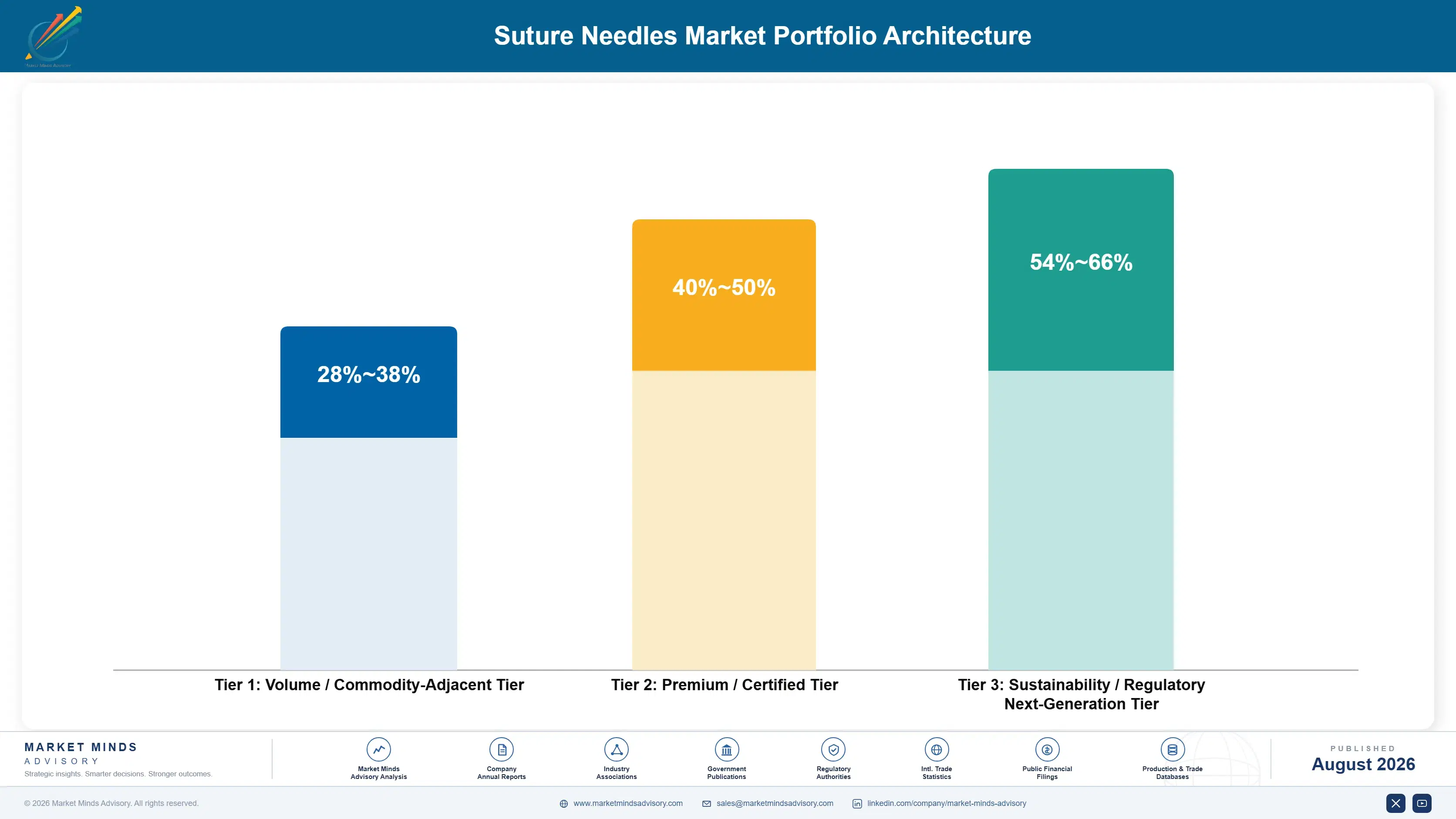
Portfolio Architecture for Margin Defence

Portfolio economics separate on manufacturing tolerance rather than on brand. General closure geometries tendered inside needled suture agreements earn gross margin in the low thirties at Western cost and less where Indian and Turkish capacity sets the award price. Blunt geometries earn more, helped by mandated conversion and by pricing that has not yet been tendered down. Microsurgical and spatula geometries earn most of all, because very few manufacturers can grind them consistently.
The tension is that general closure volume holds the hospital agreement while specialist geometries earn the margin, and the two are sold to entirely different people. Purchasing decides the agreement and never examines the needle. Ophthalmic and microsurgical surgeons decide their own geometry and will switch over a single bad point. A supplier organised for one of those conversations is usually poor at the other.

High-value pools concentrate in three places: microsurgical geometries where capability is scarce, blunt conversion where regulation sets the specification, and contract supply to branded competitors who cannot grind what they sell. None is large in units. Each is protected by manufacturing capability rather than by commercial position.

Volume / Commodity-Adjacent Tier

Taper, cutting and reverse cutting geometries for general closure, tendered inside needled suture agreements on price against functionally equivalent alternatives. Indian and Turkish manufacturing sets the award price in most markets, and award turns on cost position and delivery reliability alone.
Gross Margin: 30-36%

Premium / Certified Tier

Blunt point and taper-cut geometries where specification is written by occupational health or by cardiovascular and specialist surgical requirement. Margin comes from mandated conversion and from specification that resists price-only comparison, and the nine-point range reflects wide variation between tendered and specified accounts.
Gross Margin: 44-53%

Sustainability / Regulatory / Next-Generation Tier

Microsurgical and spatula geometries, plus reduced-packaging and recyclable presentation formats that European procurement increasingly scores. The twelve-point range reflects the gap between mature specialist geometries and sustainability formats still carrying qualification cost.
Gross Margin: 54-66%
suture-needles-market-portfolio-architecture-1787309394600

High-value Sub-segments and Strategic Watch-out

Microsurgical and spatula geometries

The highest-margin pool and the scarcest capability, growing at 7.2% on ophthalmic and reconstructive volume. Surgeons specify directly and switch over a single deformed point, which makes consistency worth more than price. Grinding capability, not commercial reach, decides who participates here at all. Capability is the whole barrier.
Gross Margin: 56-66%

Blunt point conversion volume

Growing at 6.1% on regulation rather than persuasion, with occupational health functions writing specification that purchasing then tenders. Realised pricing runs above the cutting points replaced. Conversion outside Western Europe remains largely untouched, which is where the remaining upside sits. Regulation is doing the selling, which no competitor can undercut.
Gross Margin: 46-54%

General closure geometry volume

Still the largest segment by units and revenue, growing slowly and losing price steadily to Indian and Turkish capacity. It earns little and holds the hospital agreement that everything else travels inside. Exiting it costs the bundling weight that wins specialist volume too. Hold it, do not fund it.
Gross Margin: 30-36%

Barbed and mechanical closure displacement

Procedures moving from hand-sewn closure to barbed suture or stapling, notably arthroplasty, hysterectomy and bowel anastomosis. It reads as portfolio evolution for diversified suppliers. For needle volume it is permanent removal that no commercial response has ever recovered. Supplying the displacing products is the only sensible response available.
Gross Margin: 0-5%

How Needle Demand Actually Repeats

Demand here is consumption tied to procedure volume, which makes it about as predictable as surgical supply gets. Every closure consumes needles, and neither marketing nor discounting changes how many. What varies is contract position and geometry mix: a supplier inside a group purchasing agreement receives general closure volume automatically, and a supplier outside it receives none regardless of manufacturing quality. Specialist geometries work in reverse, since surgeons request them by code a
Adoption depth varies sharply by surgical service. Ophthalmic and microsurgical services specify needles closely and will change supplier over point consistency alone. Cardiovascular surgery specifies almost as closely, since a needle failing during an anastomosis is a genuine emergency. General surgery is largely indifferent between equivalent geometries and defers to purchasing entirely. Orthopaedic services have moved substantially toward barbed closure, and obstetric practice sits between the two, adopting blunt geometry quickly where occupational health has made it policy.

Buyer profiles are shifting in ways that cut both ways. Surgeons trained in the last decade encountered barbed closure and staplers early and reach for hand-sewn technique less readily. Occupational health functions, meanwhile, hold more procurement authority than they did a decade ago.
suture-needles-market-end-use-penetration-index-1787309395096

What We Would Do Here

These are among the four positions where our research anticipates prominent divergence between winners and laggards over the coming forecast period. Each is grounded in the demand model, the regulatory perimeter, and the announced capacity pipeline.
01 / OCCUPATIONAL HEALTH SELLING

Sell blunt conversion to occupational health, not purchasing

Sharps injury rules give occupational health functions specification authority that purchasing respects, and blunt geometries carry realised pricing roughly 15% above the cutting points they replace. Suppliers working that function convert institutions about twice as fast as those approaching surgical procurement alone, and the specification survives individual surgeon preference entirely. The work is compliance documentation and injury data rather than clinical evidence, which is unfamiliar territory for device sales teams and considerably cheaper than any product development programme anybody could fund.
02 / PRECISION CAPABILITY INVESTMENT

Protect grinding capability rather than chasing commodity volume

Microsurgical geometries compound at 7.2% and earn roughly 18 points above commodity closure, and the capability to grind them consistently takes about four years to qualify. That qualification barrier is the most durable asset anybody in this category holds, and it cannot be bought quickly at any price whatsoever. Manufacturers redirecting capital toward commodity cost reduction are competing against Indian and Turkish labour rates they will simply never reach, while neglecting the one asset competitors cannot copy at any speed.
03 / CONTRACT SUPPLY POSITIONING

Supply specialist geometries to competing branded suppliers

Several branded companies sell microsurgical geometries they cannot manufacture, which makes contract supply to competitors a real business rather than an embarrassment to be managed. It earns roughly 12 points above commodity closure on volume no own-brand position could ever reach, without any clinical selling cost attached. Mani built an entire company on exactly this logic and it remains the least contested position in the category, which suggests the discomfort other manufacturers feel about supplying competitors is expensive rather than strategic.
04 / DISPLACEMENT RESPONSE DISCIPLINE

Accept hand-sewn displacement and reprice what remains

Barbed suture and mechanical closure have removed procedures worth around six minutes of theatre time each, and displaced volume has never returned in any market anybody can point to. Defending it consumes commercial effort that earns nothing and delays the repositioning that would. The correct posture is to supply the displacing products where possible and concentrate needle investment on procedures where hand-sewn closure remains clinically superior rather than merely traditional, which is a smaller category and a considerably better one to be defending.

Engagement Snapshot From the Field

A live engagement with an industry participant carrying material or product regulatory and market exposure ahead of a defining policy shift, showing how our research translates into a defensible multi-year portfolio strategy.
MARKET MINDS ADVISORY · CLIENT ENGAGEMENT SUMMARY
Suture Needles Producer Strategic Portfolio Review and Transition Roadmap 2026·Investment Scenario on Suture Needles Exposure Evaluation 2025-26
CLIENT PROFILE
An Asian precision needle manufacturer supplying general and specialist geometries, with revenue near USD 240 million annually (client-reported, unverified by MMA), qualified grinding capacity across two countries, and roughly 61% of output sold as contract supply to branded closure companies. The company held strong microsurgical capability, no direct hospital relationships worth speaking of, and pricing set almost entirely by customers who were also competitors.
STRATEGIC CHALLENGE
Two branded customers had signalled intentions to build internal grinding capability, which would remove roughly a fifth of volume over several years. Management proposed launching an own-brand closure range into hospital markets in response. The board doubted the company could build clinical and contract relationships from nothing, and nobody had established what the existing capability was actually worth to customers.
MMA APPROACH
MMA benchmarked the client's specialist geometry quality and yield against alternative sources its customers could realistically qualify, then modelled the cost and timeline of internal capability development from the customers' perspective rather than the client's. Forty-seven expert interviews across ophthalmic surgeons, closure product managers and procurement leads established where geometry consistency genuinely influenced purchasing behaviour.
KEY FINDINGS
  1. Internal grinding capability would take either branded customer roughly four years and considerably more capital than management had assumed, which meant the threat was real but far slower than the proposed response required.
  2. Ophthalmic surgeons in three markets could identify the client's spatula geometries by feel without knowing the brand on the package, which meant the quality position was reaching users despite no direct relationship.
  3. Contract pricing on specialist geometries sat roughly 20% below what the same quality commanded when specified directly by microsurgical accounts, a gap the client had never tested or challenged.
  4. An own-brand general closure launch would compete directly with the customers supplying 61% of revenue, at margins below what contract supply already earned on the same lines.
CLIENT PROFILE
An Asian precision needle manufacturer supplying general and specialist geometries, with revenue near USD 240 million annually (client-reported, unverified by MMA), qualified grinding capacity across two countries, and roughly 61% of output sold as contract supply to branded closure companies. The company held strong microsurgical capability, no direct hospital relationships worth speaking of, and pricing set almost entirely by customers who were also competitors.
STRATEGIC CHALLENGE
Two branded customers had signalled intentions to build internal grinding capability, which would remove roughly a fifth of volume over several years. Management proposed launching an own-brand closure range into hospital markets in response. The board doubted the company could build clinical and contract relationships from nothing, and nobody had established what the existing capability was actually worth to customers.
MMA APPROACH
MMA benchmarked the client's specialist geometry quality and yield against alternative sources its customers could realistically qualify, then modelled the cost and timeline of internal capability development from the customers' perspective rather than the client's. Forty-seven expert interviews across ophthalmic surgeons, closure product managers and procurement leads established where geometry consistency genuinely influenced purchasing behaviour.
KEY FINDINGS
  1. Internal grinding capability would take either branded customer roughly four years and considerably more capital than management had assumed, which meant the threat was real but far slower than the proposed response required.
  2. Ophthalmic surgeons in three markets could identify the client's spatula geometries by feel without knowing the brand on the package, which meant the quality position was reaching users despite no direct relationship.
  3. Contract pricing on specialist geometries sat roughly 20% below what the same quality commanded when specified directly by microsurgical accounts, a gap the client had never tested or challenged.
  4. An own-brand general closure launch would compete directly with the customers supplying 61% of revenue, at margins below what contract supply already earned on the same lines.
RECOMMENDED STRATEGY
Phase 1: Phase 1 (0 to 6 months): Abandon the own-brand general closure plan, and reprice specialist geometry contract supply against demonstrated qualification difficulty rather than against commodity benchmarks. Phase 2: Phase 2 (6 to 18 months): Build direct ophthalmic distribution in two markets for spatula geometries only, avoiding any overlap with branded customer positions. Phase 3: Phase 3 (18 to 36 months): Contract multi-year specialist supply agreements with customers at indexed pricing, trading volume commitment for margin protection.
OUTCOME
The own-brand launch was cancelled. Specialist geometry contract pricing was renegotiated upward with three customers, lifting blended gross margin by roughly four points within four quarters (client-reported, unverified by MMA). Direct ophthalmic distribution in two markets reached modest volume at materially better pricing. One customer proceeded with internal capability development anyway.

Frequently Asked Questions

Foundational context covering the market sizes, CAGR, scope, country, region and competition that inform every finding below. This section is provided to cover basics and most often pre-purchase conversations, answered from the MMA Primary Research Dataset.

What is the current size of the Suture Needles Market?

MMA sizes the global suture needles market at USD 1.6 billion in 2025, rising to USD 1.68 billion in 2026. That covers the needle component of needled suture units plus standalone needle revenue at hospital contract prices.

How large will the Suture Needles Market be by 2036?

MMA forecasts USD 2.68 billion by 2036, an expansion multiple of 1.60 times the 2026 base. That represents roughly USD 1.00 billion of incremental value over the forecast period.

What is the CAGR for the Suture Needles Market 2026 to 2036?

The base case compounds at 4.8% annually, with a bull case of 6.0% and a bear case of 3.6%. Geometry mix improvement contributes more than unit volume growth across the period.

Which segment is growing fastest?

Spatula and ophthalmic micro-point needles compound at 7.2%, exactly 1.50 times the market rate. Microsurgical volume growth and manufacturing tolerances few suppliers can meet together explain that premium.

Who are the major companies in the Suture Needles Market?

Ethicon, Medtronic, B Braun Melsungen, Mani and Advanced Medical Solutions together account for 63% of needle shipment volume. Fifteen further participants including Peters Surgical, Healthium Medtech, Katsan and Dogsan are profiled.

Which country is growing fastest?

India compounds at 7.6%, ahead of every other national market MMA tracks. Domestic manufacturing serving both local demand and export contracts accounts for most of that growth.

Report Segmentation Architecture

The full report scope spans multiple orthogonal segmentation dimensions, with cross-tabulated demand data provided for each dimension pair. Coverage extends further to regional breakdowns, trend trajectories, and the competitive detail needed to support segment-level decision-making.

By Needle Point and Body Geometry

  • Taper Point Needles
  • Cutting and Reverse Cutting Needles
  • Blunt Point Needles
  • Taper-Cut Needles
  • Spatula and Ophthalmic Micro-Point Needles
  • Trocar Point Needles

By End-Use Surgical Service

  • General and Gastrointestinal Surgery
  • Cardiovascular and Thoracic Surgery
  • Ophthalmic and Microsurgery
  • Obstetrics and Gynaecology
  • Orthopaedic and Trauma Surgery

By Procurement Route

  • Group Purchasing Organisation Contract
  • National and Regional Public Tender
  • Contract Manufacturing Supply
  • Distributor and Specialist Channel

By Region

  • North America
  • Western Europe
  • East Asia
  • South Asia and Pacific
  • Latin America
  • Middle East and Africa
  • Eastern Europe

Scope, Methodology, and Coverage

Every figure in this report is reproducible from documented input assumptions. The scope below maps the historical period, the forecast horizon, the segmentation dimensions, and the countries covered, alongside the underlying primary and qualitative methodology.
Historical Period
2020 to 2025
Forecast Period
2026 to 2036
Base Year
2025 (USD billions; MMA Primary Research Dataset, August 2026)
Market Definition
The market comprises surgical needles used for tissue closure, supplied either swaged to suture material as a needled unit or as standalone eyed needles, covering taper, cutting and reverse cutting, blunt, taper-cut, spatula and micro-point, and trocar point geometries. Sizing captures the needle component of needled suture revenue plus standalone needle sales, valued at hospital contract prices and including contract manufacturing supply at transfer prices. Suture material sold without a needle, staplers and staples, tissue adhesives, skin closure devices, biopsy and injection needles, and reusable instruments are outside scope.
Quantitative Units
USD billions (current prices); million needles shipped; USD per needled unit at hospital contract price
Segmentation Dimensions
By Needle Point and Body Geometry; By End-Use Surgical Service; By Procurement Route; By Region
Regions Covered
North America, Western Europe, East Asia, South Asia and Pacific, Latin America, Middle East and Africa, Eastern Europe
Countries Covered
USA, China, Germany, France, UK, Japan, South Korea, India, Australia, Canada, Brazil, Mexico, Indonesia, Vietnam, Thailand, Malaysia, UAE, Saudi Arabia, South Africa, Nigeria, Turkey, Poland, Netherlands, Italy, Spain, Sweden, Switzerland, Argentina, Colombia, Singapore, and additional markets relevant to this sector
Key Companies Profiled
Ethicon, Medtronic, B Braun Melsungen, Mani, Advanced Medical Solutions, Peters Surgical, Healthium Medtech, DemeTech, Katsan Surgical Sutures, Dogsan, Unilene, Assut Medical, Riverpoint Medical, Lotus Surgicals, Futura Surgicare, Shandong Weigao Group, Serag-Wiessner, Resorba Medical, Corza Medical, Meril Life Sciences.
Quantitative Methodology
Primary survey, n=3,800 respondents, Q4 2025, six countries; demand-side model with trade association cross-validation
Qualitative Methodology
47 expert interviews, Q4 2025; applied to validate demand model assumptions, identify emerging dynamics, and assess competitive positioning
Report Format
PDF and XLSX data workbook (Word format preview document)
Publisher
Market Minds Advisory
Report Code
MMA-2026-MED-046
Published
August 2026
Contact
sales@marketmindsadvisory.com | www.marketmindsadvisory.com

Purchase the full Suture Needles Market Report (2026 to 2036).

The full report sizes the suture needles market across six point geometries, five surgical services, four procurement routes and seven regions, with annual forecasts to 2036 in revenue and needles shipped. It quantifies blunt point conversion by country against the regulatory obligation driving it, which is the only specification change currently moving pricing in the category. Twenty participants are assessed on a consistent needle shipment basis, with grinding and swaging capability mapped separately from brand position because the two diverge sharply. Contract manufacturing flows between competing suppliers are traced, and displacement by barbed and mechanical closure is quantified procedure by procedure.
Six point geometries sized and forecast annually
Blunt conversion quantified country by country
Twenty participants on consistent needle shipment basis
Grinding capability mapped separately from brand position
Contract manufacturing flows traced between competing suppliers
Barbed and mechanical displacement quantified by procedure

Built For The People Who Decide

From boardroom strategy to bench-side execution, this report is read cover-to-cover by leaders shaping the next decade of their industry, turning demand scenarios, market dynamics and valuation benchmarks into decisions.
CXOs/ Presidents/ VPs/ Managers
M&A and Corporate Development
Strategy Teams and R&D Heads
Procurement and Product Directors
Regulatory and Compliance Leaders
Investor Relations and Equity Analysts