Market Minds Advisory
Survival Tools Market

Survival Tools Market: Survival Tools Market: Untested Purifier Claims, Stored Battery Failure and Products Judged At Purchase

Almost nine in ten kits are never opened in an emergency, so the buyer never generates the feedback that would discipline a category selling insurance against an event that does not arrive.

Lead Analyst

Published

September 2026

Make Smarter Decisions with Customized Research Insights

Request a free sample report and evaluate market opportunities, growth trends, and competitive dynamics relevant to your business needs.

2025 MARKET VALUE$2.6BMarket Size 2025
2036 FORECAST VALUE$5.7BBase Case , 2026 to 2036
CAGR 2026 TO 20367.4 %Bull 8.7% / Bear 6.2%
INCREMENTAL OPPORTUNITY$2.9BNet 10- year value creation
EXPANSION MULTIPLE2.04x2036 value over 2026 base
Strategic Levers
M&A Pipeline
Regional Outlook
Country Rankings
Competitive Intelligence
Segmental Deep-dive
Call-Us : 91 93563 13602

Executive Snapshot and Market Trajectory.

This category is judged in the hand at purchase rather than in the field, because roughly 88% of kits are never opened in an emergency. The buyer who would discover a product fails never gets to find out, which removes the feedback every other durable category relies on.
Water filtration and purification devices grow at 11.1%, half again the market rate of 7.4%, and they are the one segment where the claim is testable and the failure is dangerous. Signalling and illumination follows at 8.6%. Fixed blade survival knives grow slowest at 5.4%, constrained by jurisdiction rules that fragment the range. Multi-tools are the only products here used weekly, which makes them the one segment with genuine brand loyalty and wear-driven replacement.
Two numbers deserve more attention than the category gives them. Around 12% of water devices are tested against any recognised microbiological purifier standard while log reduction claims appear on most of them. And roughly 34% of stored devices are disabled by alkaline cell leakage before they are ever switched on. A torch corroded by a leaking cell fails at the worst possible moment.
Market Definition
This market covers tools and equipment carried or stored for emergency and wilderness survival use, spanning multi-tools and folding knives, fixed blade survival knives, water filtration and purification devices, fire starting and ignition tools, signalling and illumination devices, and emergency shelter and cordage. Sizing is at wholesale shipment value. Firearms and ammunition, camping furniture and tents, freeze-dried food, medical first aid kits and vehicle recovery equipment are excluded.
Base Year Value
$2.6B in 2025 (MMA Primary Research Dataset, September 2026)
Forecast Period
2026 to 2036, eleven discrete annual values
CAGR
7.4% base case. Bull 8.7%. Bear 6.2%.
Fastest Growth Segment
Water Filtration And Purification Devices: 11.1% CAGR
Fastest Growth Country
Japan: 10.2% CAGR
Fastest Growth Region
South Asia and Pacific: 9.4% CAGR
Largest Region
North America: 41% of 2025 global value
Market Leaders
Fiskars Group, Victorinox, Leatherman Tool Group, Katadyn Group, Cascade Designs. Source: MMA Primary Research Dataset, July 2026.
Primary Survey
n=3,800 procurement and R&D decision-makers, Q4 2025, six countries
Methodology
Demand-side build-up, cross-validated against public data, 47 expert interviews

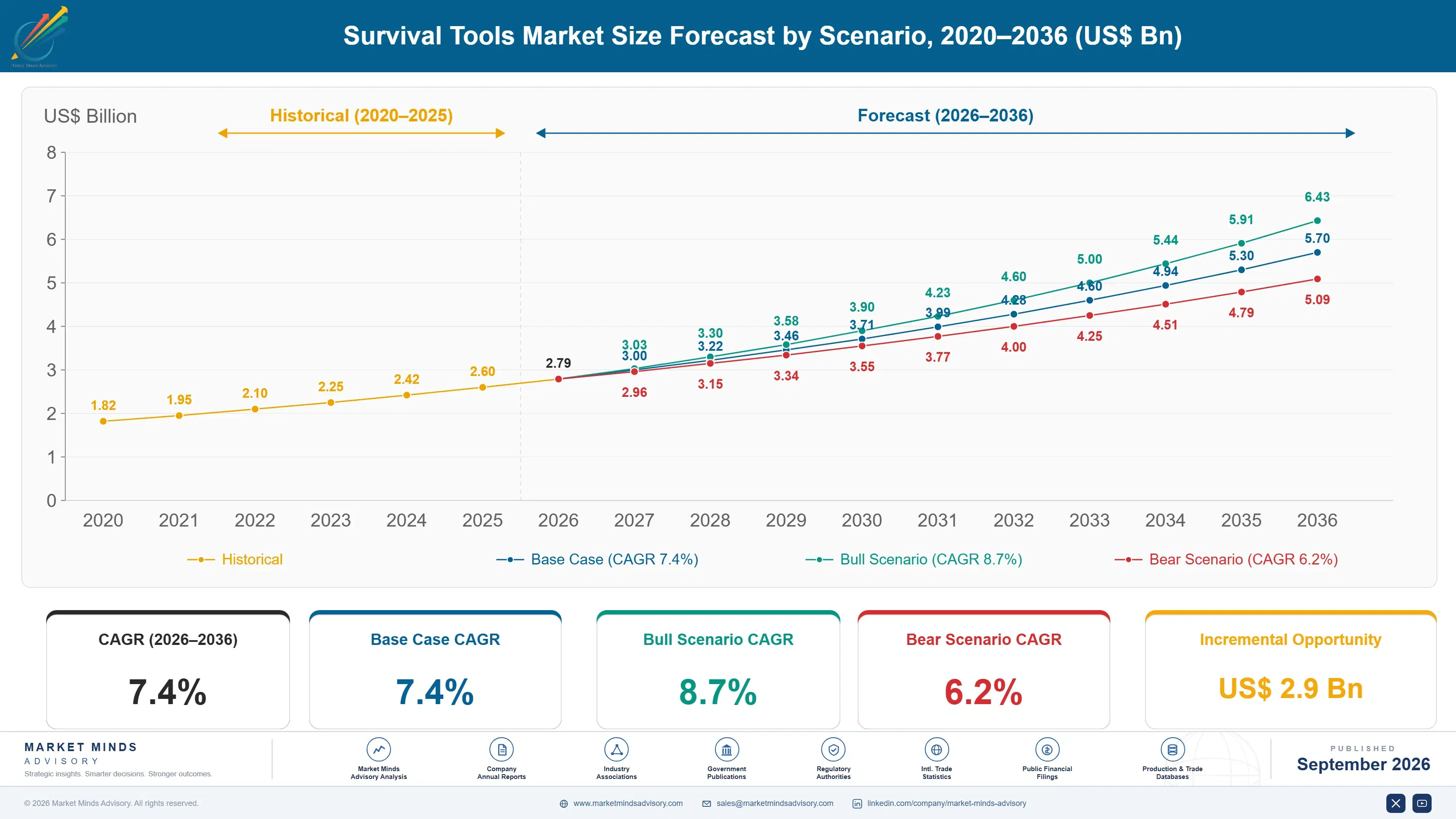
Survival Tools Market Forecast Scenarios

survival-tools-market-size-forecast-scenario-1790023497146
Growth of 6.3% between 2020 and 2025 came from anxiety more than from activity. Pandemic supply disruption, extreme weather and grid failures each produced a purchasing wave that subsided within a quarter or two while the installed kits stayed in cupboards. Underlying outdoor recreation demand grew steadily throughout and was largely obscured by the spikes.
Three mechanisms carry the base case. Water treatment grows at 11.1% because it serves both preparedness and genuine outdoor use, and because the claim can be tested in a way no knife claim can. Japanese household disaster preparedness expands at 10.2%, supported by municipal guidance and a culture that treats the kit as routine rather than exceptional. Multi-tools grow on replacement because they are the only items in the category people use every week.
The bull case is purifier certification becoming a listing requirement. If any major retailer demands testing against a recognised microbiological standard, the 12% of devices that already meet one separate immediately from the rest. The bear case is a quiet failure. A widely reported incident in which a certified-looking filter failed in real use would damage trust across every segment, including the ones where the products actually work.

Products Nobody Ever Tests

Almost every product in this category is bought as insurance and roughly 88% of kits are never opened in an emergency. That inverts the relationship durable goods usually have with their buyers, because the person who would discover a product fails is the person who never gets the chance. What disciplines the category instead is how a tool feels in the hand on a shop counter, which is an entirely different attribute.
TOP FIVE CONCENTRATION22%Combined shipment value share held by the five largest participants
KITS NEVER USED88%Survival kits never opened in an actual emergency situation
AVERAGE SELLING PRICEUSD 54Weighted global wholesale price across all tool categories
PURIFIER STANDARD COMPLIANCE12%Water devices tested against a recognised microbiological standard
ALKALINE LEAK FAILURES34%Stored devices disabled by cell leakage before any use
BLADE LENGTH JURISDICTIONS23Distinct legal blade limits across the major covered markets
Water treatment is the exception and it is the segment where failure is dangerous rather than disappointing. Recognised standards exist that define what a microbiological purifier must remove and at what reduction, and around 12% of devices sold into this market are tested against one. Log reduction claims nonetheless appear on most of them, generated by nobody in particular against no stated protocol.
Stored battery chemistry is the quiet failure that ruins the rest. Alkaline cells leak over multi-year storage and corrode the contacts of the torch or radio they sit in, and roughly 34% of stored devices are disabled that way before they are ever switched on. Lithium primary cells do not leak and cost more. Almost nothing states which to use.
"The industry sells torches that will not switch on and filters that were never tested, and gets away with both because the customer only finds out on the worst day of their life. That is not a market failure so much as a market with no feedback loop."
Director, Outdoor Equipment and Preparedness Practice · MMA Consumer and Industrial Goods Practice · September 2026

Market Trends

Water Treatment Bridges Preparedness And Real Outdoor Use

A water filter is the only item in a survival kit that a hiker, a traveller and a household preparing for a storm all buy for the same reason, which gives the segment a demand base the rest of the category lacks. It grows at 11.1% against 7.4% for the market. It is also the only segment where independent testing against a recognised standard is possible and meaningful, since the performance is a measurable reduction rather than a feeling. Participants holding certification are separating from those making log reduction claims nobody generated against any protocol at all.
Market Impact: Waves last about 2 quarters
Household Preparedness Becomes Routine Rather Than Exceptional

In markets where earthquake, typhoon or wildfire risk is a recurring fact rather than a remote possibility, household emergency kits have become ordinary purchases renewed on a schedule instead of one-off reactions to an event. Japan is the clearest case, growing at 10.2% on municipal guidance and a culture that treats the kit as routine. That converts an anxiety-driven spike category into a replacement one, which is a far better business. Participants selling on fear do well in a bad month; participants selling on routine renewal do well every year.
Market Impact: Used weekly by 1 segment

Market Opportunities and Growth Drivers

Extreme Weather Events Produce Repeated Purchasing Waves

Grid failures, wildfires and flooding across North America, Southern Europe and Australia have each generated purchasing spikes lasting a quarter or two, and their frequency is rising rather than the individual events growing larger. That produces a demand pattern of repeated short surges rather than steady growth, which is difficult to forecast and easy to misread as underlying momentum. Participants holding inventory against those events capture them; those manufacturing to order miss most of the window entirely and then carry the stock afterwards. Reading a spike as underlying momentum is the most common planning error in this category.
Market Impact: Only 12% are tested

Multi-Tools Earn The Only Routine Use In The Category

A multi-tool gets used weekly for tasks that have nothing to do with survival, which makes it the one product here that generates genuine familiarity, wear and replacement demand. That gives the segment brand loyalty the rest of the category cannot build, since nobody forms an opinion about a fire steel they never struck. Replacement runs on wear rather than on anxiety, which stabilises revenue. Participants without a credible multi-tool are absent from the only part of this market with a normal relationship to its customer. Nobody forms an opinion about a fire steel they never struck.
Market Impact: Leakage disables 34% stored

Market Restraints and Challenges

Water Purifier Claims Rest On No Tested Protocol

Around 12% of water devices sold into this market are tested against a recognised microbiological purifier standard, while log reduction claims appear on the large majority of them. The root cause is that no regulator requires the testing for a product sold as outdoor equipment rather than as a drinking water appliance. Commercially this leaves genuinely certified products competing against numbers somebody wrote down. Participants holding certification now state the standard by name on pack, which works precisely because the comparison is verifiable. Naming the standard is the only verifiable claim available to anyone in this market.
Market Impact: Grows 3.7 points above category

Alkaline Cells Destroy The Devices They Are Stored In

Roughly 34% of stored emergency devices are disabled by alkaline cell leakage before they are ever used, and the corrosion typically destroys the contacts rather than merely draining the charge. The root cause is that alkaline cells are what ships with a product because they cost less, and nothing on the pack explains that a device intended for storage should carry lithium primary cells instead. Commercially the failure appears at the worst possible moment and is attributed to the product. Stating the chemistry costs a printed line. Lithium primary cells remove it completely.
Market Impact: Japan grows 2.8 points faster
3 additional market trends, 4 additional growth drivers, and 2 additional restraints and challenges are covered in the full report. Contact sales@marketmindsadvisory.com to access the complete intelligence.

Segment CAGR and Growth Architecture

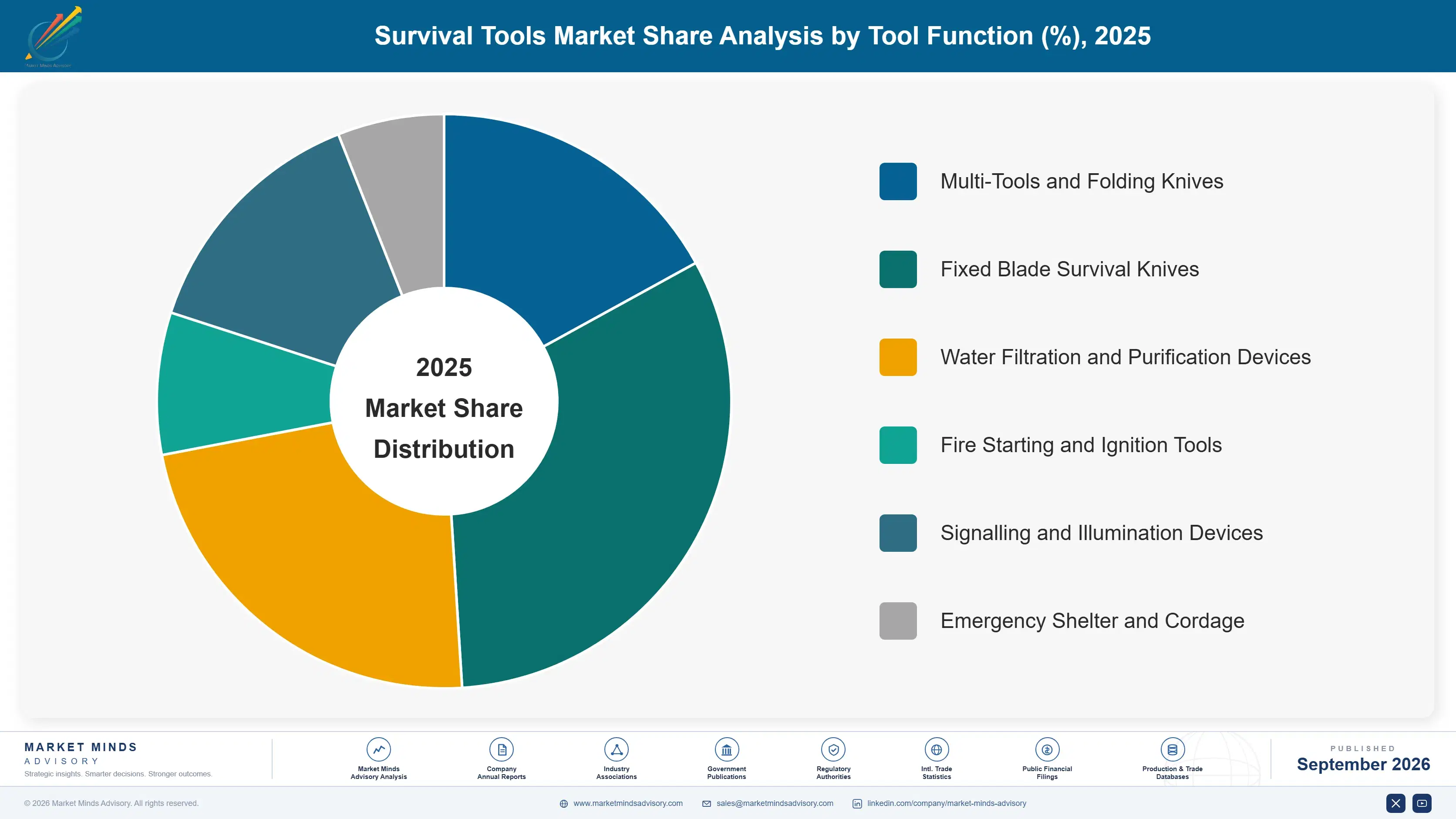
Segmentation follows tool function, the dimension on which manufacturing route, regulatory treatment, usage frequency and margin all divide together in this market. Six functions are assessed at wholesale shipment value. Firearms, tents and camping furniture, freeze-dried food, medical first aid kits and vehicle recovery equipment sit outside scope. Preparedness and outdoor recreation demand are sized together here.
survival-tools-market-market-share-analysis-1790023497708

Water Filtration And Purification Devices

Water treatment grows at 11.1%, half again the market rate of 7.4%, and it is the only segment in this category that serves three distinct buyers for the same reason. A hiker, an international traveller and a household preparing for a storm all want the same measurable outcome, which gives the segment a demand base the rest of the market lacks entirely. It is also the only segment where independent testing against a recognised standard is both possible and meaningful, because performance is a reduction that can be measured rather than a feeling in the hand. Roughly 12% of devices are actually tested that way, and participants holding certification are separating from those that are not.
CAGR 11.1%

Signalling And Illumination Devices

Signalling and illumination grows at 8.6% and carries the category's most avoidable failure. Torches, beacons and radios are stored for years and then needed suddenly, and roughly 34% of them are disabled by alkaline cell leakage that corrodes the contacts long before anyone reaches for the switch. Lithium primary cells eliminate the problem entirely and cost a few dollars more across a device lifetime. Rechargeable options introduce a different problem, since a lithium ion cell left uncharged for two years is frequently unrecoverable. Almost no product in the segment states which chemistry a stored device should carry, and the failure is then attributed to the product. The failure then reaches the owner at the one moment it matters most.
CAGR 8.6%
Full segment breakdown across 6 segments available in the complete report.

Regional Architecture and Country Demand Map

Regional shares measure wholesale shipment value where tools are sold. North America sits far above the standard band on preparedness purchasing, and three other regions consequently sit below theirs across this table. Preparedness culture rather than income explains this distribution entirely, and three other regions consequently sit below their bands.

North America

At 41% this sits far above the standard band, and household preparedness purchasing here has no equivalent anywhere else in the world. Wildfire, hurricane and grid failure events each generate purchasing waves across large populations, and a well-established retail and online infrastructure exists specifically to serve them. Leatherman, Gerber and a deep field of specialist brands compete across price points that range from impulse purchase to serious equipment. Hunting and outdoor recreation provide an additional demand base the category does not have elsewhere. Growth of 6.6% is below several other regions because the base is already very large. No other region combines event-driven household purchasing with an outdoor recreation base of comparable scale.
Share: 41% | CAGR: 6.6% (2026 to 2036)

East Asia

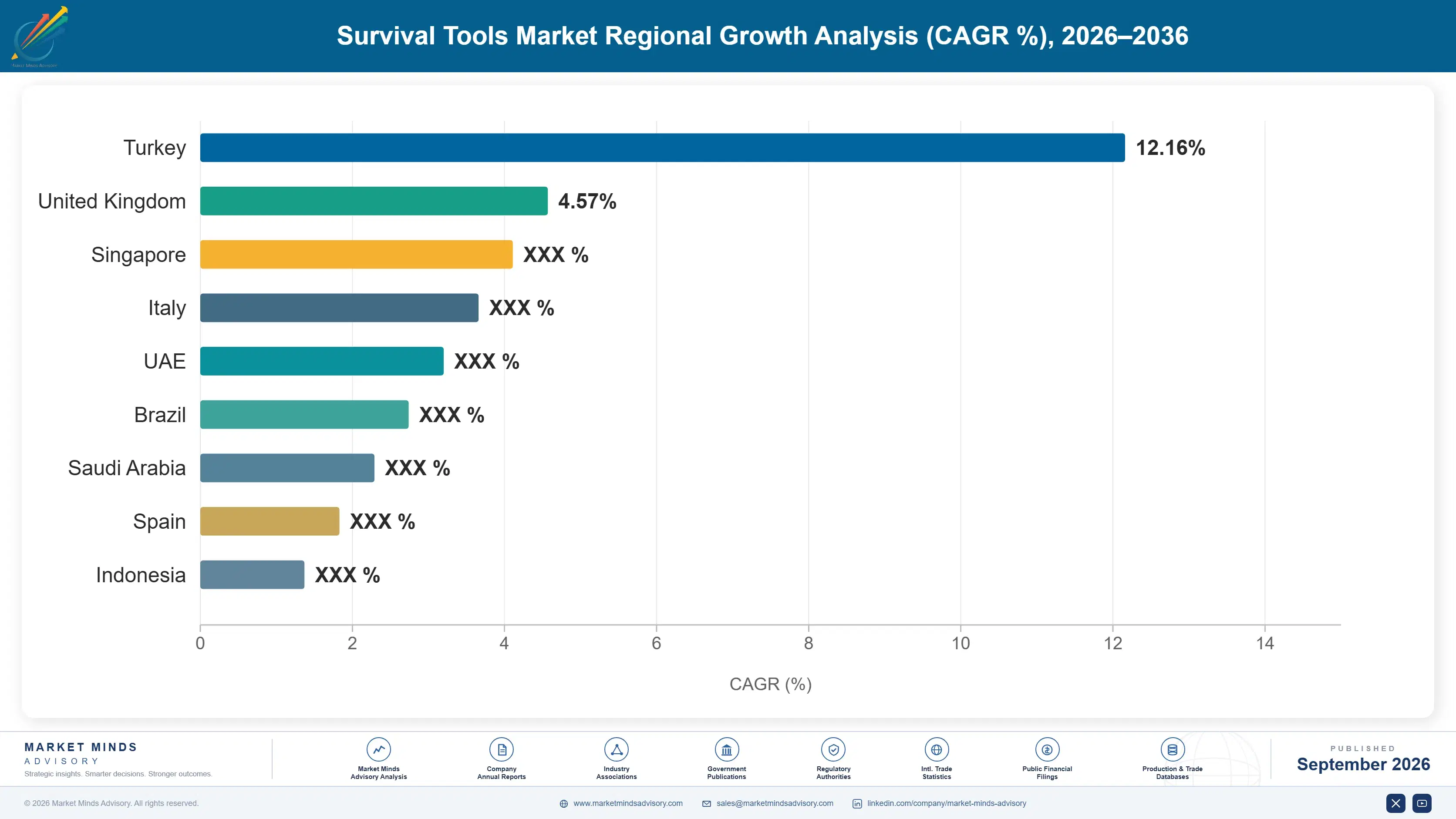
The 21% position falls just below the standard band, and Japan rather than China drives most of its value. Japanese household disaster preparedness is routine rather than exceptional, supported by municipal guidance and by a culture that treats an emergency kit as an ordinary household item renewed on a schedule. Japan grows at 10.2%, the fastest national market covered here. Chinese demand is largely outdoor recreation rather than preparedness, and Chinese manufacturing supplies a large share of the global category regardless of where it is sold. Korean demand follows Japanese patterns at smaller scale. Japanese preparedness behaves like a replacement category while Chinese demand behaves like outdoor recreation, which makes one regional forecast less useful than two.
Share: 21% | CAGR: 8.3% (2026 to 2036)
Regional intelligence for 5 additional markets available in the complete report: Western Europe, South Asia and Pacific, Latin America, Middle East and Africa, Eastern Europe. Contact sales@marketmindsadvisory.com.
survival-tools-market-country-cagr-analysis-1790023498249

Four Moves Worth Making Now

These four address a category whose customers cannot test what they bought and whose failures therefore go undiscovered until they matter most. Each has been executed by at least one participant with measurable results, and three of the four cost a printed line or a testing programme rather than any product change. The fourth is a range design decision.

Certify Water Devices Against A Named Standard

Around 12% of water treatment devices sold here are tested against a recognised microbiological purifier standard while log reduction claims appear on most of them, generated against no stated protocol by anyone. Testing and naming the standard on pack costs a laboratory programme rather than reformulation, and it makes the comparison verifiable in a category where nothing else is. Participants holding certification report price realisation around 1.7 times comparable uncertified devices, because the buyer is purchasing an outcome they cannot check themselves. Nothing else in this category can be checked by anyone.
Market Impact: Lifts price realisation to roughly 1.7 times higher

State The Battery Chemistry Stored Devices Need

Roughly 34% of stored emergency devices are disabled by alkaline cell leakage that corrodes contacts before the device is ever used, and alkaline cells ship with products because they cost less. Printing that a stored device should carry lithium primary cells, and shipping those cells in preparedness ranges, costs a few dollars and removes the category's most avoidable failure. Participants doing it report warranty and complaint contacts on stored devices falling by about 52%, on a change requiring no engineering whatever. The cost difference is trivial against a device that does not work.
Market Impact: Cuts stored device complaint volumes by roughly 52%

Build A Renewal Schedule Into Preparedness Kits

Roughly 88% of kits are never opened, which means the customer relationship ends at purchase unless something brings them back. Printing expiry dates on consumable contents and offering scheduled renewal converts a one-off purchase into a recurring one, which is exactly how Japanese household preparedness already behaves at 10.2% growth. Participants offering renewal report repeat purchase around 2.6 times their range average. The kit is insurance, and insurance is renewed rather than bought once and forgotten. Nothing else in this category brings a preparedness customer back at all, since no wear occurs.
Market Impact: Raises repeat purchase to roughly 2.6 times higher

Design Blade Ranges Around Jurisdiction Limits

Twenty-three distinct legal blade length and locking limits apply across the major markets covered here, which fragments ranges and strands inventory that cannot legally be sold in the market it was shipped to. Designing a core range within the most restrictive common limit, and adding longer variants only where permitted, cuts stock-keeping complexity substantially. Participants doing this report inventory write-downs on blade products falling by roughly 29%, with no loss of sales in the permissive markets. Longer variants can still be added wherever the law permits them, which preserves sales in the more permissive markets entirely.
Market Impact: Cuts blade inventory write-downs by roughly 29% overall

Who Controls the Margin Pool

Concentration is low at 22% held by the top five, measured consistently on wholesale shipment value of survival and preparedness tools rather than on units. The leader to challenger gap is wide in manufacturing reputation and in outdoor specialty distribution, both accumulated over decades, and narrow in product, where Chinese manufacturers supply competent knives, filters and lights to anyone placing an order at modest volume.
Competition runs on three dimensions currently. Feel and finish at the point of sale decide most retail volume, because the buyer cannot evaluate field performance and will not get to. Certification decides water treatment, which is the only segment where an independent claim exists. Price decides online marketplace volume, where uncertified product and unstated battery chemistry both concentrate and where most of the category's failures originate.

Pressure is building around verifiable claims, and that is where positions will move. Participants certifying water devices against a recognised standard are separating from a field asserting numbers nobody produced. The battery chemistry failure is a similar opportunity sitting unclaimed, since it costs a printed line and removes a failure that reaches the customer at the single worst moment they could encounter it.
survival-tools-market-company-positioning-matrix-1790023498778

Competitive Moat and Risk Dimensions

FISKARS GROUP

Moat: Manufacturing Scale And Brands

Ownership of Gerber alongside broader cutting tool manufacturing gives the company genuine metallurgy and blade production capability rather than a sourcing relationship, and outdoor specialty distribution across North America and Europe places product in front of the buyers who evaluate feel and finish directly. Metallurgy of that depth cannot be assembled from a sourcing relationship.
FISKARS GROUP

Risk: Blade Weighted Portfolio Exposure

Portfolio concentration in blade products places substantial revenue in the segments growing slowest, fragmented by twenty-three distinct jurisdiction limits that strand inventory. The fastest growth sits in water treatment, which requires membrane technology and certification capability rather than the metallurgy the group is built around.
LEATHERMAN TOOL GROUP

Moat: Multi-Tool Category Ownership

The multi-tool is the only product in this category used weekly, which gives it genuine familiarity, wear-based replacement and brand loyalty that nothing else here can build. Domestic manufacturing supports a warranty position that competitors sourcing from contract manufacturers find difficult to match credibly. Weekly use is what produces preference in any tool category.
LEATHERMAN TOOL GROUP

Risk: Narrow Category Participation

A portfolio concentrated on one product type leaves the business absent from water treatment at 11.1% and from illumination at 8.6%, the two fastest-growing segments covered. Entering either requires membrane or electronics capability entirely unrelated to the precision metalwork the company has built its reputation and its factory around.

Players Tracked

Prominent Players

Fiskars Group
Victorinox
Leatherman Tool Group
Katadyn Group
Cascade Designs

Other Key Players

SOG Specialty Knives
Benchmade
Spyderco
Buck Knives
Morakniv
Helle
Ka-Bar
Vestergaard
Sawyer Products
Grayl
UST Brands
Exotac
Streamlight
Petzl
Black Diamond Equipment

Recent Developments

OCTOBER 2024

Katadyn introduces filters certified to a microbiological purifier standard

The company launched water treatment devices tested against a recognised microbiological purifier standard with the protocol named on packaging. This was internal product development involving no acquisition, licence or partnership with any external testing or membrane technology business. Uncertified devices in the range were withdrawn alongside it.
Signal: Certification is now being used as differentiation in the only segment where independent testing is meaningful.
FEBRUARY 2025

Leatherman expands Portland manufacturing capacity

The company added machining and assembly capacity at its Oregon facility serving multi-tool production for domestic and export demand. This was organic capital investment funded internally, involving no joint venture, acquisition or contract manufacturing partner at any stage. Existing contract manufactured accessory lines continued unchanged.
Signal: Domestic manufacturing is being defended in the one segment with real customer familiarity. Warranty credibility depends on owning the factory.
JUNE 2025

Fiskars Group consolidates European outdoor brand distribution

The company concentrated European distribution for its outdoor and cutting tool brands into fewer facilities as part of a wider cost programme. This was an internal logistics decision taken on cost grounds, with no acquisition, divestiture or external partner involved. Product ranges and jurisdiction compliance were unaffected by the move.
Signal: Blade fragmentation across jurisdictions makes European distribution expensive to operate efficiently. Range fragmentation is expensive to distribute efficiently.

What These Tools Cost

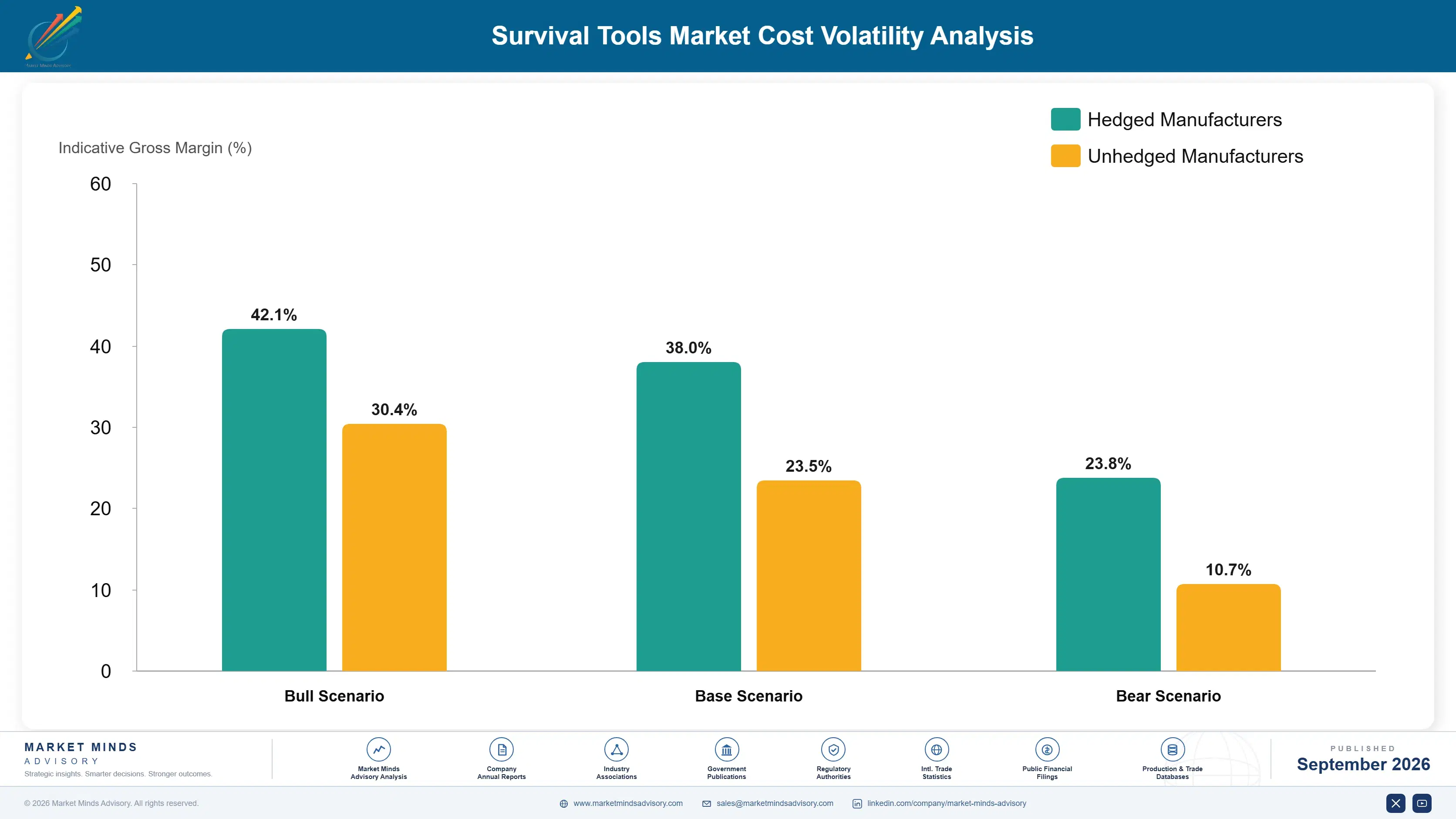
Stainless and tool steel dominates blade and multi-tool cost at roughly 29%, with grade driving wide variation between stamped and machined products. Hollow fibre membrane accounts for about 31% of water device cost and comes from a narrow group of specialist producers. Light emitting diodes, cells and electronics carry illumination products, while machining and assembly labour takes most of the remainder across every category here.
The 2021 and 2022 period pressured steel and membrane supply from unrelated directions at once. Stainless prices rose sharply on nickel and energy while hollow fibre membrane allocation tightened as water treatment demand grew faster than specialist capacity, and container rates multiplied several times over on both. Fiskars Group reporting for that period identifies raw material and logistics inflation across outdoor and cutting categories as requiring pricing action.

Exposure varies sharply by product category, which decides who absorbs a shock. Blade manufacturers carry stainless and machining exposure with no substitution available at equivalent performance. Water device manufacturers carry membrane exposure concentrated in very few suppliers worldwide. Illumination manufacturers carry semiconductor and cell exposure that moves on consumer electronics cycles entirely unrelated to outdoor demand, and all three moved together in the same two years.
survival-tools-market-cost-volatility-analysis-1790023498975

Qualify a second hollow fibre membrane supplier early

Membrane supply for water treatment concentrates among very few specialist producers, and substitution requires performance retesting and potentially recertification against the standard a product claims. Qualifying an alternative ahead of constraint costs a development and testing cycle. Doing it afterwards means either losing the certification or losing the production season entirely. Recertification is the hidden cost of switching.

Design blade ranges to the most restrictive common limit

Twenty-three distinct jurisdiction limits on blade length and locking mechanisms fragment ranges and strand inventory in markets where it cannot legally be sold. Building a core range inside the tightest common limit and adding longer variants only where permitted reduces stock-keeping complexity substantially without losing permissive market sales. Twenty-three limits apply across the markets covered.

Ship lithium primary cells with stored preparedness products

Alkaline cells ship with devices because they cost less, and they then leak in storage and destroy the product before it is ever used. Lithium primary cells add a few dollars and remove the failure entirely. On a preparedness product the cost difference is trivial against a device that does not work when it is finally needed.

Portfolio Architecture for Margin Defence

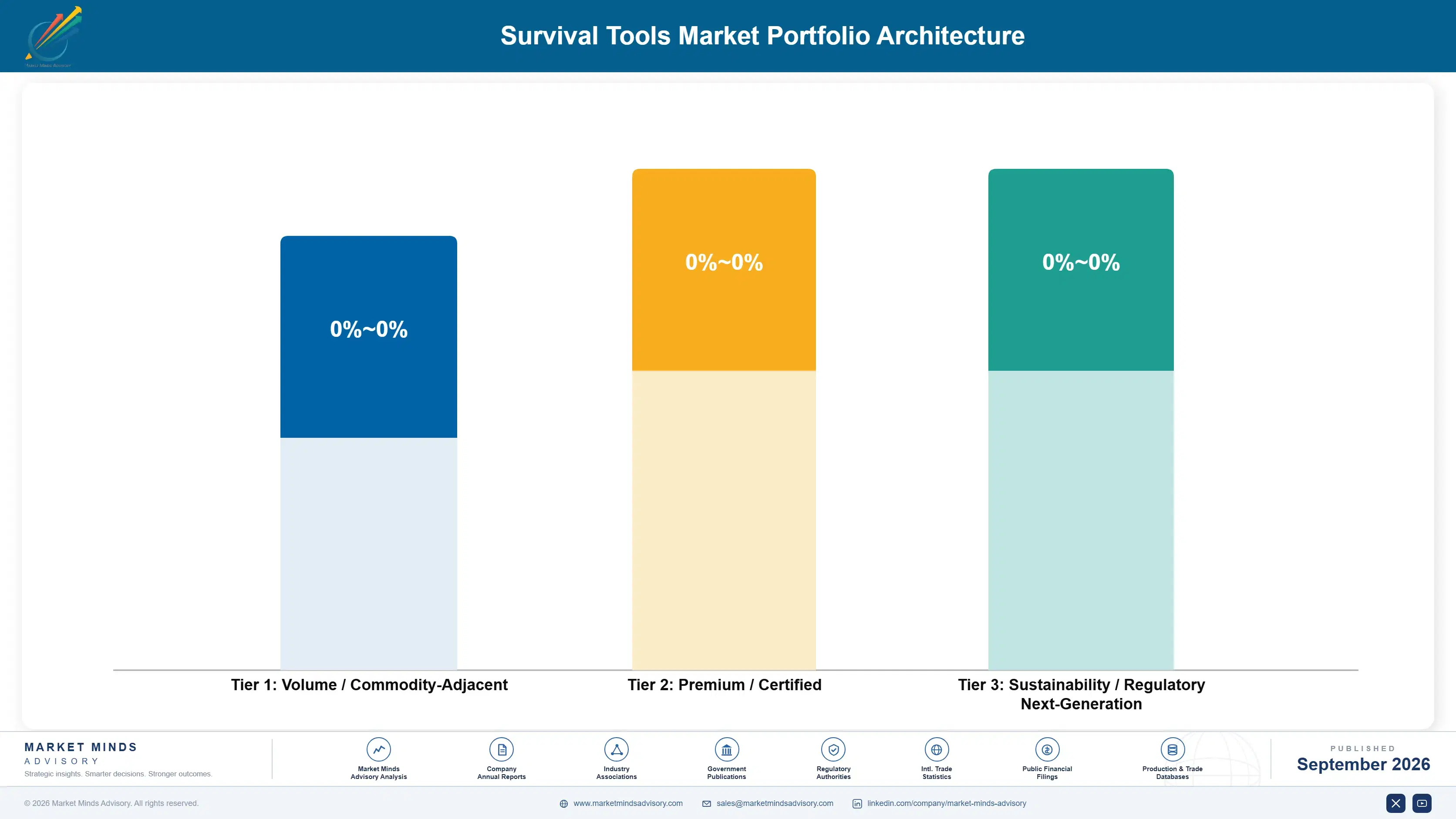
Margin architecture divides by whether a claim can be verified and by whether the product is ever actually used, which is an unusual pair of variables. Entry kits and assembled bundles sold through online marketplaces run at gross margins in the high twenties to mid thirties, competing on contents count and photograph against products nobody will open and therefore nobody will review accurately.
Specialist blades, multi-tools and quality illumination sold through outdoor specialty channels hold gross margins in the mid forties to low fifties. The spread reflects manufacturing reputation and feel in the hand rather than any measurable performance, since the buyer evaluates at the counter. Multi-tools in particular support the strongest pricing because they are the one product here that gets used and therefore genuinely earns preference.

The highest-value pool is certified water treatment, at margins in the mid fifties to low sixties. A named standard on pack is the only verifiable claim in this market, and buyers pay for an outcome they cannot check themselves precisely because somebody else did. Entry kits generate volume and reviews from people who never opened them. They generate very little else.

Volume / Commodity-Adjacent

Entry kits and assembled bundles sold through online marketplaces on contents count and photograph. Nobody opens them, so no accurate review ever forms and price becomes the only comparable variable at all.
Gross Margin: 28 to 36%

Premium / Certified

Specialist blades, multi-tools and quality illumination through outdoor specialty channels. The eight-point range reflects manufacturing reputation and feel at the counter rather than any measurable field performance. Multi-tools support the strongest pricing of the three.
Gross Margin: 44 to 52%

Sustainability / Regulatory / Next-Generation

Water treatment devices certified against a named microbiological standard. This is the only verifiable claim in the category, and buyers pay for an outcome somebody else has actually tested for them.
Gross Margin: 54 to 62%
survival-tools-market-portfolio-architecture-1790023499480

High-value Sub-segments and Strategic Watch-out

Certified Water Treatment Devices

High value and high growth at 11.1%. Only about 12% of water devices are tested against a recognised standard while claims appear on most. Certified participants report price realisation around 1.7 times uncertified equivalents. Buyers pay for an outcome that somebody else has actually gone and tested.
Gross Margin: 56 to 62%

Multi-Tools And Folding Knives

High value and steady growth. The only product here used weekly, which builds familiarity, wear-based replacement and genuine brand loyalty that nothing else in this category manages to develop at all. Replacement runs on wear rather than anxiety, which stabilises revenue considerably across the year.
Gross Margin: 46 to 52%

Entry Assembled Survival Kits

Volume core sold on contents count and photograph through marketplaces. Nobody opens them so no accurate feedback forms, and the tier competes purely on how much appears to be in the package. Contents count rather than any performance attribute decides the purchase decision here entirely.
Gross Margin: 28 to 35%

Alkaline Shipped Stored Devices

Strategic watch-out. Leakage disables roughly 34% of stored devices before first use, and the failure arrives at the worst possible moment. The fourteen-point range reflects how differently participants specify cells. Alkaline cells ship only because they cost a little less to include in the box.
Gross Margin: 34 to 48%

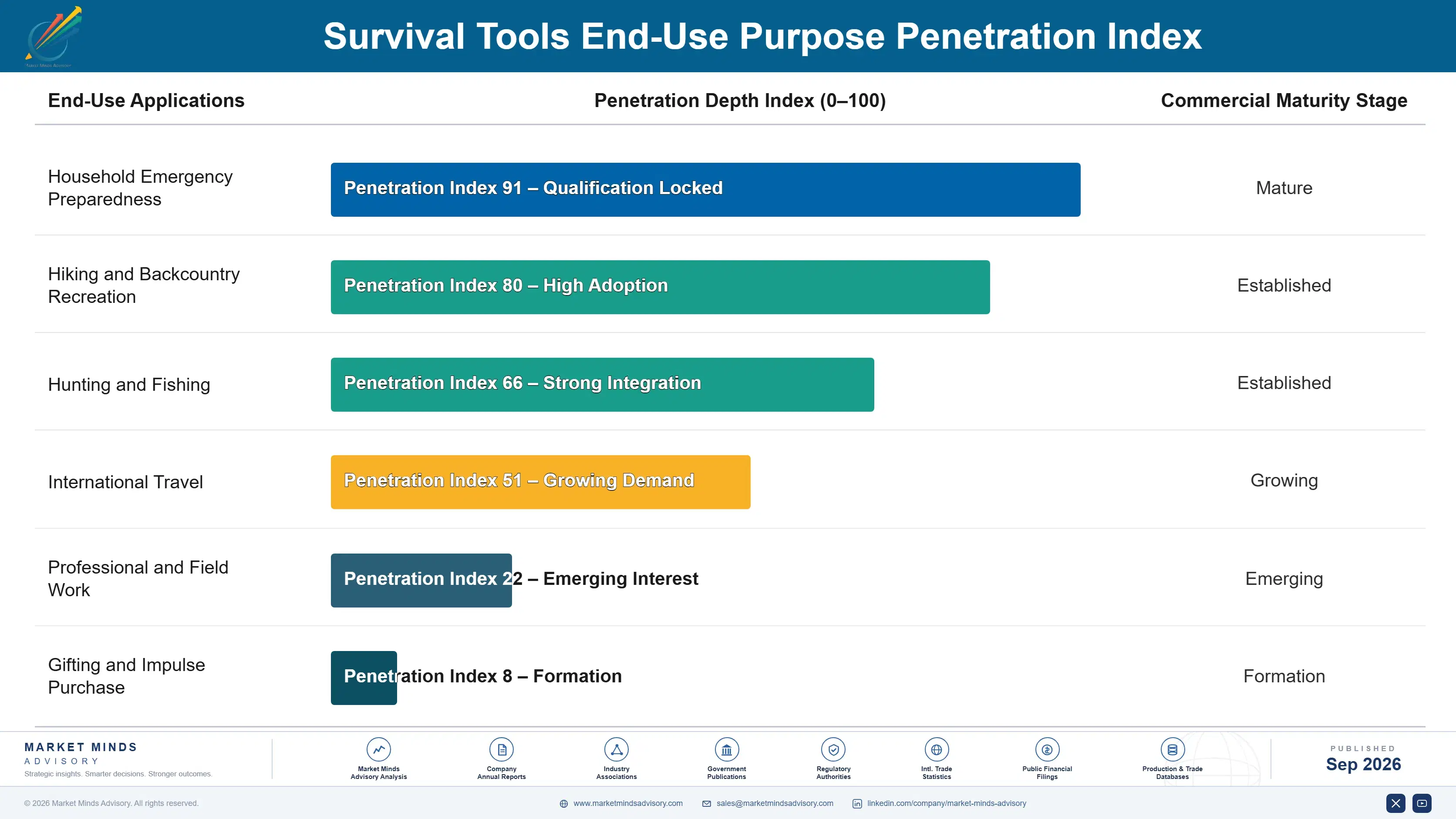
Why Buyers Rarely Return

Most of this category is a single-purchase relationship and the industry has largely accepted that. Roughly 88% of kits are never opened, which means no wear occurs, no replacement is triggered and no informed opinion forms about whether the product was any good. A customer who bought insurance against an event that did not happen has no reason to buy it again, and nothing in the product reminds them to.
Stickiness varies sharply by whether the product gets used. Multi-tool owners are the most loyal group in this market by a wide margin, because weekly use produces familiarity and eventual wear that triggers a genuine replacement. Water treatment buyers using devices for hiking or travel replace cartridges on a schedule and behave like a consumables customer. Preparedness-only buyers behave like nobody at all, since the transaction simply ends.

Buyer behaviour is shifting in one market in a way the rest could learn from. Japanese households treat the emergency kit as a routine item renewed on a schedule rather than a reaction to an event, which converts the category from anxiety-driven spikes into steady replacement demand. That group replaces expired consumables and buys again without any incident prompting it.
survival-tools-market-end-use-penetration-index-1790023499969

Where Trust Can Be Built

These are among the four positions where our research anticipates prominent divergence between winners and laggards over the coming forecast period. Each is grounded in the demand model, the regulatory perimeter, and the announced capacity pipeline.
01 / PURIFIER STANDARD CERTIFICATION

Test the one claim that can be tested

Around 12% of water treatment devices sold here are tested against a recognised microbiological purifier standard, while log reduction claims appear on the large majority of them generated against no stated protocol by anyone at all. Testing and naming the standard on pack costs a laboratory programme rather than reformulation, and it is the only verifiable claim this category contains. Participants holding certification report price realisation around 1.7 times comparable uncertified devices, because the buyer is purchasing an outcome they cannot check.
02 / STORED CELL SPECIFICATION

Ship the battery that will still work

Roughly 34% of stored emergency devices are disabled by alkaline cell leakage that corrodes the contacts long before anyone reaches for the switch, and alkaline cells ship with products only because they cost less. Printing that a stored device needs lithium primary cells, and shipping those cells with preparedness ranges, removes the category's most avoidable failure for a few dollars. Participants doing it report warranty and complaint contacts on stored devices falling by about 52% with no engineering change involved.
03 / KIT RENEWAL SCHEDULING

Sell insurance the way insurance is sold

Roughly 88% of survival kits are never opened, which means no wear occurs, no replacement triggers and the customer relationship simply ends at purchase. Printing expiry dates on consumable contents and offering scheduled renewal converts that one-off transaction into a recurring one, which is precisely how Japanese household preparedness already behaves at 10.2% growth. Participants offering renewal report repeat purchase around 2.6 times their range average across subsequent years, and nothing else in this category brings a preparedness customer back at all.
04 / JURISDICTION RANGE DESIGN

Build blades to the tightest limit that matters

Twenty-three distinct legal blade length and locking limits apply across the major markets covered in this report, fragmenting ranges and stranding inventory in markets where it cannot lawfully be sold at all. Designing a core range inside the most restrictive common limit and adding longer variants only where permitted reduces stock-keeping complexity substantially. Participants doing this report inventory write-downs on blade products falling by roughly 29%, with no measurable loss of sales in permissive markets, and longer variants can still be added wherever the law actually permits them.

Engagement Snapshot From the Field

A live engagement with an industry participant carrying material or product regulatory and market exposure ahead of a defining policy shift, showing how our research translates into a defensible multi-year portfolio strategy.
MARKET MINDS ADVISORY · CLIENT ENGAGEMENT SUMMARY
Survival Tools Producer Strategic Portfolio Review and Transition Roadmap 2026·Investment Scenario on Survival Tools Exposure Evaluation 2025-26
CLIENT PROFILE
A North American outdoor equipment brand selling knives, illumination and assembled preparedness kits through specialty retail and online marketplaces, with revenue near USD 96 million (client-reported, unverified by MMA). Water treatment devices carried log reduction claims with no certification behind them. Every illumination product shipped with alkaline cells, and kits carried no expiry or renewal information of any kind.
STRATEGIC CHALLENGE
Revenue spiked with weather events and fell back between them, producing a pattern management described as unforecastable, and a marketing programme built around event response had been approved. Nobody had examined what happened to customers after purchase, or whether the water device claims could survive any scrutiny at all. Neither question had ever been asked internally.
MMA APPROACH
MMA commissioned independent testing of the client's water devices against a recognised microbiological purifier standard, then tested stored illumination products from the field for cell leakage damage. Purchase records were analysed for repeat behaviour across three years. Blade range stock-keeping units were mapped against jurisdiction limits in the markets they were shipped to.
KEY FINDINGS
  1. Two of four water devices failed the recognised purifier standard outright, and both carried log reduction claims that had been supplied by the contract manufacturer without any test documentation.
  2. Field-returned illumination products showed cell leakage damage in 39% of units, above the category figure, and every one had shipped with alkaline cells included.
  3. Repeat purchase across three years ran at 9% overall but reached 41% among multi-tool buyers, confirming that only used products generate any returning customer at all.
  4. Blade stock-keeping units shipped into markets where 22% of them could not lawfully be sold, and that inventory had been written down twice without the cause being identified.
CLIENT PROFILE
A North American outdoor equipment brand selling knives, illumination and assembled preparedness kits through specialty retail and online marketplaces, with revenue near USD 96 million (client-reported, unverified by MMA). Water treatment devices carried log reduction claims with no certification behind them. Every illumination product shipped with alkaline cells, and kits carried no expiry or renewal information of any kind.
STRATEGIC CHALLENGE
Revenue spiked with weather events and fell back between them, producing a pattern management described as unforecastable, and a marketing programme built around event response had been approved. Nobody had examined what happened to customers after purchase, or whether the water device claims could survive any scrutiny at all. Neither question had ever been asked internally.
MMA APPROACH
MMA commissioned independent testing of the client's water devices against a recognised microbiological purifier standard, then tested stored illumination products from the field for cell leakage damage. Purchase records were analysed for repeat behaviour across three years. Blade range stock-keeping units were mapped against jurisdiction limits in the markets they were shipped to.
KEY FINDINGS
  1. Two of four water devices failed the recognised purifier standard outright, and both carried log reduction claims that had been supplied by the contract manufacturer without any test documentation.
  2. Field-returned illumination products showed cell leakage damage in 39% of units, above the category figure, and every one had shipped with alkaline cells included.
  3. Repeat purchase across three years ran at 9% overall but reached 41% among multi-tool buyers, confirming that only used products generate any returning customer at all.
  4. Blade stock-keeping units shipped into markets where 22% of them could not lawfully be sold, and that inventory had been written down twice without the cause being identified.
RECOMMENDED STRATEGY
Phase 1: Phase one: withdraw the two failing water devices and certify the remaining range against the named standard before relaunch. Two of four failed outright. Phase 2: Phase two: ship lithium primary cells with all stored illumination and print the chemistry requirement clearly on pack. Leakage disabled 39% of field returns. Phase 3: Phase three: add expiry dates and scheduled renewal to preparedness kits and rebuild the blade range around jurisdiction limits. Renewal is what insurance does.
OUTCOME
Repeat purchase rose from 9% to 24% within four quarters, driven almost entirely by kit renewal (client-reported, unverified by MMA). Certified water devices sold at a 44% price premium to the withdrawn products, and blade inventory write-downs stopped once the range was rebuilt around the limits it actually shipped into.

Frequently Asked Questions

Foundational context covering the market sizes, CAGR, scope, country, region and competition that inform every finding below. This section is provided to cover basics and most often pre-purchase conversations, answered from the MMA Primary Research Dataset.

What is the current size of the Survival Tools Market?

The market was valued at USD 2.6 billion in 2025, rising to USD 2.8 billion in 2026. Sizing is at wholesale shipment value across six tool functions.

How large will the Survival Tools Market be by 2036?

MMA forecasts USD 5.7 billion by 2036, an increase of USD 2.9 billion over the 2026 base. That represents expansion of 2.04 times across the forecast period.

What is the CAGR for the Survival Tools Market 2026 to 2036?

The base case CAGR is 7.4%, with a bull case of 8.7% and a bear case of 6.2%. Historical growth between 2020 and 2025 ran at 6.3%.

Which segment is growing fastest?

Water filtration and purification devices grow at 11.1%, half again the market rate, because they serve preparedness and outdoor use together and the claim is testable. Signalling follows at 8.6%.

Who are the major companies in the Survival Tools Market?

Fiskars Group, Victorinox, Leatherman, Katadyn and Cascade Designs lead on shipment value, holding a combined 22%. The category remains among the most fragmented in outdoor equipment.

Which country is growing fastest?

Japan grows fastest at 10.2%, because household disaster preparedness is routine there rather than exceptional, supported by municipal guidance and scheduled kit renewal. Contents are checked and expired consumables replaced without any incident prompting it.

Report Segmentation Architecture

The full report scope spans multiple orthogonal segmentation dimensions, with cross-tabulated demand data provided for each dimension pair. Coverage extends further to regional breakdowns, trend trajectories, and the competitive detail needed to support segment-level decision-making.

By Tool Function

  • Multi-Tools and Folding Knives
  • Fixed Blade Survival Knives
  • Water Filtration and Purification Devices
  • Fire Starting and Ignition Tools
  • Signalling and Illumination Devices
  • Emergency Shelter and Cordage

By End-Use Purpose

  • Household Emergency Preparedness
  • Hiking and Backcountry Recreation
  • Hunting and Fishing
  • International Travel
  • Professional and Field Work
  • Gifting and Impulse Purchase

By Distribution Channel

  • Outdoor Specialty Retail
  • Online Marketplaces
  • Mass and Sporting Goods Retail
  • Brand Direct Online
  • Military and Tactical Suppliers
  • Hardware and General Retail

By Region

  • North America
  • East Asia
  • Western Europe
  • South Asia and Pacific
  • Latin America
  • Middle East and Africa
  • Eastern Europe

Scope, Methodology, and Coverage

Every figure in this report is reproducible from documented input assumptions. The scope below maps the historical period, the forecast horizon, the segmentation dimensions, and the countries covered, alongside the underlying primary and qualitative methodology.
Historical Period
2020 to 2025
Forecast Period
2026 to 2036
Base Year
2025 (USD billions; MMA Primary Research Dataset, September 2026)
Market Definition
This market covers tools and equipment carried or stored for emergency and wilderness survival use, spanning multi-tools and folding knives, fixed blade survival knives, water filtration and purification devices, fire starting and ignition tools, signalling and illumination devices, and emergency shelter and cordage. Sizing is at wholesale shipment value across outdoor specialty, marketplace, mass, direct, tactical and hardware channels. Firearms and ammunition, camping furniture and tents, freeze-dried food, medical first aid kits sold as medical devices and vehicle recovery equipment are excluded throughout.
Quantitative Units
USD billions at wholesale shipment value; volume in millions of units; blade length in millimetres.
Segmentation Dimensions
Tool function, end-use purpose, distribution channel, and geographic region.
Regions Covered
North America, East Asia, Western Europe, South Asia and Pacific, Latin America, Middle East and Africa, Eastern Europe
Countries Covered
United States, Japan, Germany, Australia, Brazil, Canada
Key Companies Profiled
Fiskars Group, Victorinox, Leatherman Tool Group, Katadyn Group, Cascade Designs, SOG Specialty Knives, Benchmade, Spyderco, Buck Knives, Morakniv, Helle, Ka-Bar, Vestergaard, Sawyer Products, Grayl, UST Brands, Exotac, Streamlight, Petzl, Black Diamond Equipment
Quantitative Methodology
Primary survey, n=3,800 respondents, Q4 2025, six countries; demand-side model with trade association cross-validation
Qualitative Methodology
47 expert interviews, Q4 2025; applied to validate demand model assumptions, identify emerging dynamics, and assess competitive positioning
Report Format
PDF and XLSX data workbook (Word format preview document)
Publisher
Market Minds Advisory
Report Code
MMA-2026-CON-788
Published
September 2026
Contact
sales@marketmindsadvisory.com | www.marketmindsadvisory.com

Purchase the full Survival Tools Market Report (2026 to 2036).

The full report sizes the survival tools market across six tool functions, six end-use purposes and six distribution channels for all seven global regions. It includes independent testing of water treatment devices against a recognised microbiological purifier standard, with results compared against the claims those products carry. Field-returned illumination products are examined for stored cell leakage damage. Repeat purchase is analysed by product type to establish which items generate returning customers, and blade ranges are mapped against jurisdiction limits. Competitive assessment covers 20 participants on a consistent shipment value basis.
Water devices tested against a recognised purifier standard
Field returned illumination examined for cell leakage
Repeat purchase analysed by product type
Blade ranges mapped against jurisdiction limits
Six tool functions sized through 2036
Twenty participants assessed on wholesale shipment value

Built For The People Who Decide

From boardroom strategy to bench-side execution, this report is read cover-to-cover by leaders shaping the next decade of their industry, turning demand scenarios, market dynamics and valuation benchmarks into decisions.
CXOs/ Presidents/ VPs/ Managers
M&A and Corporate Development
Strategy Teams and R&D Heads
Procurement and Product Directors
Regulatory and Compliance Leaders
Investor Relations and Equity Analysts