

Market Minds Advisory
Surimi Market

Surimi Market: The Grade Is a Measure of Time, Not Skill

Gel strength begins falling within about four hours of a fish leaving the water, so the entire price ladder in this product measures logistics rather than any difference in processing capability.

Lead Analyst

Lisa Gevelber

Published

September 2026

Make Smarter Decisions with Customized Research Insights

Request a free sample report and evaluate market opportunities, growth trends, and competitive dynamics relevant to your business needs.

2025 MARKET VALUE$4.6BMarket Size 2025
2036 FORECAST VALUE$7.7BBase Case , 2026 to 2036
CAGR 2026 TO 20364.8 %Bull 6.0% / Bear 3.6%
INCREMENTAL OPPORTUNITY$2.9BNet 10- year value creation
EXPANSION MULTIPLE1.60x2036 value over 2026 base
Strategic Levers
M&A Pipeline
Regional Outlook
Country Rankings
Competitive Intelligence
Segmental Deep-dive
Call-Us : 91 93563 13602

Executive Snapshot and Market Trajectory

Everything that decides the value of this product happens in the first four hours. Myofibrillar protein begins losing its gel forming ability almost immediately after a fish is landed, and nothing downstream recovers it, so grade records elapsed time rather than processing skill.
That explains a price ladder spanning roughly 2.4 times between top and commodity grades. Factory vessels processing at sea hold the high end because the fish never waits, while shore plants working landed catch cannot close that gap however good their equipment is. The ladder is a logistics outcome that reads on a specification sheet as a quality difference. No equipment recovers what the clock already took.
Supply is also close to its ceiling. Alaska pollock is well managed and around 96% of the sustainable quota is already taken, so the traditional resource cannot grow. Tropical species surimi grows fastest at 7.2% and Vietnam leads all countries at 9.4%, which means the category's future depends on warm-water gel quality improving rather than on catching more fish. Japanese demand for the best grades is declining too. Plant capability barely enters any of it.
Market Definition
Washed and stabilised minced fish protein paste supplied as an intermediate ingredient, covering Alaska pollock surimi, Pacific whiting and other northern species, tropical marine species, freshwater species, byproduct and recovered flesh surimi, and blended multi-species surimi. Measured at processor selling value. Excludes finished surimi seafood products such as crab sticks and fish cakes, whole and filleted fish, fish protein isolates, plant-based seafood analogues, and fishmeal.
Base Year Value
$4.6B in 2025 (MMA Primary Research Dataset, August 2026)
Forecast Period
2026 to 2036, eleven discrete annual values
CAGR
4.8% base case. Bull 6.0%. Bear 3.6%.
Fastest Growth Segment
Tropical Marine Species Surimi: 7.2% CAGR
Fastest Growth Country
Vietnam: 9.4% CAGR
Fastest Growth Region
South Asia and Pacific: 6.8% CAGR
Largest Region
East Asia: 34% of 2025 global value
Market Leaders
Trident Seafoods, Maruha Nichiro, Nissui, American Seafoods, Thai Union Group. Source: MMA Primary Research Dataset, July 2026.
Primary Survey
n=3,800 procurement and R&D decision-makers, Q4 2025, six countries
Methodology
Demand-side build-up, cross-validated against public data, 47 expert interviews

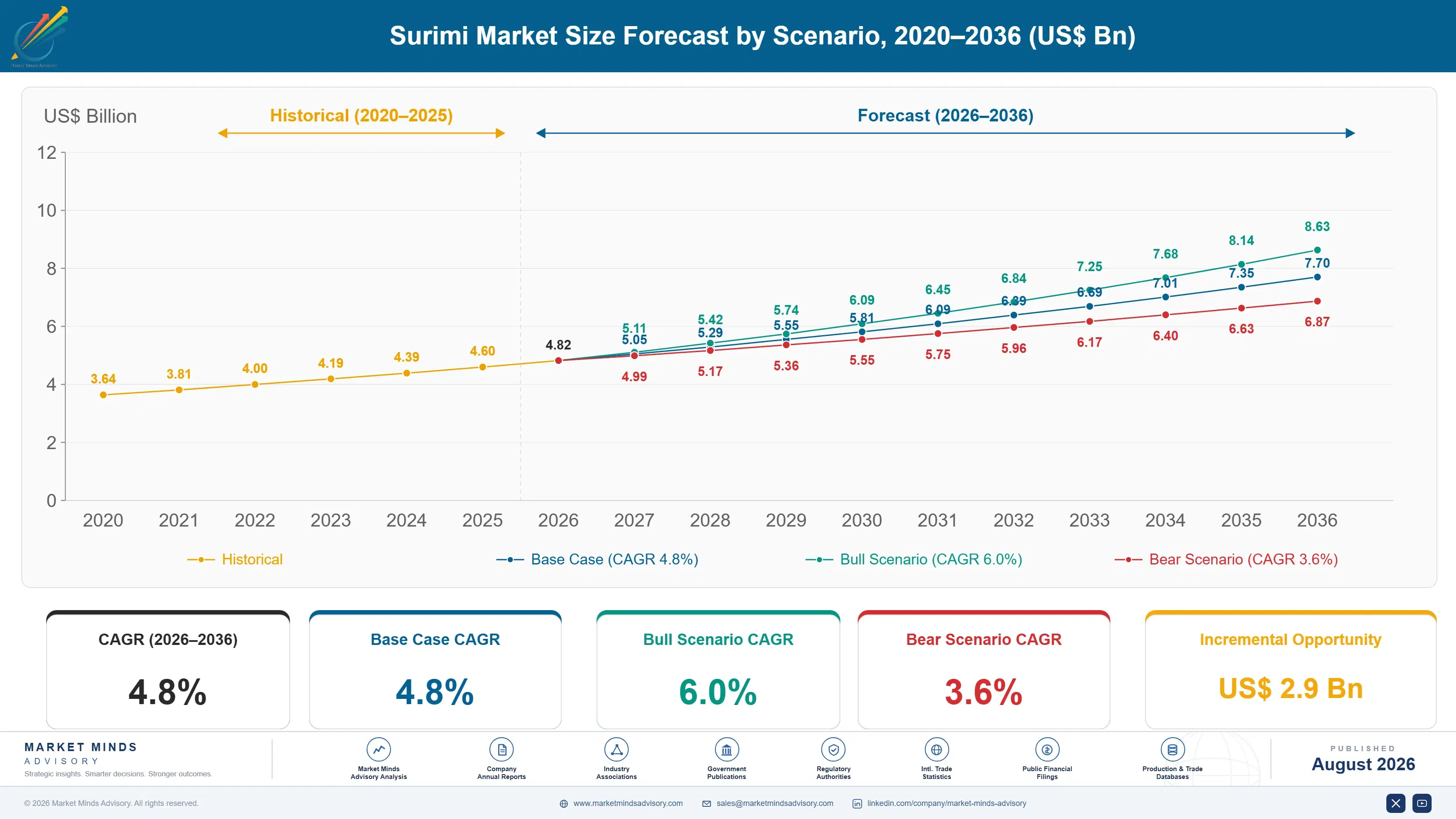
Surimi Market Forecast Scenarios

surimi-market-trends-size-forecast-scenario-1787639581484
Growth ran near 4.0% between 2020 and 2025, with volume constrained by resource limits rather than by demand at any point in the period. Alaska pollock quotas moved within a narrow band and could not expand, tropical species production grew steadily from India and Southeast Asia, and Japanese consumption of traditional kamaboko products continued its long decline while crab stick demand expanded elsewhere.
Base case 4.8% rests on three mechanisms. Tropical marine species surimi grows at 7.2% because it is the only source with meaningful headroom left, and gel quality has improved enough to reach applications previously closed to it. Freshwater species surimi grows at 6.4% on Chinese and Indian aquaculture output. And Vietnam grows fastest of any country at 9.4% as processing capacity expands near landing sites. All three run on supply rather than demand.
The bull case at 6.0% assumes tropical gel strength improving enough to substitute into mid grade applications currently reserved for northern species, which would release the resource constraint that caps this market. The bear case at 3.6% is Japanese traditional consumption declining faster than crab stick demand grows elsewhere, which would erode the value mix while volume stays broadly flat.

Four Hours Decides the Whole Price

Surimi grading looks like a quality measurement and functions as a clock. Myofibrillar protein starts losing gel forming ability within roughly four hours of a fish being landed, and no amount of washing, refining or cryoprotectant addition afterwards restores what has already gone. A processor with excellent equipment and fish that waited overnight cannot make top grade product, and one with ordinary equipment and fresh fish can.
TOP FIVE CONCENTRATION33%Vessel ownership and landing access keep the field wide
POST-CATCH WINDOW4 hoursPeriod after landing before gel forming ability begins degrading
GRADE PRICE SPREAD2.4xDifference between top and commodity surimi grade pricing
POLLOCK QUOTA UTILISATION96%Share of the sustainable annual catch already being taken
YIELD FROM WHOLE FISH22%Portion of landed weight recovered as finished paste
CRYOPROTECTANT ADDITION8%Sugar and phosphate content added before frozen storage
That single fact organises the entire industry. Factory trawlers processing at sea occupy the premium tier because the interval between catching and washing is measured in minutes, and shore based plants working landed catch necessarily occupy the tiers below. The resulting price spread of around 2.4 times between top and commodity grades is a logistics outcome that everybody reads as a difference in manufacturing capability.
Growth now runs into the resource. Alaska pollock is among the best managed fisheries anywhere and roughly 96% of the sustainable quota is already being taken, which means the traditional supply base cannot expand however strong demand becomes. The available headroom sits in tropical and freshwater species, where gel strength is lower and improving, and that improvement rather than any fishing decision determines how large this market becomes.
"Buyers argue about grade specifications as though they were negotiating manufacturing quality, when what they are really pricing is how quickly a boat got to a washing line. The processors who understand that are buying vessel time rather than upgrading plant."
Director, Seafood Processing and Protein Ingredients Practice · MMA Agriculture and Food Practice · August 2026

Market Trends

Tropical gel quality improving toward mid grade substitution

Threadfin bream and other warm-water species produce lower gel strength than northern whitefish, which historically confined tropical surimi to the cheapest applications. Improved onboard handling, faster chilling and better washing control have narrowed that gap enough for tropical product to enter mid grade formulations that were previously closed to it. Growth at 7.2% follows from that technical progress rather than from any expansion in fishing effort, and it is the only headroom this market genuinely has. Whether that gap closes further is the single most consequential technical question anybody in this industry is currently working on.
Market Impact: Vietnam growing fastest at 9.4%

Traditional Japanese consumption declining as export formats grow

Kamaboko, chikuwa and other traditional Japanese products have been losing consumption steadily with an ageing population and changing eating patterns, and those are the applications that historically paid for top grade surimi. Crab stick and fish cake demand across Europe, North America and Latin America grows in their place at lower grade requirements. Volume holds up reasonably well while value mix deteriorates, which is a considerably less comfortable position than the headline suggests. A processor holding the best resource and the fastest declining customer base at once is in a more awkward position than headline volume figures suggest.
Market Impact: Reaches beyond 2.4 times grade spread

Market Opportunities and Growth Drivers

Southeast Asian processing capacity building beside landing sites

Vietnam grows fastest of any country at 9.4% as processing capacity is built close to landing points, which shortens the interval between catch and washing and directly improves the grade achievable from the same fish. That is a logistics investment producing a quality outcome, which is how this industry actually works. Indian and Thai capacity follows a similar pattern, and the resulting product increasingly competes for applications that northern species once held exclusively. The resulting product increasingly competes for applications that northern species once held to themselves entirely. Grade follows siting rather than plant.
Market Impact: Quota utilisation reaches 96%

Crab stick consumption expanding across newer western markets

Crab stick and imitation seafood consumption continues expanding across Europe, North America and Latin America, where the products are treated as an affordable protein rather than a traditional food. Those applications specify mid and commodity grades rather than the premium product Japanese traditional manufacture requires, which suits the tropical and freshwater supply that has headroom. Retail promotion and foodservice adoption both drive it, and price sensitivity keeps grade requirements modest. That suits the tropical and freshwater supply which has headroom, and it steadily shifts the industry's value mix downward while total volume keeps rising.
Market Impact: Degradation begins within 4 hours

Market Restraints and Challenges

Resource limits capping supply regardless of demand strength

Around 96% of the sustainable Alaska pollock quota is already taken and the fishery is managed carefully enough that it will not be expanded, which means the traditional supply base cannot grow whatever demand does. The root cause is biological rather than commercial. Commercially it caps volume and pushes buyers toward species with lower gel strength. Tropical and freshwater sourcing plus improved yield from landed weight are the routes participants are pursuing instead. Yield improvement is the only route to more product from the same fish. That constraint binds regardless of price.
Market Impact: Tropical surimi growing at 7.2%

Time to washing determining grade beyond processor control

Gel forming ability begins degrading within roughly four hours of landing and nothing downstream recovers it, so a shore based processor working catch that travelled overnight cannot reach top grade whatever its equipment. The root cause is protein chemistry rather than plant capability. Commercially it means capital investment in processing does not buy grade improvement. Vessel time, onboard chilling and siting plants near landings are the mitigations that genuinely work. Processors reading their grade limitation as an equipment problem keep investing in plant that cannot address it, which is a recurring and expensive mistake across this industry.
Market Impact: Grade spread reaches 2.4 times
3 additional market trends, 4 additional growth drivers, and 2 additional restraints and challenges are covered in the full report. Contact sales@marketmindsadvisory.com to access the complete intelligence.

Segment CAGR and Growth Architecture

Six segments are split by raw material source, because source determines the gel strength achievable, the interval between catch and washing, the resource headroom available and the applications the resulting product can serve. Grade variants sit inside each source rather than beside them. Processing location and channel are handled separately in the framework. Headroom differs by source too.
surimi-market-trends-market-share-analysis-1787639582155

Tropical Marine Species Surimi

Growing at 7.2%, half again the market rate of 4.8%, this covers threadfin bream and other warm-water species processed largely across India, Vietnam and Thailand. Gel strength has historically sat below northern whitefish, confining the product to the cheapest applications, but improved onboard chilling and processing sited close to landings have narrowed that gap enough to reach mid grade formulations. It is the only source with genuine resource headroom, which makes its quality trajectory the single most consequential technical question in this market. Processing sited beside landings buys more grade than any equipment specification does. Improved onboard chilling has already narrowed the gel gap enough to matter commercially, and further progress determines how much of this resource becomes genuinely usable.
CAGR 7.2%

Freshwater Species Surimi

At 6.4% freshwater surimi is produced mainly from Chinese and Indian aquaculture species including silver carp and tilapia, where supply is farmed rather than fished and therefore expands with production decisions rather than with quota allocations. Gel characteristics differ from marine species and colour is generally less white, which limits applications and requires blending in many formulations. Proximity between farm and processor is achievable in ways that ocean fisheries cannot match, which partly offsets the inherent protein disadvantage in gel performance. Supply expands with stocking and harvest decisions rather than with quota allocations, which makes it the one source in this market that responds to commercial signals within a single production cycle.
CAGR 6.4%
Full segment breakdown across 6 segments available in the complete report.

Regional Architecture and Country Demand Map

East Asia holds 34% of value, above the standard band, because surimi is fundamentally an East and Southeast Asian food and Japan, Korea and China consume the majority of finished product between them. Two other regional shares also fall outside their standard bands. Scope is global.

North America

Share sits at 16%, below the standard band, because surimi consumption is concentrated in Asian markets while North America is primarily a producing region. Alaska pollock factory vessels supply the premium grades that define the top of the market, processing within minutes of catching in a way no shore plant can match. Domestic crab stick consumption is growing steadily as an affordable protein rather than a traditional food. Growth at 4.0% reflects a fishery already at its sustainable limit. Quota access rather than processing capability defines the position here, and quota is allocated rather than purchasable at will by any competitor. Shore based operations here face the same clock as anywhere else.
Share: 16% | CAGR: 4.0% (2026 to 2036)

Western Europe

Crab stick and imitation seafood consumption is well established across France, Spain and Italy, where the products are an everyday retail protein rather than a specialist item. Almost all surimi is imported, from American, Japanese and increasingly Southeast Asian processors, which makes the region a demand centre without any production position. Grade requirements are moderate and price sensitivity meaningful. Growth of 3.4% is the slowest anywhere on mature consumption in the established national markets. Sourcing certification and traceability documentation are asked for harder by retail buyers here than in most markets, which shapes which processors can supply at all. Almost no regional production exists, which makes this a demand centre entirely dependent on imported paste from processors elsewhere.
Share: 18% | CAGR: 3.4% (2026 to 2036)
Regional intelligence for 5 additional markets available in the complete report: East Asia, South Asia and Pacific, Latin America, Middle East and Africa, Eastern Europe. Contact sales@marketmindsadvisory.com.
surimi-market-trends-country-cagr-analysis-1787639582814

Four Moves Against the Clock

Grade is decided by elapsed time between catch and washing, and the resource that produces the best grades is already fully taken. What remains is buying time rather than equipment, improving what warm-water species can do, and accepting that the value mix is shifting whether or not anybody likes it. Time is the variable.

Buy vessel time rather than upgrading shore plant

Gel forming ability degrades within about four hours of landing and no processing investment recovers it, which means capital spent on shore equipment cannot buy grade improvement. Vessel access, onboard chilling and plant siting close to landings all buy the thing that actually matters. Processors who understand the 2.4 times grade spread as a logistics outcome allocate capital very differently from those reading it as a manufacturing quality difference. The grade spread of 2.4 times rewards hours saved rather than equipment installed, which is an uncomfortable conclusion for anybody who has just approved a capital programme.
Market Impact: Protects the entire 2.4 times grade price spread

Invest in tropical gel improvement while headroom exists

Around 96% of the pollock quota is already taken, which leaves tropical species as the only source with meaningful supply headroom in this market. Gel strength improvement there through better onboard handling and washing control determines whether that headroom becomes usable volume or stays confined to the cheapest applications. The technical work is modest against the resource constraint it addresses, and growth at 7.2% already reflects partial progress. Nothing else in this market has any headroom left. Onboard chilling, faster washing and tighter process control at source are what close the remaining gel gap,
Market Impact: Serves 7.2% tropical species growth in every year

Site processing capacity beside landing points deliberately

Vietnam grows at 9.4% largely because processing has been built close to where fish comes ashore, which shortens the interval that decides grade more effectively than any equipment specification. That is a siting decision rather than a technology one, and it is available to anybody prepared to place capacity awkwardly relative to labour or logistics. The grade improvement it produces is worth considerably more than the operational inconvenience it creates. A single season generally repays the inconvenience through realised grade alone. Labour and logistics disadvantages are real and generally smaller than the grade uplift,
Market Impact: Follows 9.4% Vietnamese production growth in every year

Rebuild the mix around growing export formats

Japanese traditional consumption that paid for top grade product is declining while crab stick demand in western and Latin American markets grows at lower grade requirements. A processor built entirely around premium Japanese supply is serving a shrinking customer base with the resource that has least headroom. Rebalancing toward export formats accepts a lower grade mix in exchange for volume that is actually growing, which is an uncomfortable but necessary trade. Volume across those export formats grows while premium Japanese demand falls, and a processor holding 96% utilised quota against a shrinking customer base is defending the wrong asset.
Market Impact: Shifts mix across the full 2.4 times spread

Who Controls the Margin Pool

Participation is measured on annual surimi production tonnage, and the top five hold 33%. Concentration is low because production follows fishing access and landing proximity rather than any manufacturing barrier, which leaves a long tail of regional processors. Trident Seafoods and Maruha Nichiro lead through vessel ownership and quota access rather than through any processing advantage that could be replicated onshore. The gap to challengers is fishing access rather than processing capability.
Competition runs on three fronts. Fishing access and quota holdings decide who can produce premium grades at all. Landing proximity decides achievable grade for shore based operations, which is a siting question rather than an operational one. And processing cost decides commodity supply, where Southeast Asian producers compete effectively. Certification and traceability have become a fourth front, and western retail buyers press it considerably harder than Asian traditional manufacturers do.

Pressure ahead comes from tropical gel improvement narrowing the grade gap, and from Japanese traditional demand declining beneath premium producers. Expect quota holders to defend premium positions while volume growth happens elsewhere entirely. Rankings shift on who builds capacity beside tropical landings first. Concentration should stay low given how supply access works.
surimi-market-trends-company-positioning-matrix-1787639583389

Competitive Moat and Risk Dimensions

TRIDENT SEAFOODS

Moat: Quota access and at-sea processing

Alaska pollock quota holdings combined with factory vessels that process within minutes of catching produce top grade surimi that no shore based operation can match at any level of equipment investment. Quota is allocated rather than purchasable at will, which makes the position genuinely difficult to enter regardless of capital available to a competitor.
TRIDENT SEAFOODS

Risk: Premium demand base decline

The applications that pay for top grade surimi are concentrated in Japanese traditional products whose consumption is falling steadily with an ageing population and changing diet. Holding the best resource matters less if the customers willing to pay for its output are gradually disappearing, and export formats do not require the grade being produced.
THAI UNION GROUP

Moat: Tropical sourcing and processing reach

Processing capacity positioned across Southeast Asian landing points addresses the only supply source with meaningful headroom left, and proximity to landings buys the grade improvement that equipment cannot. Combined with established seafood distribution into western retail, that positions the business where volume growth is actually happening rather than where the best resource sits.
THAI UNION GROUP

Risk: Gel strength technical ceiling

Warm-water species produce inherently lower gel strength than northern whitefish, and improved handling narrows that gap without closing it entirely. If tropical product cannot reach mid grade applications reliably, the business remains confined to the cheapest formulations where price competition among regional processors is fiercest.

Players Tracked

Prominent Players

Trident Seafoods
Maruha Nichiro
Nissui
American Seafoods
Thai Union Group

Other Key Players

Golden Alaska Seafoods
Arctic Storm Management Group
Alyeska Seafoods
Pacific Seafood
Viciunai Group
Aquamar
Seaprimexco Vietnam
Gadre Marine Exports
QL Foods
Kibun Foods
Sugiyo
Apex Frozen Foods
Sea Delight
Royal Greenland
Hai Nam Company

Recent Developments

FEBRUARY 2026

Processor commissions capacity beside Southeast Asian landing point

A seafood processor commissioned surimi capacity immediately adjacent to a Southeast Asian landing point, shortening the interval between catch and washing to well under the window in which gel forming ability begins degrading measurably. Equipment specification was deliberately modest, since siting was expected to deliver the grade.
Signal: Siting rather than equipment is what buys grade improvement in this product at almost any cost
SEPTEMBER 2025

Pollock quota set within narrow band for further season

The Alaska pollock quota was set within its established narrow band for a further season, confirming that the fishery is being managed at sustainable yield and cannot supply the volume growth that rising demand for surimi would otherwise absorb. Buyers seeking additional volume were directed toward warm-water sourcing instead.
Signal: The premium resource is capped, so growth has to come from warmer water for any further growth
DECEMBER 2025

Japanese manufacturer consolidates traditional product lines on falling demand

A Japanese surimi products manufacturer consolidated traditional kamaboko and chikuwa production lines, citing consumption decline with an ageing population. Those product lines had been among the few applications specifying top grade surimi consistently. Export format capacity was expanded in their place, at considerably lower grade requirements throughout the range.
Signal: The customers who paid for the best grades are the ones disappearing fastest from the market

Fish, Fuel and Cold Chain

Raw fish carries around 62% of surimi cost, with yield near 22% of landed weight meaning that roughly four and a half kilograms of fish produce one of finished paste. Marine fuel takes about 11% for at-sea processing and considerably less for shore operations. Cryoprotectants at around 8% addition, water, energy and effluent treatment account for around 14%. Frozen storage and freight absorb the balance.
Marine fuel pricing moved sharply through 2022 alongside broader energy costs, per IEA oil market reporting and Maruha Nichiro annual reporting for 2025 on fishing and processing cost exposure. At-sea processors absorbed that movement far more heavily than shore based operations, which briefly narrowed the cost advantage that premium grade pricing had always been assumed to support comfortably. Fuel hedging discipline improved noticeably across the fleet afterwards.

Exposure divides on processing location rather than on scale. A factory vessel carries marine fuel across more than a tenth of cost and quota acquisition or lease costs besides. A shore plant carries lower energy exposure and higher raw material cost, since it buys landed fish at market rather than catching it. Tropical processors carry the lowest cost base and lowest achievable grade, the trade defining this industry.
surimi-market-trends-cost-volatility-analysis-1787639583600

Improve yield recovery from landed and processed weight

Yield sits near 22% of landed weight, so a percentage point of recovery improvement is worth considerably more than any comparable saving elsewhere in the cost structure. Better washing control, refiner settings and recovery of flesh from frames all address it, and the gains are permanent rather than dependent on market conditions holding. Recovery gains are permanent.

Hedge or contract marine fuel against fishing seasons

Marine fuel carries over a tenth of at-sea processing cost and moves with crude markets no fishing business influences. Seasonal fishing patterns make forward positions unusually straightforward to size against actual requirement, which several operators discovered they had not done during the last fuel price movement. Seasonal patterns make sizing forward positions unusually straightforward compared with most commodity exposures.

Site shore processing to minimise time from landing

Raw fish is the dominant cost and grade determines what the resulting paste sells for, so shortening the interval between landing and washing improves realised value from identical raw material. Siting decisions that look awkward for labour or logistics frequently pay for themselves through grade alone within a single season of operation. Grade pays for the inconvenience.

Portfolio Architecture for Margin Defence

Margin here follows grade, and grade follows elapsed time, which means the margin structure of this industry is largely determined before any processing begins. Commodity grade tropical and freshwater surimi earns margins in the mid single digits to low teens, where regional processors compete on delivered cost into price sensitive crab stick manufacture. Delivered cost is the only variable there.
Mid grade northern and improved tropical product does better in the low to high teens, because formulations requiring reliable gel performance narrow the supplier field and manufacturers cannot substitute freely between grades without reformulating the finished product they sell. Reformulating a finished product to accept a different grade changes its eating quality, which buyers avoid unless something forces them into it.

Premium at-sea processed grades hold the strongest position, reaching into the high twenties, where quota access and minutes-old fish produce a product that shore based operations cannot make at all. Those margins reflect fishing rights and vessel capability rather than any advantage in processing technology or plant efficiency. Quota is allocated rather than bought, which makes the position genuinely difficult to enter at any level of capital.

Commodity Tropical and Freshwater Grades

Lower gel strength paste sold into price sensitive imitation seafood manufacture. The seven point range reflects landing proximity and processing cost rather than any capability difference between the regional processors competing.
Gross Margin: 5-12%

Mid Grade Northern and Improved Tropical

Reliable gel performance for formulations that cannot substitute freely between grades. The six point range reflects consistency of supply and how far improved tropical product has closed the gap on northern species.
Gross Margin: 13-19%

Premium At-Sea Processed Grades

Top grade paste from fish processed within minutes of catching aboard factory vessels. The nine point range reflects quota position and vessel capability rather than anything achievable through processing equipment investment ashore.
Gross Margin: 20-29%
surimi-market-trends-portfolio-architecture-1787639584141

High-value Sub-segments and Strategic Watch-out

Improved Tropical Species Grades

High value and the fastest growth at 7.2%, and the only source with real resource headroom left as pollock quota utilisation sits near its sustainable ceiling. Gel improvement decides whether that headroom becomes usable volume. Onboard handling and washing control at source decide it. Headroom is real.
Gross Margin: 14-19%

Premium At-Sea Processed Surimi

High value and defensible on quota access, though the Japanese traditional applications that pay for top grade are declining with an ageing population and changing diet across the region. Export formats do not require the grade this resource produces. Quota allocation protects the position regardless of demand.
Gross Margin: 21-29%

Commodity Crab Stick Grades

The volume core, growing with imitation seafood consumption across western and Latin American retail where price sensitivity is high and grade requirements stay modest throughout the supply chain. Improved tropical product serves it perfectly adequately now. Price sensitivity is high throughout the chain. Grade requirements stay modest.
Gross Margin: 5-12%

Resource Ceiling Exposure

The strategic watch-out. Around 96% of pollock quota is already taken and cannot expand, and the range reflects whether a processor has built tropical sourcing capability or remains dependent on a capped northern resource. Sourcing capability is the only real hedge available. Northern quota cannot expand at all.
Gross Margin: 4-27%

Grade Requirements Set the Buyer

Demand divides by what the finished product needs the paste to do. A Japanese kamaboko manufacturer requires gel strength that only minutes-old fish delivers and pays accordingly. A crab stick producer supplying European retail needs consistency and price, with gel requirements comfortably within what improved tropical product now achieves. Those are different businesses buying an ingredient with the same name. The grade requirement decides which one a processor can serve.
Stickiness follows reformulation cost rather than relationship. A manufacturer that has qualified a grade into a finished product specification will not switch casually, since gel differences change the eating quality of the product on shelf. Commodity supply reopens at every contract because the buyers treat interchangeable grades as interchangeable. Premium supply holds on scarcity as much as on preference.

Buying influences have shifted as sourcing scrutiny increased. Grade and price once decided everything and now sit alongside fishery certification, traceability documentation and increasingly questions about labour conditions in processing. Western retail buyers ask those questions considerably harder than Asian traditional manufacturers do, which means a processor's answers matter differently depending on which customer is asking. Answers matter differently by customer.
surimi-market-trends-end-use-penetration-index-1787639584716

Where We Would Put Effort

These are among the four positions where our research anticipates prominent divergence between winners and laggards over the coming forecast period. Each is grounded in the demand model, the regulatory perimeter, and the announced capacity pipeline.
01 / LANDING PROXIMITY INVESTMENT

Buy hours, not equipment

Gel forming ability begins degrading within roughly four hours of landing and nothing downstream restores it, which means capital spent on shore processing equipment cannot purchase grade improvement at any level of investment. Vessel access, onboard chilling and plant siting beside landing points buy the only variable that actually ends up deciding value here. Processors reading the 2.4 times grade spread as a manufacturing quality difference are allocating capital against a problem that no amount of plant investment could ever solve.
02 / TROPICAL QUALITY DEVELOPMENT

The only headroom left is warm

Around 96% of the sustainable Alaska pollock quota is already taken and the fishery itself will not be expanded further, which now leaves tropical species as the only single source with meaningful supply headroom in this market. Whether that headroom converts into usable volume depends entirely on gel strength improvement achieved through better onboard handling and tighter washing control at source. Growth at 7.2% against a market rate of 4.8% already reflects partial technical progress on exactly that technical question already.
03 / VALUE MIX REBALANCING

The premium customers are the ones leaving

Japanese traditional kamaboko and chikuwa consumption pays for top grade surimi and has been declining steadily with an ageing population and changing eating patterns across the country. Crab stick demand growing across western and Latin American retail specifies considerably lower grades than those applications ever did. A processor built around premium Japanese supply holds the best resource and the fastest shrinking customer base at the same time, which is an uncomfortable combination to hold and a difficult one to defend.
04 / YIELD RECOVERY DISCIPLINE

Raw fish is nearly two thirds of cost

Raw fish carries around 62% of surimi cost at a yield near 22% of landed weight, so roughly four and a half kilograms of whole fish become one kilogram of finished paste and every point of recovery therefore matters enormously. Washing control, refiner settings and flesh recovery from frames each address it directly and permanently. Given that the underlying resource itself simply cannot be expanded, yield improvement is the only route to more product available from the same constrained biological base.

Engagement Snapshot From the Field

A live engagement with an industry participant carrying material or product regulatory and market exposure ahead of a defining policy shift, showing how our research translates into a defensible multi-year portfolio strategy.
MARKET MINDS ADVISORY · CLIENT ENGAGEMENT SUMMARY
Surimi Producer Strategic Portfolio Review and Transition Roadmap 2026·Investment Scenario on Surimi Exposure Evaluation 2025-26
CLIENT PROFILE
A regional seafood processor producing surimi from landed catch at two shore based plants supplying imitation seafood manufacturers across export markets, at annual revenue near 84 million dollars (client-reported, unverified by MMA). Capital investment had been concentrated in processing equipment upgrades over several years. Landing proximity had never featured in siting decisions. Yield had never been benchmarked.
STRATEGIC CHALLENGE
Successive equipment investments had failed to lift achievable grade, and management could not understand why plants running modern washing and refining lines still produced mid grade product. A further capital programme was under consideration on the same reasoning as the previous ones. Board approval was due that quarter. Capital was already provisionally allocated.
MMA APPROACH
MMA measured elapsed time between landing and washing across both plants and compared achieved gel strength against at-sea processed benchmarks, assessed alternative siting options near landing points, sized tropical species sourcing opportunities, and reviewed yield recovery against industry norms. Interviews with 47 experts covered surimi processing, fisheries management and imitation seafood manufacture.
KEY FINDINGS
  1. Elapsed time from landing to washing averaged well beyond the window in which gel forming ability degrades, which no equipment on either site could compensate for at all.
  2. Grade achieved correlated almost entirely with transport time from landing point, and not at all with the processing equipment installed at either of the client's two plants.
  3. Yield recovery sat several points below industry norms, which on raw fish at roughly 62% of cost represented a larger opportunity than any equipment upgrade under consideration.
  4. A landing adjacent site with poorer labour access would have delivered grade improvement worth considerably more than its operational disadvantages across a single season.
CLIENT PROFILE
A regional seafood processor producing surimi from landed catch at two shore based plants supplying imitation seafood manufacturers across export markets, at annual revenue near 84 million dollars (client-reported, unverified by MMA). Capital investment had been concentrated in processing equipment upgrades over several years. Landing proximity had never featured in siting decisions. Yield had never been benchmarked.
STRATEGIC CHALLENGE
Successive equipment investments had failed to lift achievable grade, and management could not understand why plants running modern washing and refining lines still produced mid grade product. A further capital programme was under consideration on the same reasoning as the previous ones. Board approval was due that quarter. Capital was already provisionally allocated.
MMA APPROACH
MMA measured elapsed time between landing and washing across both plants and compared achieved gel strength against at-sea processed benchmarks, assessed alternative siting options near landing points, sized tropical species sourcing opportunities, and reviewed yield recovery against industry norms. Interviews with 47 experts covered surimi processing, fisheries management and imitation seafood manufacture.
KEY FINDINGS
  1. Elapsed time from landing to washing averaged well beyond the window in which gel forming ability degrades, which no equipment on either site could compensate for at all.
  2. Grade achieved correlated almost entirely with transport time from landing point, and not at all with the processing equipment installed at either of the client's two plants.
  3. Yield recovery sat several points below industry norms, which on raw fish at roughly 62% of cost represented a larger opportunity than any equipment upgrade under consideration.
  4. A landing adjacent site with poorer labour access would have delivered grade improvement worth considerably more than its operational disadvantages across a single season.
RECOMMENDED STRATEGY
Phase 1: Phase one: halt the planned equipment programme, since grade is decided before fish reaches either plant and no processing investment recovers it. Phase 2: Phase two: relocate or add capacity adjacent to landing points, accepting labour and logistics disadvantages for the grade improvement they buy. Phase 3: Phase three: run a yield recovery programme, which addresses the dominant cost element rather than the least consequential one. Fish dominates the cost.
OUTCOME
The processor cancelled its equipment programme and committed to a landing adjacent site during 2026, reporting yield recovery improving within the first season of the parallel programme (client-reported, unverified by MMA). Capital was redirected toward siting and sourcing rather than plant upgrades. Grade improvement began appearing from the new site within the first year.

Frequently Asked Questions

Foundational context covering the market sizes, CAGR, scope, country, region and competition that inform every finding below. This section is provided to cover basics and most often pre-purchase conversations, answered from the MMA Primary Research Dataset.

What is the current size of the Surimi Market?

MMA sizes it at USD 4.6 billion in 2025, rising to USD 4.82 billion in 2026. The figure covers washed and stabilised fish protein paste at processor selling value across all source species.

How large will the Surimi Market be by 2036?

USD 7.70 billion by 2036, an incremental USD 2.88 billion over the 2026 base and an expansion multiple of 1.60 times. Tropical species account for a disproportionate share of that growth.

What is the CAGR for the Surimi Market 2026 to 2036?

4.8% in the base case, with a bull case at 6.0% and a bear case at 3.6%. The spread turns on whether tropical gel strength improves enough to reach mid grade applications.

Which segment is growing fastest?

Tropical marine species surimi at 7.2%, half again the market rate of 4.8%. It is the only source with meaningful resource headroom now that pollock quota is fully utilised.

Who are the major companies in the Surimi Market?

Trident Seafoods, Maruha Nichiro, Nissui, American Seafoods and Thai Union Group lead on production tonnage. Fifteen further participants are profiled in the full report on that basis.

Which country is growing fastest?

Vietnam at 9.4%, where processing capacity built close to landing points shortens the interval between catch and washing and lifts achievable grade from the same raw material.

Report Segmentation Architecture

The full report scope spans multiple orthogonal segmentation dimensions, with cross-tabulated demand data provided for each dimension pair. Coverage extends further to regional breakdowns, trend trajectories, and the competitive detail needed to support segment-level decision-making.

By Raw Material Source

  • Alaska Pollock Surimi
  • Pacific Whiting and Other Northern Species
  • Tropical Marine Species Surimi
  • Freshwater Species Surimi
  • Byproduct and Recovered Flesh Surimi
  • Blended Multi-Species Surimi

By End-Use Industry

  • Traditional Japanese Products
  • Crab Stick and Imitation Seafood
  • Fish Ball and Asian Snack Manufacture
  • Retail Frozen and Chilled Products
  • Foodservice and Institutional Catering
  • Pet Food and Other Applications

By Commercial Dimension

  • Direct Manufacturer Supply Contracts
  • Seafood Trading and Broker Channels
  • Vertically Integrated Processing
  • Contract Processing Arrangements
  • Certified and Traceable Supply Programmes
  • Export and Cross-Border Supply

By Region

  • North America
  • Western Europe
  • East Asia
  • South Asia and Pacific
  • Latin America
  • Middle East and Africa
  • Eastern Europe

Scope, Methodology, and Coverage

Every figure in this report is reproducible from documented input assumptions. The scope below maps the historical period, the forecast horizon, the segmentation dimensions, and the countries covered, alongside the underlying primary and qualitative methodology.
Historical Period
2020 to 2025
Forecast Period
2026 to 2036
Base Year
2025 (USD billions; MMA Primary Research Dataset, August 2026)
Market Definition
Washed and stabilised minced fish protein paste supplied as an intermediate ingredient, covering Alaska pollock surimi, Pacific whiting and other northern species, tropical marine species, freshwater species, byproduct and recovered flesh surimi, and blended multi-species surimi. Measured at processor selling value. Finished surimi seafood products such as crab sticks and fish cakes, whole and filleted fish, fish protein isolates, plant-based seafood analogues, and fishmeal are excluded from scope.
Quantitative Units
USD billions (current prices); thousand tonnes produced; USD per tonne by grade and source
Segmentation Dimensions
Raw material source; end-use industry; commercial dimension; region
Regions Covered
North America, Western Europe, East Asia, South Asia and Pacific, Latin America, Middle East and Africa, Eastern Europe
Countries Covered
United States, Canada, Mexico, France, Spain, Italy, Germany, United Kingdom, Japan, South Korea, China, Taiwan, India, Vietnam, Thailand, Indonesia, Brazil, Chile, Poland, Russia
Key Companies Profiled
Trident Seafoods, Maruha Nichiro, Nissui, American Seafoods, Thai Union Group, Golden Alaska Seafoods, Arctic Storm Management Group, Alyeska Seafoods, Pacific Seafood, Viciunai Group, Aquamar, Seaprimexco Vietnam, Gadre Marine Exports, QL Foods, Kibun Foods, Sugiyo, Apex Frozen Foods, Sea Delight, Royal Greenland, Hai Nam Company
Quantitative Methodology
Primary survey, n=3,800 respondents, Q4 2025, six countries; demand-side model with trade association cross-validation
Qualitative Methodology
47 expert interviews, Q4 2025; applied to validate demand model assumptions, identify emerging dynamics, and assess competitive positioning
Report Format
PDF and XLSX data workbook (Word format preview document)
Publisher
Market Minds Advisory
Report Code
MMA-2026-AGR-195
Published
August 2026
Contact
sales@marketmindsadvisory.com | www.marketmindsadvisory.com

Purchase the full Surimi Market Report (2026 to 2036).

The full report treats grade as a measure of elapsed time between catch and washing rather than as a processing outcome, because that reframing explains the price ladder and the capital allocation mistakes across this industry. It sizes all six source segments independently through 2036, quantifies resource headroom against quota utilisation by fishery, and models tropical gel improvement against the applications it could reach. Regional chapters cover all seven regions with production separated from consumption throughout. Competitive profiling covers 20 participants on one consistent tonnage basis. Landing proximity is assessed by processor throughout.
Six raw material sources sized independently through 2036
Grade analysed against elapsed time from landing to washing
Resource headroom quantified against quota utilisation by fishery
Tropical gel improvement mapped against reachable application grades
Production and consumption separated across all seven regions
Twenty participants profiled on one consistent production tonnage basis

Built For The People Who Decide

From boardroom strategy to bench-side execution, this report is read cover-to-cover by leaders shaping the next decade of their industry, turning demand scenarios, market dynamics and valuation benchmarks into decisions.
CXOs/ Presidents/ VPs/ Managers
M&A and Corporate Development
Strategy Teams and R&D Heads
Procurement and Product Directors
Regulatory and Compliance Leaders
Investor Relations and Equity Analysts