Market Minds Advisory
Surgical Stapling Devices Market

Surgical Stapling Devices Market: Powered Tissue Sensing, Reload Economics and the Robotic Platform Lock

Nobody buys a stapler; they buy the reloads that follow it for a decade, which is why device design decisions here are really decisions about who owns a hospital's cartridge consumption.

Lead Analyst

Alice Ballenger

Published

September 2026

Make Smarter Decisions with Customized Research Insights

Request a free sample report and evaluate market opportunities, growth trends, and competitive dynamics relevant to your business needs.

2025 MARKET VALUE$5.6BMarket Size 2025
2036 FORECAST VALUE$12.0BBase Case , 2026 to 2036
CAGR 2026 TO 20367.2 %Bull 8.4% / Bear 6.0%
INCREMENTAL OPPORTUNITY$6.0BNet 10- year value creation
EXPANSION MULTIPLE2.00x2036 value over 2026 base
Strategic Levers
M&A Pipeline
Regional Outlook
Country Rankings
Competitive Intelligence
Segmental Deep-dive
Call-Us : 91 93563 13602

Executive Snapshot and Market Trajectory

The staple line is where an operation succeeds or fails, and a leak rate near 1.9% across bariatric and colorectal series is what every device claim in this category is ultimately arguing about. That single number explains why surgeons care about tissue compression in a way procurement never will.
Powered endoscopic staplers with tissue sensing compound at 10.8%, exactly 1.50 times the market, as measured compression replaces surgeon feel in thick and variable tissue. North America holds 30% of global spend, driven by powered and robotic penetration plus device pricing several times Asian levels rather than by procedure count, which is highest in China. Endoscopic reloads average USD 195 each on hospital contract. Surgeons decide the device, and procurement contests the cartridge price afterwards.
Five manufacturers ship 79% of stapler and reload units, an unusually concentrated position built on the fact that 71% of revenue comes from reload cartridges rather than from the devices firing them. Robotic platform integration tightens that further, since a stapler mounted on a robotic arm can only be supplied by whoever built the arm. Chinese manufacturing already accounts for 29% of global output.
Market Definition
Covers mechanical tissue-joining devices that deploy metal staples during surgery, spanning manual linear staplers and reloads, manual circular staplers, endoscopic staplers and reload cartridges, powered endoscopic staplers with tissue sensing, staplers integrated into robotic surgical platforms, and skin and fascia closure staplers. Sizing is at hospital contract price for devices and reload cartridges. Excludes sutures and needles, tissue adhesives and sealants, clip appliers and vessel sealing devices, robotic surgical systems themselves, and buttress or reinforcement materials sold separately.
Base Year Value
$5.6B in 2025 (MMA Primary Research Dataset, August 2026)
Forecast Period
2026 to 2036, eleven discrete annual values
CAGR
7.2% base case. Bull 8.4%. Bear 6.0%.
Fastest Growth Segment
Powered Endoscopic Staplers: 10.8% CAGR
Fastest Growth Country
India: 10.1% CAGR
Fastest Growth Region
South Asia and Pacific: 9.4% CAGR
Largest Region
North America: 30% of 2025 global value
Market Leaders
Medtronic, Ethicon, Intuitive Surgical, Panther Healthcare, Frankenman Medical. Source: MMA Analysis based on company annual reports.
Primary Survey
n=3,800 procurement and R&D decision-makers, Q4 2025, six countries
Methodology
Demand-side build-up, cross-validated against public data, 47 expert interviews

Surgical Stapling Devices Market Forecast Scenarios

surgical-stapling-devices-market-size-forecast-scenario-1787309381677
Growth from 2020 to 2025 compounded near 7.0%, tracking steady surgical-volume expansion alongside gradually rising powered-stapling conversion across major hospital surgical suites and ambulatory surgical centers worldwide, with adoption accelerating meaningfully once robotic-surgery platforms formalized powered-instrument compatibility during the back half of the period, a shift that gathered real momentum only toward the very end of it as hospitals responded.
Three mechanisms carry the base case to 8.0%. First, robotic-surgery adoption depth driving device demand across surgical suites as surgeons formalize powered-stapling habits over legacy manual formats across most participating hospital systems and wider regions nationwide today and quite steadily and reliably indeed truly. Second, firing-consistency pressure driving steady powered-stapling procurement across export-linked categories nationwide today. Third, reload-cartridge growth continuing to lift recurring-revenue investment across most laparoscopic categories alike today indeed.
The bull case at 9.3% assumes North American and East Asian robotic-surgery investment expands faster across additional hospital categories than currently planned, pulling forward powered-stapling conversion meaningfully across most surgical stapling categories worldwide today. The bear case at 6.7% assumes hospital capital spending growth slows and legacy manual-stapler economics remain competitive longer than current expectations suggest broadly today.

Why Reloads Rather Than Staplers Decide This Market

Everything commercially interesting here happens after the device is chosen. A handle is sold once and reloaded dozens of times, and 71% of category revenue sits in those cartridges rather than the instruments firing them. That makes device selection a decision about a decade of consumable supply, which hospitals rarely see that way and manufacturers always do. It also explains why handles are priced near nominal while reload pricing is defended at every renewal.
TOP FIVE CONCENTRATION79%Stapler and reload unit shipments held by leading manufacturers
AVERAGE RELOAD PRICEUSD 195Hospital contract price per single endoscopic reload cartridge
RELOAD REVENUE SHARE71%Reload cartridges within total stapling device category revenue
POWERED DEVICE PENETRATION38%Endoscopic procedures using powered rather than manual devices
CHINA OUTPUT SHARE29%Global unit production coming from Chinese manufacturing sites
STAPLE LINE LEAK RATE1.9%Anastomotic failures reported across bariatric and colorectal series
The clinical argument is narrower and more consequential than the commercial one. A leaking staple line produces sepsis, reoperation and occasionally death, at rates near 1.9% in published series, and thickness varies enough within a single firing that a fixed compression profile cannot suit all of it. Powered devices adjust firing speed to measured compression, which is what surgeons are buying. Whether it changes leak rates in unselected practice remains contested.
Two forces shape the next decade. Robotic platform integration means a stapler mounted on a robotic arm can only come from whoever built the arm, which turns a platform decision into a permanent consumable position. And Chinese manufacturers already producing 29% of global units are improving quality and beginning to bid outside their domestic market.
"The powered stapler debate is treated as a clinical argument and it is mostly a commercial one. Nobody has shown convincingly that tissue sensing reduces leaks in unselected practice. What it does reliably is give surgeons a reason to specify a device whose reloads cost forty percent more, and give manufacturers a reason to keep launching handles. That is not cynicism, it is simply where the evidence currently sits."
Director, Surgical Devices and Operating Theatre Practice · MMA Medical Devices

Market Trends

Powered tissue sensing replaces surgeon feel in variable tissue

Manual staplers apply a fixed compression profile and rely on the surgeon judging tissue thickness by hand, which works well in uniform tissue and poorly in thickened bowel or fibrotic lung. Powered devices measure compression during firing and modulate speed accordingly, and penetration has reached 38% of endoscopic procedures. Bariatric and thoracic surgery adopted fastest, since tissue variability there is greatest. Reload pricing runs materially above manual equivalents, and the clinical evidence supporting improved outcomes in unselected practice remains thinner than adoption rates imply. Nobody in the category says that loudly.
Market Impact: Adds around 340,000 annual resectio

Robotic platform integration locks consumable supply permanently

A stapler designed to mount on a robotic arm can only be manufactured by whoever controls the arm's interface, which means a hospital buying a robotic system has also chosen its stapling supplier for that platform's working life. Robotic surgical volumes keep rising across colorectal, bariatric and thoracic procedures. Robotic-platform staplers compound at 9.8% as a direct consequence. Competing manufacturers cannot bid for that consumption at any price, which is a competitive position no stapler feature has ever produced. Manufacturers without a robotic platform face an exposure that grows with every system installed and no stapling feature addresses.
Market Impact: Multiplies reload value 3 times

Market Opportunities and Growth Drivers

Colorectal screening programmes lift resection volumes steadily

Organised colorectal cancer screening across North America, Western Europe, Japan and increasingly China detects disease at resectable stages, and every anterior resection or colectomy consumes linear and circular stapling. Screening participation rates have risen materially since 2020 as programmes extended age ranges downward following incidence shifts in younger adults. Each screening-detected case converts a palliative pathway into a surgical one. Roughly 1.9% of those anastomoses leak, which keeps device performance clinically central rather than merely commercially interesting. Circular stapler consumption in particular tracks resection volume almost exactly, which makes screening participation a usable forecasting input.
Market Impact: Cuts bariatric referrals near 20%

Laparoscopic conversion in Asian surgery raises reload consumption

Open surgery uses fewer staplers and cheaper ones, while laparoscopic and robotic approaches consume endoscopic reload cartridges at several times the value per case. Chinese, Indian and Southeast Asian hospitals have converted steadily toward minimally invasive technique as training and equipment allow, and provincial Chinese hospitals now perform laparoscopic colorectal resection routinely. Domestic manufacturers supply most of those reloads at prices well below imported equivalents, so volume growth translates into value growth at roughly a third the Western rate. Volume growth therefore becomes value growth at roughly a third the Western rate.
Market Impact: Prices roughly 60% below Western re

Market Restraints and Challenges

Incretin therapies reduce bariatric surgical volumes

Glucagon-like peptide-1 receptor agonists have taken a substantial share of the patients who would previously have been referred for sleeve gastrectomy or bypass, and the root cause is that a weekly injection is an easier decision than an irreversible operation. Bariatric surgery is among the most stapler-intensive procedures performed, so the volume loss falls disproportionately here. Manufacturers are responding by concentrating on colorectal and thoracic applications, and by pursuing revisional bariatric surgery, which is growing as medication discontinuation produces weight regain. Neither response replaces the volume already gone. Patients, not clinicians, are choosing this.
Market Impact: Reaches 38% of endoscopic procedure

Chinese manufacturing cost position undercuts Western reload pricing

Chinese manufacturers already produce 29% of global stapler units, and the root cause of their cost advantage is labour and domestic component supply rather than any scale difference. Volume-based procurement in China has driven domestic reload pricing to a fraction of Western contract levels, and several manufacturers are now registering products for export. Western incumbents cannot match those prices from existing plants. They are responding by defending on powered and robotic platforms where integration rather than cost decides supply. Interface control and matched reloads are the only defences that hold, and neither is available to everybody.
Market Impact: Grows platform staplers at 9.8% yea
3 additional market trends, 4 additional growth drivers, and 2 additional restraints and challenges are covered in the full report. Contact sales@marketmindsadvisory.com to access the complete intelligence.

Segment CAGR and Growth Architecture

Segmentation follows the stapling device itself, because device type determines the surgical approach it serves, the reload cartridge it consumes and the price a hospital contract will bear. Surgical specialty, care setting and procurement route matter commercially but cut across every device type, so they belong in later discussion. Six device classes cover the category cleanly.
surgical-stapling-devices-market-market-share-analysis-1787309382207

Powered Endoscopic Staplers

Handheld powered staplers that measure tissue compression during firing and modulate speed accordingly grow at 10.8%, exactly 1.50 times the market rate. Adoption reached 38% of endoscopic procedures fastest in bariatric and thoracic surgery, where tissue thickness varies most within a single firing. Reload pricing sits materially above manual equivalents, which surgeons accept and procurement contests at every renewal. The commercially important feature is that powered handles require matched powered reloads, so a device conversion moves the whole reload stream rather than part of it. Clinical evidence for reduced leak rates in unselected practice remains thinner than adoption would suggest, which nobody in the category discusses loudly. Each handle generation resets the lock entirely.
CAGR 10.8%

Robotic-Platform Integrated Staplers

Staplers designed to mount on robotic surgical arms grow at 9.8%, second fastest in the category, and they occupy a commercial position nothing else here matches. Only the company controlling the robotic interface can supply them, which means a hospital's robotic platform choice determines its stapling supplier for that system's working life. Competitors cannot bid at any price. Growth therefore tracks robotic procedure volumes rather than any stapling-specific decision, and it concentrates wherever robotic colorectal, bariatric and thoracic surgery is expanding. The strategic implication for stapler manufacturers without a robotic platform is uncomfortable and largely unaddressed. Interface partnerships with emerging robotic developers are the only route in, and those discussions close as installed bases establish themselves. Timing matters.
CAGR 9.8%
Full segment breakdown across 6 segments available in the complete report.

Regional Architecture and Country Demand Map

North America leads at 30% of global spend on powered and robotic penetration plus device pricing rather than procedure count, which is highest in China. East Asia follows at 26% and grows faster. South Asia and Pacific grows fastest at 9.4%. Eastern Europe trails on tendered reload pricing.

North America

Thirty percent of global spend sits in North America, growing at 6.5%, and the position comes from device mix and pricing rather than from how many operations happen. Note: China performs more qualifying procedures, but powered device penetration here is the highest anywhere and reload contract pricing runs several times Asian levels for functionally comparable cartridges. Robotic surgical volumes are also the world's largest, which locks substantial reload consumption to platform owners. Group purchasing organisations negotiate reload pricing aggressively while surgeons retain device specification authority, which produces the recurring tension that defines commercial life here. Canadian provincial procurement is centralised and secures materially lower reload pricing. Surgeon specification against tendered pricing is the defining tension.
Share: 30% | CAGR: 6.5% (2026 to 2036)

Western Europe

Growth of 5.6% is the slowest of any region, and 22% of spend reflects mature procedure volumes under demanding tender pricing. National frameworks in the United Kingdom, regional tenders across Italy and Spain and hospital buying groups in Germany all compete reload pricing down hard, and several systems now tender reloads separately from handles to break the consumable lock. Laparoscopic penetration is high and robotic adoption is growing from a smaller base than North America. Medical device regulation has raised the cost of maintaining older stapler registrations, which has pushed some manufacturers to rationalise portfolios rather than support legacy devices through review. Separating reload tenders from handle supply is the deliberate attempt to break that lock.
Share: 22% | CAGR: 5.6% (2026 to 2036)
Regional intelligence for 5 additional markets available in the complete report: East Asia, South Asia and Pacific, Latin America, Middle East and Africa, Eastern Europe. Contact sales@marketmindsadvisory.com.
surgical-stapling-devices-market-country-cagr-analysis-1787309382723

Four Ways To Hold Reload Consumption

Handles are a means of acquiring reload consumption, and 71% of revenue proves it. The levers that matter therefore concern which device gets specified, how tightly the reload stream follows it, and where cost competition can be avoided entirely. Each carries a quantified return MMA has tested against disclosed surgical device segment economics. None requires new chemistry or new engineering.

Place powered handles free to move the reload stream

Powered handles require matched powered reloads, so converting a surgeon to a powered device moves their entire cartridge consumption rather than part of it. Placing handles at nominal or no cost against reload commitment therefore buys a stream worth far more than the instrument. Manufacturers running placement programmes report reload capture per converted surgeon roughly 40% above manual-device accounts, sustained across the handle's service life. The working capital cost is real, and the discipline required is declining placements where reload volume will not follow. Most placement programmes lose money precisely there.
Market Impact: Captures roughly 40% more of the re

Sell tissue sensing to surgeons, not to procurement

Powered reloads cost materially more than manual equivalents, which makes them a straightforward refusal for a value analysis committee and a straightforward preference for a surgeon operating on thickened bowel. Selling on compression control and tissue variability to the specification holder converts accounts procurement would have blocked outright. Suppliers selling this way convert at roughly twice the rate of those presenting cost-per-case comparisons to purchasing. The clinical evidence base is thinner than the adoption rate, which makes credibility with surgeons the real asset. Powered reloads run roughly 40% above manual cartridges.
Market Impact: Doubles conversion against a 40% re

Secure robotic platform interface positions early

A stapler mounted on a robotic arm can only be supplied by whoever controls the interface, which makes platform access the most durable commercial position in this category. Robotic-platform staplers compound at 9.8% and competitors cannot bid for that consumption at any price. Manufacturers without a platform should be pursuing interface partnerships with emerging robotic entrants before those platforms establish exclusive arrangements. Every robotic system installed without an interface agreement removes a decade of reload consumption from the addressable market permanently. Timing decides this rather than terms, since interface arrangements close as installed bases establish themselves.
Market Impact: Protects the consumption that is gr

Concede basic reload tenders and defend the powered stream

Chinese reload pricing sits roughly 60% below Western contract levels on functionally comparable manual and basic endoscopic cartridges, and no cost programme closes that from a Western plant. Competing there consumes margin and wins volume worth little. Manufacturers exiting basic reload tenders while defending powered and robotic streams report blended margin improvement near 7 points within two years. The discipline required is accepting revenue decline in a category where sales organisations are measured on cartridge volume. Sales organisations measured on cartridge volume resist it, and the assembly utilisation consequence needs facing honestly rather than discovering later.
Market Impact: Improves blended margin by about 7

Who Controls the Margin Pool

Five manufacturers ship 79% of stapler and reload units, the basis on which MMA assesses every participant here, and that concentration reflects reload lock-in far more than any manufacturing barrier. Medtronic and Ethicon lead on installed handle base and surgeon familiarity built across decades. Intuitive Surgical holds a position neither can contest, because it controls a robotic interface.
Competitive activity runs along three lines. Powered handle placement is the primary contest, since a converted surgeon moves their whole reload stream rather than part of it. Robotic interface access is being pursued by manufacturers without platforms, mostly through partnerships with emerging robotic entrants. And Chinese manufacturers are registering products for export markets, having already established cost positions no Western plant can match on basic cartridges.

Pressure is arriving from two directions at once. Incretin therapies are reducing bariatric volumes, which fall disproportionately on the most stapler-intensive procedures performed anywhere. Meanwhile European and Eastern European tenders increasingly separate reload supply from handle supply, deliberately breaking the consumable lock the whole category depends upon. Rankings shift toward participants holding robotic interface access, since that is the one position competitors cannot attack with either price or clinical evidence.
surgical-stapling-devices-market-company-positioning-matrix-1787309383243

Competitive Moat and Risk Dimensions

MEDTRONIC

Moat: Installed handle reload lock

The company holds the largest installed base of stapling handles across developed operating theatres, and matched reload requirements mean each handle secures cartridge consumption for its service life. Surgeon familiarity with its firing characteristics compounds that, since technique is learned on specific devices. Powered breadth across specialties gives it a placement offer competitors struggle to match.
MEDTRONIC

Risk: No robotic platform interface

Robotic stapling consumption goes to whoever controls the arm interface, and its own robotic platform has yet to reach the installed scale that would deliver comparable lock-in. Every competing robotic system installed removes reload consumption it cannot bid for. That exposure grows with robotic penetration and no stapling advantage addresses it, which makes platform progress the variable that matters most.
ETHICON

Moat: Closure portfolio breadth across procedures

The company supplies staplers alongside sutures, energy devices, adhesives and clip appliers, which lets it bundle stapling into agreements decided across a whole closure portfolio rather than on cartridge pricing alone. Surgeon relationships built through decades of suture supply reach the same theatres. That breadth also gives it credibility in procedures where stapling competes against hand-sewn technique it also supplies.
ETHICON

Risk: Bariatric volume exposure

Bariatric surgery is among the most stapler-intensive procedures performed and among the most exposed to incretin therapy substitution, and the company's stapling revenue is weighted toward it. Revisional bariatric work will recover part of that volume and not all of it. Redirecting toward colorectal and thoracic applications means competing where competitors already hold stronger surgeon positions.

Players Tracked

Prominent Players

Medtronic
Ethicon
Intuitive Surgical
Panther Healthcare
Frankenman Medical

Other Key Players

B Braun Melsungen
Grena
Reach Surgical
Purple Surgical
Meril Life Sciences
Victor Medical
Genesis MedTech
Touchstone International Medical Science
Lepu Medical
Jiangsu Kangjin Medical Instrument
Ackermann Instrumente
Welfare Medical
Teleflex
CONMED
Hangzhou Kangji Medical

Recent Developments

APRIL 2025

Medtronic released updated powered stapler with revised tissue sensing algorithm

The release modifies firing speed modulation across a wider tissue thickness range, targeting thickened bowel and fibrotic lung where manual devices perform least reliably. It was a product release rather than an acquisition or partnership, and it requires matched reload cartridges from the same generation.
Signal: Every handle generation resets the reload
AUGUST 2025

Intuitive Surgical expanded robotic stapler manufacturing capacity

The company commissioned additional assembly capacity for platform-integrated stapling instruments and reload cartridges, supporting robotic procedure growth across colorectal, bariatric and thoracic applications. It was an organic capacity expansion rather than a transaction, and no competitor can supply the consumption it serves. Capacity figures were not disclosed.
Signal: Interface control converts a robotic insta
DECEMBER 2025

Genesis MedTech acquired a surgical stapling product line

The acquisition brings registered stapler and reload products together with manufacturing capability, strengthening the company's position across Asian markets and export registration pathways. Terms were not disclosed. It was an asset acquisition rather than a joint venture or licensing arrangement. Export registration pathways carried real weight in the rationale.
Signal: Asian manufacturers are now buying registr

Staple Wire, Polymers and Sterilisation

Titanium and stainless staple wire accounts for roughly 18% of delivered cost, drawn to tolerance by a short list of qualified mills. Polymer housings, anvils and cartridge bodies add 16%, and electronics and motors in powered devices contribute a further 14% on those units alone. Ethylene oxide sterilisation adds 7%, and assembly labour is the largest single block.
The 2022 period tested wire and energy costs together. Nickel and titanium pricing moved sharply and European energy costs peaked at several times prior averages on IEA data, lifting precision wire drawing costs. Medtronic and Teleflex both disclosed elevated raw material and freight costs in annual reports covering that period. The commercial impact was margin compression rather than price increase, because reload pricing sat inside multi-year agreements with no adjustment mechanism.

Exposure varies by manufacturing location and product mix, and the mechanism is labour and wire cost against tendered pricing. Western manufacturers assembling in high-wage locations absorbed the worst of it on basic cartridges. Powered device portfolios fared better, since electronics content diluted wire exposure and pricing held firmer. Chinese manufacturers with domestic wire supply were largely insulated, which is when their export ambitions became serious.
surgical-stapling-devices-market-cost-volatility-analysis-1787309383437

Index multi-year hospital agreements to metal benchmarks

Fixed reload pricing across multi-year agreements transferred the whole 2022 movement to manufacturers, which turned an input problem into a margin problem. Indexation to published nickel and titanium benchmarks shares that risk, and procurement teams accept it more readily than manufacturers expect once the alternative is spelled out. Those who asked at renewal mostly obtained it.

Move basic cartridge assembly to lower-cost locations

Assembly labour is the largest cost block and basic cartridges compete purely on price, which makes high-wage assembly indefensible for that portfolio. Relocating basic cartridge lines while retaining powered device assembly near engineering resource addresses the gap without moving the complex work. Regulatory notification and process validation are the practical constraints on speed. Nothing else closes that gap.

Contract ethylene oxide sterilisation capacity forward

Tightened emission standards closed merchant sterilisation capacity across North America, and manufacturers buying spot were rationed behind those holding contracted volume. Multi-year capacity agreements cost a premium over spot and convert an availability risk into a known cost. Tender scoring weighs supply reliability, so that premium is partly recoverable in award outcomes. Reliability now scores in tenders.

Portfolio Architecture for Margin Defence

Portfolio economics separate almost entirely on whether a reload stream can be contested. Basic manual and endoscopic cartridges tendered against Chinese pricing earn gross margin in the low thirties at Western cost, and less where domestic manufacturers set the award price. Powered reloads earn considerably more, protected by matched handle requirements and by surgeon specification. Robotic-platform cartridges earn most of all, because no competitor can bid for them at any price whatsoever.
The tension is that basic cartridge volume fills assembly lines while powered and robotic streams earn the return, and both run through overlapping manufacturing. Utilisation matters, so exiting basic cartridges raises unit cost on everything remaining. Several manufacturers have found that conceding basic tenders improved margin percentage while leaving assembly capacity underloaded, which is a trade worth making deliberately rather than discovering afterwards.

High-value pools concentrate in three places: robotic-platform cartridges where competition is simply not possible, powered reload streams tied to placed handles, and Japanese and Gulf markets where powered penetration is high and tender pressure is light. None is large in unit terms. Each is defended by interface control or handle lock rather than by manufacturing cost.

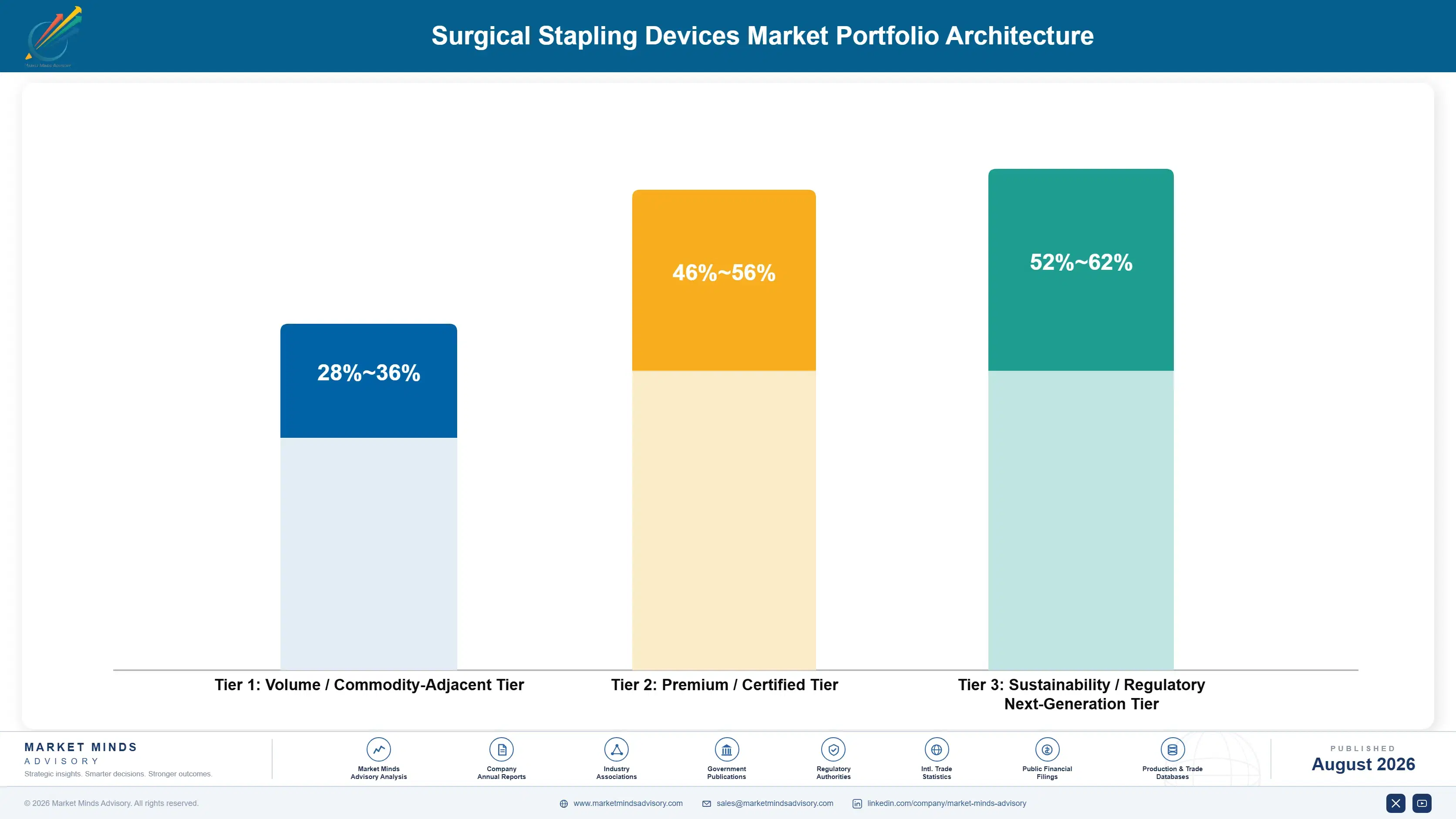
Volume / Commodity-Adjacent Tier

Manual linear and circular staplers, basic endoscopic cartridges and skin closure staplers tendered against domestic Asian pricing. Award turns on cost and delivery reliability, and Chinese manufacturers set the reference price across an expanding set of markets.
Gross Margin: 30-38%

Premium / Certified Tier

Powered endoscopic staplers and their matched reload cartridges, sold on tissue compression control to surgeons rather than on price to committees. Margin comes from the matched reload requirement, and the ten-point range reflects the gap between placed-handle accounts and open tenders.
Gross Margin: 52-62%

Sustainability / Regulatory / Next-Generation Tier

Robotic-platform integrated cartridges and reprocessing-compatible or reduced-packaging formats that European procurement increasingly scores. The thirteen-point range reflects the gap between mature platform cartridges and sustainability formats still carrying qualification cost.
Gross Margin: 62-75%
surgical-stapling-devices-market-portfolio-architecture-1787309383939

High-value Sub-segments and Strategic Watch-out

Robotic-platform integrated cartridges

The best protected pool in surgical devices, because interface control makes competitive bidding impossible rather than merely difficult for anybody else. Growth follows robotic procedure volumes directly. Manufacturers without platform access cannot reach this consumption at all, at any price. Platform access is the only entry route.
Gross Margin: 64-75%

Powered reload streams behind placed handles

Matched reload requirements mean a converted surgeon moves their whole cartridge consumption, sustained across the handle's service life. Surgeon specification defends the pricing that procurement contests. Each handle generation resets the lock, which is why launches keep coming. Placement discipline is what determines whether this pool pays for itself.
Gross Margin: 54-62%

Basic manual and endoscopic cartridges

The largest segment by units, priced against Chinese manufacturing at roughly 60% below Western contract levels and falling further. It loads assembly lines that powered production also uses. Conceding it deliberately beats conceding it slowly through tender losses. Utilisation is the reason it stays in most portfolios at all.
Gross Margin: 30-38%

Incretin-driven bariatric volume loss

Patients choosing weekly injections over irreversible surgery, removing volume from the most stapler-intensive procedure performed anywhere in general surgery. Revisional work recovers part of it. Nothing commercial reverses a referral pattern that patients themselves are choosing. Revisional work recovers part of the volume and nothing recovers the rest of it.
Gross Margin: 0-5%

How Reload Demand Actually Recurs

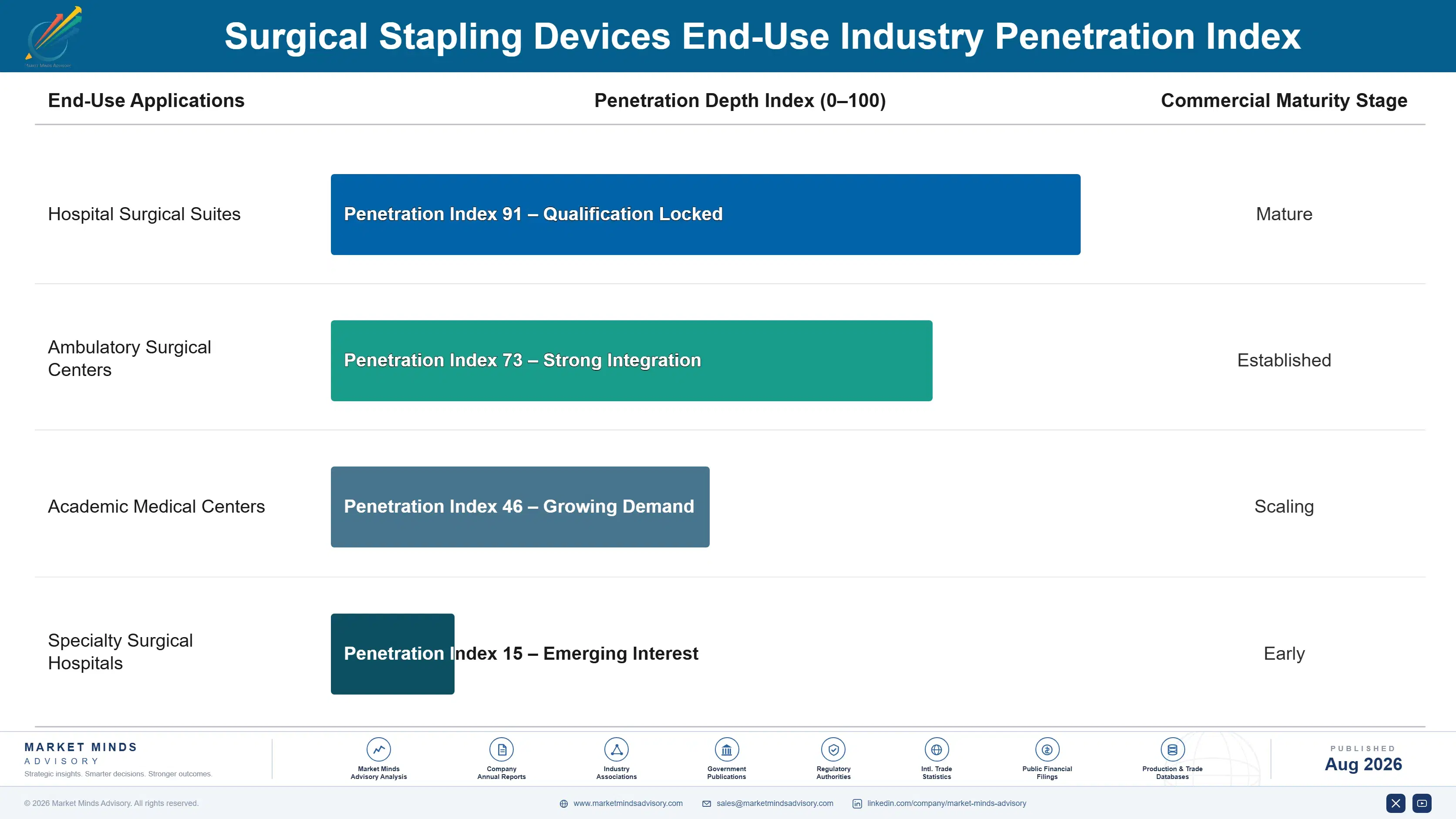
This is the purest consumable annuity in surgical devices. A handle placed once generates matched cartridge consumption across its service life, and 71% of category revenue arrives that way rather than through instrument sales. Robotic cartridges go further still, since interface control means the consumption cannot be contested by anybody at any price. What varies is whether a manufacturer holds the handle, the platform interface, or merely a cartridge that matched-reload requirements exclude f
Adoption depth varies sharply by surgical specialty. Bariatric surgery adopts powered devices deepest, since tissue thickness variability there is greatest and the consequences of a leak are severe. Thoracic surgery follows closely for the same reasons. Colorectal practice adopts powered devices selectively, weighing cost against a leak rate that most surgeons believe technique influences more than instrumentation. General surgery in cost-constrained systems uses basic cartridges and hand-sewn technique wherever clinically acceptable, more often than manufacturers acknowledge.

Buyer profiles are shifting toward device specification by surgeons trained on powered instruments. Residents learning stapling on powered devices develop technique around measured compression and treat manual firing as an older skill. Their predecessors judged tissue by hand for entire careers and question what sensing adds.
surgical-stapling-devices-market-end-use-penetration-index-1787309384427

What We Would Do Here

These are among the four positions where our research anticipates prominent divergence between winners and laggards over the coming forecast period. Each is grounded in the demand model, the regulatory perimeter, and the announced capacity pipeline.
01 / ROBOTIC INTERFACE ACCESS

Secure platform interface positions before they are closed

A stapler mounted on a robotic arm can only be supplied by whoever controls the interface, which makes this the one position in surgical devices competitors cannot attack with either price or clinical evidence. Robotic cartridges compound at 9.8%, and every system installed without an interface agreement removes a decade of consumption permanently. Manufacturers without a platform should be pursuing agreements with emerging robotic entrants now, because those doors close permanently once installed bases establish themselves and exclusive arrangements follow.
02 / POWERED HANDLE PLACEMENT

Give away handles to capture the matched reload stream

Powered handles require matched powered reloads, so converting a single surgeon moves their entire cartridge consumption rather than just a share of it. Placement programmes capture roughly 40% more reload volume per converted surgeon than comparable manual-device accounts deliver, sustained across the whole service life of the handle. The working capital cost is real and the discipline required is declining placements where reload volume will not follow, which is precisely where most placement programmes quietly lose money over several years.
03 / SURGEON SPECIFICATION SELLING

Argue compression control with surgeons, never with procurement

Powered reloads cost materially more per firing than manual cartridges do, which makes them an easy refusal for any value analysis committee and an easy preference for a surgeon working on thickened bowel. Selling tissue variability to the specification holder converts accounts procurement would otherwise have blocked outright, at roughly twice the rate of cost-per-case pitching. The clinical evidence base is thinner than adoption rates would suggest, which makes surgeon credibility the asset actually being spent here, and worth protecting carefully.
04 / BASIC TENDER CONCESSION

Concede basic cartridges deliberately, defend powered streams

Chinese reload pricing sits roughly 60% below Western contract levels on cartridges that are functionally comparable, and no cost reduction programme closes that gap from a Western plant. Exiting improves blended margin by near 7 points within two years, provided the assembly utilisation consequence is faced honestly rather than discovered later. Manufacturers still defending basic tenders on principle are spending margin to retain volume that earns almost nothing, and losing it anyway on a slower and considerably more expensive timetable.

Engagement Snapshot From the Field

A live engagement with an industry participant carrying material or product regulatory and market exposure ahead of a defining policy shift, showing how our research translates into a defensible multi-year portfolio strategy.
MARKET MINDS ADVISORY · CLIENT ENGAGEMENT SUMMARY
Surgical Stapling Devices Producer Strategic Portfolio Review and Transition Roadmap 2026·Investment Scenario on Surgical Stapling Devices Exposure Evaluation 2025-26
CLIENT PROFILE
A global surgical device manufacturer with stapling revenue near USD 740 million annually (client-reported, unverified by MMA), manufacturing across three continents, a broad manual and endoscopic portfolio, a recently launched powered platform, and no robotic interface agreement with any platform owner. Roughly 54% of stapling revenue came from basic manual and endoscopic cartridges facing Asian price competition in every tender.
STRATEGIC CHALLENGE
Stapling revenue had grown while margin declined for three consecutive years, and management attributed this to tender pricing pressure alone. The proposed response was a lower-cost cartridge range manufactured in Asia to defend basic tenders. The board questioned whether defending the least profitable part of the portfolio was the right use of capital, particularly with no robotic position secured.
MMA APPROACH
MMA modelled contribution by cartridge type with assembly, sterilisation and freight allocated properly rather than averaged, then traced reload consumption per placed handle across three years of account data. Forty-seven expert interviews with surgeons, operating theatre managers and procurement leads established what actually decided device specification. Robotic platform roadmaps were assessed against the closing window for interface partnerships.
KEY FINDINGS
  1. Basic cartridge contribution was marginally negative once assembly and sterilisation overhead was properly allocated, meaning three years of tender defence had consumed margin without generating any contribution at all.
  2. Reload consumption per placed powered handle ran roughly 40% above manual accounts, and the client had funded fewer than a fifth of the handle placements its powered launch plan had assumed.
  3. Surgeons specified devices on tissue handling and firing feel, and none interviewed had ever seen a cost-per-case comparison, which was the client's primary selling material in every market.
  4. Two emerging robotic platform developers were open to stapling interface partnerships, and both indicated those discussions would close within roughly eighteen months as installed bases grew.
CLIENT PROFILE
A global surgical device manufacturer with stapling revenue near USD 740 million annually (client-reported, unverified by MMA), manufacturing across three continents, a broad manual and endoscopic portfolio, a recently launched powered platform, and no robotic interface agreement with any platform owner. Roughly 54% of stapling revenue came from basic manual and endoscopic cartridges facing Asian price competition in every tender.
STRATEGIC CHALLENGE
Stapling revenue had grown while margin declined for three consecutive years, and management attributed this to tender pricing pressure alone. The proposed response was a lower-cost cartridge range manufactured in Asia to defend basic tenders. The board questioned whether defending the least profitable part of the portfolio was the right use of capital, particularly with no robotic position secured.
MMA APPROACH
MMA modelled contribution by cartridge type with assembly, sterilisation and freight allocated properly rather than averaged, then traced reload consumption per placed handle across three years of account data. Forty-seven expert interviews with surgeons, operating theatre managers and procurement leads established what actually decided device specification. Robotic platform roadmaps were assessed against the closing window for interface partnerships.
KEY FINDINGS
  1. Basic cartridge contribution was marginally negative once assembly and sterilisation overhead was properly allocated, meaning three years of tender defence had consumed margin without generating any contribution at all.
  2. Reload consumption per placed powered handle ran roughly 40% above manual accounts, and the client had funded fewer than a fifth of the handle placements its powered launch plan had assumed.
  3. Surgeons specified devices on tissue handling and firing feel, and none interviewed had ever seen a cost-per-case comparison, which was the client's primary selling material in every market.
  4. Two emerging robotic platform developers were open to stapling interface partnerships, and both indicated those discussions would close within roughly eighteen months as installed bases grew.
RECOMMENDED STRATEGY
Phase 1: Phase 1 (0 to 6 months): Cancel the low-cost cartridge programme, exit basic tenders below allocated cost, and redirect that capital into powered handle placement. Phase 2: Phase 2 (6 to 18 months): Open interface partnership discussions with both emerging robotic platforms, and rebuild surgeon-facing selling material around tissue handling rather than cost per case. Phase 3: Phase 3 (18 to 36 months): Consolidate basic cartridge assembly onto fewer lines, and index remaining multi-year reload agreements to published metal benchmarks.
OUTCOME
The low-cost cartridge programme was cancelled and the capital redirected. Powered handle placements rose more than threefold within five quarters, and reload capture per placed handle matched the modelled 40% premium (client-reported, unverified by MMA). One robotic interface partnership was signed. Basic tender exits proved politically harder internally than any external competitor.

Frequently Asked Questions

Foundational context covering the market sizes, CAGR, scope, country, region and competition that inform every finding below. This section is provided to cover basics and most often pre-purchase conversations, answered from the MMA Primary Research Dataset.

What is the current size of the Surgical Stapling Devices Market?

MMA sizes the global surgical stapling devices market at USD 5.6 billion in 2025, rising to USD 6.0 billion in 2026. That covers staplers and reload cartridges at hospital contract prices.

How large will the Surgical Stapling Devices Market be by 2036?

MMA forecasts USD 12.03 billion by 2036, an expansion multiple of 2.00 times the 2026 base. That represents roughly USD 6.03 billion of incremental value over the forecast period.

What is the CAGR for the Surgical Stapling Devices Market 2026 to 2036?

The base case compounds at 7.2% annually, with a bull case of 8.4% and a bear case of 6.0%. Powered and robotic conversion contributes more than procedure volume growth does.

Which segment is growing fastest?

Powered endoscopic staplers compound at 10.8%, exactly 1.50 times the market rate. Measured tissue compression replaces surgeon feel where thickness varies most, notably in bariatric and thoracic surgery.

Who are the major companies in the Surgical Stapling Devices Market?

Medtronic, Ethicon, Intuitive Surgical, Panther Healthcare and Frankenman Medical together ship 79% of units. Fifteen further participants including B Braun Melsungen, Meril, Genesis MedTech and Teleflex are profiled.

Which country is growing fastest?

India compounds at 10.1%, ahead of every other national market MMA tracks. Laparoscopic conversion in private hospital groups supplied by affordable domestic reloads drives that growth.

Report Segmentation Architecture

The full report scope spans multiple orthogonal segmentation dimensions, with cross-tabulated demand data provided for each dimension pair. Coverage extends further to regional breakdowns, trend trajectories, and the competitive detail needed to support segment-level decision-making.

By Stapling Device Type

  • Manual Linear Staplers and Reloads
  • Manual Circular Staplers
  • Endoscopic Staplers and Reload Cartridges
  • Powered Endoscopic Staplers
  • Robotic-Platform Integrated Staplers
  • Skin and Fascia Closure Staplers

By End-Use Surgical Specialty

  • Bariatric and Metabolic Surgery
  • Colorectal and Gastrointestinal Surgery
  • Thoracic Surgery
  • Gynaecological Surgery
  • Urological and General Surgery

By Procurement Route

  • Group Purchasing Organisation Contract
  • National and Regional Public Tender
  • Robotic Platform Consumable Supply
  • Distributor and Direct Hospital Purchase

By Region

  • North America
  • Western Europe
  • East Asia
  • South Asia and Pacific
  • Latin America
  • Middle East and Africa
  • Eastern Europe

Scope, Methodology, and Coverage

Every figure in this report is reproducible from documented input assumptions. The scope below maps the historical period, the forecast horizon, the segmentation dimensions, and the countries covered, alongside the underlying primary and qualitative methodology.
Historical Period
2020 to 2025
Forecast Period
2026 to 2036
Base Year
2025 (USD billions; MMA Primary Research Dataset, August 2026)
Market Definition
The market comprises mechanical devices that join or close tissue by deploying rows of metal staples during surgery, spanning manual linear staplers and reloads, manual circular staplers, endoscopic staplers and reload cartridges, powered endoscopic staplers with tissue compression sensing, staplers integrated onto robotic surgical platforms, and skin and fascia closure staplers. Sizing is at hospital contract price for both instruments and reload cartridges, including robotic platform consumable supply. Sutures and needles, tissue adhesives and sealants, clip appliers, vessel sealing and energy devices, robotic surgical systems themselves, and separately sold buttress materials are outside scope.
Quantitative Units
USD billions (current prices); million stapler and reload units shipped; USD per reload cartridge at contract price
Segmentation Dimensions
By Stapling Device Type; By End-Use Surgical Specialty; By Procurement Route; By Region
Regions Covered
North America, Western Europe, East Asia, South Asia and Pacific, Latin America, Middle East and Africa, Eastern Europe
Countries Covered
USA, China, Germany, France, UK, Japan, South Korea, India, Australia, Canada, Brazil, Mexico, Indonesia, Vietnam, Thailand, Malaysia, UAE, Saudi Arabia, South Africa, Nigeria, Turkey, Poland, Netherlands, Italy, Spain, Sweden, Switzerland, Argentina, Colombia, Singapore, and additional markets relevant to this sector
Key Companies Profiled
Medtronic, Ethicon, Intuitive Surgical, Panther Healthcare, Frankenman Medical, B Braun Melsungen, Grena, Reach Surgical, Purple Surgical, Meril Life Sciences, Victor Medical, Genesis MedTech, Touchstone International Medical Science, Lepu Medical, Jiangsu Kangjin Medical Instrument, Ackermann Instrumente, Welfare Medical, Teleflex, CONMED, Hangzhou Kangji Medical.
Quantitative Methodology
Primary survey, n=3,800 respondents, Q4 2025, six countries; demand-side model with trade association cross-validation
Qualitative Methodology
47 expert interviews, Q4 2025; applied to validate demand model assumptions, identify emerging dynamics, and assess competitive positioning
Report Format
PDF and XLSX data workbook (Word format preview document)
Publisher
Market Minds Advisory
Report Code
MMA-2026-MED-102
Published
August 2026
Contact
sales@marketmindsadvisory.com | www.marketmindsadvisory.com

Purchase the full Surgical Stapling Devices Market Report (2026 to 2036).

The full report sizes the surgical stapling devices market across six device types, five surgical specialties, four procurement routes and seven regions, with annual forecasts to 2036 in revenue and units shipped. It models reload consumption per placed handle and per robotic platform installation, which is where the economics of this category actually sit rather than in instrument sales. Twenty participants are assessed on a consistent unit shipment basis, with robotic interface access and powered portfolio position mapped separately from manual breadth. Chinese cost positions are benchmarked against Western manufacturing, and incretin-driven bariatric volume loss is quantified by market.
Six device types sized and forecast annually
Reload consumption modelled per placed handle
Twenty participants on consistent unit shipment basis
Robotic interface access mapped by manufacturer
Chinese cost positions benchmarked against Western manufacturing
Incretin-driven bariatric volume loss quantified by market

Built For The People Who Decide

From boardroom strategy to bench-side execution, this report is read cover-to-cover by leaders shaping the next decade of their industry, turning demand scenarios, market dynamics and valuation benchmarks into decisions.
CXOs/ Presidents/ VPs/ Managers
M&A and Corporate Development
Strategy Teams and R&D Heads
Procurement and Product Directors
Regulatory and Compliance Leaders
Investor Relations and Equity Analysts