Market Minds Advisory
Surgical Sphincteroplasty Market

Surgical Sphincteroplasty Market: Repair Durability, Neuromodulation Displacement and the Undiagnosed Obstetric Injury

Direct sphincter repair holds continence in well under half of patients a decade later, and roughly two thirds of the obstetric injuries causing the problem were never identified at delivery.

Lead Analyst

Alice Ballenger

Published

September 2026

Make Smarter Decisions with Customized Research Insights

Request a free sample report and evaluate market opportunities, growth trends, and competitive dynamics relevant to your business needs.

2025 MARKET VALUE$0.3BMarket Size 2025
2036 FORECAST VALUE$0.7BBase Case , 2026 to 2036
CAGR 2026 TO 20367.6 %Bull 8.8% / Bear 6.3%
INCREMENTAL OPPORTUNITY$0.4BNet 10- year value creation
EXPANSION MULTIPLE2.09x2036 value over 2026 base
Strategic Levers
M&A Pipeline
Regional Outlook
Country Rankings
Competitive Intelligence
Segmental Deep-dive
Call-Us : 91 93563 13602

Executive Snapshot and Market Trajectory

Direct overlapping sphincteroplasty was the standard operation for faecal incontinence and its results do not last: continence holds in 38% of patients at ten years. That single finding redirected the field toward sacral neuromodulation, and it explains the whole commercial structure of this category better than any product argument does.
Sacral neuromodulation systems compound at 11.4%, exactly 1.50 times the market rate, because a test stimulation period lets clinicians select patients before committing an implant, and 72% of those tested proceed to permanent placement. North America holds 30% of value, the largest position, on neuromodulation reimbursement and colorectal specialist density together. Implanted systems realise roughly USD 21,600 each, which reimbursement availability alone decides in each market.
Five participants support 68% of treated patient episodes, which is concentrated because implantable neuromodulation carries barriers direct surgical repair never did. Roughly 3,200 colorectal surgeons perform reconstruction with any regularity. Only 36% of obstetric sphincter injuries are recognised at delivery, which is where the addressable population is genuinely created. Recognition and referral rather than surgical capacity limit everything this category can reach, well ahead of any device or surgical constraint.
Market Definition
Covers surgical and device-based reconstruction and restoration of anal sphincter function in faecal incontinence, spanning sacral neuromodulation systems, biologic graft-augmented repair, injectable bulking agents, direct overlapping sphincteroplasty instrumentation, artificial and magnetic sphincter devices, and perioperative bowel management and diversion supplies. Sizing captures implant, device, graft and single-use supply revenue at realised hospital price. Excludes urinary incontinence devices and slings, pelvic organ prolapse mesh, haemorrhoid and fistula treatment, colorectal cancer resection, stoma appliances for permanent diversion, and pelvic floor physiotherapy services.
Base Year Value
$0.3B in 2025 (MMA Primary Research Dataset, August 2026)
Forecast Period
2026 to 2036, eleven discrete annual values
CAGR
7.6% base case. Bull 8.8%. Bear 6.3%.
Fastest Growth Segment
Sacral Neuromodulation Systems: 11.4% CAGR
Fastest Growth Country
India: 10.2% CAGR
Fastest Growth Region
South Asia and Pacific: 9.7% CAGR
Largest Region
North America: 30% of 2025 global value
Market Leaders
Medtronic, Axonics, Coloplast, Boston Scientific, Becton Dickinson. Source: MMA Analysis based on company annual reports.
Primary Survey
n=3,800 procurement and R&D decision-makers, Q4 2025, six countries
Methodology
Demand-side build-up, cross-validated against public data, 47 expert interviews

Surgical Sphincteroplasty Market Forecast Scenarios

surgical-sphincteroplasty-market-size-forecast-scenario-1787309826814
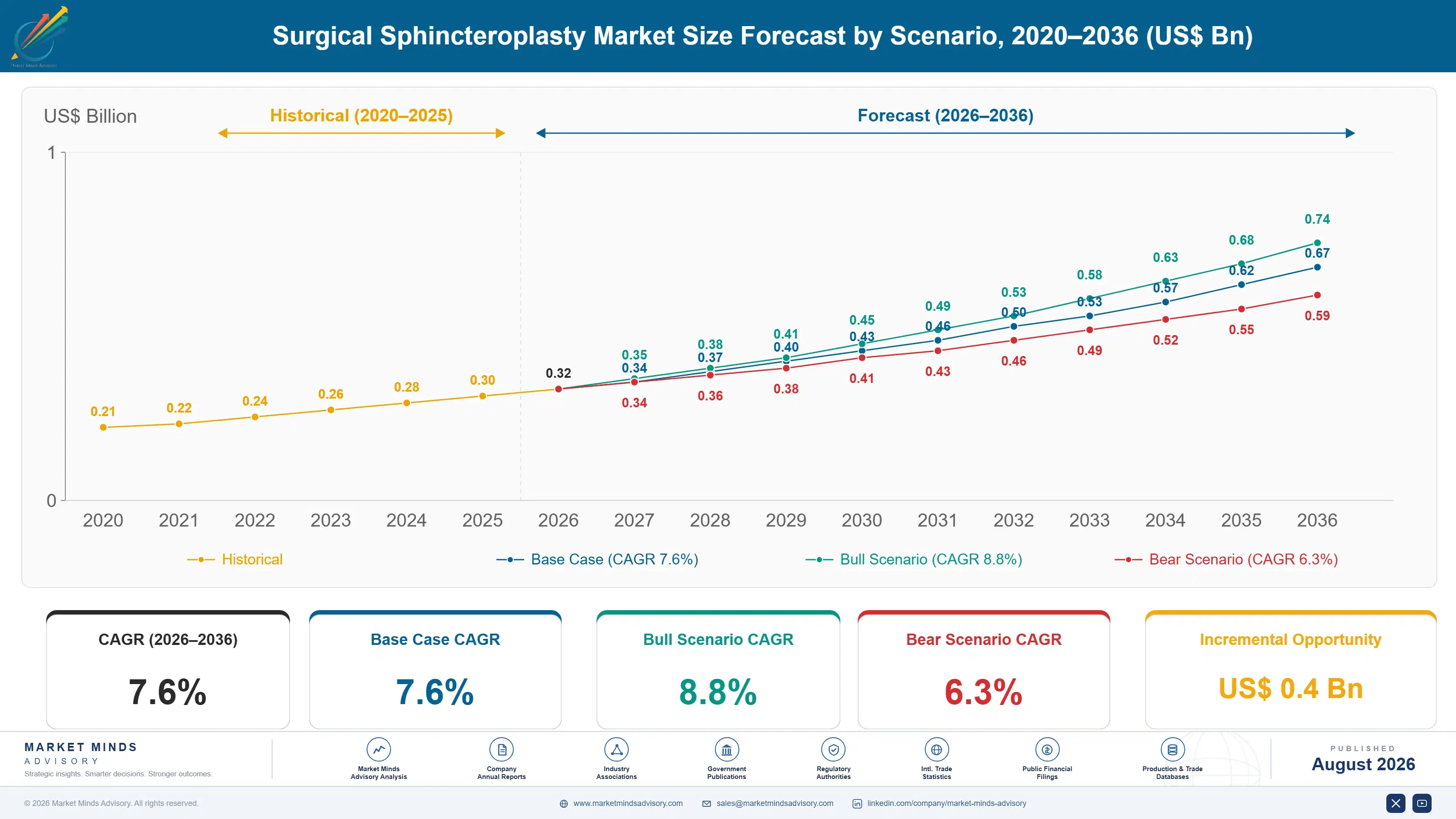
Growth of 6.4% across 2020 to 2025 came from a substitution rather than from expansion. Long-term follow-up of direct sphincteroplasty confirmed that continence deteriorates substantially over a decade, and colorectal practice shifted toward sacral neuromodulation where reimbursement permitted it. Elective colorectal surgery suspension during 2020 removed a block of volume that recovered fully. Injectable bulking agents lost ground as durability data disappointed and several products were withdrawn.
The base case of 7.6% rests on three mechanisms. Sacral neuromodulation keeps converting from direct repair because a test stimulation period allows genuine patient selection before implantation, which nothing in surgical repair offers. Biologic graft augmentation is being adopted where direct repair remains the only option and durability must be improved. And Asian colorectal subspecialty capacity is expanding against a large undiagnosed obstetric injury population that has never been offered treatment.
The bull case of 8.8% assumes obstetric sphincter injury recognition at delivery improves materially through structured examination programmes, which would enlarge the identified patient population well beyond current referral rates. The bear case of 6.3% reflects two pressures: neuromodulation reimbursement restriction as volumes grow beyond payer models, and continued absence of any recognition improvement leaving most of the affected population undiagnosed indefinitely.

The Operation That Does Not Last

Two facts shape this market and neither is about products. The first is that direct overlapping sphincteroplasty, the standard repair for a torn anal sphincter, holds continence in only 38% of patients at ten years, because repaired muscle and its nerve supply both deteriorate. That finding moved colorectal practice toward sacral neuromodulation, which modulates the reflex arc rather than rebuilding the muscle. The second is that most of the population needing any of this was never identified.
TOP FIVE CONCENTRATION68%Treated patient episodes supported by leading category participants
NEUROMODULATION SYSTEM PRICEUSD 21,600Realised hospital price for one implanted stimulation system
TEN-YEAR CONTINENCE RETENTION38%Patients still continent a decade after direct surgical repair
OBSTETRIC INJURY RECOGNITION36%Sphincter tears identified at the time of delivery itself
COLORECTAL SPECIALISTS PERFORMING3,200Surgeons undertaking sphincter reconstruction with any real regularity
NEUROMODULATION TRIAL SUCCESS72%Patients proceeding to permanent implant after test stimulation
Obstetric anal sphincter injury is the dominant cause and only 36% of those tears are recognised at delivery. The rest present years later with symptoms nobody connects to a birth, frequently to a general practitioner who does not ask. That makes recognition the binding constraint on the addressable population, well ahead of surgical capacity. Roughly 3,200 colorectal surgeons perform reconstruction regularly, which is adequate for those who reach them.
Two forces determine the next decade. Sacral neuromodulation keeps taking share because a test stimulation period allows patient selection before committing an implant, with 72% of tested patients proceeding. And whether obstetric injury recognition improves at delivery decides whether this category grows on its true clinical population or on the fraction currently identified.
"Colorectal surgery spent decades perfecting an operation that fails in most patients within ten years, and the honest response was to stop doing it where something better exists. What nobody has fixed is that two thirds of these injuries are missed at delivery. The market is not constrained by surgeons or devices. It is constrained by an examination nobody performs."
Director, Colorectal and Pelvic Floor Reconstruction Practice · MMA Medical Devi

Market Trends

Neuromodulation replaces repair on durability grounds

Direct overlapping sphincteroplasty holds continence in 38% of patients at ten years, because repaired muscle and its damaged nerve supply both deteriorate over time regardless of technical quality. Sacral neuromodulation modulates the reflex arc instead of rebuilding muscle, and a test stimulation period lets clinicians confirm response before committing an implant, with 72% proceeding. The segment compounds at 11.4% against 7.6% for the market. Reimbursement availability rather than clinical preference determines where the substitution has actually happened so far. Direct repair persists everywhere coverage does not, which is most of the world.
Market Impact: Recognises only 36% at delivery
Biologic graft augmentation improves repair where surgery persists

Neuromodulation is unavailable or inappropriate for a meaningful group of patients, particularly those with large defects, prior device infection or in systems without reimbursement, and direct repair remains their only option. Biologic graft augmentation reinforces the overlap and aims to slow the deterioration that undermines conventional repair, growing at 9.2%. Evidence remains shorter than the deterioration timeline it claims to address, which is a genuine limitation. Graft cost adds materially to a procedure previously requiring only suture and instruments. Colorectal surgeons raise the evidence gap consistently and buy the product anyway, for lack of alternatives.
Market Impact: Converts 72% of trials to implant

Market Opportunities and Growth Drivers

Asian subspecialty capacity meets an untreated obstetric population

Obstetric anal sphincter injury rates across South and East Asia are substantial and recognition at delivery is considerably lower than in developed systems, which leaves a very large population of women with symptoms nobody has connected to childbirth. Colorectal subspecialty capacity is now expanding across China, India and Southeast Asia. East Asia holds 22% of category value at 8.6% growth and South Asia and Pacific grows at 9.7%. Neuromodulation reaches almost nobody there on cost, so repair and grafts serve that demand instead. Recognition at delivery is the constraint everywhere in the region.
Market Impact: Misses 64% of injuries at delivery

Test stimulation lets clinicians select patients before implanting

Sacral neuromodulation is the only intervention in this category that can be trialled before commitment, since a temporary lead and external stimulator establish response over a fortnight before any permanent implant is placed. Roughly 72% of tested patients proceed. That removes the uncertainty every surgical option carries, where the operation is performed and the result becomes apparent afterwards. Payers value it for the same reason, since the trial identifies non-responders before the expensive part of the pathway begins at all. Nothing surgical in this category offers a comparable safeguard to a payer anywhere.
Market Impact: Threatens USD 21,600 system payment

Market Restraints and Challenges

Obstetric injury recognition failure hides the patient population

Only 36% of obstetric anal sphincter injuries are identified at delivery, and the root cause is that recognition requires a structured examination immediately after birth that most systems do not mandate and many clinicians never learnt. Women present years later to clinicians who do not connect symptoms to childbirth. Participants respond by funding midwifery and obstetric education programmes, by supporting structured perineal examination protocols, and by working with continence charities on symptom awareness campaigns that reach women directly. None of it generates revenue for years, and all of it benefits every competitor equally.
Market Impact: Replaces repair failing in 62%

Neuromodulation reimbursement restricts as volumes exceed models

Implanted systems realise roughly USD 21,600 and reimbursement was established when faecal incontinence volumes were small, and the root cause of the exposure is that payers routinely revisit coverage once utilisation exceeds what they projected. Several systems have already narrowed criteria. Participants respond by generating cost-offset evidence on containment product and care hours avoided, by emphasising the trial period as a payer safeguard, and by pursuing markets where coverage is being established rather than reviewed. Cost-offset evidence takes years to build and is the only defence available when a review opens.
Market Impact: Reinforces repair for 62% who fail
3 additional market trends, 4 additional growth drivers, and 2 additional restraints and challenges are covered in the full report. Contact sales@marketmindsadvisory.com to access the complete intelligence.

Segment CAGR and Growth Architecture

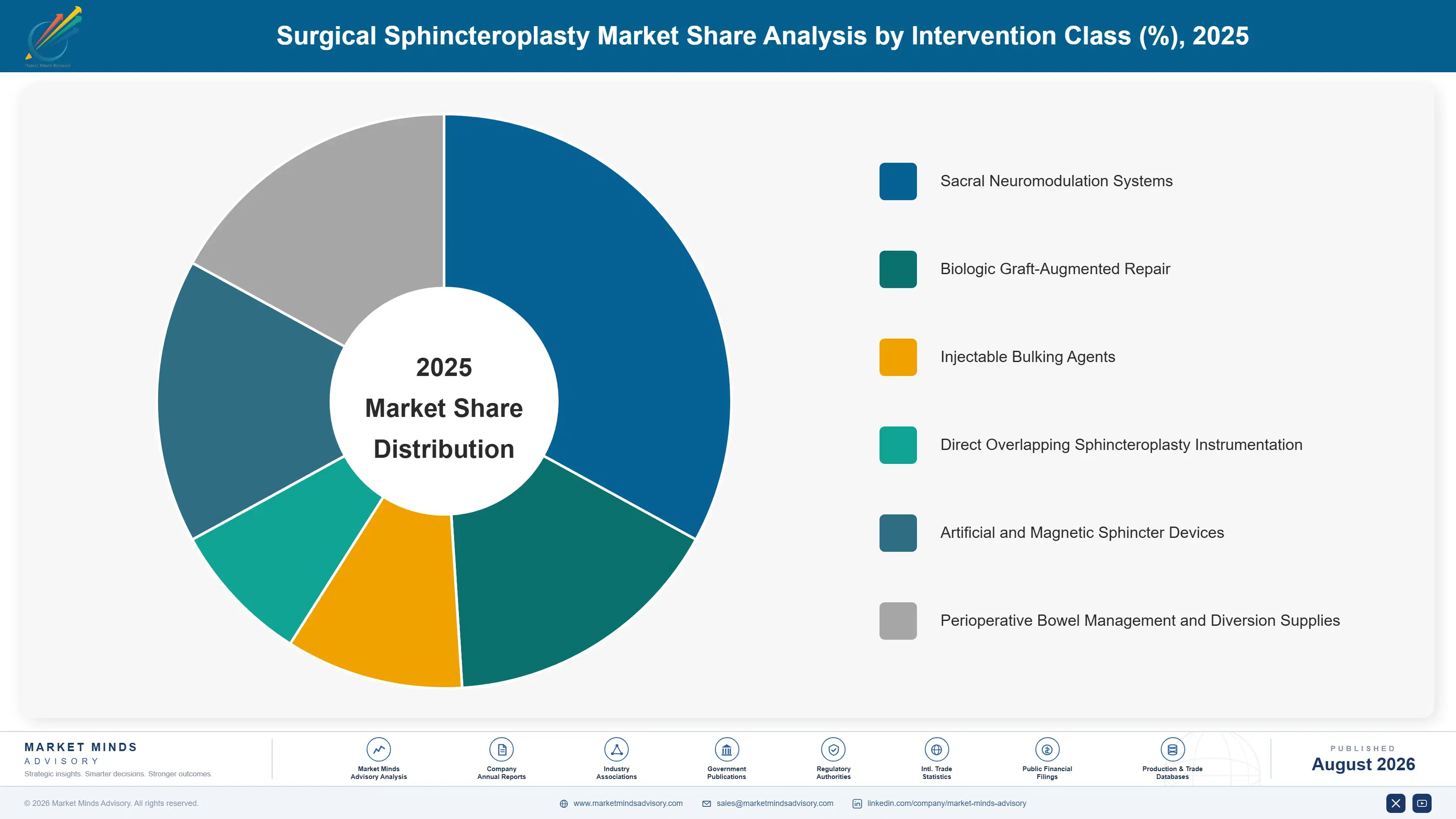
Segmentation follows the intervention class, because each class carries a distinct durability profile, reimbursement pathway and surgical requirement. Patient aetiology, care setting and geography all matter commercially but cut across every class, so they belong in later discussion. Six intervention classes cover current sphincter reconstruction practice worldwide, and their commercial trajectories diverge very sharply indeed.
surgical-sphincteroplasty-market-market-share-analysis-1787309827345

Sacral Neuromodulation Systems

Sacral neuromodulation compounds at 11.4%, exactly 1.50 times the market rate, and it won the field on durability rather than on any elegance of concept. Modulating the reflex arc avoids the muscle and nerve deterioration that leaves direct repair holding continence in only 38% of patients at ten years. Three commercial features follow. A test stimulation period lets clinicians and payers select patients before commitment, with 72% proceeding, which nothing surgical offers. Implanted system pricing near USD 21,600 makes reimbursement availability the binding constraint on adoption. And review exposure grows as volumes exceed the models coverage was originally set against. Reimbursement availability rather than clinical preference has determined every substitution so far.
CAGR 11.4%

Biologic Graft-Augmented Repair

Biologic graft augmentation grows at 9.2%, second fastest, and it serves the patients neuromodulation cannot reach. Large sphincter defects, prior device infection and health systems without neuromodulation coverage all leave direct repair as the only available option, and graft reinforcement aims to slow the deterioration undermining conventional overlap. The commercial difficulty is evidence: available follow-up is shorter than the deterioration timeline the product claims to address, which colorectal surgeons raise consistently. Graft cost also adds materially to an operation that previously needed only suture and instruments. Donor tissue availability rather than clinical demand is what limits how much of this segment can actually be supplied to any surgeon at all anywhere.
CAGR 9.2%
Full segment breakdown across 6 segments available in the complete report.

Regional Architecture and Country Demand Map

North America holds 30% of value on neuromodulation reimbursement and colorectal specialist density together, rather than on patient numbers. Western Europe follows at 24% on structured obstetric injury programmes. South Asia and Pacific grows fastest, led by India at 10.2%, on an untreated obstetric injury population.

North America

Thirty percent of global value sits in North America, growing at 6.9%, and neuromodulation reimbursement rather than patient numbers explains the position. Implanted systems realise well above other regions, and coverage for faecal incontinence has been established long enough that colorectal practice has largely substituted away from direct repair. Coverage review activity has increased as volumes grew. Obstetric injury recognition varies enormously between institutions, and women who present years later frequently reach continence clinics rather than colorectal surgeons, which shapes referral patterns considerably. Neuromodulation substitution has gone considerably furthest here, which also concentrates the coverage review exposure that now threatens the highest-value segment anywhere in this whole category right now.
Share: 30% | CAGR: 6.9% (2026 to 2036)

Western Europe

Twenty-four percent of value and 6.1% growth reflect the strongest obstetric injury programmes anywhere. British and Nordic maternity services mandate structured perineal examination after delivery, which lifts recognition well above the global figure and identifies women years earlier than elsewhere. That produces a younger and better-characterised referral population. Neuromodulation coverage varies by country and by region within countries, which fragments substitution considerably. Dutch and Scandinavian colorectal units contributed much of the long-term repair follow-up that redirected the field in the first place. Recognition programmes here demonstrate what the identified population could be everywhere else, and the referral volumes that follow are considerably higher here as a direct result of it.
Share: 24% | CAGR: 6.1% (2026 to 2036)
Regional intelligence for 5 additional markets available in the complete report: East Asia, South Asia and Pacific, Latin America, Middle East and Africa, Eastern Europe. Contact sales@marketmindsadvisory.com.
surgical-sphincteroplasty-market-country-cagr-analysis-1787309827853

Four Ways To Find The Patients

Only 36% of the injuries causing this condition are recognised at delivery and direct repair fails most patients within a decade, which means diagnosis rather than surgical capacity constrains everything. The levers that matter find patients, protect reimbursement and serve the systems neuromodulation cannot reach. Each carries returns tested against disclosed participant economics and primary interview evidence.

Fund obstetric recognition programmes as market building

Only 36% of obstetric sphincter injuries are identified at delivery, and every unrecognised tear is a patient who will present years later or never at all. Participants funding midwifery and obstetric examination education report referral volume roughly 55% higher in programme regions than in comparable ones without them. It costs money years before any surgical revenue appears and benefits every competitor in the region equally, which is precisely why almost nobody has done it at meaningful scale. A market leader accepting that cost would still capture most of the resulting referral growth itself.
Market Impact: Lifts referral volume roughly 55% a

Build cost-offset evidence before coverage is reviewed

Implanted systems realise roughly USD 21,600 and coverage was established when volumes were small, which is exactly the situation payers revisit once utilisation exceeds their projections. Participants holding cost-offset evidence on containment products and care hours avoided report coverage review outcomes roughly 45% more favourable than those relying on clinical trial data alone. Building that evidence costs money years before any review opens, and the alternative is arguing without it when one finally does. Several systems have already narrowed criteria without giving anybody any advance warning at all in advance.
Market Impact: Improves coverage review outcomes r

Serve the systems neuromodulation pricing cannot reach

System pricing near USD 21,600 puts neuromodulation outside most Asian, African and Latin American funding arrangements entirely, and those regions hold much of the affected population. Participants supplying graft-augmented and conventional repair into those systems report volume growth roughly 40% above their neuromodulation businesses in the same markets. Margins are considerably thinner and the clinical result is worse, which is uncomfortable and remains far better than offering those patients nothing at all. Neuromodulation will not reach those systems at current pricing within any realistic planning horizon anybody can see at all.
Market Impact: Grows volume roughly 40% above neur

Frame the trial as a payer safeguard

Sacral neuromodulation is the only intervention here that can be trialled before commitment, and 72% of tested patients proceed to permanent implant. Presenting that trial explicitly as a payer safeguard rather than as a clinical step shortens coverage negotiations considerably, and participants doing so report coverage establishment roughly 35% faster in new markets. It requires health economic framing that device commercial teams rarely produce, and it converts a clinical feature into a reimbursement argument nobody else in the category can make. Payers value non-responder identification before the expensive part of the pathway begins.
Market Impact: Establishes new coverage roughly 35

Who Controls the Margin Pool

Five participants support 68% of treated patient episodes, the basis on which MMA assesses this category across device and surgical modalities together. Medtronic leads on sacral neuromodulation across both faecal and urinary indications. Axonics holds the strongest challenger position and drove much of the recent technical improvement in implanted systems.
Competitive activity runs along three lines. Neuromodulation system design is contested on battery life, recharge burden and imaging compatibility, which are the features implanting surgeons actually compare. Coverage establishment and defence is a continuous market access contest as volumes grow beyond payer models. And graft and repair products are being positioned for the systems neuromodulation pricing excludes entirely.

Pressure arrives from two directions. Neuromodulation coverage review activity is increasing in several major markets as volumes exceed what payers projected, which threatens the highest-value segment directly. Meanwhile the undiagnosed population represents growth nobody is capturing, because recognition programmes benefit every competitor equally and none will fund them alone. Rankings shift toward participants holding both neuromodulation and repair portfolios, because those serve the funded and unfunded systems that together hold the whole patient population. Nobody has yet built a position spanning both funded and unfunded systems properly.
surgical-sphincteroplasty-market-company-positioning-matrix-1787309828374

Competitive Moat and Risk Dimensions

MEDTRONIC

Moat: Neuromodulation breadth and coverage history

The company established sacral neuromodulation for both urinary and faecal indications and holds the longest coverage relationships and outcome datasets in the category. Implanting surgeons trained on its systems select them disproportionately afterwards. Its broader pelvic health portfolio reaches colorectal and urogynaecology specialists together, which is a call point pure neuromodulation competitors cannot replicate at comparable cost.
MEDTRONIC

Risk: Coverage review concentration exposure

A large share of category revenue depends on neuromodulation coverage established when faecal incontinence volumes were small, and payers revisit rates once utilisation exceeds their models. Several systems have already narrowed criteria. Cost-offset evidence is the available defence and takes years to build properly, which leaves the exposure open while volumes keep growing beyond projections.
AXONICS

Moat: System design and recharge improvement

The company drove the technical improvements implanting surgeons genuinely compare, including battery longevity, reduced recharge burden and imaging compatibility, which shifted selection in a category where the incumbent had held position largely unchallenged. Focus on neuromodulation alone means engineering attention is undivided. Surgeon relationships built through direct clinical support have converted accounts the incumbent had held for years.
AXONICS

Risk: Single modality concentration risk

The company depends almost entirely on neuromodulation, which leaves it fully exposed to the coverage review activity threatening that segment and with nothing to offer systems where pricing excludes implantation altogether. Repair and graft portfolios are the natural hedge and require capability it does not hold. Scale also limits how much cost-offset evidence it can fund independently.

Players Tracked

Prominent Players

Medtronic
Axonics
Coloplast
Boston Scientific
Becton Dickinson

Other Key Players

Integra LifeSciences
Cook Medical
Baxter International
Organon
Laborie Medical Technologies
Teleflex
Convatec
Hollister
B. Braun Melsungen
Medline Industries
Palette Life Sciences
Ethicon
Cousin Biotech
Aspide Medical
RTI Surgical

Recent Developments

APRIL 2025

Axonics expanded its faecal incontinence neuromodulation indication

The approval widens the eligible patient population for its sacral neuromodulation system in faecal incontinence, covering presentations previously treated only through direct surgical repair with its known durability limitations. It was a regulatory approval decision rather than any acquisition, joint venture or partnership arrangement whatsoever.
Signal: Widening the faecal indication takes patie
SEPTEMBER 2025

Medtronic published long-term faecal neuromodulation outcome data

The publication reports continence and device longevity outcomes over extended follow-up, addressing the durability comparison against direct repair that colorectal surgeons and payers alike both raise persistently and repeatedly. It was a clinical data publication rather than any acquisition, licensing, joint venture or partnership arrangement whatsoever.
Signal: Long-term outcome data is the asset that d
JANUARY 2026

Coloplast acquired a biologic graft reinforcement business

The acquisition brings processed biologic graft capability for sphincter repair reinforcement, addressing the systems where neuromodulation pricing excludes implantation and direct repair therefore remains the only available option for those patients. Terms were not disclosed. It was an outright acquisition rather than a licensing arrangement.
Signal: Buying graft capability targets exactly th

Batteries, Silicon And Donor Tissue

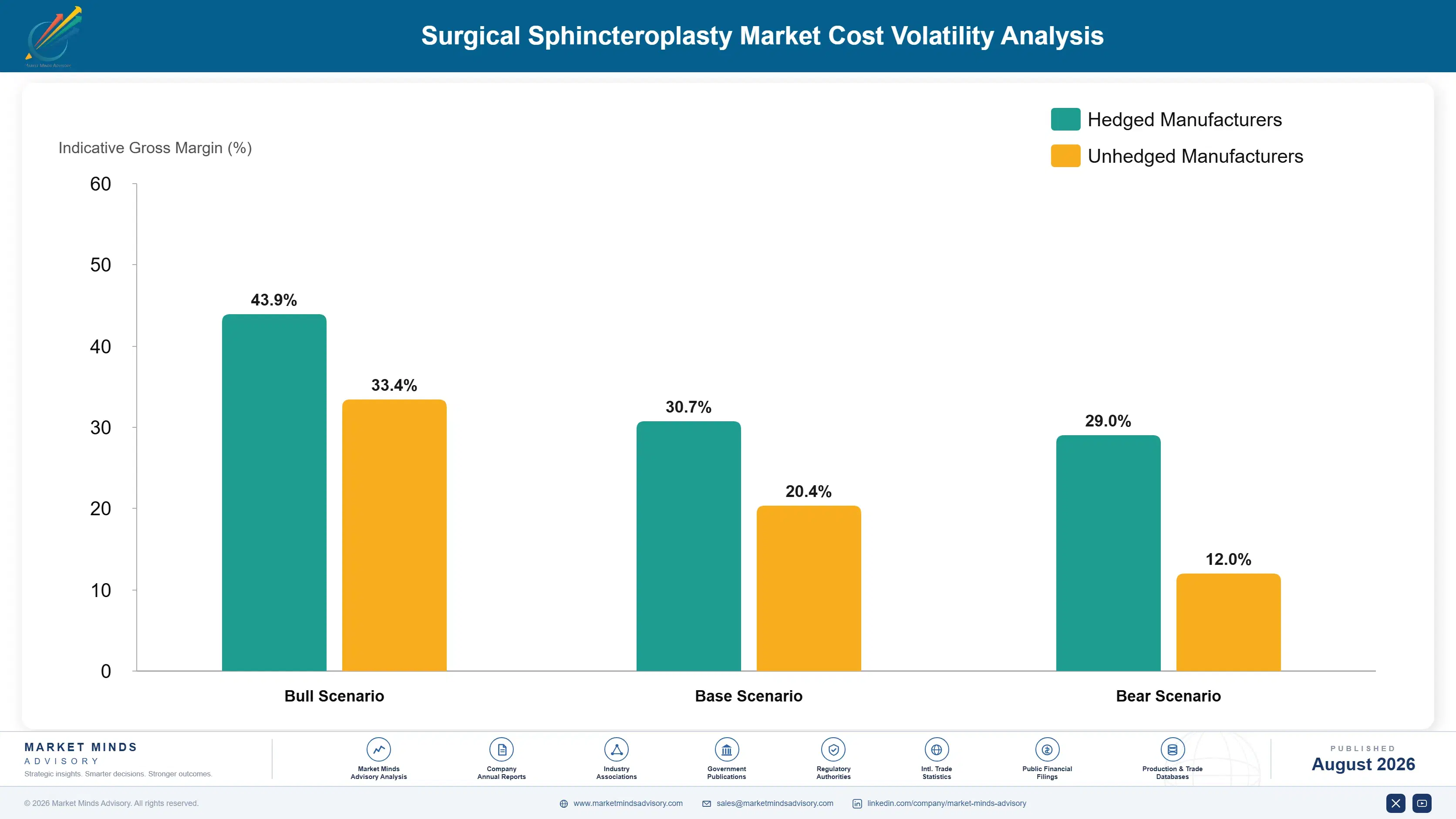
Cost structure differs completely between the implanted and surgical halves. Implantable batteries and hermetic enclosures account for roughly 27% of neuromodulation system cost of goods, from the short list of suppliers qualified to implantable standard. Custom silicon and lead assemblies add 24%. On the surgical side, processed biologic graft material represents roughly 41% of graft-augmented repair cost, and donor tissue supply governs it entirely.
Two input movements affected the two halves differently. SEMI reported foundry capacity fully allocated across 2021 and 2022, which lengthened custom silicon lead times and delayed implantable system production. US Census Bureau import data recorded higher titanium and precious metal values through 2022, raising enclosure and electrode cost. Donor tissue availability tightened separately as elective procedure recovery increased graft demand. Several participants disclosed component availability and input cost pressure in reports for those years.

Exposure varies by portfolio and the mechanism is administratively set device reimbursement against variable input cost. Neuromodulation participants could not reprice within established coverage rates and absorbed the movement entirely. Graft-weighted portfolios faced donor tissue availability rather than price, which constrained volume instead of margin. Conventional repair instrumentation carried almost no exposure, which is one of very few advantages that segment retains.
surgical-sphincteroplasty-market-cost-volatility-analysis-1787309828572

Secure implantable battery supply on multi-year committed volumes

Implantable batteries come from a very short list of qualified suppliers and represent 27% of system cost, and coverage rates set administratively cannot follow input movement upward. Multi-year committed volumes cost a premium and protect the production those rates depend upon. Qualifying an alternate battery requires full system revalidation measured in years rather than quarters, so redundancy must exist beforehand.

Design implant silicon around mature multiply-sourced nodes

Custom silicon inside implantable stimulators competed for foundry capacity against consumer electronics and lost across 2021 and 2022, delaying production of systems patients were already waiting for. Designing to mature nodes with several qualified foundries costs some capability and removes that exposure permanently. Implant revalidation is substantial, so participants do this at platform refresh rather than as a separate programme.

Diversify donor tissue sourcing across processing partners

Processed biologic graft is 41% of graft-augmented repair cost and donor tissue availability rather than price is the binding constraint on volume. Multiple qualified processing partners spread that exposure and let volume continue when one supply tightens. Qualification requires validation and regulatory notification, and synthetic alternatives remain clinically inferior for this application on current evidence.

Portfolio Architecture for Margin Defence

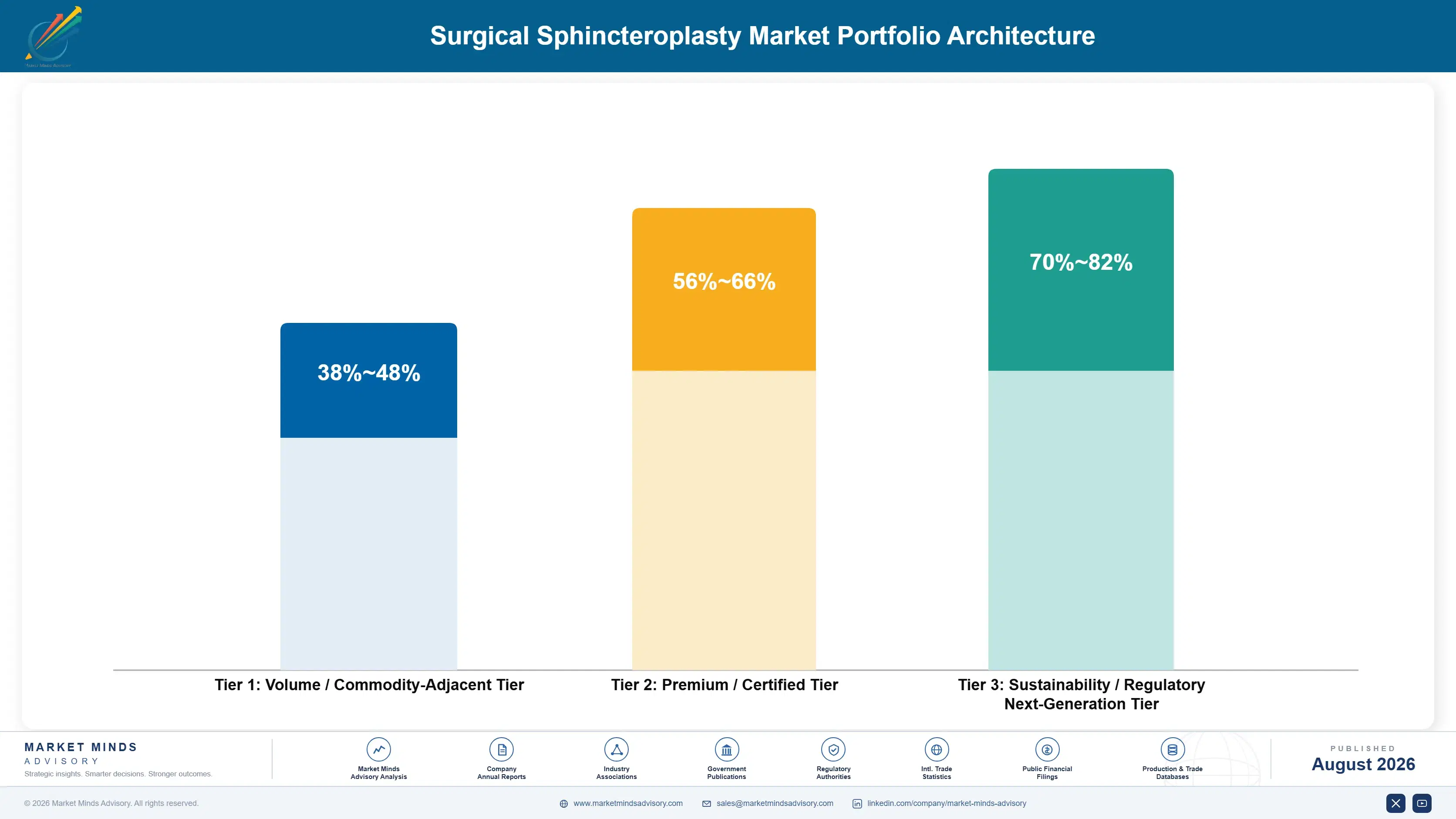
Portfolio economics separate on whether an intervention carries device reimbursement. Conventional sphincteroplasty instrumentation earns gross margin in the low forties, since the operation needs only suture and standard instruments. Injectable bulking agents earn more and have lost clinical standing as durability disappointed. Biologic graft products earn considerably more, constrained by donor tissue supply rather than demand. Neuromodulation systems earn most of all, because coverage at roug
The tension is that the highest-earning position depends on coverage somebody else sets and reviews, while the lowest-earning positions serve most affected patients. Neuromodulation reaches funded systems and excludes everywhere else on price. Repair and grafts reach the unfunded majority at margins that fund very little. A participant holding both serves the whole population at blended economics neither position produces alone.

High-value pools concentrate in three places: neuromodulation systems in markets with established coverage, biologic grafts where donor supply permits and repair remains the only option, and cost-offset evidence positions that will decide coverage reviews. None is large in absolute revenue terms. Each is defended by coverage relationships, tissue supply or accumulated evidence rather than device design, which competitors replicate within a generation.

Volume / Commodity-Adjacent Tier

Conventional overlapping sphincteroplasty instrumentation, perioperative bowel management and diversion supplies. Standard instruments and consumables with nothing distinguishing them commercially, priced through general surgical contracts everywhere and supplied by essentially anybody.
Gross Margin: 38-48%

Premium / Certified Tier

Biologic graft-augmented repair products, injectable bulking agents and artificial or magnetic sphincter devices. Tissue processing capability and regulatory position defend pricing. The ten-point range reflects donor-supplied against synthetic material economics.
Gross Margin: 56-66%

Sustainability / Regulatory / Next-Generation Tier

Sacral neuromodulation systems in markets with established faecal incontinence coverage. Reimbursement position and long-term outcome evidence defend pricing entirely. The twelve-point range reflects the gap between established and emerging coverage market economics.
Gross Margin: 70-82%
surgical-sphincteroplasty-market-portfolio-architecture-1787309829069

High-value Sub-segments and Strategic Watch-out

Covered neuromodulation markets

Where coverage at roughly USD 21,600 supports economics no surgical product approaches, and the trial period reassures payers before commitment. Review activity is rising as volumes grow. Cost-offset evidence is the only real defence available. Nothing surgical offers a payer anything comparable to that trial.
Gross Margin: 72-82%

Donor-supplied biologic grafts

Serving the systems neuromodulation pricing excludes entirely, constrained by donor tissue availability rather than by clinical demand anywhere. Synthetic alternatives remain clinically inferior currently. Processing partner diversity determines how much volume is possible. Multiple processing partners are the only real way to hold any volume here.
Gross Margin: 58-66%

Conventional repair instrumentation

An operation needing only suture and standard instruments, serving most of the world's affected patients at margins funding almost nothing at all. It carries essentially no input cost exposure. Nothing distinguishes one supplier from another here. Serving these patients badly still beats not serving them at all.
Gross Margin: 38-48%

Obstetric recognition programme regions

Where structured examination after delivery lifts identification well above the global figure and produces younger, better-characterised referral populations. Nobody funds these programmes alone. Every competitor in the region benefits equally from them. That coordination failure is exactly why nobody has funded any of them yet.
Gross Margin: 64-76%

Where These Patients Come From

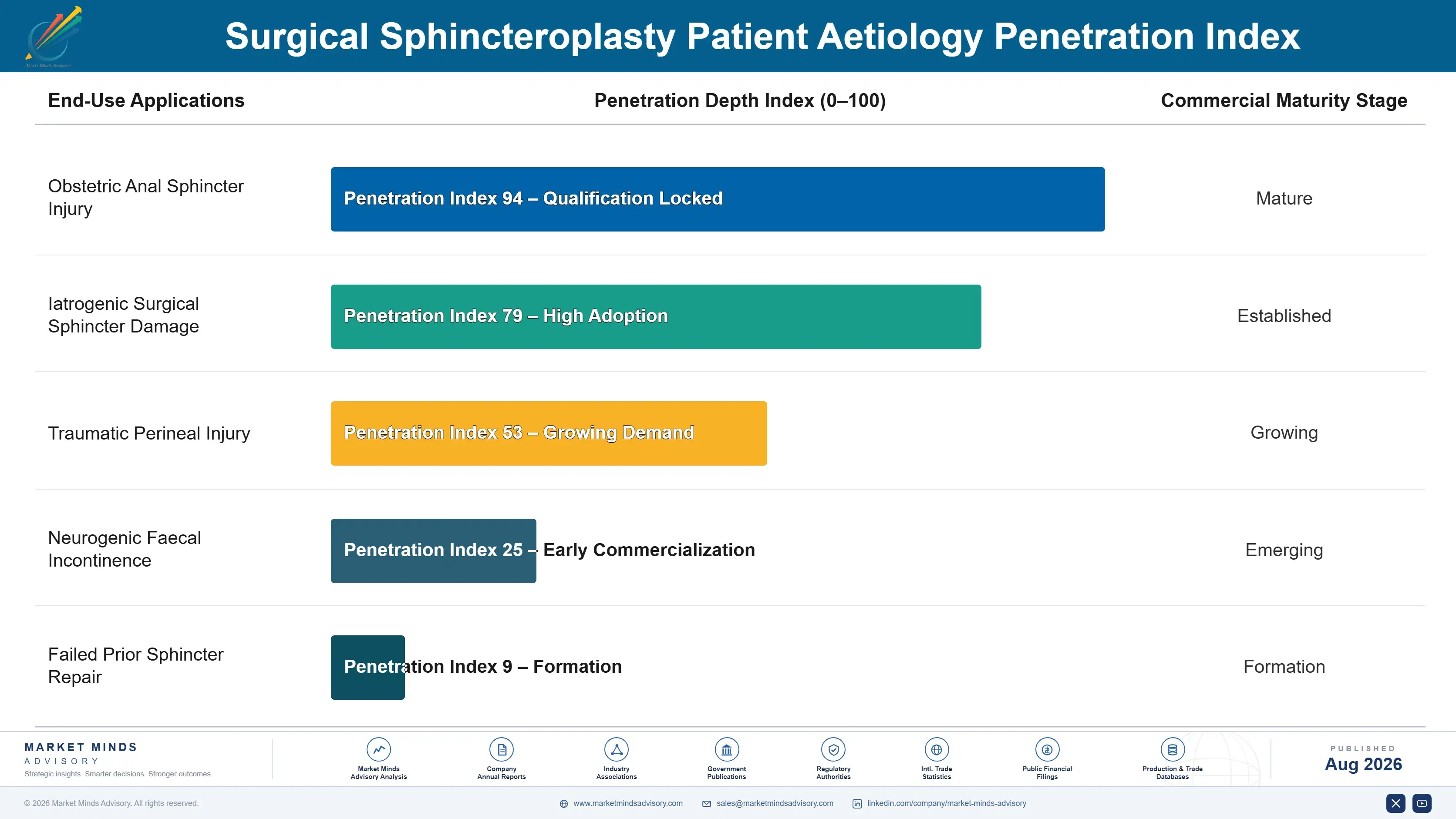
Demand here originates at a birth and appears years or decades later, which makes it unlike almost any other surgical category. An obstetric sphincter tear that goes unrecognised produces symptoms that emerge gradually, are rarely volunteered and are frequently attributed to ageing rather than to childbirth. Only 36% of those injuries are identified at delivery. The result is a category whose true clinical population is several times the treated one, and whose growth depends far more on recognit
Adoption depth varies almost entirely by funding. Colorectal units in systems with established neuromodulation coverage substitute away from direct repair substantially, and implant volumes follow coverage boundaries closely. Units without coverage perform direct repair and graft augmentation knowing the durability limitations. Continence clinics and pelvic floor services see many of these women first and refer variably depending on local pathways. Charitable surgical programmes handle much of the burden in the poorest systems, where nothing else reaches these patients.

Buyer profiles are unusually dispersed. A colorectal surgeon selects the intervention, a payer decides whether the expensive option is available, and a midwife years earlier determined whether the patient was ever identified at all.
surgical-sphincteroplasty-market-end-use-penetration-index-1787309829562

What We Would Do Here

These are among the four positions where our research anticipates prominent divergence between winners and laggards over the coming forecast period. Each is grounded in the demand model, the regulatory perimeter, and the announced capacity pipeline.
01 / RECOGNITION PROGRAMME FUNDING

Fund the delivery examination nobody currently performs

Only 36% of obstetric sphincter injuries are identified at delivery, and every unrecognised tear becomes a patient who presents years later or simply never presents at all to anybody. Participants funding midwifery and obstetric examination education report referral volume roughly 55% higher in programme regions than in comparable regions without them. It costs money years before any surgical revenue appears and benefits every competitor in the region equally, which is exactly why almost nobody has attempted it at meaningful scale.
02 / COVERAGE DEFENCE EVIDENCE

Build cost-offset data before the review opens

Implanted systems realise roughly USD 21,600 and coverage was established when faecal incontinence volumes were genuinely small, which is precisely the situation payers revisit once utilisation exceeds their original projections. Participants holding cost-offset evidence on containment products and care hours avoided report coverage review outcomes roughly 45% more favourable than those relying on clinical trial data alone. Building that evidence costs money years beforehand, and the alternative is arguing without it once a review has already been opened against you.
03 / UNFUNDED SYSTEM SUPPLY

Serve the patients neuromodulation pricing will never reach

System pricing near USD 21,600 puts neuromodulation outside most Asian, African and Latin American funding arrangements altogether, and those regions hold a large share of the affected population worldwide. Participants supplying graft-augmented and conventional repair into those systems report volume growth roughly 40% above their own neuromodulation businesses in the very same markets. Margins are considerably thinner and clinical results are worse, which is uncomfortable and still far better than offering those patients nothing whatsoever, which is the current alternative.
04 / TRIAL PERIOD FRAMING

Present the test stimulation as a payer safeguard

Sacral neuromodulation is the only intervention in this category that can be trialled before any permanent commitment, and roughly 72% of tested patients go on to receive an implant. Presenting that trial explicitly as a payer safeguard rather than merely as a clinical step shortens coverage negotiations considerably, and participants doing so report coverage establishment roughly 35% faster in new markets. It requires health economic framing device commercial teams rarely produce and converts a clinical feature into an argument competitors cannot make.

Engagement Snapshot From the Field

A live engagement with an industry participant carrying material or product regulatory and market exposure ahead of a defining policy shift, showing how our research translates into a defensible multi-year portfolio strategy.
MARKET MINDS ADVISORY · CLIENT ENGAGEMENT SUMMARY
Surgical Sphincteroplasty Producer Strategic Portfolio Review and Transition Roadmap 2026·Investment Scenario on Surgical Sphincteroplasty Exposure Evaluation 2025-26
CLIENT PROFILE
A global pelvic health device company with faecal incontinence revenue near USD 96 million annually (client-reported, unverified by MMA), concentrated almost entirely in sacral neuromodulation across markets with established coverage, no biologic graft or repair portfolio, and no involvement in obstetric injury recognition anywhere. Roughly 93% of revenue came from eight markets with established faecal incontinence coverage.
STRATEGIC CHALLENGE
Growth had slowed as covered market penetration matured and coverage review activity increased in two of those eight markets, and management proposed pursuing coverage establishment in six additional markets. The board wanted to know whether coverage was realistically achievable at current pricing in those markets, and what else could be done with the affected population already identified.
MMA APPROACH
MMA modelled coverage feasibility across twelve candidate markets against health system funding capacity and comparable device coverage precedents. Forty-seven expert interviews with colorectal surgeons, payer medical directors, midwifery leads and continence service managers established both coverage prospects and the recognition gap. The client's addressable population was then recalculated on identified rather than epidemiological patient numbers.
KEY FINDINGS
  1. Coverage at current system pricing was realistically achievable in only two of the six markets management had proposed, and the remaining four would require pricing the client had never contemplated offering.
  2. Identified patients represented a small fraction of the epidemiological population in every market reviewed, and recognition at delivery rather than surgical capacity was the binding constraint everywhere.
  3. Midwifery leads in four markets confirmed that structured perineal examination programmes were feasible and unfunded, and no device participant had ever approached them about supporting one.
  4. Graft-augmented repair reached patients in eleven of twelve markets reviewed where neuromodulation reached patients in only four, and the client had no product for any of them.
CLIENT PROFILE
A global pelvic health device company with faecal incontinence revenue near USD 96 million annually (client-reported, unverified by MMA), concentrated almost entirely in sacral neuromodulation across markets with established coverage, no biologic graft or repair portfolio, and no involvement in obstetric injury recognition anywhere. Roughly 93% of revenue came from eight markets with established faecal incontinence coverage.
STRATEGIC CHALLENGE
Growth had slowed as covered market penetration matured and coverage review activity increased in two of those eight markets, and management proposed pursuing coverage establishment in six additional markets. The board wanted to know whether coverage was realistically achievable at current pricing in those markets, and what else could be done with the affected population already identified.
MMA APPROACH
MMA modelled coverage feasibility across twelve candidate markets against health system funding capacity and comparable device coverage precedents. Forty-seven expert interviews with colorectal surgeons, payer medical directors, midwifery leads and continence service managers established both coverage prospects and the recognition gap. The client's addressable population was then recalculated on identified rather than epidemiological patient numbers.
KEY FINDINGS
  1. Coverage at current system pricing was realistically achievable in only two of the six markets management had proposed, and the remaining four would require pricing the client had never contemplated offering.
  2. Identified patients represented a small fraction of the epidemiological population in every market reviewed, and recognition at delivery rather than surgical capacity was the binding constraint everywhere.
  3. Midwifery leads in four markets confirmed that structured perineal examination programmes were feasible and unfunded, and no device participant had ever approached them about supporting one.
  4. Graft-augmented repair reached patients in eleven of twelve markets reviewed where neuromodulation reached patients in only four, and the client had no product for any of them.
RECOMMENDED STRATEGY
Phase 1: Phase 1 (0 to 9 months): Narrow coverage pursuit to the two feasible markets, and begin building cost-offset evidence ahead of the two reviews already opening. Phase 2: Phase 2 (9 to 24 months): Acquire or license a biologic graft repair product to serve the systems where neuromodulation pricing excludes implantation entirely. Phase 3: Phase 3 (24 to 42 months): Fund obstetric recognition programmes in three markets, and reframe the trial period as a payer safeguard in coverage submissions.
OUTCOME
Coverage pursuit was narrowed to the two feasible markets before budget was committed to the other four. Cost-offset evidence work began ahead of both reviews and one concluded favourably (client-reported, unverified by MMA). A biologic graft product was licensed rather than acquired. Obstetric recognition funding was approved in two markets rather than three.

Frequently Asked Questions

Foundational context covering the market sizes, CAGR, scope, country, region and competition that inform every finding below. This section is provided to cover basics and most often pre-purchase conversations, answered from the MMA Primary Research Dataset.

What is the current size of the Surgical Sphincteroplasty Market?

MMA sizes the global surgical sphincteroplasty market at USD 0.32 billion in 2025, rising to USD 0.34 billion in 2026. That covers implant, device, graft and single-use supply revenue at realised hospital price.

How large will the Surgical Sphincteroplasty Market be by 2036?

MMA forecasts USD 0.71 billion by 2036, an expansion multiple of 2.09 times the 2026 base. That represents roughly USD 0.37 billion of incremental revenue across the forecast period.

What is the CAGR for the Surgical Sphincteroplasty Market 2026 to 2036?

The base case compounds at 7.6% annually, with a bull case of 8.8% and a bear case of 6.3%. Whether obstetric injury recognition at delivery improves decides which case materialises.

Which segment is growing fastest?

Sacral neuromodulation systems compound at 11.4%, exactly 1.50 times the market rate. Direct repair holds continence in only 38% of patients at ten years, which is what redirected the field.

Who are the major companies in the Surgical Sphincteroplasty Market?

Medtronic, Axonics, Coloplast, Boston Scientific and Becton Dickinson support 68% of treated patient episodes. Fifteen further participants including Integra LifeSciences and Palette Life Sciences are profiled.

Which country is growing fastest?

India compounds at 10.2%, ahead of every other national market MMA tracks here. A very large untreated obstetric injury population and expanding colorectal capacity drive that growth.

Report Segmentation Architecture

The full report scope spans multiple orthogonal segmentation dimensions, with cross-tabulated demand data provided for each dimension pair. Coverage extends further to regional breakdowns, trend trajectories, and the competitive detail needed to support segment-level decision-making.

By Intervention Class

  • Sacral Neuromodulation Systems
  • Biologic Graft-Augmented Repair
  • Injectable Bulking Agents
  • Direct Overlapping Sphincteroplasty Instrumentation
  • Artificial and Magnetic Sphincter Devices
  • Perioperative Bowel Management and Diversion Supplies

By Patient Aetiology

  • Obstetric Anal Sphincter Injury
  • Iatrogenic Surgical Sphincter Damage
  • Traumatic Perineal Injury
  • Neurogenic Faecal Incontinence
  • Failed Prior Sphincter Repair

By Care Setting

  • Specialist Colorectal Surgical Units
  • Pelvic Floor and Continence Services
  • General Surgical Departments
  • Charitable and Outreach Surgical Programmes

By Region

  • North America
  • Western Europe
  • East Asia
  • South Asia and Pacific
  • Latin America
  • Middle East and Africa
  • Eastern Europe

Scope, Methodology, and Coverage

Every figure in this report is reproducible from documented input assumptions. The scope below maps the historical period, the forecast horizon, the segmentation dimensions, and the countries covered, alongside the underlying primary and qualitative methodology.
Historical Period
2020 to 2025
Forecast Period
2026 to 2036
Base Year
2025 (USD billions; MMA Primary Research Dataset, August 2026)
Market Definition
The market comprises surgical and device-based reconstruction and restoration of anal sphincter function in faecal incontinence, spanning sacral neuromodulation systems, biologic graft-augmented repair, injectable bulking agents, direct overlapping sphincteroplasty instrumentation, artificial and magnetic sphincter devices, and perioperative bowel management and diversion supplies. Sizing captures implant, device, graft and single-use supply revenue at realised hospital price. Urinary incontinence devices and slings, pelvic organ prolapse mesh, haemorrhoid and fistula treatment, colorectal cancer resection, stoma appliances for permanent diversion, and pelvic floor physiotherapy services are outside scope.
Quantitative Units
USD billions (current prices); thousand treated patient episodes annually; USD per episode at realised hospital price
Segmentation Dimensions
By Intervention Class; By Patient Aetiology; By Care Setting; By Region
Regions Covered
North America, Western Europe, East Asia, South Asia and Pacific, Latin America, Middle East and Africa, Eastern Europe
Countries Covered
USA, Canada, UK, Sweden, Denmark, Norway, Netherlands, Germany, France, Italy, Spain, Switzerland, Japan, China, South Korea, Taiwan, India, Australia, Brazil, Mexico, Argentina, Colombia, Indonesia, Thailand, Vietnam, UAE, Saudi Arabia, Turkey, Nigeria, Kenya, South Africa, Poland, Czech Republic, and additional markets relevant to this sector
Key Companies Profiled
Medtronic, Axonics, Coloplast, Boston Scientific, Becton Dickinson, Integra LifeSciences, Cook Medical, Baxter International, Organon, Laborie Medical Technologies, Teleflex, Convatec, Hollister, B. Braun Melsungen, Medline Industries, Palette Life Sciences, Ethicon, Cousin Biotech, Aspide Medical, RTI Surgical.
Quantitative Methodology
Primary survey, n=3,800 respondents, Q4 2025, six countries; demand-side model with trade association cross-validation
Qualitative Methodology
47 expert interviews, Q4 2025; applied to validate demand model assumptions, identify emerging dynamics, and assess competitive positioning
Report Format
PDF and XLSX data workbook (Word format preview document)
Publisher
Market Minds Advisory
Report Code
MMA-2026-MED-326
Published
August 2026
Contact
sales@marketmindsadvisory.com | www.marketmindsadvisory.com

Purchase the full Surgical Sphincteroplasty Market Report (2026 to 2036).

The full report sizes the surgical sphincteroplasty market across six intervention classes, five patient aetiologies, four care settings and seven regions, with annual forecasts to 2036 in revenue and treated patient episodes. It reconciles epidemiological injury prevalence against identified and treated patient numbers market by market, which is the analysis that quantifies how much of this category's growth sits behind an examination nobody performs. Twenty participants are assessed on a consistent treated patient episodes basis, with neuromodulation coverage positions and graft supply capability mapped separately. Coverage review exposure is quantified, and obstetric recognition rates are tracked market by market.
Six intervention classes sized and forecast annually
Epidemiological prevalence reconciled against identified patient numbers
Twenty participants on consistent treated patient episodes basis
Neuromodulation coverage positions mapped market by market
Biologic graft supply capability compared across every participant
Obstetric injury recognition rates tracked market by market

Built For The People Who Decide

From boardroom strategy to bench-side execution, this report is read cover-to-cover by leaders shaping the next decade of their industry, turning demand scenarios, market dynamics and valuation benchmarks into decisions.
CXOs/ Presidents/ VPs/ Managers
M&A and Corporate Development
Strategy Teams and R&D Heads
Procurement and Product Directors
Regulatory and Compliance Leaders
Investor Relations and Equity Analysts