Market Minds Advisory
Surgical Scissors Market

Surgical Scissors Market: Single-Use Adoption and Ambulatory Surgery Growth Reshape Instrument Specification

Hospitals and ambulatory surgical centers are shifting toward single-use scissors as sterilization cost and infection control scrutiny rise, forcing instrument makers to prove cutting precision parity with reusable steel while meeting tighter reprocessing documentation.

Lead Analyst

Alice Ballenger

Published

September 2026

Make Smarter Decisions with Customized Research Insights

Request a free sample report and evaluate market opportunities, growth trends, and competitive dynamics relevant to your business needs.

2025 MARKET VALUE$1.1BMarket Size 2025
2036 FORECAST VALUE$2.3BBase Case , 2026 to 2036
CAGR 2026 TO 20366.4 %Bull 7.7% / Bear 5.1%
INCREMENTAL OPPORTUNITY$1.1BNet 10- year value creation
EXPANSION MULTIPLE1.86x2036 value over 2026 base
Strategic Levers
M&A Pipeline
Regional Outlook
Country Rankings
Competitive Intelligence
Segmental Deep-dive
Call-Us : 91 93563 13602

Executive Snapshot and Market Trajectory

Hospitals and ambulatory surgical centers are shifting toward single-use scissors as sterilization cost and infection control scrutiny rise, forcing instrument makers to prove cutting precision parity with reusable steel while meeting tighter reprocessing documentation across every accredited surgical facility this cycle.
Demand concentrates among ambulatory surgical centers standardizing single-use instrument kits for high-volume outpatient procedures and hospitals reassessing central sterile reprocessing economics against disposable alternatives. North America anchors global consumption on its dense surgical procedure volume and ambulatory center growth, while specialty and micro-surgical scissors post the second-fastest segment growth behind single-use formats, as ophthalmic and neurosurgical procedures increasingly demand precision-ground blades that standard dissecting scissors cannot reliably deliver across every accredited surgical facility this cycle.
Competition splits between a handful of established German and North American surgical instrument manufacturers supplying certified reusable and single-use lines and a wider field of regional producers selling commodity stainless steel scissors at lower price points. Tightening sterilization and reprocessing regulation alongside rising scrutiny of counterfeit instruments are reshaping procurement, rewarding suppliers that can document consistent blade sharpness and material traceability across every surgical tray and every regulatory audit it faces.
Market Definition
The surgical scissors market covers reusable and single-use surgical scissors used in operating rooms, ambulatory surgical centers, and outpatient procedure settings, including dissecting, suture, and specialty scissors sold to hospitals, surgical centers, and distributors. It excludes electrosurgical cutting devices, powered surgical instruments, and non-surgical general-purpose scissors.
Base Year Value
$1.1B in 2025 (MMA Primary Research Dataset, August 2026)
Forecast Period
2026 to 2036, eleven discrete annual values
CAGR
6.4% base case. Bull 7.7%. Bear 5.1%.
Fastest Growth Segment
Single-Use Surgical Scissors: 10.6% CAGR
Fastest Growth Country
India: 9.3% CAGR
Fastest Growth Region
South Asia and Pacific: 8.6% CAGR
Largest Region
North America: 27% of 2025 global value
Market Leaders
B. Braun Melsungen AG, Medtronic plc, Integra LifeSciences Holdings Corporation, KLS Martin Group, Teleflex Incorporated. Source: MMA Analysis based on company annual reports.
Primary Survey
n=3,800 procurement and R&D decision-makers, Q4 2025, six countries
Methodology
Demand-side build-up, cross-validated against public data, 47 expert interviews

Surgical Scissors Market Forecast Scenarios

surgical-scissors-market-size-forecast-scenario-1787299920214
Surgical scissors demand grew steadily between 2020 and 2025 as postponed elective procedures resumed and ambulatory surgical center construction accelerated, with the historical CAGR near 5.6% reflecting cautious hospital capital spending before single-use adoption gained meaningful traction across most regional surgical markets, particularly among larger systems that moved early on sterilization compliance investment ahead of most regional peers.
The base case assumes continued single-use conversion as three mechanisms compound: ambulatory surgical centers standardizing disposable instrument kits for outpatient procedures, sterilization and reprocessing regulation tightening across major healthcare markets, and specialty surgical volume growth demanding precision-ground blades. Together these push buyers toward higher-value certified instruments and away from unbranded commodity stainless steel entirely, reinforcing single-use kits as the default specification most institutional buyers now expect rather than an optional upgrade worth paying extra for.
A bull scenario assumes faster-than-expected ambulatory surgical center construction across South and Southeast Asia pulling forward single-use instrument demand ahead of schedule and lifting conversion rates faster than currently modeled. The bear case centers on stainless steel and specialty alloy cost volatility squeezing manufacturer margins, delaying single-use conversion among smaller regional hospitals still dependent on reusable reprocessed instrument sets across most price-sensitive markets.

Reprocessing Economics and Single-Use Conversion Dynamics

Surgical scissors economics increasingly hinge on reprocessing cost avoidance rather than unit price alone, as hospitals weigh central sterile department labor and instrument tracking cost against single-use purchase price. Material traceability now separates competitive manufacturers from those still selling unbranded commodity stainless steel into price-sensitive distribution channels, and that gap widens every time a major hospital network tightens its sterilization specification further.
MARKET CONCENTRATIONCR5 26%top five instrument makers hold a moderate combined share
AVERAGE PRICE PREMIUM50-70% for single-usedisposable scissors command a meaningful pricing premium currently
TOP PRODUCING COUNTRY SHAREGermany 21%leading share of global surgical instrument manufacturing output
CAPACITY UTILISATION64-76%instrument manufacturing lines running below theoretical maximum output
TRADE INTENSITY58%share of finished scissor volume crossing an international border
FEEDSTOCK COST SHARE36-46%surgical-grade stainless steel dominates total instrument production cost
Commercial activity concentrates around ambulatory surgical center specification upgrades rather than hospital capacity expansion, since overall surgical procedure volume growth is steady rather than explosive. Buyers weigh single-use purchase cost against sterilization labor savings, with disposable scissors increasingly justified even for mid-sized surgical centers previously locked into reusable sets by upfront cost alone, particularly once multi-year kit contracts spread that cost across a longer commercial relationship.
Single-use conversion, precision blade engineering for specialty procedures, and instrument traceability are reshaping specification sheets for the next decade, pushing manufacturers toward certified product lines surgical buyers can specify confidently rather than commodity grades requiring case-by-case sharpness verification. Manufacturers slow to convert risk losing accounts to competitors already treating single-use availability as standard practice rather than a costly optional upgrade.
"Surgical directors used to reorder scissors when the last set went dull. Now they run the numbers on sterilization labor first, and disposable often wins before the blade even matters."
Director, Surgical Instruments Practice · MMA Medical Devices / Surgical Instrum

Market Trends

Single-Use Scissors Displace Reusable Reprocessing Cycles

Hospital central sterile departments have shifted roughly twenty five percent of routine surgical scissor volume from reusable reprocessed sets to single-use disposables over the past three years, a pace that outstripped most manufacturers' production capacity planning assumptions. Infection control committees increasingly write single-use specification directly into procedure protocols for high-risk cases, requiring documented sterility assurance rather than relying on reprocessing validation alone. This shift is pulling smaller regional hospitals toward single-use suppliers they previously avoided on cost grounds, reshaping purchasing relationships across the surgical supply chain as disposable specification becomes standard protocol rather than a premium exception.
Market Impact: Cites 25%+ of audited departments

Ambulatory Surgical Centers Drive Precision Blade Demand

Ambulatory surgical center construction has expanded outpatient procedure capacity faster than hospital operating room growth, pulling instrument demand toward high-turnover facilities that prioritize procedure throughput over instrument longevity. These centers increasingly specify single-use precision-ground blades for ophthalmic and minor surgical procedures rather than maintaining costly in-house reprocessing infrastructure for low daily case volume. Manufacturers report rising order frequency from ambulatory center chains that previously ordered irregularly, now placing recurring monthly orders tied to steady outpatient procedure growth across their expanding facility network and seasonal scheduling peaks nationwide and across every new regional site opened.
Market Impact: Tracks 10%+ annual volume growth

Market Opportunities and Growth Drivers

AAMI Reprocessing Standards Tighten Sterilization Requirements

Updated Association for the Advancement of Medical Instrumentation reprocessing guidance is forcing hospitals to document validated cleaning and sterilization cycles for every reusable instrument tray, with compliance audits citing incomplete reprocessing records at more than a quarter of surveyed central sterile departments over the past two years. Hospital systems increasingly treat this documentation burden as justification for single-use conversion in high-turnover procedure categories rather than continuing to absorb reprocessing compliance risk. This regulatory pressure is spreading fastest across accredited surgical centers where audit failure directly threatens facility certification status itself.
Market Impact: Adds 50-70% cost versus reusable sets

Rising Global Surgical Volume Expands Instrument Demand

World Health Organization data on global surgical volume growth coincides with expanding ambulatory and elective procedure capacity across major healthcare markets, with several national health ministries reporting surgical volume growth exceeding ten percent annually as backlog procedures clear and outpatient capacity expands. Hospital systems operating across multiple facilities increasingly standardize instrument specification nationwide rather than maintaining separate facility-specific purchasing, simplifying procurement but concentrating demand among manufacturers capable of guaranteeing consistent certified supply at national scale across every regional distribution warehouse a hospital network operates, since inconsistent supply risks compliance gaps that procurement officers increasingly flag during annual contract review.
Market Impact: Adds 10-15% verification cost overhead

Market Restraints and Challenges

Single-Use Cost Premium Limits Broad Conversion

Single-use scissors carry a fifty to seventy percent price premium over reusable instruments amortized across their reprocessing lifespan, a gap rooted in the disposable manufacturing economics that cannot spread material cost across hundreds of sterilization cycles the way reusable steel does. This cost gap has slowed conversion among budget-constrained hospitals that continue reprocessing instruments despite rising sterilization labor cost and compliance documentation burden. Several manufacturers are now optimizing single-use material formulations and expanding volume discount programs to narrow the total cost of ownership gap, though these improvements remain incremental rather than closing it entirely.
Market Impact: Shifts 25% of scissor volume

Counterfeit Instruments Undermine Certified Supplier Trust

Counterfeit and substandard surgical instruments bearing falsified certification marks continue circulating through secondary distribution channels, a problem rooted in fragmented import verification systems that make certification marks easy to replicate without genuine material testing. This undermines buyer confidence in certified manufacturers broadly, forcing legitimate suppliers to invest in additional material traceability measures to differentiate themselves from counterfeit product flooding price-sensitive distribution channels. Suppliers increasingly embed laser-etched batch codes and digital verification tools, while industry associations lobby regulators for stronger enforcement against falsified certification marks and harsher penalties for distributors caught knowingly selling counterfeit product.
Market Impact: Adds 18% ambulatory order frequency
3 additional market trends, 3 additional growth drivers, and 2 additional restraints and challenges are covered in the full report. Contact sales@marketmindsadvisory.com to access the complete intelligence.

Segment CAGR and Growth Architecture

Segmentation follows material composition and reusability format because production process, sterilization pathway, and end-use suitability differ substantially between single-use, reusable, and specialty alloy formats, each carrying its own distinct cost structure and certification pathway shaped by procedure type, buyer specification, and the manufacturer's own material sourcing, quality audit cycle, and export documentation requirements nationwide.
surgical-scissors-market-market-share-analysis-1787299920751

Single-Use Surgical Scissors

Single-use scissors lead growth as hospitals and ambulatory surgical centers push sterilization cost avoidance across high-turnover procedure categories. These instruments use precision-stamped stainless steel blades engineered for one-time sterility assurance, eliminating the reprocessing validation burden that reusable instruments require under updated sterilization guidance. Ambulatory surgical centers serving high daily case volume increasingly standardize on single-use kits specifically because eliminating in-house reprocessing infrastructure simplifies facility certification and staffing requirements, avoiding the capital and compliance complexity centralized sterile processing demands. Manufacturers with established single-use production report the fastest order backlog growth among facilities expanding beyond reusable instrument sets, positioning this category well ahead of every other segment through the current forecast horizon.
CAGR 10.6%

Specialty and Micro-Surgical Scissors

Specialty and micro-surgical scissors post the second-fastest growth as ophthalmic, neurosurgical, and microvascular procedures expand and demand precision-ground blades that standard dissecting scissors cannot reliably deliver. These instruments achieve micron-level cutting tolerance through specialized alloy composition and hand-finishing processes rather than the automated stamping that commodity scissors use, making them a premium category less exposed to single-use commoditization pressure. Surgical centers increasingly specify specialty micro-scissors as a standard line item for expanding ophthalmic and reconstructive procedure volume rather than adapting general-purpose instruments. Suppliers selling certified specialty scissors report rising order frequency from expanding surgical subspecialty practices, positioning this category just behind single-use formats in overall segment expansion through the current forecast horizon.
CAGR 8.9%
Full segment breakdown across 6 segments available in the complete report.

Regional Architecture and Country Demand Map

North America leads on its dense surgical procedure volume and ambulatory surgical center growth, while South Asia and Pacific grows fastest as India's healthcare infrastructure investment expands and domestic manufacturing capacity accelerates across new export-linked industrial zones and manufacturing corridors serving the wider region nationwide.

North America

Ambulatory surgical center growth drives most North American surgical scissors demand, as high-volume outpatient facilities standardize single-use instrument kits across their entire procedure schedule rather than maintaining costly in-house reprocessing infrastructure. Updated AAMI reprocessing guidance, with compliance audits citing incomplete documentation at more than a quarter of surveyed central sterile departments, is accelerating hospital conversion toward single-use categories where compliance risk outweighs the reusable cost advantage. US Census Bureau data confirms continued net healthcare employment growth, sustaining steady instrument volume even as per-facility single-use intensity rises with expanded conversion. Canadian health systems increasingly mirror US sterilization requirements to maintain single-specification procurement across both markets and their shared distribution networks today.
Share: 27% | CAGR: 7.2% (2026 to 2036)

Western Europe

Germany's Tuttlingen surgical instrument cluster anchors regional manufacturing, supplying certified reusable and single-use scissors to hospitals across the continent from a concentration of specialized precision engineering suppliers built up over generations of instrument-making heritage. European Union medical device regulation enforcement is among the most stringent globally, pushing hospital systems to treat CE-marked certification and material traceability as a mandatory tender requirement rather than an optional differentiator. German and French hospital networks increasingly specify certified instrument sets as a standard procurement line item, reinforcing regional production leadership even as growth trails faster-expanding regions given already-mature per-procedure consumption levels across most member state markets tracked this cycle and the next forecast period as well.
Share: 22% | CAGR: 4.9% (2026 to 2036)
Regional intelligence for 5 additional markets available in the complete report: East Asia, South Asia and Pacific, Latin America, Middle East and Africa, Eastern Europe. Contact sales@marketmindsadvisory.com.
surgical-scissors-market-country-cagr-analysis-1787299921275

Where Instrument Makers Capture Margin Beyond Volume

Reusable commodity scissors margins are compressing as regional manufacturers expand capacity, pushing suppliers toward single-use conversion, specialty precision engineering, and traceability revenue that commands a durable premium rather than competing purely on unit volume shipped, particularly among suppliers serving institutional buyers demanding documented compliance and material certification across every audited procurement cycle and renewal round.

Expand Single-Use Instrument Kit Offerings Broadly

Manufacturers investing in single-use production capacity capture a 50 to 70 percent price premium over reusable commodity scissors, converting a sterilization compliance requirement into a durable margin advantage rather than a pure reprocessing cost avoidance play. Institutional buyers increasingly treat single-use availability as a baseline qualifying criterion for high-turnover procedure categories, meaning suppliers without it are excluded from ambulatory center tenders entirely. Manufacturers that convert early capture multi-year kit supply agreements with hospital networks standardizing specifications across their facility footprint, locking in volume before slower competitors catch up with comparable capacity of their own.
Market Impact: Adds 50-70% pricing premium over reusable sets sold

Develop Proprietary Precision-Ground Specialty Blade Formulations

Manufacturers developing specialized alloy formulations and hand-finishing processes for ophthalmic and microsurgical blades address the precision gap currently limiting general-purpose scissor use in expanding subspecialty procedures, opening an addressable market worth an estimated 25 to 35 percent premium over standard dissecting instruments. Blade engineering expertise creates a defensible technical moat that commodity producers cannot easily replicate without significant metallurgical investment. Early movers in this category are securing exclusive supply relationships with surgical subspecialty practices eager to standardize on documented precision tolerances across every procedure category they perform and every new hire they onboard.
Market Impact: Captures 25-35% specialty blade pricing premium each year

Offer Laser-Etched Batch Traceability Verification Systems

Manufacturers developing laser-etched batch codes and digital verification tools engineered specifically to combat counterfeit instruments capture rising demand from institutional buyers wary of falsified certification marks, a concern cited at more than 25 percent of audited central sterile departments during recent compliance reviews. This lever converts a compliance concern into a recurring revenue channel as more buyers specify traceability verification as a standard procurement requirement rather than an optional add-on. Suppliers with established traceability systems report meaningfully higher institutional order retention than competitors without verification capability across every renewal cycle.
Market Impact: Cites 25%+ of departments flagging concerns openly today

Secure Long-Term Surgical Steel Supply Contracts

Manufacturers locking in long-term surgical-grade stainless steel supply contracts with mills reduce margin exposure to spot market volatility that squeezed smaller competitors dependent on quarterly purchasing, typically stabilizing input cost within a 5 to 10 percent band rather than the wider swings the open market delivers. This approach lets manufacturers offer institutional buyers multi-year fixed pricing, a commercial advantage increasingly valued by health systems managing their own annual budget planning cycles. Manufacturers with secured steel supply report winning larger, longer-duration contracts than spot-market competitors still exposed to volatility and unable to guarantee comparable delivery consistency.
Market Impact: Stabilizes steel cost within a 5-10% band annually

Who Controls the Margin Pool

The top five instrument makers hold roughly twenty six percent combined share on a production capacity and annual shipment revenue basis, leaving a wide field of regional manufacturers competing for commodity reusable scissors orders below the certified single-use and specialty price tiers. The gap between leading manufacturers and mid-tier challengers centers on precision engineering depth and institutional distribution reach rather than raw manufacturing capacity alone.
Current competitive activity concentrates on three fronts: single-use kit expansion for high-turnover ambulatory procedures, specialty blade engineering for expanding subspecialty surgical volume, and traceability system development to combat counterfeit instruments simultaneously. Manufacturers are also racing to secure long-term surgical steel supply agreements, insulating margin from the raw material volatility that has squeezed smaller regional competitors.

Emerging pressure comes from Asian domestic manufacturers improving certification capability fast enough to challenge German and North American suppliers on mid-tier single-use categories, previously an uncontested Western stronghold. Indian manufacturers backed by expanding domestic production capacity are also gaining share in South Asian and African export markets, positioning them to challenge established players on price for commodity reusable and entry-level single-use grades within the next several forecast years.
surgical-scissors-market-company-positioning-matrix-1787299921987

Competitive Moat and Risk Dimensions

B. BRAUN MELSUNGEN AG

Moat: Integrated Aesculap precision manufacturing

B. Braun's Aesculap division combines decades of precision instrument engineering heritage with integrated steel sourcing, letting it control material quality more tightly than competitors dependent on purchased components. This integration supports consistent certified output at a scale few competitors can match, while absorbing steel price volatility more effectively than smaller manufacturers.
B. BRAUN MELSUNGEN AG

Risk: High fixed-cost demand exposure

B. Braun's capital-intensive integrated production model carries substantial fixed cost that becomes a disadvantage during demand downturns, when smaller, more flexible manufacturers can idle capacity with less financial exposure. This structure leaves the company more sensitive to prolonged hospital capital spending contraction than asset-light competitors purchasing steel on the open market.
MEDTRONIC PLC

Moat: Broad surgical portfolio bundling reach

Medtronic's established relationships across broader surgical device categories let it bundle scissors into wider operating room equipment contracts that regional specialists cannot match, capturing a larger share of total hospital procurement spend. Its existing customer relationships support rapid qualification across new surgical center accounts as ambulatory capacity expands.
MEDTRONIC PLC

Risk: Scissors a minor portfolio priority

Medtronic's surgical scissors business represents a small share of its overall device portfolio, leaving it less focused on instrument-specific innovation than specialist competitors dedicating their full research investment to blade engineering and single-use conversion technology across every procedure category, a gap that widens further as subspecialty demand accelerates industry-wide.

Players Tracked

Prominent Players

B. Braun Melsungen AG
Medtronic plc
Integra LifeSciences Holdings Corporation
KLS Martin Group
Teleflex Incorporated

Other Key Players

Cardinal Health, Inc.
Medline Industries, LP
Symmetry Surgical Inc.
Sklar Surgical Instruments
Scanlan International, Inc.
Aspen Surgical Products, Inc.
Novo Surgical, Inc.
KAI Industries Co., Ltd.
Robbins Instruments, Inc.
Accurate Surgical & Scientific Instruments Corporation
Becton, Dickinson and Company
Hu-Friedy Mfg. Co., LLC
Surgical Holdings Ltd
V. Mueller
Getinge AB

Recent Developments

APRIL 2025

B. Braun expands single-use instrument production line

B. Braun's Aesculap division expanded its single-use surgical instrument production line to add dedicated capacity for ambulatory surgical center kits, responding to rising sterilization compliance demand and outpatient procedure growth across its major hospital network accounts. The expansion includes new precision stamping equipment for blade manufacturing.
Signal: Confirms single-use conversion as a growing capacity priority ahead of broader industry-wide adoption this planning cycle.
OCTOBER 2024

Integra LifeSciences launches specialty micro-scissor line

Integra LifeSciences launched a specialty micro-scissor line engineered for ophthalmic and neurosurgical procedures, targeting subspecialty surgical practices expanding precision procedure volume across their growing outpatient footprint. The launch responds to rising order frequency from surgical centers previously underserved by standard general-purpose instruments sold through wholesale distributors.
Signal: Indicates manufacturers prioritizing specialty blade engineering ahead of broader subspecialty demand acceleration nationwide this planning cycle.
JANUARY 2025

KLS Martin signs steel supply agreement with German mill

KLS Martin signed a long-term surgical-grade stainless steel supply agreement with a German steel mill to stabilize input cost for its certified instrument production, responding to recent steel price volatility that squeezed manufacturer margins industry-wide. The agreement is a supply arrangement, not an equity acquisition or joint venture.
Signal: Signals manufacturers prioritizing steel cost stability over spot market flexibility amid sustained input cost volatility industry-wide.

Surgical Steel and Precision Alloy Exposure

Surgical-grade stainless steel accounts for roughly thirty six to forty six percent of scissors cost of goods sold, sourced primarily from German, Japanese, and North American specialty steel mills depending on manufacturer location and certification requirements. Precision alloy components for specialty blades add a further eighteen to twenty six percent, concentrated among a smaller set of metallurgical suppliers serving the broader surgical instrument market.
B. Braun's most recent annual report cited elevated specialty steel and alloy costs pressuring surgical instruments segment margins through 2024, consistent with broader specialty metals market tightness affecting surgical-grade steel availability. Extended lead times on specific alloy grades forced several manufacturers to requalify alternate suppliers mid-production run, adding validation cost and delaying some scheduled shipments by several weeks across affected order backlogs this past year.

Smaller regional manufacturers face proportionally higher input cost exposure than vertically integrated producers able to control steel sourcing across their own mill relationships. This cost disadvantage compounds for manufacturers concentrated in a single region, since they cannot offset localized steel price spikes by shifting sourcing across geographically diversified supplier relationships the way larger, integrated competitors routinely can.
surgical-scissors-market-cost-volatility-analysis-1787299922245

Diversify Steel Sourcing Across Multiple Regions

Leading manufacturers now qualify surgical-grade steel suppliers across at least two producing regions, typically Germany and Japan, reducing exposure to localized supply disruption that squeezed single-region buyers during recent volatility. This dual-sourcing approach adds modest logistics cost but has proven its value repeatedly during past specialty metals disruptions industry-wide, particularly the most recent global supply shock.

Lock In Steel Pricing Through Annual Contracts

Manufacturers with sufficient production volume increasingly negotiate annual fixed-price steel supply contracts rather than buying on the spot market, smoothing cost volatility across a full production year. Smaller manufacturers lacking this volume leverage remain more exposed to short-term steel price swings between order intake and delivery, often passing part of that cost through to customers directly.

Vertically Integrate Precision Alloy Production

Larger manufacturers increasingly bring precision alloy processing in-house rather than purchasing from third-party metallurgical suppliers, reducing margin exposure to material price volatility while gaining tighter quality control over blade hardness and edge retention performance. This approach remains capital-intensive and unavailable to most smaller manufacturers lacking sufficient scale or balance sheet capacity to invest in dedicated production lines.

Portfolio Architecture for Margin Defence

Manufacturer portfolios split across three tiers running from commodity reusable scissors through certified single-use kits to fully engineered specialty and traceability next-generation formats. Gross margin widens substantially moving up this ladder, since single-use and specialty grades carry proprietary engineering and compliance documentation that commodity reusable instruments simply cannot support at comparable pricing, regardless of how efficiently a manufacturer manages raw steel cost o
Volume tier competition remains intensely price-driven as Asian and regional manufacturers expand commodity reusable capacity, while premium single-use and specialty tier competition centers on precision engineering, sterility assurance, and supply consistency rather than unit price alone. This tension pushes established Western manufacturers further up-tier rather than defending volume-tier share against lower-cost regional competitors directly, concentrating their research investment where differentiation still commands a premium worth defending in every clinical category served.

High-value pools concentrate in single-use and specialty grades sold with documented precision engineering and traceability, where certification investment compounds pricing power over a product line's full commercial life rather than ending at initial qualification. Manufacturers capturing this recurring specification advantage increasingly outperform peers selling commodity reusable volume alone, a gap that widens further with each additional year of certified installed base growth.

Volume / Commodity-Adjacent Tier

Reusable stainless steel dissecting scissors priced on unit cost, competing mainly on price and regional supply proximity across price-sensitive institutional accounts with thin annual capital budgets and tight replacement schedules.
Gross Margin: 16-24%

Premium / Certified Tier

Single-use and certified precision scissors with documented sterility and material traceability, commanding higher pricing across institutional accounts and their annual audit and renewal cycles and vendor qualification reviews each round.
Gross Margin: 32-42%

Sustainability / Regulatory / Next-Generation Tier

Specialty micro-surgical and traceable single-use formats with multi-standard certification documentation, priced on total clinical value across long-term institutional supply relationships spanning several renewal cycles and audit rounds each fiscal year.
Gross Margin: 38-50%
surgical-scissors-market-portfolio-architecture-1787299922794

High-value Sub-segments and Strategic Watch-out

Single-Use Surgical Scissors

High value and high growth at 10.6%, the fastest category, as hospitals and ambulatory centers push sterilization cost avoidance across every new procurement contract negotiated this year and next across the full forecast horizon and every major regional market tracked closely each cycle and beyond.
Gross Margin: 32-42%

Specialty and Micro-Surgical Scissors

High value with strong growth at 8.9%, driven by ophthalmic and neurosurgical procedure volume pushing precision-ground blade demand across expanding subspecialty practices nationwide each quarter and every new facility opening this year and the following fiscal one as well, industry-wide today and well beyond that.
Gross Margin: 38-50%

Reusable Stainless Steel Dissecting Scissors

The volume core by unit count, growing near 4.4% as commodity hospital demand remains steady even as single-use segments capture incremental growth across most regional healthcare markets tracked this cycle and the next forecast period across nearly every account served nationwide and overseas markets alike.
Gross Margin: 16-24%

Suture and Ligature Scissors

The strategic watch-out, growing slowest at roughly 2.1% and facing steady share erosion as bundled single-use kits replace standalone reusable purchases under evolving hospital procurement models nationwide and their affiliated outpatient sites, specialty clinics, and satellite facilities served across every region today and well beyond.
Gross Margin: 14-22%

Recurring Kit Revenue Beyond Initial Sale

Surgical scissors generate recurring revenue across multi-year institutional supply agreements once a manufacturer qualifies with a major hospital or ambulatory surgical center, turning a single certification into a durable commercial relationship spanning repeat kit purchases for as long as the facility remains contracted. Manufacturers with strong compliance documentation capture a meaningfully larger share of this recurring value than those competing purely on per-order pricing, since kit mar
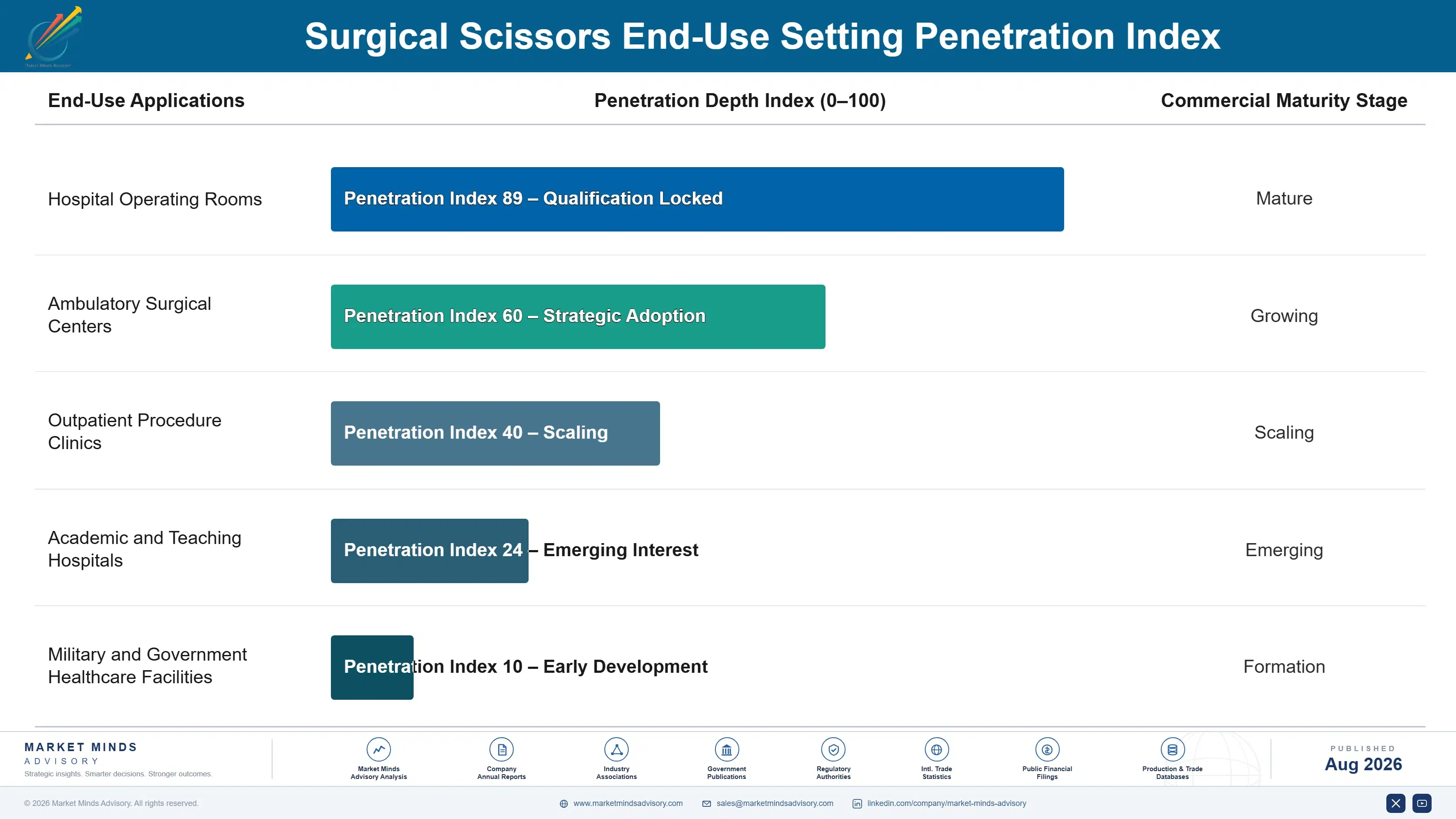
Adoption depth varies sharply by end-use vertical: large ambulatory surgical center chains standardize on single-use kits across their entire procedure schedule, while smaller clinics and independent hospitals remain price-sensitive commodity buyers slower to adopt disposable formats. Subspecialty surgical practices facing the strictest precision requirements increasingly demand specialty micro-scissors tied to expanding procedure volume, pushing their suppliers toward engineered formats faster than the broader commodity hospital segment requires, widening the gap between these two buyer profiles each year.

A generational shift in surgical procurement is accelerating single-use adoption, as younger operating room directors taking over purchasing decisions at both large systems and independent facilities prioritize documented sterility assurance over the lowest unit price their predecessors typically favored, reshaping how buyers evaluate new supplier relationships.
surgical-scissors-market-end-use-penetration-index-1787299923291

Where Manufacturers Should Invest Next

These are among the four positions where our research anticipates prominent divergence between winners and laggards over the coming forecast period. Each is grounded in the demand model, the regulatory perimeter, and the announced capacity pipeline.
01 / SINGLE-USE CAPACITY INVESTMENT

Prioritize single-use conversion over commodity capacity expansion

Single-use scissors are capturing the overwhelming majority of growth as hospitals and ambulatory centers push sterilization avoidance that reusable instruments cannot satisfy, and that gap widens with every reprocessing cycle across major healthcare markets. Manufacturers still investing primarily in commodity reusable capacity risk ceding the fastest-growing customer segment to competitors already established in single-use production, particularly among large ambulatory chains that set specification trends for smaller regional facilities to follow. The capital case favors single-use investment even where near-term commodity volume remains steady, since it is unlikely to expand further.
02 / SPECIALTY BLADE DEVELOPMENT

Develop precision-ground blades for expanding subspecialty volume

The precision blade gap in ophthalmic and neurosurgical procedures is already determining which suppliers win subspecialty tenders, and closing it represents the single largest remaining opportunity as surgical practices push toward complete precision coverage across every eligible procedure category. Manufacturers that develop proprietary blade formulations ahead of competitors secure a durable technical advantage difficult to replicate quickly, since metallurgical expertise takes years to build rather than months. Waiting until competitors close this gap first cedes the largest remaining growth opportunity to faster-moving rivals investing in blade research right now.
03 / TRACEABILITY SYSTEM DEVELOPMENT

Expand laser-etched verification against counterfeit instruments

A meaningful and growing share of institutional buyers now cite counterfeit instrument concerns during procurement, representing an underserved segment that most manufacturers' current systems do not adequately address with verifiable traceability. Suppliers offering laser-etched batch codes and digital verification can capture this segment without competing purely on commodity pricing, converting compliance-focused buyers into long-term institutional accounts years earlier than a standard sales cycle would allow. This approach also builds long-term customer relationships that scale alongside expanding certification requirements, reinforcing loyalty well beyond the initial verification rollout.
04 / REGIONAL STEEL SECURITY

Secure diversified steel supply ahead of continued volatility

Surgical-grade steel price volatility is already squeezing manufacturer margins industry-wide, and this constraint will only intensify as single-use demand adds further pressure on specialty metals supply chains worldwide. Manufacturers that diversify steel sourcing across multiple regions ahead of the next volatility cycle secure a durable cost advantage difficult for single-region competitors to replicate on short notice. Waiting until the next steel price spike to act cedes preferential supplier relationships and favorable long-term contract terms to faster-moving competitors securing supply today.

Engagement Snapshot From the Field

A live engagement with an industry participant carrying material or product regulatory and market exposure ahead of a defining policy shift, showing how our research translates into a defensible multi-year portfolio strategy.
MARKET MINDS ADVISORY · CLIENT ENGAGEMENT SUMMARY
Surgical Scissors Producer Strategic Portfolio Review and Transition Roadmap 2026·Investment Scenario on Surgical Scissors Exposure Evaluation 2025-26
CLIENT PROFILE
The client is a mid-sized regional ambulatory surgical center chain operating seven facilities performing outpatient ophthalmic and general surgical procedures within a single state market. Annual instrument spending is reported at approximately USD 14 million (client-reported, unverified by MMA), with scissors and cutting instruments accounting for roughly a quarter of total procurement. The chain had not yet standardized single-use kits across all seven facilities.
STRATEGIC CHALLENGE
The client faced rising sterilization labor cost and reprocessing compliance documentation burden across its central sterile departments, while inconsistent single-use adoption left some facilities more exposed to audit findings than others. Management needed an objective evaluation of whether network-wide single-use conversion justified the investment given constrained capital availability and competing budget priorities.
MMA APPROACH
MMA benchmarked the client's sterilization labor cost and audit findings against regional single-use adopters, modeled conversion payback across a five-year horizon, and interviewed the client's central sterile and surgical leadership regarding compliance priorities. The analysis incorporated primary survey data on ambulatory center single-use adoption trends alongside manufacturer pricing benchmarks gathered directly from vendor discussions.
KEY FINDINGS
  1. Sterilization labor and compliance costs tied to reusable sets exceeded the annual cost of single-use conversion within roughly fifteen months of continued operation.
  2. Converting the three highest-volume facilities captured most of the compliance benefit at under half the cost of a full network-wide rollout across all sites.
  3. Staff interviews showed a clear preference for single-use kits over reprocessed sets during high-turnover surgical days and peak scheduling periods each quarter.
  4. The smallest facility's procedure volume did not justify dedicated single-use contracting relative to its limited annual case count and shrinking patient base.
CLIENT PROFILE
The client is a mid-sized regional ambulatory surgical center chain operating seven facilities performing outpatient ophthalmic and general surgical procedures within a single state market. Annual instrument spending is reported at approximately USD 14 million (client-reported, unverified by MMA), with scissors and cutting instruments accounting for roughly a quarter of total procurement. The chain had not yet standardized single-use kits across all seven facilities.
STRATEGIC CHALLENGE
The client faced rising sterilization labor cost and reprocessing compliance documentation burden across its central sterile departments, while inconsistent single-use adoption left some facilities more exposed to audit findings than others. Management needed an objective evaluation of whether network-wide single-use conversion justified the investment given constrained capital availability and competing budget priorities.
MMA APPROACH
MMA benchmarked the client's sterilization labor cost and audit findings against regional single-use adopters, modeled conversion payback across a five-year horizon, and interviewed the client's central sterile and surgical leadership regarding compliance priorities. The analysis incorporated primary survey data on ambulatory center single-use adoption trends alongside manufacturer pricing benchmarks gathered directly from vendor discussions.
KEY FINDINGS
  1. Sterilization labor and compliance costs tied to reusable sets exceeded the annual cost of single-use conversion within roughly fifteen months of continued operation.
  2. Converting the three highest-volume facilities captured most of the compliance benefit at under half the cost of a full network-wide rollout across all sites.
  3. Staff interviews showed a clear preference for single-use kits over reprocessed sets during high-turnover surgical days and peak scheduling periods each quarter.
  4. The smallest facility's procedure volume did not justify dedicated single-use contracting relative to its limited annual case count and shrinking patient base.
RECOMMENDED STRATEGY
Phase 1: Phase 1 (Months 1-4): Convert the three highest-volume facilities to single-use kits first and fastest, ahead of peak season demand. Phase 2: Phase 2 (Months 5-9): Pilot expanded specialty blade ordering across ophthalmic procedures at converted facilities and two additional pilot sites. Phase 3: Phase 3 (Months 10-15): Extend conversion to remaining facilities based on pilot results and volume trends observed closely across accounts.
OUTCOME
Within twelve months of completing the initial conversion, the client reported sterilization labor cost down by more than a third and successfully passed two regional accreditation reviews previously flagged as at-risk (client-reported, unverified by MMA). Management deferred conversion at the smallest facility pending continued volume validation.

Frequently Asked Questions

Foundational context covering the market sizes, CAGR, scope, country, region and competition that inform every finding below. This section is provided to cover basics and most often pre-purchase conversations, answered from the MMA Primary Research Dataset.

What is the current size of the Surgical Scissors Market?

The global surgical scissors market is valued at USD 1.15 billion in 2025, covering single-use, reusable, and specialty scissors sold to hospitals and surgical centers worldwide.

How large will the Surgical Scissors Market be by 2036?

The market is projected to reach USD 2.27 billion by 2036, roughly 1.86 times its 2026 value of USD 1.22 billion, driven by single-use conversion and ambulatory surgery growth.

What is the CAGR for the Surgical Scissors Market 2026 to 2036?

The base case CAGR is 6.4%, with a bull case of 7.7% if ambulatory surgical center construction accelerates faster than expected, and a bear case of 5.1% under steel cost pressure.

Which segment is growing fastest?

Single-Use Surgical Scissors lead at a 10.6% CAGR, roughly 1.66 times the overall market rate, as hospitals and ambulatory centers standardize on disposable formats nationwide.

Who are the major companies in the Surgical Scissors Market?

B. Braun, Medtronic, Integra LifeSciences, KLS Martin, and Teleflex lead the market, together holding roughly 26% of combined production and shipment revenue, per recent filings.

Which country is growing fastest?

India leads at a 9.3% CAGR as its healthcare infrastructure investment expands and domestic manufacturing capacity accelerates nationwide each year and beyond the current forecast.

Report Segmentation Architecture

The full report scope spans multiple orthogonal segmentation dimensions, with cross-tabulated demand data provided for each dimension pair. Coverage extends further to regional breakdowns, trend trajectories, and the competitive detail needed to support segment-level decision-making.

By Material Composition and Reusability Format

  • Single-Use Surgical Scissors
  • Specialty and Micro-Surgical Scissors
  • Reusable Stainless Steel Dissecting Scissors
  • Suture and Ligature Scissors
  • Titanium and Tungsten Carbide-Insert Scissors
  • Pediatric and Ophthalmic Scissors

By End-Use Setting

  • Hospital Operating Rooms
  • Ambulatory Surgical Centers
  • Outpatient Procedure Clinics
  • Academic and Teaching Hospitals
  • Military and Government Healthcare Facilities

By Commercial Dimension

  • Direct Institutional Sales Channels
  • Distributor and Wholesaler Networks
  • Group Purchasing Organization Contracts
  • Reprocessing and Sterilization Service Bundles

By Region

  • North America
  • Western Europe
  • East Asia
  • South Asia and Pacific
  • Latin America
  • Middle East and Africa
  • Eastern Europe

Scope, Methodology, and Coverage

Every figure in this report is reproducible from documented input assumptions. The scope below maps the historical period, the forecast horizon, the segmentation dimensions, and the countries covered, alongside the underlying primary and qualitative methodology.
Historical Period
2020 to 2025
Forecast Period
2026 to 2036
Base Year
2025 (USD billions; MMA Primary Research Dataset, August 2026)
Market Definition
The surgical scissors market covers reusable and single-use surgical scissors used in operating rooms, ambulatory surgical centers, and outpatient procedure settings, including dissecting, suture, and specialty scissors sold to hospitals, surgical centers, and distributors. It excludes electrosurgical cutting devices, powered surgical instruments, and non-surgical general-purpose scissors.
Quantitative Units
USD billions (current prices); units shipped annually
Segmentation Dimensions
By Material Composition and Reusability Format; By End-Use Setting; By Commercial Dimension; By Region
Regions Covered
North America, Western Europe, East Asia, South Asia and Pacific, Latin America, Middle East and Africa, Eastern Europe
Countries Covered
USA, China, Germany, France, UK, Japan, South Korea, India, Australia, Canada, Brazil, Mexico, Indonesia, Vietnam, Thailand, Malaysia, UAE, Saudi Arabia, South Africa, Nigeria, Turkey, Poland, Netherlands, Italy, Spain, Sweden, Switzerland, Argentina, Colombia, Singapore, and additional markets relevant to this sector
Key Companies Profiled
B. Braun Melsungen AG, Medtronic plc, Integra LifeSciences Holdings Corporation, KLS Martin Group, Teleflex Incorporated, Cardinal Health, Inc., Medline Industries, LP, Symmetry Surgical Inc., Sklar Surgical Instruments, Scanlan International, Inc., Aspen Surgical Products, Inc., Novo Surgical, Inc., KAI Industries Co., Ltd., Robbins Instruments, Inc., Accurate Surgical & Scientific Instruments Corporation, Becton, Dickinson and Company, Hu-Friedy Mfg. Co., LLC, Surgical Holdings Ltd, V. Mueller, Getinge AB
Quantitative Methodology
Primary survey, n=3,800 respondents, Q4 2025, six countries; demand-side model with trade association cross-validation
Qualitative Methodology
47 expert interviews, Q4 2025; applied to validate demand model assumptions, identify emerging dynamics, and assess competitive positioning
Report Format
PDF and XLSX data workbook (Word format preview document)
Publisher
Market Minds Advisory
Report Code
MMA-2026-MED-101
Published
August 2026
Contact
sales@marketmindsadvisory.com | www.marketmindsadvisory.com

Purchase the full Surgical Scissors Market Report (2026 to 2036).

The full MMA report on the surgical scissors market delivers detailed segmentation by material composition, end-use setting, and commercial channel across all seven global regions, supported by primary survey data from hospital and ambulatory center procurement respondents. It includes country-level demand estimates, detailed competitive profiles of all twenty companies covered, and forward-looking analysis of single-use and specialty blade revenue opportunity through 2036. The report also benchmarks single-use and reusable instrument economics across major end-use verticals in detail. Buyers receive full access to underlying data tables alongside the complete analytical narrative.
Seven-region demand and CAGR data breakdown
Twenty-company competitive benchmarking and positioning profiles
Single-use and specialty blade revenue sizing
Single-use versus reusable instrument economics compared
Primary survey data from procurement operators
Ten-year forecast through 2036 by segment

Built For The People Who Decide

From boardroom strategy to bench-side execution, this report is read cover-to-cover by leaders shaping the next decade of their industry, turning demand scenarios, market dynamics and valuation benchmarks into decisions.
CXOs/ Presidents/ VPs/ Managers
M&A and Corporate Development
Strategy Teams and R&D Heads
Procurement and Product Directors
Regulatory and Compliance Leaders
Investor Relations and Equity Analysts