Market Minds Advisory
Surgical Scalpels Market

Surgical Scalpels Market: Sharps Injury Regulation Turns The Blade Into A Safety Purchase

Hospitals keep converting standard blade procurement into safety scalpel mandates as sharps injury prevention regulation makes retractable and shielded designs a compliance requirement rather than an optional purchase decision each year.

Lead Analyst

Alice Ballenger

Published

September 2026

Make Smarter Decisions with Customized Research Insights

Request a free sample report and evaluate market opportunities, growth trends, and competitive dynamics relevant to your business needs.

2025 MARKET VALUE$1.4BMarket Size 2025
2036 FORECAST VALUE$2.5BBase Case , 2026 to 2036
CAGR 2026 TO 20365.6 %Bull 6.8% / Bear 4.4%
INCREMENTAL OPPORTUNITY$1.1BNet 10- year value creation
EXPANSION MULTIPLE1.72x2036 value over 2026 base
Strategic Levers
M&A Pipeline
Regional Outlook
Country Rankings
Competitive Intelligence
Segmental Deep-dive
Call-Us : 91 93563 13602

Executive Snapshot and Market Trajectory

Surgical scalpels have shifted from a purely commodity blade purchase into a safety-compliance category, a change driven by sharps injury prevention regulation that now shapes procurement decisions across nearly every hospital surgical department nationwide each year overall each cycle overall nationwide each fiscal year overall each cycle overall nationwide.
Safety scalpels grow fastest at 9.4%, roughly 1.68 times the overall rate, as hospitals increasingly convert standard blade procurement into retractable and shielded designs to reduce needlestick and sharps injury exposure. East Asia holds the largest regional share at 29%, reflecting China's enormous and rapidly growing surgical procedure volume ahead of every other region tracked here each cycle overall across every category tracked overall each cycle overall each cycle overall.
Competition sits at 38% concentration among the top five suppliers, a fragmented picture reflecting how many regional manufacturers can enter this category with modest capital investment relative to more complex surgical device formats. Blade sharpness consistency and safety mechanism reliability increasingly separate durable suppliers from commodity producers unable to meet hospital procurement specifications each contract cycle each cycle overall each cycle nationwide overall each cycle overall.
Market Definition
The surgical scalpels market covers disposable and reusable bladed cutting instruments, including safety-engineered designs, used for incision during surgical and clinical procedures. It excludes energy-based cutting devices such as electrosurgical and ultrasonic scalpels, and excludes surgical scissors and forceps, both covered under separate market reports.
Base Year Value
$1.4B in 2025 (MMA Primary Research Dataset, August 2026)
Forecast Period
2026 to 2036, eleven discrete annual values
CAGR
5.6% base case. Bull 6.8%. Bear 4.4%.
Fastest Growth Segment
Safety Scalpels: 9.4% CAGR
Fastest Growth Country
China: 8.6% CAGR
Fastest Growth Region
South Asia and Pacific: 7.6% CAGR
Largest Region
East Asia: 29% of 2025 global value
Market Leaders
Swann-Morton, Aspen Surgical, B. Braun, Integra LifeSciences, Medline. Source: MMA Analysis based on company annual reports.
Primary Survey
n=3,800 procurement and R&D decision-makers, Q4 2025, six countries
Methodology
Demand-side build-up, cross-validated against public data, 47 expert interviews

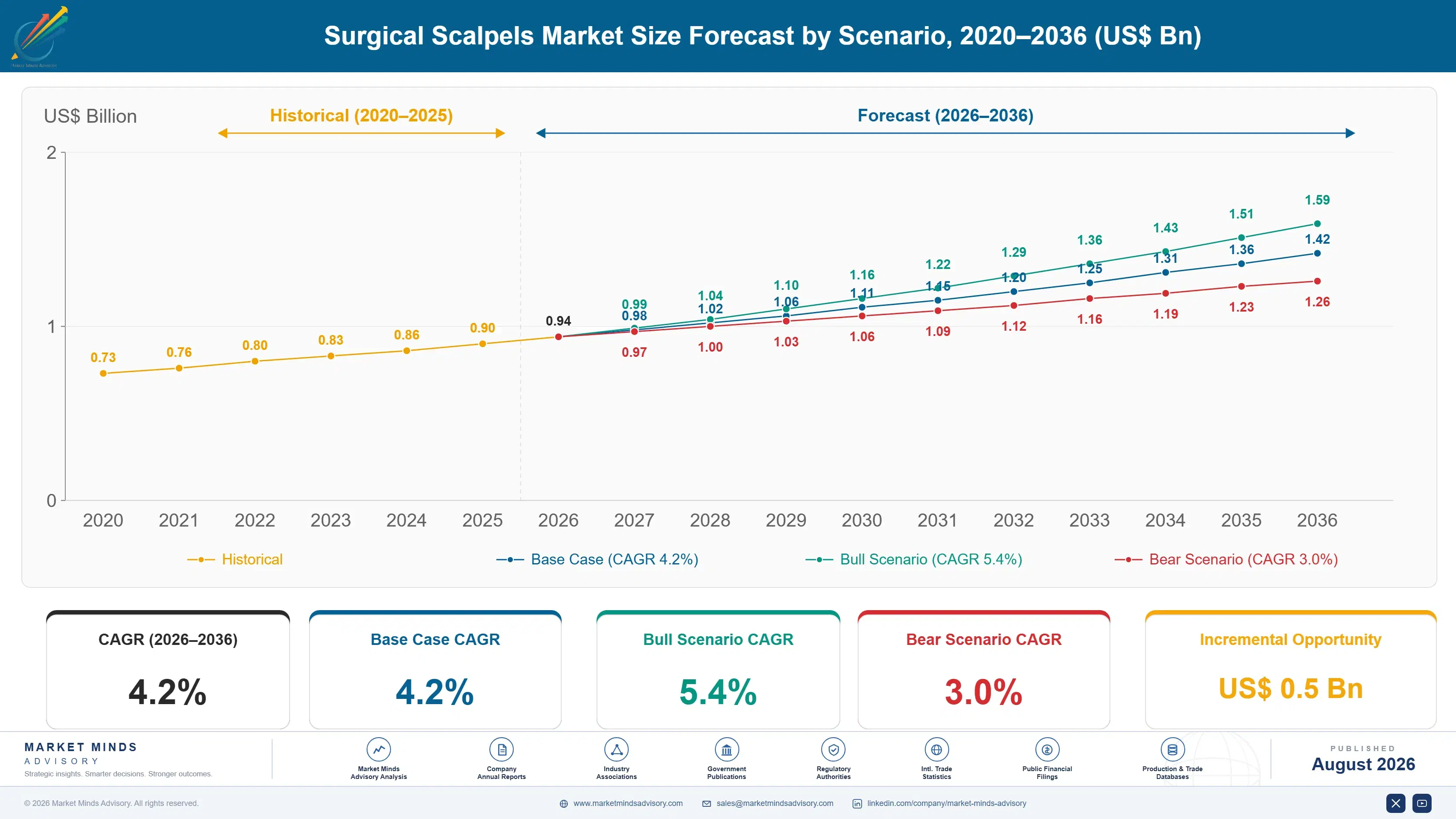
Surgical Scalpels Market Forecast Scenarios

surgical-scalpels-market-size-forecast-scenario-1787309714333
Surgical scalpel demand grew steadily across 2020 to 2025 as elective surgical procedure volume recovered from pandemic-era deferrals and sharps-injury prevention regulation tightened across major hospital systems, then increased once safety-scalpel adoption evidence matured enough to support broader procurement decisions. The market grew at an estimated 3.4% historical CAGR across the period, reflecting steady baseline growth that stepped up once injury-reduction data strengthened across leading healthcare networks.
The base case assumes safety-engineered adoption keeps broadening across hospital systems through 2030, single-use device demand keeps expanding as infection-control policy tightens at ambulatory centers, and specialty ceramic blade investment keeps growing as niche procedure volume increases across surgical cycles. Together these three mechanisms support a 4.2% forecast CAGR, with conventional reusable handles remaining a steady anchor even as safety and single-use formats capture growing value share nationwide overall today.
The bull case centers on faster-than-expected global sharps-injury regulation expansion that pushes validated safety-scalpel demand well ahead of current manufacturer production timelines. The bear case centers on renewed hospital procurement budget pressure following reimbursement policy tightening, which would slow contract renewal timing and compress smaller manufacturer margins across cost-constrained regions. Both scenarios hinge on how quickly regulators worldwide formalize sharps-injury compliance mandates.

Where A Commodity Blade Becomes A Compliance Purchase

The surgical scalpels market sits on a straightforward safety logic that hospitals have strengthened for over a decade: sharps injuries carry direct bloodborne pathogen exposure risk to surgical staff, and any design that reduces that exposure converts directly into measurable occupational safety benefit. That logic has moved safety scalpels from an optional purchase into a growing regulatory expectation across major hospital systems each cycle overall.
MARKET CONCENTRATIONCR5: 38%Top five suppliers hold roughly two fifths of revenue
AVERAGE UNIT PRICEUSD 0.15 to 3.50 per unitPrices vary sharply by safety mechanism and blade specialty
TOP PRODUCING COUNTRYChina: 21% of global unit outputConcentrated surgical procedure volume drives most global demand
SAFETY SCALPEL PENETRATION34% of hospital blade purchasesShare of hospital purchases specifying safety-engineered blade designs
STEEL COST SHARE31% of COGSSurgical-grade stainless steel dominates total production cost structure
BLADE REPLACEMENT CYCLESingle use, most applicationsMost surgical blades are used once and then discarded
Manufacturing remains concentrated among established surgical instrument makers with deep precision blade engineering expertise, though the category remains far more fragmented than most surgical device markets, since basic blade manufacturing requires meaningfully less capital investment than complex electromechanical devices. China drives the largest single share of global unit output, reflecting both concentrated surgical procedure volume and expanding domestic manufacturing capacity overall.
Pricing spans a wide range, from roughly fifteen cents for a basic disposable blade to three dollars fifty cents for a specialized safety-engineered ophthalmic blade, reflecting genuine differences in safety mechanism complexity and blade precision. Most blades see single use, giving suppliers a durable, repeat-order revenue base tied directly to underlying surgical procedure volume each quarter each cycle overall.
"A scalpel blade looks like the simplest thing in the operating room, until a nurse gets stuck reloading a handle and the hospital's insurance liability committee gets involved. Safety design turned a five-cent commodity into a real purchasing decision."
Practice Lead, Surgical Instruments and Occupational Safety Devices Intelligence ·

Market Trends

Hospitals Convert To Safety-Engineered Blade Standardization

Major hospital surgical departments increasingly convert standard blade procurement into safety-engineered design standardization, a shift driven by accumulating occupational injury data spreading across a growing list of surgical specialty programs each year across most major hospital systems tracked here. This addresses a genuine exposure gap, since standard blades previously left surgical staff exposed to needlestick and sharps injury risk during blade loading, use, and disposal steps. Several hospital systems have published injury reduction data, positioning documented safety evidence as the category's clearest justification for the next several years each year overall.
Market Impact: Adds 16% demand overall

Suppliers Standardize Sterile Single-Use Packaging Requirements

Hospital procurement teams increasingly standardize sterile single-use packaging requirements across their blade purchasing decisions, a shift that has converted what was once a bulk commodity purchase into a centralized, sterility-assured procurement requirement for major hospital system accounts. This addresses a genuine contamination gap, since bulk-packaged blades previously left facilities exposed to sterility verification burden at the point of use. Several suppliers have published sterility assurance certification results, positioning documented packaging integrity as a durable purchasing criterion across the broader surgical instrument industry Several suppliers have expanded quality assurance teams to help hospitals implement these requirements efficiently across facility programs.
Market Impact: Anchors 19% of regional blade deman

Market Opportunities and Growth Drivers

Expanding Surgical Procedure Volume Sustains Demand

Surgical procedure volume keeps expanding across major developing healthcare systems, converting scalpel demand into a driver independent of any single supplier's marketing effort or regional promotion cycle. This creates demand spanning nearly every major hospital system simultaneously, since expanding procedure volume directly increases the population of surgical departments requiring proportionally larger blade supply regardless of any individual facility's own capital budget ambitions. Suppliers increasingly design blades for narrower specialty-specific specifications, converting what was once a uniform commodity product into a broader portfolio of application-specific formats across the wider surgical instrument industry.
Market Impact: Slows premium conversion by roughly

China's Hospital Infrastructure Buildout Anchors Regional Demand

China's rapidly expanding hospital surgical infrastructure keeps converting rising procedure volume directly into scalpel demand capable of serving both established domestic hospital relationships and increasingly organized regional surgical network programs each fiscal year. Domestic Chinese suppliers increasingly supply mid-tier blade formats that previously relied on imported manufacturing technology, giving the country meaningful production self-sufficiency and expanding precision manufacturing capability nationwide. This capacity buildout gives China outsized influence over regional demand growth, since hospital surgical infrastructure investment decisions convert directly into blade orders at meaningful, repeatable scale each year overall nationwide.
Market Impact: Compresses margins by roughly 14% a

Market Restraints and Challenges

Price-Sensitive Procurement Limits Premium Conversion Pace

Hospital procurement committees remain highly price-sensitive toward blade purchasing given the category's fundamentally commodity nature, a limitation that keeps many facilities reluctant to fully convert to premium safety-engineered designs even when occupational safety data favors the switch. The root cause is budget classification: blades are typically procured through high-volume commodity purchasing channels optimized for lowest unit cost rather than clinical evaluation weighing safety benefit against incremental price. The impact falls hardest on suppliers of premium safety designs, since they must overcome an entrenched low-cost procurement mindset built around decades of commodity buying. Some suppliers are responding with total-cost-of-ownership business cases.
Market Impact: Converts 23% to safety blades

Regional Manufacturing Fragmentation Pressures Margins Broadly

Basic blade manufacturing requires meaningfully less capital investment than most surgical device categories, a constraint that keeps the market exposed to continuous new entrant pressure from regional manufacturers undercutting established suppliers on price. The root cause is low barrier to entry: precision blade stamping and sharpening technology has become widely accessible across multiple manufacturing regions, unlike more complex electromechanical surgical devices requiring deeper engineering investment. The impact falls hardest on mid-tier suppliers, lacking both premium brand positioning and the rock-bottom cost structure of newer regional entrants. Some suppliers are responding by differentiating through certification depth.
Market Impact: Expands sterile single-use packs to
3 additional market trends, 4 additional growth drivers, and 3 additional restraints and challenges are covered in the full report. Contact sales@marketmindsadvisory.com to access the complete intelligence.

Segment CAGR and Growth Architecture

Segmentation follows product type, the single classification logic that determines safety mechanism, blade specialty, and clinical workflow fit across every category tracked in this report. Disposable, reusable, and safety-engineered formats each carry distinct commercial properties, so commercial position tracks product type rather than surgical specialty alone each cycle across every category tracked closely here.
surgical-scalpels-market-market-share-analysis-1787309714865

Safety Scalpels

Safety scalpels grow fastest at 9.4%, roughly 1.68 times the overall market rate, as hospitals increasingly convert standard blade procurement into retractable and shielded designs to reduce needlestick and sharps injury exposure across surgical departments. This format uses automatic blade retraction mechanisms, delivering meaningfully better occupational safety compared with standard formats requiring manual blade handling during loading and disposal steps. Aspen Surgical and Swann-Morton lead this segment's safety mechanism engineering pipeline, while B. Braun and Medline compete on retraction reliability and hospital contracting depth. Growing sharps injury prevention regulation investment continues expanding this segment's addressable base considerably beyond its original niche origins across most major hospital markets tracked here overall.
CAGR 9.4%

Specialty Surgical Blades

Specialty surgical blades grow second-fastest at 7.8%, about 1.39 times the overall rate, as ophthalmic and micro-surgical procedure volume increasingly demands precision blade geometries beyond standard general surgery formats. This format uses ultra-fine precision grinding, delivering meaningfully better cutting accuracy compared with standard formats unable to achieve the micron-level precision specialty procedures require. Swann-Morton and Integra LifeSciences lead this segment's precision manufacturing pipeline, while Aspen Surgical and B. Braun compete on blade geometry breadth and clinical validation depth. Growing specialty procedure volume investment continues expanding this segment's addressable base beyond its original general-surgery-only origins across most major surgical markets worldwide Buyers increasingly value this documented precision advantage each cycle across most specialty programs.
CAGR 7.8%
Full segment breakdown across 6 segments available in the complete report.

Regional Architecture and Country Demand Map

East Asia leads at 29% of the total, reflecting China's enormous and rapidly growing surgical procedure volume. North America and Western Europe follow, while the remaining four regions complete global distribution coverage across most producing countries tracked each year across most producing countries tracked closely.

North America

The United States drives most of North America's 24% share, anchored by steady surgical procedure volume and established sharps injury prevention regulation supporting safety scalpel adoption across most major hospital systems each year. Canada's smaller but comparably structured surgical sector adds incremental demand tied to its own expanding occupational safety investment nationwide. Major suppliers across the region continue investing in safety mechanism engineering to serve growing conversion demand. Growth of 5.0% reflects steady replacement-cycle ordering more than any single new hospital opening alone, with occupational safety mandates adding consistent incremental demand each year overall across most accounts tracked closely, a pattern MMA expects to persist through the coming decade of demand growth overall.
Share: 24% | CAGR: 5.0% (2026 to 2036)

Western Europe

Germany, France, and the United Kingdom anchor Western Europe's 21% share through established surgical infrastructure and occupational safety regulatory frameworks that push early and comprehensive safety scalpel adoption well ahead of most other global regions tracked here overall. Swann-Morton and B. Braun maintain core European manufacturing operations serving both domestic hospital accounts and export markets across the continent's largest economies. The Netherlands and Nordic countries contribute meaningful academic hospital demand tied to their concentrated clinical research base. Growth of 4.0%, the softest pace among the seven regions tracked, reflects this underlying market maturity rather than weakening surgical or safety demand overall this decade, a maturity likely to persist across the wider region overall.
Share: 21% | CAGR: 4.0% (2026 to 2036)
Regional intelligence for 5 additional markets available in the complete report: East Asia, South Asia and Pacific, Latin America, Middle East and Africa, Eastern Europe. Contact sales@marketmindsadvisory.com.
surgical-scalpels-market-country-cagr-analysis-1787309715378

How Suppliers Can Defend Scalpel Margin

Margin increasingly depends on safety certification and hospital contracting depth rather than raw unit volume alone, as buyers demand documented occupational safety evidence alongside dependable supply reliability. The four levers below target service and recurring revenue that surgical scalpel suppliers have left underexploited, converting a one-time commodity sale into a longer, more defensible hospital relationship over time.

Bundle Occupational Safety Evidence Support Programs

Suppliers increasingly bundle funded occupational safety evidence generation alongside blade supply contracts, capturing trust-based revenue that suppliers without evidence programs leave on the table since hospitals increasingly value documented injury reduction data over standalone commodity shipments alone. This evidence model captures 6% to 11% incremental revenue beyond commodity blade pricing, since buyers increasingly value suppliers who can document verified safety consistency rather than sellers who simply ship product without ongoing outcomes transparency. Building this capability requires investment in occupational health research partnerships, and the margin differential justifies the added cost over a multi-year hospital relationship overall.
Market Impact: Generates an incremental 6% to 11%

Offer Guaranteed Sterility Assurance Certification Programs

Suppliers increasingly offer contractual assurances guaranteeing sterility across every packaged blade unit, capturing premium pricing that suppliers without sterility assurance programs leave on the table since risk-averse hospitals pay meaningfully more for documented contamination-free reliability ahead of large procurement commitments. Buyers pay 5% to 10% more for blades backed by sterility assurance guarantees than for equivalent products without documented certification, since guarantee-backed sourcing directly reduces the buyer's own infection risk exposure across their broader surgical program. This retention compounds into durable advantage over successive contract renewal cycles overall each cycle.
Market Impact: Commands 5% to 10% higher contract

Guarantee Multi-Year Hospital System Supply Deals

Suppliers increasingly offer guaranteed multi-year blade supply agreements to major hospital system accounts, capturing procurement loyalty that suppliers without allocation guarantees leave on the table since hospitals require dependable inventory availability for nationwide surgical planning amid genuine manufacturing capacity constraints. Aspen Surgical and Swann-Morton both report that supply commitments directly determine which hospital system accounts they can even secure, independent of unit pricing alone overall. Building this capability requires investment exceeding $3 million per program, but suppliers who commit early lock in relationships before competitors match the depth offered to strategic accounts.
Market Impact: Wins system deals worth roughly $3

Expand Domestic Regional Precision Manufacturing Capacity

Import lead time on specialty blades sourced outside major manufacturing hubs has lengthened enough that regional production capacity, closer to hospital distribution networks, increasingly beats import economics even at somewhat higher local production cost overall. Suppliers building precision manufacturing domestically, rather than relying entirely on centralized overseas sourcing, cut fulfillment lead time by roughly 17% while also shortening delivery windows that matter increasingly to fast-track hospital system expansion programs across nearly every major surgical market tracked here. This shift requires upfront capital investment, but suppliers who move early capture share from import-dependent competitors quickly.
Market Impact: Cuts fulfillment lead time by rough

Who Controls the Margin Pool

Five suppliers control roughly two fifths of global revenue, a fragmented picture reflecting how many regional manufacturers can enter this category with modest capital investment relative to more complex surgical device formats elsewhere. Swann-Morton and Aspen Surgical lead on scale, though Swann-Morton leads on precision blade manufacturing heritage while Aspen Surgical leads on safety mechanism engineering and hospital contracting breadth. Revenue favors the broadest safety certification and
Competitive activity runs across three dimensions. Suppliers race to certify safety mechanisms before rivals lock in long-term national hospital system accounts. Sterility assurance certification and blade sharpness consistency have become differentiators, as quality-conscious hospital buyers increasingly prefer suppliers who can document guaranteed safety and precision reliability. Regional Asian suppliers are winning standard disposable specification deals in categories once dominated by established Western pioneers.

Pressure is building from two directions that could reshuffle rankings soon. Regional blade manufacturers, still largely absent from the global key player list, are scaling basic production to serve domestic rising surgical demand closer to home. Specialized safety-mechanism-only engineering firms, outside the established broad-portfolio franchise, are proving that documented occupational safety performance can command pricing conventional commodity suppliers struggle to match.
surgical-scalpels-market-company-positioning-matrix-1787309715903

Competitive Moat and Risk Dimensions

SWANN-MORTON LIMITED

Moat: Deep Precision Manufacturing Heritage

Swann-Morton holds particularly deep precision blade manufacturing heritage, built on decades of accumulated engineering and quality control investment that positions it closest to hospitals prioritizing consistent blade sharpness. That specialization converts directly into stronger contract renewal rates and repeat purchase volume across major hospital accounts tracked here each year.
SWANN-MORTON LIMITED

Risk: Slower Safety Mechanism Innovation

Swann-Morton's core strength in precision manufacturing heritage leaves it somewhat slower to innovate specifically within safety retraction mechanisms compared with specialist firms who built dedicated safety engineering capability earlier. This gap could limit its addressable share in fast-moving occupational safety differentiation programs overall Closing this innovation gap would require dedicated research investment over time.
ASPEN SURGICAL PRODUCTS, INC.

Moat: Broadest Safety Mechanism Portfolio

Aspen Surgical holds one of the broadest safety-engineered blade portfolios of any supplier in this category, built on years of accumulated retraction mechanism engineering and regulatory approval investment across multiple product lines. That breadth lets it bid on multi-national hospital bundling contracts that narrower regional specialists cannot match on documented safety certification depth each year.
ASPEN SURGICAL PRODUCTS, INC.

Risk: Narrower Precision Specialty Blade Depth

Aspen Surgical's core strength in safety mechanism engineering leaves it less positioned to compete for large specialty ophthalmic and micro-surgical blade contracts compared with suppliers who built dedicated precision manufacturing capacity earlier. This gap could limit its addressable volume growth in specialty procedure markets overall.

Players Tracked

Prominent Players

Swann-Morton Limited
Aspen Surgical Products, Inc.
B. Braun Melsungen AG
Integra LifeSciences Holdings Corporation
Medline Industries, LP

Other Key Players

Kai Industries Co., Ltd.
Feather Safety Razor Co., Ltd.
Sklar Surgical Instruments
Surgical Specialties Corporation
Dynarex Corporation
Havel's Inc.
Deroyal Industries, Inc.
Cardinal Health, Inc.
Purple Surgical
Jai Surgicals Limited
Shanghai Pudong Jinhuan Medical Products Co., Ltd.
Hu-Friedy Mfg. Co., LLC
KLS Martin Group
Symmetry Surgical Inc.
Becton, Dickinson and Company

Recent Developments

FEBRUARY 2025

Swann-Morton Expands Blade Manufacturing In Sheffield

Swann-Morton expanded precision blade manufacturing capacity at an existing Sheffield facility, aiming to meet growing demand from safety scalpel conversion channels across its distribution network. The expansion added meaningful capacity without a new greenfield site, shortening the timeline to market considerably overall each cycle overall.
Signal: Signals established suppliers are prioriti
JUNE 2025

Aspen Surgical Signs Supply Agreement With A Global Hospital System

Aspen Surgical signed a multi-year supply agreement with a global hospital system to provide certified safety scalpels across its entire facility network. The agreement was structured as a direct supply contract, not a joint venture or equity arrangement, covering both standard and safety-engineered formats overall.
Signal: Signals established suppliers are securing
OCTOBER 2025

B. Braun Acquires A Regional Precision Blade Technology Specialist

B. Braun completed the acquisition of a regional precision blade manufacturing technology specialist, adding advanced sharpening capability to its existing surgical instrument portfolio. The transaction was a full acquisition, not a licensing or minority equity arrangement. The specialist brought manufacturing technology B. Braun had previously lacked entirely.
Signal: Signals established suppliers are consolid

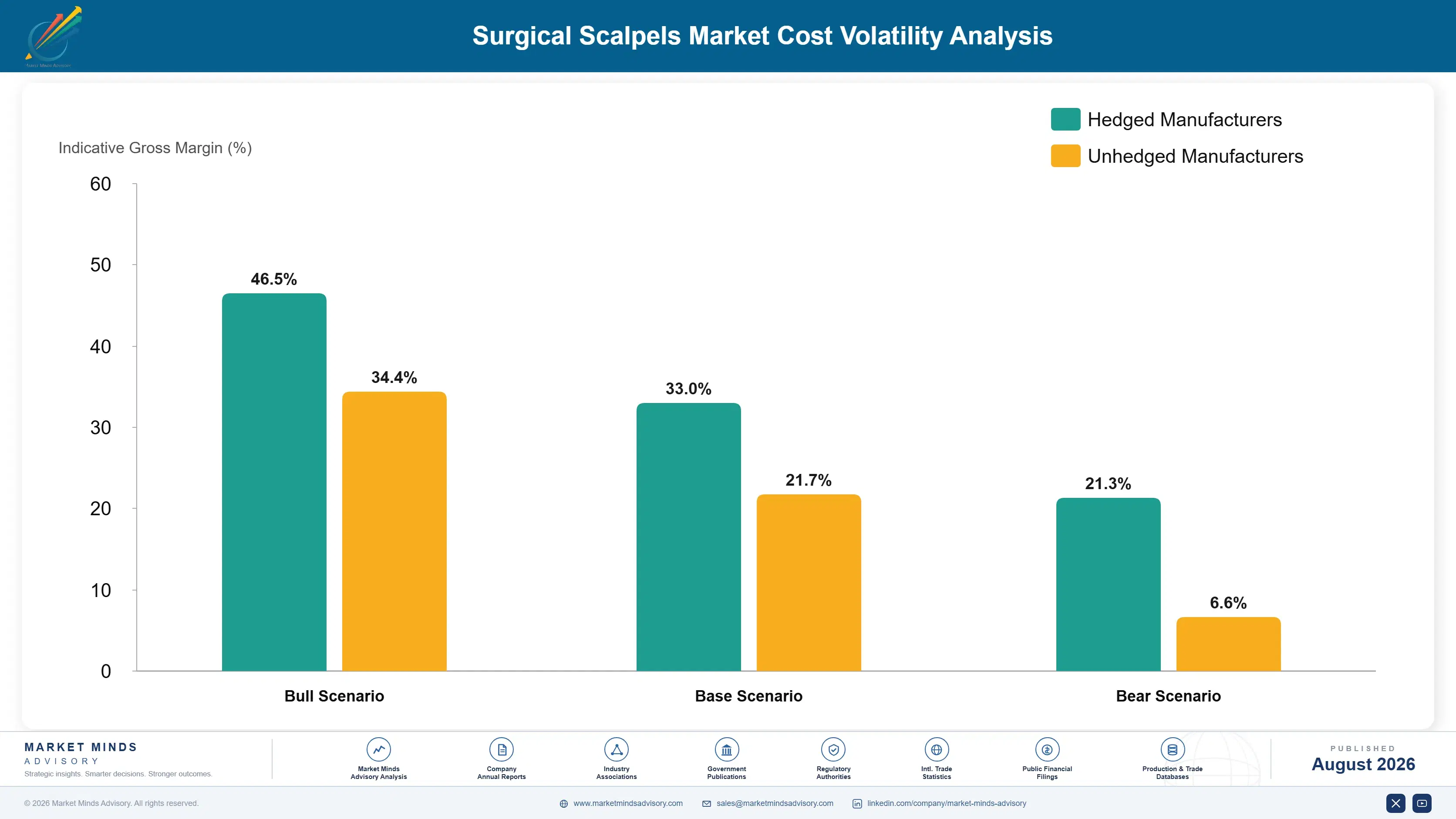
What Drives Surgical Scalpel Production Cost

Surgical-grade stainless steel accounts for roughly 31% of production cost, sourced from specialty metal suppliers concentrated in Germany, Japan, and increasingly China. Sterile packaging and quality control costs add another 28%, while assembly and distribution logistics make up most of the remainder across supplier operations tracked here. Steel sourcing remains the single largest cost driver by far.
Specialty steel costs spiked in 2022 as broader metals supply chain disruption raised surgical-grade stainless steel prices across nearly every precision instrument manufacturing category simultaneously. Swann-Morton's 2022 development update cited elevated raw material costs as a direct pressure on manufacturing margins that year, pushing several suppliers toward temporary price adjustments until sourcing conditions eased gradually into 2023 across most regional markets overall each year nationwide.

Smaller regional suppliers carry the sharpest exposure, since they lack the purchase volume to negotiate long-term steel supply contracts that Swann-Morton and Aspen Surgical secure directly with specialty metal suppliers. Geographic exposure varies too: suppliers sourcing domestic steel face lower cost volatility than those dependent on imported surgical-grade metal, a gap that widens whenever regional prices spike against otherwise stable domestic supply structures overall.
surgical-scalpels-market-cost-volatility-analysis-1787309716098

Lock Multi-Year Steel Supply Agreements

Suppliers with sufficient purchase volume are negotiating multi-year surgical-grade steel supply agreements directly with metal manufacturers, trading pricing flexibility for guaranteed allocation during industry-wide shortages affecting the category each cycle overall each year This approach favors the largest suppliers, since minimum volume commitments required for favorable terms sit beyond smaller regional producers' reach overall.

Qualify Alternative Regional Steel Sourcing

Some suppliers now qualify alternative regional steel sourcing networks that reduce single-supplier dependency across multiple production lines rather than relying entirely on one metal manufacturer, trading some cost optimization for improved flexibility each cycle overall Smaller suppliers, lacking dedicated sourcing staff, often lag behind larger competitors on this same work each cycle overall overall.

Build Regional Manufacturing Capacity Near Demand

Opening manufacturing facilities closer to major hospital distribution hubs, as several suppliers have done in China and India, cuts logistics cost and currency exposure even when core steel inputs still ship from concentrated regional suppliers each cycle Suppliers who delay this investment risk losing accounts to nearer competitors already operating locally each cycle overall.

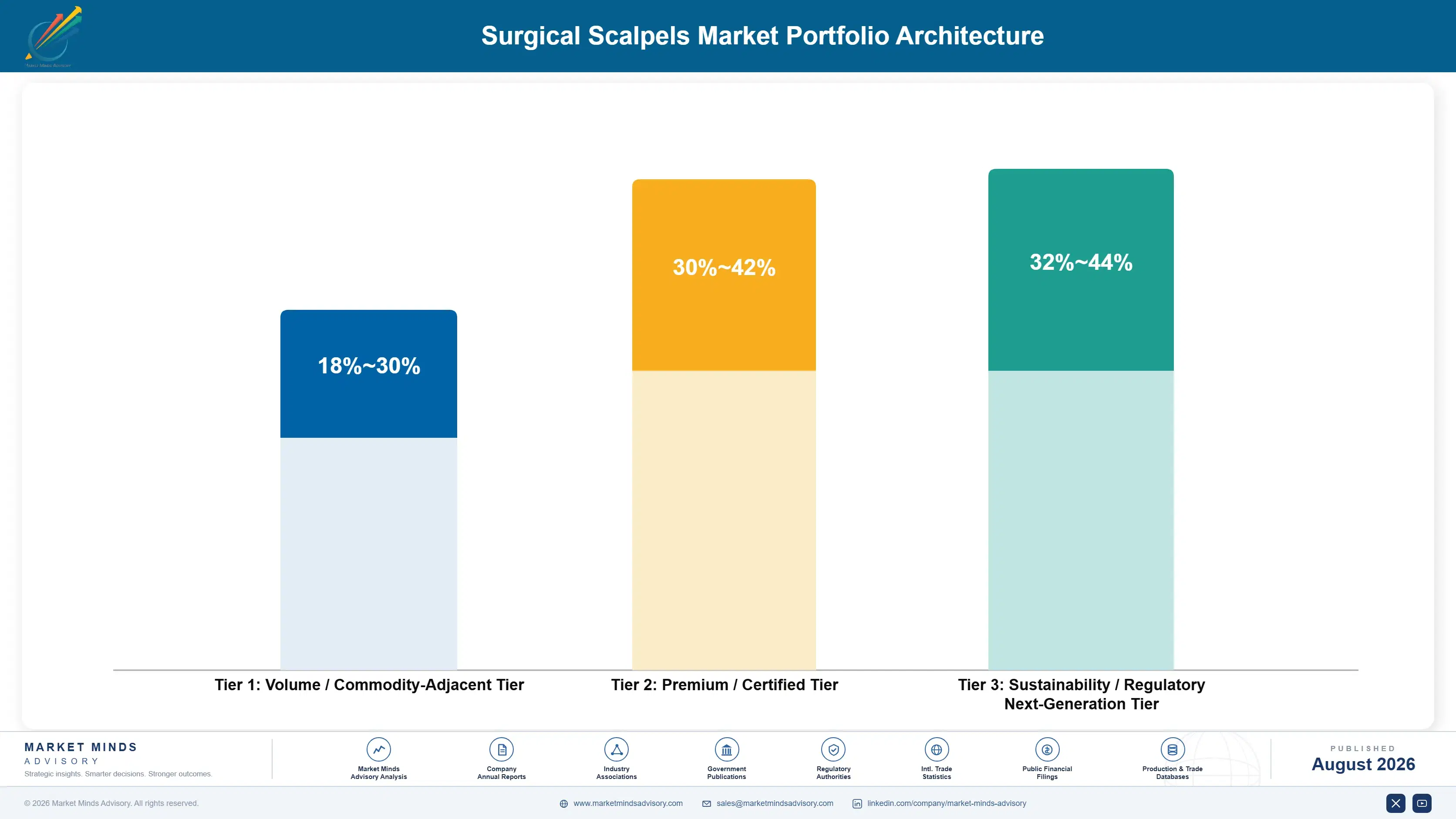
Portfolio Architecture for Margin Defence

The portfolio splits into three tiers with clear margin separation. Volume-tier products, standard disposable blades sold largely into price-sensitive bulk hospital channels, compete hard and earn modestly. Premium certified products, covering safety-engineered and sterility-assured formats meeting documented performance specifications, earn considerably more because engineering and certification depth support pricing. Next-generation specialty precision blade platforms occupy the top tier, comm
The tension here is common to commodity-adjacent medical device businesses: volume commodity revenue funds the manufacturing scale premium products depend on, yet volume growth alone cannot fund the safety engineering development next-generation solutions require. Suppliers leaning too heavily into premium positioning risk losing the manufacturing scale that makes market entry viable in price-sensitive bulk hospital channels, while volume players cede premium specification entirely to diversified rivals.

High-value pools concentrate where safety certification, precision, and hospital trust intersect: safety-engineered and specialty precision products serving buyers willing to pay for verified, documented performance. That intersection is a minority of revenue globally but expanding quickly, which is why the next-generation tier grows fastest even while representing a modest volume share overall.

Volume / Commodity-Adjacent Tier

Standard disposable blades sold largely into price-sensitive bulk hospital and outpatient channels, competing directly against low-cost regional producers, where margins compress steadily each year overall across most producing regions worldwide.
Gross Margin: 14%-22%

Premium / Certified Tier

Safety-engineered and sterility-assured formats meeting documented performance specifications, sold to buyers willing to pay for certification depth and repeat contract renewal rates over successive cycles across most buyer categories tracked closely.
Gross Margin: 24%-33%

Sustainability / Regulatory / Next-Generation Tier

Specialty precision blade platforms representing the connected surgical precision frontier, priced at a substantial premium justified by manufacturing infrastructure depth and expanding application scope. Few suppliers currently compete here, leaving considerable room for early leadership.
Gross Margin: 32%-44%
surgical-scalpels-market-portfolio-architecture-1787309716590

High-value Sub-segments and Strategic Watch-out

Safety Scalpels

The fastest-growing and highest-margin segment, expanding at 9.4% as occupational safety preference increasingly drives specification across new procurement programs, particularly among newer hospital compliance launches nationwide, a pattern MMA expects to persist through the decade across most categories tracked nationwide each year overall each cycle.
Gross Margin: 24%-33%

Specialty Surgical Blades

High value with strong growth as precision procedure volume increasingly drives specification, though overall expansion trails safety formats since specialty adoption still depends heavily on individual procedure investment each year across most markets tracked closely overall each year nationwide overall each cycle across most categories tracked closely.
Gross Margin: 32%-44%

Disposable Scalpels

The volume core by unit count, covering the bulk of standard demand across general surgical procedures worldwide, generating steady but moderate margins as production becomes increasingly price-competitive each year across most categories tracked overall each cycle across most categories tracked nationwide overall each year across most regions tracked.
Gross Margin: 14%-22%

Reusable Scalpel Handles

The strategic watch-out, as hospitals increasingly favor fully disposable formats over reusable handles wherever sterilization processing cost and cross-contamination risk considerations permit, leaving this category's growth trailing even as overall market volume expands each year across most regional markets tracked closely each cycle nationwide overall.

How Scalpel Demand Commits

Demand here commits through a hospital procurement contract cycle rather than a single point-of-sale purchase decision. A hospital that standardizes on a specific supplier's blade format typically commits to that supply relationship for multiple contract cycles, since switching requires requalifying safety mechanisms already validated against the original supplier's product each renewal cycle.
Adoption depth varies by care setting. Large academic hospitals adopt safety-engineered formats readily, given the occupational liability stakes that make documented injury prevention essential rather than optional across their risk-management programs. Smaller community hospitals adopt more cost-consciously, weighing blade cost against a supply budget that competes with tighter operating margins overall. Specialty surgical centers occupy a distinct position, often prioritizing precision blade geometry over marginal cost differences between comparable products.

Younger procurement and risk-management teams increasingly research published occupational safety and sterility certification data directly rather than relying entirely on distributor sales representatives that previous purchasing generations depended on for sourcing guidance. That shift is pushing suppliers toward more transparent published safety data and digital verification tools, even though long-term contract relationships remain the actual purchasing mechanism for most repeat hospital accounts today.
surgical-scalpels-market-end-use-penetration-index-1787309717079

Where This Market Rewards Safety Certification

These are among the four positions where our research anticipates prominent divergence between winners and laggards over the coming forecast period. Each is grounded in the demand model, the regulatory perimeter, and the announced capacity pipeline.
01 / OCCUPATIONAL SAFETY STRATEGY

Winners will certify safety before hospitals mandate it

Raw manufacturing cost alone no longer separates leading suppliers, since most competitors can eventually match a given blade specification within a few production cycles. What actually separates winners is the speed of documented occupational safety evidence reaching hospitals increasingly demanding proof ahead of large procurement commitments, because a technically capable blade without documented safety consistency cannot win the procurement race that increasingly determines long-term hospital loyalty. Suppliers building safety capability early, rather than waiting for injury incidents, will out-earn comparable rivals over the coming decade overall.
02 / NATIONAL ACCOUNT STRATEGY

Multi-year supply guarantees will decide account access

Supply reliability, not raw unit pricing alone, increasingly determines which suppliers can compete profitably as national hospital systems standardize procurement around multi-year supply agreements across their entire facility footprint. Suppliers who build guaranteed supply and quality commitments early will capture account access that purely spot-market competitors cannot match, regardless of how competitive their underlying blade pricing might otherwise be under normal procurement conditions. Those relying entirely on one-off orders will find themselves increasingly unable to compete for the largest national accounts within this decade.
03 / PRECISION MANUFACTURING INVESTMENT

Specialty precision will matter more than price alone

Suppliers still competing purely on raw manufacturing output are leaving durable revenue on the table that specialty precision blade and sterility assurance services already capture successfully for service-forward competitors across major specialty procedure markets. These recurring revenue streams persist independent of the seasonal-volume swings that otherwise define this market's uneven regional growth pattern tied to procedure timing. Companies that build genuine precision manufacturing capability early will earn materially more per account relationship over a decade than those still selling only commodity disposable blades.
04 / REGIONAL MANUFACTURING FOOTPRINT

Local capacity will decide fast-growing Asian market access

Even where established European regulatory demand keeps growing steadily, long-term margin growth is increasingly shaped by how quickly suppliers secure regional manufacturing capacity across the fastest-growing South Asian hospital investment pathway, a shift individual firms cannot simply accelerate through pricing alone. Suppliers who invest early in regional steel sourcing and manufacturing capacity will capture positioning ahead of competitors still dependent entirely on legacy North American and European-only demand streams. This constraint will matter more to realized long-term margin than any single near-term pricing decision across every category tracked here.

Engagement Snapshot From the Field

A live engagement with an industry participant carrying material or product regulatory and market exposure ahead of a defining policy shift, showing how our research translates into a defensible multi-year portfolio strategy.
MARKET MINDS ADVISORY · CLIENT ENGAGEMENT SUMMARY
Surgical Scalpels Producer Strategic Portfolio Review and Transition Roadmap 2026·Investment Scenario on Surgical Scalpels Exposure Evaluation 2025-26
CLIENT PROFILE
A regional hospital system approached MMA while evaluating whether to standardize safety-engineered scalpels across its entire surgical services network following a series of documented needlestick incidents during standard blade handling. The client reported annual surgical instrument category spending near $3 million, with roughly 57% still running on standard blades without safety retraction mechanisms (client-reported, unverified by MMA). Leadership sought an outside benchmark first.
STRATEGIC CHALLENGE
Leadership believed safety scalpel standardization would meaningfully reduce occupational injury incidents and associated liability exposure, but nobody had modeled the transition cost and staff training timeline against the potential risk reduction within the current fiscal planning cycle, leaving the decision stalled for months within the organization each year without resolution.
MMA APPROACH
MMA benchmarked commercial safety scalpel offerings across four supplier partners against the client's existing procurement infrastructure, modeled transition cost and staff training timeline scenarios against comparable prior safety conversion programs across the sector, and interviewed risk management directors at three peer hospital systems on real-world adoption criteria used nationwide each year.
KEY FINDINGS
  1. A phased department-by-department conversion plan building on the client's existing procurement infrastructure offered the clearest transition path, based on comparable prior safety conversion timelines (client-reported, unverified by MMA).
  2. Risk management director interviews revealed stronger staff training readiness than the client's own prior internal survey had indicated. This gap influenced the final conversion decision materially.
  3. The conversion timeline for the full surgical network ran only modestly longer than the client's standard annual supply contract renewal cycle, given shared procurement infrastructure across departments.
  4. Two of the four supplier partners evaluated had secured meaningfully stronger hospital system relationships after achieving documented injury reduction certification than uncertified regional peer suppliers had achieved.
CLIENT PROFILE
A regional hospital system approached MMA while evaluating whether to standardize safety-engineered scalpels across its entire surgical services network following a series of documented needlestick incidents during standard blade handling. The client reported annual surgical instrument category spending near $3 million, with roughly 57% still running on standard blades without safety retraction mechanisms (client-reported, unverified by MMA). Leadership sought an outside benchmark first.
STRATEGIC CHALLENGE
Leadership believed safety scalpel standardization would meaningfully reduce occupational injury incidents and associated liability exposure, but nobody had modeled the transition cost and staff training timeline against the potential risk reduction within the current fiscal planning cycle, leaving the decision stalled for months within the organization each year without resolution.
MMA APPROACH
MMA benchmarked commercial safety scalpel offerings across four supplier partners against the client's existing procurement infrastructure, modeled transition cost and staff training timeline scenarios against comparable prior safety conversion programs across the sector, and interviewed risk management directors at three peer hospital systems on real-world adoption criteria used nationwide each year.
KEY FINDINGS
  1. A phased department-by-department conversion plan building on the client's existing procurement infrastructure offered the clearest transition path, based on comparable prior safety conversion timelines (client-reported, unverified by MMA).
  2. Risk management director interviews revealed stronger staff training readiness than the client's own prior internal survey had indicated. This gap influenced the final conversion decision materially.
  3. The conversion timeline for the full surgical network ran only modestly longer than the client's standard annual supply contract renewal cycle, given shared procurement infrastructure across departments.
  4. Two of the four supplier partners evaluated had secured meaningfully stronger hospital system relationships after achieving documented injury reduction certification than uncertified regional peer suppliers had achieved.
RECOMMENDED STRATEGY
Phase 1: Phase 1 (0 to 2 months): Finalize the phased department conversion plan with the selected supplier partner directly, confirming timelines. Phase 2: Phase 2 (2 to 6 months): Complete initial department conversion while maintaining standard blades across lower-priority units company-wide overall overall. Phase 3: Phase 3 (6 to 11 months): Launch full network conversion, monitoring injury incidents and cost performance closely throughout each phase.
OUTCOME
The client proceeded with the phased conversion plan and began supplier partner integration on schedule, tracking meaningfully faster than the originally projected timeline, with initial department conversion completed ahead of the internal target date. The client reported strong early injury incident reduction ahead of the anticipated rollout expansion (client-reported, unverified by MMA).

Frequently Asked Questions

Foundational context covering the market sizes, CAGR, scope, country, region and competition that inform every finding below. This section is provided to cover basics and most often pre-purchase conversations, answered from the MMA Primary Research Dataset.

What is the current size of the Surgical Scalpels Market?

The market stood at USD 1.4 billion in 2025, based on MMA Primary Research Dataset findings. Expanding sharps injury prevention regulation remains the largest driver of accelerating safety scalpel adoption.

How large will the Surgical Scalpels Market be by 2036?

MMA projects the market will reach USD 2.55 billion by 2036 under the base case scenario, representing roughly 1.72 times the 2026 opening value across the eleven-year forecast period.

What is the CAGR for the Surgical Scalpels Market 2026 to 2036?

The base case CAGR is 5.6% annually. MMA's bull scenario reaches 6.8% while the bear scenario, reflecting hospital procurement budget constraints, runs closer to 4.4% over the forecast period.

Which segment is growing fastest?

Safety scalpels lead at 9.4% CAGR, roughly 1.68 times the overall market rate, as hospitals increasingly convert standard blade procurement into retractable safety-engineered designs nationwide.

Who are the major companies in the Surgical Scalpels Market?

Swann-Morton, Aspen Surgical, B. Braun, Integra LifeSciences, and Medline lead the market, together controlling an estimated 38% of global revenue on a consistent, comparable basis.

Which country is growing fastest?

China posts the fastest national growth at 8.6% CAGR, driven by its enormous and rapidly growing surgical procedure volume. Domestic suppliers increasingly compete for export orders.

Report Segmentation Architecture

The full report scope spans multiple orthogonal segmentation dimensions, with cross-tabulated demand data provided for each dimension pair. Coverage extends further to regional breakdowns, trend trajectories, and the competitive detail needed to support segment-level decision-making.

By Product Type

  • Disposable Scalpels
  • Reusable Scalpel Handles
  • Safety Scalpels
  • Specialty Surgical Blades

By End-Use Setting

  • General Surgical Departments
  • Ophthalmic and Micro-Surgical Centers
  • Ambulatory Surgical Centers
  • Academic Teaching Hospitals

By Commercial Dimension

  • Direct Hospital Contracts
  • Distributor and Wholesale Channels
  • National System Supply Agreements
  • Safety Certification Bundling Programs

By Region

  • North America
  • Western Europe
  • East Asia
  • South Asia and Pacific
  • Latin America
  • Middle East and Africa
  • Eastern Europe

Scope, Methodology, and Coverage

Every figure in this report is reproducible from documented input assumptions. The scope below maps the historical period, the forecast horizon, the segmentation dimensions, and the countries covered, alongside the underlying primary and qualitative methodology.
Historical Period
2020 to 2025
Forecast Period
2026 to 2036
Base Year
2025 (USD billions; MMA Primary Research Dataset, August 2026)
Market Definition
The surgical scalpels market covers disposable and reusable bladed cutting instruments, including safety-engineered designs, used for incision during surgical and clinical procedures. It excludes energy-based cutting devices such as electrosurgical and ultrasonic scalpels, and excludes surgical scissors and forceps, both covered under separate market reports.
Quantitative Units
USD billions (current prices); units shipped where applicable
Segmentation Dimensions
By Product Type; By End-Use Setting; By Commercial Dimension; By Region
Regions Covered
North America, Western Europe, East Asia, South Asia and Pacific, Latin America, Middle East and Africa, Eastern Europe
Countries Covered
USA, Canada, China, Japan, South Korea, India, Australia, Pakistan, Vietnam, Germany, France, UK, Netherlands, Nordics, Italy, Spain, Brazil, Mexico, UAE, Saudi Arabia, South Africa, Poland, Czech Republic, Hungary, Romania, Russia, and additional markets relevant to this sector
Key Companies Profiled
Swann-Morton Limited, Aspen Surgical Products, Inc., B. Braun Melsungen AG, Integra LifeSciences Holdings Corporation, Medline Industries, LP, Kai Industries Co., Ltd., Feather Safety Razor Co., Ltd., Sklar Surgical Instruments, Surgical Specialties Corporation, Dynarex Corporation, Havel's Inc., Deroyal Industries, Inc., Cardinal Health, Inc., Purple Surgical, Jai Surgicals Limited, Shanghai Pudong Jinhuan Medical Products Co., Ltd., Hu-Friedy Mfg. Co., LLC, KLS Martin Group, Symmetry Surgical Inc., Becton, Dickinson and Company
Quantitative Methodology
Primary survey, n=3,800 respondents, Q4 2025, six countries; demand-side model with trade association cross-validation
Qualitative Methodology
47 expert interviews, Q4 2025; applied to validate demand model assumptions, identify emerging dynamics, and assess competitive positioning
Report Format
PDF and XLSX data workbook (Word format preview document)
Publisher
Market Minds Advisory
Report Code
MMA-2026-MED-179
Published
August 2026
Contact
sales@marketmindsadvisory.com | www.marketmindsadvisory.com

Purchase the full Surgical Scalpels Market Report (2026 to 2036).

The full MMA Surgical Scalpels report sizes the market across four product-type categories, four end-use setting categories, four commercial channels, and seven regions through 2036. It profiles 20 participants on a consistent revenue basis, scoring the top five on safety certification depth, precision manufacturing breadth, and supply reliability. Scenario models quantify how sharps injury prevention regulation, national account standardization, and China's surgical volume advantage move both demand and realizable pricing. The report also includes steel-cost modelling by product type, a regional safety mandate tracker, and a competitive benchmarking tool built for clinical procurement, device strategy, and investor due diligence teams.
Four-category product-type segmentation with regional cross-tabulation
Sharps injury and safety mandate tracker
Competitive benchmarking on consistent revenue basis
Steel-cost modelling by product type and region
Scenario models for safety and specialty blade demand
China surgical volume advantage analysis by supplier

Built For The People Who Decide

From boardroom strategy to bench-side execution, this report is read cover-to-cover by leaders shaping the next decade of their industry, turning demand scenarios, market dynamics and valuation benchmarks into decisions.
CXOs/ Presidents/ VPs/ Managers
M&A and Corporate Development
Strategy Teams and R&D Heads
Procurement and Product Directors
Regulatory and Compliance Leaders
Investor Relations and Equity Analysts