Market Minds Advisory
Surgical Retractors Market

Surgical Retractors Market: Reprocessing Economics, Self-Retaining Systems and the Instrument Tray Nobody Has Audited

A hospital reprocesses a stainless retractor four hundred times and never counts the cost, then buys a single-use one and complains about the price of something it can actually measure.

Lead Analyst

Alice Ballenger

Published

September 2026

Make Smarter Decisions with Customized Research Insights

Request a free sample report and evaluate market opportunities, growth trends, and competitive dynamics relevant to your business needs.

2025 MARKET VALUE$2.2BMarket Size 2025
2036 FORECAST VALUE$3.9BBase Case , 2026 to 2036
CAGR 2026 TO 20365.3 %Bull 6.5% / Bear 4.1%
INCREMENTAL OPPORTUNITY$1.6BNet 10- year value creation
EXPANSION MULTIPLE1.68x2036 value over 2026 base
Strategic Levers
M&A Pipeline
Regional Outlook
Country Rankings
Competitive Intelligence
Segmental Deep-dive
Call-Us : 91 93563 13602

Executive Snapshot and Market Trajectory

A retractor holds tissue out of the way. That is the whole function, it has not changed in a century, and the commercial question is not about the instrument at all. It is about who holds it, how it gets cleaned afterwards, and whether anybody has costed either.
Single-use self-retaining systems compound at 7.95%, exactly 1.50 times the market, because they remove both a reprocessing cycle and an assistant from the room. East Asia holds 29% of demand on surgical volume and manufacturing capacity together. Reprocessing costs about USD 4.10 per instrument cycle and almost nobody measures it. Only around 37% of a standard tray is used in the procedure it was assembled for. Every unused instrument is reprocessed anyway at full cost.
Five manufacturers hold 41%. Positions rest on tray standardisation and surgeon preference rather than on any technical claim, since a retractor that a surgeon has used for twenty years is genuinely difficult to displace on specification alone. The commercial openings are all outside the instrument. Reprocessing cost, tray composition and theatre staffing are each measurable, each expensive, and each routinely ignored by the procurement function comparing unit prices.
Market Definition
The market covers manual and mechanical instruments used to hold surgical tissue apart, spanning handheld reusable retractors, reusable self-retaining and table-mounted retractor systems, single-use self-retaining retractor systems, wound protector and access retractors, minimally invasive and laparoscopic retractors, and specialty retractors for neurosurgery, cardiothoracic and orthopaedic use. Surgical robotic systems and their instruments, endoscopes and visualisation equipment, trocars and access ports without retraction function, and sterilisation equipment are excluded.
Base Year Value
$2.2B in 2025 (MMA Primary Research Dataset, August 2026)
Forecast Period
2026 to 2036, eleven discrete annual values
CAGR
5.3% base case. Bull 6.5%. Bear 4.1%.
Fastest Growth Segment
Single-Use Self-Retaining Retractor Systems: 8.0% CAGR
Fastest Growth Country
India: 7.6% CAGR
Fastest Growth Region
South Asia and Pacific: 7.4% CAGR
Largest Region
East Asia: 29% of 2025 global value
Market Leaders
Medtronic, Johnson & Johnson MedTech, B. Braun Melsungen, Teleflex, Applied Medical. Source: MMA Analysis based on company annual reports.
Primary Survey
n=3,800 procurement and R&D decision-makers, Q4 2025, six countries
Methodology
Demand-side build-up, cross-validated against public data, 47 expert interviews

Surgical Retractors Market Forecast Scenarios

surgical-retractors-market-size-forecast-scenario-1787309375868
Growth of 4.7% across 2020 to 2025 tracked surgical procedure volume with one interruption and one quiet shift underneath. Elective deferral through 2020 cut instrument and consumable demand hard, and the backlog lifted volume above trend for roughly two years afterwards. The shift was mix: barrier retraction took share from reusable steel steadily, on infection evidence rather than surgeon preference.
The base case of 5.4% rests on three mechanisms. Surgical site infection reduction targets keep pushing hospitals toward barrier retraction, since infection rates are publicly reported and increasingly tied to reimbursement in several systems. Minimally invasive and robotic approaches require purpose-built access retraction that open surgery never needed. And Asian surgical volume keeps growing, though realised prices sit far below Western levels because domestic manufacture supplies it. None of those three mechanisms depends on procedure volume rising.
The bull case of 6.6% assumes barrier retraction becomes routine in colorectal and hepatobiliary surgery, converting much reusable volume into consumable revenue. The bear case of 4.2% reflects the countervailing pressure: hospital sustainability programmes questioning single-use plastic on environmental grounds, and Pakistani and Indian instrument pricing that makes the cheap alternative hard to argue against.

The Instrument Nobody Costs Properly

This is a market where the product is trivial and the accounting is not. A stainless steel retractor is a piece of shaped metal that lasts around 400 cycles, and hospitals treat the reprocessing that sits between each of those cycles as a fixed overhead rather than a cost per instrument. It is roughly USD 4.10 each time, covering decontamination, inspection, packaging, sterilisation and the labour behind all four.
TOP FIVE CONCENTRATION41%Combined share held by the five largest instrument manufacturers globally
REPROCESSING CYCLE COSTUSD 4.10Full cost of decontaminating and repackaging one reusable instrument
REUSABLE INSTRUMENT LIFE400 cyclesTypical service life before wear or damage forces replacement
TRAY INSTRUMENT UTILISATION37% of itemsShare of a standard tray actually used during a procedure
ASSISTANT HOURS RELEASED1.8 hours dailyStaff time freed per theatre by self-retaining retractor systems
SINGLE-USE PENETRATION26% of unitsProportion of retraction performed using disposable single-use instruments
That figure changes the comparison completely and it is almost never calculated. A hospital comparing a single-use retractor against a reusable one compares purchase prices, because one has an invoice and the other has an overhead. When somebody does the arithmetic properly, single-use frequently wins on total cost before any infection control or capacity argument is even raised.
The other unexamined number is tray composition. Around 37% of instruments in a standard tray are actually used in the procedure it was assembled for, and the rest are reprocessed anyway because trays are configured by tradition and rarely audited. Every unused instrument carries a full reprocessing cost, which makes tray rationalisation the largest available saving in the whole operating room.
"I have never met a theatre manager who could tell me their reprocessing cost per instrument, and I have never met one who did not have an opinion about single-use pricing. Those two facts are related."
Director, Surgical Instruments and Operating Room Practice · MMA Surgical Instru

Market Trends

Self-Retaining Systems Substitute for Scarce Assistant Hands

Operating room staffing shortages have made a pair of hands holding a retractor an expensive way to use a trained assistant, and self-retaining and table-mounted systems free roughly 1.8 hours of staff time per theatre each day. That argument reaches theatre management rather than procurement, and it survives budget scrutiny in a way an instrument specification never does. Single-use self-retaining systems compound at 7.95% against a market at 5.3% because they remove a reprocessing cycle at the same time. Choosing the audience is the whole commercial decision here. Theatre management controls the rota and procurement controls the price.
Market Impact: Instruments lasting about 400 cycle
Reprocessing Cost Visibility Changes the Single-Use Comparison

Full reprocessing cost runs near USD 4.10 per instrument cycle including decontamination, inspection, packaging, sterilisation and labour, and hospitals overwhelmingly treat it as fixed overhead rather than a per-item cost. Where sterile services capacity is constrained or labour is scarce, that assumption breaks down and single-use becomes cheaper on total cost. Penetration stands at 26% of units and rises fastest in exactly the systems that have run the calculation properly rather than assumed the answer. Sustainability procurement policy is what caps the segment rather than any cost comparison, and several European systems now name single-use instruments explicitly in waste targets.
Market Impact: Only 37% of tray items used

Market Opportunities and Growth Drivers

Surgical Volume Growth Tracks Ageing Populations Reliably

Retraction is required in essentially every open and many minimally invasive procedures, so instrument demand follows total surgical volume almost mechanically. Orthopaedic, cardiovascular, general and gynaecological surgery volumes all rise with population age across developed and middle-income markets, and none of the substitution happening within the category changes the underlying denominator. That makes this market forecastable from procedure statistics in a way most device categories are not, which is genuinely useful for capacity planning. Instruments last roughly 400 cycles, so replacement demand is slow, predictable attrition against an installed tray configuration nobody revisits.
Market Impact: Penetration capped near 26% share

Tray Rationalisation Releases Savings Nobody Has Claimed

Around 37% of instruments in a standard surgical tray are used during the procedure, and every unused item still consumes a full reprocessing cycle at roughly USD 4.10. Trays are configured by tradition, inherited from surgeons who have retired, and audited almost never. Manufacturers who help a hospital audit and rebuild its trays release real savings and shape which instruments remain in the standard set, which is a considerably better commercial position than bidding on a tender. Leading that audit beats bidding into a tender somebody else specified. Nobody else is offering to do it.
Market Impact: Preferences persisting over 20 year

Market Restraints and Challenges

Sustainability Procurement Rules Restrict Single-Use Explicitly

Several European health systems now set waste and carbon targets that name single-use instruments directly, which caps the segment regardless of its total cost advantage. The root cause is that waste volume is visible and measurable while reprocessing energy, water and chemical use is diffuse and rarely counted against the reusable alternative. Manufacturers mitigate by commissioning full lifecycle comparisons, by offering take-back and recycling schemes, and by supplying hybrid designs with reusable frames and disposable contact elements. Hybrid reusable frames with disposable contact elements are the only answer that satisfies both objectives at once.
Market Impact: Releasing 1.8 assistant hours daily

Surgeon Preference Resists Any Specification Argument

A surgeon who has used a particular retractor for twenty years will not change it because a competitor's version is measurably better, and theatre management rarely overrules that preference for an instrument costing very little. The root cause is that the instrument is an extension of hand and habit rather than a technology choice. Manufacturers mitigate by working through tray standardisation projects where whole sets are reconsidered together, and by targeting new procedures rather than established ones. Tray standardisation projects are the practical route, since whole sets get reconsidered together rather than one instrument at a time.
Market Impact: Reprocessing costing USD 4.10 per c
3 additional market trends, 4 additional growth drivers, and 2 additional restraints and challenges are covered in the full report. Contact sales@marketmindsadvisory.com to access the complete intelligence.

Segment CAGR and Growth Architecture

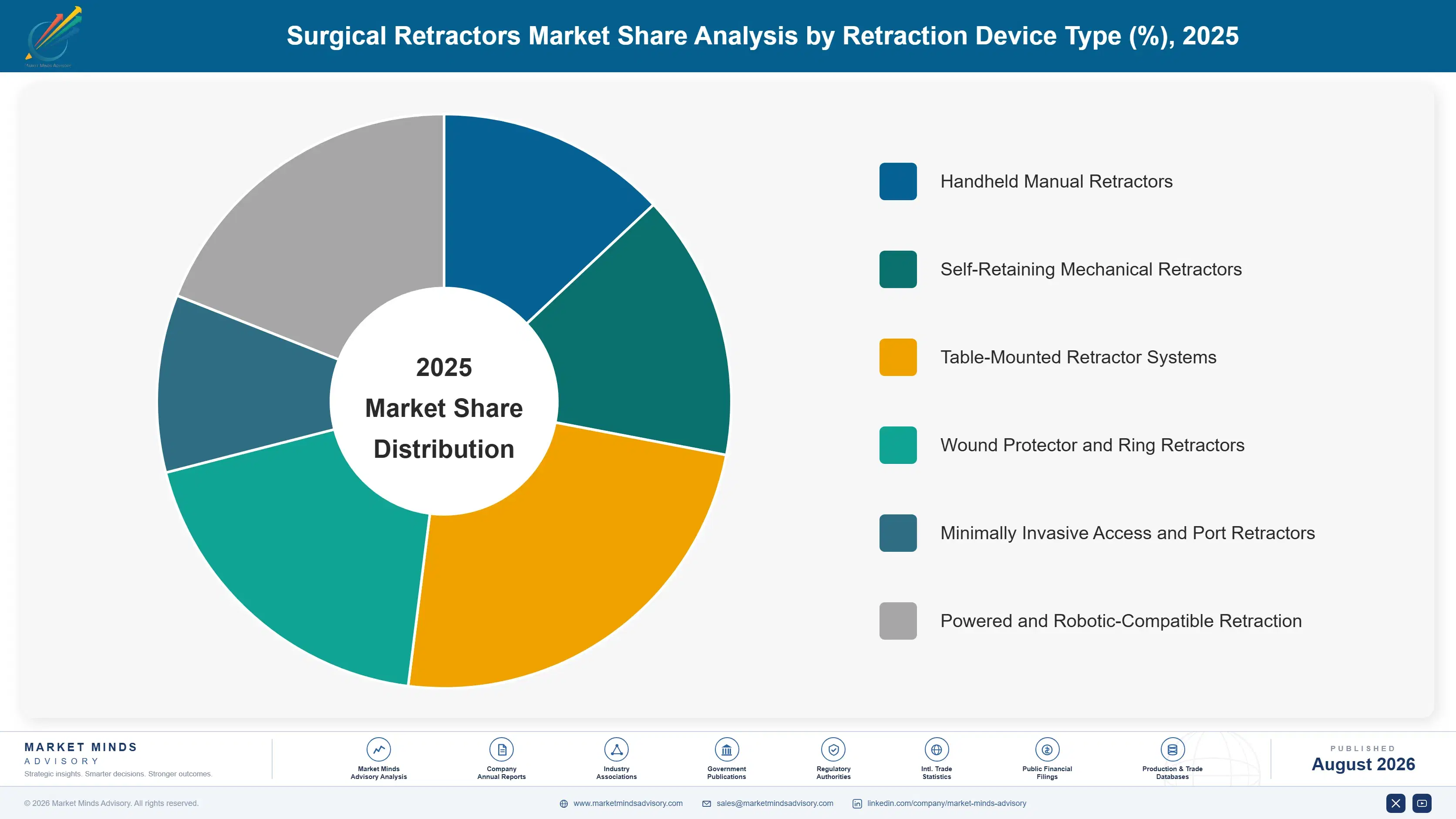
Segmentation follows instrument type and reuse model, because those together determine reprocessing burden, staffing requirement and how the purchase gets funded. A hospital moving from a handheld reusable retractor to a single-use self-retaining system is changing its labour model rather than its instrument specification. Six categories sit in the hierarchy, separated by reuse model as much as by instrument design.
surgical-retractors-market-market-share-analysis-1787309376396

Single-Use Self-Retaining Retractor Systems

Single-use self-retaining systems compound at 7.95%, exactly 1.50 times the market, because they attack two costs at once. The self-retaining function releases roughly 1.8 hours of assistant time per theatre daily, which matters more than ever with operating room staffing shortages, and the disposable format removes a reprocessing cycle costing around USD 4.10 per instrument. Penetration across all retraction sits at 26% of units and rises fastest where a hospital has actually costed its sterile services rather than treating them as fixed overhead. The constraint is sustainability procurement policy, which names single-use instruments explicitly in several European systems and caps adoption regardless of what the total cost comparison shows. Hybrid frames are the emerging answer.
CAGR 8.0%

Wound Protector and Access Retractors

Wound protectors and access retractors grow at 6.6% by combining retraction with wound edge protection and specimen extraction through a single device, which is genuinely more than a retraction function. Surgical site infection reduction is the clinical argument, and it is supported by better evidence than most claims in this category, though the effect size varies by procedure and by baseline infection rate. These devices are almost entirely single-use by design, since the polymer ring and sleeve construction does not survive reprocessing. Colorectal, hepatobiliary and caesarean procedures are the largest applications. The commercial advantage is that infection prevention reaches a budget holder who is not comparing instrument prices at all.
CAGR 6.6%
Full segment breakdown across 6 segments available in the complete report.

Regional Architecture and Country Demand Map

Demand follows surgical procedure volume and reprocessing economics together, since a region with cheap labour and abundant sterile services capacity has little reason to adopt disposable instruments at any price. East Asia leads on both surgical volume and instrument manufacturing capacity. Labour cost decides the reuse model everywhere.

East Asia

East Asia holds 29% of demand, the largest regional share, growing at 6.1%. Chinese surgical volumes are the largest anywhere and rising as hospital capacity expands beyond tier one cities, and China is simultaneously the largest manufacturing base for stainless steel surgical instruments globally, which compresses reusable pricing across every market it exports to. Japanese practice favours high-quality reusable instruments and meticulous reprocessing, with single-use adoption slower than elsewhere. Korean and Taiwanese hospitals adopt single-use self-retaining systems readily where staffing pressure justifies them, and regional demand growth reflects procedure volume rather than substitution. Chinese manufacturing pricing effectively sets the global floor for commodity reusable retractors, which no Western producer can match on cost at that end of the range.
Share: 29% | CAGR: 6.1% (2026 to 2036)

North America

North America accounts for 28% of demand and grows at 5.0%. Single-use penetration is the highest of any region because labour costs make reprocessing expensive and because sterile services capacity is a genuine constraint at many hospitals rather than a theoretical one. Group purchasing organisations dominate the reusable instrument channel and compress pricing severely, which pushes manufacturers toward differentiated single-use and access devices where a clinical argument can be made. Tray rationalisation programmes are more advanced here than anywhere else and are frequently manufacturer-supported. Group purchasing organisations compress reusable pricing severely, which pushes manufacturers toward differentiated single-use and access devices where a clinical argument can actually be made to a different budget holder.
Share: 28% | CAGR: 5.0% (2026 to 2036)
Regional intelligence for 5 additional markets available in the complete report: Western Europe, South Asia and Pacific, Latin America, Middle East and Africa, Eastern Europe. Contact sales@marketmindsadvisory.com.
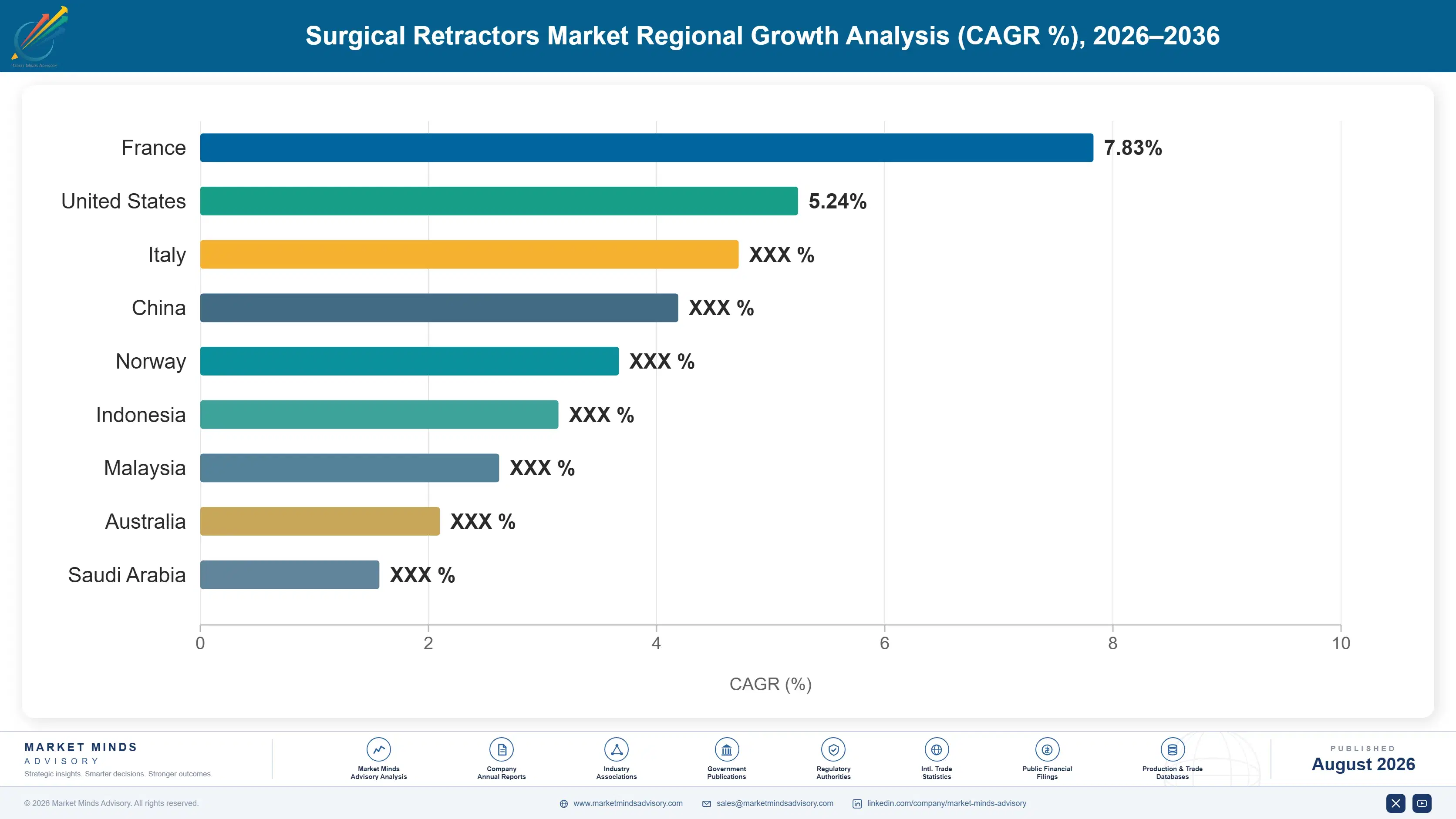
surgical-retractors-market-country-cagr-analysis-1787309376911

Selling Into the Reprocessing Budget

A retractor is a commodity and the money sits in what happens around it: the reprocessing cycle nobody costs, the tray nobody audits, and the assistant standing there holding it. Four positions matter here: three of them require analysis the hospital has never performed, and one requires a design answer to a procurement policy.

Cost the Customer's Reprocessing Cycle Before Quoting

Full reprocessing runs near USD 4.10 per instrument cycle and hospitals treat it as fixed overhead, so a single-use comparison is made on purchase price alone and single-use loses. Manufacturers who calculate a hospital's actual per-cycle cost, including sterile services labour and capacity constraints, change what is being compared entirely. Penetration is 26% of units and rises fastest in systems that have run this arithmetic, which suggests most of the opportunity is analytical rather than commercial. Most of the opportunity here is analytical rather than commercial. Sterile services never appear in the conversation.
Market Impact: Reprocessing costing USD 4.10 for e

Lead Tray Rationalisation Audits at Customer Hospitals

Around 37% of instruments in a standard tray are used during the procedure, and every unused item consumes a full reprocessing cycle regardless. Trays are inherited from retired surgeons and audited almost never. A manufacturer that leads the audit releases genuine savings for the hospital and shapes which instruments stay in the standard set, which is a fundamentally better position than bidding into a tender somebody else has specified. Removing unused instruments from the highest-volume trays frequently reduces reprocessing throughput by a fifth or more, which can eliminate a capacity shortfall a hospital was preparing to spend capital on.
Market Impact: Removing waste from 37% tray utilis

Argue Staffing Release Rather Than Instrument Performance

Self-retaining and table-mounted systems free roughly 1.8 hours of assistant time per theatre daily, and operating room staffing shortages have made that the most valuable thing a retractor can offer. The argument reaches theatre management, who control staffing and rota, rather than procurement, who compare unit prices. Instrument performance claims reach neither audience persuasively, which is why single-use self-retaining systems compound at 7.95% while conventional retractors track surgical volume. Conventional retractors track surgical volume and nothing else. Instrument performance claims persuade neither audience convincingly, which is why the self-retaining segment consistently outgrows conventional retraction.
Market Impact: Releasing fully 1.8 theatre hours e

Offer Hybrid Frames Against Sustainability Restrictions

Several European systems name single-use instruments explicitly in waste and carbon targets, which caps adoption whatever the total cost comparison shows. Hybrid designs with a reusable frame and disposable tissue-contact elements satisfy both the waste target and the reprocessing argument, and they preserve a recurring consumable revenue stream. Manufacturers arriving with lifecycle comparisons and take-back schemes negotiate from a considerably better position than those defending a fully disposable product. Penetration is 26% of units and the policy risk applies to all of it. A manufacturer without a hybrid alternative has no answer when a waste target captures its entire range.
Market Impact: Protecting all of the 26% single-us

Who Controls the Margin Pool

Five manufacturers hold 41% measured on surgical retractor revenue, the basis applied throughout this section. The field mixes large diversified device companies selling retractors alongside broader surgical portfolios, specialist instrument makers with deep reusable ranges, and access device specialists. Medtronic and Johnson & Johnson MedTech lead through portfolio reach rather than through any instrument advantage.
Competition operates on three dimensions. Tray standardisation influence decides which instruments remain in a hospital's routine sets. Clinical argument in access and infection prevention decides who reaches a budget holder not comparing instrument prices. And manufacturing cost position decides who survives in the reusable segment where group purchasing compresses pricing relentlessly. Instrument design itself decides almost nothing.

Two pressures are moving position. Chinese, Pakistani and Indian instrument manufacturing has made reusable retractors close to unbrandable at the commodity end. Meanwhile sustainability policy is capping single-use in the markets where it was growing fastest. Rankings will shift toward manufacturers holding access device clinical evidence and hybrid designs. A manufacturer holding only commodity reusables is competing directly with Chinese and Pakistani producers on cost, which is not a contest any Western operation wins for long.
surgical-retractors-market-company-positioning-matrix-1787309377427

Competitive Moat and Risk Dimensions

MEDTRONIC

Moat: Portfolio breadth into theatre

Medtronic sells across the surgical portfolio a theatre already purchases, which puts retractors inside a broader commercial relationship rather than into a standalone instrument tender. In a category where the instrument itself carries no defensible advantage, being part of a contract covering energy devices, staplers and access systems is worth considerably more than any product claim.
MEDTRONIC

Risk: Commodity reusable price erosion

Chinese, Indian and Pakistani manufacturers supply stainless retractors at prices that make branded reusable instruments difficult to justify, and group purchasing organisations are entirely willing to specify them. Portfolio breadth defends the relationship without defending the price, and the reusable segment steadily converts into commodity supply nobody can differentiate.
APPLIED MEDICAL

Moat: Access device clinical evidence

Applied Medical built its position on wound protector and access devices supported by surgical site infection evidence, which reaches infection prevention and quality budgets rather than instrument procurement. That evidence base took years to assemble and it moves the purchase decision to a budget holder who is not comparing retractor prices at all.
APPLIED MEDICAL

Risk: Single-use policy exposure

Access devices are single-use by construction, since polymer ring and sleeve designs do not survive reprocessing, which puts the whole position inside the segment European sustainability procurement now names explicitly. A manufacturer without a hybrid or reusable-frame alternative has no answer when a health system sets a waste reduction target that captures its entire range.

Players Tracked

Prominent Players

Medtronic
Johnson & Johnson MedTech
B. Braun Melsungen
Teleflex
Applied Medical

Other Key Players

Becton Dickinson
Integra LifeSciences
CONMED Corporation
Aesculap
KLS Martin Group
Thompson Surgical Instruments
Mediflex Surgical Products
Automated Medical Products
June Medical
Sklar Surgical Instruments
Surtex Instruments
Lawton Surgical
Rudolf Medical
Shanghai Medical Instruments
Kangji Medical

Recent Developments

MARCH 2025

European health systems name single-use instruments in waste targets

National procurement frameworks across several European health systems set waste and carbon reduction targets that specifically identify single-use surgical instruments, requiring justification for their continued use. These were procurement policy decisions rather than regulatory actions, and justification now applies before any single-use range is adopted.
Signal: A waste target capping single-use override
JULY 2025

Theatre staffing shortages accelerate self-retaining system adoption

Persistent operating room assistant and scrub nurse shortages across developed markets pushed hospitals toward self-retaining and table-mounted retractor systems that free staff for other tasks. This reflects labour market conditions rather than any development among instrument manufacturers, and theatre management drove most of those decisions.
Signal: Staffing scarcity converts a retractor pur
NOVEMBER 2025

Tray rationalisation programmes expand across hospital networks

Hospital networks extended surgical tray audit and rationalisation programmes, removing unused instruments from standard sets to reduce reprocessing volume and sterile services workload. These were operational efficiency decisions rather than corporate developments among the suppliers affected. Sterile services capacity constraints rather than instrument cost prompted most of the programmes.
Signal: Whoever leads the tray audit also shapes w

Stainless Steel, Polymer and Machining

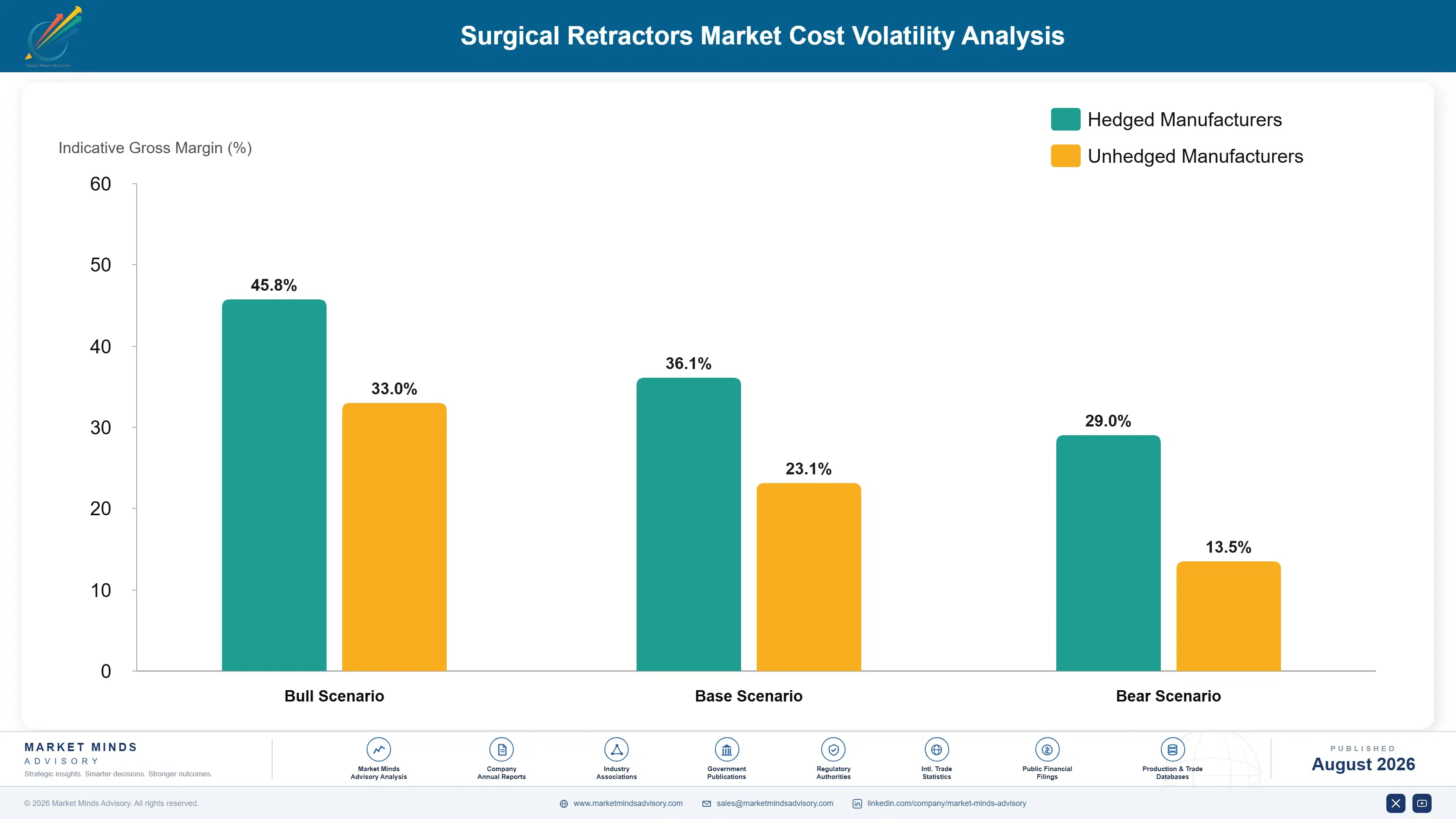
Surgical grade stainless steel and machining account for roughly 38% of cost of goods for reusable instruments, with hand finishing, passivation and inspection adding a substantial labour component that automation has never fully replaced. Single-use systems carry medical grade polymer and moulding cost near 29% plus sterilisation and packaging. Sterile barrier packaging and ethylene oxide or radiation processing are proportionally heavier burdens on disposable products.
Surgical grade stainless steel and nickel alloy pricing moved sharply through 2021 and 2022, and reusable instrument manufacturers absorbed most of it against group purchasing agreements written annually with no adjustment mechanism. Company annual reports across the surgical instrument manufacturers disclose the resulting margin compression. Energy Information Administration data on industrial metal and energy pricing documents the underlying movement across the period. Group agreements offered no adjustment mechanism at all.

Exposure divides sharply between reuse models. Reusable instrument manufacturers carry metal and skilled machining labour cost against pricing that low-cost Asian producers set, which leaves very little room. Single-use manufacturers carry polymer and sterilisation cost against pricing supported by a clinical or labour argument, which holds up considerably better. Hybrid designs carry both, and recover them through consumable revenue on a reusable frame.
surgical-retractors-market-cost-volatility-analysis-1787309377622

Index group purchasing agreements to published metal references

Annual group purchasing agreements written without adjustment clauses against volatile surgical grade stainless pricing put the entire cycle onto the manufacturer. Indexing to a published metal reference with a defined reset period matches pass-through to actual exposure, and purchasing organisations accept the mechanism more readily on reusable instruments than most manufacturers expect. Few manufacturers have asked.

Shift mix toward clinically argued single-use and access devices

Reusable retractor pricing is set by low-cost Asian manufacturing and cannot be defended on brand or quality claims at the commodity end. Deliberately weighting the portfolio toward access devices and self-retaining systems, where an infection prevention or staffing argument supports pricing, improves realised margin without requiring any change to manufacturing capability. Manufacturing capability is not the constraint.

Design hybrid frames to convert capital into consumable revenue

A reusable frame with disposable tissue-contact elements satisfies sustainability procurement while preserving recurring revenue, and it spreads polymer and sterilisation cost across a smaller component than a fully disposable system requires. That architecture also gives the manufacturer an answer when a health system sets a waste target capturing single-use ranges entirely. It is the only credible policy answer.

Portfolio Architecture for Margin Defence

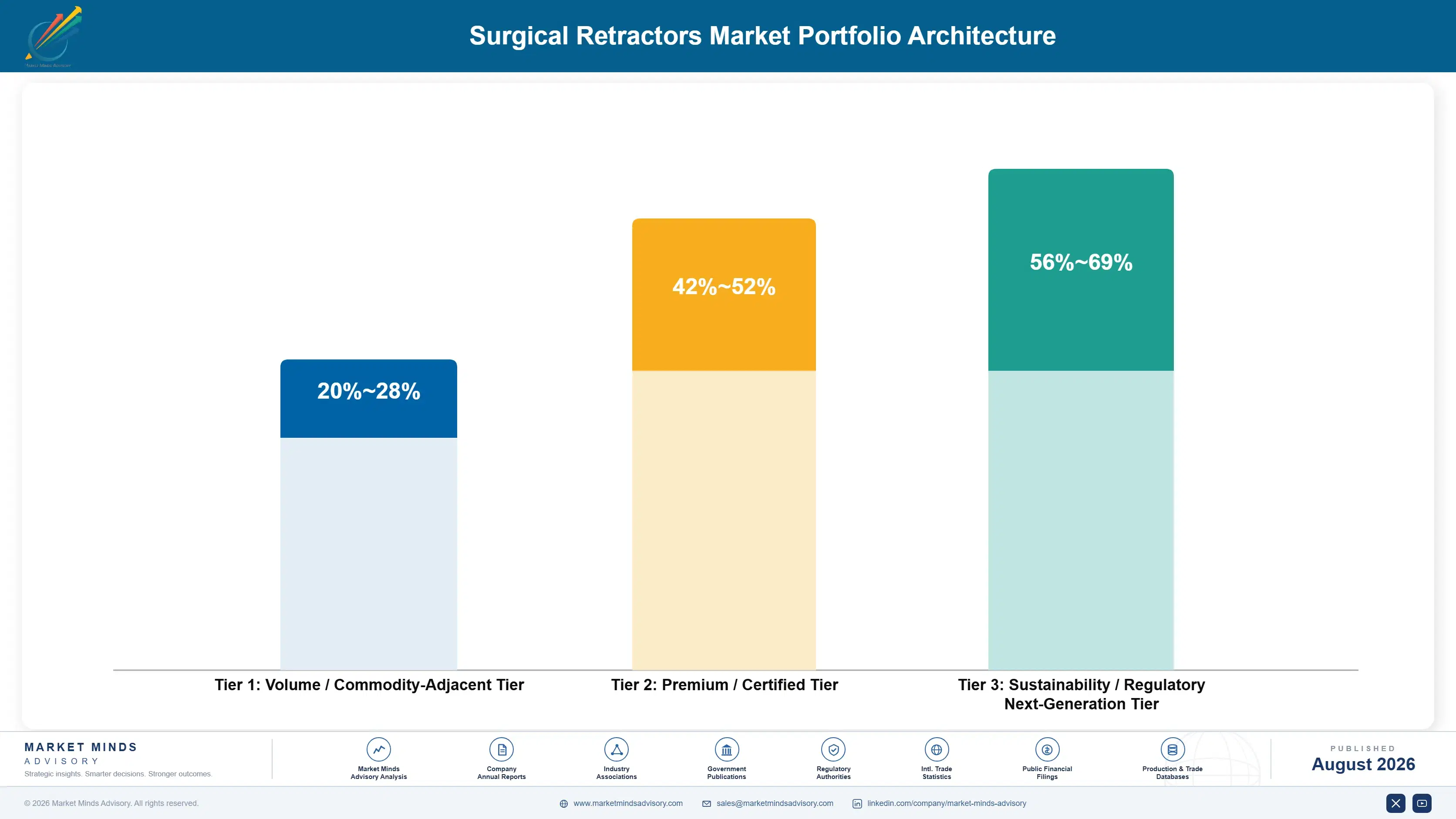
The portfolio separates on whether an argument exists beyond the instrument itself. Handheld reusable retractors are commodity metal, priced by Asian manufacturing and specified by tradition. Reusable self-retaining systems add a staffing argument and capital sale. Single-use self-retaining systems add reprocessing removal. Access and wound protector devices add clinical infection evidence, which reaches an entirely different budget holder. Specialty instruments sit apart on unit value rather th
The tension is between volume and defensibility. Handheld reusables carry the largest unit volumes and no differentiation whatsoever, so they exist to hold tray presence rather than to earn margin. Access devices and self-retaining systems earn the margin on far smaller volumes. A manufacturer weighted toward commodity reusables is competing directly with Chinese and Pakistani producers on cost, which is not a contest a Western operation wins.

High-value pools concentrate where somebody other than procurement is buying. Access devices with infection evidence, self-retaining systems sold on staffing release, and hybrid designs answering sustainability policy all qualify, and none competes on price per instrument. What they share is a buyer who is not procurement, which is the only reliable escape from a price comparison here.

Volume / Commodity-Adjacent Tier

Handheld reusable retractors in stainless steel, specified by tradition and purchased on price through group agreements. Low-cost Asian manufacturing sets the pricing, and no quality or brand claim defends a premium at this end of the range.
Gross Margin: 22-32%

Premium / Certified Tier

Reusable self-retaining and table-mounted retractor systems sold on staffing release and procedural stability. Capital sale with an installed base that generates accessory and replacement revenue, and theatre management rather than procurement makes the decision.
Gross Margin: 38-52%

Sustainability / Regulatory / Next-Generation Tier

Single-use self-retaining systems, wound protector and access devices, and hybrid reusable-frame designs. The wide margin range separates access devices carrying infection evidence from disposable ranges exposed to waste reduction procurement policy.
Gross Margin: 40-66%
surgical-retractors-market-portfolio-architecture-1787309378120

High-value Sub-segments and Strategic Watch-out

Single-Use Self-Retaining Systems

Compounding at 7.95% by removing a reprocessing cycle and an assistant simultaneously, at 26% penetration of units. Sustainability procurement policy naming single-use instruments explicitly is the binding constraint rather than any cost comparison. Hybrid frames are emerging as the only real answer to that policy problem.
Gross Margin: 44-62%

Wound Protector and Access Devices

Growing at 6.6% on surgical site infection evidence that reaches infection prevention and quality budgets rather than instrument procurement. Single-use by construction, which puts the whole position inside the segment European policy now names. Effect size varies honestly by procedure and by baseline infection rate.
Gross Margin: 48-66%

Handheld Reusable Retractors

The volume core at 3.1%, commodity stainless priced by Asian manufacturing and specified by surgeon habit rather than evidence. It holds tray presence and earns almost nothing, and no Western manufacturer wins it on cost. Tray presence rather than margin is the reason to carry it.
Gross Margin: 22-32%

Hybrid Reusable-Frame Systems

The strategic watch-out and the policy answer together. A reusable frame with disposable contact elements satisfies waste targets while preserving consumable revenue, and adoption depends on whether procurement accepts the distinction at all. Whether procurement accepts the distinction between a reusable frame and a disposable element decides the whole segment.
Gross Margin: 36-58%

Trays Reordered, Habits Rarely Broken

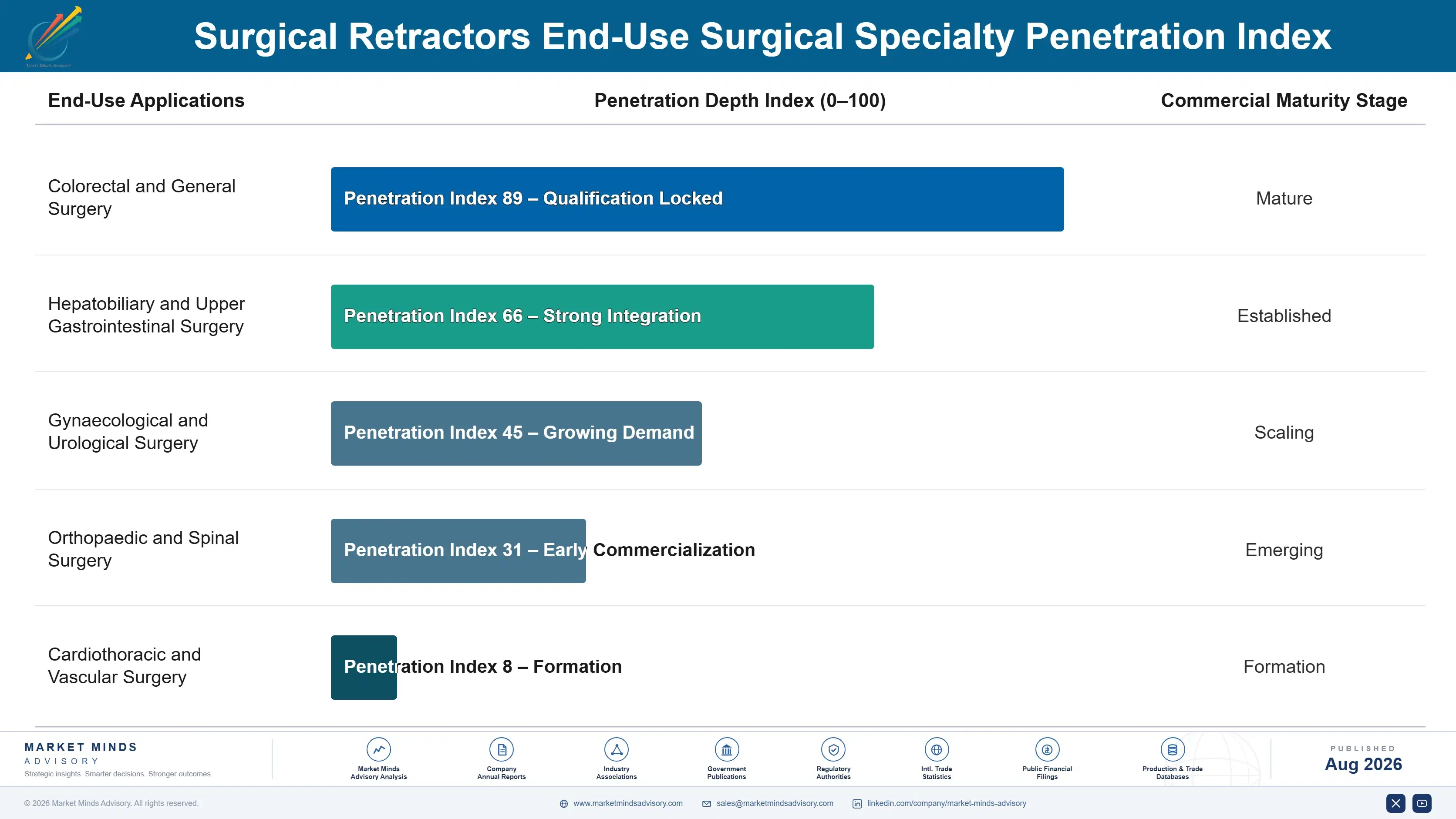
Revenue arrives through two quite different mechanisms. Reusable instruments are replaced as they wear out across roughly 400 cycles or are damaged, which produces slow predictable attrition against an installed tray configuration nobody revisits. Single-use and access devices generate consumption revenue with every procedure, which is far more attractive and far more exposed to a policy decision that removes the format entirely. One is durable and one is exposed.
Depth varies by procedure type and by who holds the budget. Colorectal, hepatobiliary and caesarean surgery buy access devices deeply on infection evidence. Orthopaedic and spinal surgery buy self-retaining systems on procedural stability and staffing. General surgery buys handheld reusables in volume at minimal value. Neurosurgery and cardiothoracic buy specialty instruments at high unit value and very low volume.

The deciding party depends entirely on which argument is being made. Instrument specification sits with surgeons and their preference is close to immovable. Staffing release reaches theatre management, who control rota and capacity. Infection prevention reaches quality and infection control budgets. Reprocessing cost reaches sterile services, who almost never appear in an instrument purchasing conversation at all.
surgical-retractors-market-end-use-penetration-index-1787309378607

Where Instrument Makers Win

These are among the four positions where our research anticipates prominent divergence between winners and laggards over the coming forecast period. Each is grounded in the demand model, the regulatory perimeter, and the announced capacity pipeline.
01 / REPROCESSING COST ANALYSIS

One side has an invoice and the other has an overhead

Full reprocessing runs near USD 4.10 per instrument cycle and hospitals treat it as fixed overhead, so single-use comparisons are made on purchase price alone and single-use loses before the discussion starts. Manufacturers who calculate a hospital's actual per-cycle cost, including sterile services labour and capacity, change what is being compared. Penetration rises fastest in exactly the systems that have run that arithmetic properly rather than assuming the answer, and it is analysis rather than persuasion that changes the outcome.
02 / TRAY AUDIT LEADERSHIP

Two-thirds of a tray is reprocessed without being used

Around 37% of instruments in a standard surgical tray are used during the procedure, and every unused item still consumes a full reprocessing cycle at roughly USD 4.10 each time. Trays are inherited from retired surgeons and audited almost never. A manufacturer leading that audit releases real savings for the hospital and shapes which instruments remain in the standard set, which beats bidding into a tender somebody else specified, and the saving frequently exceeds a capacity shortfall the hospital was funding capital against.
03 / STAFFING ARGUMENT FRAMING

Theatre management controls hours, procurement controls price

Self-retaining and table-mounted systems free roughly 1.8 hours of assistant time per theatre daily, and persistent operating room staffing shortages have made that the most valuable property a retractor can have. The argument reaches theatre management, who control rota and capacity, rather than procurement comparing unit prices. Instrument performance claims persuade neither of those audiences, which is precisely why the self-retaining segment outgrows conventional retraction quite so consistently, and choosing the audience correctly is most of the commercial task here.
04 / WASTE POLICY ANSWER

A hybrid frame satisfies the target and keeps the consumable

Several European health systems name single-use instruments explicitly in waste and carbon targets, which caps adoption regardless of what any total cost comparison demonstrates. Hybrid designs with a reusable frame and disposable tissue-contact elements satisfy the waste target while still preserving the recurring consumable revenue stream. Manufacturers arriving with lifecycle comparisons and take-back schemes negotiate from a far stronger position than those defending a fully disposable range, because the alternative is having no answer at all when the target arrives.

Engagement Snapshot From the Field

A live engagement with an industry participant carrying material or product regulatory and market exposure ahead of a defining policy shift, showing how our research translates into a defensible multi-year portfolio strategy.
MARKET MINDS ADVISORY · CLIENT ENGAGEMENT SUMMARY
Surgical Retractors Producer Strategic Portfolio Review and Transition Roadmap 2026·Investment Scenario on Surgical Retractors Exposure Evaluation 2025-26
CLIENT PROFILE
A six-hospital network performing roughly 58,000 surgical procedures annually with centralised sterile services across two decontamination units, and about USD 2.1 billion in operating revenue (client-reported, unverified by MMA). Instrument purchasing was managed through a group agreement, and single-use retraction requests from surgeons were routinely refused on unit price grounds. Reprocessing cost had never been fully absorbed.
STRATEGIC CHALLENGE
Sterile services was running at capacity and delaying theatre turnaround, and the proposed solution was a third decontamination unit costing an estimated USD 14 million (client-reported, unverified by MMA). Leadership treated the bottleneck as a capacity problem. Nobody had established how much of the reprocessing volume was instruments that had never been used.
MMA APPROACH
MMA audited tray composition against actual instrument use across 340 procedures spanning eight specialties, recording which items were opened and which returned unused. Full reprocessing cost per instrument cycle was calculated including labour, consumables, utilities and capital, then applied to the unused volume. Single-use alternatives were then re-compared against the corrected figure for each of the eight specialties reviewed.
KEY FINDINGS
  1. Thirty-four percent of instruments in standard trays were used during the procedures observed, and the remainder were reprocessed at full cost without ever leaving the tray.
  2. Fully absorbed reprocessing cost was USD 4.60 per instrument cycle against an internal working figure of USD 1.20 that had been used in every single-use comparison the network had made.
  3. Removing unused instruments from the twelve highest-volume trays would reduce reprocessing throughput by roughly 22%, which exceeded the capacity shortfall the third unit was intended to address.
  4. Single-use retraction was cheaper on fully absorbed cost than reusable in four of the eight specialties reviewed, reversing every purchasing decision made on the old figure.
CLIENT PROFILE
A six-hospital network performing roughly 58,000 surgical procedures annually with centralised sterile services across two decontamination units, and about USD 2.1 billion in operating revenue (client-reported, unverified by MMA). Instrument purchasing was managed through a group agreement, and single-use retraction requests from surgeons were routinely refused on unit price grounds. Reprocessing cost had never been fully absorbed.
STRATEGIC CHALLENGE
Sterile services was running at capacity and delaying theatre turnaround, and the proposed solution was a third decontamination unit costing an estimated USD 14 million (client-reported, unverified by MMA). Leadership treated the bottleneck as a capacity problem. Nobody had established how much of the reprocessing volume was instruments that had never been used.
MMA APPROACH
MMA audited tray composition against actual instrument use across 340 procedures spanning eight specialties, recording which items were opened and which returned unused. Full reprocessing cost per instrument cycle was calculated including labour, consumables, utilities and capital, then applied to the unused volume. Single-use alternatives were then re-compared against the corrected figure for each of the eight specialties reviewed.
KEY FINDINGS
  1. Thirty-four percent of instruments in standard trays were used during the procedures observed, and the remainder were reprocessed at full cost without ever leaving the tray.
  2. Fully absorbed reprocessing cost was USD 4.60 per instrument cycle against an internal working figure of USD 1.20 that had been used in every single-use comparison the network had made.
  3. Removing unused instruments from the twelve highest-volume trays would reduce reprocessing throughput by roughly 22%, which exceeded the capacity shortfall the third unit was intended to address.
  4. Single-use retraction was cheaper on fully absorbed cost than reusable in four of the eight specialties reviewed, reversing every purchasing decision made on the old figure.
RECOMMENDED STRATEGY
Phase 1: Phase 1 (months 1 to 5): Audit and rebuild the twelve highest-volume trays with surgeon involvement and remove instruments not used in practice. Phase 2: Phase 2 (months 5 to 12): Adopt the fully absorbed reprocessing figure in all single-use comparisons and revisit the refused requests. Phase 3: Phase 3 (months 12 to 20): Defer the third decontamination unit and reassess capacity after tray rationalisation has taken effect.
OUTCOME
Reprocessing throughput fell by approximately 19% within seven months of rebuilding the highest-volume trays (client-reported, unverified by MMA). The third decontamination unit was deferred indefinitely, avoiding around USD 14 million of capital (client-reported, unverified by MMA). Single-use adoption rose in the four specialties where fully absorbed costing favoured it, and theatre turnaround delays attributable to sterile services ceased.

Frequently Asked Questions

Foundational context covering the market sizes, CAGR, scope, country, region and competition that inform every finding below. This section is provided to cover basics and most often pre-purchase conversations, answered from the MMA Primary Research Dataset.

What is the current size of the Surgical Retractors Market?

The global market was worth USD 2.2 billion in 2025, reaching USD 2.32 billion in 2026. East Asia holds the largest regional share at 29% of demand.

How large will the Surgical Retractors Market be by 2036?

MMA forecasts USD 3.89 billion by 2036, an expansion multiple of 1.68 times the 2026 base. That represents roughly USD 1.57 billion of incremental value.

What is the CAGR for the Surgical Retractors Market 2026 to 2036?

The base case compounds at 5.3% annually, with a bull case of 6.5% and a bear case of 4.1%. Historical growth from 2020 to 2025 ran at 4.2%.

Which segment is growing fastest?

Single-use self-retaining retractor systems compound at 7.95%, exactly 1.50 times the market rate. They remove a reprocessing cycle and an assistant from the room simultaneously.

Who are the major companies in the Surgical Retractors Market?

Medtronic, Johnson & Johnson MedTech, Teleflex, Applied Medical and B Braun Melsungen hold a combined 41% of the market. Portfolio reach and clinical evidence sustain those positions rather than instrument design.

Which country is growing fastest?

India compounds at 7.6%, ahead of every other national market. Rising surgical volumes and continued hospital construction drive that growth rather than any product substitution.

Report Segmentation Architecture

The full report scope spans multiple orthogonal segmentation dimensions, with cross-tabulated demand data provided for each dimension pair. Coverage extends further to regional breakdowns, trend trajectories, and the competitive detail needed to support segment-level decision-making.

By Instrument Type and Reuse Model

  • Handheld Reusable Retractors
  • Reusable Self-Retaining and Table-Mounted Systems
  • Single-Use Self-Retaining Retractor Systems
  • Wound Protector and Access Retractors
  • Minimally Invasive and Laparoscopic Retractors
  • Specialty Neurosurgical and Cardiothoracic Retractors

By End-Use Industry

  • General and Colorectal Surgery
  • Orthopaedic and Spinal Surgery
  • Cardiothoracic and Vascular Surgery
  • Obstetrics and Gynaecological Surgery
  • Neurosurgery and Specialty Procedures

By Commercial Dimension

  • Group Purchasing and Tender Supply
  • Direct Hospital and Theatre Sales
  • Distributor and Surgical Supply Channel
  • Ambulatory Surgery Centre Programmes

By Region

  • North America
  • Western Europe
  • East Asia
  • South Asia and Pacific
  • Latin America
  • Middle East and Africa
  • Eastern Europe

Scope, Methodology, and Coverage

Every figure in this report is reproducible from documented input assumptions. The scope below maps the historical period, the forecast horizon, the segmentation dimensions, and the countries covered, alongside the underlying primary and qualitative methodology.
Historical Period
2020 to 2025
Forecast Period
2026 to 2036
Base Year
2025 (USD billions; MMA Primary Research Dataset, August 2026)
Market Definition
The market covers manual and mechanical instruments used to hold surgical tissue apart, spanning handheld reusable retractors, reusable self-retaining and table-mounted retractor systems, single-use self-retaining retractor systems, wound protector and access retractors, minimally invasive and laparoscopic retractors, and specialty retractors for neurosurgery, cardiothoracic and orthopaedic use, together with the frames, blades and accessories supplied with them. Surgical robotic systems and their instruments, endoscopes and visualisation equipment, trocars and access ports without a retraction function, sterilisation and decontamination equipment, surgical drapes and gowns, and operating tables are excluded. Sizing is measured at manufacturer revenue in current prices.
Quantitative Units
USD billions (current prices); instrument units, reprocessing cycles and reuse life in cycles where applicable
Segmentation Dimensions
By Instrument Type and Reuse Model; By End-Use Industry; By Commercial Dimension; By Region
Regions Covered
North America, Western Europe, East Asia, South Asia and Pacific, Latin America, Middle East and Africa, Eastern Europe
Countries Covered
China, USA, Germany, Japan, India, France, UK, Italy, Spain, South Korea, Canada, Brazil, Mexico, Taiwan, Pakistan, Turkey, Australia, Indonesia, Thailand, Malaysia, Saudi Arabia, UAE, South Africa, Egypt, Poland, Czech Republic, Netherlands, Sweden, Argentina, Colombia, and additional markets relevant to this sector
Key Companies Profiled
Medtronic, Johnson & Johnson MedTech, B. Braun Melsungen, Teleflex, Applied Medical, Becton Dickinson, Integra LifeSciences, CONMED Corporation, Aesculap, KLS Martin Group, Thompson Surgical Instruments, Mediflex Surgical Products, Automated Medical Products, June Medical, Sklar Surgical Instruments, Surtex Instruments, Lawton Surgical, Rudolf Medical, Shanghai Medical Instruments, Kangji Medical
Quantitative Methodology
Primary survey, n=3,800 respondents, Q4 2025, six countries; demand-side model with trade association cross-validation
Qualitative Methodology
47 expert interviews, Q4 2025; applied to validate demand model assumptions, identify emerging dynamics, and assess competitive positioning
Report Format
PDF and XLSX data workbook (Word format preview document)
Publisher
Market Minds Advisory
Report Code
MMA-2026-MED-934
Published
August 2026
Contact
sales@marketmindsadvisory.com | www.marketmindsadvisory.com

Purchase the full Surgical Retractors Market Report (2026 to 2036).

The full report sizes surgical retractors across six instrument and reuse categories, three commercial dimensions and seven regions, with annual forecasts to 2036 under base, bull and bear scenarios. Fully absorbed reprocessing cost per instrument cycle is modelled by health system, which is the figure that decides every single-use comparison and which almost no hospital calculates correctly. Tray utilisation is measured by specialty against reprocessing throughput. Sustainability procurement restrictions on single-use instruments are mapped by jurisdiction. Twenty manufacturers are profiled on a consistent retractor revenue basis.
Fully absorbed reprocessing cost modelled by health system
Tray utilisation measured by specialty against reprocessing throughput
Sustainability procurement restrictions mapped by jurisdiction and format
Theatre staffing release quantified across self-retaining system types
Access device infection evidence assessed by procedure category
Low-cost manufacturing pricing tracked against branded reusable ranges

Built For The People Who Decide

From boardroom strategy to bench-side execution, this report is read cover-to-cover by leaders shaping the next decade of their industry, turning demand scenarios, market dynamics and valuation benchmarks into decisions.
CXOs/ Presidents/ VPs/ Managers
M&A and Corporate Development
Strategy Teams and R&D Heads
Procurement and Product Directors
Regulatory and Compliance Leaders
Investor Relations and Equity Analysts