Market Minds Advisory
Surgical Mask Market

Surgical Mask Market: Commodity Volume Meets a Quiet Premium Segment

Post-pandemic overcapacity has pushed standard surgical mask pricing toward commodity floors, forcing manufacturers to defend margin through antimicrobial treatment and respirator-grade certification rather than pure production volume. across both hospital and outpatient channels.

Lead Analyst

Alice Ballenger

Published

September 2026

Make Smarter Decisions with Customized Research Insights

Request a free sample report and evaluate market opportunities, growth trends, and competitive dynamics relevant to your business needs.

2025 MARKET VALUE$8.2BMarket Size 2025
2036 FORECAST VALUE$12.9BBase Case , 2026 to 2036
CAGR 2026 TO 20364.2 %Bull 5.4% / Bear 2.9%
INCREMENTAL OPPORTUNITY$4.3BNet 10- year value creation
EXPANSION MULTIPLE1.51x2036 value over 2026 base
Strategic Levers
M&A Pipeline
Regional Outlook
Country Rankings
Competitive Intelligence
Segmental Deep-dive
Call-Us : 91 93563 13602

Executive Snapshot and Market Trajectory

Surgical masks are splitting between standard commodity products sold on rock-bottom unit cost and antimicrobial-treated or respirator-grade products sold on documented clinical differentiation. That divide keeps widening slowly, and it is reshaping which manufacturers hospital procurement teams actually trust. Vendors that misjudge this shift risk losing share.
Antimicrobial-treated masks grow fastest as hospitals seek infection-control differentiation, followed by respirator-grade surgical masks gaining adoption for higher-risk clinical settings. East Asia holds the largest share on the deepest manufacturing base and largest overall clinical procedure volume. South Asia and Pacific is closing that gap quickly as hospital infrastructure expands across the region steadily. Latin America and the Middle East grow steadily off smaller manufacturing bases within the covered scope. Momentum broad.
Competitive intensity concentrates around a fragmented field of manufacturers with proven commodity production platforms, led by 3M and Honeywell's broad PPE portfolios. Post-pandemic overcapacity and antimicrobial technology adoption are increasingly reshaping which manufacturers hospitals actually specify, pressuring standard-mask makers without differentiated technology to compete for a shrinking pool of premium budget. That pressure is forcing several mid-tier manufacturers to rethink product roadmap priorities entirely and quickly.
Market Definition
The surgical mask market covers disposable and reusable masks worn by clinicians and patients to reduce airborne and droplet transmission during clinical procedures, including standard surgical masks, fluid-resistant masks, respirator-grade surgical masks, and antimicrobial-treated masks. It excludes industrial respirators not cleared for surgical use, cloth face coverings, and general-purpose non-medical masks.
Base Year Value
$8.2B in 2025 (MMA Primary Research Dataset, August 2026)
Forecast Period
2026 to 2036, eleven discrete annual values
CAGR
4.2% base case. Bull 5.4%. Bear 2.9%.
Fastest Growth Segment
Antimicrobial-Treated Surgical Masks: 7.8% CAGR
Fastest Growth Country
India: 8.9% CAGR
Fastest Growth Region
South Asia and Pacific: 6.2% CAGR
Largest Region
East Asia: 30% of 2025 global value
Market Leaders
3M Company, Honeywell International Inc., Kimberly-Clark Corporation, Cardinal Health Inc., Medline Industries LP. Source: MMA Analysis based on company annual reports.
Primary Survey
n=3,800 procurement and R&D decision-makers, Q4 2025, six countries
Methodology
Demand-side build-up, cross-validated against public data, 47 expert interviews

Surgical Mask Market Forecast Scenarios

surgical-mask-market-size-forecast-scenario-1787309124801
Between 2020 and 2025 the market grew at an estimated 5.4% historical CAGR, normalizing after pandemic-era demand spikes while hospital-acquired infection prevention mandates and surgical volume growth sustained a durable higher baseline across major health system markets throughout the historical period. Companies investing early in certified fluid-resistant capacity captured a disproportionate share of this demand base ahead of slower-moving commodity competitors.
The base case assumes 6.4% CAGR through 2036, anchored in three commercial mechanisms: expanding hospital-acquired infection prevention mandates across major developed and emerging markets requiring proportional certified mask capacity, rising surgical procedure volume sustaining base commodity and premium mask demand, and growing infection control committee preference for antimicrobial-coated formats over standard masks in high-risk procedures. Rising healthcare infrastructure investment in emerging markets adds a further reinforcing tailwind as the sector matures.
A bull scenario, near 7.6% CAGR, assumes faster surgical volume growth and accelerated antimicrobial coating validation pull premium mask orders forward across more procedure categories worldwide. The bear case, near 5.2% CAGR, assumes broader hospital capital spending tightens considerably and health systems extend existing standard mask protocols rather than converting to certified formats on the standard procurement cycle industry-wide.

Differentiated Technology Is Becoming the Category's Margin Line

Three forces converge on this market at once. Routine infection control protocols keep sustaining baseline demand, outpatient clinic volume growth keeps expanding overall consumption, and antimicrobial technology keeps gaining hospital procurement traction. Standard-mask manufacturers without differentiated technology increasingly lose hospital contracts to competitors already delivering documented filtration and antimicrobial performance reliably across large procurement volumes. That gap is wi
MARKET CONCENTRATION (CR5)28%Top five manufacturers hold under a third of total share
AVERAGE ANTIMICROBIAL MASK PRICE$0.42/unitAntimicrobial masks command premium over standard commodity pricing
TOP PRODUCING COUNTRY SHARE31%China leads installed surgical mask manufacturing capacity globally
BACTERIAL FILTRATION EFFICIENCY98%Leading surgical masks achieve this documented filtration performance rate
TRADE INTENSITY44%Nearly half of surgical mask volume crosses national borders
NONWOVEN FABRIC COST SHARE38% of COGSSpecialty meltblown nonwoven fabric costs dominate production expense
Commercially, the market splits between standard commodity masks, priced at rock-bottom margins and sold largely on price against a globally oversupplied manufacturing base, and antimicrobial-treated or respirator-grade masks, priced at meaningful premium and sold on documented clinical performance hospitals need to justify formulary placement above commodity alternatives. That premium category commands disproportionate growth.
Over the next decade the defining question is whether differentiated technology becomes the mainstream standard across most clinical settings, or whether cost sensitivity in budget-constrained health systems keeps standard commodity masks entrenched in the largest volume segments despite mounting differentiation pressure, and manufacturers that misjudge this timing risk stranding capital in a mask tier hospitals no longer prioritize. and manufacturers that misjudge this timing risk stranding capital in a tier hospitals no longer prioritize broadly.
"A surgical mask used to be judged almost entirely on price per box, a pure commodity nobody thought twice about specifying beyond cost. Now a hospital infection-control committee can request documented antimicrobial performance data before approving a formulary switch, and that quiet shift has turned a forgettable consumable into a genuine, if narrow, differentiation contest."
Director, Personal Protective Equipment Practice · MMA Medical Devices / Persona

Market Trends

Antimicrobial Treatment Gains Hospital Procurement Traction

Antimicrobial-treated surgical masks, which incorporate coatings designed to reduce microbial load on the mask surface during extended wear, have moved from a niche premium offering to mainstream hospital procurement consideration, tracked across an expanding number of hospital formulary procurement filings since 2023. 3M and Kimberly-Clark have both expanded antimicrobial mask production capacity specifically targeting hospitals formalizing infection-control differentiation criteria. Manufacturers without validated antimicrobial performance data increasingly lose hospital contracts to competitors already delivering documented microbial reduction reliably. That adoption curve is expected to keep steepening as more hospitals formalize infection-control differentiation criteria broadly.
Market Impact: Adds 3-5% baseline demand
Domestic Reshoring Reduces Import Dependence Steadily

Domestic manufacturing reshoring, driven by lingering supply chain security concerns following pandemic-era import disruption, increasingly shifts production capacity back toward North American and European facilities rather than relying purely on Asian import volume, a shift documented across an expanding number of national medical supply chain policy announcements since early 2024. Honeywell and Cardinal Health have both expanded domestic mask production capacity specifically targeting government supply chain resilience procurement programmes. Hospitals increasingly evaluate manufacturers on documented domestic production capability alongside pure unit cost. This expectation increasingly shapes procurement scoring criteria at hospitals evaluating new manufacturer relationships.
Market Impact: Adds 3% to 4% consumption yearly

Market Opportunities and Growth Drivers

Routine Infection Control Protocols Sustain Baseline Demand

Routine hospital infection control protocols, tracked across an expanding number of national infection-control guideline updates, keep sustaining baseline surgical mask replacement demand as health systems maintain standard usage requirements for every clinical procedure regardless of broader public health conditions. Each hospital that formalizes standardized mask usage protocols represents recurring, multi-year demand tied directly to that facility's annual clinical procedure volume, giving manufacturers a demand driver more predictable than categories dependent purely on discretionary infection-control budget increases. This visibility increasingly shapes how manufacturers plan production capacity across multiple facilities. This visibility increasingly shapes how manufacturers plan production capacity across multiple facilities.
Market Impact: Compresses margins by 12-20% since

Outpatient Clinic Volume Growth Expands Consumption Broadly

Outpatient and dental clinic volume growth, driven by continued shift of routine procedures away from inpatient hospital settings, keeps expanding total surgical mask consumption beyond traditional hospital procurement channels alone. Each newly opened outpatient facility represents recurring, multi-year mask demand tied directly to that facility's annual patient encounter volume. Manufacturers serving these outpatient channels increasingly build distribution relationships that strengthen their position when additional facilities evaluate supplier options. This distribution reach compounds further as more outpatient networks consolidate procurement decisions centrally. This credibility compounds further as more outpatient networks require documented data before contracting.
Market Impact: Depresses utilization to 55-65% of

Market Restraints and Challenges

Commodity Pricing Pressure Compresses Manufacturer Margins

Standard surgical mask pricing has fallen sharply from pandemic-era peaks as global manufacturing capacity normalized, and the root cause is that dozens of manufacturers who scaled production during acute pandemic shortage now compete for a demand pool that has settled back to pre-pandemic baseline levels. This pricing pressure constrains margins particularly for manufacturers dependent purely on standard commodity products without differentiated technology, forcing many toward consolidation or exit from the category entirely. Manufacturers are mitigating the pressure by shifting portfolio mix toward antimicrobial and respirator-grade products where commodity pricing pressure is meaningfully weaker.
Market Impact: Cuts surface microbial load by 55%

Pandemic-Era Overcapacity Steadily Depresses Utilization Rates

Manufacturing capacity added during acute pandemic shortage periods now substantially exceeds normalized post-pandemic demand, and the root cause is that emergency capacity investment decisions were made under extreme shortage conditions unlikely to recur at that scale under normal circumstances. This overcapacity depresses utilization rates across the industry broadly, leaving many facilities operating well below efficient production thresholds and further pressuring already thin commodity margins. Manufacturers are mitigating the overcapacity through facility consolidation and repurposing excess capacity toward adjacent nonwoven fabric product categories. This rationalization process is becoming a standard industry response to persistent overcapacity broadly.
Market Impact: Domestic share rose to 23%
3 additional market trends, 4 additional growth drivers, and 3 additional restraints and challenges are covered in the full report. Contact sales@marketmindsadvisory.com to access the complete intelligence.

Segment CAGR and Growth Architecture

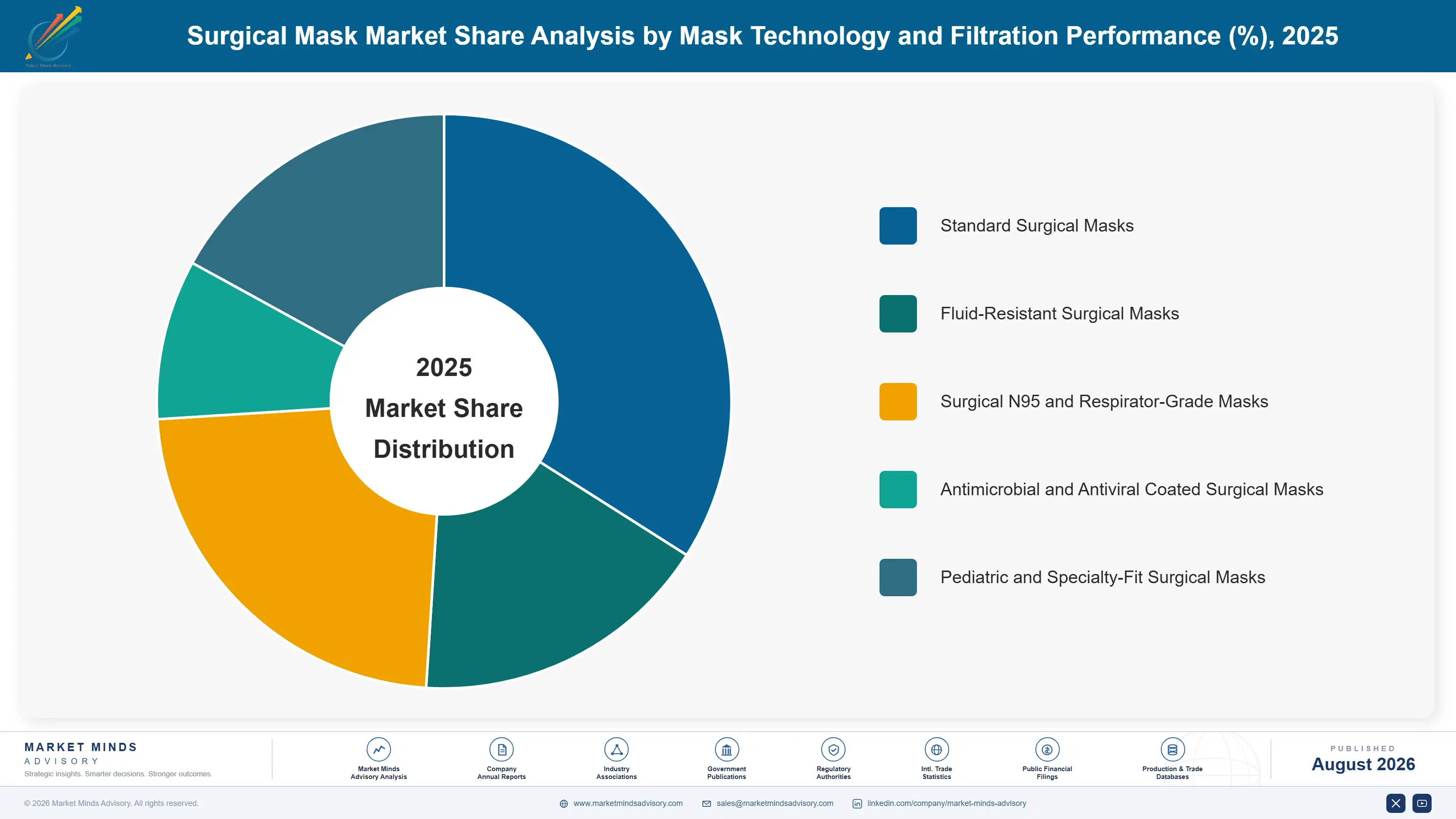
Segmentation follows mask technology and filtration performance, a single technology-based logic distinguishing how each product achieves clinical protection. End-use setting and distribution channel are treated as separate commercial dimensions, not parallel segments within this hierarchy. This keeps the analysis internally consistent. Each hierarchy therefore stays internally consistent and mutually exclusive across every named segment in this report.
surgical-mask-market-market-share-analysis-1787309125335

Antimicrobial-Treated Surgical Masks

Antimicrobial-treated surgical masks grow fastest at 7.8%, about 1.86 times the overall rate, as hospitals increasingly demand documented infection-control differentiation beyond standard filtration performance for extended-wear clinical settings. This category commands substantial premium pricing over standard commodity masks that reflects the antimicrobial coating technology and documented microbial reduction value hospitals pay for directly. 3M leads commercial capacity expansion, having invested heavily in antimicrobial mask development since 2023 specifically targeting hospitals formalizing infection-control differentiation criteria. Adoption is fastest among large academic hospital systems, while smaller community clinics continue adopting more gradually as unit pricing declines with rising production scale. Academic hospital momentum keeps building as unit pricing declines with rising production scale.
CAGR 7.8%

Respirator-Grade Surgical Masks

Respirator-grade surgical masks, which combine N95 or FFP2-equivalent filtration performance with surgical-grade fluid resistance for higher-risk clinical settings, grow at 6.5%, the second-fastest category, as hospitals increasingly specify enhanced protection for procedures generating aerosolized particles. This category commands meaningful premium pricing over standard fluid-resistant masks, reflecting genuine filtration engineering and the protection value clinicians specifically pay for. Honeywell maintains substantial respirator-grade production capacity serving both hospital and outpatient surgical center customers directly. Growth here reflects genuine protection-driven demand rather than pure substitution from adjacent standard mask technologies already in wide clinical use. Outpatient surgical center adoption still represents a meaningful share of unit volume even as hospital demand leads growth.
CAGR 6.5%
Full segment breakdown across 6 segments available in the complete report.

Regional Architecture and Country Demand Map

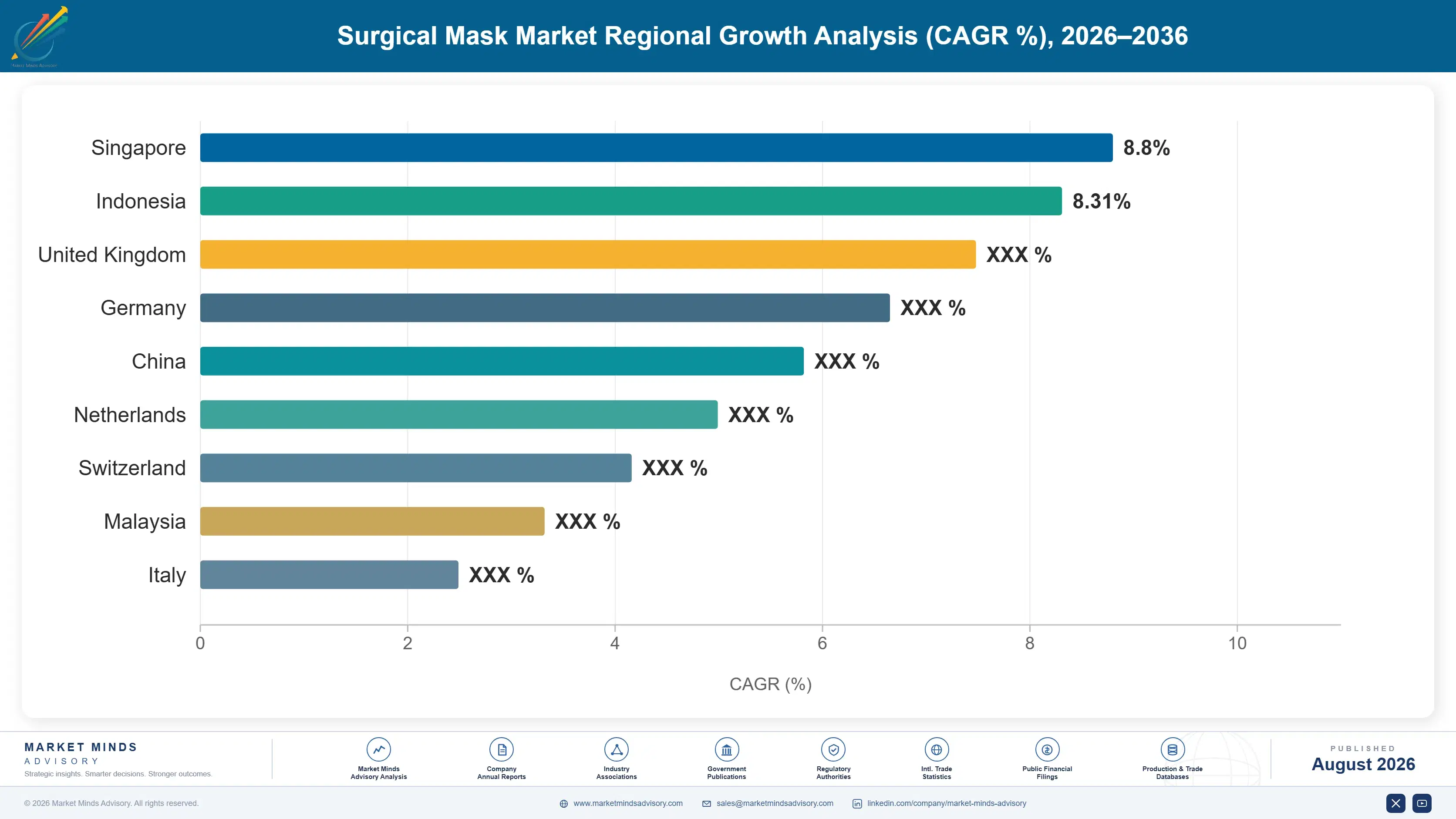
East Asia leads on the deepest manufacturing base and largest overall clinical procedure volume, North America follows on established hospital infrastructure, and South Asia and Pacific grows fastest among major regions overall. Latin America and the Middle East grow steadily off smaller bases, while Eastern Europe trails the average.

North America

The United States hosts well-developed hospital infection-control infrastructure and a sizable domestic manufacturing base rebuilt following pandemic-era supply chain disruption, with government supply chain resilience programmes driving meaningful demand for domestically produced masks tracked by national medical supply chain policy reporting. 3M and Honeywell both run substantial domestic manufacturing capacity, serving hospital, outpatient, and dental clinic customers from facilities across the country. Canada's smaller but stable hospital market follows similar domestic sourcing preference patterns, generally trailing American reshoring investment pace. Growth trails East Asia and South Asia and Pacific because the region's clinical infrastructure is already extensively built out, leaving differentiated technology depth as the primary driver going forward nationally.
Share: 24% | CAGR: 3.5% (2026 to 2036)

Western Europe

Germany and France both maintain well-developed hospital infection-control infrastructure, with national health systems anchoring steady regional demand for both standard and antimicrobial-treated surgical masks across major hospital networks. The United Kingdom's national health system has supported consistent procurement frameworks for standardized mask usage protocols, sustaining demand across public hospitals nationwide. The European Medicines Agency's regulatory framework has reinforced consistent filtration and bacterial efficiency standards across member states for approved surgical masks. Growth trails East Asia and South Asia and Pacific as the region's clinical infrastructure is already substantially mature relative to faster-growing emerging markets. Italy and Spain both contribute smaller but steady demand tied to expanding outpatient clinic networks. Sweden and the Netherlands both contribute smaller but steady demand within.
Share: 19% | CAGR: 2.7% (2026 to 2036)
Regional intelligence for 5 additional markets available in the complete report: East Asia, South Asia and Pacific, Latin America, Middle East and Africa, Eastern Europe. Contact sales@marketmindsadvisory.com.
surgical-mask-market-country-cagr-analysis-1787309125852

Where Mask Manufacturers Can Still Defend Margin

Four commercial moves separate manufacturers capturing durable differentiation-driven margin from those competing purely on commodity mask pricing: antimicrobial technology investment timing, domestic manufacturing depth, hospital contract bundling, and nonwoven fabric sourcing diversification. Each move converts a technical or timing advantage into a defensible commercial position. Manufacturers combining these moves well outperform those competing purely on price alone.

Invest in Antimicrobial Technology Ahead of Demand

Hospitals facing aggressive infection-control differentiation requirements need manufacturers who can actually deliver validated antimicrobial performance data, and manufacturers investing in antimicrobial technology ahead of confirmed demand growth capture disproportionate share of premium hospital contracts as procurement committees lock in vendor relationships well before competitors can match validated microbial reduction data. This is a genuine capability race, and manufacturers who wait for demand to fully materialize before investing risk losing accounts to competitors already qualified. Manufacturers with validated antimicrobial technology typically capture 22% to 32% of new hospital contract adoption before competitors complete comparable development.
Market Impact: Early movers capture 22% to 32% of

Build Domestic Manufacturing Depth to Close Resilience Gaps

Government supply chain resilience requirements represent a genuine barrier to import-dependent manufacturers seeking public sector procurement contracts, and manufacturers investing in domestic production capacity that closes this gap capture government specifications competitors without comparable domestic footprint cannot win reliably. This manufacturing investment differentiates beyond pure product pricing and reliability, addressing the specific resilience objection that otherwise limits how broadly hospitals will source from import-dependent suppliers. Manufacturers with proven domestic capacity report winning 18% to 27% more competitive government tenders than import-dependent competitors. This advantage compounds further as more governments require documented domestic capacity before awarding contracts.
Market Impact: Wins 18% to 27% more government ten

Build Deep Hospital Contract Bundling Relationships

Large hospital systems increasingly seek PPE vendors who can bundle surgical masks with broader personal protective equipment product lines rather than negotiating each category separately, and manufacturers building this bundled contracting capability capture premium system-wide business single-category competitors cannot access as easily. This bundling approach also builds switching costs, since a hospital's procurement standardization often becomes tied to the specific vendor relationship over time. Manufacturers building this bundling depth report commanding 12% to 22% pricing premiums over competitors offering purely single-category supply relationships. This bundling depth increasingly determines which manufacturers win the largest multi-year system-wide contracts.
Market Impact: Commands 12% to 22% premium for bun

Diversify Nonwoven Fabric Sourcing to Manage Volatility

Specialty meltblown nonwoven fabric price and availability volatility creates genuine margin risk for manufacturers dependent on single-source or spot market purchasing, and manufacturers building diversified sourcing relationships across suppliers in multiple regions weather cost volatility with meaningfully less margin disruption than competitors dependent on concentrated sourcing facing the same market conditions. Manufacturers pursuing diversified sourcing report reducing margin volatility by 7% to 12% during price spikes relative to competitors dependent on single-region concentrated sourcing that leaves them fully exposed when nonwoven fabric markets move sharply. This diversification discipline increasingly separates resilient manufacturers from those exposed to sudden shocks.
Market Impact: Reduces margin volatility by 7% to

Who Controls the Margin Pool

Concentration sits at a low CR5 of 28%, reflecting a genuinely fragmented commodity field where dozens of manufacturers worldwide compete on price alone for standard product volume. 3M and Honeywell compete on manufacturing scale and portfolio breadth, while Kimberly-Clark and Cardinal Health anchor strong positions in hospital distribution relationships and antimicrobial technology respectively. Numerous smaller regional specialists compete for narrower commodity export niches.
Current competitive activity runs along three lines: antimicrobial technology development, where manufacturers race to secure validated performance data ahead of hospital formulary review cycles; domestic manufacturing expansion, increasingly central to winning government supply chain resilience specifications; and hospital contract bundling, as manufacturers compete for premium system-wide business beyond standard mask supply. All participants are assessed on one consistent basis, annual revenue from surgical mask product sales.

Pressure is building from two directions. Manufacturers with strong antimicrobial technology are capturing disproportionate hospital contract share, a dynamic slower-moving competitors cannot easily counter through pricing alone. Meanwhile well-funded emerging specialists are scaling both domestic-manufacturing and increasingly commercially viable antimicrobial platforms, pressuring diversified incumbents in the fastest-growing niches. Rankings over the next five years will shift toward manufacturers combining differentiation speed with genuine domestic manufacturing depth.
surgical-mask-market-company-positioning-matrix-1787309126373

Competitive Moat and Risk Dimensions

3M COMPANY

Moat: Broadest antimicrobial technology portfolio

3M's global manufacturing footprint and product breadth spanning standard, antimicrobial, and respirator-grade masks let it serve multinational hospital customers as a single-vendor relationship few narrower competitors can match, particularly valuable as hospitals consolidate PPE vendor relationships. That breadth gives 3M a durable pricing floor even against faster-innovating challengers.
3M COMPANY

Risk: Standard commodity product exposure

3M's substantial installed base of standard commodity mask production faces mounting margin pressure as pandemic-era overcapacity keeps pricing depressed, exposing a meaningful share of its production footprint to commoditization risk its antimicrobial investment has not yet fully offset. Hospitals increasingly weight differentiation data heavily in formulary decisions, narrowing 3M's window to close that gap.
HONEYWELL INTERNATIONAL INC.

Moat: Deep domestic manufacturing footprint

Honeywell's early and sustained investment in domestic manufacturing capacity, built through extensive government supply chain resilience relationships, gives it a defensible position in the fastest-growing government procurement category that funds continued expansion into adjacent respirator-grade technology. That manufacturing advantage compounds as resilience-driven demand keeps expanding across additional public sector contracts.
HONEYWELL INTERNATIONAL INC.

Risk: Narrower commercial hospital breadth

Honeywell's revenue concentration in government and industrial-adjacent channels, while highly defensible, leaves it more exposed than diversified competitors to any sustained shift in public sector procurement priorities or alternative domestic sourcing policy within that specific narrow category. Closing that commercial gap will require sustained investment over several years.

Players Tracked

Prominent Players

3M Company
Honeywell International Inc.
Kimberly-Clark Corporation
Cardinal Health Inc.
Medline Industries LP

Other Key Players

Owens & Minor Inc.
Ansell Limited
Molnlycke Health Care AB
Prestige Ameritech Ltd
Alpha Pro Tech Ltd
Winner Medical Group Inc.
Lakeland Industries Inc.
Makrite Industries Inc.
DACH Schutzbekleidung GmbH
Suzhou Sunmed Biotech Co Ltd
Shanghai Dasheng Health Products Manufacture Co Ltd
Zhende Medical Co Ltd
Irema SA
Hakugen Earth Corporation
Uvex Safety Group GmbH

Recent Developments

MAY 2025

Kimberly-Clark expands antimicrobial mask production capacity

Kimberly-Clark commissioned expanded antimicrobial mask production capacity specifically targeting hospitals formalizing infection-control differentiation criteria. This was an organic capacity expansion funded from existing capital, not an acquisition or partnership, reflecting sustained demand growth from hospital systems. The expansion adds meaningful annual unit output. That output serves both hospital and outpatient.
Signal: Continued capacity investment in antimicro
OCTOBER 2024

Honeywell signs supply agreement with national government procurement office

Honeywell signed a multi-year supply agreement with a national government procurement office to provide domestically manufactured masks across its expanding supply chain resilience programme. This was a commercial supply agreement, not a joint venture or acquisition, securing recurring volume tied to the office's expanding stockpile requirements.
Signal: Large government procurement contracts sho
FEBRUARY 2025

Cardinal Health acquires antimicrobial coating technology developer

Cardinal Health completed the acquisition of a privately held company developing antimicrobial coating technology for surgical mask applications. This was an acquisition, not a joint venture or minority investment, giving Cardinal Health full ownership and control of the acquired technology and development team. The deal closed within the same quarter.
Signal: Continued acquisition activity in antimicr

Specialty Meltblown Nonwoven Fabric Drives Cost

Specialty meltblown nonwoven fabric inputs account for roughly thirty-eight percent of production COGS, sourced from a mix of petrochemical-derived nonwoven manufacturers concentrated in China, North America, and increasingly Southeast Asia, where nonwoven fabric production capacity has expanded steadily since 2020. This regional sourcing pattern shapes how quickly manufacturers can respond to sudden demand shifts. This regional sourcing pattern shapes how quickly manufacturers can respond to su
The clearest recent volatility event traces to 2021 and 2022, when global meltblown nonwoven fabric supply chains experienced significant disruption as manufacturing bottlenecks affecting polypropylene resin production, documented by national plastics trade associations, tightened established supply chains industry-wide. Several mask manufacturers reported meaningful delivery delays during this period, as fixed-price hospital contracts limited their ability to adjust pricing quickly to reflect rapidly changing resin costs.

Exposure varies by manufacturer scale and sourcing relationships. Larger manufacturers with direct, long-term resin supply agreements and diversified sourcing across multiple regions weathered the disruption with meaningfully less delay than smaller manufacturers dependent on spot market purchasing. Manufacturers serving hospital accounts under fixed multi-year contracts faced particular pressure to maintain schedule commitments despite fabric availability constraints, prompting several to renegotiate pricing terms.
surgical-mask-market-cost-volatility-analysis-1787309126568

Diversify Nonwoven Fabric Sourcing Across Regions

Manufacturers are increasingly qualifying multiple meltblown nonwoven fabric sourcing regions and suppliers, reducing exposure to any one region's manufacturing disruption or supply policy shift affecting a concentrated fabric supply base. This diversification approach increasingly mirrors sourcing discipline already standard across other polypropylene-dependent categories facing comparable concentration. Several leading manufacturers now maintain formal qualification programmes covering multiple independent suppliers.

Index Long-Term Hospital Contracts to Resin Benchmarks

More manufacturers now write fabric price pass-through clauses directly into multi-year hospital supply agreements, tying mask pricing to published polypropylene resin benchmark indices rather than negotiating each adjustment separately after cost increases have already occurred. Hospitals generally accept these clauses now, having watched competitors absorb painful losses previously. This shift reflects growing recognition that resin cost volatility is now a.

Invest in Fabric-Efficient Design to Reduce Waste

Some manufacturers are optimizing mask construction and layering design to reduce meltblown fabric volume required per unit while maintaining filtration and bacterial efficiency performance, cutting fabric cost exposure per unit even as optimization requires meaningful upfront design investment. That efficiency gain increasingly favors manufacturers with strong nonwoven engineering expertise over those relying on standard construction methods.

Portfolio Architecture for Margin Defence

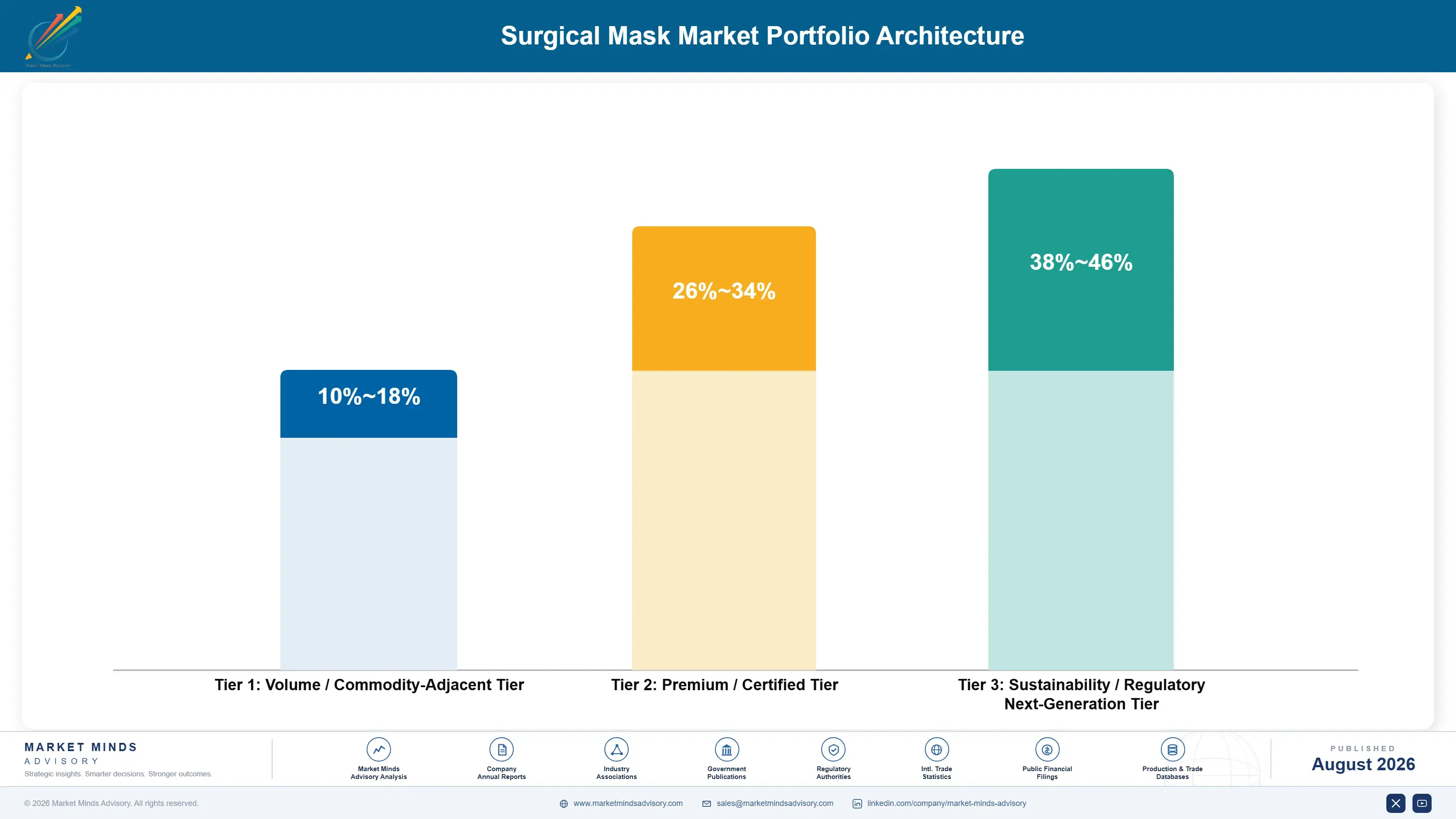
The portfolio splits into three tiers with real margin separation. Standard commodity masks compete purely on price against a globally oversupplied manufacturing base, earning thin margins defended almost entirely through production scale. Antimicrobial-treated and respirator-grade products earn substantially more because hospitals pay for documented clinical differentiation standard products alone cannot deliver. That gap widens as hospitals demand validated performance data before committing f
The tension between standard product volume and premium differentiated positioning shapes manufacturer strategy directly: standard products keep production lines running and build broad hospital relationships, but manufacturers that let standard volume crowd out differentiated technology investment risk losing the fastest-growing, highest-margin category to more capability-focused competitors. Manufacturers that manage this balance well capture both broad hospital presence and premium margin.

High-value pools concentrate overwhelmingly in antimicrobial-treated and respirator-grade products, where documented clinical performance reliability justifies premium economics few standard-product competitors can match. The emerging fabric-efficient design tier currently earns unevenly as manufacturers await broader hospital adoption confirmation ahead of the leading programmes, a gap that keeps widening as formulary requirements tighten further. That gap should widen further as formulary requirements expand across additional hospital networks broadly.

Volume / Commodity-Adjacent Tier

Standard surgical masks sold purely on price against a globally oversupplied manufacturing base to mainstream hospital and clinic customers broadly. Competitive pressure here concentrates on production efficiency and total cost of ownership.
Gross Margin: 8-18%

Premium / Certified Tier

Antimicrobial-treated and respirator-grade masks commanding premium pricing from hospitals prioritizing documented clinical performance, who pay durable premiums for validated data rather than risk infection-control failure. Vendor selection here increasingly hinges on documented clinical performance evidence.
Gross Margin: 28-42%

Sustainability / Regulatory / Next-Generation Tier

Fabric-efficient design and next-generation domestic manufacturing technology still absorbing development investment against developing commercial adoption, where manufacturers are betting capital on capability they expect hospitals and governments to demand broadly within several years.
Gross Margin: 6-32%
surgical-mask-market-portfolio-architecture-1787309127060

High-value Sub-segments and Strategic Watch-out

Hospital Antimicrobial Formulary Programmes

The field's highest current value and growth given surging infection-control differentiation demand, commanding durable premium pricing once formulary requirements force validated data decisions hospital-wide. Manufacturers slower to invest simply cannot secure these contracts once specifications tighten. Vendor selection here increasingly hinges on documented antimicrobial performance evidence.
Gross Margin: 30-42%

Government Resilience-Certified Domestic Production

High value with strong current growth as supply chain security-conscious governments expand procurement, priced above standard imports while remaining accessible to established public sector budgets. Adoption is broadening steadily beyond emergency stockpile programmes into routine procurement. Manufacturers with proven domestic capacity increasingly command favorable government scoring.
Gross Margin: 24-36%

Standard Commodity Surgical Masks

The volume core, sold purely on price to mainstream hospital and clinic customers, defended mainly through production scale and razor-thin per-unit margin discipline across facilities. Competitive pressure here concentrates on production efficiency rather than differentiation reshaping premium tiers. Facilities that fail to modernize gradually lose bidding competitiveness on large contracts.
Gross Margin: 8-18%

Pandemic-Era Overcapacity Production Lines

The strategic watch-out, facing continued utilization pressure as manufacturing capacity added during acute shortage periods now substantially exceeds normalized demand. Manufacturers dependent on this excess capacity should redirect investment toward differentiated technology steadily and consistently over time. This obsolescence pressure compounds quickly once competitors complete their own repurposing.
Gross Margin: 3-12%

How Mask Demand Actually Recurs

Demand here runs on continuous per-procedure consumption tied directly to a facility's clinical volume rather than periodic capital purchases. A hospital that standardizes on a manufacturer's mask line for its standard infection-control protocol typically maintains that relationship across thousands of annual clinical encounters, making a single formulary decision worth years of recurring consumable volume rather than a standalone transaction. That protocol-driven pattern gives manufacturers unu
Adoption depth varies sharply by facility tier. Leading academic medical centers pursuing aggressive infection-control differentiation integrate qualified antimicrobial products deeply into standardized clinical protocols once adopted, making manufacturer switching costly and rare absent a compelling performance or cost reason. Smaller community clinics, by contrast, evaluate manufacturers more flexibly based purely on cost and distributor relationships, creating more frequent switching opportunities between competing manufacturers.

Buyer profiles are shifting generationally as younger infection-control administrators, trained on data-driven procurement frameworks, increasingly treat documented antimicrobial performance as a baseline expectation rather than a differentiator requiring special justification. Older administrators trained primarily on pure cost-based purchasing are adapting more gradually, but that generational shift is accelerating as differentiation criteria expand across major hospital networks.
surgical-mask-market-end-use-penetration-index-1787309127546

Where Mask Manufacturer Value Concentrates Next

These are among the four positions where our research anticipates prominent divergence between winners and laggards over the coming forecast period. Each is grounded in the demand model, the regulatory perimeter, and the announced capacity pipeline.
01 / ANTIMICROBIAL TECHNOLOGY INVESTMENT

Build validated antimicrobial capability ahead of demand

Hospitals facing aggressive infection-control differentiation requirements need manufacturers ready to deliver validated antimicrobial performance data on schedule, and manufacturers investing ahead of confirmed demand capture the contract wave before competitors catch up. This is a genuine capability race with real consequences for companies that wait too long to commit development capital. Manufacturers moving decisively now will own the hospital relationships that differentiation-driven growth is about to make urgently valuable, especially as formulary criteria become standard across most major hospital systems.
02 / DOMESTIC MANUFACTURING DEPTH

Close the resilience gap before it becomes a category ceiling

Government supply chain resilience requirements genuinely cap how broadly import-dependent manufacturers can compete for public sector contracts, and manufacturers investing in domestic production capacity that closes this gap capture specifications competitors cannot serve credibly. This manufacturing investment differentiates beyond pure product pricing and reliability. Companies treating domestic capacity as secondary to raw production cost are underestimating how directly it determines total addressable government contract size, especially as resilience mandates expand broadly, especially as domestic sourcing mandates become standard across most major government procurement programmes.
03 / HOSPITAL CONTRACT BUNDLING

Build bundled relationships beyond single-category product supply

Large hospital systems increasingly seek PPE vendors who can bundle surgical masks with broader protective equipment product lines rather than negotiating each category separately, and manufacturers building this deeper bundling capability capture premium system-wide business single-category competitors cannot access. This bundling approach also builds genuine switching costs over time. Companies still selling purely on single-category price sheets are missing the relationship depth that increasingly determines premium account retention long-term across most hospital systems, especially as procurement committees consolidate vendor relationships across protective equipment categories broadly.
04 / NONWOVEN FABRIC SOURCING DIVERSIFICATION

Diversify sourcing before the next resin price cycle hits

Meltblown nonwoven fabric volatility is a persistent feature of a category dependent on petrochemical resin markets outside manufacturer control, and manufacturers still dependent on concentrated sourcing relationships remain exposed to margin compression every time resin markets move sharply. Diversifying sourcing now, rather than reactively after the next price spike, protects margin durably across multi-year hospital contracts. This is a defensive priority every manufacturer serving fixed-price contracts should treat as non-negotiable given how exposed unprotected margin becomes, given how exposed unprotected margin becomes across every major supply region.

Engagement Snapshot From the Field

A live engagement with an industry participant carrying material or product regulatory and market exposure ahead of a defining policy shift, showing how our research translates into a defensible multi-year portfolio strategy.
MARKET MINDS ADVISORY · CLIENT ENGAGEMENT SUMMARY
Surgical Mask Producer Strategic Portfolio Review and Transition Roadmap 2026·Investment Scenario on Surgical Mask Exposure Evaluation 2025-26
CLIENT PROFILE
A regional hospital network operating nine facilities approached MMA while evaluating a system-wide transition from standard commodity masks to antimicrobial-treated products ahead of an upcoming infection-control accreditation review. The client reported the transition represented roughly USD 2.1 million in projected annual mask spending once standardization completed, with none of the nine facilities using antimicrobial products at the outset (client-reported, unverified by MMA).
STRATEGIC CHALLENGE
Management needed to select a single manufacturer capable of supporting a nine-facility rollout ahead of the accreditation review date, without disrupting existing clinical protocols during the transition period the board had already scheduled publicly for the coming quarter. The board had already communicated the review deadline publicly to affiliated referring clinics.
MMA APPROACH
MMA benchmarked antimicrobial performance data and supply reliability across three qualified manufacturers against the network's specific accreditation requirements, modeled total cost of standardization including transition disruption risk, and assessed each manufacturer's track record supporting comparable-scale multi-facility rollouts elsewhere. We also interviewed facility infection-control coordinators to confirm real-world procurement constraints the quantitative model alone could not capture.
KEY FINDINGS
  1. Only two of three benchmarked manufacturers could credibly commit to a nine-facility rollout within the network's accreditation review timeline given production constraints.
  2. The mask cost differential across qualified manufacturers was meaningfully smaller than the network's initial internal estimate once volume-based pricing was properly negotiated against a system-wide commitment.
  3. One manufacturer's prior experience standardizing a comparably sized regional hospital network provided a proven rollout playbook that reduced projected transition risk considerably across all facilities.
  4. Phasing the rollout across two facility groups rather than all nine simultaneously reduced clinical disruption while preserving the original accreditation review timeline (client-reported, unverified by MMA).
CLIENT PROFILE
A regional hospital network operating nine facilities approached MMA while evaluating a system-wide transition from standard commodity masks to antimicrobial-treated products ahead of an upcoming infection-control accreditation review. The client reported the transition represented roughly USD 2.1 million in projected annual mask spending once standardization completed, with none of the nine facilities using antimicrobial products at the outset (client-reported, unverified by MMA).
STRATEGIC CHALLENGE
Management needed to select a single manufacturer capable of supporting a nine-facility rollout ahead of the accreditation review date, without disrupting existing clinical protocols during the transition period the board had already scheduled publicly for the coming quarter. The board had already communicated the review deadline publicly to affiliated referring clinics.
MMA APPROACH
MMA benchmarked antimicrobial performance data and supply reliability across three qualified manufacturers against the network's specific accreditation requirements, modeled total cost of standardization including transition disruption risk, and assessed each manufacturer's track record supporting comparable-scale multi-facility rollouts elsewhere. We also interviewed facility infection-control coordinators to confirm real-world procurement constraints the quantitative model alone could not capture.
KEY FINDINGS
  1. Only two of three benchmarked manufacturers could credibly commit to a nine-facility rollout within the network's accreditation review timeline given production constraints.
  2. The mask cost differential across qualified manufacturers was meaningfully smaller than the network's initial internal estimate once volume-based pricing was properly negotiated against a system-wide commitment.
  3. One manufacturer's prior experience standardizing a comparably sized regional hospital network provided a proven rollout playbook that reduced projected transition risk considerably across all facilities.
  4. Phasing the rollout across two facility groups rather than all nine simultaneously reduced clinical disruption while preserving the original accreditation review timeline (client-reported, unverified by MMA).
RECOMMENDED STRATEGY
Phase 1: Phase 1 (0 to 2 months): Finalize manufacturer selection and negotiate system-wide volume pricing terms with legal review. and finance sign-off before deployment begins. Phase 2: Phase 2 (2 to 5 months): Roll out antimicrobial masks across the first facility group with staff training sessions. and updated clinical documentation across all staff. Phase 3: Phase 3 (5 to 8 months): Complete rollout across the remaining facilities and formalize the differentiation protocol permanently. documenting variance for future budget cycles.
OUTCOME
The hospital network completed Phase 1 implementation on schedule, reporting that the phased rollout approach preserved its planned accreditation review timeline without disrupting existing clinical operations. The network also reported that negotiated volume pricing kept projected annual spending within its original budget (client-reported, unverified by MMA).

Frequently Asked Questions

Foundational context covering the market sizes, CAGR, scope, country, region and competition that inform every finding below. This section is provided to cover basics and most often pre-purchase conversations, answered from the MMA Primary Research Dataset.

What is the current size of the Surgical Mask Market?

The surgical mask market was valued at USD 8.2 billion in 2025. Growth is driven by routine infection control protocols, outpatient clinic volume growth, and antimicrobial technology adoption.

How large will the Surgical Mask Market be by 2036?

The market is projected to reach USD 12.89 billion by 2036 under the base case scenario. That reflects an expansion multiple of roughly 1.51 times the 2026 value.

What is the CAGR for the Surgical Mask Market 2026 to 2036?

The base case CAGR is 4.2%, with a bull case of 5.4% and a bear case of 2.9%. Antimicrobial technology adoption and overcapacity rationalization are the main swing factors.

Which segment is growing fastest?

Antimicrobial-treated surgical masks grow fastest at 7.8% CAGR, roughly 1.86 times the overall market rate. Respirator-grade surgical masks follow as the second-fastest segment at 6.5%.

Who are the major companies in the Surgical Mask Market?

Leading manufacturers include 3M, Honeywell, Kimberly-Clark, Cardinal Health, and Medline Industries, together holding a combined 28% share of the market. This reflects a consistent revenue basis across all five manufacturers.

Which country is growing fastest?

India is the fastest-growing country at 8.9% CAGR, driven by rapidly expanding hospital infrastructure. Private hospital chains and government insurance schemes both anchor that growth.

Report Segmentation Architecture

The full report scope spans multiple orthogonal segmentation dimensions, with cross-tabulated demand data provided for each dimension pair. Coverage extends further to regional breakdowns, trend trajectories, and the competitive detail needed to support segment-level decision-making.

By Mask Technology and Filtration Performance

  • Standard Surgical Masks
  • Fluid-Resistant Surgical Masks
  • Respirator-Grade Surgical Masks
  • Pediatric and Specialty-Fit Masks
  • Antimicrobial-Treated Masks
  • Surgical Masks with Integrated Face Shields

By End-Use Setting

  • Hospital Inpatient Departments
  • Outpatient and Dental Clinics
  • Academic Medical Centers
  • Long-Term Care Facilities

By Commercial Dimension

  • Direct Hospital Supply
  • Group Purchasing Organization Contracts
  • Distributor Channel
  • Government Procurement Contracts

By Region

  • North America
  • Western Europe
  • East Asia
  • South Asia and Pacific
  • Latin America
  • Middle East and Africa
  • Eastern Europe

Scope, Methodology, and Coverage

Every figure in this report is reproducible from documented input assumptions. The scope below maps the historical period, the forecast horizon, the segmentation dimensions, and the countries covered, alongside the underlying primary and qualitative methodology.
Historical Period
2020 to 2025
Forecast Period
2026 to 2036
Base Year
2025 (USD billions; MMA Primary Research Dataset, August 2026)
Market Definition
The surgical mask market comprises disposable and reusable masks worn by clinicians and patients to reduce airborne and droplet transmission during clinical procedures, including standard surgical masks, fluid-resistant masks, respirator-grade surgical masks, and antimicrobial-treated masks. Industrial respirators not cleared for surgical use, cloth face coverings, and general-purpose non-medical masks are excluded.
Quantitative Units
USD billions (current prices); unit volume where applicable
Segmentation Dimensions
By Mask Technology and Filtration Performance; By End-Use Setting; By Commercial Dimension; By Region
Regions Covered
North America, Western Europe, East Asia, South Asia and Pacific, Latin America, Middle East and Africa, Eastern Europe
Countries Covered
USA, China, Germany, France, UK, Switzerland, Japan, South Korea, India, Australia, Canada, Brazil, Mexico, Indonesia, Vietnam, Thailand, Malaysia, UAE, Saudi Arabia, South Africa, Nigeria, Turkey, Poland, Netherlands, Italy, Spain, Sweden, Argentina, Colombia, Singapore, and additional markets relevant to this sector
Key Companies Profiled
3M Company, Honeywell International Inc., Kimberly-Clark Corporation, Cardinal Health Inc., Medline Industries LP, Owens & Minor Inc., Ansell Limited, Molnlycke Health Care AB, Prestige Ameritech Ltd, Alpha Pro Tech Ltd, Winner Medical Group Inc., Lakeland Industries Inc., Makrite Industries Inc., DACH Schutzbekleidung GmbH, Suzhou Sunmed Biotech Co Ltd, Shanghai Dasheng Health Products Manufacture Co Ltd, Zhende Medical Co Ltd, Irema SA, Hakugen Earth Corporation, Uvex Safety Group GmbH
Quantitative Methodology
Primary survey, n=3,800 respondents, Q4 2025, six countries; demand-side model with trade association cross-validation
Qualitative Methodology
47 expert interviews, Q4 2025; applied to validate demand model assumptions, identify emerging dynamics, and assess competitive positioning
Report Format
PDF and XLSX data workbook (Word format preview document)
Publisher
Market Minds Advisory
Report Code
MMA-2026-MED-916
Published
August 2026
Contact
sales@marketmindsadvisory.com | www.marketmindsadvisory.com

Purchase the full Surgical Mask Market Report (2026 to 2036).

The full MMA Surgical Mask Market report sizes demand across six mask technology categories, four end-use settings, four commercial dimensions, and seven regions through 2036. It profiles twenty companies on a consistent revenue basis, scoring each on antimicrobial technology depth, domestic manufacturing footprint, and hospital contract bundling breadth. Scenario models quantify how differentiation adoption and overcapacity rationalization move both demand and realizable pricing. The report includes total cost of standardization modeling by mask category and a manufacturer qualification-readiness screen built for hospital procurement teams. It also benchmarks capacity utilization trends across major manufacturing regions to flag oversupply risk early.
Mask cost-curve modeling across major filtration technologies
Domestic manufacturing capacity tracking database by country
Antimicrobial and respirator-grade demand forecasts by region
Filtration and antimicrobial performance benchmarking across manufacturers
Nonwoven fabric cost exposure modeling by manufacturer scale
Differentiation demand scenarios under bull and bear cases

Built For The People Who Decide

From boardroom strategy to bench-side execution, this report is read cover-to-cover by leaders shaping the next decade of their industry, turning demand scenarios, market dynamics and valuation benchmarks into decisions.
CXOs/ Presidents/ VPs/ Managers
M&A and Corporate Development
Strategy Teams and R&D Heads
Procurement and Product Directors
Regulatory and Compliance Leaders
Investor Relations and Equity Analysts