Market Minds Advisory
Surgical Drainage Devices Market

Surgical Drainage Devices Market: Digital Thoracic Systems, Commodity Price Erosion and the Fight for Contract Position

An eleven-dollar drain decides nothing clinically until it fails, which is why hospitals buy on contract price while thoracic surgeons quietly pay ten times that for electronic suction they can actually measure.

Lead Analyst

Alice Ballenger

Published

September 2026

Make Smarter Decisions with Customized Research Insights

Request a free sample report and evaluate market opportunities, growth trends, and competitive dynamics relevant to your business needs.

2025 MARKET VALUE$2.1BMarket Size 2025
2036 FORECAST VALUE$3.7BBase Case , 2026 to 2036
CAGR 2026 TO 20365.4 %Bull 6.6% / Bear 4.2%
INCREMENTAL OPPORTUNITY$1.5BNet 10- year value creation
EXPANSION MULTIPLE1.69x2036 value over 2026 base
Strategic Levers
M&A Pipeline
Regional Outlook
Country Rankings
Competitive Intelligence
Segmental Deep-dive
Call-Us : 91 93563 13602

Executive Snapshot and Market Trajectory

Two products sit inside this category with almost nothing in common. A closed suction wound drain is an eleven-dollar commodity bought on contract price by a purchasing department. A digital chest drainage system costs several hundred dollars and is specified by the surgeon reading its air-leak data every morning.
Digital chest drainage systems compound at 8.1%, exactly 1.50 times the market, because measured air leak shortens the decision to remove a tube. East Asia holds 29% of global spend, the largest regional share, on surgical procedure volume rather than pricing. Average closed suction set pricing sits near USD 11.40 on hospital contract. Digital penetration of thoracic drainage reaches only 17%. Capital approval, not clinical argument, is what holds that number down.
Five suppliers account for 42% of unit shipments, which makes this considerably less concentrated than most surgical device categories. Position rests on hospital contract inclusion and distributor reach rather than on product differentiation, and Chinese manufacturing supplies 38% of global units, much of it under other companies' labels. Sterilisation capacity, not manufacturing capacity, has become the constraint that decides who can supply at all.
Market Definition
Covers devices that evacuate fluid or air from a surgical site or body cavity, including closed suction wound drainage systems, chest and thoracic drainage units, digital chest drainage systems, passive gravity drains, percutaneous and image-guided catheter drainage sets, and sump and irrigation drainage systems. Sizing is at hospital contract price for consumable devices and at acquisition price for reusable digital units. Excludes negative pressure wound therapy systems, urinary catheters and collection, surgical suction and smoke evacuation equipment, and drainage tubing supplied as part of dialysis or infusion circuits.
Base Year Value
$2.1B in 2025 (MMA Primary Research Dataset, August 2026)
Forecast Period
2026 to 2036, eleven discrete annual values
CAGR
5.4% base case. Bull 6.6%. Bear 4.2%.
Fastest Growth Segment
Digital Chest Drainage Systems: 8.1% CAGR
Fastest Growth Country
India: 8.2% CAGR
Fastest Growth Region
South Asia and Pacific: 7.6% CAGR
Largest Region
East Asia: 29% of 2025 global value
Market Leaders
Becton Dickinson, Teleflex, Medela, Cardinal Health, Redax. Source: MMA Analysis based on company annual reports.
Primary Survey
n=3,800 procurement and R&D decision-makers, Q4 2025, six countries
Methodology
Demand-side build-up, cross-validated against public data, 47 expert interviews

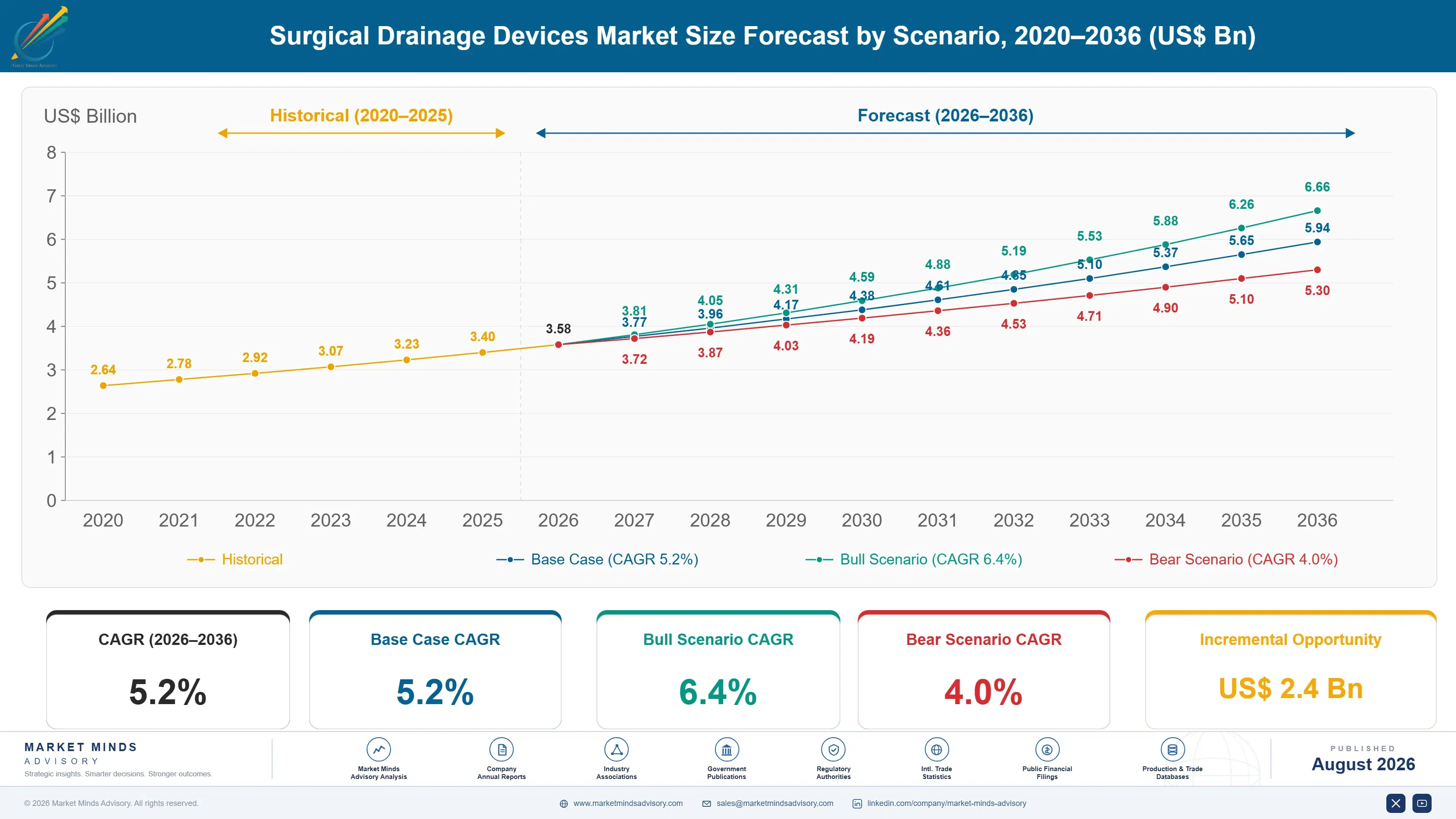
Surgical Drainage Devices Market Forecast Scenarios

surgical-drainage-devices-market-size-forecast-scenario-1787309363332
Growth of 4.3% across 2020 to 2025 was held back by clinical practice rather than by demand. Enhanced recovery protocols spread rapidly through colorectal, orthopaedic and hepatobiliary practice, and every implementation reduced both drains placed and days retained. Elective surgery suspension during 2020 removed a further block of volume. Digital chest drainage and negative pressure incision systems were the only genuinely growing product classes.
The base case of 5.2% rests on three mechanisms. Digital chest drainage keeps converting from analogue water seal systems because electronic air leak measurement supports earlier tube removal, which is exactly what thoracic teams want. Negative pressure incision management is spreading to high-risk closures where surgical site infection cost justifies a premium device. And Asian and Indian surgical volume growth outruns the per-case reduction that recovery protocols keep producing everywhere else.
The bull case of 6.4% assumes negative pressure incision systems achieve broad guideline recommendation for high-risk closures, which would convert a selective premium product into routine practice. The bear case of 4.0% reflects two pressures: recovery protocols eliminating drains faster than surgical volume grows, and Chinese and Indian manufacturers extending price competition from conventional drains into digital chest systems.

Where an Eleven-Dollar Device Still Earns Something

Most of this category is a commodity and everybody involved knows it. A closed suction set is silicone tubing, a perforated catheter, a bulb and a connector, built to a specification barely changed in thirty years. Hospitals buy on price through group purchasing agreements, and the winner wins on contract position, delivery reliability and holding price for three years. Clinical preference barely registers, because a surgeon who has used four brands cannot tell them apart at all.
TOP FIVE CONCENTRATION42%Unit shipments held by the leading device suppliers
CLOSED SUCTION SET PRICEUSD 11.40Typical hospital contract price per complete drainage set
CHINA OUTPUT SHARE38%Global unit production coming from Chinese manufacturing sites
DIGITAL CHEST PENETRATION17%Thoracic drainage cases using regulated electronic suction units
SILICONE COST SHARE24%Medical grade polymer share of delivered product cost
PROCEDURE ATTACHMENT RATE0.9 per caseAverage drains placed per qualifying surgical procedure performed
The exception is thoracic drainage, and it is a genuine exception rather than a marketing distinction. A digital unit measures air leak quantitatively instead of leaving a resident to judge bubbling by eye, and that shortens the argument about removing a chest tube. Length of stay follows. Surgeons therefore specify these units directly, which is the only place in the category where clinical preference overrides contract price.
Two forces will shape the next decade. Enhanced recovery protocols continue removing drains from procedures where evidence never supported them, which subtracts commodity volume permanently. And sterilisation capacity constraints following tighter ethylene oxide emission rules have made supply reliability a competitive variable in a category that had treated it as a given.
"This category has spent twenty years being told it is a commodity, and for four-fifths of the volume that is simply true. What nobody expected is that the interesting margin would show up in thoracic drainage, where a surgeon reading a number off a screen at seven in the morning is worth more to a supplier than any purchasing committee. Measurement created a premium product out of a plastic box."
Director, Surgical Consumables and Hospital Supply Practice · MMA Medical Device

Market Trends

Digital chest drainage converts a consumable into a measured device

Traditional water-seal chest drainage leaves air leak assessment to visual judgement, which varies between observers and between shifts. Digital units apply regulated suction and report leak volume numerically, and published thoracic surgery series have shown chest tube duration falling by roughly a day where they are used routinely. That day is worth considerably more than the device costs. Penetration remains at 17% of thoracic drainage, held back by capital acquisition rather than by clinical doubt, which is why several suppliers now place units free against consumable commitments. Capital approval is the whole barrier.
Market Impact: Adds around 30% resection volume
Enhanced recovery protocols remove drains from established procedures

Enhanced recovery after surgery programmes have systematically questioned interventions that were never supported by evidence, and prophylactic drainage has come out badly in that review. Colorectal, breast and several orthopaedic procedures now routinely proceed without a drain where one was standard a decade ago. Attachment rates have fallen to roughly 0.9 drains per qualifying procedure and continue drifting down. Suppliers cannot argue against the evidence and mostly do not try. The commercial response has been to concentrate on procedures where drainage remains clinically necessary rather than customary. That volume does not come back.
Market Impact: Grows catheter volume at 7.0% yearl

Market Opportunities and Growth Drivers

Thoracic surgery volume growth outpaces general procedure growth

Lung cancer screening programmes across the United States, Japan, Korea and increasingly China are detecting resectable disease at earlier stages, which converts inoperable presentations into surgical ones. Every anatomical lung resection needs chest drainage, and video-assisted and robotic approaches have not changed that. Screening-driven resection volume has grown by roughly 30% across the largest programmes since 2019. That growth lands squarely in the highest-value part of the category, which matters more than the volume itself does. Japanese and Korean screening programmes are the most established, and Chinese provincial programmes are scaling fastest from a much larger population base.
Market Impact: Erodes commodity pricing near 3% an

Image-guided percutaneous drainage replaces open surgical washout

Abscesses and collections that once required a return to theatre are now drained percutaneously under computed tomography or ultrasound guidance by interventional radiology. That shift moves the procedure out of the operating room and the device purchase out of surgical supply into radiology, which is a different budget and often a different distributor. Percutaneous drainage catheter volume grows at 7.0% against 5.4% for the category, and interventional radiology departments specify on catheter performance rather than on contract price. Suppliers organised around theatre contracts alone reach almost none of that growth, which has left specialist catheter companies holding it.
Market Impact: Extends lead times near 6 weeks

Market Restraints and Challenges

Group purchasing contracts compress commodity drainage pricing

Closed suction drainage is tendered through group purchasing organisations and national frameworks on three-year cycles, and the root cause of price erosion is that nothing distinguishes the bids. Specifications are functionally identical, so award goes to price and supply reliability alone. Chinese and Indian manufacturers with lower cost bases have taken contract positions steadily, and incumbents have responded by holding price rather than defending share. Mitigation runs through bundling commodity drains with higher-value thoracic or catheter products in a single agreement, which is the only lever that reliably changes the conversation.
Market Impact: Cuts tube duration by 1 day

Ethylene oxide sterilisation rules constrain available capacity

Silicone drainage devices are predominantly sterilised with ethylene oxide, and tightened EPA emission standards have forced contract sterilisation facilities to install controls or close. The root cause is regulatory rather than commercial: several facilities serving medical device volume shut rather than invest. Available capacity tightened noticeably across North America, and lead times extended for suppliers without contracted allocation. Participants are responding by qualifying radiation sterilisation where materials permit, contracting capacity years ahead, and in two cases building owned sterilisation rather than relying on the merchant market. None of those options is quick.
Market Impact: Drops attachment rate to 0.9 drains
3 additional market trends, 4 additional growth drivers, and 2 additional restraints and challenges are covered in the full report. Contact sales@marketmindsadvisory.com to access the complete intelligence.

Segment CAGR and Growth Architecture

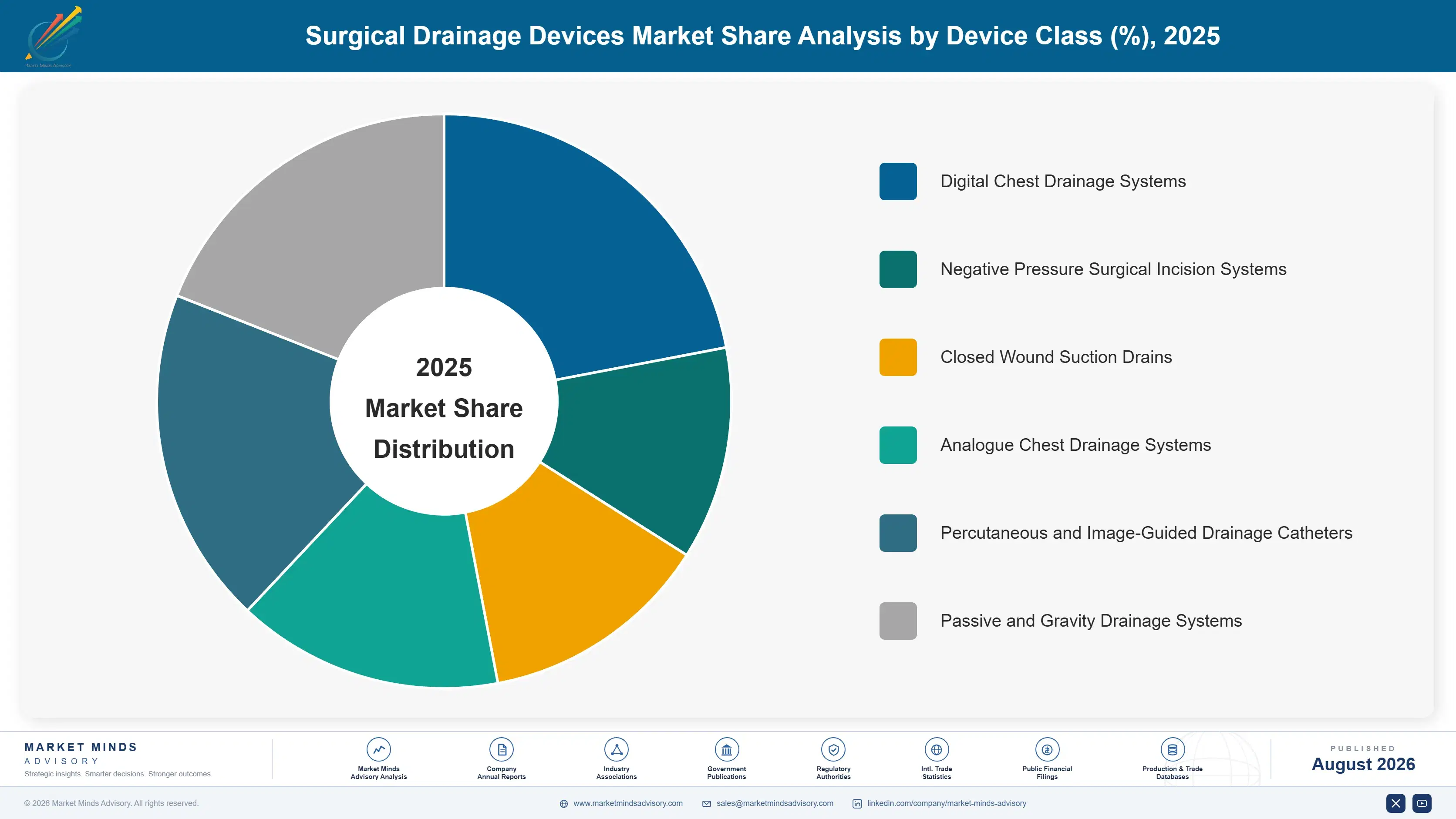
Segmentation follows the drainage device itself, since the device type determines the regulatory pathway, the clinical specifier and whether price or performance decides the sale. Care setting and procurement route matter commercially but cut across every device type, so they belong in later discussion. Six device classes cover the category without overlap between them.
surgical-drainage-devices-market-market-share-analysis-1787309363860

Digital Chest Drainage Systems

Electronic units applying regulated suction and reporting air leak numerically grow at 8.1%, exactly 1.50 times the market rate. This is the only part of the category where a surgeon rather than a purchasing department decides the purchase. Quantified leak measurement shortens chest tube duration by roughly a day in published series, and length of stay follows, which makes the clinical case straightforward at any institution counting bed days. Penetration sits at 17% of thoracic drainage and the barrier is capital acquisition rather than evidence. Several suppliers now place units without charge against multi-year consumable commitments, which converts a capital request into an operating line and removes the obstacle entirely.
CAGR 8.1%

Percutaneous and Image-Guided Catheter Drainage Sets

Catheter sets for computed tomography and ultrasound-guided drainage of abscesses and collections grow at 7.0%, ahead of the category and well ahead of commodity wound drainage. The clinical shift behind it is genuine: collections that once meant a return to theatre are now managed by interventional radiology in an imaging suite. Commercially the important consequence is that the buyer changes. Interventional radiology specifies on catheter stiffness, pigtail retention and locking reliability, and it procures through a different budget and frequently a different distributor than surgical supply. Suppliers organised solely around operating theatre contracts reach this growth poorly, which has left room for specialist catheter companies. Reaching it means calling on a department most drainage suppliers have never visited.
CAGR 7.0%
Full segment breakdown across 6 segments available in the complete report.

Regional Architecture and Country Demand Map

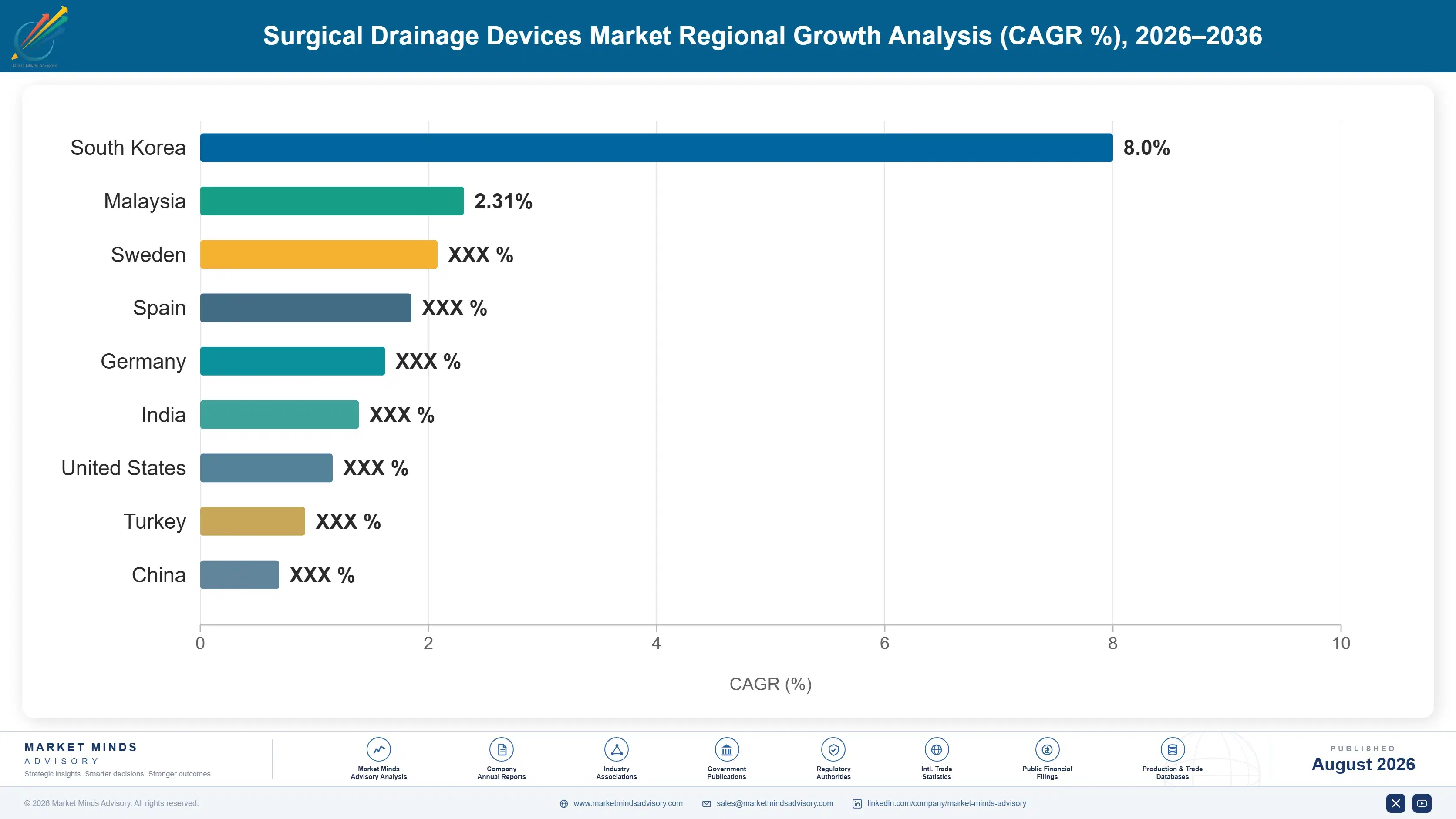
East Asia leads at 29% of global spend on surgical procedure volume rather than pricing, with Chinese case numbers and Japanese thoracic practice both contributing. North America follows at 27% on price. South Asia and Pacific grows fastest, led by India at 8.2%. Eastern Europe trails badly.

North America

Twenty-seven percent of global spend sits in North America, growing at 4.6%, and the position comes from device pricing rather than from procedure volume. Group purchasing organisations and integrated delivery networks tender commodity drainage on three-year cycles against functionally identical specifications, which has driven steady price erosion while preserving the highest absolute price levels anywhere. Digital chest drainage penetration is the highest of any region, helped by thoracic programmes that count bed days closely and by lung cancer screening feeding resection volume. Ethylene oxide sterilisation constraints have bitten hardest here following tightened EPA emission standards, and suppliers without contracted sterilisation allocation lost contract positions they had held for years. Reliability now scores alongside price.
Share: 27% | CAGR: 4.6% (2026 to 2036)

Western Europe

Growth of 3.7% is the slowest anywhere, and 21% of spend reflects mature procedure volume with aggressive public tendering. National frameworks in the United Kingdom, regional tenders across Italy and Spain and hospital buying groups in Germany all award commodity drainage on price against identical specifications. Enhanced recovery protocols were adopted here earlier and more thoroughly than in most regions, which has removed drains from more procedures and shows in the growth rate. Thoracic practice is strong, with Italian and German centres among the earliest adopters of digital chest drainage and Redax supplying much of it from Italian manufacturing. Medical device regulation has also raised the cost of maintaining older product registrations.
Share: 21% | CAGR: 3.7% (2026 to 2036)
Regional intelligence for 5 additional markets available in the complete report: East Asia, South Asia and Pacific, Latin America, Middle East and Africa, Eastern Europe. Contact sales@marketmindsadvisory.com.
surgical-drainage-devices-market-country-cagr-analysis-1787309364373

Four Ways Out of Pure Price Competition

Four-fifths of this category is tendered on price against identical specifications, and no amount of product development changes that. What does change it is bundling, buyer selection and removing the capital barrier on the one product surgeons genuinely care about. Each lever below has been executed commercially, with returns MMA has tested against disclosed segment economics.

Place digital units free against consumable commitment

Digital chest drainage penetration sits at 17% and the barrier is a capital request, not clinical doubt. Placing units at no acquisition cost against a three-year consumable commitment converts that capital request into an operating line item nobody has to defend. Suppliers using this model report placement rates roughly three times higher than capital sales achieve, with consumable margin over the contract term exceeding what an outright unit sale would have earned. It consumes working capital and requires the discipline to walk away from thin commitments. Thin commitments are how this model fails.
Market Impact: Triples unit placement over outrigh

Bundle commodity drains with thoracic and catheter lines

A commodity drainage tender awarded on price alone is unwinnable at Western cost. Bundling it into a single agreement covering thoracic drainage and percutaneous catheters changes what the committee is evaluating, because those products carry clinical preference the commodity line does not. Suppliers negotiating bundled agreements retain commodity volume at roughly 8% higher realised pricing than standalone tenders deliver. The requirement is a portfolio broad enough to bundle, which is precisely why the specialists and the diversified suppliers behave so differently here. Specialists cannot bundle, and the diversified suppliers can, which explains most tender outcomes in this category.
Market Impact: Holds commodity contract pricing ro

Sell percutaneous catheters to radiology, not surgery

Image-guided drainage grows at 7.0% and it is bought by interventional radiology on catheter performance rather than by surgical supply on contract price. Suppliers organised entirely around operating theatre contracts reach it badly, and several have never called on a radiology department at all. Building that channel means a different clinical conversation and frequently a different distributor, but the pricing environment is materially better because specification actually matters. Realised margin on radiology-specified catheters runs roughly 20 points above commodity surgical drainage. The catheters themselves need no development work. Distribution is the work.
Market Impact: Earns roughly 20 points of extra re

Contract sterilisation capacity years ahead of need

Tightened ethylene oxide emission standards closed merchant sterilisation capacity, and suppliers without contracted allocation saw lead times extend by around 6 weeks and lost contract positions as a result. Contracting capacity three or more years forward, or qualifying radiation sterilisation where silicone formulation permits, converts a supply vulnerability into a competitive advantage during the next constraint. Two participants have built owned sterilisation outright. In a category where tender award weighs supply reliability alongside price, that reliability is now worth paying for. Multi-year capacity typically costs 10% above spot rates. Award scoring recovers it.
Market Impact: Removes near 6 weeks of lead time r

Who Controls the Margin Pool

Five suppliers hold 42% of unit shipments, the basis on which MMA assesses every participant here, and that leaves this considerably more fragmented than most surgical device categories. Becton Dickinson and Teleflex lead on breadth and contract reach. Medela and Redax hold disproportionate positions in digital thoracic drainage, where product actually differentiates.
Competitive activity runs along three lines. Contract bundling is the primary commercial weapon, since commodity drainage cannot be won on price against Asian cost bases. Digital chest drainage placement models are being reworked toward consumable commitments rather than capital sales. And sterilisation capacity has become a competitive input rather than an operational detail, with suppliers holding contracted allocation winning tenders on reliability alone.

Pressure is arriving from two directions. Asian manufacturers that built their positions as contract suppliers are moving into branded contract bidding directly, which removes the margin layer Western incumbents were taking. And enhanced recovery protocols keep subtracting commodity volume that nobody can win back. Rankings shift toward suppliers with thoracic and catheter positions, because that is where clinical preference still overrides price and where volume is growing rather than shrinking.
surgical-drainage-devices-market-company-positioning-matrix-1787309364883

Competitive Moat and Risk Dimensions

BECTON DICKINSON

Moat: Contract breadth across hospital supply

The company reaches nearly every hospital purchasing agreement in developed markets across a portfolio far wider than drainage, which lets it bundle commodity drains into agreements decided on other products entirely. Distribution reliability and the ability to hold price across a three-year term matter more than product attributes in this category, and few competitors can match either at scale.
BECTON DICKINSON

Risk: Limited digital thoracic position

The fastest growing part of the category is specified by thoracic surgeons on measurement capability, and the company's position there is weaker than its overall scale suggests. Medela and Redax built that ground through focus. Competing on portfolio breadth does not help where a single surgeon decides, and building the clinical relationship required is slow work at any scale.
TELEFLEX

Moat: Interventional catheter capability

Percutaneous and image-guided drainage catheters draw on the same design and manufacturing capability as the company's broader interventional portfolio, and it already sells into interventional radiology rather than only into surgical supply. That channel position reaches the segment growing at 7.0% with an existing clinical conversation, which competitors organised around theatre contracts cannot easily replicate.
TELEFLEX

Risk: Commodity exposure without cost position

A meaningful share of drainage revenue sits in commodity wound drainage tendered purely on price, where Asian manufacturers hold cost positions the company cannot approach. Defending that volume erodes margin and abandoning it removes the bundling weight that helps elsewhere. Neither option is attractive, and the decision is being made by tender outcomes rather than by strategy.

Players Tracked

Prominent Players

Becton Dickinson
Teleflex
Medela
Cardinal Health
Redax

Other Key Players

ConvaTec
Cook Medical
Argon Medical Devices
Merit Medical Systems
Getinge
Rocket Medical
Sterimed Group
Romsons Group
Angiplast
Degania Silicone
pfm medical
Wellead Medical
Zhejiang Kindly Medical Devices
Poly Medicure
Bicakcilar

Recent Developments

MARCH 2025

Medela expanded digital chest drainage manufacturing capacity in Switzerland

The company commissioned additional assembly and testing capacity for electronic thoracic drainage units, supporting placement programmes that supply hardware against consumable commitments. It was an organic capacity expansion rather than an acquisition or partnership, and it signals confidence that placement volume will keep rising. Volumes were not disclosed.
Signal: Placement models consume far more hardware
SEPTEMBER 2025

Teleflex acquired a percutaneous drainage catheter product line

The transaction brought a specialist locking pigtail catheter range and its interventional radiology account relationships into the company's portfolio. Terms were not disclosed. It was an asset acquisition rather than a corporate merger or joint venture, targeting the fastest growing catheter segment rather than additional commodity volume.
Signal: Buying radiology account access is faster
JANUARY 2026

Becton Dickinson completed sterilisation capacity relocation ahead of emission deadlines

The company shifted ethylene oxide sterilisation volume to facilities with installed emission controls, ahead of compliance deadlines under tightened EPA standards. It was an internal operational change rather than a transaction, and it removes an exposure that cost several competitors contract positions during the capacity squeeze.
Signal: Sterilisation reliability now decides tend

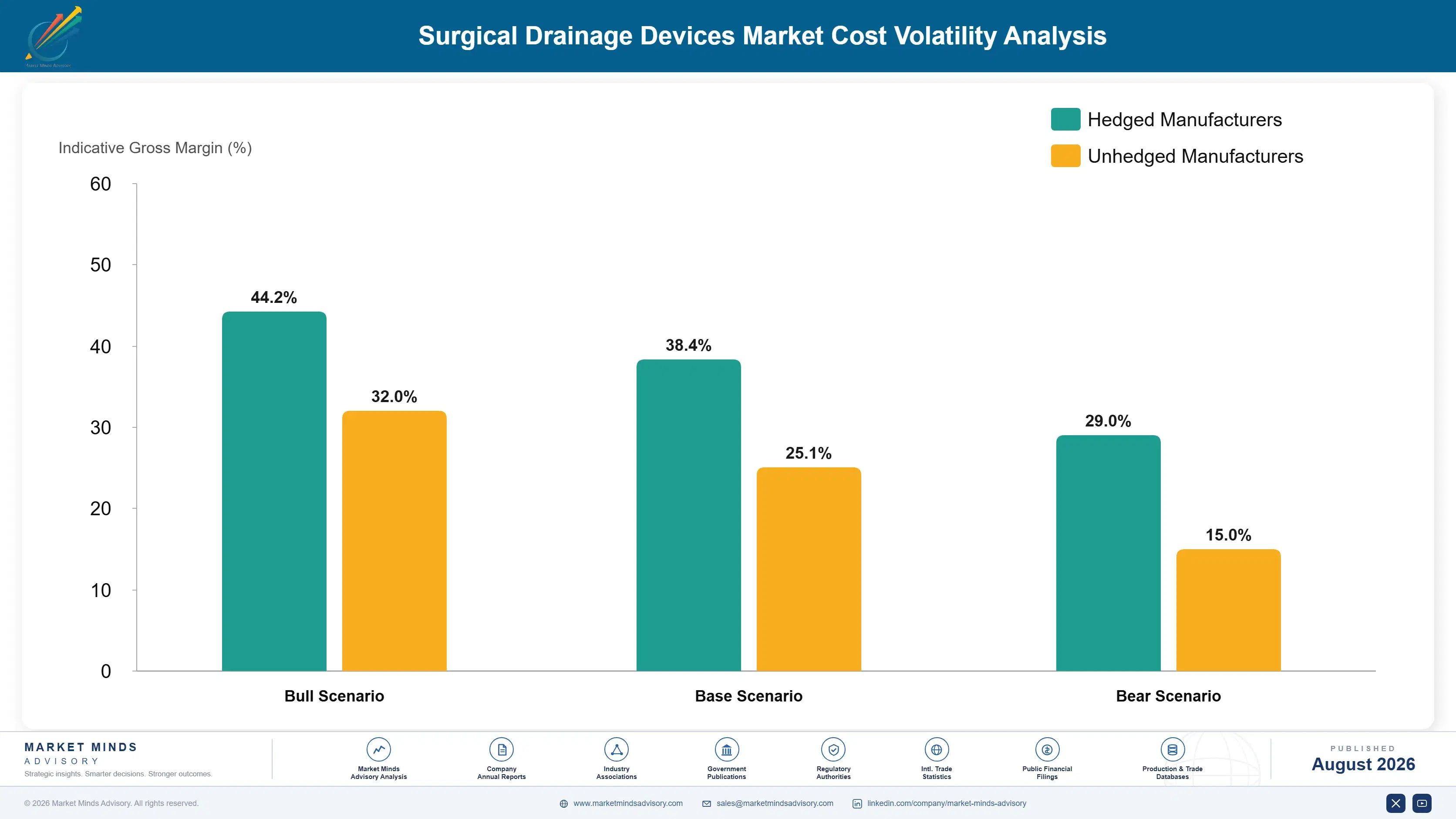
Silicone, Sterilisation and Freight

Medical-grade silicone and polyvinyl chloride together account for roughly 24% of delivered product cost, supplied from a short list of qualified compounders in the United States, Germany, Japan and increasingly China. Contract sterilisation adds another 9%, ethylene oxide for most silicone devices and radiation where formulation permits. Packaging, labelling and validation documentation contribute 8%. Outbound freight matters more than it sounds for a bulky, low-value product.
Tightened ethylene oxide emission standards demonstrated how fast a services input can become a hard constraint. EPA rules issued in 2024 required merchant sterilisation facilities to install controls, and several closed instead of investing. Available North American capacity tightened and lead times extended by around six weeks for suppliers without contracted allocation. The commercial impact was availability rather than cost: tenders were lost on delivery commitments, and two suppliers exited lines they could no longer sterilise.

Exposure varies by supplier scale and sterilisation strategy, and the mechanism is allocation priority. Suppliers with contracted multi-year sterilisation capacity, or owned facilities, kept supplying through the squeeze and won tenders on reliability. Those buying spot were rationed behind larger customers. Asian manufacturers with domestic sterilisation faced none of it, widening a cost advantage into a reliability advantage.
surgical-drainage-devices-market-cost-volatility-analysis-1787309365078

Qualify radiation sterilisation where silicone formulation permits

Ethylene oxide is used partly by habit rather than necessity, and several drainage device formulations tolerate electron beam or gamma sterilisation with modest reformulation. Qualifying a second modality removes dependence on a constrained merchant market entirely. The work costs validation time and regulatory notification, and suppliers that completed it before 2024 were the ones still shipping through the squeeze.

Contract sterilisation capacity on multi-year terms

Spot merchant sterilisation leaves a supplier rationed behind whoever holds contracted volume, which is how contract positions were lost during the recent capacity tightening. Multi-year capacity agreements cost a premium over spot rates and convert an availability risk into a known cost. Tender scoring increasingly weighs supply reliability, so that premium is recoverable in award outcomes rather than purely absorbed.

Manufacture regionally to cut freight on bulky product

A drainage set is mostly air by volume, which makes ocean freight a meaningful share of delivered cost and container rate volatility a real exposure. Regional assembly near demand cuts that and shortens lead times, which tender scoring rewards. The trade-off is lower utilisation across more sites, so it works where regional volume genuinely supports a line.

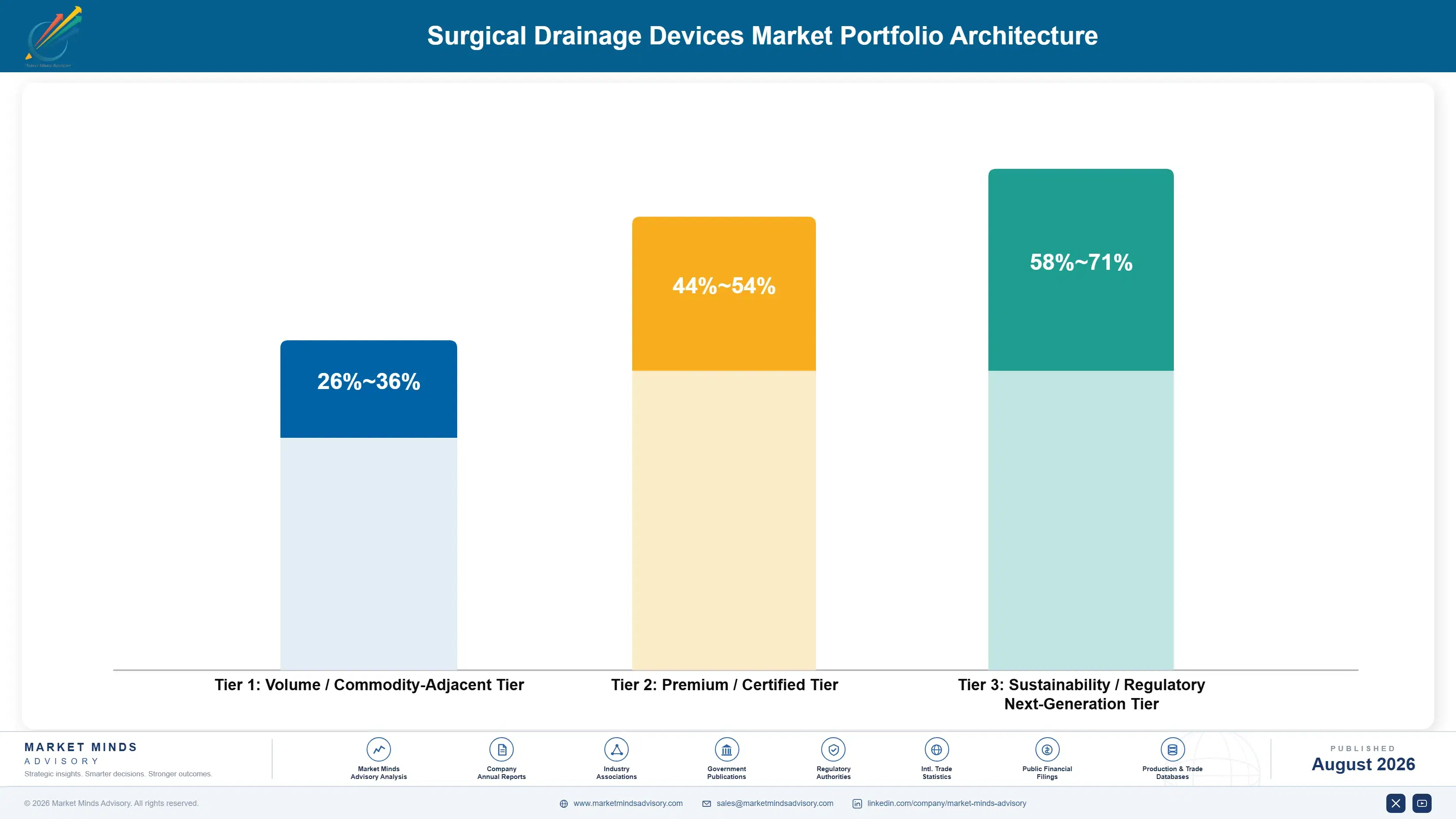
Portfolio Architecture for Margin Defence

Portfolio economics here separate almost entirely on who specifies the product. Commodity wound drainage tendered on price earns gross margin in the mid twenties at Western cost, less where Asian manufacturers set the award price. Percutaneous catheters specified by interventional radiology on performance earn considerably more, because the buyer is comparing catheters rather than prices. Digital chest drainage consumables sit highest of all, protected by the placed hardware they run on.
The tension is that commodity volume funds the contract relationship while specialty products fund the company. A supplier holding a large commodity position has bundling weight that specialty-only competitors lack, and that weight wins agreements. Abandoning commodity drainage to protect margin therefore costs more than the margin recovered, which is why the diversified suppliers keep bidding volume they earn almost nothing on. It is an uncomfortable position and a rational one.

High-value pools concentrate in three places: digital thoracic consumables tied to placed hardware, radiology-specified drainage catheters, and Gulf and Japanese markets where specification levels stay high without tender price compression. None is large in units. Each is defended by clinical preference rather than by cost position. Volume alone will not find any of them.

Volume / Commodity-Adjacent Tier

Closed suction wound drainage sets, passive gravity drains and basic chest drainage units tendered on price against functionally identical specifications. Award goes to cost position and delivery reliability, and Asian manufacturing sets the reference price in most markets.
Gross Margin: 22-28%

Premium / Certified Tier

Percutaneous and image-guided drainage catheters specified by interventional radiology on performance attributes, plus sump and irrigation systems for complex cases. Margin comes from specification mattering to the buyer, and the nine-point range reflects wide variation between tendered and specialist-account pricing.
Gross Margin: 44-53%

Sustainability / Regulatory / Next-Generation Tier

Digital chest drainage consumables running on placed hardware, together with reduced-polymer and recyclable packaging formats that European procurement increasingly scores. The twelve-point range reflects the gap between mature digital consumables and sustainability formats still carrying development cost.
Gross Margin: 56-68%
surgical-drainage-devices-market-portfolio-architecture-1787309365569

High-value Sub-segments and Strategic Watch-out

Digital thoracic drainage consumables

The highest-margin pool in the category and the only one where a surgeon specifies rather than a committee, protected by the placed hardware each consumable runs on. Growth follows placement volume directly. Working capital is the constraint, not clinical acceptance or competitive pressure. Working capital decides the pace.
Gross Margin: 58-68%

Radiology-specified drainage catheters

Growing at 7.0% and priced on catheter performance rather than contract position, which makes it the best pricing environment in the category. Reaching it needs a radiology channel most surgical suppliers never built. Specialist catheter companies currently hold disproportionate share here. Channel access is the only barrier here.
Gross Margin: 44-53%

Commodity closed suction drainage

Still the largest segment by units and by revenue, growing slowly and losing roughly three points of price annually to Asian cost positions. It earns very little and provides the bundling weight that wins agreements. Abandoning it costs more than it saves. Exiting costs more than staying.
Gross Margin: 22-28%

Enhanced recovery protocol displacement

Procedures where evidence has removed prophylactic drainage entirely, notably colorectal, breast and several orthopaedic operations. It reads as a clinical improvement rather than a commercial event. Every protocol adoption permanently removes volume no supplier can win back through any commercial effort. Nothing commercial reverses a protocol.
Gross Margin: 0-5%

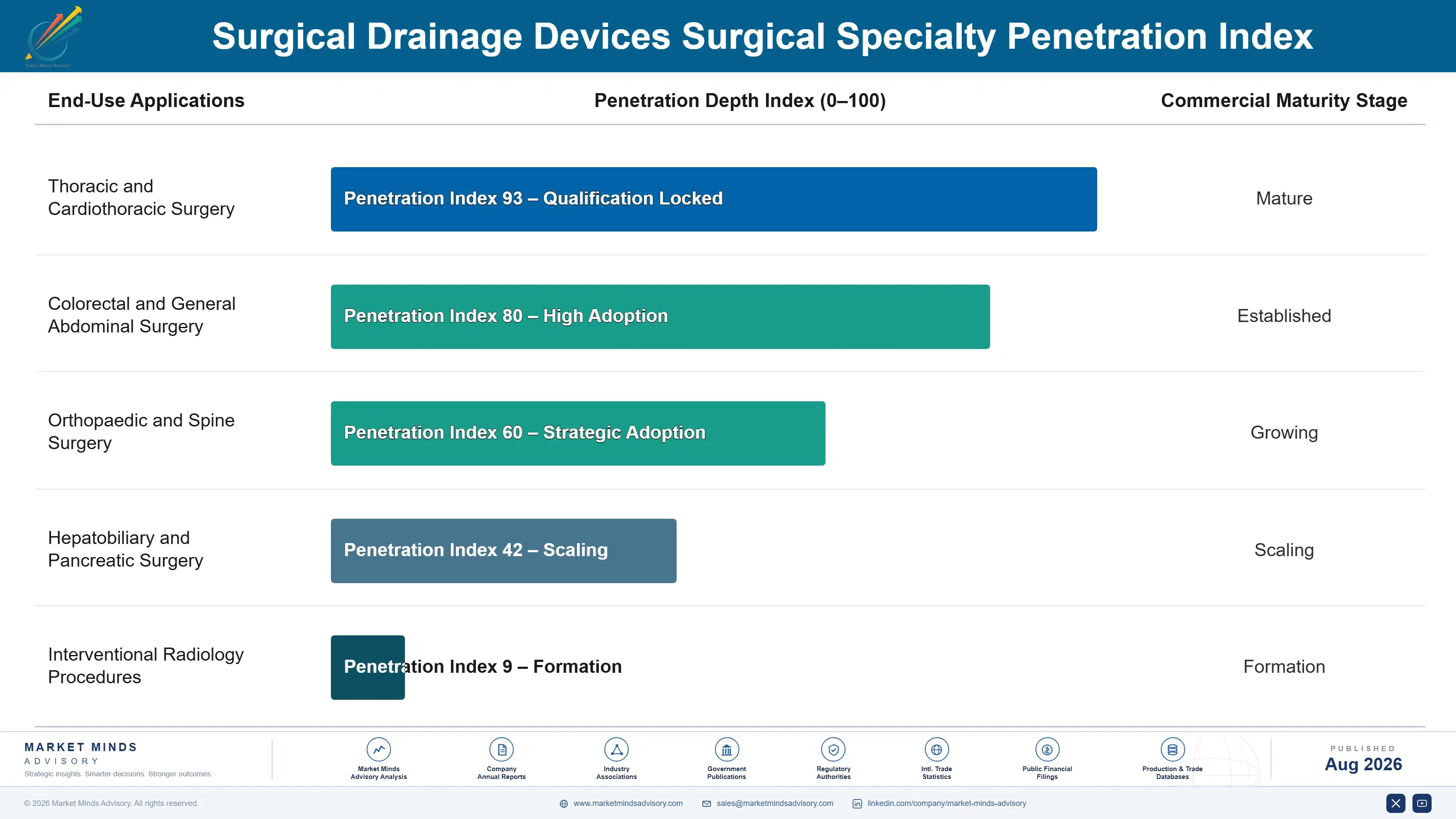
How Drainage Demand Actually Repeats

This is consumable demand tied to procedure volume, which makes it as close to an annuity as surgical supply gets. Every qualifying operation consumes a drain, at an attachment rate near 0.9 per case, and no marketing effort triggers or suppresses that. What varies is contract position: a supplier on the agreement receives that volume automatically, and a supplier off it receives none regardless of quality. Digital drainage differs again, since placed hardware locks consumable supply for the ter
Adoption depth varies sharply by clinical service. Thoracic surgery adopts digital drainage deepest where bed days are counted, and barely at all where they are not. Interventional radiology specifies catheters closely and switches on performance. General surgery is nearly indifferent between commodity brands and defers entirely to purchasing. Enhanced recovery programmes have removed drains outright from several services, and that runs deepest in Western European and Australian systems where compliance is audited.

Buyer profiles are shifting in a way that favours specification over price, though slowly. Thoracic surgeons trained in the last decade expect quantified air leak data and treat water-seal systems as guesswork. Their predecessors judged bubbling by eye for thirty years and consider the electronics unnecessary.
surgical-drainage-devices-market-end-use-penetration-index-1787309366056

What We Would Do Here

These are among the four positions where our research anticipates prominent divergence between winners and laggards over the coming forecast period. Each is grounded in the demand model, the regulatory perimeter, and the announced capacity pipeline.
01 / DIGITAL PLACEMENT ECONOMICS

Place thoracic hardware free and sell the consumable

Digital chest drainage penetration sits at 17% and the obstacle is a capital request nobody in the hospital wants to defend, not any clinical doubt about measured air leak. Placement against three-year consumable commitments raises unit deployment roughly three times over capital sales while earning more across the term. It consumes working capital and demands the discipline to decline thin commitments, which is where most suppliers running this model actually fail, since a placement against weak consumable volume is simply a donated unit.
02 / BUNDLED TENDER CONSTRUCTION

Never bid commodity drainage as a standalone line

Commodity wound drainage tendered alone against Asian cost positions is unwinnable at Western manufacturing cost, and bidding it that way simply donates margin. Bundled agreements covering thoracic drainage and percutaneous catheters retain commodity volume at roughly 8% higher realised pricing, because the committee is then weighing products where clinical preference exists. Suppliers without a portfolio broad enough to bundle should be exiting commodity tenders rather than defending them, because there is no cost programme that reaches Asian bid pricing from a Western base.
03 / RADIOLOGY CHANNEL BUILDING

Call on interventional radiology, not only surgical supply

Image-guided drainage compounds at 7.0% and is specified on catheter performance, which produces margin roughly 20 points above commodity surgical drainage. Suppliers organised entirely around operating theatre contracts have frequently never called on a radiology department, and they are consequently missing the best pricing environment anywhere in the category. Building that channel means a different clinical conversation and often a different distributor, and it is considerably cheaper than defending commodity share against manufacturers who will always undercut it on price alone.
04 / STERILISATION SUPPLY SECURITY

Contract sterilisation capacity before the next squeeze

Tightened ethylene oxide emission standards closed merchant capacity and extended lead times around six weeks for suppliers buying spot, which cost several of them contract positions outright. Multi-year capacity agreements and qualified radiation alternatives convert that vulnerability into a reliability advantage tender scoring now rewards. Suppliers still treating sterilisation as an operational detail are one regulatory cycle away from losing awards they have held for years, and the capacity that prevents it has to be contracted long before anybody needs it.

Engagement Snapshot From the Field

A live engagement with an industry participant carrying material or product regulatory and market exposure ahead of a defining policy shift, showing how our research translates into a defensible multi-year portfolio strategy.
MARKET MINDS ADVISORY · CLIENT ENGAGEMENT SUMMARY
Surgical Drainage Devices Producer Strategic Portfolio Review and Transition Roadmap 2026·Investment Scenario on Surgical Drainage Devices Exposure Evaluation 2025-26
CLIENT PROFILE
A Western European manufacturer of surgical drainage and wound consumables with revenue near EUR 180 million annually (client-reported, unverified by MMA), owned silicone extrusion and assembly across two sites, and contract positions on national frameworks in four countries. Roughly 78% of drainage revenue came from commodity closed suction sets, with a small thoracic range and no percutaneous catheter presence at all.
STRATEGIC CHALLENGE
The company had lost three national framework renewals in two years to Asian and Turkish bidders, and management proposed automating extrusion further to close the cost gap. The board was unconvinced that additional capital would ever reach Chinese cost levels. Nobody had examined whether the thoracic and catheter opportunities were reachable with the sales organisation already in place.
MMA APPROACH
MMA benchmarked the client's delivered cost against Asian and Turkish bid pricing across the four lost tenders, then modelled contribution by device class with sterilisation and freight allocated properly rather than averaged. Forty-seven expert interviews across thoracic surgeons, interventional radiologists and hospital procurement leads established who specified what, and on what basis. Existing regulatory registrations were catalogued against the percutaneous catheter requirement.
KEY FINDINGS
  1. No achievable level of extrusion automation closed the gap to Asian bid pricing, because the difference sat in labour, sterilisation and freight rather than in the extrusion step management had focused on.
  2. The client's thoracic range was clinically competitive but sold through the same purchasing contacts as commodity drains, so it had never reached the surgeons who actually specify digital chest drainage.
  3. Interventional radiology departments in three of the four markets bought drainage catheters through distributors the client did not use, and had never been called on by anyone from the company.
  4. Merchant sterilisation exposure was flagged as a rising risk that had not yet materialised for the client, but two competitors had already lost tender positions for exactly that reason.
CLIENT PROFILE
A Western European manufacturer of surgical drainage and wound consumables with revenue near EUR 180 million annually (client-reported, unverified by MMA), owned silicone extrusion and assembly across two sites, and contract positions on national frameworks in four countries. Roughly 78% of drainage revenue came from commodity closed suction sets, with a small thoracic range and no percutaneous catheter presence at all.
STRATEGIC CHALLENGE
The company had lost three national framework renewals in two years to Asian and Turkish bidders, and management proposed automating extrusion further to close the cost gap. The board was unconvinced that additional capital would ever reach Chinese cost levels. Nobody had examined whether the thoracic and catheter opportunities were reachable with the sales organisation already in place.
MMA APPROACH
MMA benchmarked the client's delivered cost against Asian and Turkish bid pricing across the four lost tenders, then modelled contribution by device class with sterilisation and freight allocated properly rather than averaged. Forty-seven expert interviews across thoracic surgeons, interventional radiologists and hospital procurement leads established who specified what, and on what basis. Existing regulatory registrations were catalogued against the percutaneous catheter requirement.
KEY FINDINGS
  1. No achievable level of extrusion automation closed the gap to Asian bid pricing, because the difference sat in labour, sterilisation and freight rather than in the extrusion step management had focused on.
  2. The client's thoracic range was clinically competitive but sold through the same purchasing contacts as commodity drains, so it had never reached the surgeons who actually specify digital chest drainage.
  3. Interventional radiology departments in three of the four markets bought drainage catheters through distributors the client did not use, and had never been called on by anyone from the company.
  4. Merchant sterilisation exposure was flagged as a rising risk that had not yet materialised for the client, but two competitors had already lost tender positions for exactly that reason.
RECOMMENDED STRATEGY
Phase 1: Phase 1 (0 to 6 months): Cancel the extrusion automation programme, and contract multi-year sterilisation capacity while spot pricing remains available at reasonable terms. Phase 2: Phase 2 (6 to 18 months): Redirect the thoracic range to surgeon-facing selling with a placement model, and bid commodity drainage only inside bundled agreements. Phase 3: Phase 3 (18 to 36 months): Enter percutaneous drainage catheters through distribution serving interventional radiology, using existing registrations where they already cover the products.
OUTCOME
The automation programme was cancelled and the capital redirected. Thoracic placements rose from eleven to sixty-four units within five quarters once selling moved to surgeons (client-reported, unverified by MMA). Two commodity frameworks were retained inside bundled agreements at better pricing than standalone bids had achieved. Catheter entry proved slower than planned.

Frequently Asked Questions

Foundational context covering the market sizes, CAGR, scope, country, region and competition that inform every finding below. This section is provided to cover basics and most often pre-purchase conversations, answered from the MMA Primary Research Dataset.

What is the current size of the Surgical Drainage Devices Market?

MMA sizes the global surgical drainage devices market at USD 2.1 billion in 2025, rising to USD 2.21 billion in 2026. That covers wound, thoracic, digital and percutaneous drainage devices at hospital contract prices.

How large will the Surgical Drainage Devices Market be by 2036?

MMA forecasts USD 3.74 billion by 2036, an expansion multiple of 1.69 times the 2026 base. That represents roughly USD 1.53 billion of incremental value over the forecast period.

What is the CAGR for the Surgical Drainage Devices Market 2026 to 2036?

The base case compounds at 5.4% annually, with a bull case of 6.6% and a bear case of 4.2%. Digital thoracic conversion adds value while enhanced recovery protocols subtract commodity volume.

Which segment is growing fastest?

Digital chest drainage systems compound at 8.1%, exactly 1.50 times the market rate. Quantified air leak measurement shortens chest tube duration by roughly a day, and length of stay follows it down.

Who are the major companies in the Surgical Drainage Devices Market?

Becton Dickinson, Teleflex, Medela, Cardinal Health and Redax together account for 42% of unit shipments. Fifteen further participants including ConvaTec, Rocket Medical, Poly Medicure and Wellead Medical are profiled.

Which country is growing fastest?

India compounds at 8.2%, ahead of every other national market MMA tracks. Domestic manufacturing supplying commodity volume and private hospital thoracic programmes together drive that growth.

Report Segmentation Architecture

The full report scope spans multiple orthogonal segmentation dimensions, with cross-tabulated demand data provided for each dimension pair. Coverage extends further to regional breakdowns, trend trajectories, and the competitive detail needed to support segment-level decision-making.

By Drainage Device Type

  • Closed Suction Wound Drainage Systems
  • Chest and Thoracic Drainage Systems
  • Digital Chest Drainage Systems
  • Passive Gravity and Penrose Drains
  • Percutaneous and Image-Guided Catheter Drainage Sets
  • Sump and Irrigation Drainage Systems

By End-Use Setting

  • Hospital Operating Theatres
  • Thoracic Surgery Units
  • Interventional Radiology Suites
  • Ambulatory Surgical Centres
  • Post-Acute and Home Care

By Procurement Route

  • Group Purchasing Organisation Contract
  • National and Regional Public Tender
  • Distributor and Dealer Supply
  • Direct Hospital Purchase

By Region

  • North America
  • Western Europe
  • East Asia
  • South Asia and Pacific
  • Latin America
  • Middle East and Africa
  • Eastern Europe

Scope, Methodology, and Coverage

Every figure in this report is reproducible from documented input assumptions. The scope below maps the historical period, the forecast horizon, the segmentation dimensions, and the countries covered, alongside the underlying primary and qualitative methodology.
Historical Period
2020 to 2025
Forecast Period
2026 to 2036
Base Year
2025 (USD billions; MMA Primary Research Dataset, August 2026)
Market Definition
The market comprises devices that evacuate fluid or air from a surgical site or body cavity, spanning closed suction wound drainage systems, chest and thoracic drainage units, digital chest drainage systems with regulated suction and air-leak measurement, passive gravity and Penrose drains, percutaneous and image-guided catheter drainage sets, and sump and irrigation drainage systems. Sizing is at hospital contract price for consumables and acquisition price for reusable digital hardware. Negative pressure wound therapy, urinary drainage, surgical suction and smoke evacuation equipment, and drainage circuits supplied within dialysis or infusion systems are outside scope.
Quantitative Units
USD billions (current prices); million units shipped; USD per set at hospital contract price
Segmentation Dimensions
By Drainage Device Type; By End-Use Setting; By Procurement Route; By Region
Regions Covered
North America, Western Europe, East Asia, South Asia and Pacific, Latin America, Middle East and Africa, Eastern Europe
Countries Covered
USA, China, Germany, France, UK, Japan, South Korea, India, Australia, Canada, Brazil, Mexico, Indonesia, Vietnam, Thailand, Malaysia, UAE, Saudi Arabia, South Africa, Nigeria, Turkey, Poland, Netherlands, Italy, Spain, Sweden, Switzerland, Argentina, Colombia, Singapore, and additional markets relevant to this sector
Key Companies Profiled
Becton Dickinson, Teleflex, Medela, Cardinal Health, Redax, ConvaTec, Cook Medical, Argon Medical Devices, Merit Medical Systems, Getinge, Rocket Medical, Sterimed Group, Romsons Group, Angiplast, Degania Silicone, pfm medical, Wellead Medical, Zhejiang Kindly Medical Devices, Poly Medicure, Bicakcilar.
Quantitative Methodology
Primary survey, n=3,800 respondents, Q4 2025, six countries; demand-side model with trade association cross-validation
Qualitative Methodology
47 expert interviews, Q4 2025; applied to validate demand model assumptions, identify emerging dynamics, and assess competitive positioning
Report Format
PDF and XLSX data workbook (Word format preview document)
Publisher
Market Minds Advisory
Report Code
MMA-2026-MED-039
Published
August 2026
Contact
sales@marketmindsadvisory.com | www.marketmindsadvisory.com

Purchase the full Surgical Drainage Devices Market Report (2026 to 2036).

The full report sizes the surgical drainage devices market across six device types, five end-use settings, four procurement routes and seven regions, with annual forecasts to 2036 in revenue and units shipped. It models contribution by device class with sterilisation and freight allocated properly rather than averaged, which is where most suppliers misjudge commodity economics. Twenty participants are assessed on a consistent unit shipment basis, with sterilisation exposure and contract position mapped market by market. Digital chest drainage placement economics are modelled against capital sale alternatives, and enhanced recovery displacement is quantified procedure by procedure.
Six device types sized and forecast annually
Contribution modelled with sterilisation properly allocated
Twenty participants on consistent unit shipment basis
Digital placement economics compared against capital sales
Enhanced recovery displacement quantified by procedure
Sterilisation exposure mapped supplier by supplier

Built For The People Who Decide

From boardroom strategy to bench-side execution, this report is read cover-to-cover by leaders shaping the next decade of their industry, turning demand scenarios, market dynamics and valuation benchmarks into decisions.
CXOs/ Presidents/ VPs/ Managers
M&A and Corporate Development
Strategy Teams and R&D Heads
Procurement and Product Directors
Regulatory and Compliance Leaders
Investor Relations and Equity Analysts