Market Minds Advisory
Surface Protection Films Market

Surface Protection Films Market: Electronics And EV Manufacturing Now Outgrow The Appliance Business That Built The Category

A commercial reading of surface protection films, where electronics and EV battery manufacturing grow faster than the appliance and metal fabrication demand that built the category, and residue-free, anti-static performance decides which converters win specification.

Lead Analyst

Bilal Shaikh

Published

September 2026

Make Smarter Decisions with Customized Research Insights

Request a free sample report and evaluate market opportunities, growth trends, and competitive dynamics relevant to your business needs.

2025 MARKET VALUE$6.8BMarket Size 2025
2036 FORECAST VALUE$14.0BBase Case , 2026 to 2036
CAGR 2026 TO 20366.8 %Bull 8.0% / Bear 5.6%
INCREMENTAL OPPORTUNITY$6.8BNet 10- year value creation
EXPANSION MULTIPLE1.93x2036 value over 2026 base
Strategic Levers
M&A Pipeline
Regional Outlook
Country Rankings
Competitive Intelligence
Segmental Deep-dive
Call-Us : 91 93563 13602

Executive Snapshot and Market Trajectory

Electronics and EV battery manufacturing now grow faster than the appliance and metal fabrication demand that originally built this category over many decades of steady expansion. Buyers increasingly specify residue-free removal and anti-static performance over the basic scratch protection that defined the product historically and reliably.
The market stands at USD 6.8 billion in 2025 and reaches USD 14.02 billion by 2036 at a 6.8% CAGR. Specialty anti-static films grow fastest at 10.8%, about 1.59 times the overall rate, as semiconductor and EV battery manufacturers specify films that will not damage sensitive components through static discharge. East Asia holds the largest share at 30% on electronics manufacturing, while India posts the quickest national growth at 10.6% on expanding electronics assembly.
Concentration sits at a fragmented CR5 of 38%, reflecting an industry built around regional converters serving local manufacturing customers rather than global consolidation. Two forces now reshape the field considerably. Residue-free removal performance has become a genuine specification requirement rather than a marketing claim, and anti-static electronics-grade film has grown from a niche variant into a category commanding its own dedicated production lines industry-wide today.
Market Definition
The surface protection films market covers temporary adhesive and static-cling polymer films applied to protect surfaces from scratching, staining, and contamination during manufacturing, transport, and installation, then removed before end use. It includes polyethylene, polypropylene, PET, PVC, co-extruded multi-layer, and specialty anti-static films. Permanent protective coatings, packaging films not applied directly to a protected surface, and industrial masking tape are excluded.
Base Year Value
$6.8B in 2025 (MMA Primary Research Dataset, August 2026)
Forecast Period
2026 to 2036, eleven discrete annual values
CAGR
6.8% base case. Bull 8.0%. Bear 5.6%.
Fastest Growth Segment
Specialty Anti-Static Films: 10.8% CAGR
Fastest Growth Country
India: 10.6% CAGR
Fastest Growth Region
South Asia and Pacific: 8.9% CAGR
Largest Region
East Asia: 30% of 2025 global value
Market Leaders
3M, Nitto Denko, tesa, Berry Global, Intertape Polymer Group. Source: MMA Analysis based on company annual reports.
Primary Survey
n=3,800 procurement and R&D decision-makers, Q4 2025, six countries
Methodology
Demand-side build-up, cross-validated against public data, 47 expert interviews

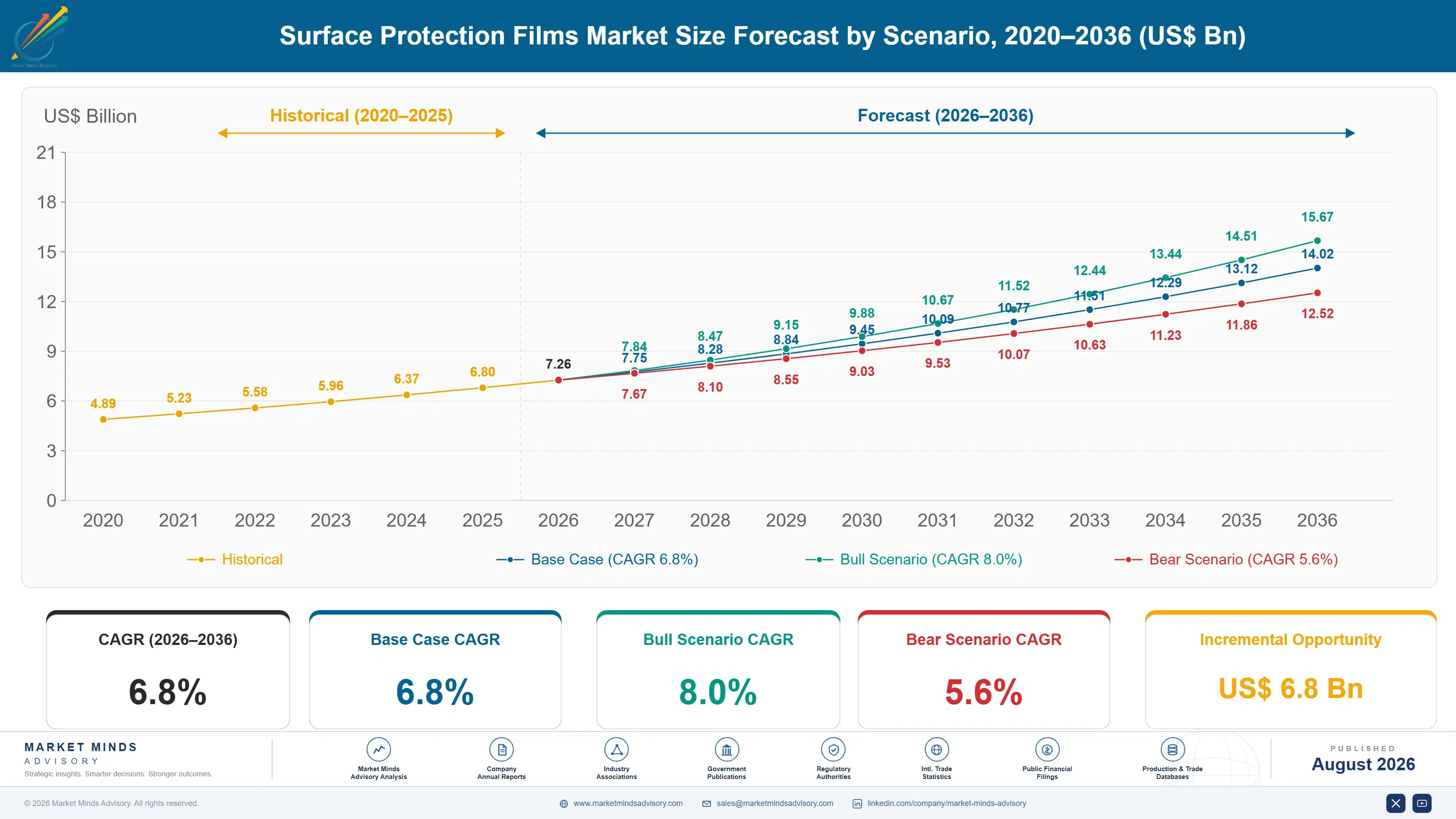
Surface Protection Films Market Forecast Scenarios

surface-protection-films-market-size-forecast-scenario-1787324424457
Growth from 2020 to 2025 compounded near 5.9%, recovering steadily from pandemic manufacturing disruption before electronics and EV battery demand accelerated the pace considerably from 2023 onward across most major global manufacturing markets worldwide. Appliance and construction glass demand remained the steady base throughout, while electronics-grade specification requirements grew into a genuinely distinct commercial category.
Three mechanisms carry the base case to 6.8%. First, electronics and EV manufacturing: semiconductor and battery producers require anti-static films that will not damage sensitive components during handling and repeated processing. Second, automotive OEM paint protection, as new vehicles increasingly ship with factory-applied film protecting exterior surfaces through transport and dealer handling. Third, construction and appliance demand, the steady historical base that continues expanding alongside global building and manufacturing activity worldwide.
The bull case at 8.0% assumes electronics and EV manufacturing capacity expansion continues at its recent pace and automotive OEM film adoption spreads to additional vehicle segments. The bear case at 5.6% assumes electronics manufacturing capital spending cycles down and construction activity slows in major markets, leaving the category to rely on its more mature appliance and metal fabrication base alone.

Why Residue-Free Removal Now Decides Specification

Three forces set demand. Electronics and EV manufacturing provides the fastest-growing layer, as semiconductor and battery producers specify anti-static films that will not damage sensitive components through handling and static discharge. Automotive OEM paint protection provides a second layer, with new vehicles increasingly shipping under factory-applied film through transport and dealer handling. Construction and appliance demand provides the steady historical base that continues expanding al
MARKET CONCENTRATIONCR5: 38%Fragmented among regional converters serving local manufacturing customers
ELECTRONICS END-USE SHAREAbout 24%Total film volume consumed by electronics and EV battery applications
RESIN INPUT COST SHARE42 to 55%Polymer resin cost within total film production cost
TYPICAL UV EXPOSURE RATING3 to 12 monthsOutdoor exposure duration before film degradation affects performance
TOP PRODUCING COUNTRY SHAREChina: about 26%Global surface protection film manufacturing output concentrated regionally
RESIDUE-FREE REMOVAL RATEAbout 96%Share of premium film removed without adhesive residue transfer
The commercial character is decided by removal performance rather than by initial adhesion strength alone. A film that adheres well but leaves residue or damages a surface on removal costs a manufacturer far more in rework than the film itself ever saved, and residue-free removal now runs near 96% for premium products specifically. That is why converters with proven removal performance defend share that lower-cost alternatives struggle to displace even at a meaningfully cheaper price point.
The next decade turns on two things. Whether electronics and EV manufacturing capacity expansion continues at its recent pace across multiple regions simultaneously. And whether automotive OEM film adoption spreads from premium vehicle segments into mainstream production, a transition that would meaningfully expand the addressable market beyond its current base.
"Everyone still thinks of this as the plastic wrap on a new refrigerator. That's the least interesting part of the category now. The interesting part is a wafer fab specifying a film that has to come off a silicon surface without leaving a single static charge behind."
Director, Specialty Films and Packaging Practice · MMA Packaging / Temporary Sur

Market Trends

Anti-Static Electronics-Grade Film Becomes A Distinct Category

Semiconductor and EV battery manufacturers increasingly specify anti-static protective films engineered to dissipate static charge without the residue or particle shedding that would contaminate sensitive electronic components. This requirement has pulled electronics-grade film from a niche variant of standard protective film into a category commanding its own dedicated production lines and material formulations. Converters serving this segment increasingly invest in cleanroom-compatible manufacturing that general-purpose film producers have not built, creating a genuine technical barrier between electronics-grade suppliers and the broader commodity film market. Demand concentrates wherever semiconductor and battery manufacturing capacity is expanding fastest, particularly across Asian electronics hubs.
Market Impact: Electronics demand adds 2.8 points
Residue-Free Removal Becomes A Genuine Specification Requirement

Manufacturers increasingly specify residue-free removal performance as a hard requirement rather than a marketing claim, since adhesive residue left on a finished surface after film removal frequently requires costly manual rework that erodes the labour savings the film was meant to provide. Premium films now achieve residue-free removal in roughly 96% of applications, a performance level that has become the baseline expectation among sophisticated buyers in electronics and automotive. Converters unable to document comparable removal performance increasingly lose specification contests regardless of price, since buyers weight the cost of rework failure heavily.
Market Impact: OEM adoption grows near 9%

Market Opportunities and Growth Drivers

Semiconductor And EV Battery Manufacturing Capacity Expands Rapidly

Global semiconductor fabrication and EV battery cell manufacturing capacity additions have driven sustained demand for anti-static protective films that prevent static discharge damage during wafer handling, panel assembly, and battery cell production. Fabrication and battery plant operators specify film performance requirements years ahead of a facility's construction timeline, giving early-qualified converters a demand pipeline visible well before volume materialises. This dynamic has pulled electronics-grade film capacity investment ahead of where general industrial demand alone would have justified it, and converters slow to invest in cleanroom-compatible production risk missing qualification windows tied to specific customer facility openings.
Market Impact: Resin cost reaches 55% of productio

Automotive OEM Paint Protection Spreads Beyond Premium Vehicles

Automakers increasingly ship new vehicles under factory-applied protective film covering exterior painted surfaces through transport, storage, and dealer handling, a practice that began in premium vehicle segments before spreading toward mainstream production as film costs declined and application processes became more efficient. This protects paint quality that damaged vehicles would otherwise require costly dealer-level touch-up work to correct before sale, a cost automakers increasingly prefer to avoid entirely through preventive film application. Converters serving automotive OEM customers directly, rather than through aftermarket channels, are capturing this expanding specification as more vehicle programmes adopt the practice.
Market Impact: Commodity pricing cuts margin 7 poi

Market Restraints and Challenges

Resin Price Volatility Compresses Converter Margin Repeatedly

Polyethylene and polypropylene resin, the primary feedstock for surface protection films, is subject to petrochemical price volatility that converters cannot always pass through to price-sensitive customers on existing contracts. The root cause is that film supply contracts typically reset annually or less frequently, while resin costs move continuously with crude oil and petrochemical feedstock pricing that shifts on a shorter cycle. Commercially this compresses margin during volatile periods regardless of underlying demand strength. Converters respond with index-linked pricing, broader resin sourcing, and reformulation toward feedstock chemistry less exposed to volatile swings.
Market Impact: Electronics-grade share reaches 24%

Commodity Film Competition Compresses Volume Tier Pricing

Standard protective films for basic scratch and dust protection face intense price competition from a widening field of regional converters, particularly Chinese manufacturers offering commodity film at prices established Western and Japanese producers struggle to match profitably. The root cause is that basic film formulation carries relatively low technical barriers once a converter has invested in extrusion equipment, unlike electronics-grade and residue-free segments requiring genuine process expertise. Commercially this compresses margin in the volume tier, pushing established converters to defend premium segments more aggressively. Converters respond by exiting commoditised product lines and concentrating investment in higher-value categories instead.
Market Impact: Residue-free removal reaches 96% no
3 additional market trends, 4 additional growth drivers, and 3 additional restraints and challenges are covered in the full report. Contact sales@marketmindsadvisory.com to access the complete intelligence.

Segment CAGR and Growth Architecture

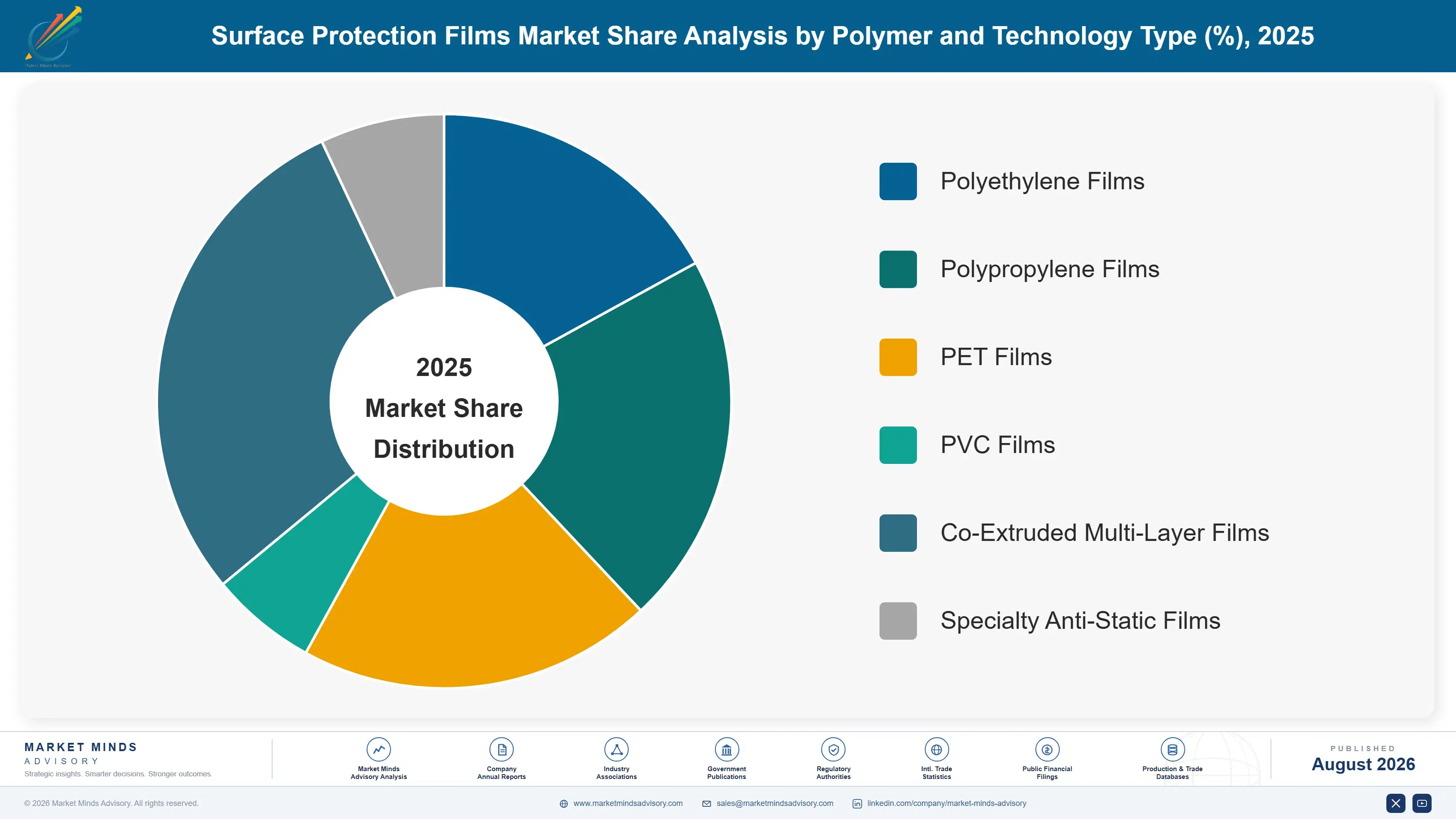
Segmentation follows polymer backbone and technology type, a single material classification logic describing the film chemistry and adhesive system a product specifies from the outset. End-use application and distribution channel sit separately within the framework, since the same polyethylene film chemistry serves both appliance and construction applications through different commercial channels and specification standards.
surface-protection-films-market-market-share-analysis-1787324425028

Specialty Anti-Static Films

Specialty anti-static films grow fastest at 10.8%, about 1.59 times the overall 6.8% rate, covering film formulations engineered to dissipate static charge without particle shedding or residue transfer that would contaminate sensitive electronic components. Semiconductor and EV battery manufacturers increasingly specify this chemistry as a hard requirement rather than a preference, since static discharge damage to wafers or battery cells carries costs far exceeding any film price differential a buyer might otherwise consider. Converters serving this segment have invested in cleanroom-compatible manufacturing that general-purpose producers have not built, creating a technical barrier separating specialists from commodity competitors. 3M, Nitto Denko, and tesa hold the strongest positions, having built electronics relationships over years of dedicated investment.
CAGR 10.8%

Co-Extruded Multi-Layer Films

Co-extruded multi-layer films grow at 9.2%, the second-fastest category, as automotive OEM paint protection and demanding industrial applications increasingly require combined properties, such as UV resistance layered with residue-free adhesive, that a single-layer film formulation cannot deliver simultaneously. Automakers specify these films for exterior paint protection through transport and dealer handling, valuing the combination of durability and clean removal that co-extrusion enables over cheaper single-layer alternatives. Berry Global and Intertape Polymer Group hold strong positions in this category, having invested in co-extrusion manufacturing capability that requires more sophisticated equipment than standard single-layer film production lines. Growth here tracks automotive production volume and OEM specification adoption closely across major vehicle manufacturing regions.
CAGR 9.2%
Full segment breakdown across 6 segments available in the complete report.

Regional Architecture and Country Demand Map

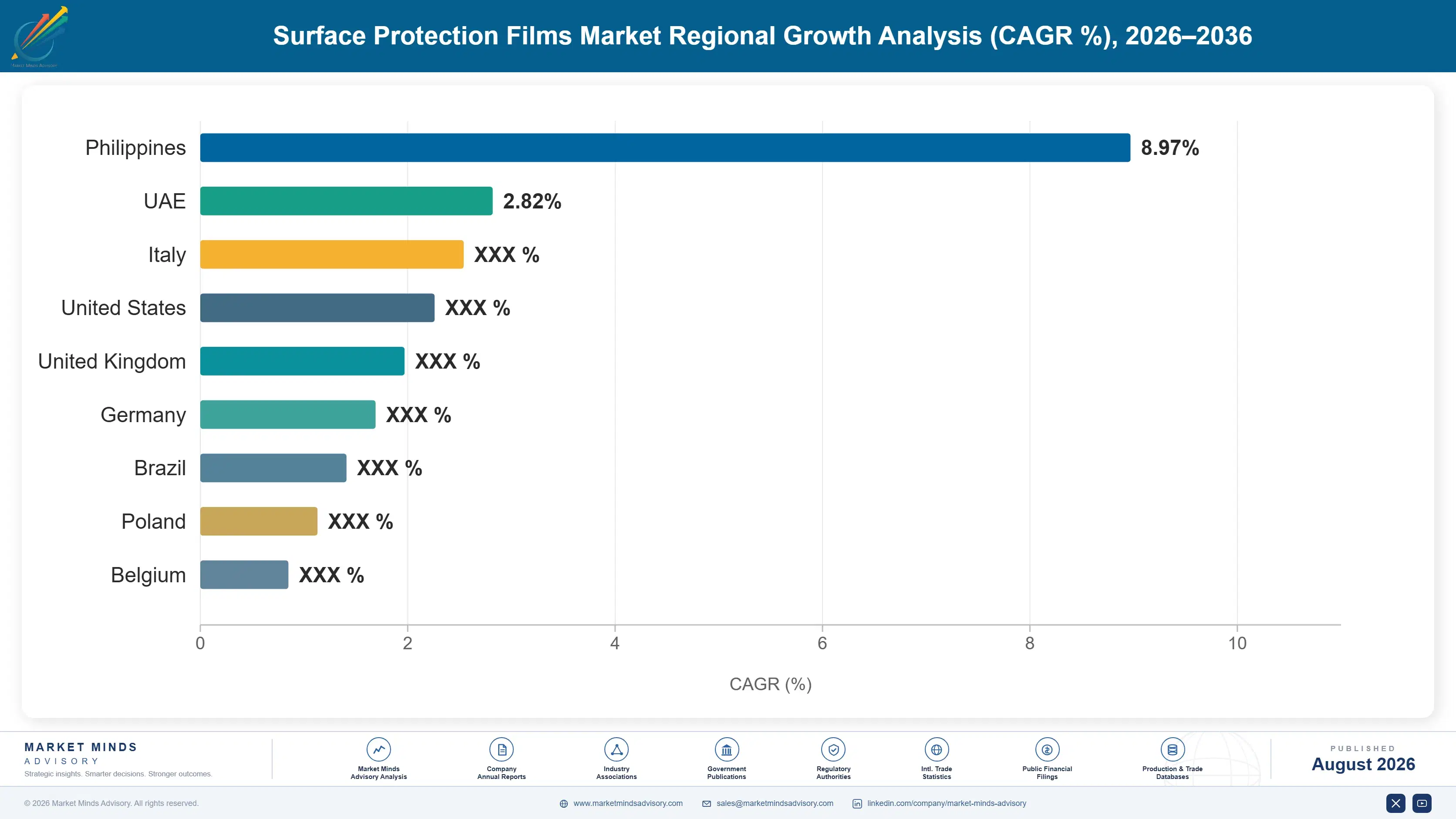
Electronics and appliance manufacturing concentration set this overall distribution more than raw construction activity alone ever really would suggest. East Asia leads on Chinese and broader regional manufacturing scale, while the fastest growth sits in South Asia and Pacific under Indian electronics assembly expansion specifically.

North America

Automotive OEM adoption and appliance manufacturing together define this 24% share. United States automakers are expanding factory-applied paint protection film programmes across mainstream vehicle segments, moving beyond the premium positioning the practice began with several years ago in the industry. Domestic appliance and construction glass demand provides a steady base that continues expanding alongside broader manufacturing activity nationally. Semiconductor fabrication investment under recent federal incentive programmes is adding meaningful new electronics-grade film demand that barely existed at comparable scale five years ago. Growth of 6.9% reflects both automotive OEM expansion and emerging domestic semiconductor-driven demand together. Domestic fabrication capacity additions increasingly compete for the same qualified electronics-grade film suppliers nationwide.
Share: 24% | CAGR: 6.9% (2026 to 2036)

Western Europe

Automotive manufacturing depth and construction glass demand define this 21% share. German and French automotive manufacturers were early adopters of factory-applied paint protection film, sustaining steady demand even as broader vehicle production volumes have moderated somewhat in recent years. Construction glass and metal fabrication demand remains substantial across the region's mature building sector, particularly in renovation and retrofit activity. Regulatory pressure on plastic film waste under EU circular economy policy is pushing some converters toward recyclable film chemistry that carries higher production cost. Growth of 5.3% is the slowest of the seven, reflecting mature automotive and construction demand growing more slowly than electronics-driven markets elsewhere. Recyclability requirements increasingly separate compliant converters from those still using legacy film chemistry.
Share: 21% | CAGR: 5.3% (2026 to 2036)
Regional intelligence for 5 additional markets available in the complete report: East Asia, South Asia and Pacific, Latin America, Middle East and Africa, Eastern Europe. Contact sales@marketmindsadvisory.com.
surface-protection-films-market-country-cagr-analysis-1787324425586

Where Surface Protection Film Converters Capture Value

Competing on basic scratch protection alone means competing against commodity film that specification increasingly commoditises across nearly every general-purpose category and region today across the industry. The four moves below shift value toward positions a commodity converter cannot simply match: electronics-grade qualification, documented removal performance, automotive OEM relationships, and co-extrusion capability built over years.

Qualify Electronics-Grade Anti-Static Chemistry Early Now

Semiconductor and EV battery manufacturers require extensive qualification before specifying a film supplier, and converters investing in cleanroom-compatible anti-static production now capture demand that materialises years later when a fab or battery plant reaches production volume. Waiting until demand is visible guarantees arriving after competitors have already locked in the qualification relationships that decide who ships volume at scale. Converters treating electronics qualification as a multi-year capital investment, not a reactive response, are capturing share that reactive competitors cannot reach in time, often losing 12 to 18 months of lead position as a result.
Market Impact: Electronics share already reaches 2

Document Residue-Free Removal Performance Rigorously Now

Buyers increasingly weight documented removal performance as heavily as initial adhesion strength, since residue left on a finished surface costs far more in rework than the film itself ever saved in labour or protection value. Converters achieving and documenting residue-free removal near 96% win specification contests that competitors relying on undocumented claims cannot match credibly. This transparency investment requires testing infrastructure and consistent formulation control that smaller converters often lack, which is precisely why documented performance functions as a genuine competitive barrier rather than simply a marketing claim in this category specifically.
Market Impact: Documented removal reaches 96% for

Build Direct Automotive OEM Specification Relationships

Automotive OEM film adoption is spreading from premium vehicle segments into mainstream production, and converters with direct OEM relationships capture this expansion before aftermarket-focused competitors can access the same specification decisions being made across the industry today. OEM programmes typically require 2 to 3 years of qualification and consistent quality documentation that favours converters who invested in automotive relationships ahead of the broader adoption curve now underway. This positioning also insulates revenue from general industrial demand volatility, since automotive OEM contracts typically run multi-year terms tied to vehicle production programmes.
Market Impact: OEM film adoption grows near 9% yea

Invest In Co-Extrusion For Combined Performance Properties

Co-extruded multi-layer films grow at 9.2% as demanding applications increasingly require combined properties, such as UV resistance paired with residue-free adhesive, that single-layer formulations cannot deliver simultaneously at comparable quality or cost. Converters investing in co-extrusion manufacturing capability capture this premium segment that single-layer competitors cannot access regardless of formulation expertise, since the underlying equipment investment itself creates the barrier. This capability also extends into adjacent premium applications beyond the original specification, since a converter with co-extrusion capacity can pursue automotive, electronics, and premium construction segments from the same manufacturing platform.
Market Impact: Co-extruded films grow 9.2% versus

Who Controls the Margin Pool

Concentration sits at a fragmented CR5 of 38%, with 3M, Nitto Denko, tesa, Berry Global, and Intertape Polymer Group holding leading positions across an industry still built around strong regional converters. The gap between these leaders and the broader field rests on electronics-grade qualification and documented removal performance rather than on basic manufacturing scale alone. All participants are assessed on one basis, annual revenue from surface protection film products, excluding broader
Competition runs along three dimensions. First, electronics-grade anti-static qualification, increasingly the fastest-growing and most consequential contest as semiconductor and EV demand accelerates. Second, documented removal performance, which commands specification wins that undocumented claims cannot match credibly. Third, automotive OEM relationship depth, particularly as film adoption spreads beyond premium vehicle segments into mainstream production.

Pressure is building from Chinese regional converters competing on price and local manufacturing relationships that multinational suppliers cannot easily replicate at comparable cost. Meanwhile specialist electronics-grade producers are capturing share from general-purpose converters lacking cleanroom-compatible manufacturing investment. Rankings should favour converters with proven electronics qualification and documented removal performance over those competing purely on basic film price and delivery speed.
surface-protection-films-market-company-positioning-matrix-1787324426129

Competitive Moat and Risk Dimensions

3M

Moat: Electronics qualification and technical depth

3M holds the deepest electronics-grade qualification track record in the category, built on decades of adhesive science expertise competitors cannot shortcut quickly. Its broad materials science portfolio supports continuous formulation improvement narrower competitors struggle to match at comparable scale. Established relationships with major semiconductor and automotive manufacturers provide a channel into expansion sales as customers scale capacity.
3M

Risk: Broad portfolio dilutes category focus

3M's enormous adhesive and materials portfolio spreads capital and management attention across far more categories than a focused film specialist must fund, which can slow film-specific investment relative to dedicated competitors. Regional Chinese converters are winning share in less qualification-intensive commodity segments of its portfolio. Corporate priorities occasionally direct investment away from surface protection film toward larger adjacent lines.
NITTO DENKO

Moat: Electronics industry depth and reach

Nitto Denko holds exceptionally deep relationships across the Japanese, Korean, and Taiwanese electronics manufacturing base, built through decades of adhesive and film technology supply into the same customer base. Its specialty film chemistry expertise spans anti-static, optical, and industrial applications fewer competitors match in combined breadth. Strong regional manufacturing presence near electronics fabrication clusters supports fast qualification and delivery.
NITTO DENKO

Risk: Regional concentration limits global reach

Nitto Denko's strength concentrates heavily in East Asian electronics manufacturing, leaving it less established in North American and European automotive OEM relationships competitors with broader regional presence have built more thoroughly. Currency exposure on a largely Japan-based footprint adds margin volatility dollar-denominated competitors avoid more easily. Chinese domestic converters are narrowing the technology gap within its core Asian market.

Players Tracked

Prominent Players

3M
Nitto Denko
tesa
Berry Global
Intertape Polymer Group

Other Key Players

Novacel
Advanced Film Solutions
Sun Ace
Achilles Corporation
Shurtape Technologies
Toray Industries
Mitsubishi Chemical
Polyplex Corporation
Guangdong Ruiyuan New Materials
Shanghai Yaguang
Wangda Group
Jiangsu Zhongsu
Cheever Films
Signature Systems Group
Surface Shields

Recent Developments

FEBRUARY 2025

3M expands electronics-grade anti-static film production capacity

3M announced a capacity expansion at an existing facility dedicated to electronics-grade anti-static film production, aiming to meet semiconductor and EV battery demand that had outrun prior planning assumptions. This was an organic expansion rather than an acquisition or joint venture, adding lines qualified for cleanroom-compatible electronics applications specifically.
Signal: Converters are sizing capacity investment
SEPTEMBER 2024

Berry Global acquires co-extrusion film specialist

Berry Global completed the acquisition of a specialist manufacturer of co-extruded multi-layer protective films, adding manufacturing capability the company had previously lacked in-house. This was a full acquisition bringing manufacturing equipment and formulation expertise directly inside Berry Global's protective film division, not a licensing arrangement.
Signal: Bringing co-extrusion capability in-house
MAY 2025

tesa signs multi-year automotive OEM supply agreement

tesa signed a multi-year supply agreement with a major automotive manufacturer to provide factory-applied paint protection film across an expanded range of mainstream vehicle models. This was a supply agreement rather than an equity stake or acquisition, formalising priority production allocation in exchange for committed purchase volume.
Signal: Multi-year OEM contracts are becoming the

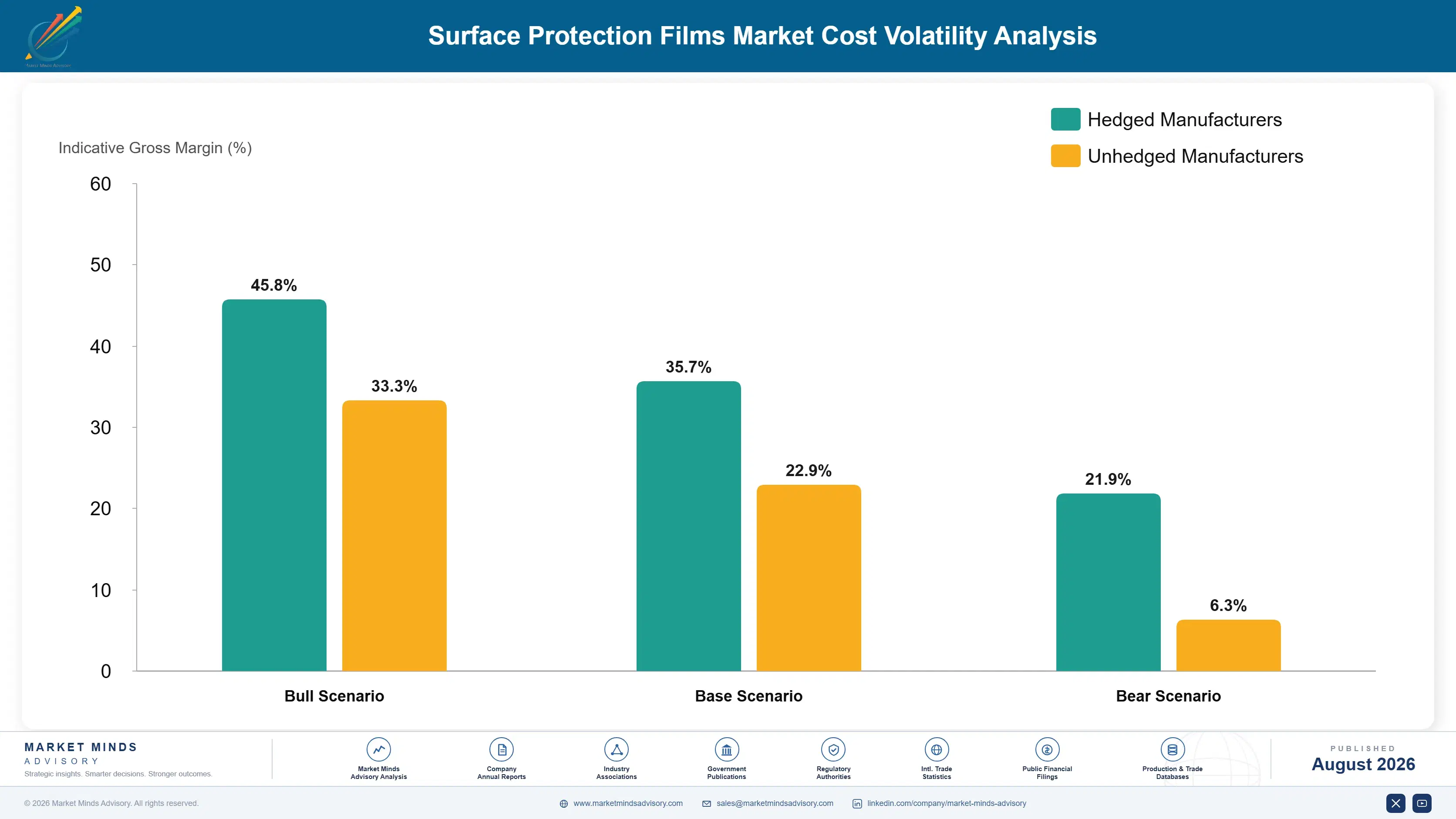
Polymer Resin And Adhesive Chemistry Costs

Polymer resin dominates cost in this category. Polyethylene and polypropylene resin account for roughly 42% to 55% of cost of goods sold, reflecting how directly film cost tracks petrochemical feedstock pricing. Adhesive chemistry and coating materials add a further 15% to 22%, while extrusion and coating process energy account for 10% to 16% and rising with electricity costs in several major manufacturing regions.
Resin price volatility has been the sharpest recent pressure. Polyethylene and polypropylene prices moved considerably through 2021 and 2022 amid petrochemical supply disruption, before easing through 2023 and 2024 as capacity normalised, according to industry reporting referenced in national chemical production indices. Converters absorbed meaningful margin pressure during the volatile period since annual supply contracts could not adjust as quickly as resin costs moved through that cycle.

Exposure separates by resin sourcing and contract structure. A converter dependent on spot resin purchasing faces cost risk that one with long-term supply contracts or hedging programmes simply does not carry, while one serving primarily electronics and automotive OEM customers can pass through cost increases more readily than one competing in price-sensitive commodity applications. Converters with diversified resin sourcing weather feedstock volatility considerably better than narrowly sourced regional competitors.
surface-protection-films-market-cost-volatility-analysis-1787324426323

Negotiate index-linked pricing on large contracts

Fixed annual pricing exposes converters to the gap between contract price and continuously moving resin costs, absorbing volatility index-linked contracts would instead pass through. Large electronics and automotive OEM contracts are the easiest place to introduce this mechanism, since buyers accept the tradeoff for supply reliability. Converters that established this practice early protect margin better than competitors on fixed terms.

Diversify resin sourcing across multiple suppliers

Relying on a narrow resin supplier base concentrates both price and availability risk exactly when demand is strong and petrochemical supply tightest. Qualifying multiple resin suppliers across regions preserves negotiating leverage and supply continuity during disruption. Converters that started diversifying early hold a genuine cost advantage over those still narrowly sourced to a single regional supplier.

Prioritise electronics and OEM customers during volatility

Customers requiring extensive qualification, electronics and automotive OEM buyers specifically, accept price increases more readily than commodity customers because switching suppliers carries requalification cost and delay outweighing any short-term savings. Converters should weight commercial strategy toward these customers during volatility, since pricing power concentrates where switching cost is highest and buyer patience is lowest.

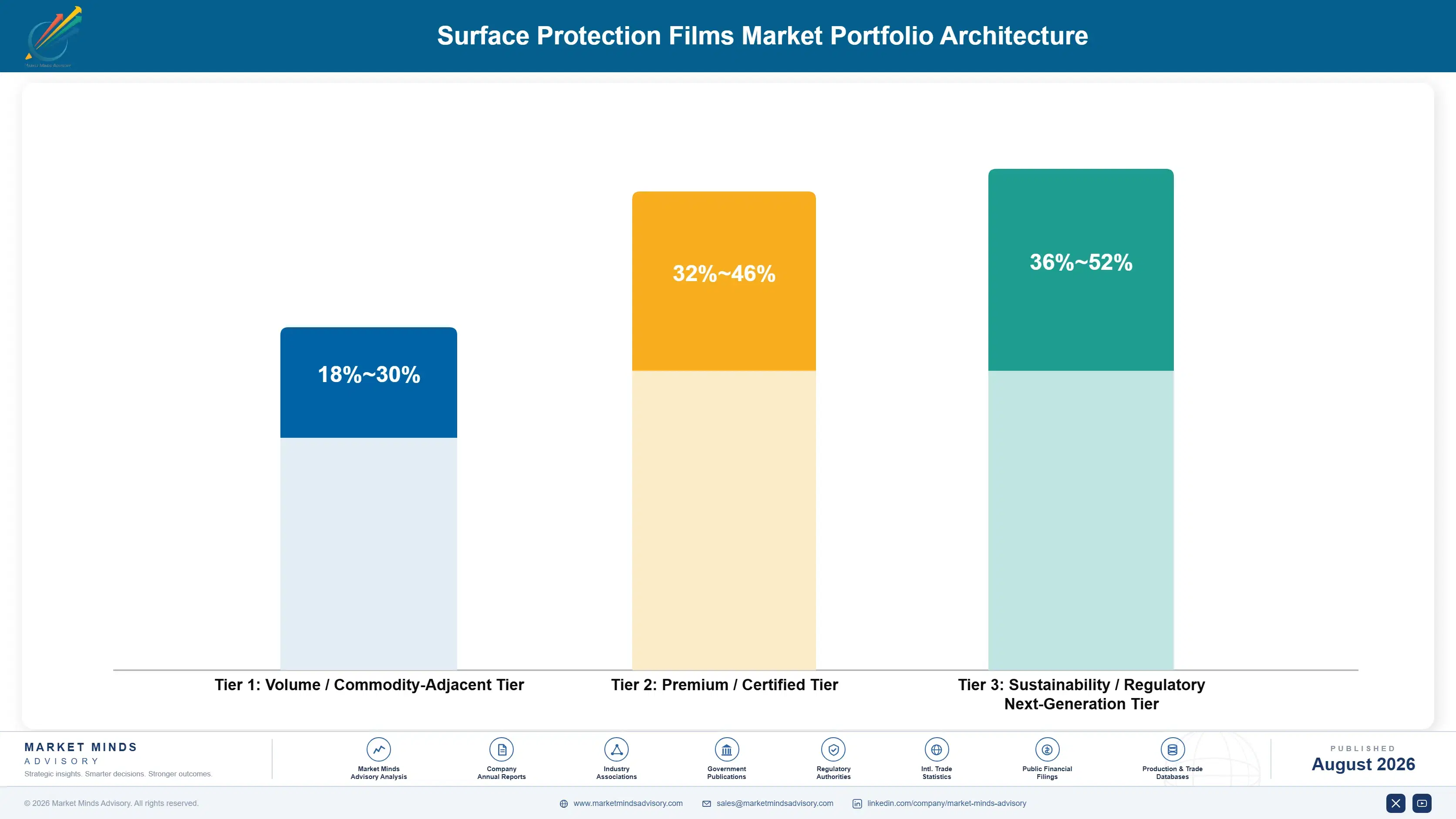
Portfolio Architecture for Margin Defence

The portfolio splits into three tiers with distinct economics. General-purpose polyethylene and polypropylene films form the volume tier, competing on price against a widening field of regional converters including Chinese manufacturers. Electronics-grade anti-static and documented residue-free films earn considerably more, since qualification barriers and testing requirements both resist commoditisation. Co-extruded and automotive OEM-specified films sit differently again, priced against combin
The tension runs between defending general-purpose film volume, which still funds much of the business today for several major converters, and investing in electronics-grade and co-extrusion capability that increasingly drives growth. Converters over-indexed on commodity film risk missing the electronics and automotive transition that has already reshaped where capital flows industry-wide. Yet building cleanroom-compatible and co-extrusion capacity requires sustained investment that margins alone do not always fund.

High-value pools concentrate where qualification barriers, documented performance, or co-extrusion capability limit competition: electronics-grade anti-static film with proven fabrication customer qualification, automotive OEM-specified co-extruded film with multi-year supply agreements, and premium residue-free film with documented removal data. All three resist price competition that general-purpose film increasingly faces from a widening field. Commodity-adjacent basic protective film sold on price alone sits at the other end.

Volume / Commodity-Adjacent Tier

General-purpose polyethylene and polypropylene films sold largely on price against a widening field of regional converters including increasingly capable Chinese manufacturers competing closely on cost, delivery speed, and consistent basic quality.
Gross Margin: 18-30%

Premium / Certified Tier

Electronics-grade anti-static and documented residue-free films with proven qualification track records, where testing data and consistent formulation control command sustained pricing power that unqualified alternatives simply cannot match at any comparable price point.
Gross Margin: 32-46%

Sustainability / Regulatory / Next-Generation Tier

Co-extruded automotive OEM-specified films and recyclable chemistry sold with documented combined performance properties and multi-year supply relationships that competitors have not yet fully replicated at comparable scale industry-wide today across most markets.
Gross Margin: 36-52%
surface-protection-films-market-portfolio-architecture-1787324426822

High-value Sub-segments and Strategic Watch-out

Specialty Anti-Static Films

High value and high growth at 10.8%, the fastest category, as semiconductor and EV battery manufacturers specify chemistry that will not damage sensitive components through static discharge across most producing regions worldwide. Cleanroom-compatible manufacturing capability, not general demand, is now the binding growth constraint industry-wide.
Gross Margin: 34-50%

Co-Extruded Multi-Layer Films

High value with strong growth at 9.2% as automotive OEM and demanding industrial applications require combined properties single-layer formulations cannot deliver simultaneously across most producing regions worldwide today still now consistently. Growth tracks automotive production volume and OEM specification adoption closely across major manufacturing regions.
Gross Margin: 32-48%

Polyethylene and Polypropylene Films

The volume core by revenue, growing moderately as appliance and construction demand continues expanding steadily while electronics and automotive segments increasingly capture new specification budget allocation across most regions worldwide today still now consistently. Competition on price is most intense in this established category worldwide.
Gross Margin: 20-32%

PVC Protective Films

The strategic watch-out, growing slowest as environmental regulation in several major markets pushes buyers toward polyethylene and polypropylene alternatives with more favourable recyclability and disposal profiles nationally and internationally today still now consistently overall. Regulatory pressure increasingly constrains this category's addressable applications worldwide currently overall.
Gross Margin: 18-28%

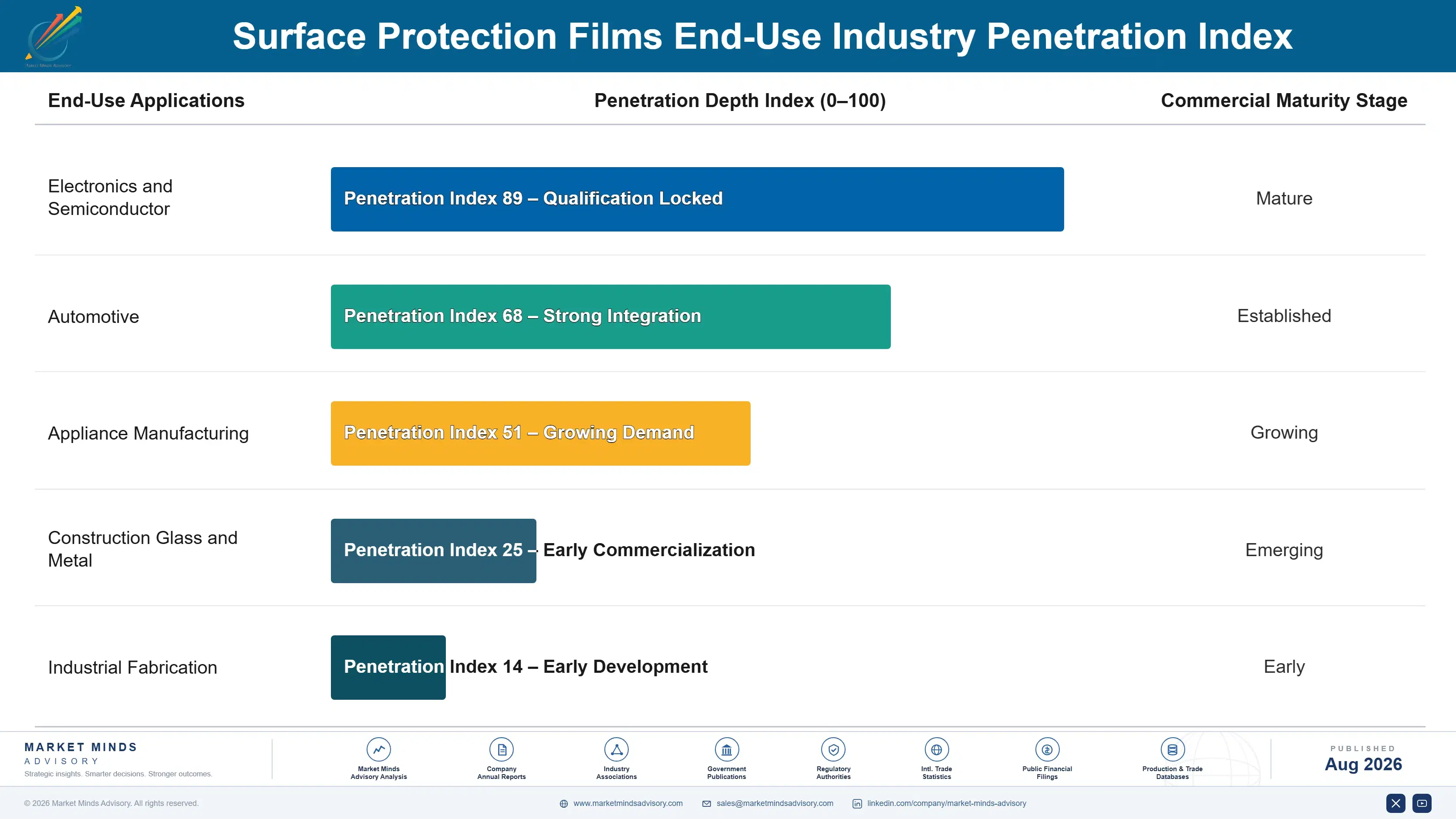
How Specification Relationships Actually Persist

Revenue depends on specification relationships persisting across a customer's production life, and once a manufacturer qualifies a converter's film for a specific application, switching suppliers mid-programme carries requalification cost that protects the incumbent for years. Electronics and automotive OEM contracts, once qualified, generate recurring volume across the full production run rather than one-time purchases. A small number of large electronics and automotive customers drive dispropo
Adoption depth varies sharply by application. Electronics and semiconductor manufacturing adopt deepest, since qualification requirements are strictest and switching cost highest once a film is validated for a specific process. Automotive OEM adoption is accelerating steadily as paint protection film spreads beyond premium vehicle segments into mainstream production. General construction and appliance applications adopt most price-sensitively, with decisions often made primarily on cost.

Buyer profiles have shifted from purchasing managers focused on unit price toward quality and manufacturing engineering teams who evaluate converters against documented performance data and multi-year supply reliability. Procurement increasingly requires removal performance testing before committing to a new supplier, a diligence standard basic commodity film purchases never required. Younger manufacturing engineers also weight documented reliability data more heavily than prior generations did.
surface-protection-films-market-end-use-penetration-index-1787324427315

Our Call On Surface Protection Films

These are among the four positions where our research anticipates prominent divergence between winners and laggards over the coming forecast period. Each is grounded in the demand model, the regulatory perimeter, and the announced capacity pipeline.
01 / ELECTRONICS SETS THE PACE

Anti-static qualification decides growth more than appliance demand

Electronics-grade film already accounts for roughly 24% of total volume, a share that barely existed at meaningful scale a decade ago and now shapes capacity investment decisions more than traditional appliance and construction demand does. Converters that invested early in cleanroom-compatible manufacturing are capturing qualification relationships years before competitors organised around general-purpose production can respond. Companies should size capacity investment around electronics and EV demand curves specifically now, because waiting for that demand to become obvious guarantees arriving after the qualification window has already closed for that generation of facilities.
02 / REMOVAL PERFORMANCE BEATS PRICE

Documented data wins specification more than adhesion strength

Buyers increasingly weight documented removal performance as heavily as initial adhesion strength, since residue left on a finished surface costs far more in rework than any film price differential a competitor might offer instead. Converters achieving and documenting residue-free removal near 96% are winning specification contests that competitors relying on undocumented claims simply cannot match credibly. Companies should invest in testing infrastructure and consistent formulation control now, because documented performance functions as a genuine competitive barrier that undocumented competitors cannot replicate quickly.
03 / OEM RELATIONSHIPS COMPOUND VALUE

Automotive adoption spreading beyond premium vehicles rewards early movers

Automotive OEM film adoption is spreading from premium vehicle segments into mainstream production, and converters with direct OEM relationships are capturing this expansion before aftermarket-focused competitors can access the same specification decisions being made right now. OEM programmes require multi-year qualification that favours converters who invested in automotive relationships ahead of the broader adoption curve currently underway across the industry. Companies should prioritise direct OEM relationship building over aftermarket channel expansion, since mainstream adoption will reward suppliers already qualified when volume actually arrives.
04 / CO-EXTRUSION ENABLES PREMIUM SEGMENTS

Combined properties beat single-layer formulations on value

Co-extruded multi-layer films grow at 9.2% against an overall market at 6.8%, because demanding applications increasingly require combined properties that single-layer formulations cannot deliver simultaneously regardless of chemistry sophistication applied to any one layer alone. Converters investing in co-extrusion manufacturing capability capture premium segments that single-layer competitors cannot access, since the equipment investment itself creates the barrier separating capable converters from the broader field. Companies without co-extrusion capacity should evaluate this investment now, given how directly it opens automotive, electronics, and premium construction segments simultaneously.

Engagement Snapshot From the Field

A live engagement with an industry participant carrying material or product regulatory and market exposure ahead of a defining policy shift, showing how our research translates into a defensible multi-year portfolio strategy.
MARKET MINDS ADVISORY · CLIENT ENGAGEMENT SUMMARY
Surface Protection Films Producer Strategic Portfolio Review and Transition Roadmap 2026·Investment Scenario on Surface Protection Films Exposure Evaluation 2025-26
CLIENT PROFILE
A regional protective film converter with an established appliance and construction film business engaged MMA while evaluating whether to invest in electronics-grade anti-static production for the first time. The client reported annual film revenue near USD 95 million, with roughly 88% concentrated in general-purpose applications and no current electronics manufacturer qualification (client-reported, unverified by MMA).
STRATEGIC CHALLENGE
Leadership recognised electronics-grade film as a growth opportunity but worried that cleanroom-compatible production required capital investment the general-purpose business could not easily justify against near-term returns. Commercial leadership had received informal interest from a regional battery manufacturer but lacked a framework for evaluating qualification investment against the company's existing commitments. The board wanted a clear investment case before committing capital to unfamiliar production requirements.
MMA APPROACH
MMA modelled electronics-grade capacity investment returns against comparable converters who had made the transition earlier, incorporating actual qualification timelines rather than the client's more optimistic internal assumptions. We assessed the specific battery manufacturer's qualification requirements against the client's existing production capability and identified the incremental investment required. We then evaluated capital allocation tradeoffs between electronics qualification and continued general-purpose capacity expansion.
KEY FINDINGS
  1. Electronics-grade qualification investment modelled a return above the client's hurdle rate within three years, assuming successful qualification with the interested battery manufacturer specifically.
  2. The client's existing extrusion equipment required incremental rather than wholesale investment to meet cleanroom compatibility standards, reducing capital requirements considerably below initial estimates.
  3. Qualification timeline with the battery manufacturer was estimated at 22 months, faster than the client's internal planning assumption of over three years (client-reported, unverified by MMA).
  4. Delaying the investment decision by even six months risked losing the qualification opportunity, since the battery manufacturer was simultaneously evaluating two other film converters.
CLIENT PROFILE
A regional protective film converter with an established appliance and construction film business engaged MMA while evaluating whether to invest in electronics-grade anti-static production for the first time. The client reported annual film revenue near USD 95 million, with roughly 88% concentrated in general-purpose applications and no current electronics manufacturer qualification (client-reported, unverified by MMA).
STRATEGIC CHALLENGE
Leadership recognised electronics-grade film as a growth opportunity but worried that cleanroom-compatible production required capital investment the general-purpose business could not easily justify against near-term returns. Commercial leadership had received informal interest from a regional battery manufacturer but lacked a framework for evaluating qualification investment against the company's existing commitments. The board wanted a clear investment case before committing capital to unfamiliar production requirements.
MMA APPROACH
MMA modelled electronics-grade capacity investment returns against comparable converters who had made the transition earlier, incorporating actual qualification timelines rather than the client's more optimistic internal assumptions. We assessed the specific battery manufacturer's qualification requirements against the client's existing production capability and identified the incremental investment required. We then evaluated capital allocation tradeoffs between electronics qualification and continued general-purpose capacity expansion.
KEY FINDINGS
  1. Electronics-grade qualification investment modelled a return above the client's hurdle rate within three years, assuming successful qualification with the interested battery manufacturer specifically.
  2. The client's existing extrusion equipment required incremental rather than wholesale investment to meet cleanroom compatibility standards, reducing capital requirements considerably below initial estimates.
  3. Qualification timeline with the battery manufacturer was estimated at 22 months, faster than the client's internal planning assumption of over three years (client-reported, unverified by MMA).
  4. Delaying the investment decision by even six months risked losing the qualification opportunity, since the battery manufacturer was simultaneously evaluating two other film converters.
RECOMMENDED STRATEGY
Phase 1: Phase 1 (0 to 5 months): Commit capital to incremental cleanroom upgrades and begin formal qualification engagement immediately with the manufacturer. Phase 2: Phase 2 (5 to 22 months): Complete battery manufacturer qualification while maintaining existing general-purpose production without disruption to current customers. Phase 3: Phase 3 (22 to 36 months): Scale electronics-grade capacity based on qualified volume and pursue additional electronics customer relationships more broadly.
OUTCOME
The client committed capital to incremental cleanroom upgrades and began formal qualification with the battery manufacturer within the recommended timeline, avoiding the risk of losing the opportunity to a competing converter. Qualification progressed close to the modelled 22 month timeline, and the client began evaluating additional electronics customer relationships before qualification even completed (client-reported, unverified by MMA).

Frequently Asked Questions

Foundational context covering the market sizes, CAGR, scope, country, region and competition that inform every finding below. This section is provided to cover basics and most often pre-purchase conversations, answered from the MMA Primary Research Dataset.

What is the current size of the Surface Protection Films Market?

The global surface protection films market is valued at USD 6.8 billion in 2025, covering polyethylene, polypropylene, PET, PVC, co-extruded, and specialty anti-static films. Permanent protective coatings and packaging films are excluded.

How large will the Surface Protection Films Market be by 2036?

The market is forecast to reach USD 14.02 billion by 2036 in the base case, about 1.93 times the 2026 level. That represents incremental value of roughly USD 6.76 billion across the decade.

What is the CAGR for the Surface Protection Films Market 2026 to 2036?

The market grows at a 6.8% CAGR in the base case, with bull and bear scenarios at 8.0% and 5.6%. The spread turns mainly on electronics and EV manufacturing capacity expansion and automotive OEM adoption pace.

Which segment is growing fastest?

Specialty anti-static films grow fastest at 10.8%, about 1.59 times the overall rate, as semiconductor and EV battery manufacturers specify static-safe chemistry. Co-extruded multi-layer films follow at 9.2%.

Who are the major companies in the Surface Protection Films Market?

Leading companies include 3M, Nitto Denko, tesa, Berry Global, and Intertape Polymer Group. Concentration remains fragmented at CR5 of 38%, reflecting strong regional converters rather than global consolidation.

Which country is growing fastest?

India grows fastest at a 10.6% CAGR, as global electronics manufacturers diversify assembly capacity into the country under domestic incentive programmes. China follows on continued electronics and appliance manufacturing scale.

Report Segmentation Architecture

The full report scope spans multiple orthogonal segmentation dimensions, with cross-tabulated demand data provided for each dimension pair. Coverage extends further to regional breakdowns, trend trajectories, and the competitive detail needed to support segment-level decision-making.

By Polymer and Technology Type

  • Polyethylene Films
  • Polypropylene Films
  • PET Films
  • PVC Films
  • Co-Extruded Multi-Layer Films
  • Specialty Anti-Static Films

By End-Use Industry

  • Electronics and Semiconductor
  • Automotive
  • Appliance Manufacturing
  • Construction Glass and Metal
  • Industrial Fabrication

By Commercial Dimension

  • Direct OEM Supply
  • Distribution and Converter Channel
  • Aftermarket and Installation Services
  • Custom Formulation Contracts

By Region

  • North America
  • Western Europe
  • East Asia
  • South Asia and Pacific
  • Latin America
  • Middle East and Africa
  • Eastern Europe

Scope, Methodology, and Coverage

Every figure in this report is reproducible from documented input assumptions. The scope below maps the historical period, the forecast horizon, the segmentation dimensions, and the countries covered, alongside the underlying primary and qualitative methodology.
Historical Period
2020 to 2025
Forecast Period
2026 to 2036
Base Year
2025 (USD billions; MMA Primary Research Dataset, August 2026)
Market Definition
The surface protection films market comprises temporary adhesive and static-cling polymer films applied to protect surfaces from scratching, staining, and contamination during manufacturing, transport, and installation, then removed before end use, valued at converter revenue from film products and directly attached formulation services. It spans polyethylene, polypropylene, PET, PVC, co-extruded multi-layer, and specialty anti-static films. Permanent protective coatings, packaging films not applied directly to a protected surface, and industrial masking tape are excluded.
Quantitative Units
USD billions (current prices); film volume in square metres where applicable
Segmentation Dimensions
By Polymer and Technology Type; By End-Use Industry; By Commercial Dimension; By Region
Regions Covered
North America, Western Europe, East Asia, South Asia and Pacific, Latin America, Middle East and Africa, Eastern Europe
Countries Covered
USA, China, Germany, France, UK, Japan, South Korea, India, Australia, Canada, Brazil, Mexico, Indonesia, Vietnam, Thailand, Malaysia, UAE, Saudi Arabia, South Africa, Nigeria, Turkey, Poland, Netherlands, Italy, Spain, Sweden, Switzerland, Argentina, Colombia, Singapore, and additional markets relevant to this sector
Key Companies Profiled
3M, Nitto Denko, tesa, Berry Global, Intertape Polymer Group, Novacel, Advanced Film Solutions, Sun Ace, Achilles Corporation, Shurtape Technologies, Toray Industries, Mitsubishi Chemical, Polyplex Corporation, Guangdong Ruiyuan New Materials, Shanghai Yaguang, Wangda Group, Jiangsu Zhongsu, Cheever Films, Signature Systems Group, Surface Shields
Quantitative Methodology
Primary survey, n=3,800 respondents, Q4 2025, six countries; demand-side model with trade association cross-validation
Qualitative Methodology
47 expert interviews, Q4 2025; applied to validate demand model assumptions, identify emerging dynamics, and assess competitive positioning
Report Format
PDF and XLSX data workbook (Word format preview document)
Publisher
Market Minds Advisory
Report Code
MMA-2026-PAC-208
Published
August 2026
Contact
sales@marketmindsadvisory.com | www.marketmindsadvisory.com

Purchase the full Surface Protection Films Market Report (2026 to 2036).

The full MMA Surface Protection Films report sizes the market across six polymer and technology categories, five end-use industries, four commercial dimensions, and seven regions through 2036. It profiles 20 companies on a consistent surface protection film revenue basis, scoring each on electronics qualification status, documented removal performance, and automotive OEM relationship depth. Scenario models quantify how electronics and EV manufacturing growth, automotive OEM adoption, and resin cost volatility move both film volume and achievable margin by category. The report also includes electronics qualification timeline benchmarking, removal performance data tracking by converter, and automotive OEM adoption pace analysis for commercial and product strategy teams.
Six-category and four-dimension market sizing to 2036
Twenty-company benchmark on surface protection film revenue basis
Electronics-grade qualification timeline benchmarking by converter
Documented removal performance tracking across major suppliers
Automotive OEM adoption pace analysis by vehicle segment
Resin cost volatility and margin impact modelling by tier

Built For The People Who Decide

From boardroom strategy to bench-side execution, this report is read cover-to-cover by leaders shaping the next decade of their industry, turning demand scenarios, market dynamics and valuation benchmarks into decisions.
CXOs/ Presidents/ VPs/ Managers
M&A and Corporate Development
Strategy Teams and R&D Heads
Procurement and Product Directors
Regulatory and Compliance Leaders
Investor Relations and Equity Analysts