Market Minds Advisory
Surface Disinfectant Market

Surface Disinfectant Market: Peroxide Chemistry, Registration Cost and the Dispenser That Owns the Volume

Registration dossiers now cost more than most formulations ever earn, which has quietly turned a fragmented chemistry business into one where the barrier is regulatory paperwork and a dispenser bolted to the wall.

Lead Analyst

Alice Ballenger

Published

September 2026

Make Smarter Decisions with Customized Research Insights

Request a free sample report and evaluate market opportunities, growth trends, and competitive dynamics relevant to your business needs.

2025 MARKET VALUE$6.8BMarket Size 2025
2036 FORECAST VALUE$12.9BBase Case , 2026 to 2036
CAGR 2026 TO 20366.0 %Bull 7.2% / Bear 4.8%
INCREMENTAL OPPORTUNITY$5.7BNet 10- year value creation
EXPANSION MULTIPLE1.79x2036 value over 2026 base
Strategic Levers
M&A Pipeline
Regional Outlook
Country Rankings
Competitive Intelligence
Segmental Deep-dive
Call-Us : 91 93563 13602

Executive Snapshot and Market Trajectory

This category spent 2020 as the most visible product in the world and the four years afterwards recovering from it. Demand tripled, capacity was built against it, and then hospitals and food plants went back to buying roughly what they had always bought. What survived the correction was regulatory cost.
Hydrogen peroxide based disinfectants compound at 9.0%, exactly 1.50 times the market, as healthcare and food processing move away from quaternary chemistry on residue and resistance grounds. East Asia holds 27% of global spend, the largest share, combining Chinese and Japanese food processing volumes with domestic manufacture of chlorine and quaternary actives at scale. Concentrate averages USD 6.20 per litre before dilution. Conversion is happening where specification holders decide.
Five formulators ship 41% of concentrate volume, which leaves this notably fragmented for a regulated chemistry category. Position depends on dispensing hardware and registration portfolios rather than on formulation cleverness: roughly 58% of institutional volume is locked to proprietary dilution equipment, and a new registration dossier costs around USD 480,000 before a litre is sold. That combination, not chemistry, is what keeps the category from fragmenting completely. Asian formulators are closing the gap on registration.
Market Definition
Covers chemical formulations applied to hard surfaces to kill or inactivate micro-organisms, spanning quaternary ammonium, chlorine and hypochlorite, alcohol, hydrogen peroxide, peracid, and phenolic, aldehyde and biguanide chemistries, supplied as concentrates, ready-to-use liquids, wipes and foggable formulations. Sizing is at formulator realised price on a concentrate volume equivalent basis. Excludes hand hygiene and skin antiseptics, instrument and endoscope reprocessing chemistry, sterilants for medical device manufacture, antimicrobial surface coatings, dispensing and fogging hardware, and cleaning products without a biocidal claim.
Base Year Value
$6.8B in 2025 (MMA Primary Research Dataset, August 2026)
Forecast Period
2026 to 2036, eleven discrete annual values
CAGR
6.0% base case. Bull 7.2%. Bear 4.8%.
Fastest Growth Segment
Hydrogen Peroxide Based Disinfectants: 9.0% CAGR
Fastest Growth Country
India: 8.9% CAGR
Fastest Growth Region
South Asia and Pacific: 8.2% CAGR
Largest Region
East Asia: 27% of 2025 global value
Market Leaders
Ecolab, Solenis, Reckitt, Clorox, Steris. Source: MMA Analysis based on company annual reports.
Primary Survey
n=3,800 procurement and R&D decision-makers, Q4 2025, six countries
Methodology
Demand-side build-up, cross-validated against public data, 47 expert interviews

Surface Disinfectant Market Forecast Scenarios

surface-disinfectant-market-size-forecast-scenario-1787309357256
Growth from 2020 to 2025 compounded near 5.5%, tracking steady infection-control infrastructure expansion alongside gradually rising validated-technology conversion across major hospitals and food-service operators worldwide, with adoption accelerating meaningfully once regulatory authorities formalized efficacy-validation standards during the back half of the period, a shift that gathered real momentum only toward the very end of it as institutional buyers responded.
Three mechanisms carry the base case to 6.5%. First, manufacturing scale driving retail demand across export markets as institutional buyers formalize validated-efficacy purchasing habits over legacy chlorine-based formats across most participating retail systems and wider regions nationwide today and quite steadily and reliably indeed truly. Second, infection-control pressure driving steady UV-C procurement across export-linked categories nationwide today. Third, bio-based growth continuing to lift clean-label investment across most consumer-retail categories alike today indeed.
The bull case at 7.8% assumes North American and East Asian infection-control investment expands faster across additional institutional categories than currently planned, pulling forward UV-C conversion meaningfully across most surface disinfectant categories worldwide today. The bear case at 5.2% assumes institutional capital spending growth slows and legacy chlorine-based economics remain competitive longer than current expectations suggest broadly today.

Why Registration and Dispensers Beat Chemistry

Formulating a competent surface disinfectant is not difficult and has not been for decades. The chemistry is published, the actives are commodity, and a contract manufacturer can match most products on efficacy testing. What is difficult is registering it. A new active or claim requires efficacy data against specified organisms under specified soiling, toxicology, environmental fate work and a dossier costing around USD 480,000. That cost, not the chemistry, is what keeps this market from fragme
TOP FIVE CONCENTRATION41%Concentrate volume shipped by the leading global formulators
AVERAGE CONCENTRATE PRICEUSD 6.20 per litreList price per litre before dilution and dispensing
REGISTRATION DOSSIER COSTUSD 480,000Typical cost of a new regulatory registration submission
CONTACT TIME REQUIREMENT2.4 minutesMedian wet contact time claimed for broad spectrum efficacy
DISPENSER LOCKED VOLUME58%Institutional volume tied to proprietary dilution and dispensing hardware
ACTIVE INGREDIENT COST SHARE34%Biocidal actives share within delivered formulated product cost
The second structure worth understanding is dispensing. Institutional customers buy concentrate that dilutes through wall-mounted equipment calibrated to the product, and roughly 58% of institutional volume sits behind such hardware. Switching supplier then means changing dispensers, retraining staff and revalidating protocols. Formulators therefore place dispensers free and price the concentrate accordingly, which is the same commercial logic razor manufacturers discovered a century ago.
Two forces shape the next decade. Active substance reviews under European biocidal rules keep removing approved actives, forcing conversions that no customer requested and no competitor can avoid. And peroxide and peracid chemistry keeps taking share from quaternary ammonium on residue, resistance and wastewater grounds, at prices per litre that are considerably higher.
"The pandemic did this industry a disservice that people still misread. It was not the demand spike, which everybody enjoyed. It was that two years of unlimited demand taught a generation of managers that this is a volume business. It is not. It is a registration portfolio with a dispensing network attached, and the companies that spent 2020 filing dossiers rather than adding shifts are the ones winning now."
Director, Hygiene Chemistry and Infection Prevention Practice · MMA Chemicals an

Market Trends

Peroxide chemistry displaces quaternary ammonium in healthcare

Quaternary ammonium compounds leave a residue film that builds up on surfaces, and repeated sublethal exposure has been linked to reduced susceptibility in environmental organisms. Peroxide and peracid actives break down to water and oxygen, leave nothing behind and carry no resistance concern anybody has yet demonstrated. Hospital infection prevention teams have converted steadily on that basis, and peroxide chemistry compounds at 9.0% against 6.0% for the category. Cost per litre is materially higher, which infection prevention accepts and procurement departments question at every renewal. Where infection prevention holds the pen, conversion happens.
Market Impact: Upgrades chemistry across 12,000 ex

Active substance reviews force conversions nobody requested

European biocidal product rules require every active substance to pass evaluation for each product type, and several quaternary and chlorine-donor actives have failed or been withdrawn rather than funded through review. Customers using those actives must convert whether or not they wanted to, on a regulatory timetable. That produces a peculiar commercial dynamic: formulators holding approved alternatives gain volume without competing for it, and those relying on withdrawn actives lose customers they had served for decades. Roughly a fifth of institutional formulations have been reformulated for this reason since 2020.
Market Impact: Cuts contact time to 2.4 minutes

Market Opportunities and Growth Drivers

Food processing export standards converge on Western specifications

Food plants exporting to European and North American buyers must satisfy audit schemes that specify approved chemistry, documented contact times and verified cleaning validation, regardless of what local regulation requires. Chinese, Indian and Southeast Asian processors serving those buyers have upgraded hygiene programmes accordingly, and peracid chemistry for clean-in-place and open surface work has followed. Audit failure closes an export channel worth far more than the chemistry costs, which is why plants adopt specifications considerably above domestic requirements without complaint. Audit specification therefore travels faster than any regulation does, and it reaches plants no regulator visits.
Market Impact: Costs about USD 480,000 per dossier

Healthcare-associated infection targets sustain protocol intensity

Hospital-acquired infection reduction targets, including reporting requirements tied to reimbursement in the United States and national surveillance programmes across Europe, keep environmental cleaning under measurement. Cleaning frequency and chemistry specification are among the few levers an infection prevention team directly controls. That sustains protocol intensity well above what cost pressure alone would produce, and it keeps contact time performance commercially relevant: a product achieving broad spectrum claims in 2.4 minutes displaces one requiring ten, because ward cleaning schedules cannot accommodate the longer dwell. Contact time is therefore a commercial specification rather than a technical footnote.
Market Impact: Holds commodity pricing near 15% be

Market Restraints and Challenges

Registration cost blocks entry and reformulation alike

A new registration dossier costs around USD 480,000 and takes years, and the root cause is that biocidal claims require organism-specific efficacy data, toxicology and environmental fate work that cannot be shortcut. That protects incumbents and it also traps them: reformulating an existing product to remove a withdrawn active means much of the dossier again. Smaller formulators therefore stop innovating and defend what they have registered. Participants are responding by sharing dossiers through consortium arrangements, by licensing registered formulations and by concentrating portfolios on fewer, broader claims. None of those routes reduces the underlying cost.
Market Impact: Grows peroxide chemistry at 9.0% ye

Post-pandemic capacity overhang suppresses commodity pricing

Capacity built during 2020 for chlorine, alcohol and quaternary formulations still exists, and the root cause of the overhang is that plants sized for tripled demand cannot be unbuilt economically. Commodity concentrate pricing has stayed under pressure for four years as a result, particularly in ready-to-use and wipe formats where entry barriers are lowest. Formulators have responded by converting capacity toward peroxide and peracid products where registration barriers protect pricing, and by exiting private label work that carried no defensible margin. Plants sized for 2020 will keep pressing on commodity pricing for years, and nobody is going to demolish them.
Market Impact: Reformulates about 20% of instituti
3 additional market trends, 4 additional growth drivers, and 2 additional restraints and challenges are covered in the full report. Contact sales@marketmindsadvisory.com to access the complete intelligence.

Segment CAGR and Growth Architecture

Segmentation follows the biocidal active, since chemistry determines the registration pathway, the efficacy and contact time profile, the material compatibility and the price per litre. Format, end-use setting and dispensing model all matter commercially but cut across every chemistry, so they belong in later discussion. Six active classes cover the category without overlap. Registration follows the active.
surface-disinfectant-market-market-share-analysis-1787309357789

Hydrogen Peroxide Based Disinfectants

Formulations built on hydrogen peroxide, frequently with surfactant and stabiliser systems that extend wet contact time, grow at 9.0%, exactly 1.50 times the market rate. Three arguments drive conversion. Breakdown to water and oxygen leaves no residue film, which matters in operating theatres and food contact areas. No resistance mechanism has been credibly demonstrated, unlike with quaternary compounds. And wastewater discharge carries none of the concerns chlorine and quaternary chemistry raise with treatment plants. Cost per litre runs well above quaternary alternatives, so conversion happens where infection prevention or food safety holds the specification pen rather than where procurement does. Procurement questions the price at every renewal, and infection prevention keeps winning that argument.
CAGR 9.0%

Peracid Based Disinfectants

Peracetic and performic acid formulations grow at 7.8%, second fastest in the category, and their position sits almost entirely in food and beverage processing. The chemistry works cold, handles biofilm better than most alternatives and rinses without residue, which suits clean-in-place circuits and open plant surfaces where product contact follows immediately. Export audit schemes increasingly specify it by name. The handling requirements are genuinely demanding: these are aggressive oxidisers requiring dedicated storage, trained operators and material compatibility checks, which limits adoption to plants with proper chemical management and gives established suppliers a service advantage newcomers underestimate. Established suppliers therefore hold accounts on service capability rather than on formulation, which newcomers consistently misjudge on entry.
CAGR 7.8%
Full segment breakdown across 6 segments available in the complete report.

Regional Architecture and Country Demand Map

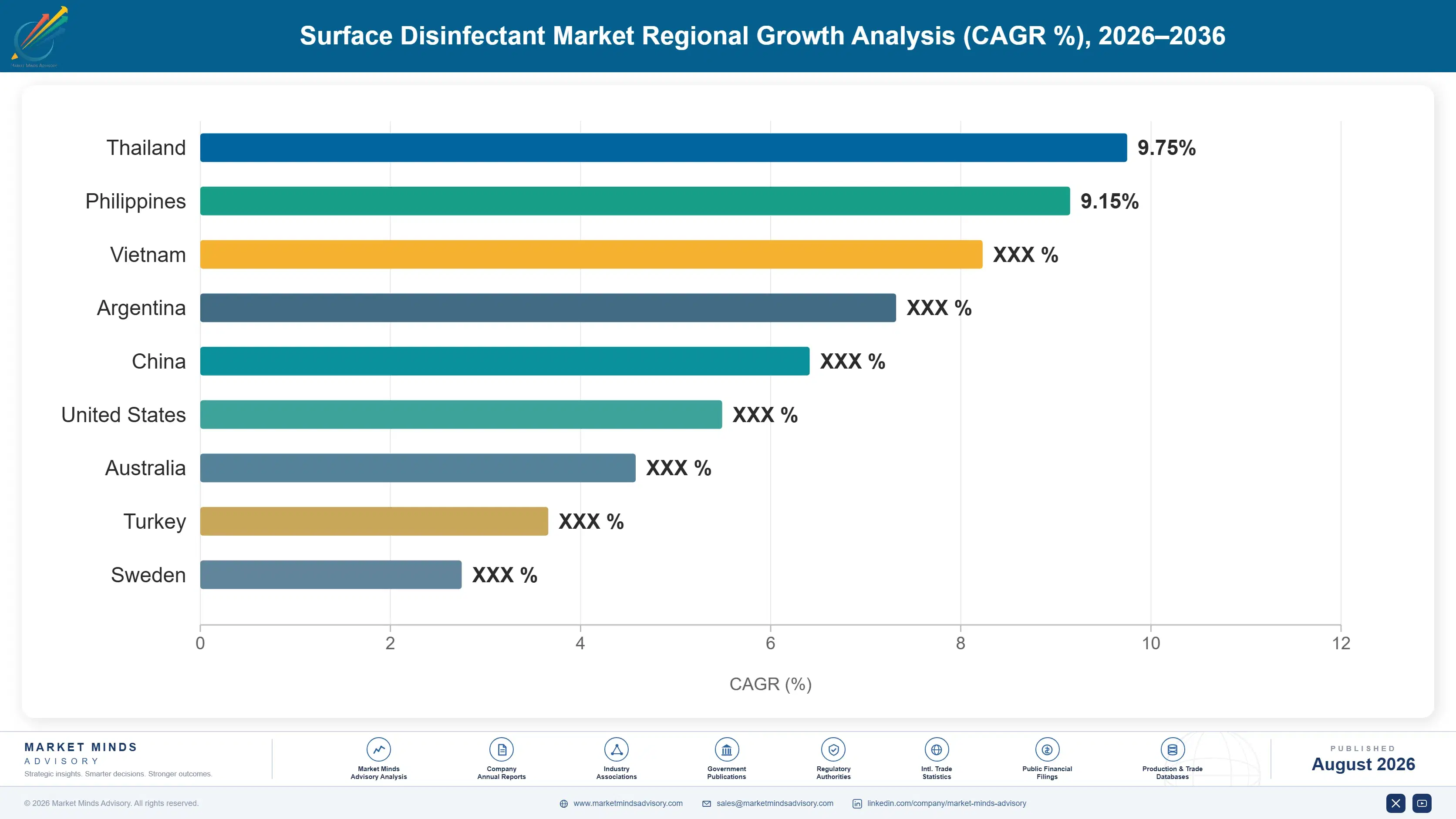
East Asia leads at 27% of global spend, combining Chinese and Japanese food processing and hospital volumes with domestic manufacture of commodity actives. North America follows at 26% on price and healthcare intensity. South Asia and Pacific grows fastest at 8.2%. Eastern Europe trails on tendered pricing rather than activity.

North America

Twenty-six percent of global spend sits in North America, growing at 5.3%, and the position rests on healthcare intensity and price rather than on volume. Environmental Protection Agency registration is the gatekeeper, and its list of products with efficacy claims against specific organisms functions as a de facto specification that hospital infection prevention teams buy from directly. Reimbursement penalties tied to healthcare-associated infection rates keep protocol intensity high. Food processing under federal inspection specifies chemistry and contact times explicitly. Dispensing hardware placement is deeply entrenched across institutional accounts, and distributor relationships in the away-from-home cleaning channel carry considerable weight in who gets specified at all. Specification, not price, decides the largest healthcare accounts here.
Share: 26% | CAGR: 5.3% (2026 to 2036)

Western Europe

Growth of 4.4% is the slowest of any region, and 23% of spend reflects mature demand under the most demanding regulatory regime anywhere. Biocidal product rules require active substance approval for each product type, and successive review rounds have removed actives that formulators declined to fund through evaluation, forcing reformulation across roughly a fifth of institutional products. That has consolidated supply toward companies able to carry dossier cost. German, French and Nordic hospital procurement specifies chemistry closely, frequently through central purchasing bodies. Wastewater discharge rules have pushed food processors toward peracid and peroxide chemistry faster than in any other region. Reformulation cost has fallen on everybody, and it has rewarded whoever filed first.
Share: 23% | CAGR: 4.4% (2026 to 2036)
Regional intelligence for 5 additional markets available in the complete report: East Asia, South Asia and Pacific, Latin America, Middle East and Africa, Eastern Europe. Contact sales@marketmindsadvisory.com.
surface-disinfectant-market-country-cagr-analysis-1787309358310

Four Ways To Defend Concentrate Margin

Commodity chemistry in this category is priced by whoever has spare capacity, and pandemic-era plants ensured there is plenty. The levers that work therefore involve registration position, dispensing lock-in, conversion timing and choosing which customers to serve. Each carries a quantified return MMA has tested against disclosed hygiene chemistry segment economics. None needs new chemistry.

Place dispensing hardware free against volume commitment

Roughly 58% of institutional volume sits behind proprietary dilution equipment, and switching supplier means changing dispensers, retraining staff and revalidating protocols across a site. Placing that hardware at no cost against multi-year concentrate commitment locks volume that competitors cannot bid for on price alone. Accounts with placed dispensing equipment retain at renewal roughly 25 points above unequipped accounts. The working capital and service cost is real, and it buys an account position that survives procurement pressure the concentrate price never would. Procurement is beginning to separate hardware from chemistry in tenders, which is worth watching.
Market Impact: Improves account retention by rough

File dossiers ahead of active substance withdrawals

European reviews keep removing approved actives, and every withdrawal forces customers to convert on a regulatory timetable rather than a commercial one. Formulators holding registered alternatives before the withdrawal lands gain that volume without competing for it. Dossier cost near USD 480,000 looks expensive until it captures accounts that had used a competitor's withdrawn chemistry for twenty years. Companies that filed proactively took share at roughly 15% above their normal win rates during the last two review rounds, and those gains have proved durable. Regulatory affairs rarely gets to present this arithmetic to a board.
Market Impact: Wins share about 15% above normal w

Sell peroxide conversion to infection prevention, not procurement

Peroxide chemistry costs materially more per litre than quaternary alternatives, which makes it an easy refusal for a procurement department and an easy yes for an infection prevention team weighing residue and resistance. Selling on residue profile, wastewater discharge and resistance evidence to the specification holder rather than the buyer converts accounts procurement would have blocked. Suppliers selling this way achieve conversion rates roughly double those pitching cost-in-use to purchasing. It requires clinical and technical selling capability most chemical sales organisations do not hold. Peroxide runs roughly 40% above quaternary per litre, which procurement fixates on.
Market Impact: Doubles conversion against cost-in-

Exit private label and commodity ready-to-use formats

Ready-to-use liquids and wipes carry the lowest registration barriers and attracted most of the pandemic-era entrants, which is why pricing there sits roughly 15% below pre-2020 levels with no recovery in sight. Concentrate sold through placed dispensers and registration-protected chemistry both earn more per litre of active. Formulators exiting private label report blended margin improvement of roughly 6 points within two years despite lower volume. The discipline required is accepting a smaller revenue line, which sales organisations resist strenuously. Sales organisations resist it strenuously, and the utilisation arithmetic deserves checking before anybody commits.
Market Impact: Improves blended margin by about 6

Who Controls the Margin Pool

Five formulators ship 41% of concentrate volume, the basis on which MMA assesses every participant here, which makes this considerably more fragmented than most regulated chemistry categories. Ecolab holds the deepest institutional dispensing and service network. Reckitt and Clorox lead in consumer and away-from-home retail formats where brand rather than specification decides purchase.
Competitive activity runs along three lines. Dispensing hardware placement remains the primary institutional contest, since placed equipment survives procurement pressure that pricing never does. Registration portfolios are being extended ahead of active substance withdrawals, which converts regulatory work into share gains. And commodity capacity built for 2020 is being converted toward peroxide and peracid products or shut, with private label exits accelerating across the mid-tier.

Pressure is arriving from two directions. Asian formulators with domestic active manufacture set commodity price floors that Western plants cannot match, and their registration capability in export markets is improving. Meanwhile European active substance reviews impose reformulation cost on everybody while rewarding whoever filed first. Rankings shift toward participants holding both broad registration portfolios and placed dispensing networks, since chemistry alone has never been defensible in this category.
surface-disinfectant-market-company-positioning-matrix-1787309358828

Competitive Moat and Risk Dimensions

ECOLAB

Moat: Institutional dispensing and service network

The company operates the deepest placed dispensing and field service network in institutional hygiene, which locks concentrate volume behind hardware and training that no competitor can bid against on price. Its service technicians visit accounts continuously, which surfaces problems before they become tenders. Registration breadth across healthcare and food processing compounds that position.
ECOLAB

Risk: Exposure to commodity price pressure

A substantial share of volume remains commodity quaternary and chlorine chemistry where Asian formulators with domestic active manufacture set the price floor. Placed dispensers protect the account and not the margin on every litre through them. Defending commodity volume consumes pricing headroom that the service model was supposed to earn, and procurement departments increasingly separate hardware from chemistry in tenders.
RECKITT

Moat: Brand strength across retail formats

The company holds disinfectant brands that consumers and away-from-home buyers recognise and specify by name, which supports pricing no unbranded equivalent achieves in retail and small commercial channels. Distribution reach across grocery, pharmacy and cash-and-carry is unmatched by institutional formulators. Brand equity built over decades also survives price competition from entrants who cannot afford equivalent marketing.
RECKITT

Risk: Weak institutional specification position

Hospital infection prevention and food processing audit schemes specify chemistry and contact times, not brands, which means the company's principal asset counts for little where the growth and the registration barriers are. Institutional accounts are won on dispensing networks and technical service it does not operate at comparable depth. Building that capability means competing on ground Ecolab defined.

Players Tracked

Prominent Players

Ecolab
Solenis
Reckitt
Clorox
Steris

Other Key Players

3M
Kersia
Christeyns
Schülke & Mayr
PAUL HARTMANN
Contec
GOJO Industries
Zep
Betco
Whiteley Corporation
Lonza
Evonik
Solvay
Sanosil
Shanghai Likang Disinfectant

Recent Developments

MARCH 2025

Ecolab expanded peroxide-based formulation capacity in the United States

The company commissioned additional blending and stabilised peroxide filling capacity, converting part of a facility built for pandemic-era chlorine and quaternary volumes. It was an organic capacity conversion rather than an acquisition, and it reflects where registration barriers still protect pricing across institutional chemistry. Volumes were not disclosed.
Signal: Pandemic-era commodity capacity is being c
SEPTEMBER 2025

Solenis acquired a European institutional cleaning chemistry business

The acquisition brings registered formulations, dispensing installations and food processing account relationships across several European markets. Terms were partially disclosed. It was an outright acquisition rather than a distribution agreement, and the registration portfolio carried more weight in the rationale than the manufacturing assets did.
Signal: Registration portfolios are now being acqu
JANUARY 2026

European Commission concluded active substance reviews removing several biocidal actives

Evaluation outcomes under biocidal product rules withdrew approval for actives that registrants declined to support through review, requiring reformulation across affected product types. It was a regulatory decision rather than a commercial event, and it forces conversions on a timetable no customer chose. Transition periods vary by product type.
Signal: Regulatory withdrawal now moves volume bet

Actives, Solvents and Packaging

Biocidal actives account for roughly 34% of delivered formulated cost, with quaternary compounds from fatty amines, peroxide from a handful of large producers, and hypochlorite made close to point of use because it degrades. Surfactants, sequestrants and stabilisers add 14%. Packaging contributes 13% and matters whenever resin prices move. Freight on dilute ready-to-use formats is disproportionate to their value.
The 2021 and 2022 period tested every input at once. Alcohol pricing rose sharply as sanitiser demand competed for supply, and European energy costs peaked at several times prior averages on IEA data, lifting peroxide and chlor-alkali costs. Ecolab and Solenis both disclosed elevated raw material and freight costs in annual reports covering that period. The impact was margin compression rather than price increase, since institutional contracts were fixed and new competitors bid volume at any price.

Exposure varies sharply by product mix, and the mechanism is active cost against contract structure. Formulators concentrated in alcohol and chlorine chemistry absorbed the worst of it. Peroxide and peracid portfolios fared better, since registration barriers kept pricing firmer and contracts carried adjustment terms. Asian formulators with domestic active manufacture were largely insulated, which is precisely when their export share began to grow.
surface-disinfectant-market-cost-volatility-analysis-1787309359023

Index institutional contracts to published active benchmarks

Fixed multi-year institutional contracts transferred the entire 2021 movement to formulators, which is how a volume boom produced margin compression. Indexation to published petrochemical and chlor-alkali benchmarks shares that risk, and procurement teams accept it more readily than suppliers expect once the alternative is explained. Formulators who asked during renewal cycles mostly obtained it.

Ship concentrate rather than ready-to-use dilutions

Ready-to-use formats are mostly water, and freight on water is the least defensible cost in this industry. Concentrate shipped to placed dispensers cuts freight per litre of active by a large multiple while locking the account to the hardware. The obstacle is customer preference for ready-to-use convenience, which dispensing equipment and staff training address directly.

Qualify second active suppliers before reviews force changes

Active substance withdrawals and supplier exits both force reformulation, and reformulation means much of a registration dossier again. Qualifying alternative actives inside existing registrations where the pathway permits reduces that exposure considerably. It requires regulatory work done in advance of need, which is precisely the work that never gets funded until it is urgent.

Portfolio Architecture for Margin Defence

Portfolio economics separate on registration barrier and dispensing lock rather than on chemistry cost. Commodity chlorine and quaternary ready-to-use products earn gross margin in the high twenties, competing against pandemic-era capacity that has not left the market. Concentrate sold through placed dispensers earns considerably more, because the account cannot switch on price alone. Peroxide and peracid formulations earn most, protected by registration cost and by specification holders valuing
The tension is that commodity volume fills the plant while protected chemistry earns the return, and both run through the same blending and filling assets. Utilisation matters, so exiting commodity work raises unit cost on everything remaining. Several mid-tier formulators found that abandoning private label improved margin percentage while worsening absolute contribution, which is a mistake that looks like discipline in a board pack.

High-value pools concentrate in three places: peroxide and peracid chemistry where specification holders decide, institutional concentrate behind placed dispensing hardware, and registration positions covering actives competitors abandoned during review. None is large in litres. Each is defended by regulatory work or installed equipment rather than by formulation, which is why chemistry capability alone has never been enough here.

Volume / Commodity-Adjacent Tier

Chlorine, quaternary and alcohol-based ready-to-use liquids and wipes, including private label, competing against capacity built for pandemic demand that has not been withdrawn. Award turns on price and availability, and entry barriers are the lowest in the category.
Gross Margin: 26-34%

Premium / Certified Tier

Institutional concentrates supplied through placed dilution equipment with registered efficacy claims and technical service. Margin comes from dispensing lock-in and registration rather than chemistry, and the ten-point range reflects the gap between equipped accounts and open tenders.
Gross Margin: 42-52%

Sustainability / Regulatory / Next-Generation Tier

Peroxide and peracid chemistry with favourable residue and wastewater profiles, plus reduced-packaging and refill formats European procurement increasingly scores. The thirteen-point range reflects the gap between established peroxide products and peracid systems still recovering registration and handling support cost.
Gross Margin: 50-63%
surface-disinfectant-market-portfolio-architecture-1787309359518

High-value Sub-segments and Strategic Watch-out

Peroxide and peracid chemistry

The fastest growing and best protected pool, converting healthcare and food processing on residue, resistance and wastewater grounds at prices well above quaternary alternatives. Specification holders decide, not procurement. Registration cost keeps the competitive field narrow and is likely to keep doing so. Nothing in this category is better protected.
Gross Margin: 52-63%

Dispenser-locked institutional concentrate

Volume sitting behind proprietary dilution hardware that cannot be switched without changing equipment, retraining staff and revalidating protocols across a whole site. Retention runs far above open accounts. Procurement teams are beginning to separate hardware from chemistry in tenders. Separating hardware from chemistry in tenders is the emerging threat here.
Gross Margin: 44-52%

Commodity ready-to-use formats

The largest segment by litres and the least defensible, priced by whoever holds spare capacity from 2020 and still roughly 15% below pre-pandemic levels. It fills blending and filling assets. Exiting it raises unit cost across everything else running through them. Utilisation is the reason it persists in most portfolios.
Gross Margin: 26-34%

Asian commodity active supply

Formulators with domestic quaternary and chlorine manufacture setting price floors no Western plant can match, and improving their export registration capability steadily. It reads as a regional cost phenomenon. Registration capability is the only barrier still holding it back. Export registration capability is improving faster than most expect.
Gross Margin: 22-30%

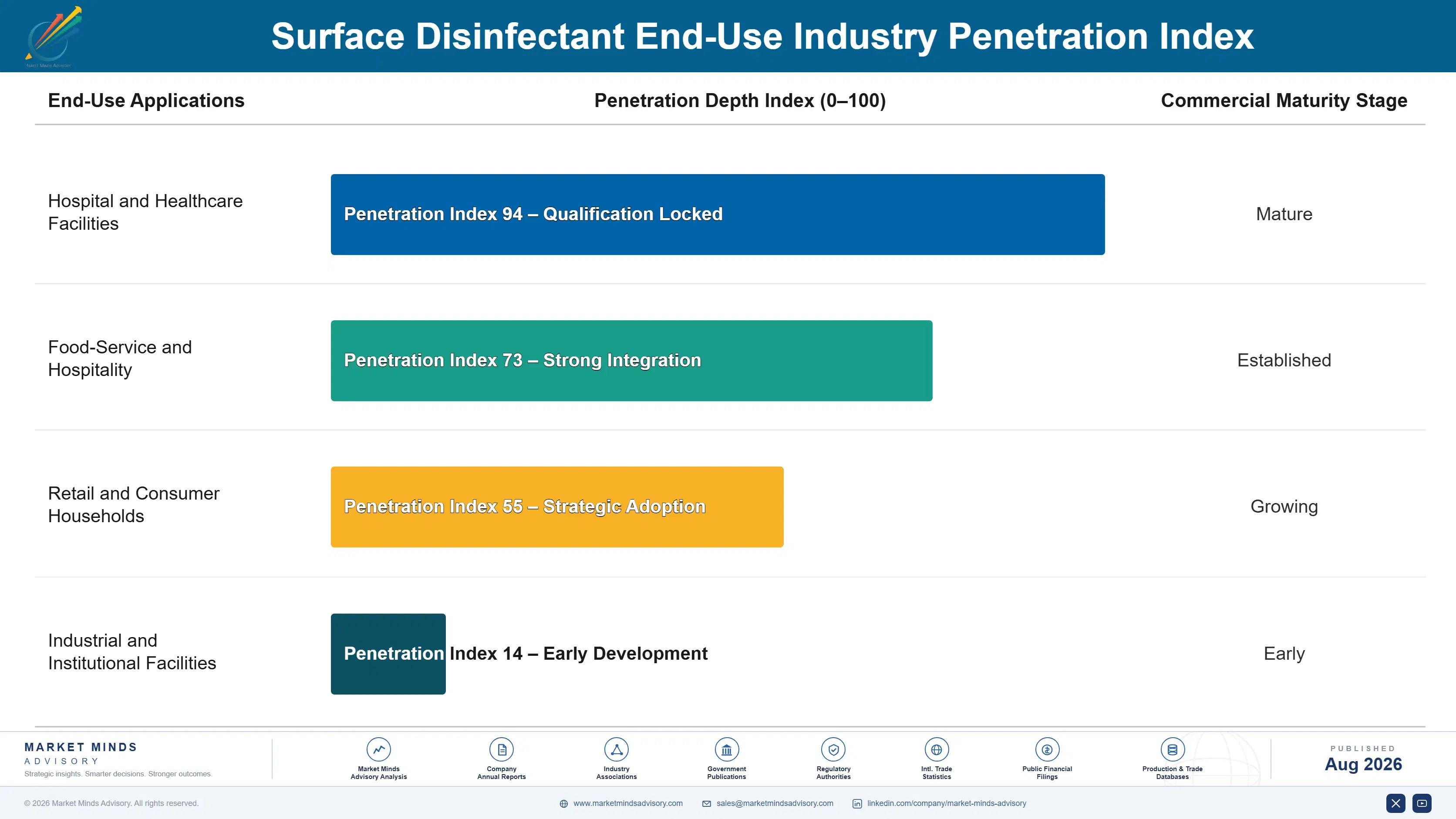
How Disinfectant Demand Actually Recurs

Consumption here is genuinely continuous, which makes it as close to an annuity as chemistry gets. A hospital ward, food plant or hotel cleans on a schedule and consumes accordingly, and nothing commercial changes the frequency. What varies is who supplies it. Roughly 58% of institutional volume is locked behind placed dispensing hardware, and those accounts renew almost automatically, while open-tender accounts reprice annually against whoever has spare capacity. The equipment, not the chemistr
Adoption depth varies sharply by end-use setting. Hospital infection prevention adopts premium chemistry deepest, since residue and resistance arguments land with the people holding the specification. Export food processing adopts whatever audit schemes require and validates it thoroughly. Domestic-only food plants adopt the cheapest compliant product and frequently nothing beyond chlorine. Hospitality and facilities management adopt on cost-in-use with occasional brand influence, and residential consumers adopt on brand and scent instead.

Buyer profiles are shifting in a way that favours technical selling. Infection prevention and food safety functions hold more specification authority than they did a decade ago, and they read efficacy data. Purchasing departments once decided alone and compared price per litre.
surface-disinfectant-market-end-use-penetration-index-1787309360004

What We Would Do Here

These are among the four positions where our research anticipates prominent divergence between winners and laggards over the coming forecast period. Each is grounded in the demand model, the regulatory perimeter, and the announced capacity pipeline.
01 / REGISTRATION PORTFOLIO TIMING

File ahead of withdrawals rather than reacting to them

European active substance reviews keep removing approved chemistry, and each withdrawal moves volume directly to whoever already holds a registered alternative ready to offer. Companies filing proactively took share roughly 15% above normal win rates through the last two review rounds, and those gains have held. A dossier near USD 480,000 looks expensive until it captures accounts a competitor served for twenty years, which is precisely the arithmetic regulatory affairs functions rarely get an opportunity to present to a board.
02 / DISPENSING NETWORK PLACEMENT

Place the hardware and price the concentrate behind it

Roughly 58% of all institutional volume already sits behind proprietary dilution equipment, and switching supplier means new dispensers, retrained staff and revalidated cleaning protocols across an entire site. Equipped accounts retain at roughly 25 points above unequipped ones, which is a form of protection that no concentrate price on its own has ever achieved. The working capital and field service cost is real and recurring, and it buys an account position that survives procurement pressure no price concession ever survives.
03 / SPECIFICATION HOLDER SELLING

Sell peroxide conversion to infection prevention teams

Peroxide chemistry costs materially more per litre than quaternary, which makes it a straightforward refusal for a procurement department and a straightforward yes for an infection prevention team weighing residue films and resistance evidence. Suppliers selling to the specification holder convert at roughly double the rate achieved by those pitching cost-in-use to purchasing departments. It needs the technical selling capability that most chemical sales organisations have never built, and building it is considerably cheaper than any registration programme would ever be.
04 / COMMODITY EXIT DISCIPLINE

Leave private label, but watch the utilisation arithmetic

Ready-to-use and private label pricing sits roughly 15% below pre-pandemic levels with capacity that will not leave the market, and exiting improves blended margin by around 6 points within a couple of years. The trap is that the same blending assets also make the protected chemistry, so lost utilisation raises unit cost on everything remaining. Several mid-tier formulators have improved margin percentage while worsening absolute contribution, which reads as commercial discipline right up until somebody actually checks the contribution numbers.

Engagement Snapshot From the Field

A live engagement with an industry participant carrying material or product regulatory and market exposure ahead of a defining policy shift, showing how our research translates into a defensible multi-year portfolio strategy.
MARKET MINDS ADVISORY · CLIENT ENGAGEMENT SUMMARY
Surface Disinfectant Producer Strategic Portfolio Review and Transition Roadmap 2026·Investment Scenario on Surface Disinfectant Exposure Evaluation 2025-26
CLIENT PROFILE
A European institutional hygiene chemistry formulator with revenue near EUR 165 million annually (client-reported, unverified by MMA), blending and filling capacity across two countries, roughly 41% of volume in private label and commodity ready-to-use formats, and registered formulations across healthcare, food processing and facilities management. The company held modest dispensing hardware placement and a regulatory function sized for maintenance rather than for new filings.
STRATEGIC CHALLENGE
Two actives central to its healthcare portfolio were entering European review, and the registrants supporting them had signalled they might not fund evaluation. Management proposed waiting for the outcome before committing to reformulation. The board was uncomfortable, since a withdrawal would strand accounts the company had held for two decades with no registered alternative ready to offer them.
MMA APPROACH
MMA modelled the account exposure under each review outcome, mapping every customer using the affected chemistry against available alternatives the company already held. Forty-seven expert interviews with infection prevention leads, food safety managers and procurement heads established what would happen at each account if conversion became necessary. Registration timelines and dossier costs were then compared against the contribution at risk.
KEY FINDINGS
  1. Accounts using the two actives under review represented roughly a third of healthcare contribution, and the company held no registered alternative that could serve them without a new dossier taking three years.
  2. Two competitors had already filed peroxide-based alternatives for the same applications, which meant a withdrawal would move those accounts directly to named rivals rather than to open tender.
  3. Infection prevention leads at eleven of the fifteen largest accounts said they would prefer peroxide chemistry regardless of the review outcome, on residue and resistance grounds nobody had ever asked them about.
  4. Private label volume was absorbing blending capacity at contribution below the fully allocated cost of running it, while protected chemistry was being turned away at capacity limits.
CLIENT PROFILE
A European institutional hygiene chemistry formulator with revenue near EUR 165 million annually (client-reported, unverified by MMA), blending and filling capacity across two countries, roughly 41% of volume in private label and commodity ready-to-use formats, and registered formulations across healthcare, food processing and facilities management. The company held modest dispensing hardware placement and a regulatory function sized for maintenance rather than for new filings.
STRATEGIC CHALLENGE
Two actives central to its healthcare portfolio were entering European review, and the registrants supporting them had signalled they might not fund evaluation. Management proposed waiting for the outcome before committing to reformulation. The board was uncomfortable, since a withdrawal would strand accounts the company had held for two decades with no registered alternative ready to offer them.
MMA APPROACH
MMA modelled the account exposure under each review outcome, mapping every customer using the affected chemistry against available alternatives the company already held. Forty-seven expert interviews with infection prevention leads, food safety managers and procurement heads established what would happen at each account if conversion became necessary. Registration timelines and dossier costs were then compared against the contribution at risk.
KEY FINDINGS
  1. Accounts using the two actives under review represented roughly a third of healthcare contribution, and the company held no registered alternative that could serve them without a new dossier taking three years.
  2. Two competitors had already filed peroxide-based alternatives for the same applications, which meant a withdrawal would move those accounts directly to named rivals rather than to open tender.
  3. Infection prevention leads at eleven of the fifteen largest accounts said they would prefer peroxide chemistry regardless of the review outcome, on residue and resistance grounds nobody had ever asked them about.
  4. Private label volume was absorbing blending capacity at contribution below the fully allocated cost of running it, while protected chemistry was being turned away at capacity limits.
RECOMMENDED STRATEGY
Phase 1: Phase 1 (0 to 6 months): Begin peroxide dossier preparation immediately rather than awaiting review outcomes, and exit the lowest-contribution private label contracts at renewal. Phase 2: Phase 2 (6 to 18 months): Build technical selling capability aimed at infection prevention leads, and place dispensing equipment across the fifteen largest healthcare accounts. Phase 3: Phase 3 (18 to 36 months): Convert freed blending capacity toward peroxide and peracid production, and index remaining institutional contracts to published active benchmarks.
OUTCOME
Dossier preparation began ahead of the review outcome. One of the two actives was subsequently withdrawn, and the company retained eleven of its fifteen largest healthcare accounts through early conversion offers (client-reported, unverified by MMA). Private label exits freed capacity that peroxide demand absorbed within three quarters. Contract indexation proved the hardest negotiation of the three.

Frequently Asked Questions

Foundational context covering the market sizes, CAGR, scope, country, region and competition that inform every finding below. This section is provided to cover basics and most often pre-purchase conversations, answered from the MMA Primary Research Dataset.

What is the current size of the Surface Disinfectant Market?

MMA sizes the global surface disinfectant market at USD 6.8 billion in 2025, rising to USD 7.21 billion in 2026. That covers biocidal hard surface formulations at formulator realised prices on a concentrate equivalent basis.

How large will the Surface Disinfectant Market be by 2036?

MMA forecasts USD 12.91 billion by 2036, an expansion multiple of 1.79 times the 2026 base. That represents roughly USD 5.70 billion of incremental value over the forecast period.

What is the CAGR for the Surface Disinfectant Market 2026 to 2036?

The base case compounds at 6.0% annually, with a bull case of 7.2% and a bear case of 4.8%. Chemistry conversion rather than volume growth accounts for most of the base case.

Which segment is growing fastest?

Hydrogen peroxide based disinfectants compound at 9.0%, exactly 1.50 times the market rate. No residue film, no demonstrated resistance mechanism and clean wastewater discharge together drive the conversion.

Who are the major companies in the Surface Disinfectant Market?

Ecolab, Solenis, Reckitt, Clorox and Steris together ship 41% of concentrate volume. Fifteen further participants including Kersia, Christeyns, Schülke & Mayr and Whiteley Corporation are profiled.

Which country is growing fastest?

India compounds at 8.9%, ahead of every other national market MMA tracks. Export-facing food processing and pharmaceutical plants adopting audited Western chemistry drive most of that growth.

Report Segmentation Architecture

The full report scope spans multiple orthogonal segmentation dimensions, with cross-tabulated demand data provided for each dimension pair. Coverage extends further to regional breakdowns, trend trajectories, and the competitive detail needed to support segment-level decision-making.

By Biocidal Active Chemistry

  • Quaternary Ammonium Compounds
  • Chlorine and Hypochlorite Based
  • Alcohol Based
  • Hydrogen Peroxide Based
  • Peracid Based
  • Phenolic, Aldehyde and Biguanide Based

By End-Use Setting

  • Hospitals and Healthcare Facilities
  • Food and Beverage Processing
  • Hospitality and Facilities Management
  • Pharmaceutical and Life Science Manufacturing
  • Institutional and Educational Premises

By Supply and Dispensing Model

  • Concentrate Through Placed Dispensing Equipment
  • Ready-to-Use Liquids and Wipes
  • Private Label and Contract Manufacture
  • Distributor and Away-From-Home Channel

By Region

  • North America
  • Western Europe
  • East Asia
  • South Asia and Pacific
  • Latin America
  • Middle East and Africa
  • Eastern Europe

Scope, Methodology, and Coverage

Every figure in this report is reproducible from documented input assumptions. The scope below maps the historical period, the forecast horizon, the segmentation dimensions, and the countries covered, alongside the underlying primary and qualitative methodology.
Historical Period
2020 to 2025
Forecast Period
2026 to 2036
Base Year
2025 (USD billions; MMA Primary Research Dataset, August 2026)
Market Definition
The market comprises chemical formulations applied to hard surfaces to kill or inactivate micro-organisms, spanning quaternary ammonium, chlorine and hypochlorite, alcohol, hydrogen peroxide, peracid, and phenolic, aldehyde and biguanide chemistries, supplied as concentrates, ready-to-use liquids, wipes and foggable formulations. Sizing is at formulator realised price on a concentrate volume equivalent basis and includes private label supply at transfer prices. Hand hygiene and skin antiseptics, instrument and endoscope reprocessing chemistry, sterilants for device manufacture, antimicrobial surface coatings, dispensing and fogging hardware, and cleaning products without a biocidal claim are outside scope.
Quantitative Units
USD billions (current prices); million litres concentrate equivalent; USD per litre at formulator realised price
Segmentation Dimensions
By Biocidal Active Chemistry; By End-Use Setting; By Supply and Dispensing Model; By Region
Regions Covered
North America, Western Europe, East Asia, South Asia and Pacific, Latin America, Middle East and Africa, Eastern Europe
Countries Covered
USA, China, Germany, France, UK, Japan, South Korea, India, Australia, Canada, Brazil, Mexico, Indonesia, Vietnam, Thailand, Malaysia, UAE, Saudi Arabia, South Africa, Nigeria, Turkey, Poland, Netherlands, Italy, Spain, Sweden, Switzerland, Argentina, Colombia, Singapore, and additional markets relevant to this sector
Key Companies Profiled
Ecolab, Solenis, Reckitt, Clorox, Steris, 3M, Kersia, Christeyns, Schülke & Mayr, PAUL HARTMANN, Contec, GOJO Industries, Zep, Betco, Whiteley Corporation, Lonza, Evonik, Solvay, Sanosil, Shanghai Likang Disinfectant.
Quantitative Methodology
Primary survey, n=3,800 respondents, Q4 2025, six countries; demand-side model with trade association cross-validation
Qualitative Methodology
47 expert interviews, Q4 2025; applied to validate demand model assumptions, identify emerging dynamics, and assess competitive positioning
Report Format
PDF and XLSX data workbook (Word format preview document)
Publisher
Market Minds Advisory
Report Code
MMA-2026-CHM-095
Published
August 2026
Contact
sales@marketmindsadvisory.com | www.marketmindsadvisory.com

Purchase the full Surface Disinfectant Market Report (2026 to 2036).

The full report sizes the surface disinfectant market across six active chemistries, five end-use settings, four supply and dispensing models and seven regions, with annual forecasts to 2036 in revenue and concentrate equivalent volume. It quantifies dispenser-locked volume separately from open-tender volume, since the two behave nothing alike at renewal and most formulators do not track the distinction. Twenty participants are assessed on a consistent concentrate volume basis, with registration portfolios mapped against active substances under review. Post-pandemic capacity overhang is quantified by format, and peroxide conversion economics are modelled by end-use setting.
Six active chemistries sized and forecast annually
Dispenser-locked volume separated from open tender
Twenty participants on consistent concentrate volume basis
Registration portfolios mapped against actives under review
Post-pandemic capacity overhang quantified by format
Peroxide conversion economics modelled by end-use setting

Built For The People Who Decide

From boardroom strategy to bench-side execution, this report is read cover-to-cover by leaders shaping the next decade of their industry, turning demand scenarios, market dynamics and valuation benchmarks into decisions.
CXOs/ Presidents/ VPs/ Managers
M&A and Corporate Development
Strategy Teams and R&D Heads
Procurement and Product Directors
Regulatory and Compliance Leaders
Investor Relations and Equity Analysts