

Market Minds Advisory
Supramalleolar Osteotomy Implants Market

Supramalleolar Osteotomy Implants Market: Correction Planning, Surgeon Scarcity and the Joint Preservation Argument

Roughly fourteen hundred surgeons worldwide can realign an arthritic ankle instead of replacing or fusing it, and almost one correction in ten has to be done all over again afterwards.

Lead Analyst

Alice Ballenger

Published

September 2026

Make Smarter Decisions with Customized Research Insights

Request a free sample report and evaluate market opportunities, growth trends, and competitive dynamics relevant to your business needs.

2025 MARKET VALUE$0.1BMarket Size 2025
2036 FORECAST VALUE$0.3BBase Case , 2026 to 2036
CAGR 2026 TO 20369.8 %Bull 11.0% / Bear 8.4%
INCREMENTAL OPPORTUNITY$0.2BNet 10- year value creation
EXPANSION MULTIPLE2.55x2036 value over 2026 base
Strategic Levers
M&A Pipeline
Regional Outlook
Country Rankings
Competitive Intelligence
Segmental Deep-dive
Call-Us : 91 93563 13602

Executive Snapshot and Market Trajectory

This market is limited by surgeons rather than by patients. Roughly 1,400 foot and ankle specialists worldwide perform supramalleolar correction regularly, against a very large population of asymmetric ankle arthritis that would otherwise face replacement or fusion. Training capacity, not implant availability, sets the growth rate.
Patient-specific guided correction systems compound at 14.7%, exactly 1.50 times the market rate, because getting the correction angle wrong is the failure mode: 9% of cases require revision for alignment. East Asia holds 30% of value, the largest position, because Japanese and Korean orthopaedics prefer joint preservation over arthroplasty far more consistently than Western practice does. Constructs realise roughly USD 3,900 each, which is modest against the surgical cost.
Five manufacturers supply 62% of implant constructs, and position rests on foot and ankle surgeon relationships and instrument set availability rather than on plate design. Ankle survival reaches 78% at ten years where correction succeeds. Only 34% of cases are planned with three-dimensional software, which is the gap the fastest segment exists to close. Instrument set availability on the day decides most individual hospital selections regardless of any implant preference the surgeon happens to hold.
Market Definition
Covers implants and constructs for supramalleolar and distal tibial corrective osteotomy in asymmetric ankle arthritis and post-traumatic malalignment, spanning patient-specific guided correction systems, anatomic locking plate systems, wedge grafts and synthetic wedge implants, staple and compression screw constructs, circular and hexapod external fixation, and conventional non-locking plate constructs. Sizing captures implant, construct and single-use instrument revenue at realised hospital price. Excludes total ankle replacement, ankle and hindfoot arthrodesis hardware, calcaneal and midfoot osteotomy implants, trauma fracture fixation, cartilage repair and osteochondral grafting, and orthotic bracing or footwear.
Base Year Value
$0.1B in 2025 (MMA Primary Research Dataset, August 2026)
Forecast Period
2026 to 2036, eleven discrete annual values
CAGR
9.8% base case. Bull 11.0%. Bear 8.4%.
Fastest Growth Segment
Patient-Specific Guided Correction Systems: 14.7% CAGR
Fastest Growth Country
India: 12.4% CAGR
Fastest Growth Region
South Asia and Pacific: 11.9% CAGR
Largest Region
East Asia: 30% of 2025 global value
Market Leaders
Stryker, Zimmer Biomet, Arthrex, Smith and Nephew, Orthofix Medical. Source: MMA Analysis based on company annual reports.
Primary Survey
n=3,800 procurement and R&D decision-makers, Q4 2025, six countries
Methodology
Demand-side build-up, cross-validated against public data, 47 expert interviews

Supramalleolar Osteotomy Implants Market Forecast Scenarios

supramalleolar-osteotomy-implants-market-size-forecast-scenario-1787309819407
Growth of 8.5% across 2020 to 2025 tracked surgeon training rather than clinical demand. Fellowship programmes in foot and ankle reconstruction expanded modestly and each newly trained surgeon added case volume that persisted, while published joint survival data strengthened the argument against early arthroplasty in younger patients. Elective orthopaedic suspension during 2020 removed volume that recovered fully afterwards. Patient-specific planning arrived late in the period.
The base case of 9.8% rests on three mechanisms. Patient-specific guided correction addresses the alignment failures causing 9% revision, which is the single largest technical obstacle to wider adoption. Joint preservation evidence keeps strengthening in younger patients where a replacement would need revising within their lifetime anyway. And Asian orthopaedic practice continues to favour preservation over arthroplasty, generating case volume growth faster than any Western market achieves on the same disease burden.
The bull case of 11.0% assumes patient-specific planning reduces revision rates enough to bring the procedure within reach of general orthopaedic surgeons rather than specialists alone, which would multiply the surgeon population considerably. The bear case of 8.4% reflects two pressures: total ankle replacement improving enough to remove the preservation argument in middle-aged patients, and fellowship training capacity failing to expand at all.

Fourteen Hundred Surgeons Worldwide

Almost everything commercially interesting about this market follows from one number. Roughly 1,400 surgeons worldwide perform supramalleolar correction regularly, against a population of asymmetric ankle arthritis measured in millions, because realigning a tibia above an arthritic joint to redistribute load is genuinely difficult to plan and genuinely difficult to execute. Get the correction angle wrong and the joint fails anyway, which is what the 9% revision rate for malunion actually represe
TOP FIVE CONCENTRATION62%Implant constructs supplied by the leading orthopaedic manufacturers
AVERAGE CONSTRUCT PRICEUSD 3,900Realised hospital price for one corrective osteotomy construct
TEN-YEAR JOINT SURVIVAL78%Ankles avoiding replacement or fusion after corrective surgery
SURGEONS PERFORMING ANNUALLY1,400Foot and ankle specialists undertaking the procedure regularly
PREOPERATIVE PLANNING ADOPTION34%Cases planned with three-dimensional correction software beforehand entirely
MALUNION REVISION RATE9%Corrections requiring further surgery for alignment failure alone
The clinical argument for doing it is strong where it applies. Ankle survival reaches 78% at ten years when correction succeeds, which matters enormously in a forty-five year old who would otherwise face a replacement requiring revision within their lifetime or a fusion ending ankle motion permanently. Arthroplasty has improved and has not removed that argument for younger patients. Fusion remains reliable and remains a permanent loss of function nobody chooses lightly.
Two forces determine the next decade. Patient-specific guided correction attacks the planning problem directly and compounds at 14.7%, with only 34% of cases currently planned in three dimensions. And surgeon training capacity remains the binding constraint on everything, because no implant improvement expands a procedure that too few people can perform.
"You can count the surgeons who do this well, and that is the entire market. The implants are not the hard part and never were: planning a three-plane correction above an arthritic joint is. Patient-specific guides matter because they might let a good general orthopaedic surgeon do what only a specialist can do today, and that would change the arithmetic completely."
Director, Foot and Ankle Reconstruction Practice · MMA Medical Devices / Foot an

Market Trends

Patient-specific guides attack the correction planning problem

Planning a three-plane correction above an arthritic ankle from plain radiographs is difficult enough that 9% of cases need revision for alignment failure, and that risk is what keeps most orthopaedic surgeons away from the procedure entirely. Patient-specific cutting guides derived from computed tomography transfer the plan into the operation directly, and the segment compounds at 14.7% against 9.8% for the market. Only 34% of cases currently use three-dimensional planning at all. Manufacturing lead time is the practical constraint, since guides take weeks to produce, which rules out urgent and semi-urgent cases entirely.
Market Impact: Holds 30% of global construct value
Joint preservation evidence strengthens against early arthroplasty

Ankle survival reaching 78% at ten years after successful correction gives younger patients an alternative to a replacement they would outlive and a fusion that ends ankle motion permanently. Published series have lengthened considerably, and the argument is now made in guideline discussions rather than only in specialist journals. Arthroplasty has improved substantially and has not displaced the case in patients under fifty. That evidence base is the main reason fellowship interest in the procedure has grown at all. Fusion remains reliable and remains a permanent loss of ankle motion nobody chooses lightly.
Market Impact: Affects patients 20 years younger

Market Opportunities and Growth Drivers

Asian orthopaedic practice prefers preservation over arthroplasty consistently

Japanese and Korean orthopaedic culture favours joint-preserving reconstruction over replacement far more consistently than Western practice does, and much of the published supramalleolar literature originated in Japanese centres. That preference produces case volume out of proportion to population and to arthritis prevalence. East Asia holds 30% of category value at 10.8% growth. Chinese foot and ankle subspecialty capacity is expanding quickly from a low base, and domestic implant manufacturers are entering the anatomic plate segment at accessible pricing. Regional case volume therefore runs well ahead of what arthritis prevalence alone would predict.
Market Impact: Limits volume to 1,400 surgeons

Post-traumatic malalignment generates a younger patient population

A substantial share of asymmetric ankle arthritis follows earlier fracture or ligament injury rather than primary degeneration, which means the affected population is considerably younger than in hip or knee arthritis. A thirty-five year old with post-traumatic varus malalignment is a poor arthroplasty candidate by any measure, since a replacement would require revision within their lifetime. That demographic reality is what sustains the procedure clinically and what makes the preservation argument straightforward to make to patients. Road traffic injury rates in developing markets keep enlarging that population considerably faster than degeneration does.
Market Impact: Holds argument below 50 years

Market Restraints and Challenges

Surgeon scarcity caps procedure volume regardless of implants

Roughly 1,400 surgeons worldwide perform this correction regularly, and the root cause is technical difficulty rather than any lack of interest: planning and executing a three-plane correction above an arthritic joint requires fellowship-level training and case volume to maintain. No implant improvement expands a procedure too few people can perform. Participants respond by funding fellowship positions and cadaveric training, by supporting surgeon-led teaching faculties, and by developing patient-specific guides that might bring the technique within reach of general orthopaedic surgeons. None of that expands the surgeon population quickly, which is why growth stays measured.
Market Impact: Cuts malunion revision below 9%

Arthroplasty improvement erodes the preservation argument gradually

Total ankle replacement design and survivorship have improved substantially, and the root cause of the commercial risk is that every improvement lowers the age at which arthroplasty becomes defensible. Preservation currently holds the argument in patients under fifty. Participants respond by generating longer joint survival series, by emphasising the revision burden a young arthroplasty patient eventually faces, and by holding positions in both procedures so that a shift in indication boundaries changes revenue mix rather than revenue level. Preservation and replacement are competing procedures, which makes holding both genuinely uncomfortable internally.
Market Impact: Preserves 78% of joints at ten
3 additional market trends, 4 additional growth drivers, and 2 additional restraints and challenges are covered in the full report. Contact sales@marketmindsadvisory.com to access the complete intelligence.

Segment CAGR and Growth Architecture

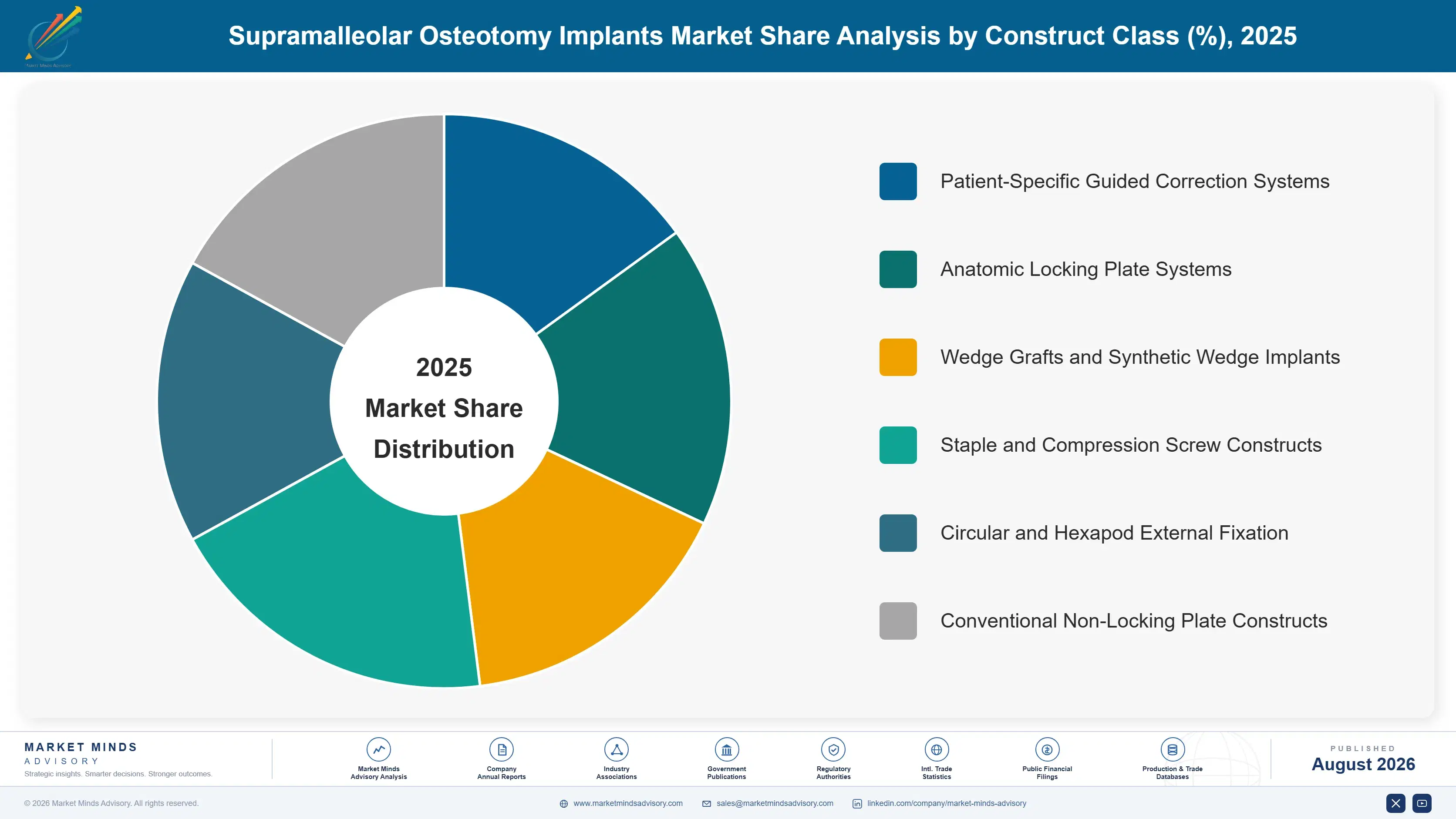
Segmentation follows the implant or construct class, because construct type determines the planning requirement, the surgical technique and the price a hospital pays. Patient aetiology, care setting and geography all matter commercially but cut across every construct class, so they belong in later discussion. Six construct classes cover current supramalleolar correction practice worldwide, and their commercial models differ considerably.
supramalleolar-osteotomy-implants-market-market-share-analysis-1787309819965

Patient-Specific Guided Correction Systems

Patient-specific guided systems compound at 14.7%, exactly 1.50 times the market rate, and they exist to solve the one problem that actually limits this procedure. Planning a three-plane correction from plain radiographs is hard enough that 9% of cases need revision for malunion, and cutting guides derived from computed tomography transfer the plan into the operation directly. Three commercial features follow. Realised pricing runs several times a conventional plate construct, because the planning service is the product. Manufacturing lead time of several weeks rules out urgent cases entirely. And they might eventually bring the technique within reach of general orthopaedic surgeons, which would change the arithmetic of this whole category completely.
CAGR 14.7%

Anatomic Locking Plate Systems

Anatomic locking plates grow at 11.3%, second fastest, and they are what most correction actually uses today. Pre-contoured medial and lateral distal tibial plates with locking screw options hold a corrected position through bone healing without the prominence that troubled earlier constructs. Instrument set availability rather than plate design decides selection in most hospitals, since a surgeon performing a handful of these annually needs the full instrumentation on the shelf. That favours manufacturers with broad foot and ankle portfolios and consignment capability over specialists with better individual implants. Domestic Asian manufacturers are entering this class at pricing Western producers cannot match on conventional plate geometry, which is squeezing this class from below already.
CAGR 11.3%
Full segment breakdown across 6 segments available in the complete report.

Regional Architecture and Country Demand Map

East Asia leads at 30% of value because Japanese and Korean orthopaedics favour joint preservation over arthroplasty far more consistently than Western practice. North America follows at 26% on construct pricing. South Asia and Pacific grows fastest, led by India at 12.4%, on post-traumatic burden.

North America

Twenty-six percent of global value sits in North America, growing at 9.0%, and construct pricing rather than case volume explains the position. Realised prices here run well above other regions on identical implants. Foot and ankle fellowship programmes are well established and produce most of the world's newly trained specialists, though total ankle replacement has grown faster than preservation surgery in the same period. Patient-specific planning adoption is highest here, supported by surgeons comfortable with preoperative imaging workflows. Consignment instrument availability rather than implant preference decides most hospital selections. Total ankle replacement has grown faster than correction surgery here, which is the standing commercial risk for anybody holding only a preservation portfolio.
Share: 26% | CAGR: 9.0% (2026 to 2036)

Western Europe

Twenty-four percent of value and 8.3% growth reflect strong specialist centres and considerable published output. Swiss, German and Dutch foot and ankle units contributed much of the European evidence base and maintain unusually high case volumes per surgeon. British provision runs through a smaller number of tertiary centres with long waiting lists. Public system procurement compresses construct pricing considerably relative to North America. Patient-specific guided systems face reimbursement questions in several countries, since the planning service sits awkwardly inside procedure payments designed around implants alone. Fellowship exchange between Swiss, German and Dutch units has produced a concentrated group of high-volume surgeons whose construct preferences carry a genuinely disproportionate amount of commercial weight.
Share: 24% | CAGR: 8.3% (2026 to 2036)
Regional intelligence for 5 additional markets available in the complete report: East Asia, South Asia and Pacific, Latin America, Middle East and Africa, Eastern Europe. Contact sales@marketmindsadvisory.com.
supramalleolar-osteotomy-implants-market-country-cagr-analysis-1787309820517

Four Ways To Grow A Constrained Procedure

Only 1,400 surgeons perform this correction regularly and 9% of their cases need revision for alignment, which means capability rather than patients or implants limits volume. The levers that matter expand the surgeon population, cut the technical failure rate and hold the instrument availability deciding selection. Each carries returns tested against disclosed manufacturer economics and primary interview evidence.

Fund fellowship and cadaveric training as market building

Procedure volume is limited by how many surgeons can plan and execute a three-plane correction, and each newly trained specialist adds case volume that persists for a career. Manufacturers funding fellowship positions and cadaveric courses report implant selection loyalty roughly 65% higher among surgeons they trained than among those they did not. It costs money years before revenue and benefits competitors whenever a trained surgeon switches, which is precisely why the category remains chronically under-trained. A market leader accepting that cost anyway captures most of the resulting volume growth for itself.
Market Impact: Lifts selection loyalty roughly 65%

Sell the planning service, not the cutting guide

Patient-specific systems realise several times a conventional construct price, and the reason is the three-dimensional planning that precedes the guide rather than the printed part itself. Manufacturers presenting planning as a service with surgeon collaboration report adoption roughly 50% above those selling guides as premium implants. It requires clinical engineering staff who can discuss correction angles with surgeons credibly, which is a capability implant sales organisations have essentially never needed before now. Surgeons treat the plan as the deliverable and the guide as merely the means of actually executing it properly.
Market Impact: Raises adoption roughly 50% above p

Hold full instrument sets on consignment everywhere

A surgeon performing a handful of these corrections annually needs complete instrumentation available on the day, and hospitals will not stock sets for a procedure this infrequent. Manufacturers holding consignment sets across their accounts report construct selection wins roughly 55% above those requiring set delivery on request. It ties up considerable inventory against very low turnover, which finance functions question repeatedly and which is nonetheless the single clearest determinant of selection in this category. Hospitals will not stock sets for a procedure performed as infrequently as this one is anywhere.
Market Impact: Wins construct selection roughly 55

Hold positions in preservation and replacement together

Arthroplasty improvement keeps lowering the age at which replacement becomes defensible, and preservation currently holds the argument below fifty. Manufacturers holding both correction and total ankle replacement portfolios report revenue stability roughly 35% better through indication boundary shifts than single-position competitors manage. It requires investment in two procedures partly competing with each other, which product organisations find uncomfortable and which is the only genuine hedge available here. Indication boundaries have moved before and will move again, whatever the current evidence position happens to be at any given moment in time.
Market Impact: Improves revenue stability roughly

Who Controls the Margin Pool

Five manufacturers supply 62% of implant constructs, the basis on which MMA assesses every participant here, and that concentration reflects foot and ankle portfolio breadth rather than any specific implant advantage. Stryker leads through its extremities business and the surgeon relationships behind it. Arthrex holds strong foot and ankle positions supported by unusually extensive surgeon education infrastructure.
Competitive activity runs along three lines. Surgeon training investment is the primary contest, because the surgeon population rather than the patient population limits volume. Patient-specific planning capability is being built or bought by everyone with a foot and ankle portfolio worth defending. And consignment instrument availability decides most individual hospital selections regardless of implant preference.

Pressure arrives from two directions. Specialist foot and ankle manufacturers including Paragon 28, Medartis and In2Bones compete with focused portfolios and surgeon relationships that large diversified companies find hard to match in a subspecialty this small. Meanwhile domestic Asian manufacturers are entering the conventional plate segment at pricing nobody Western can approach. Rankings shift toward participants holding trained surgeon relationships and credible planning capability, because those two decide who supplies the growth this procedure actually has.
supramalleolar-osteotomy-implants-market-company-positioning-matrix-1787309821035

Competitive Moat and Risk Dimensions

STRYKER

Moat: Extremities portfolio and surgeon reach

The company holds one of the broadest foot and ankle portfolios spanning correction, arthroplasty and arthrodesis together, which means it participates whichever procedure a surgeon selects for a given patient. Consignment capability across a large account base removes the availability problem deciding most selections. Its extremities sales infrastructure reaches foot and ankle specialists through several categories at once.
STRYKER

Risk: Subspecialty attention against scale

Supramalleolar correction is minor within a very large orthopaedic business, which means investment in patient-specific planning, fellowship funding and implant refinement competes against hip, knee and trauma programmes with vastly greater revenue. Specialist foot and ankle manufacturers move considerably faster. Surgeon relationships in a subspecialty this small are personal, and specialists cultivate them more attentively than a diversified group manages.
ARTHREX

Moat: Surgeon education infrastructure depth

The company operates surgeon education and cadaveric training facilities at a scale no competitor in this subspecialty approaches, which matters more here than anywhere because trained surgeon count is the binding constraint. Surgeons trained on its instrumentation select it disproportionately afterwards. Privately held status also lets it fund training without the quarterly scrutiny public competitors face.
ARTHREX

Risk: Limited arthroplasty hedge position

The company holds a weaker total ankle replacement position than several competitors, which leaves it exposed if arthroplasty improvement continues lowering the age at which replacement becomes defensible. Preservation is the position it holds most strongly. Building a competitive arthroplasty portfolio in a subspecialty this small is difficult to justify against the training investment already committed elsewhere.

Players Tracked

Prominent Players

Stryker
Zimmer Biomet
Arthrex
Smith and Nephew
Orthofix Medical

Other Key Players

DePuy Synthes
Medartis
Acumed
Paragon 28
Integra LifeSciences
Extremity Medical
Globus Medical
Nextremity Solutions
In2Bones
Novastep
NewClip Technics
OrthoPediatrics
Kyocera
Teijin Nakashima Medical
Waldemar Link

Recent Developments

MAY 2025

Paragon 28 launched a patient-specific supramalleolar correction system

The launch combines computed tomography based three-dimensional planning with printed cutting guides and matched anatomic plates, addressing the alignment failures that drive revision in nearly one case in ten. It was an organic product development programme rather than an acquisition, joint venture or partnership arrangement whatsoever.
Signal: A specialist launching planning-led correc
OCTOBER 2025

Medartis expanded its anatomic distal tibial plate range

The company added medial and lateral pre-contoured plate options with revised locking configurations, citing surgeon feedback on prominence and screw trajectory in corrective rather than in trauma applications specifically. It was an organic product range extension rather than any acquisition, joint venture or partnership arrangement whatsoever.
Signal: Designing plates for correction rather tha
FEBRUARY 2026

Zimmer Biomet acquired a three-dimensional orthopaedic planning developer

The acquisition brings preoperative correction planning software and guide manufacturing capability, addressing a gap that left the company selling implants into procedures whose planning had been happening entirely somewhere else beforehand. Terms were not disclosed. It was an outright acquisition rather than a licensing arrangement.
Signal: Buying planning capability means participa

Titanium, Machining And Guides

Cost structure is dominated by metal and machining rather than volume economics. Medical-grade titanium is roughly 24% of construct cost of goods, with mill supply concentrated among few qualified producers. Precision machining and surface finishing contribute 29%, much of it fixed setup cost spread across very small production runs. Sterile packaging and validation add 13%, and instrument amortisation a further 11%.
The 2022 titanium disruption affected this industry directly. Aerospace-grade titanium supply tightened sharply as one major producer became commercially inaccessible to Western buyers, US Census Bureau import data recorded sharply higher titanium values across the period, and IEA data recorded industrial energy prices well above prior averages which raised machining cost simultaneously. Several participants disclosed elevated input costs in annual reports for that year. The impact fell on margin under existing hospital contracts.

Exposure varies by production scale and contract structure, and the mechanism is hospital contract pricing against variable titanium and energy cost. Manufacturers running very small batches carried disproportionate setup cost, since fixed machining cost cannot be spread in a subspecialty this small. Diversified orthopaedic groups absorbed it across far larger titanium volumes comfortably. Patient-specific guide production carried additive cost that moved considerably less than mill titanium.
supramalleolar-osteotomy-implants-market-cost-volatility-analysis-1787309821231

Contract medical-grade titanium on multi-year committed volumes

Medical titanium comes from a short list of qualified mills and represents 24% of construct cost, and hospital contract pricing cannot follow metal movement upward. Multi-year committed volumes cost a premium and remove that exposure permanently. Qualifying an alternate mill requires material testing and regulatory notification measured in quarters, so redundancy must exist before the disruption arrives.

Pool machining runs across the foot and ankle portfolio

Fixed machining setup cost cannot be spread across the tiny production runs a single correction construct requires, which is why small manufacturers carry disproportionate unit cost. Pooling runs across a wider foot and ankle portfolio spreads that setup considerably. It requires portfolio breadth specialists lack, and it explains why diversified groups hold cost advantages the implants never justify.

Index hospital contracts to published titanium benchmarks

Hospital construct contracts running multiple years transferred the whole 2022 titanium movement onto manufacturers with no recovery mechanism available. Indexation to published titanium or metal benchmarks shares that exposure, and hospital procurement accepts it more readily at renewal than manufacturers expect them to. Those who never asked absorbed the movement and reported it as margin compression instead of raising it.

Portfolio Architecture for Margin Defence

Portfolio economics separate on whether a manufacturer participates in the planning decision. Conventional non-locking plate constructs earn gross margin in the low fifties, competing against Asian producers on price with nothing to differentiate. Anatomic locking plates earn considerably more, defended by instrument set availability and surgeon familiarity rather than by design. Patient-specific guided systems earn most, because the planning service rather than the printed part is what a hospit
The tension between volume and premium is unusual because the volume is so small in absolute terms. A subspecialty performed by 1,400 surgeons cannot support the fixed machining and set costs diversified portfolios spread across far larger businesses. That is why specialists compete on surgeon relationships while diversified groups compete on availability and cost, and why both models persist without either displacing the other.

High-value pools concentrate in three places: patient-specific planning and guided correction where the service carries the price, trained surgeon relationships that determine construct selection for a career, and consignment instrument availability that decides individual hospital cases. None is large in absolute revenue terms. Each is defended by clinical engineering, training investment or working capital rather than implant design, which competitors replicate within a cycle.

Volume / Commodity-Adjacent Tier

Conventional non-locking plate constructs, staple and compression screw fixation, and generic wedge implants. Domestic Asian producers compete directly on price, and nothing about these constructs differentiates them commercially anywhere in the world.
Gross Margin: 48-58%

Premium / Certified Tier

Anatomic locking plate systems and circular or hexapod external fixation constructs. Instrument availability and surgeon familiarity defend pricing rather than any design advantage. The nine-point range reflects consigned against delivered instrument economics.
Gross Margin: 62-71%

Sustainability / Regulatory / Next-Generation Tier

Patient-specific guided correction systems with three-dimensional planning services attached. The planning service rather than the printed guide carries the pricing entirely. The twelve-point range reflects service-led against product-led commercial models.
Gross Margin: 72-84%
supramalleolar-osteotomy-implants-market-portfolio-architecture-1787309821743

High-value Sub-segments and Strategic Watch-out

Patient-specific planning services

Where the three-dimensional planning rather than the printed guide carries the price, and clinical engineering capability is what actually delivers it. Lead times rule out urgent cases. It might eventually widen the surgeon population considerably. Clinical engineering staff rather than sales representatives are what deliver it.
Gross Margin: 74-84%

Trained surgeon relationships

Where a fellowship or cadaveric course determines construct selection across an entire career, which is the longest payback in orthopaedic commercial investment. Competitors benefit whenever surgeons move. Under-investment across the category is chronic. Nothing else in orthopaedics pays back over anything like that long a horizon.
Gross Margin: 66-76%

Conventional construct volume

The cheapest constructs and the least defensible, with domestic Asian producers competing directly on price and nothing distinguishing the implants themselves. Fixed machining cost hurts small manufacturers most. Portfolio pooling is the only real answer. Nothing about the implants themselves distinguishes one of them from another.
Gross Margin: 48-58%

Consignment instrument availability

Decides individual hospital selections more reliably than implant preference does, because nobody stocks sets for a procedure performed this rarely. Working capital is the whole requirement. Finance functions question it and surgeons never do. Nobody stocks sets for a procedure performed as infrequently as this one.
Gross Margin: 62-71%

How Correction Demand Actually Arises

Demand here is episodic, surgeon-mediated and unusually inelastic to anything a manufacturer does. A patient with asymmetric ankle arthritis reaches correction only if they consult one of roughly 1,400 surgeons who perform it, and that consultation depends on referral patterns rather than on patient awareness or implant marketing. There is no consumable and no annuity, though a successful correction avoids the arthroplasty or fusion that would otherwise have followed, which is a revenue transfer
Adoption depth varies almost entirely by surgeon capability. Fellowship-trained foot and ankle specialists in high-volume centres perform corrections routinely and adopt patient-specific planning readily. General orthopaedic surgeons refer these patients onward or offer arthroplasty and fusion instead, which is the appropriate decision given the technical demands. Trauma-heavy practices in markets with high road injury rates see the post-traumatic population first and refer variably. Public systems with long waiting lists frequently default to fusion on throughput grounds.

Buyer profiles remain surgeon-led to an unusual degree. Hospital procurement negotiates price and rarely challenges construct selection in a procedure this infrequent, and instrument availability on the day matters more to the outcome than any contract term does.
supramalleolar-osteotomy-implants-market-end-use-penetration-index-1787309822242

What We Would Do Here

These are among the four positions where our research anticipates prominent divergence between winners and laggards over the coming forecast period. Each is grounded in the demand model, the regulatory perimeter, and the announced capacity pipeline.
01 / SURGEON TRAINING INVESTMENT

Fund fellowships, because surgeons are the actual market

Procedure volume is limited by how many surgeons can plan and execute a three-plane correction above an arthritic joint, and each newly trained specialist adds case volume that then persists for an entire career. Manufacturers funding fellowship positions and cadaveric courses report implant selection loyalty roughly 65% higher among surgeons they trained than among those they did not. It costs money years before any revenue and benefits competitors whenever a trained surgeon moves, which is precisely why this category stays chronically under-trained.
02 / PLANNING SERVICE POSITIONING

Sell the correction plan, not the printed guide

Patient-specific systems realise several times a conventional construct price and the reason is the three-dimensional planning preceding the guide rather than the printed part that emerges from it. Manufacturers presenting planning as a collaborative service with the surgeon report adoption roughly 50% above those selling the guides as premium implants instead. It requires clinical engineering staff who can discuss correction angles credibly with specialists, which is a capability implant sales organisations have essentially never needed to build before this point.
03 / INSTRUMENT AVAILABILITY DISCIPLINE

Consign complete sets or lose the case entirely

A surgeon performing a handful of these corrections each year needs the complete instrumentation available on the day itself, and no hospital anywhere stocks sets for a procedure performed as infrequently as this. Manufacturers holding consignment sets across their accounts report construct selection wins roughly 55% above those requiring set delivery on request. It ties up considerable inventory against very low turnover, which finance functions question repeatedly and which remains the single clearest determinant of construct selection anywhere in this category.
04 / INDICATION BOUNDARY HEDGING

Own preservation and replacement, not just one

Total ankle arthroplasty design and survivorship keep improving, and every improvement lowers the age at which replacement becomes clinically defensible against corrective surgery instead of it. Manufacturers holding both correction and total ankle replacement portfolios report revenue stability roughly 35% better through indication boundary shifts than single-position competitors ever manage. It requires investing in two procedures that directly and partly compete with each other, which product organisations find uncomfortable and which nonetheless remains the only genuine hedge available anywhere here.

Engagement Snapshot From the Field

A live engagement with an industry participant carrying material or product regulatory and market exposure ahead of a defining policy shift, showing how our research translates into a defensible multi-year portfolio strategy.
MARKET MINDS ADVISORY · CLIENT ENGAGEMENT SUMMARY
Supramalleolar Osteotomy Implants Producer Strategic Portfolio Review and Transition Roadmap 2026·Investment Scenario on Supramalleolar Osteotomy Implants Exposure Evaluation 2025-26
CLIENT PROFILE
A specialist foot and ankle implant manufacturer with supramalleolar correction revenue near USD 14 million annually (client-reported, unverified by MMA), a well-regarded anatomic locking plate range, limited consignment instrument capability outside two markets, no patient-specific planning offering, and no total ankle replacement portfolio. Roughly 88% of revenue came from surgeons the company had never trained directly.
STRATEGIC CHALLENGE
Revenue had grown steadily but well below category growth, and management proposed a plate design refresh to differentiate against larger competitors. The board suspected the constraint was commercial reach rather than implant design, but nobody had established what actually determined construct selection in the accounts the company had actually been losing.
MMA APPROACH
MMA interviewed surgeons across 46 accounts where the client had won or lost correction cases, coding each decision by determinant. Forty-seven expert interviews with fellowship directors, foot and ankle specialists, hospital procurement leads and theatre managers established how selection actually happened. The client's consignment footprint and training investment were then benchmarked against the participants winning those accounts.
KEY FINDINGS
  1. Instrument set availability on the day of surgery determined the outcome in 31 of 46 decisions reviewed, and implant design was cited as decisive in only four of them anywhere.
  2. Surgeons trained through a manufacturer's fellowship or cadaveric programme selected that manufacturer in the great majority of subsequent cases, and the client had trained almost none of them.
  3. Patient-specific planning was being requested by surgeons in eleven accounts, and the client's inability to offer it had cost cases where its plates were otherwise preferred.
  4. The plate design refresh management proposed addressed features no surgeon interviewed had raised as a limitation of the existing range at all.
CLIENT PROFILE
A specialist foot and ankle implant manufacturer with supramalleolar correction revenue near USD 14 million annually (client-reported, unverified by MMA), a well-regarded anatomic locking plate range, limited consignment instrument capability outside two markets, no patient-specific planning offering, and no total ankle replacement portfolio. Roughly 88% of revenue came from surgeons the company had never trained directly.
STRATEGIC CHALLENGE
Revenue had grown steadily but well below category growth, and management proposed a plate design refresh to differentiate against larger competitors. The board suspected the constraint was commercial reach rather than implant design, but nobody had established what actually determined construct selection in the accounts the company had actually been losing.
MMA APPROACH
MMA interviewed surgeons across 46 accounts where the client had won or lost correction cases, coding each decision by determinant. Forty-seven expert interviews with fellowship directors, foot and ankle specialists, hospital procurement leads and theatre managers established how selection actually happened. The client's consignment footprint and training investment were then benchmarked against the participants winning those accounts.
KEY FINDINGS
  1. Instrument set availability on the day of surgery determined the outcome in 31 of 46 decisions reviewed, and implant design was cited as decisive in only four of them anywhere.
  2. Surgeons trained through a manufacturer's fellowship or cadaveric programme selected that manufacturer in the great majority of subsequent cases, and the client had trained almost none of them.
  3. Patient-specific planning was being requested by surgeons in eleven accounts, and the client's inability to offer it had cost cases where its plates were otherwise preferred.
  4. The plate design refresh management proposed addressed features no surgeon interviewed had raised as a limitation of the existing range at all.
RECOMMENDED STRATEGY
Phase 1: Phase 1 (0 to 9 months): Cancel the plate design refresh, and redirect that spend into consignment instrument sets across priority accounts. Phase 2: Phase 2 (9 to 24 months): Establish a cadaveric training programme with surgeon-led faculty, and partner for patient-specific planning capability. Phase 3: Phase 3 (24 to 42 months): Contract titanium supply on multi-year committed terms, and evaluate arthroplasty portfolio access through licensing arrangements.
OUTCOME
The plate design refresh was cancelled before engineering commitment. Consignment sets were placed across priority accounts and selection wins improved measurably within four quarters (client-reported, unverified by MMA). A cadaveric training programme was established with surgeon-led faculty. Patient-specific planning was partnered rather than built, and arthroplasty access was evaluated and deferred.

Frequently Asked Questions

Foundational context covering the market sizes, CAGR, scope, country, region and competition that inform every finding below. This section is provided to cover basics and most often pre-purchase conversations, answered from the MMA Primary Research Dataset.

What is the current size of the Supramalleolar Osteotomy Implants Market?

MMA sizes the global supramalleolar osteotomy implants market at USD 0.11 billion in 2025, rising to USD 0.12 billion in 2026. That covers implant, construct and single-use instrument revenue at realised hospital price.

How large will the Supramalleolar Osteotomy Implants Market be by 2036?

MMA forecasts USD 0.31 billion by 2036, an expansion multiple of 2.55 times the 2026 base. That represents roughly USD 0.19 billion of incremental revenue across the forecast period.

What is the CAGR for the Supramalleolar Osteotomy Implants Market 2026 to 2036?

The base case compounds at 9.8% annually, with a bull case of 11.0% and a bear case of 8.4%. Whether patient-specific planning widens the surgeon population decides which case materialises.

Which segment is growing fastest?

Patient-specific guided correction systems compound at 14.7%, exactly 1.50 times the market rate. They attack the alignment planning failures that drive revision in nearly one case in ten.

Who are the major companies in the Supramalleolar Osteotomy Implants Market?

Stryker, Zimmer Biomet, Arthrex, Smith and Nephew and Orthofix Medical together supply 62% of constructs. Fifteen further participants including Medartis, Paragon 28 and In2Bones are profiled.

Which country is growing fastest?

India compounds at 12.4%, ahead of every other national market MMA tracks here. A severe young post-traumatic malalignment population and building private capability drive that growth.

Report Segmentation Architecture

The full report scope spans multiple orthogonal segmentation dimensions, with cross-tabulated demand data provided for each dimension pair. Coverage extends further to regional breakdowns, trend trajectories, and the competitive detail needed to support segment-level decision-making.

By Construct Class

  • Patient-Specific Guided Correction Systems
  • Anatomic Locking Plate Systems
  • Wedge Grafts and Synthetic Wedge Implants
  • Staple and Compression Screw Constructs
  • Circular and Hexapod External Fixation
  • Conventional Non-Locking Plate Constructs

By Patient Aetiology

  • Post-Traumatic Varus Malalignment
  • Post-Traumatic Valgus Malalignment
  • Primary Asymmetric Ankle Osteoarthritis
  • Congenital and Developmental Deformity
  • Failed Prior Ankle Reconstruction

By Surgical Setting

  • Academic Foot and Ankle Centres
  • Private Orthopaedic Hospitals
  • General Hospital Orthopaedic Departments
  • Ambulatory Surgical Centres

By Region

  • North America
  • Western Europe
  • East Asia
  • South Asia and Pacific
  • Latin America
  • Middle East and Africa
  • Eastern Europe

Scope, Methodology, and Coverage

Every figure in this report is reproducible from documented input assumptions. The scope below maps the historical period, the forecast horizon, the segmentation dimensions, and the countries covered, alongside the underlying primary and qualitative methodology.
Historical Period
2020 to 2025
Forecast Period
2026 to 2036
Base Year
2025 (USD billions; MMA Primary Research Dataset, August 2026)
Market Definition
The market comprises implants and constructs for supramalleolar and distal tibial corrective osteotomy in asymmetric ankle arthritis and post-traumatic malalignment, spanning patient-specific guided correction systems, anatomic locking plate systems, wedge grafts and synthetic wedge implants, staple and compression screw constructs, circular and hexapod external fixation, and conventional non-locking plate constructs. Sizing captures implant, construct and single-use instrument revenue at realised hospital price. Total ankle replacement, ankle and hindfoot arthrodesis hardware, calcaneal and midfoot osteotomy implants, trauma fracture fixation, cartilage repair and osteochondral grafting, and orthotic bracing or footwear are outside scope.
Quantitative Units
USD billions (current prices); thousand constructs implanted annually; USD per construct at realised hospital price
Segmentation Dimensions
By Construct Class; By Patient Aetiology; By Surgical Setting; By Region
Regions Covered
North America, Western Europe, East Asia, South Asia and Pacific, Latin America, Middle East and Africa, Eastern Europe
Countries Covered
Japan, South Korea, USA, Germany, Switzerland, Netherlands, UK, France, Italy, Spain, Austria, Sweden, China, Taiwan, India, Australia, Canada, Brazil, Mexico, Argentina, Colombia, Indonesia, Thailand, Malaysia, UAE, Saudi Arabia, Israel, Turkey, South Africa, Poland, Czech Republic, and additional markets relevant to this sector
Key Companies Profiled
Stryker, Zimmer Biomet, Arthrex, Smith and Nephew, Orthofix Medical, DePuy Synthes, Medartis, Acumed, Paragon 28, Integra LifeSciences, Extremity Medical, Globus Medical, Nextremity Solutions, In2Bones, Novastep, NewClip Technics, OrthoPediatrics, Kyocera, Teijin Nakashima Medical, Waldemar Link.
Quantitative Methodology
Primary survey, n=3,800 respondents, Q4 2025, six countries; demand-side model with trade association cross-validation
Qualitative Methodology
47 expert interviews, Q4 2025; applied to validate demand model assumptions, identify emerging dynamics, and assess competitive positioning
Report Format
PDF and XLSX data workbook (Word format preview document)
Publisher
Market Minds Advisory
Report Code
MMA-2026-MED-319
Published
August 2026
Contact
sales@marketmindsadvisory.com | www.marketmindsadvisory.com

Purchase the full Supramalleolar Osteotomy Implants Market Report (2026 to 2036).

The full report sizes the supramalleolar osteotomy implants market across six construct classes, five patient aetiologies, four surgical settings and seven regions, with annual forecasts to 2036 in revenue and constructs implanted. It codes construct selection decisions across a large sample of accounts by determinant, which is the analysis that establishes how far instrument availability and surgeon training outweigh implant design commercially. Twenty participants are assessed on a consistent constructs supplied basis, with patient-specific planning capability and consignment instrument footprint mapped separately. Surgeon training investment is compared across manufacturers, and revision rates are tracked by construct class.
Six construct classes sized and forecast annually
Construct selection decisions coded by actual determinant
Twenty participants on consistent constructs supplied basis
Patient-specific planning capability mapped manufacturer by manufacturer
Consignment instrument footprint compared across every participant
Surgeon training investment benchmarked against selection loyalty

Built For The People Who Decide

From boardroom strategy to bench-side execution, this report is read cover-to-cover by leaders shaping the next decade of their industry, turning demand scenarios, market dynamics and valuation benchmarks into decisions.
CXOs/ Presidents/ VPs/ Managers
M&A and Corporate Development
Strategy Teams and R&D Heads
Procurement and Product Directors
Regulatory and Compliance Leaders
Investor Relations and Equity Analysts