Market Minds Advisory
Super Generics Market in Europe

Super Generics Market in Europe: Health Technology Assessment That Calls Reformulation Commercial, and Pharmacists Who Substitute It Anyway

European assessment bodies decide whether a reformulation is clinically meaningful or merely commercial, and pharmacists across half the continent substitute it back to the generic regardless of what they conclude.

Lead Analyst

Alice Ballenger

Published

September 2026

Make Smarter Decisions with Customized Research Insights

Request a free sample report and evaluate market opportunities, growth trends, and competitive dynamics relevant to your business needs.

2025 MARKET VALUE$7.4BMarket Size 2025
2036 FORECAST VALUE$15.9BBase Case , 2026 to 2036
CAGR 2026 TO 20367.2 %Bull 8.4% / Bear 6.0%
INCREMENTAL OPPORTUNITY$8.0BNet 10- year value creation
EXPANSION MULTIPLE2.00x2036 value over 2026 base
Strategic Levers
M&A Pipeline
Regional Outlook
Country Rankings
Competitive Intelligence
Segmental Deep-dive
Call-Us : 91 93563 13602

Executive Snapshot and Market Trajectory

Europe is the hardest market in the world to sell a reformulated molecule into, and the most instructive. Health technology assessment bodies here distinguish explicitly between clinically meaningful improvement and commercially motivated reformulation, and they publish the criteria they use. Both gates are public and only one gets read.
Long-acting injectable reformulations compound at 10.8%, exactly 1.50 times the market, because a clinician-administered depot cannot be substituted at a pharmacy counter and adherence outcomes are measurable. Germany holds 24% of European value on assessment structure and pricing rather than population. Substitution rules remove premiums outright in eleven markets. Only 48% of submissions secure the premium sought. Realised pricing reaches roughly seven times generic where a premium survives at all.
Five companies hold 41%. Positions rest on assessment dossier capability and on choosing formats pharmacists cannot swap, since an approved product reimbursed at generic parity is a commercial failure dressed as a regulatory success. Reference pricing links most European systems together, so a low price agreed early propagates outward and caps everything afterwards. Launch sequencing therefore matters more than promotional effort, and most companies decide it on market size instead. That is the wrong criterion.
Market Definition
The market covers reformulated versions of off-patent molecules delivering a demonstrable clinical or practical improvement over the reference product across European markets, spanning long-acting injectable reformulations, modified-release oral formulations, subcutaneous conversions of parenteral products, fixed-dose combination reformulations, improved-solubility and bioavailability formulations, and alternative-route delivery reformulations. Straight generic and biosimilar copies, novel chemical entities, medical devices sold separately from a drug, and simple strength line extensions are excluded.
Base Year Value
$7.4B in 2025 (MMA Primary Research Dataset, August 2026)
Forecast Period
2026 to 2036, eleven discrete annual values
CAGR
7.2% base case. Bull 8.4%. Bear 6.0%.
Fastest Growth Segment
Long-Acting Injectable Reformulations: 10.8% CAGR
Fastest Growth Country
Poland: 9.3% CAGR
Fastest Growth Region
South Asia and Pacific: 9.2% CAGR
Largest Region
Western Europe: 71% of 2025 global value
Market Leaders
Alkermes, Chiesi Farmaceutici, Recordati, Zentiva, Camurus. Source: MMA Analysis based on company annual reports.
Primary Survey
n=3,800 procurement and R&D decision-makers, Q4 2025, six countries
Methodology
Demand-side build-up, cross-validated against public data, 47 expert interviews

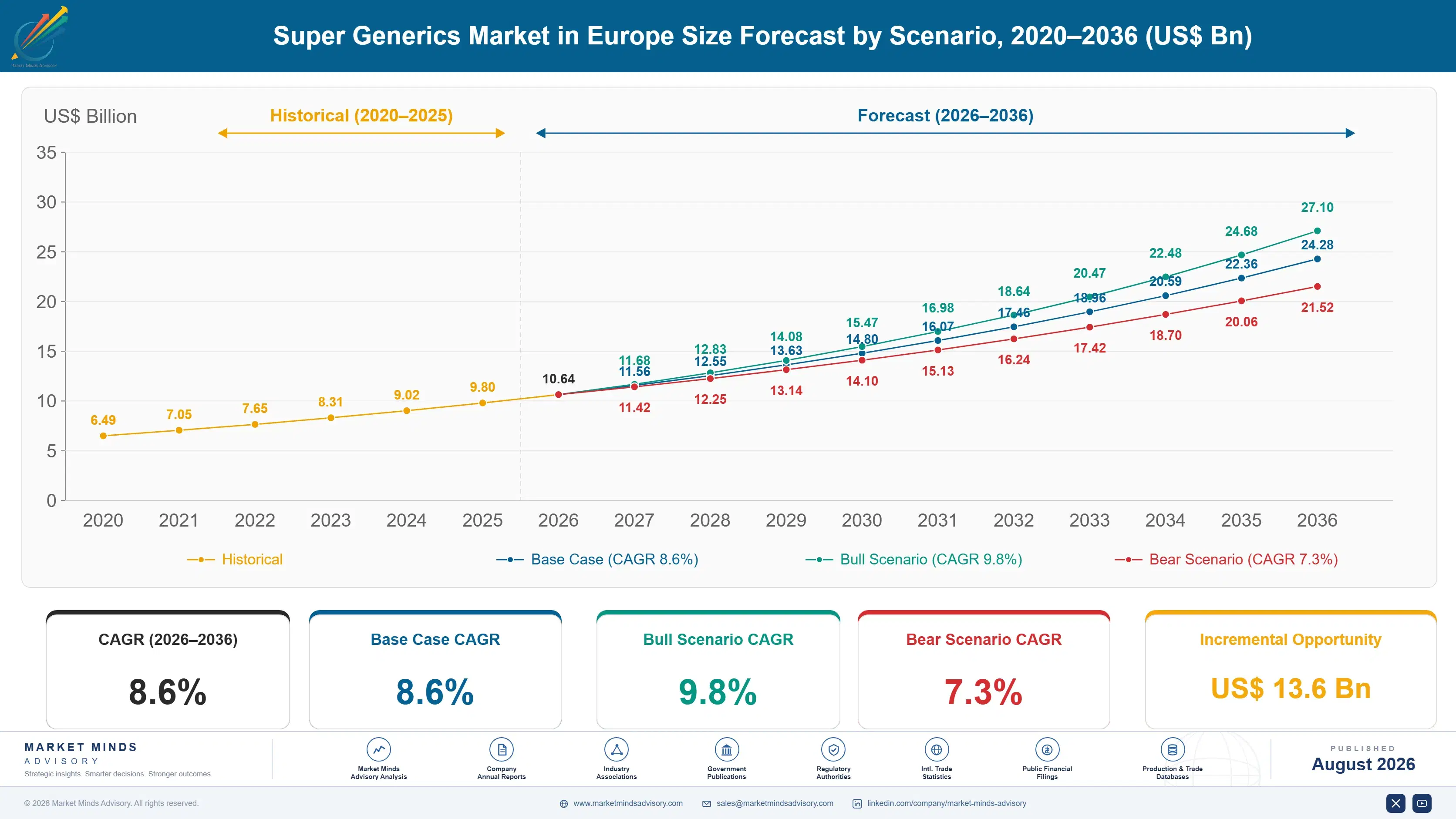
Super Generics Market Forecast Scenarios

super-generics-market-in-europe-size-forecast-scenario-1787309351344
Growth of 7.4% across 2020 to 2025 came from a narrow set of therapeutic areas rather than broadly. Psychiatry long-acting injectables and modified-release pain formulations carried most of it, while payer resistance blunted returns in cardiovascular and respiratory hybrids where cheap plain generics already satisfied prescribers. Several developers abandoned programmes after reimbursement rejection, which taught the industry to test payer appetite before committing spend.
The base case of 8.6% rests on three mechanisms. Long-acting injectable dosing intervals are extending from monthly to quarterly and beyond, which changes adherence economics enough that payers concede premium pricing near 3.4 times generic equivalents. European developers are increasingly selling hybrid products into North American and Asian markets rather than Europe alone. And the hybrid pathway itself is being used earlier in molecule life, before plain generic entry compresses the reference price.
The bull case of 9.8% assumes European health technology assessment bodies adopt adherence-adjusted value frameworks, which would convert clinical evidence into pricing more reliably than the current process manages. The bear case of 7.3% reflects two pressures: national payer tendering treating hybrids as interchangeable with plain generics, and Indian and Chinese developers entering the same pathway at budgets European firms cannot approach.

Judged Twice and Substituted Anyway

European reformulation faces two independent gatekeepers and most companies plan for only one. Health technology assessment bodies decide whether the improvement is clinically meaningful or commercially motivated, publishing criteria that make the answer largely predictable in advance. Then, in eleven markets, a pharmacist may substitute the product back to the reference generic at the counter regardless of what any assessor concluded.
TOP FIVE CONCENTRATION41%Combined share held by the five largest participating companies regionally
PREMIUM ACHIEVEMENT RATE48% of submissionsShare securing reimbursement at the premium originally sought
MARKETS WITH AUTOMATIC SUBSTITUTION11 marketsEuropean countries where pharmacists may swap oral reformulations freely
ASSESSMENT DURATION14 monthsTypical interval from filing to national reimbursement decision
REALISED PREMIUM7 times genericAchieved pricing against the reference generic where premiums hold
ADHERENCE IMPROVEMENT38 percentage pointsGain from monthly injection against daily oral administration
That second gate is what separates European outcomes from North American ones. Only around 48% of submissions achieve the premium originally sought, against a realised multiple of roughly seven times generic where premiums do hold, which is materially lower than the eleven times achieved in less regulated markets. Assessment takes about 14 months, so a failed submission costs both the price and the launch year. Both the price and the year are lost together.
The formats that survive are the ones a pharmacist cannot swap. A clinician-administered depot injection improving adherence by roughly 38 percentage points is assessed on relapse and hospitalisation outcomes and dispensed by a nurse, not a counter. That combination is why long-acting injectables compound at 10.8% while oral modified-release products are reimbursed at parity and quietly withdrawn.
"Companies spend two years building an assessment dossier and then launch an oral reformulation into a market where the pharmacist substitutes it on day one. Both gates are published. Only one of them tends to get read."
Director, European Market Access and Drug Delivery Practice · MMA Specialty Phar

Market Trends

Assessment Bodies Publish Explicit Meaningful Improvement Criteria

European health technology assessment bodies have moved from case-by-case judgement to published criteria distinguishing clinically meaningful formulation improvement from commercially motivated reformulation, with evidence requirements stated in advance. That makes the reimbursement outcome largely predictable at programme design rather than discoverable after a 14 month assessment. Only around 48% of submissions currently achieve their sought premium, and almost all the failures could have been anticipated by reading criteria that were already public. Reading them at programme inception rather than after a fourteen month assessment is the whole discipline, and remarkably few companies do it.
Market Impact: Assessment taking around 14 months

Substitution Rules Decide Outcomes That Assessment Does Not

Eleven European markets permit pharmacists to substitute oral reformulations back to the reference generic, which removes any premium at the counter regardless of what an assessment body concluded about clinical value. The rules were written for bioequivalent copies and apply awkwardly to products deliberately not equivalent. Format selection therefore determines commercial outcome as much as evidence does, and clinician-administered injectables are the only category the rules cannot reach. Several companies have now abandoned oral formats for European launches entirely as a result. Litigating around a dispensing rule is not an available option for anybody.
Market Impact: Adherence gaining 38 percentage poi

Market Opportunities and Growth Drivers

Hospital Capacity Pressure Rewards Administration Savings

Converting an infused biologic to subcutaneous administration removes day unit chair time, nursing hours and facility overhead, and European hospitals under sustained capacity pressure value that saving in a budget they control directly. The health economic case is unusually clean because the saving and the drug cost sit with the same payer, which is not true in most health systems. Assessment bodies accept resource-use evidence more readily than tolerability claims by a wide margin. Administration-time evidence generated during registration is exactly what assessors ask for. Tolerability claims fail against the same assessors reliably.
Market Impact: Premiums realised at 7 times generi

Adherence Outcomes Clear Assessment Where Convenience Fails

Monthly depot administration improves adherence by roughly 38 percentage points against daily oral dosing, and in psychiatry, addiction medicine and infectious disease that converts into relapse, transmission and hospitalisation outcomes assessment bodies will fund. Convenience claims fail almost universally against published criteria. The distinction is entirely about whether the improvement produces a measurable clinical consequence, and companies that select molecules on that basis clear assessment considerably more often. Selecting molecules where missed doses produce a measurable clinical consequence, rather than merely an inconvenience, is what separates a clearing dossier from a failing one.
Market Impact: Losing premiums in 11 markets

Market Restraints and Challenges

Reference Pricing Compresses Premiums Across Borders

Most European markets reference prices against a basket of comparator countries, so a low price agreed in one market propagates outward and caps what can be achieved elsewhere. The root cause is that reformulation pricing was never contemplated when reference baskets were designed. Companies mitigate by sequencing launches to establish price in higher-paying markets first, by confidential discount arrangements that protect list price, and by declining to launch where a low reference would damage the wider position. Declining a market where a low reference would damage the wider position is frequently the correct decision.
Market Impact: Only 48% achieving sought premium

Oral Reformulations Cannot Escape Counter Substitution

In eleven markets a pharmacist may swap an oral reformulation for the reference generic, and no clinical evidence prevents it because the rules concern dispensing rather than efficacy. The root cause is regulation written for bioequivalent products applied to deliberately non-equivalent ones. Companies mitigate by seeking distinct reimbursement codes, by pursuing indications the reference product does not carry, and increasingly by abandoning oral formats for European launches altogether. Several companies have concluded that European oral reformulation is simply not viable and have restructured their pipelines toward injectable formats accordingly. Pipelines are being restructured accordingly.
Market Impact: Substitution permitted in 11 market
3 additional market trends, 4 additional growth drivers, and 2 additional restraints and challenges are covered in the full report. Contact sales@marketmindsadvisory.com to access the complete intelligence.

Segment CAGR and Growth Architecture

Segmentation follows reformulation type, because each faces a different assessment argument and a different exposure to pharmacy substitution. In Europe those two variables determine commercial outcome more completely than the clinical improvement itself does. Six types sit here, separated by the assessment argument each can make and by whether a pharmacist can reverse it.
super-generics-market-in-europe-market-share-analysis-1787309351875

Long-Acting Injectable Reformulations

Long-acting injectables compound at 10.8%, exactly 1.50 times the market, and they are the only category that clears both European gates reliably. Monthly or quarterly depot administration improves adherence by roughly 38 percentage points against daily oral dosing, which in psychiatry, addiction medicine and infectious disease produces relapse, transmission and hospitalisation outcomes assessment bodies accept as clinically meaningful. Because a clinician administers the product, no pharmacist can substitute it at a counter, which protects the premium in the eleven markets where substitution removes it from oral formats entirely. Formulation is genuinely difficult, involving microsphere or crystalline suspension engineering that must release predictably across weeks, and that difficulty also limits how quickly competitors follow.
CAGR 10.8%

Subcutaneous Conversions of Parenteral Products

Subcutaneous conversions grow at 9.4% on an argument European payers find unusually easy to accept. Removing day unit chair time, nursing hours and facility overhead produces a saving that falls in the same budget funding the medicine, which is not the case in most health systems, and assessment bodies weigh resource-use evidence far more readily than tolerability claims. Recombinant hyaluronidase co-formulation and high-concentration protein engineering are the enabling technologies, both carrying real risk around viscosity, injection volume and local tolerability. Reference product manufacturers frequently pursue these conversions themselves, which makes the competitive position considerably less protected than long-acting injectables and rather more contested on timing. Timing rather than capability decides that contest.
CAGR 9.4%
Full segment breakdown across 6 segments available in the complete report.

Regional Architecture and Country Demand Map

Although the market is defined as Europe, regional shares below allocate European reformulation value across the seven standard regions by where the assessing and reimbursing health system sits rather than by manufacturer origin. Assessment and dispensing rules within each system determine almost all of the variation in realised value.

Western Europe

Western Europe accounts for 71% of the value described. Note: this is far outside the standard band because the market is defined as European reformulation value, and the great majority of it is assessed, reimbursed and consumed across the Western European systems. Germany holds the largest national share at 24% of European value, driven by assessment structure and pricing rather than by population. French, Italian and Spanish assessment bodies apply published meaningful improvement criteria rigorously. Automatic substitution operates in eleven markets, and the Nordic countries and the Netherlands apply it most aggressively of all. Reference pricing links these systems together, so a single early low price propagates through several of them and caps the whole regional position for years afterwards.
Share: 71% | CAGR: 6.1% (2026 to 2036)

Eastern Europe

Eastern Europe covers 17% of the value described, growing at 6.3%. Note: this exceeds the standard band because the market definition is European, and Central and Eastern European systems account for a substantial and growing share of it. Poland compounds at 9.3%, the fastest national market, as reimbursement systems mature beyond straight generic supply. Czech, Hungarian and Romanian access is improving from a low base. Reference pricing and aggressive substitution both compress premiums, so realised pricing sits well below Western European levels even where reimbursement is secured at all. Injectable formats hold value here where oral reformulations do not, which is the same pattern seen further west but with a lower ceiling throughout.
Share: 17% | CAGR: 6.3% (2026 to 2036)
Regional intelligence for 5 additional markets available in the complete report: North America, East Asia, South Asia and Pacific, Latin America, Middle East and Africa. Contact sales@marketmindsadvisory.com.
super-generics-market-in-europe-country-cagr-analysis-1787309352381

Clearing Two Gates Not One

A European reformulation must satisfy an assessment body that publishes its criteria and then survive a pharmacist who can ignore them. Four positions matter, and the first two are decided before any development work begins at all. The other two concern launch sequencing and the one argument European payers consistently accept. None of the four is a promotional activity.

Read the Published Assessment Criteria Before Selecting a Molecule

European assessment bodies publish explicit criteria distinguishing clinically meaningful improvement from commercially motivated reformulation, and only around 48% of submissions achieve their sought premium. Almost every failure was predictable from documents already public at programme inception. Companies that select molecules where the improvement produces a measurable clinical consequence, rather than a tolerability or convenience claim, clear assessment far more often and avoid losing both the price and the 14 month launch year. The criteria were public before most programmes were even designed. Losing both the price and the year is entirely avoidable.
Market Impact: Only 48% achieving the premium they

Choose Formats a Pharmacist Cannot Substitute

Eleven European markets permit pharmacists to swap oral reformulations back to the reference generic, which removes the premium at the counter whatever an assessment body concluded. A clinician-administered depot cannot be substituted, which is why long-acting injectables compound at 10.8% while oral modified-release products are reimbursed at parity and quietly withdrawn. Format selection is therefore the single most consequential commercial decision in a European reformulation programme. Several companies have now stopped launching oral reformulations in Europe altogether, which is a rational response to a rule nobody can litigate around. It is the single most consequential decision here.
Market Impact: Substitution removing premiums acro

Sequence Launches Against Reference Pricing Baskets

Most European systems reference prices against a basket of comparator countries, so a low price agreed early propagates outward and caps everything afterwards. Realised premiums sit near seven times generic where they hold, well below less regulated markets, largely because of this mechanism. Companies that sequence launches to establish price in higher-paying markets first, and decline markets where a low reference would damage the wider position, protect considerably more value than those launching everywhere available. Speed of approval is the wrong criterion for a first launch, since realised premiums sit near 7 times generic only where sequencing protected them.
Market Impact: Premiums realised at only 7 times t

Build Resource-Use Evidence for Hospital Budget Holders

Subcutaneous conversion removes day unit chair time, nursing hours and facility overhead, and the saving falls in the same budget funding the medicine, which is unusual and makes the case unusually easy. European assessment bodies weigh resource-use evidence far more readily than tolerability claims. Subcutaneous conversions grow at 9.4% substantially on that asymmetry, and companies generating administration-time data during registration arrive with exactly what assessors ask for. Approximating it after the fact rarely persuades an assessor who asked for it specifically. Assessors weigh resource-use evidence far above tolerability claims. That asymmetry is unusually favourable to reformulators.
Market Impact: Subcutaneous conversions compoundin

Who Controls the Margin Pool

Five companies hold 41% measured on European reformulated product revenue, the basis applied throughout this section. The field combines a long-acting injectable specialist, two European specialty pharmaceutical companies with deep national market access capability, a large generics organisation pursuing reformulation, and a delivery platform developer. Alkermes and Chiesi lead from quite different bases. None of them competes on formulation science alone.
Competition operates on three dimensions. Assessment dossier capability decides whether an approved product earns a premium or generic parity. Format selection judgement decides whether pharmacy substitution removes whatever premium is granted. And national market access depth decides how well a launch sequence can be managed against reference pricing baskets across twenty-odd systems. Formulation science decides remarkably little of it.

Two pressures are moving position. Assessment criteria keep hardening, which rewards companies that read them before selecting molecules rather than afterwards. Meanwhile substitution rules keep extending across oral formats. Rankings will shift toward companies holding injectable platform capability alongside genuine multi-country access infrastructure. Companies that read published criteria before selecting molecules, and choose formats a pharmacist cannot reverse, will take share from those still discovering both rules after launch.
super-generics-market-in-europe-company-positioning-matrix-1787309352893

Competitive Moat and Risk Dimensions

ALKERMES

Moat: Long-acting injectable platform depth

Alkermes built and validated long-acting injectable technology together with the outcome trial experience that converts an adherence claim into evidence European assessment bodies accept. That combination clears both the assessment gate and the substitution gate simultaneously, which no oral reformulation platform can do regardless of how good the formulation science behind it is.
ALKERMES

Risk: European access infrastructure depth

Managing launch sequence across twenty-odd national systems with interlocking reference pricing baskets requires country-level access capability that a platform developer typically lacks. A single early low price propagates outward and caps the whole European position, and that damage is done by market access execution rather than by any weakness in the product itself.
CHIESI FARMACEUTICI

Moat: National market access breadth

Chiesi holds established reimbursement relationships and submission capability across the major European systems, which is what determines whether a reformulation is priced at a premium or at parity. That infrastructure took decades to build and it is considerably harder to replicate than any formulation technology, since it depends on relationships rather than on capital.
CHIESI FARMACEUTICI

Risk: Injectable platform ownership

Long-acting injectables are the only category clearing both European gates reliably, compounding at 10.8%, and a company without its own depot platform must license or partner to participate. Access infrastructure without platform ownership means competing for in-licensing opportunities against every other well-connected European specialty company.

Players Tracked

Prominent Players

Alkermes
Chiesi Farmaceutici
Recordati
Zentiva
Camurus

Other Key Players

Sandoz
Stada Arzneimittel
Teva Pharmaceutical Industries
Viatris
Hikma Pharmaceuticals
Indivior
Ethypharm
Adare Pharma Solutions
Rovi Laboratories
Ferrer Internacional
Almirall
Menarini Group
Zambon
Orion Corporation
Krka

Recent Developments

MARCH 2025

Assessment bodies publish shared meaningful improvement criteria

European health technology assessment bodies issued clarified and largely aligned criteria distinguishing clinically meaningful formulation improvement from commercially motivated reformulation, with evidence requirements specified. These were assessment methodology decisions rather than regulatory approvals or commercial developments among developers. Alignment between bodies makes the outcome largely knowable in advance.
Signal: Published criteria make the reimbursement
JULY 2025

Automatic substitution extends to further oral reformulation categories

Several European markets widened pharmacy substitution rules to cover additional modified-release oral formats previously treated as distinct products, removing achievable premiums at the counter. These were dispensing policy decisions rather than assessment or regulatory changes affecting the products themselves. Assessment conclusions became irrelevant at the counter in those markets.
Signal: Dispensing rules override assessment concl
NOVEMBER 2025

Hospital capacity pressure raises value of subcutaneous conversion

European hospital systems under sustained day unit and nursing capacity constraint gave increasing weight to administration time released by subcutaneous conversion of infused biologics. This reflects health system operating conditions rather than any transaction among the developers involved. Administration time released became a funded consideration rather than a soft benefit.
Signal: A saving landing in the same budget as the

Excipients, Assessment Dossiers and Sterile Manufacture

Specialised excipients, release-controlling polymers and delivery components account for roughly 24% of cost of goods, above straight generic levels because these materials carry specialty pricing. Sterile and complex manufacture adds about 21%, since long-acting injectables and subcutaneous conversions both require aseptic processing. Assessment dossier preparation and national submission costs sit outside cost of goods and scale with the number of markets entered.
Delivery polymer and specialty excipient supply tightened through 2021 and 2023 as pharmaceutical demand competed with industrial uses, and reformulation developers carried it badly because excipient substitution requires bioequivalence and stability work rather than a purchase order. Company annual reports across the European specialty companies disclose the resulting cost and timeline effects. World Health Organization reporting on pharmaceutical supply chains documents specialty excipient manufacturing concentration. Bridging studies cannot be run inside a disruption.

Exposure divides by format and by market footprint. Injectable developers carry excipient and aseptic manufacturing cost against premiums the format protects. Oral developers carry lower cost against premiums substitution removes. Companies submitting across many European systems carry dossier and access cost that scales with country count rather than with revenue, which penalises small portfolios disproportionately.
super-generics-market-in-europe-cost-volatility-analysis-1787309353089

Qualify secondary excipient sources during formulation development

Release-controlling polymer substitution requires bioequivalence and stability work that cannot be completed inside a supply disruption. Qualifying a second source while the stability programme is already running costs very little and preserves the option to switch without repeating a bridging study that no launch timeline can absorb comfortably. Doing it later costs a full cycle.

Scale submission effort against expected premium not market size

Assessment dossier and national submission cost scales with the number of systems entered while achievable premium varies enormously between them. Prioritising submissions by expected realised price rather than by population avoids spending the same effort in a market where substitution will remove the premium as in one where it will hold. Population is the wrong prioritisation variable entirely.

Contract aseptic capacity rather than building it

Long-acting injectables and subcutaneous conversions require aseptic manufacture, and dedicated capacity for a reformulation portfolio runs at poor utilisation while carrying full fixed cost. Contracting it converts a capital commitment into a variable cost and avoids the multi-year qualification timeline that would otherwise sit inside every European launch plan. Qualification timelines would otherwise dominate every launch plan.

Portfolio Architecture for Margin Defence

The portfolio separates on which of the two European gates each format can clear. Long-acting injectables clear both, being assessed on outcomes and dispensed by clinicians. Subcutaneous conversions clear assessment on resource-use evidence and face limited substitution risk. Fixed-dose combinations clear neither reliably. Oral modified-release formats may clear assessment and then lose the premium at a pharmacy counter regardless. Alternative routes clear neither gate consistently.
The tension is between development cost and European survivability. Oral reformulations are cheapest to develop and least survivable here, which is precisely the opposite of what a portfolio optimised for programme count would produce. Injectable and subcutaneous work costs considerably more, requires aseptic manufacture, and holds its pricing through both gates. Europe punishes the cheap option more severely than any other region. That inversion catches most portfolios out.

High-value pools concentrate where both gates are cleared. Long-acting injectables in adherence-sensitive conditions, subcutaneous conversions with administration-time evidence, and any product with a distinct reimbursement code all qualify, and none of them depends on a convenience argument. What they share is that both European gatekeepers have been satisfied rather than only the one that publishes its reasoning.

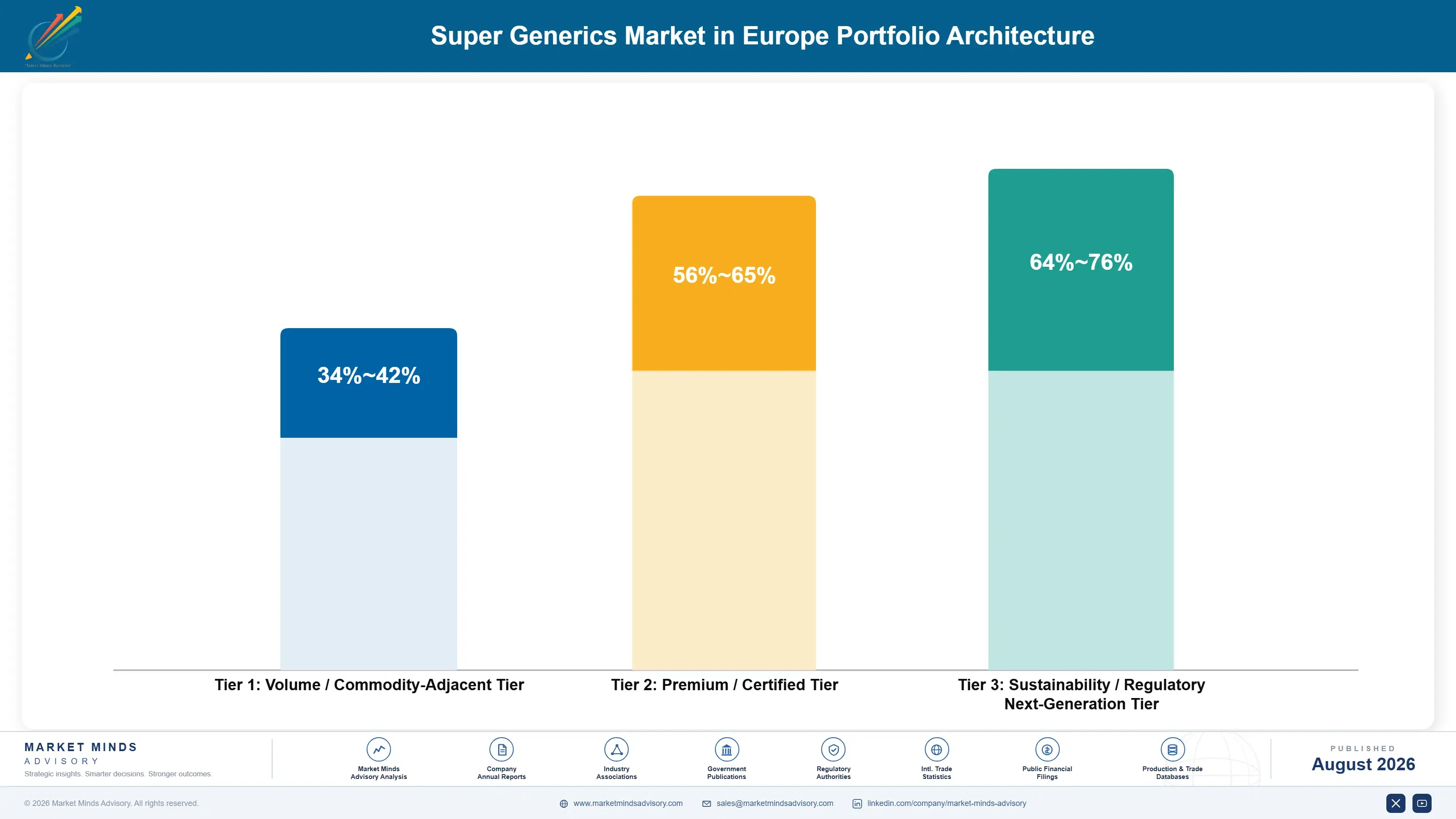
Volume / Commodity-Adjacent Tier

Modified-release oral reformulations and simple fixed-dose combinations arguing tolerability or pill burden. Cheapest to develop, routinely reimbursed at generic parity, and substituted at the counter in eleven European markets regardless of assessment outcome.
Gross Margin: 24-38%

Premium / Certified Tier

Subcutaneous conversions and improved-bioavailability formulations supported by administration-time and resource-use evidence. Assessment bodies accept the saving readily because it lands in the same budget funding the medicine itself. Substitution exposure is limited because a nurse rather than a pharmacist administers the product.
Gross Margin: 44-60%

Sustainability / Regulatory / Next-Generation Tier

Long-acting injectable reformulations with adherence outcome evidence and clinician-administered delivery. The wide margin range separates platforms holding European reimbursement precedent from programmes still assembling the outcome evidence assessors require. Neither gate applies to a product a pharmacist never handles.
Gross Margin: 48-72%
super-generics-market-in-europe-portfolio-architecture-1787309353592

High-value Sub-segments and Strategic Watch-out

Long-Acting Injectable Reformulations

Compounding at 10.8% as the only category clearing both European gates, with adherence gains near 38 percentage points and no pharmacy substitution exposure whatsoever. Formulation difficulty also limits how quickly competitors can follow into the space. Microsphere and crystalline suspension engineering is the real barrier here.
Gross Margin: 52-72%

Subcutaneous Parenteral Conversions

Growing at 9.4% on administration savings falling in the same budget that funds the medicine, which European assessors accept unusually readily. Reference manufacturers pursue these conversions themselves, making the position contested on timing rather than capability. Viscosity and injection volume remain the genuine formulation constraints.
Gross Margin: 46-62%

Modified-Release Oral Reformulations

The volume core at 4.6%, cheapest to develop and least survivable in Europe, reimbursed at parity and substituted at the counter across eleven markets. Several have been withdrawn from individual markets entirely after launch. Europe punishes the cheapest option harder than any other region does.
Gross Margin: 24-38%

Alternative-Route Delivery Reformulations

The strategic watch-out. Nasal, transdermal and buccal routes solve genuine problems for specific molecules, and each requires separate formulation science with no platform reuse and limited assessment precedent to rely on. Assessment precedent is thin and platform reuse across routes is essentially absent, which makes each programme a standalone bet.
Gross Margin: 32-58%

Reimbursed Once, Priced Everywhere

European revenue arrives through reimbursement decisions rather than through prescriptions, and each decision affects the others. A price agreed in one market propagates through reference baskets into several more, so the first launch shapes the whole regional position for years. That makes launch sequencing a more consequential commercial decision than promotional effort, and it is one most companies make on the basis of market size instead. Market size is the wrong sequencing criterion.
Depth varies by format and by whether a clinician holds the product. Long-acting injectable patients in psychiatry and addiction generate the deepest relationships, with administration recorded as a clinical encounter for years. Subcutaneous conversion patients continue while the underlying therapy does. Oral reformulation patients are switched back by pharmacists routinely. Hospital-administered products are protected in a way retail-dispensed products simply are not.

The deciding party differs by gate. Assessment bodies decide the price using published criteria and structured dossiers. Clinicians decide prescribing within whatever the assessment permits. Pharmacists decide, in eleven markets, whether any of it survives the counter. A company that has satisfied the first two and ignored the third has built a commercial failure with excellent documentation.
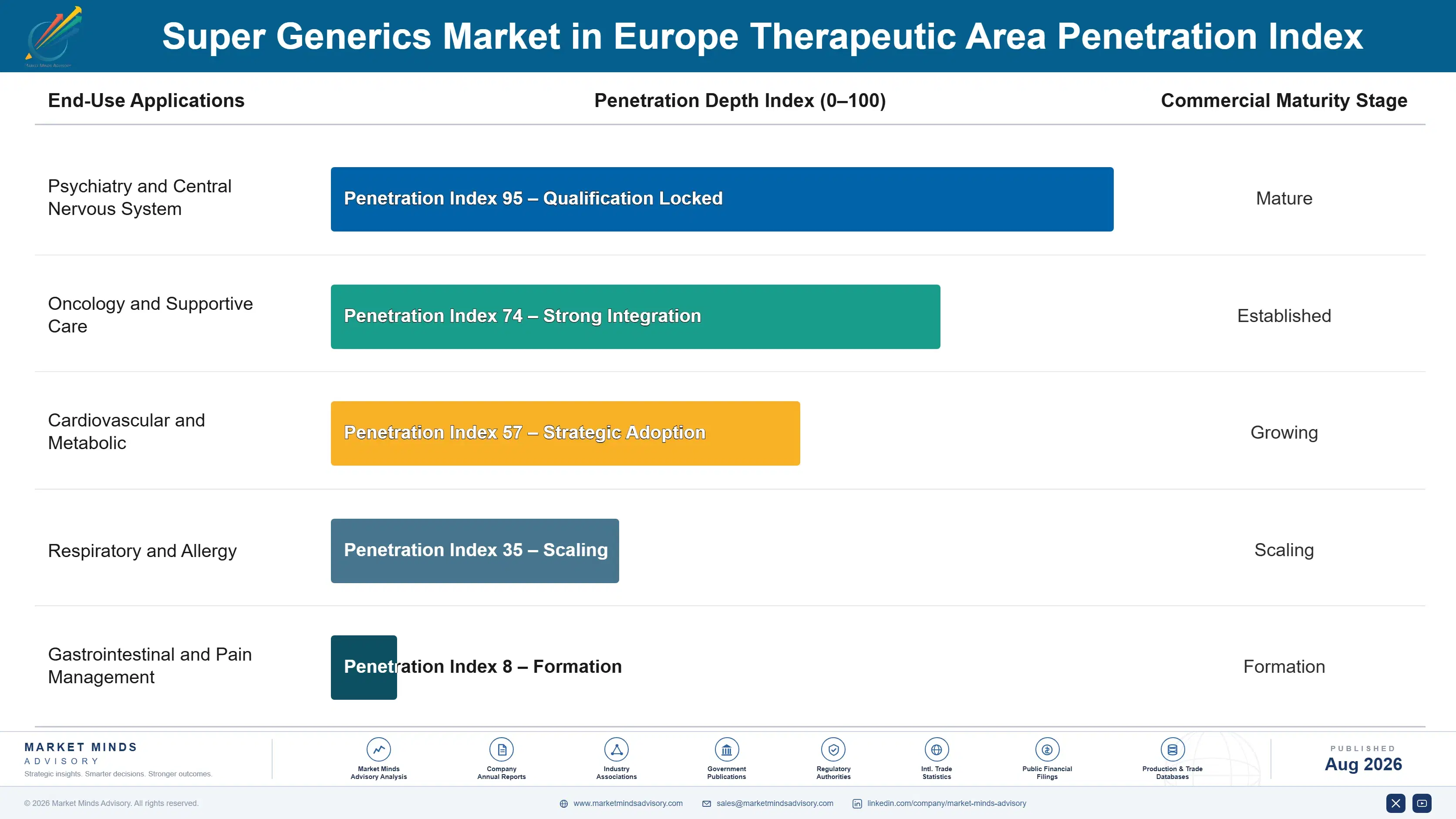
super-generics-market-in-europe-end-use-penetration-index-1787309354079

Where Reformulators Survive Europe

These are among the four positions where our research anticipates prominent divergence between winners and laggards over the coming forecast period. Each is grounded in the demand model, the regulatory perimeter, and the announced capacity pipeline.
01 / PUBLISHED CRITERIA READING

Almost every rejection was predictable from public documents

European assessment bodies publish explicit criteria separating clinically meaningful improvement from commercially motivated reformulation, and only around 48% of submissions achieve their sought premium. Almost every failure could have been anticipated at programme inception from documents already in the public domain. Selecting molecules where the improvement produces a measurable clinical consequence, rather than a tolerability claim, avoids losing both the price and the fourteen month launch year, and the fourteen month assessment interval is lost alongside the price, and the criteria were public long.
02 / SUBSTITUTION-PROOF FORMAT SELECTION

A pharmacist can undo two years of assessment work

Eleven European markets permit pharmacists to swap oral reformulations back to the reference generic, which removes the premium at the counter regardless of what any assessment body concluded about clinical value. A clinician-administered depot cannot be substituted at all. That single dispensing fact is why long-acting injectables compound at 10.8% while oral modified-release products are reimbursed at parity and quietly withdrawn from individual markets, and several companies have now abandoned oral formats in Europe entirely, and no clinical evidence at all changes that dispensing.
03 / LAUNCH SEQUENCE DISCIPLINE

The first European price sets the ceiling for all of them

Most European systems reference prices against baskets of comparator countries, so a low price agreed early propagates outward and caps everything that follows, which is largely why realised premiums sit near seven times generic rather than the eleven achieved elsewhere. Sequencing launches to establish price in the higher-paying markets first protects considerably more value than launching everywhere available does. Declining a market entirely, where a low reference price would damage the wider European position, is frequently the correct commercial decision to take.
04 / SAME-BUDGET SAVINGS EVIDENCE

European payers fund what they can see in their own budget

Subcutaneous conversion removes day unit chair time, nursing hours and facility overhead, and in most European systems that saving falls in the same budget funding the medicine, which is unusual and makes the argument unusually easy to win. Assessment bodies weigh resource-use evidence far more readily than tolerability claims. Companies generating administration-time data during registration arrive with precisely what assessors ask for rather than approximating it, and approximating the data afterwards rarely persuades anybody at all, and assessors reward precision here far more than.

Engagement Snapshot From the Field

A live engagement with an industry participant carrying material or product regulatory and market exposure ahead of a defining policy shift, showing how our research translates into a defensible multi-year portfolio strategy.
MARKET MINDS ADVISORY · CLIENT ENGAGEMENT SUMMARY
Super Generics in Europe Producer Strategic Portfolio Review and Transition Roadmap 2026·Investment Scenario on Super Generics in Europe Exposure Evaluation 2025-26
CLIENT PROFILE
A mid-sized European specialty company with an approved modified-release oral reformulation of a widely used molecule, launched across nine European markets over eighteen months, and roughly EUR 430 million in total revenue (client-reported, unverified by MMA). Realised pricing had reached the sought premium in two of the nine markets and generic parity in the remaining seven. Nobody had separated the two failure modes.
STRATEGIC CHALLENGE
The launch was performing at a third of forecast and leadership attributed it to market access execution, having replaced the access lead in two countries. Assessment outcomes had been mixed rather than uniformly negative. Nobody had separated the markets where assessment refused a premium from those where a premium was granted and then lost at the pharmacy counter.
MMA APPROACH
MMA reviewed the assessment outcome and the dispensing rules separately for each of the nine markets, tracing realised price against both. Published assessment criteria at the time of programme inception were compared against the evidence the registrational programme had actually generated. Reference basket linkages were traced from the first launch price through every subsequent market decision.
KEY FINDINGS
  1. In four of the seven underperforming markets the assessment body had granted a premium, and pharmacy substitution had removed it at the counter within the first two quarters after launch.
  2. In the remaining three the assessment body had refused a premium on criteria that had been published two years before the registrational programme was designed at all.
  3. The registrational programme contained no resource-use or clinical outcome endpoint, relying entirely on pharmacokinetic and tolerability data that published criteria explicitly identified as insufficient.
  4. The first launch had been in a low-priced market chosen for speed of approval, and reference basket linkage had propagated that price into five of the eight subsequent markets.
CLIENT PROFILE
A mid-sized European specialty company with an approved modified-release oral reformulation of a widely used molecule, launched across nine European markets over eighteen months, and roughly EUR 430 million in total revenue (client-reported, unverified by MMA). Realised pricing had reached the sought premium in two of the nine markets and generic parity in the remaining seven. Nobody had separated the two failure modes.
STRATEGIC CHALLENGE
The launch was performing at a third of forecast and leadership attributed it to market access execution, having replaced the access lead in two countries. Assessment outcomes had been mixed rather than uniformly negative. Nobody had separated the markets where assessment refused a premium from those where a premium was granted and then lost at the pharmacy counter.
MMA APPROACH
MMA reviewed the assessment outcome and the dispensing rules separately for each of the nine markets, tracing realised price against both. Published assessment criteria at the time of programme inception were compared against the evidence the registrational programme had actually generated. Reference basket linkages were traced from the first launch price through every subsequent market decision.
KEY FINDINGS
  1. In four of the seven underperforming markets the assessment body had granted a premium, and pharmacy substitution had removed it at the counter within the first two quarters after launch.
  2. In the remaining three the assessment body had refused a premium on criteria that had been published two years before the registrational programme was designed at all.
  3. The registrational programme contained no resource-use or clinical outcome endpoint, relying entirely on pharmacokinetic and tolerability data that published criteria explicitly identified as insufficient.
  4. The first launch had been in a low-priced market chosen for speed of approval, and reference basket linkage had propagated that price into five of the eight subsequent markets.
RECOMMENDED STRATEGY
Phase 1: Phase 1 (months 1 to 4): Withdraw from the four substitution markets where the premium cannot be defended and stop further submission spend there. Phase 2: Phase 2 (months 4 to 12): Restructure the pipeline to injectable and subcutaneous formats and add resource-use endpoints to programmes still in design. Phase 3: Phase 3 (months 12 to 24): Rebuild launch sequencing rules around reference basket linkage rather than around speed of approval.
OUTCOME
Withdrawal from the four substitution markets released approximately EUR 6 million of annual access and promotional spend with no revenue loss, since the premium had already gone (client-reported, unverified by MMA). Two pipeline programmes were converted to injectable formats and three oral programmes discontinued (client-reported, unverified by MMA). Launch sequencing now begins in the highest-priced market available.

Frequently Asked Questions

Foundational context covering the market sizes, CAGR, scope, country, region and competition that inform every finding below. This section is provided to cover basics and most often pre-purchase conversations, answered from the MMA Primary Research Dataset.

What is the current size of the Super Generics Market in Europe?

The European market was worth USD 7.4 billion in 2025, reaching USD 7.93 billion in 2026. Western European systems account for 71% of that value.

How large will the Super Generics Market in Europe be by 2036?

MMA forecasts USD 15.89 billion by 2036, an expansion multiple of 2.00 times the 2026 base. That represents roughly USD 7.96 billion of incremental value.

What is the CAGR for the Super Generics Market in Europe 2026 to 2036?

The base case compounds at 7.2% annually, with a bull case of 8.4% and a bear case of 6.0%. Historical growth from 2020 to 2025 ran at 6.1%.

Which segment is growing fastest?

Long-acting injectable reformulations compound at 10.8%, exactly 1.50 times the market rate. They are the only category clearing both European assessment and substitution gates reliably.

Who are the major companies in the Super Generics Market in Europe?

Alkermes, Chiesi Farmaceutici, Recordati, Zentiva and Camurus hold a combined 41% of the market. Assessment dossier capability and format selection sustain those positions rather than science.

Which country is growing fastest?

Poland compounds at 9.3%, ahead of every other national market. Reimbursement systems maturing beyond straight generic supply account for very nearly all of that growth.

Report Segmentation Architecture

The full report scope spans multiple orthogonal segmentation dimensions, with cross-tabulated demand data provided for each dimension pair. Coverage extends further to regional breakdowns, trend trajectories, and the competitive detail needed to support segment-level decision-making.

By Reformulation Type

  • Long-Acting Injectable Reformulations
  • Modified-Release Oral Formulations
  • Subcutaneous Conversions of Parenteral Products
  • Fixed-Dose Combination Reformulations
  • Improved-Solubility and Bioavailability Formulations
  • Alternative-Route Delivery Reformulations

By End-Use Industry

  • Psychiatry and Central Nervous System
  • Oncology and Supportive Care
  • Infectious Disease and HIV
  • Addiction Medicine and Substance Use
  • Cardiometabolic and Chronic Disease

By Commercial Dimension

  • Direct Branded Specialty Supply
  • Licensed Partner Commercialisation
  • Hospital Tender and Reimbursed Channel
  • Formulation Platform Licensing

By Region

  • North America
  • Western Europe
  • East Asia
  • South Asia and Pacific
  • Latin America
  • Middle East and Africa
  • Eastern Europe

Scope, Methodology, and Coverage

Every figure in this report is reproducible from documented input assumptions. The scope below maps the historical period, the forecast horizon, the segmentation dimensions, and the countries covered, alongside the underlying primary and qualitative methodology.
Historical Period
2020 to 2025
Forecast Period
2026 to 2036
Base Year
2025 (USD billions; MMA Primary Research Dataset, August 2026)
Market Definition
The market covers reformulated versions of off-patent molecules delivering a demonstrable clinical or practical improvement over the reference product across European markets, spanning long-acting injectable reformulations, modified-release oral formulations, subcutaneous conversions of parenteral products, fixed-dose combination reformulations, improved-solubility and bioavailability formulations, and alternative-route delivery reformulations, together with the health technology assessment and market access work supporting them. Straight generic and biosimilar copies, novel chemical entities and new biological entities, medical devices sold separately from a drug product, over-the-counter switches without formulation change, and simple strength line extensions are excluded. Sizing is measured at manufacturer revenue in current prices.
Quantitative Units
USD billions (current prices); treated patient counts, realised premium against reference and assessment intervals where applicable
Segmentation Dimensions
By Reformulation Type; By End-Use Industry; By Commercial Dimension; By Region
Regions Covered
North America, Western Europe, East Asia, South Asia and Pacific, Latin America, Middle East and Africa, Eastern Europe
Countries Covered
Germany, France, Italy, Spain, UK, Netherlands, Belgium, Austria, Switzerland, Sweden, Denmark, Norway, Finland, Ireland, Portugal, Greece, Poland, Czech Republic, Hungary, Romania, Slovakia, Bulgaria, Croatia, Slovenia, Turkey, Israel, USA, Japan, Australia, Brazil, and additional markets relevant to this sector
Key Companies Profiled
Alkermes, Chiesi Farmaceutici, Recordati, Zentiva, Camurus, Sandoz, Stada Arzneimittel, Teva Pharmaceutical Industries, Viatris, Hikma Pharmaceuticals, Indivior, Ethypharm, Adare Pharma Solutions, Rovi Laboratories, Ferrer Internacional, Almirall, Menarini Group, Zambon, Orion Corporation, Krka
Quantitative Methodology
Primary survey, n=3,800 respondents, Q4 2025, six countries; demand-side model with trade association cross-validation
Qualitative Methodology
47 expert interviews, Q4 2025; applied to validate demand model assumptions, identify emerging dynamics, and assess competitive positioning
Report Format
PDF and XLSX data workbook (Word format preview document)
Publisher
Market Minds Advisory
Report Code
MMA-2026-HLT-983
Published
August 2026
Contact
sales@marketmindsadvisory.com | www.marketmindsadvisory.com

Purchase the full Super Generics Market in Europe Report (2026 to 2036).

The full report sizes European super generics across six reformulation types, three commercial dimensions and seven regions, with annual forecasts to 2036 under base, bull and bear scenarios. Assessment outcomes are analysed separately from dispensing outcomes by market, which is the distinction that explains why approved products end up reimbursed at parity. Automatic substitution rules are mapped by country and delivery format. Reference pricing basket linkages are modelled to show how an early low price propagates. Twenty companies are profiled on a consistent European reformulated product revenue basis.
Assessment outcomes analysed separately from dispensing outcomes by market
Automatic substitution rules mapped by country and delivery format
Reference pricing basket linkages modelled across European systems
Published meaningful improvement criteria compiled by assessment body
Administration-time savings quantified for subcutaneous conversion candidates
Launch sequencing outcomes compared against realised regional pricing

Built For The People Who Decide

From boardroom strategy to bench-side execution, this report is read cover-to-cover by leaders shaping the next decade of their industry, turning demand scenarios, market dynamics and valuation benchmarks into decisions.
CXOs/ Presidents/ VPs/ Managers
M&A and Corporate Development
Strategy Teams and R&D Heads
Procurement and Product Directors
Regulatory and Compliance Leaders
Investor Relations and Equity Analysts