Market Minds Advisory
Super Absorbent Polymer Market

Super Absorbent Polymer Market: A Birth Rate Business in Materials Clothing

Two thirds of demand goes into infant nappies while births fall almost everywhere, and the ageing that causes the decline creates an adult product using three times the polymer per unit.

Lead Analyst

Bilal Shaikh

Published

September 2026

Make Smarter Decisions with Customized Research Insights

Request a free sample report and evaluate market opportunities, growth trends, and competitive dynamics relevant to your business needs.

2025 MARKET VALUE$9.4BMarket Size 2025
2036 FORECAST VALUE$15.1BBase Case , 2026 to 2036
CAGR 2026 TO 20364.4 %Bull 5.6% / Bear 3.2%
INCREMENTAL OPPORTUNITY$5.3BNet 10- year value creation
EXPANSION MULTIPLE1.54x2036 value over 2026 base
Strategic Levers
M&A Pipeline
Regional Outlook
Country Rankings
Competitive Intelligence
Segmental Deep-dive
Call-Us : 91 93563 13602

Executive Snapshot and Market Trajectory

Around 64% of this polymer ends up in infant nappies, and births are falling across most of the markets that consume it. That makes demographics rather than chemistry the governing variable, which is not how anybody in this industry describes their own business. Nobody describes their business that way.
The offset is unusually neat. The same ageing that reduces births produces adult incontinence demand growing at 6.6%, and an adult product carries roughly three times the polymer of an infant one. Volume per person rises as the population that needs it changes, and the adult category is worth considerably more per unit shipped. Producers built around infant contracts sit very differently from those holding adult qualification.
One cushion has already been spent. Thin-core design replaced around 78% of the fluff pulp that nappies once contained, lifting polymer content per unit and masking falling birth numbers for a decade. That substitution is essentially finished, so declining unit volumes now show through directly, which several producers have yet to model properly. Falling nappy units now pass straight through to polymer volume with nothing behind them. Several producers have not modelled that yet.
Market Definition
Crosslinked superabsorbent polymers supplied for liquid retention applications, covering baby diapers, adult incontinence products, feminine hygiene, agriculture and soil conditioning, industrial water blocking and cable applications, and medical and wound care. Measured at producer selling value. Excludes fluff pulp and other absorbent cores, nonwoven cover materials, finished hygiene products, hydrogels for drug delivery, and acrylic acid sold as a monomer.
Base Year Value
$9.4B in 2025 (MMA Primary Research Dataset, August 2026)
Forecast Period
2026 to 2036, eleven discrete annual values
CAGR
4.4% base case. Bull 5.6%. Bear 3.2%.
Fastest Growth Segment
Adult Incontinence Products: 6.6% CAGR
Fastest Growth Country
India: 8.6% CAGR
Fastest Growth Region
South Asia and Pacific: 6.4% CAGR
Largest Region
East Asia: 30% of 2025 global value
Market Leaders
Nippon Shokubai, BASF, Sumitomo Seika, LG Chem, Evonik. Source: MMA Primary Research Dataset, July 2026.
Primary Survey
n=3,800 procurement and R&D decision-makers, Q4 2025, six countries
Methodology
Demand-side build-up, cross-validated against public data, 47 expert interviews

Super Absorbent Polymer Market Forecast Scenarios

super-absorbent-polymer-market-trends-size-forecast-scenario-1787639562928
Growth ran near 3.8% between 2020 and 2025, and the composition disguised what was happening underneath. Falling births across East Asia and Europe reduced nappy unit volumes while thin-core design raised polymer content per nappy, which offset each other well enough that headline demand looked stable. Adult incontinence grew steadily throughout, and acrylic acid pricing moved sharply with propylene through the same period.
Base case 4.4% rests on three mechanisms. Adult incontinence products grow at 6.6% as ageing populations expand and the products carry roughly three times the polymer of infant equivalents. Agricultural soil conditioning grows at 6.0% on water scarcity in irrigated production. And India grows fastest of any country at 8.6% as nappy penetration rises from a low base, which is now the only large market where infant volume genuinely expands.
The bull case at 5.6% assumes agricultural adoption accelerating under water scarcity pressure, which would add a demand pool independent of demographics entirely. The bear case at 3.2% is birth rates falling faster than current projections while thin-core substitution is finished, which would leave nothing to offset unit decline in the largest application anywhere. Demography sets the floor and the ceiling alike.

Demographics Wearing a Polymer Data Sheet

Everything commercially interesting about this polymer sits in a birth registry rather than a data sheet. Around 64% of volume goes into infant nappies, and births have fallen sharply across China, Japan, Korea and most of Europe over the past decade. A producer running capacity planning off industrial growth assumptions is modelling the wrong variable entirely, and several have been doing exactly that for years.
TOP FIVE CONCENTRATION61%Capital intensity and hygiene qualification keep the field narrow
ABSORPTION CAPACITY30xSaline volume held relative to the polymer's own weight
INFANT APPLICATION SHARE64%Portion of demand going into infant nappy production worldwide
ADULT PRODUCT LOADING3xPolymer content against an equivalent infant hygiene product
MONOMER COST SHARE71%Acrylic acid portion of finished polymer cost structure
PULP ALREADY DISPLACED78%Fluff pulp removed from modern nappy core design already
The demographic transition supplies its own answer, which is the genuinely interesting part. Ageing populations generate adult incontinence demand growing at 6.6%, and an adult pad or pant carries roughly three times the polymer of an infant nappy. The population that stops producing babies starts needing considerably more polymer per person, so volume moves up an age bracket and gains value on the way.
What has masked the transition until now is nearly exhausted. Thin-core design has already removed about 78% of the fluff pulp that nappies once contained, replacing it with polymer and lifting content per unit steadily for a decade. That substitution has very little left to give. From here, falling nappy unit volumes translate almost directly into falling polymer volume in that application, with no formulation cushion remaining.
"The industry spent ten years congratulating itself on thin cores without noticing that the extra polymer per nappy was covering for fewer nappies. That cover has run out, and the only participants who look comfortable now are the ones who built an adult incontinence position while everybody else was chasing infant contracts."
Director, Hygiene Materials and Specialty Polymers Practice · MMA Chemicals and Materials Practice · August 2026

Market Trends

Thin-core substitution exhausting the cushion it provided

Thin-core nappy design has removed around 78% of the fluff pulp that infant products once contained and replaced it with polymer, which lifted content per unit and offset falling birth numbers for most of a decade. There is very little pulp left to displace. From here, unit volume decline in the largest application passes straight through to polymer demand with no formulation offset behind it, which several producers have not yet built into their capacity planning. Producers who read a decade of rising demand as market growth were reading a substitution effect that has now run its course entirely.
Market Impact: India growing fastest at 8.6%

Adult incontinence demand carrying triple the polymer loading

An adult incontinence pad or pant carries roughly three times the polymer of an infant nappy, and the category grows at 6.6% as populations age across every developed market. That converts a demographic problem into a demographic opportunity, since the same transition reducing infant volume expands a higher loading application. Producers holding hygiene qualification with adult product manufacturers are positioned very differently from those built around infant contracts alone. Qualification with adult product manufacturers takes years and holds for years once established, which makes the timing of entry considerably more consequential than the commercial terms.
Market Impact: Agricultural demand growing at 6.0%

Market Opportunities and Growth Drivers

Nappy penetration still rising across large emerging markets

India grows fastest of any country at 8.6% because disposable nappy penetration remains well below developed market levels and is rising with urbanisation and household income together. It is now effectively the only large market where infant polymer volume genuinely expands rather than contracts. Southeast Asian and African markets follow a similar pattern at smaller scale, and price sensitivity there favours lower specification grades over the premium products developed markets consume. Producers applying developed market specifications and pricing to those markets arrive with a product that simply cannot be bought at the prevailing retail price.
Market Impact: Affects 64% of total demand

Water scarcity pushing soil conditioning into irrigated agriculture

Superabsorbent polymer incorporated into soil holds irrigation water in the root zone and releases it slowly, which improves water use efficiency in arid and semi-arid production where irrigation cost or allocation is the binding constraint. Agricultural demand grows at 6.0% on that basis. Product requirements differ from hygiene grades, with slower release, salinity tolerance and eventual breakdown all mattering, so it is a genuine product development effort rather than a channel extension. Demand follows water allocation policy rather than agronomic fashion, which makes it unusually predictable for anybody willing to read irrigation regulation.
Market Impact: Holds 30 times its weight

Market Restraints and Challenges

Falling birth rates removing volume from the largest application

Around 64% of demand goes into infant nappies and births have fallen sharply across the developed markets and China that consume most of it, in several cases faster than official projections anticipated. The root cause is demographic and no product improvement addresses it. Commercially it means the largest application is in outright unit decline. Adult incontinence, agricultural conditioning and emerging market penetration are the offsets participants are pursuing, and only the first is large enough to matter. The other two are useful without being large enough to matter. Only adult incontinence is genuinely large enough.
Market Impact: About 78% of pulp displaced

Persistence in single-use waste attracting regulatory attention

This is a crosslinked polymer that does not break down, used in a single-use product that goes to landfill or incineration in very large volume, and nappy waste streams have become a visible target for waste policy in several jurisdictions. The root cause is the crosslinking that makes the polymer work at all. Commercially it creates an unpriced future liability. Partially biodegradable and bio-based routes are being pursued, and none matches performance at commercial cost. Producers beginning that work now hold an option worth more than the research costs, while those waiting follow somebody else's specification.
Market Impact: Carries 3 times the polymer loading
3 additional market trends, 4 additional growth drivers, and 2 additional restraints and challenges are covered in the full report. Contact sales@marketmindsadvisory.com to access the complete intelligence.

Segment CAGR and Growth Architecture

Six segments are split by application, because application determines the polymer specification, the loading per unit, the qualification a manufacturer imposes and the demographic or agronomic variable that actually drives volume. Particle size and grade variants sit inside each application. Production route and channel are handled separately in the framework. Demand drivers differ by application as well.
super-absorbent-polymer-market-trends-market-share-analysis-1787639563491

Adult Incontinence Products

Growing at 6.6%, half again the market rate of 4.4%, adult pads and pants carry roughly three times the polymer of an infant nappy because retention volume and leakage tolerance requirements are both considerably higher. Demand grows with ageing across every developed market and with the reduced social reluctance that has slowly expanded the addressable user base. Product specification favours faster acquisition and better performance under pressure, which is a genuine technical difference from infant grades rather than a marketing distinction between them. Japanese manufacturers pioneered the formats now spreading across other developed markets, and their suppliers carry qualification advantages that reflect that head start. Loading per unit is what changes the economics.
CAGR 6.6%

Agriculture and Soil Conditioning

At 6.0% polymer incorporated into soil holds irrigation water in the root zone and releases it as the soil dries, improving water use efficiency where irrigation allocation or cost binds production. Growth follows water scarcity rather than any demographic variable, which makes it the one demand pool in this market entirely independent of birth rates. Specification differs substantially from hygiene grades, requiring salinity tolerance, slower release and eventual breakdown, so serving it is a development programme rather than a sales extension. Competition here is narrower than in hygiene precisely because the product cannot simply be a rebadged nappy grade sold into a different channel with a new label on the bag.
CAGR 6.0%
Full segment breakdown across 6 segments available in the complete report.

Regional Architecture and Country Demand Map

East Asia holds 30% of value on Chinese production capacity that exceeds any other region and on hygiene consumption at scale. North America follows at 24% on adult incontinence demand rather than infant volume. South Asia and Pacific grows fastest of the seven regions. All shares sit in band.

North America

Adult incontinence is the growth story here rather than infant nappies, with an ageing population and comparatively open consumer attitudes producing a large and expanding category that carries triple the polymer loading. Infant volumes are declining slowly with births. Agricultural soil conditioning demand is meaningful across arid western production where irrigation allocation is genuinely constrained. Growth at 3.6% reflects adult category expansion offsetting infant decline rather than any underlying growth in total hygiene units. Producers holding adult qualification are considerably better placed than those built around the infant converters that once carried most of the regional volume. Waste policy attention is lighter here than in Europe. Agricultural adoption is meaningful in western irrigated production.
Share: 24% | CAGR: 3.6% (2026 to 2036)

Western Europe

Births have fallen further and for longer here than almost anywhere, which puts infant nappy polymer volume in sustained decline that adult incontinence growth only partly offsets. Waste policy attention on single-use hygiene is more advanced here and creates an overhang no current product answers. Producers face high industrial energy costs alongside declining core demand. Growth of 2.8% is the slowest anywhere and reflects a genuinely shrinking primary application. Capacity sited here faces the sharpest demand decline and the highest energy cost simultaneously, which is an uncomfortable combination to hold through the next decade. Adult incontinence growth is real but starts from a base too small to offset infant decline across the region as a whole.
Share: 21% | CAGR: 2.8% (2026 to 2036)
Regional intelligence for 5 additional markets available in the complete report: East Asia, South Asia and Pacific, Latin America, Middle East and Africa, Eastern Europe. Contact sales@marketmindsadvisory.com.
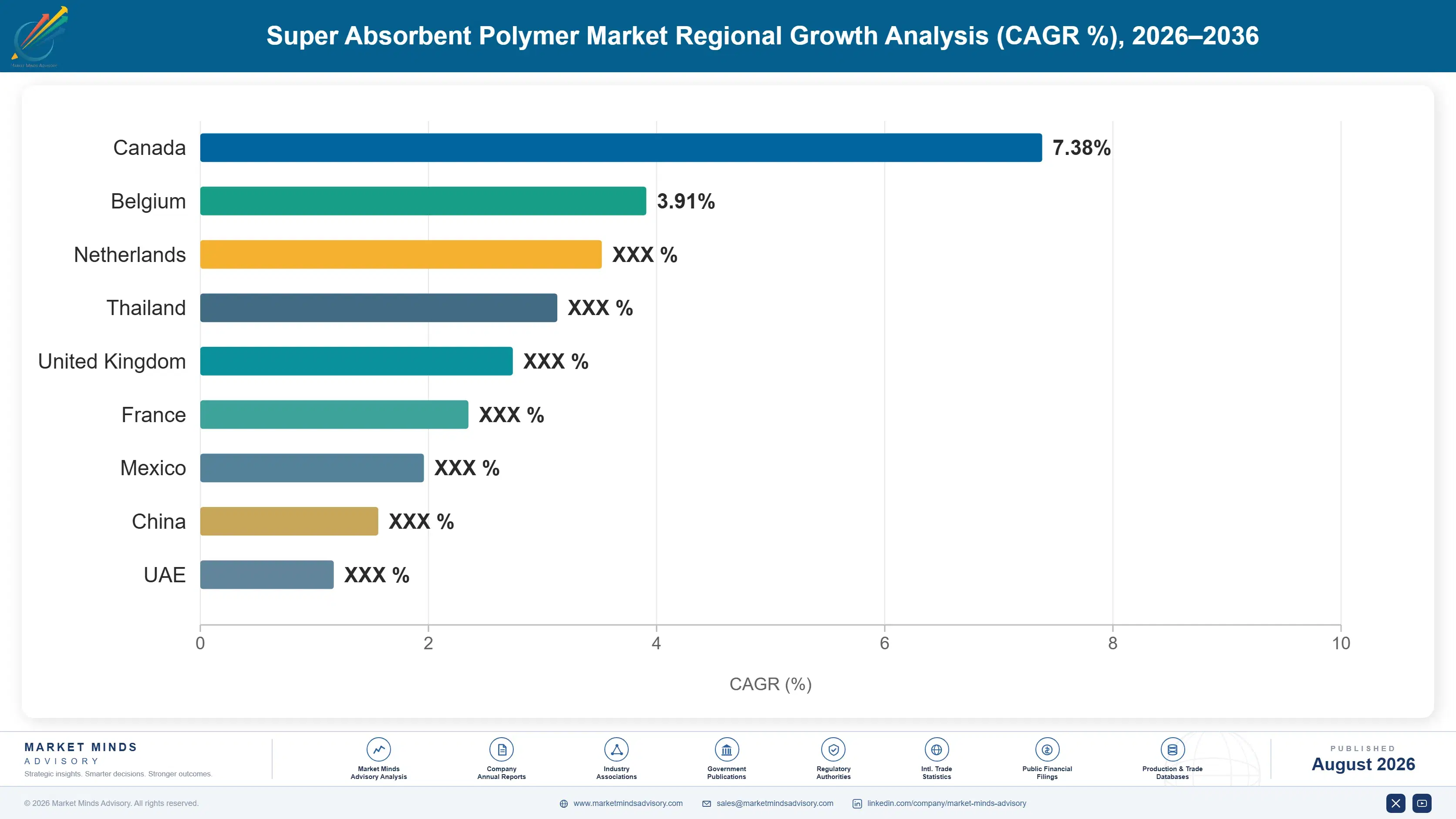
super-absorbent-polymer-market-trends-country-cagr-analysis-1787639564032

Four Moves After the Cushion Ran Out

Thin-core substitution masked a falling birth rate for a decade and has almost nothing left to give. What remains is an adult category carrying triple the loading, an agricultural pool independent of demographics entirely, and the emerging markets where infant volume still grows at all. Only one is large enough to replace what is going.

Build adult incontinence qualification ahead of infant decline

Adult products carry roughly three times the polymer of infant nappies and the category grows at 6.6% while infant volume contracts, which makes this the natural destination for capacity currently serving nappy contracts. Qualification with adult product manufacturers takes time and holds for years once established. Producers waiting until infant decline shows in their own volumes will be qualifying into a category competitors have already secured positions in. Timing matters more than terms, since qualification cycles run for years and positions hold for years afterwards once they are established. Terms matter far less.
Market Impact: Captures 3 times the polymer loading per unit

Develop agricultural grades as a demographic hedge

Soil conditioning demand grows at 6.0% on water scarcity rather than on any birth or ageing variable, which makes it the only meaningful demand pool in this market independent of demographics. Specification differs genuinely, requiring salinity tolerance, slower release and eventual breakdown, so it needs a development programme rather than a repackaged hygiene grade. That difference is exactly why the competitive field there is narrower than in hygiene. Irrigation allocation policy is public and predictable, which makes this demand easier to forecast than anything in hygiene. Nothing in hygiene forecasts that cleanly.
Market Impact: Adds 6.0% growth outside all demographic drivers entirely

Serve emerging market penetration with appropriate grades

India grows at 8.6% and is effectively the last large market where infant polymer volume genuinely expands, but price points there will not support premium grades developed for western thin-core products. Producers applying developed market specifications and pricing arrive with the wrong product. Lower specification grades manufactured regionally address the volume that actually exists rather than the volume a western planning model would assume. Regional manufacture at appropriate specification is what actually serves that volume, rather than discounting a premium grade toward a price it was never designed to reach.
Market Impact: Follows 8.6% Indian volume growth in every year

Start the biodegradability work before policy forces it

A crosslinked polymer that holds 30 times its weight and never breaks down, used in single-use products at very large volume, is an obvious target for waste policy and several jurisdictions have already noticed. No commercial route matches performance at acceptable cost today. Producers beginning that development now hold an option worth considerably more than the research costs, and those starting after a rule lands will be following somebody else's specification. The research spend is modest against the exposure it addresses. Waste policy consultations have already begun in several jurisdictions, which shortens the time available considerably.
Market Impact: Addresses a polymer holding 30 times its weight

Who Controls the Margin Pool

Participation is measured on annual polymer production capacity in tonnes, and the top five hold 61%. Concentration is high because capacity is capital intensive and hygiene manufacturers qualify suppliers over long periods, which limits how quickly a new entrant can convert capacity into volume. Nippon Shokubai and BASF lead on capacity and qualification depth together rather than on any single technical advantage. The gap to challengers is qualification history rather than plant capability.
Competition runs on three fronts. Hygiene qualification decides access to the large converter contracts that carry most volume. Manufacturing cost decides commodity grade supply, where Chinese capacity competes hard. And application development decides agricultural and specialty positions, which very few producers have pursued seriously at all. Application development has become a fourth front, and almost nobody has pursued it with any seriousness.

Pressure ahead comes from infant volume decline removing the demand base that current capacity was built for, and from Chinese capacity pressing on commodity pricing. Expect producers to compete for adult incontinence qualification rather than infant contracts. Rankings shift on who converts capacity toward growing applications first. Concentration should hold while qualification remains the barrier.
super-absorbent-polymer-market-trends-company-positioning-matrix-1787639564557

Competitive Moat and Risk Dimensions

NIPPON SHOKUBAI

Moat: Capacity scale and hygiene qualification

Production capacity across multiple regions combined with qualification depth at the largest hygiene converters creates positions that require years to displace, since a converter changing polymer supplier revalidates product performance across an entire product line. That combination also positions the company well in adult incontinence, where Japanese manufacturers pioneered the formats now spreading elsewhere.
NIPPON SHOKUBAI

Risk: Infant application volume decline

Heavy exposure to infant nappy applications ties capacity to a demand base contracting with births across the markets that consume most of it, with thin-core substitution no longer available to offset falling units. That decline is demographic rather than competitive, so no product improvement or commercial effort reverses it in any market.
BASF

Moat: Acrylic acid integration and reach

Integration back into acrylic acid production removes exposure across roughly 71% of polymer cost that non-integrated producers carry in full, in a product where monomer dominates the cost structure entirely. Combined with hygiene qualification and geographic reach, that produces a cost and supply position a standalone polymer producer cannot assemble at reasonable capital cost.
BASF

Risk: European demand and energy exposure

European production faces both the sharpest infant volume decline of any region and the highest industrial energy costs, which is an uncomfortable combination for capacity sited there. Serving growth markets from European assets adds freight to a product whose economics do not readily absorb it over long distances.

Players Tracked

Prominent Players

Nippon Shokubai
BASF
Sumitomo Seika
LG Chem
Evonik

Other Key Players

Sanyo Chemical Industries
SDP Global
Formosa Plastics
Kao Corporation
Songwon Industrial
Yixing Danson Technology
Zhejiang Weilong Polymer
Quanzhou Banglilai
Shandong Nuoer Biological
Satellite Chemical
Wanhua Chemical
Acuro Organics
Chase Corporation
Sinofloc Chemical
Kolon Industries

Recent Developments

MARCH 2026

Producer converts nappy grade capacity toward adult product specifications

A polymer producer converted part of its infant nappy grade capacity to adult incontinence specifications, citing declining nappy unit volumes across its core markets and the substantially higher loading that adult products carry per unit shipped. Existing infant contracts were allowed to run down rather than renewed.
Signal: Capacity is being redirected toward the applications that demographics are actually growing rather than shrinking away
SEPTEMBER 2025

Waste policy consultation targets single-use hygiene product streams

A waste policy consultation identified single-use hygiene products as a priority stream, raising questions about polymer persistence in landfill and incineration that no current commercial product answers at performance parity or acceptable cost. No commercial biodegradable alternative was identified during the process. Industry submissions acknowledged as much.
Signal: Persistence is becoming a policy question before any commercial answer actually exists for the industry anywhere
JANUARY 2026

Irrigated grower adopts soil conditioning polymer under water allocation limits

An irrigated grower adopted soil conditioning polymer across a production block after water allocation was reduced, valuing retention in the root zone rather than any yield claim. Salinity tolerance and release rate decided the product selection. Yield claims were treated as secondary throughout the evaluation.
Signal: Agricultural demand follows water allocation policy rather than any agronomic fashion cycle in any market at all

Acrylic Acid Is Nearly Everything

Acrylic acid carries around 71% of finished polymer cost and is produced by propylene oxidation, which ties the input directly to refinery and cracker economics rather than to anything in hygiene. Caustic soda for neutralisation takes about 7%. Crosslinkers, surface treatment agents and additives account for around 6%. Energy, labour, packaging and freight absorb the balance across most producers.
Propylene and acrylic acid pricing moved sharply through 2021 and 2022 alongside energy costs, per IEA petrochemical reporting and BASF Annual Report 2025 alongside Nippon Shokubai annual reporting for 2025 on monomer exposure. Non-integrated producers absorbed the movement while integrated ones passed considerably less through, and hygiene converters resisted price increases hard given their own retail pricing constraints. Contract structures with the largest converters were not renegotiated afterwards.

Exposure divides on integration rather than on scale. A producer holding its own acrylic acid capacity carries roughly a third of the exposure that a merchant buyer does across the dominant cost element. Chinese producers carry lower energy cost and substantial capacity across both stages. A non-integrated producer with fixed price converter contracts is effectively running an unhedged propylene position with a polymer plant attached.
super-absorbent-polymer-market-trends-cost-volatility-analysis-1787639564755

Integrate backward or contract acrylic acid on multi-year terms

With around 71% of cost in a single monomer priced against propylene, a non-integrated producer holding fixed price converter contracts carries an unhedged commodity position for the contract duration. Integration is expensive and multi-year indexed contracting is not, and either beats absorbing movements that have repeatedly compressed margins across this industry. Integration is the durable answer here.

Negotiate monomer indexation into converter supply agreements

Hygiene converters resist price increases because their own retail pricing is constrained, which pushes monomer volatility onto polymer producers by default. Indexation clauses shift that exposure back to where it originates, and converters generally accept them once the monomer share of cost is set out plainly in the negotiation. Most converters accept the logic readily.

Shift mix toward applications that tolerate higher pricing

Adult incontinence, medical and agricultural grades all support better pricing than commodity infant nappy supply, which is where converter purchasing pressure is fiercest. Moving mix reduces exposure to the segment with the least pricing tolerance while following the applications that demographics and water policy are actually growing. Mix shift is the practical route available.

Portfolio Architecture for Margin Defence

Margin here follows the customer's own pricing freedom, because a polymer producer selling into a category with constrained retail pricing inherits that constraint. Commodity infant nappy grades earn margins in the mid single digits to low teens, where large converters purchase against tight specifications and pass very little cost increase through to their own customers. Converter purchasing pressure is fiercest there. Specifications are tight and prices are set by the buyer.
Adult incontinence and premium hygiene grades do better in the mid teens to mid twenties, because performance under pressure and acquisition rate genuinely differentiate products, and the retail category itself supports better pricing than infant nappies do in any market. Adult retail categories carry pricing freedom that infant nappies have never had in any market.

Agricultural, medical and specialty industrial grades hold the strongest position, reaching into the low thirties, where specification differences are substantial and the buyer is solving a problem rather than filling a nappy core. Those margins reflect application development capability rather than any advantage in monomer cost or plant scale. Very few producers have built the application development capability those grades genuinely require.

Commodity Infant Nappy Grades

High volume hygiene grades sold to large converters against tight specifications. The seven point range reflects monomer integration position and plant scale rather than any product difference between qualified suppliers.
Gross Margin: 5-12%

Adult Incontinence and Premium Hygiene

Higher performance grades where acquisition rate and retention under pressure genuinely differentiate. The ten point range reflects qualification depth and how far the converter's own retail pricing supports a better polymer.
Gross Margin: 15-25%

Agricultural, Medical and Specialty Grades

Application specific grades with salinity tolerance, controlled release or medical qualification behind them. The ten point range reflects development capability and how narrow the qualified supplier field is in each application.
Gross Margin: 22-32%
super-absorbent-polymer-market-trends-portfolio-architecture-1787639565276

High-value Sub-segments and Strategic Watch-out

Adult Incontinence Grades

High value and the fastest growth at 6.6%, carrying roughly three times the polymer of infant products. Ageing populations expand it as the same demographic transition contracts the infant category that most capacity was built for. Qualification takes years and holds for years. Timing decides position.
Gross Margin: 17-25%

Agricultural Soil Conditioning

High value and growing at 6.0% on water scarcity rather than demographics, which makes it the only demand pool here independent of birth and ageing rates. Specification differences keep the qualified field narrow. Water allocation policy rather than agronomic fashion drives it. Rebadged hygiene grades fail.
Gross Margin: 22-31%

Commodity Infant Nappy Grades

The volume core, tied to a demand base contracting with births and no longer cushioned by thin-core substitution. Converter purchasing pressure is fiercest here and retail pricing constrains what can be passed through. Thin-core substitution has nothing left to give. Retail pricing constrains pass-through. Volume falls directly.
Gross Margin: 5-12%

Polymer Persistence Exposure

The strategic watch-out. A crosslinked polymer holding 30 times its weight never breaks down, and the range reflects how far a producer has begun development work before waste policy forces a specification on everybody. No commercial alternative currently matches performance. Consultations have already begun. Development takes years.
Gross Margin: 4-30%

Registries, Not Order Books

Demand here originates in demographic statistics rather than in any commercial variable a producer influences. Infant volume follows birth registrations with a lag of months, adult incontinence follows population ageing with a lag of decades, and agricultural demand follows water allocation policy. None of the three responds to sales effort, which makes forecasting unusually reliable and commercial influence unusually limited. Sales effort changes none of it.
Stickiness follows qualification depth rather than relationship. A hygiene converter revalidates product performance across a whole line when it changes polymer supplier, which makes established positions genuinely durable and new entry slow regardless of price. Agricultural and medical positions hold on specification rather than volume. Commodity supply into price led converters reopens far more readily than any of them.

The deciding functions differ by application in ways that catch producers out. Hygiene converter selection sits with product development and procurement together, weighing performance against a constrained retail price. Agricultural selection sits with agronomists assessing water retention under local soil conditions. Medical grades sit with regulatory affairs. A producer running one technical approach across all three is right by coincidence. Very few run three.
super-absorbent-polymer-market-trends-end-use-penetration-index-1787639565788

Where We Would Put Effort

These are among the four positions where our research anticipates prominent divergence between winners and laggards over the coming forecast period. Each is grounded in the demand model, the regulatory perimeter, and the announced capacity pipeline.
01 / ADULT CATEGORY QUALIFICATION

The same ageing that took the babies

Adult incontinence products carry roughly three times the polymer of infant nappies and grow at 6.6% against a market rate of 4.4%, driven by exactly the same ageing that is now reducing births across those same markets. Qualification with adult product manufacturers takes several years and then holds for years afterwards once it has been established properly. Producers who wait until infant decline appears in their own volumes will be qualifying into positions their competitors will already have secured entirely.
02 / AGRICULTURAL GRADE DEVELOPMENT

One demand pool that ignores demographics

Soil conditioning demand grows at 6.0% on genuine water scarcity and irrigation allocation limits rather than on any birth or ageing statistic, which makes it the only material demand anywhere in this market that demographics do not govern at all. Specification differs genuinely, needing genuine salinity tolerance, slower release and eventual breakdown rather than accepting any repackaged hygiene grade instead. That single difference is precisely why the qualified competitive field there remains considerably narrower than anywhere in the hygiene applications.
03 / EMERGING GRADE POSITIONING

India needs a different product entirely

India grows fastest of any country at 8.6% and is effectively the last large market where infant polymer volume genuinely expands rather than contracting along with falling birth numbers. Retail price points there will not support the premium grades developed for western thin-core nappy designs at any meaningful volume at all. Producers applying developed market specifications and pricing assumptions end up arriving with a product the market simply cannot buy, however good the product happens to be on any technical measure.
04 / PERSISTENCE RESEARCH TIMING

Start before somebody writes the rule

A crosslinked polymer holding 30 times its weight and never breaking down, used at enormous volume in single-use products, is an obvious waste policy target and several jurisdictions have already begun formal consultations on exactly that question. No commercial route currently matches performance at acceptable cost anywhere in the industry. Producers beginning that development now hold an option worth a great deal more than the research spend itself, while those starting later end up following a specification that somebody else has written.

Engagement Snapshot From the Field

A live engagement with an industry participant carrying material or product regulatory and market exposure ahead of a defining policy shift, showing how our research translates into a defensible multi-year portfolio strategy.
MARKET MINDS ADVISORY · CLIENT ENGAGEMENT SUMMARY
Super Absorbent Polymer Producer Strategic Portfolio Review and Transition Roadmap 2026·Investment Scenario on Super Absorbent Polymer Exposure Evaluation 2025-26
CLIENT PROFILE
An Asian superabsorbent polymer producer operating capacity supplying infant nappy converters across regional and export markets, at annual revenue near 340 million dollars (client-reported, unverified by MMA). Adult incontinence supply was incidental and no agricultural grade development existed within the business at all. Demand forecasting was built entirely from converter order patterns. No agricultural work existed.
STRATEGIC CHALLENGE
Volumes had been flat for three years despite capacity expansion, and management could not reconcile stable shipments with converter reports of falling nappy production. A capacity investment decision was pending and the demand outlook underpinning it looked increasingly unreliable. Board approval was scheduled within two quarters. Capital was already allocated.
MMA APPROACH
MMA reconstructed polymer demand from birth registration data and nappy unit volumes rather than from converter order patterns, quantified how much of the past decade's demand had come from thin-core substitution rather than unit growth, sized adult incontinence and agricultural demand independently, and assessed qualification requirements for both. Interviews with 47 experts covered hygiene converting, polymer production and irrigated agronomy.
KEY FINDINGS
  1. Roughly the whole of the client's volume growth over five years had come from rising polymer content per nappy rather than from any increase in the number of nappies produced.
  2. Thin-core substitution had removed most of the fluff pulp available to displace, which meant that source of growth was effectively finished across the client's customer base.
  3. Adult incontinence demand within the client's own regional markets exceeded its infant volume growth several times over and carried substantially better pricing per tonne shipped.
  4. Agricultural grade development was achievable within existing production capability and reached demand entirely uncorrelated with the demographic decline threatening the core business.
CLIENT PROFILE
An Asian superabsorbent polymer producer operating capacity supplying infant nappy converters across regional and export markets, at annual revenue near 340 million dollars (client-reported, unverified by MMA). Adult incontinence supply was incidental and no agricultural grade development existed within the business at all. Demand forecasting was built entirely from converter order patterns. No agricultural work existed.
STRATEGIC CHALLENGE
Volumes had been flat for three years despite capacity expansion, and management could not reconcile stable shipments with converter reports of falling nappy production. A capacity investment decision was pending and the demand outlook underpinning it looked increasingly unreliable. Board approval was scheduled within two quarters. Capital was already allocated.
MMA APPROACH
MMA reconstructed polymer demand from birth registration data and nappy unit volumes rather than from converter order patterns, quantified how much of the past decade's demand had come from thin-core substitution rather than unit growth, sized adult incontinence and agricultural demand independently, and assessed qualification requirements for both. Interviews with 47 experts covered hygiene converting, polymer production and irrigated agronomy.
KEY FINDINGS
  1. Roughly the whole of the client's volume growth over five years had come from rising polymer content per nappy rather than from any increase in the number of nappies produced.
  2. Thin-core substitution had removed most of the fluff pulp available to displace, which meant that source of growth was effectively finished across the client's customer base.
  3. Adult incontinence demand within the client's own regional markets exceeded its infant volume growth several times over and carried substantially better pricing per tonne shipped.
  4. Agricultural grade development was achievable within existing production capability and reached demand entirely uncorrelated with the demographic decline threatening the core business.
RECOMMENDED STRATEGY
Phase 1: Phase one: begin adult incontinence qualification with regional converters immediately, since the process takes years and competitors are already moving. Phase 2: Phase two: develop agricultural soil conditioning grades, which need salinity tolerance and controlled release rather than any repackaging of hygiene product. Phase 3: Phase three: defer the pending capacity expansion until demand is rebuilt from demographic data rather than from converter order patterns.
OUTCOME
The producer deferred its capacity expansion and entered adult incontinence qualification with three converters during 2026 (client-reported, unverified by MMA). Agricultural grade development began in parallel, and demand forecasting was rebuilt on demographic rather than order based inputs. Infant grade capacity was gradually redirected rather than expanded further.

Frequently Asked Questions

Foundational context covering the market sizes, CAGR, scope, country, region and competition that inform every finding below. This section is provided to cover basics and most often pre-purchase conversations, answered from the MMA Primary Research Dataset.

What is the current size of the Super Absorbent Polymer Market?

MMA sizes it at USD 9.4 billion in 2025, rising to USD 9.81 billion in 2026. The figure covers crosslinked superabsorbent polymers at producer selling value across all applications.

How large will the Super Absorbent Polymer Market be by 2036?

USD 15.09 billion by 2036, an incremental USD 5.28 billion over the 2026 base and an expansion multiple of 1.54 times. Adult incontinence accounts for a disproportionate share of that.

What is the CAGR for the Super Absorbent Polymer Market 2026 to 2036?

4.4% in the base case, with a bull case at 5.6% and a bear case at 3.2%. The spread turns on birth rate trajectories against adult and agricultural demand expansion.

Which segment is growing fastest?

Adult incontinence products at 6.6%, half again the market rate of 4.4%. Those products carry roughly three times the polymer of an infant nappy and grow with population ageing.

Who are the major companies in the Super Absorbent Polymer Market?

Nippon Shokubai, BASF, Sumitomo Seika, LG Chem and Evonik lead on production capacity. Fifteen further participants are profiled in the full report on that same consistent basis.

Which country is growing fastest?

India at 8.6%, where disposable nappy penetration is still rising from a low base and infant polymer volume genuinely expands rather than contracting as it does elsewhere.

Report Segmentation Architecture

The full report scope spans multiple orthogonal segmentation dimensions, with cross-tabulated demand data provided for each dimension pair. Coverage extends further to regional breakdowns, trend trajectories, and the competitive detail needed to support segment-level decision-making.

By Application

  • Baby Diapers
  • Adult Incontinence Products
  • Feminine Hygiene
  • Agriculture and Soil Conditioning
  • Industrial Water Blocking and Cable
  • Medical and Wound Care

By End-Use Industry

  • Infant Hygiene Manufacture
  • Adult and Medical Hygiene
  • Feminine Care Manufacture
  • Agriculture and Horticulture
  • Cable and Wire Manufacture
  • Medical Devices and Wound Care

By Commercial Dimension

  • Direct Converter Supply Contracts
  • Distributor and Trading Channels
  • Private Label Converter Supply
  • Agricultural Input Channels
  • Qualified Medical Supply Agreements
  • Export and Cross-Border Supply

By Region

  • North America
  • Western Europe
  • East Asia
  • South Asia and Pacific
  • Latin America
  • Middle East and Africa
  • Eastern Europe

Scope, Methodology, and Coverage

Every figure in this report is reproducible from documented input assumptions. The scope below maps the historical period, the forecast horizon, the segmentation dimensions, and the countries covered, alongside the underlying primary and qualitative methodology.
Historical Period
2020 to 2025
Forecast Period
2026 to 2036
Base Year
2025 (USD billions; MMA Primary Research Dataset, August 2026)
Market Definition
Crosslinked superabsorbent polymers supplied for liquid retention applications, covering baby diapers, adult incontinence products, feminine hygiene, agriculture and soil conditioning, industrial water blocking and cable applications, and medical and wound care. Measured at producer selling value. Fluff pulp and other absorbent cores, nonwoven cover materials, finished hygiene products, hydrogels for drug delivery, and acrylic acid sold as a monomer are excluded from scope.
Quantitative Units
USD billions (current prices); thousand tonnes produced; USD per tonne by application grade
Segmentation Dimensions
Application; end-use industry; commercial dimension; region
Regions Covered
North America, Western Europe, East Asia, South Asia and Pacific, Latin America, Middle East and Africa, Eastern Europe
Countries Covered
United States, Canada, Mexico, Germany, France, Belgium, United Kingdom, Italy, China, Japan, South Korea, Taiwan, India, Indonesia, Australia, Brazil, Turkey, Saudi Arabia, South Africa, Poland
Key Companies Profiled
Nippon Shokubai, BASF, Sumitomo Seika, LG Chem, Evonik, Sanyo Chemical Industries, SDP Global, Formosa Plastics, Kao Corporation, Songwon Industrial, Yixing Danson Technology, Zhejiang Weilong Polymer, Quanzhou Banglilai, Shandong Nuoer Biological, Satellite Chemical, Wanhua Chemical, Acuro Organics, Chase Corporation, Sinofloc Chemical, Kolon Industries
Quantitative Methodology
Primary survey, n=3,800 respondents, Q4 2025, six countries; demand-side model with trade association cross-validation
Qualitative Methodology
47 expert interviews, Q4 2025; applied to validate demand model assumptions, identify emerging dynamics, and assess competitive positioning
Report Format
PDF and XLSX data workbook (Word format preview document)
Publisher
Market Minds Advisory
Report Code
MMA-2026-CHM-141
Published
August 2026
Contact
sales@marketmindsadvisory.com | www.marketmindsadvisory.com

Purchase the full Super Absorbent Polymer Market Report (2026 to 2036).

The full report rebuilds demand from birth registrations and population ageing rather than from converter order patterns, because demographics govern this market and order books lag them by months. It sizes all six applications independently through 2036, separates thin-core substitution from genuine unit growth across the past decade, and models adult incontinence and agricultural demand as independent pools. Regional chapters cover all seven regions with production capacity assessed separately from consumption. Competitive profiling covers 20 participants on one consistent capacity basis. Qualification cycle length is assessed by application throughout.
Six applications sized independently through 2036
Demand rebuilt from birth registration and ageing data directly
Thin-core substitution separated from genuine unit volume growth
Adult incontinence loading quantified against infant product equivalents
Agricultural demand modelled against water allocation policy by region
Twenty participants profiled on one consistent capacity basis

Built For The People Who Decide

From boardroom strategy to bench-side execution, this report is read cover-to-cover by leaders shaping the next decade of their industry, turning demand scenarios, market dynamics and valuation benchmarks into decisions.
CXOs/ Presidents/ VPs/ Managers
M&A and Corporate Development
Strategy Teams and R&D Heads
Procurement and Product Directors
Regulatory and Compliance Leaders
Investor Relations and Equity Analysts