Market Minds Advisory
Sulphur Coated Urea Market

Sulphur Coated Urea Market: Nutrient Efficiency Policy Meets Soil Sulphur Deficiency

Tightening nitrogen use efficiency policy, widespread soil sulphur deficiency, and precision agriculture adoption are pulling controlled-release fertilizer demand toward polymer-enhanced sulphur coated urea that standard prilled urea cannot match agronomically.

Lead Analyst

Bilal Shaikh

Published

September 2026

Make Smarter Decisions with Customized Research Insights

Request a free sample report and evaluate market opportunities, growth trends, and competitive dynamics relevant to your business needs.

2025 MARKET VALUE$1.6BMarket Size 2025
2036 FORECAST VALUE$3.2BBase Case , 2026 to 2036
CAGR 2026 TO 20366.6 %Bull 7.8% / Bear 5.4%
INCREMENTAL OPPORTUNITY$1.5BNet 10- year value creation
EXPANSION MULTIPLE1.89x2036 value over 2026 base
Strategic Levers
M&A Pipeline
Regional Outlook
Country Rankings
Competitive Intelligence
Segmental Deep-dive
Call-Us : 91 93563 13602

Executive Snapshot and Market Trajectory

Sulphur coated urea is moving from a niche specialty fertilizer into a policy-favored input, as nitrogen use efficiency regulation and widespread soil sulphur deficiency give agronomists a defensible reason to specify it over standard prilled urea. Producers now compete on formulation science as much as production scale.
Commercial demand splits between large-acreage row crop farmers seeking nitrogen release control and reduced application frequency, and turf and specialty growers who value the dual nitrogen and sulphur nutrition this product reliably delivers across a full growing season. China accounts for close to a third of global consumption, driven by its massive fertilizer manufacturing base and government-driven nutrient use efficiency modernization programs, while India's severe and well-documented soil sulphur deficiency adds substantial further demand nationally.
Competition remains moderately concentrated, with the top five holding under half of global capacity. Koch Agronomic Services and Nutrien hold the deepest agronomic and distribution relationships, while polymer-enhanced coating technology is pulling premium segment growth well ahead of standard sulphur coating alone. Newer entrants remain years behind on the formulation and agronomic research depth this segment requires. This dynamic favors technically established suppliers over new competitors lacking track records.
Market Definition
This market covers sulphur coated urea fertilizers, including standard sulphur coated urea, polymer sulphur coated urea, and sulphur coated urea blended with micronutrients, used to deliver controlled-release nitrogen and supplemental sulphur nutrition in agricultural, turf, and ornamental applications. It excludes standard uncoated urea, ammonium sulphate, and other nitrogen fertilizers not incorporating a sulphur coating layer.
Base Year Value
$1.6B in 2025 (MMA Primary Research Dataset, August 2026)
Forecast Period
2026 to 2036, eleven discrete annual values
CAGR
6.6% base case. Bull 7.8%. Bear 5.4%.
Fastest Growth Segment
Polymer Sulphur Coated Urea: 9.2% CAGR
Fastest Growth Country
India: 8.4% CAGR
Fastest Growth Region
South Asia and Pacific: 8.9% CAGR
Largest Region
East Asia: 30% of 2025 global value
Market Leaders
Koch Agronomic Services LLC, Nutrien Ltd., Yara International ASA, ICL Group Ltd., Kingenta Ecological Engineering Group Co. Ltd. Source: MMA Analysis based on company annual reports.
Primary Survey
n=3,800 procurement and R&D decision-makers, Q4 2025, six countries
Methodology
Demand-side build-up, cross-validated against public data, 47 expert interviews

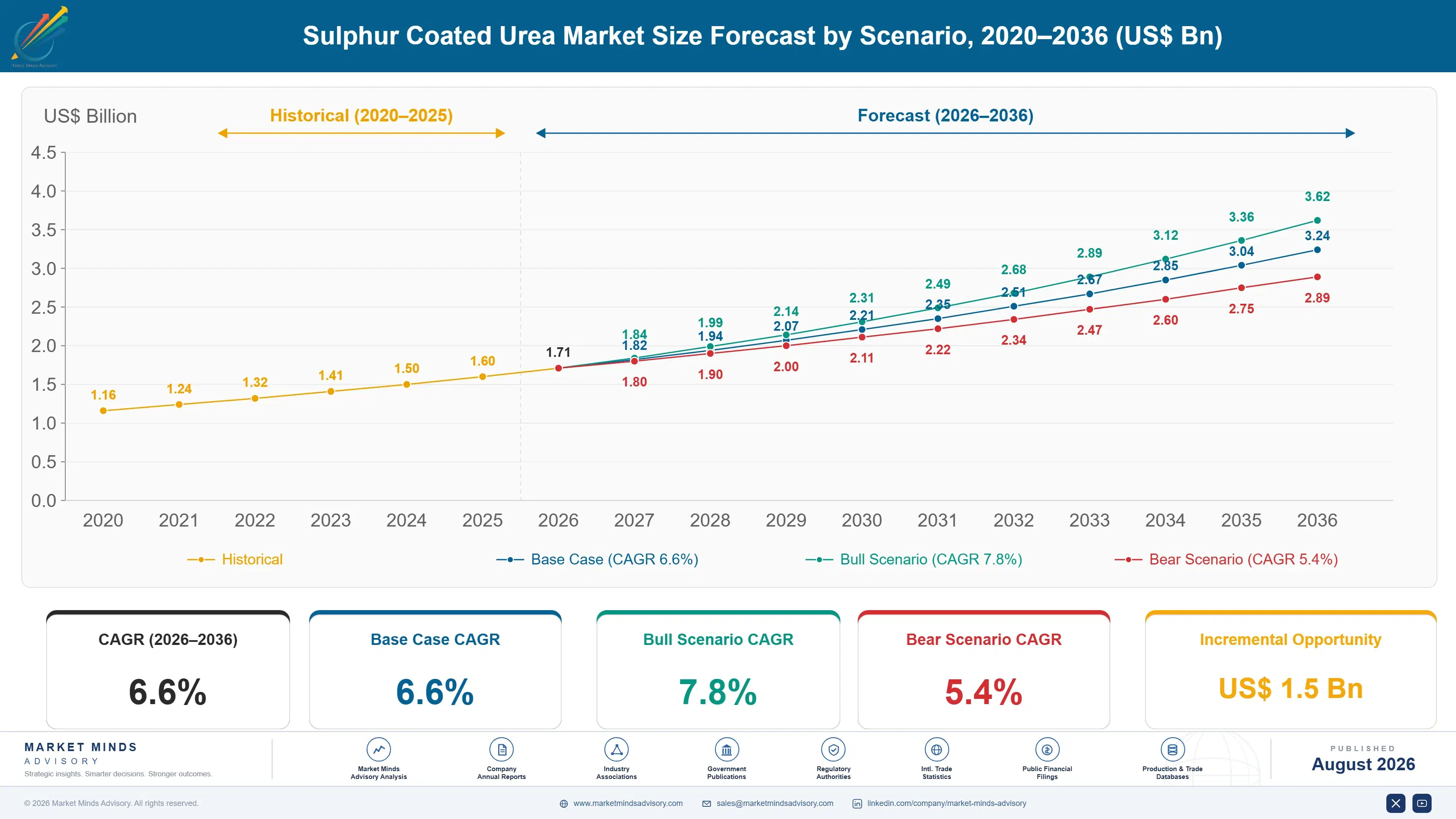
Sulphur Coated Urea Market Forecast Scenarios

sulphur-coated-urea-market-size-forecast-scenario-1787311034275
Sulphur coated urea demand grew steadily through 2020 to 2025 as nutrient use efficiency policy expanded across major agricultural economies and soil sulphur deficiency awareness increased among agronomists. The market grew at an estimated 5.8% historical CAGR across the period, with polymer sulphur coated grades consistently outpacing standard coating growth after 2022. Standard coating volume grew more modestly across mature agricultural markets.
The base case assumes 6.6% CAGR through 2036, driven by three mechanisms operating together. First, continued nitrogen use efficiency policy across major agricultural economies pushes farmers toward controlled-release fertilizers that reduce nitrogen loss and application frequency compared to standard urea. Second, widespread and well-documented soil sulphur deficiency, worsened by declining atmospheric sulphur deposition from cleaner industrial emissions, is driving agronomic demand for fertilizers that deliver sulphur alongside nitrogen. Third, precision agriculture adoption is accelerating polymer-enhanced coating specification.
The bull case (7.8% CAGR) assumes faster-than-expected nutrient use efficiency policy adoption across additional major agricultural markets pulls demand forward ahead of current industry planning assumptions. The bear case (5.4% CAGR) reflects the risk that persistent price sensitivity among smallholder farmers in price-constrained markets keeps standard uncoated urea the default choice longer than currently expected.

Dual Nutrition Economics Reshape Fertilizer Specification

Sulphur coated urea economics increasingly reward producers that can demonstrate genuine controlled-release performance and sulphur delivery consistency, since the price premium over standard urea only holds up commercially when agronomists can verify the yield and efficiency benefit through field trial data rather than marketing claims alone. This performance verification requirement rewards producers with established agronomic research programs over those competing purely on price. Producers s
CR5 CONCENTRATION44%share held by the top five global producers
AVERAGE SELLING PRICE$310-480/tonrange spanning standard grade to polymer-enhanced coating grades
TOP PRODUCING COUNTRY SHAREChina, 26%share of global sulphur coated urea production capacity today
CAPACITY UTILIZATION73%average operating rate across dedicated coating production lines
TRADE INTENSITY29%of finished coated urea volume crossing borders before distribution
FEEDSTOCK COST SHARE48% of COGSurea granule and elemental sulphur feedstock inputs combined together
Row crop farmers and turf or specialty growers behave differently as buyers. Row crop farmers evaluate this product against detailed cost-per-acre nitrogen efficiency calculations, often requiring multi-season trial data before switching from standard urea, while turf and specialty growers move faster and prioritize consistent release performance and application convenience over granular cost comparison alone. This divergence in buying behavior requires distinctly different commercial approaches for each customer type.
Over the next decade, two forces will determine winners. Continued nitrogen use efficiency policy will keep expanding the addressable row crop market, while soil sulphur deficiency awareness adds a second, agronomically distinct growth vector that rewards producers investing early in dual-nutrient formulation technology. Producers investing in both vectors stand to capture the broadest share of growth.
"Farmers have been trained for decades to think about nitrogen efficiency and ignore sulphur entirely, because industrial pollution used to deposit plenty of it for free. Now that atmospheric sulphur has declined along with cleaner air, coated urea producers are selling a genuine agronomic fix rather than just a marketing upgrade."
Director, Specialty Fertilizers and Crop Nutrition Practice · MMA Agriculture Pr

Market Trends

Declining Atmospheric Sulphur Deposition Drives Agronomic Demand

Decades of cleaner industrial and power generation emission standards have sharply reduced atmospheric sulphur deposition that historically supplied a meaningful share of crop sulphur nutrition for free, creating genuine and increasingly documented soil sulphur deficiency across major agricultural regions that previously never required supplemental sulphur fertilization. Agronomists increasingly recommend sulphur coated urea specifically to address this deficiency, since it delivers both nitrogen and sulphur in a single application rather than requiring separate sulphur fertilizer purchases and application passes. This trend has proven durable, since the underlying cause, cleaner air, shows no sign of reversing while soil reserves continue depleting.
Market Impact: Adds 1.1 million ton policy-driven
Polymer Coating Technology Improves Release Predictability

Producers have commercialized polymer-enhanced sulphur coating technology that improves nitrogen release predictability compared to standard sulphur coating alone, giving precision agriculture operations more confidence in matching nutrient availability to crop uptake timing across the growing season. This technology commands a meaningful price premium over standard sulphur coated urea, reflecting the additional formulation research and quality control investment required to achieve consistent release performance. Several major producers have expanded polymer coating capacity specifically to serve large-acreage row crop customers increasingly adopting precision nutrient management practices as part of broader farm efficiency programs.
Market Impact: Adds 6% turf demand

Market Opportunities and Growth Drivers

Nitrogen Use Efficiency Policy Expands Addressable Market

Government nitrogen use efficiency policy across China, India, and parts of Europe continues pushing farmers toward controlled-release fertilizers that reduce nitrogen loss to leaching and volatilization compared to standard urea, since these losses represent both an economic cost to farmers and an environmental concern to regulators focused on water quality and greenhouse gas emissions. This policy pressure has made it a specified alternative in government-supported programs across several markets, and continued expansion is expected to sustain growth. Producers securing early positioning within subsidy frameworks gain adoption incentives smaller producers cannot match.
Market Impact: Adds 20-30% price premium

Turf and Specialty Grower Demand Remains Resilient

Golf course, sports field, and ornamental landscape managers continue specifying sulphur coated urea for its controlled nitrogen release and reduced application frequency, valuing the labor and equipment cost savings this delivers compared to more frequent standard urea application schedules. This demand has proven resilient even during periods of broader agricultural commodity price softness, since turf and specialty markets operate on maintenance budgets less directly tied to crop commodity economics than row crop farming decisions. Producers serving this demand typically maintain closer relationships with turf management professionals and distributors than with the agronomic research relationships that dominate row crop sales.
Market Impact: Cuts conversion margin 7% in volati

Market Restraints and Challenges

Price Premium Limits Smallholder Farmer Adoption

Sulphur coated urea carries a meaningful price premium over standard uncoated urea, often 20 to 30% more per ton for comparable nitrogen content, which remains a genuine barrier for smallholder farmers operating under constrained input budgets regardless of the documented agronomic benefit. This cost gap has confined adoption largely to larger commercial farming operations and turf or specialty markets where buyers can better absorb or justify the premium within broader operating budgets, limiting penetration in price-sensitive smallholder-dominated agricultural markets. Producers are addressing this through continued production efficiency investment intended to narrow the cost gap gradually over time.
Market Impact: Adds 9% sulphur-deficiency-driven d

Elemental Sulphur Price Volatility Compresses Margins

Elemental sulphur, a key feedstock recovered primarily as a byproduct of oil and gas refining, is priced on volatile global commodity markets that coated urea producers cannot fully control, and while most supply agreements pass through some feedstock cost, the conversion margin itself faces pressure whenever sulphur prices spike sharply within a contract period before pricing formulas can reset. This volatility has squeezed smaller producers without long-term sulphur supply agreements during recent periods of rapid price movement, forcing some to delay planned capacity investment until pricing stabilized. Larger producers with hedging capability have weathered these swings more comfortably.
Market Impact: Adds 7% polymer coating segment vol
3 additional market trends, 4 additional growth drivers, and 3 additional restraints and challenges are covered in the full report. Contact sales@marketmindsadvisory.com to access the complete intelligence.

Segment CAGR and Growth Architecture

MMA segments this market by coating formulation type, the classification agronomists and distributors use when specifying controlled-release fertilizer for a given application. This lens separates standard sulphur coated, polymer sulphur coated, and micronutrient-blended formulations by underlying coating technology rather than crop application alone, reflecting genuinely different production processes. Regional origin is treated as a separate dimension.
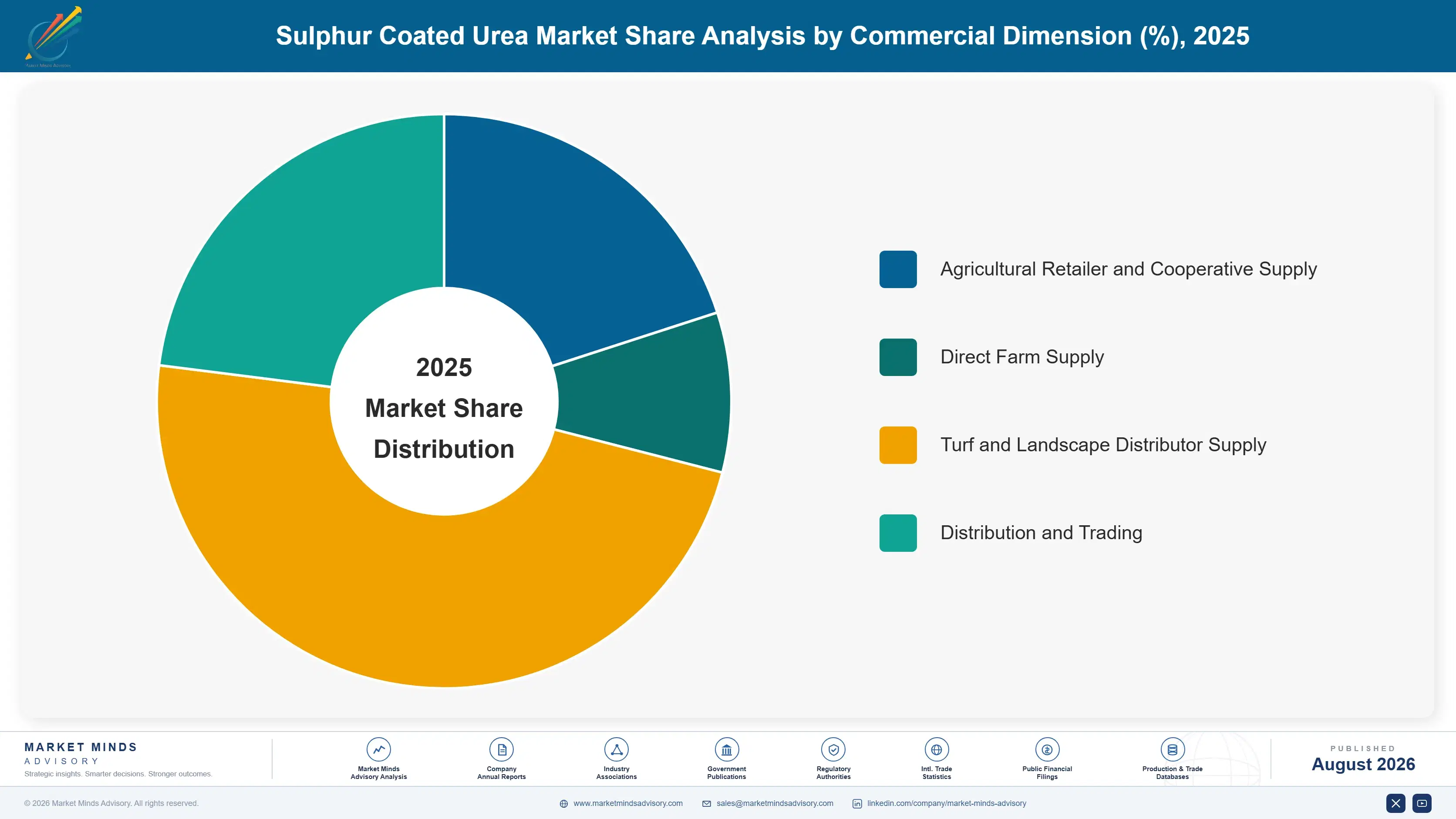
sulphur-coated-urea-market-market-share-analysis-1787311034809

Polymer Sulphur Coated Urea

Polymer sulphur coated urea is the fastest-growing segment by a wide margin, expanding directly alongside precision agriculture adoption as large-acreage row crop farmers specify this formulation for its more predictable nitrogen release timing compared to standard sulphur coating alone. This release predictability allows farmers to better match nutrient availability to crop uptake curves across the growing season, delivering agronomic performance that standard coated urea cannot reliably match. Koch Agronomic Services and Nutrien hold the deepest technical positions in this segment, having invested years in polymer formulation refinement to achieve consistent release performance at commercial scale. Growth here concentrates among large commercial operations investing in precision nutrient management, giving producers exposure to the industry's most sophisticated buyer base.
CAGR 9.2%

Sulphur Coated Urea With Micronutrient Blends

Sulphur coated urea blended with micronutrients is expanding faster than the standard coating base, driven by growing agronomic recognition that combined macro and micronutrient delivery in a single granule improves application convenience and nutrient use consistency compared to separate fertilizer applications. This segment commands meaningfully higher pricing than standard sulphur coated urea, reflecting the additional formulation complexity required to incorporate micronutrients without compromising coating integrity or release performance. Yara and ICL maintain strong positions given established agronomic research capability supporting blended product development. Growth here remains tied closely to continued adoption of comprehensive nutrient management programs among commercial farming operations globally. This growth spans multiple crop categories rather than any single application alone.
CAGR 7.4%
Full segment breakdown across 6 segments available in the complete report.

Regional Architecture and Country Demand Map

East Asia dominates sulphur coated urea production and consumption given China's massive fertilizer manufacturing base and government-driven nutrient use efficiency modernization programs, with South Asia posting the fastest regional growth given severe, well-documented soil sulphur deficiency across the country's vast smallholder farming regions nationwide today.

North America

United States turf and specialty markets, alongside large-acreage row crop farming across the Corn Belt, anchor North American sulphur coated urea demand, with Koch Agronomic Services maintaining significant domestic production capacity serving both segments directly. Canada contributes through smaller specialty and turf demand rather than large-scale row crop application comparable to leading American agricultural regions. Nutrien operates substantial production capacity supporting both its own agricultural retail network and third-party distribution across the region. Golf course and sports field management represents a particularly resilient demand pool given maintenance budget stability relative to row crop commodity economics. Growth trails East Asia's faster-expanding agricultural modernization programs but benefits from steady, technically sophisticated demand across both turf and precision agriculture row crop applications.
Share: 25% | CAGR: 6.9% (2026 to 2036)

Western Europe

Germany, France, and the United Kingdom anchor European sulphur coated urea demand through both commercial row crop farming and well-established turf and landscape management markets. European Union nitrogen use efficiency and water quality regulation has pushed farmers toward controlled-release fertilizers faster in this region than in many other markets, supporting continued adoption despite the region's already mature agricultural input base. Yara, headquartered in Norway, maintains deep agronomic research relationships across the region's farming community built over decades of fertilizer innovation. Soil sulphur deficiency awareness is particularly well documented in this region given extensive academic agronomic research tracking declining atmospheric sulphur deposition. Growth trails the global average as the region's mature agricultural sector grows more slowly than expanding Asian markets.
Share: 18% | CAGR: 5.0% (2026 to 2036)
Regional intelligence for 5 additional markets available in the complete report: East Asia, South Asia and Pacific, Latin America, Middle East and Africa, Eastern Europe. Contact sales@marketmindsadvisory.com.
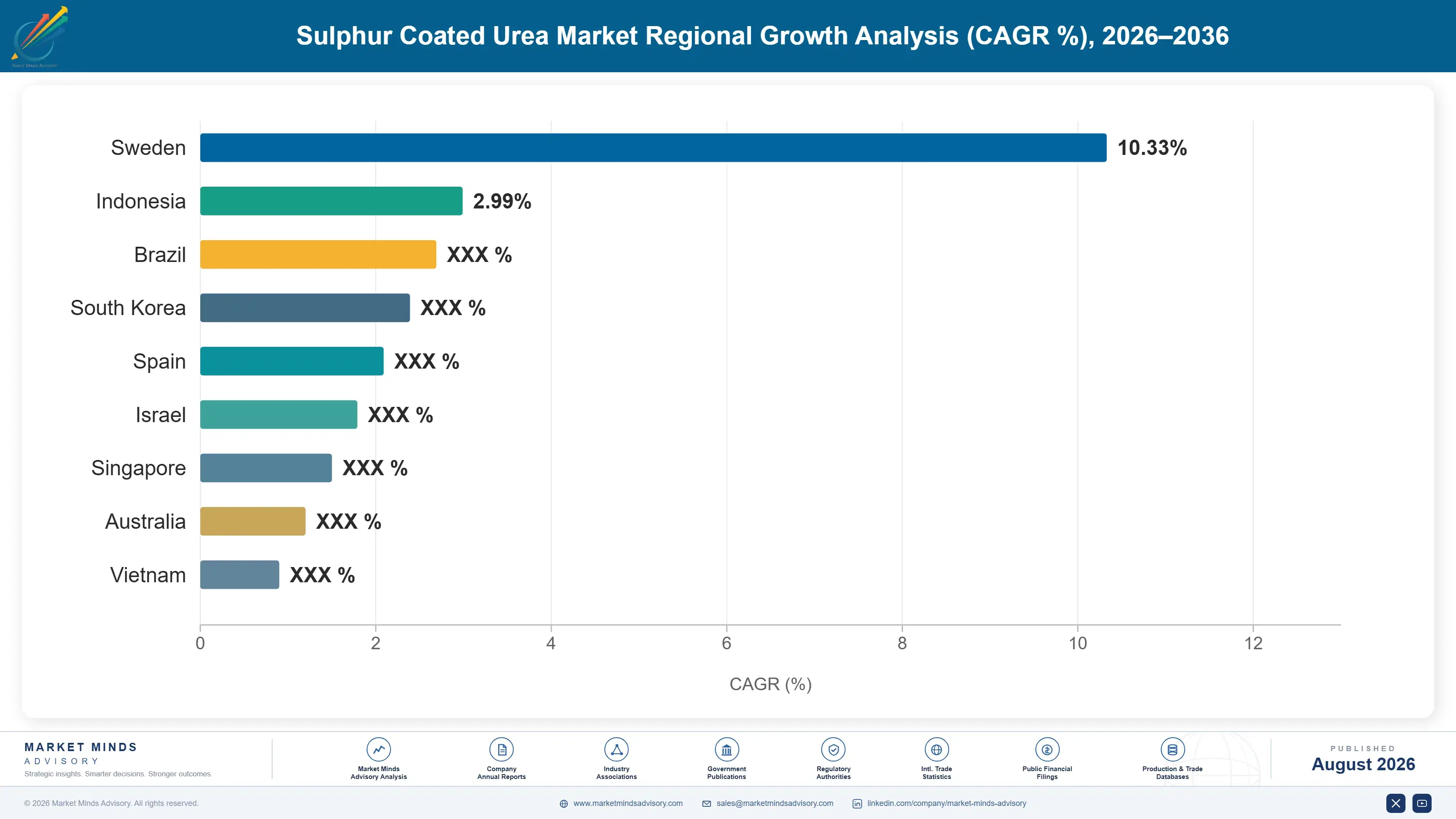
sulphur-coated-urea-market-country-cagr-analysis-1787311035326

Where Coated Urea Producers Can Expand Margins

Producers create outsized value not from standard coating tonnage but from polymer formulation depth, agronomic research investment, and long-term distributor relationships. The levers below identify where margin expands fastest, moving beyond commodity coated urea sales toward premium release technology, dual-nutrient blends, and application-specific technical support. This favors producers investing ahead of visible agronomic demand signals.

Polymer Coating Technology Commands Premium Pricing

Producers that achieve consistent polymer-enhanced release performance capture meaningfully higher realized pricing than standard sulphur coated urea, often 15 to 25% more per ton for equivalent nitrogen content, because precision agriculture customers pay for the release predictability this technology provides over standard coating alone. This formulation expertise requires years of process development and significant capital investment in coating equipment, but producers that achieve it gain access to the highest-margin segment of the entire market well ahead of competitors still selling standard commodity coating alone. Several producers have captured outsized share of new precision agriculture contracts this way.
Market Impact: Adds 250 to 350 basis points gross

Agronomic Research Investment Wins Farmer Trust

Producers that invest in multi-season field trial research and publish credible yield and efficiency data win farmer adoption more consistently than competitors relying on marketing claims alone, since row crop farmers require verified performance evidence before switching from familiar standard urea. This research investment requires sustained funding but builds a durable trust advantage that smaller producers without comparable agronomic research capability struggle to replicate quickly regardless of product quality. Producers with this credibility typically lift farmer adoption rates by roughly 20% relative to competitors lacking comparable field trial evidence. This trust advantage compounds over successive growing seasons.
Market Impact: Lifts the farmer adoption rate by 2

Dual-Nutrient Blend Formulation Deepens Customer Value

Producers that develop micronutrient-blended coated urea formulations capture value beyond standard nitrogen and sulphur delivery, addressing comprehensive crop nutrition needs in a single application that reduces farmer application cost and complexity. This formulation capability requires sustained research investment, but producers achieving it capture pricing 15 to 20% above standard sulphur coated urea given the added agronomic value comprehensive nutrition delivery provides to sophisticated commercial farming customers. This engineering layer has become a meaningful differentiator among distributors evaluating competing coated urea suppliers. Producers offering this capability report measurably deeper distributor relationships than commodity coating sellers competing purely on price.
Market Impact: Adds a 15 to 20 percent pricing pre

Long-Term Distributor and Retailer Supply Partnerships

Producers that establish multi-year supply agreements with major agricultural retailers and distributors, tied to specific regional market development programs, secure durable revenue relationships that persist across multiple growing seasons once established. Requalifying an alternative supplier requires distributors to rebuild farmer education and agronomic support infrastructure, a barrier that keeps switching rare once a distribution relationship is established and trusted within a regional farming community. These agreements typically extend across 3 to 5 years, giving producers revenue visibility that spot sales cannot provide. Producers value this predictability highly given the seasonal nature of agricultural input demand.
Market Impact: Secures 3 to 5 years of forward vol

Who Controls the Margin Pool

CR5 stands at 44%, reflecting a market where the largest producers hold meaningful but not dominant share given the range of regional fertilizer manufacturers competing across different formulation tiers. The gap between these five leaders and smaller regional producers is widest in polymer coating technology and agronomic research depth, where established players have accumulated years of formulation refinement.
Competition currently plays out across three dimensions: polymer coating technology races among leaders serving precision agriculture customers, agronomic research investment among producers building farmer trust through verified field trial data, and capacity expansion timed to Asian agricultural modernization programs among a broader group of regional producers. Chinese and Indian producers compete primarily on standard-grade volume and price, where formulation barriers remain lower than in premium polymer-coated applications.

Emerging pressure comes from two directions. Asian producers are investing in polymer coating capability to reduce reliance on imported technology, though formulation consistency remains a gap relative to established suppliers. Continued soil sulphur deficiency awareness could also reorder competitive rankings if agronomic demand accelerates faster than currently expected, favoring producers with early research investment over pure-volume competitors. Neither trend is likely to reorder the top five soon.
sulphur-coated-urea-market-company-positioning-matrix-1787311035854

Competitive Moat and Risk Dimensions

KOCH AGRONOMIC SERVICES LLC

Moat: Deepest Polymer Coating Technical Depth

Koch Agronomic Services has built the industry's most extensive polymer coating technical base, achieving consistent release performance that took years of formulation refinement, giving it preferred supplier status across precision agriculture customers and turf management professionals. This depth is difficult for smaller competitors to replicate quickly.
KOCH AGRONOMIC SERVICES LLC

Risk: Premium Pricing Limits Volume Scale

Koch's premium positioning and technology investment commands higher pricing but limits volume scale compared to producers competing more purely on cost, leaving less flexibility to capture share among price-sensitive smallholder-dominated agricultural markets. This trade-off has become more visible as cost-conscious growers enter the category. Competitors have taken notice.
NUTRIEN LTD.

Moat: Integrated Distribution and Retail Network

Nutrien operates an extensive agricultural retail distribution network alongside its production capacity, giving it direct farmer relationships and agronomic support infrastructure that standalone coated urea producers without comparable retail presence cannot easily replicate. This breadth, built over decades, remains difficult for standalone producers to replicate quickly.
NUTRIEN LTD.

Risk: Diversified Focus Limits Specialization

Nutrien's broad agricultural input portfolio means coated urea competes internally for capital and research attention against larger, more established product lines within the company's overall crop nutrition and crop protection business strategy. This internal competition could slow investment relative to more singularly focused rivals. Competitors are watching closely.

Players Tracked

Prominent Players

Koch Agronomic Services LLC
Nutrien Ltd.
Yara International ASA
ICL Group Ltd.
Kingenta Ecological Engineering Group Co. Ltd.

Other Key Players

Sichuan Meifeng Chemical Industry Co. Ltd.
Hanfeng Evergreen Inc.
Aglukon Spezialduenger GmbH & Co. KG
Haifa Group
EuroChem Group AG
OCI Nitrogen
CF Industries Holdings Inc.
National Fertilizers Limited
Rashtriya Chemicals & Fertilizers Limited
Chambal Fertilisers and Chemicals Limited
Coromandel International Limited
Indian Farmers Fertiliser Cooperative Limited
Helm AG
SABIC Agri-Nutrients Company
Simplot Grower Solutions

Recent Developments

MARCH 2025

Koch Agronomic Services Expands Polymer Coating Capacity in the United States

Koch Agronomic Services announced completion of a capacity expansion at its United States production facility, adding qualified polymer sulphur coated urea capacity to serve growing precision agriculture demand. The expansion follows several years of formulation refinement supporting the segment's premium release performance requirements. The expansion targets continued demand growth.
Signal: Confirms leading producers are dedicating
AUGUST 2025

Kingenta Expands Sulphur Coated Urea Capacity at Chinese Facility

Kingenta Ecological Engineering Group announced completion of a capacity expansion at its Shandong production facility, adding qualified sulphur coated urea capacity to serve growing domestic agricultural modernization demand. The expansion follows several years of quality improvement work narrowing the gap with established international suppliers. Analysts view this as domestic investment.
Signal: Signals Chinese producers are scaling cost
JANUARY 2026

Nutrien and a Major Agricultural Cooperative Sign Multi-Year Supply Agreement

Nutrien signed a multi-year supply agreement with a major regional agricultural cooperative covering polymer sulphur coated urea for member farmer distribution across multiple growing seasons. The agreement secures forward volume for Nutrien at negotiated pricing ahead of the cooperative's planned nutrient efficiency program expansion. The agreement reflects growing cooperative demand.
Signal: Signals agricultural cooperatives are incr

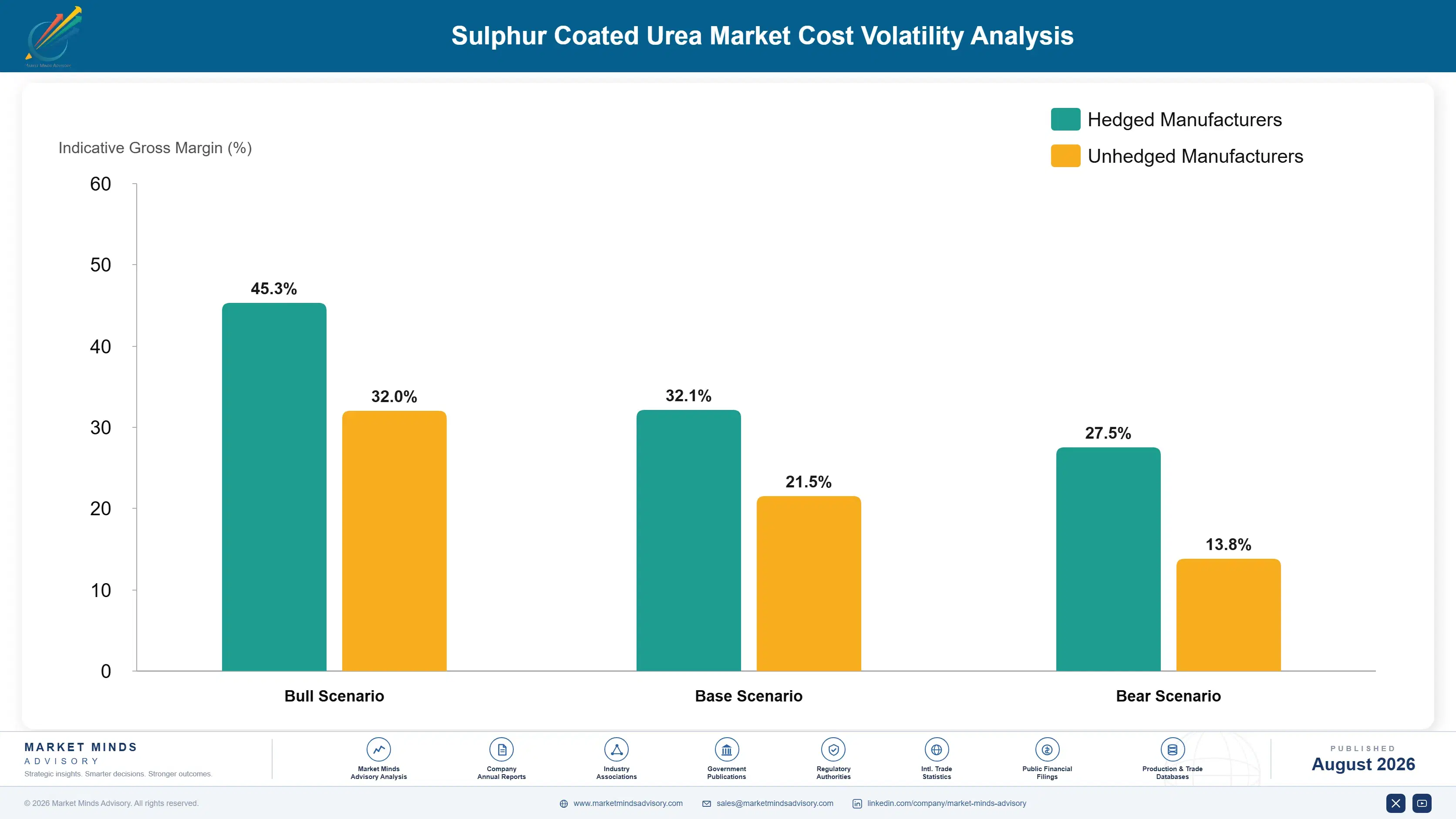
Urea Granule and Elemental Sulphur Feedstock Exposure

Urea granule and elemental sulphur feedstocks together account for roughly 48% of cost of goods sold across sulphur coated urea production, with elemental sulphur sourced primarily as a byproduct of oil and gas refining operations rather than dedicated sulphur mining. Producers without long-term sulphur supply agreements face direct exposure to this byproduct-driven pricing dynamic. Larger producers with diversified sourcing manage this exposure more effectively than smaller regional players.
Elemental sulphur prices rose sharply during 2022, documented in company annual reports across the sector, as broader industrial sulphur demand and refining capacity utilization changes pulled global sulphur markets tighter than in prior years. Several producers reported compressed conversion margins during this period, since customer pricing on longer-term distributor contracts could not be renegotiated quickly enough to reflect rising feedstock cost, illustrating how directly feedstock volatility can affect near-term profitability.

This exposure disadvantages smaller producers relative to larger competitors with diversified feedstock sourcing and long-term supply agreements, widening margin gaps during volatile pricing periods that are difficult to close through efficiency gains alone. Producers without formal supply agreements absorb volatility directly in margin, while larger integrated players like Nutrien hedge exposure through diversified sourcing and upstream production relationships.
sulphur-coated-urea-market-cost-volatility-analysis-1787311036058

Long-Term Sulphur Supply Agreements

Larger producers are locking in multi-year elemental sulphur supply contracts directly with refinery operators, reducing exposure to spot market volatility. This approach requires established refinery relationships but provides more predictable feedstock costs than spot market purchasing during volatile periods. Larger producers with dedicated procurement teams have adopted this discipline most consistently across recent volatile periods.

Diversified Sulphur Sourcing Geographies

Producers are diversifying sulphur sourcing across multiple refinery and geographic sources, reducing exposure to any single region's production disruption or pricing pressure. This diversification requires established supplier relationships but provides meaningful protection during periods of localized supply constraint. This approach has become more common since 2022 as producers sought greater supply security. This trend has accelerated.

Frequent Pricing Formula Resets With Distributors

Several producers have renegotiated distributor contracts to reset sulphur-linked pricing formulas more frequently, reducing the lag between feedstock cost movement and realized customer pricing. This shift protects conversion margin more effectively during periods of rapid feedstock price movement. Customers have generally accepted these terms given the mutual benefit of reduced pricing uncertainty. This shift has become more common.

Portfolio Architecture for Margin Defence

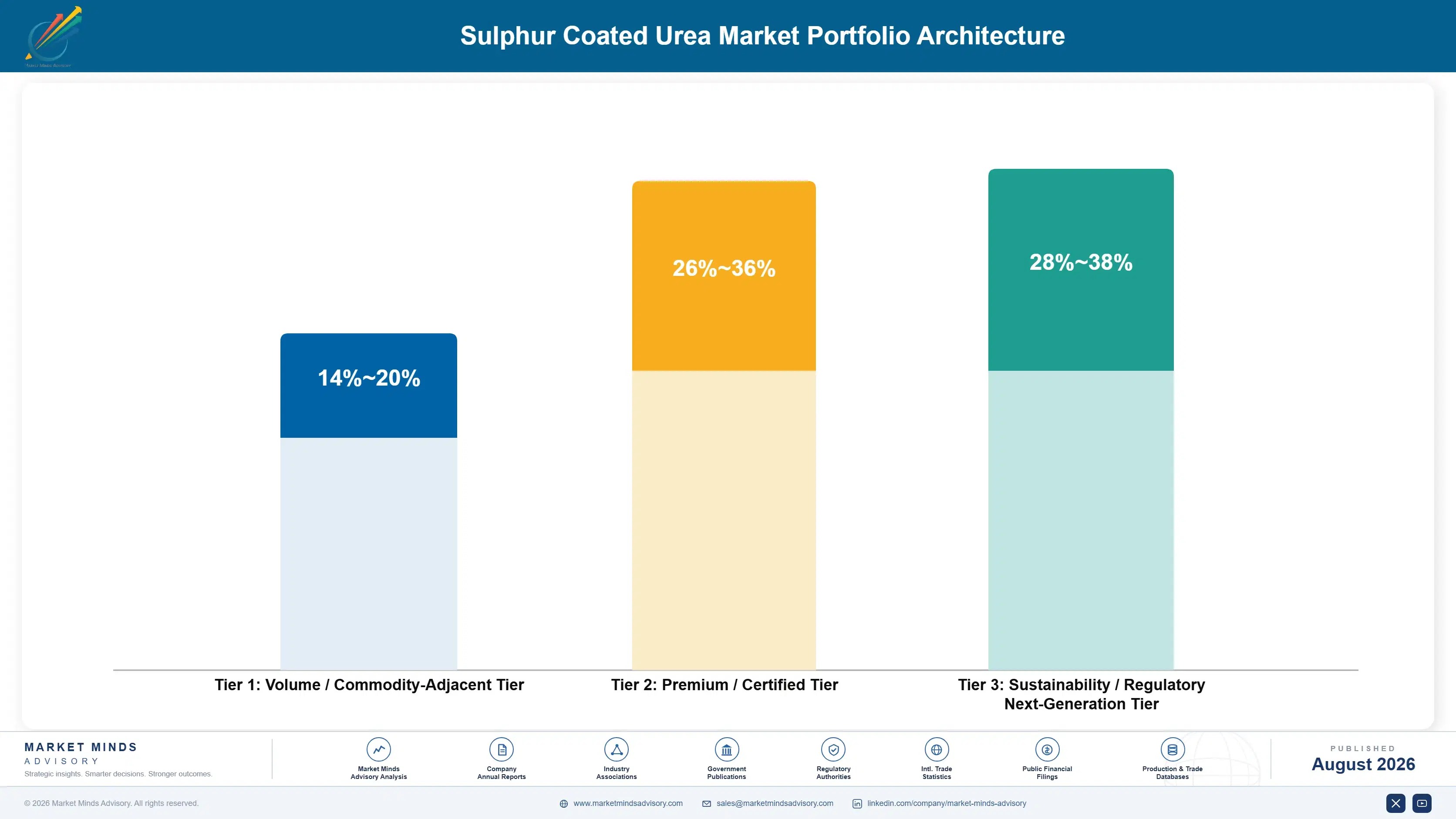
MMA organizes this market into three tiers by coating technology and margin profile. The volume tier covers standard sulphur coated urea sold into conventional agricultural applications, competing primarily on price and feedstock cost position. The premium tier covers polymer-enhanced coating formulations qualified for precision agriculture applications, commanding higher margins through technical differentiation. The sustainability tier captures micronutrient-blended and next-generation formula
Volume tier producers compete on price and feedstock cost position with moderate margins, while premium tier suppliers protect pricing power through formulation barriers that keep new entrants out for years. This creates real tension inside diversified producers, since capital allocated to sustaining standard capacity competes directly with capital needed to fund polymer coating and blend development, and most large producers now favor the latter given superior long-term returns.

The highest-value pools concentrate in polymer sulphur coated urea for precision agriculture and micronutrient-blended formulations for comprehensive nutrition programs, where technical differentiation and durable distributor relationships combine to support the strongest pricing power in the entire market. Turf and specialty grade formulations are emerging as a further high-value pool given resilient maintenance budget-driven demand.

Volume / Commodity-Adjacent Tier

Standard sulphur coated urea sold into conventional agricultural applications, competing primarily on price and feedstock cost position with limited technical differentiation between qualified suppliers. Feedstock cost position and scale dominate competitiveness in this tier.
Gross Margin: 14-20%

Premium / Certified Tier

Polymer-enhanced sulphur coated urea qualified for precision agriculture and turf applications, commanding higher margins through technical differentiation and long-term distributor supply relationships. Suppliers here typically hold multi-year qualified distributor relationships built over time.
Gross Margin: 26-36%

Sustainability / Regulatory / Next-Generation Tier

Micronutrient-blended and next-generation coating formulations positioned ahead of expanding comprehensive nutrition program adoption, commanding premium pricing from technically demanding early-adopter customers. Scale remains modest today but growth here outpaces the rest of the market by a wide margin.
Gross Margin: 28-38%
sulphur-coated-urea-market-portfolio-architecture-1787311036582

High-value Sub-segments and Strategic Watch-out

Polymer Sulphur Coated Urea for Precision Agriculture

This segment combines the highest formulation barriers in the market with the fastest unit growth, as precision agriculture adoption pushes toward more predictable nitrogen release performance. Producers with proven formulation expertise hold a durable advantage. New entrants face years of process development before reaching comparable qualification.
Gross Margin: 30-40%

Micronutrient-Blended Comprehensive Nutrition Formulations

Growing adoption of comprehensive nutrient management programs is driving steady demand growth, with established formulation research providing meaningful competitive protection against new entrants lacking comparable technical depth. Established formulation research provides meaningful protection against new entrants lacking equivalent technical depth. This growth is largely independent of standard commodity coating cycles.
Gross Margin: 28-36%

Standard Sulphur Coated Urea for Row Crops

The largest volume base by tonnage, this segment covers standard-grade coated urea sold into conventional row crop agriculture, where competition is driven mostly by price and feedstock cost position rather than deep technical differentiation. Integrated producers with strong feedstock positions consistently outcompete smaller sellers lacking scale advantages.
Gross Margin: 12-18%

Turf and Specialty Grade Formulations

Golf course and sports field maintenance budgets provide resilient demand largely independent of row crop commodity cycles, a trajectory worth monitoring closely by producers focused primarily on agricultural applications alone. Established producers focused on row crop applications are watching this trajectory closely as demand keeps growing.
Gross Margin: 20-28%

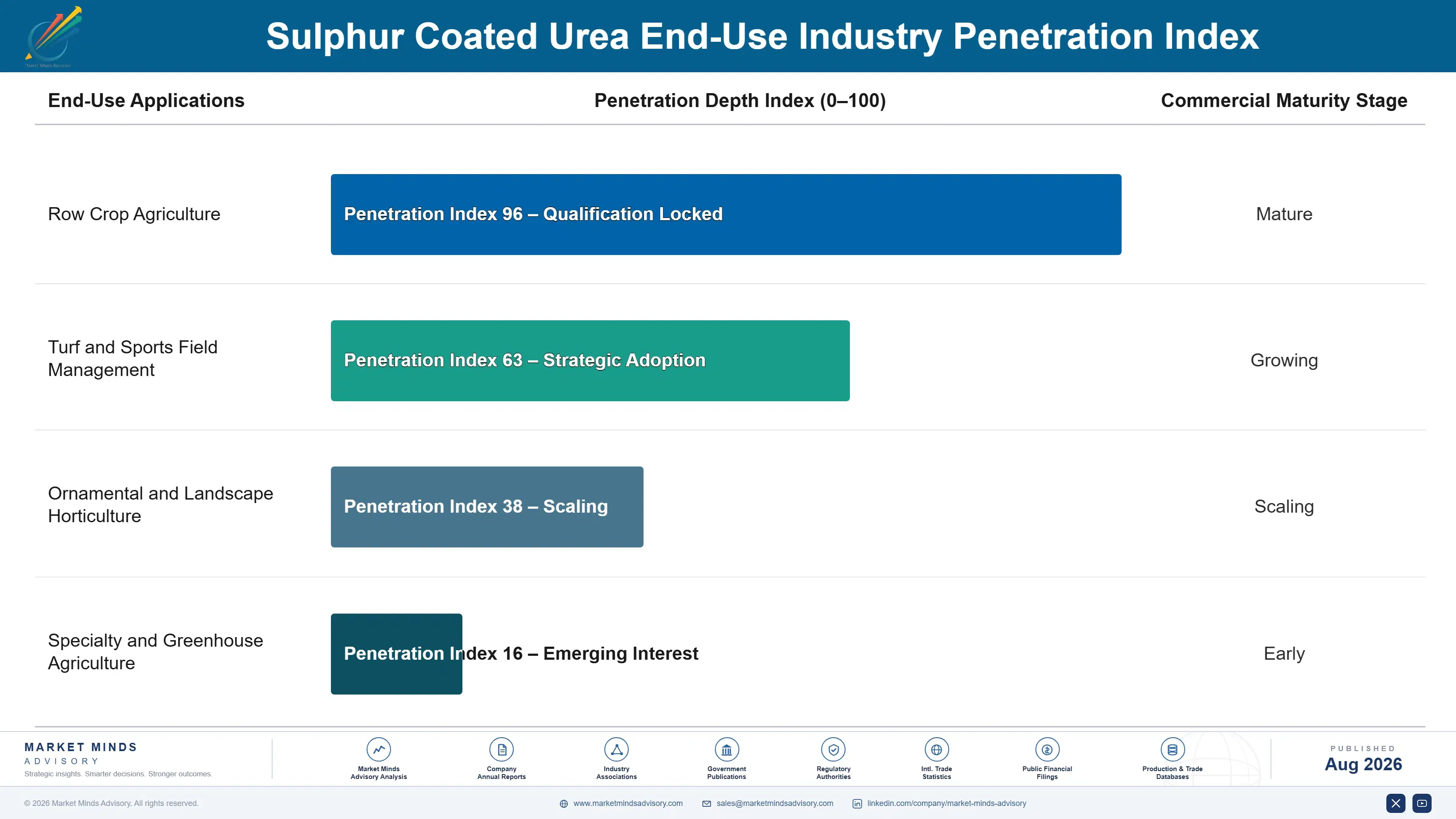
Adoption Depth Across Grower Segments

Once a farmer or turf manager adopts sulphur coated urea into a standard fertilization program after successful field trial results, that relationship typically persists across multiple subsequent growing seasons, since switching back to standard urea or to a competing formulation requires reopening cost and performance comparisons that most satisfied customers avoid without strong cause. This creates durable, low-churn revenue characteristics once adoption is established, distinct from the more
Adoption depth varies sharply by vertical. Turf and specialty growers show the deepest stickiness once satisfied with performance, since maintenance program consistency matters more than incremental cost savings from switching suppliers. Large commercial farmers show moderate stickiness tied to annual purchasing decisions. Smallholder farmers show the least stickiness of the three, since price sensitivity keeps purchasing decisions more transactional and less tied to established supplier relationships than larger commercial operations.

Buyer profiles are shifting generationally as farmers increasingly weigh comprehensive nutrient efficiency and environmental credentials, not just cost per ton of nitrogen, as explicit purchasing criteria. Younger farm operators and agronomic advisors increasingly favor suppliers with credible research-backed performance data, a consideration barely present in purchasing decisions before recent nutrient efficiency policy pressure intensified significantly.
sulphur-coated-urea-market-end-use-penetration-index-1787311037107

Where MMA Sees the Opportunity

These are among the four positions where our research anticipates prominent divergence between winners and laggards over the coming forecast period. Each is grounded in the demand model, the regulatory perimeter, and the announced capacity pipeline.
01 / POLYMER COATING INVESTMENT

Deepen Polymer Coating Technology Ahead of Precision Adoption

Polymer coating technology commands the strongest pricing power in the entire market, and producers that invest in formulation research and coating equipment now position themselves ahead of continued precision agriculture adoption through 2036. This capability requires years of process development, but producers that achieve consistent commercial-scale release performance gain access to the highest-margin segment of the entire market well ahead of competitors still selling standard commodity coating. Waiting until precision agriculture demand is obviously large risks ceding this technology advantage to producers who invested earlier.
02 / AGRONOMIC RESEARCH PROGRAMS

Invest in Field Trial Research to Build Farmer Trust

Farmers require verified performance evidence before switching from familiar standard urea, and producers that invest in credible multi-season field trial research build a durable trust advantage that competitors relying on marketing claims alone cannot easily replicate. This research investment requires sustained funding, but producers that establish credible agronomic credibility win farmer adoption more consistently and defend that relationship against future competitive challenges more effectively than research-light competitors. This positioning compounds over time as trial data accumulates across additional growing seasons and regions.
03 / MICRONUTRIENT BLEND DEVELOPMENT

Develop Micronutrient Blends for Comprehensive Nutrition Programs

Comprehensive nutrient management programs represent a genuine growth opportunity beyond standard nitrogen and sulphur delivery, and producers that develop credible micronutrient-blended formulations now capture value from sophisticated commercial farming customers seeking application simplicity alongside nutritional completeness. This formulation capability requires sustained research investment, but producers achieving it capture meaningful pricing premiums over standard sulphur coated urea. This positioning also deepens customer relationships ahead of continued adoption of comprehensive nutrition frameworks, while competitors focused only on standard delivery risk missing this broader opportunity entirely.
04 / ASIAN CAPACITY RESPONSE

Defend Technical Differentiation Against Asian Cost Competition

Asian producers are scaling standard-grade capacity aggressively and investing in polymer coating capability, threatening to commoditize segments that once commanded meaningful technical differentiation premiums. Producers that concentrate investment in polymer coating and micronutrient blend technology, where Asian technical capability remains less developed, protect margin more effectively than those competing head-on in standard commodity grades. This repositioning requires deliberate capital reallocation toward genuinely differentiated technical segments where competitors remain years behind on formulation depth, a gap likely to persist for several more years.

Engagement Snapshot From the Field

A live engagement with an industry participant carrying material or product regulatory and market exposure ahead of a defining policy shift, showing how our research translates into a defensible multi-year portfolio strategy.
MARKET MINDS ADVISORY · CLIENT ENGAGEMENT SUMMARY
Sulphur Coated Urea Producer Strategic Portfolio Review and Transition Roadmap 2026·Investment Scenario on Sulphur Coated Urea Exposure Evaluation 2025-26
CLIENT PROFILE
The client is a regional agricultural cooperative serving approximately 4,200 member farmers across a major row crop growing region, generating substantial annual input distribution revenue through its member supply network. The cooperative was evaluating whether to launch a coordinated nutrient efficiency program promoting sulphur coated urea adoption amid growing member interest in input cost and yield optimization.
STRATEGIC CHALLENGE
The cooperative needed to decide whether to commit approximately $1.4 million (client-reported, unverified by MMA) to a multi-year member education and subsidized trial program promoting sulphur coated urea adoption, uncertain whether member farmers would value the switch enough to justify the program investment given entrenched standard urea purchasing habits. The board needed clear evidence before committing scarce program funds.
MMA APPROACH
MMA's advisory team analyzed comparable cooperative nutrient efficiency program outcomes and interviewed a sample of member farmers about their receptiveness to switching from standard urea given documented field trial performance data. The analysis assessed realistic adoption rates and payback timelines for the proposed program investment. The recommendation prioritized realistic adoption assumptions over optimistic projections.
KEY FINDINGS
  1. Comparable cooperative programs that included subsidized first-season trial plots achieved member adoption rates significantly higher than programs relying on educational materials alone without a trial component.
  2. Member farmer interviews indicated that yield and input cost data from trusted local trial results carried substantially more influence over purchasing decisions than manufacturer-provided marketing materials.
  3. The program's projected member adoption rate, if achieved, was estimated to generate incremental cooperative distribution margin sufficient to recover the program investment within approximately three growing seasons.
  4. Comparable cooperatives that successfully ran multi-season programs reported member retention benefits extending beyond the specific product being promoted, strengthening the broader supplier relationship.
CLIENT PROFILE
The client is a regional agricultural cooperative serving approximately 4,200 member farmers across a major row crop growing region, generating substantial annual input distribution revenue through its member supply network. The cooperative was evaluating whether to launch a coordinated nutrient efficiency program promoting sulphur coated urea adoption amid growing member interest in input cost and yield optimization.
STRATEGIC CHALLENGE
The cooperative needed to decide whether to commit approximately $1.4 million (client-reported, unverified by MMA) to a multi-year member education and subsidized trial program promoting sulphur coated urea adoption, uncertain whether member farmers would value the switch enough to justify the program investment given entrenched standard urea purchasing habits. The board needed clear evidence before committing scarce program funds.
MMA APPROACH
MMA's advisory team analyzed comparable cooperative nutrient efficiency program outcomes and interviewed a sample of member farmers about their receptiveness to switching from standard urea given documented field trial performance data. The analysis assessed realistic adoption rates and payback timelines for the proposed program investment. The recommendation prioritized realistic adoption assumptions over optimistic projections.
KEY FINDINGS
  1. Comparable cooperative programs that included subsidized first-season trial plots achieved member adoption rates significantly higher than programs relying on educational materials alone without a trial component.
  2. Member farmer interviews indicated that yield and input cost data from trusted local trial results carried substantially more influence over purchasing decisions than manufacturer-provided marketing materials.
  3. The program's projected member adoption rate, if achieved, was estimated to generate incremental cooperative distribution margin sufficient to recover the program investment within approximately three growing seasons.
  4. Comparable cooperatives that successfully ran multi-season programs reported member retention benefits extending beyond the specific product being promoted, strengthening the broader supplier relationship.
RECOMMENDED STRATEGY
Phase 1: Phase 1 (Season 1): Launch subsidized trial plots with a representative sample of member farmers across different soil and crop conditions to generate credible local performance data. Phase 2: Phase 2 (Season 2): Expand the program to additional members using Season 1 trial results as educational material, prioritizing farmers with soil conditions similar to successful trial plots. Phase 3: Phase 3 (Season 3): Scale the program cooperative-wide based on accumulated multi-season performance data, transitioning from subsidized trials to standard member purchasing.
OUTCOME
The cooperative launched the phased program and achieved member adoption rates exceeding initial projections by the end of the second growing season, driven by strong local trial results that member farmers trusted more than external marketing claims. The cooperative reported recovering its investment within the projected timeline while strengthening member loyalty to its broader input supply relationship.

Frequently Asked Questions

Foundational context covering the market sizes, CAGR, scope, country, region and competition that inform every finding below. This section is provided to cover basics and most often pre-purchase conversations, answered from the MMA Primary Research Dataset.

What is the current size of the Sulphur Coated Urea Market?

The Sulphur Coated Urea Market was valued at $1.6 billion in 2025. MMA projects it will reach $1.71 billion in 2026 as nutrient efficiency policy and sulphur deficiency awareness both continue expanding demand.

How large will the Sulphur Coated Urea Market be by 2036?

MMA forecasts the market will reach $3.24 billion by 2036, up from $1.71 billion in 2026. That represents a 1.89 times expansion over the ten-year forecast window.

What is the CAGR for the Sulphur Coated Urea Market 2026 to 2036?

The market is projected to grow at a 6.6% CAGR between 2026 and 2036. MMA's bull and bear scenarios range from 7.8% to 5.4% depending on nitrogen use efficiency policy adoption pace.

Which segment is growing fastest?

Polymer Sulphur Coated Urea is the fastest-growing segment, expanding at a 9.2% CAGR, roughly 1.39 times the overall market rate as precision agriculture adoption accelerates.

Who are the major companies in the Sulphur Coated Urea Market?

Koch Agronomic Services, Nutrien, Yara, ICL, and Kingenta lead the market, together holding an estimated 44% of global production capacity. This concentration reflects the range of regional producers across major agricultural markets.

Which country is growing fastest?

India is the fastest-growing country market, expanding at an estimated 8.4% CAGR as severe soil sulphur deficiency and government fertilizer policy both drive rapid adoption.

Report Segmentation Architecture

The full report scope spans multiple orthogonal segmentation dimensions, with cross-tabulated demand data provided for each dimension pair. Coverage extends further to regional breakdowns, trend trajectories, and the competitive detail needed to support segment-level decision-making.

By Primary Market Dimension

  • Standard Sulphur Coated Urea
  • Polymer Sulphur Coated Urea
  • Sulphur Coated Urea With Micronutrient Blends
  • Turf and Ornamental Grade Sulphur Coated Urea
  • Bio-Based Polymer Coated Sulphur Urea
  • Agricultural Grade Sulphur Coated Urea

By End-Use Industry

  • Row Crop Agriculture
  • Turf and Sports Field Management
  • Ornamental and Landscape Horticulture
  • Specialty and Greenhouse Agriculture

By Commercial Dimension

  • Agricultural Retailer and Cooperative Supply
  • Direct Farm Supply
  • Turf and Landscape Distributor Supply
  • Distribution and Trading

By Region

  • North America
  • Western Europe
  • East Asia
  • South Asia and Pacific
  • Latin America
  • Middle East and Africa
  • Eastern Europe

Scope, Methodology, and Coverage

Every figure in this report is reproducible from documented input assumptions. The scope below maps the historical period, the forecast horizon, the segmentation dimensions, and the countries covered, alongside the underlying primary and qualitative methodology.
Historical Period
2020 to 2025
Forecast Period
2026 to 2036
Base Year
2025 (USD billions; MMA Primary Research Dataset, August 2026)
Market Definition
This report covers sulphur coated urea fertilizers, including standard sulphur coated urea, polymer sulphur coated urea, and sulphur coated urea blended with micronutrients, used to deliver controlled-release nitrogen and supplemental sulphur nutrition in agricultural, turf, and ornamental applications. It excludes standard uncoated urea, ammonium sulphate, and other nitrogen fertilizers not incorporating a sulphur coating layer.
Quantitative Units
USD billions (current prices); metric tons of production capacity where applicable
Segmentation Dimensions
By Coating Formulation Type; By End-Use Industry; By Commercial Dimension; By Region
Regions Covered
North America, Western Europe, East Asia, South Asia and Pacific, Latin America, Middle East and Africa, Eastern Europe
Countries Covered
USA, China, Germany, France, UK, Japan, South Korea, India, Australia, Canada, Brazil, Mexico, Indonesia, Vietnam, Thailand, Malaysia, UAE, Saudi Arabia, South Africa, Nigeria, Turkey, Poland, Netherlands, Italy, Spain, Sweden, Switzerland, Argentina, Colombia, Singapore, and additional markets relevant to this sector
Key Companies Profiled
Koch Agronomic Services LLC, Nutrien Ltd., Yara International ASA, ICL Group Ltd., Kingenta Ecological Engineering Group Co. Ltd., Sichuan Meifeng Chemical Industry Co. Ltd., Hanfeng Evergreen Inc., Aglukon Spezialduenger GmbH & Co. KG, Haifa Group, EuroChem Group AG, OCI Nitrogen, CF Industries Holdings Inc., National Fertilizers Limited, Rashtriya Chemicals & Fertilizers Limited, Chambal Fertilisers and Chemicals Limited, Coromandel International Limited, Indian Farmers Fertiliser Cooperative Limited, Helm AG, SABIC Agri-Nutrients Company, Simplot Grower Solutions
Quantitative Methodology
Primary survey, n=3,800 respondents, Q4 2025, six countries; demand-side model with trade association cross-validation
Qualitative Methodology
47 expert interviews, Q4 2025; applied to validate demand model assumptions, identify emerging dynamics, and assess competitive positioning
Report Format
PDF and XLSX data workbook (Word format preview document)
Publisher
Market Minds Advisory
Report Code
MMA-2026-AGR-101
Published
August 2026
Contact
sales@marketmindsadvisory.com | www.marketmindsadvisory.com

Purchase the full Sulphur Coated Urea Market Report (2026 to 2036).

The full Sulphur Coated Urea Market report delivers ten-year forecasts across all seven regions, six product segments, and the full competitive landscape of twenty profiled producers. It includes detailed analysis of polymer coating technology economics, agronomic research investment strategies, and demand drivers spanning row crop agriculture, turf management, and specialty horticulture. Buyers receive segment-level margin benchmarking across the volume, premium, and sustainability tiers identified in this summary. The report also includes primary survey data from 3,800 respondents and 47 expert interviews conducted in the fourth quarter of 2025, supporting every demand and pricing assumption in the forecast.
Ten-year regional and segment-level forecast models
Competitive profiles covering twenty fertilizer producers
Agronomic research and farmer adoption case data
Agronomic research and farmer adoption mapping
Portfolio margin benchmarking across three commercial tiers
Primary survey and expert interview data appendix

Built For The People Who Decide

From boardroom strategy to bench-side execution, this report is read cover-to-cover by leaders shaping the next decade of their industry, turning demand scenarios, market dynamics and valuation benchmarks into decisions.
CXOs/ Presidents/ VPs/ Managers
M&A and Corporate Development
Strategy Teams and R&D Heads
Procurement and Product Directors
Regulatory and Compliance Leaders
Investor Relations and Equity Analysts