Market Minds Advisory
Sugarcane-Derived Squalane Market

Sugarcane-Derived Squalane Market: Sugarcane-Derived Squalane Market: The Same Molecule From A Shark, An Olive Or A Vat, And A Category Resting On One Production Platform, 2026 to 2036

Squalane is one molecule regardless of source, so provenance and batch consistency are the entire argument. About 26% of world squalene still comes from deep-sea shark liver. One platform supplies 68% of the fermentation volume.

Lead Analyst

Published

September 2026

Make Smarter Decisions with Customized Research Insights

Request a free sample report and evaluate market opportunities, growth trends, and competitive dynamics relevant to your business needs.

2025 MARKET VALUE$0.5BMarket Size 2025
2036 FORECAST VALUE$1.3BBase Case , 2026 to 2036
CAGR 2026 TO 20369.8 %Bull 11.0% / Bear 8.6%
INCREMENTAL OPPORTUNITY$0.8BNet 10- year value creation
EXPANSION MULTIPLE2.60x2036 value over 2026 base
Strategic Levers
M&A Pipeline
Regional Outlook
Country Rankings
Competitive Intelligence
Segmental Deep-dive
Call-Us : 91 93563 13602

Executive Snapshot and Market Trajectory.

Squalane is the same molecule whether it came from a shark liver, an olive, or a fermentation vessel. There is no performance difference to sell. Provenance and batch consistency are the whole argument, and the industry leads with only the first of those. Consistency is the harder claim to copy.
Hemisqualane and short-chain alkanes grow at 14.7%, half again the market rate of 9.8%, on volatile silicone replacement rather than on anything squalane itself does. Pharmaceutical and adjuvant grade follows at 12.3% on a small volume with outsized strategic weight. Technical grade squalane grows slowest of the six classes at 6.2%. Cosmetic grade sits in the middle at 9.1% and carries most of the category's volume.
East Asia holds 38% of demand, with South Korean growth of 13.6% leading every market covered. Around 26% of world squalene still originates from deep-sea shark liver, which the sugarcane route was built to displace and has not. About 68% of sugarcane squalane volume comes from a single production platform worldwide. An interruption there reprices the whole category rather than redistributing volume between suppliers, which buyers have now observed directly rather than in theory.
Market Definition
This market covers squalane and related alkanes produced by sugarcane fermentation, including cosmetic grade squalane, pharmaceutical and adjuvant grade squalane, hemisqualane and short-chain alkanes, squalane ester derivatives, high-purity industrial and lubricant grades, and technical grade squalane. It excludes shark liver squalene and squalane, olive-derived squalane, amaranth and rice bran squalane, synthetic petrochemical isoparaffins, and finished consumer cosmetic products.
Base Year Value
$0.5B in 2025 (MMA Primary Research Dataset, September 2026)
Forecast Period
2026 to 2036, eleven discrete annual values
CAGR
9.8% base case. Bull 11.0%. Bear 8.6%.
Fastest Growth Segment
Hemisqualane And Short-Chain Alkanes: 14.7% CAGR
Fastest Growth Country
South Korea: 13.6% CAGR
Fastest Growth Region
South Asia and Pacific: 11.8% CAGR
Largest Region
East Asia: 38% of 2025 global value
Market Leaders
Amyris, Kuraray, Nikko Chemicals, Croda International, and Clariant lead the field. Source: MMA Primary Research Dataset, July 2026.
Primary Survey
n=3,800 procurement and R&D decision-makers, Q4 2025, six countries
Methodology
Demand-side build-up, cross-validated against public data, 47 expert interviews

Sugarcane-Derived Squalane Market Forecast Scenarios

sugarcane-derived-squalane-market-size-forecast-scenario-1790017954587
Growth from 2020 to 2025 ran at 8.5% and came from cosmetic formulation switching away from shark and olive sources rather than from any expansion in squalane use overall. Korean and Japanese brands drove that switch and Western formulators followed. Vaccine adjuvant demand spiked and then normalised, leaving behind a stockpiling requirement that did not exist before and now supports a small, steady, high-value volume.
The base case at 9.8% rests on three mechanisms. Hemisqualane keeps displacing volatile silicones in formulations facing microplastic and persistence scrutiny. Asian cosmetic formulation keeps expanding, with South Korean growth at 13.6% leading every country covered. And pandemic preparedness stockpiling supports adjuvant grade demand on a procurement cycle unconnected to cosmetic consumption in any way. Nothing in the base case assumes shark-derived material is restricted rather than simply discouraged by brands.
The bull case at 11.0% depends on shark-derived squalene being restricted rather than merely discouraged, which would move roughly a quarter of world supply toward fermentation overnight. The bear case at 8.6% is concentration: about 68% of sugarcane squalane volume comes from a single production platform, and any interruption there reprices the category rather than redistributing it.

One Molecule, Three Origins

Squalane is a single saturated hydrocarbon. A molecule from a shark liver, an olive, and a fermentation vessel are indistinguishable by any analysis a formulator would run, which means there is no performance story to tell. What differs is where it came from and how consistent it is. The industry has built its messaging on the first and left the second unsold.
TOP FIVE CONCENTRATION61%Share of category revenue held by the leading producers
SHARK ROUTE PERSISTENCE26%World squalene supply still originating from deep-sea shark liver
BATCH PURITY VARIANCE0.4%Fermentation route purity spread against olive extraction batch ranges
SINGLE PLATFORM DEPENDENCY68%Sugarcane squalane volume from one production platform worldwide
ADJUVANT GRADE SHARE4%Category volume going to vaccine adjuvant and pharmaceutical use
SILICONE REPLACEMENT SHARE31%Hemisqualane volume displacing volatile silicone in finished formulation
Batch consistency is the argument that would actually move a formulator. Olive squalane varies with harvest, region, and refining, and purity spreads across batches run several times what fermentation produces. Sugarcane squalane holds purity within roughly 0.4 percentage points batch to batch, carries no pesticide residue question, and arrives with full traceability. That is an industrial process advantage being marketed as a farm story, which undersells it considerably.
The uncomfortable number is 26%. That share of world squalene still comes from deep-sea shark liver, species that mature slowly and are poorly monitored, and it persists because the material is cheap and the supply chains are opaque. Sugarcane squalane exists to displace that and has displaced only part of it. Restriction rather than preference would finish the job, and none has arrived.
"It is the same molecule three ways, so nobody can claim it performs better and everybody tries to imply it anyway. The genuine advantage is that a fermentation batch is the same as the last one, and almost nobody leads with that because it sounds less like a story."
Practice Director, Specialty Chemicals and Personal Care Ingredients · MMA Chemicals and Materials Practice · September 2026

Market Trends

Hemisqualane Displaces Silicones Rather Than Squalane

Hemisqualane and short-chain alkanes grow at 14.7%, fastest of the six classes, and they are not really a squalane story at all. The C13 alkane is a different molecule sold under the same family name, and around 31% of its volume displaces volatile silicone in formulations facing microplastic and persistence scrutiny. That makes its growth dependent on silicone regulation rather than on anything happening in squalane. Producers treating it as a line extension are misreading where the demand actually comes from. The buyer inside a customer organisation is also different, working to a compliance deadline.
Market Impact: Country grows at 13.6%

Shark Supply Persists Despite Two Decades Of Pressure

About 26% of world squalene still originates from deep-sea shark liver, and the share has fallen slowly rather than collapsed. The material is cheap, the supply chains are opaque, and the species involved mature slowly enough that stock recovery is measured in decades. Voluntary commitments by cosmetic brands have moved premium formulation and left low-cost and industrial applications largely untouched. Restriction rather than preference is what would shift the remaining share, and no major jurisdiction has yet moved on it. Enforcement of brand commitments rests almost entirely on supplier declaration rather than on any independent verification.
Market Impact: Grade holds 4% volume

Market Opportunities and Growth Drivers

Korean Formulation Made Squalane A Staple Ingredient

South Korea grows at 13.6%, faster than any country covered, and Korean formulation is what moved squalane from a specialist emollient into a mainstream skin care ingredient that consumers recognise by name. East Asia holds 38% of world demand. Japanese producers hold the longest technical history with the molecule, originally from shark liver, and now supply fermentation-derived material at high purity. Chinese formulation follows Korean direction and is where regional volume growth is currently concentrating. Shark-derived material also retains a presence in lower-cost regional formulation that brand commitments elsewhere have never reached, which complicates the regional supply picture considerably.
Market Impact: One platform supplies 68%

Adjuvant Stockpiling Creates Demand Without Consumption

Pharmaceutical and adjuvant grade squalane grows at 12.3% on a volume that is roughly 4% of the category and carries strategic weight far beyond its size. Pandemic preparedness stockpiling generates procurement that is unconnected to cosmetic demand and runs on government cycles rather than commercial ones. Supply security matters more than price in this application, which is the one place where single-platform concentration is genuinely examined by a buyer. Qualification requirements make the positions extremely durable once won. That makes the volume genuinely counter-cyclical against anything happening in cosmetic demand.
Market Impact: Exactly 0 performance gap

Market Restraints and Challenges

Most Volume Depends On One Production Platform

About 68% of sugarcane squalane volume comes from a single production platform, and the root cause is that fermentation route development required capital and time that only one participant committed early. Commercially this means an interruption reprices the whole category rather than redistributing volume between suppliers. Buyers respond by dual sourcing where an alternative exists, by qualifying olive material as backup despite its consistency disadvantage, and by writing supply continuity terms into contracts rather than assuming them. Most cosmetic buyers have not yet written continuity terms into contracts at all.
Market Impact: Displaces 31% of volume

No Performance Argument Exists To Defend Price

Squalane from any source is chemically identical, and the root cause is simply that it is a single defined molecule rather than a mixture. Commercially this leaves provenance and consistency as the only differentiators, and provenance is a claim a competitor can match by switching feedstock. Producers respond by publishing batch purity distributions, by offering traceability documentation to finished-brand level, and by moving toward derivatives and hemisqualane where the molecule itself differs. Batch consistency is the exception, because it comes from the process rather than the feedstock and cannot be matched by a contract.
Market Impact: Shark supplies 26% still
4 additional market trends, 3 additional growth drivers, and 2 additional restraints and challenges are covered in the full report. Contact sales@marketmindsadvisory.com to access the complete intelligence.

Segment CAGR and Growth Architecture

Segmentation follows product and grade class across six categories: cosmetic grade squalane, pharmaceutical and adjuvant grade squalane, hemisqualane and short-chain alkanes, squalane ester derivatives, high-purity industrial and lubricant grades, and technical grade squalane. Application, feedstock origin, and purity specification are treated as separate dimensions entirely. Shark, olive, amaranth, and petrochemical routes fall outside the defined scope entirely.
sugarcane-derived-squalane-market-market-share-analysis-1790017955144

Hemisqualane And Short-Chain Alkanes

Hemisqualane grows at 14.7%, half again the market rate of 9.8%, and its demand has almost nothing to do with squalane. The C13 alkane is a distinct molecule with a volatility profile close to cyclopentasiloxane, and roughly 31% of its volume replaces volatile silicone in formulations facing microplastic and environmental persistence scrutiny. That ties the segment's growth to silicone regulation rather than to emollient demand, which is a completely different driver with a completely different timeline. Producers treating it as a squalane line extension misread the customer entirely. Formulators buying it are solving a regulatory problem rather than a sensory one. Producers reaching only the ingredient purchasing function are missing the decision entirely.
CAGR 14.7%

Pharmaceutical And Adjuvant Grade Squalane

Pharmaceutical and adjuvant grade squalane grows at 12.3% on roughly 4% of category volume and carries strategic weight far beyond that share. Vaccine adjuvant formulation requires purity and traceability specifications that cosmetic grades do not approach, and pandemic preparedness stockpiling generates procurement on government cycles unconnected to any commercial demand signal. Supply security is worth more than price here, which makes it the one application where single-platform concentration receives genuine scrutiny from a buyer. Qualification is slow, expensive, and effectively permanent once completed, so positions won in this segment hold for many years without being contested. Single-platform concentration is examined here more closely than in any other application, because a formulation file cannot be changed quickly.
CAGR 12.3%
Full segment breakdown across 6 segments available in the complete report.

Regional Architecture and Country Demand Map

Regional shares reflect where sugarcane squalane is formulated into finished products rather than where sugarcane is grown or fermented. Two regions sit outside the standard bands, for reasons named in their own paragraphs and summarised below for operator review. Sourcing scrutiny and application mix vary considerably between them.

East Asia

At 38% this sits above the standard band, and the justification is that Korean formulation moved squalane from a specialist emollient into a mainstream ingredient consumers recognise by name, and regional demand followed. South Korean growth of 13.6% leads every country covered. Japanese producers hold the longest technical history with the molecule and now supply fermentation-derived material at very high purity. Chinese formulation follows Korean direction and carries most regional volume growth. Shark-derived material also retains a presence in lower-cost regional formulation that brand commitments elsewhere have not reached. Traceability documentation is requested here more consistently than in most regions. Consistency arguments land better here than origin ones do with regional formulators.
Share: 38% | CAGR: 10.8% (2026 to 2036)

North America

Premium and clean beauty positioning drove early adoption of sugarcane squalane here, and brand-level commitments to avoid shark-derived material are more publicly stated than anywhere else. Growth of 9.4% runs close to the world rate. Adjuvant grade demand from pandemic preparedness stockpiling adds a small, high-value, government-cycle volume that behaves nothing like the cosmetic business. Hemisqualane adoption is advancing as silicone scrutiny builds. Single-platform supply concentration is examined by buyers here more closely than in any other region, largely because of the adjuvant requirement. Independent brands and clean beauty positioning drove the early switch and continue to specify by source rather than by grade. Documentation to finished-brand level is requested more consistently than in most regions.
Share: 20% | CAGR: 9.4% (2026 to 2036)
Regional intelligence for 5 additional markets available in the complete report: Western Europe, South Asia and Pacific, Latin America, Middle East and Africa, Eastern Europe. Contact sales@marketmindsadvisory.com.
sugarcane-derived-squalane-market-country-cagr-analysis-1790017955671

Where Squalane Producers Actually Earn

Four commercial moves matter in a category selling a molecule that performs identically whatever its origin. Each replaces the provenance story, which any competitor can match by changing feedstock, with something that is genuinely harder to copy and considerably more useful to a formulator. None of the four requires the molecule itself to change in any way.

Sell Batch Consistency Rather Than Origin Story

Squalane is chemically identical from every source, so provenance is a claim a competitor matches by switching feedstock. Fermentation holds purity within roughly 0.4 percentage points batch to batch where olive extraction spreads several times wider. Producers publishing batch purity distributions report specification retention 2.5 times higher than those leading on origin alone. Consistency is a process advantage that cannot be copied by changing a supply contract, and it is what a formulation chemist actually cares about. Publishing a distribution costs routine analytical work and separates a producer from every competitor still leading on a farm story.
Market Impact: Raises specification retention rates to 2.5 times higher

Build A Second Production Platform Deliberately

About 68% of sugarcane squalane volume comes from one production platform, which means any interruption reprices the category rather than redistributing it. Producers establishing genuine second-source capability report contract values 2.1 times higher with pharmaceutical and adjuvant buyers, where supply security is worth more than unit price. Those buyers already ask the question and most producers cannot answer it well. Cosmetic buyers will start asking once an interruption teaches them to. A supply agreement with a second producer achieves most of the protection without building a plant, and several producers could do it this year. Almost none have.
Market Impact: Raises pharmaceutical contract values to 2.1 times higher

Position Hemisqualane Against Silicone Not Squalane

Hemisqualane grows at 14.7% and about 31% of its volume replaces volatile silicone in formulations facing persistence and microplastic scrutiny. Producers positioning it as a silicone alternative rather than a squalane variant report conversion rates 3.3 times higher with reformulating brands. The buyer is solving a regulatory problem on a regulatory timetable, not choosing an emollient. Selling it through the squalane sales conversation reaches the wrong person inside a customer organisation entirely. Reformulation teams also move faster and with less price sensitivity than ingredient purchasing does, because they are working against a compliance date somebody else set.
Market Impact: Raises brand conversion rates to 3.3 times higher

Take Adjuvant Qualification While It Is Open

Pharmaceutical and adjuvant grade is roughly 4% of category volume and carries qualification requirements that are slow, expensive, and effectively permanent once completed. Producers investing in that qualification report revenue per account 4.6 times higher than cosmetic equivalents over a five-year period. Stockpiling procurement runs on government cycles unconnected to commercial demand, which makes it counter-cyclical. Positions in this segment are not contested again once a supplier is written into a formulation file. Purification depth rather than fermentation yield is what decides whether a producer can reach the grade at all, and most underinvest in exactly that.
Market Impact: Raises revenue per account to 4.6 times higher

Who Controls the Margin Pool

Concentration is high. Five producers hold 61% of category revenue, measured consistently on that basis across all participants, and one production platform accounts for the large majority of sugarcane-derived volume. The remainder divides between Japanese specialty houses with long squalane histories, European formulation ingredient suppliers, and distributors adding purification or blending rather than producing the molecule themselves. That concentration is unusual for a specialty ingredient category.
Competition currently turns on three dimensions: batch consistency and published purity data, which is the only differentiator that cannot be copied by switching feedstock; supply continuity, which pharmaceutical buyers examine and cosmetic buyers mostly do not; and hemisqualane position, where the customer and the buying rationale are entirely different from squalane. Price decides in cosmetic and technical grades, which together carry the large majority of category volume across every region covered.

Pressure builds from two directions. Olive-derived producers compete on an equally valid plant provenance at lower capital intensity. Single-platform concentration remains unaddressed across most of the category. Rankings will shift toward producers holding second-source capability and adjuvant qualification rather than cosmetic volume alone. Producers holding only cosmetic grade volume face the most exposed position in the field.
sugarcane-derived-squalane-market-company-positioning-matrix-1790017956202

Competitive Moat and Risk Dimensions

AMYRIS

Moat: Fermentation Platform And Scale

The farnesene fermentation platform behind most sugarcane squalane represents years of strain and process development that no competitor has matched at commercial scale. That position determines cost per kilogram across the category and gives the producer a role in setting the price at which fermentation-derived material competes against olive.
AMYRIS

Risk: Concentration Cuts Both Ways

Supplying the large majority of category volume from one platform makes any operational or financial interruption a category event rather than a company one, which buyers have now observed directly. Pharmaceutical purchasers in particular treat that concentration as a qualification risk rather than merely a commercial preference.
KURARAY

Moat: Purity And Pharmaceutical Grade Depth

Capability in high-purity production and the documentation pharmaceutical and adjuvant applications demand gives access to a segment where qualification is slow and effectively permanent. That position is worth considerably more per kilogram than cosmetic volume and is contested far less frequently once established. Qualification files are not reopened without regulatory cause.
KURARAY

Risk: Limited Hemisqualane Presence

Depth in squalane itself leaves little position in the short-chain alkanes growing fastest in the category, where demand comes from silicone reformulation rather than emollient selection. That is a different customer conversation and a different technical file, and it is not reached from a squalane sales position.

Players Tracked

Prominent Players

Amyris
Kuraray
Nikko Chemicals
Croda International
Clariant

Other Key Players

Sophim
Arista Industries
Seppic
Gattefosse
Lubrizol
BASF
Evonik Industries
Ajinomoto
Kobo Products
Innospec
Vantage Specialty Chemicals
Hallstar
Elementis
Shanghai Sunwise Chemical
Zhejiang Wonderful Chemical

Recent Developments

FEBRUARY 2026

Kuraray Publishes Batch Purity Distribution Data Across Squalane Grades

Kuraray released batch-to-batch purity distribution data across its squalane range alongside the analytical method used. The disclosure puts a comparable consistency figure where origin claims have carried most of the category's messaging. Distributions were published for each grade rather than as a single aggregate figure.
Signal: Consistency is the one advantage a competitor cannot copy by switching feedstock. Process advantages outlast supply contract advantages.
SEPTEMBER 2025

Croda Qualifies Second Sugarcane Squalane Supply Source

Croda International completed qualification of a second production source for sugarcane-derived squalane, addressing the single-platform concentration that has defined category supply. The arrangement is a supply agreement rather than an acquisition or joint venture. Qualification covered pharmaceutical as well as cosmetic grade material across the range.
Signal: Supply continuity is being qualified before an interruption forces the question. Pharmaceutical buyers ask this question routinely already.
APRIL 2025

Clariant Expands Hemisqualane Capacity For Silicone Reformulation

Clariant completed an organic expansion of hemisqualane production capacity, funded internally with no partner involved. Management cited demand from brands reformulating away from volatile silicones under persistence and microplastic scrutiny. Capacity was added ahead of contracted volume rather than behind it, on the expectation that silicone restriction timetables will hold.
Signal: The fastest growing product here answers a silicone question, not a squalane one. The driver sits outside this category.

What Fermentation Squalane Costs

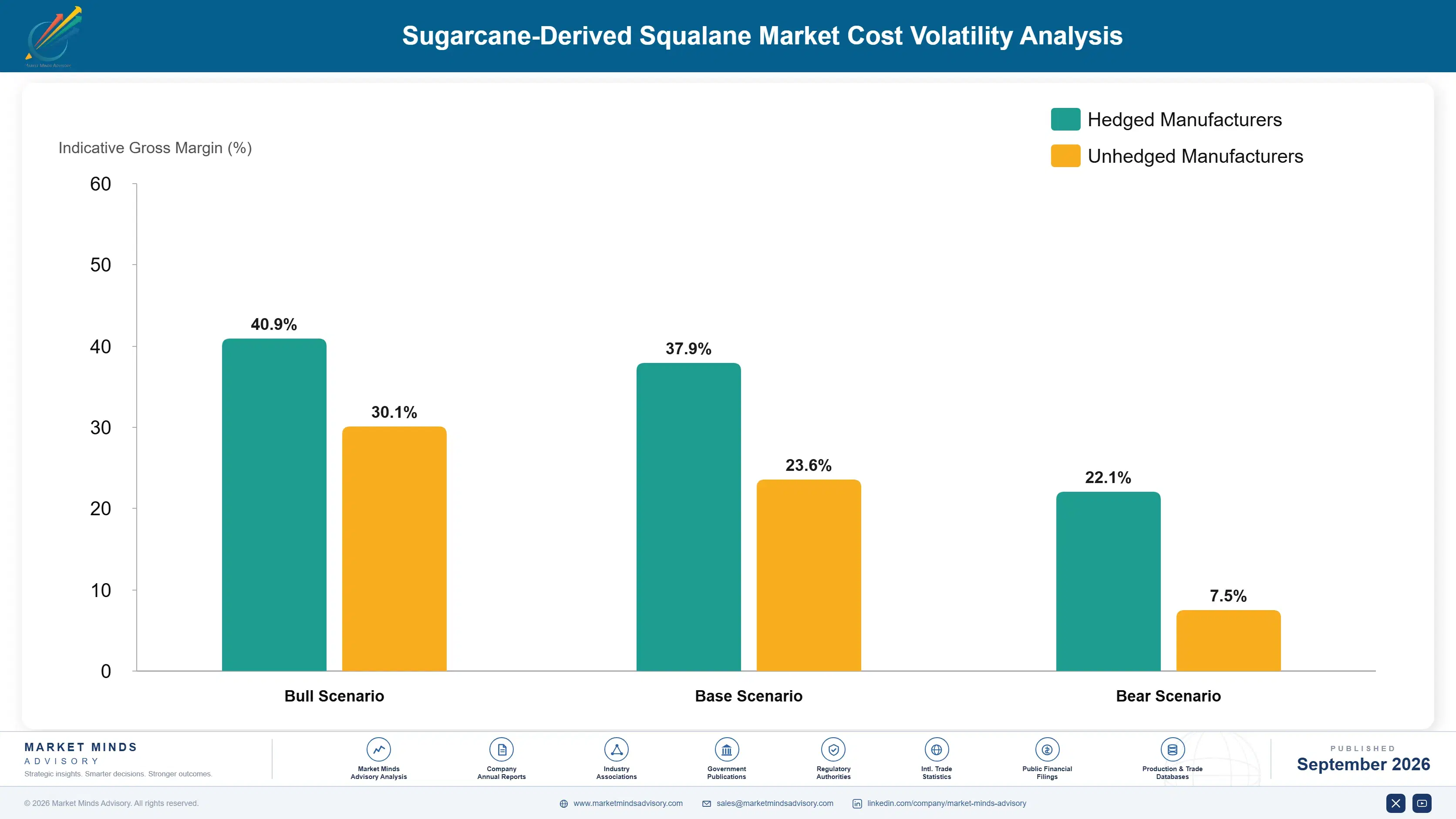
Three cost groups dominate. Hydrogenation, purification, and deodorisation run 28% to 36% of cost of goods sold, the largest single group and the one that determines whether a producer can reach pharmaceutical grade at all. Sugarcane feedstock takes 24% to 32%, and the eight-point range reflects Brazilian harvest and world sugar pricing. Fermentation energy and utilities account for 22% to 30%, varying sharply with regional power costs.
Brazilian sugar pricing moved through 2024 and 2025 on harvest conditions and ethanol demand competing for the same cane, and United States Department of Agriculture sugar statistics documented the underlying movements across the period. Industrial electricity pricing moved separately on regional generation mix, with Energy Information Administration series recording that divergence. Several producers described the two exposures separately in their annual reports. The two moved independently.

The competitive disadvantage mechanism runs through downstream processing rather than through fermentation yield. A producer without hydrogenation and purification depth cannot reach pharmaceutical or adjuvant grade whatever its fermentation performance, which locks it out of the segment paying most per kilogram. Exposure therefore varies by process integration rather than by scale, and producers buying crude farnesene for finishing are capped by whoever supplies it.
sugarcane-derived-squalane-market-cost-volatility-analysis-1790017956398

Invest In Purification Before Fermentation Capacity

Hydrogenation, purification, and deodorisation form the largest cost group and determine which grades a producer can reach at all. Adding fermentation capacity without matching downstream depth produces more cosmetic-grade material into the most contested part of the market, while the pharmaceutical segment paying most per kilogram remains inaccessible. Most producers underinvest in exactly this line.

Contract Cane Against Ethanol Demand Cycles

Brazilian sugarcane is allocated between sugar and ethanol on economics that shift with fuel policy and world sugar pricing, neither of which squalane demand influences at all. Contracting multi-season volume against those allocation cycles rather than buying on spot removes most of the exposure and secures supply through the tighter periods. Spot buyers find allocation scarce in the tight seasons.

Site Fermentation Against Regional Power Pricing

Fermentation energy runs close to a quarter of production cost and is determined by plant location rather than by process efficiency. Siting capacity where generation is cheap is worth more than several years of yield improvement, and it is a decision made once rather than defended continuously against competitors doing the same work. Geography defends the position afterwards.

Portfolio Architecture for Margin Defence

Margin follows grade and documentation rather than feedstock origin. Technical grade squalane competes close to commodity terms against olive and lower-cost sources. Cosmetic grade earns moderately on traceability and consistency where a formulator values them. Ester derivatives earn well on genuine molecular difference, and pharmaceutical and adjuvant grade earns most, because qualification is slow, permanent, and paid for accordingly.
The tension between volume and premium runs through what the buyer is really specifying. A cosmetic formulator naming squalane at a percentage is buying a defined molecule available from several origins, and price with a provenance preference decides it. A pharmaceutical buyer writing a supplier into an adjuvant formulation file is buying purity, documentation, and continuity, and will not revisit that decision for many years afterwards.

High-value pools concentrate in adjuvant and pharmaceutical grade, in hemisqualane sold against silicone reformulation deadlines, and in ester derivatives where the molecule genuinely differs from what competitors supply. Where the product is technical or cosmetic grade squalane sold on a percentage and an origin claim, the molecule is identical across the field and the contest reduces to price and documentation.

Volume / Commodity-Adjacent

Technical grade squalane and lower-purity industrial material sold against a percentage and a certificate of analysis. The ten-point range reflects feedstock position and energy siting rather than any capability a formulator would pay a premium to obtain.
Gross Margin: 20% to 30%

Premium / Certified

Cosmetic grade squalane and ester derivatives supplied with traceability documentation and published batch consistency data. The twelve-point range separates producers publishing purity distributions from those supplying an origin claim and a certificate.
Gross Margin: 36% to 48%

Sustainability / Regulatory / Next-Generation

Pharmaceutical and adjuvant grade squalane and hemisqualane supplied against silicone reformulation requirements. The sixteen-point range reflects purification depth and qualification position, neither of which can be assembled quickly by anybody.
Gross Margin: 54% to 70%
sugarcane-derived-squalane-market-portfolio-architecture-1790017956896

High-value Sub-segments and Strategic Watch-out

Adjuvant And Pharmaceutical Grade

Highest value in the category on roughly 4% of volume, with qualification that is slow, expensive, and effectively permanent once completed. The sixteen-point range reflects purification and documentation depth, which very few producers can currently reach. Stockpiling procurement also runs counter-cyclically to cosmetic demand entirely.
Gross Margin: 58% to 74%

Hemisqualane Silicone Replacements

High value because the buyer is meeting a regulatory deadline rather than choosing an emollient on its merits. The fourteen-point range reflects whether a producer reaches the reformulation team or only the ingredient purchasing function. Reaching the reformulation team is the whole commercial problem here.
Gross Margin: 48% to 62%

Consistency Documented Cosmetic Grade

Volume core where published batch purity distribution is the only differentiator a competitor cannot copy by switching feedstock supply. The twelve-point range reflects analytical practice rather than any difference in the molecule supplied. Very few producers currently publish anything measurable at all on this point.
Gross Margin: 38% to 50%

Technical Grade Squalane

The strategic watch-out. An identical molecule available from olive, shark, and fermentation routes, sold on percentage and price with no defensible claim. The ten-point range reflects feedstock and energy position alone. Origin claims are matched by any competitor that simply switches to a different feedstock.
Gross Margin: 18% to 28%

How This Demand Repeats

Cosmetic demand repeats on formulation life rather than on any purchasing decision, and a squalane specification survives as long as the product does. Requalifying means repeating stability and sensory work that costs many multiples of an annual price difference on an ingredient carried at a few per cent. What breaks that pattern is not price but supply: an interruption forces a formulator to qualify an alternative, and the alternative frequently keeps the position afterwards.
Pharmaceutical demand is durable in a different and stronger way. A supplier written into an adjuvant formulation file is not revisited for many years, because changing an excipient source in a licensed product means regulatory work nobody undertakes voluntarily. Procurement then runs on government stockpiling cycles rather than commercial ones, which makes the volume small, high-value, and unconnected to anything happening in cosmetics.

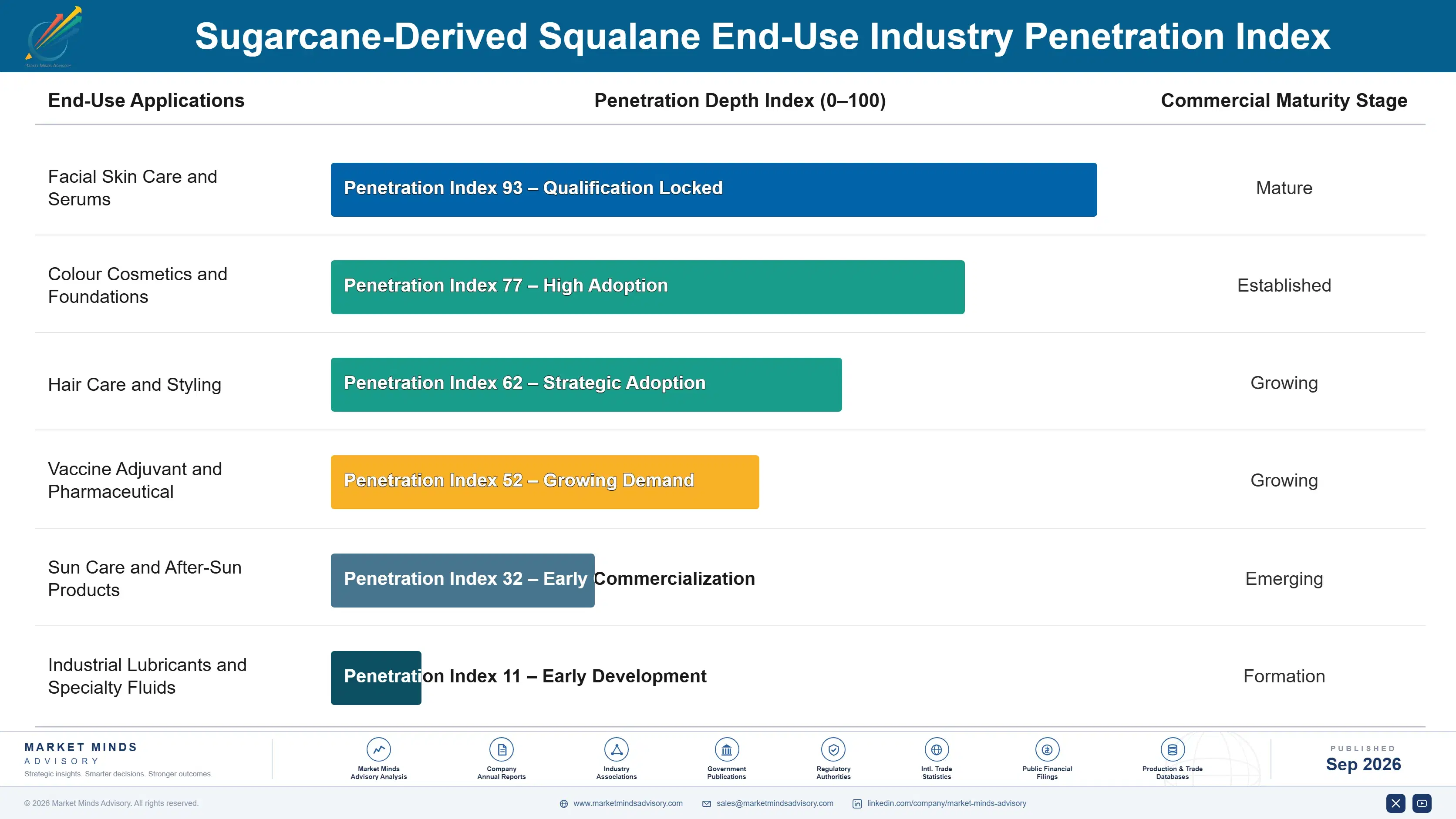
The buyer is shifting toward regulatory and formulation functions as silicone reformulation drives hemisqualane demand. That buyer is working to a compliance deadline rather than an ingredient review cycle, and reaches a decision faster and with less price sensitivity than a cosmetic purchasing team. Producers selling hemisqualane through their squalane relationships are reaching the wrong person inside the customer entirely.
sugarcane-derived-squalane-market-end-use-penetration-index-1790017957388

Where This Market Rewards

These are among the four positions where our research anticipates prominent divergence between winners and laggards over the coming forecast period. Each is grounded in the demand model, the regulatory perimeter, and the announced capacity pipeline.
01 / BATCH CONSISTENCY PUBLISHING

Origin is a claim, consistency is not

Squalane is chemically identical from shark, olive, or fermentation origin, so provenance is a claim any competitor can match simply by changing feedstock supply. Fermentation holds purity within roughly 0.4 percentage points batch to batch where olive extraction spreads several times wider, and producers publishing distributions report specification retention 2.5 times higher. Consistency is a process advantage that cannot be copied by a supply contract, and it is what a formulation chemist genuinely cares about, and publishing a distribution costs only routine analytical work to produce.
02 / SECOND SOURCE DEVELOPMENT

One platform, most of the volume

About 68% of sugarcane squalane volume comes from a single production platform, so any operational interruption reprices the entire category rather than redistributing volume between competing suppliers. Producers establishing genuine second-source capability report contract values 2.1 times higher with pharmaceutical and adjuvant buyers, who already ask the question routinely. Cosmetic buyers do not ask it yet and will begin doing so the first time an interruption teaches them to, and a supply agreement with a second producer achieves most of the protection without building a plant.
03 / HEMISQUALANE CUSTOMER TARGETING

A silicone answer, not a squalane one

Hemisqualane grows at 14.7% and roughly 31% of its volume replaces volatile silicone in formulations facing persistence and microplastic scrutiny across regulated markets. Producers positioning it as a silicone alternative rather than a squalane variant report conversion rates 3.3 times higher with reformulating brands. The buyer is meeting a compliance deadline rather than selecting an emollient, and the squalane sales conversation reaches entirely the wrong person, and reformulation teams move faster and with less price sensitivity than purchasing functions do.
04 / ADJUVANT QUALIFICATION INVESTMENT

Four per cent worth far more

Pharmaceutical and adjuvant grade accounts for roughly 4% of category volume while carrying qualification requirements that are slow, expensive, and effectively permanent once a supplier is written into a file. Producers investing in that qualification report revenue per account 4.6 times higher than cosmetic equivalents across a five-year period. Stockpiling procurement also runs on government cycles unconnected to commercial demand, which makes the volume genuinely counter-cyclical, and purification depth rather than fermentation yield decides whether a producer can reach the grade.

Engagement Snapshot From the Field

A live engagement with an industry participant carrying material or product regulatory and market exposure ahead of a defining policy shift, showing how our research translates into a defensible multi-year portfolio strategy.
MARKET MINDS ADVISORY · CLIENT ENGAGEMENT SUMMARY
Sugarcane-Derived Squalane Producer Strategic Portfolio Review and Transition Roadmap 2026·Investment Scenario on Sugarcane-Derived Squalane Exposure Evaluation 2025-26
CLIENT PROFILE
A premium skin care group with squalane ingredient spend near USD 26 million (client-reported, unverified by MMA) across forty markets. A supply interruption at its sole fermentation source had forced emergency substitution across eleven products in a single quarter, and procurement had proposed returning to olive-derived material permanently. Nobody had costed what the variability had historically caused. The exposure had never been documented.
STRATEGIC CHALLENGE
The proposed return would have reintroduced batch variability the group had switched away from years earlier, and nobody had quantified what that variability actually cost in stability testing and reformulation. The single-source exposure had also never been documented as a risk in any supply review. Procurement and formulation had never compared their figures.
MMA APPROACH
MMA measured batch purity distribution across the group's fermentation and olive-derived material, costed the stability and reformulation work variability had historically generated, mapped alternative fermentation and olive sources against qualification requirements, and modelled dual-sourcing structures against continuity and cost. Historical stability retesting was costed by ingredient so variability appeared as a sourcing number rather than a laboratory one.
KEY FINDINGS
  1. Olive-derived batches spread several times wider on purity than fermentation material, and that variability had historically generated stability retesting the group had never attributed to it.
  2. The emergency substitution had itself cost more in reformulation and retesting than three years of the price premium the fermentation material carried.
  3. A second qualified fermentation source existed and could be qualified within two quarters, which no prior supply review had identified or considered at all.
  4. Dual sourcing across two fermentation suppliers cost marginally more per kilogram and removed the exposure that had caused the entire episode. That premium was smaller than a single episode.
CLIENT PROFILE
A premium skin care group with squalane ingredient spend near USD 26 million (client-reported, unverified by MMA) across forty markets. A supply interruption at its sole fermentation source had forced emergency substitution across eleven products in a single quarter, and procurement had proposed returning to olive-derived material permanently. Nobody had costed what the variability had historically caused. The exposure had never been documented.
STRATEGIC CHALLENGE
The proposed return would have reintroduced batch variability the group had switched away from years earlier, and nobody had quantified what that variability actually cost in stability testing and reformulation. The single-source exposure had also never been documented as a risk in any supply review. Procurement and formulation had never compared their figures.
MMA APPROACH
MMA measured batch purity distribution across the group's fermentation and olive-derived material, costed the stability and reformulation work variability had historically generated, mapped alternative fermentation and olive sources against qualification requirements, and modelled dual-sourcing structures against continuity and cost. Historical stability retesting was costed by ingredient so variability appeared as a sourcing number rather than a laboratory one.
KEY FINDINGS
  1. Olive-derived batches spread several times wider on purity than fermentation material, and that variability had historically generated stability retesting the group had never attributed to it.
  2. The emergency substitution had itself cost more in reformulation and retesting than three years of the price premium the fermentation material carried.
  3. A second qualified fermentation source existed and could be qualified within two quarters, which no prior supply review had identified or considered at all.
  4. Dual sourcing across two fermentation suppliers cost marginally more per kilogram and removed the exposure that had caused the entire episode. That premium was smaller than a single episode.
RECOMMENDED STRATEGY
Phase 1: Phase one: reject the return to olive-derived material and qualify a second fermentation source across the affected product range immediately. Phase 2: Phase two: write supply continuity terms and batch purity specifications into every ingredient contract rather than assuming either one. Specify distributions rather than maximum limits. Phase 3: Phase three: cost historical stability retesting by ingredient so variability appears in sourcing decisions rather than in laboratory budgets. Report those costs to procurement each quarter.
OUTCOME
Dual fermentation sourcing was qualified within two quarters at a marginal cost increase (client-reported, unverified by MMA). No further substitution was required. Batch purity specification now appears in every ingredient contract the group issues worldwide. Stability retesting volumes fell materially over the following year as batch variability narrowed.

Frequently Asked Questions

Foundational context covering the market sizes, CAGR, scope, country, region and competition that inform every finding below. This section is provided to cover basics and most often pre-purchase conversations, answered from the MMA Primary Research Dataset.

What is the current size of the Sugarcane-Derived Squalane Market?

The market was worth USD 0.5 billion in 2025 and stands at USD 0.5 billion in 2026. Value covers sugarcane fermentation squalane and related alkanes at producer selling price.

How large will the Sugarcane-Derived Squalane Market be by 2036?

MMA forecasts USD 1.3 billion by 2036, an increase of USD 0.8 billion across the forecast period. That represents 2.60 times the 2026 base of USD 0.5 billion.

What is the CAGR for the Sugarcane-Derived Squalane Market 2026 to 2036?

The base case compound annual growth rate is 9.8%, with a bull case at 11.0% and a bear case at 8.6%. Historical growth from 2020 to 2025 ran at 8.5%.

Which segment is growing fastest?

Hemisqualane and short-chain alkanes grow at 14.7%, half again the market rate of 9.8%. Their demand comes from volatile silicone reformulation rather than from squalane itself.

Who are the major companies in the Sugarcane-Derived Squalane Market?

Amyris, Kuraray, Nikko Chemicals, Croda International and Clariant lead the field. Together they hold 61% of category revenue, with one production platform behind most sugarcane volume.

Which country is growing fastest?

South Korea grows at 13.6%, and Korean formulation moved squalane from a specialist emollient into a mainstream ingredient consumers recognise by name. Japanese producers hold the longest technical history with the molecule.

Report Segmentation Architecture

The full report scope spans multiple orthogonal segmentation dimensions, with cross-tabulated demand data provided for each dimension pair. Coverage extends further to regional breakdowns, trend trajectories, and the competitive detail needed to support segment-level decision-making.

By Product and Grade Class

  • Cosmetic Grade Squalane
  • Pharmaceutical and Adjuvant Grade Squalane
  • Hemisqualane and Short-Chain Alkanes
  • Squalane Ester Derivatives
  • High-Purity Industrial and Lubricant Grades
  • Technical Grade Squalane

By End-Use Industry

  • Facial Skin Care and Serums
  • Colour Cosmetics and Foundations
  • Hair Care and Styling
  • Vaccine Adjuvant and Pharmaceutical
  • Sun Care and After-Sun Products
  • Industrial Lubricants and Specialty Fluids

By Commercial Dimension

  • Global Brand Direct Supply
  • Contract Manufacturer and ODM Supply
  • Specialty Ingredient Distribution
  • Pharmaceutical Supply Contracts
  • Indie and Emerging Brand Supply
  • Reformulation Technical Service Contracts

By Region

  • East Asia
  • North America
  • Western Europe
  • South Asia and Pacific
  • Latin America
  • Middle East and Africa
  • Eastern Europe

Scope, Methodology, and Coverage

Every figure in this report is reproducible from documented input assumptions. The scope below maps the historical period, the forecast horizon, the segmentation dimensions, and the countries covered, alongside the underlying primary and qualitative methodology.
Historical Period
2020 to 2025
Forecast Period
2026 to 2036
Base Year
2025 (USD billions; MMA Primary Research Dataset, September 2026)
Market Definition
This market covers squalane and related alkanes produced by sugarcane fermentation, across cosmetic grade squalane, pharmaceutical and adjuvant grade squalane, hemisqualane and short-chain alkanes, squalane ester derivatives, high-purity industrial and lubricant grades, and technical grade squalane. It excludes shark liver squalene and squalane, olive-derived squalane, amaranth and rice bran squalane, synthetic petrochemical isoparaffins, and finished consumer cosmetic products.
Quantitative Units
USD billions, revenue at producer selling price
Segmentation Dimensions
Product and grade class, end-use application, commercial dimension, region
Regions Covered
East Asia, North America, Western Europe, South Asia and Pacific, Latin America, Middle East and Africa, Eastern Europe
Countries Covered
South Korea, Japan, China, Taiwan, United States, Canada, Mexico, France, Italy, Germany, United Kingdom, Spain, Netherlands, Switzerland, Poland, Czechia, India, Indonesia, Thailand, Vietnam, Australia, Brazil, Argentina, Colombia, Chile, Saudi Arabia, United Arab Emirates, Turkey, Egypt, South Africa
Key Companies Profiled
Amyris, Kuraray, Nikko Chemicals, Croda International, Clariant, Sophim, Arista Industries, Seppic, Gattefosse, Lubrizol, BASF, Evonik Industries, Ajinomoto, Kobo Products, Innospec, Vantage Specialty Chemicals, Hallstar, Elementis, Shanghai Sunwise Chemical, Zhejiang Wonderful Chemical
Quantitative Methodology
Primary survey, n=3,800 respondents, Q4 2025, six countries; demand-side model with trade association cross-validation
Qualitative Methodology
47 expert interviews, Q4 2025; applied to validate demand model assumptions, identify emerging dynamics, and assess competitive positioning
Report Format
PDF and XLSX data workbook (Word format preview document)
Publisher
Market Minds Advisory
Report Code
MMA-2026-CHM-591
Published
September 2026
Contact
sales@marketmindsadvisory.com | www.marketmindsadvisory.com

Purchase the full Sugarcane-Derived Squalane Market Report (2026 to 2036).

The full report sizes the sugarcane-derived squalane market across six product and grade classes, seven regions, and thirty countries, with forecasts to 2036 under base, bull, and bear cases. It compares batch purity distributions across fermentation, olive, and shark-derived routes, quantifies remaining shark-derived supply, and assesses single-platform concentration as a category-level exposure. Competitive analysis covers twenty participants evaluated consistently on category revenue, with detailed treatment of purification depth and adjuvant qualification position. Hemisqualane demand is traced to silicone reformulation rather than emollient selection throughout. Primary research includes 3,800 survey responses and 47 expert interviews.
Six product and grade classes sized and forecast separately
Twenty participants evaluated on category revenue consistently
Batch purity distributions compared across all sourcing routes
Remaining shark-derived squalene supply quantified by application
Single-platform supply concentration assessed as category exposure
Hemisqualane demand traced to silicone reformulation timetables

Built For The People Who Decide

From boardroom strategy to bench-side execution, this report is read cover-to-cover by leaders shaping the next decade of their industry, turning demand scenarios, market dynamics and valuation benchmarks into decisions.
CXOs/ Presidents/ VPs/ Managers
M&A and Corporate Development
Strategy Teams and R&D Heads
Procurement and Product Directors
Regulatory and Compliance Leaders
Investor Relations and Equity Analysts